

Emotional intelligence and vocational interests have received much research attention individually, but rarely in relation to each other. The purpose of the present study was to examine how trait emotional intelligence (trait EI), and vocational interests are related at the phenotypic (zero-order), genetic, and environmental levels. Trait EI is defined as a constellation of emotional self-perceptions located at the lower levels of personality hierarchies (Petrides et al., Reference Petrides, Pita and Kokkinaki2007). Vocational interests are defined as the degree of personal preference an individual has in engaging in tasks/behaviors representative or commonly occurring in various careers. In particular, this study examines the relationships between the four factors (well-being, self-control, emotionality, and sociability) and global score of the TEIQue (e.g., Petrides & Furnham, Reference Petrides and Furnham2003) in relation to the factors of the JCE (Schermer et al., Reference Schermer, MacDougall and Jackson2012).
The JCE was first published as a modified version of the Jackson Vocational Interest Survey (JVIS; Jackson, Reference Jackson1977) by Schermer and Vernon (Reference Schermer and Vernon2008). Its 34 scales correlate in meaningful directions with other vocational interest measures as well as with personality traits (Schermer, Reference Schermer2012; Schermer & MacDougall, Reference Schermer and MacDougall2011). In a sample of twins and individuals (Schermer & Vernon, Reference Schermer and Vernon2008), the JCE scales were found to fit a seven-factor solution: business (dominant leadership, finance, business, sales, supervision, human resources management, law, and professional advising); work style (job security, stamina, accountability, academic achievement, independence, planfulness, and interpersonal confidence); science (mathematics, physical science, engineering, and life science); social (social science, personal services, teaching, social service, and elementary education); artistic (creative arts, performing arts, author-journalism, and technical writing); applied (skilled trades, family activity, and office work); and biology (adventure, nature-agriculture, and medical service).
To our knowledge, this is the first study in the literature to utilize twin samples in the examination of trait EI (measured by the TEIQue) and vocational interests (measured by the JCE) using bivariate genetic model-fitting procedures. By examining the relationships between emotionality profiles and vocational interests, further information may be revealed that may assist career counselors. The aim of the present study was to assess the influence of genetics (A), common environment (C), and unique environment (E) on observed (phenotypic) covariance between trait EI and vocational interests. Vernon et al. (Reference Vernon, Petrides, Bratko and Schermer2008) demonstrated that the four TEIQue factors and global trait EI score are moderately heritable (between 0.35 and 0.50), and show dominant genetic influences (with the exception of the emotionality factor). The remaining variance was explained by E, while no C effects were found. In a separate sample, the four TEIQue factors and global trait EI were explained by A and E effects, with heritability values ranging from 0.36 for emotionality and well-being to 0.43 for global trait EI (Vernon et al., Reference Vernon, Villani, Schermer, Kirilovic, Martin, Petrides and Spector2009).
In the only twin study with the JCE, Schermer and Vernon (Reference Schermer and Vernon2008) reported that 30 of its 34 scales were best explained by an AE univariate genetic model, with the remaining four (job security, business, sales, and human resources management) explained by a CE model. For the 30 scales best fit by the AE model, heritability estimates ranged from 37% (elementary education and supervision) to 61% (social science). For the four scales best fit by the CE model, common environment effects ranged from 28% (human relations management) to 46% (business). At the factor level, six of the seven factor scales were best fit by the AE model, with heritability estimates ranging from 47% (work style) to 53% (artistic). The biology interest factor was the only factor to be best fit by the CE model, with 50% of its variance due to C (Schermer & Vernon, Reference Schermer and Vernon2008). Because both the trait EI and JCE dimensions have been found to be heritable, the genetic correlations between the two constructs were examined in the present study.
Method
Participants
Participants were 273 adult twin pairs (mean age = 40.51 years, SD = 17.50; range = 15–92), recruited primarily via newspaper advertisements from across Canada and the United States. Of these, 37 pairs were monozygotic (MZ) male twins, 170 pairs were MZ female twins, nine pairs were dizygotic (DZ) male twins, and 57 pairs were DZ female twins. There were no age differences between the four zygosity groups, F(3,265) = 1.27, p > .30. All of the complete pairs of twins who responded to the request to participate were included in the analyses. The sample size suggests that the phenotypic correlations should be stable estimates (Schönbrodt & Perugini, Reference Schönbrodt and Perugini2013).
Measures and Procedure
Twins completed the TEIQue (Petrides & Furnham, Reference Petrides and Furnham2003). The TEIQue consists of 153 items predicated on trait EI theory and covering the sampling domain of trait EI comprehensively. Participants respond on a 7-point Likert scale, ranging from completely disagree to completely agree. The TEIQue yields scores on 15 facets, 4 factors, and global trait EI. An independent psychometric analysis of the inventory is presented in Mikolajczak et al. (Reference Mikolajczak, Luminet, Leroy and Roy2007).
Participants also completed the JCE (Schermer et al., Reference Schermer, MacDougall and Jackson2012), which is a modified version of the JVIS (Jackson, Reference Jackson1977). In creating the JCE, two modifications to the original JVIS were undertaken. First, the number of items was reduced to 170 (from 289 pairs) and the ipsative response (forced choice) format was changed to a 5-point Likert scale. The scale measures 34 vocational interests, each with 5 items. The average alpha for the scales is 0.76 (Schermer, Reference Schermer2012; Schermer & MacDougall, Reference Schermer and MacDougall2011; Schermer & Vernon, Reference Schermer and Vernon2008). As reported above, Schermer and Vernon (Reference Schermer and Vernon2008) found that the 34 JCE scales fitted a seven factor model. Factor scale scores were calculated using the weighted linear regression approach with rotated factor loadings as weights.
Analyses
In bivariate behavioral genetic model-fitting, standardized MZ and DZ cross-correlations are computed to estimate the extent to which one twin's score on one variable correlates with his or her co-twin's score on another variable. If the cross-correlation is higher in MZ twins, compared to DZ twins, the higher cross-correlation is suggested to be due to a common genetic factor. In actual model-fitting, what is referred to as a ‘full model’ provides estimates of the extent to which common genetic (A), shared environmental (C), and non-shared environmental (E) factors contribute to correlations between variables. As is the case in univariate model-fitting, reduced models can also be fit to see whether any of the A, C, or E factors can be dropped to improve the fit. Thus, an AE model tests whether C factors can be dropped and a CE model tests whether a purely environmental model can account for the data.
In our analyses, we first fit full ACE models to the data and then tested reduced models. The final models were then used to compute genetic and environmental correlations between the two variables, which estimate the extent to which their phenotypic (observed) correlations are attributable to the fact that the same genes and/or the same environmental factors contribute to both. All analyses were performed with the software package Mx (Neale et al., Reference Neale, Boker, Xie and Maes1999).
Results and Discussion
Table 1 provides the phenotypic (rp), genetic (rg), and environmental (common = rc and unique = re) correlations of the four TEIQue factors and global trait EI with the seven vocational interest factors. All correlations across all models were found to be best fit by an AE (genetic and non-shared environmental) model.
Phenotypic (rp), Genetic (rg), and Environmental (rc and re) Correlations Between Vocational Interests, the Four TEIQue Factors, and Global Trait EI
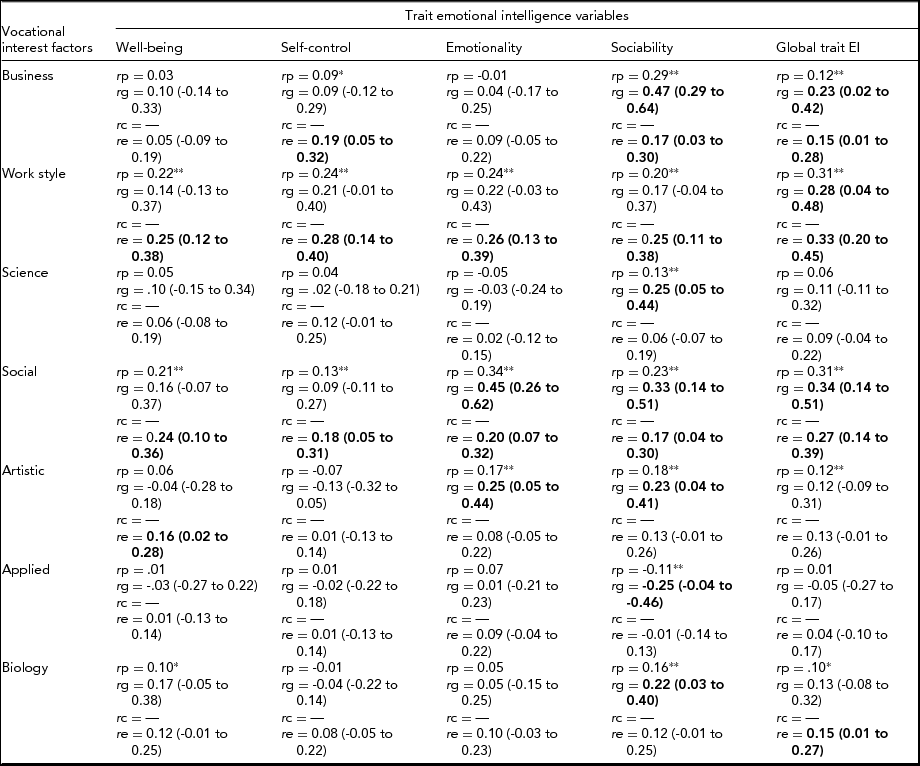
*p < .05; ** p < .01, two-tailed. Values in bold are considered to be significant in that the 95% CI values (in brackets) exclude zero.
The business interest factor correlated positively and significantly with the following TEIQue variables: self-control, sociability, and global trait EI. The unique environmental correlation with self-control was also significant, and both the genetic and unique environmental correlations with sociability and global trait EI were significant. These correlations may reflect the social interaction dimension of the Business interest factor, with respect to sales, human relations, and dominant leadership.
The work style factor represents work environment preferences (such as job security, independence, and planfulness). Work style had significant positive phenotypic correlations and significant unique environmental correlations with all four of the TEIQue factors, as well as with global trait EI. A significant genetic correlation was also found with global trait EI.
The science interest factor had significant positive phenotypic and genetic correlations with the sociability factor of the TEIQue. It is important to note that key aspects of the sociability factor, such as assertiveness and social awareness, correlate positively with career satisfaction specifically in scientists (Lounsbury et al., Reference Lounsbury, Foster, Patel, Carmody, Gibson and Stairs2012)
The Social interest factor captures interests in teaching and providing services to others. This factor correlated positively and significantly with all of the TEIQue factors as well as with global trait EI at the phenotypic and unique environmental levels. In addition, the Social interest factor showed significant genetic correlations with emotionality, sociability, and global trait EI.
The artistic interest factor includes creative arts, performing, and writing. This factor correlated significantly and positively at the phenotypic level with the emotionality, sociability, and global trait EI. Only the correlations with emotionality and sociability had significant genetic components, while none of the unique environmental correlations were significant. A significant unique environmental correlation was found between the artistic interest factor and well-being, although the phenotypic correlation was small. This finding should be replicated in an independent sample.
The applied factor is a blue-collar, office work, and family activity interest dimension. Significant negative phenotypic and genetic correlations were found with the sociability factor, suggesting that individuals with high scores on assertiveness (low TEIQue sociability scores) are less interested in collaborative blue-collar work or family activities.
The biology interest factor was the only one to be best fit by a CE model at the univariate level (Schermer & Vernon, Reference Schermer and Vernon2008). This factor includes nature-agriculture and medical service and showed positive phenotypic correlations with well-being, sociability, and global trait EI. A significant genetic correlation was also found with the sociability factor. It should be noted that although the biology factor was best fit by a CE model, this does not suggest that there is no genetic component to it, but rather that the genetic component was not significantly adding to the fit of the model. The biology interest factor also had a significant unique environmental correlation with global trait EI.
Conclusion
This is the first paper investigating the genetic links between the affective aspects of personality, comprehensively encompassed by trait EI, and vocational interests. The results not only confirm that individual differences in trait EI partly underlie vocational interests, as might be expected in the light of relevant research from the fields of career preferences and subject choice at university (e.g., Di Fabio & Saklofske, Reference Di Fabio and Saklofske2014; Sánchez-Ruiz et al., Reference Sánchez-Ruiz, Perez-Gonzalez and Petrides2010), but also that their interrelationships have a partial genetic basis. The joint relationships between trait EI and vocational interests may be of use for career counsellors advising clients on best vocations to pursue.
At the same time, there are important non-shared environmental effects, suggesting the operation of uniquely experienced environmental influences on the relationship between certain aspects of trait EI and vocational interests. For example, peer groups and peer group status (e.g., Ellis & Zarbatany, Reference Ellis and Zarbatany2007) may well be one of the key non-shared factors differentially affecting children in the same family and giving rise to the non-shared environment part of the correlation between trait EI and social vocational interests.
Because of the relatively small sample size, the present study limited the analyses to the factor level. Further details will emerge from analyses conducted at the facet level of the TEIQue, which will provide a more precise localization of the origins of the links between trait EI and vocational interests. More importantly, the possibility is now open for an exploratory investigation to identify the clusters of genes and environmental experiences influencing the nature and extent of these links.



