


1. Introduction
Artificial Intelligence (AI) is becoming more and more used in the design sector, including UX/UI design (Reference Xu, Liu, Xu and TanXu et al., 2024), graphics design (Reference ÖzdalÖzdal, 2024), product design (Reference Nozaki, Konno, Sato, Sakairi, Shibuya, Kanazawa and GeorgescuNozaki et al., 2017), and architectural design (Reference Paananen, Oppenlaender and VisuriPaananen et al., 2023). Recently, AI integration into the design process has seen noticeable attention for all central stages of the process, from problem identification (Reference Han and MoghaddamHan & Moghaddam, 2021) to final detail design, prototyping (Reference Bilgram and LaarmannBilgram & Laarmann, 2023), and manufacturing (Reference Arinez, Chang, Gao, Xu and ZhangArinez et al., 2020).
Generative design (GD), a computational approach, generates multiple design variations based on constraints, aiding functional, creative ideation, and conceptual design in early-stage design (Reference Lopez, Miller and TuckerLopez et al., 2018; Reference Barbieri and MuzzupappaBarbieri & Muzzupappa, 2024). Additionally, GD generates design variations within set parameters, supporting designers in initial inspiration while leaving decision-making and refinement to them (Reference Saadi and YangSaadi & Yang, 2023). GD tools have transformed traditional design processes, enabling the creation of innovative products with attributes such as high strength, lightweight structures, and reduced component numbers. For example, fusion 360’s GD reduced seat bracket weight by 40% and increased strength by 20% using topology optimization and genetic algorithms (Reference Briard, Segonds and ZamariolaBriard et al., 2020). While GD focuses on computational optimization based on predefined parameters, generative AI (GAI) generates creative outputs such as images and text using machine learning models (Reference Cai, Rick, Heyman, Zhang, Filipowicz, Hong, Klenk and MaloneCai et al., 2023). AI’s influence is most evident in early-stage ideation, conceptualization, and decision-making, where it aids in inspiration, iteration, and design refinement (Reference Chandrasekera, Hosseini and PereraChandrasekera et al., 2024; Reference Mao, Rafner, Wang and ShersonMao et al., 2023).
Despite the advantages of AI in idea generation and design decision-making, its utilisation in early-stage design remains underexplored (Reference Barbieri and MuzzupappaBarbieri & Muzzupappa, 2024). Additionally, it is still not clear how AI tools are effectively used by designers in the design process for better design outcomes. Considering decision-making, designers’ confidence in AI tools varies across design stages, with poor AI performance lowering trust in AI and AI accuracy changes reducing self-confidence (Reference Chong, Raina, Goucher-Lambert, Kotovsky and CaganChong et al., 2023). Consequently, AI augmentation significantly enhanced the design process by increasing information processing, decision-making, and cognitive iteration activities, leading to deeper and broader design solutions (Reference Zhou, Zhang and YuZhou et al., 2023). This adoption helps designers in the early stages of ideation by generating multiple variants much faster than previously possible. However, AI’s limitations require designers to critically assess outputs, ensuring alignment with functional and creative requirements.
This study examines utilisation of AI in the design process by reviewing literature on GAI and GD, analysing their scope and limitations. It explores the applications and recent advancements of GAI across various design disciplines, including fashion and graphics design. Additionally, it compares AI techniques and applications across disciplines in current design practices. The research questions of the current review are as follows:
1. What are the most prominent uses of GAI during the design process across various disciplines?
2. What are the differences and commonalities in the use of GAI for different tasks in the design process between the disciplines?
A systematic selection process was followed, sourcing papers from Google Scholar using targeted search queries (e.g., “generative AI in product design”). The review summarizes key trends, limitations, and future research directions in GD and GAI applications in design. Section 2 provides background information on GD, GAI, and their advancements. Section 3 presents the literature review, covering paper selection, GAI trends, and key AI tools. It also examines AI types and tasks across design disciplines. Section 4 includes a comparative analysis and discussion, focusing on AI tools and tasks, and Section 5 concludes the study, highlighting key findings and future research directions.
2. Background
AI is increasingly integrated into various design tasks, including ideation through inspiring stimuli, content generation using GANs for text-to-image synthesis, and AI-based evaluation of aesthetic and functional aspects of designs focusing on computational aesthetics (Reference Tang, Huang, Yao, Wei, Li, He and LiTang et al., 2019; Reference Deng, Loy and TangDeng et al., 2018). It enhances scalability, design scope, and real-time adaptability, driving innovation in human-centered design workflows, such as the Netflix application (Reference Verganti, Vendraminelli and IansitiVerganti et al., 2020). GD is transforming the design process, shifting from traditional approaches to AI-assisted workflows. Additionally, GD combined with machine learning has enhanced efficiency by enabling rapid generation and evaluation of design solutions (Reference Gradišar, Dolenc and KlincGradišar et al., 2024).
In early-stage design, AI supports ideation and concept generation through tools like ChatGPT for textual brainstorming and Midjourney for visual inspiration (Reference Takaffoli, Li and MäkeläTakaffoli et al., 2024; Reference Zhang and LiuZhang & Liu, 2024). In mid-stage design, AI enhances prototyping and iteration, with tools like Fusion 360 optimising design structures through GD (Reference Buonamici, Carfagni, Furferi, Volpe and GoverniBuonamici et al., 2020). In late-stage design, AI facilitates manufacturing and performance analysis, streamlining production workflows (Reference Liu, Tian and KanLiu et al., 2022). However, despite these advancements, existing studies primarily explore AI’s role within individual disciplines, lacking an inter-disciplinary perspective on its applications. This study aims to bridge this gap by systematically analysing AI adoption across multiple design fields.
GAI tools influence a range of design applications, including artworks (Reference MesserMesser, 2024), product design for creativity and education (Reference Barbieri and MuzzupappaBarbieri & Muzzupappa, 2024; Camba & Barlett, 2024), graphics design ideation (Reference Choi, Hong, Park, Chung and KimChoi et al., 2024), conceptual floorplans and 3D models in architecture (P. Reference Li, Cao, Lin, Hou, Zhu and El AliLi et al., 2024), fashion ideation and revision (Reference Jin, Yoon, Self and LeeJin et al., 2024). Tools like Midjourney have been widely adopted for conceptual inspiration, but concerns remain regarding limited output depth, response accuracy, and refinement capabilities (Reference Lai, Chen and YangLai et al., 2023). GAI primarily serves as an inspirational tool as it relies on training data, which can limit its ability to create truly novel or unconventional designs (Reference Ali Elfa and DawoodAli Elfa & Dawood, 2023). Additionally, the rapid evolution of AI tools requires designers to continuously adapt, impacting workflow efficiency (Reference Reynolds and BatleyReynolds & Batley, 2024). While AI can facilitate visual ideation, its ability to foster design originality is often hindered by fixation and other creativity inhibitors (Reference Wadinambiarachchi, Kelly, Pareek, Zhou and VellosoWadinambiarachchi et al., 2024). Ethical concerns, including bias, copyright protection challenges, plagiarism risks, and originality issues, further complicate the adoption of GAI in design workflows (Reference Bartlett and CambaBartlett & D. Camba, 2024).
Most reviews focus on individual design applications using classical AI (genetic algorithms, fuzzy logic, neural networks) or advanced machine learning in engineering product design (Reference Yüksel, Börklü, Sezer and CanyurtYüksel et al., 2023). Additionally, the review of advancements and applications of GAI is discussed in the context of the architectural design process (C. Reference Li, Cao, Lin, Hou, Zhu and El AliLi et al., 2024), but it lacks the comprehensive use case of GAI in other related fields, such as product design. Furthermore, a systematic review of AI in UX design found that AI integration into the design process has received limited exploration (Reference Stige, Zamani, Mikalef and ZhuStige et al., 2023). This study aims to address this research gap by conducting a review of AI applications across multiple design stages and disciplines, focusing on product design, furniture design, artwork and creativity, fashion design, architectural design, graphics design, and UX design. Additionally, this review will analyse commonalities and differences in AI methods, tools, and tasks across these disciplines to provide a broader understanding of AI’s role in design.
3. Literature review
3.1. Methods of paper selection
The paper search was conducted using Google Scholar with keywords such as ‘AI in the design process’, ‘AI and generative design’, ‘Application of generative design’, ‘Review of generative design’, ‘Generative AI in the design process’, ‘Generative AI in product design’, ‘Generative AI in graphic design’, ‘Generative AI in architectural design’, ‘Generative AI in artworks and creativity’, ‘Generative AI in UX design’, ‘Generative AI in the review of generative design’, and ‘Review of generative AI’. Titles, abstracts, and conclusions were screened to identify studies using GAI tools for design tasks. Relevant papers were selected if their context aligned with AI and design process, with further screening of discussion sections for confirmation. Only papers published after 2015 were included, as AI applications in design have grown significantly since then, particularly in conceptual design challenges in architecture (Reference Castro Pena, Carballal, Rodríguez-Fernández, Santos and RomeroCastro Pena et al., 2021; Reference Stige, Zamani, Mikalef and ZhuStige et al., 2023). Earlier AI research focused on rule-based systems, genetic algorithms, and traditional machine learning, which are less relevant to modern GAI applications (Reference Russell and NorvigRussell & Norvig, 2016). Papers unrelated to design disciplines, such as those in healthcare, finance, and mining, were excluded. Google Scholar was chosen for its broad coverage of rapidly evolving AI research, including conference papers and preprints, which is considered essential for a search of this fast-evolving research landscape at the moment. Finally, we selected 78 papers for this review.
3.1.1. Study classifications and data extraction
To classify the selected papers, the following information were brought into consideration including AI methods involved, the tools used, the task executed in the study, and the type of AI involved. Additionally, the scope and limitations of each study were thoroughly screened for deeper understanding and noted down.
3.1.2. Analysis process
Most selected studies were published in 2022, 2023, and 2024. These studies primarily examined the use of AI tools applied to various aspects of the design process, for example, idea generation. A thematic analysis (Reference Miles, Huberman and SaldañaMiles et al., 2014) will identify key GAI use cases across disciplines. It will also compare tasks, tools, and AI types used in different design disciplines.
3.2. Current trends of generative AI across the disciplines
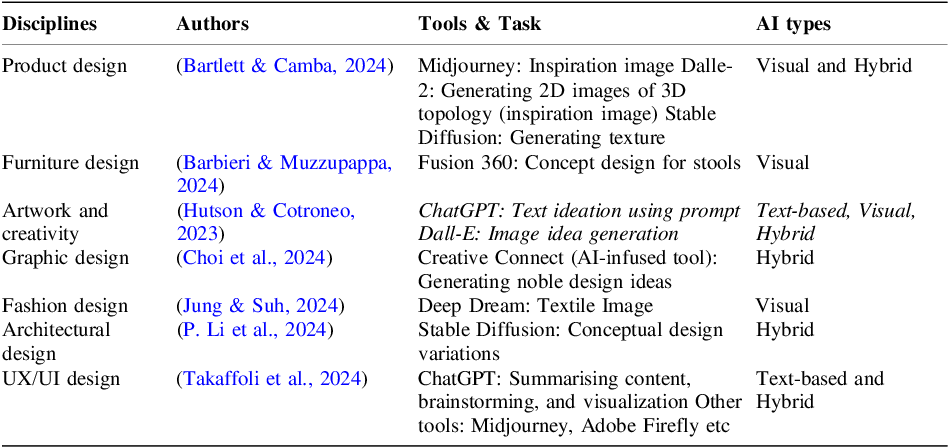
AI adoption is transforming design by enabling workflows, improving problem-solving, and enhancing decision-making (Reference Huang and FuHuang & Fu, 2019; Reference Zhang, Wang, Pangaro, Martelaro and ByrneZhang et al., 2023). GD automates iteration and optimizes structures, assisting designers. Advances in computing power have integrated GD into CAD systems, enabling designers to create lightweight, efficient, and optimized designs (Reference Buonamici, Carfagni, Furferi, Volpe and GoverniBuonamici et al., 2020). GAI accelerates ideation and visualization, though challenges remain in interpretability and creative control (Reference Riemer and PeterRiemer & Peter, 2024). Table 1 presents AI adoption across seven design disciplines.
Few examples of tools, tasks and AI-types across seven disciplines

3.2.1. Product design
In product design, ChatGPT (a popular GAI tool) assists in brainstorming, idea generation, and keyword identification (Reference FangFang, 2023). Additionally, DALL-E, integrating with ChatGPT, significantly supports generating 2D images of 3D topologies for visual inspiration, and Midjourney produces innovative and inspirational concepts by processing text and hybrid prompts (Reference Bartlett and CambaBartlett & Camba, 2024; Reference FangFang, 2023). Stable Diffusion with ControlNet refines sketches, producing high-quality outputs like car front-end designs (Reference FangFang, 2023).
3.2.2. Furniture design
In furniture design, GD fosters creativity and design efficiency using AI tools. Fusion 360 supports tasks such as defining the design spaces, materials, structural constraints, and mass reduction for stool design (Reference Barbieri and MuzzupappaBarbieri & Muzzupappa, 2024). Midjourney produces customisable furniture images with simulated materials and textures (Reference ZahraZahra, 2023). Moreover, GD can facilitate alternative solutions and improved performance utilising 3D models (Reference Uludüz and AydınUludüz & Aydın, 2022).
3.2.3. Artwork and creativity
AI can improve designers’ creativity and reduce cognitive constraints during the creative process (Reference Ali Elfa and DawoodAli Elfa & Dawood, 2023). GAI tools, such as ChatGPT and Dall-E, are widely used for idea generation, visual illustration, and artwork (Reference Hutson and CotroneoHutson & Cotroneo, 2023). ‘DesignAID’, which is powered by Stable Diffusion, enables rapid visual ideation through prompt refinement and iterations (Reference Cai, Rick, Heyman, Zhang, Filipowicz, Hong, Klenk and MaloneCai et al., 2023). However, designers must be aware of design fixation due to process brief and examples to ensure high-quality outcome. Likewise, the AI tool ‘DeepThink’ can support producing digital art with increased creativity and expressivity through the human-AI co-creative process (Reference Du, An, Leung, Li, Chapman and ZhaoDu et al., 2024).
3.2.4. Graphic design
In graphic design, AI is significantly impacting design activities by enhancing workflow, creativity, and output (Reference MustafaMustafa, 2023). It aids designers in colour selection, layout, composition, and typography using machine learning (Reference MustafaMustafa, 2023). Additionally, Creative Connect generates keywords and ideas to compare with baseline (Reference Choi, Hong, Park, Chung and KimChoi et al., 2024). Finally, educators encourage students in critical understanding of GAI for their professional careers (Reference FleischmannFleischmann, 2024).
3.2.5. Fashion design
In fashion design, generative adversarial networks (GANs) generate knitted textile designs, which were evaluated through surveys (Reference Wu and LiWu & Li, 2024), and support in producing renderings and textures for clothing (Reference Yan, Zhang, Liu, Zhou, Xu, Zhang and YanYan et al., 2022). Additionally, Stable Diffusion and CrossGAI further enhance fashion sketches and renderings (Reference JinJin, 2024; Reference Deng, Jiang, Yu, Ouyang and WuDeng et al., 2024). AI tools such as Deep Dream (image creation), WowPattern (pattern transformation), Zepeto (avatar creation), and 3D CLO (digital fashion prototyping) streamline the design process and learning experiences (Reference Jung and SuhJung & Suh, 2024).
3.2.6. Architectural design
In architectural design, AI tools like Midjourney, Stable Diffusion, and DALL-E generate early-stage concept designs and inspirational images, often using a hybrid approach (Reference Paananen, Oppenlaender and VisuriPaananen et al., 2024; P. Reference Li, Cao, Lin, Hou, Zhu and El AliLi et al., 2024; Reference BaudouxBaudoux, 2024). Additionally, ControlNet refines design generation based on sketches, while ChatGPT extracts textual design intent from web sources (Reference Shi, Seo, Cha, Xiao and ChiShi et al., 2024). The Web crawlers assist in data collection, and the Lora algorithm fine-tunes Stable Diffusion (SD) models for architectural applications. In structural design, AI enhances data representation, intelligent generation algorithms, design evaluation, and optimization techniques (Reference Liao, Lu, Fei, Gu and HuangLiao et al., 2024).
3.2.7. UX/UI design
In UX/UI design, most studies relied on online surveys and designer interviews to assess AI adoption. The use of text-based AI through ChatGPT supported draft writing, question reframing, content summarization, and data analysis (Reference Takaffoli, Li and MäkeläTakaffoli et al., 2024). Visual AI tools like Midjourney facilitated image generation for brainstorming, image variations, and UI aesthetics (Reference Takaffoli, Li and MäkeläTakaffoli et al., 2024; Reference Casteleiro-PitrezCasteleiro-Pitrez, 2024; J. Reference Li, Cao, Lin, Hou, Zhu and El AliLi et al., 2024). Additionally, Adobe Firefly assisted in icon creation, text-to-image generation, and generative fill, while Figma plugins integrated with ChatGPT enabled real-time collaboration in ideation (Reference Takaffoli, Li and MäkeläTakaffoli et al., 2024; Reference Casteleiro-PitrezCasteleiro-Pitrez, 2024; Reference Peña LópezPeña López, 2023).
3.3. Differences in generative AI use between disciplines
GAI influences various stages of the design process, including ideation, visualization, iteration, and decision-making. Understanding AI adoption in each discipline provides a foundation for inter-disciplinary comparison. While commonalities exist, applications vary by field; for example, product and furniture design focus on structural optimization and parametric modelling, whereas UX/UI and fashion design emphasize creative ideation and refinement.
3.3.1. Task and tools
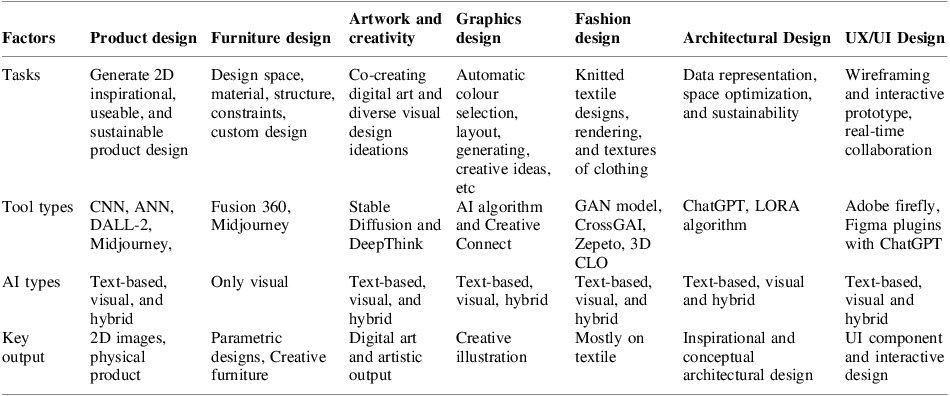
Table 2 highlights AI applications across disciplines. Product design uses DALL-E 2 for 2D concept generation with 3D topology, while furniture design relies on Fusion 360 and Midjourney for ergonomic and customisable solutions. In creative fields, DeepThink supports human-AI collaboration in artwork, while AI enhances texture creation, color selection, and layout composition in fashion and graphic design. Architectural design focuses on optimization, intelligent generation, and sustainability, using Stable Diffusion and ControlNet for spatial planning and façade design. UX/UI design applies AI in user research and ideation, enhancing interface design with tools like Adobe Firefly and Figma integrated with ChatGPT. While AI adoption in fashion and UX/UI design is well-documented, its role in furniture and architectural design is still evolving, particularly in parametric modeling, material exploration, and ergonomic optimisation.
3.3.1. AI types and use case output
The use of text-based AI is utilised in almost all disciplines except for furniture design. Hybrid types of AI, which integrate text-based capabilities with visual capabilities, for example, the integration of ChatGPT with DALL-E or Stable Diffusion with advanced control, are used in all disciplines except for furniture design and graphic design. The key factors have been demonstrated in Table 2 to highlight tasks, tools, AI type, and outputs across the disciplines.
Differences in tasks, tools, AI types, and key output

3.4. Commonalities in generative AI use in between and across disciplines
1. Improving designers’ creativity: AI tools such as Stable Diffusion, used for increasing creativity in disciplines including Artwork and Creativity, Graphics design, and Fashion design.
2. Idea generations for concept and inspirations: ChatGPT aids text-based brainstorming, while Midjourney, Stable Diffusion, and DALL-E generate visual inspiration across product, furniture, artwork, architectural, and UX/UI design.
3. Hybrid use of GAI (combination of text and visual context): Combining text-based AI (ChatGPT) with visual AI (DALL-E, Figma) enhances concept generation and illustration.
4. Iteration and customisation: AI facilitates design refinements, including sketch improvements (product & fashion design) and customisable products (furniture design).
5. Decision-making: AI enhances decision-making by introducing efficiency (graphics, artwork), flexibility (product, furniture, graphics design), data-driven insights (architecture), and collaboration (UX design).
6. Effective timing: AI tools save time by automating repetitive tasks, such as generating alternative designs, ideas, and renderings in furniture, graphics, and fashion design.
4. Discussion
The review focuses utilisation of AI across disciplines, from product to UX/UI design, revealing key insights from Table 2 and Section 3.4. Findings show ChatGPT is widely used for concept generation, inspiration, and illustration, often combined with DALL-E or Figma. Its popularity derives from its versatile text prompts, making brainstorming, editing, and keyword generation convenient (Reference Takaffoli, Li and MäkeläTakaffoli et al., 2024). Additionally, ChatGPT’s ability to summarize content, extract information, and analyse data enhances its integration into product, architectural, and UX/UI design workflows (Reference Takaffoli, Li and MäkeläTakaffoli et al., 2024; Reference Shi, Seo, Cha, Xiao and ChiShi et al., 2024; Reference FangFang, 2023). Similarly, Midjourney and Stable Diffusion are commonly used for visual ideation and inspiration (Reference Bartlett and CambaBartlett & Camba, 2024; P. Reference Li, Cao, Lin, Hou, Zhu and El AliLi et al., 2024). Hybrid AI models, like ChatGPT + DALL-E for text-to-image synthesis and Stable Diffusion + ControlNet for structured design, enhance AI-assisted decision-making.
AI supports decision-making by providing inspiration, enhancing sketches, and adjusting parameters to meet design goals (C. Reference Zhang, Wang, Pangaro, Martelaro and ByrneZhang et al., 2023). However, designers’ confidence in AI declines with poor performance, while fluctuating accuracy and misinterpreted feedback affect their trust in AI suggestions (Reference Ramesh, Anandhi, Singla, Chandra, Sethi and AboodRamesh et al., 2024). Additionally, AI-driven iteration enhances creative exploration but requires human intervention to filter meaningful outcomes (Reference Hutson and CotroneoHutson & Cotroneo, 2023; Reference Kwon, Ryan, Bazylak and ShuKwon et al., 2020). Meanwhile, AI-supported decision-making can optimise design choices based on constraints but risks reducing the designer’s intuitive judgment (Reference Chong, Raina, Goucher-Lambert, Kotovsky and CaganChong et al., 2023; Reference Zhou, Zhang and YuZhou et al., 2023).
AI adoption across disciplines shares commonalities in AI type, customisation, efficiency, decision-making, and human-AI collaboration. Most fields use text-based, visual, and hybrid AI. Product and fashion design focus on structural and functional tasks, with AI assisting in material simulation, texture generation, and sketch refinement. UX/UI design utilizes AI for wireframing, prototyping, and collaborative ideation (Reference Casteleiro-PitrezCasteleiro-Pitrez, 2024). AI improves efficiency and flexibility, helping designers make faster, more informed decisions. Artwork, graphics, and fashion design use AI for co-creation and automatic colour selection (Table 1).
Despite these commonalities, significant differences exist across disciplines. Architecture focuses on early-stage concept generation and structural optimization, while UX/UI design emphasizes research synthesis and real-time collaboration (Reference Paananen, Oppenlaender and VisuriPaananen et al., 2024; Reference Takaffoli, Li and MäkeläTakaffoli et al., 2024). Fashion design adopts AI for exploratory and aesthetic-driven processes, as seen with Deep Dream and WowPattern, unlike furniture and architectural design, which apply AI for structural tasks (Reference Jung and SuhJung & Suh, 2024; Reference Barbieri and MuzzupappaBarbieri & Muzzupappa, 2024; Reference Liao, Lu, Fei, Gu and HuangLiao et al., 2024). Graphics design prioritizes creativity, differing from product and architectural design, which are more structured (Reference Choi, Hong, Park, Chung and KimChoi et al., 2024; Reference Bartlett and CambaBartlett & Camba, 2024). However, this review emphasises AI’s key applications, commonalities, and differences across seven disciplines, aligning with the research aim and questions.
4.1.1. Limitation
This review has several limitations. First, the study is anecdotal, focusing on the prominent use of GAI, along with key anomalies and commonalities across design disciplines. Second, game design and interior design were excluded due to limited relevant literature, while the seven selected disciplines were chosen for their active adoption with AI in academia and industry. Third, the review primarily includes papers published after 2015, with most sources from 2022 onward, which may not fully represent earlier foundational research. Additionally, the study relied on Google Scholar for literature selection, screening papers based on titles, abstracts, and contextual relevance. Expanding the search to databases such as Scopus and Web of Science using systematic queries could yield a broader and more diverse dataset. Finally, the study did not provide any specific AI-design frameworks, which can be considerations for future AI-assisted design studies across design disciplines.
4.1.2. Future research direction
The limitations of this review open new directions for future research. Firstly, a systematic review of AI utilization across more design disciplines is needed, incorporating papers from other powerful databases (e.g., SCOPUS). Secondly, empirical studies with professional designers can provide deeper insights into AI’s role in ideation and decision-making while also revealing the purpose of AI tools and the need for updated versions tailored to design-specific tasks. Thirdly, research on AI adoption in inter-disciplinary contexts could reveal new effective frameworks for AI-assisted design decision-making. Finally, the privacy implications of GAI in design should be explored, particularly concerning data security, user consent, and ethical concerns. Additionally, comparative studies across design disciplines can clarify AI’s impact, identifying discipline-specific benefits and challenges.
5. Conclusion
The review explored the latest trends and diverse applications of GAI across seven design disciplines, focusing on its role in enhancing creativity, efficiency, and decision-making. GAI tools like ChatGPT are widely used for conceptual ideation, information retrieval, and content summarization, while their integration with DALL-E, Figma, Stable Diffusion, and Midjourney has proven effective for visual generation, optimization, iteration, and refinement. These tools facilitate creativity, streamline iterative customisation, and support decision-making while reducing time in the design process and improving design efficiency. While these tools are widely adopted, their adoption into the various stages of the design process is still evolving, and their long-term impact still needs further exploration. Rather than offering a structured framework for AI’s role in design, this review presented an overview of its emerging applications as revealed in recent literature. Despite these commonalities, differences exist in AI adoption across disciplines. UX/UI design prioritises user research and collaborative ideation, whereas architectural design focuses on structural optimisation. Similarly, fashion and graphic design utilise AI for aesthetics, such as pattern creation and sketching, while product and architectural design take a more structured approach. Recently, the growing adoption of AI is reshaping the design process, requiring designers to adapt to AI-driven iteration cycles, updated versions of AI tools, real-time optimization, and new forms of human-AI collaboration. As AI automates routine tasks, future designers must develop advanced AI literacy, including prompt engineering and critical evaluation of AI-generated design output. However, the extent to which AI contributes beyond automation and efficiency gains requires further exploration. This review focused on seven design disciplines, excluding areas such as interior and game design. Future research should expand to a broader range of fields to provide a more comprehensive understanding of AI adoption in design. Additionally, reliance on specific databases and recent publications may limit the completeness of findings. To address these gaps, empirical studies involving designers from diverse design disciplines are necessary to extract deeper insights into AI utilisation and its emerging trends in the design process.

 Open access

