

Introduction
Magnetite is extremely widespread as an ore or alteration mineral in many mineral deposit types, from magmatic to hydrothermal systems, and in metamorphosed deposits. As such the chemical signatures of magnetite in terms of both stable isotope and trace element composition have been extensively investigated as tracers of deposit type and mineral system fertility (e.g. Beaudoin and Dupuis, Reference Beaudoin, Dupuis, Corriveau and Mumin2009; Nadoll et al., Reference Nadoll, Angerer, Mauk, French and Walshe2014). A focus of this work has been to produce discrimination diagrams in terms of trace element composition, to distinguish magmatic versus hydrothermal magnetite (e.g. Dare et al., Reference Dare, Barnes, Beaudoin, Meric, Boutroy and Potvin-Doucet2014; Velasco et al., Reference Velasco, Tornos and Hanchar2016), as well as to distinguish deposits of different genetic type. However, it is not unusual for magnetite composition from a single source to span multiple previously defined fields, or to plot in a genetic model defined field which contradicts other sources of evidence (e.g. Broughm et al., Reference Broughm, Hanchar, Tornos, Westhues and Attersley2017). There is a clear need for the use of mineral trace element data in genetic models and deposit type discrimination to move beyond uncritical application of discrimination diagrams and to focus on process-based interpretations of trace element distribution patterns. Experimental and empirical criteria have been a focus of recent work which now allow these interpretations to be made (e.g. Canil and Lacourse, Reference Canil and Lacourse2020).
Trace element discrimination diagrams have been applied widely in attempts to constrain the origin of iron oxide-apatite (IOA or ‘Kiruna type’) deposits, and the potentially related iron oxide-copper-gold (IOCG) deposits (e.g. Knipping et al., Reference Knipping, Bilenker, Simon, Reich, Barra, Deditius, Lundstrom, Bindeman and Munizaga2015a, Reference Knipping, Bilenker, Simon, Reich, Barra, Deditius, Wӓlle, Heinrich, Holtz and Munizaga2015b; Simon et al., Reference Simon, Knipping, Reich, Barra, Deditius, Bilenker and Childress2018; Palma et al., Reference Palma, Barra, Reich, Simon and Romero2020; Rodriguez-Mustafa et al., Reference Rodriguez-Mustafa, Simon, del Real, Thompson, Bilenker, Barra and Bindeman2020). The IOA deposits are distributed globally (Fig. 1a), represent major Fe resources (Fig. 1b), and are typically massive magnetite and/or hematite associated with accessory apatite, and a range of other minerals including actinolite and titanite, and associated with sodic and potassic alteration of the surrounding rock (Hitzman et al., Reference Hitzman, Oreskes and Einaudi1992; Hitzman, Reference Hitzman and Porter2000; Williams et al., Reference Williams, Barton, Johnson, Fontbote, de Haller, Mark, Oliver and Marschik2005). Iron oxide-copper-gold deposits consist of copper sulfide mineralisation with an iron oxide dominant (low pyrite) gangue, and a trace element association of F, P, Co, Ni, As, Mo, Ag, Ba, LREE and U (Hitzman, Reference Hitzman and Porter2000; Williams et al., Reference Williams, Barton, Johnson, Fontbote, de Haller, Mark, Oliver and Marschik2005). Both deposit types typically cross-cut host rock structures with evidence for brecciation of surrounding lithologies and spatial relationships to major crustal structures. In the IOCG deposits sulfide mineralisation typically post-dates the main iron oxide depositing stage, and the early stages of mineralisation have close parallels to the IOA deposits (Barton, Reference Barton2014). The IOCG deposits are widely accepted to form by hydrothermal circulation of high concentration brines, with different districts showing evidence for a range of brine sources in multiple stages of mineralisation and alteration, including magmatic fluids (Pollard, Reference Pollard2006), evaporite metamorphism and dissolution and surface derived hyper-saline brines (Barton and Johnson, Reference Barton and Johnson1996, Reference Barton, Johnson and Porter2000; Barton, Reference Barton2014), potentially with mixing of different sources (Kendrick et al., Reference Kendrick, Mark and Phillips2007; Kendrick et al., Reference Kendrick, Honda, Gillen, Baker and Phillips2008; Gleeson and Smith, Reference Gleeson and Smith2010). The IOA deposits are problematic, and the origin of these deposits is still the topic of intense debate. Genetic models include magmatic immiscibility and crystallisation from iron oxide-phosphate melts (e.g. Nyström, Reference Nyström1985, Nyström and Henríquez, Reference Nyström and Henríquez1994), magnetite flotation and growth by volatile bubble attachment (e.g. Knipping et al., Reference Knipping, Bilenker, Simon, Reich, Barra, Deditius, Lundstrom, Bindeman and Munizaga2015a, Reference Knipping, Webster, Simon and Holtz2019), formation from hydrous salt melts (Zeng et al., Reference Zeng, Zhao, Spandler, Mavrogenes, Mernagh, Liao, Fan, Hu, Fu and Li2024) or hypersaline magmatic fluids (e.g. Williams et al., Reference Williams, Barton, Johnson, Fontbote, de Haller, Mark, Oliver and Marschik2005), and hydrothermal formation via replacement of host rocks by iron-rich brines with the same range of potential sources as are proposed for the IOCG deposits (Barton and Johnson, Reference Barton and Johnson1996; Reference Barton, Johnson and Porter2000; Barton Reference Barton2014). All the latter models invoke the presence of iron chloride-rich brines that have been detected in post-ore, quartz-hosted fluid inclusions at Kiruna (Smith et al., Reference Smith, Gleeson and Yardley2012; Martinsson et al., Reference Martinsson, Billstrom, Broman, Weihed and Wanhainen2016). Although Fe-rich melt immiscibility undoubtedly does occur in natural igneous systems (e.g. Charlier et al., Reference Charlier, Namur and Grove2013) and has been demonstrated extensively experimentally (Philpotts, Reference Philpotts1967; Lester et al., Reference Lester, Clark, Kyser and Naslund2013; Hou et al., Reference Hou, Charlier, Holtz, Veksler, Zhang, Thomas and Namur2018), some workers have questioned wherever it could produce deposits at the scale of the largest, economically mined, IOA deposits (e.g. Lindsey and Eppler, Reference Lindsey and Epler2017) and have invoked a multistage origin from early igneous stages, through magmatic-hydrothermal systems to later stage, purely hydrothermal modification (e.g. Rodriguez-Mustafa et al., Reference Rodriguez-Mustafa, Simon, del Real, Thompson, Bilenker, Barra and Bindeman2020; Reich et al., Reference Reich, Simon, Barra, Palma, Hou and Bilenker2022).
(a) World map showing the location of major IOA and IOCG deposits and provinces. (b) Comparison of grade and tonnage in the Turgai deposits with major hydrothermal iron ores. Skarn related deposits are highlighted. Data on hydrothermal iron ores (IOA and IOCG related) from Williams et al. (Reference Williams, Barton, Johnson, Fontbote, de Haller, Mark, Oliver and Marschik2005). Data on Fe skarns from Meinert (Reference Meinert1992). Diagram from Hawkins et al. (Reference Hawkins, Smith, Herrington, Maslennikov, Boyce, Jeffries and Creaser2017).

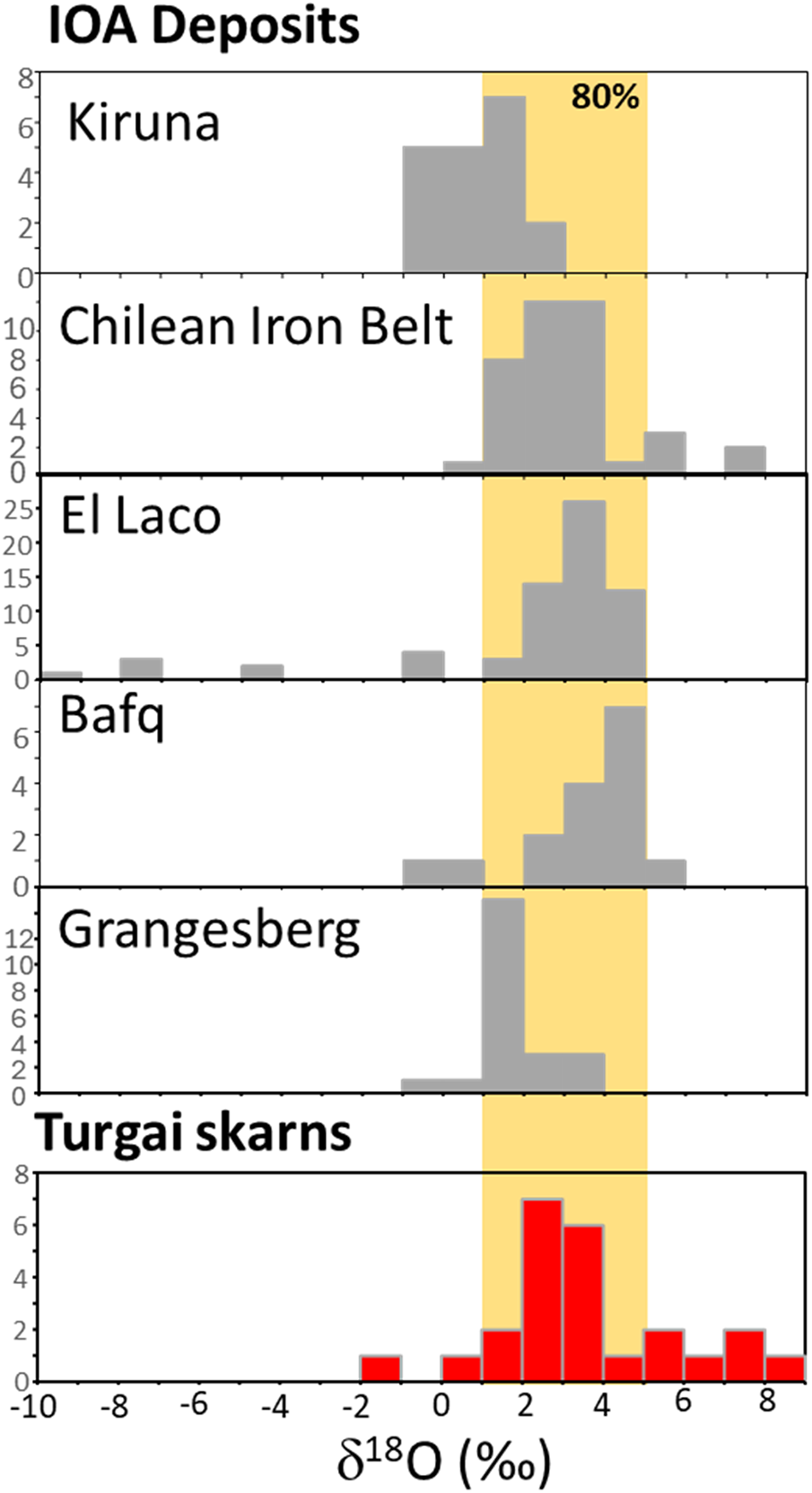
In this study we have analysed magnetite from the Kiruna district, Sweden and the Turgai District, Kazakhstan, with the objective of constraining the utility of magnetite trace element compositions in distinguishing deposit type and formation processes. Kiirunavaara and the Turgai skarns are similar in terms of the magnitude of the iron resource (Fig. 1) and have a number of mineralogical and geochemical similarities (Hawkins et al., Reference Hawkins, Smith, Herrington, Maslennikov, Boyce, Jeffries and Creaser2017). The common features include an association with accessory apatite, a halo of sodic alteration, including albite and scapolite, and a late-stage sulfide mineralisation overprinting magnetite (Barton and Johnson, Reference Barton and Johnson1996; Herrington et al., Reference Herrington, Smith, Maslennikov, Belogub, Armstrong and Porter2002; Williams et al., Reference Williams, Barton, Johnson, Fontbote, de Haller, Mark, Oliver and Marschik2005). Recent studies in the Kiruna district have focussed on aspects including stable isotope geochemistry, and from global comparisons concluded that such data support magmatic models for IOA genesis (Fig. 2). The Turgai deposits are, however, unequivocally limestone replacement skarns (Hawkins et al., Reference Hawkins, Smith, Herrington, Maslennikov, Boyce, Jeffries and Creaser2017), and skarns have been conspicuously absent from comparative studies on IOA deposit genesis, despite skarn-like alteration assemblages in some deposits (e.g. Iron Mountain – Nold et al., Reference Nold, Dudley and Davidson2014; Yangtze basin – Zeng et al., Reference Zeng, Zhao, Spandler, Mavrogenes, Mernagh, Liao, Fan, Hu, Fu and Li2024). The main distinction in terms of δ18O [((18O/16O)sample/(18O/16O)SMOW –1) × 1000 where SMOW is standard mean ocean water] is that some IOA deposits show evidence of late-stage interaction with meteoric water (Childress et al., Reference Childress, Simon, Reich, Barra, Arce, Lundstrom and Bindeman2020), whereas the Turgai magnetite data shows evidence of mixing with oxygen derived from marine carbonate (Hawkins et al., Reference Hawkins, Smith, Herrington, Maslennikov, Boyce, Jeffries and Creaser2017). However, across all the reviewed IOA deposits in Fig. 2 and the Turgai district 80% of the δ18O data are in the range 1–5‰ proposed as indicative of primary igneous magnetite by Jonsson et al. (Reference Jonsson, Troll, Högdahl, Harris, Weis, Nilsson and Skelton2013) and widely accepted as indicative of primary magmatic origin (e.g. Troll et al., Reference Troll, Weis, Jonsson, Andersson, Majidi, Högdahl, Harris, Millet, Chinnasamy, Kooijman and Nilsson2019; Rodriguez-Mustafa et al., Reference Rodriguez-Mustafa, Simon, del Real, Thompson, Bilenker, Barra and Bindeman2020; Fig. 2). The data from the Turgai district clearly indicate that this range can only be interpreted as indicative as of high temperature (T >500°C; Hawkins et al., Reference Hawkins, Smith, Herrington, Maslennikov, Boyce, Jeffries and Creaser2017) origin, with an igneous derivation of oxygen, either via precipitation from magmatic or magmatic equilibrated hydrothermal fluids, or replacement of previously formed igneous rocks, not as an indicator of exclusively magmatic origin. Equally, published δ56Fe values [((56Fe/54Fe)sample/(56Fe/54Fe)IRMM-014 –1) × 1000] from limestone replacement skarn magnetite (Wang et al., Reference Wang, Zhu, Mao, Li and Cheng2011; Zhu et al., Reference Zhu, Zhang, Zhao and He2016; Lu et al., Reference Lu, Santosh, Su, Wang, Cui, Wang and Zang2024; Zhao et al., Reference Zhao, Brzozowski and Li2024) fall in the range –0.37 to 0.21‰, which significantly overlaps with the range 0 to 0.53‰ reported for magnetite from IOA deposits (Simon et al., Reference Simon, Knipping, Reich, Barra, Deditius, Bilenker and Childress2018; Troll et al., Reference Troll, Weis, Jonsson, Andersson, Majidi, Högdahl, Harris, Millet, Chinnasamy, Kooijman and Nilsson2019; Childress et al., Reference Childress, Simon, Reich, Barra, Arce, Lundstrom and Bindeman2020; Rodriguez-Mustafa et al., Reference Rodriguez-Mustafa, Simon, del Real, Thompson, Bilenker, Barra and Bindeman2020). Geochemical criteria proposed as indicative of a purely orthomagmatic origin for IOA deposits do not, therefore, effectively discriminate IOA deposits from high-temperature replacement skarns.
Histograms of compiled oxygen isotope data from IOA deposits, compared to the Turgai skarns. Data from Simon et al. (Reference Simon, Knipping, Reich, Barra, Deditius, Bilenker and Childress2018), Troll et al. (Reference Troll, Weis, Jonsson, Andersson, Majidi, Högdahl, Harris, Millet, Chinnasamy, Kooijman and Nilsson2019), Childress et al. (Reference Childress, Simon, Reich, Barra, Arce, Lundstrom and Bindeman2020), Rodriguez-Mustafa et al. (Reference Rodriguez-Mustafa, Simon, del Real, Thompson, Bilenker, Barra and Bindeman2020), Hawkins et al. (Reference Hawkins, Smith, Herrington, Maslennikov, Boyce, Jeffries and Creaser2017).

We therefore make here a comparison of the trace element composition between magnetite from IOA and IOCG type mineralisation in the Kiruna District and magnetite from Fe skarns from the Turgai district with the objective of determining the utility of magnetite trace element data in discriminating deposit types and constraining formation processes.
Geology
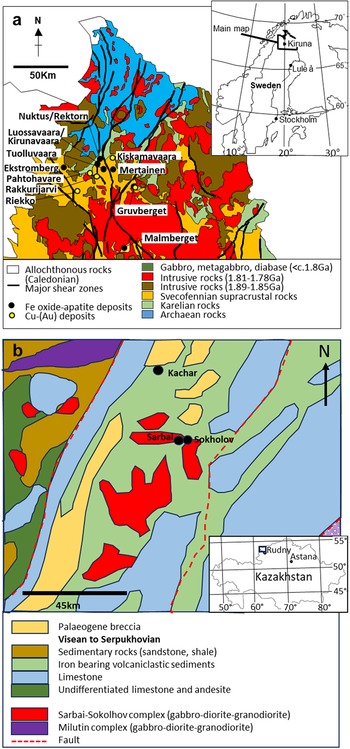
The major iron ore province of northern Sweden is hosted within Karelian (2.5–2.0 Ga) and Svecofennian (1.9–1.88 Ga) Palaeoproterozoic rocks, which extend from northern Sweden into Finland and parts of northern Norway (Fig. 3a). The Palaeoproterozoic rocks of the area are now preserved in deformed metamorphic belts which are intruded by a range of granitoid plutons. The Greenstone Group (>1.9 Ga) consists of tholeiitic to komatiitic volcanic rocks (Ekdahl, Reference Ekdahl1993; Martinsson, Reference Martinsson1997) and is overlain by the Middle Sediment Group (Witschard, Reference Witschard1984), then by the andesitic volcanic Porphyrite Group, and then by the Kiirunavaara Group (Martinsson, Reference Martinsson2004). The Kiirunavaara Group consists of syenitic and quartz-syenitic igneous rocks and intercalated sediments, which host the Kiirunavaara magnetite–apatite deposit. The syenitic character of these rocks might be the result of alteration overprinting an original calc-alkaline signature. Calc-alkaline and alkali-calcic monzonite granites of the Haparanda and Perthite suites intruded these rocks between 1.9 and 1.8 Ga (Skiöld, Reference Skiöld1987) followed by the Lina suite granitoids at ∼1.79 Ga (Skiöld, Reference Skiöld1988; Bergman et al., Reference Bergman, Küber and Martinsson2001). Deformation and upper greenschist to lower amphibolite facies metamorphism of the supracrustal sequence accompanied the intrusion of these granitoids (Bergman et al., Reference Bergman, Küber and Martinsson2001).
(a) Summary geological map of Norrbotten County, Sweden, showing the location of samples used in this study. Map simplified from Bergman et al. (Reference Bergman, Küber and Martinsson2001). (b) Summary geological map of the Turgai region, Kazakhstan. Simplified from Hawkins et al. (Reference Hawkins, Smith, Herrington, Maslennikov, Boyce, Jeffries and Creaser2017).

The volcanic sequence is affected by scapolitisation and albitisation at regional and deposit scale, in association with both iron oxide and Cu–(Au) mineralisation (Frietsch et al., Reference Frietsch, Tuisku, Martinsson and Perdahl1997). The Fe oxide-apatite bodies are typified by the Kiirunavaara–Luossavaara body, dominated by magnetite, and the Per Geiger ores, with both hematite and magnetite (Geijer, Reference Geijer1910, Reference Geijer1931; Martinsson, Reference Martinsson2004). The deposits are accompanied by sodic and potassic alteration (albite–K-feldspar–biotite), in some instances including marialitic scapolite (Frietsch et al., Reference Frietsch, Tuisku, Martinsson and Perdahl1997; Bernal et al., Reference Bernal, Gleeson, Smith, Barnes and Pan2017). Potassic alteration typically overprints sodic alteration (e.g. Rakkurijärvi, Smith et al., Reference Smith, Coppard, Herrington and Stein2007). The IOCG-type deposits occur both as relatively undeformed bodies hosted by the Greenstone, Porphyrite and Kiirunavaara Groups (e.g. Pahtohavare; Lindblom et al., Reference Lindblom, Broman and Martinsson1996) and as deformed bodies associated with major deformation zones (e.g. Nautanen and Aitik on the Nautanen Deformation Zone (NDZ); Martinsson and Wanhainen, Reference Martinsson and Wanhainen2004). Chalcopyrite mineralisation is typically spatially associated with early magnetite and scapolite–albite alteration and later potassic and finally carbonate alteration, although major Cu-mineralisation is typically later than the development of magnetite.
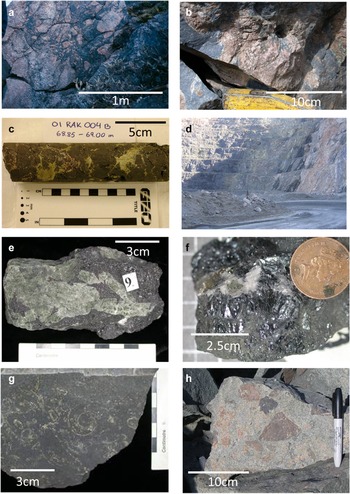
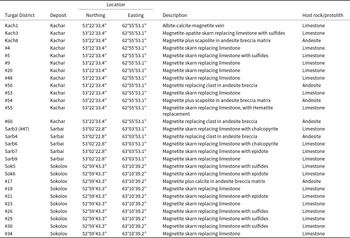
The samples used in this study are described in Table 1 (Kiruna District) and Table 2 (Turgai District). The Kiruna district sites include Fe oxide-apatite bodies: Kiirunavaara–Luossavaara; Nuktus; Rektorn; Tuolluvaara; Mertainen; Ekstromberg; Malmberget (Geijer, Reference Geijer1910, Reference Geijer1931; Martinsson et al., Reference Martinsson, Billstrom, Broman, Weihed and Wanhainen2016), and relatively undeformed IOCG deposits or prospects: Pahtohavare (Martinsson, Reference Martinsson1997); Rakkurijärvi (Smith et al., Reference Smith, Coppard, Herrington and Stein2007); Riekko, Kiskamavaara (Wägman and Ohlsson, Reference Wägman and Ohlsson2000; Martinsson, Reference Martinsson2011); and Gruvberget (Martinsson and Virkkunen, Reference Martinsson and Virkkunen2004). Magnetite in the IOA deposits is typically massive, can show brecciated contacts with host volcanic rocks (Fig. 4a), is associated with apatite and actinolite (Fig. 4b), and in more oxidised ores (Nuktus, Rektorn) with hematite. The Malmberget body shows evidence of folding, ductile deformation and recrystallisation of magnetite and apatite. Magnetite from the IOCG mineralisation is either massive (Gruvberget) or clearly replacive of metasediments (Pahtohavare) or trachyandesitic volcanics (Rakkurijärvi; Fig. 4c) and is overprinted by later stage sulfide mineralisation dominated by pyrite and chalcopyrite.
Field and hand specimen scale context of samples used in this study. (a) Magnetite cemented hydraulic breccia, summit of Kiirunavaara, Sweden. (b) Apatite vein in magnetite, Nuktus deposit, Sweden. (c) Chalcopyrite cemented magnetite breccia, Rakkurijärvi, Sweden, from Smith et al. (Reference Smith, Coppard, Herrington and Stein2007). (d) Sub-vertical magnetite skarn body from Sokolov open pit, Kazakhstan. The magnetite body is flanked by volcanic rocks, pyroxene-epidote skarn, andradite skarn and limestone. (e) Magnetite vein with coarse diopside, Sarbai, Kazakhstan. (f) Late hematite, calcite, pyrite and chalcopyrite cutting magnetite, Sarbai, Kazakhstan. (g) Magnetite skarn flanking albite vein, with goniatites and bivalves replaced by chalcopyrite and pyrite, Sarbai, Kazakhstan. (h) Lithic breccias composed of volcanic clasts, some with complete replacement by magnetite, cemented by scapolite plus albite, Kachar, Kazakhstan.

Sample numbers and brief descriptions of samples from the Kiruna IOA district, Sweden

* Swedish national grid (RT90)
Sample numbers and brief descriptions of samples from the Turgai Skarns, Kazakhstan
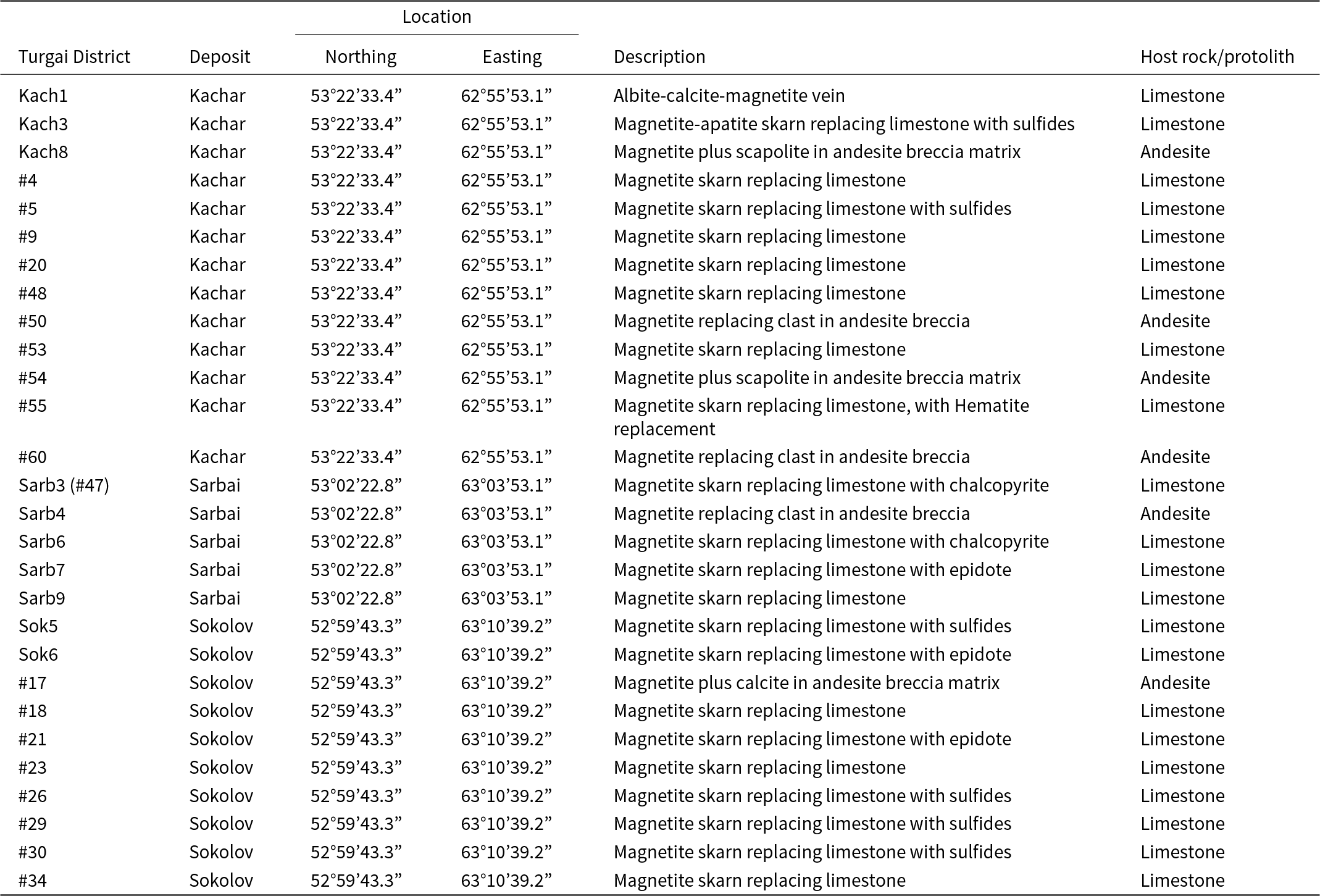
The Turgai skarns (Kachar, Sarbai and Sokolov) are located in the north-west of Kazakhstan (Fig. 3b; Table 2), hosted within the Valerianovka Arc, which is part of the Transuralian tectonic terrane (Brown et al., Reference Brown, Puchkov, Alvarez-Marron, Bea, Perez-Estaun, Gee and Stephenson2006). These stratabound to cross-cutting, massive, magnetite deposits contained at least 3000 Mt of iron ore and combined represent an iron oxide resource of the same magnitude as Kiirunavaara. They have been subject to several detailed studies (e.g. Bekmuhametov, Reference Bekmuhametov, Halls, Seltmann and Dolgopolova2004; Smirnov, and Dymkin, Reference Smirnov and Dymkin1989; Sokolov and Grigorev, Reference Sokolov, Grigorev and Smirnov1977; Porotov, et al., Reference Porotov, Dymkin, Poltavets, Ovchinnikov and Dymkin1987). The deposits are hosted by the Carboniferous Valerianovka Supergroup which comprises more than 1000 m of andesite lavas and volcaniclastic sediments, overlain by siliciclastic and carbonate rocks, and are associated with the Sarbai–Sokolov calc-alkaline intrusive Series (Hawkins et al., Reference Hawkins, Smith, Herrington, Maslennikov, Boyce, Jeffries and Creaser2017). Similarities with IOA deposits include the occurrence of apatite as an accessory phase, the development of marialitic scapolite together with albite in a sodic alteration halo, and the overall characteristics of a large volume of iron oxides with super-imposed sulfide mineralisation (Hawkins et al., Reference Hawkins, Smith, Herrington, Maslennikov, Boyce, Jeffries and Creaser2017). In contrast, a number of iron oxide-apatite deposits (IOA) including both Kiirunavaara (Sweden) and El Laco (Chile) have either diopside associated with magnetite (El Laco; Nyström and Henríquez, Reference Nyström and Henríquez1994; Sillitoe and Burrows, Reference Sillitoe and Burrows2002), or have been inferred to have contained primary diopside now replaced by actinolite (Kiirunavaara; Blake, Reference Blake1992). The Turgai orebodies are unequivocally limestone replacement skarns with an alteration assemblage of calc-silicates including wollastonite, diopside, andradite garnet and actinolite (Fig. 4e), with later stage hematite, calcite and sulfides (Fig 4f). The ore and silicate gangue preserve evidence of direct volume-for-volume replacement of both a Carboniferous fossil assemblage, and of igneous clasts in the surrounding calc-alkaline volcanic sequence (Fig. 4g, h; Hawkins et al., Reference Hawkins, Smith, Herrington, Maslennikov, Boyce, Jeffries and Creaser2017). The samples analysed here are of massive magnetite, either replacing limestone or brecciated volcanic clasts in breccias hosting the ore bodies.
Methods
The textures of magnetite were examined in reflect light, and using a Zeiss Evo scanning electron microscope (SEM) equipped with a Oxford instruments XMax EDS detector, in back-scattered electron (BSE) mode at the University of Brighton, using an accelerating voltage of 20 kV and a beam current of 1 nA. The major-element compositions of magnetite were measured by wavelength-dispersive X-ray spectrometry (WDS) using a Cameca SX100 electron microprobe at the Natural History Museum (NHM), London. The instrument was operated at a beam current of 40 nA and an accelerating voltage of 20 kV using a 1 mm beam diameter. Standards used were forsterite for Mg; cordierite for Al; fayalite for Si; Mn–Ti oxide for Ti and Mn; V on vanadate; CrO2 for Cr; FeO for Fe; cobalt metal for Co; NiO2 for Ni; sphalerite for Zn; Nb metal for Nb; Mo metal for Mo; and Ce-bearing glass for Ce. These data were reduced and corrected using the PAP routine (Pouchou and Pichoir, Reference Pouchou and Pichoir1984).
Trace element analysis of magnetite by laser-ablation inductively-coupled-plasma mass-spectrometry (LA-ICP-MS) was performed at the NHM, London using an ESI 193 nm Laser Ablation system operated at a wavelength of 193 nm and pulse duration of 4 ns, and an Agilent 7700 ICP-MS. Helium was used as a carrier gas with a flow rate of 380 ml/min. The samples were analysed using a spot diameter of 50 μm, dwell time of 60 s, repetition rate of 8 Hz and fluence of 3.0 J/cm2. The iron content determined from an ideal magnetite or hematite formula was used as an internal standard for all analyses, and external calibration was performed using basalt glass standard GSD. The ideal formula approach is justified because from probe analyses 1 σ of the mean Fe content for both sample sets was within 2% of the ideal, and thus any introduced error is less than the expected error for LA-ICP-MS analysis, and frequently less than the difference from calculating the concentration from different isotopes (e.g. 47Ti vs 49Ti). Magnetite BC28 was analysed as a quality check. Within-run reproducibility was typically within 5% for Al, Sc, Ti, V, Cr, Co, Ni, Ga, and 10% for Mg, Zn, Nb, Hf and Ta. Other elements not used in discriminant analysis, or very close to detection limits were outside this range (full data available at https://doi.org/10.17033/DATA.00000316).
Magnetite was separated from additional samples by hand crushing, followed by using a hand magnet and hand picking from the separated material. Possible sulfide and carbonate inclusions were removed by treatment with concentrated nitric acid. The samples were then fused with LiBO3 flux in Pt crucibles using a Fluxana induction furnace and digested in 10% HNO3. The resulting solutions were diluted to 2% HNO3 using deionised water, and trace elements determined using a quadrupole inductively coupled plasma mass spectrometer (ICP-MS, Agilent 7900) at the University of Brighton, UK. The octopole reaction system was operated in He mode to reduce polyatomic interferences. Multi-element calibration standards (Inorganic Ventures CCS; Agilent STD4; Inorganic Ventures Stock 21; Perkin Elmer single element Sn) were diluted with a blank LiBO3 solution, deionised water and 2% nitric acid to produce matrix matched solutions for calibration from 1 µg/L to 500 µg/L. Internal standard (100 µg/L Rh) was added via online solution addition to all standards, samples and blanks. Internal reproducibility was within 5% for all elements, except Mn, Ge and Zr which were within 14%. Mean values (n = 3) are within 1 σ agreement with certified values for trace elements in standards BCR2 (Columbia River Basalt) and GSP2 (granodiorite) except Mn, Ni, Zn and Ge which were within the reported ranges from the GEO-REM compilation (Jochum et al., Reference Jochum, Nohl, Herwig, Lammel, Stoll and Hoffmann2005; https://georem.mpch-mainz.gwdg.de/sample_query.asp, accessed 2024). Calcium and silicon were not calibrated quantitatively, but were monitored to allow exclusion of samples with significant potential contamination by apatite or silicates respectively.
Results
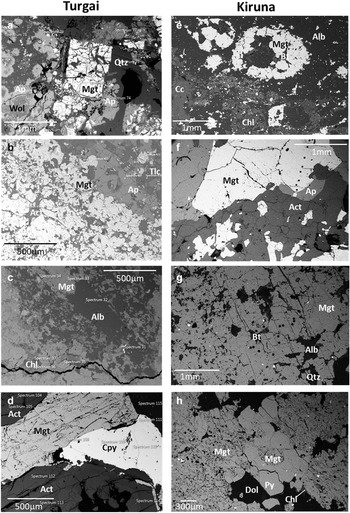
Magnetite in silicic volcanic rocks includes partially replaced trachyandesite from Luossavaara (Fig. 4a), and magnetite replacing clasts in dacitic breccia from the Turgai zone (Fig. 4h). Magnetite within these samples either replaces silicic rocks together with an assemblage of wollastonite, apatite and quartz (Fig. 5a, Turgai) or infills amygdales and replaces matrix together with an assemblage of albite, chlorite and calcite (Fig. 5b, Luossavaara). A single example from the Turgai district showed ilmenite exsolution in magnetite from an ulvöspinel precursor, suggesting a pre-existing high Ti oxide phase (Fig. 6b,f). This sample was from a volcanic breccia with clear evidence of clast replacement by magnetite (Fig. 4h, 5a). Analyses integrating magnetite and ilmenite lamellae in this sample are taken as reflecting the composition of the precursor phase. Magnetite within the Turgai district samples either occurred with a skarn-type alteration assemblage including diopside, garnet and epidote (Fig. 4c,d), or with apatite, actinolite, talc and albite (Fig. 5b,c). Minerals associated with magnetite in the Kiruna district IOA deposits include apatite, actinolite, albite and biotite, with later stage carbonates (Fig. 5f,g,h). Both the Turgai skarns and the Kiruna district IOCGs show sulfide mineralisation interstitial to magnetite in some samples (Fig. 5d,h). Element-distribution mapping by SEM shows limited evidence for internal zonation or partial alteration during sulfide mineralisation in either district (Fig. 6).
Back-scattered electron images of magnetite assemblages and textures. (a) Magnetite plus apatite replacing meta-andesite, Turgai district. (b) Magnetite and apatite plus talc and actinolite in skarn, Turgai district. (c) Magnetite plus albite and scapolite in skarn, Turgai district. (d) Magnetite plus actinolite with interstitial chalcopyrite, Turgai district. (e) Magnetite replacing vesicle fill and host meta-andesite, Luossavaara, Kiruna district. (f) Magnetite plus apatite and actinolite, Malmberget, Kiruna district. (g) Magnetite plus albite, quartz and biotite, Mertainen, Kiruna District. (h) Magnetite with interstitial pyrite, dolomite and chlorite, Pahtohavare, Kiruna district.

Element-distribution maps of key magnetite textures from Kiruna and Turgai. (a+b) Magnetite with ilmenite exsolution lamellae in magnetite replacing andesites, Turgai district. (c+d) Skarn magnetite, Turgai district. (e+f) Magnetite with associated apatite, Malmberget, Kiruna District. (g+h) Magnetite encased in pyrite, Pahtohavare, Kiruna District.

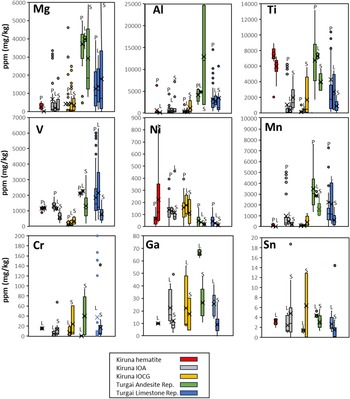
The results of magnetite analyses by electron probe microanalyses (EPMA), LA-ICP-MS and solution ICP-MS are shown in Figs 7, 8, 9. The full data set of analyses is available at https://doi.org/10.17033/DATA.00000316. The ranges of trace element concentration are summarised in Fig. 7. Comparison between all analytical techniques shows the ranges of data are consistent allowing comparison of data types for purposes of interpretation. A single sample of hematite was included in the analysis to allow discrimination from magnetite and to identify any effects from incipient martitisation of magnetite. Hematite is clearly distinguished both in terms of the major element compositions from EPMA and by elevated Ti and low Al, Mn and Mg compared to magnetite (Figs 7 and 8). There is no evidence of partial replacement of magnetite by hematite in the trace element data.
Box and whisker plots showing the range in trace element concentrations from the Kiruna and Turgai districts. P – EPMA data; L – LA-ICPMS data; S - Solution-ICPMS data.

Magnetite and hematite trace element data from the Turgai and Kiruna districts compared with element discrimination diagrams of Dupuis and Beaudoin (Reference Dupuis and Beaudoin2011) and Nadoll et al. (Reference Nadoll, Angerer, Mauk, French and Walshe2014).

(a) Magnetite and hematite Sn and Ga data from the Turgai and Kiruna districts compared with element discrimination diagram from Nadoll et al. (Reference Nadoll, Angerer, Mauk, French and Walshe2014). (b) Magnetite and hematite Ti and V data from the Turgai and Kiruna districts compared with fields for igneous and hydrothermal magnetite from Nadoll et al. (Reference Nadoll, Angerer, Mauk, French and Walshe2014) and Knipping et al. (Reference Knipping, Bilenker, Simon, Reich, Barra, Deditius, Wӓlle, Heinrich, Holtz and Munizaga2015b). Data fields for Kiruna and El Laco from Broughm et al. (Reference Broughm, Hanchar, Tornos, Westhues and Attersley2017). (c) Magnetite and hematite Ti and V data from the Turgai and Kiruna districts compared with fields for different deposit types from Knipping et al. (Reference Knipping, Bilenker, Simon, Reich, Barra, Deditius, Wӓlle, Heinrich, Holtz and Munizaga2015b).

The most abundant trace elements in magnetite are Mg, Ti, Al and Mn. These are typical constituents of the spinel solid-solution series and are compatible in the magnetite structure. Significant levels of V are also detected. Notable differences between the Kiruna district IOA and IOCG deposits are lower overall concentrations of most trace elements, but an increased level of Ni in IOCGs. Within the Turgai Skarns there are significant differences between limestone replacive and andesite replacive magnetite, most notably increased Mg and Ti in the magnetite replacing andesite. Comparison between Kiruna district IOA deposits and the Turgai skarns shows key differences in Mg, Al and Ti, all of which are higher in the analysed Turgai skarn magnetites, but also significant overlap between the concentrations of V, Cr, Ga and Sn.
The REE were below detection for electron microprobe and LA-ICP-MS methods. The solution ICP-MS results were filtered for potential REE bearing mineral inclusions using correlation with Ca, Si and P. The remaining data have ΣREE ranging from 0.5 to 17.5 mg/kg in the Turgai skarns and 0.1–57 mg/kg in the Kiruna District samples, with light REE enrichment, flat HREE distribution patterns, and no to negative Eu anomaly. Yttrium, as a pseudo-lanthanide (Bau, Reference Bau1996), shows no significant anomaly relative to Dy and Ho in the Turgai skarns, but shows a slight negative anomaly in the Kiruna district IOA and IOCG deposits.
Discussion
Applicability of magnetite trace element discrimination diagrams
The Al+Mn and Ti+V diagrams for data acquired in this study are plotted on Fig. 8a (Dupuis and Beaudoin, Reference Dupuis and Beaudoin2011; Nadoll et al., Reference Nadoll, Angerer, Mauk, French and Walshe2014). The total data set for both districts straddles the skarn and porphyry fields, with no clear separation of deposit type. Data from the Kiruna district IOA deposits plot partly in the Kiruna-type field, but also in fields defined for IOCGs, porphyry systems, and outside of any of the defined fields. This is in common with a number of other studies of IOA magnetite composition (e.g. Nadoll et al., Reference Nadoll, Angerer, Mauk, French and Walshe2014; Broughm et al., Reference Broughm, Hanchar, Tornos, Westhues and Attersley2017). The IOCG magnetite data plot in fields proposed for IOCGs, banded iron formations (BIF) and hydrothermally modified or metamorphosed BIF. The Turgai andesite replacement magnetite data plot in the skarn and porphyry fields, whereas the limestone replacement magnetite data plot in fields for skarn, porphyry, IOCG, Kiruna-type and magmatic Fe-Ti-V deposits. A similar situation is shown for the Ni/(Cr+Mn) versus Ti+V diagram (Dupuis and Beaudoin, Reference Dupuis and Beaudoin2011), with none of the compositions plotting as Kiruna type, and the majority of data from Kiruna district IOA deposits and the Turgai district skarns plotting in the skarn field. The Kiruna district IOCGs plot as IOCGs, but also as BIFs. These diagrams do not provide a definitive discrimination of deposit type for the deposits studied here, and the discrimination diagram approach should not be applied uncritically to develop genetic models or discriminants for deposit type in exploration. The closest comparison to Fe oxide deposits inferred to be of magmatic origin in the Chilean iron belt (Knipping et al., Reference Knipping, Bilenker, Simon, Reich, Barra, Deditius, Lundstrom, Bindeman and Munizaga2015a, Reference Knipping, Bilenker, Simon, Reich, Barra, Deditius, Wӓlle, Heinrich, Holtz and Munizaga2015b; Rojas et al., Reference Rojas, Barra, Deditius, Reich, Simon, Roberts and Rojo2018; Palma et al., Reference Palma, Barra, Reich, Simon and Romero2020) is with the Turgai skarns (indisputably of magmatic-hydrothermal replacement origin) with the Kiruna district deposits plotting in correspondence with analyses inferred to represent later hydrothermal magnetite deposition in the Chilean deposits (Palma et al., Reference Palma, Barra, Reich, Simon and Romero2020; Reich et al., Reference Reich, Simon, Barra, Palma, Hou and Bilenker2022).
Single-element discrimination plots have been proposed by Nadoll et al. (Reference Nadoll, Angerer, Mauk, French and Walshe2014). In terms of Sn and Ga all the samples analysed here plot within the porphyry igneous and hydrothermal field. The fields proposed for igneous and hydrothermal magnetite in the plot of Ti versus V (Nadoll et al., Reference Nadoll, Angerer, Mauk, French and Walshe2014; Knipping et al., Reference Knipping, Bilenker, Simon, Reich, Barra, Deditius, Wӓlle, Heinrich, Holtz and Munizaga2015b) do not discriminate Kiruna district IOA deposits from the Turgai skarns, and the Turgai skarns plot dominantly in the igneous field, with significant overlap with data from El Laco and Kiruna (Broughm et al., Reference Broughm, Hanchar, Tornos, Westhues and Attersley2017). The only samples to plot exclusively within the hydrothermal field are those from Kiruna district IOCGs which have both Ti and V below 1000mg/kg. The inclusion of Cr into the analysis (Fig.10c; Knipping et al., Reference Knipping, Bilenker, Simon, Reich, Barra, Deditius, Wӓlle, Heinrich, Holtz and Munizaga2015b) still does not effectively discriminate the Turgai skarns from the Kiruna IOA deposits. In all cases the Ti and V contents of magnetite are lower than proposed fields for igneous magnetite. In this study we have analysed magnetite from IOA deposits across the Kiruna district, with only two samples from the Kiirunavaara-Luossavaara system (L4.6, 03LUOSS01). Other studies have analysed multiple samples from different settings at Kiirunavaara and found a very similar range of trace element compositions, and no evidence for an early high Ti magnetite generation (Broughm et al., Reference Broughm, Hanchar, Tornos, Westhues and Attersley2017), as seen in a number of deposits of the Chilean iron belt (Palma et al., Reference Palma, Barra, Reich, Simon and Romero2020; Knipping et al., Reference Knipping, Bilenker, Simon, Reich, Barra, Deditius, Lundstrom, Bindeman and Munizaga2015a, Reference Knipping, Bilenker, Simon, Reich, Barra, Deditius, Wӓlle, Heinrich, Holtz and Munizaga2015b; Rojas et al., Reference Rojas, Barra, Deditius, Reich, Simon, Roberts and Rojo2018; Salazar et al., Reference Salazar, Barra, Reich, Simon, Leisen, Palma, Romero and Rojo2020). This is significant in that the low concentration of Ti is more indicative of hydrothermal than magmatic origin. Most notably Charlier et al. (Reference Charlier, Namur and Grove2013) analysed ferro-basaltic (oxide-rich ferrogabbros; immiscible ferrobasaltic globules; melt inclusions) and rhyolitic pairs in natural unmixed systems and demonstrated that the Fe-P rich ferrobasaltic melt was enriched in Ti compared to the iron-poor melt. A similar result was found by Lester et al. (Reference Lester, Clark, Kyser and Naslund2013). This is not consistent with an immiscible iron oxide melt origin for most of the deposits analysed here, and the most Ti-rich magnetite analysed in this study is from the replacive skarn deposits of the Turgai belt. Titanium magnetite-melt partition coefficients are ∼1 at high T (1150°C; Sievwright et al., Reference Sievwright, O’Neill, Tolley, Wilkinson and Berry2020) so magnetite Ti concentrations should closely reflect the composition of any source fluid. Low Ti iron oxide melts have been produced experimentally to below 1000°C, but in the presence of C as a reductant (Lindsey and Epler, Reference Lindsey and Epler2017), for which there is little or no evidence in the Kiruna district. The temperatures of the low Ti melts are still in excess of 850°C for these experiments, which is not consistent with isotopic or trace element geothermometry (see below). It is even more significant in that in high-salinity fluids (10–30 wt.% NaCl) at temperatures from 300–600°C, rutile (TiO2) solubility is in excess of 1000 mg/kg Ti (Tanis et al., Reference Tanis, Simon, Zhang, Chow, Xiao, Hanchar, Tschauner and Shen2016), therefore low Ti in magnetite must indicate low Ti fluids, or a low Ti source.
Plots of key elements and element ratios in magnetite from the Kiruna and Turgai districts against semi-quantitative temperature estimates based on the Mg content and the data of Canil and Lacourse (Reference Canil and Lacourse2020). (a) Ni/(Cr+Mn); (b) Al+Mn; (c) Ti+V; (d) Ga.

In summary data from this study indicates that the use of empirical magnetite trace element discrimination diagrams needs much more development and critical use, or, better, a change to a process-based interpretation of trace element distribution patterns. This is particularly true for the Kiruna district IOA deposits, which are not effectively discriminated from magnetite skarns using this approach. There is more potential for the discrimination of base metal sulfide-rich, magnetite bearing systems through use of V, Ni, Cr, Al and Mn, notably to discriminate magnetite potentially related to IOCGs, and with significant sulfide mineralisation.
Formation temperature and post-formation effects
Canil and Lacourse (Reference Canil and Lacourse2020) presented empirical correlations between 1200 to 700°C in igneous magnetite, and to below 600°C in porphyry magnetite, demonstrating that a range of trace element substitutions in magnetite, and particularly Mg, had strong temperature control. They noted positive correlations with T for Mg and Ti, and negative ones (with additional control from fO2) for V and Cr. Manganese did not correlate with T at all. They proposed an empirical geothermometer based on the Mg content in magnetite with the mineral assemblage plagioclase + amphibole ± biotite ± ilmenite ± garnet ± quartz. They also noted that although this geothermometer had been calibrated in igneous systems it gave consistent results in porphyry hydrothermal systems. With the latter point in mind, we have used the Mg in magnetite geothermometer to provide at least semi-quantitative estimates for the temperature of formation of the magnetite analysed here.
Within the Turgai skarns, samples of magnetite replacing andesite show the highest T origin, with estimated equilibration T of 800–600°C. The limestone replacement magnetite shows estimated equilibration from this range down to ∼350°C. The T range is consistent with that estimated from magnetite–calcite oxygen isotope exchange by Hawkins et al. (Reference Hawkins, Smith, Herrington, Maslennikov, Boyce, Jeffries and Creaser2017; 550–250°C). In the Kiruna district IOA deposits magnetite gives estimated equilibration temperatures from ∼550–480°C (Malmberget) down to ∼420–320°C (all others). These results are in contrast to the conclusion of Jonsson et al. (Reference Jonsson, Troll, Högdahl, Harris, Weis, Nilsson and Skelton2013) that O stable isotopes had equilibrated at >600°C. However, this result was on the basis of direct comparison between magnetite δ18O in different environments and not on mineral isotope exchange thermometry. The Kiruna district IOCGs show a comparable range in estimated equilibration T from ∼650 to 320°C. Previous estimates from fluid-inclusion data are consistent with this, ranging from 500–300°C in IOA and IOCG deposits (Smith et al., Reference Smith, Gleeson and Yardley2012).
Correlation of the estimated T with the discriminant trace elements proposed in previous work shows a range of trends (Fig. 10). The skarn and IOA magnetite show a clear negative correlation between Ni/(Cr+Mn) and T (Fig. 10a). This indicates that this ratio is strongly affected by late-stage formation or modification of magnetite. The correlation with Ni in this instance is indicative of the influence of late sulfide mineralising fluids overprinting magnetite in both IOA deposits and skarns. Iron oxide-copper-gold deposits fall on a separate (but still negative) trend at higher Ni content, providing one possible discriminant for IOCG magnetite compared to skarn and IOA magnetite. A similar increase in Ni in titanite associated with IOCGs was noted by Smith et al. (Reference Smith, Storey, Jeffries and Ryan2009). In contrast Al+Mn shows a positive correlation with estimated T (Fig. 10b), with the highest contents in andesite replacement magnetite from the Turgai district. Hence, this might be a discriminant of high T silicate volcanic replacement or magmatic origin for magnetite. Neither Ti+V nor Ga show correlation with T (Fig. 10c,d). These trace elements are therefore inferred to be either independent of T, or resistant to low T equilibration. This conclusion is consistent with the data of Sievwright et al. (Reference Sievwright, O’Neill, Tolley, Wilkinson and Berry2020) and Van Orman and Crispin (Reference Van Orman and Crispin2010) who showed that V, Ti, Al and Ga had substantially lower diffusion coefficients in magnetite than Ni, Mn, Mg, Co and Cu. The contrast in behaviour can be related to the crystal chemistry of magnetite, whereby 3+ cations are compatible on the tetrahedral Fe3+ site, whilst 2+ cations are compatible on the octahedral Fe2+ site (Nadoll et al., Reference Nadoll, Angerer, Mauk, French and Walshe2014). A similar conclusion was reached by Palma et al. (Reference Palma, Barra, Reich, Simon and Romero2020), who concluded that V and Ga are the most reliable tracers of magnetite formation. Hu et al. (Reference Hu, Lentz, Li, McCarron, Zhao and Hall2015) argued that magnetite in skarn systems could be re-equilibrated by dissolution–reprecipitation down to relatively low T, especially for Si, Mg, Ca, Al, Mn and Ti.
On the basis of the above discussion, we plotted Ti+V against Ga as a set of trace elements potentially resistant to low T re-equilibration and indicative of the primary origin of magnetite (Fig. 11). The highest Ti, V and Ga contents are in andesite replacement magnetite from the Turgai district, allowing discrimination of silicate volcanic replacement and high T skarn with volcanic host-rock influence from other magnetite sources. The Kiruna district IOA magnetite data plot in the same composition range as Turgai skarn magnetite. This is not necessarily indicative of a common genetic mechanism, but of either replaced host rock composition or the source of mineralising fluids.
Plots of tetrahedral cation concentrations with low T dependence from the Kiruna and Turgai districts. (a) Ti+V versus Ga. (b) V versus Ga. Fields in (b) from Palma et al. (Reference Palma, Barra, Reich, Simon and Romero2020).

The exception to this is the Malmberget magnetite data, which plot as a tight group at relative low Ti+V and high Ga compared to the main data trend. This can be attributed to recrystallisation of magnetite during metamorphism and deformation at Malmberget. The low Ti content of Kiruna magnetite, and IOA magnetite in general, has previously been attributed to post-formation hydrothermal metasomatism or metamorphism (Broughm et al., Reference Broughm, Hanchar, Tornos, Westhues and Attersley2017). Lower Ti+V and low Ga in the IOCG type deposits can be attributed to a fully hydrothermal origin because of the low solubility of these elements. A single relatively high Ga grouping is from Pahtohavare where magnetite is inferred to have replaced slate between basaltic volcanics (Martinsson, Reference Martinsson1997). Geochemically Ga is strongly associated with Al and hence concentrated in mud rocks (Yuan et al., Reference Yuan, Chen, Teng, Chetelat, Cai, Liu, Wang, Bouchez, Moynier, Gaillardet, Schott and Liu2021). Hence, the dominant controls on the trace element composition of magnetite can be discriminated and are temperature, re-equilibration with transition metal enriched hydrothermal fluids, the metal source and the host rock for the magnetite deposit.
This hypothesis can be further tested using the REE data. Figure 12 shows chondrite (Sun and McDonough, Reference Sun and McDonough1989) normalised REE distribution diagrams for magnetite which passed the QA test proposed above for bulk digestion and solution analyses. Cook et al. (Reference Cook, Ciobanu, Ehrig, Slattery and Gibert2022) have demonstrated that the REE can be incorporated in the magnetite lattice. At an order of magnitude lower concentration, the magnetite REE distribution patterns for IOA deposits in the Kiruna area match those of the Kiirunavaara group metavolcanics analysed by Sarlus et al. (Reference Sarlus, Andersson, Martinsson, Bauer, Wanhainen, Andersson and Whitehouse2020), with LREE enrichment, flat HREE distribution patterns and a well-developed Eu anomaly. The magnetite REE distribution patterns are comparable in magnetite and relative element concentrations to the REE contents of magnetite presented by Freitsch and Perdahl (Reference Frietsch and Perdahl1995). The IOCG magnetites show distinct REE distribution patterns with lower LREE and no Eu anomaly. This is consistent with a less evolved REE source. Smith and Storey (Reference Smith and Storey2017) proposed, on the basis of Sm–Nd isotopic data, that the Cu enriched deposits of the Kiruna district had metals derived from the metabasic rocks of the Greenstone group. The Turgai skarn magnetite data show similar results, with skarn magnetite having consistent REE patterns with the host volcanic rocks, albeit at an order of magnitude lower concentration. The limestone replacement magnetite is closely comparable to local granitoids, the potential source of mineralising fluids, whereas the andesite replacement magnetite is comparable to the Sarbai-Sokolov series volcanic rocks which hosts the limestone units that are the main ore horizon (data from Hawkins, Reference Hawkins2011; Hawkins et al, Reference Hawkins, Smith, Herrington, Maslennikov, Boyce, Jeffries and Creaser2017). The comparison in REE patterns is emphasised in Fig. 10e,f which shows element ratios to remove the effects of absolute concentration.
Chondrite normalised REE concentrations in magnetite compared to local volcanic and plutonic igneous rocks. (a) Kiruna district magnetite. (b) The host rocks to the Malmberget deposit (Sarlus et al., Reference Sarlus, Andersson, Martinsson, Bauer, Wanhainen, Andersson and Whitehouse2020) (c) Turgai district magnetite. (d) Volcanic and plutonic rocks from the Turgai district (Hawkins, Reference Hawkins2011; Hawkins et al., Reference Hawkins, Smith, Herrington, Maslennikov, Boyce, Jeffries and Creaser2017). (e), (f) Plots of elemental ratios comparing the overall REE pattern between magnetite and local igneous rocks.

Implications for genetic models
Immiscibility between oxide and silicate melts has been unequivocally identified by numerous experimental studies (e.g. Philpotts, Reference Philpotts1967; Lester et al., Reference Lester, Clark, Kyser and Naslund2013; Hou et al., Reference Hou, Charlier, Holtz, Veksler, Zhang, Thomas and Namur2018) and has been strongly supported by textural evidence at the micron-to-mm scale in natural rocks (e.g. Knipping et al., Reference Knipping, Bilenker, Simon, Reich, Barra, Deditius, Lundstrom, Bindeman and Munizaga2015a; Velasco et al., Reference Velasco, Tornos and Hanchar2016). However, as noted above, the characteristic low Ti content of Kiruna-type IOA deposits in the Kiruna district is not consistent with data for naturally occurring or experimental P-rich ferrobasaltic melts which are typically Ti enriched relative to the conjugate silicate melt (Charlier et al., Reference Charlier, Namur and Grove2013; Hou et al., Reference Hou, Charlier, Holtz, Veksler, Zhang, Thomas and Namur2018). That silicate melt is also typically rhyolitic in composition, rather than intermediate in affinity. Flotation of magnetite by attachment to magmatic volatile bubbles has also been proposed as contributing to magnetite concentration in the upper portions of intrusions (Knipping et al., Reference Knipping, Bilenker, Simon, Reich, Barra, Deditius, Lundstrom, Bindeman and Munizaga2015a, Reference Knipping, Webster, Simon and Holtz2019). Problems with the orthomagmatic model include the ability of a high-density iron oxide dominant liquid to intrude to mid or high crustal levels in near vertical bodies (Charlier et al., Reference Charlier, Namur and Grove2013). Extreme overpressures could drive the eruption of iron oxide or ferrobasaltic melt to the surface, but these would most probably be achieved through having very high volatile contents, moving the mineralising medium to a magmatic-hydrothermal fluid or salt melt. Equally, the volume of iron depleted source magma required to generate deposits of the scale envisioned (2 billion tonnes of magnetite in the case of Kiirunavaara) means that an origin of such a volume of magnetite purely by melt immiscibility is unlikely (Reich et al., Reference Reich, Simon, Barra, Palma, Hou and Bilenker2022). At a smaller scale iron oxide melts may contribute to the formation of high Ti iron oxide-apatite deposits in basic intrusions (nelsonites – Charlier et al., Reference Charlier, Namur and Grove2013). Application of the Lever rule to published solvi for iron and silica-rich melts (e.g. Hou et al., Reference Hou, Charlier, Holtz, Veksler, Zhang, Thomas and Namur2018) suggests that the generation of a P-rich iron oxide melt by immiscibility would require a mass of silica-rich melt of rhyolitic to trachytic composition of ∼9 (for andesitic starting compositions) to ∼3 (for basaltic starting compositions) times that of the iron oxide melt be generated. In the case of Kiruna the hanging wall volcanics are currently of trachytic composition, but they probably achieved this as a result of metasomatism from an andesitic or trachyandesitic precursor with calc-alkaline affinities (Martinsson et al., Reference Martinsson, Billstrom, Broman, Weihed and Wanhainen2016; Sarlus et al., Reference Sarlus, Andersson, Martinsson, Bauer, Wanhainen, Andersson and Whitehouse2020). The arguments presented here suggest that trace element and stable isotope data are not uniquely indicative of magmatic origin. Evidence for hydrothermal replacement origin includes textural evidence for magnetite replacement of silicate volcanics (Smith et al., Reference Smith, Coppard, Herrington and Stein2007; Hawkins et al., Reference Hawkins, Smith, Herrington, Maslennikov, Boyce, Jeffries and Creaser2017), evidence for hydraulic brecciation on the margins of some bodies, including Kiirunavaara (Fig. 4a), and the extensive sodic (and sometimes skarn-like) alteration haloes around many IOA bodies (Hitzman et al., Reference Hitzman, Oreskes and Einaudi1992; Hitzman, Reference Hitzman and Porter2000; Williams et al., Reference Williams, Barton, Johnson, Fontbote, de Haller, Mark, Oliver and Marschik2005).
Both the reviewed data and the new trace element data from magnetite indicate that there is no definitive geochemical tracer in magnetite for magmatic source, and many tracers are indistinguishable between IOA deposits and magnetite skarns. The mobile, temperature sensitive trace element contents of magnetite in Kiruna district IOA deposits are not consistent with a directly magmatic origin for magnetite (as seen for Kiirunavaara itself; Broughm et al., Reference Broughm, Hanchar, Tornos, Westhues and Attersley2017), and the less mobile high-field-strength elements in tetrahedral sites reflect protoliths far more than being specific to a particular deposit type. The trace element data from the Turgai skarns are consistent with initial magnetite formation at >600°C, by replacement of either intermediate volcanic rocks or limestone by hypersaline magmatic brines. This conclusion is supported by the variation in tetrahedral 4+ cations which we infer above to retain primary information from magnetite formation, and which clearly differentiate limestone replacive from volcanic replacive magnetite within the Turgai skarns. It is also supported by the REE patterns of magnetite which show no significant deviation from the host volcanic REE patterns in terms of relative enrichment in either the Kiruna district or the Turgai skarns. As noted above, previous studies suggest that an oxide melt should preferentially incorporate Ti compared to the cognate silicate melt, for which we see no evidence in these data. The close similarity in the Kiruna district and Turgai skarns concentrations of V, Cr, Ti and Ga mean the medium for iron transport in the Kiruna area is not constrained by the trace element data presented here or in previous studies. Skarns unequivocally form by the interaction of hypersaline brines with limestone, surrounding volcaniclastic rocks or source intrusions (e.g. Pan, Reference Pan and Lentz1998; Hawkins et al., Reference Hawkins, Smith, Herrington, Maslennikov, Boyce, Jeffries and Creaser2017). The formation of high Ti magnetite from Fe-bearing hydrosaline melts has been demonstrated by Zeng et al. (Reference Zeng, Zhao, Spandler, Hu, Hu, Li and Hu2022). By analogy we would suggest that formation of the Kiruna district IOA deposits took place from hyper-saline magmatic hydrothermal fluids or salt melts (e.g. Mernagh and Mavrogenes, Reference Mernagh and Mavrogenes2019), with subsequent modification or additional iron oxide precipitation down to 300°C. This is consistent with the derivation of less mobile trace elements from the host volcanic pile and related granitoids in both areas, as previously inferred from Nd isotopic data for titanite by Smith and Storey (Reference Smith and Storey2017). It is also entirely consistent with new evidence from salt-melt inclusions in diopside, garnet and zircon in the Taocun, Meishan, and Luohe IOA deposits, Yangtze basin, China, which are inferred to be the transporting medium for iron (Zeng et al., Reference Zeng, Zhao, Spandler, Mavrogenes, Mernagh, Liao, Fan, Hu, Fu and Li2024). It is also supported by the late-stage Na-Fe-Ca brines preserved in quartz veins around Kiirunavaara (Broman and Martinsson, Reference Broman, Martinsson, Weihed and Martinsson2000; Smith et al., Reference Smith, Gleeson and Yardley2012), and the excess of chloride over bromide when compared to magmatic fumarole gases in those fluids (Gleeson and Smith, Reference Gleeson and Smith2010). That the initial fluids were capable of replacement of aluminosilicate volcanic rocks, is demonstrated by clear evidence of this process in the Turgai skarns, and some IOCG deposits in the Kiruna district (Rakkurijärvi; Smith et al., Reference Smith, Coppard, Herrington and Stein2007). Preservation of protolith textures is clearly possible in limestone by constant volume replacement as seen in the Turgai skarns and may also occur in replacement of volcanic rocks (Hawkins et al., Reference Hawkins, Smith, Herrington, Maslennikov, Boyce, Jeffries and Creaser2017). Such a model does not preclude the involvement of oxide melts early in the deposit formation process, or the role of magnetite flotation. Indeed, studies of magnetite trace element data from the Chilean iron belt have shown early generations of magnetite with high Ti+V and Al+Mn contents (Palma et al., Reference Palma, Barra, Reich, Simon and Romero2020; Knipping et al., Reference Knipping, Bilenker, Simon, Reich, Barra, Deditius, Lundstrom, Bindeman and Munizaga2015a, Reference Knipping, Bilenker, Simon, Reich, Barra, Deditius, Wӓlle, Heinrich, Holtz and Munizaga2015b; Rojas et al., Reference Rojas, Barra, Deditius, Reich, Simon, Roberts and Rojo2018; Salazar et al., Reference Salazar, Barra, Reich, Simon, Leisen, Palma, Romero and Rojo2020) and Mg in magnetite geothermometry suggesting temperatures from >1000°C down to 400°C. Also, evidence for iron oxide, or iron-rich silicate, melt inclusions indicating silicate-iron rich melt immiscibility is widespread (e.g. Velasco et al., Reference Velasco, Tornos and Hanchar2016; Pietruszka et al., Reference Pietruszka, Hanchar, Tornos, Wirth, Graham, Severin, Velasco, Steele-MacInnis and Bain2023). However, data presented here suggests that at district scale around Kiruna, replacement of silicate rocks (IOA deposits) is the dominant process, comparable to replacement of limestone (magnetite skarns) in other deposit types.
Conclusions
On the basis of previously published data and our new data for trace elements in magnetite there are no geochemical or isotopic criteria which can reliably distinguish Kiruna-type iron oxide-apatite deposits from high-temperature magnetite skarns. The major control on trace element compositions is temperature of formation and subsequent hydrothermal re-equilibration, with a secondary control from inheritance of trace element signatures from the host rock. In previously published discrimination diagrams the data from this study which plot most clearly into ‘magmatic’ fields are those from the Turgai skarns, particularly from volcanic breccia with evidence for andesite clast replacement by magnetite. The ‘magmatic’ signature can be attributed to magnetite formation at high T (>600°C) in hydrothermal skarn forming systems, particularly in replacement of volcanic rocks, although high-temperature signatures also occur in limestone replacement. On the basis of those trace elements in tetrahedral sites, which are least prone to subsequent re-equilibration, including Ga, Sn, Ti, Cr and V, there is little discrimination between the iron oxide-apatite deposits of the Kiruna district and the high T magnetite skarns of the Turgai district. There is discrimination in terms of Al and Mn, with the Kiruna district IOA deposits having lower contents, which is most likely to reflect a lower T origin, or lower T re-equilibration, than the Turgai skarns. Models of a single stage magmatic origin for the Kiruna IOA ores are not supported by the magnetite trace element data. They suggest more complex models with early magmatic fluids (oxide or hydrous salt melts) transitioning to hypersaline brines and re-equilibration and further hydrothermal magnetite deposition down to relatively low T. The Turgai skarns are unequivocally formed by replacement of limestone and andesitic volcanics by hypersaline magmatic brines, with trace elements reflecting the temperature of formation, the source of magmatic fluids in local granitoids, and the protolith in the case of andesite replacement. There are clear parallels between the formation of large iron skarn systems and the formation of the Kiruna district IOA deposits, although the genetic mechanism is not precisely the same.
The most significant discrimination in terms of trace element composition is between skarns plus IOA deposits and iron oxide-copper-gold prospects. We infer this to reflect lower T (300–400°C) re-equilibration and precipitation of magnetite from fluids responsible for significant sulfide mineralisation. On this basis the chalcophile transition element content of magnetite could be an effective exploration guide to sulfide mineralised IOCG systems compared to low sulfide IOA systems. This conclusion could be further tested by including analysis of sulfide mineralised skarn systems.
Supplementary material
The supplementary material for this article can be found at https://doi.org/10.17033/DATA.00000316.
Acknowledgements
The authors thank Peter Lyons and Magdalena Grove for laboratory assistance at the University of Brighton. The samples analysed here were collected as part of the EU-RDF Georange program (Kiruna district) or the CERCAMS project (Turgai District). Sokolovsko-Sarbaiskiy Gorno-Obogatitelnoe Objedineniye (The Sokolov-Sarbai Mining Production Association, SSMPA) allowed access to the open pits in Kazakhstan for fieldwork and sampling.
Data availability
The supplementary material for this article has been deposited online at https://doi.org/10.17033/DATA.00000316.
Competing interests
The authors declare none.





 Open access

