

1. Introduction
The Greater Indian Landmass (GIL) is divided into northern and southern crustal provinces. The Archaean Bundelkhand Craton is the nucleus of the northern crustal province, and the southern province is a composite assemblage of the Dharwar, the Bastar and the Singhbhum Archean Cratons (Acharyya, Reference Acharyya2003). The Central Indian Tectonic Zone (CITZ) is an ENE–WSW-trending Proterozoic mobile belt that marks the suture zone between the two crustal provinces. The northern region of the CITZ is occupied by the Mahakoshal Mobile Belt (MMB), which is a narrow rift zone bounded by the Moho-reaching Son-Narmada lineaments. The wider southern belt of the CITZ comprises the Sausar Mobile Belt, the Chotanagpur Granite Gneiss Complex (CGGC) and the Shillong Plateau Gneissic Complex (SPGC).
The CGGC of the east Indian shield is a high-grade terrain located in the eastern part of the CITZ, occupying an area of c. 80 000 km2 (Mahadevan, Reference Mahadevan2002; Acharyya, Reference Acharyya2003) (Fig. 1a). The Quaternary sediments of Gangetic alluvium mostly cover the northern margin of the CGGC with exposures of rocks of the Bihar Mica Belt (BMB), Munger Group and Rajgir–Gaya sub-basins. The sediments of the Bengal Basin mark the eastern margin of the CGGC. Mesozoic volcanics of Rajmahal Trap mark the northeastern fringe of the CGGC, and the western margin is dominantly covered by the Gondwana deposits of Permian – Middle Cretaceous age (Mahadevan, Reference Mahadevan2002). The northwestern margin of the CGGC is in contact with the Vindhyan and Mahakoshal groups of rocks of Proterozoic age. The southern margin is marked by contact with the North Singhbhum Mobile Belt (NSMB) and the E–W-trending crustal-scale shear zone called the South Purulia Shear Zone of Proterozoic age (Fig. 1a). Multiple magmatic and metamorphic episodes and deformations mark the evolution of the CGGC over a geological history from Proterozoic time until c. 65 Ma (Mukherjee & Ghose, Reference Mukherjee and Ghose1998). Based on radiometric dates for the CGGC, four magmato-metamorphic events at c. > 2.5, 1.6–1.5, 1.2–1.0 and 0.9 Ga (e.g. Chatterjee et al. Reference Chatterjee, Crowley and Ghose2008, Reference Chatterjee, Banerjee, Bhattacharya and Maji2010; Maji et al. Reference Maji, Goon, Bhattacharya, Mishra, Mahato and Bernhardt2008; Singh & Krishna, Reference Singh and Krishna2009; Chatterjee & Ghose Reference Chatterjee and Ghose2011; Karmakar et al. Reference Karmakar, Bose, Sarbadhikari and Das2011; PK Mukhopadhyay et al., unpub. report, 2011; Sanyal & Sengupta, Reference Sanyal, Sengupta, Mazumder and Saha2012; Mukherjee et al. Reference Mukherjee, Dey, Sanyal and Sengupta2018; Dey et al. Reference Dey, Karmakar, Mukherjee, Sanyal, Dutta and Sengupta2019) are recognized in the CGGC.
(a) Left: tectonic map of India showing the location of the Central Indian Tectonic Zone (CITZ) along with other Proterozoic mobile belts of India, including the Eastern Ghats Mobile Belt (EGMB) and the Aravalli Delhi Mobile Belt (ADMB). The CITZ comprises the central CITZ, the Chotanagpur Granite Gneiss Complex (CGGC) and the easternmost Shillong Plateau Gneissic Complex (SPGC). The Bathani Volcano Sedimentary Sequence (BVSS) lies within the ENE–WSW-trending Son-Narmada (SONA) lineaments shown in dashed lines. Four Archaean cratonic nuclei of India, namely Singhbhum, Bastar, Bundelkhand and Dharwar, are also shown (modified after Pradhan et al. Reference Pradhan, Meert, Pandit, Kamenov, Gregory and Malone2009). GB – Godavari Basin; MB – Mahanadi Basin; MMB – Mahakoshal Mobile Belt; SB – Satpura Basin; NSMB – North Singhbhum Mobile Belt; SGT – Southern Granulite Terrain. Right: CGGC (map modified after Sanyal & Sengupta, Reference Sanyal, Sengupta, Mazumder and Saha2012). The map represents five subdivisions of CGGC, namely (I) Ranchi–Purulia; (II) Hazaribagh–Dumka; (III) Giridih–Deoghar; (IV) Bihar Mica Belt; and (V) Rajgir–Kharagpur subdivisions as proposed by Mahadevan (Reference Mahadevan2002) delineated by brown lines. Also shown in the map are current subdivisions of CGGC proposed by Mukherjee et al. (Reference Mukherjee, Dey, Sanyal, Sengupta and Mukherjee2019) marked as Domain I (IA and IB), Domain II and Domain III. The red square box shows the study area. NPSZ – North Purulia Shear Zone; SPSZ – South Purulia Shear Zone. (b) Geological map of the area near Bathani village of the Bathani Volcano sedimentary sequence after M Ahmad & AQ Paul, unpub. report (2013). Sample locations are marked in stars.

Mahadevan (Reference Mahadevan2002) classified the CGGC into five E–W divisions based on the Damodar and the Koel river Gondwana basins as reference frames. Mukherjee et al. (Reference Mukherjee, Dey, Sanyal, Sengupta and Mukherjee2019) suggested three roughly E–W-trending domains for the CGGC by integrating the available geochronological, petrological and geochemical data (Fig. 1a); from south to north these are Domain I (IA and IB), Domain II and Domain III. Domain IA includes rocks exposed in the southernmost part of the CGGC and is bounded by the Gondwana Boundary Fault (GBF) to the north and the South Purulia Shear Zone (SPSZ) in the south and comprises variably deformed migmatitic felsic orthogneisses with xenoliths of dismembered rafts of mafic granulite and calc-silicate gneisses. This domain is intruded by massif-type anorthositic rocks. On the other hand, Domain IB is sandwiched between the GBF to the south and Domain II in the north. Domain IB comprises felsic gneiss of granulite grade. Domain II comprises the BMB, and is sandwiched between Domain III in the north and Domain IB in the south. Domain III, at the northern fringe of the CGGC, lies to the north of the BMB. The area exposes an ensemble of migmatitic quartzo-feldspathic gneisses and supracrustals. Supracrustals are dominated by quartzite and phyllite in association with mafic–ultramafic and felsic intrusives.
Several tectonic models have been suggested to explain the origin and evolution of the CGGC. (1) Rekha et al. (Reference Rekha, Upadhyay, Bhattacharya, Kooijman, Goon, Mahato and Pant2011) presented a tectonothermal model involving two stages of accretion at c. 1560 Ma and 1000 Ma for the evolution of the composite NSMB and CGGC. (2) Sarkar & Saha (Reference Sarkar and Saha1977), Sarkar (Reference Sarkar1982) and Mahato et al. (Reference Mahato, Goon, Bhattacharya, Mishra and Bernhardt2008) advocate N-wards subduction of an ancient oceanic crust attached to the Singhbhum Craton beneath the CGGC microcontinent. Continued subduction resulted in collision and annexation of the Singhbhum Craton with the CGGC. (3) Acharyya (Reference Acharyya2003) proposed S-wards subduction of the northern crustal block beneath the southern crustal block with a continental collision at c. 1600–1500 Ma. (4) Mukhopadhyay (Reference Mukhopadhyay and Sychanthavong1990) and Gupta & Basu (Reference Gupta and Basu2000) proposed plume-driven rifting between the Singhbhum Craton and the CGGC that led to the formation of an ensialic basin. The present-day NSMB is believed to represent the rift basin. The development of the rift basin was followed by mafic magmatism and crustal shortening. The existence of such varied propositions entails a complex origin and evolution of the CGGC.
The positioning of the CGGC, an eastern continuity of the CITZ, is significant for understanding the supercontinent cycle prevalent during the geological past. Many authors have suggested that the CGGC and Eastern Ghats Mobile Belt (EGMB) were juxtaposed against the East Antarctic Precambrian basement during the existence of the Rodinia supercontinent during Proterozoic time (Dasgupta & Sengupta, Reference Dasgupta, Sengupta, Yoshida, Windley and Dasgupta2003; Chatterjee et al. Reference Chatterjee, Banerjee, Bhattacharya and Maji2010). Saikia et al. (Reference Saikia, Gogoi, Kaulina, Lialina, Bayanova, Ahmad, Pant and Dasgupta2017) have also related the granitic magmatism of the Bathani area to the Nuna Supercontinent assembly (2000–1700 Ma). Rocks exposed in various units of the CGGC may therefore provide exciting clues of the magmatism, metamorphism and deformation that accompanied the supercontinent amalgamation and break-up (Mukherjee et al. Reference Mukherjee, Dey, Sanyal, Sengupta and Mukherjee2019).
Ahmad & Wanjari (Reference Ahmad and Wanjari2009) reported a NE–SW-trending volcano-sedimentary sequence comprising banded iron formation (BIF), garnet-mica schist, chert bands and mafic–intermediate volcanics from in and around Bathani village in the Gaya district of Bihar from the northern fringe of the CGGC, referred to here as the Bathani Volcano Sedimentary Sequence (BVSS) that falls within the strike continuity of the Mahakoshal Belt. According to the recent classification of the CGGC by Mukherjee et al. (Reference Mukherjee, Dey, Sanyal, Sengupta and Mukherjee2019), the BVSS is a part of Domain III (see Fig. 1a), former Rajgir metasediments and associated granitoids. This discovery is the first preserved magmatic sequence from this highly metamorphosed and deformed northern margin of the CGGC. Ahmad & Wanjari (Reference Ahmad and Wanjari2009) described the stratigraphy and depositional environment of the BVSS (probably an ophiolitic section) and identified pillow lava basalts and dolerite dykes in the volcano-sedimentary sequence units. However, detailed geochemical characterization and petrographic descriptions of the pillow lava basalts and dolerite dykes from the BVSS of the CGGC have remained undetermined.
We present new geochemical data of the mafic pillow lava and associated dolerite dykes of Bathani area at the northern fringe of the CGGC, and compare the geochemical fingerprints with known and well-studied ophiolite tectonic settings in supra-subduction zones and mid-oceanic ridges to constrain the evolutionary history of mafic rocks of BVSS, in relation to the CGGC. Our findings are significant as the geochemical trends of the studied rocks are highly resonant with the Proterozoic supra-subduction zone ophiolitic lavas, and may have significance for the assembly of the Nuna Supercontinent.
2. Geological background and field relations
The Bathani volcanic sequence is a volcano-sedimentary suite exposed at the northern edges of the CGGC in eastern India with a NE–SW trend (Ahmad & Wanjari, Reference Ahmad and Wanjari2009; M Ahmad & AQ Paul, unpub. report, 2013). The aerial extent of all rock variants of the volcano-sedimentary sequence was documented for a strike length of 6 km and width of 5 km. However, extensive geological mapping of BVSS on various scales has revealed a maximum strike extension of 65–70 km from Rajgir in the NE to Jaganathpur in the SW (M Ahmad & AQ Paul, unpub. report, 2013). The type area is located in Bathani (24° 59.5' N, 85° 16′ E) village, Gaya district of Bihar (Fig. 1b). The BVSS can be categorized into three distinct litho-domains from north to south: the northern domain (ND) is represented by intrusive granitoids with xenoliths of volcanics, pyroxenite-gabbro-anorthosite suites; the central domain (CD) comprises low-grade folded differentiated volcano-sedimentary sequence with mafic intrusions; and the southern domain (SD) includes metasedimentary rocks, quartzite and phyllite. The northern litho-domain (ND) represents granitoid rocks that are intrusive within the central volcano-sedimentary litho-domain (CD) (Fig. 1b).
The ND is well exposed around the Nimchak, Bathani, Ghansura and Gaya township area towards the north of the CD. The terrain consists of granite, aplite veins, granodiorite, diorite, mafic magmatic enclaves and xenoliths of rocks of the CD, including banded carbonate chert and basaltic pyroclasts and rocks of pyroxenite-gabbro-anorthosite suites. The granitoids show an intrusive relation with the rocks of the CD, and occur as granite apophyses and cross-cutting aplite veins.
The SD is a meta-sedimentary litho-domain exposed from Rajgir to Gaya for c. 65–70 km strike length lying to the south of the volcano-sedimentary CD. A folded sequence of quartzite-phyllite horizons marks the SD. The quartzite-phyllite horizons display sedimentary structures such as graded bedding, trough cross-bedding, ripple marks and syneresis cracks. Dolerite/gabbro dykes and the pyroxenite-gabbro-anorthosite enclaves show an intrusive relation to the central and southern litho-domain of the BVSS.
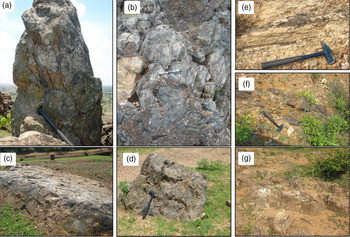
The CD consists of tuff, tuffaceous phyllite, banded iron formation (BIF), banded carbonate chert (BCC), carbonate, pillow basalt, massive basalt, andesite, rhyolite and pyroclastics. A garnet-micaschist band occurs at the contact with granitoids of the ND, and concordant intrusive bodies of pyroxenite-dolerite/gabbro are also observed (Figs 1b, 2). The tuffaceous rocks are spread throughout the area and encompass multiple thin lensoids of BIF, BCC and carbonate (Fig. 2f). Mafic to felsic pyroclastic rocks are exposed near Ghansura village. Basalts are the most widespread volcanic rock from the CD. These basalts are represented by both massive as well as pillowed varieties. The CD extends sporadically for a strike length of 45–50 km from Mahadev Bigha locality in the NE up to Churi and Jaganathpur locality in the SW (Fig. 1b; online Supplementary Fig. S1, available at http://journals.cambridge.org/geo).
(a, b) Cross-sectional view of pillows at Churi displaying variation in size and shape, inter-pillow space, rim/rind, vesicles, budding etc. (c) Longitudinal view of pillows at Mahadev Bigha. (d) Irregular shape pillow at Ghansura, loosely packed, inter-pillow space filled with quartz and carbonate. (e) Chert and jasper bands in carbonate (siliceous dolomite) rock. (f) banded iron formations (BIFs) in alternation with tuffaceous layers. Tuff is metamorphosed to tuffaceous phyllite. (g) Typical elephant skin weathering in siliceous dolomite.

No robust chronostratigraphic relations amongst the litho-domains of BVSS is yet established due to a lack of age data from the exposed rock types. However, field relations show that the BVSS unconformably overlies the CGGC. The lowermost unit of the BVSS comprises a pyroxenite-gabbro-anorthosite suite of rocks, which is exposed as enclaves within overlying units. This unit is overlain by the pillow and massive lavas, mafic-felsic pyroclasts, felsic volcanics, felsic tuff, BIF, BCC and limestone occurring as a rock assemblage. Dolerite/gabbro dykes are intrusive in this unit. Clastic sediments, phyllite and quartzite tops this rock assemblage as the sedimentary cover, and granites/granitoids cross-cut this entire litho-domain of the BVSS. Generalized stratigraphy of the area with respect to the CGGC is provided in online Supplementary Table S1.
The focus of the current study is the pillow basalts. Well-preserved pillow basalts are found near Mahadev Bigha and Ghansura villages towards the northeastern extension and near Churi and Jaganathpur towards the southwestern extension of the BVSS (Fig. 2a–d; online Supplementary Fig. S2). The pillows in the basalt of the BVSS are of variable shape and dimension. Their size ranges from small pillow of < 20 cm to mega pillow of > 1 m length of the longer axis. The lower horizon of basalts shows diversity in pillows configuration, for example, spherical, elongated, ellipsoidal, bun, mushroom, kidney, irregular shape, etc. However, in upper flows, pillows are either spherical or elliptical in shape. The pillow structures exhibit well-developed chilled margins, rim/rind, vesicles, cracks, V-up and convex-up features. However, radial cracks in pillows are not frequently observed. The pillows are tightly packed with less inter-pillow space (online Supplementary Fig. S2). Pillow breccias are abundant in Jagannathpur.
Both primary and diastrophic structures are well preserved in the volcano-sediments of the area. The sedimentary structures include mainly compositional and colour banding (S0) in tuff/tuffaceous phyllite, BIF and BCC. The BCC with alternate chert and carbonate bands shows a rib and furrow structure. The primary magmatic structures in volcanic rocks include primary compositional/colour banding, flow banding, pillows, pyroclasts and vesicular structures. The folded volcano-sedimentary sequence experienced at least three phases of deformation: D1, D2 and later D3. Both mappable and non-mappable closures corresponding to these deformational events have been recognized from the swerving of foliation, attitude of the beds and presence of folded outcrops. The presence of three sets of foliations, the refolding of bedding-parallel foliation and the presence of doubly plunging folds and rootless isoclinal folds are noteworthy features (online Supplementary Figs S3, S4). The area has experienced brittle and brittle-ductile deformation, as indicated by tension gashes showing en échlon sigmoidal shear sense. The normal and thrust faults have been identified in various parts of the volcano-sedimentary sequence. Faults are observed in the form of brecciation, fault gauge, slickensides, silicification, pseudo-tachylite and en échlon pattern of tension gashes at various locations (online Supplementary Fig. S5).
3. Samples and analytical methods
3.a. Outcrops and samples
Mafic rock samples were collected from the Churi, Jagannathpur, Gulani and Bathani villages, Gaya district of Bihar. Ten rock samples from outcrops of pillow basalts and associated dolerite dykes were taken for petrographic and major- and trace-element studies. The co-ordinates of the samples are given in online Supplementary Table S2. The outcrops occur as massive blocks associated with sedimentary units.
3.b. Analytical methods
Ten representative samples were selected and cut into thin-sections for qualitative petrographic analysis at the University of Delhi, India. All 10 petrographically studied samples were broken into small pieces to remove any trace of veins. The rock samples were crushed and pulverized using agate carbide ring grinder. The major oxides and selected trace-elements analysis were carried out using an X-ray fluorescence spectrometer (XRF) (Bruker S8 Tiger Sequential X-ray spectrometer with Rh excitation source) following the procedure described by Saini et al. (Reference Saini, Mukherjee, Rathi, Khanna and Purohit1998, Reference Saini, Mukherjee, Rathi and Khanna2000). Rare earth elements (REE) were analysed using inductively coupled plasma mass spectrometry at the Wadia Institute of Himalaya Geology, Dehradun, India.
The operating conditions were: no filter, vacuum path and 20–40 kV for the major oxides; and no filter, vacuum path and 55–60 kV for trace elements. The overall accuracy in relative standard deviation (RSD) percentage is 4.5% for major and minor oxides, and 12% for the trace elements. The average precision is better than 2.0% (Purohit et al. Reference Purohit, Mukherjee, Saini, Khanna and Rathi2006; Saini et al. Reference Saini, Mukherjee, Rathi, Khanna and Purohit2007). Sample solutions were introduced for REE analysis into the argon plasma using a peristaltic pump and a cross-flow nebulizer. The procedures adopted for sample digestion and the preparation of solutions are described in Balaram et al. (Reference Balaram, Saxena, Manikyamba and Ramesh1990). Samples from the United States Geological Survey (USGS) (Sample BHVO-1) and the Japanese Geotechnical Society (JGS) (Sample JBI 1a) were used as rock standards to minimize the matrix effect. The RSD for most of the samples is better than 10%.
4. Results
4.a. Petrography
Mafic rocks can be identified as basalts and dolerites based on petrography. The basalts display a mineral assemblage typical of lower greenschist facies conditions. They are composed of plagioclase feldspar, amphibole, chlorite and minor opaque minerals (Fe–Ti oxide) (Fig. 3a–d). The phenocrysts are mainly euhedral and subhedral pseudomorphs of amphibole (Fig. 3c) after pyroxene. Plagioclases commonly show replacement by albite and saussurite (Fig. 3a, b) in most of the basalt samples. However, the plagioclases of sample RJ8 show extensive sericitization. Chlorite and amphibole usually replace pyroxene in the samples (Fig. 3d). The groundmass of the basalt displays intergranular or intersertal textures. It is composed of long columnar or acicular plagioclase, rhomboidal pale-brown amphibole, acicular or fibrous pale-green amphibole. Some of the metabasalts display plagioclase grains preserved within a matrix composed of chlorite and carbonate minerals (Fig. 3d).
Photomicrographs. (a) Metamorphosed pillow basalt showing spherulitic texture and greenschist facies mineralogy. (b) Metabasalt showing porphyritic texture. Phenocryst is of saussuritized plagioclase embedded in the fine-grained groundmass of amphibole, chlorite and opaque minerals (c) Metabasalt showing phenocryst of pyroxene, which has altered to amphibole, embedded in a groundmass of altered plagioclase and chlorite. (d) Relics of the porphyritic intergranular texture of an altered basalt. Altered plagioclase crystals can be observed with preserved subhedral to euhedral shapes. (e, f) Altered dolerite shows ophitic texture where laths of plagioclases are enclosed within pyroxenes, which are now altered to chlorite and amphibole. (g, h) Metadolerites showing saussuritization of plagioclase and alteration of pyroxene to amphibole and chlorite.

Dolerite consists of plagioclase, hornblende and opaque minerals. Dolerites exhibit ophitic to sub-ophitic textures. Ophitic to sub-ophitic textures are usually observed where plagioclase laths are enclosed partially or entirely within pyroxenes, now amphiboles and chlorites (Fig. 3e–g). The plagioclases are saussuritized, and the clinopyroxenes are typically replaced by secondary amphibole or chlorite (Fig. 3g, h).
4.b. Geochemistry
Major- and trace-element data and selected inter-element ratios of 10 samples of mafic rocks of BVSS are presented in Table 1, and their geochemical signatures are described below.
Major oxides, trace and rare earth elements composition of the pillow lava basalts and dolerites from the Bathani volcano-sedimentary sequence of CGGC. BDL – below detection limit.

The major-element composition is consistent with the compositional range of basalts and dolerites in which moderate variations are observed. In basalts the variations are: SiO2, 43.67–49.83 wt%; Al2O3, 8.9–18.6 wt%; TiO2, 1.6–2.57 wt%; Fe2O3, 8.96–18.79 wt%; MgO, 5.4–8.25 wt%; CaO, 10.39–15.39 wt%; K2O, 0.17–0.79 wt% (except for one sample RJ8 with K2O content of 4.3 wt%); and Na2O, 0.79–2.8 wt%. The variations in dolerites are: SiO2, 45.08–46.72 wt%; Al2O3, 14.03–14.07 wt%; TiO2, 0.72–0.79 wt%; Fe2O3, 12.01–13.38 wt%; MgO, 10.07–11.15 wt%; CaO, 9.25–10.55 wt%; K2O, 0.33–0.5 wt%; and Na2O, 2.07–2.54 wt%.
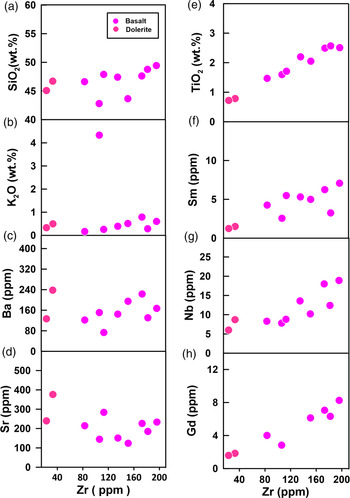
The Mg no. for basalt varies from 37.3 to 64.4 and for dolerites is c. 62. The Mg no. is calculated based on the formula 100 ×(MgO/40.32)/[(MgO/40.32) + (FeO/71.85)], where FeO is calculated from Fe2O3 by using a conversion factor of 0.8998. The studied rocks display low loss on ignition (LOI) values (0.3–3.75 wt%). The fluid mobile large-ion lithophile elements (LILE) concentrations are: Rb, 3–99 ppm; Sr, 124–376 ppm; and Ba, 73–238 ppm. To find the mineralogically altered primary rock composition of the rock, we adopted a rock classification diagram based on immobile element ratios. The immobile element ratio diagrams remove the elemental mass change effect produced by the hydrothermal alteration. The high-field-strength element (HFSE) ratio of altered rock is similar to the HFSE ratio of parent rock (Finlow-Bates & Stumpfl Reference Finlow-Bates and Stumpfl1981; MacLean & Barrett, Reference MacLean and Barrett1993). The HFSE classification diagram is therefore preferred for altered rocks. All the studied samples plot in the field of basalt of Zr/Ti versus Nb/Y discrimination diagram (online Supplementary Fig. S6) after Pearce (Reference Pearce and Wyman1996). Variation diagrams of selected major elements (SiO2 and K2O) and fluid mobile elements (Ba and Sr) do not display systematic correlations with Zr contents (Fig. 4a–d). Zr was chosen to be plotted against other elements in bivariate plots as it is considered to be one of the least mobile elements; it is therefore used as an alteration independent index of geochemical variations in modern volcanic rocks (Winchester & Floyd, Reference Winchester and Floyd1977; Pearce & Peate, Reference Pearce and Peate1995; Polat et al. Reference Polat, Hofmann and Rosing2002). The fluid immobile elements display moderate variations in Ti (4316–15 046 ppm), V (196–441 ppm), Th (0–2.25 ppm), Yb (0.88–4.53 ppm), Nb (3.8–18.9 ppm), Y (16–47 ppm), La (3.3–19.4 ppm) and Sm (1.5–7.08 ppm). Selected fluid immobile elements (TiO2, Sm, Nb and Gd) display systematic correlations with Zr contents (Fig. 4e–h), and ratios of Zr/Ti = 0.05–0.01, Nb/Y = 0.22–0.48, Ti/V = 20.26–36.17 and (La/Sm)N = 1.31–2.15 are consistent with the transitional nature of basalts between tholeiitic and calc-alkaline. The transitional nature of magma is further confirmed by discrimination diagram based on the immobile element of Y versus Zr (online Supplementary Fig. S7).
Bivariate diagrams. (a–d) Zr versus selected major elements such as SiO2 and K2O and fluid mobile elements such as Ba and Sr. (e–h) Zr versus selected fluid immobile elements such as TiO2, Sm, Nb and Gd. Major elements and fluid mobile elements show non-correlating behaviour. In contrast, the fluid immobile elements show a correlating trend.

On the chondrite-normalized REE diagram, the studied mafic rocks display slight enrichment of LREEs ((La/Yb)N = 1.71–3.88; (Gd/Yb)N = 1.18–1.74) relative to HREEs (Fig. 5a). Studied samples display variable Eu/Eu* values (0.87–1.26), suggesting fractionation of plagioclase. The sum of REEs ranges from 43.75 to 119.11 for basalts and from 24.36 to 31.72 in the dolerites. These values, along with the subparallel nature of the trend in REEs, indicate the cogenetic nature of these rocks. On normal mid-ocean ridge basalat (N-MORB) normalized trace-element diagram (Fig. 5b), the mafic rocks display elevated concentrations of slab-derived components such as K, Rb, Sr, Ba, Th and Pb relative to the conservative mantle-wedge-derived components such as Ti, Zr, Nb, Sm, Eu, Dy, Yb and Lu.
(a) Sample/chondrite-normalized rare earth element trends of Bathani mafics; normalizing data from Sun & McDonough (Reference Sun, McDonough, Saunders and Norry1989). (b) Sample/MORB normalized trace-element spidergrams; normalizing data from Hofmann (Reference Hofmann1988). For comparison purposes, trace-element data in blue and purple patterns plotted from the Izu–Bonin–Mariana and New Britain–Manus back-arc basins. Data source: Metcalf & Shervais (Reference Metcalf, Shervais, Wright and Shervais2008).

5. Discussion
5.a. Post-magmatic alteration
Petrographic observations show that the mafic rocks of the Bathani area have experienced greenschist facies metamorphism. The amphiboles and chlorites are interpreted as metamorphic minerals that have entirely replaced magmatic counterparts, most likely pyroxene. Plagioclase occurs as laths, reflecting typical magmatic textures in the mafic pillows. The replacement of original pyroxene crystals by amphiboles without any change in original igneous textures suggests isochemical changes and volume to volume replacement (Redman & Keays, Reference Redman and Keays1985). The observed modification in the magmatic textures and primary minerals of the BVSS basalts is possibly connected with the metamorphic event reported in the CGGC spaning 1.6–1.5 Ga during the Mesoproterozoic Era (Maji et al. Reference Maji, Goon, Bhattacharya, Mishra, Mahato and Bernhardt2008; Chatterjee et al. Reference Chatterjee, Banerjee, Bhattacharya and Maji2010; Karmakar et al. Reference Karmakar, Bose, Sarbadhikari and Das2011; Rekha et al. Reference Rekha, Upadhyay, Bhattacharya, Kooijman, Goon, Mahato and Pant2011). Further, the mafic samples of our study display variations in major elements and LILEs. No clear correlation can be ascertained for the Zr behaviour against major elements and LILE of these samples (see Fig. 4). The LOI values (0.3–3.7 wt%) seem to have been affected by the post-magmatic alteration process. Most likely, the LOIs are increased by the presence of amphibole and chlorites in the samples. However, the absence of Ce anomaly and the lack of any tight correlation of major oxides, HFSE and LILE with the LOI values suggest that these elements were not significantly modified by the metamorphism or any other secondary alteration process.
Several studies have established that major elements, LILE (K, Rb, Na, Sr, Ba, U and Pb) and LREE are susceptible to redistribution during metamorphism as a result of their high mobility. In contrast, Nb, Ti, Zr and Y and HREE are relatively immobile during alteration processes (Pearce & Norry, Reference Pearce and Norry1979; Valsami & Cann, Reference Valsami, Cann, Parson, Murton and Browning1992). The petrogenetic inferences of the studied rocks are therefore based on the assessment of geochemical signatures of the fluid immobile elements.
5.b. Magmatic evolution
Mafic magma experiences open-system processes such as crustal contamination and fractional crystallization; these processes may change the chemical compositions of the primary mafic magma during its passage through the continental crust to variable extents. The potential influence of such processes should therefore be assessed before constraining the nature of parental magma for the mafic rocks of the BVSS.
Melt derived from the mantle is susceptible to crustal contamination through ascent or temporary residence in crustal magma chambers (Watson, Reference Watson1982; Mohr, Reference Mohr, Halls and Fahrig1987; Pe-piper et al. Reference Pe-piper, Matarangas, Reynolds and Chatterjee2003). The continental crust is enriched in LILEs and LREEs and depleted in HFSEs. The assessment of ratios, namely Ti/Y, Ba/Nb, La/Yb, La/Sm, Ba/Zr, Zr/Y, (Nb/Yb)PM, (Th/Yb)PM and Nb/Y, is therefore routinely used in evaluating the crustal contamination (Rollinson, Reference Rollinson1993). Trace-element ratio diagrams for Bathani mafic rocks are shown in Figure 6a–c. Plots show that studied basalts follow the mantle array except for the dolerites. Samples plotting away from the mantle array are likely affected by lower continental crustal (LCC) contamination. The elemental ratios such as Zr/Nb (3.66–15.16) and Ba/Nb (8.11–26.44) in the studied basalts are lower than those for continental crust (Zr/Nb = 16.2; Ba/Nb = 54; Hofmann et al. Reference Hofmann, Jochum, Seufert and White1986), which indicates that they probably lack continental lithospheric sources. The studied mafic rocks also have La/Nb ratios (0.55–1.13) similar to the asthenospheric mantle (La/Nb < 1) and lower than the lithospheric mantle (La/Nb > 1) (Fitton et al. Reference Fitton, James, Kempton, Ormerod and Leeman1988; Thompson & Morrison, Reference Thompson and Morrison1998), suggesting an origin from the asthenospheric mantle. The origin of the rocks from asthenospheric mantle source is further corroborated by the ratio diagram of (La/Yb) versus (Nb/La) of Smith et al. (Reference Smith, Sánchez, Walker and Wang1999) (Fig. 7a). Moreover, in crustal contamination, the bulk composition of rocks shifts towards andesitic composition with higher SiO2 and low MgO. On the contrary, the integration of the subduction component into the mantle would not ensue any such change in the bulk composition (Rudnick & Gao, Reference Rudnick, Gao, Rudnick, Holland and Turekian2003; Hollings et al. Reference Hollings, Smyk and Consens2012; Ernst, Reference Ernst2014). Our samples display a lower abundance of SiO2 (< 49.43 wt%), a higher abundance of MgO (5.85–11.15 wt%), Ni (43–429 ppm) and Cr (156–628 ppm), and a lower abundance of Th (< 2.2 ppm). These signatures of available bulk rock data of our samples rule out significant crustal contamination as the dominant process. Rather, the trace-element characteristic of Bathani mafic rocks can be attributed to an enriched mantle source rather than crustal contamination.
(a) Ti/Y versus Ba/Zr; (b) Ti/Y versus Ba/Nb; and (c) Nb/Y versus Zr/Y variation diagrams of the mafic rocks of the BVSS. Average lower crust (+; Weaver and Tarney, Reference Weaver and Tarney1984), N-MORB (half-filled square; Humphris et al. Reference Humphris, Thompson, Schillin and Kingsley1985), E-MORB (open square; Humphris et al. Reference Humphris, Thompson, Schillin and Kingsley1985), OIB (star; Sun, Reference Sun1980), primordial mantle (circle; after McDonough & Sun, Reference McDonough and Sun1995). The value of average continental crust (+) is from Rudnick & Fountain (Reference Rudnick and Fountain1995) and Rudnick & Gao (Reference Rudnick, Gao, Rudnick, Holland and Turekian2003).

(a) La/Yb versus Nb/La (Smith et al. Reference Smith, Sánchez, Walker and Wang1999) plot shows enriched mantle source for Bathani mafics. (b) Th/Sm versus Th/Ce diagrams of the Bathani mafics showing the involvement of subducted sediment in the depleted mantle. (c) Nb/Y versus Rb/Y (d) Nb/Zr versus Th/Zr, indicating melt addition in Bathani mafics.

The enrichment of LILE and depletion of HFSE in the studied samples can be a characteristic of the mantle source, which may be attributed to subduction-related mantle metasomatism. Generally, enrichment/metasomatism can take place in two ways: either by hydrous melts or by slab-derived fluids in subduction systems (Saunders et al. Reference Saunders, Norry, Tarney, Pickering, Knipe, Dewey, Tarney, Pickering, Knipe and Dewey1991; Pearce & Parkinson, Reference Pearce, Parkinson, Prichard, Alabaster, Harris and Neary1993; Pearce & Peate, Reference Pearce and Peate1995; Gribble et al. Reference Gribble, Stern, Bloomer, Stüben, O’Hearn and Newman1996; Hawkesworth et al. Reference Hawkesworth, Turner, McDermott, Peate and Van Calstern1997; MacDonald et al. Reference MacDonald, Hawkesworth and Heath2000; Elburg et al. Reference Elburg, Bergen, Hoogewerff, Foden, Vroon, Zulkarnain and Nasution2002). Several studies on mantle metasomatism have revealed that proxies such as REE, Th, and Ba behave differently in slab-derived fluid and slab-derived melts (e.g. Kogiso et al. Reference Kogiso, Tatsumi and Nakano1997; Woodhead et al. Reference Woodhead, Hergt, Davidson and Eggins2001; Spandler & Pirard, Reference Spandler and Pirard2013). The use of these proxies can therefore easily identify the role of fluids and melts derived from subducted oceanic crust and sediments (Guo et al. Reference Guo, Li, Fan, Li, Zhao, Huang and Xu2015). As illustrated in the plot of Th/Sm versus Th/Ce, the Bathani mafic rocks show a sediment input trend (Fig. 7b) probably indicative of sediment-related melt enrichment. In ratio plots of Rb/Y versus Nb/Y (Fig. 7c) and Nb/Zr versus Th/Zr (Fig. 7d), all the studied samples indicate that melt-related enrichment by sediment metasomatism has played a dominant role in the evolution of the mafic magma. It can be inferred that the mafic rocks of the Bathani area have been derived from a depleted mantle source that was modified mainly by the subduction-related sediments with subordinate influence from the fluid-derived melt.
It is widely accepted that primary mantle-derived melts generally have Mg no. > 70, Cr > 1000 ppm and Ni > 400 ppm (Yan et al. Reference Yan, Shi, Metcalfe, Liu, Xu, Kornkanitnan, Sirichaiseth, Yuan, Zhang and Zhang2018). The mafic rocks of the BVSS have much lower values for Mg no. (37.38–62.42), Cr (156–489 ppm) and Ni (49–282 ppm, except for sample RJ8), indicating the substantial role of fractional crystallization. Low concentrations of MgO, CaO and compatible elements indicate fractionation of clinopyroxene in the studied rocks. The positive correlation between Cr and Ni also favours the fractionation of clinopyroxene in the studied samples (online Supplementary Fig. S8a). In contrast, the positive correlations of Eu/Eu* with Sr/Y and Sr/Sr* and a negative correlation between Eu/Eu* and total REE indicate the role of plagioclase fractionation (online Supplementary Fig. S8b–d). However, for the dolerite samples (RJ15 and RJ19), Eu/Eu* > 1.0, suggesting plagioclase accumulation is responsible for the positive Eu anomalies observed for these samples. Fractionation and/or accumulation of pyroxene and plagioclase in the magma chamber were therefore responsible for forming the BVSS mafics.
5.c. Depth constraints, partial melting and mantle source
In chondrite-normalized REE patterns, magmas generated by partial melting of a garnet-lherzolite mantle source are known to exhibit relatively high fractionation of HREEs due to the presence of residual garnet, whereas magmas generated from partial melting of a spinel lherzolite source display flat REE patterns (e.g. Hirose & Kushiro, Reference Hirose and Kushiro1993). The chondrite-normalized REE plot of Bathani mafic rocks display relatively flat HREE patterns ((Dy/Yb)CN = 0.89–1.74), suggesting their formation by partial melting of a mantle source in the spinel stability field. Further, the melting of the plagioclase-bearing mantle would generate quartz tholeiitic basalts (e.g. Hansen et al. Reference Hansen, Davidson, Jerram, Ottley and Widdowson2019), which is not the case with Bathani mafic rocks. The primary magma for the Bathani mafic therefore probably formed between pressures P < 2.8 GPa (Robinson & Wood, Reference Robinson and Wood1998) and P > 0.8–0.7 GPa (Borghini et al. Reference Borghini, Fumagalli and Rampone2010), corresponding to depths of < 85 km and > 30 km (where depth is calculated as (3.02 × P in kbar) + 5; Scarrow & Cox, Reference Scarrow and Cox1995), respectively.
Three types of melting – batch, fractional and dynamic – models are generally used to estimate the degree of partial melting in the source. During batch (equilibrium) melting, a finite amount of melt is produced that equilibrates with the solid residue. The melt is extracted during fractional melting as soon as it is produced, and very little amount will be in equilibrium with the solid residue. Dynamic melting is based on the principle that melt in excess of source porosity is extracted at the same rate at which it is produced (e.g. Zou & Zindler, Reference Zou and Zindler1996). Batch melting model is usually applied for homogenous rocks where the mineral phases appear to be in equilibrium. However, robust quantification of the melting processes that produced Bathani mafic rocks is difficult as mantle source compositions are hard to constrain. Nonetheless, semi-quantitative REE modelling has been widely used to constrain the source for mafic rocks associated with various tectonic settings (Montanini et al. Reference Montanini, Tribuzio and Vernia2008; Reference Saccani, Allahyari, Beccaluva and BianchiniSaccani et al. 2013a , b, 2014; Liu et al. Reference Liu, Chen, Ma, Liu, Gong, Shi and Han2018).
Here, we use the non-modal batch melting calculations (after Shaw, Reference Shaw1970) to estimate the degree of partial melting (F) of a mantle source that produced the Bathani basaltic rocks. Chondrite-normalized REE patterns of Bathani basalt suggest partial melting of source in the spinel stability field, as discussed in Section 5.b. Non-modal batch melting of a depleted mantle source (DM; Salters & Stracke, Reference Salters and Stracke2004) produces partial melts with more depleted LREE trends than the Bathani basalt. It can therefore be inferred that an LREE composition slightly more enriched than DM is the most credible source for the studied samples. After a trial, it was found that slightly LREE enriched spinel lherzolite of Carlson & Ionov (Reference Carlson and Ionov2019; sample s_S-32) produced melts that are near-parallel to the Bathani mafic at variable degrees of partial melting. The inferred mantle source composition is similar to the primitive mantle (Sun & McDonough, Reference Sun, McDonough, Saunders and Norry1989).
The possible range of residual mineral modes in the source can be inferred from naturally occurring spinel lherzolites. The effects of source composition and residual mineralogy on partial melting are better constrained in the (Yb)N versus (Ce/Sm)N binary plot (e.g. Hansen et al. Reference Hansen, Davidson, Jerram, Ottley and Widdowson2019). Figure 8 is a (Yb)N versus (Ce/Sm)N binary plot for Bathani basalt samples. Partial melts generated by non-modal batch melting of the inferred source (sample s_S-32; Carlson & Ionov, Reference Carlson and Ionov2019) at variable mineral modes are also shown. Figure 8 demonstrates that partial melt generated by residual mineral mode olivine 55%, orthopyroxene 20%, clinopyroxene 23% and spinel 2% is best suited to the Bathani basalt samples. Here, the Bathani basalt samples are well constrained within F = 4–12%.
(Yb)N versus (Ce/Sm)N plot for Bathani basalt samples. Dashed black lines are melt curves at variable residual mineral modes, and filled circles represent the percent of partial melt fractions. Source rock is spinel lherzolite (Sample s_S-32; Carlson & Ionov, Reference Carlson and Ionov2019). Residual mineral mode 0.55 ol, 0.20 opx, 0.23 cpx and 0.02 sp best represent Bathani basalt samples. Partition coefficients from McKenzie & O’Nions (Reference McKenzie and O’Nions1991). Normalizing chondrite values from Sun & McDonough (Reference Sun, McDonough, Saunders and Norry1989). Depleted mantle (DM) composition after Salter & Stracke (2004). ol – olivine; opx – orthopyroxene; cpx – clinopyroxene; sp – spinel.

5.d. Tectonic setting and geodynamic implications
The trend of the N-MORB normalized trace elements of the studied mafic rocks has a strong resemblance to the back-arc basalts with enriched MORB (E-MORB) affinity as for those from the Izu–Bonin–Mariana back-arc. A pronounced enrichment in highly incompatible elements such as Cs, Rb and Th are consistent with back-arc basin basalts of subduction environment. The Th/Yb versus Nb/Y discrimination diagram shows the composition of the mafic rocks clustering near E-MORB composition (Fig. 9a) showing similarity to basalt that erupts in general back-arc tectonic settings (Metcalf & Shervais, Reference Metcalf, Shervais, Wright and Shervais2008). Furthermore, the tectonic setting of altered mafic rocks can be robustly constrained by evaluating the fluid immobile elements such as Ti, V, Zr and Y. In Figure 9b, Ti/V ratios for the studied samples range over 20.26–36.17 and fall within the MORB and back-arc basin tectonic settings (Shervais, Reference Shervais1982). The Ti/Zr versus Zr discrimination diagram after Woodhead et al. (Reference Woodhead, Eggins and Gamble1993) show the back-arc basin affinity of the Bathani mafics rocks (Fig. 9c). However, Zr/Y versus Zr plots displayed mixed signatures of MORB and arc lavas (Fig. 9d). The observed hybrid mixture between MORB and arc-like elemental signatures for the studied mafic rocks is generally associated with back-arc basin basalts (Volpe et al. Reference Volpe, Macdougall and Hawkins1987; Pearce & Peate, Reference Pearce and Peate1995; Pearce & Stern, Reference Pearce, Stern, Christie, Fisher, Lee and Givens2006). A closer look at the REE pattern and trace-element signatures along with trace-element ratios (e.g. Th/Yb, Nb/Yb, Zr/Y, Zr/Ti and Ti/V) of the studied mafic rocks reveal that the Bathani area matches the composition of back-arc supra-subduction zone (SSZ) ophiolitic basalts.
(a) Nb/Yb versus Th/Yb plot after Pearce (Reference Pearce2008) for the studied samples of Bathani mafics showing compositional similarity to E-MORB. (b) Ti versus V plot of the Bathani mafics (Ti/V ratios: island arcs, 10–20; MORB, 20–50; mixed MORB and island arc, 20–30; back-arc basins, 10–50) and boninite field; diagram after Shervais (Reference Shervais1982). (c) Discrimination of back-arc basalt affinity of the Bathani mafics rocks on Ti/Zr versus Zr (Woodhead et al. Reference Woodhead, Eggins and Gamble1993). (d) Zr versus Zr/Y tectonic discrimination diagram (after Pearce & Norry, Reference Pearce and Norry1979) showing mixed signatures of island arc and MORB for Bathani mafics. IAT – island-arc tholeiite; MORB – mid-oceanic ridge basalt; WPB – within-plate basalt.

SSZ ophiolites represent oceanic lithosphere formed in the extended upper plates of subduction zones formed by magmatism in the fore-arc and back-arc basin and the nascent stage of arc volcanism, in the region above the Wadati–Benioff zone (Hawkins, 2003). The lavas therefore range from MORB to arc tholeiite to boninite, primarily reflecting formation in different parts of a supra-subduction zone environment (Dilek & Furnes, Reference Dilek and Furnes2009). The genesis of supra-subduction ophiolites involves subduction initiation, followed by rapid slab rollback leading to extension and seafloor spreading in the downgoing slab. These processes generate melt with MORB-like composition in the proto-arc to back-arc settings during the early phase of melting. In subsequent phases of melting, melt column beneath the proto-arc–back-arc region may be strongly influenced by processes such as slab dehydration and related mantle metasomatism, melting of subduction sediments, repeated episodes of partial melting of metasomatized peridotites and mixing of highly enriched liquids from the deeper fertile source resulting in variable lava composition. Studies by Hawkins (2003) and Dilek & Furnes (Reference Dilek and Furnes2014) have further pointed out that SSZ systems also display rock series ranging from picrites to rhyolites, including arc tholeiitic, high-K calc-alkaline and shoshonitic magma series generated in the associated volcanic arc. Deeper-level arc crust also displays various types of layered and isotropic gabbro as well as granitoid plutons. A wide assortment of sediments ranging from arc-derived tephra and volcanoclastic turbidites to silicic and carbonate oozes also occurs in SSZ systems. Crustal units are commonly underlain by mafic cumulates and mantle rocks comprising depleted harzburgite, dunite and serpentinized equivalents. The close spatial and temporal association of back-arc basin rocks with arc rocks and volcanic detritus is a significant signature which distinguishes it from MORB ophiolites. The crustal contraction in an SSZ environment would tectonically juxtapose arc, back-arc and fore-arc crust leading to a close spatial and temporal association of back-arc basin rocks with arc rocks and volcanic detritus. This signature distinguishes it as an SSZ ophiolite, differentiating it from MORB-type ophiolites.
We envisage that during juvenile stages of intra-oceanic subduction, a back-arc basin opened up in which basaltic rocks of E-MORB affinity of the CD of Bathani area were generated. This led to a modification of the pre-existing oceanic lithosphere within which subduction started, and in which a magmatic arc formed upon subduction maturation. In this magmatic arc, the mafic and felsic volcanics, andesites and associated pyroclastics were generated. Although the mantle rock sequence pyroxenite-gabbro-anorthosite is not directly exposed in the area, it is preserved as enclaves within the granitoids of the ND. Subduction zone sediment cover is now metamorphosed and manifests itself as clastic sediments, phyllite and quartzite, overlying these units comprising the SD. The 1750–1640 Ma granites/granitoids of arc affinity present in the area cross-cut the ophiolite sequence and, in all probability, mark the post-collisional orogenic events.
Although geochronological records from the massive terrain of the CGGC are limited, Palaeoproterozoic ages corresponding to metamorphic and magmatic events have been reported from different parts of the terrain. Dey et al. (Reference Dey, Mukherjee, Sanyal, Ibenz-Mejia, Sengupta and Mazumder2017) reported Late Palaeoproterozoic (c. 1650 Ma) ultra-high-temperature metamorphism from the northeastern part of the CGGC, and the P–T path inferred by the study supports a convergent margin setting. Saikia et al. (Reference Saikia, Gogoi, Kaulina, Lialina, Bayanova, Ahmad, Pant and Dasgupta2017, Reference Saikia, Gogoi, Ahmad, Kumar, Kaulina, Bayanova and Mondal2019) reported Palaeoproterozoic subduction-related felsic magmatism (c. 1750–1660 Ma) from the northern part of the terrain. Shreds of evidence of such tectonothermal events from parts of the CGGC establishes beyond doubt its involvement in the evolution of the Greater Indian landmass during the Columbia/Nuna supercontinent assembly. It is significant in the context of our study as the Bathani area is cross-cut by late intruded granites of Palaeoproterozoic age, from which it can be inferred that the mafic rocks precede the granites and have at least a Palaeoproterozoic age. This study and the published petrological, geochemical and geochronological data indicate that the Bathani area is a site of preserved Palaeoproterzoic relics of volcanic back-arc magmas and associated felsic magmatism of arc affinity of subduction regime. The geometrical configuration of the BVSS indicates its emplacement between the Archean to Proterozoic Son-Narmada Lineament zone and the Palaeoproterozoic felsic orthogneisses exposed within the Quaternary alluvium towards the north of the CGGC. Geochemical signatures suggest that the Bathani pillow lavas are reminiscent of Proterozoic supra-subduction zone ophiolite lavas. We compare our data with known occurrences of Proterzoic ophiolitic lavas in India and other geological occurrences, and the similarity is very significant (Fig. 10a–d). We infer that the Bathani mafic pillow lavas and associated chert and dolomites represent the upper part of a supra-subduction-type columnar ophiolite section, which was displaced onto the present-day northern margin of CCGC and is believed to mark the suture between Northern and Southern Indian blocks at c. 1.9 Ga.
Various diagrams used for geochemical classification and tectonic discrimination of tectonic settings of ophiolitic crustal units after Pearce (Reference Pearce2014) were adopted in this paper to compare our mafic rock data with Proterzoic ophiolitic mafics. (a) Zr/Ti–Nb/Y diagram from Floyd & Winchester (Reference Floyd and Winchester1975). (b) Th/Yb–Nb/Yb and (d) TiO2/Yb–Nb/Yb diagrams after Pearce (Reference Pearce2008). (c) V–Ti/1000 diagrams after Shervais (Reference Shervais1982) and modified by Pearce (Reference Pearce2014). Data used for comparison are from Indian occurrences of Proterozoic ophiolites: Palaeoproterozoic Kandra Ophiolite Complex, Southern India and Proterozoic ophiolite melange Nellore–Khamman schist belt, SE, India: Saha et al. (Reference Saha, Mazumder and Kar2017); world occurrences of Proterozoic ophiolites: Rao & Reddy (Reference Rao and Reddy2009); Neoproterozoic Wadi Ghadir ophiolite, Eastern desert, Egypt: El-Rahman et al. (Reference El-Rahman, Plot, Dilek, Fryer, Sharkawy and Sakran2009); 1.95 Ga Jormua Ophiolite, North Eastern Finland: Peltonen et al. (Reference Peltonen, Kontinen and Huhma1996); Neoproterozoic Wadi Ghadir Ophiolite, NE Africa, and Cretaceous Ophiolite: Basta et al. (Reference Basta, Maurice, Bakhit, Ali and Manton2011); Cretaceous ophiolite volcanic suite, Ghayth area Oman: Shaikh et al. (Reference Shaikh, Miyashita and Matsueda2005); Late Cretaceous Makran ophiolite, SE Iran: Monsef et al. (Reference Monsef, Rahgoshay, Pirouz, Chiaradia, Gregoire and Ceuleneer2019).

6. Conclusions
The Bathani–Churi section at the northern fringe of Chotanagpur Granite Gneiss Complex is an exemplary site of well-preserved relicts of a subducted Palaeoproterozoic oceanic crust. It is marked by the presence of pillow basalt and dolerites, intermediate–basic volcanics and associated tuff, chert, jasper and dolomites representing the Bathani volcano-sedimentary sequence. The remnants of the oceanic crust are metamorphosed to low-grade greenschist facies conditions. Fluid mobile elements have therefore been redistributed. However, the fluid immobile elements preserve the primary geochemical signatures. The studied mafic rocks may be the product of MORB-like magma generated by partial melting of the upwelling spinel lherzolite in a back-arc extensional setting. The primary magma corresponds to 4–12% partial melting of spinel lherzolite mantle. Geochemical trends of the Bathani mafic rocks are highly reminiscent of the Proterozoic supra-subduction zone ophiolitic composition. The rock assemblage exposed in the study area implies it is part of the supra-subduction-type ophiolitic section marking the suturing of the Northern and Southern Indian blocks during the Nuna Supercontinent amalgamation during the Palaeoproterozoic Era.
Acknowledgements
The manuscript benefited from insightful, constructive revisions by anonymous reviewers and Editor Dr Kathryn Goodenough. Mansoor Ahmad and Abdul Qayoom Paul express sincere gratitude to the Deputy Director General, State Unit, Bihar for his guidance and encouragement. Mansoor Ahmad express thanks to Additional Director General and Head of Department, North Eastern Region, Shillong, for the manuscript’s kind approval for publication. Ashima Saikia acknowledges a Council of Scientific and Industrial Research grant (no. 24(0317)/12/EMR-II).
Supplementary material
To view supplementary material for this article, please visit https://doi.org/10.1017/S0016756821000078





 Open access

