

Introduction
Due to consistent democratic support (Haynie and Watts Reference Haynie, Watts and Stonecash2010; Rigueur Reference Rigueur2014; Wamble et al. Reference Wamble, Laird, McConnaughy and White2022) and the corresponding high levels of racial consciousness and linked fate (Chong and Rogers Reference Chong, Rogers, Wolbrecht and Hero2004; Dawson Reference Dawson1995), Black Americans are often viewed as a political monolith. However, growing numbers of Black migrants (Hamilton Reference Hamilton2019; Reference Hamilton2020; Rogers Reference Rogers2006) and increased identification with Islam (Mohamed Reference Mohamed, Yukich and Edgell2020; Hackett et al. Reference Hacket, Cooperman and Schiller2017) warrant deeper consideration for what growing diversity in the Black community means for conventional theories of Black politics. To that aim, we ask: in what ways do different religious backgrounds reflect differences in Black group consciousness? And, most importantly, does different religious socialization result in differing patterns of political engagement among Black Americans?
Traditionally, religion has been a key focus for Black political mobilization, particularly as Black churches are viewed as key axes of mobilization during the Civil Rights Movement (Allen Reference Allen2023; McAdam Reference McAdam1999; Morris Reference Morris1984). While Black churches were certainly key to the mobilization of Black communities during the Civil Rights Era, so too were Black mosques (Lincoln Reference Lincoln1994). In this article, we examine the legacies of this historical context of Black religious mobilization, and its meaning for the present day amid shifting demographics in Black communities. Despite historical understanding of Black churches reinforcing political socialization of Black communities, there is also a decrease in identification with Christianity and church attendance of Black Christians (Allen Reference Allen2023). When coupled with the general growth of Muslims (Lipka and Hackett Reference Lipka and Hackett2017), Black Muslims have also increased in number, composing about 20% of the U.S. Muslim population (Mohamed and Diamant Reference Mohamed and Diamant2019). This suggests that a decline in traditional political socialization may be combining with new sources of political socialization among Black communities.
We argue that these general differences in religious socialization are also likely to induce differences in how Black Americans perceive politics, form political attitudes, and mobilize. To make this claim, we begin with an examination of how political movements mobilize around collective identities (Bonilla and Tillery Jr Reference Bonilla and Tillery2020; Snow et al. Reference Snow, Rochford, Worden and Benford1986). For Black communities, institutions disseminate important informational cues that inform how Black publics should make political decisions (Dawson Reference Dawson1995). Black institutions are vital in setting the agenda and framing issues (Bonilla and Tillery Jr Reference Bonilla and Tillery2020; Cohen Reference Cohen1999b; Strolovitch Reference Strolovitch2008). However, because Black Christians and Black Muslims maintain different religious affiliations, these institutions may differently reinforce identity, resulting in key differences in how Black Christian and Black Muslim identities reinforce Black identity (Snow and McAdam Reference Snow, McAdam, Stryker, Owens and White2000; White and Laird Reference White and Laird2020). These differences then also result in different attitude construction and issue prioritizations, including on levels of perceived discrimination and social justice issues. As a result, we hypothesize that Black collective identity may be reinforced by religious identity. For Black Christians, race may be perceived as more salient than religion. For Black Muslims, religion may have higher identity salience than race.
We test these hypotheses with two data sets. First, we use data from the 2020 Collaborative Multiracial Post-election Survey (CMPS) to examine how subgroups of Black Americans view their identities, and how different religious backgrounds affect patterns of linked fate among Black Americans. Second, we use the 2020 Pew Black Religion Survey to investigate how religious practices may lead to important differences between Black Muslims and Black Christians, as well as critical similarities. Ultimately, we find differences in the strength of Black identity between Black Muslims and Black Christians. While religious identity is relatively low for Black Christians, it is more salient for Black Muslims. And, while both groups strongly support civil rights actions, there are key differences in attitude formation. Specifically, Black Christians are more likely to perceive race-based discrimination, while Black Muslims are more likely to perceive religious-based discrimination. Both groups maintain relatively high levels of support for social justice issues. But both Black and religious identity are meaningful for the formation of attitudes among Black Muslims, while race-based linked fate is more informative for Black Protestants.
This paper aims to contribute to the growing literature in Black politics that moves beyond partisan identification of groups, and rather probes underlying heterogeneity or complexity in the way group members (here, Black Americans) use other salient identities (here, religion) to inform their political decision-making. The data suggest that religion is a salient and distinct element of socialization among Black Americans. Importantly, Black Americans tend to largely share agreement on social justice issues regardless of religion, but the formation of those opinions relies on differences in religious socialization. As a result, theoretical research understanding Black group consciousness must account for the changing religious involvement of Black Americans, a critical component of time dynamics in adjusting for diversity within racial groups (Hancock Reference Hancock2011). And, empirical research on group consciousness and linked fate among Black Americans should account for religious differences as well. Most critically, work should strive to increase the empirical study of Black Muslims as a growing and important group among Black Americans.
The Role of Religion in Black Political Mobilization
Research on collective identity demonstrates the importance of a shared “we-ness” that results in group consciousness for mobilization (Flesher Fominaya Reference Flesher Fominaya2010; Hunt Reference Hunt2004; Polletta and Jasper Reference Polletta and Jasper2001). Although political movements often unite group members for a cause, the unity can ultimately minimize differences within social movements (Lorde Reference Lorde2012). However, group members will have multiple facets of their identity stemming from class, race, gender, region, and religion that are likely meaningful in determining discrimination and subsequent goals for social change (Hancock Reference Hancock2011). While theories of intersectionality encapsulate the need to understand the interdependence of systems of discrimination (Collins Reference Collins1990; Collins and Bilge Reference Collins and Bilge2020), they also make it clear how social movements—and researchers—struggle to identify and communicate intersectional motivations behind political organization (Bonilla and Tillery Jr Reference Bonilla and Tillery2020). Indeed, to motivate and direct collective action among disparate individuals, a social movement necessarily elevates the unifying identities among its constituents over other identities (Cohen Reference Cohen1999b).
Importantly, more recent Black movements have outlined clear intentions at moving toward intersectional awareness of community needs and of movement participants (Bunyasi and Smith Reference Bunyasi and Smith2019; Hancock Reference Hancock2011), despite difficulties in actualizing them (Bonilla and Tillery Jr Reference Bonilla and Tillery2020). Because historical evidence from the Civil Rights movement exemplifies the connections between political norms that operate through religious institutions (Cohen Reference Cohen1999b; Gay et al. Reference Gay, Hochschild and White2016), we argue that work should also engage religious background in conversations around intersectional identity and Black American mobilization. In particular, how do Black Christians and Black Muslims engage their religious background in the formation of their political attitudes and behaviors? We begin our discussion with a review of how Black Churches and Mosques historically mattered for Black political mobilization. We then examine how differences in Black religious communities might cause differences in political socialization between Black communities.
The Civil Rights Movement, Religion, and Black Mobilization
The Black Church served as a powerful institution for political mobilization, education, and community building due to its ability to act as a site for identity convergence (Cone Reference Cone1970; Gates Jr Reference Gates2022). Identity convergence takes place when existing solidarity networks are appropriated by movement organizers (Snow and McAdam Reference Snow, McAdam, Stryker, Owens and White2000). Thus, as the history of the Black Church was one born from the shared history of oppression of Black Americans, it acted as an ideal site for religious identity and racial identity to reinforce each other and produce political action (Cone Reference Cone1970; Wingfield Reference Wingfield1988). The Black church was central to the movement for various reasons. First, unlike organizations like the NAACP, the church was rooted in specific communities that allowed for church leaders and members to spend time socializing with each other in a way that facilitated cohesion (Morris Reference Morris1984).
Second, the Church was also able to capitalize on the affective dimensions of religion to cultivate movement support (Wingfield Reference Wingfield1988). Religious leaders, such as Martin Luther King Jr., used their extreme charisma and oratory skills to weave cultural references and political messages into weekly sermons (Morris Reference Morris1984). By framing the movement in a nonviolent philosophy and protest as divine, King was often viewed as a prophet that the masses were able to associate with Biblical figures such as Jesus (ibid). By preaching to the masses that all were children of God and juxtaposing the reality of inequality, ministers like King employed the gospel to promote social change (ibid).
Third, the Church served as a space that was uniquely free from white control. Black Churches originated from the exclusion of Black Americans from White churches (Wingfield Reference Wingfield1988). And, Black Churches were economically sustained by the community, which allowed for greater discretion in activities (Owens Reference Owens2008; Tucker-Worgs Reference Tucker-Worgs, Pollard and Duncan2016). As states across the country attempted to ban the NAACP from operating, the Black Churches were able to step in and offer financial support and venues for protest training due to their inability to be outlawed (Morris Reference Morris1984). In the United States, the Black Christian church continues to serve as a predominant mechanism for disseminating political information and monitoring political behavior (Morris Reference Morris1984; White and Laird Reference White and Laird2020). The Black church can also be a site of collaboration with the government to distribute social services (Owens Reference Owens2008). Thus, most work on Black Americans and the political implications of religiosity focuses on the Black church.
Despite the prevalence of the Black Church in histories of the Civil Rights Movement, Black Mosques also played an important role in American political discourse from the Antebellum period to the Civil Rights Movement and beyond (Curtis IV Reference Curtis IV2013). Unlike Christianity, which was introduced to Black Americans upon their arrival in the United States, some West Africans brought Islam with them in the Antebellum period, and religious practices were a form of resistance against White Protestant enslavers (Turner Reference Turner2004). The 20th century saw lively activity from the Black Muslim community through groups such as the Ahmadiyya Muslim community, the Moorish Science Temple, the Nation of Islam, as well as Sunni, Shia, and Sufi groups (Curtis Reference Curtis2007; Husain Reference Husain2017; McCloud Reference McCloud1995). These groups and institutions not only served as sites of religious and political organizing but also cultural phenomena, such as art, music, and fashion, which were used to protest the racial status quo (McCloud Reference McCloud1995).
Black Muslims were credited not simply with helping mobilize in the Civil Rights era, but also with setting critical messages for the movement (Lincoln Reference Lincoln1994). In fact, leader Elijah Muhammad was also credited with mobilizing Black Americans, particularly among lower-income and formerly Christian communities, who were increasingly dissatisfied with the progress of Civil Rights in the United States (ibid). And, as Baldwin (Reference Baldwin1998) noted, the movement driven by Muhammad importantly reframed important arguments, including violence and the approach to the recognition of Black Americans. Perhaps further, the symbolism of changing names signified a key contribution of the movement, which “explicitly and convincingly about the psychological damage that slavery had done to Black Americans” (Turner Reference Turner2004, 457). Even as Malcolm X split from the Nation of Islam movement led by Muhammad (Curtis IV Reference Curtis IV2009), his narrative began to focus on a growing critique of capitalism, which he linked to racial oppression (Turner Reference Turner2004).
As with other Black Christian organizations, Black Muslim organizations in the US were also targets of increased government surveillance throughout the Civil Rights Movement. Surveillance for Black Muslims continued and grew in part due to their transnational ties to the broader Islamic World and opposition to neocolonialism and White supremacy (Curtis Reference Curtis2007). In fact, the height of the pre-9/11 “Muslim scare” was aimed at politically active Black Muslim organizations in the US, which were targeted indiscriminately by the FBI for being “scheming peddlers of foreign ‘isms’” and facilitating transnational ties and diasporic consciousness of Muslims globally (Curtis IV Reference Curtis IV2013).
Collective Identity and Black Politics
The key to understanding Black American political behavior is the role of racial socialization in shaping beliefs about community and the larger effects on the community. For decades, evidence has affirmed Black group consciousness as a unique and defining feature of Black political behavior (Philpot and Walton Jr Reference Philpot and Walton2007; Pinderhughes Reference Pinderhughes1987; Rogers and Kim Reference Rogers and Kim2023; Shingles Reference Shingles1981; Smith Reference Smith2013). In particular, Black Americans tend to have higher levels of linked fate, group consciousness, and generally factor in the considerations of their racial group when making political decisions (Dawson Reference Dawson1995). The original theory of linked fate helped explain why Black Americans, unlike other racial groups, maintained more liberal attitudes even as wealth increased (Dawson Reference Dawson1995). Dawson’s (Reference Dawson1995) claim was that due to a shared history of oppression, Black Americans retained this knowledge and understood a collective sense that what happened to other Black Americans would determine their own fate. And, beliefs of linked fate connection have been quite stable over time in Black communities (Sanchez and Vargas Reference Sanchez and Vargas2016). Linked fate has been shown to affect political behavior (Chong and Rogers Reference Chong and Rogers2005; Manzano and Sanchez Reference Manzano and Sanchez2010), support for policies (Tate Reference Tate2003), establish coalitions (Pinderhughes et al. Reference Pinderhughes, Lien, Hardy-Fanta and Sierra2009), as well as solidarity with other historically excluded communities (Brown and Shaw Reference Brown and Shaw2002; Reese and Brown Reference Reese and Brown1995). In some cases, community beliefs are even strong enough to pressure those with different beliefs to adhere to traditional Democratic support among Black voters (White and Laird Reference White and Laird2020).
Subsequent work has demonstrated that linked fate is also an important construct for understanding differences within Black communities, which also helps us better understand the construction of linked fate. For example, studies of younger Black Americans demonstrate that age cohorts who came of age during the Civil Rights Movement have the highest levels of linked fate—and that linked fate itself varies over time (Smith et al. Reference Smith, Bunyasi and Smith2019). Black women (and women of color generally) suggest that higher levels of linked fate are linked to perceptions of racial inequality and gender discrimination (Matos and Sanbonmatsu Reference Matos and Sanbonmatsu2024; Simien Reference Simien2005). Additionally, Americans with multiracial identities who experience discrimination are more likely to have higher levels of linked fate (Gonlin and Cobb Reference Gonlin and Cobb2023). Ultimately, these articles lend evidence to the idea that part of what predicts linked fate is a shared history of and contemporary experiences with discrimination.
While religious linked fate acts as an important identity marker for Black Americans in aggregate (Gay et al. Reference Gay, Hochschild and White2016), religious identity may operate differently for Black Christians and Black Muslims. If experience with discrimination matters for assessments of linked fate, then we consider the implications for what that means for how religion might subsequently inform linked fate if two sub-groups experience discrimination differently due to religious background. Although the nature of religious discrimination may differ, Black Christians certainly experience discrimination and violence, including at their places of worship (Allen Reference Allen2019). As many have noted, churches remain one of the most strongly segregated institutions in the United States, especially compared to mosques, which tend to be more diverse (Smith et al. Reference Smith, Cooperman, Alper, Mohamed, Rotolo, Tevington, Nortey, Kallom, Diamant and Fahmy2025). However, as members of dominant Black institutions, racial identity may in fact reinforce and reaffirm each other along with perceptions that the Black church has, and continues to, play an important role in Black political organizing (McDaniel Reference McDaniel2009; Owens Reference Owens2008). Thus, for Black Christians, to the extent that religious identity shapes political viewpoints, it may serve to reinforce their racial identity as the two have been historically and contemporarily linked.
Initial evidence suggests that there is a distinction between their identity as Black and their identity as Muslim (Mohamed and Diamant Reference Mohamed and Diamant2019; Schoettmer Reference Schoettmer2015). In one study, Black Muslims described feeling that they are perceived as only Black, and that perception is only shifted when wearing explicitly religious garb (Husain Reference Husain2017; Schoettmer Reference Schoettmer2015). These feelings map onto a conflation of race and religion by the general public (d’Urso and Bonilla Reference d’Urso and Bonilla2023; Rana Reference Rana2007; Zopf Reference Zopf2018) and assumptions that Islam and Blackness are foreign to each other (Husain Reference Husain2017). These (mis)perceptions may cause Black Muslims to feel tension between religious and racial identity, particularly because Black Muslims, like their Christian counterparts, tend to have high levels of religiosity (Mohamed and Diamant Reference Mohamed and Diamant2019; Schoettmer Reference Schoettmer2015).
In addition, political socialization for Black Muslims invokes hyper-vigilance in understanding targeted violence. This phenomenon may have especially marginalized members of the Black community who hold different faiths, in this case, Muslims, by isolating them from a predominant site of political organizing, the Black church. Jamal (Reference Jamal2005) examines the link between mosque attendance and political participation among African, Arab, and South Asian Americans and finds that mosque participation is directly related to a stronger sense of group consciousness for African American Muslims. However, higher levels of group consciousness do not translate into higher levels of political participation (Jamal Reference Jamal2005). Further, this strategy may have worked to silo concerns of the Black Muslim population into what Cohen (Reference Cohen1999a) calls cross-cutting issues, those that affect a minority of the population, rather than being framed as significant to the well-being of every member of the community. Thus, linked fate with religious and racial identity may be separate for Black Muslims (Mauleón Reference Mauleón2018; Rana and Rosas Reference Rana and Rosas2006), and yield in different assessments of the political world.
Thus, while we anticipate that Black Christians and Black Muslims are likely to experience discrimination based on their race, we also think differences may exist due to differences in religious experiences. As a result, we may expect to see differences in how Black Americans differently understand their own identity and perceive societal discrimination and linked fate. But, we may also expect to see differences in political attitudes, particularly toward social justice issues, due to different religious experiences. However, the history of anti-Black and anti-Muslim discrimination stems from a shared history of being cast as the foreigner-outsider and enslavement (Rana and Rosas Reference Rana and Rosas2006). As well as Black and Muslim communities being over-policed as a threat against American society (Mauleón Reference Mauleón2018; Mohamed Reference Mohamed, Yukich and Edgell2020). So even if linked fate or evaluations of Black identity differ between Black Muslims and Christians, it is still possible for Black Muslims and Christians to retain a shared view of the world. There is even some evidence that Black Americans with multi-racial heritage show stronger levels of linked fate for each of their racial affiliations than those who identify with either alone (Gonlin and Cobb Reference Gonlin and Cobb2023), suggesting an alternative hypothesis that Black Muslims could potentially demonstrate stronger Black identity than Black Christians.
Study 1: 2020 Collaborative Multiracial Post-election Survey
First, we examine how expressions of identity vary between Black Muslims and Black Christians in the United States through the 2020 Collaborative Multiracial Post-election Survey (CMPS) fielded in 2021. The CMPS is a long-standing and well-respected data collection effort that produces the largest sample of diverse American populations. The 2020 CMPS features a large sample of Black Americans, as well as an oversample of Black Muslims. While we acknowledge that Christians encompass much more than Protestants, we focus on Protestants as the traditional religious denomination of Black Americans. This yields approximately 1854 Black Christians and 161 Black Muslims in our sample.Footnote 1 In addition to featuring a diverse sample of Black Americans, the CMPS also features many questions on identity and perceived discrimination. We use these variables to examine how Black Americans vary in their expressions of identity by religion and how those views are also consequential in perceptions of their lived experiences.
Data Description
First, we examine how Black Americans express the importance of their identity through two sets of variables. The first set of variables features a unique way to ask people about their identity stemming from Spry (Reference Spry2018; Reference Spry, Druckman and Green2021). This method of measuring identity asks respondents, “How important are the following identities to you personally? Please rank the following from most to least important.” Respondents are given options of racial, gender, religious, party, culture, class, their town, or American identity. We focus primarily on the ordering of race, religions, and gender identities (the three most common among Black Americans) as a comparison.
In contrast, identity importance is also measured through a more traditional version of linked fate, stemming from Dawson Reference Dawson1995. While linked fate traditionally measures the collective group consciousness of Black Americans (e.g., Smith et al. Reference Smith, Bunyasi and Smith2019), the concept has been applied to other groups and shown fidelity (Gay et al. Reference Gay, Hochschild and White2016). Further, linked fate has been demonstrated to be different among subgroups of Black Americans, including by age cohort (Smith et al. Reference Smith, Bunyasi and Smith2019) and nativity status and gender (Capers and Smith Reference Capers and Smith2016). As such, we focus on linked fate within Black identity, but also examine linked fate with Muslim Americans.Footnote 2 The question asks, “How much do you think what happens to the following groups here in the U.S. will have something to do with what happens in YOUR life?” and lists “Black people” and “Muslim people.”
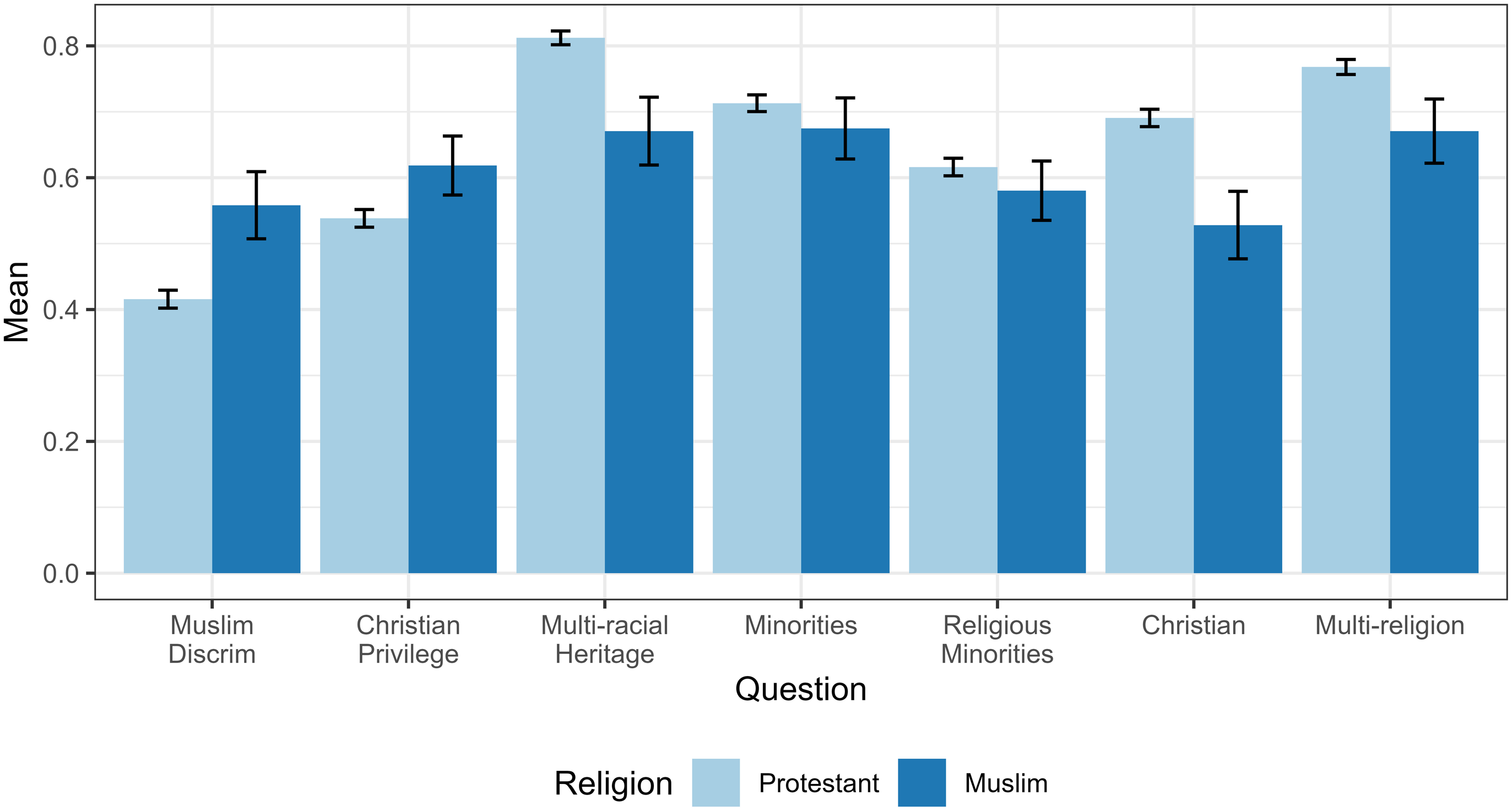
Second, we also examine how Black Americans differ in their perceptions of discrimination in America. We hypothesize that not only would Black Christians and Black Muslims vary in expressions of identity, but also vary in their lived experiences. We target this by examining perceptions of perceived discrimination and the importance of protections for various groups. First, we engage with perceived discrimination of Black and Muslim people as well as immigrants. These questions ask “How much discrimination, if any, do you think exists against each of the following groups in the U.S. today?” and ask about “Blacks,” “Immigrants,” and “Muslims.” The second set of questions asks similar questions but speaks more toward whether Muslim discrimination is a problem, the existence of Christian privilege, and whether the federal government should protect several different groups. The questions read (1) Muslim Discrimination—How big a problem is discrimination toward Muslims? (2) Christian Privilege—How much do you agree that our social system privileges Christians? (3) Mutli-racial Heritage—How much should the government do to protect and preserve Multi-racial heritage, (4) Minorities—minorities, (5) Religious Minorities, (6) Christian heritage, and (7) America’s Multi-religious heritage?
Finally, we also examine perceptions of policy attitudes. Here, we include two additional sets of political attitudes that may be vulnerable to identification and religious socialization. These include (1) Support of BLM—How much do you support or oppose for Black Lives Matter, (2) Muslim surveillance—agreement with the need to police Muslim neighborhoods more, and (3) Muslim ban—support or opposition to a ban on Muslim immigration. We follow many scholars (including those named above) in approximating group consciousness with linked fate. Here, we leverage linked fate measures that approximate linked fate with Black Americans and linked fate with Muslim Americans. Importantly, we anticipate that Black Christians will have higher levels of linked fate with Black Americans than Muslim Americans, while Black Muslims will have similar levels of linked fate for each measure. We hypothesize that Black linked fate will be more informative for both groups about Black Lives Matter, but that Muslim linked fate, or an interaction of Muslim and Black linked fate, will be significant in Black Muslim decision-making.Footnote 3
Importantly, none of these group-based questions specifically engage with what it means to be Black and Muslim or Black and Christian. However, we rely on the presumption that Black respondents will similarly include themselves within the religious-named group if that identity is salient. Because our hypotheses engage with the idea that religion shifts their own perceptions of their Black identity, data that suggests differences in Black identity and is predictive of differences in perceptions of religious groups underlines the possibility of religion having an important effect on the formation of Black identity.
Results
We begin our analysis with an examination of descriptive differences among our different dependent variables, which highlight key differences between how Black Muslims and Christians identify. We then use multivariate analysis to demonstrate that, controlling for other potential differences between the two groups, the differences in identity expression also correspond to differences in understanding discrimination and in the expression of attitudes on policies. For most of our analyses (except the ranking), we have converted the variables to a 0–1 scale to more easily interpret the results across different variables. This means that all results can be read as a $100\;{\rm{*}}\;\bar x$
or
$100\;{\rm{*}}\;\bar x$
or $100\;{\rm{*}}\;\beta $
%.
$100\;{\rm{*}}\;\beta $
%.
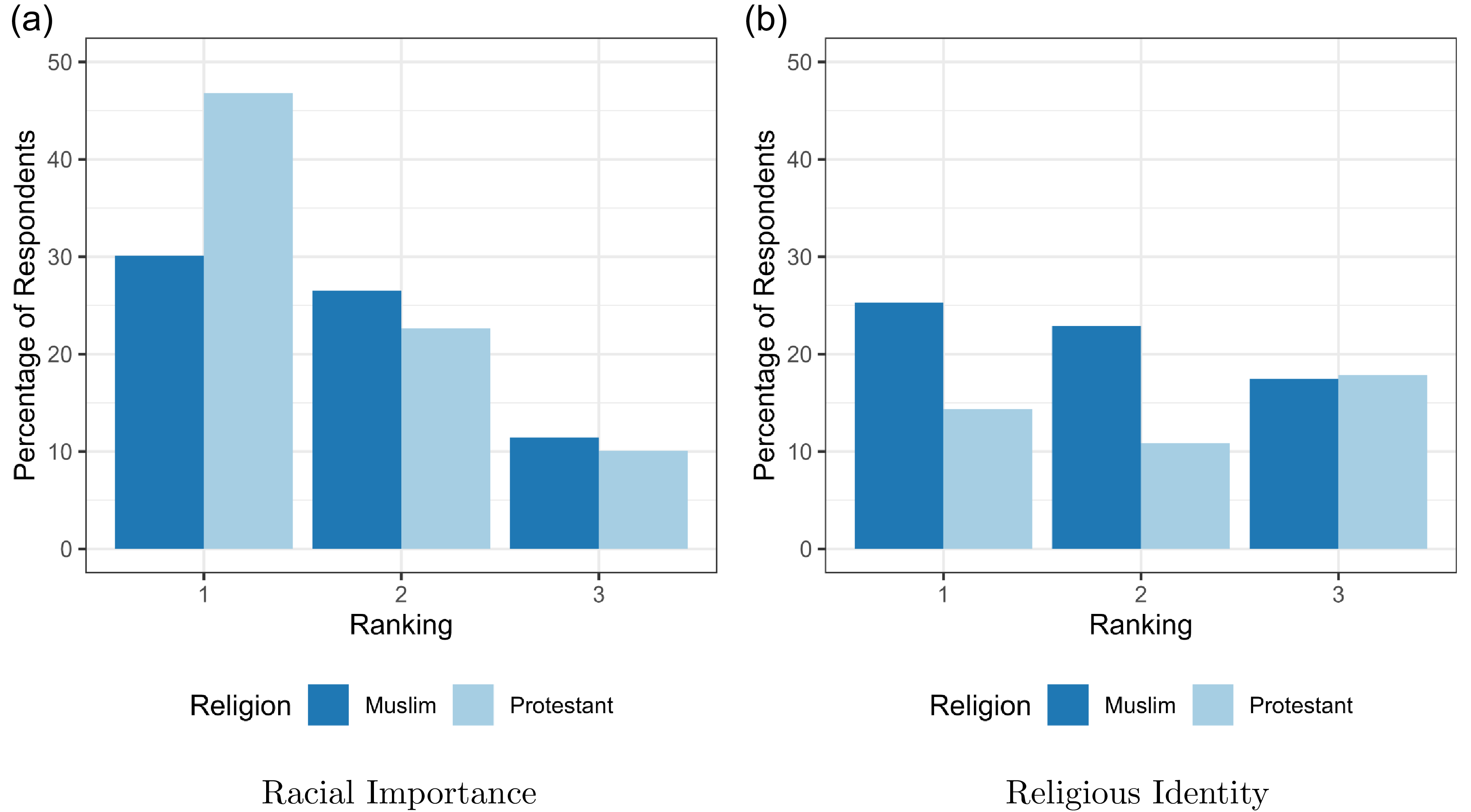
First, analysis of the rank order identities suggests that Black Christians are much more likely to identify with their race than are Black Muslims. Figure 1 shows how Black Muslims and Christians rank the importance of their race and religion. For Muslims, the most common primary identity is race at 30.1% of the sample. Closely behind, the second most common primary identification is religion (25.3%), followed by gender (21.1%). For Christians, close to a majority—46.8%—ranks their race as the primary identity. The second highest group ranks religion as most important (14.3%), followed closely by gender (13.8%). While the order of prioritization of the different groups remains the same between Black Muslims and Christians, the composition of the groups differs. Muslims are much less likely to say race and much more likely to say religion than are Christians.
Importance of identity rankings.
Notes: These figures reports the % of respondents who indicated their race (left) or religion (right) as their most important identity. The x-axis presents the rank that different participants assigned to their race (left) or religion (right), while the y-axis shows the percentage of respondents selecting that rank.

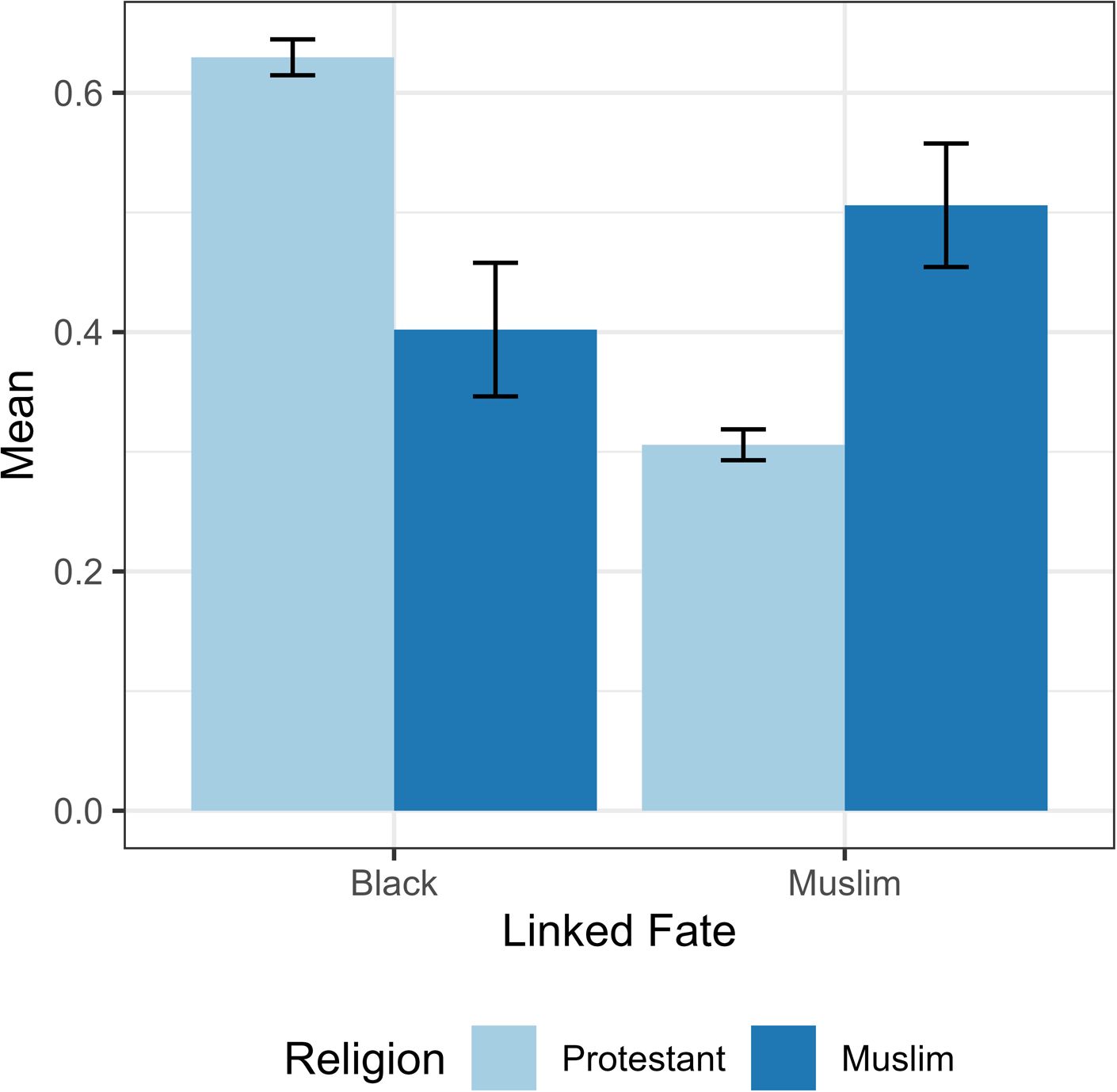
Similarly, we see key differences in how Black Americans express group-based linked fate by religious identification. Figure 2 displays the results for linked fate questions, broken down by religious identification. The bars on the left display linked fate with Black Americans, and the bars on the right denote linked fate with Muslims. On average, linked fate with Black Americans is relatively low for Black Muslims ( $\bar x =.42$
), with over half of the sample selecting that what happens to African Americans has little or nothing to do with what happens in their own life. For Protestants, average linked fate with Black Americans is significantly higher than for Muslims (
$\bar x =.42$
), with over half of the sample selecting that what happens to African Americans has little or nothing to do with what happens in their own life. For Protestants, average linked fate with Black Americans is significantly higher than for Muslims ( $\bar x = .70.0$
,
$\bar x = .70.0$
, $p \lt .001$
), with over half of the sample responding that what happens to African Americans has a great deal or a lot to do with what happens in their own life.
$p \lt .001$
), with over half of the sample responding that what happens to African Americans has a great deal or a lot to do with what happens in their own life.
Comparing linked fate.
Notes: Comparison of the average linked fate estimate for Black Muslims and Protestants. The bars on the left represent Black linked fate and the bars on the right represent Muslim linked fate.

Conversely, Black Muslims were symmetrically distributed in their responses to Muslim linked fate, with the modal response being that what happens to other Muslims has something to do with what happens to them. The average response among Muslims is significantly higher than for Protestants ( ${\bar x_M} = .51$
,
${\bar x_M} = .51$
, ${\bar x_P} = .31$
,
${\bar x_P} = .31$
, $p \lt .001$
). It is perhaps unsurprising that Black Protestants identify more with their race than with Muslims (
$p \lt .001$
). It is perhaps unsurprising that Black Protestants identify more with their race than with Muslims ( $p \lt .001$
). For Black Muslims, however, who identify with both categories, on average, identify significantly more with Muslim linked fate than Black linked fate (
$p \lt .001$
). For Black Muslims, however, who identify with both categories, on average, identify significantly more with Muslim linked fate than Black linked fate ( $p = .008$
), which is important in separating the results for how the identities rank against each other. This suggests that their collective identity with the two groups is strong, but that the Muslim identity may be slightly stronger for many Black Muslims.
$p = .008$
), which is important in separating the results for how the identities rank against each other. This suggests that their collective identity with the two groups is strong, but that the Muslim identity may be slightly stronger for many Black Muslims.
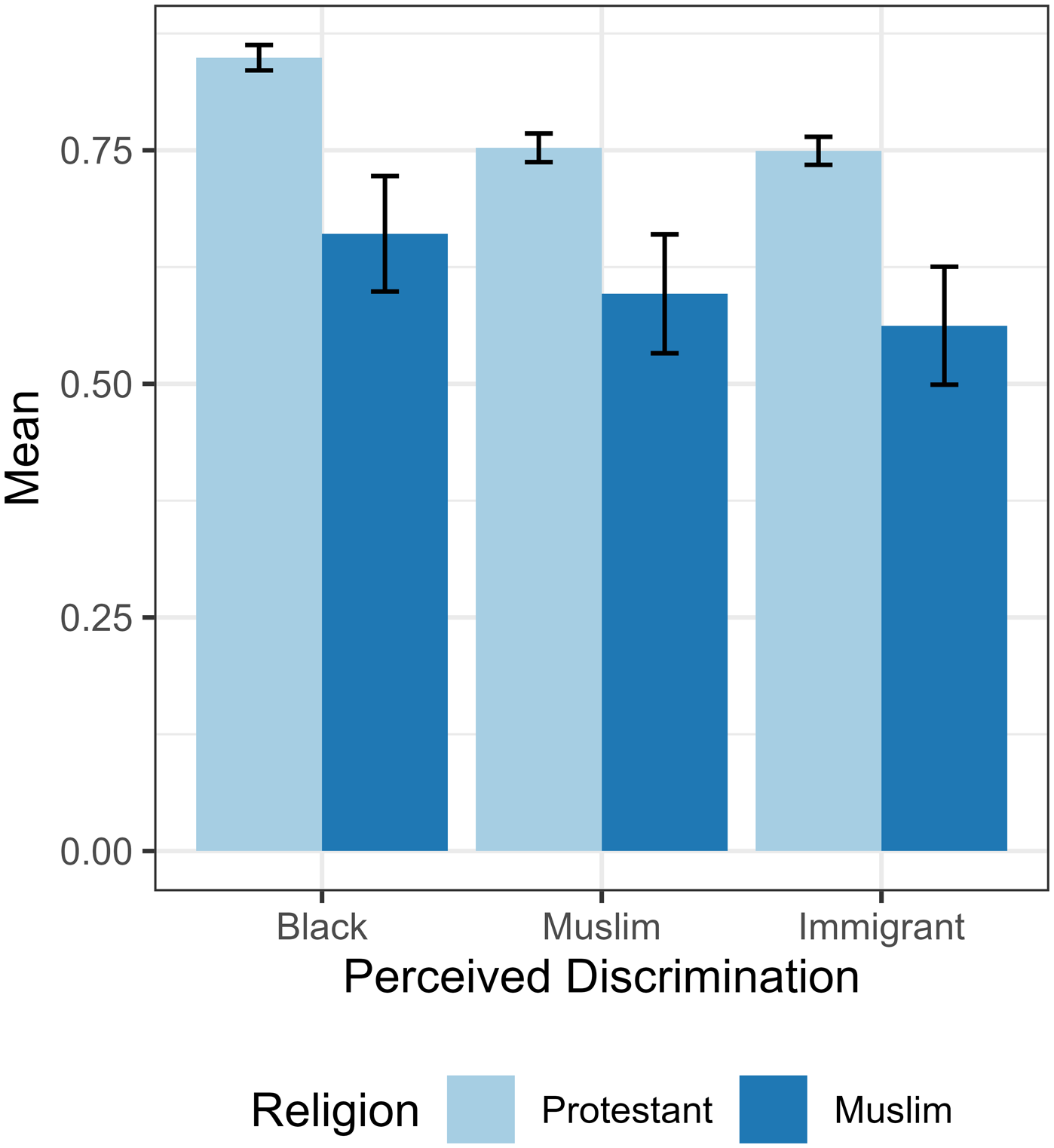
Now, we turn to an analysis of whether different religious identities begin to predict different perceptions of the world. Here, we look at the descriptive information of two sets of data before we look at the multivariate regression. First, we look at how each group perceives levels of discrimination toward three different groups: Black Americans, Muslim Americans, and Immigrants. These results are displayed in Figure 3. Across each group, Muslims rate perceived levels of discrimination lower than those of Christians ( $p \lt \;.001$
for each Muslim-Protestant comparison). However, while Muslims rate Black discrimination as more common than Muslim or Immigrant discrimination, only Black discrimination is perceived as significantly more common than Immigrant discrimination (
$p \lt \;.001$
for each Muslim-Protestant comparison). However, while Muslims rate Black discrimination as more common than Muslim or Immigrant discrimination, only Black discrimination is perceived as significantly more common than Immigrant discrimination ( $p = .03$
). Among Protestants, there is a marked consensus that discrimination toward Black Americans is more common than that directed toward either Muslim (
$p = .03$
). Among Protestants, there is a marked consensus that discrimination toward Black Americans is more common than that directed toward either Muslim ( $p \lt .001$
) or Immigrant groups (
$p \lt .001$
) or Immigrant groups ( $p \lt .001$
). However, Protestants perceive Muslim discrimination as more common than Immigrant discrimination (
$p \lt .001$
). However, Protestants perceive Muslim discrimination as more common than Immigrant discrimination ( $p = .02$
). Ultimately, these data suggest two important findings: (1) Protestants generally perceive higher levels of discrimination directed toward historically excluded communities, and (2) Black Muslims see Black and Muslim discrimination as more similar than Black Christians. Together, these factors suggest that religious identification may have meaningful implications for political socialization.
$p = .02$
). Ultimately, these data suggest two important findings: (1) Protestants generally perceive higher levels of discrimination directed toward historically excluded communities, and (2) Black Muslims see Black and Muslim discrimination as more similar than Black Christians. Together, these factors suggest that religious identification may have meaningful implications for political socialization.
Levels of perceived discrimination across groups.
Notes: This figure reports the mean level of perceived discrimination experienced by Black Americans, Muslims Americans, and Immigrants. The results are moderated by religion, with Protestants in light blue (left side of each column) and Muslims in dark blue (right side of each column). The error bar displays the 95% confidence interval around the mean.

Similarly, we look at a set of variables that examine how the survey participants view issues regarding religion, religious discrimination, and Christian privilege. Figure 4 displays these results moderated by Muslim and Protestant Attitudes. In contrast to the pure discrimination questions, Muslims were much more likely to say that discrimination toward Muslims is a problem ( $\bar x = .56$
) than Protestants (
$\bar x = .56$
) than Protestants ( $\bar x = .042$
,
$\bar x = .042$
, $p \lt .001$
). Similarly, Muslims were much more likely to say that society protects Christian privilege (
$p \lt .001$
). Similarly, Muslims were much more likely to say that society protects Christian privilege ( $\bar x = .62$
) than Protestants (
$\bar x = .62$
) than Protestants ( $\bar x = .54$
,
$\bar x = .54$
, $p,.001$
), though the average response for both groups is well above the scale’s mid-way point. Muslims and Protestants similarly feel that the U.S. government needs to protect minorities (
$p,.001$
), though the average response for both groups is well above the scale’s mid-way point. Muslims and Protestants similarly feel that the U.S. government needs to protect minorities ( ${\bar x_M} = .67$
,
${\bar x_M} = .67$
, ${\bar x_P} = .41$
,
${\bar x_P} = .41$
, $p = .12$
) and religious minorities (
$p = .12$
) and religious minorities ( ${\bar x_M} =. 58$
,
${\bar x_M} =. 58$
, ${\bar x_P} = .62$
,
${\bar x_P} = .62$
, $p = .14$
). On all other measures, Protestants scored higher than Muslims (
$p = .14$
). On all other measures, Protestants scored higher than Muslims ( $p{\rm{ }} \lt .001$
for all). Ultimately, this suggests that Muslims are more attuned to the importance of issues surrounding Muslim discrimination, even if they do not believe it to be as common as Protestants. Muslims are also more aware of the social ordering of religions. However, each group is equally concerned about minority and religious minority protection. Again, these findings move to suggest that despite the differences we see between groups, there are also key similarities in what they believe the government should do.
$p{\rm{ }} \lt .001$
for all). Ultimately, this suggests that Muslims are more attuned to the importance of issues surrounding Muslim discrimination, even if they do not believe it to be as common as Protestants. Muslims are also more aware of the social ordering of religions. However, each group is equally concerned about minority and religious minority protection. Again, these findings move to suggest that despite the differences we see between groups, there are also key similarities in what they believe the government should do.
Understanding of religious discrimination and privilege.
Notes: This figure reports the mean level of attitudes across the seven issues displayed on the x-axis. The results are moderated by religion, with Protestants in light blue (left side of each column) and Muslims in dark blue (right side of each column). The error bar displays the 95% confidence interval around the mean.

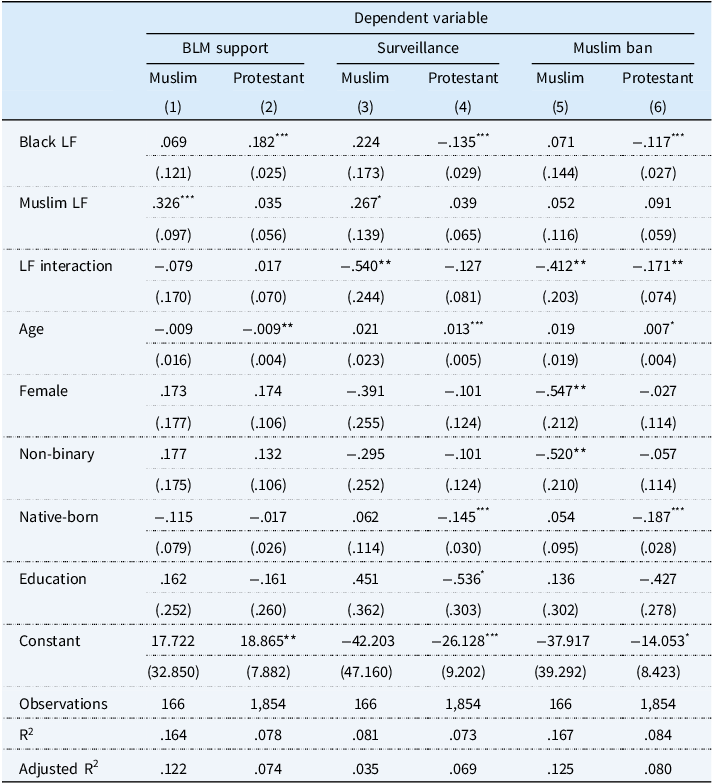
Finally, we use a multivariate comparison to determine how group consciousness corresponds to policy attitudes. We use OLS regression, allowing for the interaction of Black and Muslim linked fate:
 $$\eqalign{ & {Y_i} = {\beta _0} + {\beta _1} \cdot BlackL{F_i} + {\beta _2} \cdot MuslimL{F_i} + {\beta _3} \cdot \left( {BlackL{F_i} \cdot MuslimL{F_i}} \right) \cr & \quad \quad \quad + {\beta _4} \cdot Control{s_i} + {\varepsilon _i} \cr} $$
The results from this analysis are found in Table 1.Footnote
4
The results show the contrast between the two religious groups. Support for BLM is predicted by higher levels of Muslim linked fate for Muslim respondents ( $\beta = .33$
,
$\beta = .33$
, $p = .001$
, while support for BLM is predicted by higher levels of Black linked fate for Protestant communities (
$p = .001$
, while support for BLM is predicted by higher levels of Black linked fate for Protestant communities ( $\beta = .18$
,
$\beta = .18$
, $p = .02$
). On the question of support for higher levels of surveillance for Muslim communities, as Muslim linked fate increases, support for more surveillance decrease (
$p = .02$
). On the question of support for higher levels of surveillance for Muslim communities, as Muslim linked fate increases, support for more surveillance decrease ( $\beta =. 27$
,
$\beta =. 27$
, $p = .06$
). But as levels of both types of linked fate increase, so do levels of rejection for Muslim surveillance (
$p = .06$
). But as levels of both types of linked fate increase, so do levels of rejection for Muslim surveillance ( $\beta =- .54$
,
$\beta =- .54$
, $p = .03$
). For Black Protestants, only Black linked fate is significant, which corresponds to a decrease in support for surveillance as Black linked fate increases (
$p = .03$
). For Black Protestants, only Black linked fate is significant, which corresponds to a decrease in support for surveillance as Black linked fate increases ( $\beta =- .14$
,
$\beta =- .14$
, $p \lt .001$
). The final category contains a similar pattern for Muslims. Muslims with increasing levels of both Black and Muslim linked fate are more negative about the Muslim ban (
$p \lt .001$
). The final category contains a similar pattern for Muslims. Muslims with increasing levels of both Black and Muslim linked fate are more negative about the Muslim ban ( $\beta =- .41$
,
$\beta =- .41$
, $p = .04$
). For Protestants, however, as Black linked fate increases (
$p = .04$
). For Protestants, however, as Black linked fate increases ( $\beta =- .12$
,
$\beta =- .12$
, $p \lt \;.001$
) and as both Black and Muslim linked fate increase (
$p \lt \;.001$
) and as both Black and Muslim linked fate increase ( $\beta =- .17$
,
$\beta =- .17$
, $p = .02$
), support for the Muslim ban decreases. Across all categories, Muslim linked fate or an interaction of Muslim linked fate makes Black Muslims more likely to have more liberal attitudes on issues. Black Protestants are more likely to have liberal attitudes, primarily when they have higher levels of Black linked fate. Across the studies, Black linked fate and Muslim linked fate operate differently for Black Muslims. And, Black linked fate operates differently for Black Muslims and Black Protestants. This suggests that in addition to expressions of group consciousness, group consciousness differently corresponds to attitude formation on key policy issues.
$p = .02$
), support for the Muslim ban decreases. Across all categories, Muslim linked fate or an interaction of Muslim linked fate makes Black Muslims more likely to have more liberal attitudes on issues. Black Protestants are more likely to have liberal attitudes, primarily when they have higher levels of Black linked fate. Across the studies, Black linked fate and Muslim linked fate operate differently for Black Muslims. And, Black linked fate operates differently for Black Muslims and Black Protestants. This suggests that in addition to expressions of group consciousness, group consciousness differently corresponds to attitude formation on key policy issues.
Connecting Black and Muslim linked fate to attitudes

Note: This table tests the OLS regression predicting support for issues based on both Muslim and Black linked fate, while holding constant several demographic variables that may matter for decision-making. *p < .1; **p< .05; ***p < .01.
Overall, the analysis from the CMPS confirms two key things. First, Black Muslims have critical differences in how they identify compared to Black Christians. While both groups have the plurality of members identifying first with their race, a significantly larger portion of Muslims identify primarily with their religion. Muslims have higher expressions of Muslim linked fate over Black linked fate, suggesting that their expressions of racial group consciousness are not absent, but less certain than for Black Protestants. Second, corresponding to differences in identification, attitudes about group needs, discrimination, and policy differ. Black Muslims are more likely to pay attention to issues relevant to Muslim communities, and their decision-making is connected to their expressions of both Muslim and Black linked fate. Ultimately, these two findings confirm that religious identity operates distinctly from racial identity for Black Muslims. Since we do not see the same pattern with Black Protestants, differing perceptions of identity help explain differences in political attitudes.
Study 2: 2020 PEW Black Religion Survey
Our second study features data from the PEW 2020 Black Faith Survey (Mohamed et al. Reference Mohamed, Cox, Diamant and Gecewicz2021), fielded from November 19, 2019, to June 3, 2020. PEW specifies that most respondents completed the survey between January 21, 2020, and February 10, 2020. While the survey contains about 8,660 Black respondents, 100 are Muslim and 5,784 are Protestant Christian. While the CMPS allowed us to examine expressions of identity in conjunction with attitudes, the PEW Black Religion Survey gives less purchase into identity expression but yields more information about understanding of the role of religious expression in American public life and in organizing.
Data Description
While using the CMPS, we were able to evaluate the strength and relative ordering of racial and religious identity; the PEW survey questions primarily focus on religious practices and experiences. However, the PEW survey also asks about how respondents understand religious discrimination and how they perceive the relative importance of different religious institutions. Similar to Study 1, we first investigate descriptive responses about identity and perceptions of discrimination, followed by regressing identity importance on attitudes.
A key challenge in this data is the absence of the typical linked fate metrics. However, there are questions about identity importance from which we can proxy how meaningful race and religion are to both respondents, with an understanding that identity importance is more about personal understanding of identity rather than a collective view on how meaningful identity is on a social level. The religious importance question asks, “How important is religion in your life?” The racial importance question asks, “How important is being Black to how you think about yourself?”
Second, we examine questions on discrimination. This survey asks respondents a series of questions about whether they have experienced four different types of discrimination: (1) called you racist names, (2) snubbed you, (3) acted as if you were suspicious, and (4) acted as if they were better than you because of your race? These questions were asked in the context of the discrimination happening at the respondent’s place of worship or elsewhere. While these questions cannot give us an idea of how religious and racial discrimination compare, they can give us an idea of whether racial discrimination is more likely at a religious institution where people share the same religion, or outside a religious institution where shared religion cannot be presumed. The PEW Survey gives an opportunity not present in the CMPS: perceptions of how much different organizations “have done to help Black people move toward equality in the U.S.” The question probes civil rights organizations, the federal government, predominantly Black churches, predominantly White churches, and predominantly Black Muslims’ organizations like the Nation of Islam.
Finally, we use political attitude questions to understand how the importance of Black identity and religious identity map onto attitudes. Here, we focus on four questions that prime overlapping views about discrimination and government policy. The first question examines how responsible respondents think that Black people are for racial disparities in choosing between “Racial discrimination is the main reason why many Black people can’t get ahead these days” or “Black people who can’t get ahead in this country are mostly responsible for their own condition. The second questions asks respondents to “think about the criminal justice system in our country,” and asks if the system needs no changes, minor change, major changes, or needs to be completely rebuilt. Third, the survey asks about views toward immigrants, choosing between “Immigrants today strengthen our country because of their hard work and talents” and “Immigrants today are a burden on our country because they take our jobs, housing and health care.” Finally, we use the question of whether “opposing racism or racial discrimination” is essential to their faith, to bridge between race and religion.
Importantly, because of the way that identity importance (which we are using to proxy for group consciousness in place of linked fate) is measured here, Black Protestants and Black Muslims can both identify the importance of their own religious experience. This allows an important addition to Study 1. Similarly to before, we anticipate that racial and religious identity importance may be high for all respondents. We also anticipate that identity importance will be salient for how Black respondents understand policy issues as well. We hypothesize that Black identity importance will be highly significant on policy issues for Black protestants, but do not necessarily expect religious identity importance to be significant. For Black Muslims, however, where religious identity is also politicized, we anticipate that religious identity importance and the interaction of importance will also be significant.
Results
Similarly to Study 1, we begin with a brief examination of descriptive differences in identity and assessments with discrimination and organizations. We then use multivariate analysis to examine how identity importance informs opinion formation. As in Study 1, we convert the variables to a 0–1 scale where appropriate to more easily interpret the results, which can be read as a $100\;{\rm{*}}\;\bar x$
difference or
$100\;{\rm{*}}\;\bar x$
difference or $100\;{\rm{*}}\;\beta $
% change.
$100\;{\rm{*}}\;\beta $
% change.
We begin by discussing the relative importance of identity captured by Figure 5. Both religion and race are extremely important to the identity of most of the sample, where all means exceed 80%. For Protestants, religious identity is more important than racial identity ( ${\bar x_{{\rm{\Delta }}P}} = .06$
,
${\bar x_{{\rm{\Delta }}P}} = .06$
, ${p_P}{\rm{ }} \lt .001$
), though not for Muslims (
${p_P}{\rm{ }} \lt .001$
), though not for Muslims ( ${\bar x_{{\rm{\Delta }}M}} = .01$
,
${\bar x_{{\rm{\Delta }}M}} = .01$
, ${p_M} = .71$
). Between the groups, however, neither religious identity (
${p_M} = .71$
). Between the groups, however, neither religious identity ( ${\bar x_{\rm{\Delta }}} =- .04$
,
${\bar x_{\rm{\Delta }}} =- .04$
, $p = .11$
) nor racial identity differs in any salient way (
$p = .11$
) nor racial identity differs in any salient way ( ${\bar x_{\rm{\Delta }}} = .005$
,
${\bar x_{\rm{\Delta }}} = .005$
, $p = .87$
). Importantly, while there are salient differences between religious and racial identification for Black Protestants in this sample, those differences are not salient for Black Muslims or between Protestants and Muslims. These data largely speak to the importance of both religion and race to both groups.
$p = .87$
). Importantly, while there are salient differences between religious and racial identification for Black Protestants in this sample, those differences are not salient for Black Muslims or between Protestants and Muslims. These data largely speak to the importance of both religion and race to both groups.
PEW responses on identity and perceived discrimination.
Notes: This figure reports the mean level of responses for identity importance (left sub-figure) and locations of discrimination (right sub-figure). The identity importance figure displays the importance of religious identity (left) compared to racial identity (right). The location of discrimination figure displays where discrimination is experienced by respondents, whether in religious institutions (left) and outside of religious institutions (right). The results for both sub-figures are moderated by religion, with Protestants in light blue (left side of each column) and Muslims in dark blue (right side of each column). The error bar displays the 95% confidence interval around the mean.

Perceptions of discrimination also differ by religious affiliation. As a reminder, the question here is where discrimination occurs, compared to if or how frequently this has happened. Since the survey asks about four different types of discrimination, we found that the responses were quite similar across whether each type of discrimination occurs in a religious institution ( $\alpha = .83$
) rather than outside (
$\alpha = .83$
) rather than outside ( $\alpha = .82$
). For both Protestants and Muslims, there is more perceived racial discrimination at religious institutions than outside them (
$\alpha = .82$
). For both Protestants and Muslims, there is more perceived racial discrimination at religious institutions than outside them ( ${\bar x_{{\rm{\Delta }}M}} = .19$
,
${\bar x_{{\rm{\Delta }}M}} = .19$
, ${p_M}{\rm{ }} \lt .001$
;
${p_M}{\rm{ }} \lt .001$
; ${\bar x_{{\rm{\Delta }}P}} = .21$
,
${\bar x_{{\rm{\Delta }}P}} = .21$
, ${p_P}{\rm{ }} \lt .001$
). Black Protestants also describe higher levels of reported discrimination than Black Muslims both within religious institutions (
${p_P}{\rm{ }} \lt .001$
). Black Protestants also describe higher levels of reported discrimination than Black Muslims both within religious institutions ( ${\bar x_{\rm{\Delta }}} = .10$
,
${\bar x_{\rm{\Delta }}} = .10$
, $p = .04$
) and outside of them (
$p = .04$
) and outside of them ( ${\bar x_{\rm{\Delta }}} = .08$
,
${\bar x_{\rm{\Delta }}} = .08$
, $p{\rm{ }} \lt .001$
). These data speak again to higher amounts of discrimination being reported by Black Protestants than Black Muslims, though the relative ordering of where the discrimination occurs is quite similar. Importantly, this difference again suggests to a different socialization based on religion—even if at this point the source of discrimination is somewhat unclear.
$p{\rm{ }} \lt .001$
). These data speak again to higher amounts of discrimination being reported by Black Protestants than Black Muslims, though the relative ordering of where the discrimination occurs is quite similar. Importantly, this difference again suggests to a different socialization based on religion—even if at this point the source of discrimination is somewhat unclear.
We now turn to Figure 6, which describes the organizations respondents think contribute toward fighting for civil rights. Importantly, the data look remarkably similar across all but one response group. Both Muslims and Christians describe civil rights organizations as doing the most to help Black people move forward with equity. For Muslims, the remaining categories are not significantly different from each other. However, for Christians, both the federal government and mosques are perceived as doing the least for achieving equality. And, both are seen as doing less for achieving equality than either Black churches ( ${\bar x_{{\rm{\Delta }}FG}} =- .08$
,
${\bar x_{{\rm{\Delta }}FG}} =- .08$
, $p{\rm{ }} \lt .001$
;
$p{\rm{ }} \lt .001$
; ${\bar x_{{\rm{\Delta }}M}} =- .09$
,
${\bar x_{{\rm{\Delta }}M}} =- .09$
, $p{\rm{ }} \lt .001$
) or even White churches (
$p{\rm{ }} \lt .001$
) or even White churches ( ${\bar x_{{\rm{\Delta }}FG}} =- .04$
,
${\bar x_{{\rm{\Delta }}FG}} =- .04$
, $p{\rm{ }} \lt .001$
;
$p{\rm{ }} \lt .001$
; ${\bar x_{{\rm{\Delta }}M}} =- .04$
,
${\bar x_{{\rm{\Delta }}M}} =- .04$
, $p{\rm{ }} \lt .001$
). In contrast, Muslims do not differ significantly from the other categories, but they do recognize a higher contribution of mosques than do Protestants (
$p{\rm{ }} \lt .001$
). In contrast, Muslims do not differ significantly from the other categories, but they do recognize a higher contribution of mosques than do Protestants ( ${\bar x_{\rm{\Delta }}} = .14$
,
${\bar x_{\rm{\Delta }}} = .14$
, $p = .003$
). These data suggest that Muslims and Protestants also have a different understanding of who is mobilizing in the struggle for Black equality, again affirming a different socialization of how Black Muslims and Protestants understand equality.
$p = .003$
). These data suggest that Muslims and Protestants also have a different understanding of who is mobilizing in the struggle for Black equality, again affirming a different socialization of how Black Muslims and Protestants understand equality.
Importance of organizations in civil rights.
Notes: This figure reports the mean level of perceived importance of organizations in defending civil rights. The x-axis presents five different organizations that could have contributed to civil rights. The results are moderated by religion, with Protestants in light blue (left side of each column) and Muslims in dark blue (right side of each column). The error bar displays the 95% confidence interval around the mean.

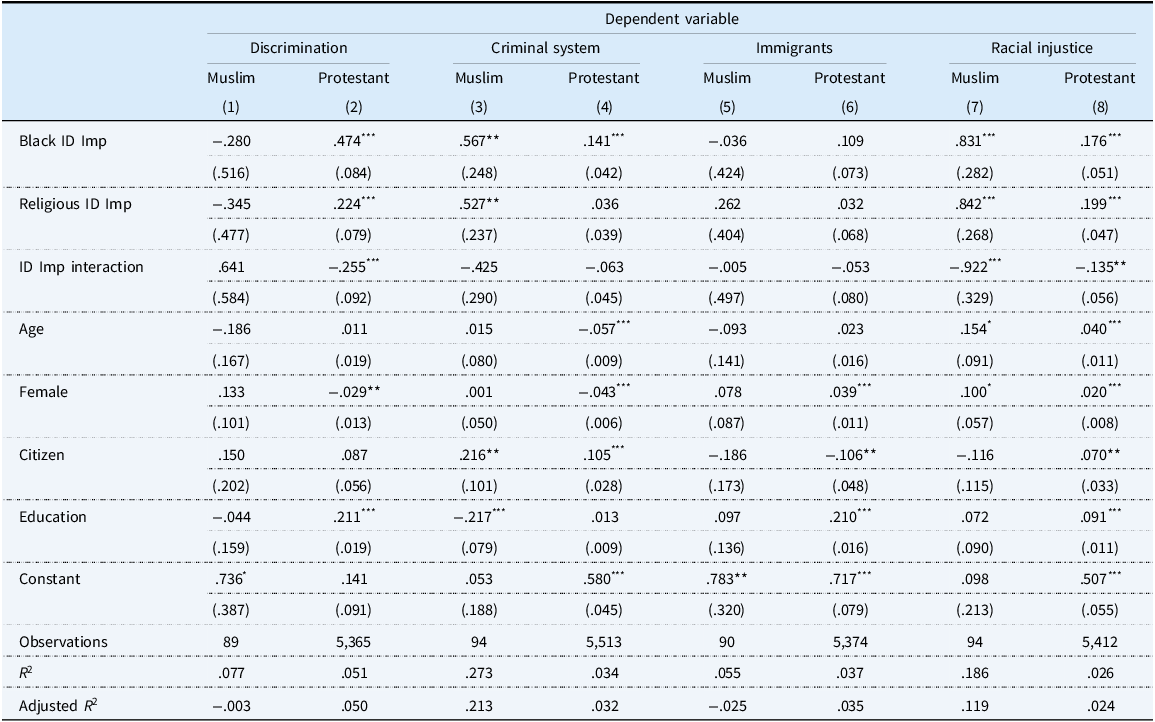
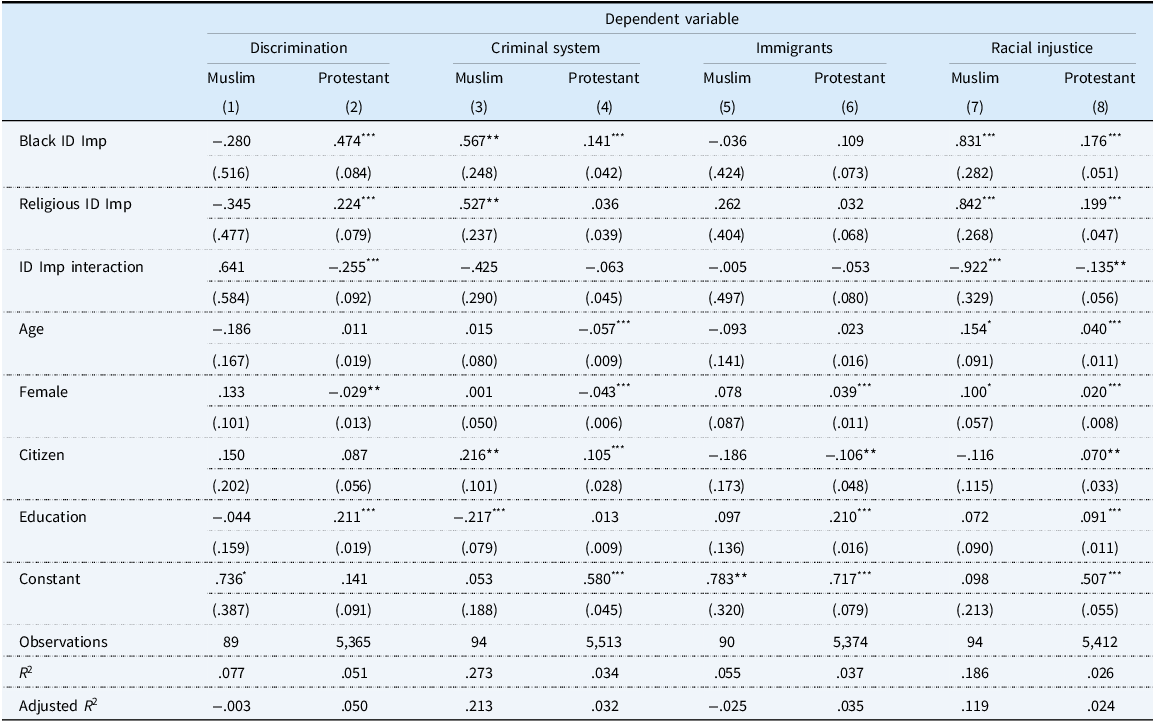
Finally, we present the results of a multivariate regression that suggests how meaningful racial and religious identity importance is in constructing political attitudes, controlling for demographic factors. We again use an OLS regression strategy, and again control for gender, age category (age is not shared as a continuous variable), citizenship status (which we use as a proxy for nativity), and education: $\eqalign{{Y_i} & = {\beta _0} + {\beta _1} \cdot BlackI{D_i} + {\beta _2} \cdot MuslimI{D_i} + {\beta _3} \cdot \left( {BlackI{D_i} \cdot MuslimI{D_i}} \right) \cr & \quad+ {\beta _4} \cdot Control{s_i} + {\varepsilon _i}}$
These results are shared in Table 2.Footnote
5
For Black Muslims, there is no predictive element of identity importance on political attitudes for either the discrimination or the immigrant dependent variable. However, there is a strong positive and significant effect stemming from both racial and religious identities on both the criminal justice system ( ${\beta _{race}} = .57$
,
${\beta _{race}} = .57$
, ${p_{race}} = .02$
;
${p_{race}} = .02$
; ${\beta _{rel}} = .53$
,
${\beta _{rel}} = .53$
, ${p_{rel}} = .03$
) and racial injustice (
${p_{rel}} = .03$
) and racial injustice ( ${\beta _{race}} = .83$
,
${\beta _{race}} = .83$
, ${p_{race}} = .004$
;
${p_{race}} = .004$
; ${\beta _{rel}} = .84$
,
${\beta _{rel}} = .84$
, ${p_{rel}} = .002$
) dependent variables. However, the interaction between the identity importance variables is not significant on attitudes toward the criminal justice system (
${p_{rel}} = .002$
) dependent variables. However, the interaction between the identity importance variables is not significant on attitudes toward the criminal justice system ( $\beta =- .43$
,
$\beta =- .43$
, $p = .15$
) and is negative on racial injustice attitudes (
$p = .15$
) and is negative on racial injustice attitudes ( $\beta =- .92$
,
$\beta =- .92$
, $p = .01$
). Together, these data suggest that for Black Muslims, racial and religious importance have distinct, and not always overlapping, effects.
$p = .01$
). Together, these data suggest that for Black Muslims, racial and religious importance have distinct, and not always overlapping, effects.
Connecting Black and Muslim identity to attitudes
Note: This table tests the OLS regression predicting attitudes by religious and Black identity, while holding constant several demographic variables that may matter for decision-making. *p < .1; **p < .05; ***p < .01.
For Black Protestants, there is a contrasting story. These data show a strong positive and significant effect across racial identification as predictive of all dependent variables except the immigrant dependent variable. Both the race and religious identity importance variable and the interaction of the two identity variables are all significant on the discrimination dependent variable ( ${\beta _{race}} = .47$
,
${\beta _{race}} = .47$
, ${p_{race}}{\rm{ }} \lt .001$
;
${p_{race}}{\rm{ }} \lt .001$
; ${\beta _{rel}} = .22$
,
${\beta _{rel}} = .22$
, ${p_{rel}} = .004$
;
${p_{rel}} = .004$
; ${\beta _{int}} =- .23$
,
${\beta _{int}} =- .23$
, ${p_{int}} = .006$
), and the racial injustice dependent variable (
${p_{int}} = .006$
), and the racial injustice dependent variable ( ${\beta _{race}} = .18$
,
${\beta _{race}} = .18$
, ${p_{race}}{\rm{ }} \lt .001$
;
${p_{race}}{\rm{ }} \lt .001$
; ${\beta _{rel}} = .20$
,
${\beta _{rel}} = .20$
, ${p_{rel}}{\rm{ }} \lt .001$
;
${p_{rel}}{\rm{ }} \lt .001$
; ${\beta _{int}} =- .14$
,
${\beta _{int}} =- .14$
, ${p_{int}} = .02$
). But, only the racial importance variable is predictive for protestants on the criminal justice system attitudes (
${p_{int}} = .02$
). But, only the racial importance variable is predictive for protestants on the criminal justice system attitudes ( $\beta = .14$
,
$\beta = .14$
, ${p_{race}}{\rm{ }} \lt .001$
). And, no identity importance measure is predictive of attitudes toward immigrants. For Black respondents, these data suggest that both race and religious identities contribute toward Black equality variables—but not necessarily toward other political attitudes. Across both groups, there are important similarities and differences. Unlike Black Muslims, Black Protestants use racial importance alone to determine their attitudes. However, both religious and racial identity are salient for both Black Muslims and Protestants.
${p_{race}}{\rm{ }} \lt .001$
). And, no identity importance measure is predictive of attitudes toward immigrants. For Black respondents, these data suggest that both race and religious identities contribute toward Black equality variables—but not necessarily toward other political attitudes. Across both groups, there are important similarities and differences. Unlike Black Muslims, Black Protestants use racial importance alone to determine their attitudes. However, both religious and racial identity are salient for both Black Muslims and Protestants.
While the conclusions do not perfectly align with our hypotheses, we do still find support for many of them. First, Black Protestants express stronger racial identity and experiences of discrimination than do Black Muslims. Second, Black Muslims are much more likely to recognize the role of Black Islamic organizations in developing civil rights achievements. Both of these findings suggest that Protestants and Muslims have slightly different orientations toward their identity and how society operates. While we see many similarities in how these differing socializations predict political attitudes, the data indicate critical differences between how identity salience contributes to political attitudes for Black Protestants and Black Christians.
Across the two studies, we notice some differences—we argue likely due to measurement—but ultimately, there is a shared takeaway between both sets of data. First, in the CMPS, the primary identity ranking for both groups is racial, while in PEW, racial identity is rated as slightly less important than religious identity—likely due to differences in rank ordering, which may yield slightly different calculations than ratings. Similarly, religious linked fate for Muslims is higher than for Protestants, a finding that does not carry through to religious importance in the PEW study. We believe these differences are likely due to linked fate questions, which focus on relationships between a group and society rather than the individual importance of an identity. Most importantly, however, the two data sources yielded an important overall conclusion: religion is a meaningful and important concept that causes differences in identification, perceptions of discrimination, and policy attitudes.
Conclusion
The literature on Black group consciousness and political socialization shows a unique, distinct, and important effect of Black group consciousness informing political thought (Dawson Reference Dawson1995). Yet recent literature has demonstrated that within broader categories, there are key distinctions in how Black Americans view the political world (White and Laird Reference White and Laird2020), some of which are based on other identity categories (e.g., Bonilla and Tillery Jr Reference Bonilla and Tillery2020; Bunyasi and Smith Reference Bunyasi and Smith2019). Here, we consider the case of religion, which we argue is of particular importance due to the historical importance of both the Black Protestant church and Black Muslim institutions in fighting for civil rights (Allen Reference Allen2023; Lincoln Reference Lincoln1994; McAdam Reference McAdam1999). As Black churches have declined in influence (Allen Reference Allen2023; Tucker-Worgs Reference Tucker-Worgs2011), and as Black Muslim populations have increased (Mohamed and Diamant Reference Mohamed and Diamant2019) in the United States, understanding attitudes of Black Muslims becomes particularly important. Here, we argue that Black Muslims and Black Protestants experience different socialization, which, even if leading to similar political attitudes, features key distinctions between the two populations.
We leverage two surveys to test these claims. First, we use the 2020 CMPS, which features questions on identity and group consciousness, discrimination, and policy. We also use the 2020 PEW Black Faith Survey, which features questions on identity importance, discrimination, and policy. Although the two surveys are not directly comparable, we argue that the combination of the two data sets gives us insight into how Black Protestants and Muslims identify and whether self-identification is meaningful in predicting political attitudes. In essence, we find evidence across both surveys that Black Muslims and Christians differ in ways that they identify. All agree that both race and religion are important, but several variables show a conflict between religious and racial identity for Black Muslims that is not present among Black Christians. Further, attitudes differ between the two groups. Racial linked fate and identity importance typically are more important for Protestants than for Muslims, while religious linked fate and identity importance or an interaction between race and religious importance are key for Black Muslims. This suggests that Black Muslim political attitudes depend on both religious and racial identities in ways that Black Christian political attitudes do not.
These findings yield two important contributions to our understanding of Black political socialization. First, religion is an important factor upon which Black Americans develop unique and different understandings of Black identity. Across both sets of data, Black Protestants and Black Muslims differently weigh the importance of religion and race. Assessments of discrimination are a critical component of group belonging (Pérez Reference Pérez2021), which means that subgroups that differently perceive the salience of group discrimination and their own may eventually weaken perceived group salience over time.
Second, religion is an important factor upon which Black American political socialization sometimes yields different attitudes and experiences, and different thought processes, even when attitudes are quite similar. Both because Muslims are perceived as foreign and non-American (Lajevardi Reference Lajevardi2020), which adds outsider status to Black Americans, who tend to experience discrimination that is primarily different from that of other historically excluded groups (Masuoka and Junn Reference Masuoka and Junn2013). As a result, Black Protestants and Black Muslims have different socialization, which may produce key differences in how the two groups make decisions. Despite relative agreement on social justice issues, there is more work to explore if this is true across all issue categories and over time.
A key limitation for both sets of data is that Black Muslims are a much smaller share of the sample. Nonetheless, we argue that the results presented here are still important and provide evidence for continued study on this issue. We believe that the agreement of the results across both studies suggests that there is indeed an important empirical difference that meaningfully suggests that religious socialization is important for Black racial socialization. As a result, a key next step in this line of research is developing surveys where Black Muslim representation comprises a sufficient sample size to allow for continued research.
Supplementary material
The supplementary material for this article can be found at https://doi.org/10.1017/rep.2026.10064
Acknowledgments
The authors would like to thank SESP and IPR at Northwestern University for funding for this project. We are appreciative of audience feedback at MPSA and the organizers and audience at the Muslim Studies Program at Michigan State University, who hosted the “Researching Muslim America” Workshop. Finally, we are thankful to Reuel Rogers, Nazita Lajevardi, and the anonymous reviewers who provided sage advice that improved the project.




 Open access

