




Introduction
Seed persistence in the soil and germination timing have significant ecological and evolutionary importance in plant population and community dynamics as they strongly affect population fitness components, such as survival and fecundity (Saatkamp et al., Reference Saatkamp, Poschlod, Venable and Gallagher2014; Long et al., Reference Long, Gorecki, Renton, Scott, Colville, Goggin, Commander, Westcott, Cherry and Finch-Savage2015; Yang et al., Reference Yang, Baskin, Baskin, Pakeman, Huang, Gao and Cornelissen2021). Soil seed banks are reservoirs of viable seeds in or on the soil, and their ecological roles depend on seed persistence in the soil, germination patterns over time, the species' life history (e.g. lifespan and reproductive strategy), and environmental conditions (Thompson and Grime, Reference Thompson and Grime1979;Saatkamp et al., Reference Saatkamp, Poschlod, Venable and Gallagher2014). Persistent seed banks, in which a fraction of the seed population remains viable in the soil for more than 1 year after dispersal, are viewed as a bet-hedging strategy that spreads the risk of reproductive failure and distributes genetic diversity over time, thereby increasing long-term fitness, population persistence, and biodiversity maintenance (Saatkamp et al., Reference Saatkamp, Poschlod, Venable and Gallagher2014; Long et al., Reference Long, Gorecki, Renton, Scott, Colville, Goggin, Commander, Westcott, Cherry and Finch-Savage2015; Gioria et al., Reference Gioria, Pyšek, Baskin and Carta2020; Yang et al., Reference Yang, Baskin, Baskin, Pakeman, Huang, Gao and Cornelissen2021). Alternatively, transient seed banks are those in which seeds persist in the soil up to 1 year after dispersal. In species with transient seed banks, dormancy alleviation and/or germination cues that signal favourable conditions for seedling establishment ensure seeds germinate under optimal conditions that favour seedling growth and survival (Saatkamp et al., Reference Saatkamp, Poschlod, Venable and Gallagher2014; Yang et al., Reference Yang, Baskin, Baskin, Pakeman, Huang, Gao and Cornelissen2021).
Seed storage behaviour is intrinsically linked to seed persistence in the soil, and both are crucial to understand regeneration ecology and to make informed decisions in both in situ management of species and ex situ conservation (Wyse and Dickie, Reference Wyse and Dickie2018; Tweddle et al., Reference Tweddle, Dickie, Baskin and Baskin2003). Seeds are classified into three storage categories according to their response to desiccation and storage temperature: orthodox seeds, which tolerate desiccation and display increased seed longevity with negative storage temperatures; intermediate seeds, which also tolerate desiccation but negative storage temperatures reduce seed longevity; and recalcitrant seeds, which do not tolerate desiccation (Hong and Ellis, Reference Hong and Ellis1996). Recalcitrant species generally disperse seeds with the onset of the rainy season that either germinate rapidly after dispersal or form short-lived transient seed banks (Daws et al., Reference Daws, Garwood and Pritchard2005; Wyse and Dickie, Reference Wyse and Dickie2018). Instead, desiccation-tolerant species can form persistent or transient soil seed banks according to the species’ regeneration niche, evolutionary history, life-history traits (such as seed mass and shape, life form, reproductive frequency and germination strategy), and the environmental conditions of where the species occur (such as environmental predictability, abiotic stresses and soil type) (Fenner and Thompson, Reference Fenner and Thompson2005; Wyse and Dickie, Reference Wyse and Dickie2017; Gioria et al., Reference Gioria, Pyšek, Baskin and Carta2020; Yang et al., Reference Yang, Baskin, Baskin, Pakeman, Huang, Gao and Cornelissen2021; Mašková et al., Reference Mašková, Phartyal, Abedi, Bartelheimer and Poschlod2022; Chen et al., Reference Chen, Hu, Baskin and Baskin2024).
Seed persistence in the soil is strongly driven by environmental predictability. Environments with unpredictable climate (i.e. high interannual variation), such as deserts, select species with persistent soil seed banks as it spreads seed germination in time, increasing the chances of at least some seeds germinating in favourable years (Saatkamp et al., Reference Saatkamp, Poschlod, Venable and Gallagher2014; Gioria et al., Reference Gioria, Pyšek, Baskin and Carta2020). By contrast, when climates change in a temporally predictable form, such as in seasonal ecosystems, transient rather than persistent soil seed banks tend to form, with germination timing determined by cues for dormancy loss or by germination requirements of non-dormant seeds matching the favourable season for growth and survival (Thompson and Grime, Reference Thompson and Grime1979; Saatkamp et al., Reference Saatkamp, Poschlod, Venable and Gallagher2014; Escobar et al., Reference Escobar, Rubio de Casas and Morellato2021). However, persistent banks might be adaptive in seasonal ecosystems when the regeneration opportunities are unpredictable (e.g. gap formation) or as a strategy to cope with high spatial heterogeneity in environmental conditions, sibling competition, and density-dependent mortality (Hyatt and Evans, Reference Hyatt and Evans1998; Saatkamp et al., Reference Saatkamp, Poschlod, Venable and Gallagher2014; Long et al., Reference Long, Gorecki, Renton, Scott, Colville, Goggin, Commander, Westcott, Cherry and Finch-Savage2015; Gioria et al., Reference Gioria, Pyšek, Baskin and Carta2020).
Seed persistence in the soil, desiccation tolerance, and seed dormancy are expected to be negatively correlated with other life-history traits, such as iteroparity, long life span, and large seeds that also buffer risks of local extinction caused by reproductive failure (Metcalf et al., Reference Metcalf, Rose and Rees2003; Long et al., Reference Long, Gorecki, Renton, Scott, Colville, Goggin, Commander, Westcott, Cherry and Finch-Savage2015). Global-scale analysis shows higher proportions of orthodox seed behaviour, persistent soil bank, and seed dormancy in herbaceous rather than woody species, in annual rather than perennial herbs, and for light rather than heavy seeds (Baskin and Baskin, Reference Baskin and Baskin2014; Rubio de Casas et al., Reference Rubio De Casas, Donohue, Venable and Cheptou2015; Wyse and Dickie, Reference Wyse and Dickie2017; Gioria et al., Reference Gioria, Pyšek, Baskin and Carta2020; Chen et al., Reference Chen, Hu, Baskin and Baskin2024). However, seed dormancy seems to be a poor predictor of seed persistence in the soil and storage behaviour, except for physically dormant seeds, which tend to form persistent seed banks (Gioria et al., Reference Gioria, Pyšek, Baskin and Carta2020; Chen et al., Reference Chen, Hu, Baskin and Baskin2024). Nevertheless, these global-scale analyses have a notable bias as seed desiccation responses and soil seed banking strategies in perennial herbaceous species remain deeply neglected, especially in tropical ecosystems (Wyse and Dickie, Reference Wyse and Dickie2017; Chen et al., Reference Chen, Hu, Baskin and Baskin2024).
Here, we evaluated the seed storage behaviour and potential longevity (i.e. ex situ longevity), soil seed bank strategy, seed dormancy alleviation in the field, and the effect of after-ripening temperature and time on seed dormancy alleviation of Carajasia cangae (R.M.Salas, E.L.Cabral & Dessein), an endangered rock-dwelling perennial forb of the Amazon ironstone outcrops (Salas et al., Reference Salas, Viana, Cabral, Dessein and Janssens2015; Amorim and Bicalho, Reference Amorim and Bicalho2022). C. cangae is an edaphic specialist and a narrow endemic species of the ironstone outcrops (locally known as canga) that occurs throughout the southern mountain range of the Carajás National Forest (FLONA de Carajás), Eastern Amazon region (Giulietti et al., Reference Giulietti, Giannini, Mota, Watanabe, Viana, Pastore, Silva, Siqueira, Pirani, Lima, Pereira, Brito, Harley, Siqueira and Zappi2019). Ironstone outcrops are a seasonally dry, grassy-shrubby vegetation mosaic with nutrient-impoverished and shallow soils and a low water holding capacity (Schaefer et al., Reference Schaefer, Corrêa, Candido, Arruda, Nunes, Araujo, Rodrigues, Filho, Pereira, Brandão, Neri and Fernandes2016; Silveira et al., Reference Silveira, Negreiros, Barbosa, Buisson, Carmo, Carstensen, Conceição, Cornelissen, Echternacht, Fernandes, Garcia, Guerra, Jacobi, Lemos-Filho, Stradic, Morellato, Neves, Oliveira, Schaefer, Viana and Lambers2016; Miola et al., Reference Miola, Ramos and Silveira2021). Moreover, plant species associated with cangas face high temperatures and high ultraviolet exposure (Jacobi et al., Reference Jacobi, do Carmo, Vincent and Stehmann2007; Viana et al., Reference Viana, Mota, Gil, Salino, Zappi, Harley, Ilkiu-Borges, Secco, Almeida, Watanabe, dos Santos, Trovó, Maurity and Giulietti2016). This vegetation mosaic shows a huge variation in environmental conditions on a scale of metres, which is mainly determined by soil depth and landscape roughness (Gastauer et al., Reference Gastauer, Mitre, Carvalho, Trevelin, Sarmento, Neto, Caldeira, Ramos and Rodolfo2021). The canga vegetation can vary from areas with extremely shallow soils (~5 cm), where the substrate forms a rocky carapace with small soil cavities and herbaceous species are dominant (locally known as canga couraçada and referred to as rocky grasslands henceforth), to the capão de mata, where soils are deeper than 30 cm and can support small-statured forests (Mota et al., Reference Mota, Silva, Martins, Viana, Carmo and Kamino2015).
We hypothesize that C. cangae displays an orthodox seed storage behaviour, as it is a herbaceous, small-seeded species (<1 mm) that release seeds during the rainy-to-dry season transition (Salas et al., Reference Salas, Viana, Cabral, Dessein and Janssens2015; Santos et al., Reference Santos, Cavalcante, Cardoso, Caldeira Júnior, Carvalho Neto, Escobar, Silveira, Tyski, Zanetti and Morais2023), a period of great abiotic stress. Moreover, mountain-top grasslands and shrublands are dominated by species with orthodox storage behaviour (Wyse and Dickie, Reference Wyse and Dickie2017). We expect a transient seed bank strategy due to its perennial and iteroparity life-history strategy and reliable yet strongly seasonal climate, with seed dormancy alleviation cues synchronizing germination with the rainy season. However, the restricted distribution of C. cangae to rocky grasslands together with the fine-grain mosaic vegetation could select a persistent seed bank, as the recolonization of a previously occupied safe site is easier to occur from the seed bank in a local patch than in a distant one because of the high environmental heterogeneity on a microscale (Gutterman, Reference Gutterman1994; Satterthwaite, Reference Satterthwaite2009; Rubio de Casas et al., Reference Rubio De Casas, Donohue, Venable and Cheptou2015). Furthermore, its small seed size and herbaceous life form are usually related to persistent soil banks (Gioria et al., Reference Gioria, Pyšek, Baskin and Carta2020; Chen et al., Reference Chen, Hu, Baskin and Baskin2024). This study provides important insights into in situ management and ex situ conservation of C. cangae, showing the species germination strategy and how seed dormancy status changes in the soil seed bank. We also show how seed dormancy of C. cangae seeds can be alleviated and potential longevity increased, thus assisting conservation actions. Moreover, our study contributes to filling the sizable knowledge gap of soil seed persistence in tropical ecosystems.
Methods
Study area and species
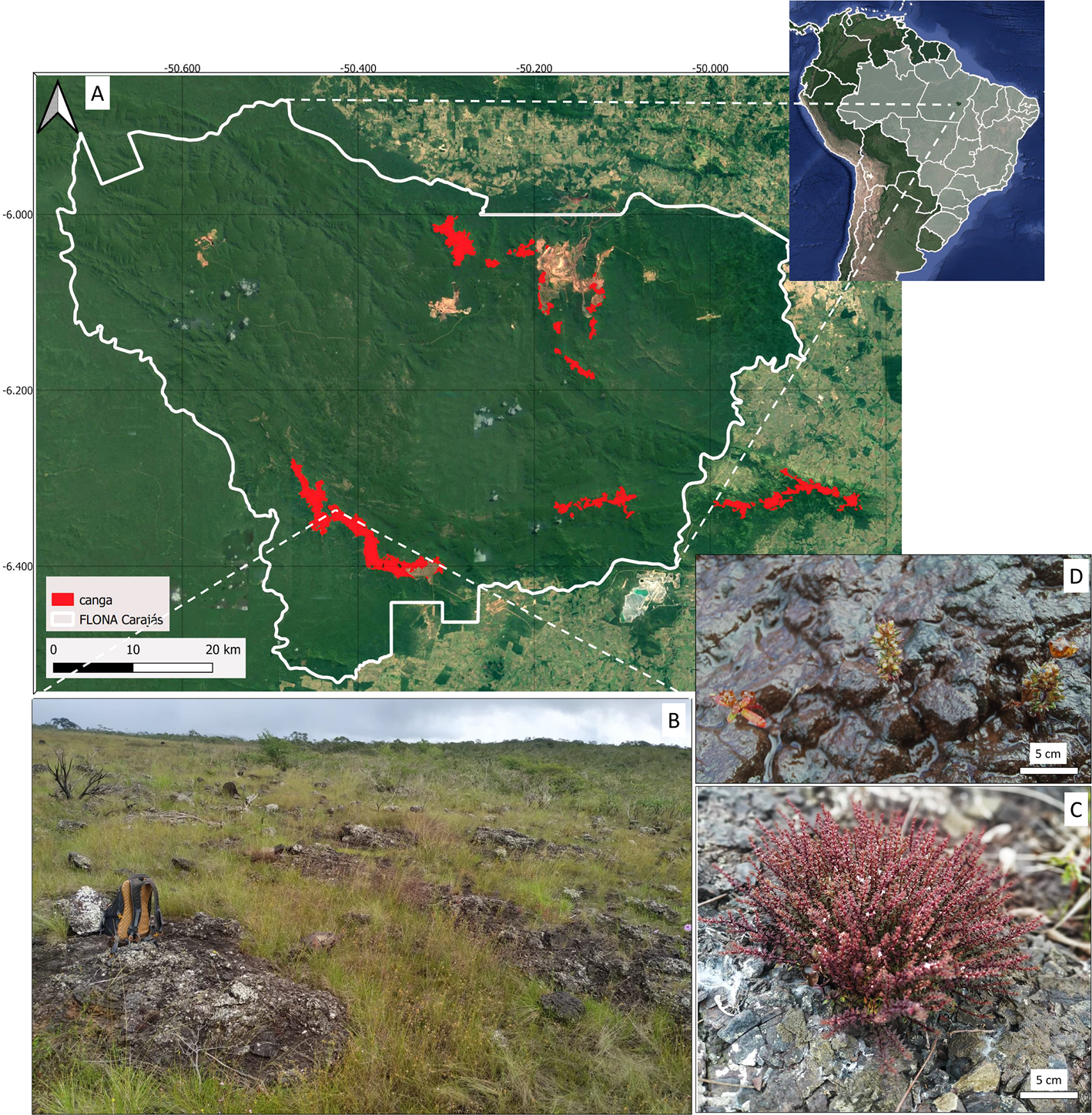
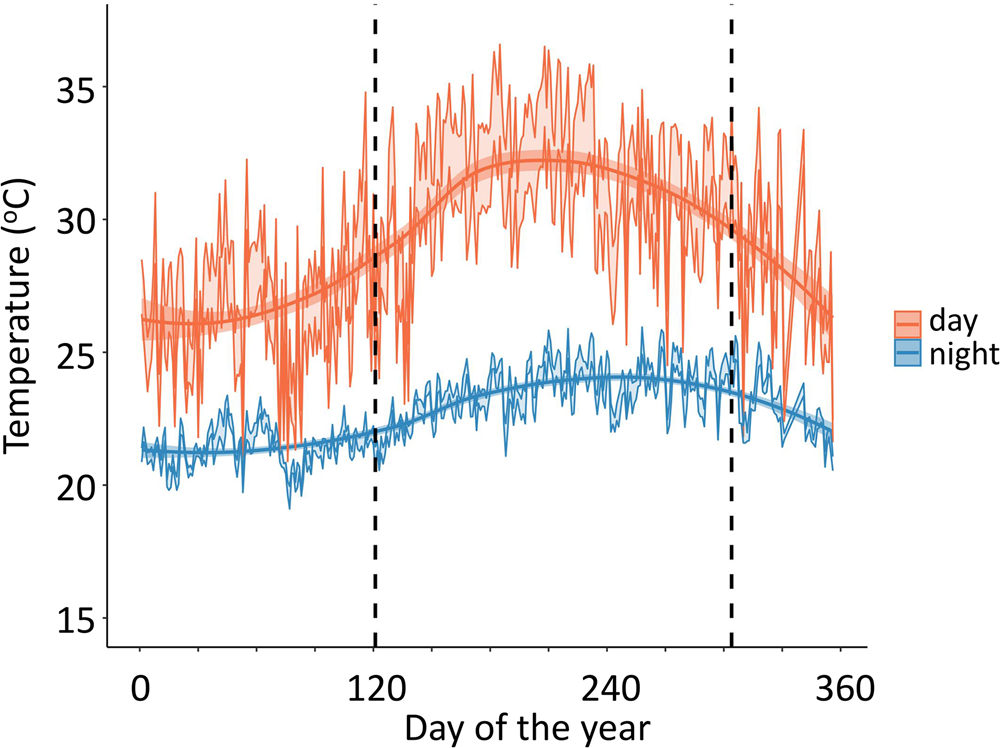
The Carajás National Forest, which is located in the Eastern Amazon (Pará, Brazil), is a protected area created in 1998 where vast forests surround mountain-tops that are rich in iron ore, where the ironstone outcrop (canga) ecosystems occur. The canga ecosystems of FLONA of Carajás are distributed throughout the northern mountain range (Serra Norte) and the southern mountain range (Serra Sul; Fig. 1A). The climate is hot and humid (Köppen Aw), with a marked dry season from May to October and a rainy season from November to April, during which most of the annual precipitation occurs (1,800–2,300 mm; Viana et al., Reference Viana, Mota, Gil, Salino, Zappi, Harley, Ilkiu-Borges, Secco, Almeida, Watanabe, dos Santos, Trovó, Maurity and Giulietti2016). Mean temperatures fluctuate between 20 and 23°C at night and between 23 and 35°C during the day (Fig. 2), but maximum temperatures on the soil surface can reach up to 60°C in rocky grasslands (T. Zupo et al., unpublished data).
(A) Location of the Carajás National Forest, Eastern Amazon (north of Brazil), where the northern and southern mountain ranges of ironstone outcrops occur. (B) Habitat of C. cangae, where it grows over rocks of the rocky grassland formations in the southern mountain range of Carajás. (C) A large and (D) small mature individuals of C. cangae during flowering.
Temperature (mean ± se) during the day (6 AM to 6 PM) and night (6 PM to 6 AM). Dashed vertical lines represent the beginning and end of the dry season. Temperature values were extracted from two Hobo MX2301A sensors placed 30 cm above the soil in the area where C. cangae occurs. Sensors registered air temperature every hour for 1 year (December 2022 to December 2023).
C. cangae is a small-sized rock-dwelling perennial forb species (<11 cm in height, Salas et al., Reference Salas, Viana, Cabral, Dessein and Janssens2015). However, many individuals exhibit an annual behaviour, completing their life cycle (recruitment, growth, reproduction and death) within one growing season, but reaching only very small sizes (3–5 cm in height; T. Zupo, personal communication). This species has a narrow geographic and ecological distribution, limited to rocky grassland formations of the largest canga plateau (S11, approximately 48.1 km2 of area, Souza-Filho et al., Reference Souza-Filho, Giannini, Jaffé, Giulietti, Santos, Nascimento, Guimarães, Costa, Imperatriz- Fonseca and Siqueira2019) in the southern mountain range of the Carajás National Forest (−50.424934, −6.341843; Fig. 1; Costa et al., Reference Costa, Pinho, Silva, Carvalho, Tavares, Assis and Watanabe2023). Seeds are 0.7–0.75 mm long, with a fresh seed mass of 0.0729 ± 0.0028 mg (mean ± SD) (n = 16 groups of 100 seeds, weighed using an analytical balance – Mettler Toledo, MS204S; Columbus, OH, USA), and they have no apparent dispersal structures. Seeds are dispersed between the end of the rainy season and the onset of the dry season (April to June) and exhibit physiological dormancy (Salas et al., Reference Salas, Viana, Cabral, Dessein and Janssens2015; Zanetti et al., Reference Zanetti, Dayrell, Wardil, Damasceno, Fernandes, Castilho, Santos and Silveira2020; Santos et al., Reference Santos, Cavalcante, Cardoso, Caldeira Júnior, Carvalho Neto, Escobar, Silveira, Tyski, Zanetti and Morais2023; Boanares et al., Reference Boanares, Cardoso, Escobar, Costa, Bitencourt, Costa, Ramos, Gastauer and Caldeira2024).
Seed harvest
Mature fruits were collected in May 2022 from at least 30 individuals. Permits to sample fruits were granted by SISBIO (Sistema de Autorização e Informação em Biodiversidade, permission number 76784-1). Fruits were put into paper bags and taken to the laboratory, where they were put together and sorted to avoid empty seeds. Fresh seeds were stored in room conditions (around 25°C and 50% relative humidity) for 14 days prior to the germination and ex situ storage experiments and for 30 days prior to the in situ storage experiments (see details below).
Seed storage and germination experiments
We assessed seed longevity and the alleviation of seed dormancy, both ex-situ and in-situ, by comparing the germination and viability of fresh and dry seeds with those stored under controlled and field conditions over time. We performed two germination experiments, one to determine ex situ and another to determine in situ seed longevity. To determine ex situ seed longevity, we used a factorial design with three storage temperatures (−20, 5 and 28°C) and three storage times (92, 187, and 227 days); seeds were also stored for 365 days at −20°C. We were only able to store seeds for 365 days at −20°C due to seed availability. To determine in situ seed longevity, we used three storage periods (108, 223 and 339 days) and one storage condition (field condition). The storage periods correspond to the end of the dry season, the first half of the rainy season and the beginning of the next dry season.
Fresh and dried seeds were used as the controls. The same controls were used for both experiments given the same seed lot was used for both in situ and ex situ germination experiments (see details below). For the fresh seed control, we used recently harvested seeds kept for 14 days at 23°C and 50% RH before the germination experiments. For the dried seed control, fresh seeds were placed in a desiccator containing silica gel (10–12 RH%) at room temperature (23°C) for 50 days. We used the seed equilibrium relative humidity (eRH%) as a measure of the seed moisture status of both fresh and dried seeds. The eRH was determined at 23°C by a hygrometer (HOBO UX 100-023) within a sealed glass chamber. For such, we placed a sample of seeds into the hygrometer chamber and allowed 60–90 min to reach equilibrium with the relative air humidity. The seed sample occupied at least 20% of the chamber's total volume (Probert et al., Reference Probert, Manger, Adams, Smith, Dickie, Linington, Pritchard and Probert2003).
Seeds stored ex situ were firstly dried for 50 days at 10–12 RH% and 23°C. They were then placed in tightly capped 2 mL polypropylene cryovials, wrapped in aluminium foil and stored at −20, 5 and 28°C; each cryovials contained 120 seeds. At each storage period (92, 187, 227 and 365 days), a cryovial per temperature was removed, and seeds were tested for germination and viability as described below. To determine in situ longevity, we placed fresh seeds (kept for 30 days at 50% RH and 23°C) in nylon mesh bags of approximately 15 × 5 cm and 1 mm mesh size (30 seeds per bag), which were then placed on the rocky surface of the area where a population of C. cangae naturally occurs. To prevent the bags from dispersing, we tied them to the rocks with galvanized iron wire (Fig. 1B). Three bags (one per storage period) were placed in one of six locations (replicates) distributed along the area. At each storage period (108, 223 and 339 days), a bag was removed from each location (total of six bags/storage period) and taken to the laboratory. Seeds were then retrieved and tested for germination and viability, as described below.
The germination tests were carried out in Petri dishes containing filter paper saturated with distilled water and incubated at alternating temperatures of 24/32°C with a 12/12 h photoperiod (~50 μmol s−1 m−2 photosynthetically active radiation). These temperatures were selected as they correspond to the approximate mean day and night temperatures (Fig. 2). For the controls and ex situ storage, six replicates (Petri dish) of 20 seeds each (n = 120) were used, while, for the in-situ storage, the number of seeds per Petri dish varied among storage periods due to the availability of seeds retrieved from the mesh bags (4–29 seeds, Supplementary Table S1). The experiments were monitored once a week for 90 days, and radicle protrusion was used as the germination criterion. At the end of the experiment, the viability of non-germinated seeds was analyzed by means of the tetrazolium test using 1% solution at 37 ± 2°C for 72 h incubation. We extended the incubation period to 72 h and increased the temperature above the recommended levels for crop species (up to 48 h and approximately 30°C, BRASIL, 2009) to facilitate the penetration of the tetrazolium salt into the embryo. Following incubation, seeds were longitudinally sectioned using a stereoscope (ZEISS Discovery.V12) at 27.2× magnification. Seeds were classified as viable if all embryonic structures were stained bright red (Supplementary Figure S1).
Data analysis
Seed storage behaviour and seed longevity
Seed storage behaviour was determined based on Hong and Ellis (Reference Hong and Ellis1996). First, we determined the seed desiccation tolerance by comparing the viability of fresh and dried seeds through a general linear model (GLM) using a binomial distribution. Then, we used the GLM to examine the effect of storage conditions and time on seed viability. To test if seed longevity differs between storage conditions, we performed a GLM with a factorial design (4 × 1) with four storage conditions (–20, 5 and 28°C, and field storage), the control and storage time as a continuous variable; fresh seeds were considered as having zero storage time. In the model above, we used storage time as a continuous variable to show the general tendency of viability change over time according to storage conditions. To detect changes in seed viability in relation to fresh seeds and between storage periods, we fitted two other GLMs with storage time as a discrete variable, one model for ex situ storage conditions and another for in situ storage conditions (field). That is, we compared the viability of fresh seeds with stored seeds in controlled conditions (−20, 5 and 28°C) in each storage time (92, 187 and 227 days), and similarly, we compared the viability of fresh seeds with seeds stored in the field for three periods (108, 223 and 339 days). In all three GLMs, seed viability was the response variable, and storage condition and time were the predictors. We fitted the full models that included all main effects and their interactions and performed a stepwise backward selection to choose the best model according to the Akaike information criterion (AIC) value; GLMs were fitted using a binomial distribution (seeds could be viable or non-viable) and logit-link function. Additionally, we tested the viability of seeds stored at −20°C for 12 months to evaluate their potential for germplasm conservation through conventional seed banking.
Seed dormancy alleviation
We evaluated seed dormancy alleviation in the field and the effect of after-ripening temperature and time on seed dormancy alleviation by fitting GLMs that compared seed germination time and the percentage of stored seeds in the field and controlled conditions across time. Thus, we assessed the effect of storage condition and time in seed germination by performing three GLMs for each germination parameter, seed germination percentage, and mean germination time, totalling six GLMs. First, we tested if germination parameters differed between storage conditions using a factorial design (4 × 1) with four storage conditions (−20, 5 and 28°C, as well as field), the control and storage time as a continuous variable. Then, we compared the germination parameter of fresh seeds with stored seeds in the field in each storage time (108, 223 and 339 days). Finally, we compared the germination parameter of fresh seeds with stored seeds in controlled conditions in each storage time (0, 92, 187 and 227 days). Similar to the seed longevity models, we used storage time as a continuous variable to assess the general trend of germination parameters changing across time according to storage conditions. In contrast, we used storage time as a discrete variable to compare changes in germination between storage periods in each storage condition. The fitted GLMs used the mean germination time or percentage as a response variable and storage temperature and time as predictors. For the mean germination time GLMs, we used a Gamma distribution with an inverse link function, while, for seed germination percentage, we used a binomial distribution with a logit link function. We fitted the full models that included all main effects and their interactions and performed a stepwise backward selection to choose the best model according to the AIC value. All analyses were carried out in the R software (R Core Development Team, 2024).
Results
Seed storage behaviour and seed longevity
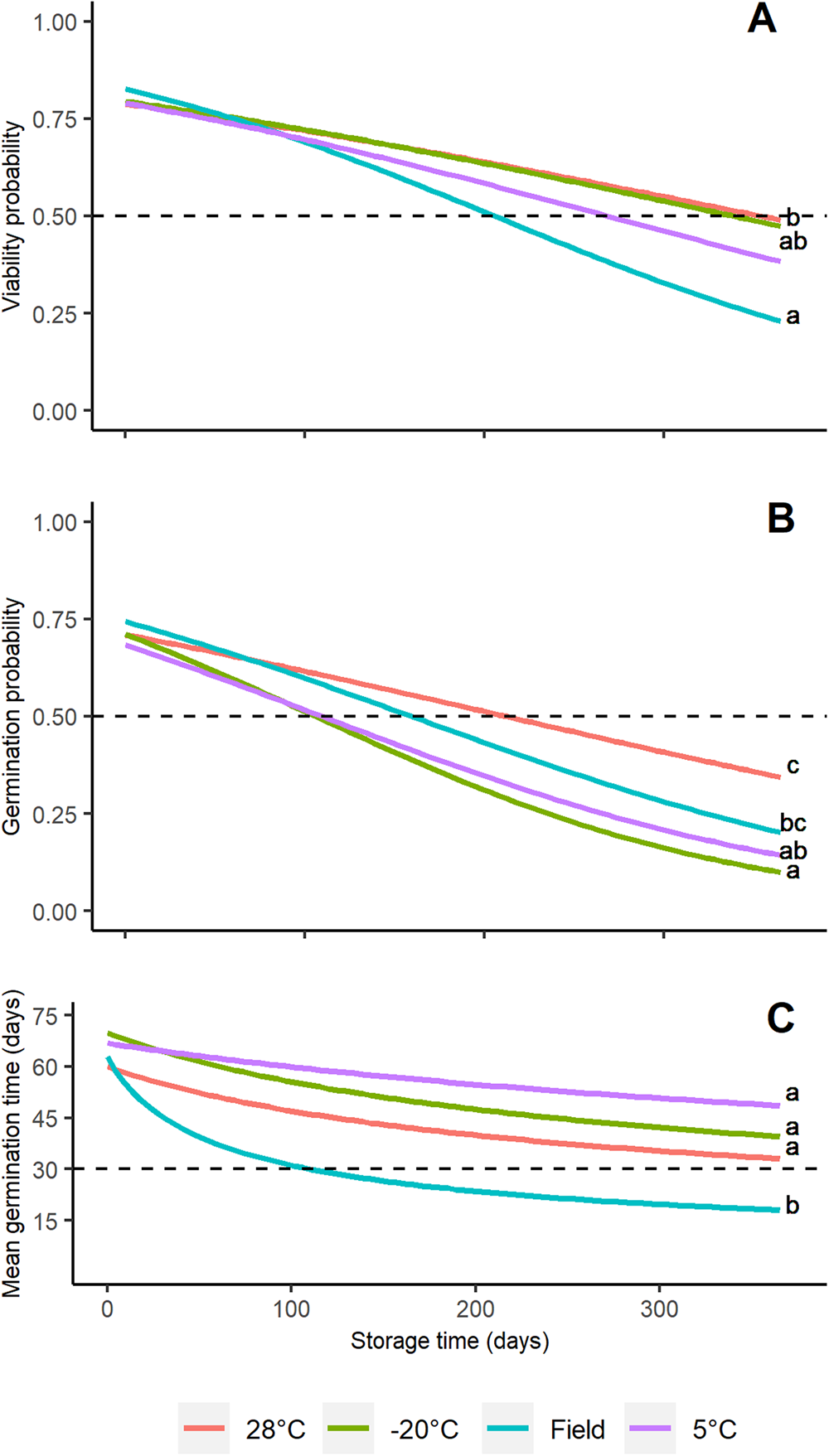
Fresh seeds of C. cangae showed a moderate moisture status (45.5 eRH%) and high viability (79.5 ± 0.12%), which was not reduced (GLM, z = 0.432, P > 0.6) after seed desiccation to low moisture (14.8 eRH%). Seed viability decreased with storage time, but the rates of decline varied depending on the storage condition (Fig. 3A, Supplementary Table S2). The rate of viability loss was higher for seeds stored in the field than for those stored at 28 and −20°C, but it did not differ from seeds stored at 5°C (Fig. 3A). The probability that seeds remain viable is less than 50% after 213 days stored in the field, 264 days stored at 5°C, 333 days at −20°C and 350 stored at 28°C (Fig. 3A). Seed viability seems to stabilize after 277 days at −20°C, as there was no difference in seed viability between seeds stored for 277 and 365 days (Table 1).
Effect of storage time and conditions on viability (A), germination proportion (B) and germination time (C) of C. cangae seeds stored in controlled conditions and in the field. Different letters indicate statistical differences. Storage time was used as a continuous variable.
Effect of storage time and temperature on the viability and germination of C. cangae seeds stored in controlled conditions
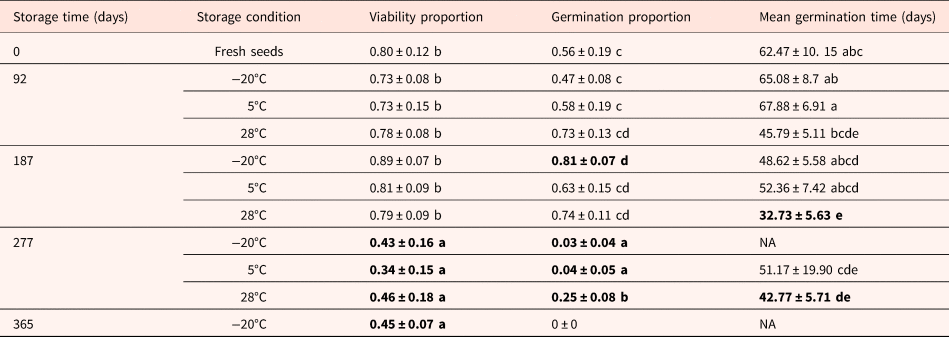
Note: Storage time as a discrete variable.
Different letters indicate statistical differences (P < 0.05) in viability and germination parameters between storage conditions and time. Values within a column followed by different bold letters indicate statistically significant differences (P < 0.05) in viability and germination parameters between stored and fresh seeds.
Seed dormancy alleviation
Seed germination depended on the interaction between storage time and conditions (Supplementary Tables S3 and S4). Germination percentage decreased with time, potentially due to a decline in seed viability. However, seeds stored at −20 and 5°C lost germinability faster than those stored at 28°C. There was no difference in germination percentage between seeds stored at 28°C and seeds stored in the field (Fig. 3B). Although seed germination tended to decrease with storage time, it significantly increased in relation to fresh seeds when stored in the field or at −20°C for 108 and 187 days, respectively (Tables 1 and 2). Moreover, seeds stored in the field and at 28°C for 108 and 187 days, respectively, germinated significantly faster (lower mean germination time) than fresh seeds (Tables 1 and 2; Supplementary Figure S2). Indeed, seeds stored in the field showed faster germination than all other storage conditions (Fig. 3C).
Effect of storage time on seed viability and germination of C. cangae seeds stored in the field

Different letters indicate statistical differences (P < 0.05) in viability germination parameters between storage conditions and time. Values within a column followed by different bold letters indicate statistically significant differences (P < 0.05) in viability and germination parameters between stored and fresh seeds.
Discussion
Our results showed that C. cangae displays an orthodox seed storage behaviour as seeds tolerate desiccation and storage at sub-zero temperatures. Seed longevity depends on storage conditions and time, where seeds stored in the field retain a viability of at least 50% for about 7 months, while seeds stored in controlled conditions (28, 5 and −20°C) retain a viability of at least 50% for about 9 months. The marked loss of seed viability in less than 1 year, regardless of storage condition, indicates a transient soil seed bank and low potential for germplasm conservation through conventional seed banking. Seed dormancy was fully alleviated after 3 months of field storage during the dry season. Moreover, seeds stored for 6 months at high temperatures (28°C) had their dormancy partially alleviated as seed germination remained high and mean germination time was deeply reduced, while low storage temperatures did not affect seed dormancy, indicating that environmental conditions found throughout the dry season in the C. cangae habitat are required to alleviate seed dormancy in this species.
Orthodox seed storage behaviour is expected in C. cangae as their seeds are released during the harsh conditions of the dry season, i.e., high temperatures and soil desiccation. Therefore, seed desiccation tolerance allows seed survival until the next rainy season. Moreover, orthodox storage behaviour is strongly correlated with herbaceous life forms, small seeds, and mountain-top grassland and shrubland ecosystems (Wyse and Dickie, Reference Wyse and Dickie2017). Despite the orthodox storage behaviour, C. cangae seeds exhibited short longevity in ex situ storage. This short potential longevity might be related to the presence of endosperm in mature C. cangae seeds (D. Escobar, personal observation), as endospermic seeds persist for shorter periods in conventional seed banks compared to those without endosperm (Probert et al., Reference Probert, Daws and Hay2009; Merritt et al., Reference Merritt, Martyn, Ainsley, Young, Seed, Thorpe, Hay, Commander, Shackelford, Offord, Dixon and Probert2014; Tausch et al., Reference Tausch, Leipold, Reisch and Poschlod2019). Potential longevity is also associated with climate, increasing from cool and moist climates to warm and seasonally dry climates (Probert et al., Reference Probert, Daws and Hay2009; Mondoni et al., Reference Mondoni, Probert, Rossi, Vegini and Hay2011; Merritt et al., Reference Merritt, Martyn, Ainsley, Young, Seed, Thorpe, Hay, Commander, Shackelford, Offord, Dixon and Probert2014). However, the expected relationship between potential high seed longevity and climate was not supported by our results, as our studied species, which is from strongly seasonally dry environments, showed short potential longevity. The short potential longevity of C. cangae seed may be a consequence of their evolutionary history, as endosperm presence seems conserved at the family level (Tausch et al., Reference Tausch, Leipold, Reisch and Poschlod2019, but see Felix et al., Reference Felix, de Oliveira, de Freitas, de Freitas, Jilani and Torres2021). Nevertheless, studies accessing both embryo–seed ratio evolution and potential seed longevity in the tropics are scarce and, thus, are needed to better understand seed trait correlations and plant conservation methods.
Considering that C. cangae disperses its seed from April to June and the seed persistence in the soil was approximately 7 months, the seed could retain the ability to germinate until the onset of the next rainy season (November–January). Thus, C. cangae seeds do not persist long enough to form a persistent soil seed bank but rather form a transient bank in which viable seeds persist in the soil for less than 1 year (Saatkamp et al., Reference Saatkamp, Poschlod, Venable and Gallagher2014). Our results support that soil seed bank strategies are strongly driven by climate predictability; even in a small-seeded herbaceous species, the transient soil seed bank has been selected. Moreover, C. cangae seed dormancy was fully and partially alleviated by field storage during the dry season and by ex-situ dry storage at 28°C, respectively, indicating that hot and dry climatic conditions are required to alleviate seed dormancy. Besides, seed dormancy alleviation by short duration of dry storage suggests that C. cangae seeds show non-deep physiological dormancy (Baskin and Baskin, Reference Baskin and Baskin2014). Thus, dormancy enhances seed persistence in the soil by delaying germination until the onset of the next rainy season, ultimately synchronizing germination with the favourable season for seedling establishment (Donohue, Reference Donohue2005b).
Synchronizing seed germination with the onset of the rainy season maximizes seed fitness, given early germination increases the duration of the growing period (before the onset of the dry season), ultimately resulting in higher seedling survival (Verdù and Traveset, Reference Verdù and Traveset2005). However, even in C. cangae seeds that were released from dormancy after dry storage in the field, germination did not occur rapidly (germination started after 10 days and mean germination was attained after 20 days; Supplementary Figure S2), suggesting that slow germination is likely due to high-water requirements for germination. Slow germination is seen as an adaptation to reduce the risk of drought-induced seedling mortality in seasonal environments, such as the occurrence of unpredictable dry spells during the onset of the rainy season (Daws et al., Reference Daws, Burslem, Crabtree, Kirkman, Mullins and Dalling2002, Reference Daws, Crabtree, Dalling, Mullins and Burslem2008; Donohue, Reference Donohue2005a; Verdù and Traveset, Reference Verdù and Traveset2005; Kos and Poschlod, Reference Kos and Poschlod2008; Salazar et al., Reference Salazar, Goldstein, Franco and Miralles-Wilhelm2012). Further studies examining the germination response of C. cangae seeds to hydric potential are needed to determine the role of water requirements for germination as a risk-reduction strategy in the species.
The strategies that plants use to avoid reproductive failure and ensure population persistence are the outcome of adaptive interactions among risk-reduction traits and the environmental conditions where species occur (Buoro and Carlson, Reference Buoro and Carlson2014; Escobar et al., Reference Escobar, Rubio de Casas and Morellato2021; Chen et al., Reference Chen, Hu, Baskin and Baskin2024). The predictability of climatic conditions in canga vegetation can favour protection against temporal habitat variability through transient soil seed banks, with seed dormancy controlling the time of year in which seeds may respond to germination stimuli and slow germination time – and maybe high-water requirements – avoiding seedling mortality due to dry-spells (Fenner and Thompson, Reference Fenner and Thompson2005; Yang et al., Reference Yang, Baskin, Baskin, Pakeman, Huang, Gao and Cornelissen2021). Moreover, perenniality and iteroparity are also risk reduction traits that C. cangae exhibits to deal with the highly spatially heterogeneous environment where it occurs, allowing it to occupy safe sites via annual seed recruitment and adult survival (Saatkamp et al., Reference Saatkamp, Poschlod, Venable and Gallagher2014). Iteroparity and plant lifespan are negatively correlated with seed persistence in the soil, as high reproduction frequency buffers better against risks of local extinction caused by reproductive failure than persistent soil seed banks (Metcalf et al., Reference Metcalf, Rose and Rees2003; Chen et al., Reference Chen, Hu, Baskin and Baskin2024). Therefore, predictability in climatic conditions, long lifespan and iteroparity could favour transient soil seed banks in C. cangae, regardless of the low seed mass, herbaceous life form, harsh environmental conditions and high spatial variability of the canga vegetation on a micro-scale that increases the likelihood of seeds being dispersed to non-safe sites (Jacobi et al., Reference Jacobi, do Carmo, Vincent and Stehmann2007; Dayrell et al., Reference Dayrell, Fuzessy, Azevedo, Lambers, Veneklaas and Silveira2021).
However, given C. cangae populations recover via freshly dispersed seeds rather than persistent soil seed banks and many individuals (around 80%) of C. cangae exhibit a short lifespan (annual behaviour, T. Zupo, personal communication, October 2024), population persistence will rely on the annual seed production and subsequent seedling establishment. Therefore, this species may suffer severe impacts due to population reduction, as it will not have a seed bank to re-establish the population, and the even short-term persistence of C. cangae depends on individuals in the area being able to grow and fruit. Hence, in situ management actions must be oriented to avoid habitat loss or degradation across the species occurrence area. Conventional seed banks do not seem to be suitable for long-term ex situ conservation as seed viability decreased from 79.5 ± 11.6 to 44.9 ± 7.1% after 1 year at −20°C and 15 RH%, but long-term seed storage studies and/or controlled aging tests are needed to understand potential longevity dynamics. We suggest examining cryopreservation as an alternative to conventional seed banking due to C. cangae desiccation-tolerant embryo (Center for Plant Conservation, 2019). We also showed that seed dormancy was fully alleviated by the environmental conditions during the dry season and partially alleviated after-ripening storage at a high constant temperature. Nonetheless, further studies testing gradients of alternating after-ripening temperatures can indicate the most effective conditions for ex situ seed dormancy alleviation.
Conclusions
C. cangae displays an orthodox seed storage behaviour; however, seed viability promptly decreases in ex situ storage, indicating the low potential for germplasm conservation through conventional seed banking. C. cangae copes with temporal habitat variability by exhibiting seed dormancy and slow germination, which synchronizes seed germination with favourable conditions for seedling establishment. Moreover, perenniality and iteroparity life-history strategies may buffer against risks of local extinction caused by reproductive failure, selecting transient rather than persistent soil seed banks. Therefore, our results suggest that in predictable climates, multiple reproduction events along the plant's lifespan (iteroparity) can favour a transient seed bank strategy even in herbaceous, small-seeded species with narrow ecological niches occurring in a highly spatially variable environment. This study also provides important insights to optimize the ex situ conservation of C. cangae.
Supplementary material
The supplementary material for this article can be found at https://doi.org/10.1017/S0960258525000017.
Acknowledgements
The authors thank the reviewers for their comments and recommendations.
Funding statement
Funding was provided by Instituto Tecnológico Vale (grant no. R100603.PFC.01). C.F.C. is grateful for the CNPq productivity scholarship (grant no. 311637/2022-1).


 Open access

