



1 INTRODUCTION
The formation and evolution of the Galaxy have not been fully understood, although many studies have explored the problems for several decades. Early studies thought that our Galaxy formed through isolated collapse (Eggen, Lynden-Bell, & Sandage Reference Eggen, Lynden-Bell and Sandage1962). The idea that the halo of the Galaxy may have formed partly by accreting some small fragments was proposed by Searle & Zinn (Reference Searle and Zinn1978). The stars related to these fragments could be recognisable as kinematic substructures and chemical composition among the Galactic halo stars. They should be concentrated into a number of coherent ‘streams’ in velocity space. Helmi et al. (Reference Helmi, White, de Zeeuw and Zhao1999) discovered a stellar steam in the solar neighborhood by detecting the distribution of angular momentum components. They estimated that about 10% metal-poor halo stars came from the stellar stream whose progenitor system was disrupted during the formation of the Galaxy. Because the abundance ratios of [α/Fe] in the stream are similar to those of other halo stars, Kepley et al. (Reference Kepley2007) suggested that the abundances of these stream stars are mostly enriched by Type II supernovae (SNe II). The stellar stream provides an excellent test bed for understanding the formation of our Galaxy. In this respect, a detailed study of elemental abundances, including the abundances of neutron-capture elements, in the stream is important.
The elements heavier than the iron-peak elements can be made through two neutron-capture processes: the r-process and the s-process (Burbidge et al. Reference Burbidge, Burbidge, Fowler and Hoyle1957). The s-process is further divided into two components, i.e., the main s-component and the weak s-component. The sites of the main s-component are thought to be in low- to intermediate-mass stars in the asymptotic giant branch (AGB; Busso, Gallino, & Wasserburg Reference Busso, Gallino and Wasserburg1999). The most likely sites for the weak s-component are in core helium burning and shell carbon burning in massive stars. The r-process sites are associated with SNe II from massive stars, but it has not been fully confirmed (Cowan, Thielemann, & Truran Reference Cowan, Thielemann and Truran1991; Sneden, Cowan, & Gallino Reference Sneden, Cowan and Gallino2008). Observations of the very metal-poor halo stars CS 22892−052 (Sneden et al. Reference Sneden2003; Cowan et al. Reference Cowan2005) and CS 31082−001 (Hill et al. Reference Hill2002; Honda et al. Reference Honda, Aoki, Kajino, Ando, Beers, Izumiura, Sadakane and Takada-Hidai2004) have revealed that their heavier neutron-capture elements (Z ≥ 56) are in remarkable agreement with the scaled solar system r-process pattern produced by the main r-process (Cowan et al. Reference Cowan, Pfeiffer, Kratz, Thielemann, Sneden, Burles, Tytler and Beers1999; Truran et al. Reference Truran, Cowan, Pilachowski and Sneden2002; Wanajo & Ishimaru Reference Wanajo and Ishimaru2006), but their lighter neutron-capture elements (37 ≤ Z ≤ 47) seemed to be deficient (Sneden et al. Reference Sneden, Cowan, Ivans, Fuller, Burles, Beers and Lawer2000; Hill et al. Reference Hill2002). This means that the r-process abundance pattern in solar system material cannot be explained by a single process. Based on the calculation of Galactic chemical evolution, Travaglio et al. (Reference Travaglio, Gallino, Arnone, Cowan, Jordan and Sneden2004) concluded that another component from massive stars is needed to explain the solar abundance of Sr, Y, and Zr. The corresponding process has the primary nature and is called the ‘lighter element primary process (LEPP; see Travaglio et al. Reference Travaglio, Gallino, Arnone, Cowan, Jordan and Sneden2004 and Serminato et al. Reference Serminato, Gallino, Travaglio, Bisterzo and Straniero2009) or ‘weak r-process component’ (Cowan et al. Reference Cowan2005; Ishimaru et al. Reference Ishimaru, Wanajo, Aoki, Ryan and Prantzos2005; Cowan & Sneden Reference Cowan and Sneden2006; Montes et al. Reference Montes2007; Izutani, Umeda, & Tominaga Reference Izutani, Umeda and Tominaga2009). Zhang, Cui, & Zhang (Reference Zhang, Cui and Zhang2010) analyzed the abundances of 14 metal-poor stars with metallicities [Fe/H] < −2.0 and found that the abundance patterns of both neutron-capture elements and light elements could be best explained by having a star form in a molecular cloud polluted by the weak r- and main r-process material.
A quantitative understanding of the origins of r-process elements in the metal-poor stars is still difficult. In this respect, the stream stars are optimum sites for the study of the r-process because most stream stars have not been polluted by the s-process material. Recently, Roederer et al. (Reference Roederer, Sneden, Thompson, Preston and Shectman2010a) observed the abundances of 12 metal-poor stream stars. Their angular momentum components clumped together far more than the random distribution of halo stars, which was first reported by Helmi et al. (Reference Helmi, White, de Zeeuw and Zhao1999). All of the 12 members have angular momentum components with 500 < Lz
< 1 500 kpc km s−1 and L
⊥ ~ 2000 kpc km s−1, where Lz
is the angular momentum component of rotation for a given star’s orbit and L
⊥ is the combination of the other two angular momentum components (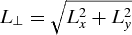 $L_{\bot }=\sqrt{L_{x}^{2}+L_{y}^{2}}$
). Based on observations of metal-poor stream stars, Roederer et al. (Reference Roederer, Sneden, Thompson, Preston and Shectman2010a) concluded that the observed abundance of the heavy elements in most stream stars cannot be fitted well by the abundances from a single r-process, especially for the lighter neutron-capture elements Sr, Y, and Zr. In order to better understand the origins of neutron-capture elements in the stellar stream, one must consider the contribution of the weak r-process. To make progress in our understanding of the neutron-capture processes, we study the element abundance patterns of the metal-poor stream stars, in which light elements, iron group elements, lighter and heavier neutron-capture elements are observed.
$L_{\bot }=\sqrt{L_{x}^{2}+L_{y}^{2}}$
). Based on observations of metal-poor stream stars, Roederer et al. (Reference Roederer, Sneden, Thompson, Preston and Shectman2010a) concluded that the observed abundance of the heavy elements in most stream stars cannot be fitted well by the abundances from a single r-process, especially for the lighter neutron-capture elements Sr, Y, and Zr. In order to better understand the origins of neutron-capture elements in the stellar stream, one must consider the contribution of the weak r-process. To make progress in our understanding of the neutron-capture processes, we study the element abundance patterns of the metal-poor stream stars, in which light elements, iron group elements, lighter and heavier neutron-capture elements are observed.
In this paper, we calculate the relative contributions from the individual neutron-capture process to the elemental abundances of nine stream stars in which elemental abundances of Eu have been observed. In Section 2, we obtain the two r-process components and extend the two abundance patterns to light elements. Using the updated weak r-component and main r-component, we calculate the relative contributions from the individual neutron-capture process to the elemental abundances in the stream stars. The calculated results are presented in Section 3. Our conclusions are given in Section 4.
2 THE WEAK r-PROCESS AND MAIN r-PROCESS COMPONENTS
Observational abundances in metal-poor stars show that sites producing the heavy r-nuclei do not produce iron group elements or the other light elements heavier than N (Qian & Wasserburg Reference Qian and Wasserburg2007). In this fact, the ‘main r-process stars’ CS 22892−052 and CS 31082−001 could have abundances that mainly reflect results of the main r-process nucleosynthesis of a few SNe. On the contrary, the ‘weak r-process stars’, i.e. HD 122563 and HD 88609, play an essential role in constraining the weak r-process, since they have the smallest contribution from the main r-process. Adopting the abundances of CS 22892−052 as the main r-process pattern, Zhang et al. (Reference Zhang, Cui and Zhang2010) found that, although the pattern of heavier neutron-capture elements is very similar to those of the main r-process pattern, the light-element abundance patterns of r-rich stars are close to those of weak r-process stars. In this study, based on the detailed abundance analysis of main r-process stars and weak r-process stars, we find that the abundances of light and iron group elements in main r-process stars do not come from main r-process events. We subtract the average abundances of main r-process stars from the average abundance of weak r-process stars, normalised to Eu. We then subtract the obtained result from the average abundance of main r-process stars, normalised to Fe. Repeating the above processes, we can obtain the pure weak r- and main r-components, which had been scaled to the solar r-process abundances given by Arlandini et al. (Reference Arlandini, Käppeler, Wisshak, Gallino, Lugaro, Busso and Straniero1999) and the values of Sr–Nb updated from Travaglio et al. (Reference Travaglio, Gallino, Arnone, Cowan, Jordan and Sneden2004).
3 RESULTS AND DISCUSSIONS
3.1 Fitted Results
The observed abundances of nine stream stars are taken from Roederer et al. (Reference Roederer, Sneden, Thompson, Preston and Shectman2010a). We will explore the origin of the neutron-capture elements in the stars by comparing the observed abundances with predicted results. The ith element abundance in a star can be calculated as
 \begin{equation}
N_{i}(Z)=(C_{r,m}N_{i,r,m}+C_{r,w}N_{i,r,w})\times 10^{\rm [Fe/H]},
\end{equation}
\begin{equation}
N_{i}(Z)=(C_{r,m}N_{i,r,m}+C_{r,w}N_{i,r,w})\times 10^{\rm [Fe/H]},
\end{equation}
Component Coefficients and χ2 for Eight Stars of the Stellar Stream

An example for the best-fit results of stream stars. In the top panel, the solid line presents our calculated result. The filled circles are observed elemental abundances. In the bottom panel, the open stars are individual relative offsets [Δlog ɛ(X)≡log ɛ(X)cal − log ɛ(X)obs]. The error bars are the observational errors.

In the stream stars, CS 29513−032 shows clear enrichment by the s-process. Roederer et al. (Reference Roederer, Sneden, Thompson, Preston and Shectman2010a) have speculated that the s-process material observed in CS 29513−032 is accreted from another low-metallicity AGB star. If it is the case, the s-process abundance in the envelope of the stars could be expected to be lower than the abundance produced by the s-process in the AGB star because the material is mixed with the envelopes of the primary (former AGB star) and secondary stars. Roederer et al. (Reference Roederer, Sneden, Thompson, Preston and Shectman2010a) found that the observed abundances could not be fitted by the scaled solar system r-process pattern nor by the s-process pattern. We explore the origin of the neutron-capture elements in the s-rich stars by comparing the observed abundances with predicted s- and r-process contribution. After considering the s-process contribution, the ith element abundance in the envelope of the star can be calculated as follows:
 \begin{equation}
N_{i}(Z)=(C_{s}N_{i,s}+C_{r,m}N_{i,r,m}+C_{r,w}N_{i,r,w})\times 10^{\rm [Fe/H]},
\end{equation}
\begin{equation}
N_{i}(Z)=(C_{s}N_{i,s}+C_{r,m}N_{i,r,m}+C_{r,w}N_{i,r,w})\times 10^{\rm [Fe/H]},
\end{equation}
The best-fit results for CS 29513−032. The left panel shows our result by adopting the result of the AGB model with [Fe/H]=−3 given by Busso et al. (Reference Busso, Gallino, Lambert, Travaglio and Smith2001). The right panel shows our result by adopting the parametric approach. The symbols are the same as in Figure 1.

In the top panel of Figure 3, we show individual relative offsets (Δlog ɛ) for the sample stars with respect to the predictions. Typical observational uncertainties in log ɛ are ~ 0.2–0.3 dex (dotted lines). The root-mean-square (RMS) offsets of these elements in log ɛ shown in the bottom panel are mostly smaller than 0.30 dex for comparison with the calculated results. These values are consistent with zero, given by the combined uncertainties in stellar abundances and predicted abundances, which confirm the validity of the approach adopted in this work. From Figures 1–3 we can see that the agreement is obtained for both light elements, iron group elements and neutron-capture elements.
Top panel: individual relative offsets [Δlog ɛ(X), Δlog ɛ(X)≡log ɛ(X)cal−log ɛ(X)obs] for the sample stars with respect to the predictions from the abundance model (stars). Typical observational uncertainties in log ɛ are ~ 0.2–0.3 dex (dotted lines). Bottom panel: the RMS offsets of these elements in log ɛ. Filled circles are average stellar abundance offsets.

3.2 The Two r-Process Component Coefficients
The component coefficients as a function of metallicity, illustrated in Figure 4, contain some important information about the polluted history of the stellar stream. The trend of coefficients C r,w is almost constant for the stream stars, which is clearly different from that of C r,m . The calculated results that C r,w is nearly constant suggest that the elements produced by the weak r-process have increased along with Fe over the polluted history of the stellar stream. This means that both the weak r-process elements and Fe are produced as primary elements from SNe II and their yields have nearly a constant mass fraction. Roederer et al. (Reference Roederer, Sneden, Thompson, Preston and Shectman2010a) have found that most of α-elements and iron group elements have small or moderate dispersions, and show no evolution with metallicity. This also means that both light elements and iron group elements are produced as primary elements from SNe II in which the weak r-process occurs, and their yields have nearly a constant mass fraction. On the other hand, they found that most of neutron-capture elements follow similarly increasing trends of [element/Fe] ratios with increasing [Fe/H]. Obviously, the increased trend in C r,m as [Fe/H] increases is a consequence of the gradual increase in the production of main r-process elements relative to iron. The rise means that the main r-process contribution may begin slightly later than the contribution from the weak r-process producing in conjunction with the Fe. This behavior supports the idea that the masses of progenitors for the main r-process are smaller than those of the weak r-process (or LEPP) (Travaglio et al. Reference Travaglio, Galli, Gallino, Busso, Ferrini and Straniero1999, Reference Travaglio, Gallino, Arnone, Cowan, Jordan and Sneden2004; Travaglio, Galli, & Burkert Reference Travaglio, Galli and Burkert2001; Wanajo & Ishimaru Reference Wanajo and Ishimaru2006; Qian & Wasserburg Reference Qian and Wasserburg2007; Izutani et al. Reference Izutani, Umeda and Tominaga2009). The main r-process coefficient C r,m is close to the weak r-process coefficient C r,w as the metallicity approaches [Fe/H] ~ −2.2.
The component coefficients as a function of metallicity. Symbols: filled circles and open circles are the main r-process coefficients and the weak r-process coefficients of eight stream stars, respectively. Filled squares, open squares, and open squares with a cross are the component coefficients responsible for the maim r-process, weak r-process, and the main s-process in the s-rich star CS 29513−032, respectively. Filled triangles and open triangles are the main r-component coefficients and the weak r-component coefficients of 14 metal-poor halo stars studied in Zhang et al. (Reference Zhang, Cui and Zhang2010), respectively. Their abundances are observed by Westin et al. (Reference Westin, Sneden, Gustafsson and Cowan2000), Cowan et al. (Reference Cowan2002), Hill et al. (Reference Hill2002), Sneden et al. (Reference Sneden2003), Honda et al. (Reference Honda, Aoki, Kajino, Ando, Beers, Izumiura, Sadakane and Takada-Hidai2004, Reference Honda, Aoki, Ishimaru, Wanajo and Ryan2006, Reference Honda, Aoki, Ishimaru and Wanajo2007), Barklem et al. (Reference Barklem2005), Ivans et al. (Reference Ivans, Simmerer, Sneden, Lawler, Cowan, Gallino and Bisterzo2006), Christlieb et al. (Reference Christlieb, Schörck, Frebel, Beers, Wisotzki and Reimers2008), Hayek et al. (Reference Hayek2009), Mashonkina et al. (Reference Mashonkina, Christlieb, Barklem, Hill, Beers and Velichko2010), and Roederer et al. (Reference Roederer, Sneden, Lawler and Cowan2010b).

For ease of comparison, the recalculated coefficients of 12 r-rich stars and two weak r-process stars (HD 122563 and HD 88609) studied in Zhang et al. (Reference Zhang, Cui and Zhang2010) are marked by triangles in Figure 4. We find that their weak r-process component coefficients are close to those of the stream stars. However, for main r-process components, the difference between the stream stars with [Fe/H] < −2.2 and r-rich stars is obvious. As seen from Figure 4, the sample stars are separated into two branches clearly by C r,m , i.e., r-rich stars having coefficient C r,m larger than 3.0 and ‘low-C r,m ’ stars with coefficient C r,m less than 3.0. All metal-poor stream stars ([Fe/H] < −2.2) and two weak r-process stars (HD 122563 and HD 88609) belong to ‘low-C r,m ’ stars.
3.3 Discussion of the Abundance Decomposition
As the abundances of the stream stars can be used as a probe of the origin of the neutron-capture elements in their progenitor system, it is important to determine the relative contributions from the individual neutron-capture processes to the abundances of heavy elements in the stars. It was possible to isolate the contributions corresponding to the weak r- and main r-processes using our approach. Taking the values of C
r,m
and C
r,w
into Equation (1), the decomposed results of sample stars can be derived. In Figures 5(a–h), the component fractions f
i,r,m $(f_{i,r,m}=\frac{C_{r,m}N_{i,r,m}}{C_{r,m}N_{i,r,m}+C_{r,w}N_{i,r,w}})$
and f
i,r,w
$(f_{i,r,m}=\frac{C_{r,m}N_{i,r,m}}{C_{r,m}N_{i,r,m}+C_{r,w}N_{i,r,w}})$
and f
i,r,w $(f_{i,r,w}=\frac{C_{r,w}N_{i,r,w}}{C_{r,m}N_{i,r,m}+C_{r,w}N_{i,r,w}})$
as a function of [Fe/H] are given by the filled circles (main r-process) and open circles (weak r-process), respectively. The abundances of Sr, Y, and Zr in the stream stars are a mixture of two r-process components. We can see that, for the sample star with the lowest metallicity, i.e. [Fe/H] = −3.29, the weak r-processes are dominantly responsible for abundances of the lighter neutron-capture elements Sr, Y, and Zr. Although the contributions from weak r-processes are larger than those of the main r-process to the lighter neutron-capture elements of the stream stars, the contributions from the main r-process to lighter neutron-capture elements, such as Sr, Y, and Zr, increase with increasing metallicity.
$(f_{i,r,w}=\frac{C_{r,w}N_{i,r,w}}{C_{r,m}N_{i,r,m}+C_{r,w}N_{i,r,w}})$
as a function of [Fe/H] are given by the filled circles (main r-process) and open circles (weak r-process), respectively. The abundances of Sr, Y, and Zr in the stream stars are a mixture of two r-process components. We can see that, for the sample star with the lowest metallicity, i.e. [Fe/H] = −3.29, the weak r-processes are dominantly responsible for abundances of the lighter neutron-capture elements Sr, Y, and Zr. Although the contributions from weak r-processes are larger than those of the main r-process to the lighter neutron-capture elements of the stream stars, the contributions from the main r-process to lighter neutron-capture elements, such as Sr, Y, and Zr, increase with increasing metallicity.
The component fractions of eight stream stars as a function of [Fe/H]. Symbols: filled circles and open circles are the fractions of the main r-component and the weak r-component, respectively.

In order to study the origins of neutron-capture elements, the variation of the logarithmic ratio [element/Fe] with metallicity is particularly useful. The component ratios of the individual neutron-capture process, i.e., [element/Fe] i (i = r, w; r, m) are derived and shown in Figure 6. The filled circles and open circles respectively represent the main r- and weak r-component ratios. The trend of ratios [element/Fe] r,w is almost constant for the stream stars, which is clearly different from that of [element/Fe] r,m . In particular, we focus on the ratios of Sr, Y, Zr, which are partly produced by weak r-process nucleosynthesis. We can see that, for the sample star, the contributions from weak r-processes are higher than those of the main r-process for abundances of the lighter neutron-capture elements Sr, Y, and Zr. The calculated results that the [Sr, Y, Zr/Fe] r,w is nearly constant suggest that the elements produced by the weak r-process have increased along with Fe. This also means that both the weak r-process and Fe are produced as primary elements from SNe II and their yields have nearly a constant mass fraction. From Figure 6(a) we find that the ratios [Sr/Fe] r,w are nearly −0.3. For the other lighter neutron-capture elements Y and Zr, the similar results can be obtained. To investigate the contribution of the main r-process in [element/Fe] for heavier neutron-capture elements Ba, La, and Eu, the variations of the logarithmic ratios [element/Fe] i are shown in Figures 6(d–f). For the heavier neutron-capture elements, the figures show that the main r-process contribution is dominant. We find an increased trend in the [element/Fe] r,m as [Fe/H] increases. This would mean a consequence of the gradual increase in the production rate of the main r-process relative to iron due to the increased contribution of SNe II in which main r-process events occur. Our calculated results could be used as the constraints on the chemical characteristics of the progenitor system from which the stream stars originated.
The logarithmic component ratios vary with metallicity for eight stream stars. Symbols: filled circles and open circles are the main r-component ratios and the weak r-component ratios, respectively.

Up to now, the metal-poor stars HD 122563 and HD 88609 are only two stars having extremely excesses of lighter neutron-capture elements and are called as ‘weak r-process stars’. Their overall abundance pattern could represent the yields of the weak r-process. In order to investigate the robustness of the weak r-process pattern, it is very important to find the more weak r-process stars. The component coefficients can be used to select special stars. If one component coefficient is much larger than others, the abundances of this star may be dominantly produced by the corresponding process. Based on our results shown in Figure 4 and Table 1, we can find that the metal-poor stars, HD 237846 with C r,m = 0.42 and C r,w = 3.84, could be one weak r-process star. In order to test this finding, Figure 7 shows the abundance comparisons on the logarithmic scale between HD 237846 and HD 122563 as a function of the atomic number, which have been normalised to the Fe abundance of HD 122563. Our conclusion here is that, except element O, the abundance patterns of HD 237846 and HD 122563 are quite similar. The metallicity of HD 237846 ([Fe/H] = −3.29) is even lower than that of HD 88609. This study reveals that HD 237846 is another weak r-process star.
The abundance comparisons on the logarithmic scale between HD 237846 and HD 122563 as a function of the atomic number. Symbols: the open circles and filled circles present the observed abundances in HD 122563 and HD 237846, respectively.

4 CONCLUSIONS
In our Galaxy, nearly all chemical evolution and nucleosynthetic information is in the form of elemental abundances of stars with various metallicities. In this respect, the stellar abundances polluted by only a few processes, such as main r-process stars and weak r-process stars, are very significant, because their abundances can be directly compared with model prediction. However, such stars are very rare. The chemical abundances of the metal-poor stars in the stellar stream are excellent information for setting constraints on models of r-processes. Our results can be summarised as follows.
-
1. The observed abundances of the heavy elements in the stream stars cannot be well fitted by the abundances of the main r-process (Roederer et al. Reference Roederer, Sneden, Thompson, Preston and Shectman2010a). After adding the contribution of the weak r-process and its accompaniment, the abundances of most metal-poor stream stars, including light elements, iron group elements, and neutron-capture elements, can be fitted. For lighter neutron-capture elements Sr, Y, and Zr, the contributions from the weak r-process are larger than those of the main r-process.
-
2. The weak r-process coefficients are almost constant for the sample stars, including r-rich stars. This means that the elements produced by the weak r-process have increased along with Fe over the polluted history of the stellar stream. Both the weak r-process and Fe are produced as primary elements from SNe II and their yields have nearly a constant mass fraction.
-
3. The increased trend in the [element/Fe] r,m as [Fe/H] increases means the gradual increase in the production rate of the main r-process relative to iron. This behavior is due to the increased contribution of SNe II in which main r-process events occur and would imply that the masses of progenitors for the main r-process are smaller than those of the weak r-process.
-
4. The difference between the stream stars and r-rich stars is obvious. The r-rich stars and the stream stars are separated into two branches clearly, with a systematic different in the main r-process component C r,m at a given metallicity. All metal-poor stream stars ([Fe/H] < −2.2) belong to ‘low-C r,m ’ stars. Moreover, the weak r-process stars HD 122563 and HD 88609 also belong to ‘low-C r,m ’ stars.
-
5. Although a large number of metal-poor stars have been studied over the past few decades, only two weak r-process stars, HD 122563 ([Fe/H] = −2.77) and HD 88609 ([Fe/H] = −3.07), have been found. Using the component coefficients, chemical-specific stars can be selected. We find that the metal-poor star HD 237846 is another weak r-process star. The metallicity of HD 237846 is [Fe/H] = −3.29, which means that the abundance pattern produced by the weak r-process is stable from star to star for a wider range of metallicities. This result would give a stronger constraint on the models of the weak r-process in the very early Galaxy.
-
6. The calculated results imply that the relative contribution from the individual neutron-capture process to the heavy element abundances is not usually in the solar proportion, for most stream stars. The contributions of the weak r-process are larger than those of the main r-processes to lighter neutron-capture elements Sr, Y, and Zr. The main r-process coefficient C r,m close to the weak r-process coefficient C r,w as the metallicity approaches [Fe/H] ~ −2.2, which implies that both the weak r-process and the main r-process component fractions reach their solar system values as the metallicity approaches [Fe/H] ~ −2.2.
-
7. CS 29513−032 is the only s-rich star in the stellar stream. Considering the contribution of the s-process, its abundances can be fitted. The s-process elements in CS 29513−032 are a result of pollution from the dredged-up material in the former low-mass AGB star (e.g. 1.5 M⊙). Based on the analysis of angular momentum components, Roederer et al. (Reference Roederer, Sneden, Thompson, Preston and Shectman2010a) suggested the s-rich star CS 29513−032 is a member of the stream stars. We find that its r-process coefficients are close to other stream stars with similar metallicity, which means that the initial abundance (i.e. before polluted by the AGB star) of CS 29513−032 is similar to the abundances of the other stream stars. This implies that the astrophysical origin of CS 29513−032 and other stream stars is similar. Our result supports the suggestion by Roederer et al. (Reference Roederer, Sneden, Thompson, Preston and Shectman2010a). CS 29513−032 should belong to a wide binary system which forms in a molecular cloud that has been polluted by both the weak and main r-process material.
Clearly, it is important for future studies to determine the relation between metal-poor halo stars and metal-poor stellar stream stars. More theoretical and observational studies of stream stars will reveal the characteristics of the r-process at low metallicity and the history of the enrichment of neutron-capture elements in the early Galaxy.
ACKNOWLEDGMENTS
We are grateful to the referee for very valuable comments and suggestions that improved this paper greatly. This work has been supported by the National Natural Science Foundation of China under grants U1231119, 11273011, 10847119, 10778616, 10973006, and 11003002, the Natural Science Foundation of Hebei Provincial Education Department under grant 2008127, the Science Foundation of Hebei Normal University under grants L2007B07 and L2009Z04, the Natural Science Foundation of Hebei Province under grants A2009000251 and A2011205102, and the Program for Excellent Innovative Talents in the University of Hebei Province under grant CPRC034.



