





Introduction
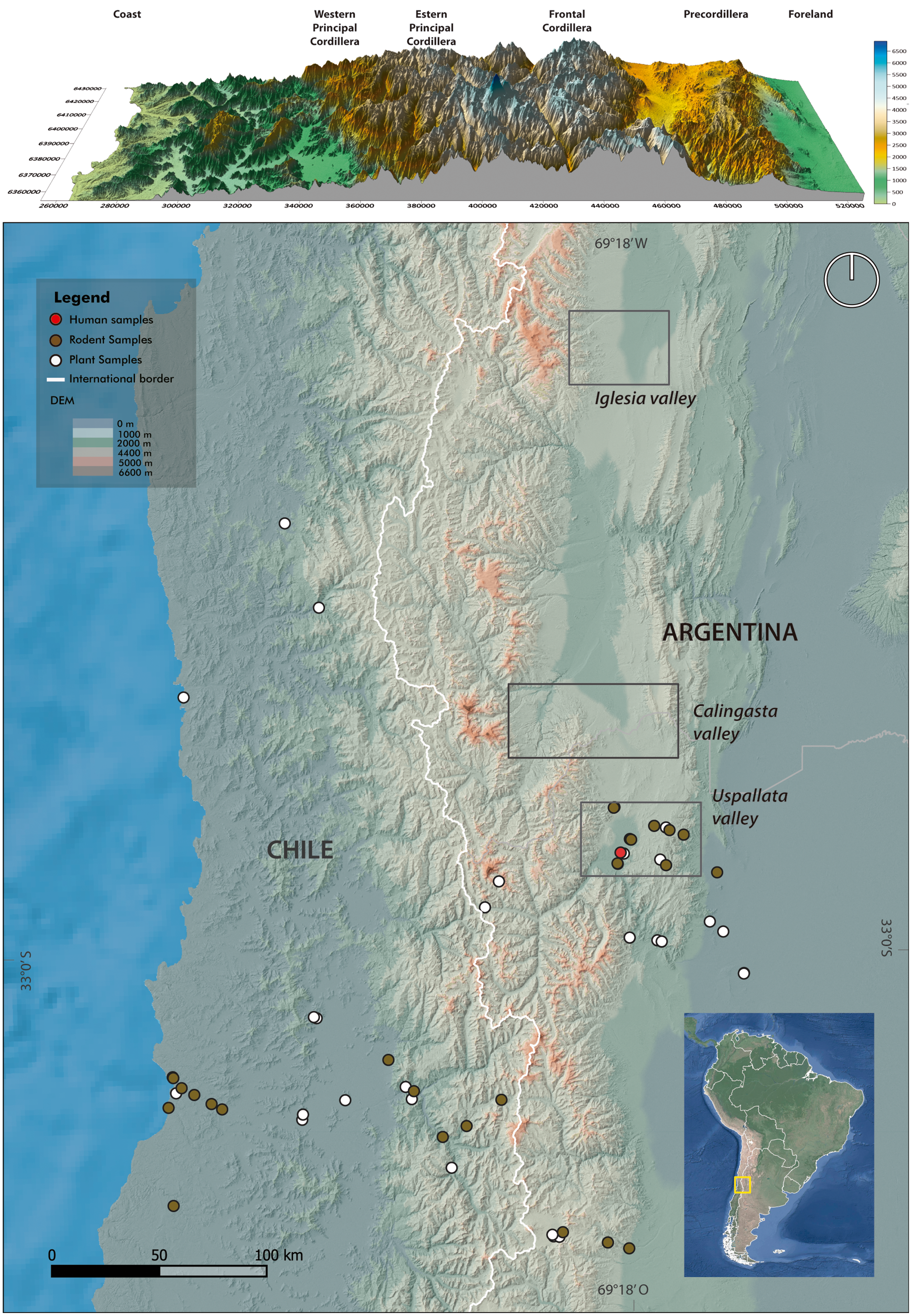
Migration is understood as the long-term or permanent movement of human beings across space and over time, occurring beyond the scale of traditionally occupied territories (Anthony Reference Anthony1990; Snow Reference Snow2009; Tsuda et al. Reference Tsuda, Baker, Eder, Knudson, Maupin, Meierotto, Scott, Baker and Tsuda2015). Despite the wealth of studies in the south central Andes, particularly—but not exclusively—in relation with the diasporic Tiwanaku societies (Knudson et al. Reference Knudson, Price, Buikstra and Blom2004; Knudson et al. Reference Knudson, Goldstein, Dahlstedt, Somerville and Schoeninger2014; Torres-Rouff and Knudson Reference Torres-Rouff and Knudson2017; Tessone et al. Reference Tessone, Barberena and Knudson2023), human migration still is a neglected process in the archaeology of the southern Andes. Due to a lack of analytical resolution, and also probably as part of the “retreat from migrationism” that followed the dominant approaches developed up to the 1960s (Adams et al. Reference Adams, Van Gerven and Levy1978; Hakenbeck Reference Hakenbeck2008), migration is still not viewed as a significant variable in shaping the socio-demographic trajectories of southern Andean societies (although see Gambier Reference Gambier2000; Marsh Reference Marsh2023; Menéndez et al. Reference Menéndez, Novellino, D’Addona, Brachetta, Beguelin, Bernal, Cortegoso, Durán and Gasco2014). Recently, however, the development of a macro-regional isoscape of bioavailable strontium isotopes (87Sr/86Sr) across the southern Andes of Argentina and Chile has allowed identifying the remains of southern Andean migrants with confidence (Barberena et al. Reference Barberena, Durán, Novellino, Winocur, Benítez, Tessone, Quiroga, Marsh, Gasco and Cortegoso2017, Reference Barberena, Tessone, Le Roux, Lucero, Llano, Samec, Quintana, Mallea, Gasco and Guevara2023). By applying this isoscape in a region characterized by striking east-west variation in rock age and composition, we have identified a pulse of human immigration of intensive maize farmers in the Uspallata Valley (Mendoza, Argentina, Figure 1). This is recorded by means of non-local 87Sr/86Sr values for human bone and teeth remains from three nearby archaeological sites (Barberena et al. Reference Barberena, Menéndez, le Roux, Marsh, Tessone, Novellino, Lucero, Luyt, Sealy and Cardillo2020; Barberena et al. Reference Barberena, Cardillo, Lucero, le Roux, Tessone, Llano, Gasco, Marsh, Nuevo-Delaunay and Novellino2021a). To understand the social dynamics of a migratory process it is paramount to establish its timing and, through the integration of multiple proxies, the mode(s) of migration in terms of the socio-demographic composition of the migrant groups, their geographic source, the presence of human groups in the receiving area, and the differences and similitudes between local and migrant groups (Cabana and Clark Reference Cabana and Clark2011; Cameron Reference Cameron2013; Snow Reference Snow2009).
Study area of the Uspallata and other Andean valleys in Argentina: red dot, location of the sites with migrants; green dots, location of rodent samples utilized to build the strontium isoscape; white dots, location of modern plant samples utilized to build the strontium isoscape.

Using radiocarbon dates on humans identified as migrants from the three archaeological sites containing migrant groups at Uspallata Valley, we employed Bayesian modeling to determine the likely timing and duration of the migration event/s. By combining this temporal dimension with an analysis of the demographic profiles and mortuary practices that formed these sites, we assess the modes of past migration. Ultimately, we aspire to obtain new insights into social dynamics in the southern Andes.
Study area and contextual background
The Uspallata Valley is located in northwestern Mendoza Province, Argentina, flanked by the towering mountain ranges of Precordillera to the east and the Andes to the west, with striking topographical and ecological variation (–32.594°S, –69.359°W). Connected to the north with the Calingasta and Iglesia Valleys, the region makes up a longitudinal biogeographic corridor extending east of the Andes for over 350 km. In addition, the main paths crossing the Andes range that provide access to the western shed can be accessed along this natural corridor. During the last 3000 years, the southern Andes were characterized by a diverse array of socioecological niches variously combining hunting-gathering, horticulture, intensive agriculture, and camelid pastoralism across space and time (Barberena et al. Reference Barberena, Tessone, Novellino, Marsh, Cortegoso, Gasco, Guevara and Durán2022; Durán et al. Reference Durán, Cortegoso, Barberena, Frigolé, Novellino, Lucero, Yebra, Gasco, Winocur and Benítez2018a; Gambier Reference Gambier2000; Gil et al. Reference Gil, Villalba, Ugan, Cortegoso, Neme, Michieli, Novellino and Durán2014). This social landscape set the conditions for multiple forms of interaction ranging from cooperation to conflict, particularly during the last 2000 years, when all the available regions had been incorporated into human territories.
Due to the high diversity of bedrock age and composition, the geology of Uspallata and surrounding areas is especially suited to track local residence and immigration, since Uspallata is flanked by the Paleozoic Precordillera to the east and by the younger Frontal and Principal Cordillera to the west (Figure 1). Biologically available strontium from each geological unit was characterized by the analysis of modern and archaeological rodents (with restricted home ranges) and plant samples (Barberena et al. Reference Barberena, Durán, Novellino, Winocur, Benítez, Tessone, Quiroga, Marsh, Gasco and Cortegoso2017, Reference Barberena, Tessone, Cagnoni, Gasco, Durán, Winocur, Benítez, Lucero, Trillas and Zonana2021b). These are appropriate for building a baseline as a frame of reference for human samples (Copeland et al. Reference Copeland, Sponheimer, Lee-Thorp, De Ruiter, Le Roux, Grimes, Codron, Berger and Richards2010; Hoppe et al. Reference Hoppe, Koch, Carlson and Webb1999; Price et al. Reference Price, Burton and Bentley2002; Scaffidi and Knudson Reference Scaffidi and Knudson2020; Washburn et al. Reference Washburn, Nesbitt, Ibarra, Fehren-Schmitz and Oelze2021). We analyzed 65 rodent samples and 26 plant samples from the main geological units along a 250-km transect from the Pacific coast (Chile) to the lowlands east of the Andes (Argentina). The results show that these samples closely track the geological regions, and that the Uspallata Valley is characterized by values averaging the highly radiogenic sediments from the Paleozoic Precordillera to the east, composed of the oldest Andean formations of ∼500–350 my, and the less radiogenic sediments from the younger Frontal Cordillera (Ramos and Folguera Reference Ramos and Folguera2009).
We have recorded non-local 87Sr/86Sr values for 62 samples from three archaeological sites: Potrero Las Colonias (from now onwards “PLC”; 57 samples, 40 individuals), Túmulo III (three samples, three individuals), and Usina Sur 2 (two samples, two individuals). This makes up for 45 individuals isotopically confirmed as migrants in Uspallata, summing up 29.2% of the minimal number of individuals reconstructed for these three sites (N = 154). Importantly, only one individual from PLC and one from Túmulo III produced a local 87Sr/86Sr signal. Available δ13Ccoll., δ13Cap. and δ15N shows that these individuals had largely C4-based diets, implying a subsistence most likely focused on intensive maize agriculture (Barberena et al. Reference Barberena, Menéndez, le Roux, Marsh, Tessone, Novellino, Lucero, Luyt, Sealy and Cardillo2020) and excludes radiocarbon reservoir offsets.
Methods
Bioarchaeology
The comingled characteristics of the sites PLC and Túmulo III, comprising the largest part of our sample, combined with outdated recovery techniques applied in the 1930s original excavations by Carlos Rusconi (Rusconi Reference Rusconi1961, Reference Rusconi1962a), lead to mixed assemblages where the integrity of the specimens for each individual has been largely lost. For the quantification of these remains, we began by separating specimens from adults and subadults to accurately estimate the Minimal Number of Individuals (MNI) (Grayson Reference Grayson1984; Gifford-Gonzalez Reference Gifford-Gonzalez2018). Then, we followed an additional step proposed for commingled human remains aimed at calculating the “Most Likely Number of Individuals” (MLNI), which estimates the original number of deposited individuals instead of the individuals recovered—as done by the MNI—based on the pairing of well-preserved homologous elements (Adams and Konigsberg Reference Adams and Konigsberg2004). The analysis was adjusted by considering additional variables such as the morphology, size, robusticity and presence of distinctive morphologic features in the remains (Grayson Reference Grayson1984; Buikstra and Ubelaker Reference Buikstra and Ubelaker1994).
For the estimation of age and sex we considered diagnostic elements with good preservation; crania in adults and femora in subadults, while sex determinations were conducted only for adults utilizing dysmorphic features of the os coxae and the skulls. To reconstruct the age at death profile, we divided the samples into Subadults (prenatal stage to the fusion of the epiphyses of the post-cranial skeleton, ca. 20 years) and Adults (>20 years) (Buikstra and Ubelaker Reference Buikstra and Ubelaker1994; Scheuer and Black Reference Scheuer and Black2000). The age at death in subadults was estimated by means of the longitudinal size of the femora using a digital caliper and an osteometric table, following the age categories defined by Buikstra and Ubelaker (Reference Buikstra and Ubelaker1994): fetal (before birth–40 weeks); infant (0–4.9 years); child (5–14.9 years); adolescent (15–19.9 years). To estimate age at death in adults we used the cranium given its better preservation and associated sex information (Meindl and Lovejoy Reference Meindl and Lovejoy1985), applying the following categories: young adult (YA: 20–34 years), middle adult (MA: 35–49 years), old adult (OA: >50 years) (Buikstra and Ubelaker Reference Buikstra and Ubelaker1994).
Chronology
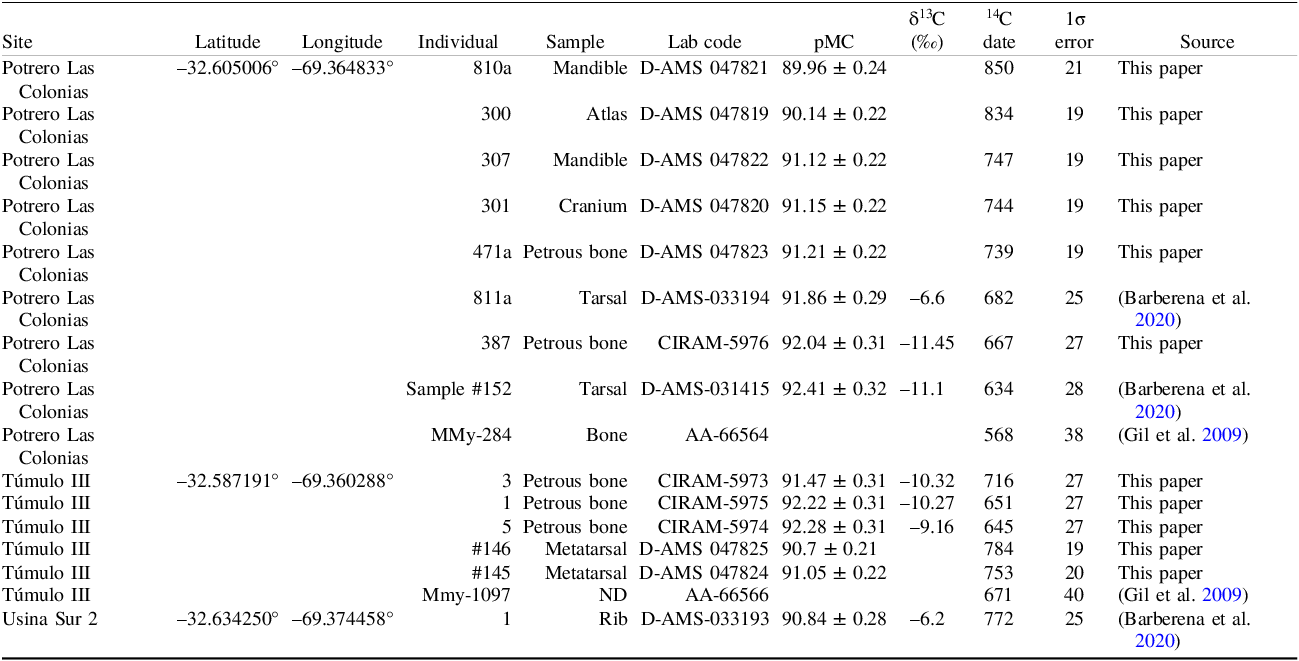
Radiocarbon measurements were obtained for 16 individuals of the three sites with migrants in Uspallata: nine from PLC, six from Túmulo III and one from Usina Sur 2. Five of these were previously reported (Gil et al. Reference Gil, Neme, Tykot, Novellino, Cortegoso and Durán2009; Barberena et al. Reference Barberena, Menéndez, le Roux, Marsh, Tessone, Novellino, Lucero, Luyt, Sealy and Cardillo2020). Of the 14 dates produced by us, 10 were dated at DirectAMS (United States) and four at CIRAM Lab (France). The two remaining dates were analyzed at the University of Arizona AMS Laboratory (United States) (Gil et al. Reference Gil, Neme, Tykot, Novellino, Cortegoso and Durán2009). Bone collagen pre-treatment methods are described in SI. Calibration and Bayesian modelling were undertaken using the SHCal calibration curve (Hogg et al. Reference Hogg, Heaton, Hua, Palmer, Turney, Southon, Bayliss, Blackwell, Boswijk and Bronk Ramsey2020, Aug 12) in OxCal 4.4 (Bronk Ramsey Reference Bronk Ramsey2009). All Bayesian models created are single-phase and uniform. The primary model includes the 16 radiocarbon measurements representing the three archaeological sites, whilst two other models are site-specific sequences for PLC and Túmulo III. Given that Usina Sur 2 is only represented by one date, no model was made. Within OxCal, the ‘Difference’ function was used to determine the coevality of specific temporal distributions. All age estimates are here noted at 95.4% credible/confidence intervals (CI) and rounded to 5 years. OxCal code can be found in SI.
Results
Bioarchaeology and mortuary practices
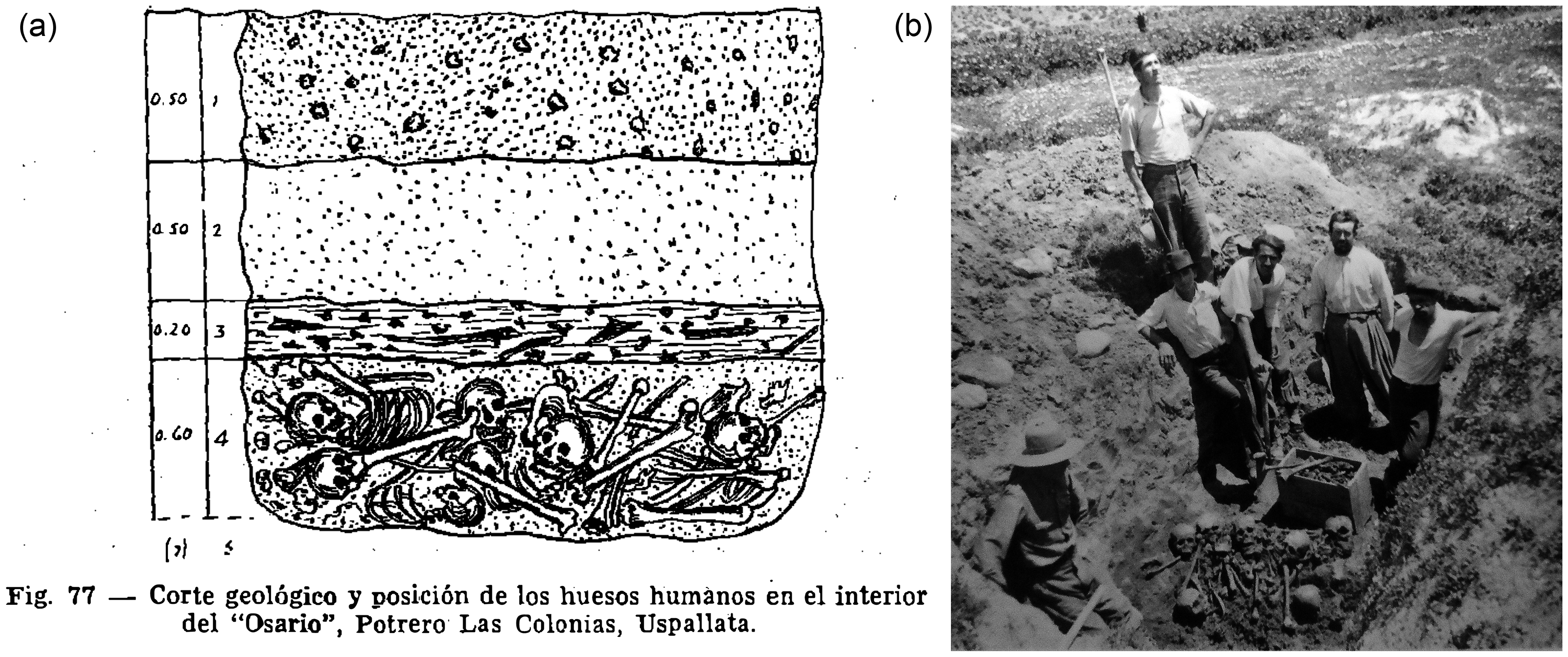
As mentioned, two of the sites with migrants were excavated by the pioneer archaeologist Carlos Rusconi in the 1930’s (Rusconi Reference Rusconi1947, Reference Rusconi1962b). PLC site is a multiple burial excavated in 1939 from which most of the available isotopic information for migrants comes from. Rusconi describes the burial as an “ossuary” containing partly disarticulated bones deposited in a small pit of ∼2.5 × 2 m (Rusconi Reference Rusconi1962a, 370) (Figure 2). While Rusconi does not record the precise limits of the burial pit (layer 4), he indicates that the remains were directly overlain by a 20 cm-thick layer containing ash, charcoal and some burnt undetermined bone remains (layer 3). Based on this, Rusconi suggests that the mortuary practices involved the ignition of fires above the deposit containing the remains (Rusconi Reference Rusconi1947). While this suggestion cannot be assessed in absence of precise contextual information, only two bones showed evidence of burning, thus discarding a significant role of the practice of cremation.
PLC site: (a) Section of the excavation drawn by Rusconi signaling layers 3 and 4 (Rusconi Reference Rusconi1962a): Figure 77); (b) Photograph of the excavation taken on February 10th, 1939 (Image facilitated by Estela Rusconi).

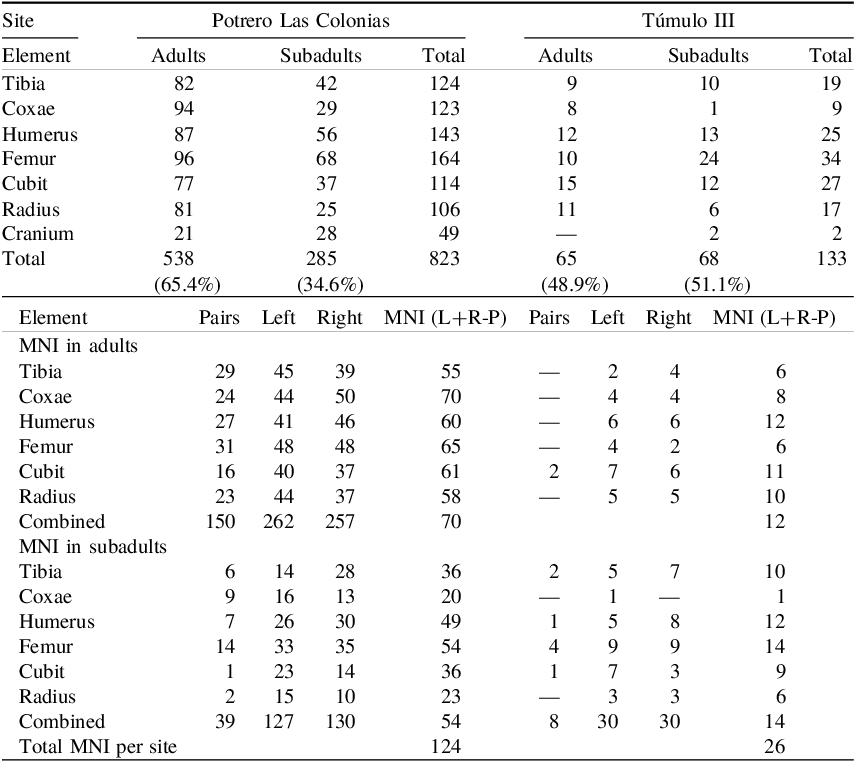
As a result of the bioarchaeological analysis, we quantified 875 diagnostic bone specimens from cranial and post-cranial anatomical elements (Table 1). The quantitative analysis allows determining an MNI of 124, of which 70 are adults and 54 are subadults. Due to a complex conservation history of these remains during the last 90 years, it is likely that part of the excavated remains has been lost and that the original number of deposited individuals was considerably higher (Guevara et al. Reference Guevara, Novellino, Barberena, Da Peña, Tessone, Le Roux and Durán2022). Indeed, the MLNI (Adams and Konigsberg Reference Adams and Konigsberg2004) reconstructed is of 76 adults and 74 subadults for a total of 150 individuals. Sex determinations conducted on the preserved crania from adults show the presence of 8 females (38%) and 13 males (62%). As for the coxae, the sample is composed of 30 females (43%), 24 males (34%) and 16 undetermined (23%).
Anatomical representation and MNI for the sites with migrants from Uspallata

Rusconi postulates two alternative hypotheses to explain the formation of this cemetery site: inter-group conflict followed by violent deaths or an epidemic that decimated a large part of these groups (Rusconi Reference Rusconi1961, 214–215). Both scenarios would have involved the speedy interment of the deceased in a communal burial with little to no associated cultural remains (Rusconi Reference Rusconi1947; Guevara et al. Reference Guevara, Novellino, Barberena, Da Peña, Tessone, Le Roux and Durán2022). Preliminary taphonomic analysis does not show traces of trauma and violent deaths. Importantly for the timing and mode of site formation, Rusconi suggests that the site represents a unique depositional event due to a catastrophic event.
Túmulo III site corresponds to another multiple burial poorly described by Rusconi as containing incomplete and comingled remains from several individuals including subadults of different ages (Rusconi Reference Rusconi1962a, 190). The author does not record any association with cultural materials on this site. Shortly, and while contextual information is limited, it appears to share some contextual characteristics with PLC: mixed remains from multiple individuals in a context that does not include mortuary goods. The bioarchaeological study of the remains shows an MNI of 26 individuals composed by 12 adults (46%) and 14 subadults (54%) (Table 1). There is a high representation of subadults compared to adults in the categories of <40 weeks, 0–3.9 years and 4–14.9 years.
Finally, Usina Sur 2 is the third site where we recorded a non-local 87Sr/86Sr signal which is isotopically like those from PLC and Túmulo III. This context was excavated by our team in 2017 in the context of a rescue of the remains that eroding in the front of a receding ravine. We recovered the partial remains of two adult individuals of undetermined sex (Barberena et al. Reference Barberena, Menéndez, le Roux, Marsh, Tessone, Novellino, Lucero, Luyt, Sealy and Cardillo2020).
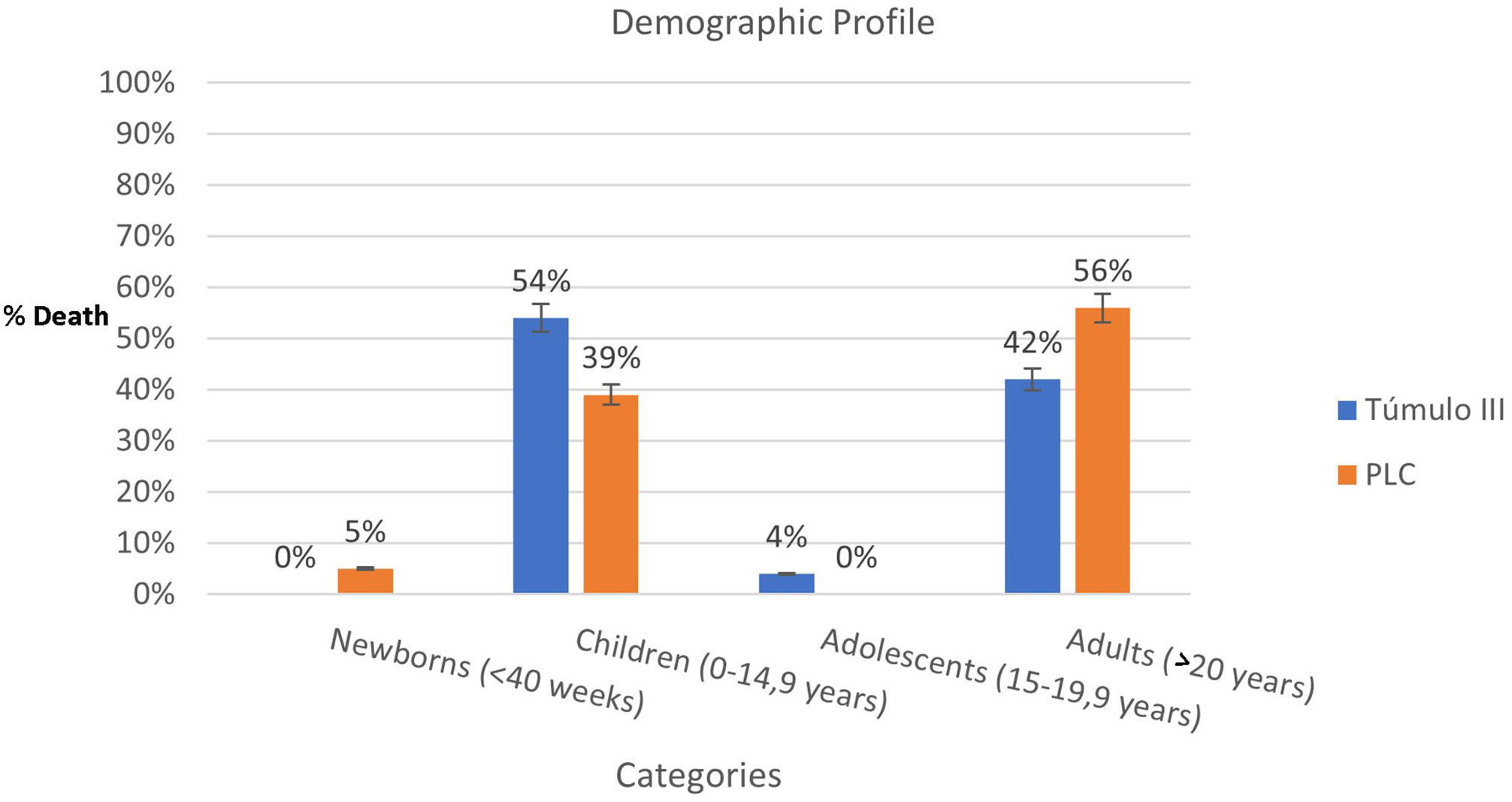
While the recovery conditions of the sites PLC and Túmulo III prevent an accurate paleodemographic reconstruction, there are some significant inferences to be made regarding the composition of the migrant groups (Baitzel and Goldstein Reference Baitzel and Goldstein2016). Firstly, nearly all the subadult and adult age categories are represented. Indeed, the interval of individuals between 0 and 14.9 years (children) is very high in PLC (39%) and Túmulo III (54%) (Figure 3). Rusconi himself remarked the high abundance of newborns and young individuals during the excavations (Rusconi Reference Rusconi1962a): 190). Since both differential preservation and recovery techniques would tend to under-represent the smaller and more fragile subadult remains, we suggest that there is a fidelity in terms of age composition between the available sample and the individuals originally deposited.
Age at death profiles at PLC and Túmulo III.

Bayesian modeling
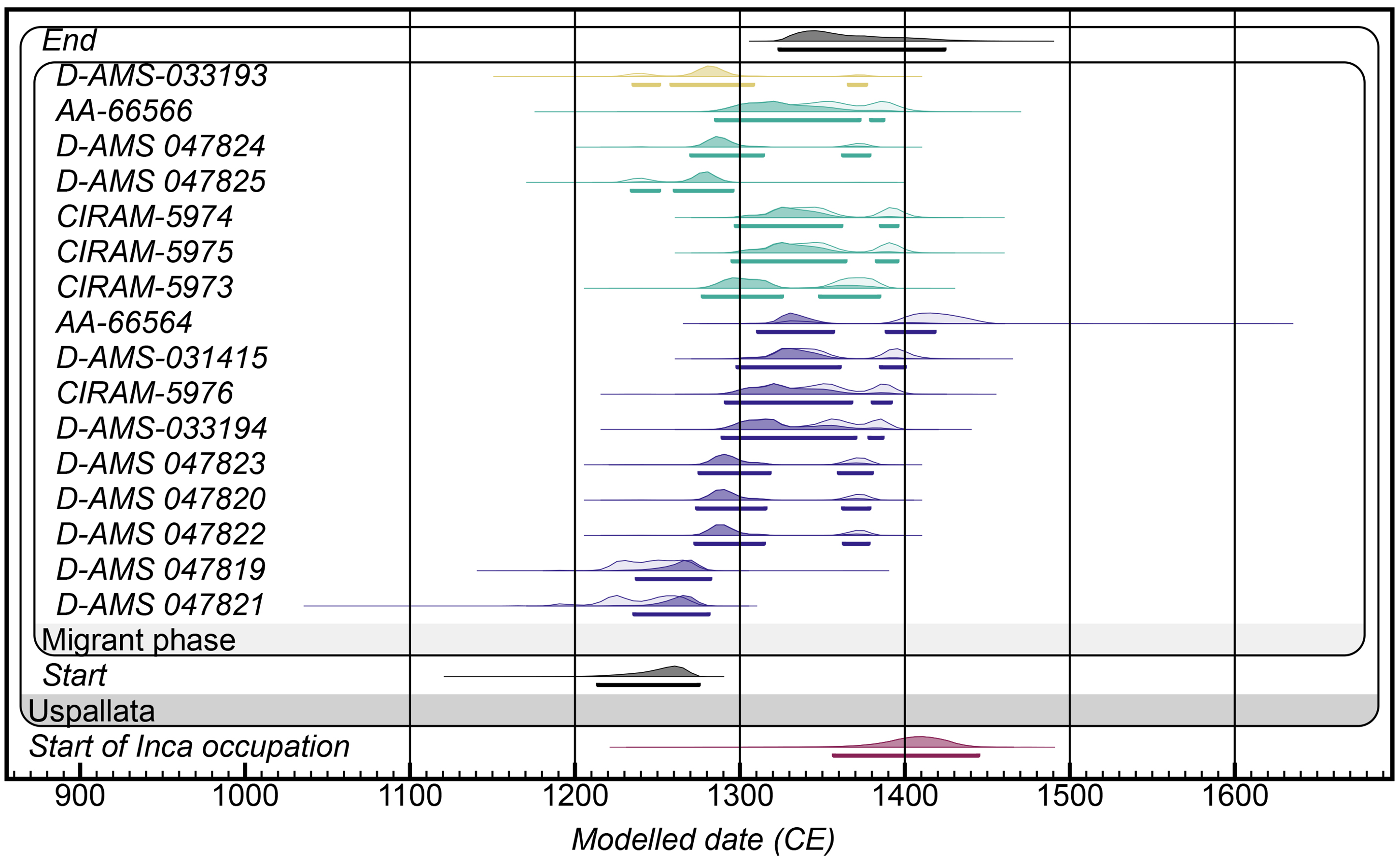
The chronological results are presented in Table 2. Bayesian modeling results estimate the start and end of the migrant phase in Uspallata to 1210–1275 CE (median 1255 CE) and 1320–1425 CE (median 1360 CE), respectively, with a likely duration of between 55 to 195 years (median 105 years) (Figure 4). These start and end estimates are comparable to those produced by the site-specific models for PLC (Figure S1) and Túmulo III (Figure S2; Figure S3). The individual date for Usina Sur 2 also falls within this period. As such, migration likely began coevally at these archaeological sites and represents a regional process. Modeling also indicates that the commencement of this migratory phase precedes the start of Inka occupation in the region—as calculated in (Marsh et al. Reference Marsh, Kidd, Ogburn and Durán2017)—by 90–210 years. As a note, real/potential offsets introduced by collagen turnover in bone (including intraskeletal variation) (Hedges et al. Reference Hedges, Clement, Thomas and O’Connell2007; Jørkov et al. Reference Jørkov, Heinemeier and Lynnerup2009; Sealy et al. Reference Sealy, Armstrong and Schrire1995) as well as targeted vs. dated event (death of the individual vs. time of migration) should fall within the dating uncertainty (around a century for calibrated ages in this period), particularly for subadults. Therefore, these factors are unlikely to significantly alter the results.
Radiocarbon dates for the sites with migrants in the Uspallata Valley

Bayesian model for the migrant phase at Uspallata, including radiocarbon measurements from PLC (blue), Túmulo III (green) and Usina Sur 2 (yellow). Bars underneath each distribution denote 95.4% CI. “CE” denotes Common Era (calibrated). The start of Inka occupation in the region (as calculated in Durán et al. Reference Durán, Novellino, Menéndez, Gasco, Marsh and Barberena2018b; Marsh et al. Reference Marsh, Kidd, Ogburn and Durán2017), is included at the bottom in red. The interval between this and the commencement of the migrant phase at Uspallata is estimated to 95–220 years.

Discussion
The integration of the mortuary and demographic results with the Bayesian modeling of the radiocarbon dates allows characterizing the timing and mode of the process of human migration in the southern Andes. The migrant groups show a high representation of children—between 0 and 14.9 years old—at PLC (39%) and Túmulo III (54%) burial sites. These sites were excavated in the 1930’s with techniques that likely produced partial recovery of the remains. However, since this bias would preferentially affect the smaller and more fragile subadult bones, we are confident that their high representation is a primary feature of these cemeteries. Considering that, in addition to the representation of the different age classes, both men and women are present, we tentatively infer that family groups were involved (Chamberlain Reference Chamberlain2006). These two sites are the only in Uspallata and nearby regions in which large numbers of individuals of different age and sex are deposited without any grave goods (Barberena et al. Reference Barberena, Menéndez, le Roux, Marsh, Tessone, Novellino, Lucero, Luyt, Sealy and Cardillo2020; Da Peña Aldao et al. Reference Da Peña Aldao, Novellino and Frigolé2016; Durán et al. Reference Durán, Novellino, Menéndez, Gasco, Marsh and Barberena2018b; Rusconi Reference Rusconi1947; Schobinger Reference Schobinger1974).
The Bayesian modeling of the 16 dates for the sites with migrants indicates that this was likely a diachronic process lasting between 55 and 195 years (Figure 4). If the span of one human generation is taken to be ∼25 years (Timpson et al. Reference Timpson, Barberena, Thomas, Méndez and Manning2021; Wang et al. Reference Wang, Al-Saffar, Rogers and Hahn2023), the results suggest that migration to Uspallata was a multi-generational process that involved at least two and up to eight generations with a median estimation of four generations. Independently of the precise number, the Bayesian model suggests that the socioecological conditions fostering migration to Uspallata were sustained through time. Importantly, the 87Sr/86Sr values for migrants are very homogeneous pointing towards a very similar–though still undetermined–source area (Barberena et al. Reference Barberena, Menéndez, le Roux, Marsh, Tessone, Novellino, Lucero, Luyt, Sealy and Cardillo2020, Reference Barberena, Cardillo, Lucero, le Roux, Tessone, Llano, Gasco, Marsh, Nuevo-Delaunay and Novellino2021a).
Finally, the dates suggest that there is nearly no overlap between the migration and the southwards expansion of the Inka Empire (Bárcena Reference Bárcena2007; Troncoso Reference Troncoso2018), with an earliest estimation for its arrival in Uspallata around 1400 CE (Cornejo Reference Cornejo2014; Marsh et al. Reference Marsh, Kidd, Ogburn and Durán2017; cf. García et al. Reference García, Greco, Moralejo and Ochoa2023). Considering that in this earliest estimation there is a minimal overlap near the end of the modelled interval, we suggest the Inka expansion is largely unrelated to the dynamics of the migratory process recorded. However, since the estimation for the end of this interval encompasses between 1320–1425 CE, it is possible that there was a minimal overlap between the end of the migration phase and the Inka arrival. In any case, as was previously suggested (Alconini and Covey Reference Alconini, Covey, Alconini and Covey2018; Pavlovic et al. Reference Pavlovic, Sánchez, Pascual, Martínez and Cortés2019; Troncoso Reference Troncoso2018), our results suggest that there likely was a multicultural social setting when the Inka arrived.
Conclusions and perspectives
We have presented contextual, bioarchaeological and chronological evidence supporting an inter-generational migration pulse shortly preceding the Inka arrival in the southern Andes of Argentina. This process involved groups composed by the different age classes and sexes, probably representing families, which were deposited in multiple burials with no significant grave goods. Importantly, the 87Sr/86Sr signature suggests that these individuals come from the same—still undetermined—geological region. This research raises new questions for which we have no clear answers yet. Combined, these issues make up an exciting research program for years to come. Firstly, the multi-generational character of the migratory pulse invites to explore possible “push” factors (Anthony Reference Anthony1990; Ingram and Schollmeyer Reference Ingram and Schollmeyer2021), or what Tsuda et al. (Reference Tsuda, Baker, Eder, Knudson, Maupin, Meierotto, Scott, Baker and Tsuda2015) define as disruptions, that may have triggered the abandonment of the migrants’ homeland. We will consider climate change, conflict and/or diseases, among other possible factors. In parallel, the results suggest that the Uspallata Valley exerted a strong pull influence on the migrants. While the reasons for this may be manifold, the existence of previous social links between the source and destination areas may have been significant. In any case, migration occurred beyond the territories of these groups as measured by 87Sr/86Sr and may have involved movement across social or ethnic frontiers (Feuer Reference Feuer2016; Parker Reference Parker2006).
The migrants from the different sites show strikingly similar non-local 87Sr/86Sr values, raising the scenario that they died not long after arriving at Uspallata, since otherwise the differential incorporation of local strontium would produce more diverse isotopic values. We need to investigate the socio-ecological scenarios that may have led to this dramatic outcome.
We are currently working on several dimensions that will help us move forward in answering these questions. Firstly, we are combining studies of human paleogenomics and cranio-facial geometric morphometrics to assess biological distances between locals and migrants, as well as group sizes and possible source areas. Geometric morphometrics will also inform on aspects of cultural identities through the study of cranial modifications (Menéndez Reference Menéndez2015; Torres-Rouff and Knudson Reference Torres-Rouff and Knudson2017). Paleogenomic studies will also target pathogen DNA which, combined with the paleopathological study of the remains, may shed light on the health and nutrition background of the migrant groups (Nelson et al. Reference Nelson, Buikstra, Herbig, Tung and Bos2020). Finally, we will seek to understand the social disruptions produced by the migrations in the local groups and how these affected the ensuing interactions that were brought by the Inka shortly after.
Supplementary material
To view supplementary material for this article, please visit https://doi.org/10.1017/RDC.2024.50
Acknowledgments
This research is funded by National Geographic Society (Grant #NGS-92679R-22), Wenner-Gren Foundation (Post PhD Grant #2368532037), Universidad Nacional de Cuyo (M042-T1), and National Research Council (CONICET) from Argentina. We deeply thank Claudia Herrera (Guaytamari) and Graciela Coz (Llahue Xumec), representatives of the Huarpe communities of Uspallata. Guillermo Campos (Museo de Ciencias Naturales y Antropológicas J.C. Moyano) and Horacio Chiavazza (Director of Museums and Cultural Heritage, Mendoza) facilitated the study of the remains. Estela Rusconi kindly provided access to the original photographic record by her father, Carlos Rusconi. Patrick Rossetti (CIRAM) assisted us with information on sample preparation for radiocarbon dating. The paper was improved by the insightful comments from the reviewers and the editor. Gustavo Lucero helped us to prepare Figure 1. Finally, we thank Gabriela Da Peña, Candela Acosta, Augusto Tessone, Petrus le Roux, Lumila Menéndez, Nicolás Rascován, Pierre Luisi, and Víctor Durán for their support and inspiration. The authors declare no conflict of interest.


 Open access

