


Recent years have seen the development of specialist crisis and home treatment teams for managing patients who would previously have been admitted for in-patient care (Reference Glover, Arts and BabuGlover et al, 2006). Despite the expansion of these community-based services, in-patient psychiatric care is necessary for patients who cannot be managed safely or effectively in the community. Admission to hospital is one of the oldest and most frequently used interventions in psychiatry, however, surprisingly little has been written about its use and outcome, although there has been concern about standards of in-patient care (Reference Quirk and LelliottQuirk & Lelliot, 2004; Reference Lelliot, Bennet and McGeorgeLelliot et al, 2006). Studies of acute hospitalisation in psychiatry have been comparisons between forms of home treatment or day hospital care and the ‘treatment as usual’ of in-patient psychiatric care (for example, Reference Priebe, Jones and McCabePriebe et al, 2006). To our knowledge there has been no systematic or prospective description of the use and outcomes of acute psychiatric in-patient care, despite the upheaval to the patient and cost of hospitalisation. We note the recent comment by Holloway (Reference Holloway2006) that ‘ … admission is construed as representing a failure of the individual patient or the service, rather than a potentially valuable therapeutic option.’ We aimed to examine the pathways to and therapeutic value of in-patient care in our service (NHS Lanarkshire), where crisis or home treatment teams have yet to be developed.
Method
Lanarkshire has a population of approximately 550 000 with relatively high deprivation ratings (Director of Public Health, 2005). There are no local private psychiatry facilities and community mental health teams (CMHTs) are the mainstay of community care for mental health services, and operate between 09.00 and 17.00 h without any specialised crisis assessment or home treatment teams. Decisions to admit are traditionally made by the junior on-call psychiatrist, supported by advice from senior colleagues. To measure psychiatric on-call activity a duty log-book was introduced to all three psychiatric admission units in Lanarkshire in February 2003. Every on-call psychiatrist was instructed to note down details of all referrals, excluding those from the acute (internal) in-patient psychiatric wards. The first noted problem was used for analysis, and problems were grouped into those related to alcohol, illicit drugs, psychosis, bipolar disorder, anxiety/depression, self-harm or suicidal behaviour, aggression, confusion or other problems. The clinical outcome of in-patient care was examined in two acute adult in-patient wards of one hospital between January 2004 and March 2005. These wards consisted of 46 beds and ran at an average 106% occupancy rate. Objective ratings utilised the validated Functional Analysis of Care Environments (FACE) instrument (http://www.facecode.com). Prior training was provided to nursing staff on the use of this scale. Self-rating of depressive symptoms was recorded using the Zung scale (Reference ZungZung, 1965). Patients also completed a further self-assessment symptom questionnaire (copies available from authors on request). All measures were recorded within 24 h of admission and 24 h of discharge.
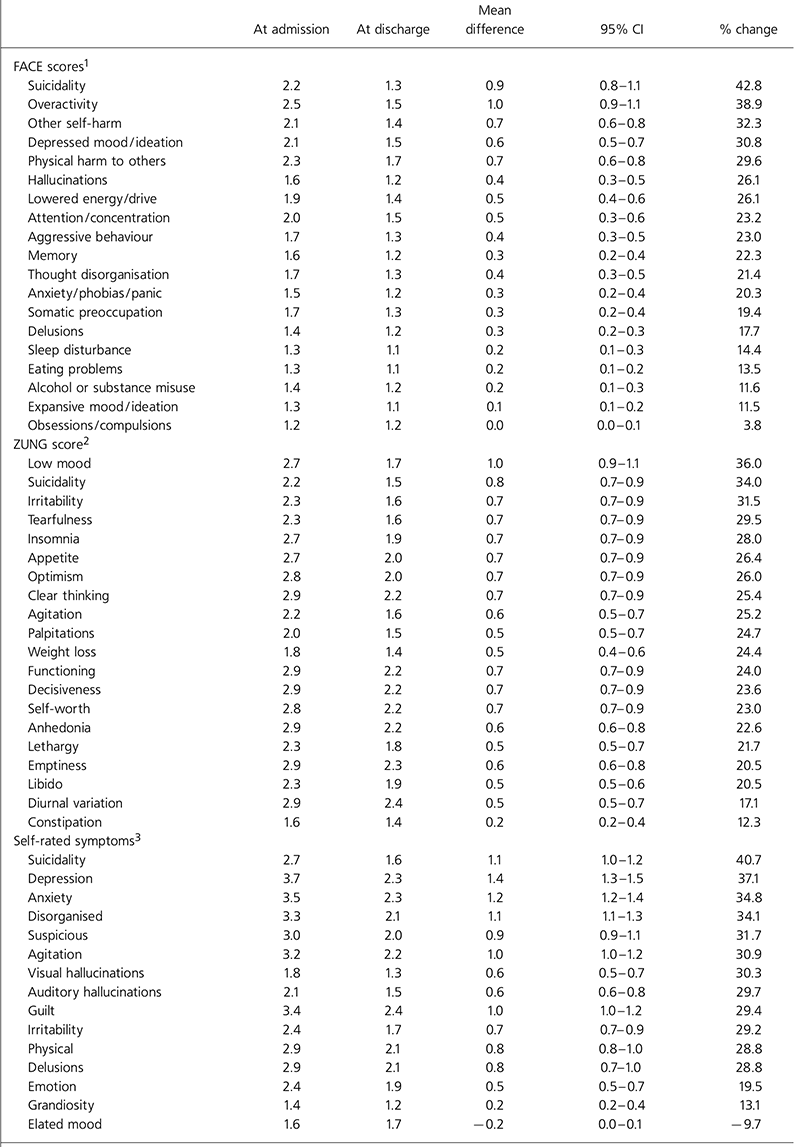
The FACE components were scored 1=no symptoms, 2=mild, 3=moderate, 4=severe and 5=very severe. The individual self-rating components examined are listed in Table 1. The scoring mechanism for the self-rating symptoms was 1–5, with 1 ‘not at all’ through to 5 ‘all the time’. The Zung Depression Scale was scored using standard methodology. Ethical approval was not sought as this work constituted service evaluation.
Change in symptom scores at discharge compared with admission
| At admission | At discharge | Mean difference | 95% CI | % change | |
|---|---|---|---|---|---|
| FACE scores1 | |||||
| Suicidality | 2.2 | 1.3 | 0.9 | 0.8-1.1 | 42.8 |
| Overactivity | 2.5 | 1.5 | 1.0 | 0.9-1.1 | 38.9 |
| Other self-harm | 2.1 | 1.4 | 0.7 | 0.6-0.8 | 32.3 |
| Depressed mood/ideation | 2.1 | 1.5 | 0.6 | 0.5-0.7 | 30.8 |
| Physical harm to others | 2.3 | 1.7 | 0.7 | 0.6-0.8 | 29.6 |
| Hallucinations | 1.6 | 1.2 | 0.4 | 0.3-0.5 | 26.1 |
| Lowered energy/drive | 1.9 | 1.4 | 0.5 | 0.4-0.6 | 26.1 |
| Attention/concentration | 2.0 | 1.5 | 0.5 | 0.3-0.6 | 23.2 |
| Aggressive behaviour | 1.7 | 1.3 | 0.4 | 0.3-0.5 | 23.0 |
| Memory | 1.6 | 1.2 | 0.3 | 0.2-0.4 | 22.3 |
| Thought disorganisation | 1.7 | 1.3 | 0.4 | 0.3-0.5 | 21.4 |
| Anxiety/phobias/panic | 1.5 | 1.2 | 0.3 | 0.2-0.4 | 20.3 |
| Somatic preoccupation | 1.7 | 1.3 | 0.3 | 0.2-0.4 | 19.4 |
| Delusions | 1.4 | 1.2 | 0.3 | 0.2-0.3 | 17.7 |
| Sleep disturbance | 1.3 | 1.1 | 0.2 | 0.1-0.3 | 14.4 |
| Eating problems | 1.3 | 1.1 | 0.2 | 0.1-0.2 | 13.5 |
| Alcohol or substance misuse | 1.4 | 1.2 | 0.2 | 0.1-0.3 | 11.6 |
| Expansive mood/ideation | 1.3 | 1.1 | 0.1 | 0.1-0.2 | 11.5 |
| Obsessions/compulsions | 1.2 | 1.2 | 0.0 | 0.0-0.1 | 3.8 |
| ZUNG score2 | |||||
| Low mood | 2.7 | 1.7 | 1.0 | 0.9-1.1 | 36.0 |
| Suicidality | 2.2 | 1.5 | 0.8 | 0.7-0.9 | 34.0 |
| Irritability | 2.3 | 1.6 | 0.7 | 0.7-0.9 | 31.5 |
| Tearfulness | 2.3 | 1.6 | 0.7 | 0.7-0.9 | 29.5 |
| Insomnia | 2.7 | 1.9 | 0.7 | 0.7-0.9 | 28.0 |
| Appetite | 2.7 | 2.0 | 0.7 | 0.7-0.9 | 26.4 |
| Optimism | 2.8 | 2.0 | 0.7 | 0.7-0.9 | 26.0 |
| Clear thinking | 2.9 | 2.2 | 0.7 | 0.7-0.9 | 25.4 |
| Agitation | 2.2 | 1.6 | 0.6 | 0.5-0.7 | 25.2 |
| Palpitations | 2.0 | 1.5 | 0.5 | 0.5-0.7 | 24.7 |
| Weight loss | 1.8 | 1.4 | 0.5 | 0.4-0.6 | 24.4 |
| Functioning | 2.9 | 2.2 | 0.7 | 0.7-0.9 | 24.0 |
| Decisiveness | 2.9 | 2.2 | 0.7 | 0.7-0.9 | 23.6 |
| Self-worth | 2.8 | 2.2 | 0.7 | 0.7-0.9 | 23.0 |
| Anhedonia | 2.9 | 2.2 | 0.6 | 0.6-0.8 | 22.6 |
| Lethargy | 2.3 | 1.8 | 0.5 | 0.5-0.7 | 21.7 |
| Emptiness | 2.9 | 2.3 | 0.6 | 0.6-0.8 | 20.5 |
| Libido | 2.3 | 1.9 | 0.5 | 0.5-0.6 | 20.5 |
| Diurnal variation | 2.9 | 2.4 | 0.5 | 0.5-0.7 | 17.1 |
| Constipation | 1.6 | 1.4 | 0.2 | 0.2-0.4 | 12.3 |
| Self-rated symptoms3 | |||||
| Suicidality | 2.7 | 1.6 | 1.1 | 1.0-1.2 | 40.7 |
| Depression | 3.7 | 2.3 | 1.4 | 1.3-1.5 | 37.1 |
| Anxiety | 3.5 | 2.3 | 1.2 | 1.2-1.4 | 34.8 |
| Disorganised | 3.3 | 2.1 | 1.1 | 1.1-1.3 | 34.1 |
| Suspicious | 3.0 | 2.0 | 0.9 | 0.9-1.1 | 31.7 |
| Agitation | 3.2 | 2.2 | 1.0 | 1.0-1.2 | 30.9 |
| Visual hallucinations | 1.8 | 1.3 | 0.6 | 0.5-0.7 | 30.3 |
| Auditory hallucinations | 2.1 | 1.5 | 0.6 | 0.6-0.8 | 29.7 |
| Guilt | 3.4 | 2.4 | 1.0 | 1.0-1.2 | 29.4 |
| Irritability | 2.4 | 1.7 | 0.7 | 0.7-0.9 | 29.2 |
| Physical | 2.9 | 2.1 | 0.8 | 0.8-1.0 | 28.8 |
| Delusions | 2.9 | 2.1 | 0.8 | 0.7-1.0 | 28.8 |
| Emotion | 2.4 | 1.9 | 0.5 | 0.5-0.7 | 19.5 |
| Grandiosity | 1.4 | 1.2 | 0.2 | 0.2-0.4 | 13.1 |
| Elated mood | 1.6 | 1.7 | -0.2 | 0.0-0.1 | -9.7 |
Results
The total number of contacts for all three hospitals was 2104 for the 6-month period, of which 51% were male. The mean age of patients was 38.3 years for males and 40.4 years for females. The mean percentage of patients admitted was 39%. On average 88% of contacts occurred between 09.00 and 01.00. There were no significant differences between the hospitals.
The source and number of referrals were as follows (relative proportion admitted in parentheses): general practitioners, n=606 (43%); emergency department, n=546 (38%); physicians, n=301 (15%); CMHTs, n=154 (73%); transfers from other hospitals, n=147 (63%); liaison psychiatry, n=57 (46%); psychiatric day hospital, n=35 (23%), non-psychiatric wards, n=28 (14%); others, n=149 (54%).
The problems identified were as follows: self-harm or suicidal behaviour, n=989 (39%); anxiety or depression, n=588 (43%); psychosis, n=443 (60%); alcohol problems, n=437 (37%); illicit drug problem, n=103 (47%); bipolar disorder, n=95 (59%); confusion, n=72 (31%); aggression, n=70 (41%); others, n=136 (32%).
Of those admitted, 53% were male. The mean age of in-patients was 40 years for males and 41 years for females. Out of 1183, 115 (9.7%) required one-to-one ‘special’ nursing observations at some point during their admission, 524 (44%) required ‘constant’ observations. The majority (84%) were treated on a voluntary basis and the mean duration of stay was 24.9 days.
Improvement was seen in virtually all symptoms for both self and observer ratings, as illustrated in Table 1. The greatest percentage improvements were seen for suicidality and depressed mood. The Spearman's correlation between self-reported and observer (FACE) suicidal ideation was 0.48 (P≤0.0001). The correlation between self-reported and FACE depressed mood was 0.43 (P≤0.0001).
Discussion
The Lanarkshire model of ‘on-call psychiatry’ was the traditional one, where junior doctors assessed and admitted patients throughout the 24 h period. This model is rapidly changing within the UK, with a drive towards specialist community-based teams who decide upon admission or intensive home and/or community treatment. In our traditional model of care, hospital admission occurred in 40% of emergency contacts with the on-call doctor. Admission was associated with improvement in all subjective and objective symptoms. The main reasons for being admitted (depressed mood and suicidality) were associated with the greatest degree of improvement. The improvements seen cannot necessarily be attributed to the effects of hospitalisation, as within the same time period (mean duration of stay 25 days) medication effects are also likely to occur. In this study, the single clinical problem with the highest admission rate (60%) was ‘ psychosis’. In areas where specialist teams are developed, hospital admission is probably being reserved for patients who are more severely ill (Reference Commander and DisanyakeCommander & Disanyake, 2006). Nevertheless, one such home treatment team found a 54% admission rate over 1 year for first-episode psychosis (Reference Gould, Theodore and PillingGould et al, 2006). This was similar to the 60% admission rate for psychosis found in this study. Although our ‘psychosis’ does not equate to first-episode psychosis, such a relatively high rate for a home treatment team reflects the fact that admission is often necessary and unavoidable for certain conditions to facilitate a favourable outcome.
All three hospitals had consistent activity over time, with 9 out of 10 unscheduled contacts occurring between 09.00 and 01.00 h. Admission rates for all unscheduled contacts between 09.00 and 17.00 h were only 10% lower when CMHTs and senior medical staff who are familiar with the patients were available to provide advice to on-call doctors. This has implications for the development of home treatment or crisis services in a particular area. It is probably unnecessary to provide such crisis cover at the same intensity throughout the 24 h period. The availability of the CMHT or sector psychiatrist did not seem to influence the proportion of patients admitted to a significant degree.
The profile of our patients who were admitted was comparable to a large database of admissions in English hospitals (Reference Thompson, Shaw and HarrisonThompson et al, 2004), although the database showed a median duration of stay of 15 days for mental illness (adult psychiatry) compared with our mean of 25 days. Again, this may be related to specific teams which facilitate early discharge planning being available in parts of England. Thompson et al (Reference Thompson, Shaw and Harrison2004) also found that depression and anxiety were the most commonly recorded reason for admission, and we have shown that both patients and their treating clinicians rate depression, anxiety and suicidal thoughts as the symptoms most amenable to improvement in the in-patient setting.
In-patient care is an expensive but essential resource for mental healthcare. It is effective in gaining control of severe symptoms and providing safety for patients and others. Even with the development of specialist community teams, in-patient care cannot be replaced and will remain as a valuable therapeutic option rather than a failure of community care. Accreditation of in-patient mental health services is now considered a priority (Reference Lelliot, Bennet and McGeorgeLelliot et al, 2006). As part of this accreditation, we believe collection of routine clinical outcome measures will be of benefit in service evaluation and therefore delivery.
Declaration of interest
None.
Acknowledgements
We thank G. Martin, M. Hughes and F. Shuel for their invaluable help with data collection and Drs M. Connolly and J. Burley for their helpful comments during preparation of this manuscript.


 Open access


eLetters
No eLetters have been published for this article.