





Introduction
Post-stroke depression (PSD) is the most common psychiatric complication after stroke, characterized by persistent low mood, diminished interest, and emotional distress (Zhou, Wei, & Xie, Reference Zhou, Wei and Xie2024). The prevalence of PSD ranges from 11% to 41% within two years after stroke (Guo, Wang, Sun, & Liu, Reference Guo, Wang, Sun and Liu2022). It is associated with poorer treatment adherence, delayed functional recovery, reduced social participation, lower quality of life, and even higher risks of suicide and mortality (Cai et al., Reference Cai, Mueller, Li, Shen and Stewart2019; J. Li et al., Reference Li, Yang, Lv, Kuang, Zhou and Xu2023; Paolucci et al., Reference Paolucci, Iosa, Coiro, Venturiero, Savo, De Angelis and Morone2019). Early and effective management of PSD is therefore critical for improving recovery trajectories and overall well-being (van Nimwegen et al., Reference van Nimwegen, Hjelle, Bragstad, Kirkevold, Sveen, Hafsteinsdóttir, Schoonhoven, Visser-Meily and de Man-van Ginkel2023).
Clinical guidelines in the UK and Ireland recommend offering psychological support to stroke survivors at risk of depression (Intercollegiate Stroke Working Party, 2023). Over the past decades, numerous trials have examined various psychological interventions for PSD in stroke survivors (Allida et al., Reference Allida, Cox, Hsieh, House and Hackett2020), creating a valuable but heterogeneous body of evidence. Conventional systematic reviews and meta-analyses have reported that interventions such as mindfulness-based therapies (Tao et al., Reference Tao, Geng, Li, Ye and Liu2022), cognitive behavioral therapy (CBT) (M. Wan, Zhang, Wu, & Ma, Reference Wan, Zhang, Wu and Ma2024), and motivational interviewing may be effective for PSD in stroke survivors (Qiqi et al., Reference Qiqi, Hangting, Jia, Jiaoni, Xinrui and Guijuan2021). However, traditional pairwise meta-analyses are limited because they cannot determine the comparative effectiveness of different psychological interventions – a critical question for clinical decision-making.
Network meta-analysis (NMA) provides a methodological advantage by integrating both direct and indirect evidence to compare and rank multiple interventions simultaneously (Bucher, Guyatt, Griffith, & Walter, Reference Bucher, Guyatt, Griffith and Walter1997). Despite its potential, few NMAs have comprehensively evaluated psychological therapies for PSD, and existing findings remain inconsistent. For instance, Yi et al. (Reference Yi, Zhao, Lv, Zhang, Rong, Wang, Yang and Li2024) conducted a NMA of 43 studies involving 3138 stroke survivors to compare the efficacy of various non-pharmacological therapies for PSD. The study reported no significant difference between psychotherapy and control groups, but their analysis included only 13 psychological intervention studies – insufficient to capture the current diversity of approaches and the overall evidence grade is very low. Conversely, another NMA explored the effects of 17 non-pharmacological interventions on PSD in stroke patients. The study reported superior effects of psychological interventions over usual care, but it also had limitations, namely the limited types of psychological interventions and a lack of evidence quality assessment (Y. Li et al., Reference Li, Wang, Gao, Meng and Deng2024). Thus, a more comprehensive and methodologically rigorous NMA is needed to clarify the relative efficacy of psychological interventions for PSD across diverse contexts.
Existing studies have primarily focused on short-term outcomes, overlooking the dynamic nature of PSD, which may persist, fluctuate, or recur over time (Dong et al., Reference Dong, Williams, Brown, Case, Morgenstern and Lisabeth2021). Moreover, patients with varying levels of baseline depression severity may respond differently to the same intervention (Zimmerman, Reference Zimmerman2019), highlighting the importance of tailoring treatment to individual needs (Cohen & DeRubeis, Reference Cohen and DeRubeis2018). Despite these insights, previous NMAs have rarely compared the long-term and severity-specific effects of psychological interventions, leaving clinicians without clear evidence on which approaches work best for different patients and recovery stages.
Therefore, this study aims to conduct a systematic review and NMA to (1) evaluate and rank the comparative efficacy of psychological interventions for PSD, (2) examine their mid- to long-term effects, and (3) explore differential treatment responses based on initial depression severity.
Methods
This systematic review and NMA followed the Preferred Reporting Items for Systematic Reviews and Meta-Analyses for Network Meta-Analyses (PRISMA-NMA) guidelines (Hutton et al., Reference Hutton, Salanti, Caldwell, Chaimani, Schmid, Cameron, Ioannidis, Straus, Thorlund, Jansen, Mulrow, Catalá-López, Gøtzsche, Dickersin, Boutron, Altman and Moher2015) and was registered in the International Prospective Register of Systematic Reviews (PROSPERO, CRD42023490577).
Eligibility criteria
Eligible full-text studies were identified based on the PICOS framework: Population, Intervention, Comparison, Outcome, and Study design.
Population
Adults (≥18 years) with clinically diagnosed PSD or mild-to-severe depressive symptoms identified by validated scales (e.g. a Patient Health Questionnaire-9 [PHQ-9] score ≥ 5) or explicitly described as having ‘PSD’ in the original studies.
Interventions and comparators
Intervention groups received psychological interventions as defined by the WHO’s Psychological Interventions Implementation Manual and mhGAP guidelines, including psychoeducation, CBT, family therapy, relaxation, and others (see Supplementary Table S2). Comparators included waitlist control (WL), treatment as usual (TAU), or another psychological intervention. Studies involving combination therapies, such as pharmacological plus psychological interventions, were excluded to reduce heterogeneity.
Outcomes
Depressive symptoms measured pre- and post-intervention using validated scales.
Study design
Only randomized controlled trials (RCTs), including cluster RCTs, were included; quasi-randomized trials were excluded.
Data sources and search strategy
A systematic search was conducted in seven English databases (PubMed, Embase, CINAHL, PsycINFO, Web of Science, Scopus, and Cochrane Library) from inception to September 17, 2025. We also manually searched reference lists of relevant reviews and studies. The search followed the PICOS framework, using a combination of medical subject terms and free words (e.g. stroke OR ischemic stroke OR hemorrhagic stroke AND psychotherapy OR CBT AND depression AND RCT). Detailed search strategies and results are provided in Supplementary Table S3.
Study selection and data extraction
All studies were imported into NoteExpress 4.1.0, and duplicates were removed. Two reviewers (R.C. and X.R.C.) independently screened titles and abstracts, followed by full-text review. Disagreements were resolved through discussion with a third reviewer (Y.T.B.).
Data extraction was performed independently by RC and XRC using a structured electronic form, including publication details, participant characteristics, intervention specifics, and depression scores at baseline and post-intervention. The time to measure effects was categorized into post-intervention and mid- to long-term. We used a common metric provided by Wahl et al. (Reference Wahl, Löwe, Bjorner, Fischer, Langs, Voderholzer, Aita, Bergemann, Brähler and Rose2014) to convert various depression scales to PHQ-9 scores in order to conduct subgroup analyses of depression severity. For missing data, calculations were made based on available information (X. Wan, Wang, Liu, & Tong, Reference Wan, Wang, Liu and Tong2014), and authors were contacted for clarifications if needed.
Assessment of the risk of bias
The Cochrane risk-of-bias tool for randomized trials (RoB-2) was used to assess methodological quality across five domains: randomization, intervention deviations, missing data, outcome measurement, and result selection (Sterne et al., Reference Sterne, Savović, Page, Elbers, Blencowe, Boutron, Cates, Cheng, Corbett, Eldridge, Emberson, Hernán, Hopewell, Hróbjartsson, Junqueira, Jüni, Kirkham, Lasserson, Li and Higgins2019). Each domain was rated as low risk, some concerns, or high risk. The overall risk was determined by the highest level of bias across all domains. Two reviewers (RC and XRC) independently assessed the studies, with disagreements resolved through discussion or adjudication by a third reviewer (YTB).
Data synthesis and analysis
We performed pairwise meta-analyses using a random-effects model in Review Manager 15.3 to calculate a single point estimate of the effect size for interventions compared to TAU with a 95% confidence interval (CI). A frequentist NMA (random-effects model) was conducted in Stata 17.0 to compare intervention categories. Depression scores, treated as continuous variables, were analyzed using standardized mean differences (SMD) and 95% CI. Statistical significance was defined as P < 0.05 or a 95% CI excluding 0. Effect sizes were interpreted as small (0.20 ≤ d < 0.50), medium (0.50 ≤ d < 0.80), and large (d ≥ 0.80), with Hedges’ g used for sample size variation (White & Thomas, Reference White and Thomas2005). Heterogeneity was assessed using I 2, classified as <40% unimportant, 30–60% moderate, 50%–90% substantial, and 75%–100% considerable (Higgins et al., Reference Higgins, Thomas, Chandler, Cumpston, Li, Page and Welch2024).
Transitivity was checked by comparing trial and sample characteristics. Inconsistency was analyzed using loop-specific and side-splitting methods. The surface under the cumulative ranking curve (SUCRA) was used to rank interventions. Publication bias was assessed with funnel plots and Egger’s test. League tables and network diagrams were used for ranking and evidence distribution visualization.
Subgroup analyses were conducted to assess the efficacy of psychological interventions for different PSD severities. Using a common metric (Wahl et al., Reference Wahl, Löwe, Bjorner, Fischer, Langs, Voderholzer, Aita, Bergemann, Brähler and Rose2014), other depression scales were converted into PHQ-9 scores: 5 ≤ scores <10 (study classified as mild depression subgroup) and scores ≥10 (study classified as moderate-to-severe depression subgroup) (Williams et al., Reference Williams, Brizendine, Plue, Bakas, Tu, Hendrie and Kroenke2005). Studies using scales that cannot be converted to PHQ-9 scores were excluded from quantitative analyses but retained for qualitative synthesis. Effects were analyzed separately for each group, following the overall NMA methodology.
Sensitivity analyses excluded studies in which some participants were taking antidepressants, studies with a sample size <30, and studies in which participants had a confirmed diagnosis of cognitive impairment.
Certainty assessment
We used the Confidence in Networks Meta-Analyses (CINeMA) web tool to evaluate the quality of evidence for each comparison (Papakonstantinou et al., Reference Papakonstantinou, Nikolakopoulou, Higgins, Egger and Salanti2020). Six domains were assessed: within-study bias, reporting bias, indirectness, imprecision, heterogeneity, and incoherence. Each comparison was rated for concern in these domains as no concern, some concern (downgraded one level), or major concern (downgraded two levels). The overall quality of evidence for each comparison was classified as high, medium, low, or very low.
Results
Study selection
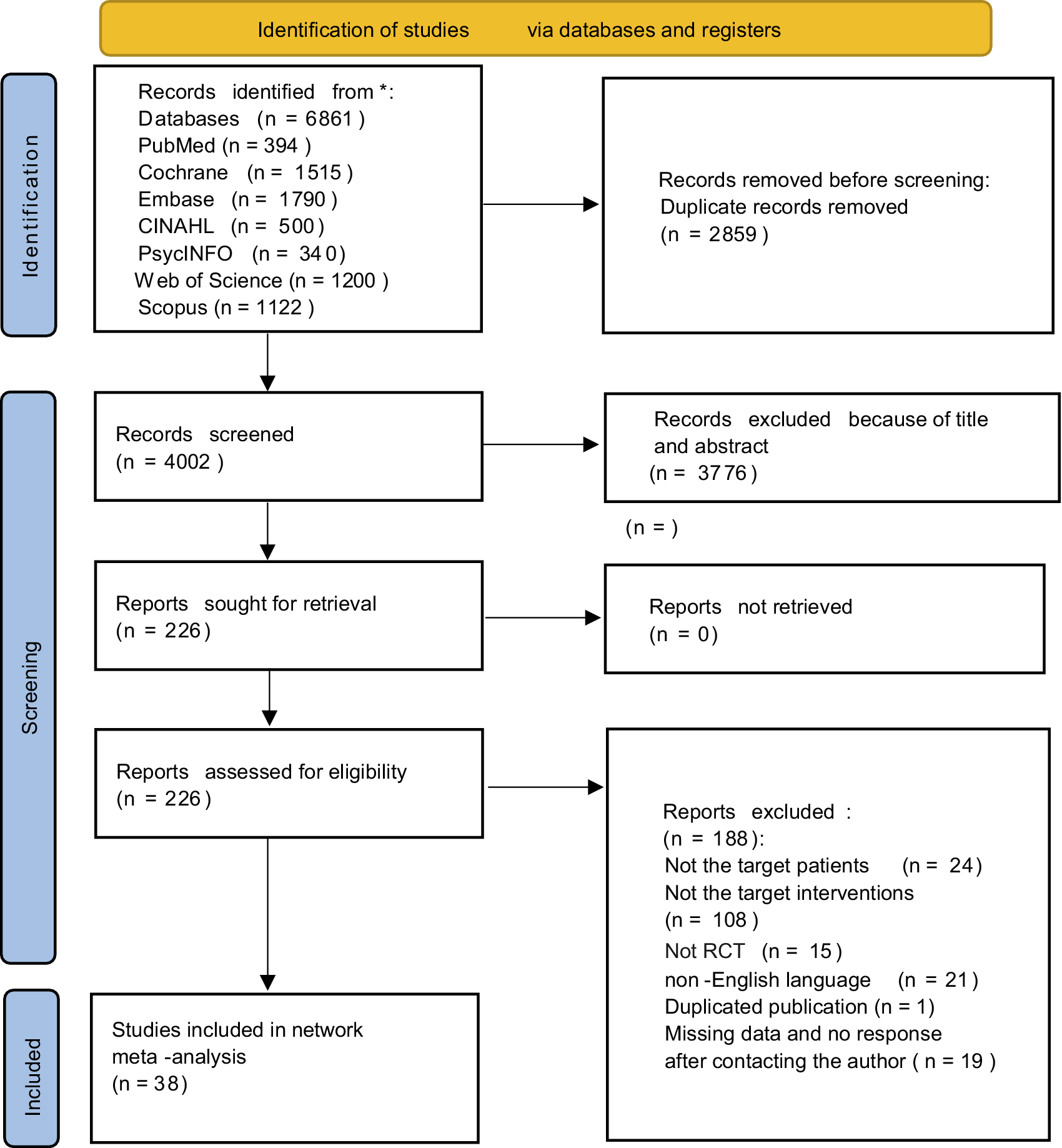
A total of 6,861 records were identified across seven databases. After removing 2,859 duplicates, 4,002 records were screened by title and abstract, and 226 full-text articles were reviewed. Of these, 188 were excluded for not meeting inclusion criteria. Ultimately, 38 articles were included in the analysis. The search and screening process is shown in Figure 1, following the PRISMA flowchart.
PRISMA flow diagram.

Figure 1. Long description
The flowchart is organized into three vertical phases: Identification, Screening, and Included.
1. Identification Phase:
- Top central box: Records identified from Databases n = 6861. Breakdown includes PubMed n = 394, Cochrane n = 1515, Embase n = 1790, C I N A H L n = 500, Psyc I N F O n = 340, Web of Science n = 1200, and Scopus n = 1122.
- Right box: Records removed before screening: Duplicate records removed n = 2859.
2. Screening Phase:
- Central box: Records screened n = 4002.
- Right box: Records excluded because of title and abstract n = 3776.
- Central box: Reports sought for retrieval n = 226.
- Right box: Reports not retrieved n = 0.
- Central box: Reports assessed for eligibility n = 226.
- Right box: Reports excluded n = 188. Reasons include: Not the target patients n = 24, Not the target interventions n = 108, Not R C T n = 15, non-English language n = 21, Duplicated publication n = 1, and Missing data and no response after contacting the author n = 19.
3. Included Phase:
- Bottom central box: Studies included in network meta-analysis n = 38.
Characteristics of included studies and participants
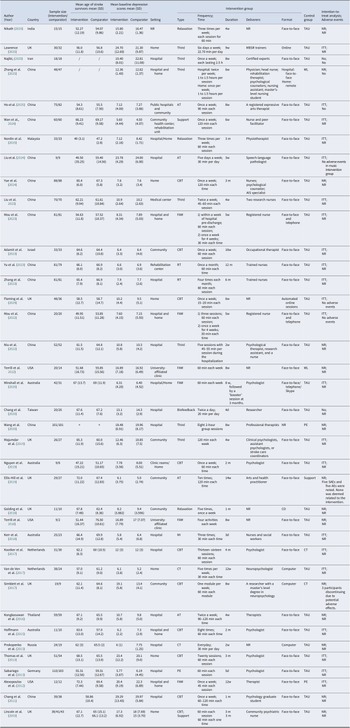
Table 1 provides the general characteristics of the included studies. Our NMA involved 3,106 stroke survivors from 38 studies published between 2003 and 2025, across 12 countries in North America, Europe, Asia, and Oceania. Sample sizes ranged from 11 to 213, with the majority of studies conducted in China (34.21%), followed by the UK (21.05%) and Australia (10.52%). The mean age of participants ranged from 47.2 to 76.5 years.
Main characteristics of included studies

Table 1. Long description
The table consists of 15 columns: Author (Year), Country, Sample size (Intervention/comparator), Mean age of stroke survivors (Intervention and Comparator), Mean baseline depression scores (Intervention and Comparator), Setting, and five columns for the Intervention group (Type, Frequency/Time, Duration, Deliverers, Format), followed by Control group type and Intention-to-treat analysis/Adverse events.
Key entries include:
* Nikath (2025), India: 15/15 sample, Relaxation therapy, 60 min sessions 3x/week for 4w, face-to-face.
* Lawrence (2025), UK: 30/32 sample, Third-wave therapy, 22.7 min sessions 6x/week for 9w, online.
* Ho et al. (2025), China: 75/82 sample, Art therapy (A T), 90 min sessions 1x/week for 8w, face-to-face.
* Yue et al. (2024), China: 88/88 sample, C B T, 120 min sessions 1x/week for 3m, face-to-face.
* Yu et al. (2023) and Zhang et al. (2023), China: Reminiscence therapy (R T) for 12m and 6m respectively.
* Fleming et al. (2023), UK: 48/36 sample, C B T, automated online sessions for 6w.
* Terrill et al. (2022, 2018), USA: Family therapy (F A M) in university-affiliated clinics.
* Lincoln et al. (2003), UK: 39/41/43 sample, comparing C B T and Supportive therapy.
Settings vary across home, hospital, community, and medical centers. Intervention types include C B T, F A M, R T, Third-wave, A T, Relaxation, and Biofeedback. Control groups are primarily T A U (treatment as usual), with some using W L (waitlist) or P E (psychoeducation).
Abbreviations: B, baseline; NR, not report; TAU, treatment as usual; WL, waitlist control; FAM, Family therapy; CBT, Cognitive behavioral therapy; RT, Reminiscence therapy; Third, Third-wave therapies; BAT, Behavioral activation therapy; Biofeedback, Biofeedback therapy; PE, Psychoeducation; CT, Cognitive training; AT, Art therapy; Relaxation, Relaxation therapy; MI, Motivational interviewing; PST, Problem-Solving therapy; Support, Supportive therapy; min, minutes; m, months; w, weeks; CD, Compact Disk; ITT, Intention-to-treat analysis; SAEs, Serious adverse events; AEs, Adverse events.
Characteristics of the interventions
Eleven psychological interventions were included: psychoeducation (n = 3), cognitive training (n = 4), supportive therapy (n = 3), family therapy (n = 6), CBT (n = 10), reminiscence therapy (n = 2), third-wave therapies (n = 7), biofeedback therapy (n = 1), art therapy (n = 4), relaxation training (n = 3), and motivational interviewing (n = 1). Five studies compared two psychological interventions, and most compared an intervention with TAU or WL. Interventions were primarily hospital-based (n = 15), with others conducted at home (n = 6), in the community (n = 6), or across multiple settings (n = 10). Four studies involved multidisciplinary teams. Most interventions were face-to-face (n = 27), with others using telehealth (n = 6) or hybrid formats (n = 4). Duration varied from 3 days to 12 months, with most lasting 8 weeks. Details are provided in Table 1.
Characteristics of outcome measurements
The included studies measured depression using nine different scales (including the Hospital Anxiety and Depression Scale, Hamilton Depression Rating Scale, the Center for Epidemiologic Studies Depression Scale, Geriatric Depression Scale, PHQ-9, Beck Depression Inventory, Stroke Aphasia Depression Questionnaire, the Patient-Reported Outcomes Measurement Information System, and Depression, Anxiety, and Stress Scale-21). Common tools included the Hospital Anxiety and Depression Scale (n = 18) and the Stroke Aphasia Depression Questionnaire for aphasia survivors. Only two studies used the Patient-Reported Outcomes Measurement Information System (Terrill et al., Reference Terrill, Reblin, MacKenzie, Cardell, Einerson, Berg, Majersik and Richards2018; Terrill et al., Reference Tao, Geng, Li, Ye and Liu2022).
Risk of bias and quality assessment
Of the 38 studies, 14 (36.80%) had low risk of bias, 15 (39.50%) moderate, and 9 (23.70%) high. Eight studies raised concerns about randomization, including unclear methods or baseline imbalances. Eleven had issues with intervention deviations, mainly due to lack of blinding and intention-to-treat analysis. Most studies had missing data concerns due to unspecified dropout reasons. Outcome measurement bias was frequently high due to unreported assessor information. One study showed high reporting bias (Lawrence et al., Reference Lawrence, Davis, Clark, Booth, Donald, Dougall, Fenocchi, Grealy, Jamieson, Jani, Kontou, MacDonald, Mason, Maxwell, Parkinson, Pieri, Wang and Mercer2025). Details are in Supplementary Figures S1–S3.
Traditional pairwise meta-analysis
Supplementary Figures S4 and S5 show results of direct comparisons. Family therapy (n = 3, sample sizes 116 vs 110, Hedges’ g = −0.30, 95% CI: −0.57 to −0.04), CBT (n = 8, sample sizes 273 vs 273, Hedges’ g = −0.33, 95% CI: −0.58 to −0.08), reminiscence therapy (n = 2, sample sizes 162 vs 160, Hedges’ g = −0.35, 95% CI: −0.57 to −0.13), third-wave therapies (n = 6, sample sizes 221 vs 212, Hedges’ g = −1.18, 95% CI: −2.19 to −0.16), art therapy (n = 3, sample sizes 138 vs 150, Hedges’ g = −0.66, 95% CI: −1.20 to −0.11), and relaxation therapy (n = 2, sample sizes 48 vs 48, Hedges’ g = −0.70, 95% CI: −1.11 to −0.29) significantly reduced PSD compared to TAU, exhibiting a small-to-large effect size.
Network meta-analysis
Main outcomes
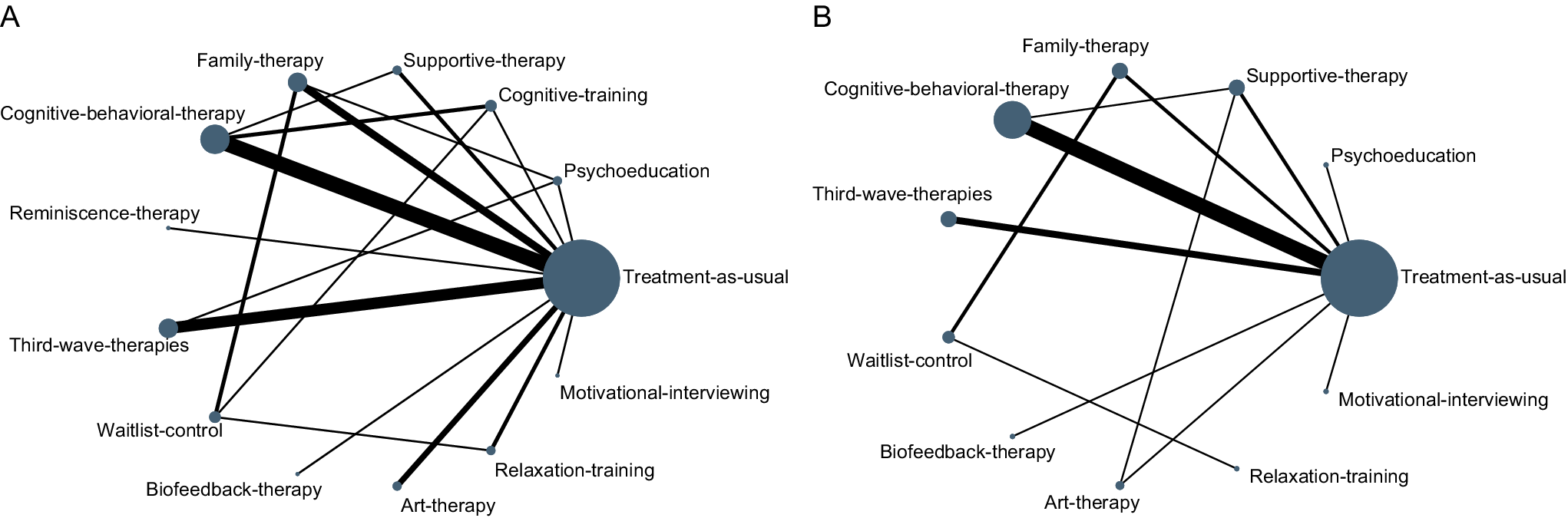
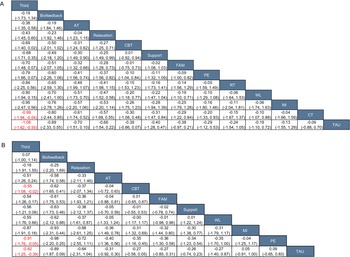
Thirty-seven studies comparing 11 intervention types were included in the NMA (Figure 2a). As shown in the league table (Figure 3a), third-wave therapies (Hedges’ g = −1.08, 95% CI: −1.62 to −0.55) significantly reduced PSD compared to TAU. Third-wave therapies were also more effective than cognitive training (Hedges’ g = −0.99, 95% CI: −1.94 to −0.04). According to the SUCRA rankings (Figure 4a), third-wave therapies had the highest probability of being the most effective intervention (SUCRA, 88.80%; mean rank, 2.30), followed by biofeedback therapy (SUCRA, 71.40%; mean rank, 4.40), art therapy (SUCRA, 68.20%; mean rank, 4.80), relaxation training (SUCRA, 65.90%; mean rank, 5.10), and CBT (SUCRA, 50.70%; mean rank, 6.90). TAU ranked the lowest (SUCRA, 19.50%; mean rank, 10.70).
Network diagram. (a) Main outcomes. (b) Mid- to long-term outcomes.

Figure 2. Long description
A two-panel network diagram.
Panel A, Main outcomes. The largest node is Treatment-as-usual, located on the right. Moving clockwise from the top, other nodes include Supportive-therapy, Cognitive-training, Psychoeducation, Motivational-interviewing, Relaxation-training, Art-therapy, Biofeedback-therapy, Waitlist-control, Third-wave-therapies, Reminiscence-therapy, Cognitive-behavioral-therapy, and Family-therapy. The thickest connection lines link Treatment-as-usual to Cognitive-behavioral-therapy and Third-wave-therapies.
Panel B, Mid- to long-term outcomes. The layout remains similar but with fewer nodes and connections. Treatment-as-usual remains the largest node on the right, followed by Cognitive-behavioral-therapy on the upper left. The thickest line connects these two nodes. A moderately thick line connects Treatment-as-usual to Third-wave-therapies. Other nodes with thin connections include Supportive-therapy, Psychoeducation, Motivational-interviewing, Relaxation-training, Art-therapy, Biofeedback-therapy, Waitlist-control, and Family-therapy. Reminiscence-therapy and Cognitive-training are absent in this panel.
Net league table. (a) Main outcomes. (b) Mid- to long-term outcomes. Effect sizes (ES) and 95% confidence intervals (CIs) are reported. Statistically significant results are highlighted in red. Abbreviations: Third, third-wave therapies; Biofeedback, biofeedback therapy; AT, art therapy; Relaxation, relaxation therapy; CBT, cognitive behavior therapy; Support, supportive therapy; FAM, family therapy; PE, psychoeducation; RT, reminiscence therapy; WL, waitlist control; MI, motivational interviewing; CT, cognitive training; TAU, treatment as usual.

Figure 3. Long description
The figure contains two triangular matrices, A and B, representing net league tables for different therapies.
Panel A: Main outcomes.
The diagonal labels from top-left to bottom-right are: Third, Biofeedback, A T, Relaxation, C B T, Support, F A M, P E, R T, W L, M I, C T, and T A U.
Data cells below the diagonal show effect sizes and 95 percent confidence intervals. Most values are in black, indicating non-significance. Two cells in the first column are highlighted in red, indicating statistical significance:
- Third versus C T: -0.99 (-1.94, -0.04)
- Third versus T A U: -1.08 (-1.62, -0.55)
Panel B: Mid- to long-term outcomes.
The diagonal labels from top-left to bottom-right are: Third, Biofeedback, Relaxation, A T, C B T, F A M, Support, W L, M I, P E, and T A U.
Significant results highlighted in red include:
- Third versus C B T: -0.55 (-1.08, -0.02)
- Third versus P E: -0.91 (-1.76, -0.05)
- Third versus T A U: -0.82 (-1.25, -0.39)
In both panels, the effect sizes generally show negative values when comparing active therapies to control groups like W L or T A U.
Mid- to long-term outcomes
Twenty-four studies with follow-ups compared 9 intervention types (Figure 2b). As shown in the league table (Figure 3b), third-wave therapies (Hedges’ g = −0.82, 95% CI: −1.25 to −0.39) significantly reduced PSD compared to TAU, showing large effects. Third-wave therapies were also more effective than psychoeducation (Hedges’ g = −0.91, 95% CI: −1.76 to −0.05), and CBT (Hedges’ g = −0.55, 95% CI: −1.08 to −0.02). No significant effects were found for other interventions. SUCRA rankings (Figure 4b) indicated third-wave therapies (SUCRA, 85.60%; mean rank, 2.40) had the highest probability of being the most effective, followed by biofeedback therapy (SUCRA, 81.40%; mean rank, 2.90), relaxation therapy (SUCRA, 65.30%; mean rank, 4.50), art therapy (SUCRA, 51.40%; mean rank, 5.90), and CBT (SUCRA, 49.30%; mean rank, 6.10). TAU ranked lowest (SUCRA, 22.50%; mean rank, 8.70).
The probability ranking for all interventions. (a) Main outcomes. (b) Mid- to long-term outcomes.

Figure 4. Long description
The figure consists of two vertically stacked line charts, labeled A and B. Both charts plot Cumulative probability on the y-axis from 0.0 to 1.0 against Rank on the x-axis.
Panel A: Composite line chart of cumulative probability on efficacy. The x-axis ranks interventions from 1 to 13. Lines generally trend upward from left to right, with Third wave therapies showing the steepest initial ascent. The legend includes:
* Waitlist control S U C R A = 36.10%
* Third wave therapies S U C R A = 88.80%
* Reminiscence therapy S U C R A = 41.80%
* Cognitive behavioral therapy S U C R A = 50.70%
* Family therapy S U C R A = 48.90%
* Supportive therapy S U C R A = 50.30%
* Cognitive training S U C R A = 29.60%
* Psychoeducation S U C R A = 43.10%
* Motivational interviewing S U C R A = 35.60%
* Relaxation therapy S U C R A = 65.90%
* Art therapy S U C R A = 68.20%
* Biofeedback therapy S U C R A = 71.40%
* Treatment as usual S U C R A = 19.50%
Panel B: Composite line chart of cumulative probability on efficacy. The x-axis ranks interventions from 1 to 11. The legend includes:
* Waitlist control S U C R A = 47.50%
* Third wave therapies S U C R A = 85.60%
* Cognitive behavioral therapy S U C R A = 49.30%
* Family therapy S U C R A = 48.10%
* Supportive therapy S U C R A = 47.60%
* Psychoeducation S U C R A = 23.00%
* Motivational interviewing S U C R A = 28.20%
* Relaxation therapy S U C R A = 65.30%
* Art therapy S U C R A = 51.40%
* Biofeedback therapy S U C R A = 81.40%
* Treatment as usual S U C R A = 22.50%
Subgroup analysis of mild-to-severe PSD
Stroke survivors in 20 studies had mild PSD at baseline (Supplementary Figure S6A). Supplementary Figure S7A shows that relaxation therapy (Hedges’ g = −0.77, 95% CI: −1.27 to −0.27), family therapy (Hedges’ g = −0.37, 95% CI: −0.57 to −0.17), and CBT (Hedges’ g = −0.36, 95% CI: −0.60 to −0.13) significantly improved PSD compared to TAU, with small-to-medium effect sizes. Relaxation therapies were also more effective than psychoeducation (Hedges’ g = −0.72, 95% CI: −1.28 to −0.16). Detailed rankings are in Supplementary Figure S8A.
Nine studies included stroke survivors with moderate-to-severe PSD at baseline (Supplementary Figure S6B). As shown in the league table (Supplementary Figure S7B), no significant difference was observed in this subgroup analysis. Detailed rankings are in Supplementary Figure S8B.
Assessment of heterogeneity and inconsistency
Considerable heterogeneity was found in the main (I 2 = 83.00%) and substantial heterogeneity in mid- to long-term (I 2 = 63.50%) outcomes. No global or local inconsistency detected in the NMA for main, mid- to long-term, or mild PSD outcomes (Supplementary Text S1, Supplementary Figure S9).
Publication bias and sensitivity analyses
Funnel plots were symmetrical, indicating no small-study effects. Publication bias was not assessed for moderate-to-severe PSD due to fewer than 10 studies (Supplementary Figure S10). Sensitivity analyses excluding studies with antidepressant use, with sample size <30, or participants with cognitive impairment produced results consistent with the main analyses (Supplementary Figures S11–S12).
Certainty of evidence
The certainty of evidence for main outcomes ranged from very low to low, mainly downgraded due to within-study bias and imprecision. About three-fifths of studies had medium-to-high risk of bias, and most 95% CIs fell outside the equivalence range. Details are provided in Supplementary Table S4.
Discussion
This NMA quantified and ranked psychological interventions for PSD. The NMA revealed that third-wave therapies showed a greater probability of being the optimal psychological interventions for improving PSD in the short-term and mid-to-long-term. These findings were robust in our sensitivity analysis. In addition, the findings of our NMA suggested relaxation therapy significantly ameliorated mild PSD. However, for moderate-to-severe PSD, no significant effects were observed in this NMA.
Third-wave therapies were significantly more effective than TAU in reducing PSD, with large effects sustained at follow-up, aligning with prior depression research (Seshadri et al., Reference Seshadri, Orth, Adaji, Singh, Clark, Frye, McGillivray and Fuller-Tyszkiewicz2021). Mindfulness-based interventions and acceptance and commitment therapy (ACT) are representative examples of third-wave therapies. Research suggested that mindfulness may be associated with structural changes in the brain regions responsible for sensory, cognitive, and emotional processing; this may be a possible biological mechanism underlying the beneficial effects of mindfulness-based interventions in alleviating PSD (Lazar et al., Reference Lazar, Kerr, Wasserman, Gray, Greve, Treadway and Fischl2005; Tao et al., Reference Tao, Geng, Li, Ye and Liu2022). Acceptance commitment therapy emphasizes accepting unpleasant emotions rather than suppressing them, which may be especially helpful for stroke survivors who find it difficult to adjust distorted perceptions in the short term (Liu et al., Reference Liu, Lv, Sun, Liang, Zhang, Chen and Jiang2023). In the studies we included, ACT was primarily delivered in group settings, with each group consisting of 4 to 8 participants; the intervention typically lasted 4 weeks. The intervention was primarily delivered by clinical psychologists, though nurses were also involved. Non-clinical psychologists were required to undergo specialized ACT training prior to delivering the intervention and received supervision from clinical psychologists throughout the intervention period.
Relaxation therapy significantly ameliorated mild PSD. This finding is consistent with prior studies in other populations, including hematopoietic stem cell transplant recipients (Xia et al., Reference Xia, Yuan, Hou, Han, Feng and Qian2025) and cancer patients (Fu et al., Reference Fu, Liu, Jiang, Chu, Shao, Chen, Zheng, Li, He, Lin and Liang2025). Relaxation therapy reduces levels of arousal by acting on the autonomic nervous system. This decreases muscle tension, improves sleep, enhances mood, and alleviates depression (Mohd Nordin, Deepak, & Ezzat Ghazali, Reference Mohd Nordin, Deepak and Ezzat Ghazali2025). Beyond its therapeutic efficacy, relaxation therapy is safe, low risk, and easily learned, making it highly accessible. For example, autogenic training is a relaxation therapy that induces physiological changes associated with calmness and tranquility. The method requires minimal therapist involvement or external tools; practitioners can learn to elicit relaxation responses through focused attention guided by simple verbal cues. It can be delivered across diverse healthcare settings, from non-specialist facilitators in community and primary care to mental health professionals, thereby offering a scalable and flexible approach to managing PSD (Hamdani et al., Reference Hamdani, Zill, Zafar, Suleman, Um Ul, Waqas and Rahman2022).
CBT, originally developed to treat depression, is recommended in clinical guidelines (American Psychological Association, 2019). It is currently widely used to treat mild depression in a variety of populations (Cuijpers et al., Reference Cuijpers, Miguel, Harrer, Plessen, Ciharova, Ebert and Karyotaki2023; Du et al., Reference Du, Mao, Ran, Zhang, Luo and Qiu2016). The impact of CBT on stroke survivors with mild PSD may stem from its ability to transform negative thoughts and beliefs into positive ones, correct behavioral patterns, activate activities that are valued by the individual, and elicit positive reinforcement from their living environment. This process enhances self-efficacy and fosters more cognitive control over negative emotions, ultimately improving mild PSD (M. Wan, Zhang, Wu, & Ma, Reference Wan, Zhang, Wu and Ma2024). In addition, our research findings indicated that family therapy was more effective than TAU in alleviating mild PSD. Research indicated that PSD was associated with an individual’s family system (Yuliana et al., Reference Yuliana, Yu, Rias, Atikah, Chang and Tsai2023). Family therapy has the advantage of considering the individual’s family system. By working with participants and their relatives to establish effective communication patterns and strengthen family support networks, this approach may effectively alleviate mild depressive symptoms (Henken et al., Reference Henken, Huibers, Churchill, Restifo and Roelofs2007).
For moderate-to-severe PSD, no significant effects were observed in this subgroup. This review only included nine relevant studies on moderate-to-severe PSD, so the absence of statistically significant findings should not be interpreted as evidence of ineffectiveness, but rather as reflecting insufficient power to detect potentially meaningful effects. Additionally, biofeedback therapy ranked second in both the main outcomes and mid- to long-term outcomes, but these findings were based on only one trial. SUCRA estimates derived from sparse networks are inherently unstable and may be inflated when a treatment node is informed by very few studies. Rankings for biofeedback therapy should therefore be viewed as preliminary signals rather than robust estimates of comparative efficacy.
It is also noteworthy that two of the studies included in our review focused on survivors with post-stroke aphasia. One of these studies developed an intervention manual based on guidelines for CBT for people with aphasia, tailored specific interventions to individuals’ needs, and utilized communication aids such as pictures, photographs, and letter charts to overcome communication difficulties. The results showed that patients in the intervention group exhibited significant improvement in depressive symptoms (Thomas et al., Reference Thomas, Walker, Macniven, Haworth and Lincoln2013). The other study employed art therapy, which relies less on verbal communication, and similarly achieved favorable outcomes (Li et al., Reference Li, Wang, Gao, Meng and Deng2024). This suggests that the use of augmentative and alternative communication methods, combined with appropriate psychological interventions, may also play a positive role in alleviating depressive symptoms in survivors with post-stroke aphasia.
Implications for clinical practice and future research
This NMA highlights the potential of psychological interventions in alleviating PSD, with significant implications for both clinical practice and future research. The effectiveness of relaxation therapy suggests that trained non-psychologist professionals can play a key role in PSD prevention and management, particularly in settings with limited mental health resources (Hamdani et al., Reference Hamdani, Zill, Zafar, Suleman, Um Ul, Waqas and Rahman2022). Clinically, integrating psychological care into routine stroke rehabilitation is essential.
Research gaps remain. The scarcity of long-term follow-up data limits understanding of sustained intervention effects. Future studies should assess medium- and long-term outcomes to inform maintenance strategies. Stratified designs based on PSD severity are also needed to support precision mental healthcare.
Limitations
This NMA provides valuable insights but has several limitations. First, one-fifth of the included studies exhibited a high risk of bias, and two-fifths were rated as moderate risk. Furthermore, substantial heterogeneity in the primary NMA, and the inclusion of studies with small sample sizes, reduced the certainty of the evidence, necessitating cautious interpretation of the NMA results. Second, the included studies were predominantly conducted in China (34.21%), the UK (21.05%), and Australia (10.52%), while TAU may vary across healthcare contexts and care settings, the external validity of the findings is restricted. Third, scale conversion to PHQ-9 equivalents may introduce measurement error and reduce sensitivity to instrument-specific constructs. Fourth, third-wave therapies include mindfulness-based interventions, ACT, metacognitive therapy, and dialectical behavioral therapy. However, due to limited studies, only mindfulness-based interventions and ACT were included in this NMA; this limits the interpretability and generalizability of the conclusion regarding ‘third-wave therapies’ as a whole. Fifth, the impact of potential confounding factors, such as participant characteristics, treatment duration, and therapist expertise on PSD, was not examined in this study. These factors may have a particular impact on the results. Sixth, due to the limited number of included studies, we focused solely on PSD and were unable to synthesize evidence regarding other clinical outcomes highly correlated with PSD, such as functional recovery, quality of life, rehospitalization, and suicidality. Finally, publication bias was not assessed in the NMA of moderate-to-severe PSD, as fewer than 10 studies were included. Consequently, the results should be interpreted with caution.
Conclusions
Our NMA provides evidence suggesting that psychological interventions may improve PSD compared to TAU. Third-wave therapies show potential benefits, with third-wave therapies demonstrating better mid- to long-term outcomes. For mild PSD, relaxation therapy seems to be the most effective, while for moderate-to-severe PSD, no significant effects were observed in this subgroup. However, the primary NMA exhibited high heterogeneity, and for most comparisons, the certainty of the evidence was generally low to very low; therefore, the findings of this NMA should be interpreted with caution. Further rigorously designed, large-scale, multicenter RCTs are needed to investigate the long-term comparative efficacy of psychotherapy for PSD.
Supplementary material
The supplementary material for this article can be found at http://doi.org/10.1017/S0033291726105273.
Acknowledgments
We thank the original authors of the selected studies for their excellent work and support of this study. In addition, we thank all members of the research team for their full cooperation. Finally, we express our sincerest gratitude to the reviewers and editors for their insightful suggestions and dedication to this work.
Author contribution
Conceptualization: X.C., R.C., Y.Q., Q.Z.; Formal analysis: X.C., R.C.; Methodology: X.C., R.C., Q.Z.; Resources: Q.Z.; Supervision: Q.Z.; Validation: Y.Q., Y.B.; Writing – original draft: X.C., R.C., Y.B., Q.Z.; Writing – review & editing: X.C., R.C., Y.Q., Q.Z.
Funding statement
This research received no specific grant from any funding agency, commercial or not-for-profit sectors.
Competing interests
The authors declared no potential conflicts of interest with respect to the research, authorship, and publication of this article.


 Open access

