

INTRODUCTION
The Ignalina Nuclear Power Plant (Ignalina NPP) in Lithuania has two RBMK-1500 type reactors and they are currently being decommissioned. Graphite in the RBMK-1500 type reactors was used as a neutron moderator and reflector. As a result of Ignalina NPP operation, about 3800 t of irradiated graphite (i-graphite) was generated (Poskas et al. Reference Poskas, Adomaitis, Ragaisis, Simonis, Smaizys, Kilda and Grigaliuniene2012). One of the key radionuclides in the i-graphite is 14C. Its long half-life (5730 yr) and the role in biological processes require appropriate treatment and disposal of i-graphite waste. The number of initiated international projects, including the International Atomic Energy Agency (IAEA) Coordinated Research projects (Ojovan and Wickham Reference Ojovan and Wickham2014, Reference Ojovan and Wickham2016; Wickham et al. Reference Wickham, Steinmetz, O’Sullivan and Ojovan2017) and collaborative European projects (Banford et al. Reference Banford, Eccles, Graves, von Lensa and Norris2008; Williams and Scourse Reference Williams and Scourse2015) clearly demonstrates the importance of this issue. The final decision on the i-graphite management route in Lithuania has not yet been taken; however, disposal in a deep geological repository (DGR) is considered as a potential solution.
Up to now, the research of RBMK-1500 i-graphite disposal in Lithuania has been limited. Initial analysis of possibilities of disposing of i-graphite in a DGR in crystalline rock was presented in (Narkuniene et al. Reference Narkuniene, Poskas and Kilda2014). Two alternatives were analyzed: i-graphite disposal in metal containers without an encapsulant and disposal of encapsulated waste. The focus of the work was mainly on the evaluation of the importance of the waste leaching rate to the 14C transfer into the geosphere and the potential radiological impact. An insufficient amount of modeling data on the source term determined that the evaluation was performed with very conservative assumptions.
The next step in the investigations related to i-graphite disposal in a DGR in Lithuania was identification of the most important near field parameters governing the release and transport of 14C (Poskas et al. Reference Poskas, Grigaliuniene, Narkuniene, Kilda and Justinavicius2016). For this purpose, the assessment of 14C transfer through engineered barriers into the geosphere was reassessed using the information on the source term which was available at that time and a local sensitivity analysis was performed. The assessment revealed that for inorganic 14C compounds, depending on the alternative, the maximal fractional flux into the geosphere (i.e. the ratio of the released activity and the total disposed activity) can vary from 10−11 yr−1 to 10−12 yr−1, while for organic 14C compounds, it is about 10−3 yr−1. Based on results of the local sensitivity analysis, it was concluded that parameters with the highest influence on the fractional flux into the geosphere are the distribution coefficient indicating 14C sorption in the backfill and the backfill hydraulic conductivity.
In the course of the EC 7FP collaborative project CAST (Carbon-14 Source Term) (2013-2018) (CAST 2013) investigations into 14C inventory in i-graphite, its release and speciation have been performed. The outcomes of these investigations together with the most recent results from the research carried out under national UK and French programs have formed the basis for a more realistic modeling of the potential release and migration of the 14C in the near field. The aim of this paper was to incorporate the information gathered during the CAST project in the context of the previous assessment of the 14C migration from the RBMK-1500 i-graphite disposed of in a DGR in crystalline rocks and to identify the areas for conservatism reduction.
METHODOLOGY
The estimation of the 14C migration from the i-graphite disposed of in a DGR is performed following the structure of the safety assessment methodology presented in the IAEA Specific Safety Guide SSG-23 (IAEA 2012). Following this structure, a framework for the assessment was defined, and the near field (engineered barrier system) was specified. A scenario of the potential 14C release from i-graphite and transfer in the near field was then developed and transformed into the conceptual model amenable to mathematical representation. Solution of the mathematical model was achieved by implementing the model into a software tool. Finally, calculations were undertaken and analyses and interpretation of the results were performed. When modeling 14C migration, at first deterministic calculations were carried out, assigning probable realistic values to the parameters. This case is further referred as the Base Case. The obtained results were compared with the results of the previous conservative assessment presented in (Poskas et al. Reference Poskas, Grigaliuniene, Narkuniene, Kilda and Justinavicius2016). Probabilistic calculations were then performed, in order to identify how the uncertainties in the parameter values could influence the modeled 14C flux from the near field.
Assessment Context
The Republic of Lithuania is a Member State of the European Union (EU) and is obliged to implement Council Directive 2011/70/EURATOM that establishes a Community framework for the responsible and safe management of spent nuclear fuel (SNF) and other radioactive waste in the EU (EU 2011). In 2015, in line with the provisions of this document, the Government of the Republic of Lithuania approved a National Radioactive Waste Management Development Program (LR 2015), which states that storage of SNF and long-lived radioactive waste (to which i-graphite is also attributed) is solely a temporary decision, and disposal of SNF and long-lived radioactive waste in a geological repository is the only sustainable method of the final disposal. Following the provisions indicated in the Program, the possibility to dispose of the i-graphite from the Ignalina NPP in a DGR in crystalline rock is investigated in this study. At this stage of the repository development the investigations of the 14C migration are limited to the near field environment. The modeling of 14C migration from the RBMK-1500 i-graphite is based on the outcomes of the research performed under the CAST project and national programs.
Repository Concept
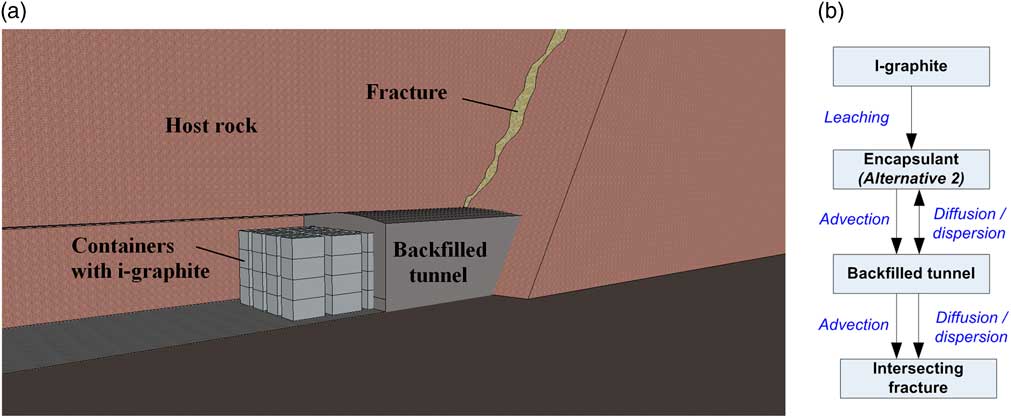
Lithuania is at an early stage of a DGR development program, and there has been no decision on the DGR disposal site yet. It was identified from the available information about geological formations that a potential location for the DGR could be in the eastern part of Lithuania, where crystalline rock is at the depth of about 700 m. Granitic rock is covered by sedimentary rocks of different hydrogeological properties forming aquifers and aquitards. For 14C release and migration from the RBMK-1500 i-graphite disposed of in a DGR, the disposal concept was adopted from the assessment reported in (Poskas et al. Reference Poskas, Grigaliuniene, Narkuniene, Kilda and Justinavicius2016). It was assumed that i-graphite is disposed of in metal containers stacked in a separate tunnel of a DGR, see Figure 1a. Two options for i-graphite disposal were analyzed: in Alternative 1, it was assumed that the graphite waste inside the metallic containers is without an encapsulant, and in Alternative 2, waste encapsulated in the metallic containers with a cement-based material was considered. At the closure of the repository, backfilling of the tunnel with a cementitious material was assumed.
Repository concept (a) and conceptual model of 14C migration (b).
Scenario Description
The review of available experimental results indicated that majority of 14C release from i-graphite occurs in solution and only small amounts of gaseous releases (about 1% of the released 14C) have been measured (Toulhout et al. Reference Toulhout, Narkunas, Zlobenko, Diaconu, Petit, Schumacher, Catherin, Capone, Von Lensa, Pina, Williams, Fachinger and Norris2015). Estimation of the hydrogen gas generation rate due to container corrosion and transport in the near field revealed that formation of the bulk gas is hardly expected. Therefore, at this stage of the DGR development, the assessment of release and migration of the 14C from the RBMK-1500 i-graphite in the near field considers 14C transfer by the water pathway. A reference scenario is analyzed, i.e. no disruptive events are taken into account. The assessment is performed for the period after the repository closure assuming fully water saturated conditions from the beginning of the assessment. Upon contact with the water, 14C is leached from the i-graphite. In the absence of the site characterization data it is assumed that a fracture is intersecting the repository and leached 14C is transported to this fracture.
Conceptual Model
The conceptual model for the developed scenario is presented in Figure 1b. The following processes are considered: 14C leaching from the i-graphite, advective and diffusive transport through the encapsulant (relevant only for Alternative 2) and the backfill and radioactive decay. There are indications that leaching of the cement under deep geological conditions is very slow (Wang et. al. Reference Wang, Martens, Jacques, De Canniere, Berry and Mallants2012) and for the preliminary assessment degradation of the cement based materials is not modeled.
Source Term
Inventory. 14C inventory in i-graphite depends on the location in the reactor core, operating power history, initial concentration of impurities, amount of cooling gases, etc. (Toulhout et al. Reference Toulhout, Narkunas, Zlobenko, Diaconu, Petit, Schumacher, Catherin, Capone, Von Lensa, Pina, Williams, Fachinger and Norris2015). In the previous assessments, the inventory was selected based either on the activation modeling with very conservative assumption on N impurity (Narkuniene et al. Reference Narkuniene, Poskas and Kilda2014) or on activity measurements at a single location in the reactor core (Poskas et al. Reference Poskas, Grigaliuniene, Narkuniene, Kilda and Justinavicius2016).
During the CAST project, a new numerical model for neutron activation was developed, and activity distribution of the 14C within the whole reactor graphite stack at the Ignalina NPP was obtained. The measured 14C content in the Ignalina NPP reactor GR-280 grade graphite reported in (Mazeika et al. Reference Mazeika, Lujaniene, Petrosius, Orysaka and Ovcinikov2015) is 1.67×10⁵ Bq g−1. Combining this data with the new model, estimation of the 14C inventory in the graphite stack was made (Narkunas and Poskas Reference Narkunas and Poskas2017). It was reported that the average specific activity value of the 14C in RBMK-1500 i-graphite was 1.9×10⁵ Bq g−1 with the standard deviation of 36.7%. These values were employed in this study for the assessment of the 14C release and migration.
Leaching. Experimental results indicate that 14C from i-graphite is released initially at a higher release rate followed by a decreased release rate in the long-term. However, for the treated graphite, the initial rapid release is not identified. The release rate also depends on the geometry of the sample: a higher release rate for crushed graphite is observed (Toulhout et al. Reference Toulhout, Narkunas, Zlobenko, Diaconu, Petit, Schumacher, Catherin, Capone, Von Lensa, Pina, Williams, Fachinger and Norris2015). Based on such information, in the previous 14C release assessments (Narkuniene et al. Reference Narkuniene, Poskas and Kilda2014; Poskas et al. Reference Poskas, Grigaliuniene, Narkuniene, Kilda and Justinavicius2016), several deterministic calculations were performed. The cases with and without rapid release as well as the bounding case with instant release of the total inventory were included. To represent rapid release, for the first 10 years after repository closure, fractional release rate of 0.1 yr−1 was assumed, while the long-term fractional release rate was varied from 1.83×10⁻⁵ yr−1 to 0.1 yr−1.
In the course of the CAST project, some more information regarding the release rate from i-graphite was reported, mainly as part of the UK program (AMEC 2016). First of all, leaching experiments with the UK graphite provided evidence that a significant proportion of the 14C content is unleachable. According to AMEC (2016), under conditions expected in a DGR, the releasable 14C makes between about 1% and 5% of the total 14C inventory and even under harsh acidic conditions not more than 30% of the 14C is released. These findings were used for the parameterization of the revised UK model of the 14C release. It was assumed that the rapid release fraction can vary in the interval from 0 to 2×10⁻³ with the best estimate value of 2×10⁻⁴; the lower bound of the fraction of the 14C that is available for slower release is 0.01, the upper bound 0.3 and the best estimate value 0.05 (AMEC 2016). Rate constant for the slower release of 14C provided in (AMEC 2016) varies from 10−3 yr−1 to 0.1 yr−1 with the best estimate value of 10−2 yr−1.
As the research performed under the UK program was carried out for other type i-graphite than RBMK-1500, the presented above UK findings are cautiously used in the 14C release assessment in the current study by assuming that the releasable fraction makes 0.3 from the total 14C inventory. The fraction of the rapid release was assumed the same as in the UK model and based on Toulhout et al. (Reference Toulhout, Narkunas, Zlobenko, Diaconu, Petit, Schumacher, Catherin, Capone, Von Lensa, Pina, Williams, Fachinger and Norris2015) and AMEC (2016) was considered as instant release. The rest from the releasable inventory was associated with slower long-term release with the release rate as in the UK model. The selected long-term release rate is conservative in comparison with 14C release rate from French and Japanese graphite (Toulhout et al. Reference Toulhout, Narkunas, Zlobenko, Diaconu, Petit, Schumacher, Catherin, Capone, Von Lensa, Pina, Williams, Fachinger and Norris2015).
Speciation. Released from i-graphite, 14C can form both organic and inorganic compounds. It is expected that for the conditions prevailing in a DGR after its closure and for slow degradation of i-graphite, mainly 14CO2/carbonate and 14CH4 will be formed (Toulhout et al. Reference Toulhout, Narkunas, Zlobenko, Diaconu, Petit, Schumacher, Catherin, Capone, Von Lensa, Pina, Williams, Fachinger and Norris2015).
Due to insufficient data on partitioning of the released 14C between organic and inorganic compounds, in the previous assessments (Narkuniene et al. Reference Narkuniene, Poskas and Kilda2014; Poskas et al. Reference Poskas, Grigaliuniene, Narkuniene, Kilda and Justinavicius2016), two cases were analyzed: in one case it was assumed no sorption of the released 14C in engineered barriers, and in another case strong sorption in cementitious material was assumed.
There is still no clear picture on partition of the released 14C between organic and inorganic compounds. On the one hand, experiments on 14C speciation under modeled DGR conditions performed in France revealed that the fraction of inorganic 14C was from 65% to 75% with the rest attributed to organic compounds (Toulhout et al. Reference Toulhout, Narkunas, Zlobenko, Diaconu, Petit, Schumacher, Catherin, Capone, Von Lensa, Pina, Williams, Fachinger and Norris2015). On the other hand, from the leaching studies of moderator and reflector graphite from the Tokai (Magnox) reactors in Japan it was found that about 80% of the released 14C was in organic form (AMEC 2016). Work undertaken as part of the UK program identified that under anaerobic high pH conditions (as expected in the DGR in the long term) released 14CO2 fraction makes 0.99 (AMEC 2016).
Taking into account that there are no experimental studies on 14C compounds released from RBMK-1500 i-graphite and available results on partition between organic and inorganic compounds from research with other types of i-graphite vary in a large interval, for the uncertainty analysis in the current study it was assumed that the fraction of organic compounds in solution vary between 20% and 80% with the best estimate value of 50%. The remaining fraction is assigned to inorganic compounds. Table 1 shows the source term parameter values from previous assessments and the values assumed in the present study.
Comparison of the source term parameter values assumed in the previous assessments and in the present study.

Mathematical Model
14C transfer in the near field is described by an advection-dispersion equation, which in one-dimensional form is:
 $${\partial \over {\partial t}}(R\;\theta \;C){\equals}{\partial \over {\partial x}}\left( {\theta D{{\partial C} \over {\partial x}}} \right){\minus}{\partial \over {\partial x}}\left( {qC} \right){\minus}\lambda \theta \;RC,$$
where C is 14C concentration in water (Bq m−3), θ is effective porosity (–), R is retardation coefficient (–), expressed as R=1 + ρ×K d / θ, ρ is bulk density (kg m−3), K d is sorption coefficient (m3 kg−1), D is diffusion-dispersion coefficient (m2 s−1), expressed as D=D eff + α×q / θ, D eff is effective diffusion coefficient (m2 s−1), α is longitudinal dispersivity (m), q is water flow rate (m s−1), λ is radioactive decay constant (s−1), x is distance in the direction of water flow (m), t is time (s). The initial condition used in the model is that there is no 14C present at t=0 around waste matrix and the boundary condition at the output to the fracture has been implemented assuming zero concentration outside the boundary.
The near field model was implemented in the software tool AMBER (Quintessa 2012). For the modeling purposes, a single central container with external dimensions of 4.013 m×2.438 m×2.2 m in the tunnel was considered assuming that the average distance from the point of release of 14C to reach the intersecting fracture is 25 m (based on Towler et al. Reference Towler, Penfold, Limer, Metcalfe and King2010). It should be noted that the presence of the fracture is not definite and should be regarded as a conservative assumption in this study. I-graphite inside the container was modeled as a homogenous block. In Alternative 2, the thickness of the encapsulant surrounding the i-graphite was assumed to be 0.15 m. Properties of the tunnel backfill and the i-graphite encapsulant were selected based on Towler et al. (Reference Towler, Penfold, Limer, Metcalfe and King2010) and Limer et al. (Reference Limer, Smith and Thorne2010). Modeling was performed with the backfill bulk density of 1730 kg m−3, hydraulic conductivity 6×10⁻⁸ m s−1 and porosity 0.55. For the encapsulant, the bulk density of 2100 kg m−3, hydraulic conductivity 10−9 m s−1 and porosity 0.125 were assumed. Effective diffusion coefficient in the backfill and in the encapsulant was taken to be 10−11 m2/s−1 (based on IAEA 2004). The hydraulic gradient for the groundwater flow was 1%, longitudinal dispersivity – 1/10 of the path length.
When modeling 14C migration through engineered barriers, it was assumed in the previous assessments (Narkuniene et al. Reference Narkuniene, Poskas and Kilda2014; Poskas et al. Reference Poskas, Grigaliuniene, Narkuniene, Kilda and Justinavicius2016) that non-sorbed 14C released from i-graphite had no interaction with the cementitious backfill and the encapsulant and migrated without retardation. No sorption of organic compounds was also assumed in a number of works collected in the CAST project report (Kendall et al. Reference Kendall, Capouet, Boulanger, Schumacher, Wendling, Griffault, Diaconu, Bucur, Rübel, Ferrucci, Levizzari, Luce, Sakuragi, Tanabe, Nummi, Poskas, Narkuniene, Grigaliuniene, Grupa, Rosca-Bocancea, Meeussen, Vokál, Källström, Cuñado Peralta, Mibus and Pantelias Garcés2015). During the CAST project it was obtained that sorption of small organic molecules in cement may be non-negligible, i.e. there are some experiments indicating sorption coefficient K d values in the interval from 10−3 m3 kg−1 to 10−5 m3 kg−1 with the best estimate value of 10−4 m3 kg−1 (Capouet et al. 2017). However, the dataset on K d values for organic 14C is rather limited therefore, in this study for the Base Case estimation it is assumed that organic compounds released from i-graphite migrate without retention and for the uncertainty analysis, the range of K d values from 0 to 10−4 m3 kg−1 was defined. K d value for inorganic compounds conservatively was taken to be 0.2 m3 kg−1 (based on Towler et al. Reference Towler, Penfold, Limer, Metcalfe and King2010) with±one order of magnitude variation for the uncertainty analysis and solubility limitation was not considered.
RESULTS AND DISCUSSION
Base Case
The fractional flux (estimated flux Bq yr−1 per Bq of 14C disposed of in the repository) from the near field to the intersecting fracture is considered as the output from the modeling of the 14C release from the RBMK i-graphite and migration in the near field. The Base Case modeling results are presented in Figure 2. In addition, the results of the assessment performed by Poskas et al. (Reference Poskas, Grigaliuniene, Narkuniene, Kilda and Justinavicius2016) are presented. The first peak in Figure 2 corresponds to the organic 14C flux from the near field and the second one to the inorganic 14C flux.
14C fractional flux from the near field: Alternative 1 – non-encapsulated waste; Alternative 2 – encapsulated waste.
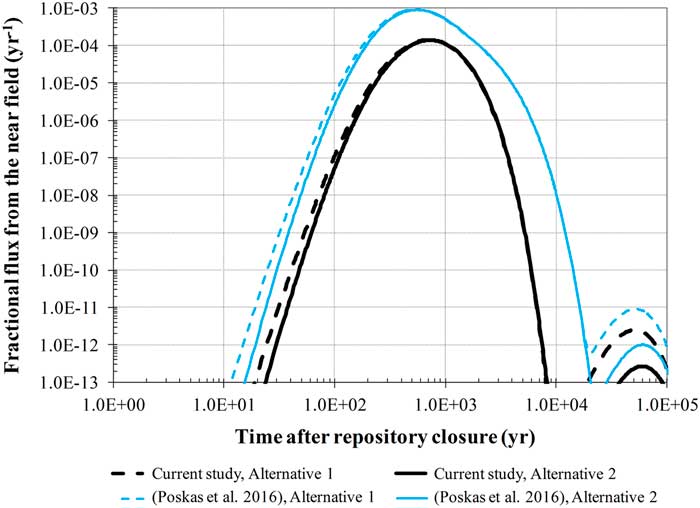
Looking at the results obtained in this study, it can be observed that the maximal fractional flux of the 14C released from the near field as organic compounds in both alternatives is approximately 1×10⁻⁴ yr−1, and the time needed to reach the maximum is about 500 years after the repository closure. The difference of the organic 14C maximal fractional flux from the near field between Alternative 1 (non-encapsulated waste) and Alternative 2 (encapsulated waste) makes about 2%. Such a small difference suggests that under assumptions introduced in the assessment, the additional cementitious barrier (encapsulant) play insignificant role in reducing the organic 14C flux from the repository.
A different result is observed for inorganic 14C. The maximal fractional flux of inorganic 14C in Alternative 1 is approximately 5×10⁻¹² yr−1. When it is assumed that the i-graphite is encapsulated in a cementitious material, the maximal fractional flux is reduced by about one order of magnitude. The maximal inorganic 14C flux from the near field appears in about 50,000 years after the repository closure. Late inorganic 14C release from the near field and significantly reduced maximal fractional flux in Alternative 2 are mainly the result of good retention in the cementitious barriers.
The comparison of the Base Case results from the present study with the results reported in (Poskas et al. Reference Poskas, Grigaliuniene, Narkuniene, Kilda and Justinavicius2016) indicates that the maximal fractional flux from the near field in the present study is lower by about one order of magnitude. The results demonstrate that more realistic assumptions could significantly reduce the conservatism.
Uncertainty Analysis
For the uncertainty analysis, 2000 sets of parameter values were randomly generated from the respective probability density functions applying Monte-Carlo technique and calculations were performed. Results of the uncertainty analysis for Alternative 1 (non-encapsulated waste) are presented in Figure 3 and for Alternative 2 (encapsulated waste) in Figure 4. They provide plots showing the fractional 14C flux from the near field for the Base Case, the mean fractional flux and the 95th percentile. In addition, the median fractional flux value is added as it might be considered as a better indication of the central tendency.
Results of the uncertainty analysis, Alternative 1 (non-encapsulated waste).

Results of the uncertainty analysis, Alternative 2 (encapsulated waste).

It can be seen from Figure 3 that the maximal fractional flux values corresponding to the organic 14C release differ between the median value and the 95th percentile by about factor of 5. The maximal fractional flux from the near field for the Base Case calculations is about 1.4×10⁻⁴ yr−1, the maximum of the 95th percentile is about 3.7×10⁻⁴ yr−1, and the maximum of the median flux is about 7.2×10⁻⁵ yr−1.
The maximal fractional flux corresponding to inorganic 14C release varies in a much wider interval than in the case of organic 14C, i.e. from 2.5×10⁻¹² yr−1 (Base Case) to 3.2×10⁻⁷ yr−1 (the 95th percentile). It is supposed that this is related to the changes in sorption coefficient values, as it was reported in (Poskas et al. Reference Poskas, Grigaliuniene, Narkuniene, Kilda and Justinavicius2016) that for inorganic 14C, sorption in cementitious barriers has the highest impact on 14C flux.
The results for Alternative 2 (see Figure 4) were obtained very similar to the results of Alternative 1 in the flux profile, with about one order of magnitude lower peak corresponding to inorganic 14C.
From the uncertainty analysis it can be concluded that further investigations in partitioning of the released 14C between organic and inorganic compounds and sorption of the released compounds in the cementitious environment could reduce the uncertainty of the results and provide a more realistic picture of the system’s capability to provide the adequate level of safety.
CONCLUSIONS
The outcomes of the research performed in the frame of the CAST project and information provided from the national research programs on 14C inventory in i-graphite, rapid and slow release fractions and release rate as well as on speciation and sorption of 14C in a cementitious environment were analyzed, and an updated set of parameter values was compiled for the modeling of 14C release from RBMK-1500 i-graphite disposed of in a DGR and for 14C migration through the engineered barriers. It was found that the information obtained during the CAST project incorporated in the assessment reduced the conservatism in the assumptions, and the estimated 14C flux from the near field decreased by about one order of magnitude in comparison with the previous conservative estimations.
The results of the uncertainty analysis demonstrated that further investigations in partitioning of released 14C between organic and inorganic compounds and sorption of the released compounds in a cementitious environment could further reduce the uncertainty in the modeling results.
However, the information on 14C release and speciation obtained during the CAST project was for other types of i-graphite than the RBMK-1500 reactor. In order to increase confidence in the justification of the parameter values and to get a more realistic representation of the system, experimental investigations into 14C release from RBMK-1500 i-graphite and speciation are still needed.
ACKNOWLEDGMENTS
This work has partly been funded by the EC Project CAST (FP7-604779) and Lithuanian Agency for Science, Innovation and Technology (31V-3/14-1707.17.17).


 Open access

