


1. Introduction
Well-educated engineers are key for the successful development of products. The development process is complex, interdisciplinary and includes all activities from clarifying the task to receiving a marketable product. The different phases are often split into four or more major phases, which is discussed more deeply in the next section: plan, conceptualize, design and, embodiment design. (Howard et al. Reference Howard, Culley and Dekoninck2008)
The mechanical engineering design process requires a lot of collaboration therefore the developer needs collaboration skillsets and experience for those activities. The whole development process includes various departments and people working together to create products and processes. Specifying the task with a team in a company together with customers presupposes teamwork and soft skills as well as engineering-oriented skills and experience in the first place (Levy et al. Reference Levy, Cannon, Burgess and Migliozzi2024). The same holds for all the following activities, which are mostly accomplished within a team, if the engineer does not work in a small company or a limited-sized department. Also, the development goals and results must be presented and discussed with superiors. Therefore, team work skills are especially advantageous to mechanical engineers (Levy et al. Reference Levy, Cannon, Burgess and Migliozzi2024; Dym et al. Reference Dym, Agogino, Eris, Frey and Leifer2005; Albers et al. Reference Albers, Denkena and Matthiesen2012). Specific knowledge and competencies are necessary for design engineers. These competencies include spatial abilities, dimensioning of machine elements, product management, initial cost calculations, creativity and analytic thinking (Albers et al. Reference Albers, Denkena and Matthiesen2012; Conrad Reference Conrad2019; Ehrlenspiel et al. Reference Ehrlenspiel, Kiewert, Mörtl and Lindemann2020; Dillenhöfer Reference Dillenhöfer2023). People working in engineering development often accomplished a higher education degree program e.g. mechanical engineering, which contains the training of the above mentioned skillsets that is later discussed in this paper.
It is recommended that courses in higher education for product development have achievable learning objectives (intended learning outcomes), encourage creativity, provide external feedback and have defined intermediate milestones in order to provide suitable, but feasible challenges and encourage motivation and engagement (Zhou 14). Conveying creativity and design concepts by sketching and describing the ideas is another important aspect to consider (Goldschmidt Reference Goldschmidt1991; Elsen et al. Reference Elsen, Häggman, Honda and Yang2012; Ling-yun Sun et al. Reference Ling-yun, Wei, Chunlei, Zhi-Yuan and Kejun2014; Felicia L. McKoy et al. Reference Felicia, Noé, Joshua and Jami2001; Yang Reference Yang2009).
For improving existing higher education and focussing on competencies relevant for the practical application it would be interesting to analyse the curricula whether engineering design activities and learning content correlate with each other. This paper does the latter by surveying three universities to identify which competencies students gain ideally in their study degree programs for the development of products. The results in this paper help to analyse if education and exams are not only content-based but also address the skills and competences beyond content that are needed for those engineering design activities. It would not only be more interesting and effective to convey the learning content but also helpful to practice the capabilities for future work life to gain experience. To achieve such goal, at first, the product development process is divided into the specific activities according to the VDI (German association of engineers) guideline. It is discussed which competencies are addressed in such engineering design courses of concern. Moreover, it is analysed to which extent these phases are being covered inside the study degree program of future design engineers to find out if the learning activities match the VDI guideline phases. These different perspectives and demands are compared to each other to point out focuses or maybe imbalances. The conclusion will show how balanced with each other the competencies students gain in their study degree program.
2. Mechanical engineering design activities and higher education
This section describes the product development process with regards to the engineering design activities as well as roughly the state of the art of product development in higher education.
2.1. The design process and its specific activities
The German association of engineers (VDI) has put forward guidelines to help mechanical engineers in practice with regards to the design process and its documentation. The VDI 2221 and the associated guidelines is a generalized methodical framework for all kinds of products and industries. It describes the process from the definition of initial objectives and requirements to a marketable product. The guideline splits the design process in nine process phases with typical activities including their specific results:
1. Clarifying and specifying the task: The ongoing activity of clarifying and specifying the assignment or task includes the concrete collection of information and requirements so that the core problem can be defined without pre-fixing on solutions.
2. Determining functions and their structures: Determining functions and their structures, especially for new developments, is a function-orientated approach and should help to find solution principles by highlighting and examining the functions.
3. Search for solution principles: For the defined functions or groups of functions, the search for solution principles and their structures follows, in that solution principles are searched for on the basis of the structural definitions for the essential sub-functions and compiled, for example, using the ‘morphological box’.
4. Evaluating and selecting solution concepts: By defining suitable evaluation criteria, possibly with weighting, the evaluation can be carried out using different methods (pairwise comparison, ABC analysis, SWOT analysis, utility value analysis, etc.) depending on the complexity and objective in order to select the best possible solution.
5. Structuring into modules: The solution concepts to be developed are divided into modules to be realised before they are further concretised by dividing a functional and logical system architecture into essential groups and elements in order to ensure an efficient division of the development work.
6. Designing of the modules: In this phase, the special modules are realised by carrying out the preliminary design or rough design, the results of which include scale drawings, CAD models, circuit diagrams, data models, program flow charts, etc.
7. Integration of the entire product: As part of the integration process, the pre-designed modules are finalised with further details and merged into a product, which is referred to as the overall design and contains, for example, elaborated CAD models and preliminary parts lists.
8. Preparation of the design and usage specifications: The preparation of the design and usage specifications supplements the previously created documents with the product documentation namely manufacturing, usage and certification information, e. g. in the form of technical drawings, CAD models, program code documentation, parts lists, manufacturing, assembly, testing and transport instructions, operating instructions or user manuals, recycling and disposal instructions.
9. Ensuring fulfilment of requirements: The term ‘ensuring fulfilment of requirements’ covers all analysis activities that are carried out continuously as one of the essential components of product development in order to compare the result with the objective (or requirements). (VDI 2221 Blatt 1 - Design of technical products and systems - Model of product design 2024)
The present VDI guideline is primarily addressed to and used by designers in practice. It is an important tool for product development. Therefore, it should also be and still is addressed in the German academia landscape. Moreover, there exists other literature that organize the product design development in similar way such as
define - ask - imagine - plan - prototype - test - improve - design validation or developing requirements - working with requirements: requirements management - functions and their structures - developing effective structures - selection and evaluation methods - product architecture - product design or similar iterative procedures (Pahl et al. Reference Pahl, Beitz and Wallace1996; Bender & Gericke Reference Bender and Gericke2021).
Literature calls these phases differently, but the meaning with respect to the activity behind the phrases is almost the same (Bender und Gericke Reference Bender and Gericke2021; Farr et al. Reference Farr, Lee, Metro and Sutton2001; Jamieson und Shaw Reference Jamieson and Shaw2020; Jonassen Reference Jonassen2008; Ertas und Jones Reference Ertas and Jones1996; Ralph und Wand Reference Ralph, Wand and Lyytinen2009; Dieter und Schmidt Reference Dieter and Schmidt2013).
Howard et al. (Reference Howard, Culley and Dekoninck2008) collected various frameworks to support the engineering design process and distinguished between several models compared to classical linear models, which differ in the activities and proceedings. They compared a number of 24 different engineering design process models. Many of these models could be broken down to four major phases, which also holds for the VDI 2222 (Version 1982). However, the VDI guideline had been renewed towards a more detailed process model as mentioned above and that is why these data are not up to date to a small extent. In fact, there are templates for “a data representation developed for collaborative mechanical design information” (Nagy et al. Reference Nagy, Ullman, Dietterich and Larry1991). (Howard et al. Reference Howard, Culley and Dekoninck2008)
2.2. Higher education for product development
Future product developer gain competencies for the development process in higher education courses in degree programs like Mechanical Engineering. (Denkena et al. Reference Denkena, Dengler and Hoppen2012) differ courses and content in four levels of knowledge according to Figure 1. The pyramid consists of basics, basic knowledge for product development, expertise and experience. A study based on this classification was performed by (Denkena et al. Reference Denkena, Dengler and Hoppen2012). This includes a content analysis of study regulations, surveys of faculties and interviews with the most important stakeholders (program directors, students, graduates, industry representatives and association members). This was compared with the industry's expectations of modern designers in order to derive recommendations for action. The content analysis of the study degree program is conducted. At first, a distinction between courses is made and defined in the following way:
-
Design-oriented courses are those that train the designer for the core of their work (synthesis) (e.g. engineering design, engineering design drawing, machine elements, …),
-
Design-related subjects (e.g. technical mechanics, mechanics, materials science),
-
Subjects that are neither construction-related nor construction-relevant (e.g. English, chemistry, law).
The study presents a proportion of design-oriented courses in the study degree program at TU Dortmund University as well as other universities in Germany in 2010. At that time an old version of the study degree program, named diploma, was included, which had been transformed into the bachelor/master degree study program that was running simultaneously when Denkena et al. (Reference Denkena, Dengler and Hoppen2012) conducted their studies. The maximum percentage of design-oriented modules possible equals about 24 percent in the bachelor at the TU Dortmund University. The arithmetic mean of design-oriented courses is about 17.7 percent in the bachelor and 19.7 percent in the master degree program. Compared to the maximum, Denkena et al. (Reference Denkena, Dengler and Hoppen2012) also analysed the minimum proportion of design-orientated modules that a student can choose from, which is possible because after the undergraduate level, where the basics are taught, a selection of modules from a given pool can be applied to the individual's degree pathway. The proportion of design-oriented modules in the master degree program at the TU Dortmund University was 9 percent at that time.
Four levels of knowledge for developing products according to (Denkena et al. Reference Denkena, Dengler and Hoppen2012)

Concerning the learning outcomes, a study with 18 higher educational institutions in Germany in the first two years of degree programs shows a focus in engineering design education on dimensioning machine elements and technical drawing, but only courses from the first two years of studying are considered. (Kossack et al. Reference Kossack and Bender2024)
3. Methodical approach and research question
Literature shows no recent results about the addressed learning outcomes in engineering design education in degree programs like mechanical engineering. Denkena et al. (Reference Denkena, Dengler and Hoppen2012) identified design-related courses in mechanical engineering degree programs in 2012. These results are almost 15 years old, refer to an outdated study degree program organization (diploma vs. bachelor/master), and the data does not include the focus on certain product development activities. A previous study from 2024 focuses on the first two years of the degree programs and contains neither data from the whole degree program nor includes assignments of the learning outcomes to specific development activities (Kossack et al. Reference Kossack and Bender2024). Denkena et al. (Reference Denkena, Dengler and Hoppen2012) pointed out the proportion of design-oriented courses in a full study degree program. Despite, there is no data available for the learning content distribution regarding a whole engineering product development cycle which is dealt with in a full study degree program. Results on how capable students are with regards to the particular product development activities and which competences they gain during those courses would benefit not only higher education but also industry because you know what to expect.
This paper deals with the analysis of the curricular and course descriptions in higher education based on course catalogues, content analyses (scripts, presentations, etc.) and interviews with lecturers. The following universities are part of the analysis: TU Dortmund University, Ruhr-University Bochum and University of Wuppertal, which are popular universities in Germany with over 20 000 students each. The paper aims to identify addressed competencies in engineering degrees at three German institutions, and only competencies in design. A comparison of the results with required competencies for professional fields might help to rework the content of degree programs. This way, one is able to synthesise and recommend actions for university teaching/training of design engineers. The authors are lecturers for some of the courses (less than 5 percent of the courses that are analysed) and know the content much better than the content of other courses.
The methodology is structured into two steps. First, the proportion of design-oriented and design-related courses according to Denkena et al. (Reference Denkena, Dengler and Hoppen2012) is researched and compared to the results that were collected one decade ago. The keywords Albers used are: component, part, assembly, construction, development, problem solving, guidelines, selection, systematics, methods, creativity, CAx methods, PLM, function, concept, shape, design and draft. In contrast, exclusion words are defined as: physics, chemistry, biology, mechanics, fluid mechanics, electronics, computer science, mechatronics, logistics, management, law, other languages. (Denkena et al. Reference Denkena, Dengler and Hoppen2012)
Non-technical courses are not considered further. The curricula respectively course description is analysed by means of the wording. Most of the data that were collected are publicly accessible or if this was not the case, the materials were procured with the help of the persons responsible for the courses (lecturer). If the title contains words which point out that it could be design-oriented, it is marked as a potential module. On the other hand, Denkena et al. defined words of exclusion which means that you are able to sort it out from the category design-oriented, if words lead to fundamentals of studies like chemistry, law and so on. After the pre-selection, the exact module description is analysed so that one can determine if the module is really design-oriented. After these two steps, all modules are categorized similar to the listing above. The categories are listed below:
-
Design-oriented courses,
-
Design-related courses,
-
Science basic courses,
-
Additional workload (project work, bachelor/master thesis, internships, …).
In contrast to Denkena, there is not only one category for subjects that are neither design-related nor design-relevant, but two categories for basics (see Fig. 1) and additional workload, which is mandatory, because theses and group work activities could be design-oriented and do not belong to the universal engineering knowledge. One is able to distinguish this workload to conclude on real appearance of design-oriented studies. Furthermore, the learning content is analysed and assigned to a certain activity from the engineering product development process according to the VDI 2221 procedure (see Section 2).
Based on the initial situation and the literature, the paper investigates and discusses the following research questions:
-
RQ1: Which proportion of design-oriented subjects are included in the study degree program (bachelor and master degree) of mechanical engineering and what dimensions are generally possible? Does it fit with the requirements for a mechanical engineer?
-
RQ2: What competences/skills are acquired in the curriculum that can be assigned to the phases of the VDI?
4. Analysis on engineering design activities
This chapter shows the results of the analysis. The first section starts with the general identification in the degree programs of design-oriented courses to identify the addressed competencies in these courses in the second section.
4.1. Design-oriented courses in mechanical engineering degree programs
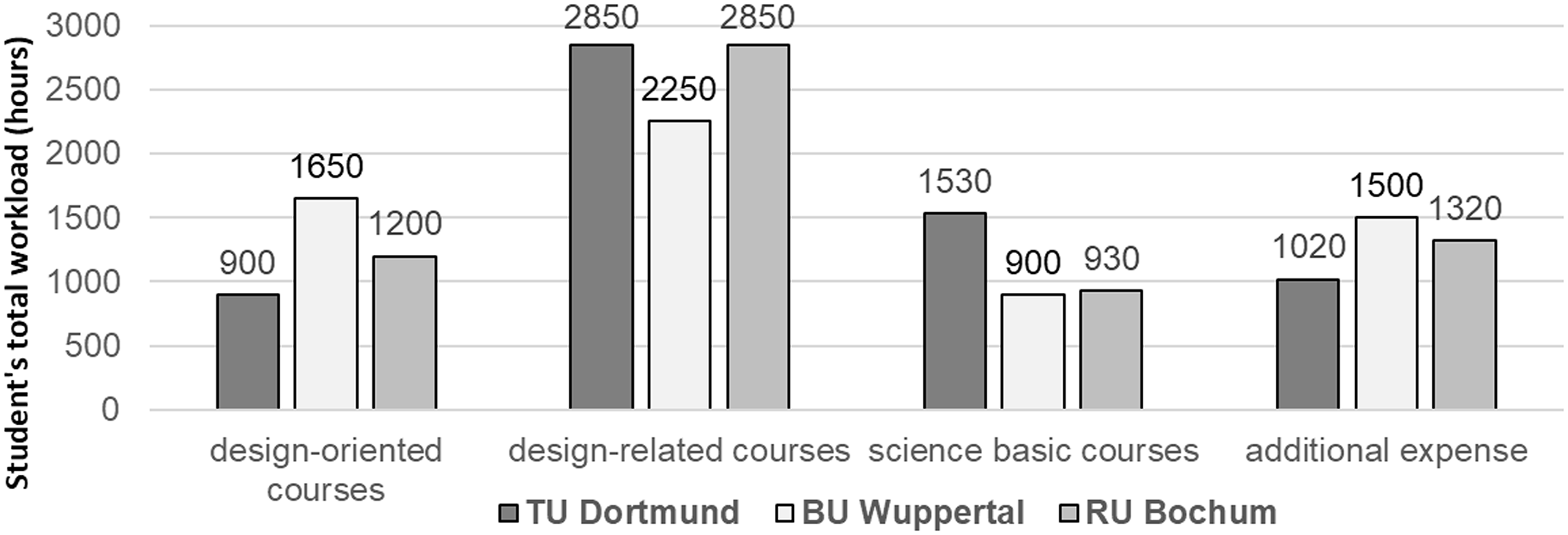
The total workload for students in the bachelor degree program mechanical engineering comprises at all three universities 210 credit points. One credit point means an estimated expenditure of 30 hours work for the students, so the overall workload is 6300 hours. Since this is the case and hours and credit points are linear depended, from now on only hours are looked at. At the three universities, students start choosing courses and a major field after two years of studying. The first two study years consist of basic science courses e.g. mathematics and physics and engineering courses. These include design-oriented courses like fundamentals in engineering design education or engineering design drawings and design-related courses like material science. This paper concentrates on students respectively study degree paths that focus on engineering design and, thus, a choice of as many design-oriented courses as possible is assumed, which is often the case for the subject of interest. Figure 2 shows the distribution in the bachelor degree program of the workload to the four categories. The workload for the design-oriented courses varies between 900 and 1650 hours. This results in a proportion between 14 percent and 26 percent of design-oriented courses in the bachelor degree program which correlates with the results of (Albers et al. Reference Albers, Denkena and Matthiesen2012).
The workload for design-related courses is about two or three times higher which leads to a percentage of 35 percent to 45 percent ratio. The workload for science basic courses and the additional workload for the students consisting of vocational training, scientific thesis or business and management courses is similar distributed at all three universities, with the exception that the University of Wuppertal has compared to the other two universities more business and management courses.
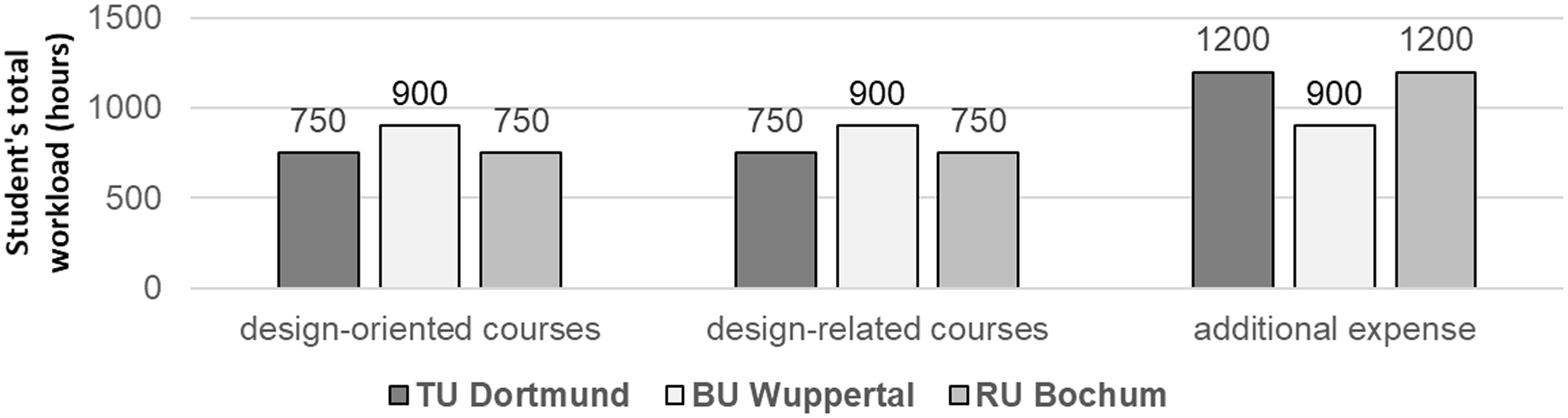
There are no science basic courses inside the master degree programs. The degree programs at all three universities have a total workload of 90 CP. This total workload consists of design-oriented courses, design-related courses and additional workload like thesis, trainings or management and language courses. Figure 3 shows the exact distribution. The workload for design-oriented courses and design-related courses is nearly the same at all individual universities (compare e.g. 750 hours for both at TU Dortmund and 900 hours for both at BU Wuppertal). The TU Dortmund focuses more on design-related expertise (1200 h vs. 900 h and 750 h) whereas University of Wuppertal aims for a higher amount of design-oriented and design-related competencies (900 h and 750 h).
Students' workload for courses in the bachelor degree program mechanical engineering

The TU Dortmund University and RU Bochum have more additional workload than BU Wuppertal. At these two universities the additional workload consists of the master thesis (900 h), a practical laboratory course (150 h) and one non-technical course free of choice e.g. a language course (150 h), which is located in the bachelor study degree program at BU Wuppertal. Here, the proportion of design-oriented courses hits from 27 percent to 33 percent of the total amount which corelates in some cases to the numbers from Denkena et al. (Reference Denkena, Dengler and Hoppen2012). The difference is that an arithmetic mean of 29 percent compared to 18 percent (Denkena et al. Reference Denkena, Dengler and Hoppen2012) and the deviation is much more decreased compared to the numbers from the literature.
Students' workload for courses in the master degree program mechanical engineering

4.2. Competencies addressed in design-oriented courses
Students gain competencies in the different design-oriented courses for different design activities. But not all activities are addressed to the same extent during the entire degree program (bachelor and master). Figure 4 shows the students' workload for gaining competencies required for the different activities. Not all workload hours of design-oriented courses match an activity in engineering design according to VDI 2221. There are hours in design-oriented courses spend with organisation of the courses, gaining competencies for interdisciplinary activities e.g. product planning or basic technical topics, patent search, business and management.
It is obvious that most workload in higher education is spend within the phase of “shaping the modules” which means to create a rough design. The workload for competencies for this activity varies between 467 and 943 hours. The workload for gaining competencies for the first activities in the engineering development process according to VDI 2221 are almost equally distributed over the first five activities at the individual universities.
Workload for acquiring competencies for activities within the whole degree program

The University of Wuppertal has the highest workload for competencies for all activities, caused by the overall highest workload of design-oriented courses. Moreover, the competencies profile of the universities analysed on a percentage-based comparison for the different activities appears quite similar with few exceptions. It seems that higher education focuses strongly on shaping the modules which quantifies in about 50 percent of the overall workload assigned to the product development activities. All the other activities manifest in an arithmetic mean of under 10 percent, because they are only treated few times, but none of them is not addressed in any way.
5. Discussion of engineering design activities
The results show a high degree of consistency in engineering design education. Existing differences might be caused in the different major focuses (TU Dortmund University 2025; Ruhr-univesity Bochum 2025; University of Wuppertal 2025) . TU Dortmund University is famous for production technology in engineering design education and courses of mechanical engineering have a large overlap with courses within the study degree program of logistics. This could be the reason why there are more basic science courses. On the other hand, University of Wuppertal has a large overlap with safety engineering and, therefore, many courses about design for safety. Thus, design-oriented content is the primary target for those competencies a safety engineer needs to acquire. RU Bochum is famous for many different fields of mechanical engineering from design and automation to energy systems and sustainability and that is why the proportion of competencies to be acquired is more balanced not only in the bachelor study degree program and master program but across all studies.
Due to an increased number of design-related courses, University of Wuppertal has the most total hours in delivering competencies for the product development activities. The tendency towards the highest proportion (50-60 percent) of taught competencies in the activity of designing modules is logic, because it is the key competence for design engineers. The other activities are covered at an almost equal amount of between 100 hours and 200 hours. It is noticeable that TU Dortmund University sets a focus more deeply on the product integration and elaboration of execution and usage requirements than the two other universities, whereas it is very important for University of Wuppertal to teach competencies regarding assurance of fulfilment of requirements, since it could be more essential for safety applications. Courses at RU Bochum addresses design-oriented activities from the VDI 2221 with less workload. Especially the content of the courses about digital engineering is hard to assign to specific activities. In addition, product planning has a high workload but is not a core activity.
If the total amount of activities is analysed percentage-wise, there are no significant differences observable. This means, if a student graduates from these three universities, their knowledge with regards to the competency profile of a mechanical engineer is equal or similar. This statement is supported by Figure 5, since the competence profile over the whole degree programs is akin. Another important factor for the concentration on the phase “shaping of the modules” is because this activity demands the highest workload and the most competencies that are needed for the whole product development process. In addition, these competencies are mostly very quick to attain. It is much more arduous to achieve high competency levels in creativity and critical thinking for example than in spatial imagination or CAD-related skills. There are some support utilities for example in terms of optimisation of the topology, but it is hard to master an effective and economic design that meets all requirements. Furthermore, the other phases often involve only lower competency or knowledge levels. Last but not least, although the product development process had been split up, the shaping-the-modules-activity is far most the one with the highest workload for engineers, consequently, the activity that receives the most attention. The paper shows the actual state of product development in higher education. Further work should examine the extent the learning content prepares students for everyday working life.
Percentage competence profile over the whole degree program

The results are subject to some limitations. The results are based on three of the 19 universities offering mechanical engineering in Germany. Hence, the results are given with a significance that is not quite good, because the sample is small. Analysing the curricula of more universities can extend the findings respectively may confirm the tendencies outlined here because engineering design education is based on few and often the same literature. Moreover, the classification of the activities was based on the topics and their incidence in lectures. Nonetheless, the amount of self-study time is high and the exact engagement with topics at that time cannot be verified. Because of that it is assumed that the distribution of hours spent at the self-study time has the same distribution like the lecture. However, it is possible that a student does focus more on one topic which means that the distribution would slightly change. The allocation of the content to different product development activities is partly subjective and the used information varies.
The identification of relevant courses is based on the title, which causes that other courses not taken into consideration in this study, may also have relevant content for the development of products according to VDI 2221. On the other hand, courses are taken into consideration because of their title and address relevant content maybe only in one or two weeks of the term. Last but not least, there could be a higher number of competencies gained at theses that could cover design-oriented topics. But since one is not able to distinguish from design-oriented activities and activities that deal with other competencies like scientific work, it is categorized inside the additional workload.
Typical teaching and learning activities in engineering design education, at least at the beginning of degree programs, are teacher-centred and self-study time. In the self-study time students work with exercises or repeat the content with e-learning, lecture sheets or books mostly by themselves. The assessment task is often a summative exam or formative tasks like technical drawing or CAD-Models. In higher semester, at some universities, project-based learning is typical as well. Students design an assembly group over some weeks in a group, document the development as a portfolio exam and present the results. (Kossack and Bender Reference Kossack, Neumann, Bender, Dillenhofer, Kunne, Sersch and Gust2024)
In addition, further investigation about appropriate teaching and learning activities and assessment formats to gain and evaluate these competencies should be performed. Kossack et al. (Reference Kossack and Bender2024) found out that some team projects have been integrated in the study degree program, but the main education in the first two study years is transmitted through frontal lectures (Kossack and Bender Reference Kossack, Neumann, Bender, Dillenhofer, Kunne, Sersch and Gust2024). This is also what Albers et al. (Reference Albers, Denkena and Matthiesen2012) found out in his studies and proposed the two aspects of aligning studies with the necessary skills and competences and creating new teaching formats for vocational training. Instead of only focusing content within the lectures and exams, soft skills and teamwork skills should be addressed, because the activities are perfectly suited for such topics, as well as the fact that the interdisciplinarity needed for the work life is a key factor (see Section 2). Some formats have been converted into more skill-oriented activities, but there seems to be much more potential. A study that surveys the competencies precisely that are used in the engineer's every day's work life would be very interesting to compare with the results of this paper.
6. Conclusion
The distribution of not only design-oriented but also design-related competencies taught in a study degree program of mechanical engineering at the three considered German universities appears similar, although different core areas are managed. In addition, the competencies related to the product design development process are similar, as the different phases are addressed with comparable amount, although slightly more at BU Wuppertal, where the total number of design-oriented courses is higher. As a conclusion, it can be assumed that graduated mechanical engineers (from these three universities) have gained similar competencies in their studies.
Another interesting aspect is the point of teamwork in education in terms of the product development process. Albers et al. (Reference Albers, Denkena and Matthiesen2012) proposed various actions, which seem to be not fully implemented in today's university education. Since the work in industry covet such skills and also interdisciplinary work, it should be analysed to which extend the education is actually using methods to address such skills and competencies and if there is still room for improvements. This holds not only for the learning phase but also for summative assessment.



 Open access

