

Introduction
Political actors in the United States and elsewhere increasingly attack the legitimacy of judicial rulings when the outcome is unfavorable. Since his first election, Trump and allied elites have repeatedly portrayed judges as partisan, corrupt, or biased when government policies or Trump’s personal interests do not prevail (Eisler et al. Reference Eisler, Parker, So and Tanfani2025; Raymond and Goudsward Reference Raymond and Goudsward2026; The Brennan Center 2020; Ulmer Reference Ulmer2025). These attacks follow a recognizable pattern. Elites channel emotionally resonant disputes into the courts and then use unfavorable rulings to delegitimize judicial authority in the eyes of the public (Gregory Reference Gregory2025). They also threaten the illegitimate use of coercive tools against non-complying judges undermining judicial independence and the rule of law (Levitsky and Ziblatt Reference Levitsky and Ziblatt2018; Tushnet Reference Tushnet2004).
The democratic stakes are high. Liberal democracy requires separation of powers where courts can apply the law without fear of retaliation. Yet “court baiting” often targets courts precisely by blurring the line between disagreement and legitimate procedure while emotionally charged issues make it easier to rile up government-allied forces within the public and seed doubt about the legitimacy of courts (O’Donohue Reference O’Donohue2025).
I argue that such practices can weaken public support for judicial independence by exploiting known vulnerabilities in citizen political decision-making. Although people express strong support for democracy in principle (Bermeo Reference Bermeo2003), including judicial independence (Marquette Law School Poll 2025), in practice, such support is malleable and context dependent (Nelson et al. Reference Nelson, Clawson and Oxley1997; Sullivan et al. Reference Sullivan, Pierson and Marcus1982). Scholarship grounded in social identity theory and motivated reasoning shows that group commitments interact with the context to structure behavior (Kunda Reference Kunda1990; Tajfel and Turner Reference Tajfel, Turner, Worchel and Austin1986). Moreover, citizens maintain a flexible conceptualization of democracy (Krishnarajan Reference Krishnarajan2023). The result is that their political judgments on the allocation of rights, liberties, and penalties can be influenced by their group identities (Buyuker Reference Buyuker2021; Graham and Svolik Reference Graham and Svolik2020). These dynamics are especially likely when disputes involve easy to understand symbolic issues. When political conflict threatens a person’s social identity, individuals may be motivated to place opponents outside the “imagined community,” thereby legitimating undemocratic penalties (Filindra and Buyuker Reference Filindra and Buyuker2026).
This identity-motivated logic, which sanctions undemocratic penalties, applies to judges in symbolic disputes. Judges are supposed to be treated as neutral arbiters, but when a ruling is interpreted as an identity judgment, citizens may treat the judge as an identity-motivated actor and become more receptive to penalties. I use the term “undemocratic penalties” to mean public support for viewpoint-driven sanctions that interfere with a judge’s ability to perform judicial duties impartially. Even if some citizens understand such retaliation as legitimate majoritarian politics, punishment of judges for lawful decisions violates liberal democratic norms by converting legal disagreement into coercive discipline. The key danger of such processes is the softening of rejection, a shift toward ambivalence about the inappropriateness of undemocratic penalties that creates space for elites to normalize retaliation against independent judicial institutions.
I test this theory using two similar vignette survey experiments, one with White and the other with Latino respondents. Latinos allow me to test whether the process generalizes across groups with different social positions (Pérez and Kuo Reference Pérez and Kuo2021). Participants were randomly assigned to one of two controls or a treatment condition. Both studies randomly assign respondents to short vignettes that describe a judge’s decision. The vignettes vary the issue (control v. Confederate flag), the direction of the flag decision (uphold v. ban), and the race of the judge (White, Black, Muslim, or Latino). The Confederate flag is a highly salient symbolic issue along racial lines and earlier studies show that approval of Confederate symbolism is structured along racial resentment levels (Benjamin et al. Reference Benjamin, Block, Clemons, Laird and Wamble2020; Hutchings et al. Reference Hutchings, Walton and Benjamin2010).
The results show that relative to a control representing the ideal democratic response, White racial liberals perceive the White judge who upholds the Confederate flag as biased and become open to undemocratic penalties against him. They also assign bias to the Muslim judge who bans the Confederate flag, but the penalties are substantively smaller. Racial conservatives perceive all banning judges, independent of race, as biased, and become more punitive toward them. Racial moderates also recognize bias in the judges’ decisions but do not penalize any judge. The effects are symmetric within parties complicating expectations of identity stacking (Mason Reference Mason2018).
Among Latinos, baseline punitiveness is higher than among Whites, suggesting a different relationship to the justice system. Furthermore, on average, unlike Whites, Latinos penalize racial exclusion, an effect concentrated among racial liberals. Latino racial conservatives do not show the same attachment to the Confederate flag as do Whites even as they penalize the Black judge who bans the flag. Overall, the results suggest that the bias-to-penalty mechanism generalizes across racial groups, but there seem to be distinct motivations in response patterns. Among Latinos, racial resentment operates as distancing from Blackness, thus limiting solidaristic opportunity, but not as defense of White racial supremacy. Finally, the two racial groups have distinct approaches to racial outsiders: White racial liberals penalize the Muslim judge as a biased outsider to the conflict, while Latinos across racial resentment groups, view the Muslim judge as the least biased and the Black judge as the most biased.
This study makes several contributions. First, it bridges research on racial attitudes and Confederate symbols with research on democratic backsliding, which focuses on partisanship. It shows that racial worldviews independently predict willingness to sanction judges through a bias perception mechanism, even after accounting for partisan identity. Second, the study documents the fragility of democratic forbearance: citizens’ default posture toward judicial independence is ambivalence rather than firm commitment, suggesting that democratic norms require active reinforcement. Third, by extending the analysis to Latino respondents, it identifies both the generalizability and the limits of this process. The bias-to-penalty pathway operates across racial groups, but the triggers are group-specific, and racial resentment among Latinos captures anti-Black distancing rather than defense of White supremacy. This is a distinction with implications for inter-minority coalition politics.
Court Baiting and Democratic Backsliding
Donald Trump has routinely berated judges who rule against him, calling them “corrupt,” “a disgrace,” “unpatriotic,” “unamerican,” “an embarrassment to our nation,” and calling for their removal and impeachment. Trump accuses judges not only of procedural failures but partisan motivations and disloyalty to the nation. State political actors are increasingly following the same playbook (Freeman Reference Freeman2020; Greco Reference Greco2015).
“Court baiting,” or bringing highly emotionally salient cases in front of judges to force them to choose between avoiding reputational costs and upholding the rule of law, is a common strategy among populist authoritarians (O’Donohue, Reference O’Donohue2025). The cases need not have high material stakes; a symbolic dispute may be sufficient to produce the desired effect (Filindra and Buyuker Reference Filindra and Buyuker2026). Illiberal leaders leverage such symbolic controversies to highlight the divergence between what they pronounce as “the majority will” or the character of “We the People,” and the decisions of judges. Subsequent court decisions that uphold the law are used to doubt judicial legitimacy and judges’ role in a democratic society by conflating the idea of majority rule with the rule of law (Gregory Reference Gregory2025). When judges do not fall in line, elected officials can use “constitutional hardball” tactics to enforce judicial discipline. This refers to the deployment of coercive tools that are technically lawful, but proscribed by democratic norms, such as politically motivated investigations, calls for resignation, or pretextual arrests. These tactics can weaken judicial independence and violate principles of mutual restraint (Levitsky and Ziblatt Reference Levitsky and Ziblatt2018; Tushnet Reference Tushnet2004).
Court baiting succeeds when mass publics prove receptive to elite attacks on judges. While elites initiate the strategy, its effectiveness depends on citizens’ willingness to prioritize substantive outcomes over procedural fairness. This creates a two-step process: first, symbolic rulings generate public anger and perceptions of judicial bias; second, elite rhetoric channels anger and loss of faith into anti-institutional sentiment and into support for undemocratic penalties against judges.
At first glance, mass opinion appears to support judicial independence. Majorities say that presidents should follow judicial decisions (The Pew Research Center 2025) and that judges should not be sanctioned just for ruling against an administration (Marquette Law School Poll 2025). Yet this support is conditional. Trust in courts varies across partisan coalitions, and evaluations of judges shift sharply when surveys reference specific disputes rather than abstract principles. These patterns suggest that public commitment to judicial independence may be malleable and context dependent.
Symbolic Politics, Democratic Backsliding, and Public Opinion
Scholars have long shown that political tolerance is malleable and context dependent. Citizens do not behave as principled democrats but instead use group attachments to determine who gets political rights and who doesn’t (Nelson et al. Reference Nelson, Clawson and Oxley1997; Sullivan et al. Reference Sullivan, Pierson and Marcus1982). Guided by partisanship, people downplay undemocratic behavior by ingroup leaders (Filindra and Harbridge Yong Reference Filindra and Harbridge Yong2022; Graham and Svolik Reference Graham and Svolik2020). Motivated by racial priors, citizens become open to undemocratic penalties against groups that pose threats to the ingroup’s social status (Buyuker Reference Buyuker2021; Filindra and Buyuker Reference Filindra and Buyuker2026).
Citizens can maintain a self perception as democratic while endorsing undemocratic action by adopting a flexible, outcome-oriented understanding of democracy (Krishnarajan Reference Krishnarajan2023). Democracy is a compound word, and the first component denotes the “nation” or the “imagined community.” Individuals can hold distinct visions of membership (Filindra Reference Filindra2023; Schildkraut Reference Schildkraut2007; Theiss-Morse Reference Theiss-Morse2009). People-based conceptions of democracy are much easier than institutional definitions for people to maintain and process. In this sense, democracy becomes about who belongs and who doesn’t, not about how rules should constrain behavior. When a political or social actor challenges citizens’ perceptions of the social order and their own position in it, people can respond by “drawing” the offender outside the boundaries of legitimate membership. This process makes it easier to accept imposition of undemocratic penalties and maintain a democratic self-perception (Buyuker et al. Reference Buyuker, Filindra, Gandenberger, Manatschal and Green2024; Filindra and Buyuker Reference Filindra and Buyuker2026; Gandenberger et al. Reference Gandenberger, Buyuker, Manatschal and Filindra2025).
I argue that this logic applies to judges in symbolic disputes. Judges are conventionally treated as neutral umpires, charged with enforcing rules rather than asserting group interests. However, when a ruling is interpreted as an identity judgment, citizens may treat the judge as an identity-driven actor and become more receptive to punishment. The key democratic problem is not mass enthusiasm for penalizing judges. It is the softening of rejection, a shift from principled opposition toward ambivalence, which creates space for elites to escalate court baiting and normalize retaliation.
Symbolic politics provide a particularly sharp test of this argument. Canonical work in political science emphasizes material interests as drivers of engagement and mobilization (Downs Reference Downs1957). Yet a large interdisciplinary literature shows that symbols and public memory shape group belonging and perceived status. Public representations of history can reinforce citizens’ sense of belonging and moral worth. Groups excluded from memorialization can experience that exclusion as stigma and social injustice, or as negative social identity (Tajfel and Turner Reference Tajfel, Turner, Worchel and Austin1986). Scholars of transitional justice argue that commemorating minoritized experiences can function as a form of recognition and repair (Barsalou Reference Barsalou2005; De Brito et al. Reference De Brito, Enríquez and Aguilar2001) Conversely, removing exclusionary monuments that encode colonialism and White supremacy can reduce prejudice and improve intergroup relations (Rahnama Reference Rahnama2025), but it could also threaten Whites’ positive ingroup attachment (Tajfel and Turner Reference Tajfel, Turner, Worchel and Austin1986).
Symbolic disputes therefore carry limited direct material stakes but can pose acute identity threats because they embody competing understandings of collective identity and hierarchy. When symbolic conflict threatens an ascriptively defined worldview, citizens may become more willing to support punitive action against institutional actors who enable that threat. However, the same logic can apply to citizens with racially inclusive worldviews if a decision is perceived as ratifying exclusionary hierarchy. The core claim is symmetrical. Procedural restraint is conditional on whether the ruling is perceived to protect the “imagined community”.
I focus on judicial decisions involving Confederate flags because they crystallize contests over public memory and activate racial ideology without involving immediate material redistribution that could confound symbolic effects. Existing research shows that group identities shape approval of symbolic change, including disputes over Confederate symbols (Benjamin et al. Reference Benjamin, Block, Clemons, Laird and Wamble2020). But approval and disapproval are distinct from democratic forbearance toward judges. The central question for democratic stability is whether negative emotions and perceptions of judicial bias in response to a disliked ruling can translate into willingness to sanction the judge.
The Confederate controversy also allows a broader test beyond the White Black binary. Negative outgroup attitudes and perceived social positioning can shape boundary drawing among minority groups as well (Tajfel and Turner Reference Tajfel, Turner, Worchel and Austin1986). People of color are attentive to their group’s relative position in the American racial hierarchy, and this perceived status can influence how they react to other minoritized groups (Pérez and Kuo Reference Pérez and Kuo2021; Perez et al. Reference Perez, Robertson and Vicuna2023). This logic also aligns with Zou and Cheryan’s (Reference Zou and Cheryan2017) racial position model, which argues that U.S. racial groups are located along two inter-related dimensions: race and nativity, a framework that is especially useful for theorizing Latino responses to symbolic conflicts over national belonging. Among Latinos, socialization in systems of colorism can contribute to anti-Black attitudes and to strategic assimilation through Whiteness (Filindra and Kolbe Reference Filindra and Kolbe2022; Pérez and Kuo Reference Pérez and Kuo2021). In recent years, some Latinos have also participated in far-right organizations and have adopted symbols of colonialism and White supremacy as exemplars of national pride (Ramos Reference Ramos2024). These dynamics suggest that Confederate symbolism may activate status and belonging concerns among Latinos, though the direction of that response depends on perceived proximity to Whiteness and on boundary definitions within the imagined community.
Hypotheses
H1: Support for undemocratic penalties will increase among racial conservatives when a judge bans the Confederate flag; racial liberals will show more punitiveness when the judge upholds the flag.
H1a The effect will be symmetrical across racial liberal and conservatives, consistent with conditional support for democratic norms.
H1b Racial conservatives will penalize minority judges who ban the Confederate flag more harshly than the White judge because of stronger perceived bias.
H2: Perceived judicial bias mediates the effect of support for undemocratic penalties for both racial liberals and conservatives.
H3 Latinos who share Whites’ racial priors will respond similarly to White respondents, consistent with shared social positioning dynamics.
Study Design and Measures
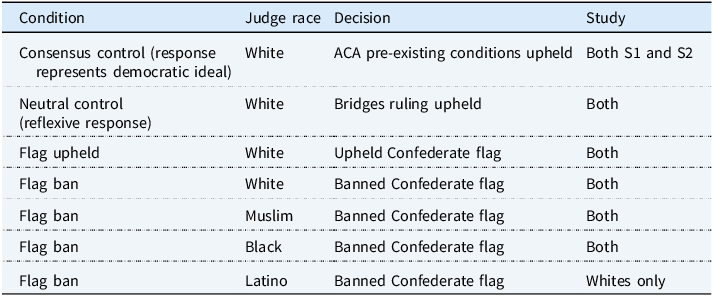
I report on two closely related survey experiments fielded August 1–23, 2019, on U.S. adults recruited from the Qualtrics panel. The samples are not representative but approximate the population’s demographic distribution. Study 1 includes non-Hispanic White respondents. Study 2 includes Hispanic/Latino respondents. Both studies randomly assign respondents to short vignettes that describe a judge’s decision. The vignettes vary the issue, the direction of the decision, and the identity of the judge. I fielded the studies in August 2019, following heightened national attention to Confederate monuments after Charlottesville (August 2017) but before the 2020 racial justice protests, providing a baseline of public attitudes in a period of moderate salience. Table 1 summarizes the experimental conditions and study design.
Experimental conditions

Table 1. Long description
The table presents the structure and content of experimental conditions and study design for survey experiments conducted on U.S. adults. It features four columns: Condition, Judge race, Decision, and Study, with six rows detailing various scenarios. The conditions include consensus control, neutral control, flag upheld, and flag ban, with corresponding judge races being White, Muslim, Black, and Latino. Decisions vary from upholding pre-existing conditions to banning the Confederate flag. The studies involve both non-Hispanic White and Hispanic/Latino respondents, with some conditions applying to both studies and one specific to Whites only. The table highlights the experimental variations in judge identity and decision direction, providing insights into public attitudes towards Confederate flag issues during a period of moderate salience.
Note: Both studies used the consensus and flag conditions. The Latino judge condition was administered to White respondents only. The Latino judge condition was excluded from Study 2 (Latinos) to avoid conflating results with in-group solidarity.
Study 1
This study has a sample of 1,437 non-Hispanic White Americans. The survey included attention checks and a manipulation check that asked respondents to identify the judge’s race. The results showed that most respondents responded correctly. Analysis produced substantively similar results when the entire sample or only high-quality responses were included, so I opted for the conservative option of including all respondents.
Respondents were assigned randomly to one of seven conditions describing a judge’s decision: (1) a neutral judicial control; (2) a consensus policy control; (3) a Confederate-flag affirmation by a White judge; or (4–7) a Confederate flag ban, with the judge’s identity randomized as White, Muslim, Latino, or Black. The judge’s identity was conveyed via his name. I selected names to provide clear, conventional cues for White, Muslim, Latino, and Black identities, following standard practice in survey and audit experiments that use names as social identity signals (Bonilla et al. Reference Bonilla, Filindra and Lajevardi2022). I hold gender constant by assigning male names to all judges.
The flag affirmation vignette read: “Judge Arnold Huntington, Sr., of the Second Circuit Court issued a decision yesterday that allows states to continue flying the Confederate flag on public properties, schools, parks, and buildings. The judge called it ‘a symbol of culture and heritage,’ praising lawmakers for seeking to fly the flag.” The Confederate flag ban vignette said: “Judge [Arnold Huntington (White)/Halim Mohamed (Muslim)/Eduardo Salinas (Latino)/Deshawn Robinson (Black)] of the Second Circuit Court issued a decision yesterday that allows states to ban the Confederate flag. The judge called it ‘a symbol of hate and disunion,’ urging lawmakers to ensure that the flag is no longer used on public properties, schools, parks, and buildings.”
The study includes two baseline conditions that jointly diagnose the strength of democratic forbearance. The neutral control presents a judicial ruling with no material or identity implications for the respondent. In principle, a citizen should strongly reject undemocratic penalties against a judge in this scenario because there is no substantive basis for punishing a judge whose decision is inconsequential to the respondent. If the neutral control mean falls well above zero, this raises a question: does this reflect genuine ambivalence about democratic norms, or is it simply measurement noise, a ceiling on how firmly surveys can capture rejection? The consensus control helps resolve this ambiguity. It presents a ruling that respondents broadly like, creating the most favorable conditions for rejecting penalties. If respondents move significantly below the neutral mean in this condition, it demonstrates that the scale can capture stronger rejection and, therefore, that the elevated neutral mean is not a measurement artifact. The neutral mean reflects respondents’ actual default position.
Furthermore, a gap between them would reveal how much of what appears to be democratic commitment is actually downstream of policy agreement. People aren’t defending judicial independence as a principle; they’re defending a judge who gave them what they wanted. This logic is consistent with recent findings but in reverse (Filindra and Harbridge Yong Reference Filindra and Harbridge Yong2022; Graham and Svolik Reference Graham and Svolik2020). I test whether people defend democratic norms when they agree with the outcome of the actor’s decision, and that defense weakens as substantive motivation dissipates.
The neutral control read, “Judge Arnold Huntington, Sr., of the Second Circuit Court issued a decision yesterday that allows state authorities to rename bridges and roads in honor of prominent citizens, both living and deceased. The judge said that his decision is consistent with federal laws in this domain.” The consensus treatment said: “Judge Arnold Huntington, Sr., of the Second Circuit Court issued a decision yesterday that requires states to make sure that insurers cover people with pre-existing medical conditions. The judge said that his decision is consistent with federal laws in this domain.” A 2018 Kaiser Family Foundation poll showed bipartisan majorities (75% overall; 58% Republicans; 86% Democrats) favored ACA preexisting condition protections. Footnote 1 This validates the expectation of strong consensus on this issue and establishes floor-level penalties.
My primary dependent variable is a measure of “undemocratic penalties.” This measure extends beyond traditional tolerance measures (Marcus et al. Reference Marcus, Sullivan, Theiss-Morse and Wood1995) to directly assess threats to the separation of powers and the rule of law. I measure these penalties using seven items that include respondents’ perceptions of how (in)appropriate is each response to the judge’s decision: State lawmakers should 1) order an investigation of the personal life and finances of the judge; 2) require the judge to resign; 3)order an investigation on the judge’s voting record and political activity; 4) impose a fine on the judge; 5) order an investigation of the finances of the judge’s family; 6) consider the judge’s decision as null and void; and 7) ignore the judge’s decision and follow their conscience. Each item directly threatens judicial independence (Levitsky and Ziblatt Reference Levitsky and Ziblatt2018). Democratic citizens should reject all such measures regardless of agreement with judicial rulings. I created an additive index (α = .915) rescaled 0–1. The distribution shows an 18% score of zero (complete rejection) and a 25% score above .62 (endorsement). The mean is .39 (SD = .29), and the median is .43. Overall, most respondents reject penalties, but there is substantial variation, which is concerning from a normative perspective.
My secondary dependent variables are decision approval (4-point scale), which directly ties the results to the existing literature (e.g., Benjamin et al. Reference Benjamin, Block, Clemons, Laird and Wamble2020) and perception of the decision as fair or biased (4-point scale), which gives us an understanding of the rationale behind people’s approval or lack thereof, and whether they raise procedural objections to rationalize their undemocratic response. Footnote 2 My moderator is the racial resentment scale (alpha = .72). I use racial resentment because it is known to relate to support for Confederate monuments and thus is directly relevant to the experimental treatments (Benjamin et al. Reference Benjamin, Block, Clemons, Laird and Wamble2020; Hutchings et al. Reference Hutchings, Walton and Benjamin2010). Racial resentment is also a full scale that measures both support for racial hierarchy and endorsement of racial equality, not just one side (Sears and Henry Reference Sears and Henry2003). The unfolded measure allows me to detect symmetric effects at both ends of the distribution, which is central to H1a. I use the same scale across groups as a measure of racial hierarchy orientation, but I do not assume equivalent psychological content across Whites and Latinos because of the groups differential social positioning (Pérez and Kuo Reference Pérez and Kuo2021; Perez et al. Reference Perez, Robertson and Vicuna2023). In interaction models, I use a categorical measure that splits the sample into three equal-sized groups: racial liberals (scores < .34), racial moderates (scores .34–.59), and racial conservatives (scores > .59). This binning makes comparisons easier. Models with the continuous racial resentment measure are in Appendix Table A9. In accordance with best practices for observed moderators, I use controls in all interaction models (Kam and Trussler Reference Kam and Trussler2017). The controls include authoritarianism, partisanship, ideology, gender, age, education (college), and income. Descriptive statistics, balance tables, and item wording are in Appendix Tables A1–A2.
I proceed in four steps. First, I establish the benchmark by comparing the neutral and consensus control conditions to show the level of support for punitive responses under ordinary conditions versus a democratic ideal baseline. Second, I estimate the main effects of the judge identity and decision direction on support for undemocratic penalties. Third, I examine heterogeneity by racial resentment to identify when symbolic judicial rulings most strongly activate punitive responses. Fourth, I assess perceived judicial bias as a proposed pathway linking the experimental conditions to support for penalties, and I interpret the mediation estimates as evidence consistent with, rather than definitive proof of, a mediating mechanism.
Comparison of the Two Controls
As I noted earlier, the consensus-policy condition provides a critical baseline representing democratic ideals. To test for differences in support for undemocratic penalties across the two controls, I isolate the 294 White respondents assigned to each control and compare their support for undemocratic penalties. OLS regression results show that support for undemocratic penalties was .35 in the neutral control condition and .22 in the consensus control, about 13 percentage points lower (p < .001). Notably, the control condition alone accounts for 6% of the variance in penalty support, indicating that agreement with a ruling’s substance, absent any identity content, meaningfully shifts democratic commitment. In substantive terms, both means live in the rejection zone of the scale, but the consensus response represents a significantly firmer rejection of undemocratic penalties than the neutral control. A model that includes the interaction between racial resentment and the control dummy shows null interactions, indicating that racial liberals and conservatives respond similarly across the two controls (Appendix Tables A3–A4).
These results confirm that people’s support for democratic norms is motivated by substantive preferences. The neutral control is noisier precisely because it strips away the substantive dimension that makes democratic commitment look robust in the consensus condition. Absent substantive motivation, respondents are reflexively ambivalent about democratic norms rather than reflexively protective of them.
Support for Undemocratic Penalties
I present analyses based on the consensus control. The theoretical reason for this presentation is that the distance from the consensus control is the gap from ideal democratic expectations. It tells us how far they travel from the conditions that should prevail in a democratic polity. Since the experiments were not preregistered, I will report the results of interaction models after applying post-hoc testing.
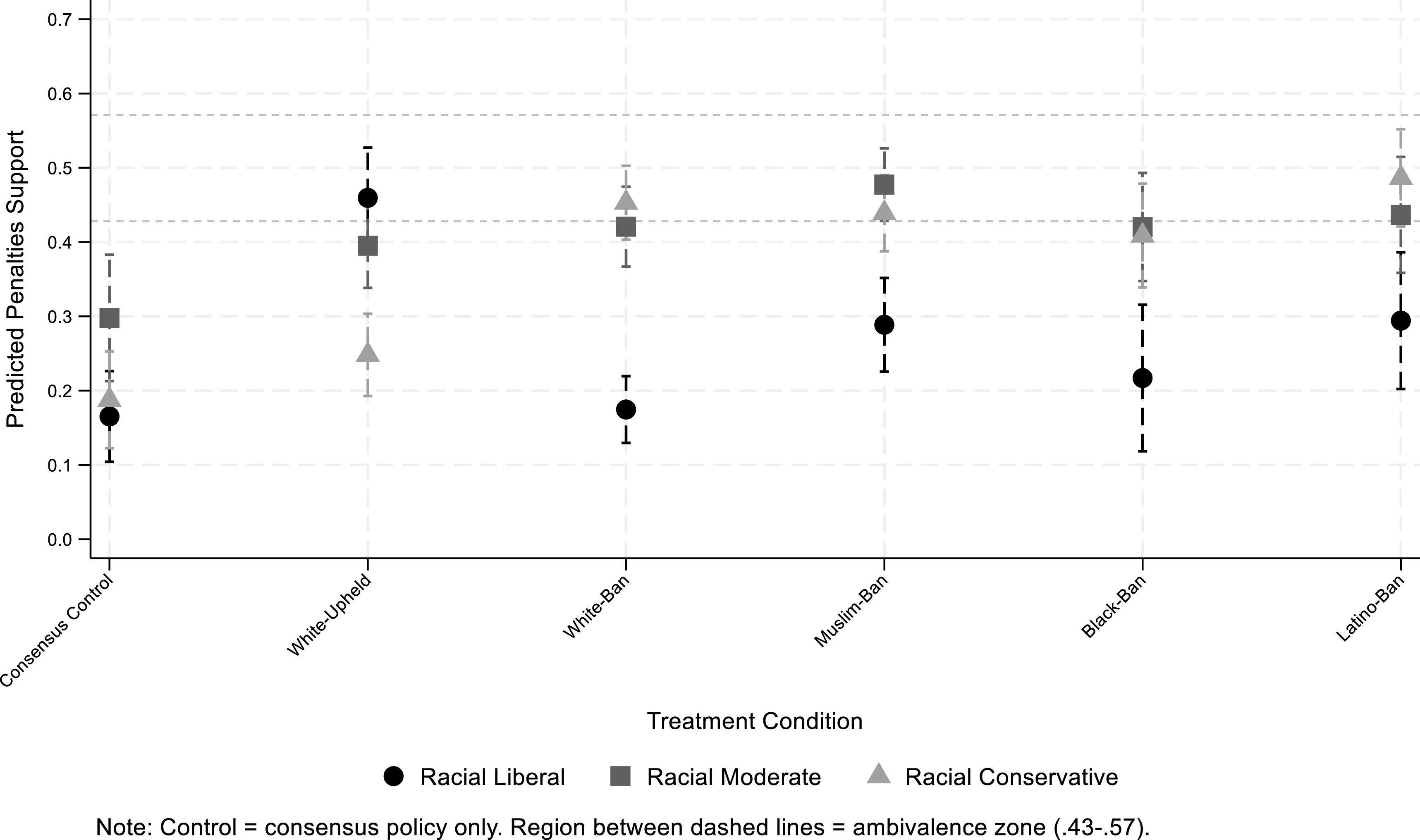
Main effect analysis shows that on average, the treatments are all statistically significant (p < .001), pushing the average White respondent away from clear rejection and toward this zone of ambivalence. I define a zone of ambivalence around the scale midpoint (between .43 and .57), corresponding to respondents whose average response falls within one scale step of the midpoint across the seven items. Scores below .43 indicate a central tendency toward rejection, while scores above .57 indicate a tendency toward endorsement. When treatment effects push predicted means from the rejection zone into the ambivalence zone, this represents a substantively meaningful shift, indicating not active endorsement of undemocratic penalties, but an erosion of the firm opposition that democratic norms require. The increase in punitiveness ranges from 14 percentage points (White judge upholding the flag) to 19 percentage points (the Muslim and Latino judges banning the flag) pushing into ambivalence. Importantly, tests of coefficients show that the differences across treatments are not significant, meaning that, for Whites, the judge’s race does not affect punitiveness (Appendix Tables A5–A6).
Figure 1 shows the results of the model that includes interactions between the treatments and racial resentment. The model explains 21% of the total variance. Racial liberals and racial conservatives respond symmetrically to decisions that threaten their respective worldviews, but the patterns are substantively distinct (H1a). Consistent with H1, among racial liberals, the White judge who upholds the Confederate flag drives the strongest reaction: support for undemocratic penalties increases by 29 percentage points relative to the consensus control (b = .294; p < .001, Bonferroni), pushing the predicted mean from .17 to .46, well into the zone of ambivalence. The Muslim judge who bans the flag also elicits a significant increase of 12 percentage points (b = .123; p = .005; Bonferroni p = .025), though the predicted mean (.29) remains in the rejection zone. The Latino ban condition shows a similar magnitude (b = .129; p = .023) but does not survive correction (adjusted p = .115). Notably, liberals do not differentiate between the consensus control and the White (b = .009; p = .800) or the Black (b = .052; p = .361) judge who bans the flag. This pattern suggests that liberals’ punitiveness is not driven solely by the judge’s decision: they accept the ban when it comes from a White or Black judge but become more ambivalent when the banning judge is Muslim or Latino, the groups with no direct historical connection to the Confederate flag’s racial symbolism. H1b expected judge race effects to emerge for racial conservatives, not liberals.
Support for undemocratic penalties, interaction of treatment × racial resentment.
Notes: Results from OLS regression with robust standard errors. The racial resentment measure is binned. Non-Hispanic Whites only. Data collected via Qualtrics panel (August 2019). N = 1,280. Controls: gender, age, income, education, partisanship, ideology, authoritarianism, and racial resentment. The dashed lines represent the zone of ambivalence, indicating conditional support for undemocratic penalties. Full model results and robustness checks are in Appendix Tables A7–A9.

Figure 1. Long description
The line graph displays predicted penalties support on the y axis ranging from 0.0 to 0.7. The x axis represents different treatment conditions: Consensus Control, White Uphold, White Ban, Muslim Ban, Black Ban, and Latino Ban. Three data lines represent racial liberal, racial moderate, and racial conservative groups. Each data point includes error bars indicating variability. The racial liberal group shows lower support across most conditions, while the racial conservative group shows higher support. The racial moderate group falls in between. The graph highlights how support varies significantly based on treatment condition and racial resentment levels.
Among racial conservatives, the pattern is clear and consistent with H1: conservatives are indifferent to the White judge who upholds the flag (b = .060; p = .163) but become markedly more punitive toward all judges who ban the flag. All four ban conditions produce large and significant increases in penalties: the White (b = .265; p < .001), Muslim (b = .251; p < .001), Black (b = .221; p < .001), and Latino (b = .299; p < .001) banning judges. All survive Bonferroni correction and push predicted means into the ambivalence zone (.41–.49). This contradicts H1b which expected racial conservatives to impose stronger penalties on minority judges.
The two patterns are mirror images of each other in structure. Neither group responds to the judge’s race per se. Each group punishes judges whose decisions threaten their racial worldview, but the triggers are substantively opposite: liberals punish the defense of racial exclusion but also outside interference. Conservatives punish the removal of symbols of White dominance.
I test whether these effects are reducible to partisan sorting by estimating a three-way interaction between treatments, racial resentment, and party identification. The three-way interaction is jointly null (F(20, 1216) = .64, p = .885), indicating that partisanship does not significantly moderate the treatment × racial resentment interaction. Split-sample analyses confirm that the treatment × racial resentment pattern replicates within partisan groups: among Democrats, racial liberals show greater punitiveness in the upheld condition (joint F = 11.77, p < .001); among Republicans, racial conservatives show significant punitiveness (joint F = 8.78, p < .001) driven by the ban conditions. The null three-way interaction thus does not reflect insufficient power but rather reflects that racial identity orientations operate on democratic norm endorsement independently of partisanship. Partisanship has a main effect that is additive rather than interactive: it shifts the overall level of penalty support without altering the structure of the treatment × racial resentment interaction (Appendix Tables A12–A14).
Relative to the neutral baseline, the treatment effects attenuate because the neutral control mean is substantially higher. For the main effects model, no treatment reaches significance after adjustment, indicating that the Confederate flag scenarios do not shift penalty support beyond respondents’ default posture toward an inconsequential judicial decision. However, the interaction model reveals important baseline-dependent findings. Among racial liberals, the consensus baseline captures increased punitiveness toward the judge who upholds the flag, while the neutral baseline reveals the complementary pattern: liberals actively protect the White judge who bans the flag, reducing penalties by 17 percentage points (b = −.170; p < .001; survives Bonferroni). Among racial conservatives, all ban conditions except the Black ban survive Bonferroni correction against the neutral baseline (White ban b = .141, p = .001; Muslim ban b = .128, p = .004; Latino ban b = .174, p < .001), confirming that the conservative pattern is robust across specifications. As with the consensus baseline, pairwise comparisons among ban conditions reveal no significant differences. Full neutral baseline results are in the Appendix.
Perceived Judicial Bias
I posit that White racial liberals and conservatives are motivated to view judges whose decisions threaten the respondent’s worldview as biased (H2). This allows them to “draw” the judge out of the imaginary community and become more open to undemocratic penalties that they would view as inappropriate when imposed on a member in good standing.
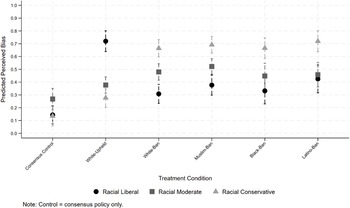
Figure 2 shows the results of an OLS regression analysis with interactions between racial resentment and the treatments, with perceived judicial bias as the dependent variable. Consistent with H2, among racial liberals, the White judge who upheld the Confederate flag produces the sharpest rise in perceived bias: 58 percentage points above the consensus control (p < .001; survives Bonferroni), pushing the predicted mean to .72 from .13 in the control. Racial liberals also perceive the judges who banned the flag as significantly more biased than the consensus control, though the effects are considerably smaller: the White (b = .164; p = .001; Bonferroni p = .005), Muslim (b = .233; p < .001), Black (b = .188; p = .002; Bonferroni p = .010), and Latino (b = .281; p < .001) banning decisions. All survive Bonferroni correction. However, while the predicted bias levels for the banning judges (.31–.43) exceed the consensus baseline, they remain below the scale midpoint, suggesting mild skepticism about judicial neutrality rather than a conviction of bias. Importantly, there is no significant race-of-judge effect in bias perception.
Perceived judicial bias, interaction of treatment × racial resentment.
Notes: Results from OLS regression with robust standard errors. The racial resentment measure is binned. Non-Hispanic Whites only. Data collected via Qualtrics panel (August 2019). N = 1,280. Controls: gender, age, income, education, partisanship, ideology, authoritarianism, and racial resentment. Full model results are in Appendix Tables A10–A11.
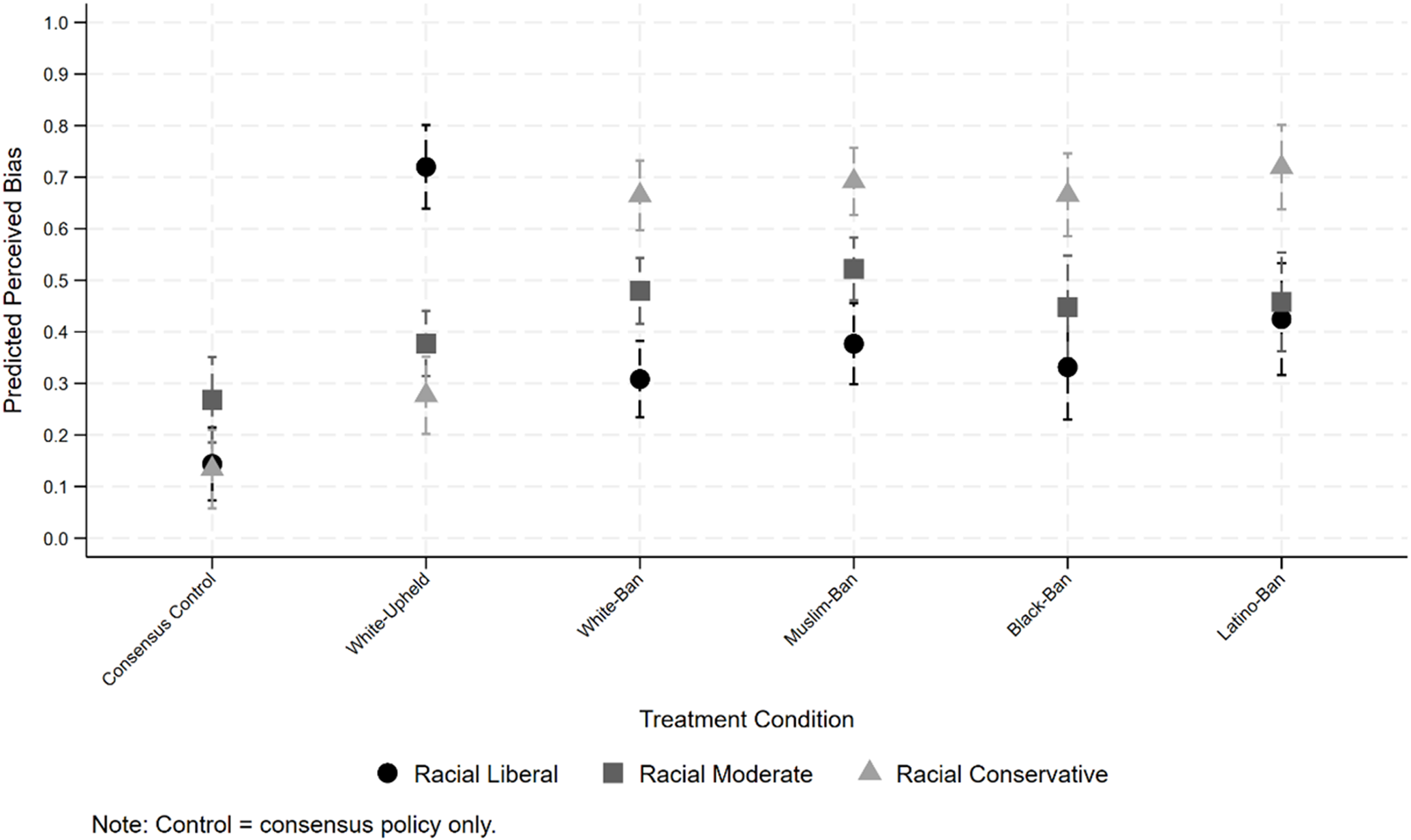
Figure 2. Long description
The line graph illustrates the predicted perceived bias across various treatment conditions, including Consensus Control, White Uphold, White Ban, Muslim Ban, Black Ban, and Latino Ban. The x-axis represents the treatment conditions, while the y-axis indicates the predicted perceived bias, ranging from 0 to 1. Three data series are depicted: racial liberals (represented by circles), racial moderates (represented by squares), and racial conservatives (represented by triangles). Each data point includes error bars. The graph shows that perceived bias varies significantly across different treatment conditions and racial attitudes. For instance, the White Uphold condition shows higher perceived bias among racial conservatives compared to racial liberals and moderates. Similarly, the Muslim Ban, Black Ban, and Latino Ban conditions exhibit higher perceived bias across all racial attitudes compared to the Consensus Control condition. All values are approximated.
Among racial conservatives, the pattern is reversed but structurally parallel (H1b, H2). Conservatives view all four banning judges as highly biased, with effects ranging from 53 to 59 percentage points (all p < .001; survive Bonferroni), pushing predicted means into the .67–.72 range. Conservatives also perceive the White judge who upheld the flag as somewhat more biased than the consensus control (b = .143; p = .008; Bonferroni p = .040), though the predicted mean (.28) remains well below the midpoint. Pairwise comparisons among the treatment conditions within each group reveal no significant race-of-judge effects after Bonferroni correction. Overall, the results suggest that judicial involvement in cases involving cultural symbols can elicit skepticism among Whites about the judge’s underlying motives, even when they reject undemocratic penalties. In essence, respondents say, “the judge is not totally fair, but the unfairness benefits my side, thus I will not endorse punishment.” This suggests conditional support for democratic norms and also shows that judicial involvement in symbolic conflicts carries a reputational cost. Courts may not be able to adjudicate these cases without some erosion of perceived impartiality. Footnote 3
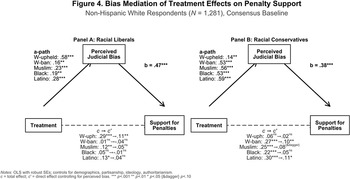
The mediation analysis presented in Figure 3 tests whether perceived judicial bias mediates the effects of judge race/decision treatments on undemocratic penalty support and whether this mechanism operates differently across racial resentment groups. The a-path replicated the results from Figure 2. The b-path shows that liberals convert bias perceptions into undemocratic penalty preferences most intensely (b = .47), focused specifically on the White judge who upholds the flag and secondarily the Muslim judge who bans it. Conservatives respond nearly as strongly (b = .38), targeting all banning judges, but moderates largely decouple perception from punishment (b = .13). This suggests that strong racial orientations, whether liberal or conservative, create a strong perception-to-penalty connection, while the absence of a strong orientation buffers against backlash even when people perceive judicial bias.
Mediation: indirect effect of judicial bias perceptions on undemocratic penalties.
Notes: Results from linear mediation analysis with robust standard errors. Bonferroni correction included in the results. The racial resentment measure is binned. Non-Hispanic Whites only. Data collected via Qualtrics panel (August 2019). N = 1,280. Controls: gender, age, income, education, partisanship, ideology, authoritarianism, and racial resentment. ***p < .001; **p < .01; *p < .05. Full model results are in Appendix Table A15.
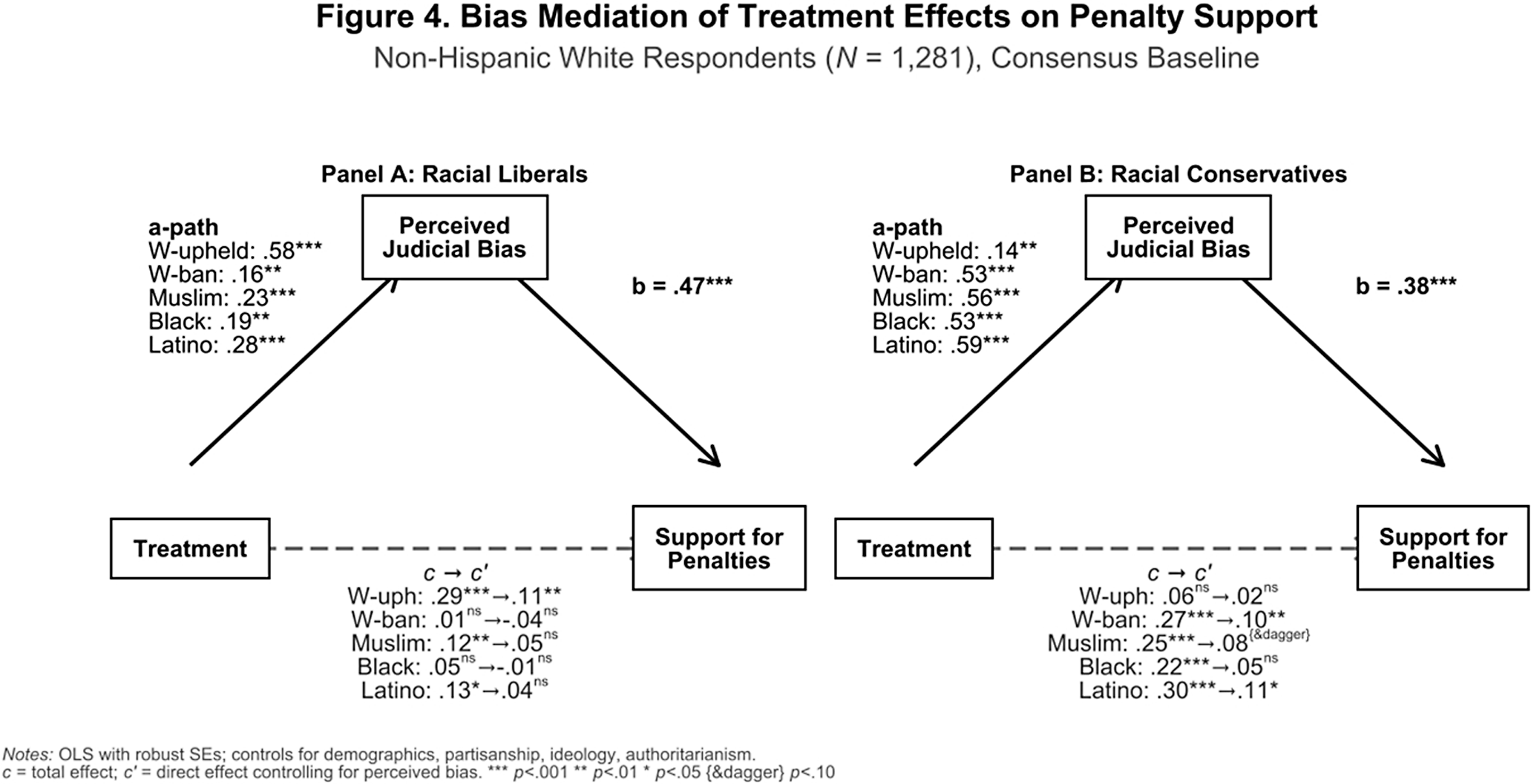
Figure 3. Long description
The diagram illustrates the mediation of treatment effects on penalty support through perceived judicial bias among non-Hispanic white respondents. It is divided into two panels: Panel A for racial liberals and Panel B for racial conservatives. Each panel shows the paths from treatment to perceived judicial bias and then to support for penalties. The a-paths indicate the effect of different treatments on perceived judicial bias, while the b-paths show the effect of perceived judicial bias on support for penalties. The total effect (c) and direct effect (c') of treatment on support for penalties are also displayed. The diagram includes statistical values for each path, indicating the strength and significance of the relationships.
The attenuation pattern in path C is consistent with mediation, though it is important to note that perceived bias and undemocratic penalties are measured simultaneously, limiting causal inferences. For liberals, the significant total effect of White judge/upheld (c = .29) was reduced but remained significant (c’ = .11), while the Muslim, Latino, and Black flag banning conditions all dropped to null. For conservatives, the pattern was symmetric: all flag-banning conditions were substantially attenuated, with the Black condition becoming null. The residual direct effects for White judge/upheld among liberals and White/Latino judge/ban among conservatives suggest that bias perceptions don’t fully account for punitiveness in the most identity-threatening conditions and that there may be additional mechanisms operating alongside judicial bias perceptions. Footnote 4
Study 2
The purpose of this study is to test whether and to what degree Latino Americans who sit in a lower position in the American racial stratification system adopt the same positions as White Americans. Are Latinos assimilating into racially conservative Whiteness by adopting symbols of White supremacy, or are they responding as minority allies who reject such symbols? In effect, I use it to test scope conditions for the theory. The same study was administered to a sample of 1,171 Hispanic Americans (August 2019, Qualtrics panel) with one key modification. The study did not include the Latino judge treatment because of concerns of conflating results with group solidarity. Descriptive statistics and balance tests are in Appendix Tables B1–B2.
Undemocratic Penalties
Among Latinos, mean support for undemocratic penalties in the consensus condition is significantly higher than among Whites (Latino mean = .35, White mean = .22, p < .001) and approximates the White mean in the neutral condition (mean = .35). Latinos thus exhibit a higher rejection floor even under the condition most favorable to principled democratic behavior. However, this difference dissipates when demographic controls, racial resentment, partisanship, and authoritarianism are included, suggesting this is not a group level but a sample composition difference (Appendix Table B10).
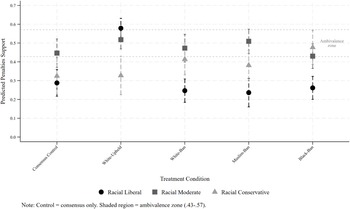
Only one treatment significantly increases Latino penalty support relative to the consensus baseline: the White judge upholding the Confederate flag (mean = .51, p < .001, Bonferroni-corrected), which moves Latinos into the zone of ambivalence. None of the ban conditions produces significant movement from the baseline, and the three ban conditions are statistically indistinguishable from one another. For Latinos, punitiveness is triggered by the perceived defense of a symbol of racial exclusion, not by disagreement with the ruling or the racial identity of the judge (Appendix Tables B3).
Figure 4 shows the interaction between treatments and racial resentment for Latinos. Among racial liberals, the White judge upholding the Confederate flag produces a large increase in penalty support, moving past the zone of ambivalence into soft endorsement (mean = .58; p < .001; survives Bonferroni correction). No flag ban condition produces significant movement among liberals. Among racial conservatives, the pattern is directionally similar to that of White conservatives: ban conditions move people into the zone of ambivalence from rejection relative to the control condition, while the upheld condition does not; however, the effects are substantially weaker. The Black judge ban condition shows the largest effect (b = .15, p = .020), but this does not survive the Bonferroni correction. The joint F-test for conservatives is also null (Appendix B5).
Support for undemocratic penalties, interaction of treatment × racial resentment.
Notes: Results from OLS regression with robust standard errors. The racial resentment measure is binned. Hispanics only. Data collected via Qualtrics panel (August 2019). N = 1,171. Controls: gender, age, income, education, partisanship, ideology, authoritarianism, and racial resentment. The dashed lines represent the zone of ambivalence, indicating conditional support for undemocratic penalties. Full model results are in Appendix Table B5.

Figure 4. Long description
The line graph illustrates predicted penalties support across various treatment conditions, including consensus control, white-uphold, white-ban, Muslim-ban, and black-ban. The x-axis represents the treatment conditions, while the y-axis indicates the predicted penalties support ranging from 0 to 0.7. Three data series are depicted: racial liberals, racial moderates, and racial conservatives, each represented by different markers. The graph shows that racial liberals consistently have lower predicted penalties support across all conditions, while racial conservatives exhibit higher support. Racial moderates fall in between. The ambivalence zone, shaded in gray, spans from 0.43 to 0.57 on the y-axis. Error bars indicate the variability of the data points. All values are approximated.
These results suggest that the Latino racial resentment interaction is fundamentally asymmetric, contradicting H1a and H3. The Latino racial liberal effect is large and robust, comparable in magnitude to the White racial conservative effect. But the conservative effect is weak and fragile. Latino racial conservatism does not produce the same punitive response to Confederate flag-banning judges that White racial conservatism does. This is likely because the Confederate flag is a White racial identity symbol, so its defense activates White conservatives far more than Latino racial conservatives.
Latino responses to the decision approval and judicial bias questions are also illuminating and help fill in the picture, so I analyze them in some detail. First, Latinos in the consensus control strongly approve of the ruling (mean = .786). All treatment conditions produce significant disapproval relative to this baseline (all Bonferroni p < .001–.004). The White upheld condition produces the largest drop (mean = .448, contrast = −.338, p < .001), but critically, the ban conditions also reduce approval substantially (White banning mean = .642, Muslim banning mean = .656, Black banning mean = .591) (Appendix Tables B6–B8). This pattern suggests that Latinos’ higher penalties baseline is not a result of inattentiveness, but differences in how they think about judges.
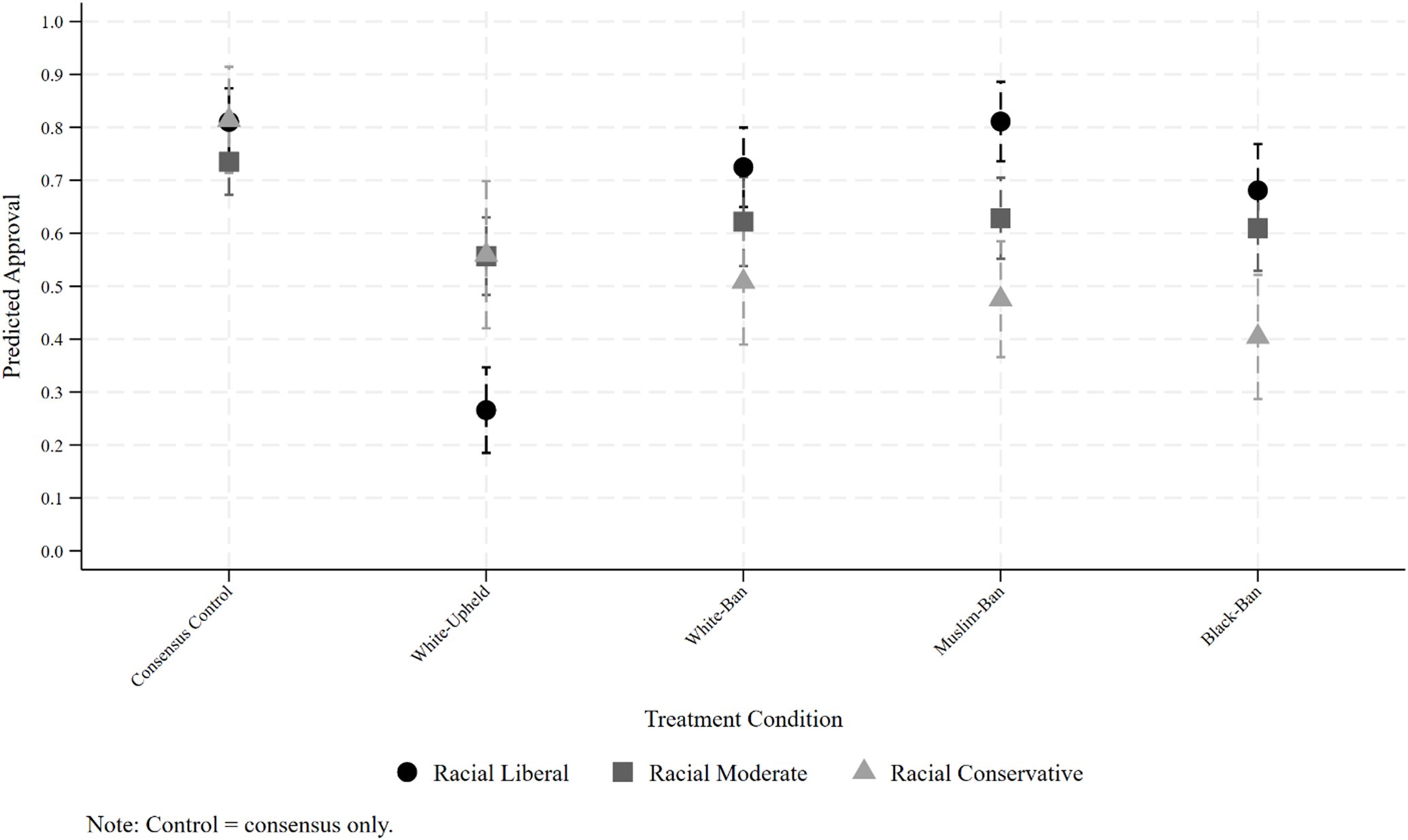
Racial liberals show strong disapproval of the White judge upholding the flag (consistent with H3), essentially rejecting the ruling outright. They maintain high approval for the ban by the Muslim judge (mean = .811) (virtually identical to control) and show moderate approval for the White (mean = .725) and the Black (mean = .681) judges banning the flag. The Muslim banning judge received the most approval, suggesting that a Muslim judge removing a symbol of White supremacy is seen as particularly legitimate by Latino racial liberals (Figure 5). This is a notable difference relative to White racial liberals, whose evaluation is based on the direction of the decision, not the judge’s race, which was not predicted by my hypotheses.
Approval of the decision, interaction of treatment × racial resentment.
Notes: Results from OLS regression with robust standard errors. The racial resentment measure is binned. Hispanics only. Data collected via Qualtrics panel (August 2019). N = 1,171. Controls: gender, age, income, education, partisanship, ideology, authoritarianism, and racial resentment. Full model results are in Appendix Table B7.

Figure 5. Long description
The line graph displays predicted approval on the y-axis, ranging from 0.0 to 1.0, and treatment conditions on the x-axis, including Consensus Control, White Uphold, White Ban, Muslim Ban, and Black Ban. Three data series are represented: racial liberals with black circles, racial moderates with gray squares, and racial conservatives with gray triangles. Each data point includes error bars indicating variability. In the Consensus Control condition, racial liberals show the highest approval, followed by moderates and conservatives. Approval decreases significantly for racial liberals in the White Uphold condition, while moderates and conservatives show moderate and high approval, respectively. In the White Ban condition, approval is highest for racial conservatives, followed by moderates and liberals. The Muslim Ban condition shows similar trends, with conservatives having the highest approval, followed by moderates and liberals. In the Black Ban condition, racial conservatives again show the highest approval, with moderates and liberals following. All values are approximated.
Racial conservatives show a completely different pattern. They also disapprove of the White upheld condition (mean = .559 vs control mean = .814), but to a lesser degree, so contrary to H3, they do not mirror White conservative patterns. More importantly, they show declining approval across all ban conditions (means: .508, .475, .404), with the Black judge who bans the flag receiving the lowest approval. Latino racial conservatives disapprove of judges banning the flag, but notably, they also disapprove of the White judge upholding it.
Perceived Bias
The analysis of perceived judicial bias further corroborates the pattern but also introduces important complexity. For the consensus control, perceived judicial bias is low among Latinos (mean = .233), and all treatments significantly increase perceived bias (all Bonferroni p ≤ .018). Yet, the White judge who upholds the Confederate flag shows the highest bias rating (mean = .532, b = .300, p < .001). Ban conditions produce moderate increases (White banning mean = .363, b = .130 p = .001; Muslim banning mean = .337, b = .104 p = .018; Black banning mean = .405, b = .172, p < .001). The Black ban judge is perceived as more biased than the Muslim judge who bans the flag, possibly because a Black judge banning a Confederate flag triggers perceptions of racial self-interest.
When I disaggregate the results by racial resentment, once again, and consistent with H3, Latino racial liberals perceived a very strong bias in the White judge who upheld the Confederate flag (Figure 6). The Muslim judge who bans the flag is perceived as virtually unbiased, possibly because he is viewed as an outsider to the conflict whose identity and interests are not involved. By contrast, the White and Black judges who ban the Confederate flag are viewed as moderately biased (White: mean = .303; Black: mean = .342). This pattern was not predicted in my hypotheses. This is likely because Latinos view them as directly implicated, and thus their decision may not be based on the law but on other considerations. The Black judge may be viewed as acting in his group’s interest, while the White judge may be seen as performing allyship or virtue signaling rather than ruling on the law. The decision is “correct” in Latino racial liberals’ eyes, but the judge’s Whiteness makes his motivation ambiguous or suspect (Figure 6). Again, this diverges substantively from the pattern among White racial liberals who are motivated by the direction of the decision and are not influenced by the social position of the judge.
Perceived judicial bias, interaction of treatment × racial resentment.
Notes: Results from OLS regression with robust standard errors. The racial resentment measure is binned. Hispanics only. Data collected via Qualtrics panel (August 2019). N = 1,171. Controls: gender, age, income, education, partisanship, ideology, authoritarianism, and racial resentment. Full model results are in Appendix Table B8.

Figure 6. Long description
The line graph displays predicted perceived bias on the y-axis, ranging from 0.0 to 1.0, and treatment conditions on the x-axis, including Consensus Control, White Uphold, White Ban, Muslim Ban, and Black Ban. Three data series are represented: racial liberals with black circles, racial moderates with gray squares, and racial conservatives with gray triangles. Each data point includes error bars indicating variability. Racial liberals show lower perceived bias across all conditions, while racial conservatives exhibit higher perceived bias, particularly in the White Ban and Black Ban conditions. Racial moderates fall in between these two groups. All values are approximated.
Racial conservatives show the opposite pattern. The White judge who upheld the Confederate flag is perceived as somewhat biased (mean = .430), but the ban conditions produce the highest bias perceptions, especially the Black ban (mean = .596) and White ban (mean = .528). Thus, racially conservative Latinos also see those judges whose identity is directly implicated as more biased (Appendix Table B8). This is not the case for White racially conservative respondents, who do not differentiate by race, only by direction of the decision.
Taken together, the results suggest that Latinos evaluate judicial bias partly through the lens of motivational transparency, deduced from the judge’s racial position: the more legible the judge’s personal racial stake in the outcome, the higher the perceived bias, independent of whether the respondent agrees with the decision. The Muslim judge, who has no direct connection to the Confederate flag’s racial symbolism, is perceived as the most procedurally neutral. The Black judge, whose racial identity makes his motivation for banning a symbol of Black subjugation most transparent, is perceived as the most biased, even by liberals who strongly approve of the ruling.
The neutral baseline reveals the complementary facet of the same pattern across all three dependent variables. Treatment condition means are identical across specifications; only the control mean shifts (consensus = .35, neutral = .51 for penalties). Against the neutral baseline, Latinos actively protect judges who ban the flag—showing significantly reduced penalties (b = −.13 to −.15, all p < .001), higher approval (b = .10 to .16, p < .001 to .037), and lower bias perceptions (all ban conditions fall below the neutral mean), while the White upheld condition attenuates to null. The interaction models confirm this pattern: racial liberals show strong protection of banning judges across all three dependent variables, while racial conservatives show reduced penalties for the upheld condition (b = −.18, p = .002) but weak and inconsistent effects for the ban conditions. Full neutral baseline results are in Appendix Tables B4, B6, B9.
Discussion and Conclusion
The study makes several contributions to our understanding of the relationship between social identities and citizens’ support for judicial independence in the context of symbolic politics. First, democratic forbearance for judicial actors does not meet the standards of democratic theory. Even in the neutral condition, Americans are reflexively ambivalent toward undemocratic penalties rather than reflexively rejecting them. This indicates that democratic norms are not internalized and require active reinforcement, not just the absence of identity threat. Footnote 5
Second, this is not a partisan story; it is a racial story. Racial worldviews activate status threat, inducing people to soften their rejection of undemocratic penalties in predictable ways. Within parties, the responses are identical: White Republicans and Democrats who embrace racial conservatism move from rejection of penalties to the zone of ambivalence for the judges who ban the Confederate flag, and the same is the case for racially liberal partisans who encounter the judge upholding the flag. The symmetry parallels results in the political tolerance literature (Gibson Reference Gibson2006), as both sides are unprincipled but focus on different targets. The null three-way interaction suggests that racial worldviews operate on democratic forbearance independently of partisan identity, which complicates theories that treat partisanship as the dominant organizing identity for democratic attitudes (Mason Reference Mason2018). Racial resentment produces equivalent effects across partisan groups, indicating that it is not reducible to, nor amplified by, partisan sorting.
Here, it is also important to point out that as much as racial liberals and conservatives respond symmetrically to identity threat by becoming ambivalent about democratic forbearance, the ideological motivations of the two groups are not normatively equivalent. One side seeks to promote racial egalitarianism and inclusivity by banning symbols of White supremacy, and the other seeks to affirm racial stratification systems. Yet, the commitment to democratic forbearance is meaningful precisely because it must hold even when the grievance is justified. If democratic norms yield whenever the substantive cause is compelling, they provide no constraint at all.
A third point is that one mechanism through which identity threat leads to softening of democratic forbearance for judges is the perception of judicial bias. People across levels of racial resentment perceive counter-attitudinal decisions as more biased and that motivates them to move away from rejection of undemocratic penalties. While all three groups perceive elevated bias in identity-threatening decisions, only those with strong racial commitments convert those perceptions into support for undemocratic penalties. The weak b-path among moderates suggests that strong racial orientation is the switch that connects cognitive appraisal to democratic norm erosion. In this context, racial moderates serve as a democratic firewall because they do not translate perceptions of bias into ambivalence toward democratic behavior.
The analysis of Latino respondents shows that the process likely generalizes across racial groups, but the conditions that elicit stronger deviation from rejection of undemocratic penalties differ by race. White Americans respond to the direction of the decision, while Latinos primarily respond to the decision that affirms racial exclusion. Furthermore, Latino racial liberals show strong substantive effects, similar to what I obtain for White racial conservatives, but with different targets. The effects for Latino racial conservatives are weaker. For this group, the Confederate flag does not represent a symbol of their understanding of racial identity. It is possible that among Latinos, therefore, racial resentment functions differently than among Whites, capturing endorsement of racial stratification combined with anti-Black prejudice (Perez et al. Reference Perez, Robertson and Vicuna2023), but this doesn’t mean that Latinos are developing symbolic attachment to White racist identity markers.
At the same time, the results suggest that shared minority status does not automatically produce solidaristic responses (Gay Reference Gay2006; Pérez and Kuo Reference Pérez and Kuo2021; Pérez et al. Reference Pérez, Vicuña and Ramos2024). Racially conservative Latinos evaluate the Black judge most negatively across all three dependent variables (lowest approval, highest bias perception, and highest penalty support), even as they do not defend the Confederate flag itself. This pattern suggests that racial resentment among Latinos targets Black authority specifically rather than defending White symbols. This can undermine the coalitional potential between these groups.
Finally, the assumed personal motivations of the judge play a role in both Whites’ and Latinos’ endorsement of undemocratic penalties, but in distinct ways. White racial liberals perceive the judges who are racial outsiders to the conflict as more biased and become more ambivalent in their response to them. From their perspective, this is a Black/White conflict, and members of other groups have no legitimate say in it, even if the judge defends the pro-attitudinal direction (ban) as is the case here. Yet Latinos across racial resentment levels take the opposite view, perceiving direct identity involvement as bias rather than legitimate involvement. The Muslim judge is viewed as the least biased because he (like Latinos) has no direct interest in the conflict. The Black judge is most suspect for inserting personal motivations into the decision.
This study does not directly test what converts ambivalence into active support for undemocratic sanctions, but the evidence offers two leads. First, the consensus condition demonstrates that substantive agreement powerfully reinforces democratic forbearance. By extension, a ruling that imposes material costs (rather than just symbolic status costs) on a group with strong identity commitments could push attitudes past ambivalence toward endorsement of sanctions. Second, the treatments in this study presented judicial decisions without accompanying elite rhetoric. If political leaders frame unfavorable rulings as evidence of judicial corruption or disloyalty, the bias perceptions that already mediate the pathway to penalties could be amplified considerably. The combination of symbolic threat and elite cues may be what closes the gap between ambivalence and active support for retaliation against courts.
This vulnerability is compounded by a structural asymmetry in democratic norms. Judges are constrained by professional and institutional expectations that require silence: they cannot respond to public criticism, engage in persuasion, or defend their reasoning outside the courtroom. The very norms that protect judicial neutrality leave judges uniquely exposed to elite-initiated attacks, unable to contest narratives of bias or illegitimacy that this study shows citizens are already predisposed to accept. Democratic norms constraining judicial behavior create the conditions under which judicial independence can be undermined.
Supplementary material
The supplementary material for this article can be found at https://doi.org/10.1017/rep.2026.10086.
Availability of data and material
Data will be available through the Harvard dataverse.
Author contributions
The author claims equal credit for this study.
Funding statement
Funding for this project was provided by the Institute for the Study of Race and Public Policy at the University of Illinoi Chicago.
Competing interests
The author declares no conflicts of interest.
Code availability
Code will be available in Stata.
Ethical standards
All studies were approved by the University of Illinois, Chicago (IRB# 2013-0959).
AI use
AI was used to help with data coding, proofing, and figure generation in Stata. Replication files with full annotations were also developed with AI assistance. It was also used to provide editing suggestions for the main document, ensure consistent use of terminology and language across the manuscript, identify typos and structural errors, and title suggestions.
Consent to participate
All respondents were informed about the purposes of the study, the risks and benefits, confidentiality, and privacy. Since the studies were conducted on the Internet, signatures were waived, and informed consent was obtained through selecting to participate in the survey. Participants were told that they could end their participation at any time and withdraw their data if they wished. All respondents were also informed about the fictitious nature of the story. Specifically, before reading the story, they were told that they are about to read a story that is similar to those found in the news today.
Consent for publication
The IRB-approved consent form either implicitly or explicitly includes consent for publication. In all cases, respondents are told that the researchers are only collecting de-identified data. All data used in the analyses stem from de-identified and aggregated data so there is no way people’s individual responses can be tracked from our analysis or the replication code we provide.


 Open access

