





Introduction
Women’s entrance into positions of political power in parliaments and governments across the world has served as a catalyst for the broadening of those issues deemed ‘political’. Women policymakers have been better positioned – and apparently, more inclined – to not only add issues to the political agenda (most often, those which impact women more than men, or impact women only), but also to contribute to a re-valuation of what matters in a political sense. In so doing, women legislators have taken seriously the issues that are important to women as political actors and citizens of polities (Enloe Reference Enloe2013).
This is particularly important because men and women diverge in their preferences across many political issues. Women citizens and lawmakers care more about social issues than men (Clayton, Josefsson, Mattes et al. Reference Clayton, Josefsson, Mattes and Mozaffar2019), and women legislators tend to be more left-leaning than men, particularly within right-leaning parties (Poggione Reference Poggione2004). Women care more about ‘women’s issues’ (Taylor-Robinson and Heath Reference Taylor-Robinson and Michelle Heath2003), like improving access to paid family leave (Newsome Reference Newsome2017), violence against women (Kalra and Joshi Reference Kalra and Joshi2020), and pay equity (Hutson, Shufeldt and Vinci Reference Hutson, Shufeldt and Vinci2023). Women legislators have played a key role in putting these issues on the political agenda and have impacted outcomes related to these issues.
Other key issue areas around which women’s and men’s preferences diverge are the climate and environment. Research shows that women are more environmentally oriented than men in a range of ways: they know more about climate change than men, they worry more about the consequences of climate change than men, they are more likely than men to change their personal behaviour in light of climate change, and they are more likely to perceive climate change mitigation as beneficial, whereas men are more likely to perceive it as costly (Arnocky and Stroink Reference Arnocky and Stroink2010; Bush and Clayton Reference Bush and Clayton2023; Goldsmith, Feygina, and Jost Reference Goldsmith, Feygina, Jost, Alston and Whittenbury2013; Hunter, Hatch and Johnson Reference Hunter, Hatch and Johnson2004; McCright Reference McCright2010; Noblet, Teisl, Evans et al. Reference Noblet, Teisl, Evans, Anderson, McCoy and Cervone2015; Semenza, Ploubidis, and George Reference Semenza, Ploubidis and George2011; Tranter Reference Tranter2011). Literature has shown that increased women’s parliamentary participation has significant beneficial outcomes for environmental policy. In contexts where corruption is low, women’s representation improves a range of environmental outcomes (Salamon Reference Salamon2024). Improving women’s representation leads to more renewable energy consumption (Salamon Reference Salamon2023), a weaker association between growth and emissions (McGee, Greiner, Christensen et al. Reference McGee, Greiner, Christensen, Ergas and Thomas Clement2020) and long-term reductions in emissions (Lv and Deng Reference Lv and Deng2018), the ratification of more environmental treaties (Norgaard and York Reference Norgaard and York2005), lower emissions (Ergas and York Reference Ergas and York2012), and less deforestation (Salahodjaev and Jarilkapova Reference Salahodjaev and Jarilkapova2020). Given the increasing politicisation and salience of climate change as perhaps the most pressing global challenge, it is increasingly important to understand how these gendered divergences in preferences and behaviours impact outcomes.
Yet this existing literature has been less successful at explaining the mechanism linking women’s representation to improved climate outcomes. How do women, as parliamentarians, impact environmental policy and outcomes? In this research, I suggest what may constitute the first step in this potentially multi-pronged mechanism: they talk about it. In the ongoing context of a growing climate crisis, a main way that parliamentarians can champion environmental issues – putting them on the political agenda and generating value around them – is by speaking about them in parliamentary debates. If women Members of Parliament (MPs) are proportionally more likely than men MPs to consistently bring the environment into their speeches, this suggests that increasing the presence of women MPs will play a crucial role in ensuring that environmentalism is consistently brought to the early stages of political decision-making.
Using the UK Parliament as a case study, I analyse the speeches that have taken place in the House of Commons in the eleven years between 2010 and 2021 and find that women speak proportionally more about climate and environmental issues in their speeches before parliament than men parliamentarians, even controlling for potentially confounding factors. The results show that women speak proportionally more about the environment in non-environmental debates, and within-party analysis shows that a gender gap in environmental speechmaking emerges in the right-leaning Conservative Party.
In this paper, I outline the relevant literature surrounding mechanisms of representation, gendered political preferences, and the use of speeches as a political tool for women MPs. I offer a theoretical underpinning for women MPs’ use of parliamentary speeches to impact environmental policy and outcomes. Finally, I outline my research methods and present an analysis of a decade’s worth of UK parliamentary speech data.
Literature review and theoretical underpinning
The political science literature has uncovered a range of issues on which men’s and women’s preferences diverge. It has explored the impact of legislators’ gender on policymaking and outcomes, the mechanisms through which women make a difference in policy outcomes even as they operate in majority-male legislatures, the gendered differences in preferences around the climate and environment, and the role that women representatives play in shaping climate outcomes.
Importantly, a notable gap in the literature remains: if women legislators positively impact environmental policy and outcomes, how do they do it? In this section, I outline how gender impacts political preferences, how women representatives have impacted political outcomes, and the particular role of speechmaking in crystallising or changing outcomes and party platforms. This is followed by a theoretical framework exploring one way that women representatives may impact environmental outcomes more than men representatives: by integrating environmental issues into their speeches before parliament.
Political preferences and gender
Citizens’ political preferences are influenced by a range of factors related to their personal identities, including their parents’ political preferences (Jennings, Stoker, and Bowers Reference Jennings, Stoker and Bowers2009), race (Craig and Richeson Reference Craig and Richeson2017; Filindra and Kaplan Reference Filindra and Kaplan2017; Zheng Reference Zheng2019), socio-economic status (Sosnaud, Brady and Frenk Reference Sosnaud, Brady and Frenk2013; Debora and Tedeschi 2019; Di Gioacchino; Tiihonen, Koivula, Saarinen et al. Reference Tiihonen, Koivula, Saarinen and Sivonen2022), and education level (Thomsen and Olsen Reference Thomsen and Olsen2017). These characteristics influence political preferences because they often shape – to varying degrees – individuals’ experiences of the world (Enloe Reference Enloe2013; MacKinnon Reference MacKinnon1989; Mansbridge Reference Mansbridge1999). Similarly, gender plays an important role in shaping political preferences. While gender has not always been a clear-cut political dividing line to the extent of other identities like class (Abendschön and Steinmetz Reference Abendschön and Steinmetz2014), statistically significant differences consistently emerge in the political preferences of men and women around the world.
Gender impacts individuals’ experiences of the world in meaningful ways. Hudson, Bowen, and Nielsen (Reference Hudson, Bowen and Nielsen2019) argue that gender relations at the household level encompass the ‘first political order’: individuals’ first experiences with power and politics usually take place in their own home, between men and women. The societal expectations and requirements of women – bearing and raising children, caring for family members, conducting most or all of household labour, adhering to beauty standards, being beholden to men’s decision-making, etc. – have an effect on women’s lived realities; the fact that these societal expectations are not placed on men equally impact men’s lived realities (MacKinnon Reference MacKinnon1989). Women’s physical experiences are often shaped by gendered dimensions, as they face high likelihoods of physical and sexual assault and harassment (Fanslow, Hashemi, Malihi et al. Reference Fanslow, Hashemi, Malihi, Gulliver and McIntosh2021); they continue to be paid less for the same work (Francis-Devine Reference Francis-Devine2024); they maintain significantly higher levels of mental load (Dean, Churchill, and Ruppanner Reference Dean, Churchill and Ruppanner2022; Weeks Reference Weeks2025); and they are often uniquely responsible for family care and associated responsibilities (Mussida and Patimo Reference Mussida and Patimo2021). Thus, women’s lived experiences are distinct from men’s, and therefore preferences tend to break along gendered lines on a range of political issues.
As such, empirical research indeed finds discrepancies between men’s and women’s preferences. Both women citizens and lawmakers care more about social issues than men (Clayton, Josefsson, Mattes et al. Reference Clayton, Josefsson, Mattes and Mozaffar2019), and women legislators tend to be more left-leaning than men, particularly within right-leaning parties (Poggione Reference Poggione2004). Women care about ‘women’s issues’ more than men (Taylor-Robinson and Heath Reference Taylor-Robinson and Michelle Heath2003): improving access to paid family leave (Newsome Reference Newsome2017), violence against women (Kalra and Joshi Reference Kalra and Joshi2020), and pay equity (Hutson, Shufeldt, and Vinci Reference Hutson, Shufeldt and Vinci2023). A growing literature on gender and climate change shows that women’s and men’s preferences on environmentalism are often distinct, particularly in developed countries (Bush and Clayton Reference Bush and Clayton2023). Women are more environmentally oriented than men in a range of ways: they know more about climate change (McCright Reference McCright2010), worry more about its consequences (Arnocky and Stroink Reference Arnocky and Stroink2010), are more likely to change their behaviour in light of climate change (Hunter, Hatch, and Johnson Reference Hunter, Hatch and Johnson2004), and are more likely to perceive climate change mitigation as beneficial whereas men are more likely to perceive it as costly (Bush and Clayton Reference Bush and Clayton2023). Some literature suggests that environmental issues are more salient for women compared to men (George and Gupta Reference George and Gupta2024; Reinbold, Kurz, Schleehauf et al. Reference Reinbold, Kurz, Schleehauf, Fröhle and Jäckle2025; Shrum, Reference Shrum2021). Explanations for the gender cleavage on environmental issues vary: women’s preferences for environmentalism could stem from the fact that they tend to be more left-leaning (Emmenegger and Manow Reference Emmenegger and Manow2014) and risk-averse (see Salamon Reference Salamon2024). According to ecofeminism, women may align with environmentalism since the domination of women and the environment are both linked to patriarchal capitalism (Clark Reference Clark2012). While no consensus exists in the literature, the fact remains that environmental preferences consistently diverge along gendered lines.
Women legislators have played a key role both in putting these issues on the political agenda and in impacting outcomes related to these issues. The literature on descriptive and substantive representation helps to explain how these preferences are made political.
Descriptive versus substantive representation: how women impact political agendas and policy
The fact that women have unique preferences from men is important for questions of political representation: political institutions around the world are still – by a vast majority, controlled by men (Salamon Reference Salamon2023), and therefore men’s preferences (even if they are never coded as such) usually prevail in political decision-making. Yet the literatures on descriptive and substantive representation address how under-represented groups can advocate for their interests in politics. Descriptive representation occurs when a representative shares descriptive characteristics with the community or individuals they are representing (Mansbridge Reference Mansbridge1999). Substantive representation occurs when representatives intentionally advocate for the interests of a particular community or identity (or set of identities) (Pitkin Reference Pitkin1967; Chaney Reference Chaney2011). Substantive representation can take multiple forms: as a process, ‘where women change the legislative agenda’ (Franceschet and Piscopo Reference Franceschet and Piscopo2008, 393) and as an outcome, where women succeed in passing laws that align with their interests (Franceschet and Piscopo Reference Franceschet and Piscopo2008). Research finds that representatives are more likely to substantively represent the constituents with whom they share descriptive identities (Pearson and Dancey Reference Pearson and Dancey2011; Mansbridge Reference Mansbridge1999).
There are many theoretical reasons why women MPs may seek to represent women constituents substantively. Firstly, shared gendered experiences make it more likely for women MPs and women constituents’ preferences to converge (Phillips Reference Phillips1995). Secondly, women MPs may go out of their way to represent the interests of women constituents to intentionally ameliorate longstanding gendered power imbalances (Franceschet and Piscopo Reference Franceschet and Piscopo2008). Thirdly, women MPs may be socialised to care more about the environment for moral and material reasons (Boas and Smith Reference Boas and Smith2022). Lastly, women MPs might represent issue areas that women constituents care about in order to win votes (Lloren, Rossett, and Wüest Reference Lloren, Rossett and Wüest2022).
Mansbridge (Reference Mansbridge1999) argues that descriptive representatives of under-represented groups can help to improve the deliberative function of democracy, and asserts that at least one representative from each group should be present and active in these deliberations. Critical actors theorists (Childs and Krook Reference Childs and Lena Krook2009; Chaney Reference Chaney2011) contend that representation hinges on actions taken by representatives ‘individually or collectively to bring about women-friendly policy change’ (Childs and Krook Reference Childs and Lena Krook2009, 127). From this point of view, substantive representation can be effectively enacted by a small pool of active and dedicated representatives. Yet, it may be more realistic to expect that a critical mass of representatives is required to actually enact representation effectively, as ‘in practice… disadvantaged groups often need the full representation that proportionality allows in order to achieve [effective representation]’ (Mansbridge Reference Mansbridge1999, 636).
Empirical research seeking to measure the effectiveness of mechanisms of representation offers a few means by which representatives from under-represented groups can promote the substantive representation of these groups. Chaney (Reference Chaney2011) finds that while critical actors play an important role in impacting policy related to women’s interests, the interaction of critical actors with critical mass is the key to effective substantive representation of women. Wittmer and Bouché (Reference Wittmer and Bouché2013) show that women representatives can impact policy by taking leadership roles in bill sponsorship related to women’s issues, particularly when they partner with male colleagues. Other literature uncovers the difference in men and women representatives’ voting records. At the citizen level, women care more about climate change than men (Bush and Clayton Reference Bush and Clayton2023); yet while representatives in the European Parliament demonstrated similar levels of environmentalist tendencies across genders, women were significantly more likely to vote for pro-environmental legislation (Ramstetter and Habersack Reference Ramstetter and Habersack2019). This suggests that even if men and women have similarly aligned preferences, women may be more likely than men to take legislative initiative on these issues.
Along these lines, research shows that increased representation of women is indeed connected to better environmental outcomes in a range of contexts, even if the mechanism through which this comes to be is less than fully understood. Countries with more women in their legislatures are more likely to ratify environmental treaties (Norgaard and York Reference Norgaard and York2005), have lower deforestation rates (Salahodjaev and Jarilkapova Reference Salahodjaev and Jarilkapova2020), lower CO2 emissions (Ergas and York Reference Ergas and York2012), greater renewable energy consumption (Salamon Reference Salamon2023), and more protected land (Nugent and Shandra Reference Nugent and Shandra2009). Increased women’s representation lessens the association between economic growth and CO2 emissions (McGee, Greiner, Christensen et al. Reference McGee, Greiner, Christensen, Ergas and Thomas Clement2020), and countries with greater political empowerment for women see long-term reductions in CO2 emissions (Lv and Deng Reference Lv and Deng2018). In low-corruption countries, a range of environmental outputs and outcomes improve with increased women’s representation (Salamon Reference Salamon2024).
Yet, a gap in understanding still remains as to how women representatives manage to improve environmental policy and outcomes, particularly considering the still male-dominated nature of governments and parliaments. I add to this literature by exploring political speechmaking as a potential tool women representatives can use to advocate for climate or environmental issues early in the policymaking process.
Women talking: gendered differences in parliamentary speech content
Making speeches in parliament is a key way that MPs register their views, or the views of their parties, in an attempt to influence policy. While speechmaking thus can be a function of party strategy or institutional opportunities (Van Kleef, Mickler, and Otjes Reference Van Kleef, Mickler and Otjes2023), increasingly research has taken in interest in ‘legislative activity and behaviour in light of MPs’ personal characteristics such as gender’ (Bäck, Debus, and Müller Reference Bäck, Debus and Müller2014, 504), particularly since speechmaking allows ‘minorities to express their views and are an important source of political legitimacy’ (Van Kleef, Mickler, and Otjes Reference Van Kleef, Mickler and Otjes2023, 880).
This empirical literature indeed uncovers the gendered nature of parliamentary speechmaking. While Bäck, Debus, and Müller (Reference Bäck, Debus and Müller2014) find that women MPs in the Swedish Riksdag give fewer speeches than men because women are less involved in dealing with ‘hard’ political issues, women use speechmaking to advocate for their political stances. Clayton, Josefsson, and Wang (Reference Clayton, Josefsson and Wang2017) find that gender ‘affect[s] the extent to which legislators talk about issues that disproportionately affect women in plenary debates’ (299) in the Ugandan parliament. Pearson and Dancey (Reference Pearson and Dancey2011) find, similarly, that women parliamentarians choose to discuss women and women’s issues significantly more frequently than men parliamentarians, helping to ‘enhanc[e] women’s representation’ (493) within the United States Congress. Catalano (Reference Catalano2009) finds that UK women MPs are significantly more likely to participate in debates on issues related to health care and suggests that ‘women MPs are using debate as a forum to achieve greater substantive representation in areas of perceived “women’s interest”’ (64–65). Dietrich, Hayes, and O’Brien (Reference Dietrich, Hayes and O’Brien2019) find that US Congresswomen ‘speak with greater emotional intensity when talking about women as compared with both their male colleagues and their [own] speech on other topics’ (941). Piscopo (Reference Piscopo2011) finds that women legislators in Argentina not only advocate for women’s sexual health, but that they ‘portray female constituents’ reproductive health needs through varied ideological prisms and narrative strategies’ (448). Tremblay (Reference Tremblay2009) finds that women MPs in the Canadian parliament speak more about women’s issues than men.
This literature importantly establishes that women legislators do indeed use speechmaking as a means by which to further political positions and ‘signal their positions and priorities’ (Bäck, Debus, and Müller Reference Bäck, Debus and Müller2014, 504); in other words, to enact substantive representation. MPs may also have incentives to use their speechmaking to diverge from the party line to attempt to push their parties towards a new political stance (Bäck, Debus, and Müller Reference Bäck, Debus and Müller2014). Below, I outline a set of hypotheses surrounding women’s speechmaking patterns and attention to environmental issues.
Hypotheses
The gender and climate change literature has yet to clearly identify the actions undertaken by women representatives that support improved environmental outcomes and policymaking. Yet, extenuating literature exploring how women representatives substantively represent women’s interests points to speechmaking as an important means by which policy and outcomes may be impacted. Women representatives’ participation in legislative processes is key to expanding the issues put on the political agenda, crystallising the interests of women as a politically minoritised group, and challenging the status quo political stances that have been determined by the male majority. For women representatives seeking to represent viewpoints that resonate with them, parliamentary speechmaking will likely be a primary step. MPs who go out of their way to publicly address the environment on the parliamentary record likely prioritise environmentalism in other ways in their official capacities; thus, environmental speechmaking is in some ways a potential litmus test for MPs’ general tendencies to prioritise the environment.
Because women citizens tend to care more about environmentalism than men citizens, and because these issues tend to be more salient for women (Reinbold, Kurz, Schleehauf et al. Reference Reinbold, Kurz, Schleehauf, Fröhle and Jäckle2025; Shrum, Reference Shrum2021; George and Gupta Reference George and Gupta2024), it is likely that women will speak about climate or environmental issues more than their male counterparts in parliament. Therefore, I hypothesise that:
H1 : Women MPs make proportionally more speeches before parliament that reference climate or environmental issues.
Some debates are explicitly related to environmental topics. Extant literature finds that women are more likely to participate in debates related to women’s issues (Catalano Reference Catalano2009) because they ‘feel a particular, gendered duty to represent women’s perspectives on issues popularly construed as “women’s issues”’ (47). Because women tend to care more about the environment, I expect that they will be more likely than men to participate in these debates. Therefore, I predict that:
H2 : Women MPs participate in debates on explicitly environmental topics proportionally more than men MPs.
Women in general demonstrate more care and concern for the environment than men. Yet environmentalism and sustainability are broad topics that are inherently related to many other political issues, including (but not limited to) development, energy, industry, taxation, transportation, and agriculture. Because of the relationship of climate or the environment to many other political issues, and because women tend to be more environmentally oriented than men, I expect that:
H3 : Women MPs are more likely than men MPs to make speeches that mention climate or environmental issues in debates that are not explicitly environmental in nature.
While I expect H1 to hold due to the literature showing that increased representation of women in parliaments leads to better environmental outcomes, political party stances will likely play a role in the extent to which MPs address climate or environmental issues in their speeches. Importantly, right-leaning parties (i.e. the Conservative Party in the UK context) are overall ‘less in favour of an interventionist role for the state’ (Chaney Reference Chaney2011, 255). Research finds that right-leaning parties are often unaligned with ambitious climate policy (Huber, Maltby, Szulecki et al. Reference Huber, Maltby, Szulecki and Cetkovic2021); environmental organisation Friends of the Earth rated Labour’s environmental policy plans four times higher than the Conservatives’ in 2024 (Friends of the Earth 2024). Party alignment is also associated with environmental preferences at the individual level, with left-leaning individuals favouring environmental protection measures while right-leaning individuals ‘typically deprioritise environmental issues in favour of smaller government and unrestricted economic growth’ (Jagers, Harring, and Matti Reference Jagers, Harring and Matti2018, 87).
Importantly, existing literature finds that women play a unique role within right-leaning parties by pushing their parties to the left ideologically (Greene and O’Brien Reference Greene and O’Brien2016), as well as towards environmentalist positions (Kroeber Reference Kroeber2021 and 2022). Because party dynamics frequently shape issue prioritisation of MPs, it is important to acknowledge that women MPs may face internal party pressure to address particular issue areas, especially if these issues are of less interest to their male co-partisans. I therefore expect that the difference between men and women when it comes to environmentalism will be of greater significance and magnitude within right-leaning parties, like the Conservative Party, than more left-leaning parties, like the Labour Party, which is overall more aligned with environmentalism.
Therefore, I predict that:
H4 : Conservative women MPs are more likely than Conservative men MPs to make speeches mentioning climate or environmental issues, while this gender difference is smaller and less significant (or insignificant) in more left-leaning parties.
The British context: case selection and parliamentary practices
To test the role of gender in environmental speechmaking, I turn to the British political context. This is an excellent case study in which to investigate the gender gap in environmental sentiments for a few reasons. Firstly, it is a country that is developed economically. Research shows that gender gaps in environmental perceptions among citizens appear only in developed countries, while in developing states, men and women do not differ significantly in their environmental preferences (Bush and Clayton Reference Bush and Clayton2023). Further research finds that women’s representation is associated with better environmental outcomes as GDP increases and where political corruption is low (Salamon Reference Salamon2023, Reference Salamon2024). Thus, investigating the mechanisms through which gender differentials manifest in the policymaking process is best done in a context like the United Kingdom.
Secondly, the UK scores relatively well on many measures of environmentalism, while requiring improvement in others. According to the Climate Change Performance Index (CCPI), the UK ranks ‘high in the greenhouse gas emissions and energy use categories, medium in Climate Policy, and low in Renewable Energy’ (Climate Change Performance Index 2025). YouGov finds that British adults consistently rank the environment ‘as one of their top three most important issues facing the country today, ahead of Brexit, immigration, crime, and many others’ (Mann, Reference Mann2021). A context in which environmental and climate policy are prioritised by citizens and policymakers, yet where improvements are still required to meet Net Zero goals, is an ideal case study in which to investigate gender dimensions of political speechmaking. A context like this implies that policymakers are incentivised to bring environmentalism into political debates, whether to contribute to attempts to meet climate goals or to demonstrate their support for an issue that is prioritised by their constituents. Analysing the UK case is practical, as speeches are delivered and recorded in English and are readily available through the Hansard.
Finally, while the present research is contextual to the UK, many characteristics of the UK as a case study suggest a level of generalisability to other similar country cases. The UK ranks alongside almost all other European countries in its Gender Inequality Index scores, suggesting that the ‘reproductive health, empowerment, and economic status’ (Our World in Data 2023) of women are essentially the same across Northern, Western, and Central Europe. The UK also ranks in the top 5 countries in the Environmental Performance Index (Block, Emerson, Esty et al. Reference Block, Emerson, Esty, de Sherbinin and Wendling2024); the top 22 countries are similarly located in Europe. While there is little reason to anticipate that results in this context should carry to developing countries with different gender dynamics and in different geographical regions, the UK’s status as a developed country with a long-standing democracy suggests that patterns found in this analysis could carry to countries with similar development levels, geographies, and political/social histories. While Brexit quite obviously sets the UK apart from other European countries, surveys have shown since at least 2019 that more than 70% Brits rank climate change as a more important political issue than Brexit (Edie Newsroom 2019; Christian Aid 2019).
The policymaking process in the UK
In the UK, Government and Parliament play distinct roles in the political process. Government is made up of members of the party that wins the most seats in a general election, including the Prime Minister and the Cabinet, and is responsible for running the country during its tenure by setting taxes, allocating public money, and delivering public services (UK Parliament 2025a).
Parliament, which is made up of the House of Commons (where Members are democratically elected) and the House of Lords (where Members are appointed), plays a key role in both constraining and influencing Government decisions. Parliament limits Government, as Government ‘cannot make new laws or raise new taxes without Parliament’s agreement’ (UK Parliament 2025a). Parliament holds Government to account through consistent and public scrutiny, making laws, debating political issues, and approving government spending and taxation (UK Parliament, 2025a). Parliamentarians have straightforward parliamentary powers like scrutiny and lawmaking, and in some cases can ‘extract concessions from ministers through behind-the-scenes influence. However, the effectiveness of these strategies can depend on the Governments’ willingness to engage with MPs and can be further limited by the structure of the scrutiny process’ (Sargeant and Pannell Reference Sargeant and Pannell2022, 4). Legislation faces the most intense and line-by-line scrutiny during the committee stage of the process (UK Parliament 2025c) and, as such, committees possess significant decision-making power.
Debates which take place in the Parliament, and particularly in the House of Commons, allow MPs to ‘discuss government policy, proposed new laws, and current issues. MPs initiate debates by moving a motion to address a particular piece of legislation or debate a general topic. After the Chair puts this question to the House, MPs simply take turns speaking to discuss the topic at hand’ (UK Parliament 2025d). While there are no standard time limits on speeches, members are encouraged to ‘speak with reasonable brevity and be mindful of others’ (House of Commons 2021, 5); the Chair may impose time limits during debates with heavy participation in order to ‘give as many Members as possible the opportunity to contribute to a debate’ (House of Commons 2021, 5). Research shows that women parliamentarians use speechmaking in Parliament to advocate for issues important to them (Clayton, Josefsson, and Wang Reference Clayton, Josefsson and Wang2017); by ‘creating publicity around an issue, they may affect legislation indirectly’ (UK Parliament 2025b).
Importantly, I do not seek to link political speechmaking to any particular outcomes. Rather, I am interested in the role of MP identity in shaping the issues they address and ‘how gender… affect[s] the articulation of women’s interests in the legislative process’ (Clayton, Josefsson, and Wang Reference Clayton, Josefsson and Wang2017, 277).
Methods
To test whether gendered differences persist in the content of men’s and women’s parliamentary speeches, I conduct quantitative text analysis of speeches made in the UK House of Commons. Speeches given by the MPs are collected and recorded in the Hansard (Odell Reference Odell2020), allowing for a comprehensive analysis of the content of these speeches. It is necessary to limit the data used in this analysis to ensure manageability while maintaining a large enough sample size to allow for valid and reliable inferences. For this reason, all speeches made in the House of Commons from 2010 (the first day of David Cameron’s Prime Ministership) to 2021 (where the Hansard dataset ends) are included in this analysis. I do not analyse speeches made in the House of Lords as the Members are unelected, and theories of representation rest on the assumption that representatives are chosen by those they represent. This window of time was chosen because it represents a significant period in recent British politics – the maintenance of power by the Conservative Party from 2010 – around which to centre the data analysed. During this 11-year period, 670,856 speeches were made in Parliament, offering a sufficiently large sample on which to test the proposed hypotheses. All data cleaning and analysis are carried out in R. I remove all ‘procedural’ speeches, by subsetting based on the variable ‘speech class’, as these are less likely to provide a platform for MPs’ substantive viewpoints.
Dependent variable: environmental dummy
The dependent variable of interest in this analysis is ‘environmental speeches’: in other words, whether speeches mention climate or environmental issues broadly. To make this determination, I construct a dictionary of environmental words and phrases and search each speech for occurrences of them. I used both inductive and deductive methods to create this dictionary. First, I consulted a report published by the Intergovernmental Panel on Climate Change (IPCC 2023) to identify key vocabulary related to the environment, climate change, and the climate emergency. I then inspected the dataset to determine which speeches indeed addressed environmental topics but did not yet match words or phrases in my dictionary to deduce what additional words should be added to the environmental dictionary. I repeated this process several times until I was no longer finding speeches that clearly mentioned climate or environmental issues and did not contain one of the environmental dictionary words.
Because some words, like ‘climate’, can be used in contexts which have nothing to do with the environment or climate change (i.e. ‘the political climate’) my dictionary contains only unambiguous words or phrases, which have no other contextual meanings outside of their environmental meanings (e.g. ‘climate change’, ‘carbon emissions’, and ‘solar energy’). There are 151 words and phrases included in this dictionary, which can be found in the online Appendix. The inability to create a dictionary with a perfect rate of accuracy in identifying environmental speeches is an insurmountable limitation of this research method. In addition, the mention of an environmental word or phrase does not guarantee the MP was speaking about environmentalism favourably. Yet, it does guarantee that the MP addresses climate or environmental issues in some way; several other studies utilise this method, speaking to its reliability and validity (Clayton, Josefsson, and Wang Reference Clayton, Josefsson and Wang2017; Catalano Reference Catalano2009; Moilanen and Ostbye Reference Moilanen and Ostbye2021; Osborn and Mendez Reference Osborn and Morehouse Mendez2010; Pearson and Dancey Reference Pearson and Dancey2011).
Independent variables
Gender
The primary independent variable of interest is speakers’ gender. This information is obtained from the UK Parliament’s House of Commons Library data (UK Parliament 2023). While gender inclusivity should be a focus of public decision-making bodies such as Parliament, the genders of MPs are coded as only male or female. Transgender MPs are coded as the gender with which they identify, rather than their sex at birth. Some data on MP gender were missing from the House of Commons Library data, and thus, I collected this missing data manually to supplement the dataset. To correctly identify MPs’ genders, I gathered this information using the Parliament’s official website and referenced honorifics (Lord, Lady, Mr., Mrs., etc.); where this was not referenced on the Parliament’s website, I relied on print-media references to the MP, a reliable method as MPs are public figures who face extensive media coverage.
Topic of debate
I control for the debate topic, as it is likely that climate or environmental issues will be mentioned more during debates that are explicitly about environmental topics. There are 10,333 unique ‘major headings’ associated with the speeches made in Parliament in the Hansard dataset (Odell Reference Odell2020). I applied the dictionary of environmental words and phrases to the major headings; where the heading contained an environmental word, the variable ‘debate topic’ was coded as ‘1’, while those that did not were coded as ‘0’.
Party membership
I collect data on the political party of each MP. I control for party in the main models through the inclusion of a dummy variable indicating if they are a member of the ruling Conservative Party. This may impact speechmaking in general, as well as speechmaking about climate or environmental issues in particular. Moilanen and Ostbye (Reference Moilanen and Ostbye2021) find evidence from Norway that ‘the difference between being in government and opposition controlling for political label (left-right), is far more important than the difference between left and right, controlling for role (opposition – government)’ (1). I derive this variable from the UK Parliament’s House of Commons Library data (UK Parliament 2023), which contains the data on MPs’ party affiliations. I code this variable as ‘1’ if the speaker is a member of the Conservative Party (which has been the ruling party for the entirety of the period covered in this dataset) and ‘0’ if they are a member of any other party. To more substantively measure the role of party, in Tables 4 and 5 and Figure 5, I conduct within-party regressions and models that interact party and gender variables.
Experience and authority in parliament
I control for the role of experience in Parliament for multiple reasons, and in line with similar studies (Catalano Reference Catalano2009; Clayton, Josefsson, and Wang Reference Clayton, Josefsson and Wang2017). MPs with more experience serving may feel more comfortable, and be more likely, to speak in debates than those with less experience. Research shows that experience generally contributes to more frequent debate participation among representatives (Hibbing Reference Hibbing1991; Taylor-Robinson and David Reference Taylor-Robinson and David2002). To create this variable, I subtract the year of each MP’s first term in Parliament from the year each speech was given. This data comes from the House of Commons Library database (UK Parliament 2023).
I control for speakers’ governing or opposition roles as an additional measure of their experience and authority in Parliament. Parliamentarians who hold formal roles within Parliament may be more likely to speak generally during debates. If a speaker holds a government or opposition role, the variables ‘governing role’ and ‘opposition role’ are coded ‘1’ or ‘0’. This variable is obtained from the UK Parliament’s House of Commons Library data (UK Parliament 2023).
Relevant committee membership
MPs may be more likely to speak on environmental topics if they are members of a committee related explicitly to environmental matters. Therefore, I control for this by including an ‘environmental committee’ binary variable indicating if they are a member of the Energy and Climate Change Committee, Energy Security and Net Zero; Environment, Food, and Rural Affairs; the Environmental Audit Committee; or the Environmental Audit Sub-Committee on Polar Research. These data come from the House of Commons Library’s data on committee roles (UK Parliament 2023) supplemented by lists of current and former members on the House of Commons’ committees website (UK Parliament 2024).
Descriptive statistics
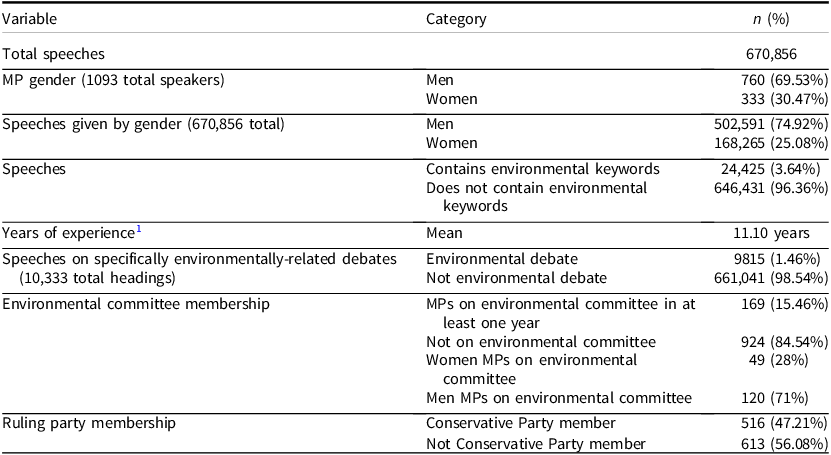
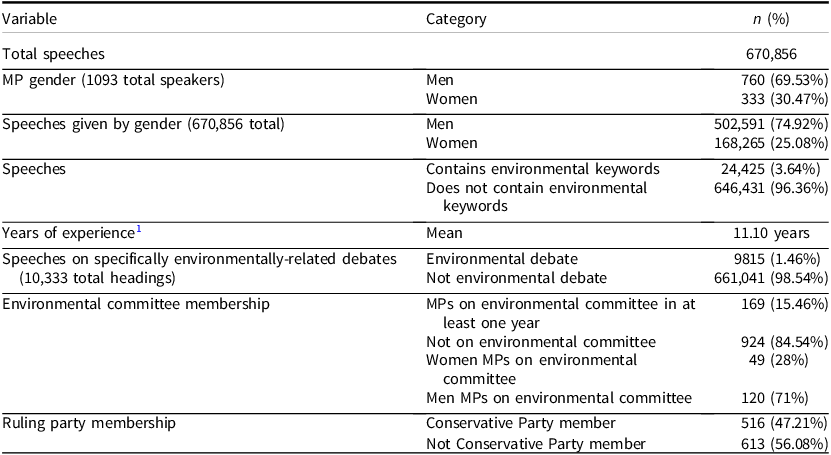
Descriptive statistics are displayed in Table 1. There are 1093 individual MPs and 670,856 speeches across the 2010-2021 timeframe included in the dataset. During this period, a disproportionate majority of MPs are men, at 70%, while women made up just 30% of MPs (the UK was ranked 45th in the world for women’s representation in Parliament in 2021, at 34.3% (IPU Parline 2021)). This over-representation of men is even greater in terms of speechmaking: men made 75% of all speeches while women made just 25%. In other words, men speak disproportionately more than women, who are already at a numerical disadvantage. Male dominance of speechmaking is a pattern that is documented in existing literature (Bäck, Debus, and Müller Reference Bäck, Debus and Müller2014). Of all the speeches in the dataset, almost 25,000 speeches, or less than 4%, contain environmental keywords. Figure 1 shows how environmental speechmaking has changed over time.
Descriptive statistics
Total environmental speeches over time: 2010–2020.Footnote 2
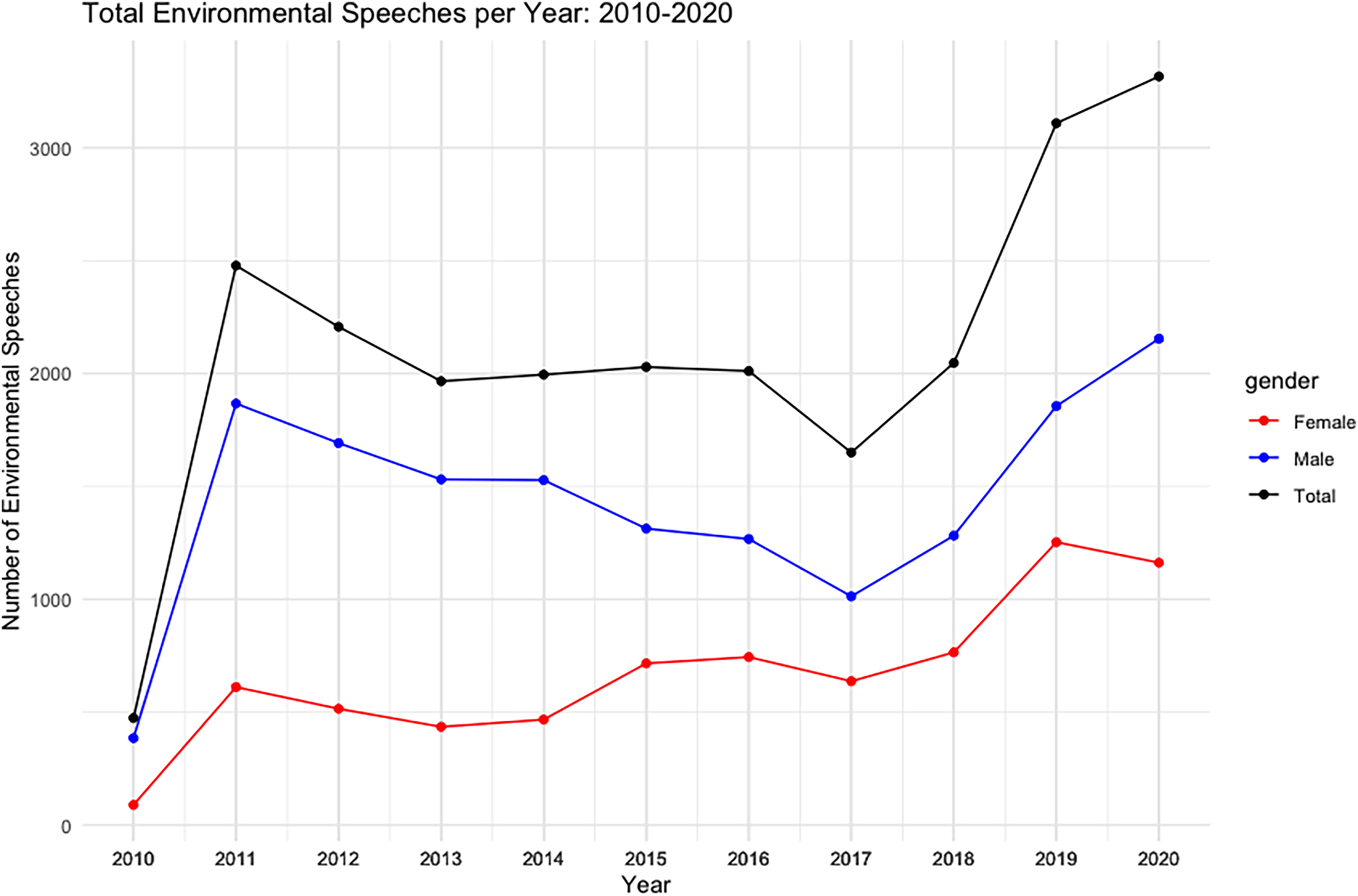
In Figure 1, I plot the total number of environmental speeches given from 2010 to 2020, as well as the total number of environmental speeches given by women and men MPs. This plot shows a significant jump in environmental speeches from 2010 to 2011, which is likely at least in part because the dataset begins in May 2010 and thus does not contain a full year of data. Another jump in 2018 across both women and men speakers may reflect a number of factors. First, the general salience of environmental issues was growing during this time: the Government’s Public Attitudes Tracker survey noted ‘a gradual rise in [environmental] concern since 2015, increasing more rapidly from 2018’ (UK Parliament 2020). Perhaps most importantly, 2018 marks the creation of the activist group Extinction Rebellion (Taylor Reference Taylor2020), which drew huge media and public attention by issuing a Declaration of Rebellion outside the Houses of Parliament. In the months and years following, protests led to Parliament’s declaration of a Climate Emergency (Taylor Reference Taylor2020).
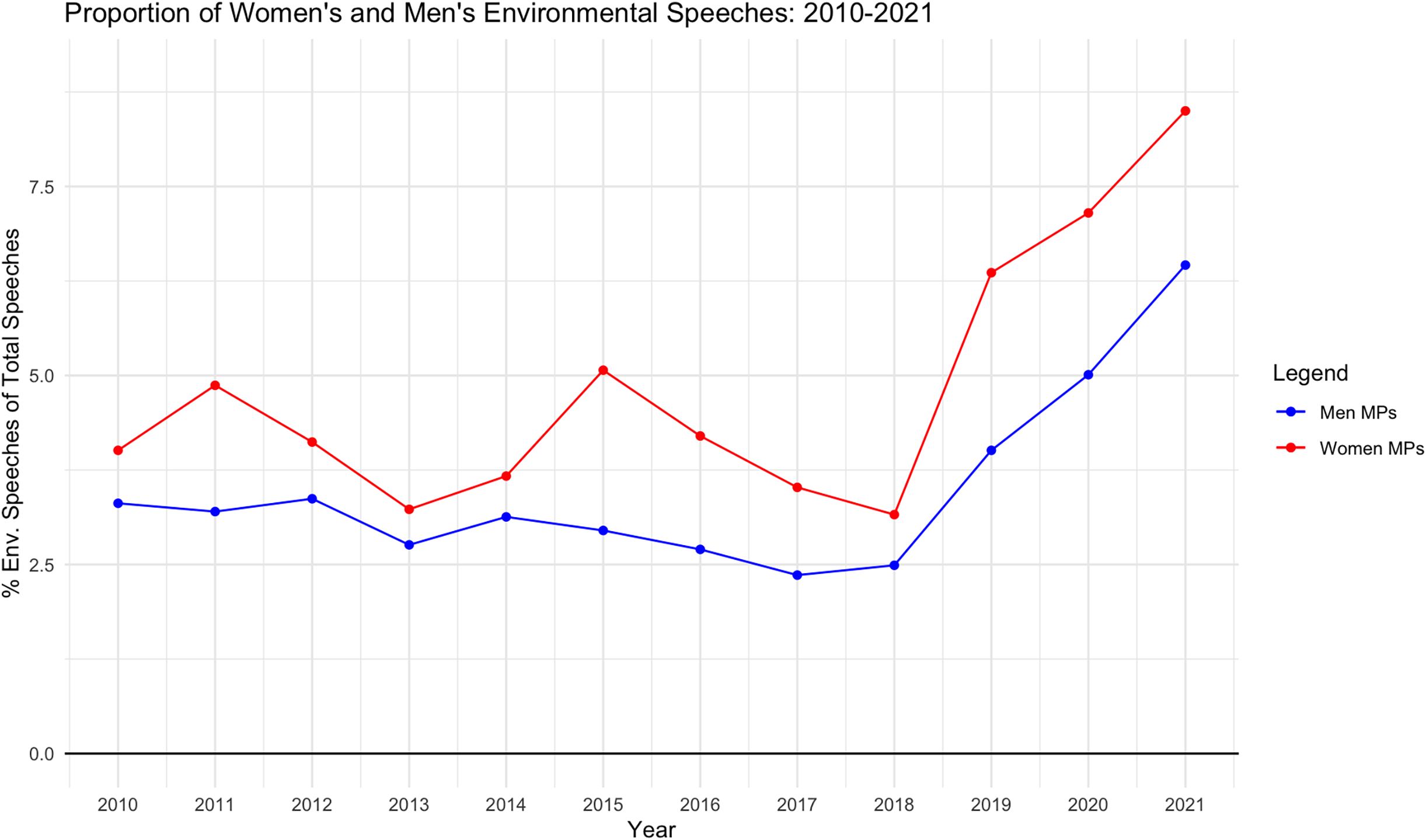
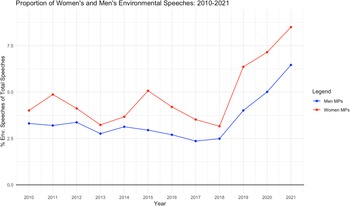
Men MPs make numerically more speeches than women MPs, which is unsurprising given that men outnumber women seven to three in the House of Commons. Yet, Figure 2 plots the proportions of both women and men MPs’ environmental speeches, demonstrating that, relative to the total number of speeches given by women and men, respectively, women make more environmental speeches than their male counterparts.
Women and men MP’s proportional environmental speeches over time.
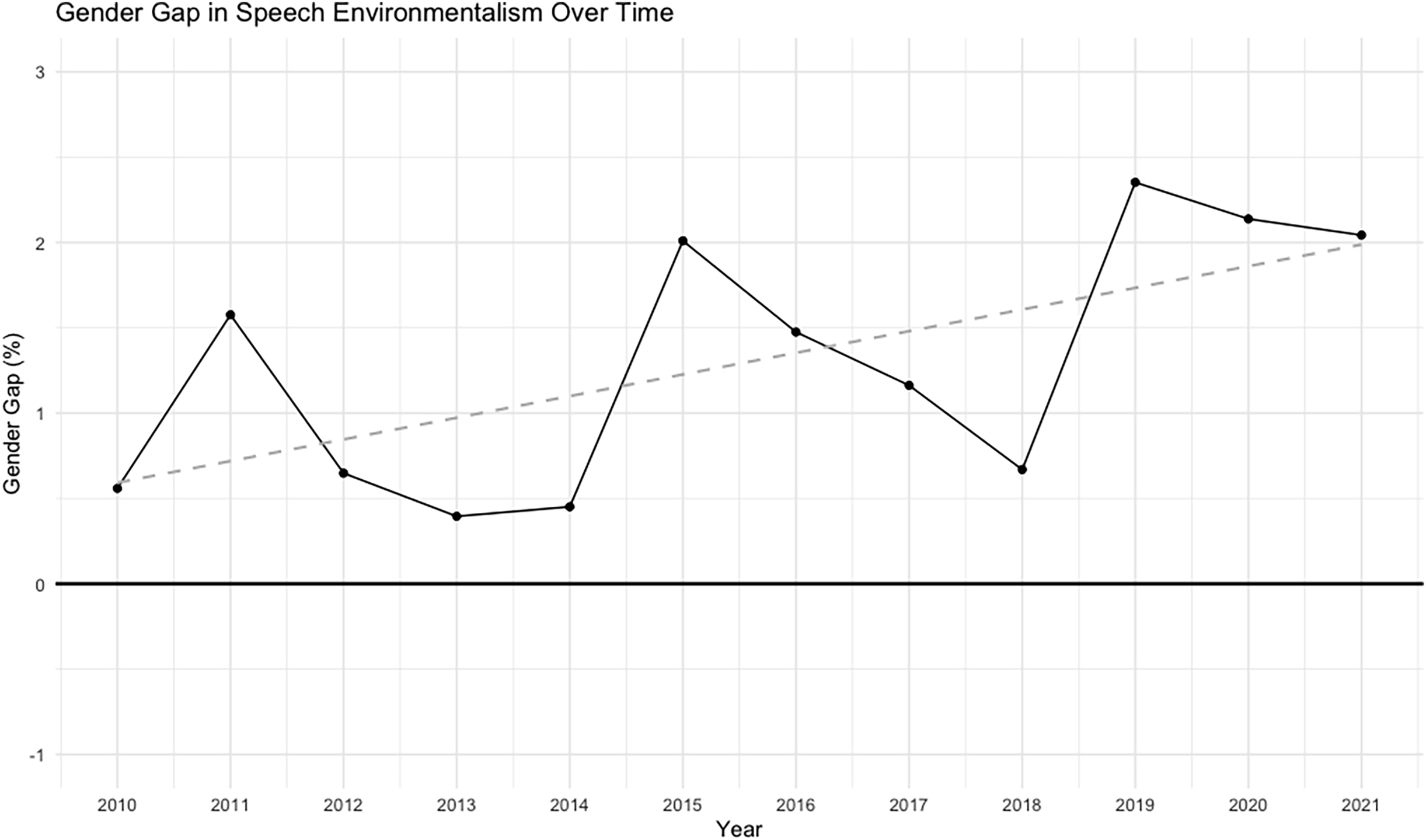
To better illustrate the difference in environmental speechmaking between women and men MPs, I construct a ‘gender gap’ variable and plot it over time (see Bush and Clayton Reference Bush and Clayton2023). This variable subtracts the proportion of environmental speeches given by women (of the total speeches given by women) from the proportion of environmental speeches given by men (of the total speeches given by men), resulting in the difference between the proportions of women’s and men’s environmental speeches: positive values indicate that a greater proportion of environmental speeches were given by women. Figure 3 plots the gender gap in environmental speeches.
Gender gap in environmental speechmaking between women and men MPs over time.
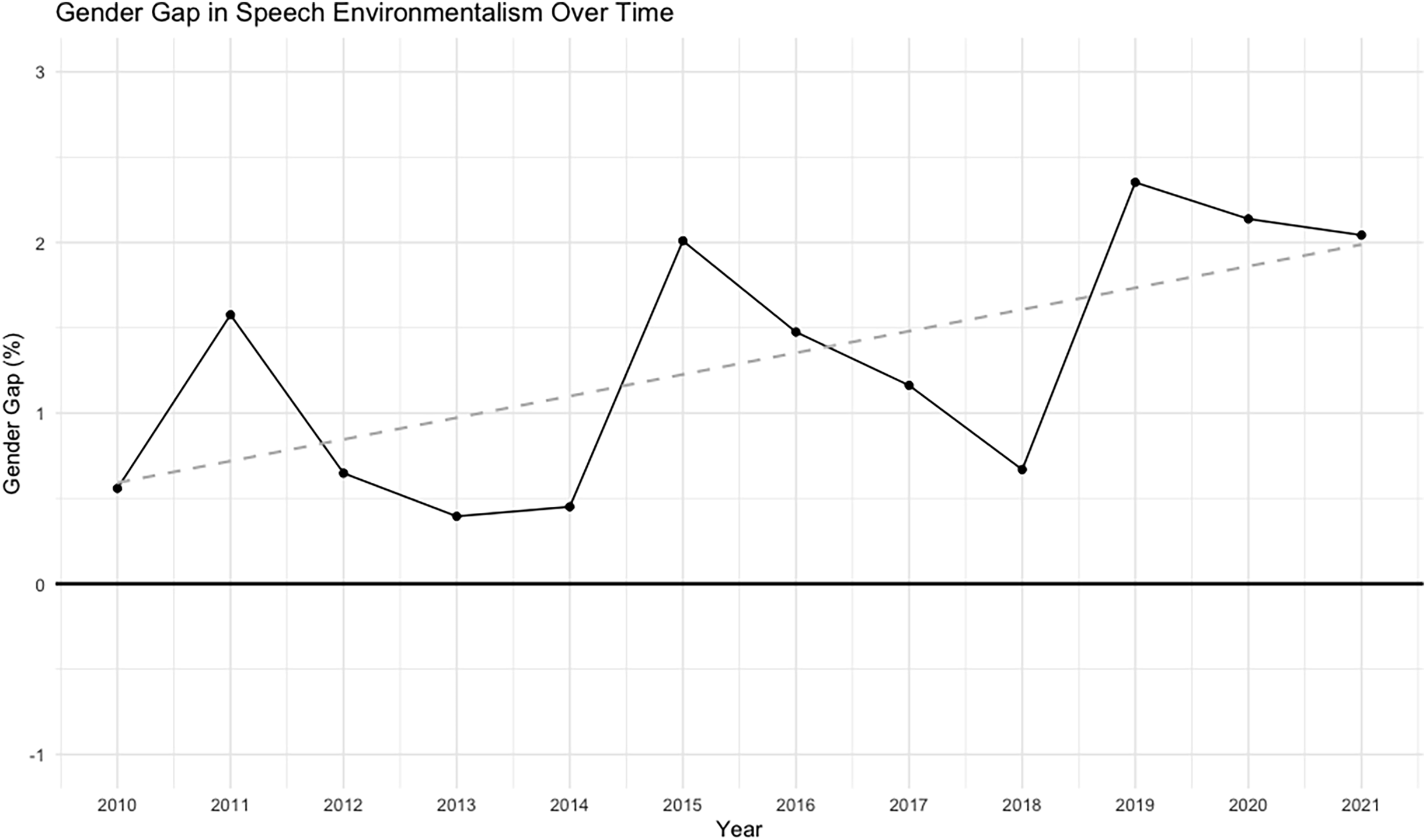
Figures 2 and 3 show that, during the entire period under question, women have made proportionally more speeches mentioning climate or environmental issues than their male counterparts. The jump in environmental speeches given by women around the time of Extinction Rebellion’s naissance is notably larger than the increase in men’s speeches, which could suggest that women MPs were more responsive to the public outcry for climate action. The gender gap is indeed trending upward, indicating that men MP’s environmental speechmaking is not increasing to the degree that women’s is over time.
Regressions: model specification
I conduct regression models to determine the magnitude and significance of MPs’ gender in predicting the extent to which they address climate or environmental issues in their speeches before Parliament while controlling for potentially confounding variables. To do so, I conduct two different models. First, I aggregate the data into MP-year units and create a dependent variable, environmental speeches, which is equal to the number of speeches made by each MP per year that contain environmental keywords. Because this dependent variable is a count variable and the aggregated data are over-dispersed, and because there are fewer observed than predicted zeros (online Appendix Table A2), I conduct negative binomial regressions.
Yet this type of model does not estimate environmental speeches relative to the total number of speeches each MP gives per year. Thus, I also conduct binary logistic regressions, which are used to predict binary outcomes. In this case, the data are not aggregated, and the binary outcome is whether each speech is environmental or not. This model helps to estimate the role of independent variables in predicting the proportion or rate of MPs’ environmental speeches relative to their total speeches.
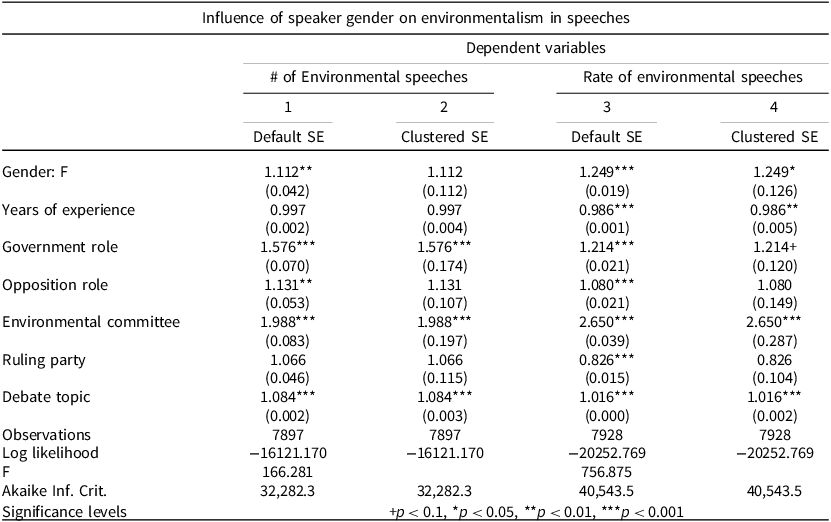
In both negative binomial regressions and binary logistic regressions, I account for the panel nature of the dataset by including year fixed effects and indicate where standard errors are clustered at the speaker level. The interpretation of both types of models is not intuitive; instead, for a change in the predictor variable (gender), the log of the expected count of the dependent variable changes by the respective regression coefficient. Thus, to interpret these results, I take the exponentiated value of each coefficient to obtain the incidence rate ratios (IRRs). The coefficients in all regression tables are these exponentiated values, allowing for intuitive interpretation. Likelihood ratio tests in Appendix Table A4 show that all models in which gender is significant are improved by the inclusion of gender in the model.
Findings
Models 1 and 2 measure the impact of speaker gender on the count of environmental speeches, controlling for potential confounding variables. The coefficients for gender reach the conventional significance threshold when standard errors are not clustered at the speaker level; however, when clustered standard errors are included, the magnitude of the estimate remains the same, but it is no longer statistically significant. This could indicate that the apparent effect of gender reflects repeated contributions from speakers who frequently address environmental topics, such that accounting for this within-speaker clustering reduces the statistical significance of gender. To test this potential, I conduct additional binomial logistic regressions in Models 3 and 4 to determine the role of gender in predicting rates of environmental speechmaking: the dependent variable is a binomial random variable of the count of environmental speeches per speaker, per year, given the total number of speeches given by each speaker per year. Adjusting for total speech shows that gender is a significant predictor of rates of environmental speechmaking: women speakers have 24.9% higher odds of giving an environmental speech than men speakers. The absence of a significant gender effect in the count model likely reflects the fact that men tend to give more speeches overall (Table 1), while Model 4 indicates that women show a relatively greater thematic emphasis on environmental topics when they do speak. This supports H1, which predicts that women speak proportionately more than men about the environment before Parliament.
Debate topic
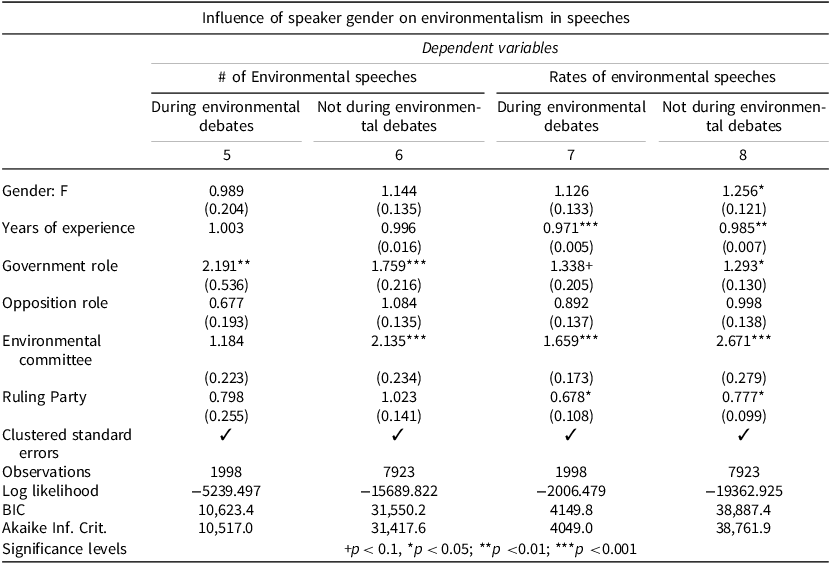
Next, to test H2 and H3, I investigate in greater detail the role of debate topics in environmental speechmaking. Following the results in Table 2, I conduct negative binomial regressions alongside binomial logistic regressions to test the role of gender in predicting environmental speech counts and environmental speech rates, respectively. I create two new datasets: one contains all data from speeches given during environmental debates, and the other contains data from speeches not given during environmental debates. Regression results with clustered standard errors are printed in Table 3.
Regression results of speaker gender on environmental speeches with exponentiated coefficients (i.e. expected percent change)
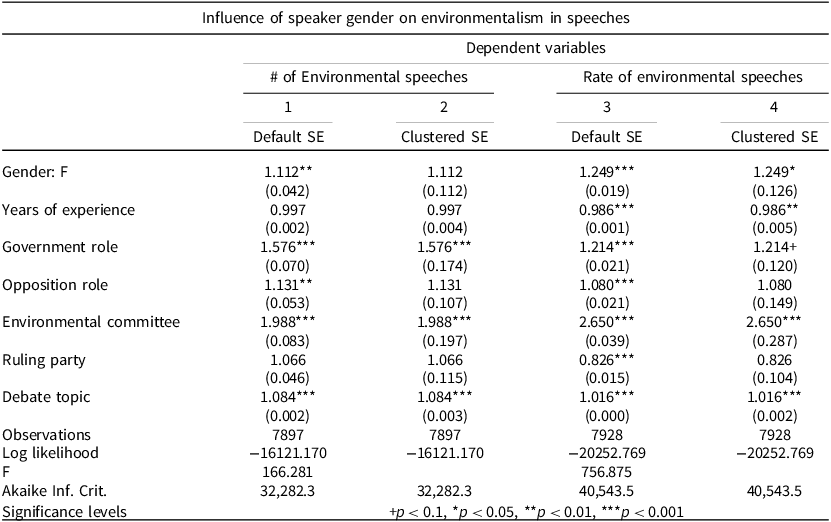
Table 3 shows that while gender is an insignificant predictor of both environmental speech counts and rates during environmental debates (rejecting H2), gender is a significant predictor of environmental speech rates in non-environmental debates: women speakers have 25.6% higher odds of giving an environmental speech than men speakers in this context. This finding supports H3 and suggests that women MPs bring climate or environmental issues into mainstream political discussions at more significant rates than men.
Impact of speaker gender on environmental speechmaking in non-environmental versus explicitly environmental debates
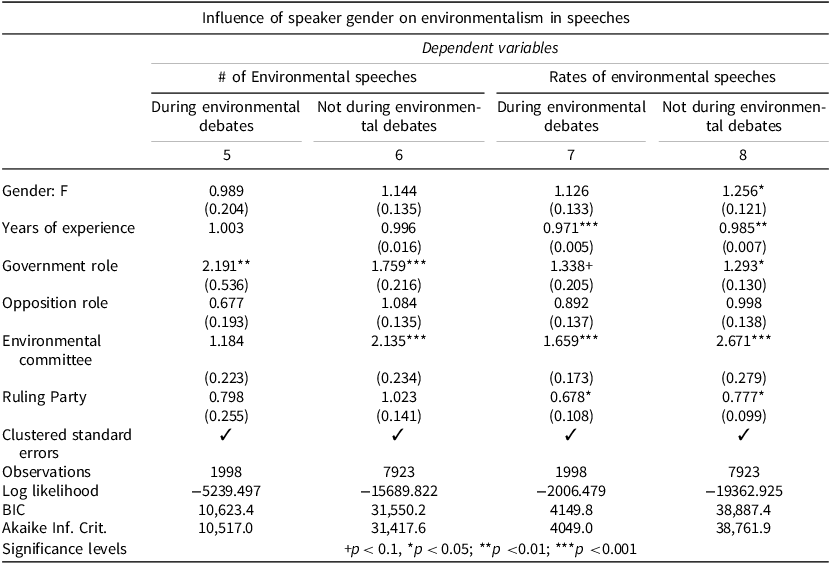
Importantly, as shown in Table 1, men make up the vast majority of environmental committee members (71%). Results in Table 3 show that environmental speech counts in non-environmental debates and rates in both non-environmental and environmental debates are significantly correlated with environmental committee membership, indicating that these (mostly male) committee members indeed also play a disproportionate role in speaking about the environment in Parliament. Yet, even controlling for the role of committee membership, gender remains a significant predictor of environmental speech rates in non-environmental debates.
Party
Next, I explore the role of the party in the promotion of climate or environmental issues in MPs’ speeches. The right-leaning Conservative Party is likely to be less in favour of ambitious climate action, while more left-leaning parties (i.e. Labour and the Green Party) are likely to be more in favour of environmental policy measures.
In previous models, I control for the influence of party by including a dummy variable indicating if the speaker is from the ruling party, which, during the timeframe under question, was the Conservative Party. In addition, government and opposition role variables are correlated with partyFootnote 3 , and thus serve as an additional party control. Yet, I do not include a straightforward ‘party’ control variable as literature shows that women parliamentarians play an important role in pushing their parties to the left ideologically (Greene and O’Brien Reference Greene and O’Brien2016), as well as towards environmentalist positions (Kroeber Reference Kroeber2021, Reference Kroeber, Baltz, Kosanke and Pickel2022). Controlling for party thus could introduce post-treatment bias, occurring ‘when researchers control for covariates that are potentially affected by the treatment’ (Senk Reference Senk2020, 5). Because the gender makeup of parties leads to variation in party positions, and in particular, environmentalist positions, holding party constant removes the indirect effect of party members’ gender in influencing speech environmentalism (Senk Reference Senk2020; Salamon Reference Salamon2023).
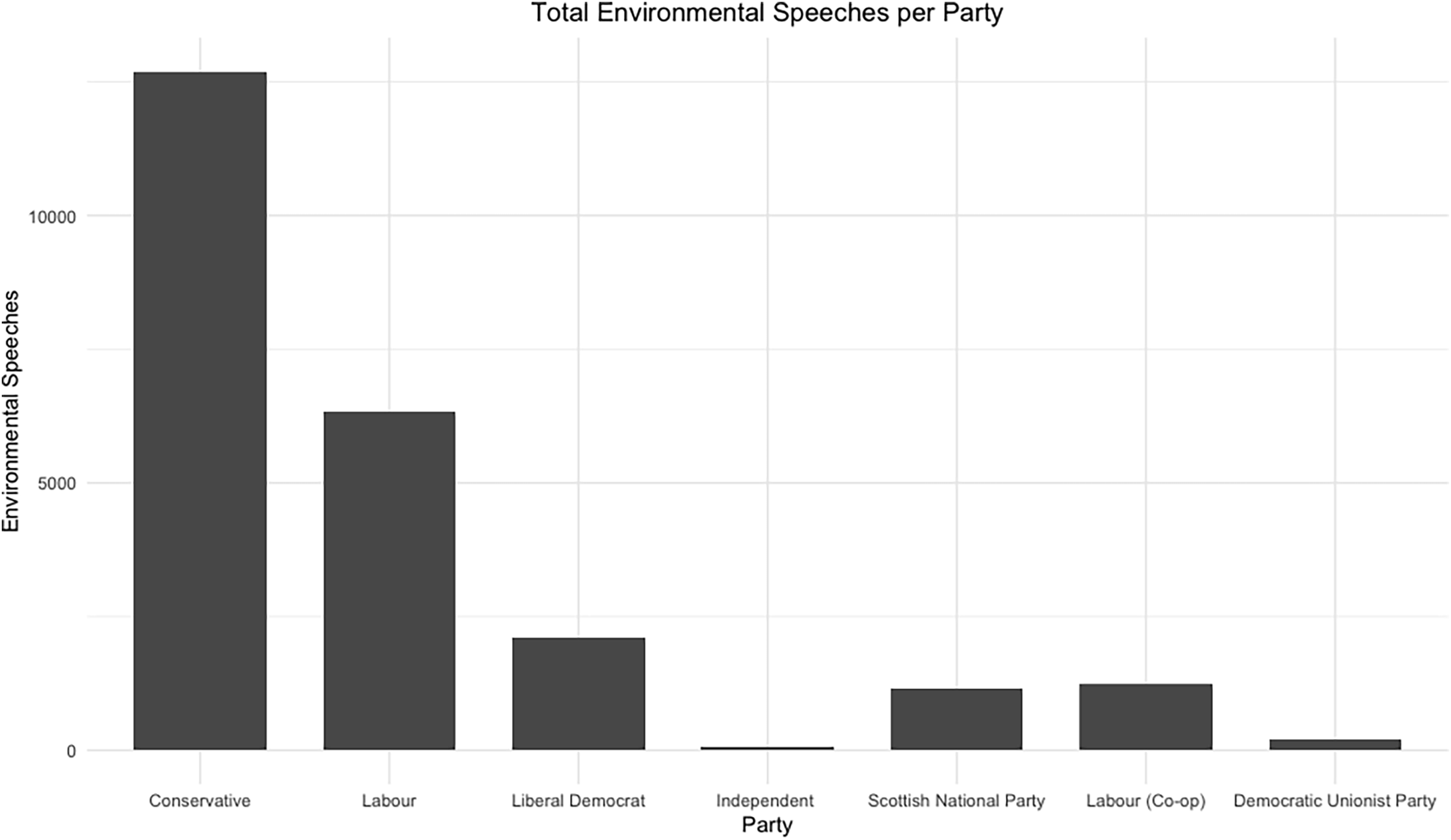
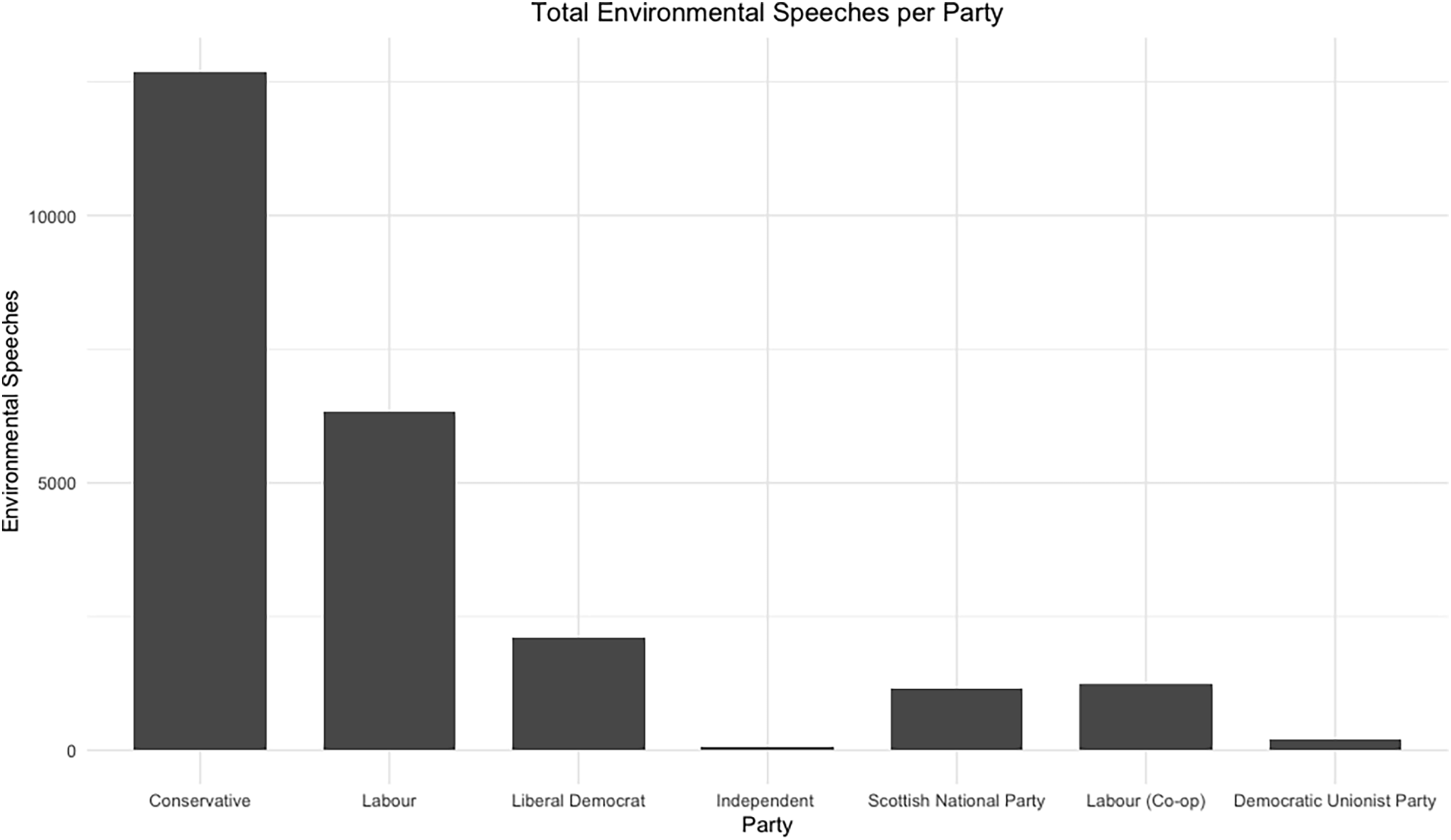
To more robustly determine the role of party affiliation, I disaggregate the dataset to inspect the role of gender in predicting environmental speechmaking within parties. In Figure 4, I plot the total number of environmental speeches from each of the 7 largest parties. Indeed, a large majority of all environmental speeches come from the two largest parties, the Conservative and Labour Parties, with the Conservative (ruling) Party contributing the most. This falls in line with Moilanen and Ostbye’s (Reference Moilanen and Ostbye2021) findings from Norway that ‘both left- and right-wing coalitions talk more about sustainability when in office’ (13). It is worth noting that in none of these parties do women outnumber men. The best-performing party in terms of gender balance is Labour: 42.7% of seats have been held by women during the period under question. By contrast, the Conservative Party performs second-worst, with only 22.9% of its seats held by women during the period under examination (Appendix Table A6). This party controlled Parliament during the entire period under question.
Total environmental speeches per party.
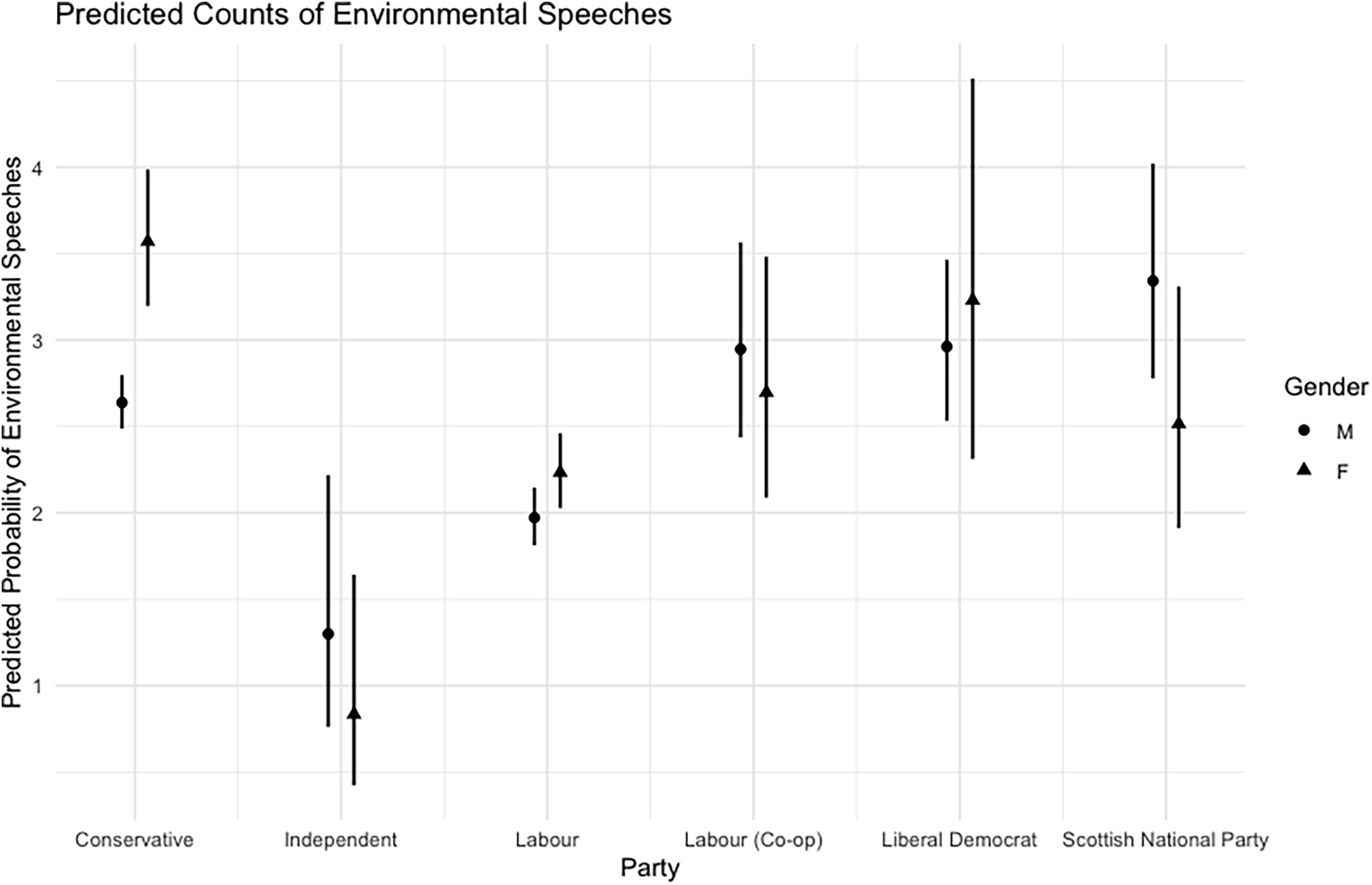
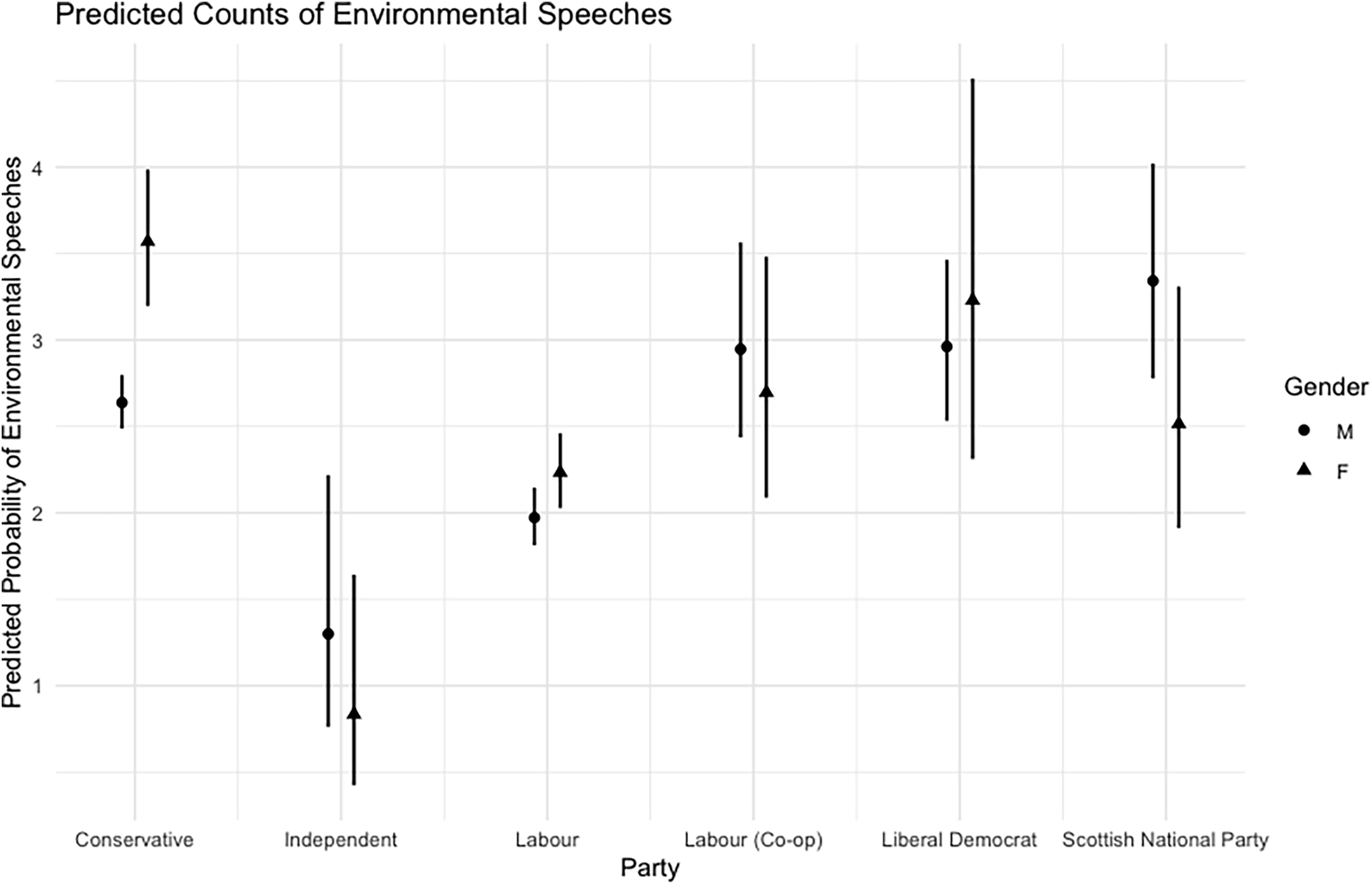
Plotted marginal effects of regression analysis interacting gender with party. Regression table can be found in Appendix Table A7.
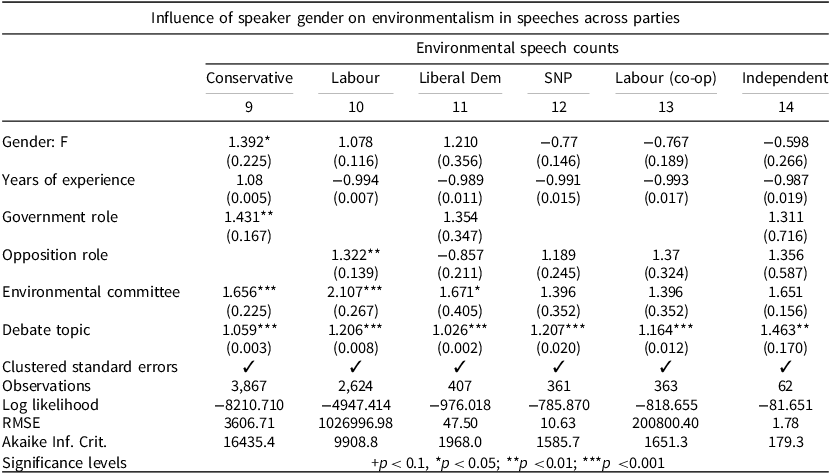
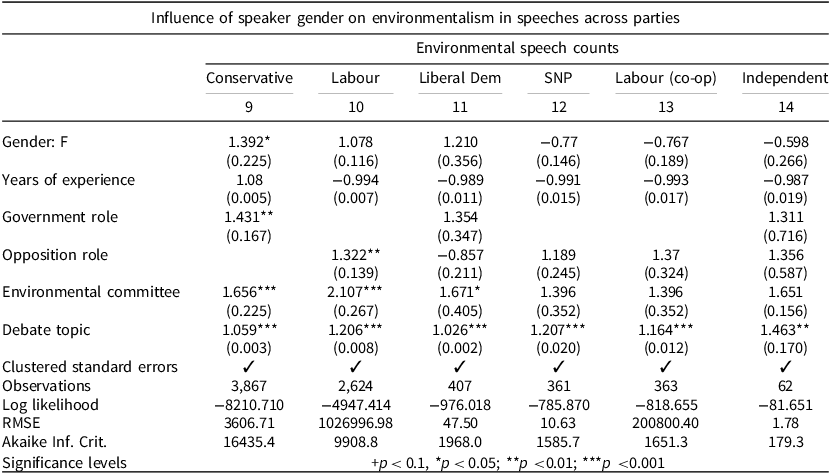
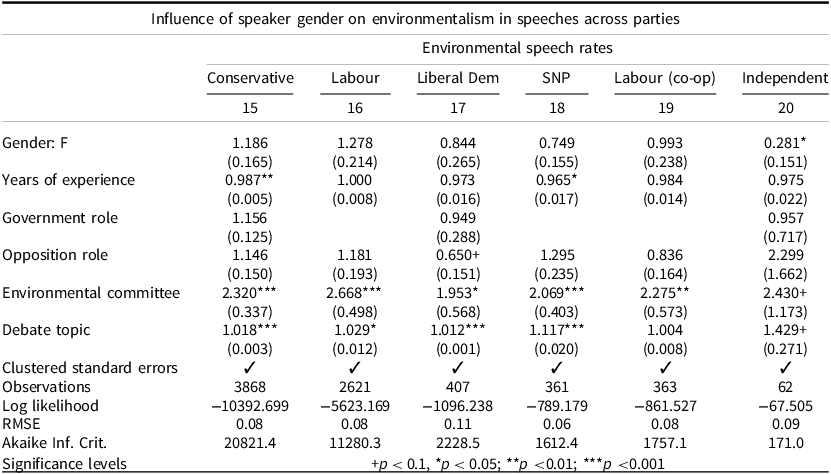
Subsetted regression outputs measuring the role of gender in predicting counts and rates of environmental speechmaking in the six biggest parties in the UK Parliament (the Conservative, Labour, Liberal Democrat, SNP, Labour (Co-op), and Independent partiesFootnote 4 ) are printed in Tables 4 and 5.
Impact of speaker gender on environmental speech counts within parties
Impact of speaker gender on environmental speech rates within parties
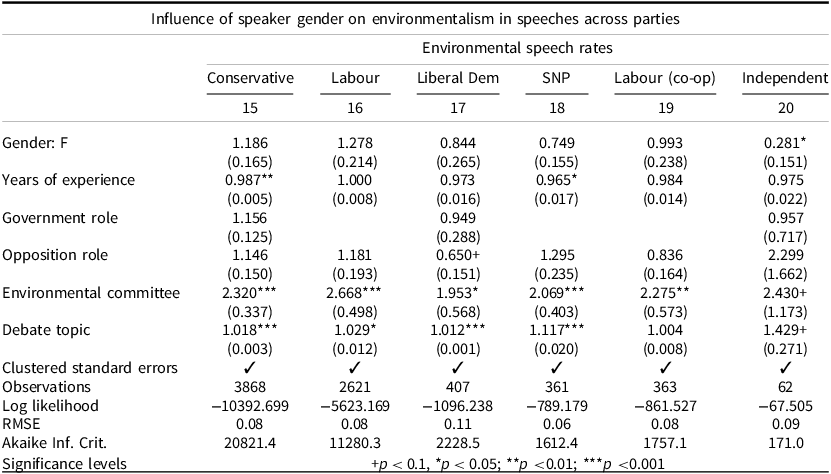
Within-party analysis shows that gender is a significant predictor of environmental speech counts only within the Conservative Party: female speakers have an expected count of environmental speeches that is 1.392 times that of male speakers – a 39.2% increase – in line with H4. I plot the marginal effects of regression models that interact party with gender in predicting environmental speech counts in Figure 5: overlapping confidence intervals among the other parties indicate the insignificance of gender in predicting environmental speeches. Gender does not increase environmental speech rates: Conservative women are not proportionately more likely to speak about the environment than about anything else. Because the rate model measures emphasis on environmentalism within an MP’s speeches while the count model measures participation in environmental speechmaking, these results indicate that the main gender difference in the Conservative Party is not between men and women’s emphasis of environmental issues, but rather their participation in speaking about the environment at all: controlling for confounders, Conservative women MPs contribute to overall counts of environmental speechmaking significantly more than their male counterparts despite making up less than 23% of the Conservative Party membership. These results speak to the importance of the role that women MPs play in bringing environmentalism into contexts that are not inherently aligned with environmentalism. It also speaks to the literature showing that increased presence of women in political parties pushes them both to the left (Greene and O’Brien Reference Greene and O’Brien2016) and towards environmentalist positions (Kroeber Reference Kroeber2021, Reference Kroeber, Baltz, Kosanke and Pickel2022).
Regression results in Table 5 show that gender is a significant predictor of environmental speech rates only for the Independent party designation, where the odds of a female speaker giving an environmental speech are 0.281 times the odds for a male speaker, holding other factors constant. In other words, women speakers are associated with a 71.9% lower odds of giving an environmental speech compared to male speakers. Given that this contradicts previous results, this raises additional questions around these dynamics: why are a greater share of men’s speeches environmental, and what are Independent women more interested in prioritising in their speeches? Because the Independent designation is small, these findings are not hugely meaningful substantively, but prompt these questions nonetheless.
Discussion and conclusion
The literature exploring the relationship between gender and climate change has uncovered an empirical link between gender equality, women’s political empowerment, and women’s representation and bettered environmental outcomes (Norgaard and York Reference Norgaard and York2005; Nugent and Shandra Reference Nugent and Shandra2009; Ergas and York Reference Ergas and York2012; Salahodjaev and Jarilkapova Reference Salahodjaev and Jarilkapova2020; Fredriksson and Wang Reference Fredriksson and Wang2011; Lv and Deng Reference Lv and Deng2018; Ramstetter and Habersack Reference Ramstetter and Habersack2019; McGee, Greiner, Christensen et al. Reference McGee, Greiner, Christensen, Ergas and Thomas Clement2020). But it has been less successful in explaining the mechanisms determining how this link successfully changes policy and outcomes. In this paper, I have tested one potential mechanism by investigating if women MPs in the UK House of Commons are more likely than men to highlight climate or environmental issues in their speeches before Parliament.
Results of this analysis show women MPs speak disproportionately more about the environment in their speeches before Parliament compared to men. Figure 1 shows that, from 2010 to 2021, a greater proportion of women’s speeches mention climate or environmental issues than men’s: in no year do men speak proportionally more about these issues than women, and the trend in this gender gap is upward. The significance of MPs’ gender in predicting environmental speeches before Parliament maintains even when potential confounding variables are held constant, including political party. Accounting for the fact that women are under-represented in Parliament, in all parties, and in speechmaking, this gender difference is both notable and worrisome for its potentially negative impacts on climate policy. This should be investigated in future research.
A deeper dive into the data reveals that while there is no significant difference between men’s and women’s speechmaking in the 1.5% of debates which are on explicitly environmental topics, gender is significantly correlated with rates of environmental speechmaking in debates which are not labelled as environmental. Results also show that while environmental speechmaking differs across parties, the party does not explain the gender gap in environmental speechmaking; rather, a gender gap emerges in the Conservative Party, and not in rates, but rather in absolute counts, of environmental speeches. Conversely, women have lower odds of making environmental speeches as Independents. These findings should prompt further investigations of the dynamics within parties when it comes to environmentalism, following from Kroeber’s (Reference Kroeber2021, Reference Kroeber, Baltz, Kosanke and Pickel2022) findings that women party members push parties towards more environmentalist stances. Given these complementary findings, I anticipate that women’s propensity to draw attention to the environment indeed impacts policy, perhaps through pointing out the environmental consequences of various policy programmes during the deliberative legislative process. Further research could track MPs’ speechmaking onward through the policymaking process to determine the extent to which speaking about issues leads to political outcomes.
I argue that these results highlight a unique and integral role that women MPs are playing in the move towards Net Zero: they are integrating climate or environmental issues into spaces and discussions that need this perspective the most – political parties and non-environmental debates. Because there are environmental consequences to effectively all political issues (which may go unnoticed, under-appreciated, or ignored), ensuring that attention is pointed at climate or environmental issues in politics in general helps to embed an ethos of sustainability into the political process itself, rather than only adding environmental concern to circles and conversations with existing environmental commitment, and helps to widen the base of support, build consensus, and crystallise effective environmental action. Not only are men a disproportionate majority of MPs in the period under question across parliament and within each party, but these men MPs dominate parliamentary speechmaking to an even greater rate of disproportionality, contributing three-quarters of total parliamentary speeches. The fact that, given this highly gendered context, women MPs still bring proportionately more attention to environmentalism in their speeches is notable.
A related insight revealed by this analysis exposes that, although women speak significantly more than men about environmentalism in the House of Commons, a vast majority of environmental committee seats are occupied by men. These committees play a key role in impacting climate policy in a variety of ways. Turnpenny, Russel, and Rayner (Reference Turnpenny, Russel and Rayner2013) find that the Environmental Audit Committee plays ‘many roles, including analyst, forum for debate and political lever, all of which provide potential for influence on specific policies, and on the nature space of political debate, [as well as shaping] many boundaries using various mechanisms, both informal and institutionally-sanctioned’ (586). The Climate Change Act (2008) ‘introduced a detailed monitoring and reporting process, which means the climate change debate is no longer ad hoc’ (Averchenkova and Finnegan Reference Averchenkova and Finnegan2021, 258) and explicitly requires the participation of a range of actors including select committees. This indicates that, unsurprisingly, environmental committees and the formal seats occupied within them carry disproportionate weight within debates and policymaking on the environment and climate. The fact that women MPs speak proportionately more than their male counterparts about the environment, and yet occupy a notable minority of powerful environmental committee seats, poses a range of normative and policy-relevant questions. Future research should continue to unpack who is wielding or hoarding political power around important environmental issues and what impacts these inequalities in power are causing both on the environment and society at large. It should also prompt questions around what reforms can be made so that political problems are being addressed by, and power is being entrusted to, the best possible candidates.
The findings raise questions around the impact women have on increasing the diversity of issues raised in parliament in general. Greene and O’Brien’s (Reference Greene and O’Brien2016) findings that increased participation of women in parliaments increases the number of issue areas parties address in their manifestos could suggest that women simply speak about more issues than men do. Thus, women’s tendency to speak more about the environment could be driven not by a particular association with environmentalism, but rather reflects greater diversity in issue attention of women relative to men. The role of the party should also be considered from the perspective that MPs can face directives from their parties: could it be the case that women speak more about the environment because parties task them with addressing this issue area? Further research should investigate these intra-party dynamics and identify if women and men are pressured by parties to address these issues to differing degrees. The importance of gender in shaping political actors’ priorities begs further questions around the extent to which other identities, and their intersections, impact political outcomes. While literature has investigated the role of other identities, like disability (Reher Reference Reher2022), age (Debus and Himmelrath Reference Debus and Himmelrath2022), and racial and ethnic backgrounds (Sobolewska, McKee, and Campbell Reference Sobolewska, McKee and Campbell2018), on representation and political outcomes, it is important for future research to better understand the ways that intersectional identities of MPs influence outcomes.
This analysis considers a period dominated by Conservative leadership: will these gendered patterns change as left-leaning political parties take power in the UK? Moreover, do the patterns uncovered in this context hold across countries? It may be the case that countries with less prominent right parties, or more powerful Green parties, see less of a gender effect on environmental speechmaking. Countries with more right-oriented political dynamics may indeed see a more substantial gender impact in environmental advocacy in speechmaking. During the period under question, environmental discourse evolved considerably, and many notable events took place, including the signing of the Paris Climate Agreement: how do these landmark events impact climate and environmental discourse across countries? This research offers a basis for exploring these questions.
Supplementary material
For supplementary material accompanying this paper visit https://doi.org/10.1017/S1475676526100747
Data availability statement
All data and code needed to replicate findings are available at https://doi.org/10.7910/DVN/UQYN1D.
Funding statement
The authors received no financial support for the research, authorship, and/or publication of this article.
Competing interests
The author declares no competing interests.
AI Declaration
AI was used during the statistical analysis as an aid for code development and support for methodological decision-making.
Ethical statement
None.



 Open access

