


Introduction
The most common way of using the crop-livestock integration system in subtropical regions is cultivating soybeans or corn during the summer and pastures of black oat (Avena strigosa Schreb) and annual ryegrass (Lolium multiflorum Lam.) in the winter (Kunrath et al., Reference Kunrath, Cadenazzi, Brambilla, Anghinoni, Moraes, Barro and Carvalho2014). Winter pastures allow to overcome the forage deficit caused by climatic limitations (Aranha et al., Reference Aranha, Andrighetto, Lupatini, Mateus, Ducatti, Roça, Martins, Santos, Luz, Utsunomiya and Athayde2018) and optimize land use. In addition, these forages increase productivity per area (Muller and Primo, Reference Müller and Primo1986), one of the main points currently debated due to the demands for more sustainable systems.
Black oat and ryegrass are complementary in their production cycles. Oat is earlier than ryegrass, allowing for earlier grazing and consequently extending the duration of pasture utilization (Fruet et al., Reference Fruet, Stefanello, Trombetta, de Souza, Rosado Júnior, Tonetto, Flores, Scheibler, Bianchi, Pacheco, de Mello and Nörnberg2019). In this context, tools can be used to extend the grazing period and increase productivity, such as mixing grasses and legumes and supplementing animals with concentrate feed, which can be strategic, aiming at better results in the animals' individual gain and gain per area.
Energy supplementation enables to increase the stocking rate, because the animals may present a substitution effect concerning the pasture depending on the level of concentrate supplementation (Moore et al., Reference Moore, Brant, Kunkle and Hopkins1999). It improves animal performance and increases the return of nutrients to the system via faeces and urine since nutrient intake increases (Danna, Reference Danna2022). In addition to the greater stocking rate, supplementation brings benefits to the animal carcass, such as greater subcutaneous fat thickness, which is important for its protection during the chilling process (Fruet et al., Reference Fruet, Stefanello, Trombetta, de Souza, Rosado Júnior, Tonetto, Flores, Scheibler, Bianchi, Pacheco, de Mello and Nörnberg2019). Animals that received supplements in the proportion of 8 g/kg BW showed higher carcass yield, greater subcutaneous fat thickness and higher marbling degree compared to animals that remained only on pasture of oat, ryegrass and clover (Santin Junior et al., Reference Santin Junior, Lima, Mateus, Santos, Zampar and Cucco2021).
On the other hand, mixing with legumes makes it possible to raise the pasture's nutritional quality due to their high nitrogen content (Schmitz et al., Reference Schmitz, Paris, Kuss, Nörnberg, Costa and Menezes2023) and, depending on the species, a longer grazing time. Legumes also contribute to the system as a whole as they can fix atmospheric nitrogen in the soil, providing ecosystem functions and ensuring good performances for animals (Kebede, Reference Kebede2021). Fruet et al. (Reference Fruet, Stefanello, Trombetta, de Souza, Rosado Júnior, Tonetto, Flores, Scheibler, Bianchi, Pacheco, de Mello and Nörnberg2019) obtained animal weight gain of 1.20 kg/day with mixed pastures of grasses and legumes. It can be both a sustainable and nutritional tool, important within production systems.
This work hypothesized that the inclusion of energy supplementation would enable to increase the stocking rate and individual gain, thus increasing productivity per area, and the inclusion of legumes would improve the nutritional quality of digesta, increasing individual gain compared to the traditional system (oat + ryegrass). In this sense, the objective of this study was to evaluate the energy supplementation or the mixing of legumes in oat and ryegrass pasture in a crop-livestock integration system on the performance and carcass characteristics of beef steers.
Materials and methods
This work was approved by the Research Ethics Committee on Animal Use (CEUA) of the Universidade Tecnológica Federal do Paraná – Dois Vizinhos Campus (UTFPR-DV) under protocols 2017-009, 2018-023, and 2020-11.
The experiment was conducted during three non-consecutive years, 2017 (71 days), 2018 (105 days) and 2020 (92 days) in the Beef Cattle Sector (Ruminant Teaching and Research Center – NEPRU) of UTFPR-DV. It is located in the physiographic region called the Third Plateau of Paraná in the coordinates 25°44′ South and 53°04′ West, at 520 metres altitude. Climatological data were collected approximately 200 metres from the experimental area (Fig. 1). The soil is classified as dystroferric Red Nitosol with a clay texture, and the climate is Cfa, humid subtropical without a defined dry season, according to the Köppen classification (Alvares et al., Reference Alvares, Stape, Sentelhas, de Moraes Gonçalves and Sparovek2013).
Average temperature and the sum of rainfall from May to October of 2017, 2018 and 2020.
Source: GBIOMET (2022).

The experimental area has been managed in a crop-livestock integration system since 2017. It rotates between the cultivation of soybean (2018 and 2020) and corn (2017) during the summer. Black oat (A. strigosa) and annual ryegrass (L. multiflorum) are cultivated during the winter, which can be mixed with legumes, depending on the treatment: vetch (Vicia sativa L.) and white clover (Trifolium repens L.) in 2017, and arrowleaf clover was used in 2018 and 2020 (Trifolium vesiculosum Savi). In all years, the treatments were allocated in the same experimental paddocks.
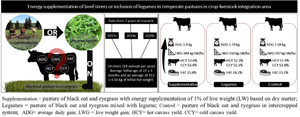
The experimental design was completely randomized with three treatments and three replicates (paddocks) for each year of evaluation. The treatments were CONTROL: pasture of black oat and ryegrass; LEG: pasture of black oat and ryegrass mixed with legume; and SUP: pasture of black oat and ryegrass with energy supplementation of 10 g/kg of body weight (BW) based on dry matter. We used 54 Angus steers (18 each year) aged 22 ± 3 months with an average initial BW of 413.08 ± 4.56 kg. They were submitted to sanitary protocols for ectoparasites and endoparasites before the beginning of the experimental period.
The animals received 1 kg of supplement for every 100 kg BW daily at 12:00 pm. Ground corn was used as a supplement. Every 21 days, the animals were weighed to adjust the amount of supplement. The steers had access ad libitum to water and mineral salt. The experimental area had 7 hectares, subdivided into 10 paddocks of approximately 0.7 hectares. In nine of them, the treatments were applied, and one was used to keep the regulatory animals. Continuous grazing with a variable stocking rate was used according to the ‘put-and-take’ method (Mott and Lucas, Reference Mott and Lucas1952).
In all years, the implantation of the pasture occurred in May, varying the day according to climatic conditions. Grasses were sown in a row and legumes by broadcast. The sowing density was 55 kg/ha for black oat seeds, 25 kg/ha for ryegrass, 25 kg/ha for vetch (2017), 5 kg/ha for white clover (2017), and 10 kg/ha for arrowleaf clover (2018 and 2020). The inclusion of arrowleaf clover (2018 and 2020) was due to the low persistence of white clover after the animals' first grazing. Arrowleaf clover was more present throughout the pasture cycle. Fertilization at sowing was done with 250 kg/ha of formulated NPK 8-20-15 each year, and two applications of urea (45–%N), totalling 75 kg/ha of N per year.
Two animals (testers) were allocated to each paddock. The average daily weight gain (ADG kg/animal/day) was determined by weighing the steers on the first and last day of the experiment, fasting solids and liquids for 14 h. The body weight gain per hectare (BWG/ha) was calculated by multiplying the number of animals, days of the period, area of paddock, and the average ADG of the paddock (Kunrath et al., Reference Kunrath, Cadenazzi, Brambilla, Anghinoni, Moraes, Barro and Carvalho2014). For body weight gain per hectare per day (BWG/ha/day), BWG/ha was divided by the days of the total grazing period.
The beginning of the grazing period occurred when the forage mass (FM) reached approximately 1500 kg DM/ha. At the beginning of grazing, the animals underwent an adaptation period to husbandry and treatments for 15 days. Then, the evaluations of pasture and animals were carried out.
Forage mass (kg DM/ha) was estimated by the double sampling (Wilm et al., Reference Wilm, Costello and Klipple1944). The double sampling technique consists of visual observations (n-20 per paddock) of the pasture at different points in each paddock. Next, cuts (n-5) and measurements of the respective forage mass are made within a small square (0.5 m × 0.5 m). Calibration equations are then generated to estimate forage mass based on several visual observations of the pasture across the paddock. The average coefficients of determination of the resulting linear equations which estimate herbage mass based on visual observations of height sward were above 0.80. The evaluations were carried out every 21 days, and two pasture exclusion cages per paddock were placed to determine the daily herbage accumulation rate (HAR), which was calculated using the formula described by Campbell (Reference Campbell1966). The clipped sample was homogenized and divided. One part was used for DM determination in a forced-air oven at 55°C for 72 h. The other part was used for botanical (forage species in the pasture) and structural (stem and leaf) evaluation, but the latter did not apply to legumes.
We used grazing simulation samples for the pasture's chemical analysis (Table 1) (Moore and Sollenberger, Reference Moore, Sollenberger and Gomide1997). The animals were observed grazing, and after 15 h every 21 days, the samples of what the animals grazed were collected. This procedure was carried out for all paddocks in all periods and years.
Chemical composition and digestibility of black oat and ryegrass pasture associated with animal supplementation or mixed with legumes by simulated grazing of finishing beef steers

The contents of total dry matter (TDM) were determined in an oven at 105°C for 16 h; ash and organic matter (ASH and OM) in a muffle furnace at 600°C for 4 h; crude protein (CP) by Kjeldahl's method (AOAC, Reference AOAC1997); ether extract (EE) was performed with petroleum ether in Ankom XT15 equipment for 1 h at 90°C; neutral detergent fibre (NDF) and acid detergent fibre (ADF) were determined by the filter bag methodology (Komarek et al., Reference Komarek, Manson and Thiex1996) using the NDF and FDA solutions proposed by Van Soest et al. (Reference Van Soest, Robertson and Lewis1991). The in vitro dry matter digestibility was determined using a Daisy II 200 incubator (Tecnal Technology) and presented as Wiseman (Reference Wiseman2018). The in vitro dry matter digestibility is the amount of dry matter ingested that is not excreted in faeces. It is calculated using the following formula (Wiseman, Reference Wiseman2018):

The animals were slaughtered at the end of the pastures' production cycle in a slaughterhouse, 25 km from the experimental area, following the establishment's protocols. When they arrived at the slaughterhouse, they remained in lairage with water sprinkling to provide comfort and welfare. The steers were desensitized with a pneumatic gun and bled under humane slaughter rules.
The animals fasted and were weighed before being sent to the slaughterhouse. Subsequently, the carcass of the animals was weighed to determine the hot carcass yield. The carcass was weighed again after 12 h of chilling to determine cold carcass yield. The carcasses were cut in half. Following the methodology of Müller (Reference Müller1987), conformation data, carcass length, thigh thickness, leg length and perimeter and arm length were collected in the left half carcass.
A sample was collected between the 11th and 13th ribs to determine the loin eye area by measuring with tracing paper. In addition, the subcutaneous fat thickness was measured with a caliper at three different points. In the same sample, the carcass composition of bone, muscle and fat was determined according to the methodology of Hankins and Howe (Reference Hankins and Howe1946).
Data were analysed using the PROC MIXED procedure from SAS 9.2 program (SAS, 2000 SAS Institute Inc., Cary, NC, USA). The normality of the data was confirmed using the Shapiro–Wilk test, and the means were compared by the Tukey test at 5% significance when any difference was detected through ANOVA (P < 0.05). The statistical model was:

where Yijkl is the dependent variable, μ is the overall mean, ti is the effect of treatment i, aj is the effect of year j, t × aij is the interaction between the variables treatment and year ij, eaijk is the error for repeated measures in time ijk, and eijkl is the random error.
Results
There was no interaction between year of evaluation and treatment (P > 0.05), so the results were grouped in the mean of all years.
Chemical composition and forage characteristics
No differences (P > 0.05) were observed for the chemical components and in vitro digestibility of the pasture (Table 1).
No differences were observed (P > 0.05) for the proportion of oat leaf, ryegrass leaf, dead material, and others in the structural composition of the pasture (Table 2). However, the inclusion of legumes resulted in a lower proportion of stem (245 vs. 293 g/kg DM) and inflorescence (25 vs. 50 g/kg DM) in the pasture and a higher leaf:stem ratio (1.57 vs. 1.32) compared to SUP.
Structural composition of black oat and ryegrass pasture associated with energy supplementation or mixed with legumes grazed by finishing beef steers

There was no difference (P > 0.05) for forage mass (1360.4 kg DM/ha), forage allowance (1.05 kg of DM/100 kg BW), and herbage accumulation rate (62.3 kg of DM/day) between treatments (Table 3).
Production characteristics of pasture, stocking rate and animal production by pasture area of black oat and ryegrass associated with energy supplementation or mixed with legumes

Animal performance and carcass traits
The daily live weight gain per area (P = 0.8) did not differ between SUP and LEG (Table 3). However, supplementation treatment increased (P < 0.05) BW/ha/day by 28% compared to the control treatment and 10.3% with LEG. When total weight gain in the period was considered, SUP provided greater gain than LEG (+17.7%) and CONTROL (+25.2%).
Supplemented steers showed higher ADG, hot and cold carcass weight, and hot and cold carcass yield than the other treatments (Table 4). On the other hand, the animals on pasture with legumes presented a higher weight of hot carcass than the control treatment.
Performance and carcass characteristics of animals finished on black oat and ryegrass pasture associated with energy supplementation or mixed with legumes

The fat thickness did not differ between treatments, but the fat percentage in the carcass was 22% higher (P < 0.05) for the supplemented steers than those that only grazed oat and ryegrass.
For the quantitative characteristics of the animal carcass, there was no treatment effect (P > 0.05) for carcass conformation, carcass length, thigh thickness, leg length, arm perimeter, and amount of muscle and bone in the carcass (Table 5).
Quantitative characteristics of steers finished on black oat and ryegrass pasture associated with energy supplementation or mixed with legumes

Discussion
The increase in animal productivity with the energy supplementation was due to the higher performance of animals and greater pasture carrying capacity, which are the main objectives of this nutritional strategy (Lisbinski et al., Reference Lisbinski, Ronsani, de Assis Farias, Paris, Farenzena, Stanqueviski and Menezes2019). It was possible to increase the stocking rate by 128 kg BW/ha and the average daily gain by 35, which provided an increase of 33.69% in weight gain per hectare. Arelovich et al. (Reference Arelovich, Arzadún, Laborde and Vasquez2003) obtained a 21% increase in the ADG of the animals on winter pastures when they were supplemented with corn.
The substitution effect explains the increase in stocking rate and, consequently, in weight gain per hectare. The forage intake decreased, but the total DM intake even increased, as also the amount of energy ingested by the animal due to the supplement. Corn is commonly used in grazing systems as a supplement since it provides a high content of rapidly fermentable carbohydrates (Fruet et al., Reference Fruet, Stefanello, Trombetta, de Souza, Rosado Júnior, Tonetto, Flores, Scheibler, Bianchi, Pacheco, de Mello and Nörnberg2019). In addition, the adaptation of microorganisms to the low pH caused by the diet reflects in more amylolytic bacteria, which reduces the population of the fibrolytic ones (Caton and Dhuyvetter, Reference Caton and Dhuyvetter1997). In this way, the digestion of the fibrous fraction of the feed slows down and decreases the pasture intake. According to Caton and Dhuyvetter (Reference Caton and Dhuyvetter1997), forages with high crude protein content display a more intense substitution effect, and in our experiment, the pasture presented 213 g/kg CP. Despite the high CP in the pastures, few species of microorganisms can obtain energy from protein. That protein is lost in the rumen, limiting an increase in protein utilization in the intestine, and this loss can reach 30 to 40% (Cruickshank et al., Reference Cruickshank, Poppi and Sykes1992). Energy supplementation is an alternative to reduce these losses in pastures with high protein content.
Thus, supplementation provides an energy substrate for ruminal bacteria, increasing nutrient utilization (Vaz et al., Reference Vaz, Lobato and Pacheco2013) and intake. This higher DM intake with greater degradability increases the passage rate in the gastrointestinal tract (GIT), directly influencing the hot carcass yield. The supplemented steers showed a higher hot carcass yield than the control treatment. In addition, the greater supply of starch increases the production of volatile fatty acids. They are a primary source for hepatic gluconeogenesis, which becomes an ATP source at muscle level, and the remainder is stored as fat (Fruet et al., Reference Fruet, Trombetta, Stefanello, Speroni, Donadel, de Souza, Rosado Júnior, Tonetto, Wagner, de Mello and Nörnberg2018). For this reason, the supplemented animals had a higher fat content in the carcass than the other two treatments.
Although pastures with legumes presented lower carrying capacity, the pasture's nutritional quality provided a good individual performance in the present study, even if smaller than that of animals that received supplementation. The similar nutritional quality of pasture between treatments may explain the lack of significant differences for animal performance between LEG and CONTROL. Sturludóttir et al. (Reference Sturludóttir, Brophy, Bélanger, Gustavsson, Jørgensen, Lunnan and Helgadóttir2013) observed that the presence of legumes increased protein content compared to single grasses, different from what was observed in the present experiment. The proportion of legumes in the pasture may have interfered with this result. Vonz et al. (Reference Vonz, Menezes, Paris, Kuss, Silveira, Venturini, Stanqueviski and Boito2021) observed higher ADG when the legume was 130 g/kg DM, observing no difference for 80 g/kg DM. In the present study, the mean of the 3 years for the legume was only 64.5 g/kg DM.
Despite the small share, it increased (P > 0.05) BWG by 10% per hectare compared to the cultivation of single grasses. This effect is mainly due to the greater nutrient amount per area caused by the legumes (Silva et al., Reference Silva, Laroca, Coelho, Gonçalves, Gomes, Pacheco, Carvalho, Pires, Oliveira, Souza, Freitas, Cabral, Wruck and Souza2022). In a crop-livestock integration system, the effect of legumes encompasses better animal performance and a long-term effect on soil structure and fertility, in addition to positively affecting grain production (Nie et al., Reference Nie, McLean, Clough, Tocker, Christy, Harris, Riffkin, Clarck and McCaskill2016). The adequate management of crop-livestock integration systems is essential to increase animal productivity and reduce environmental impact (Souza Filho et al., Reference Souza Filho, Nunes, Barro, Kunrath, de Almeida, Genro, Bayer and de Faccio Carvalho2019).
The NDF (460 g/kg) and FDA (265 g/kg) levels in pasture did not vary between treatments, demonstrating that the pastures had a high nutritional quality (Mertens, Reference Mertens1985). These values are related to a similar ruminal filling of animals in terms of NDF content and digestibility, which is related to ADF (Van Soest et al., Reference Van Soest, Robertson and Lewis1991), given the pasture. The NDF content is related to the time of permanence of the feed inside the GIT. In this sense, supplemented animals tend to seek more digestible feed.
In this experiment, the proportion of stems in the supplementation treatment was higher, and the leaf:stem ratio was lower, demonstrating a high selection by the steers. In addition, with the supply of supplements and substitution of the pasture intake, there is a surplus of forage, causing the plant to accelerate its reproductive cycle. In this sense, the supplementation treatment presented 28% more inflorescence than the control. The increase in the amount of stem in the pasture by the substitution effect caused by supplementation. The highest forage quantity observed in treatments with supplementation resulted from the substitution effect, which also had an impact on the height of the sward. The substitution effect may contribute to heightened leaf generation, escalated stem development (Lisbinski et al., Reference Lisbinski, Ronsani, de Assis Farias, Paris, Farenzena, Stanqueviski and Menezes2019).
The higher ADG for the supplemented steers provided higher slaughter weights and hot and cold carcass weights for these animals. The lower carcass yield can be explained, among other factors, by the time of digestion, causing the emptying of the GIT to be slower than the SUP treatment. Nutrition explains the variation of characteristics related to carcass quality, such as cold carcass yield, conformation, and carcass and leg length by 15% (Rotta et al., Reference Rotta, Prado, Prado, Valero, Visentaine and Silva2009). The primary determinant influencing the carcass yield is the dietary composition. Animals fed fibrous diets exhibited elevated contents in the gastrointestinal tract, leading to a subsequent reduction in carcass yield (Paris et al., Reference Paris, Santos, Menezes, Kuss, Silveira, Boito, Venturini and Stanqueviski2015). A key factor contributing to enhanced carcass yield is the decrease in the weight of gastrointestinal contents. This reduction is attributed to the adoption of concentrate diets, particularly those with a higher proportion of grains, which result in improved digestibility (Rezende et al., Reference Rezende, Restle, Fernandes, Freitas Neto, Prado and Pereira2012). Owens and Gardner (Reference Owens and Gardner2000) observed that with concentrate in the diet increased, dressing percentage, longissimus muscle area, marbling score and skeletal maturity all increased at a decreasing rate.
As in our research, Wright et al. (Reference Wright, Andrae, Rosso, Miller, Pavan, Bridges and Duckett2015) also observed no difference for fat thickness in animals finished on grass-legume pastures, supplemented or not. In all treatments, the animals reached the minimum subcutaneous fat required by Brazilian slaughterhouses (3 mm). Carcasses with adequate fat thickness lessen the shortening effects caused by carcass chilling, interfering with meat tenderness (Aranha et al., Reference Aranha, Andrighetto, Lupatini, Mateus, Ducatti, Roça, Martins, Santos, Luz, Utsunomiya and Athayde2018).
Despite the high costs of energy supplementation, there are great responses on individual performances, carcass quality, and increase in productivity per area. Associating the highest ADG, stocking rate, and gain per hectare with the highest carcass yield, it can be observed that supplementation produced 38% more carcass per ha than the control treatment.
Although the introduction of legumes into the pasture has not affected aspects related to the pasture's carrying capacity and the performance, carcass, and meat characteristics, when working in a crop-livestock integration system, one must think about the system as a whole. In other words, the effect of legumes on the grain successor crop, as in the case of Crop-Livestock Systems. The presence of legumes in the system can improve the productivity of the successor crop since there is greater biological nitrogen fixation. Therefore, systems integrating animals grazing grasses and legumes and grain production must be increasingly studied. More studies involving other forage species, especially legumes, which are more persistent when grazing, root biomass production, and symbiosis between predecessor (pasture) and successor crops (grains) must be developed to understand integrated production systems in more detail.
Conclusion
Supplementation with ground corn increased animal load, live weight gain per hectare, average daily weight gain of animals, hot carcass weight and hot carcass yield. The characteristics related to the chemical composition of the meat, metric and quantitative characteristics were not affected by the inclusion of the concentrate in the animals' diet.
The carcass and meat characteristics were also not influenced by the inclusion of the legume, which presented a final slaughter weight like the supplemented animals, as well as the gain in live weight per area per day. These are efficient alternatives for the finishing of animals, being options depending on the value of the supplement.
Author contributions
Conceptualization, W.P., L.R.S. and L.F.G.M.; methodology, F.K., L.F.G.M., F.B.S..; investigation, F.B.S., M.D., A.B., N.M.A.; writing – original draft, F.B.S. and M.D.; writing – review and editing, W.P., L.F.G.M., L.R.S. and F.K.; funding acquisition, L.R.S, W.P. and L.F.G.M.; resources, W.P. and L.F.G.M.; supervision, L.F.G.M and W.P. All authors read and approved the fnal manuscript
Funding statement
This study was financed in part by the Coordenação de Aperfeiçoamento de Pessoal de Nível Superior – Brasil (CAPES) – Finance Code 001, National Council for Scientific and Technological Development (CNPq) – Brazil – Chamada MCTIC/CNPq No 28/2018 – Universal/Faixa A and Fundação Agrisus – Brazil. Financial code: 2540/18 and 3179/21.
Competing interests
None.
Ethical standards
The Institutional Committee on Ethics of Animal Use (CEUA) of the UTFPR approved all procedures concerning animals in this study (2017-009, 2018-023 and 2020-11).
Consent to participate
Not applicable.
Consent for publication
Not applicable.
Data availability
The datasets generated during the current study are available from the corresponding author on reasonable request.



