Hostname: page-component-74d7c59bfc-hfsb5 Total loading time: 0 Render date: 2026-01-27T00:28:42.670Z Has data issue: false hasContentIssue false

Including a human rights approach in the Global Plastics Treaty can ensure protection of people and the environment

Published online by Cambridge University Press:  08 July 2025

Bethanie Carney Almroth*
Affiliation:
Department of Biological and Environmental Sciences, University of Gothenburg , Gothenburg, Sweden
Natalia de Miranda Grilli
Affiliation:
School of Social Sciences, University of Tasmania, Hobart, TAS, Australia Centre for Marine Socioecology, University of Tasmania, Hobart, TAS, Australia
Peter Stoett
Affiliation:
Faculty of Social Science and Humanities, Ontario Tech University , Oshawa, ON, Canada
*
Corresponding author: Bethanie Carney Almroth; Email: bethanie.carney@bioenv.gu.se
Rights & Permissions [Opens in a new window]

Abstract

Plastic pollution, once seen mainly as an ocean issue, is now understood as a threat across the entire life cycle of plastics – impacting climate, biodiversity and human health. Scientific evidence shows that every stage, from fossil fuel extraction to use to waste (mis)management, harms the environment and disproportionately affects vulnerable populations, violating basic human rights, including the rights to life, health, food, water, information and a clean, healthy and sustainable environment. The proposed Global Plastics Treaty should explicitly integrate human rights to strengthen its effectiveness. Doing so would align it with existing international agreements, such as the International Covenant on Civil and Political Rights and the International Covenant on Economic, Social and Cultural Rights, the Aarhus Convention and the Escazú Agreement, reinforcing obligations to protect people from pollution. Hazardous chemicals in plastics, often hidden or underreported by industry, pose direct and indirect threats to human health and well-being. Recognizing the right to science and access to information is key for public participation and accountability. Many countries, including regional blocs and alliances, support a rights-based approach for the Global Plastics Treaty. Human rights can be embedded in all parts of the treaty, from its preamble to implementation mechanisms. This integration not only enhances environmental protection but also ensures social justice. Without such an approach, governments risk future legal challenges for failing to protect citizens from the harms of plastic pollution.

Information

Type
Letter to the Editor
Creative Commons
Creative Common License - CCCreative Common License - BY
This is an Open Access article, distributed under the terms of the Creative Commons Attribution licence (http://creativecommons.org/licenses/by/4.0), which permits unrestricted re-use, distribution and reproduction, provided the original article is properly cited.
Copyright
© The Author(s), 2025. Published by Cambridge University Press

Impact statement

Plastic pollution threatens the human right to a clean, healthy and sustainable environment, as well as numerous other fundamental human rights. The Global Plastics Treaty has the potential to end plastics pollution, to protect humans and the environment from harm caused by plastics and to create a means of developing safer and more sustainable production and use of plastic materials and products. Explicitly integrating human rights into the text can strengthen the effectiveness of the treaty by aligning with existing international agreements. Doing so will enhance environmental protection while also ensuring social justice.

Early discussions on plastic pollution centered on deleterious impacts in the ocean, later evolving to include the full life cycle as a means of ending the threat to biodiversity, climate and ecosystems. While these are pressing environmental issues, plastic pollution is also a human issue, most severely affecting those with the least resources available to mitigate its impact, thereby hindering sustainable development (Stoett et al., Reference Stoett, Scrich, Elliff, Andrade, Grilli and Turra2024). Science provides indisputable evidence that these impacts occur through the entire life cycle, from extraction and production to use, waste and global contamination. We join previous calls from scientists to develop the global plastic treaty in parallel with strengthening human rights (Dauvergne, Reference Dauvergne2023; O’Meara, Reference O’Meara2023; Brander et al., Reference Brander, Senathirajah, Fernandez, Weis, Kumar, Jahnke, Hartmann, Alava, Farrelly, Almroth, Groh, Syberg, Buerkert, Abeynayaka, Booth, Cousin, Herzke, Monclús, Morales-Caselles, Bonisoli-Alquati, Al-Jaibachi and Wagner2024) and highlight the potential to maximize synergies with the acceptance of the human right to a clean, healthy and sustainable environment enshrined by the UN General Assembly (UNGA, 2022). We argue that: (1) human rights are threatened at all life cycle stages, requiring state action; (2) explicating a human rights approach in the treaty text can strengthen its implementation via synergies with obligations in existing treaties, conventions and agreements and (3) explicitly incorporating rights in the treaty can improve both human protection and treaty effectiveness in ending plastic pollution.

Human rights are impacted by plastic pollution

The plastics life cycle begins with the extraction of fossil fuels – coal, oil and natural gas – and spans transportation, production, use and disposal, with pollution occurring at every stage (Schmidt et al., Reference Schmidt, Kühnel, Materić, Stubenrauch, Schubert, Luo, Wendt-Potthoff and Jahnke2024; Villarrubia-Gómez et al., Reference Villarrubia-Gómez, Almroth, Eriksen, Ryberg and Cornell2024). Serious risks to human health and the environment (Watts et al., Reference Watts, Adger, Ayeb-Karlsson, Bai, Byass, Campbell-Lendrum, Colbourn, Cox, Davies, Depledge, Depoux, Dominguez-Salas, Drummond, Ekins, Flahault, Grace, Graham, Haines, Hamilton, Johnson, Kelman, Kovats, Liang, Lott, Lowe, Luo, Mace, Maslin, Morrissey, Murray, Neville, Nilsson, Oreszczyn, Parthemore, Pencheon, Robinson, Schütte, Shumake-Guillemot, Vineis, Wilkinson, Wheeler, Xu, Yang, Yin, Yu, Gong, Montgomery and Costello2017; Landrigan et al., Reference Landrigan, Fuller, Acosta, Adeyi, Arnold, Basu, Baldé, Bertollini, Bose-O’Reilly, Boufford, Breysse, Chiles, Mahidol, Coll-Seck, Cropper, Fobil, Fuster, Greenstone, Haines, Hanrahan, Hunter, Khare, Krupnick, Lanphear, Lohani, Martin, Mathiasen, McTeer, Murray, Ndahimananjara, Perera, Potočnik, Preker, Ramesh, Rockström, Salinas, Samson, Sandilya, Sly, Smith, Steiner, Stewart, Suk, van, Yadama, Yumkella and Zhong2018) are driven by plastic-related chemicals, micro- and nanoparticles and products that are released and emitted to the air, land and water. By adopting the human right to a clean, healthy and sustainable environment (UN, 2022), the UNGA recognized the challenges of resource extraction, unsound management of chemicals and waste and resulting pollution, calling upon “States, international organizations, business enterprises and other relevant stakeholders to adopt policies, to enhance international cooperation, strengthen capacity-building and continue to share good practices” to ensure this right.

In many ways, plastic pollution threatens the foundational human rights to life and to health (Stoett, Reference Stoett2022). These impacts occur both directly – through exposure to hazardous chemicals and microplastics in contaminated air, water, soil and food – and indirectly, for example, via plastics’ contributions to climate change and extreme weather events. Plastics contain thousands of chemicals known to be hazardous, with properties that render them toxic, cancerogenic, mutagenic and endocrine-disrupting (Symeonides et al., Reference Symeonides, Aromataris, Mulders, Dizon, Stern, Barker, Whitehorn, Pollock, Marin and Dunlop2024; Trasande et al., Reference Trasande, Krithivasan, Park, Obsekov and Belliveau2024; Wagner et al., Reference Wagner, Monclús, Arp, Groh, Løseth, Muncke, Wang and Wolf2024). Health burdens of plastic pollution are not evenly distributed. Vulnerable populations and people of lower socioeconomic status, including Indigenous Peoples and waste pickers, are more exposed and suffer greater consequences (UNEP, 2021). Frontline and fenceline communities are exposed at extraction and production sites, as well as at waste incineration (UNEP, 2021), as are workers, including waste pickers (Dauvergne, Reference Dauvergne2023; O’Hare and Nøklebye, Reference O’Hare and Nøklebye2024). The right to life is enshrined in the International Covenant on Civil and Political Rights (ICCPR, 1966) Article 6, stating that “every human being has the inherent right to life,” regarded as “a supreme right from which no derogation is permitted.” According to General Comment No. 36 of the ICCPR, States have a duty to protect the right to life, including addressing societal conditions that threaten it – such as environmental degradation (§26). States must take steps to prevent harm from pollution and climate change, ensure public access to environmental information and apply the precautionary principle (§62). In Article 12 of the International Covenant on Economic, Social and Cultural Rights (ICESCR, 1966), States recognize “the right of everyone to the enjoyment of the highest attainable standard of physical and mental health,” calling for States to take steps for the full realization of those rights.

Numerous other rights are intertwined with the rights to life and health, including access to clean water and food. Extraction of fossil fuels results in pollution of groundwater and surface waters, threatening the human right to safe drinking water. Furthermore, plastic chemicals and micro- and nanoparticles are found in drinking water in many countries (Teymoorian et al., Reference Teymoorian, Munoz, Vo Duy, Liu and Sauvé2023; Chen et al, Reference Chen, Wang, Hu and Su2025). The human right to food is also impacted, as plastics are increasingly used in food systems from agri-, mari- and aquaculture, in food preparation, packaging and transportation of foodstuffs. Scientific evidence describes how plastics threaten food safety and food security (Yates et al., Reference Yates, Deeney, Rolker, White, Kalamatianou and Kadiyala2021, Reference Yates, Deeney, Muncke, Carney Almroth, Dignac, Castillo, Courtene-Jones, Kadiyala, Kumar, Stoett, Wang and Farrelly2025). Furthermore, Indigenous communities – especially in Arctic and sub-Arctic regions – are exposed to high levels of plastic pollution in traditional foods, undermining food sovereignty and cultural identity (Vladimirova, Reference Vladimirova and Mörner2023). Indeed, Indigenous Peoples face disproportionate harms at multiple life cycle stages, especially in regions where fossil fuel extraction and plastic manufacturing occur on or near ancestral lands. These activities contribute to land dispossession, ecosystem degradation and cultural loss (Cordes, Reference Cordes, Jones, Schlacher, Amon, Bernardino, Brooke, Carney, DeLeo, Dunlop, Escobar-Briones, Gates, Génio, Gobin, Henry, Herrera, Hoyt, Joye, Kark, Mestre, Metaxas, Pfeifer, Sink, Sweetman and Witte2016). The UN Declaration on the Rights of Indigenous Peoples (UNDRIP, 2007) recognizes the right to free, prior and informed consent, cultural preservation and land and resource management, which must be integrated into the plastics treaty negotiations to ensure protection of Indigenous rights.

The petrochemical industry has undermined understanding of the causes and consequences of plastic production and pollution (Mah, Reference Mah2021) and impacted the human right to science and the human right to information, as industries withhold information and data on, for example, the emissions and releases, on chemical composition of plastics products and feasibility of potential solutions. Therefore, upholding these rights is essential in realizing other affected rights, as discussed above. Interdisciplinary and transdisciplinary science and knowledge are crucial for understanding the drivers and impacts of plastic pollution, and for developing safer and more sustainable solutions that take a holistic approach, considering all three pillars of sustainability.

State obligations to protect human rights can be enhanced via synergies with existing treaties and covenants

Numerous treaties and covenants oblige States to uphold and promote the human right to a safe environment; the most fundamental of these are the Universal Declaration on Human Rights and the above-mentioned rights enshrined in the ICESCR and ICCPR. Efforts to advance the right to a clean, healthy and sustainable environment should be grounded in science, knowledge and evidence-based decision-making. Existing UN agreements also set the precedent for the critical role of observers, including rightful knowledge holders, Indigenous Peoples, scientists and civil society and their freedom to share scientific evidence and to benefit from it.

Given the vital role science plays in understanding the complex, systemic causes of harm from chemicals and plastics, as well as in identifying safer, more sustainable solutions, scientific evidence should be the basis of the treaty negotiations. The human right to science, recognized in Article 15(1)(b) of the ICESCR, can further enable protections for the environment and human health, provided that science is transparent, independent and free from conflicts of interest.

Two regional agreements are particularly relevant to this context: the United Nations Economic Commission for Europe Convention on Access to Information, Public Participation in Decision-Making and Access to Justice in Environmental Matters (Aarhus Convention, Barritt, Reference Barritt2024) and the Regional Agreement on Access to Information, Public Participation and Justice in Environmental Matters in Latin America and the Caribbean (Escazú Agreement, ECLAC, 2018). Both are attempts to legally implement Principle 10 of the Rio Declaration on Environment and Development, which accounts for the right to access environmental information, to participate in the decision-making process and to a fair justice system (UN, 1992). Additionally, the Escazú Agreement is the first of its kind to provide legal protection for environmental human rights defenders (Environmental Governance Programme, 2022).

The interconnectedness between plastic production and pollution demands a serious discussion of corporate responsibility (Cowger et al., Reference Cowger, Willis, Bullock, Conlon, Emmanuel, Erdle, Eriksen, Farrelly, Hardesty and Kerge2024). The Guiding Principles on Business and Human Rights (UNGA, 2022 – A/HRC/17/31) affirm the responsibility of all business enterprises to respect human rights. This includes taking proactive measures to prevent and address adverse impacts resulting from the use of hazardous substances, such as plastics and related chemicals. It is equally important to strengthen the role of science in society by safeguarding it from undue influence by industry and corporate actors with vested interests. Information and data produced by corporations should be accessible; The Stockholm Convention, Article 9(5), states that “information on health and safety of humans and the environment shall not be regarded as confidential.”

Inclusion of human rights in the future Global Plastics Treaty

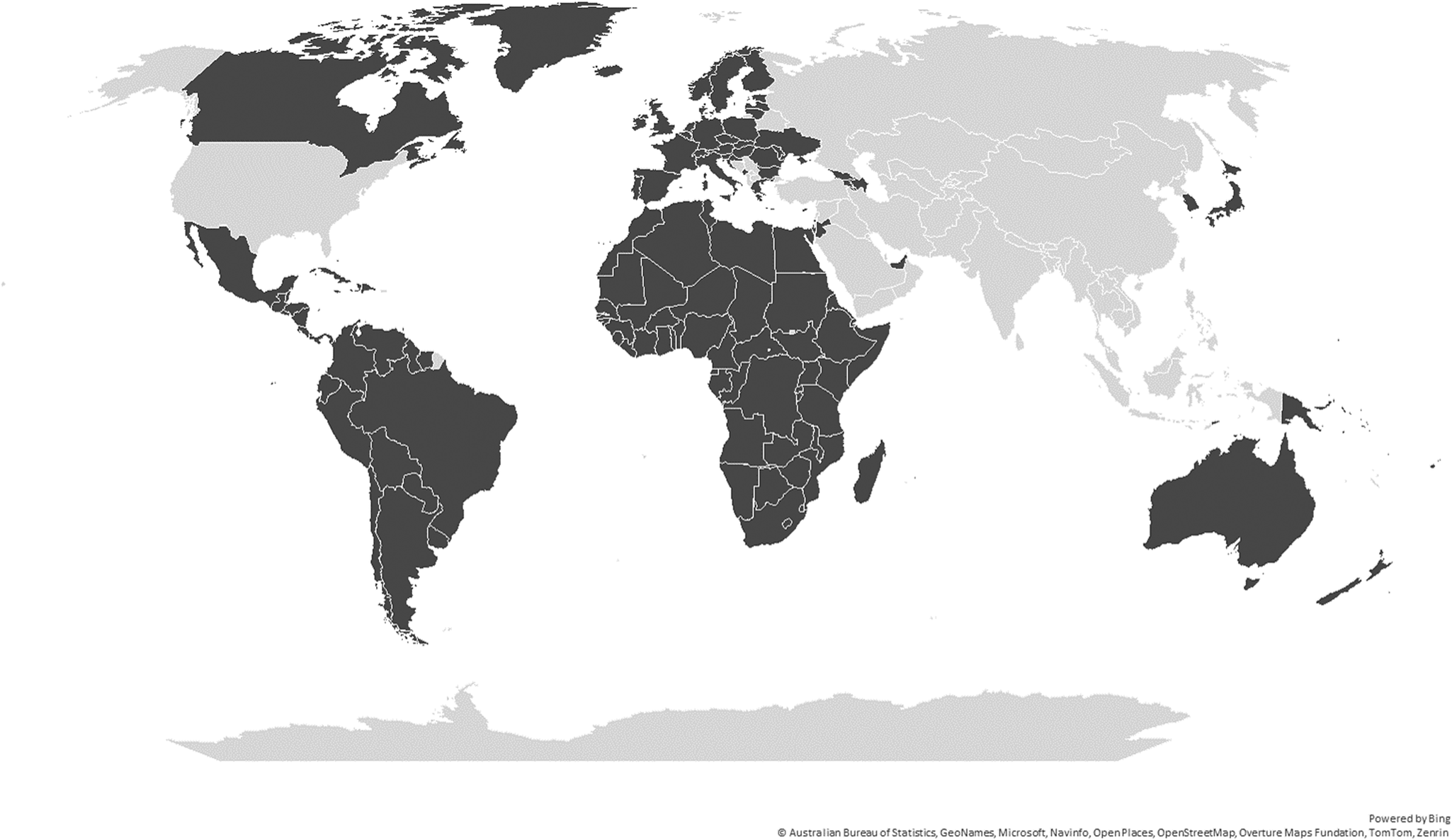
An ambitious treaty with obligations on production, chemicals, design and finance will advance human rights, and the opposite is true. Human rights aspects could be incorporated across the treaty text, including the preamble, opening provisions, control measures and implementation articles. During the sessions of the Intergovernmental Negotiating Committee (INC), the majority of countries have demonstrated support for the treaty to be underpinned by a human rights-based approach. Considering the statements made on behalf of groups of states,Footnote 1 this support was demonstrated by the African Group (2022, 2023, 2024), the Latin American and Caribbean States (2022, 2023a, 2023b, 2024), the Alliance of Small Island States (2023, 2024), the High Ambition Coalition to End Plastic Pollution (HAC, 2024) and the European Union (2023, 2024), which represent 171 countries (Figure 1).

Figure 1. Countries that have demonstrated support in including a human rights approach to the Global Plastic Treaty, based on statements made by groups of states from INC-1 to INC-5.1.

The preamble (the opening statement of an international treaty used to interpret its meaning and purpose) of the current non-paperFootnote 2 references the concern that plastic pollution presents “a serious environmental and human health problem, negatively impacting the environmental, social and economic dimensions of sustainable development.” This statement could be expanded to include reference to human rights, for example, as follows, “… negatively impacting the enjoyment of human rights, including the human right to a clean, healthy and sustainable environment….” Further, there is an opportunity to reaffirm the Universal Declaration of Human Rights, the UN Declaration on the Right to Development (UNGA, 2019), the UNDRIP, the UNGA Resolution on the right to a clean, healthy and sustainable environment and the principles of the Rio Declaration.

Text in the principles of the treaty should call for respect, protection and fulfilment of human rights for the benefit of present and future generations. The right to development, also addressed in the Rio declaration, and to equitably meet developmental and environmental needs of present and future generations should be tempered with the responsibility to ensure that activities within States’ jurisdiction or control do not cause damage to the environment of other States or of areas beyond the limits of national jurisdiction and the rights to participation, access to information and access to justice in environmental matters.

There are also opportunities to include human rights in other articles. Article 3 concerning plastic products refers to a review committee that should be founded on science and knowledge, including independent science and Indigenous and local knowledge. This should be done in a manner that ensures participation, representation and transparent sharing of data and information that is free of conflicts of interest. Furthermore, a subsidiary body is referenced in Article 20 bis, and while the composition and mandate of this body are yet to be determined, its work and impact will be strengthened by consideration of the human rights to science, to information and knowledge and participation. Article 10 on the just transition could be strengthened to explicitly include obligations to reduce inequalities and poverty, promote decent work, opportunities and livelihoods, enhance social protection and the enjoyment of rights and ensure that no one is left behind.

It is in governments’ interests to not only take these issues seriously, but to express their sincerity through supporting the enshrinement of human rights concerns in the Treaty, since they will risk future legal challenges for failing to protect citizens from the harms of plastic pollution (Varvastian, Reference Varvastian2025). Only through a rights-based approach can the Treaty, which reinforces both human rights and its own laudable objectives, be successful.

Open peer review

To view the open peer review materials for this article, please visit http://doi.org/10.1017/plc.2025.10017.

Author contribution

BCA: Conceptualization, writing, reviewing and editing. NG: Analysis, writing, reviewing and editing. PS: Writing, reviewing and editing.

Financial support

No financial support was available for this work.

Competing interests

The authors are members of the Scientists’ Coalition for an Effective Plastics Treaty.
Footnotes

1 Statement analysis was done by downloading all statements on behalf of a group of states from the INC website, translating, where needed, to English using ChatGPT and running a text search for “human rights” using NVivo R15.0.0. All the selected statements are provided in the reference list.

2 Chair’s text from December 1, 2024.

References

African Group (2022) Statement by the African Group at the First Session of the Intergovernmental Negotiating Committee to Develop an International Legally Binding Instrument on Plastic Pollution, Including in the Marine Environment. Available at https://resolutions.unep.org/resolutions/uploads/all_statements_made_by_african_group_during_inc1.pdf (accessed 13 May 2025).Google Scholar
African Group (2023) Statement by the African Group at the Third Session of the Intergovernmental Negotiating Committee to Develop an International Legally Binding Instrument on Plastic Pollution, Including in the Marine Environment. Available at https://resolutions.unep.org/resolutions/uploads/africagroup_cg3.pdf (accessed 13 May 2025).Google Scholar
African Group (2024) Statement by the African Group at the Third Session of the Intergovernmental Negotiating Committee to Develop an International Legally Binding Instrument on Plastic Pollution, Including in the Marine Environment. Available at https://resolutions.unep.org/incres/uploads/agn_statements_for_cg_4_preamble_principles_scope_definitions_26-11-24_0.pdf (accessed 13 May 2025).Google Scholar
Alliance of Small Island States (2023) Statement by the Alliance of Small Island States at the Third Session of the Intergovernmental Negotiating Committee to Develop an International Legally Binding Instrument on Plastic Pollution, Including in the Marine Environment. Available at https://resolutions.unep.org/resolutions/uploads/aosiscg3.pdf (accessed 13 May 2025).Google Scholar
Alliance of Small Island States (2024) Statement by the Alliance of Small Island States at the Fourth Session of the Intergovernmental Negotiating Committee to Develop an International Legally Binding Instrument on Plastic Pollution, Including in the Marine Environment. Available at https://resolutions.unep.org/incres/uploads/part_i_-_principles_pdf.pdf (accessed 13 May 2025).Google Scholar
Barritt, E (2024) The Aarhus convention and the latent right to a healthy environment. Journal of Environmental Law 36, 6784. https://doi.org/10.1093/jel/eqae003.CrossRefGoogle Scholar
Brander, SM, Senathirajah, K, Fernandez, MO, Weis, JS, Kumar, E, Jahnke, A, Hartmann, NB, Alava, JJ, Farrelly, T, Almroth, BC, Groh, KJ, Syberg, K, Buerkert, JS, Abeynayaka, A, Booth, AM, Cousin, X, Herzke, D, Monclús, L, Morales-Caselles, C, Bonisoli-Alquati, A, Al-Jaibachi, R and Wagner, M. (2024) The time for ambitious action is now: Science-based recommendations for plastic chemicals to inform an effective global plastic treaty. Science of the Total Environment 949, 174881. https://doi.org/10.1016/j.scitotenv.2024.174881.CrossRefGoogle ScholarPubMed
Chen, Y, Wang, Y, Hu, B and Su, L (2025) Drinking water network as a potential pathway for micro- and Nanoplastics exposure to human. A Mini Review. Water 17(8), 1188. https://doi.org/10.3390/w17081188.Google Scholar
Cordes, EE, Jones, DOB, Schlacher, TA, Amon, DJ, Bernardino, AF, Brooke, S, Carney, R, DeLeo, DM, Dunlop, KM, Escobar-Briones, EG, Gates, AR, Génio, L, Gobin, J, Henry, L-A, Herrera, S, Hoyt, S, Joye, M, Kark, S, Mestre, NC, Metaxas, A, Pfeifer, S, Sink, K, Sweetman, AK and Witte, U (2016) Environmental impacts of the deep-water oil and gas industry: A review to guide management strategies. Frontiers in Environmental Science 4, 116. https://doi.org/10.3389/fenvs.2016.00058.CrossRefGoogle Scholar
Cowger, W, Willis, KA, Bullock, S, Conlon, K, Emmanuel, J, Erdle, LM, Eriksen, M, Farrelly, TA, Hardesty, BD and Kerge, K (2024) Global producer responsibility for plastic pollution. Science Advances 10(17), eadj8275. http://doi.org/10.1126/sciadv.adj8275.CrossRefGoogle ScholarPubMed
Dauvergne, P (2023) The necessity of justice for a fair, legitimate, and effective treaty on plastic pollution. Marine Policy 155, 105785. http://doi.org/10.1016/j.marpol.2023.105785.CrossRefGoogle Scholar
ECLAC (2018) Regional Agreement on Access to Information, Public Participation and Justice in Environmental Matters in Latin America and the Caribbean, Escazú, https://repositorio.cepal.org/entities/publication/86cae662-f81c-4b45-a04a-058e8d26143c.Google Scholar
Environmental Governance Programme (2022) The Escazú Agreement, Human Rights and Healthy Ecosystems. Available at https://www.learningfornature.org/wp-content/uploads/2019/08/Escazu-Dialogue-Series-Report-Human-Rights-and-Healthy-Ecosustems-11.03.2022-Compressed.pdf (accessed 13 May 2025).Google Scholar
European Union (2023) Statement by the European Union at the Second Session of the Intergovernmental Negotiating Committee to Develop an International Legally Binding Instrument on Plastic Pollution, Including in the Marine Environment. Available at https://resolutions.unep.org/resolutions/uploads/eu_0.pdf (accessed 13 May 2025).Google Scholar
European Union (2024) Statement by the European Union at the Fourth Session of the Intergovernmental Negotiating Committee to Develop an International Legally Binding Instrument on Plastic Pollution, Including in the Marine Environment. Available at https://resolutions.unep.org/incres/uploads/european_union_just_transition.pdf (accessed 13 May 2025).Google Scholar
HAC (2024) Statement by the High Ambition Coalition to End Plastic Pollution at the Fourth Session of the Intergovernmental Negotiating Committee to Develop an International Legally Binding Instrument on Plastic Pollution, Including in the Marine Environment. Available at https://resolutions.unep.org/incres/uploads/peter_malawi_statement_on_behalf_of_hac_1.pdf (accessed 13 May 2025).Google Scholar
ICCPR (1966) International Covenant on Civil and Political Rights (ICCPR), United National General Assembly. Available at: https://www.ohchr.org/sites/default/files/ccpr.pdf (accessed 13 May 2025).Google Scholar
ICESR (1966) International Covenant on Economic, Social and Cultural Rights, United Nations General Assembly. Available at: https://www.ohchr.org/sites/default/files/cescr.pdf (accessed 13 May 2025).Google Scholar
Landrigan, PJ, Fuller, R, Acosta, NJR, Adeyi, O, Arnold, R, Basu, N (Nil), Baldé, AB, Bertollini, R, Bose-O’Reilly, S, Boufford, JI, Breysse, PN, Chiles, T, Mahidol, C, Coll-Seck, AM, Cropper, ML, Fobil, J, Fuster, V, Greenstone, M, Haines, A, Hanrahan, D, Hunter, D, Khare, M, Krupnick, A, Lanphear, B, Lohani, B, Martin, K, Mathiasen, KV, McTeer, MA, Murray, CJL, Ndahimananjara, JD, Perera, F, Potočnik, J, Preker, AS, Ramesh, J, Rockström, J, Salinas, C, Samson, LD, Sandilya, K, Sly, PD, Smith, KR, Steiner, A, Stewart, RB, Suk, WA, van, Schayck OCP, Yadama, GN, Yumkella, K and Zhong, M (2018) The Lancet Commission on pollution and health. The Lancet 391(10119), 462512. https://doi.org/10.1016/S0140-6736(17)32345-0.CrossRefGoogle ScholarPubMed
Latin American and Caribbean States (2022) Statement by the Latin American and Caribbean States at First Session of the Intergovernmental Negotiating Committee to Develop an International Legally Binding Instrument on Plastic Pollution, Including in the Marine Environment. Available at https://resolutions.unep.org/resolutions/uploads/grulac_inc1_statements_0.pdf (accessed 13 May 2025).Google Scholar
Latin American and Caribbean States (2023a) Statement by the Latin American and Caribbean States at the Second Session of the Intergovernmental Negotiating Committee to Develop an International Legally Binding Instrument on Plastic Pollution, Including in the Marine Environment. Available at https://wedocs.unep.org/bitstream/handle/20.500.11822/42594/GRULACstatement_English.pdf (accessed 13 May 2025).Google Scholar
Latin American and Caribbean States (2023b) Statement by the Latin American and Caribbean States at the Third Session of the Intergovernmental Negotiating Committee to Develop an International Legally Binding Instrument on Plastic Pollution, Including in the Marine Environment. Available at https://resolutions.unep.org/resolutions/uploads/grulac.pdf (accessed 13 May 2025).Google Scholar
Latin American and Caribbean States (2024) Statement by the Latin American and Caribbean States at the Fourth Session of the Intergovernmental Negotiating Committee to Develop an International Legally Binding Instrument on Plastic Pollution, Including in the Marine Environment. Available at https://resolutions.unep.org/incres/uploads/grulac_inc-4_opening_statement_-_final.pdf (accessed 13 May 2025).Google Scholar
Mah, A (2021) Future-proofing capitalism: The paradox of the circular economy for plastics. Global Environmental Politics 21(2), 121142. http://doi.org/10.1162/glep_a_00594.CrossRefGoogle Scholar
O’Hare, P and Nøklebye, E (2024) The human face of the UN plastics treaty”? The role of waste pickers in intergovernmental negotiations to end plastic pollution and ensure a just transition. Cambridge Prism Plastics 2, e12. http://doi.org/10.1017/plc.2024.12.CrossRefGoogle Scholar
O’Meara, N (2023) Human rights and the Global Plastics Treaty to protect health, ocean ecosystems and our climate. The International Journal of Marine and Coastal Law. 38(3), 480515. http://doi.org/10.1163/15718085-bja10143.CrossRefGoogle Scholar
Schmidt, C, Kühnel, D, Materić, D, Stubenrauch, J, Schubert, K, Luo, A, Wendt-Potthoff, K and Jahnke, A (2024) A multidisciplinary perspective on the role of plastic pollution in the triple planetary crisis. Environment International 193(109059), 18. http://doi.org/10.1016/j.envint.2024.109059.CrossRefGoogle ScholarPubMed
Stoett, P (2022) Plastic pollution: A global challenge in need of multi-level justice-Centered solutions. One Earth 5(6), 593596. https://doi.org/10.1016/j.oneear.2022.05.017.CrossRefGoogle Scholar
Stoett, P, Scrich, V, Elliff, C, Andrade, M, Grilli, NM and Turra, A (2024) Global plastic pollution, sustainable development, and plastic justice. World Development 184, 19. http://doi.org/10.1016/j.worlddev.2024.106756.CrossRefGoogle Scholar
Symeonides, C, Aromataris, E, Mulders, Y, Dizon, J, Stern, C, Barker, TH, Whitehorn, A, Pollock, D, Marin, T and Dunlop, S (2024) An umbrella review of meta-analyses evaluating associations between human health and exposure to major classes of plastic-associated chemicals. Annals of Global Health 90((1), 52. https://doi.org/10.5334/aogh.4459.CrossRefGoogle ScholarPubMed
Teymoorian, T, Munoz, G, Vo Duy, S, Liu, J and Sauvé, S (2023) Tracking PFAS in drinking water: A review of analytical methods and worldwide occurrence trends in tap water and bottled water. ACS ES&T Water 3(2), 246261. https://doi.org/10.1021/acsestwater.2c00387.CrossRefGoogle Scholar
Trasande, L, Krithivasan, R, Park, K, Obsekov, V and Belliveau, M (2024) Chemicals used in plastic materials: An estimate of the attributable disease burden and costs in the United States. Journal of the Endocrine Society 8(2), bvad163. http://doi.org/10.1210/jendso/bvad163.CrossRefGoogle ScholarPubMed
UN (2022) The Human Right to a Clean, Healthy and Sustainable Environment: Draft Resolution (No. A/76/L.75). New York. Retrieved from https://digitallibrary.un.org/record/3982508 (accessed 13 May 2025).Google Scholar
UNDRIP (2007) United Nations Declaration on the Rights of Indigenous Peoples. Available at: https://www.un.org/development/desa/indigenouspeoples/wp-content/uploads/sites/19/2018/11/UNDRIP_E_web.pdf (accessed 13 May 2025).Google Scholar
UNEP (2021) Neglected: Environmental Justice Impacts of Marine Litter and Plastic Pollution. Nairobi.Google Scholar
UNGA (2019) Promotion and Protection of All Human Rights, Civil, Political, Economic, Social and Cultural Rights, Including the Right to Development. http://doi.org/10.1163/2210-7975_HRD-9970-2016149 (accessed 13 May 2025).CrossRefGoogle Scholar
UNGA (2022) Corporate Influence in the Political and Regulatory Sphere: Ensuring Business Practice in Line with the Guiding Principles on Business and Human Rights. https://digitallibrary.un.org/record/3984698?v=pdf.Google Scholar
Varvastian, S (2025) Human Rights Approaches to Planetary Crises: From Climate Change to Plastic Pollution. Routledge, Taylor & Francis group.Google Scholar
Villarrubia-Gómez, P, Almroth, BC, Eriksen, M, Ryberg, M and Cornell, SE (2024) Plastics pollution exacerbates the impacts of all planetary boundaries. One Earth. https://doi.org/10.1016/j.oneear.2024.10.017.CrossRefGoogle Scholar
Vladimirova, V (2023). Indigenous people living with waste and pollution in the Arctic. In Mörner, N (ed.), Ecological Concerns in Transition: A Comparative Study on Responses to Waste and Environmental Destruction in the Region. Huddinge: Södertörn University, Centre for Baltic and East European Studies (CBEES), pp. 4558.Google Scholar
Wagner, M, Monclús, L, Arp, HPH, Groh, KJ, Løseth, ME, Muncke, J, Wang, Z and Wolf, R(2024) State of the science on plastic chemicals - Identifying and addressing chemicals and polymers of concern. NTNU Open. Retrieved from https://doi.org/10.5281/zenodo.10701706.CrossRefGoogle Scholar
Watts, N, Adger, WN, Ayeb-Karlsson, S, Bai, Y, Byass, P, Campbell-Lendrum, D, Colbourn, T, Cox, P, Davies, M, Depledge, M, Depoux, A, Dominguez-Salas, P, Drummond, P, Ekins, P, Flahault, A, Grace, D, Graham, H, Haines, A, Hamilton, I, Johnson, A, Kelman, I, Kovats, S, Liang, L, Lott, M, Lowe, R, Luo, Y, Mace, G, Maslin, M, Morrissey, K, Murray, K, Neville, T, Nilsson, M, Oreszczyn, T, Parthemore, C, Pencheon, D, Robinson, E, Schütte, S, Shumake-Guillemot, J, Vineis, P, Wilkinson, P, Wheeler, N, Xu, B, Yang, J, Yin, Y, Yu, C, Gong, P, Montgomery, H and Costello, A (2017) The lancet countdown: Tracking progress on health and climate change. The Lancet 389(10074), 11511164. https://doi.org/10.1016/S0140-6736(16)32124-9.CrossRefGoogle ScholarPubMed
Yates, J, Deeney, M, Rolker, HB, White, H, Kalamatianou, S and Kadiyala, S (2021) Effects of plastics in the food system on human health, food security, and the environment: A systematic scoping review. The Lancet Planetary Health 5, S18. https://doi.org/10.1016/S2542-5196(21)00102-9.CrossRefGoogle Scholar
Yates, J, Deeney, M, Muncke, J, Carney Almroth, B, Dignac, M-F, Castillo, AC, Courtene-Jones, W, Kadiyala, S, Kumar, E, Stoett, P, Wang, M and Farrelly, T (2025) Plastics matter in the food system. Communications Earth & Environment 6(1), 15. https://doi.org/10.1038/s43247-025-02105-7.CrossRefGoogle ScholarPubMed
Figure 0

Figure 1. Countries that have demonstrated support in including a human rights approach to the Global Plastic Treaty, based on statements made by groups of states from INC-1 to INC-5.1.

Author comment: Including a human rights approach in the Global Plastics Treaty can ensure protection of people and the environment — R0/PR1

Comments

Dear editors,

Thank you very much for the invitation to submit this commentary. We feel that an ambitious treaty with obligations on production, chemicals, design, finance will advance human rights. And the opposite is true. We hope that publishing this will enable further discussions on a rights based approach and support member states in strengthening these rights in the treaty text.

Sincerely, on behalf of all authors,

Bethanie Carney Almroth

Review: Including a human rights approach in the Global Plastics Treaty can ensure protection of people and the environment — R0/PR2

Conflict of interest statement

Reviewer declares none.

Comments

Dear Bethanie and team,

Thank you for submitting your letter to Cambridge Prisms: Plastics. As is usual with letters to the editor, your submission has not undergone formal peer review. However, as Editor-in-Chief, I have reviewed your letter and would like to offer some editorial feedback aimed at enhancing its clarity and impact. While I encourage you to consider and, if you find it helpful, incorporate this feedback, please be assured that the publication of your letter is not contingent upon making these changes.

Editorial notes:

Page 2, Line 26. Should “its” be “the”?

Page 2, Line 34. I think “ICCPR” and “ICESCR” should be given in full in the abstract.

Page 4, Line 43. You refer to “plastics” pollution, but have used “plastic” pollution elsewhere. Either formulation works, but please check the letter for internal consistency.

Page 4, Line 46. In the title, I think there should either be an apostrophe at the end of “states” (to (States’) or the word should be “state”.

Page 4, Line 50-51. The first sentence of the paragraph is difficult to follow. Please have a look and edit for clarity.

Page 5, Line 27. Should “indicated” be “indicates”?

Recommendation: Including a human rights approach in the Global Plastics Treaty can ensure protection of people and the environment — R0/PR3

Comments

No accompanying comment.

Decision: Including a human rights approach in the Global Plastics Treaty can ensure protection of people and the environment — R0/PR4

Comments

No accompanying comment.

Author comment: Including a human rights approach in the Global Plastics Treaty can ensure protection of people and the environment — R1/PR5

Comments

Please find the revised copy of our letter, exploring the implementation of human rights in the plastics treaty.

Review: Including a human rights approach in the Global Plastics Treaty can ensure protection of people and the environment — R1/PR6

Conflict of interest statement

Reviewer declares none.

Comments

Dear Bethanie and team,

Thank you for submitting the revised version of your letter. I am pleased to confirm that it has been accepted for publication in Cambridge Prisms: Plastics. Your contribution adds an extremely valuable perspective to the discussion ahead on INC-5.2, and I appreciate your engagement with the review process. I look forward to sharing your letter as part of the upcoming collection.

Many thanks again for your letter, and best wishes

Steve

Recommendation: Including a human rights approach in the Global Plastics Treaty can ensure protection of people and the environment — R1/PR7

Comments

No accompanying comment.

Decision: Including a human rights approach in the Global Plastics Treaty can ensure protection of people and the environment — R1/PR8

Comments

No accompanying comment.
