


Introduction
In high-income societies, most individuals continue to express a desire to become parents, with two children often considered the normative ideal (Testa, Reference Testa2012). Yet across these contexts, family formation is increasingly postponed into ages when fecundity naturally declines, and the global prevalence of infertility is rising (Mascarenhas et al., Reference Mascarenhas, Flaxman, Boerma, Vanderpoel and Stevens2012). These trends contribute to a growing misalignment between reproductive aspirations and biological timing. While reproductive technologies have expanded opportunities for later-life parenthood, individuals’ perceived ability to conceive, even in the absence of clinical diagnoses, may shape psychological well-being and the stability of intimate relationships. Such perceptions are not only private reflections but also social signals, particularly in long-term partnerships.
Over recent decades, family formation patterns have changed substantially. Marriage, parenthood, and home-leaving have become increasingly delayed (Gauthier, Reference Gauthier2007; Billari and Liefbroer, Reference Billari and Liefbroer2010), and rates of permanent childlessness have grown, particularly among women born in the 1970s (Kreyenfeld and Konietzka, Reference Konietzka2017). These shifts have contributed to more diverse family trajectories, including nonmarital cohabitation, separation, and repartnering (Heuveline and Timberlake, Reference Heuveline and Timberlake2004; Thomson, Reference Thomson2014). Despite these changes, the aspiration to have children remains widespread, and many individuals fall short of their intended family size, resulting in a persistent fertility gap across Europe (Beaujouan and Berghammer, Reference Beaujouan and Berghammer2019).
In this context, perceptions of fecundity may function as a biosocial mechanism linking reproductive goals with life course outcomes. While infertility is commonly defined as a clinical condition, the inability to conceive after 12 months of unprotected intercourse (Loftus and Andriot, Reference Loftus and Andriot2012), subjective perceptions of one’s reproductive potential, whether accurate or not, may carry significant consequences for self-concept, emotional well-being, and partnership dynamics (Passet-Wittig et al., Reference Passet-Wittig, Bujard, McQuillan and Greil2020; Dourou et al., Reference Dourou, Gourounti, Lykeridou, Gaitanou, Petrogiannis and Sarantaki2023). Concerns about subfecundity may emerge well before any medical assessment and could influence life satisfaction and relational outcomes during key reproductive years.
Despite its relevance, this subjective dimension of fecundity has received limited attention in population-based research. Most existing studies focus on individuals undergoing infertility treatment, who represent a selective subgroup with strong childbearing intentions and distinct socioeconomic profiles (McQuillan et al., Reference McQuillan, Torres Stone and Greil2007). Only one study to date has examined the longitudinal association between perceived fecundity and life satisfaction in the general population (McQuillan et al., Reference McQuillan, Passet-Wittig, Greil and Bujard2022), and very little is known about how these perceptions relate to relationship satisfaction or union dissolution.
Moreover, while fertility is inherently a relational experience, the role of a partner’s perceived fecundity (PPF) remains virtually unexplored. Fertility-related concerns often unfold within intimate partnerships, where reproductive goals, expectations, and challenges are negotiated jointly. In this context, how individuals perceive their partner’s fecundity may be just as consequential as their own. These perceptions can influence relationship satisfaction, shared timing preferences for parenthood, and decisions regarding reproductive planning or treatment-seeking (Greil et al., Reference Greil, Slauson-Blevins and McQuillan2010; Thoma et al., Reference Thoma, McLain, Louis, King, Trumble, Sundaram and Louis2013). They may also affect how emotional support, responsibility, or blame are distributed within the relationship, especially in contexts of uncertainty or unfulfilled aspirations (Peterson et al., Reference Peterson, Newton, Rosen and Schulman2006). Failing to consider this relational dimension may obscure key dynamics in how subjective fecundity shapes life course trajectories and emotional outcomes.
This study addresses these gaps by examining how changes in both individual and partner perceptions of fecundity are associated with life satisfaction, relationship quality, and separation. Drawing on 13 waves of the German Family Panel (pairfam), individual fixed-effects models are estimated to assess within-person change over time.
This study contributes to the literature by adopting a life course and biosocial perspective to examine how subjective reproductive potential functions as a latent stressor that shapes emotional well-being and relationship dynamics at the population level. The analysis moves beyond the individual by acknowledging that perceptions of reproductive potential are embedded within intimate partnerships and may have implications not only for personal well-being but also for relationship quality and stability. Because childbearing and attempts to conceive are typically joint endeavors, how one partner perceives the other’s fecundity may influence expectations, emotional support, and future planning. To capture this relational dimension, both the individual’s own perceived fecundity (OPF) and perceptions of the partner’s fecundity are incorporated. This approach allows for an examination of how perceptions of reproductive potential within couples are associated with life satisfaction, relationship satisfaction, and the risk of separation. In an era marked by delayed parenthood and rising infertility rates, understanding how subjective perceptions of fecundity – both self and partner – affect well-being and couple stability is increasingly critical. As reproductive timing becomes more misaligned with biological constraints, the role of perceived fecundity emerges as a key biosocial factor in shaping family formation trajectories and relationship outcomes.
Background
Perceived (sub)fecundity
Fecundity is commonly defined in demographic research as the biological capacity to reproduce, regardless of pregnancy intentions (Wood, Reference Wood1989). In contrast, fertility refers to the actual realization of that capacity, measured by live births and, in some cases, stillbirths (Smarr et al., Reference Smarr, Sapra, Gemmill, Kahn, Wise, Lynch, Factor-Litvak, Mumford, Skakkebaek, Slama, Lobdell, Stanford, Jensen, Boyle, Eisenberg, Turek, Sundaram, Thoma and Buck Louis2017). At the individual level, fecundity is not a fixed trait. It can vary over time, may fluctuate due to physiological, psychological, or situational factors, and is often difficult to measure directly. A couple’s fecundity is likewise dynamic, shaped by the reproductive health of both partners. Fecundity challenges may emerge, resolve, persist, or respond to medical intervention, underscoring its fluid nature.
While population-level fertility can be observed through birth rates, directly measuring fecundity, particularly at the couple level, remains methodologically challenging. Researchers, therefore, often rely on proxy indicators. For women, these include menstrual regularity, hormonal markers (e.g., anti-Müllerian hormone), and ovulation cycles (Steiner, Reference Steiner2013; Pincheira-Donoso and Hunt, Reference Pincheira-Donoso and Hunt2017). Male fecundity is typically assessed through semen parameters, hormonal profiles, and testicular volume (Olsen and Ramlau-Hansen, Reference Olsen and Ramlau-Hansen2014). Time-to-pregnancy, the number of cycles or months needed to conceive, is a common retrospective indicator of couple fecundability (Hong et al., Reference Hong, Yin, Wang, Zhao, Yu and Wang2022).
Given the cost and invasiveness of clinical measures, representative surveys rely on self-reported perceptions of fecundity (e.g., pairfam; Brüderl et al., Reference Brüderl, Drobnic, Hank, Neyer, Walper, Alt, Borschel, Bozoyan, Garrett, Geissler, Gonzalez Avilés, Gröpler, Hajek, Herzig, Lenke, Lorenz, Lutz, Peter, Preetz and Wetzel2022). These perceptions reflect whether individuals believe they would be able to have a child, typically without formal diagnosis or testing. Research suggests that perceived fecundity fluctuates over time, often in response to life course events and relational dynamics (Passet-Wittig et al., Reference Passet-Wittig, Bujard, McQuillan and Greil2020).
While perceived fecundity might be used as a subjective proxy for biological fertility, it can also be viewed as a meaningful and distinct dimension of reproductive experience. Perceptions of reproductive potential are shaped not only by personal experience and age but also by broader social and cultural cues related to gender and fertility expectations (Greil et al., Reference Greil, Slauson-Blevins and McQuillan2010). These perceptions, regardless of their clinical accuracy, may influence individuals’ health behavior, life satisfaction and planning, and relationship dynamics. In this study, we perceived fecundity is approached as a dynamic indicator that may have implications for well-being and couple outcomes even in the absence of a formal diagnosis or medical confirmation.
Perceived fecundity, life and relationship satisfaction, and the risk of union dissolution
Despite the second demographic transition, which brought delayed family formation, greater acceptance of voluntary childlessness, and declining fertility rates across high-income societies (van de Kaa, Reference van de Kaa1987; Lesthaeghe, Reference Lesthaeghe2014), parenthood remains a central life goal. For example, about 80% of European women born in the 1970s became mothers (Kreyenfeld and Konietzka, Reference Konietzka2017). This persistence of parenthood, despite broader social changes that might be expected to further reduce fertility, has prompted scholars to ask why fertility is not even lower (Kohler and Mencarini, Reference Kohler and Mencarini2016). A substantial body of literature has linked childbearing to well-being and life satisfaction. Drawing on value-of-children theories and evolutionary psychology, some studies emphasize that children fulfill biological, social, and emotional needs (Fawcett, Reference Fawcett1988; Friedman et al., Reference Friedman, Hechter and Kanazawa1994; Morgan and King, Reference Morgan and King2001; Kohler, Reference Kohler, Kaufmann and Wilcox2013). Longitudinal research shows that childbirth tends to produce a short-term increase in life satisfaction, though this boost diminishes over time, consistent with set-point theory (Headey and Wearing, Reference Headey and Wearing1989; Margolis and Myrskylä, Reference Margolis and Myrskylä2011, Reference Margolis and Myrskylä2015). One explanation is that individuals overestimate the long-term happiness associated with parenthood before the event occurs (Aassve et al., Reference Aassve, Goisis and Sironi2012).
However, the perception of foregone parenthood opportunities may also influence well-being. Individuals who experience diminished chances of childbearing – whether due to age, relational instability, or health concerns – may report lower satisfaction and greater distress, particularly when parenthood remains a salient life goal (McQuillan et al., Reference McQuillan, Greil, Shreffler, Wonch-Hill, Gentzler and Hathcoat2012). The psychological burden of subfecundity can take various forms: fears of missing out on parenthood, anxiety over biological clocks, or uncertainty about the future of a relationship. Notably, infertility is often experienced as a dyadic stressor that affects both partners, even when the medical cause lies with only one (Johnson and Johnson, Reference Johnson and Johnson2009).
Research on dyadic stress suggests that challenges faced by one partner may spill over into the relationship as a whole (Karney et al., Reference Karney, Story, Bradbury, Revenson, ayser and Bodenmann2005; Randall and Bodenmann, Reference Randall and Bodenmann2009). Perceived declines in fecundity – whether in oneself or one’s partner – can act as such stressors. They may prompt emotional strain, reduce life satisfaction, or increase relational costs, especially when the couple strongly desires children (Martins et al., Reference Martins, Peterson, Almeida, Mesquita-Guimarães and Costa2014). From the perspective of social exchange theory (Kelley, Reference Kelley1959), declining confidence in the relationship’s capacity to yield shared goals, such as parenthood, may reduce commitment and increase the risk of dissolution (Nakonezny and Denton, Reference Nakonezny and Denton2008).
While early studies suggested that infertility could increase relational strain (Greil, Reference Greil1997), more recent evidence is mixed. A meta-analysis by Luk and Loke (Reference Luk and Loke2015) found inconsistent effects of infertility on relationship quality and well-being, with outcomes largely depending on coping strategies and partner support. Couples with supportive dynamics were more likely to adapt positively, while those lacking support experienced distress and dissatisfaction.
Importantly, most of this literature relies on cross-sectional data or samples limited to clinical populations. This limits the ability to understand the dynamics of perceived fecundity in the general population and to capture how perceptions change over time.
Own perceived fecundity (OPF) vs. partner’s perceived fecundity (PPF)
Extending prior research, this study differentiates between the respondent’s OPF and their perception of their partner’s fecundity (PPF). While both may reflect broader fertility expectations, they may have distinct implications. If the effects of perceived fecundity on life satisfaction operate through general concerns about becoming a parent, the respondent’s own perceived fecundity and their perception of their partner’s fecundity may have similar associations. This is especially plausible in cases where perceptions are based on intuition or age-related concerns rather than clinical diagnosis.
However, when considering relationship satisfaction and the risk of union dissolution, the own perceived and PPF may diverge. A decline in one’s own fecundity may be internalized as a personal concern. In contrast, a decline perceived in the partner’s fecundity could be interpreted as a constraint on the couple’s shared reproductive goals and may raise questions about the viability of the relationship. This asymmetry is especially relevant in partnerships where childbearing is highly valued (Levinger, Reference Levinger1976).
Incorporating the PPF addresses a key gap in the literature. Most research has focused on individuals’ own reproductive concerns, particularly among women, while overlooking the relational context in which such concerns are formed. Yet fertility is rarely an individual matter. How one perceives a partner’s reproductive potential may shape emotional dynamics, reproductive decision-making, and long-term relational investment. The PPF thus introduces a relational dimension that has rarely been addressed in population-based studies. Accordingly, the inclusion of both measures provides a more holistic view of how perceived fertility constraints operate in intimate partnerships.
Gender differences
There are several reasons why there may be gender differences in the consequences of perceived fecundity for life satisfaction, relationship satisfaction, and the risk of separation. Biomedical factors, socialization, and gender roles all contribute to these potential differences. The majority of recent studies support earlier research concluding that infertility is more distressing for women than for men (Anderson et al., Reference Anderson, Sharpe, Rattray and Irvine2003; Peterson et al., Reference Peterson, Newton and Feingold2007; Simionescu et al., Reference Simionescu, Doroftei, Maftei, Obreja, Anton, Grab, Ilea and Anton2021).
Among the early explanations for this disparity were that women have a strong desire to become a parent, whereas men are more concerned with fulfilling the social role of parenthood (Hjelmstedt et al., Reference Hjelmstedt, Andersson, Skoog-Svanberg, Bergh, Boivin and Collins1999). Other researchers posited that women tend to perceive infertility as a distinctive life challenge, while men’s responses to it are akin to their reactions to other issues, such as to conflict within relationships (Andrews et al., Reference Andrews, Abbey and Halman1992; Ying et al., Reference Ying, Wu and Loke2015). This supposed distinction in men’s and women’s perceptions has led scholars to argue that a woman’s experience of infertility is more ‘direct’ and is intricately connected to her self-identity, whereas a man’s experience of infertility is ‘indirect’ and is channeled through his relationship with his wife (Greil, Reference Greil1997; Greil and Johnson, Reference Greil, Johnson, Cockerham, Dingwall and Quah2014).
More recently, however, it has been recognized in the literature that these gender differences are moderated by the sociocultural context (Greil et al., Reference Greil, Slauson-Blevins and McQuillan2010), especially in contexts where pro-natalism is more prevalent and motherhood is more central (Ulrich and Weatherall, Reference Ulrich and Weatherall2000; Parry, Reference Parry2005). In such contexts, women may be expected to have children in order to achieve adult status and to gain acceptance in society (Hollos, Reference Hollos2003). Because fertility is so central in these contexts, traditional understandings of infertility might coexist alongside biomedical interpretations to a greater extent there than in developed nations (Gerrits, Reference Gerrits1997; Dyer et al., Reference Dyer, Abrahams, Mokoena, Lombard and van der Spuy2005), and women in these societies may suffer more than men when they are perceived to be infertile.
Data and methods
Thirteen waves of longitudinal data from the German Family Panel (pairfam; Brüderl et al., Reference Brüderl, Drobnic, Hank, Neyer, Walper, Alt, Borschel, Bozoyan, Garrett, Geissler, Gonzalez Avilés, Gröpler, Hajek, Herzig, Lenke, Lorenz, Lutz, Peter, Preetz and Wetzel2022), a large, nationally representative study that tracks the life courses of individuals in Germany. Launched in 2008, pairfam initially sampled over 12,000 respondents across three birth cohorts (1971–73, 1981–83, and 1991–93), selected from 33,620 addresses in over 300 randomly drawn communities. In wave 2, the DemoDiff extension added 1,489 respondents, focusing on regional differences between East and West Germany. A new youth cohort (2001–2003) and a refresher sample of 6,000 respondents from the younger cohorts were added in wave 11. Attrition was highest after wave 1 (23%) but stabilized around 10% in later waves, consistent with comparable German panel studies (Müller and Castiglioni, Reference Müller, Castiglioni, Schupp and Wolf2015).
The sample is restricted to individuals who were in a romantic relationship in at least one wave (n = 14,279), as the core outcomes, relationship satisfaction and union dissolution, and one key predictor, partner’s perceived fecundity, are only applicable to partnered individuals. Respondents missing data on both their own and their PPF (n = 2,566), as well as those with only a single observation (n = 2,865), are further excluded, since within-person change is central to the analytic strategy. The final analytic sample includes 8,848 individuals and 54,612 person-years. Sample sizes vary slightly across models due to item-level missingness.
Measures
Three outcomes are analyzed: life satisfaction, relationship satisfaction, and union dissolution. The first two are measured using an 11-point scale (0 = ‘extremely dissatisfied’, 10 = ‘extremely satisfied’), a widely validated global indicator (Schimmack et al., Reference Schimmack, Schupp and Wagner2008). Union dissolution is coded as a binary variable that switches from 0 to 1 in the year of separation.
To assess participants’ OPF, the approach of McQuillan and colleagues (Reference McQuillan, Passet-Wittig, Greil and Bujard2022) and Passet-Wittig et al. (Reference Passet-Wittig, Bujard, McQuillan and Greil2020) is followed by using the following question: ‘Some people are not able to procreate naturally. As far as you know, is it physically possible for you to conceive naturally?’ Similarly, thePPF, as rated by the anchor, was derived from the following question: ‘As far as you know, would your partner be able to procreate by natural means?’ Both items featured a four-point scale: (i) definitely yes, (ii) probably yes, (iii) probably no, and (iv) definitely no. This structured approach ensured a standardized evaluation of the perceived fecundity of both the individual and their partner within the study. To facilitate interpretation, the perceived fecundity item is recoded so that higher values correspond to higher levels of perceived fecundity.
Moreover, respondents who were pregnant or whose partners were pregnant were not asked the perceived fecundity questions, as pregnancy signifies fertility. Their own perceived and PPF were treated as definitely yes following McQuillan et al. (Reference McQuillan, Passet-Wittig, Greil and Bujard2022). Similarly, individuals or partners who were sterilized were categorized as definitely no for their respective measures. This strategy avoided excluding relevant groups, especially couples expecting a child, and potentially limited generalizability. Including pregnant and sterilized individuals yielded an additional 369 participants and 4,333 person-years of data. A series of robustness checks is conducted, as detailed in the supplementary analyses section, to ensure the validity of the findings.
Statistical model
To examine how individuals’ own perceived fecundity (OPF) and their partner’s perceived fecundity (PPF) relate to life and relationship satisfaction, as well as the risk of separation, the following equation is employed: $Y_{it}=\alpha _{i}+\beta _{1}X_{it}+\beta _{2}Age_{it}+\beta _{3}Ag{e}_{it}^{2}+\beta _{4}P_{it}+\varepsilon _{it}$
In this model, t indicates the year, i represents the anchor, and ϵ was the error term. Y refers to the three outcomes examined: life satisfaction, relationship satisfaction, and the risk of separation. The same equation is estimated separately for each outcome are included in all models to leverage within-person variation over time and to address potential endogeneity and unobserved heterogeneity in the relationship between perceived fecundity and the outcomes examined. These models control for all time-invariant characteristics of individuals and couples, such as personality traits, preferences, genetic factors, early-life health endowments, and baseline relationship quality, which could confound the effect of perceived fecundity. For instance, individuals with more pessimistic dispositions may both perceive lower fecundity and report lower life or relationship satisfaction. By comparing individuals to themselves over time, this strategy accounts for these stable predispositions and isolates the consequences of within-person changes in perceived fecundity.
Moreover, age effects are included by incorporating linear and quadratic specifications of age (i.e., Age it and Age it 2) into the models, given the likely association between age and fertility patterns as well as the outcome variables. Moreover, parental status (P it ) is controlled for using a dichotomous dummy variable, as it may be related to both the main predictor and the outcomes.
The main predictor, denoted by X, refers to either OPF or PPF. To address potential collinearity issues arising from the likely correlation between own perceived and PPF (Passet-Wittig et al., Reference Passet-Wittig, Bujard, McQuillan and Greil2020), their effects are estimated separately.
These models are compared with pooled ordinary least squares (OLS) models using the same sample employed for the fixed-effects analysis. Results from these OLS and FE models are further compared with those from a pooled sample that includes all observations from pairfam. These comparisons provide a benchmark for the FE models and allow an assessment of the magnitude and direction of potential bias due to omitted variables, as well as the impact of sample selection resulting from the use of the FE model. Given that the results of the OLS models are substantively similar regardless of the chosen sample, the estimated effects are presented using FE models and OLS models with the fixed-effects sample.
For analyses focusing on union dissolution, linear probability models are estimated given that the outcome is dichotomous. Moreover, lagged measures of own perceived fecundity (OPF) and PPF are used for two reasons. First, union dissolution is a protracted process, and the ramifications of perceived fecundity variations may not manifest immediately. Employing lagged measures enables the capture of delayed effects of changes in perceived fecundity on the likelihood of separation, allowing for a more nuanced understanding of their relationship. Second, as questions regarding the PPF are not administered to single individuals, the use of lagged measures ensures data availability even when individuals transition to being single in the subsequent wave. Thus, incorporating lagged measures mitigates this issue by ensuring that data on the PPF are available for all observations in the analysis.
Results
Descriptive statistics
Panel A of Table 1 presents descriptive statistics for the three outcome measures and control variables included in the main models, disaggregated by gender and perceived fecundity categories. Individuals were categorized as having high perceived fecundity if they responded definitely or probably yes when asked about their own (OPF) or their partner’s fecundity (PPF), and as having low perceived fecundity if they responded definitely or probably no.
Descriptive statistics (standard deviations in parentheses)

Source: Pairfam (Wave 1–13), release 13.0.
Note: OPF denotes own perceived fecundity, measured as the respondent’s perception of their own ability to conceive naturally. PPF denotes partner-perceived fecundity, measured as the respondent’s perception of their partner’s ability to conceive naturally.
Overall, both life and relationship satisfaction tended to be lower among individuals who perceived either their own or their partner’s fecundity as lower, with no significant gender variations observed. This association was slightly more pronounced for partner’s perceived fecundity than for OPF. Regarding union dissolution, no significant differences emerged across groups, except that men who perceived an inability (versus an ability) of their partner to have children reported higher separation rates.
Panel B of Table 1 reveals the frequency of transitions between states. Regarding the respondent’s own perceived fecundity, around 22% of individuals in the definitely no state shifted to definitely yes in the next wave, while 67% did not change their response. Conversely, transitions from definitely yes to definitely no were much less common, with only 2% of individuals making such a shift, and 86% remaining in the definitely yes category. Similar trends were observed when focusing on the PPF. These findings highlight the dynamic nature of perceived fecundity, despite a general tendency to remain in the same state. While transitions do occur, individuals are more likely to maintain their initial perceptions of OPF and partner’s perceived fecundity.
Figure 1 (Panels A and B) shows the dynamic relationship between age, gender, and perceived fecundity based on growth curve models, where perceived fecundity was the dependent variable, and age and gender were the independent variables. The model included random slopes of age for each individual. The figure used data on both own perceived fecundity and PPF. Until their early thirties, women reported higher perceived fecundity (Panel A, yellow curve). Thereafter, however, women’s scores began to decline more noticeably, with their perceived fecundity becoming lower than that of men (red curve) in later years. These turning points occurred consistently for both OPF (Panel A) and PPF (Panel B) at around ages 31–32 for women and ages 33–34 for men.
Trajectories of perceived fecundity by age and gender (PPF in dashed lines).

Notably, men’s PPF was rated consistently higher than their own perceived fecundity. This gap was particularly pronounced at later ages, when women’s perceptions of their partner’s fecundity reached levels similar to their perceptions of their own fecundity in their twenties.
Regression results
Figure 2 displays the main effects derived from the analysis of the three focal outcomes, with detailed results presented in Appendix Table A1. To obtain a comprehensive understanding of these relationships, two distinct approaches were used. First, OLS models incorporating the fixed-effects sample provided a broad perspective on the relationships between variables. Fixed-effects models were then utilized to isolate the impact of independent variable changes on the outcomes while accounting for all time-invariant individual factors.
Main findings (PPF in dashed lines).

Figure 2. Long description
Panel A: Life satisfaction. This panel features a scatter plot with data points represented by different shapes and colors. The vertical axis is labeled OPF and PPF, while the horizontal axis ranges from 0 to 0.15. Orange circles and triangles represent OPF data, while light blue diamonds and dark blue squares represent PPF data. The orange data points are higher on the vertical axis compared to the blue data points. Panel B: Relationship satisfaction. This panel also features a scatter plot with similar data point representations. The vertical axis is labeled OPF and PPF, and the horizontal axis ranges from 0 to 0.15. The orange data points are again higher on the vertical axis compared to the blue data points. Panel C: Risk of separation. This panel features a scatter plot with the vertical axis labeled OPF and PPF, and the horizontal axis ranging from -0.008 to 0.002. The orange data points are higher on the vertical axis compared to the blue data points, indicating a higher risk of separation for OPF compared to PPF.
Panel A of Figure 2 illustrates a positive correlation between life satisfaction and perceived fecundity. In the fixed-effects models, moving from a lower category of OPF to a higher category corresponded to a 0.05 increase in life satisfaction, whereas having a child was associated with a larger increase of 0.11 in life satisfaction, as shown in the second column of Panel A in Table A1 in the Appendix. This implies that a two-unit increase in respondent’s own perceived fecundity corresponds to roughly the same change in life satisfaction as the transition to parenthood.
Furthermore, a significant association between partner’s perceived fecundity (PPF) and life satisfaction was observed, with effect sizes comparable to those for OPF. Notably, when incorporating fixed-effects models to control for time-constant individual-level characteristics, the effects observed in OLS models diminished considerably. This suggests the presence of unobserved characteristics associated with perceived fecundity and life satisfaction.
Panel B reveals a negative association between declines in own perceived fecundity and PPF and relationship satisfaction. Similar to the results for life satisfaction, the OLS models yielded larger effect sizes, but the decrease was less pronounced in the fixed-effects models. Moreover, decreases in PPF had a stronger negative impact on relationship satisfaction than decreases in OPF.
Panel C shows the relationship between perceived fertility and separation risk. No significant association was found between the respondent’s own perceived fecundity and separation. There is, however, a discernible pattern: individuals were more likely to separate when they reported a decline in PPF. Specifically, a one-unit decline in partner’s perceived fecundity was linked to a 0.5 percentage point increase in the likelihood of separation, which was comparable in effect size to that of parental status (see column 4 located in Panel C of Table A1 in the Appendix). Considering the annual base rate of separation (i.e., 0.15), a decline in PPF corresponded to an increase of approximately 3–4% in the annual base rate of the separation risk.
Interaction effects
To assess whether the effects of perceived fecundity differed across groups, interaction models and full models are estimated. Formal tests are conducted, and the significance of the interaction terms is reported in Tables A2–A4. Figure 3 presents gender-specific analyses exploring the relationship between OPF and the outcomes of interest. Findings regarding gender differences in how the PPF related to the outcomes are reported in Figure A1 of the Appendix, with detailed estimates provided in Table A2. Overall, no significant gender differences were found in the relationship between life satisfaction and either own or PPF.
Analyses by gender (focusing on own perceived fecundity).

In Panel B of Figure 3, estimates regarding relationship satisfaction are presented. Results indicated that higher own perceived fecundity was associated with higher relationship satisfaction, but the magnitude differed by gender. In the fixed-effects models, a one-unit increase in OPF was associated with a 0.066 increase in relationship satisfaction for men, while the interaction term suggested a weaker and significant (at a 10% level) association for women (−0.061; Table A2). Interestingly, while the OLS models indicated that the positive correlation between partner’s perceived fecundity and relationship satisfaction was also stronger among men than among women, these differences were no longer statistically significant once individual fixed effects were introduced. As a result, gender differences in PPF became statistically insignificant in the fixed-effects models.
Moving forward, potential gender differences in the relationship between the risk of separation and perceived fecundity are examined in Panel C. No significant gender disparities are found in the relationship between the respondent’s own perceived fecundity and the risk of separation. Similarly, analyses shown in Panel C of Figure A1 (Appendix) reveal non-significant effects of PPF on separation risk for both genders. Interestingly, although not statistically significant, the estimated effects for men trend slightly stronger in magnitude compared to those for women.
To further examine the role of perceived fecundity in life satisfaction, relationship satisfaction, and union stability, additional analyses are conducted by interacting the respondent’s own and PPF with parental status and age in separate models. These interactions test whether the effects of perceived fecundity vary by the reproductive status and age of individuals. The same three models as in the main analysis are used: OLS pooled sample, OLS fixed-effects sample (singletons are dropped), and fixed-effects models. However, for simplicity and clarity, only the results from the fixed-effects models are reported, as these provide the most rigorous and reliable estimates by controlling for unobserved individual heterogeneity.
Findings were qualitatively similar to those from the OLS models. Figure 4 displays the predicted values of each outcome variable based on the interaction effects for childless respondents and parents (full estimates are provided in Table A3 in the Appendix). The interaction models indicate that the associations between perceived fecundity and well-being were stronger among childless individuals. For example, a one-unit increase in the OPF was associated with a 0.121 increase in life satisfaction among childless respondents, whereas the interaction term with parental status (−0.099; Table A3) indicates a significantly weaker association among parents. Similar patterns were observed for relationship satisfaction and separation risk, where the interaction terms indicate that the effects of perceived fecundity were significantly pronounced less among parents. Moreover, among childless respondents, a one-unit increase in partner’s perceived fecundity was associated with a 0.105 increase in life satisfaction, while the interaction term with parental status (−0.069; Table A3) indicates a weaker association among parents. For relationship satisfaction, the interaction coefficient (−0.057) similarly suggests that the influence of PPF is pronounced less once individuals have children. In the models predicting separation risk, a one-unit decline in partner-perceived fecundity increased the likelihood of separation by about 1.2 percentage points among childless individuals, while the positive interaction term with parental status (0.011; Table A3) indicates that this association is significantly weaker among parents. This implies that perceived fecundity was more important for the life satisfaction and relationship satisfaction of individuals who did not yet have children. Similarly, the effect of PPF on separation risk was stronger and more significant for childless respondents than for parents.
Analyses by interaction with parental status.

Figure 4. Long description
Panel A: Life satisfaction. This panel contains two horizontal bar graphs. The y-axis is labeled with Childless and Parent categories. The x-axis ranges from 0 to 0.15. The orange triangle markers represent OPF-FE, and the blue square markers represent PPF-FE. Childless individuals show higher life satisfaction than parents in both estimation methods. Panel B: Relationship satisfaction. This panel also contains two horizontal bar graphs. The y-axis is labeled with Childless and Parent categories. The x-axis ranges from -0.05 to 0.2. The orange triangle markers represent OPF-FE, and the blue square markers represent PPF-FE. Childless individuals show higher relationship satisfaction than parents in both estimation methods. Panel C: Risk of separation. This panel contains two horizontal bar graphs. The y-axis is labeled with Childless and Parent categories. The x-axis ranges from -0.02 to 0.005. The orange triangle markers represent OPF-FE, and the blue square markers represent PPF-FE. Parents have a higher risk of separation than childless individuals in both estimation methods.
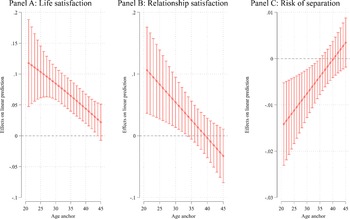
Figure 5 illustrates how the association between the respondent’s own perceived fecundity and three outcomes examined changes by age. The interaction models further indicate that the associations between perceived fecundity and the outcomes decline with age. For example, the coefficient for OPF in the relationship satisfaction model is 0.228, while the interaction term with age (−0.006; Table A4) indicates that the association weakens progressively at older ages. Similar patterns were observed for PPF, where the negative interaction terms suggest that the influence of perceived fecundity on well-being and relationship outcomes becomes smaller as individuals age. This indicates that perceived fecundity is less influential for the life and relationship satisfaction and union stability of older individuals. The same pattern is observed for the effects of partner’s perceived fecundity, as shown in Figure A2 in the Appendix.
Analyses by interacting OPF with age.

Additional robustness checks are conducted, the details of which can be found in the Appendix. First, respondents are excluded if they or their partners experienced pregnancy or sterilization, which were categorized as ‘definitely yes’ and ‘definitely no,’ respectively, in the primary models, acknowledging that these assumptions about perceived fertility may not accurately reflect reported perceptions.
Overall, the findings remain robust to this specification, as indicated in Figure A3 in the Appendix, with two exceptions. While relationship satisfaction was significantly associated with PPF in the fixed-effects modelss it was not significantly associated with the respondent’s own perceived fecundity. Moreover, the significant coefficient for PPF observed in the main models became insignificant in these alternate models. However, further analyses (not displayed) revealed that the risk of separation increased with decreasing PPF among childless individuals and younger respondents. Second, the primary models are replicated by including both own and partner’s perceived fecundity in the same model (refer to Figure A4 in the Appendix).
In additional analyses not shown, the association between OPF and life satisfaction is explored using the full sample, rather than limiting it to partnered individuals, and logit models with random effects at the individual level are employed to assess the risk of separation instead of a linear probability model, yielding similar findings. Moreover, potential differences by socioeconomic status are examined by distinguishing between individuals with tertiary education and those without. These analyses do not reveal meaningful differences across educational groups. Asymmetric effects are also considered, suggesting that the consequences of declines and increases in perceived fecundity may not be the same for the outcomes examined. However, the estimated effects of declines and increases are not significantly different from each other. In addition, a categorical measure of age is used instead of a quadratic specification, given that the age distribution may not be evenly spread across the selected cohorts. The findings are qualitatively robust to this specification. These findings are available from the authors.
Discussion
Evidence suggests that perceptions of one’s ability to have children are not static but evolve over the life course (Passet-Wittig et al., Reference Passet-Wittig, Bujard, McQuillan and Greil2020). These shifting self-assessments may carry meaningful consequences, especially in contexts where parenthood remains a central life goal for many (Johnson-Hanks et al., Reference Johnson-Hanks, Bachrach, Morgan and Kohler2011). This study examined how both an individual’s own perceived fecundity (OPF) and the PPF, as reported by the anchor, relate to life satisfaction, relationship satisfaction, and separation risk. By tracing how subjective perceptions of biological potential are linked to individual and relational outcomes, it extends the literature on the biosocial dimensions of fertility.
Descriptive analyses revealed that both own perceived and PPF declined with age, though this pattern was steeper for women. This gender difference may reflect prevailing beliefs that men’s fecundity remains viable longer than women’s, in line with cultural narratives and biomedical assumptions. Using fixed-effects models to account for all time-invariant individual characteristics, it is found that both the respondent’s own and PPF were significantly associated with reductions in life satisfaction. This finding aligns with earlier work showing the emotional consequences of perceived infertility (McQuillan et al., Reference McQuillan, Passet-Wittig, Greil and Bujard2022). However, while previous research focused solely on individuals’ self-assessments, the present study expands this approach by incorporating perceived partner fecundity, revealing that both measures exert independent effects on life satisfaction even when modeled simultaneously. This robustness highlights the value of adopting a dyadic perspective on fertility, suggesting that individuals do not experience reproductive concerns in isolation, but in relation to their partner’s perceived capacity to conceive. Consequently, fertility perceptions may operate as relational constructs, with implications that extend beyond the self and shape well-being within intimate partnerships.
Importantly, the decline in perceived partner fecundity was more consistently associated with reductions in relationship satisfaction and increased risk of union dissolution than the OPF. This distinction highlights the significance of reproductive perceptions not just as personal concerns, but as shared realities that affect how individuals evaluate their partnerships. When individuals perceive their partner’s reproductive potential to be diminishing, they may view this as a challenge to the couple’s future plans, leading to strain. One possible explanation lies in attribution theory: individuals may internalize their own fecundity issues as personal setbacks, while attributing relationship strain to external sources, such as a partner’s reproductive challenges (Miller and Ross, Reference Miller and Ross1975). Accordingly, the importance of understanding fertility might not just be a biological or individual matter but also a relational construct with implications for couple dynamics.
Comparing pooled OLS and fixed-effects models provides additional insight into the nature of these associations. For life satisfaction, the decrease of coefficients in the fixed-effects models suggests that part of the cross-sectional association may reflect stable individual characteristics, such as pessimistic dispositions or other enduring traits, that are related both to perceived fecundity and to general life satisfaction. In contrast, differences between OLS and fixed-effects estimates were substantially smaller for outcomes on relationship satisfaction and separation risk. This pattern indicates that the relationship outcomes are less driven by stable unobserved heterogeneity and more strongly reflect within-person changes in perceived reproductive potential. Taken together, the consistency between pooled and fixed-effects models suggests that the associations documented are not only artifacts of stable personality differences or baseline relationship quality, but capture meaningful dynamic processes unfolding within individuals and partnerships over time.
Contrary to earlier research suggesting that infertility is more distressing for women (e.g., Anderson et al., Reference Anderson, Sharpe, Rattray and Irvine2003; Peterson et al., Reference Peterson, Newton and Feingold2007), no significant gender differences are found in the effects of perceived fecundity on the outcomes. This divergence may be due to the fact that most prior studies focus on clinical infertility cases or rely on cross-sectional data, which are more susceptible to selection bias and unobserved heterogeneity. For example, individuals who seek infertility treatment, particularly women, may represent a highly selective group with more severe symptoms or stronger emotional investment in childbearing compared to their male counterparts, potentially strengthening observed gender differences. In contrast, the longitudinal fixed-effects design enables the assessment of within-person changes, offering stronger causal inference. Furthermore, the results are consistent with research suggesting that in Western societies, infertility is increasingly framed as a shared couple-level condition rather than an individual failing (Greil et al., Reference Greil, Slauson-Blevins and McQuillan2010). The widespread adoption of biomedical models of infertility may mitigate gendered patterns of blame and distress, particularly in settings such as Germany, where childlessness is socially accepted and pronatalist pressures are relatively weak (Kreyenfeld and Konietzka, Reference Konietzka2017).
Indeed, the German context may partially explain the lack of gendered variation in these findings. Despite recent modest increases, Germany’s fertility rates remain below replacement level, and the perceived benefits of parenthood are relatively low compared to other high-income countries (Billari and Kohler, Reference Billari and Kohler2009). These demographic patterns, alongside broad acceptance of childlessness and limited traditional gender norms, may reduce the social penalties associated with declining fertility, especially for women.
Importantly, additional analyses showed that the negative consequences of declining perceived fecundity were most pronounced among younger and childless individuals. These findings suggest that perceptions of biological constraints may be most consequential when reproductive goals remain unfulfilled. Parenthood appears to buffer the emotional and relational effects of declining fecundity, likely because those who have already met their childbearing aspirations are less vulnerable to the psychosocial costs of perceived infertility. Similarly, older individuals may interpret fertility decline as normative, rather than as a personal or relational threat.
While this study offers new insights, it is not without limitations. First, the self-reported nature of perceived fecundity raises questions about how respondents interpreted these items and which cues informed their assessments. Compared to dyadic designs that collect data from both partners, relying on a single reporter for both the respondent’s own and partner’s perceived fecundity introduces potential bias (Carr, Reference Carr, Alwin, Felmlee and Kreager2018). Still, the age-related trajectories observed are consistent with demographic expectations, supporting the validity of these measures. Second, although the longitudinal design strengthens causal inference, the sample may underrepresent individuals with severe declines in fecundity or high attrition risk. However, panel retention rates remained stable across waves (∼10%), comparable to similar studies (Müller and Castiglioni, Reference Müller, Castiglioni, Schupp and Wolf2015).
An additional concern relates to measurement error in perceived fecundity. As a self-reported and subjective assessment, perceived fecundity is likely measured with some noise, and this noise may primarily reflect within-person fluctuations over time. In a classical measurement error framework, error in the key explanatory variable tends to bias estimated coefficients towards zero, a problem that may be particularly relevant in fixed-effects models that rely exclusively on within-person variation. Consequently, the fixed-effects estimates may represent lower-bound estimates of the true associations. The similarity in direction and substantive magnitude between pooled OLS and fixed-effects models reduces concerns that the findings are driven by spurious between-person differences. Importantly, some apparent volatility in perceived fecundity may reflect notable shifts in beliefs or relational experiences rather than pure reporting error, highlighting the inherently subjective and dynamic nature of the construct. Similar to other subjective indicators, such as self-rated health (Idler and Benyamini, Reference Idler and Benyamini1997), perceived fecundity may contain measurement noise while still capturing meaningful perceptions that are predictive of individual well-being and relational outcomes. Nevertheless, future research would benefit from incorporating more refined or repeated measures of perceived reproductive potential.
Moreover, another important dimension that may shape the consequences of perceived fecundity is individuals’ desire to have (additional) children. It is plausible that perceived fecundity affects well-being and relationship dynamics differently depending on whether individuals intend to have children in the future. For example, low perceived fecundity may be particularly distressing for individuals who desire children, whereas it may be less consequential for those who do not. Unfortunately, the structure of the Pairfam survey limits the ability to directly test this mechanism. Questions about childbearing intentions are asked only to respondents who report that they are probably or definitely able to have children, which would substantially restrict the sample and complicate the interpretation of interaction models with perceived fecundity. Future research would benefit from examining how perceived fecundity interacts with fertility intentions to shape individual well-being and relationship outcomes.
Future work could build on these findings in several directions. First, the mechanisms linking perceived fecundity to well-being and relationship outcomes warrant closer investigation, particularly the role of family values, desired family size, or fertility-related communication between partners. Second, cultural context matters: expanding this research using cross-national panel data, such as the Generations and Gender Programme, could reveal how societal norms and policy environments shape the meaning and consequences of perceived reproductive potential. Finally, future studies might also explore how perceived fecundity affects broader social dynamics, including intergenerational relationships, identity, and social support networks.
In a context of delayed childbearing and rising concerns over fertility, understanding how individuals perceive their own and their partner’s reproductive potential is increasingly critical. The findings show that these perceptions are not only shaped by age and gender but have noteworthy consequences for life satisfaction and relationship stability, especially among younger and childless individuals. Crucially, partner perceptions may matter as much, if not more, than one’s own. These insights call for a relational and dynamic approach to fertility research and offer valuable implications for counseling, policy, and efforts to support couples navigating fertility uncertainty.
Funding statement
ZB was funded by the European Union (ERC Synergy, BIOSFER, 101071773). SH received partial funding from the Norwegian Research Council’s Centre of Excellence funding scheme (no. 262700) and the European Union (ERC Synergy, BIOSFER, 101071773). CR-H was supported by the European Union (ERC Synergy, BIOSFER, 101071773). MM was supported by the Strategic Research Council, decision numbers 364374, 364375, 372847, and 372848; by the National Institute on Aging (R01AG075208); by grants to the Max Planck – University of Helsinki Center from the Max Planck Society (5714240218), Jane and Aatos Erkko Foundation (210046), Faculty of Social Sciences at the University of Helsinki (77204227), and Cities of Helsinki, Vantaa and Espoo; and the European Union (ERC Synergy, BIOSFER, 101071773). The views and opinions expressed are solely those of the authors and do not necessarily reflect those of the European Union or the European Research Council. Neither the European Union nor the granting authority can be held responsible for them.
Competing interests
The authors have no conflicts of interest to declare.
Ethical standard
The authors assert that all procedures contributing to this work comply with the ethical standards of the relevant national and institutional committees on human experimentation and with the Helsinki Declaration of 1975, as revised in 2008.
Appendix
Analyses by gender (focusing on partner’s perceived fecundity).
Source: Pairfam (Wave 1–13), release 13.0.
Note: OPF denotes own perceived fecundity, measured as the respondent’s perception of their own ability to conceive naturally. PPF denotes partner-perceived fecundity, measured as the respondent’s perception of their partner’s ability to conceive naturally.

Figure A1. Long description
Panel A: Life satisfaction. This panel contains a scatter plot with horizontal error bars. The y-axis is labeled Female and Male, and the x-axis ranges from 0 to 0.2. The data points are color-coded: orange for Female - OLS (FE sample), red for Female - FE, light blue for Male - OLS (FE sample), and dark blue for Male - FE. Females show higher life satisfaction than males in both OLS and FE methods. Panel B: Relationship satisfaction. This panel also contains a scatter plot with horizontal error bars. The y-axis is labeled Female and Male, and the x-axis ranges from 0 to 0.2. The color-coding is the same as in Panel A. Females exhibit higher relationship satisfaction than males in both OLS and FE methods. Panel C: Risk of separation. This panel contains a scatter plot with horizontal error bars. The y-axis is labeled Female and Male, and the x-axis ranges from -0.15 to 0.05. The color-coding is the same as in the previous panels. Females have a higher risk of separation than males in both OLS and FE methods.
Analyses by interacting PPF with age.
Source: Pairfam (Wave 1–13), release 13.0.
Note: OPF denotes own perceived fecundity, measured as the respondent’s perception of their own ability to conceive naturally. PPF denotes partner-perceived fecundity, measured as the respondent’s perception of their partner’s ability to conceive naturally.

Full models excluding sterilized and pregnant respondents.
Source: Pairfam (Wave 1–13), release 13.0.
Note: OPF denotes own perceived fecundity, measured as the respondent’s perception of their own ability to conceive naturally. PPF denotes partner-perceived fecundity, measured as the respondent’s perception of their partner’s ability to conceive naturally.

Figure A3. Long description
Panel A: Life satisfaction. This panel features a scatter plot with data points represented by different shapes and colors. The horizontal axis ranges from 0 to 0.2, and the vertical axis is labeled with OPF and PPF. Orange circles and triangles represent OPF-OLS and OPF-FE data points, respectively, while light blue diamonds and dark blue squares represent PPF-OLS and PPF-FE data points. The orange data points are higher on the horizontal axis, indicating higher life satisfaction. Panel B: Relationship satisfaction. This panel also features a scatter plot with the same color and shape scheme. The horizontal axis ranges from -0.05 to 0.15, and the vertical axis is labeled with OPF and PPF. The orange data points are again higher on the horizontal axis, indicating higher relationship satisfaction. Panel C: Risk of separation. This panel features a scatter plot with the same color and shape scheme. The horizontal axis ranges from -0.01 to 0.05, and the vertical axis is labeled with OPF and PPF. The orange data points are lower on the horizontal axis, indicating a lower risk of separation.
Full models with OPF and PPF together.
Source: Pairfam (Wave 1–13), release 13.0.
Note: OPF denotes own perceived fecundity, measured as the respondent’s perception of their own ability to conceive naturally. PPF denotes partner-perceived fecundity, measured as the respondent’s perception of their partner’s ability to conceive naturally.

Main findings (standard errors in parentheses)

Table A1. Long description
The table is divided into three panels: Panel A, Panel B, and Panel C. Each panel presents findings from OLS and FE models. Panel A focuses on life satisfaction, Panel B on relationship satisfaction, and Panel C on the risk of separation age. Each panel includes columns for Age, Age-squared, OPF, Parent, PPF, Constant, and N. Panel A: life satisfaction. Row 1: Age, 0.026, 0.014, 0.026, 0.011. Row 2: Age-squared, 0.000, 0.000, 0.000, 0.000. Row 3: OPF, 0.098, 0.051. Row 4: Parent, 0.086, 0.113, 0.076, 0.094. Row 5: PPF, 0.108, 0.057. Row 6: Constant, 7.902, 7.921, 7.960, 7.872. Row 7: N, 54,612, 54,612, 51,987, 51,987. Panel B: relationship satisfaction. Row 1: Age, 0.024, 0.026, 0.029, 0.029. Row 2: Age-squared, 0.000, 0.000, 0.000, 0.000. Row 3: OPF, 0.055, 0.031. Row 4: Parent, 0.258, 0.372, 0.271, 0.398. Row 5: PPF, 0.103, 0.080. Row 6: Constant, 8.549, 8.901, 8.459, 8.783. Row 7: N, 50,909, 50,909, 51,232, 51,232. Panel C: Risk of separation age. Row 1: Age, 0.014, 0.003, 0.016, 0.004. Row 2: Age-squared, 0.000, 0.000, 0.000, 0.000. Row 3: OPF (lagged), 0.002, 0.002. Row 4: Parent (lagged), 0.026, 0.001, 0.024, 0.005. Row 5: PPF (lagged), 0.004, 0.005. Row 6: Constant, 0.354, 0.123, 0.390, 0.148. Row 7: N, 44,805, 44,805, 42,101, 42,101.
Notes: Pairfam (Wave 1–13), release 13.0. + p < 0.10, *p < 0.05, **p < 0.01, ***p < 0.001. OPF denotes own perceived fecundity, measured as the respondent’s perception of their own ability to conceive naturally. PPF denotes partner-perceived fecundity, measured as the respondent’s perception of their partner’s ability to conceive naturally.
Analyses by gender (standard errors in parentheses)

Notes: Pairfam (Wave 1–13), release 13.0. + p < 0.10, *p < 0.05, **p < 0.01, ***p < 0.001. OPF denotes own perceived fecundity, measured as the respondent’s perception of their own ability to conceive naturally. PPF denotes partner-perceived fecundity, measured as the respondent’s perception of their partner’s ability to conceive naturally.
Full models on interaction between parental status and perceived fecundity

Notes: Pairfam (Wave 1–13), release 13.0. + p < 0.10, *p < 0.05, **p < 0.01, ***p < 0.001. OPF denotes own perceived fecundity, measured as the respondent’s perception of their own ability to conceive naturally. PPF denotes partner-perceived fecundity, measured as the respondent’s perception of their partner’s ability to conceive naturally.
Full models on interaction between age and perceived fecundity

Notes: Pairfam (Wave 1–13), release 13.0. + p < 0.10, *p < 0.05, **p < 0.01, ***p < 0.001. OPF denotes own perceived fecundity, measured as the respondent’s perception of their own ability to conceive naturally. PPF denotes partner-perceived fecundity, measured as the respondent’s perception of their partner’s ability to conceive naturally.




 Open access

