





Many politically destabilizing factors (e.g., the rise of populist politics), and political conflict more generally, in contemporary Western societies are rooted in educational differences (Bovens and Wille Reference Bovens and Wille2017; Schakel and Hakhverdian Reference Schakel and Hakhverdian2018; Spruyt and Kuppens Reference Spruyt and Kuppens2015; van Noord et al. Reference van Noord, Kuppens, Spruyt, Kavadias, Darnon and Marot2025). Apart from significant disparities in terms of political involvement, attitudes, and (voting) behavior (e.g., Easterbrook et al. Reference Easterbrook, Kuppens and Manstead2016; Persson and Lindskog Reference Persson, Lindskog, Janmaat and Dijkstra2025; Zingher Reference Zingher2022), educational differences are expressed by a strong gap in political trust, with the less educated in particular displaying relatively high levels of distrust toward public institutions and opposing the political system (Noordzij et al. Reference Noordzij, van der Waal and de Koster2019). Less educated people are, therefore, often held responsible for tendencies of political destabilization and ‘democratic backsliding’. At the same time, the higher educated are portrayed as the carriers of liberal values and the defenders of democracy, as schooling is believed to install the knowledge and skills necessary for ‘good’ (i.e., informed and critical) political practice (e.g., Dewey Reference Dewey1916; Lipset Reference Lipset1959).
In this paper, we argue that the current educational divide in politics does not stem from the inherent characteristics of educational attainment but rather is of a relational nature and varies strongly across societies. More specifically, we posit that the political trust of educational groups depends on their access to social mobility, social status, and political influence, which is in turn conditional on the level of development of ‘schooled society’ (cf. Baker Reference Baker2014) and people’s relation to the state (Rosenfeld Reference Rosenfeld2021).
First, in schooled societies – countries in which schooling has become a primary and authoritative institution (Baker Reference Baker2014; Kavadias et al. Reference Kavadias, Spruyt and Kuppens2025; Meyer Reference Meyer1977; Spruyt et al. Reference Spruyt, Kuppens, Spears and van Noord2020; van Noord et al. Reference van Noord, Spruyt, Kuppens and Spears2019) – educational attainment has become a central and autonomous source of social status. In such societies, the higher educated are granted a superior status that is institutionally guaranteed, while the less educated are excluded from many societal and political processes. Consequently, an education-based intergroup conflict develops, in which the higher educated have come to dominate political life. This goes hand in hand with their support of the political system. At the same time, the less educated come to have relatively low levels of political trust through perceived cultural distance to elite politicians (Noordzij et al. Reference Noordzij, van der Waal and de Koster2019) and underrepresentation (Bovens and Wille Reference Bovens and Wille2017; Kesberg and Easterbrook Reference Kesberg and Easterbrook2025; Schakel et al. Reference Schakel, Persson and Sundell2024).
Second, the relational nature of educational attainment renders it likely that there exist profound country differences in the extent to which it has become a basis of social status. Especially in less strongly schooled societies, the higher educated often obtain their social status by being employed as state personnel (e.g., Bourdieu Reference Bourdieu and Wacquant2005). This renders them dependent on the state for their position and life chances, which could fuel political trust in a way that would not be predicted by classical theories on the education effect (Rosenfeld Reference Rosenfeld2021). Although the higher educated are often portrayed as a group that, formed by the university as a global institution (cf. Frank and Meyer Reference Frank and Meyer2020), are the ‘carriers’ of liberal democratic society, recent research has shown that the higher educated employed by the state display high levels of support for the public institutions – even if those institutions are actively working against the principles of liberal democracy (Rosenfeld Reference Rosenfeld2021).
The previous arguments call for more research on the worldwide dynamics among schooling, people’s relationship to the state, and political trust. Therefore, in this paper, we investigate the relationships among the institutionalization of a schooled society, educational attainment, sector of employment, and trust in state institutions. Using cross-national data from 102,102 respondents across 84 countries from the latest wave of the World Values Survey [WVS: https://www.worldvaluessurvey.org/wvs.jsp] and European Values Study [EVS: https://europeanvaluesstudy.eu/], we contribute to the existing literature in three ways. First, we employ the Schooled Society Index (Kavadias et al. Reference Kavadias, Spruyt and Kuppens2025) – a measure that reflects cross-national variation in the institutionalization of schooling – to investigate how this relates to the political trust of both the higher and non-higher educated. Second, we focus on the relationship between educational attainment and employment in a public institution regarding political trust and assess whether the strength of this relationship varies according to the institutionalization of schooling. Finally, we study these relationships from a global perspective, extending our analysis beyond (Western) European or Anglo-Saxon, democratic, and often highly schooled societies, revealing new dynamics (Kołczyńska Reference Kołczyńska2020; Ugur-Cinar et al. Reference Ugur-Cinar, Cinar and Kose2020).
Theoretical background
Educational attainment and political trust
Time and again, public opinion research conducted in Western Europe and Northern America has found that educational attainment is a central predictor of political trust, whereby being higher educated is positively related to trust in public institutions (e.g., Borgonovi Reference Borgonovi2012). Such educational differences are most often attributed to socialization effects and the role of cognitive abilities (Almond and Verba Reference Almond and Verba1963; Hakhverdian and Mayne Reference Hakhverdian and Mayne2012; Verba et al. Reference Verba, Schlozman and Brady1995). Schooling, and especially higher education, is assumed to equip people with the knowledge and skills that enable them to base their judgments of trust on a politically sophisticated and rational-critical evaluation of the functioning of political institutions and actors (e.g., Hakhverdian and Mayne Reference Hakhverdian and Mayne2012). The political trust of the higher educated is, therefore, often perceived as an indication of a democratic and ‘healthy’ political system. This line of reasoning, however, also implies that less educated citizens would be more susceptible to non-democratic ideas and deception by political elites, or only have superficial support for democracy. Hence, schooling is portrayed as producing the citizens necessary for a ‘healthy’ democracy, or else as an important aspect fostering political change toward a democratic regime (e.g., Dewey Reference Dewey1916; Lipset Reference Lipset1959). In other words, schooling is considered a key driver of democracy.
There are, however, two important problems with this line of reasoning. First, research has shown that there is no direct causal relationship between educational attainment and political trust (Fox et al. Reference Fox, Hampton, Muddiman and Taylor2019; Kunst et al. Reference Kunst, Kuhn and van de Werfhorst2020; Rasmussen et al. Reference Rasmussen, Weinschenk, Dawes, Hjelmborg and Klemmensen2022; see also Österman Reference Österman2021), and that political sophistication as a mediator explains only partially and inconsistently the education-trust relationship (e.g., Armingeon and Guthmann Reference Armingeon and Guthmann2014; Noordzij et al. Reference Noordzij, van der Waal and de Koster2019). Moreover, it has been well-established that the effect of education on political trust depends strongly on context (Hakhverdian and Mayne Reference Hakhverdian and Mayne2012; Kołczyńska Reference Kołczyńska2020; Ugur-Cinar et al. Reference Ugur-Cinar, Cinar and Kose2020), and as such, should be understood as a relational phenomenon rather than an intrinsic characteristic of one’s level of education. Second, precisely in countries where mass schooling has expanded most intensively – and where the population is thus strongly ‘schooled’ (e.g., Denmark, the Netherlands, the United States) – the less educated have the highest levels of distrust in the political institutions (e.g., Gidron and Hall Reference Gidron and Hall2020; Noordzij et al. Reference Noordzij, de Koster and van der Waal2021; van Noord et al. Reference van Noord, Kuppens, Spruyt, Kavadias, Darnon and Marot2025). Specifically in these societies, there is evidence of education-based intergroup conflict (Bovens and Wille Reference Bovens and Wille2017; Kuppens et al. Reference Kuppens, Spears, Manstead, Spruyt and Easterbrook2018; Stubager Reference Stubager2009).
In this study, we argue that the relationship between educational attainment and political trust is formed by one of the most central institutions of contemporary societies, namely, schooling itself. Rather than being mainly an individual characteristic of people, the meaning and importance of an educational degree are associated with the societal position of educational groups, which in turn depends on the centrality and authority of schooling in society (Baker Reference Baker2014; Kavadias et al. Reference Kavadias, Spruyt and Kuppens2024; Meyer Reference Meyer1977; Spruyt and Kuppens Reference Spruyt and Kuppens2015; van Noord et al. Reference van Noord, Spruyt, Kuppens and Spears2019). Moreover, we argue that conditional on this centrality of schooling, educational attainment either functions strongly autonomously or is tied to the way it interacts with people’s sector of employment – and, more specifically, employment in the public sector. These propositions are informed by the idea that people’s social status and mobility (and the positions and life chances that follow from this) and political influence (e.g., through the occupation of political positions or the feeling that they and their interests are represented) are tied to either a specific political regime or system or the general societal context and that political trust is formed based on such dependency (Hakhverdian Reference Hakhverdian2015; Hinojosa et al. Reference Hinojosa, Fridkin and Kittilson2017; Kelly and Tilly Reference Kelly and Tilley2024; Noordzij et al. Reference Noordzij, de Koster and van der Waal2021; van Noord et al. Reference van Noord, Spruyt, Kuppens and Spears2023b). In the next sections, we elaborate on these arguments.
The schooled society and the education effect
Why is educational attainment such a crucial predictor of political trust? We argue that part of the answer lies in the global position and authority of schooling as an institution, as well as its relation to the state. In Europe, between the second half of the 18th and the beginning of the 20th century, systems of mass schooling emerged everywhere, as national states formed (Bendix Reference Bendix1964; Meyer Reference Meyer1977; Ramirez and Boli Reference Ramirez and Boli1987). The monopolization of resources by noble houses had led to the necessity of personnel for the management of the state apparatus, who were chosen based on educational (instead of hereditary) titles and competency – in order to dampen the political power of the concurrent nobility (Bendix Reference Bendix1964; Bourdieu Reference Bourdieu and Wacquant2005; Elias Reference Elias2000). Subsequently, the maintenance of state power and the development of mass schooling became strongly interdependent (Bourdieu Reference Bourdieu and Wacquant2005; De Keere and Spruyt Reference De Keere and Spruyt2019; Ramirez and Boli Reference Ramirez and Boli1987). With the rise of the societal power of this ‘state nobility’ from the bourgeoisie who relied on educational qualifications and school-based specific authoritative knowledge (and under the pressures of international competition), mass schooling was used to create the ‘new citizens’ necessary for the development of a ‘new national state’ (cf. Boli Reference Boli1989), and as such, a central mediator in the reproduction of legitimate (public) power (Bourdieu Reference Bourdieu and Wacquant2005; Meyer Reference Meyer1977). During the 20th century, and particularly after World War II, systems of mass schooling diffused throughout the world. Schooling came to be seen as a universal human right and a driver for societal development. As a result, educational systems expanded exponentially (Anderson, Reference Anderson2006; Baker, Reference Baker2014; Kavadias et al. Reference Kavadias, Spruyt and Kuppens2025; Meyer et al. Reference Meyer, Boli, Thomas and Ramirez1997).
The tremendous and global expansion of schooling granted this institution a central and authoritative position in society, prompting David Baker (Reference Baker2014) to coin the term ‘schooled society’. Across societies worldwide, highly similar school systems (see Inkeles and Sirowy, Reference Inkeles and Sirowy1983) have become so ubiquitous that they are fundamental to civic integration, as well as to societal allocation (Baker Reference Baker2014; Meyer Reference Meyer1977). Indeed, the expansion of schooling in all its aspects and the legitimacy of the belief in schooling as a meritocratic institution that is a driver of individual and societal development, has increased its power to legitimately test, select, and finally allocate pupils to their later societal positions and status (Kavadias et al. Reference Kavadias, Spruyt and Kuppens2025; Meyer, Reference Meyer1977; van Noord et al. Reference van Noord, Spruyt, Kuppens and Spears2019). Thus, the institutionalization of schooling entails its growing centrality and legitimacy as both a cultural agent and an organizing principle, allocating specialized competence and symbolic authority to the holders of legalized titles that not only introduce sharp differences between people (Sayer Reference Sayer2005), but also act as a gatekeeper to a wide range of life chances and political positions (Bourdieu Reference Bourdieu1985; Meyer Reference Meyer1977; Schofer and Meyer Reference Schofer and Meyer2005).
Education-based status and intergroup conflict in a schooled society
Defined as competent and deserving elites, in schooled societies, higher educated people are granted a superior social status (Frank and Meyer Reference Frank and Meyer2020; van Noord et al. Reference van Noord, Spruyt, Kuppens and Spears2019). Differences in such status are likely to translate into an education-based divide in politics for two main reasons.
First, as schooling is more central to society, the (normative value of the) classifications it produces are institutionally guaranteed. Access to elite positions and pathways to political influence and power is then not only primarily, but also legitimately, regulated on the basis of educational attainment (Meyer Reference Meyer1977). Moreover, political life in general is to a greater extent centered around school-based forms of knowledge (i.e., scientific knowledge produced in higher education institutions) and competences (e.g., analytical modeling, data analysis), the use of which has become strongly imperative to justify political action (Baker Reference Baker2014; Kavadias et al. Reference Kavadias, Spruyt and Kuppens2024). Consequently, in schooled societies, the higher educated are politically dominant, while the less educated are excluded from and underrepresented in politics (see Gerring et al. Reference Gerring, Oncel, Morrison and Pemstein2019; Hakhverdian Reference Hakhverdian2015; Noordzij et al. Reference Noordzij, de Koster and van der Waal2021; Schakel and Van Der Pas, Reference Schakel and Van Der Pas2021) – giving rise to, for instance, ‘diploma democracies’ (cf. Bovens and Wille Reference Bovens and Wille2017). Previous research has indeed shown how social status (and recognition) is at the center of educational differences in political trust (e.g., Noordzij et al. Reference Noordzij, van der Waal and de Koster2019), and that this is increasingly the case in societies where schooling has expanded more strongly (van Noord et al. Reference van Noord, Spruyt, Kuppens and Spears2023b).
Second, and relatedly, educational attainment becomes the basis of an intergroup conflict in schooled societies, further fueling political (dis)trust. Due to the widespread and (politically) salient education differences in status, people are likely to identify with their educational category and think and behave strongly on the basis of (perceived) group membership (Spruyt and Kuppens Reference Spruyt and Kuppens2015; Stubager Reference Stubager2009). Recent research has indeed shown that identification with one’s educational position is common and related to negative intergroup attitudes. Especially higher educated people who identify with their educational degree tend to show a negative bias toward less educated citizens (Kuppens et al. Reference Kuppens, Spears, Manstead, Spruyt and Easterbrook2018), politicians (Simon and Turnbull-Dugarte Reference Simon and Turnbull-Dugarte2025; van Noord et al. Reference van Noord, Kuppens, Spruyt and Spears2023a), and the political involvement of ‘the people’ more generally (Spruyt et al. Reference Spruyt, Caluwaerts, Darnon, Easterbrook, Kavadias, Kesberg, Kuppens, Manstead, Smets and van Noord2025). Moreover, educational identification and negative outgroup attitudes also predicted a range of political outcomes, such as feelings of political alienation, (anti-)populist attitudes, and higher levels of (dis)trust in political institutions (van Noord et al. Reference van Noord, Kuppens, Spruyt, Kavadias, Darnon and Marot2025). Hence, in strongly schooled societies, the education gap in political trust is likely to follow from the processes in which (1) the higher educated defend the political dominance of their in-group and, more generally, a (political) system that grants them status, and (2) the less educated feel alienated from this political meritocracy, from which they are to a large extent excluded.
Educational attainment and state dependency
However, an important question remains: how does educational attainment function in less strongly schooled societies, and more specifically, whether it independently shapes political trust. Multiple expectations could be formulated here.
First, as schooling is less central and authoritative in these societies, the classifications it introduces are less institutionalized. Consequently, the social status of the higher educated is not guaranteed. Previous research in non-democratic states has shown how political and historical factors influence the social status and societal position of the higher educated middle classes and thereby their support of or resistance against the political system they belong to (Rosenfeld Reference Rosenfeld2021). In these countries, two groups of higher-educated middle classes arise, one that obtains its social status (and subsequent political influence) through its employment in public institutions and that thereby depends on the state for its life chances, and one that is employed in the private sector and is often a source of resistance against the ruling political system (ibid.).
As outlined above, during the nation-state’s formation process, schooling became the main source through which specialized state personnel were recruited and trained (Anderson Reference Anderson2006; Bourdieu Reference Bourdieu and Wacquant2005; De Keere and Spruyt Reference De Keere and Spruyt2019). In young nations, an interdependent relationship could thus exist between an expanding public sector and a group of higher educated state personnel. As the state needs authorized personnel to take political action, it offers pathways of social mobility to newly formed educated elites, who, in turn, depend on the state for their social status and political power. This segment of the higher educated is likely to defend the sector that provided them such positions (Bourdieu Reference Bourdieu and Wacquant2005; Rosenfeld Reference Rosenfeld2021). At the same time, a proportion of the higher educated work in the private sector. They are much less tied to the state, and their social status and life chances are therefore likely to be more unstable. Consequently, in less schooled societies, they are likely to question the authority of the institutions of the state. Supporting a societal model in which they can transform the title they acquired in the school system into social status and political agency, they potentially have lower levels of political trust than their peers employed in the public sector.
Second, however, socialization theories would argue that educational attainment functions in a highly congruent manner worldwide. As schooling, and more specifically the university, socializes people in similar ways and mainly provides them with the cognitive skills that enable them to process information more easily, think critically, and accumulate political knowledge, the reaction of the higher educated towards the political system they live in should be highly consistent (e.g., Nie et al. Reference Nie, Junn and Stehlik-Barry1996; Verba et al. Reference Verba, Schlozman and Brady1995; see also Kołczyńska Reference Kołczyńska2020). Following this line of reasoning, the higher educated are expected to defend those political systems that are more liberal and democratic and support the central position and importance of schooling, portrayed as an institution that leads to the development of individuals and the collective.
Hypotheses
Taking the previous theoretical considerations into account, we expect that the relationship between educational attainment and political trust will be moderated by the level of development of a schooled society. This general expectation can be further specified in two sub-hypotheses:
Hypothesis 1.1: In strongly schooled societies, the higher educated will (a) have higher levels of political trust than the less educated and (b) higher levels than the higher educated in less strongly schooled societies.
Hypothesis 1.2: In strongly schooled societies, the less educated will (a) have lower levels of political trust than the higher educated and (b) lower levels than the less educated in less strongly schooled societies.
Considering the role of the sector of employment, multiple hypotheses could be formulated. Following theories on state dependency, we expect that the relationship between educational attainment and political trust will be moderated by both the level of development of the schooled society and the sector of employment:
Hypothesis 2.1: In less strongly schooled societies, the relationship between educational attainment and political trust is moderated by the sector of employment, in such a way that the higher educated who are employed in the public sector will have relatively higher levels of political trust than the higher educated who are employed in other sectors.
In more strongly schooled societies, however, educational attainment should have become an independent basis of social status and political group behavior, and as such, function autonomously from the sector of employment:
Hypothesis 2.2: In strongly schooled societies, the relationship between educational attainment and political trust is not moderated by the sector of employment.
Finally, on the basis of socialization theories, educational attainment should have similar effects across the world, regardless of how ‘schooled’ a society is. We should then expect that:
Hypothesis 2.3: Both in less and more strongly schooled societies, the relationship between educational attainment and political trust is not moderated by the sector of employment.
Data and methods
Data
To test our hypotheses, we used data from the latest wave of the World Values Survey [WVS] (7th wave: 2017–2022) and the European Values Study [EVS] (5th wave: 2017–2020). These Values Survey programs are conducted at regular intervals through face-to-face interviews in the language of the respondent across a large sample of countries worldwide, obtaining data on a wide range of topics regarding people’s beliefs, values, attitudes, and socio-demographic characteristics. After excluding all respondents younger than 25 (we wanted the majority of respondents to have finished their education) and missing data, we obtained a final sample of 102,102 respondents across 84 countries. These were distributed across the following regions: (1) East Asia and the Pacific (15 countries: 17.9%); (2) Eastern Europe and Central Asia (20 countries: 23.8%); (3) Europe and North America (26 countries: 31.0%); (4) Latin America and the Caribbean (12 countries: 14.3%); (5) Middle East and North Africa (3 countries: 3.6%); (6) South Asia (4 countries: 4.8%); and (7) Sub-Saharan Africa (4 countries: 4.8%).
Dependent variable: political trust
The dependent variable of this study is political trust. We constructed a scale based on four items. Respondents were asked how much confidence they had in the following organizations: (1) the parliament (A great deal: 7.6%; Quite a lot: 29.6%; Not very much: 38.2%; None at all: 24.6%); (2) the government (A great deal: 10.9%; Quite a lot: 31.6%; Not very much: 34.9%; None at all: 22.5%); (3) the political parties (A great deal: 4.7%; Quite a lot: 20.9%; Not very much: 44.2%; None at all: 30.3%); and (4) the justice system/courts (A great deal: 14.0%; Quite a lot: 40.3%; Not very much: 30.6%; None at all: 15.1%; see Breustedt Reference Breustedt2018 for a review). Descriptive statistics showed that, across the sample as a whole, there is a great deal of political distrust; the share of people indicating that they do not trust the institution very much or not at all ranging from 45.7% (the justice system and courts) to 74.5% (political parties). On average, people had the most confidence in the justice system and courts (54.3%), followed by the government (42.5%).
Next, we analyzed the reliability of the trust measure for the sample as a whole (Cronbach’s alpha = 0.85; see online Appendix A) and across countries (Asparouhov and Muthén Reference Asparouhov and Muthén2014). The Cronbach’s α’s per country varied between 0.63 (Libya) and 0.90 (Kyrgyzstan, Morocco, and Vietnam). Only three countries had a Cronbach’s α between 0.60 and 0.70 (Azerbaijan, Jordan, and Libya, for which the item regarding confidence in the justice system/courts seemed to ‘fit’ the scale the least; see also Appendix E), which is generally perceived as a ‘minimally acceptable’ level of reliability. Moreover, factor analyses on these items per country systematically indicated that they could be explained by one underlying component. Eigenvalues varied between 1.91 and 3.05, and the proportion of variance explained by the items was between 47.8% and 76.3%. For the sample as a whole, the Eigenvalue was 2.78 and the proportion of explained variance 69.5% (as a robustness check, we also conducted a measurement invariance test, see Appendix A).
Finally, we constructed a summation scale reflecting people’s overall trust in the political institutions, which was recoded to a range of 0–10 to ease interpretability (Mean = 4.20; S.D. = 2.49). Yet, research remains inconclusive about the one-dimensionality of a single political trust scale and whether the latter varies across different groups of people. For example, confidence in the political institutions (and their combination) might vary in substantive terms across countries and educational groups. Although some studies find high levels of congruence for multiple political trust items across different groups (e.g., van Elsas Reference van Elsas2015), others warn about assuming singularity (e.g., Breustedt Reference Breustedt2018; van der Meer and Ouattara Reference van der Meer and Ouattara2019). Therefore and because we are mainly interested in cross-national variation in within-country differences between educational and occupational groups, we centered the political trust scale around the country mean in our analyses. Moreover, we conducted a robustness check in which we replicated our analysis for each of the trust items separately (see Appendix E). This did not alter our substantive conclusions. The aggregated country means before centering ranged from 1.37 in Peru (other countries with relatively low mean scores being Albania, Croatia, and Guatemala) to 7.61 in China (other countries with relatively high mean scores being the Philippines, Singapore, and Vietnam).
Independent variables
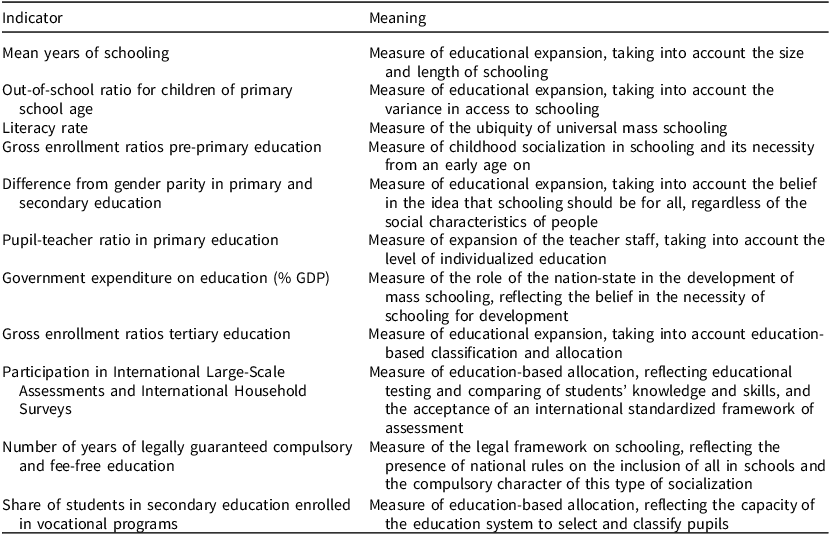
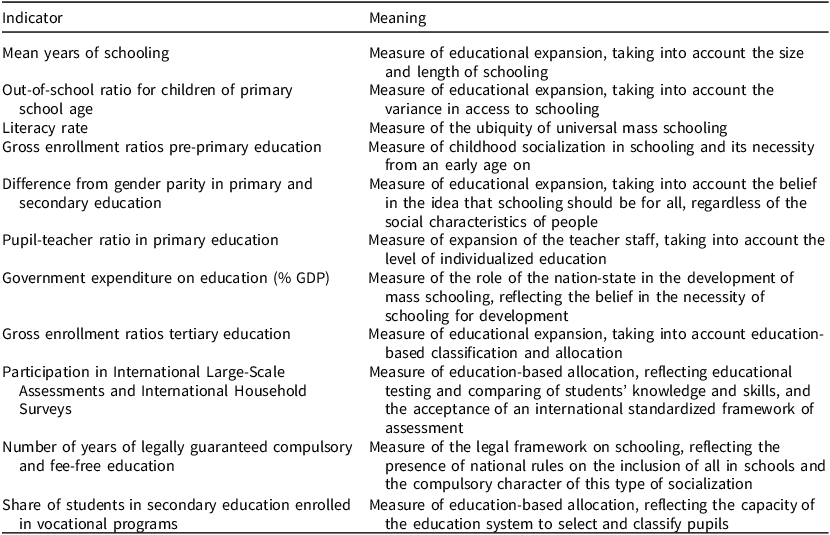
The Schooled Society Index is an indicator that measures cross-national variation in the centrality and authority of schooling in a country. Developed elsewhere by Kavadias et al. (Reference Kavadias, Spruyt and Kuppens2025), it reflects both the historical institutionalization of schooling in a country, as well as the extent to which schooling has become a basis of societal stratification (see also Kavadias et al. Reference Kavadias, Spruyt and Kuppens2024; van Noord et al. Reference van Noord, Spruyt, Kuppens and Spears2019). While previous studies often used indicators that mainly reflect the demographic aspect of the educational expansion (e.g., enrollment ratios), this index combines different indicators to account for such (1) institutional expansion (e.g., mean years of schooling, pupil-teacher ratios), as well as for the extent to which (2) the cultural authority of schooling (i.e., the belief that schooling should be for all and as such is a driver of development and societal progress; e.g., government expenditures on education; number of years of legally guaranteed fee-free and compulsory education) and (3) its stratifying role (i.e., the selection and allocation of people based on educational success and qualifications; e.g., participation rate in International Large-Scale Assessments, share of students enrolled in vocational programs) have become institutionalized in a country. Table 1 provides a brief overview of the items that are included in the index. As some indicators tap more into the status-allocating role of schooling to a greater extent (while others mainly reflect institutional expansion), we also re-ran our main analyses by employing two sub-scales of the Schooled Society Index, namely, the ‘institutionalization of schooling’ and ‘school-based allocation’ measures (see Appendix G.2; Kavadias et al. Reference Kavadias, Spruyt and Kuppens2025). Additionally, we also used the ‘school-based stratification’ scale (Kavadias et al. Reference Kavadias, Spruyt and Kuppens2024), reflecting the aggregated strength of the association between educational attainment and socio-political outcomes (i.e., health, income, and civic participation) across 97 countries (correlation with the Schooled Society Index: r = 0.52; see Table A11, Figure A3 of Appendix G.2).
Indicators of the Schooled Society Index
Overall, across 185 countries, the Schooled Society Index has a range of 0–100 (M = 59.80; S.D. = 23.41; see Kavadias et al. Reference Kavadias, Spruyt and Kuppens2025). In our sample, the index ranged from 19.74 in Ethiopia (lowest) to 100.00 in the Netherlands (highest), with a mean of 76.67 (S.D.=16.03). Appendix D provides a table showing scores on this index for the countries included in the analysis.
Educational attainment was measured through the respondents’ highest obtained diploma, following the levels of the International Standard Classification of Education [ISCED: https://www.uis.unesco.org/en/methods-and-tools/isced]. As in this study, we want to compare the political trust of the higher (i.e., tertiary) educated and the rest of the population, we distinguished between the respondents who obtained an ISCED 5 (short-cycle tertiary education) degree or higher and those who did not (ISCED 0: no formal schooling – ISCED 4: post-secondary non-tertiary education). 36.0% of our sample was higher educated (ranging from 8.9% in Bangladesh to 70.6% in Russia).
Sector of employment was measured by asking respondents for which organization they were currently working, with three possible answer categories: (1) ‘Government or public institution’; (2) ‘Private business or industry’; and (3) ‘Private non-profit organization’. We added the category ‘Other or non-applicable’ to take into account people who were not in the labor market (this category was originally coded as ‘missing’). The majority of our sample worked for the private business sector (52.6%), followed by those working for public institutions (26.9%). 5.3% of respondents worked for private nonprofit organizations, and 15.3% belonged to the category ‘other or non-applicable’.
Relationships between the independent variables
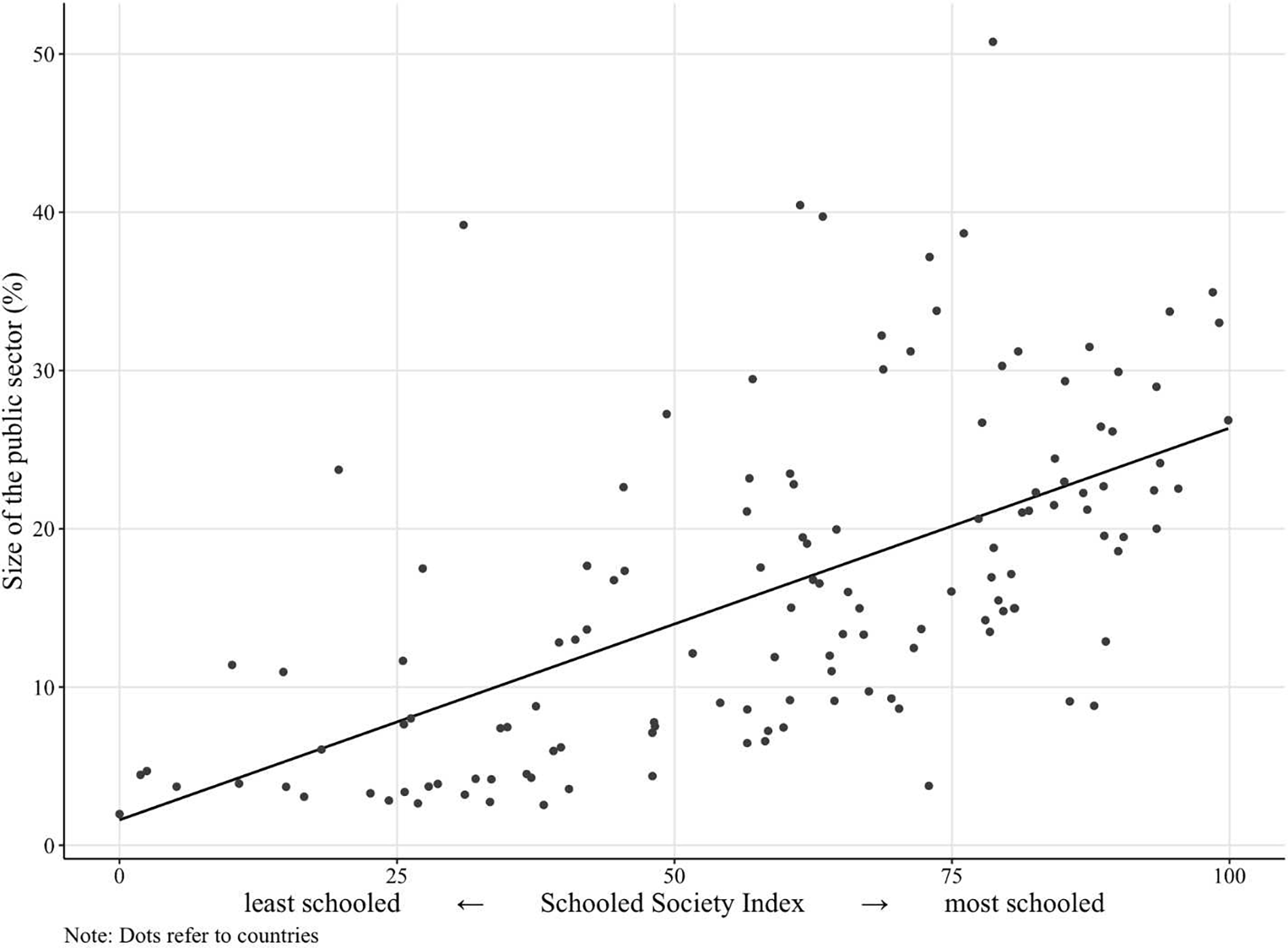
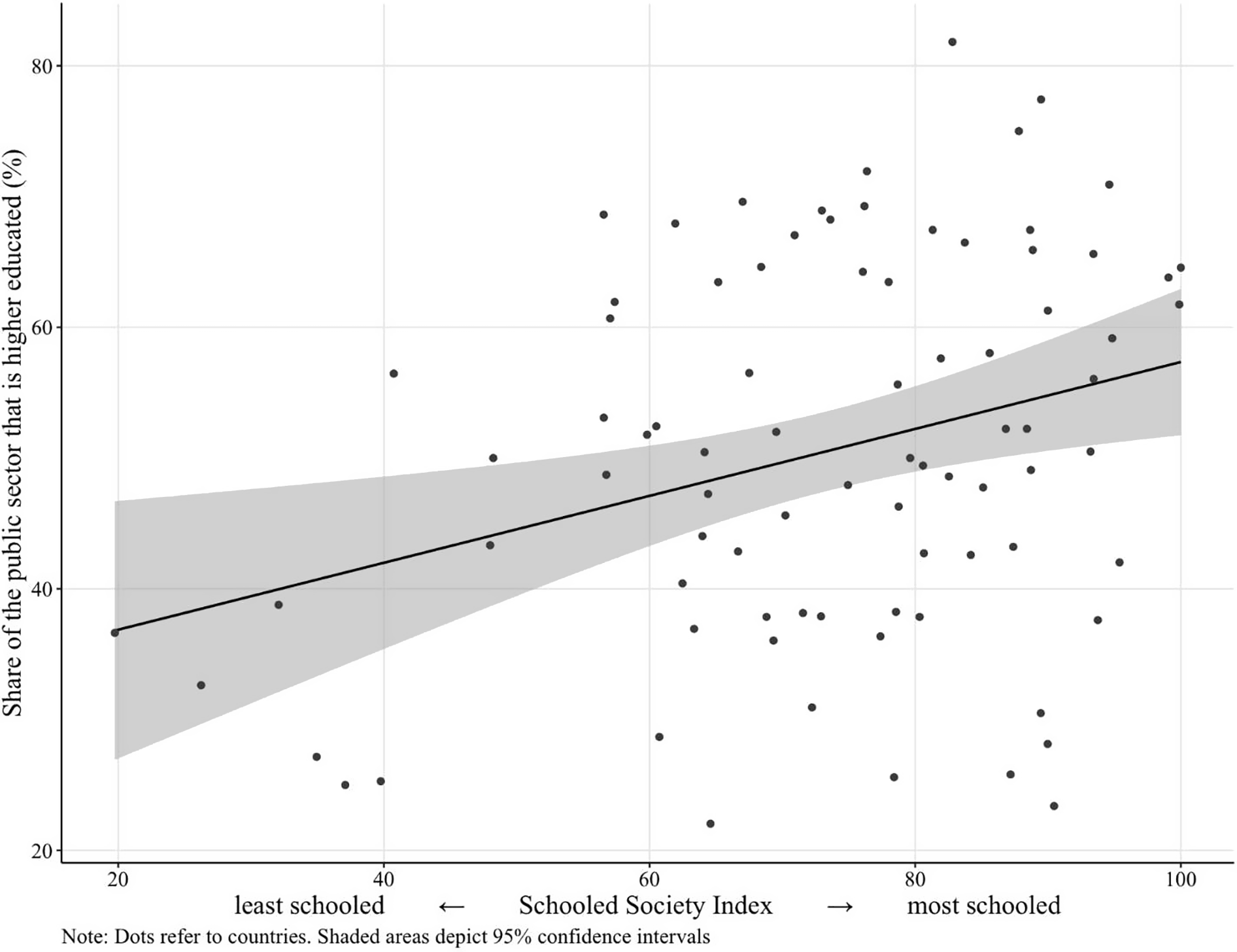
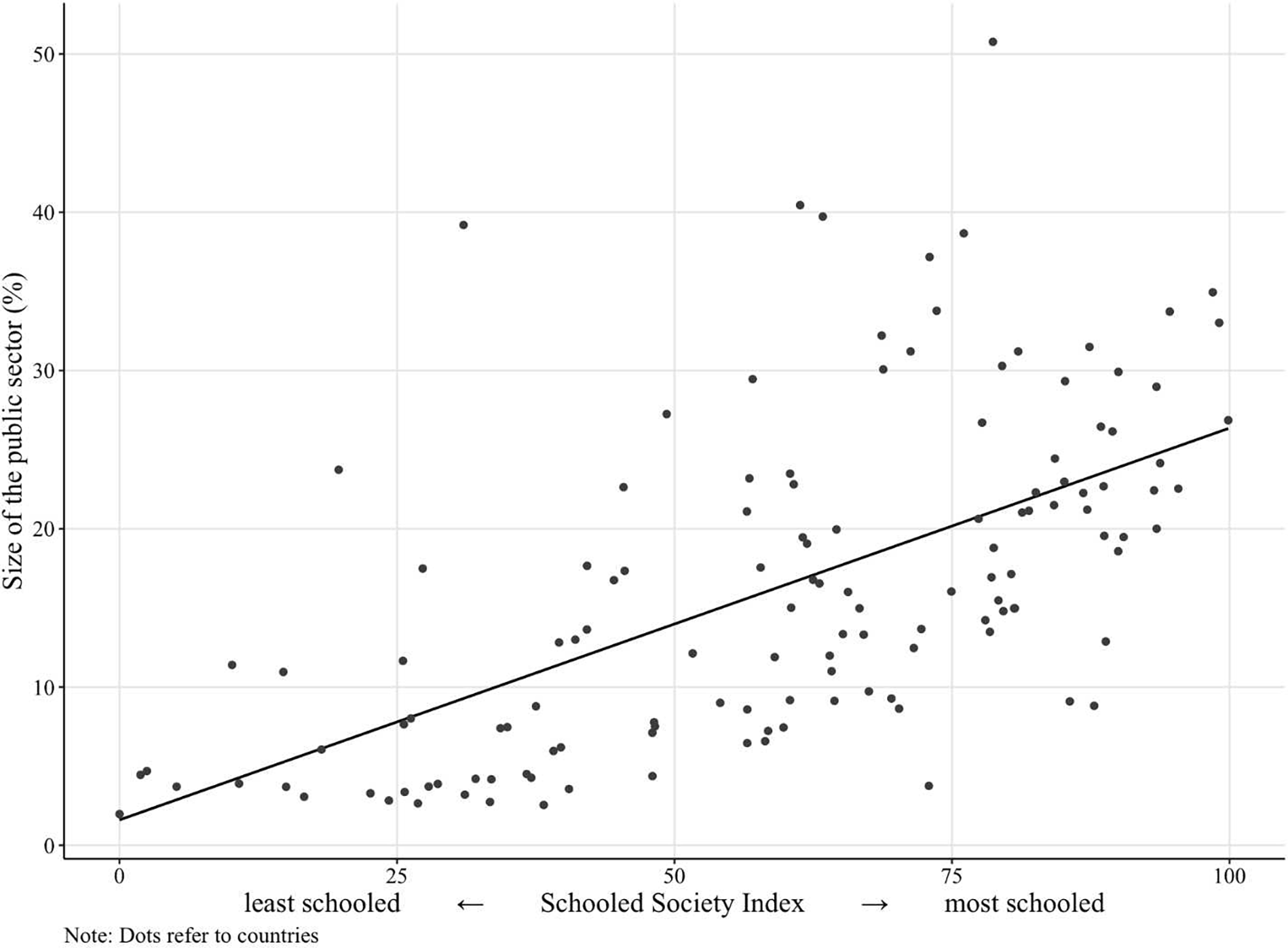
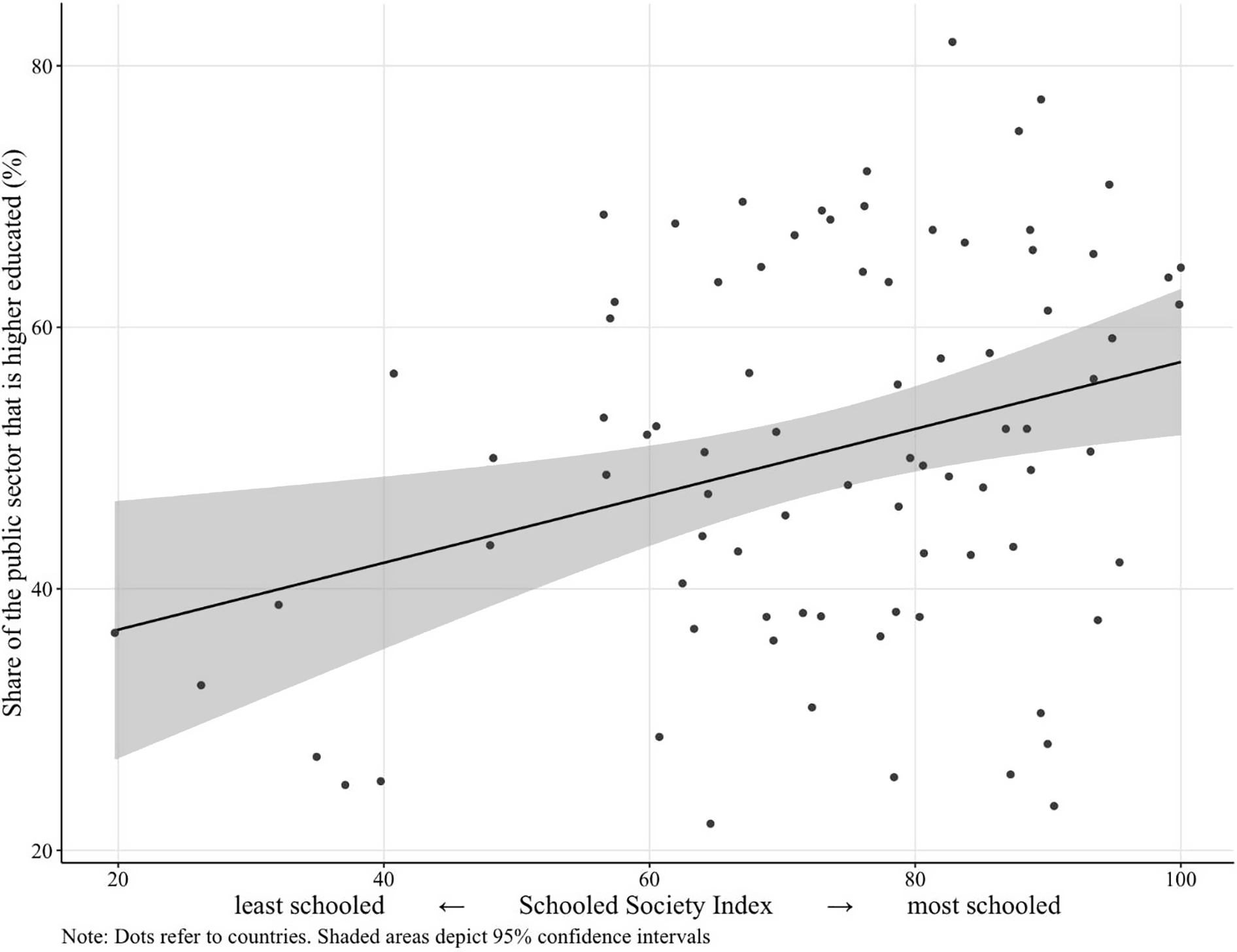
The size of the public sector and state apparatus varies between countries and regions. For example, in ‘Europe and North America’ and ‘Eastern Europe and Central Asia’, around one-third of the respondents worked for public institutions, while in the other regions, this share ranged between 10 and 20 percent. The state apparatus of countries from Eastern Europe and Central Asia was, on average, twice the size of that of countries in Latin America and the Caribbean. As discussed earlier, historically, the expansion of the ‘modern’ state and its apparatus is strongly intertwined with the institutionalization and expansion of mass schooling. By collecting administrative data from the International Labour Organization on the number of people working for a sector (e.g., private, public) and on the total number of people in the labor force, we were able to briefly examine this relationship empirically. Figure 1 displays the association between the size of the public sector and the institutionalization of a schooled society. We find a strong positive relationship between both variables (r = 0.60***): as schooling is more central in society, the size of the public sector is larger.Footnote 1 This means that in less strongly schooled societies, the public sector is likely to have a lower degree of functional differentiation and fewer positions to offer. This makes positions as state personnel more ‘closed off’ in such societies, thereby raising the stakes of occupying and holding such a position and therefore increasing dependency on the state (Elias Reference Elias2000; Rosenfeld Reference Rosenfeld2021). Simultaneously, however, a larger public sector does not necessarily imply that state positions become open to all. Rather, it is likely that in strongly schooled societies, access to public sector positions depends to a greater extent on having a higher education diploma or not, in line with the idea of the rise of diploma democracies (cf. Baker Reference Baker2014; Bovens and Wille Reference Bovens and Wille2017). Figure 2 shows that, in societies where schooling occupies a more central and authoritative position, a greater share of the people working in the public sector hold a higher education degree (in some countries, this amounts up to 70 to 80%, which is likely to be a consequence of both educational expansion and education-based allocation in the political field; at the same time, around 40% of the higher educated in our sample were employed by a public institution). The monopolization of political opportunities for the higher educated will likely have its consequences concerning political trust and conflict in schooled societies (see van Noord et al. Reference van Noord, Kuppens, Spruyt, Kavadias, Darnon and Marot2025).
Relationship between the level of development of schooled society [range: 0.00–100.00] and the size of the public sector [range: 1.98–50.77] across 133 countries.
Relationship between the level of development of schooled society [range: 19.74–100.00] and the proportion of the public sector that is higher educated [range: 22.04–81.82] across 84 countries.
Control variables
In our analyses, we included gender, age group, marital status and income at the individual level, and GDP per capita, type of political regime, the level of corruption, and the presence of armed conflict in the year prior to the survey at the country level as control variables. Gender was coded as a dummy variable (ref. = female). For age group, five (10-year) categories were constructed, ranging from 25–34 years old (ref.) to 65 years and older. Marital status was distributed across married (ref.), divorced or separated, widowed, and never married or registered partnership. Income was gauged by asking respondents to which ‘income step’ they belonged (i.e., an estimation of ‘objective’ income group on the basis of all household incomes), ranging from 1 (lowest) to 10 (highest). We treated this variable as continuous. We included these individual-level variables in the analyses as we wanted to assess the extent to which educational attainment affects political trust independently from these factors (which are known to affect trust: see Hakhverdian and Mayne Reference Hakhverdian and Mayne2012; Schakel and Hakhverdian Reference Schakel and Hakhverdian2018; van der Meer Reference van der Meer2010). If educational attainment becomes a central source of social status in schooled societies, it should also function strongly autonomously (van Noord et al. Reference van Noord, Spruyt, Kuppens and Spears2019). However, as we know that socio-demographic and economic factors such as gender and income are related to educational attainment, and that these relationships vary across contexts (e.g., Lemieux Reference Lemieux2006; Van Bavel et al. Reference van Bavel, Schwartz and Esteve2018), we conducted a robustness check in which we first (1) excluded such factors, (2) compared these models to our main model, and then (3) included cross-level interaction terms between these factors and the schooled society (Appendix G.3). We additionally controlled for the mediating role of economic capital by controlling for the level of commodification of the school system (i.e., the number of years the state provides fee-free education; Appendix G.2). These checks did not affect our substantive conclusions and provided confirmed additional confirmation of the unique role of schooling in the contemporary world.
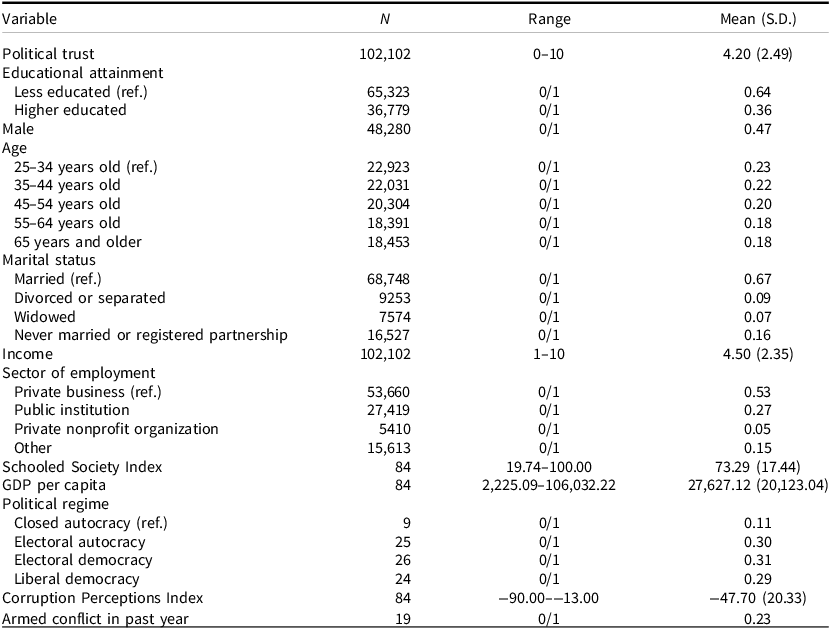
Our paper seeks to assess whether the development of a schooled society offers explanatory power over and above other contextual characteristics. Therefore, we also included several country-level indicators. Data on the GDP per capita (PPP; current international $) were obtained through the World Bank and reflect the economic capital of a nation. A country’s political regime was based on data from the Varieties of Democracy (V-Dem) Dataset (Coppedge et al. Reference Coppedge, Gerring, Knutsen, Lindberg, Teorell, Altman, Angiolillo, Bernhard, Cornell, Fish, Fox, Gastaldi, Gjerløw, Glynn, Good God, Grahn, Hicken, Kinzelbach, Marquardt, McMann, Mechkova, Neundorf, Paxton, Pemstein, von Römer, Seim, Sigman, Skaaning, Staton, Sundström, Tannenberg, Tzelgov, Wang, Wiebrecht, Wig and Ziblatt2023) and had the following categories: (1) closed autocracy (ref.; 11% of the countries in our sample); (2) electoral autocracy (30%); (3) electoral democracy (31%); and (4) liberal democracy (29%). This classification was based on a range of political characteristics in a country, such as citizens’ rights (e.g., the right to choose a chief executive of the government) and the existence of and way in which elections are conducted (Lührmann et al. Reference Lührmann, Tannenberg and Lindberg2018). Next, following Hakhverdian and Mayne (Reference Hakhverdian and Mayne2012), we included the 2023 Corruption Perceptions Index (see Transparency International 2023) to control for the perceived level of corruption in the public sector. This variable has systematically been found to predict political trust and, importantly, moderate the relationship between educational attainment and political trust (e.g., Hakhverdian and Mayne, Reference Hakhverdian and Mayne2012; Mayne and Hakhverdian Reference Mayne, Hakhverdian, Zmerli and van der Meer2017; Noordzij et al. Reference Noordzij, de Koster and van der Waal2021; Ugur-Cinar et al. Reference Ugur-Cinar, Cinar and Kose2020). We reverse-coded this variable so that a higher score signifies a higher level of corruption in a country. Finally, we also included an indicator reflecting the existence of armed conflict in a country in the year prior to the survey, as (internal) violence and conflict might affect political trust (and vice versa; e.g., Hutchison and Johnson Reference Hutchison and Johnson2011). This was measured by constructing a dummy variable that received a score of 1 when there had been 25 deaths or more due to armed conflict in that year (following the definition of Lacina and Gleditsch Reference Lacina and Gleditsch2005; data were gathered from: Uppsala Conflict Data Program, see Davies et al. Reference Davies, Pettersson, Sollenberg and Öberg2025; Sunberg and Melander Reference Sunberg and Melander2013; and Natural Earth 2024). Table 2 provides an overview of the descriptive statistics of the variables.
Descriptive statistics
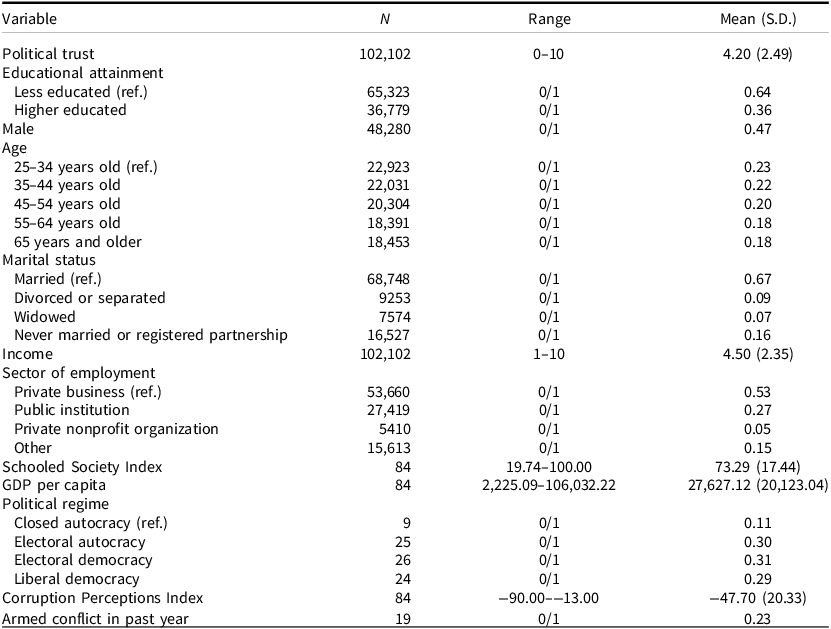
Note: Continuous independent variables standardized in the analyses (Z-scores). Standard deviations for continuous variables are in parentheses.
Methodology
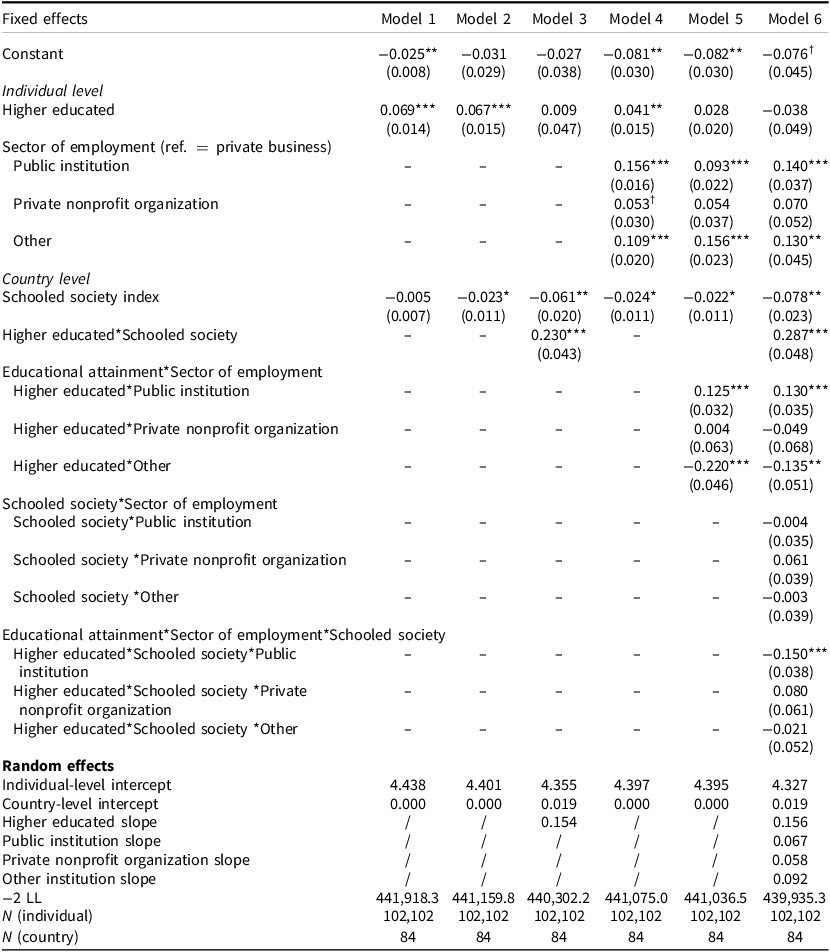
We conducted multilevel linear regression analyses (restricted maximum likelihood) to test our hypotheses (e.g., Elff et al. Reference Elff, Heisig, Schaeffer and Shikano2021). The first model only included the variables on schooling. Next, we added the control variables. In the third model, we added the cross-level interaction between the Schooled Society Index and educational attainment. The fourth model builds on the second by adding the sector of employment to examine whether this moderated the association between educational attainment and political trust. Model 5 included the interaction between educational attainment and sector of employment. In the sixth model, we added a three-way interaction between cross-national differences in the development of schooled society, educational attainment, and sector of employment. Finally, as it has been shown that the education effect depends on country-level control variables such as political regime and corruption (see Hakhverdian and Mayne Reference Hakhverdian and Mayne2012; Mayne and Hakhverdian Reference Mayne, Hakhverdian, Zmerli and van der Meer2017; Rosenfeld Reference Rosenfeld2021; Ugur-Cinar et al. Reference Ugur-Cinar, Cinar and Kose2020), we conducted additional analyses in which we tested for the interaction between educational attainment, sector of employment, and each of the country-level control variables included in the analyses as well. To increase the comparability of the effect parameters, we standardized all continuous variables in our analyses. All replication materials (data and code) are publicly accessible via https://osf.io/d9pxr/.
Results
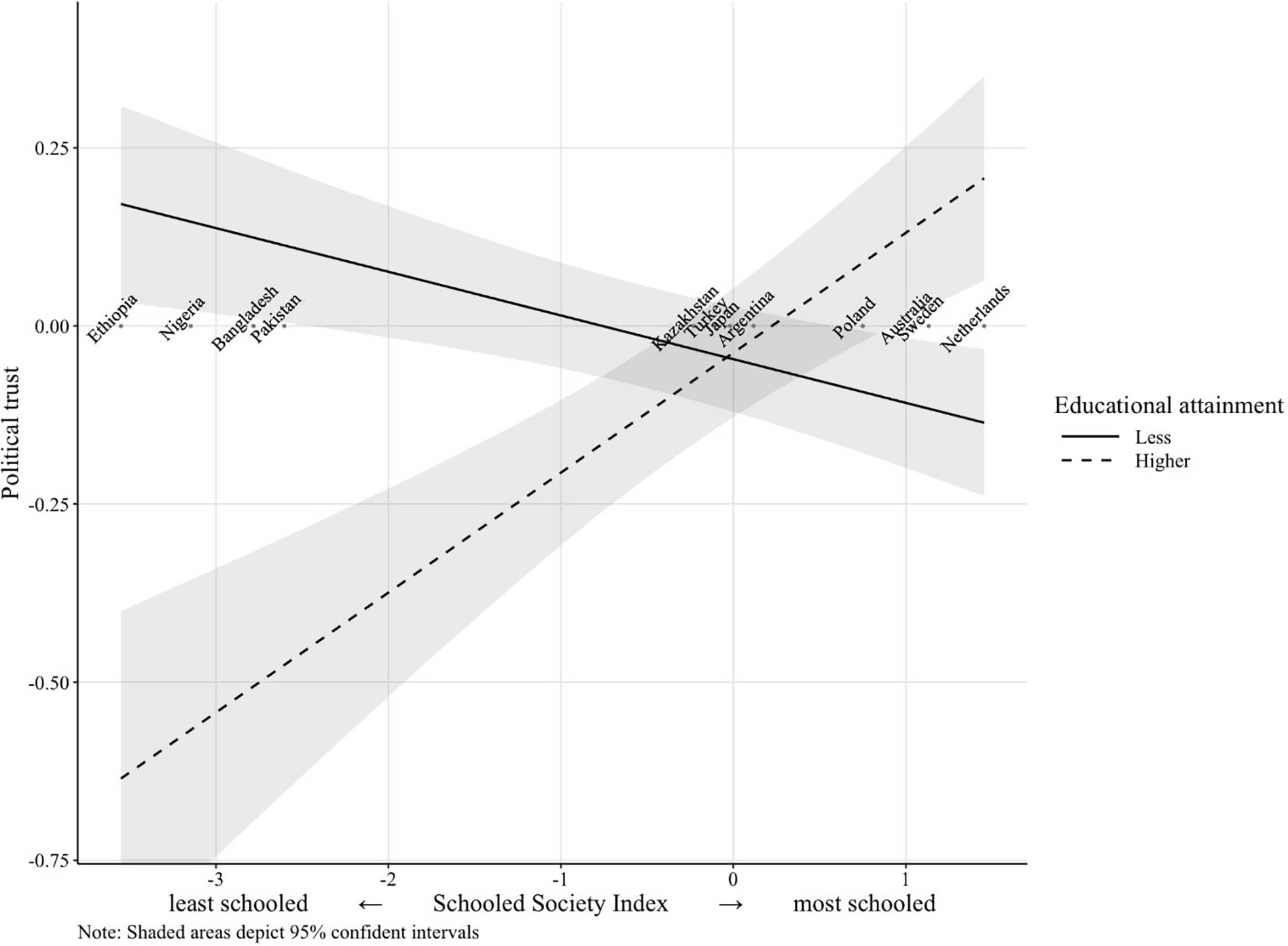
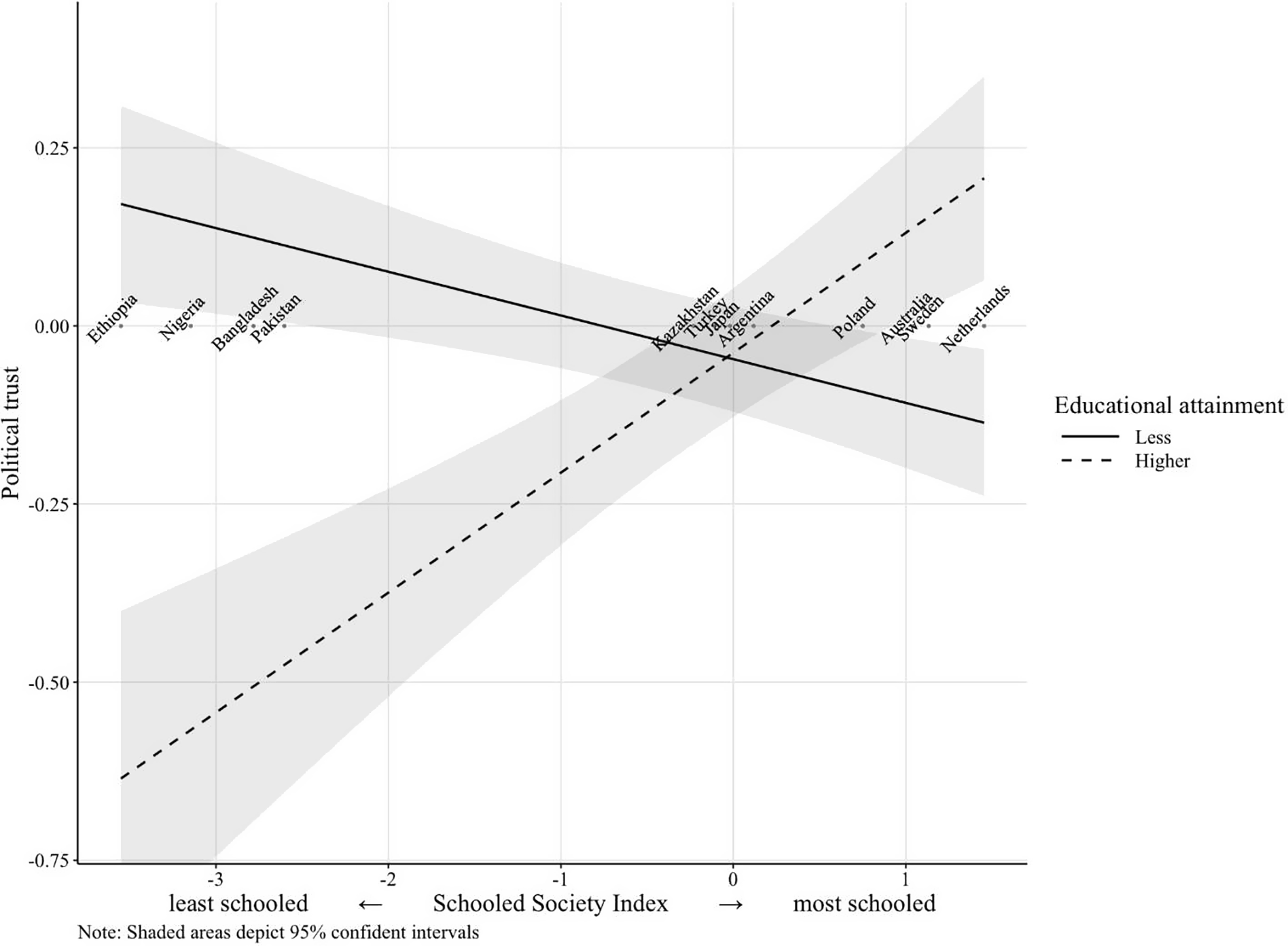
What is the relationship between educational attainment, the schooled society, sector of employment, and political trust? Table 3 presents the results of multilevel linear regression analyses (full table presented in Appendix C). Model 1 shows a positive regression coefficient of being higher educated on political trust (b = 0.069; se = 0.014). This finding was not altered when including the control variables in Model 2. However, when adding the cross-level interaction term between the Schooled Society Index and educational attainment in Model 3, the association between educational attainment and political trust became insignificant (b = 0.009; se = 0.046). Simultaneously, we found a strong positive cross-level interaction term (b = 0.228; se = 0.043), indicating that the difference in political trust between the less and higher educated was moderated by the level of development of a schooled society. When plotting this interaction on the predicted values in political trust in Figure 3, we observed an increasing trend across different levels of the schooled society for the higher educated (H1.1b confirmed), and a somewhat declining trend regarding the less educated (H1.2b confirmed). In less strongly schooled societies, the higher educated were, on average, less trusting of the political institutions than the less educated. In the most strongly schooled societies, this configuration was reversed, with the higher educated being more trusting of politics than the less educated (H1.1a and H1.2a confirmed).
Results linear multilevel regression analyses on political trust
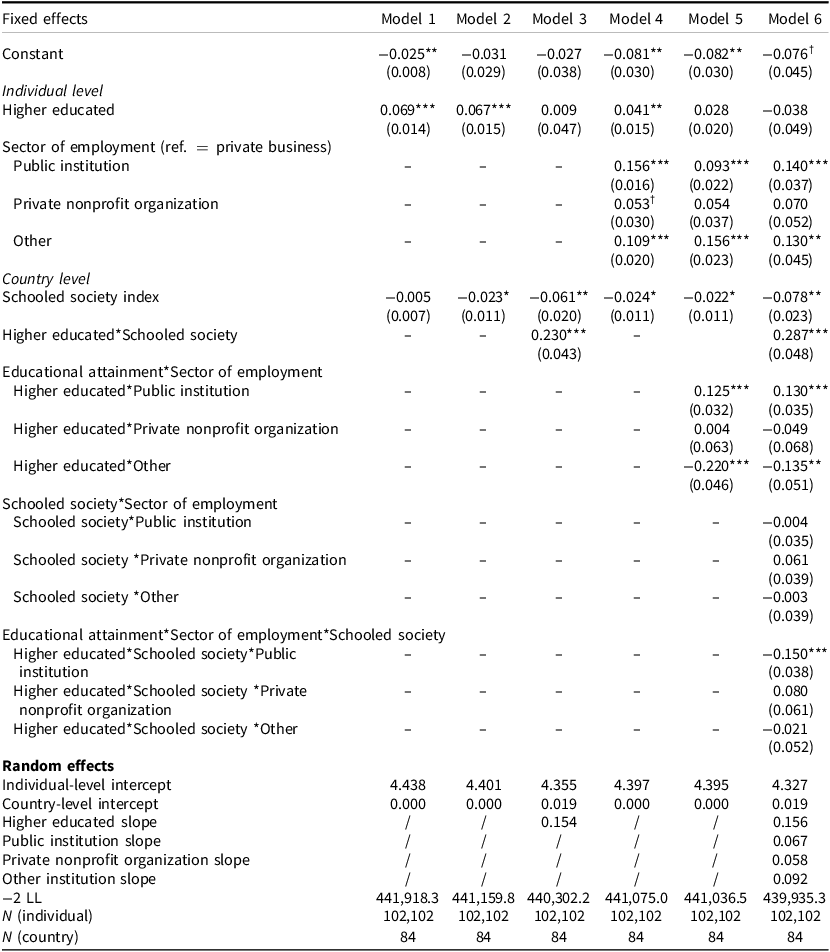
Note: †p < 0.10; *p < 0.05; **p < 0.01; ***p < 0.001. Cell entries display unstandardized regression parameters, with standard errors in parentheses. Models 2–6 controlled for by: gender, age group, marital status, income, GDP per capita, political regime, Corruption Perceptions Index, and armed conflict.
Relationship between z-standardized values of the Schooled Society Index [range: −3.55–1.46] and the predicted values of political trust [range: −0.63–0.20] by educational attainment, with examples of countries around the minimum, mean, and maximum of the Schooled Society Index.
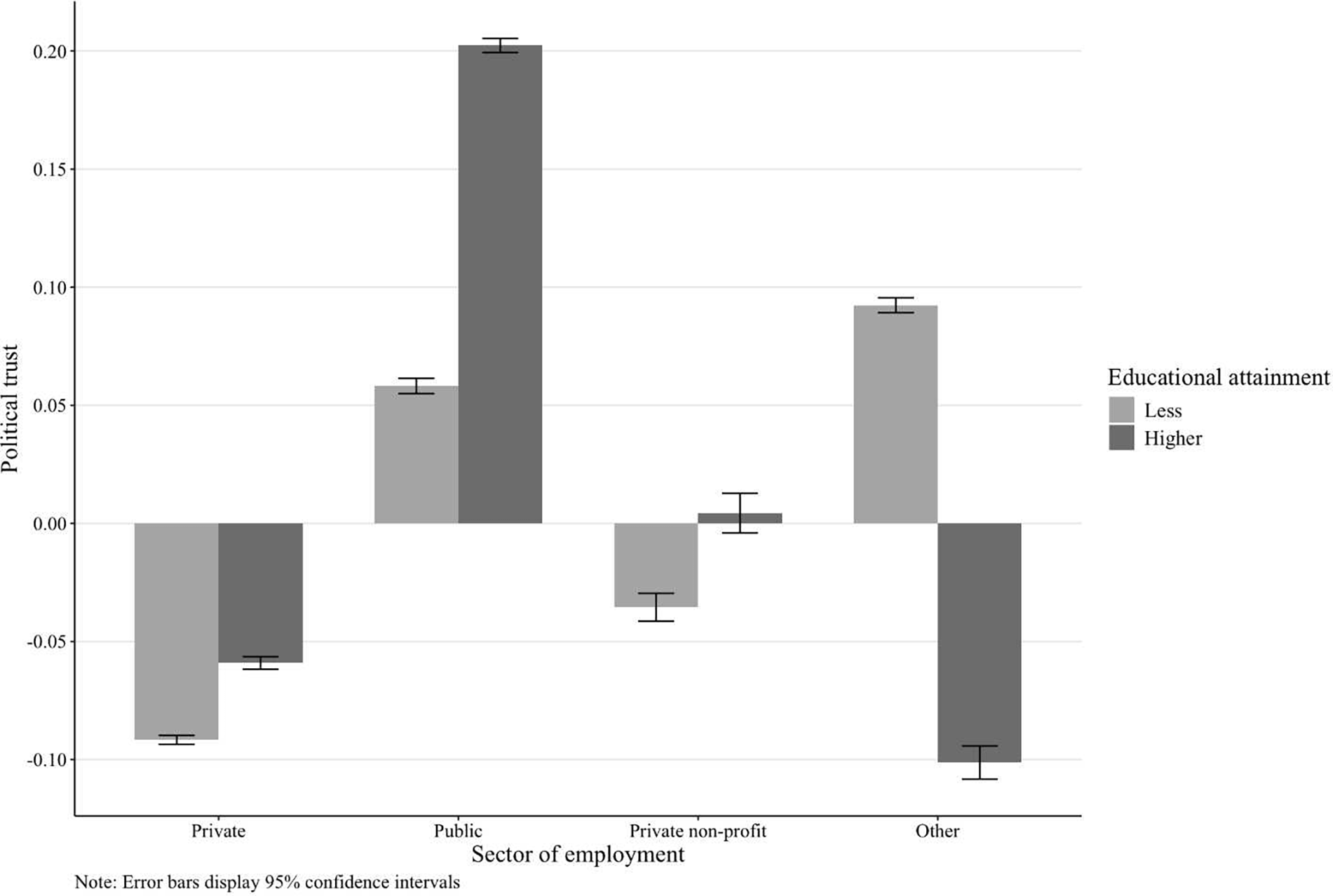
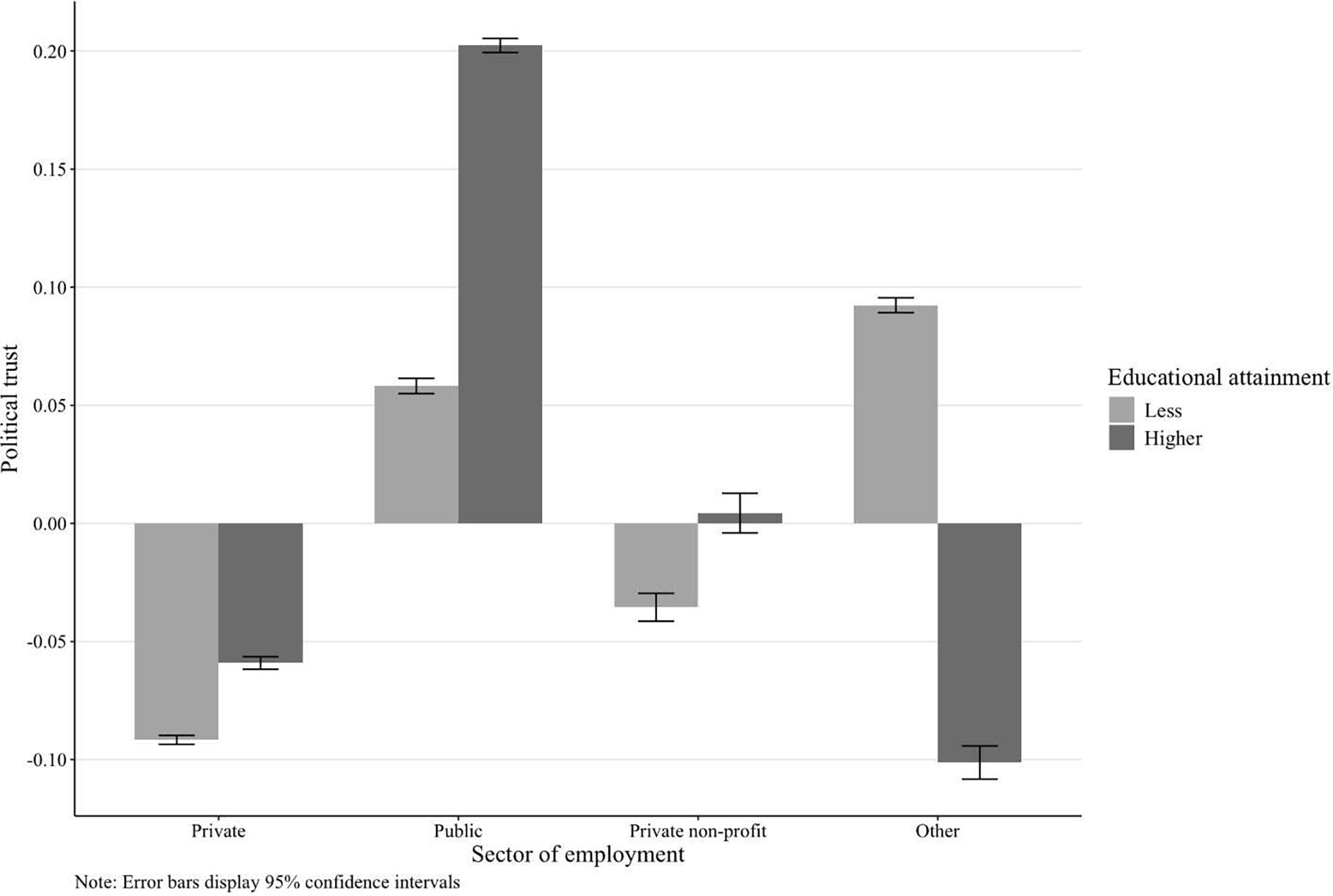
To examine whether the previously observed patterns were generalizable across the specific position of the less and higher educated concerning their sector of employment and more specifically their relation to the state, we added the sector of employment in Model 4. In general, people working for the public sector had, on average, more political trust than those working in private business (the same was true for people working for the category ‘other’; b = 0.156; se = 0.016). Thus, being employed in the public sector is positively related to political trust. Interestingly, when adding the interaction term between educational attainment and sector of employment in Model 5, we found a positive and significant association between being higher educated and working for the public sector (b = 0.125; se = 0.032). Figure 4 displays this interaction pattern. It shows that, on average, people working for the public sector had higher levels of trust in the state institutions than those in the other employment sectors, but that this was especially true for the higher educated. Remarkably, the difference in political trust between the less and higher educated was also largest in this sector of employment, apart from the ‘other’ category, in which the higher educated were less trusting of the state institutions than the less educated.
Relationship between educational attainment and predicted values of political trust [range: −0.63– 0.20] by sector of employment.
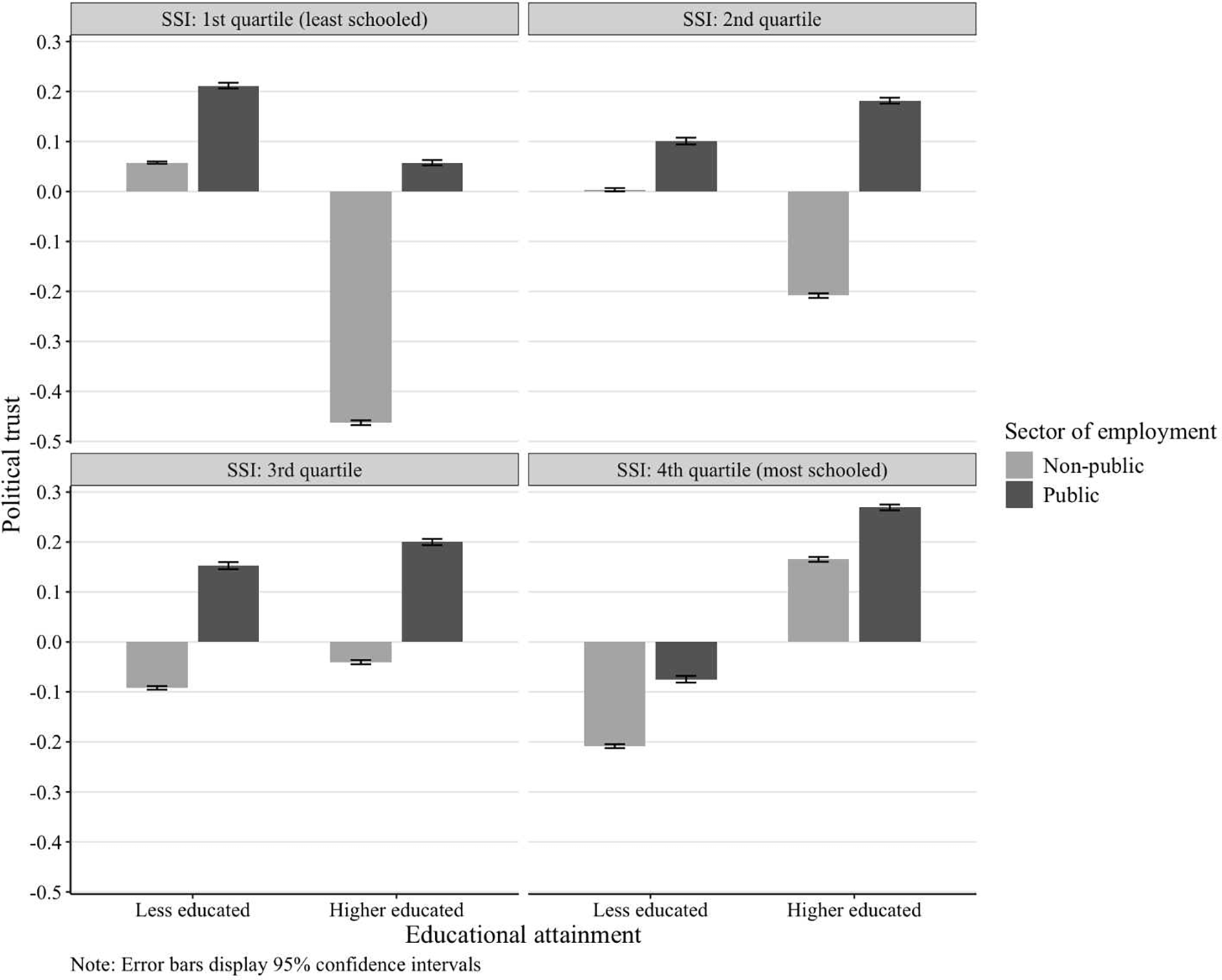
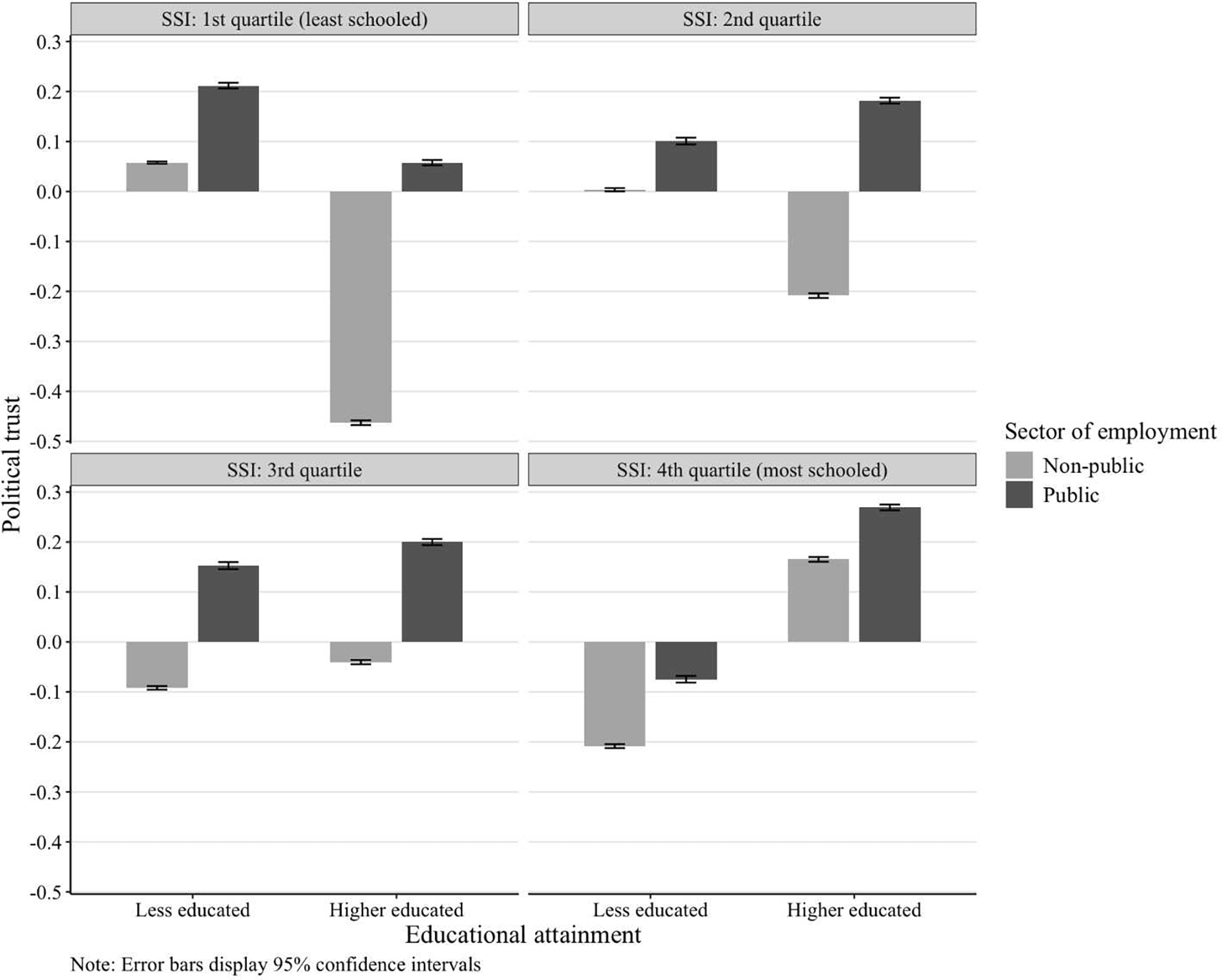
Finally, to examine how these configurations of societal position, intergroup relations and dependency differ across societies varying in the role and centrality of schooling as an institution, we added a three-way interaction effect in Model 6.Footnote 2 This significant negative interaction term (b = −0.150; se = 0.038) shows that the effect of the relationship between educational attainment and sector of employment on political trust depends on the development of schooled society. To examine this three-way interaction more thoroughly, we compared the mean levels of political trust of the less versus higher educated working for a nonpublic versus public institution, across four groups of countries divided along the level of institutionalization of schooling therein (1st quartile: 19.74–67.50; 2nd quartile: 67.50–78.75; 3rd quartile: 78.75–88.85; 4th quartile: 88.85–100.00; Appendix F provides an overview of the countries and the full results).Footnote 3 Figure 5 illustrates this comparison. In the least strongly schooled societies, the higher educated had, on average, less political trust than the less educated. Yet, among the higher educated, in these societies, we found large differences between those working for the public sector (10.3% of the sample population in those countries) and those who did not (14.4% of that sample population; H2.1 confirmed; H2.3 rejected). Thus, the negative association between having a higher education degree and political trust in these least strongly schooled societies was strongest for those who were not employed by the state, relatively trusting the state institutions a lot less than the other groups. In societies where schooling is not as central and authoritative as in strongly schooled societies, the non-publicly employed higher educated are less likely to support the state than those working for the public sector. In the two ‘middle groups’ (2nd and 3rd quartile groups of the Schooled Society Index), we find a similar divide between the higher educated working in the public and those who do not, although differences are generally smaller than in the least strongly schooled societies. Finally, in the most strongly schooled societies, we see a clear educational divide in terms of political trust, with a strong difference between less (56.9% of the sample population in those societies) and higher educated people (43.1% of that sample population) – the latter having relatively high levels of trust. Here, within each educational group, we found only relatively small differences between those working for public institutions and those who did not (H2.2 confirmed). In the next part, we discuss the implications of our findings.
Association between educational attainment and employment in the public sector regarding political trust, across the Schooled Society Index (quartiles).
Discussion and conclusion
Against the background of ongoing debates about the relationship between education and political trust, this study investigated the relationship among educational attainment, the schooled society, and the sector of employment with regard to political trust. Based on WVS/EVS data from 102,102 respondents across 84 countries, we demonstrated that (1) the extent to which schooling occupies a central and authoritative position in a country moderates the relationship between educational attainment and political trust. (2) In strongly schooled societies, the higher educated have a higher level of political trust than the less educated. (3) In less strongly schooled societies, however, we found a negative relationship between educational attainment and political trust, the higher educated being relatively less trusting of the public institutions. This was the case in a wider range of countries than might be expected based on the literature on political trust in the European context, indicating the relevance of a global perspective. Finally, and importantly, (4) in the least strongly schooled societies, we found that the higher educated who worked in the public sector had a much higher level of political trust than those who did not. This gap is smaller in societies where schooling was a more central and authoritative institution, suggesting that the higher educated in strongly schooled societies were relatively more homogeneous and that educational qualifications became an autonomous basis of political attitudes. These results were independent of the role of the level of corruption and regime type.
Our findings underscore the importance of studying the education effect on political trust from a relational perspective. Rather than being (fully) due to differences following from education-based socialization, the relationship between educational attainment and political trust strongly stems from the extent to which the (higher) educational degree guarantees the social status of its holder and offers pathways into political and elite positions. This way, the ‘education effect’ on political trust is shaped strongly through considerations of status and group interests: to what extent are political institutions, or the political system at large, aligned with the interests of my (educational) group? We have demonstrated the importance of such a status-based and relational approach, taking into account the larger societal context, in three main ways.
First, the relationship between educational attainment and political trust is strongly context-dependent (see also Hakhverdian and Mayne Reference Hakhverdian and Mayne2012; Kołczyńska Reference Kołczyńska2020; Mayne and Hakhverdian Reference Mayne, Hakhverdian, Zmerli and van der Meer2017; Ugur-Cinar et al. Reference Ugur-Cinar, Cinar and Kose2020) – a finding for which classical explanations of the political effects of schooling that purely stress the individual characteristics of people holding different educational degrees cannot account for. Rather, educational qualifications are a positional good, whose importance and impact depend on the extent to which schooling as an institution has acquired a central and authoritative position in society, thereby legitimately allocating social status, societal positions, and life chances (Kavadias et al. Reference Kavadias, Spruyt and Kuppens2024; Meyer Reference Meyer1977; Spruyt and Kuppens Reference Spruyt and Kuppens2015). The development of ‘schooled society’ thus institutionalizes the diploma as a title of distinction that attributes certain characteristics of competence and ability that are deemed necessary and valorized in the acquisition of societal positions and society at large (Baker Reference Baker2014; Meyer Reference Meyer1977; van Noord et al. Reference van Noord, Spruyt, Kuppens and Spears2019). The higher educated are, therefore, endowed with a status of entitlement that allows them to act politically (Bourdieu Reference Bourdieu1985; Frank and Meyer Reference Frank and Meyer2020). In strongly schooled societies, the accumulation of such political agency and power forms the basis of ‘diploma democracies’ (cf. Bovens and Wille Reference Bovens and Wille2017), in which the higher educated dominate the political field, while the less educated are both descriptively and substantively underrepresented in political life (Noordzij et al. Reference Noordzij, de Koster and van der Waal2021; Schakel et al. Reference Schakel, Persson and Sundell2024; Schakel and van der Pas Reference Schakel and Van Der Pas2021; Simon and Turnbull-Dugarte Reference Simon and Turnbull-Dugarte2025). This seems to have become an important basis for political conflict in strongly schooled societies (see van Noord et al. Reference van Noord, Kuppens, Spruyt, Kavadias, Darnon and Marot2025), as the higher educated are highly supportive of the political institutions that their in-group dominates, while the less educated, through feelings of misrecognition, alienation, and perceived cultural distance, oppose the legitimacy of these institutions (see Noordzij et al. Reference Noordzij, van der Waal and de Koster2019; van Noord et al. Reference van Noord, Spruyt, Kuppens and Spears2023b).
Second, by demonstrating that the ‘education effect’ on political trust is strongly contingent upon the sector of employment in which people work, our findings provide additional support for an intergroup-based conceptualization of political trust. In general, although we found educational differences in each sector, people working in the private sector had less trust in political institutions than those working in the public sector. Especially, higher educated public employees had the most political trust. Interestingly, among people who were not in the labor market, we found a strong educational divide in the opposite direction: the higher educated in this category had the least political trust compared to all other groups. It is plausible that such high levels of distrust are a reflection of the ‘broken promises of education’ (cf. Brown et al. Reference Brown, Lauder and Ashton2011) for this group, as their degree has not ‘paid off’ in terms of status and life chances, leading to a sense of dissatisfaction and trust.
However, it is only when comparing the interaction of educational attainment and sector of employment across different contexts that we get a comprehensive sense of how schooling, educational attainment, and people’s relationship to the state determine positionality and shape political trust. While socialization theories (attributing the ‘education effect’ on political trust mainly to the acquisition of political knowledge and cognitive skills) would predict that the often-found positive relationship between educational attainment and political trust reverses in societies that are characterized by lower levels of schooling and democracy and higher levels of corruption (e.g., Hakhverdian and Mayne Reference Hakhverdian and Mayne2012; Kołczyńska Reference Kołczyńska2020; Mayne and Hakhverdian Reference Mayne, Hakhverdian, Zmerli and van der Meer2017; Ugur-Cinar et al. Reference Ugur-Cinar, Cinar and Kose2020), we found that this was not the case for higher educated public employees. In less schooled (and in highly corrupt and especially electoral autocratic) countries, we found a large gap between the higher educated working for the public sector (with relatively high levels of political trust) and those who did not (who were very distrusting of the political institutions). The political trust of the state-employed higher educated in these societies is thus strongly shaped by their dependency on the state for their societal position and status. In strongly schooled societies, this gap largely disappeared and was mainly centered around differences between the less and the higher educated in general, regardless of their sector of employment.
While our analyses cannot completely rule out the possibility that public sector employees’ political trust stems partly from their involvement in the political process (and consequent political sophistication), they highlight the importance of taking into account the conditions under which people make judgments of trust. In strongly schooled societies, where political life is strongly centered on school-based knowledge and methods (e.g., analytical modeling; see Baker Reference Baker2014), it is likely that the (both publicly and non-publicly employed) higher educated rely on a form of political sophistication that is strongly valued (and functions as a symbol of distinction). However, the higher levels of distrust of the less educated in these countries can be interpreted as ‘rational’ as well, as they are both descriptively and substantively underrepresented. Similarly, in less schooled societies, the relatively low support for the state’s institutions of the non-publicly employed higher educated is shaped by the incongruence between the status they were accorded by global tertiary schooling institutions and their socio-political opportunities and power (Ugur-Cinar et al. Reference Ugur-Cinar, Cinar and Kose2020). These groups might rise in opposition to the ruling powers of those societies, struggling for life chances through the demand of a (more) merit-based system of selection (i.e., the within-country social and political recognition of a title that is recognized at a ‘global’ level) and against routes to public power through other (e.g., family ties, economic capital, religious status) mechanisms, at least when the latter are ‘officially’ installed (which also taps into the finding that the ‘education effect’ on political trust depends on the level of corruption in a country: Hakhverdian and Mayne Reference Hakhverdian and Mayne2012; Mayne and Hakhverdian Reference Mayne, Hakhverdian, Zmerli and van der Meer2017). Such dynamics might have been behind, for example, the 2024 Bangladesh university student protests against the implementation of quotas to jobs in the civil service by the government of Prime Minister Sheikh Hasina (the Western European student protests of 1968 could be interpreted in the same way). Moreover, their relative independence and distance from the state could cause them to uphold values that have become globally diffused through highly convergent university curricula (Frank and Meyer Reference Frank and Meyer2020).
As mentioned earlier, further research should investigate the specific reasons for political (dis)trust and thereby scrutinize this process in more detail. One way through which this could be done is by conducting more experimental research, in which the effects of status threats on the political trust of the higher educated are studied. This way, we could further assess how people make trust assessments, both based on how one is socialized and from considerations regarding status and group interest. Our research indicates that the latter plays a central role in shaping political trust. Alternatively, we could study this more ‘naturally’ by investigating (changes in) the political trust of both publicly and privately employed higher educated people in countries where (right- or left-wing) populist parties have achieved electoral successes or entered government. This taps into a limitation of the current study – the lack of consideration of the role of government ideology and cabinet composition (see Noordzij et al. Reference Noordzij, de Koster and van der Waal2021). It is possible that the political trust of the higher educated in strongly schooled societies (and especially those working in the public sector) will decline with the successes and rise in power of such political movements (see Spruyt et al. Reference Spruyt, Caluwaerts, Darnon, Easterbrook, Kavadias, Kesberg, Kuppens, Manstead, Smets and van Noord2025).
The third way in which our findings have demonstrated the importance of a relational approach to the ‘education effect’ on political trust, is by shedding light on both education-based relationships and the association between the state and schooling in societies that can be characterized as less strongly ‘schooled’, often located outside of the group of ‘WEIRD’ (i.e., western, educated, industrialized, rich, and democratic; cf. Henrich et al. Reference Henrich, Heine and Norenzayan2010) countries. While there has been extensive work on the historical association between the development of nation-states and the rise of mass schooling and education systems in Europe and the Americas (e.g., Bendix Reference Bendix1964; Boli, Reference Boli1989; Bourdieu Reference Bourdieu1985; Ramirez and Boli Reference Ramirez and Boli1987), less is known about how these trends interact in ‘younger’ nation-states (although see Anderson Reference Anderson2006; Rosenfeld Reference Rosenfeld2021). As world society theory argues, the culture and structure of today’s highly interdependent world produce pressures and tensions that affect individual nations to an important extent, highly independently from the historical particularities of that nation (Meyer et al. Reference Meyer, Boli, Thomas and Ramirez1997). Often through the agency of inter- and supranational organizations (e.g., the World Bank, United Nations), these pressures cause nation-states to construct and expand political institutions, bureaucratize and invest in the development of schooling and universalized educational policies (Chabbott Reference Chabbott2013; Meyer et al. Reference Meyer, Boli, Thomas and Ramirez1997; McNeely Reference McNeely1995). Such global institutions then tend to socialize people similarly, and especially higher educated elites are expected to be strongly homogeneous on a worldwide level (Frank and Meyer Reference Frank and Meyer2020; Schofer and Meyer Reference Schofer and Meyer2005). Our findings suggest that such globally universal education effects depend on the positionality of education-based groups regarding the political structure they form a part of. While more research should be done on the specific mechanisms that explain the higher levels of political trust of the publicly employed higher educated in less strongly schooled societies and the relative distrust of the non-publicly employed higher educated in those societies, Rosenfeld’s (Reference Rosenfeld2021) study on the support of the ‘state middle class’ for autocratic regimes in ex-Soviet nations shows that how state dependency might produce different types of citizens than classical modernization theories would predict. Rosenfeld shows that how such regimes and leaders can even employ political strategies in which they expand the school system and ensure the dependency of the higher educated middle classes employed in the public sector through the selective redistribution of resources, allowing informal benefits (i.e., corruption) and closing exit routes. In turn, these regimes and leaders depend on higher educated functionaries for regime stability, state power, and bureaucratization (Rosenfeld Reference Rosenfeld2021; see also Bourdieu Reference Bourdieu and Wacquant2005).
Relatedly, one important limitation of this study is that it cannot fully provide a clear distinction between the effects of the level of development of a schooled society, the level of corruption in a country, and the type of political regime. We have tried to distinguish these effects to some extent by investigating the interaction between the schooled society and educational attainment across groups of countries that varied in the level of corruption and political regime (see Appendix G.1). This showed that cross-national variation in the development of a schooled society went hand in hand with increased levels in political trust of the higher educated and decreased trust among the less educated across all levels of corruption and regimes (except for the most corrupt countries, where we did not find this for the less educated). At the same time, the clearest indications of the rise of diploma democracies, in which the less educated are strongly distrusting of the political institutions (and the higher educated quite trusting), are found in the most strongly schooled, least corrupt, and (liberally) democratic countries (e.g., Australia, Denmark, Germany, the Netherlands, Sweden, and to a lesser extent countries such as Chile, the Republic of Korea, Spain, Uruguay). Although the rise of the schooled society is an intrinsically global phenomenon – with both structurally and substantively highly convergent school systems expanding in almost all countries worldwide (Baker Reference Baker2014; Kavadias et al. Reference Kavadias, Spruyt and Kuppens2025; Schofer et al. Reference Schofer, Ramirez and Meyer2021) – the extent to which this translates into an education-based political (intergroup) conflict might be quite dependent on such political factors as well. The interdependence of these contextual factors makes this all the more likely. For instance, the expansion of schooling has been shown to lead to the professionalization of the public sector, bureaucratization, and lower levels of corruption (due to increased institutionalized forms of supervision, more formal procedures, etc.; Schofer et al. Reference Schofer, Ramirez and Meyer2021). Moreover, such ‘formalization’ also defines other forms of governance as illegitimate. In turn, the rise of a political meritocracy is likely to be conditional on low levels of corruption, because only then can institutionalized procedures legally guarantee that the obtainment of an educational degree and success can translate into political positions and influence (Bourdieu Reference Bourdieu and Wacquant2005). Further research should investigate the relationship between these contextual factors more thoroughly (e.g., with longitudinal panel studies in countries transitioning from less to more strongly schooled societies, or from autocratic regimes to democratic ones).
Conclusion
This study investigated the educational basis of political trust and its association with the sector of employment. In line with research on the rise of ‘diploma democracies’ (cf. Bovens and Wille Reference Bovens and Wille2017) and recent studies on the backlash against the political dominance of the higher educated in schooled societies (Noordzij et al. Reference Noordzij, van der Waal and de Koster2019; van Noord et al. Reference van Noord, Kuppens, Spruyt, Kavadias, Darnon and Marot2025; see also Schofer et al. Reference Schofer, Lerch and Meyer2022), we found that in strongly schooled societies, there was a significant gap in the political trust of the less and higher educated, and that the higher educated showed homogeneity in their trust. In less strongly schooled societies, there was an important gap among higher educated people, depending on whether they were employed in the public sector or not. Education, once announced as the ‘great equalizer’, has become the subject of ‘a great political divide’. It does so in ways that need a theory on the role of institutions.
Supplementary material
The supplementary material for this article can be found at https://doi.org/10.1017/S1475676526100814.
Data availability statement
All data and replication files are available via: https://osf.io/d9pxr/.
Acknowledgements
We would like to thank all participants in the ECPR 2024 Joint Sessions on Democracy, Political Trust, and Trustworthiness, as well as the anonymous reviewers of the European Journal of Political Research, for their extensive and constructive comments on earlier versions of this paper.
Funding statement
Funding provided by Research Foundation – Flanders (FWO). Grant number: 11H8922N. Open access funding provided by University of Groningen.
Competing interests
The authors declare no conflicts of interest with respect to the research, authorship, and/or publication of this article.
Ethics approval statement
Not applicable.
Permission to reproduce material from other sources
Not applicable.


 Open access

