

Increasingly, cultural resource management (CRM) archaeologists in Canada are finding themselves in the public eye as their work visibly intersects with development or disaster-response–related infrastructure projects (Amiri Reference Amiri2024; Canadian Press 2023; Galea Reference Galea2024; Gomez Reference Gomez2023; Kshatri Reference Kshatri2023). Although concerns about the value of archaeology to the public are not new, in the contemporary North American context these issues are scaffolded on a variety of new challenges facing CRM, including labor shortages (e.g., Altschul and Klein Reference Altschul and Klein2022; Malakoff Reference Malakoff2023; Willson Reference Willson2023). A recent review of the expected exponential growth of the CRM industry in the United States highlighted gaps in both the existing and future labor pool for permit or license-holding professionals (PLHP) (Altschul and Klein Reference Altschul and Klein2022; see also Aitchison and Dore Reference Aitchison and Dore2022; Malakoff Reference Malakoff2023:22–23).Footnote 1 These labor shortages are exacerbated by limited—and diminishing—training opportunities for future PLHPs. Together, these issues have the potential for significant cascading effects, including financial losses and delayed compliance work for projects—some of which have political sensitivities.
At the 2024 meeting of the Canadian Archaeological Association, a roundtable discussion on whether to create a Canadian CRM trade organization touched on similar concerns among Canadian archaeologists about the state of the CRM industry and labor force in Canada. Anecdotally, these professionals were aware that the Canadian CRM industry is facing a growing suite of challenges, including a significant increase in workload because of the growing number and scale of projects, the resource crunch for qualified PLHPs, the general lack of available labor for technician and supervisorory roles, and the inadequate training of many entering the CRM industry.
To better understand the size of the CRM industry in Canada, how industry professionals feel about the health of the industry, and what they believe are the most pressing challenges facing this sector, we designed and distributed a job satisfaction and labor market survey to Canadian CRM professionals in 2024. In this article, we present the key findings and offer preliminary recommendations for improving the overall health of the CRM industry in Canada.
Background and Context
The last two decades have been tumultuous for CRM practitioners across Canada and abroad. Although earlier critiques focused on the capacity of this industry to contribute to the academic aims of the discipline (Epp and Spurling Reference Epp and Spurling1984; Fowler Reference Fowler1982:21–25), contemporary critiques address the lack of Indigenous representation and barriers to equity-deserving groups (Gupta et al. Reference Gupta, Nicholas, Blair, Watral and Goldstein2022; Williamson Reference Williamson2018), gender imbalances (Jalbert Reference Jalbert2019; Overholtzer and Jalbert Reference Overholtzer and Jalbert2021:270), staffing shortages (Altschul and Klein Reference Altschul and Klein2022; Malakoff Reference Malakoff2023; Willson Reference Willson2023), pay disparities (Altschul et al. Reference Aitchison2023; Rocks-Macqueen Reference Rocks-Macqueen2014), and contributions to ongoing colonization (Gupta et al. Reference Gupta, Blair and Nicholas2020, Reference Gupta, Nicholas, Blair, Watral and Goldstein2022; Hutchings and LaSalle Reference Hutchings and Salle2015, Reference Hutchings and Salle2017; McLellan and Woolsey Reference McLellan and Woolsey2024).
Nevertheless, the need for CRM practitioners is growing. Using US federal labor market and funding data, Altschul and Klein (Reference Altschul and Klein2022) project that between 2022 and 2031 growth in CRM activities in the United States will generate the need for 8,000 new archaeologists. Current graduation levels estimate that only 4,000 of those positions will be filled (Altschul and Klein Reference Altschul and Klein2022). Although other estimates are more optimistic (for instance, Aitchison and Dore’s estimate reported in Malakoff Reference Malakoff2023:22–23), this projected labor shortage is not just a North American issue. In the United Kingdom, the COVID-19 pandemic and Brexit led to an enormous shortage of trained archaeologists. Although this shortage was partially resolved by 2022, there remains concern that commercial archaeology in the United Kingdom is severely understaffed (Aitchison Reference Aitchison2023). These resource crunches are happening at a time when universities, the institutions responsible for training archaeologists, are experiencing significant decreases in funding and program opportunities are disappearing (Altschul and Klein Reference Altschul and Klein2022; StatsCan 2024a). With fewer departments training fewer archaeologists, there is no indication that the labor market crisis within CRM will be resolved soon.
Canada’s CRM industry is structured much differently than that in the United States. Perhaps most glaringly, we remain the only G7 nation without federal heritage legislation, despite a recent concerted effort (e.g., Parks Canada Reference Parks2022a; see also Burley [Reference Burley1994] for historical context). The basic structure of the Canadian federation allocates responsibility for heritage resources to provinces and territories, except on federal lands (see, e.g., Pokotylo and Mason Reference Pokotylo, Mason, Smith and Messenger2010, Reference Pokotylo, Mason and Smith2020). Each province and territory, as well as an increasing number of First Nations, have their own versions of heritage legislation, regulation, and, in some cases, prescriptive guidelines (e.g., Dent Reference Dent2016; Dow et al. Reference Dow, Hrynick and Holyoke2023; Pokotylo and Mason Reference Pokotylo, Mason and Smith2020). On Canadian federal lands—such as national parks, national historic sites, and Canadian Forces bases—and on First Nations reserve lands, cultural and heritage resources are managed by a suite of laws and the federal Archaeological Heritage Policy Framework (e.g., Parks Canada Reference Parks2022b; Pokotylo and Mason Reference Pokotylo, Mason and Smith2020). Because of the myriad ways in which CRM is administered in Canada at the provincial and territorial level (and even at the municipal level [Moss Reference Moss, Baugher, Appler and Moss2017]), tracking the size of the industry is complicated and has relied on data such as permitting trends (e.g., Dow et al. Reference Dow, Hrynick and Holyoke2023; Insituated Heritage 2025; Jalbert Reference Jalbert2019; LaSalle and Hutchings Reference LaSalle and Hutchings2012). Although the sizable increase in permits issued for impact assessment archaeological work throughout the 1990s and into the 2010s indicates a significant growth in CRM-related work, there is as of yet no measure of the monetary value on that work.
Publicly available budget documents for federal departments that participate in or fund CRM work, such as the Parks Canada Agency (PCA), also lack the data necessary to calculate CRM spending. Since fiscal year 2019–2020, PCA budgets have varied, decreasing during the COVID-19 pandemic but returning to 2019–2020 levels for fiscal year 2023–2024 when a variety of special initiatives—among them the renewal of the Federal Infrastructure Investment Program (Parks Canada Reference Parks2023) and the Nature Legacy Initiative (DENR 2023)—were implemented. Despite spending on programming reaching a peak in the 2024–2025 fiscal year, Treasury Board estimates forecast a 47.5% decrease in planned spending by fiscal year 2026–2027 as those special programs—ones that directly fund archaeological and heritage programs—wrap up (Treasury Board of Canada Secretariat 2025a). This is coupled with a projected decrease from 6,138 full-time equivalent (FTE) employees in fiscal year 2023–2024 to 5,180 FTE in fiscal year 2026–2027 (Treasury Board of Canada Secretariat 2025b). It is unclear how many of these employees are working in CRM-related directorates such as Indigenous Affairs and Cultural Heritage. Where public funding data at the provincial level are available (e.g., GNB 2024), these figures indicate that, in some instances, substantial public monies are being allocated to the management of archaeology and heritage. For example, in the province of New Brunswick more than 21% ($16.3 million) of the operating budget of the Department of Tourism, Heritage and Culture is allocated for this purpose.
Because Statistics Canada tracks archaeology as a profession in a variety of ways,Footnote 2 labor force participation is similarly difficult to parse. The most recent Canadian census information from 2021 indicates that at least 6,760 people were working in NOC unit group 41409 (“Other professional occupations in social science”), the most likely category for archaeological consultants. This number included 5,430 employees and 1,330 self-employed individuals (Statistics Canada [StatsCan] 2023). However, this number is a gross overestimate because archaeology positions represent only four of the 62 occupations under that NOC unit group (6.5%). Assuming even distributions of those occupations, this suggests approximately 439 archaeologists were employed in 2021.
At a regional level, several studies include snapshots of the CRM industry in Canada, but these may not reflect current industry trends (e.g., Brooks Reference Brooks2012; Dent Reference Dent2016; Jalbert Reference Jalbert2019; La Salle and Hutchings Reference LaSalle and Hutchings2012; Zorzin and Gates St-Pierre Reference Zorzin and St-Pierre2017). A 2012 survey of the Ontario Archaeological Society’s membership indicated that 43 of the 89 members who responded worked in the CRM industry (Brooks Reference Brooks2012). A more in-depth study of the British Columbia CRM industry by LaSalle and Hutchings (Reference LaSalle and Hutchings2012:11) found that there were 202 members of the provincial professional association at that time. They considered this figure to be only a minimum value for the total number of active CRM practitioners (LaSalle and Hutchings Reference LaSalle and Hutchings2012:11). In 2023, 130 active or semi-active PLHPs were reported in Alberta, with no available data on the number of archaeological technicians in the province (Martina Purdon, personal communication 2023).
More broadly, Rowinski (Reference Rowinski2023) derived a national labor pool profile indicating that at least 335 people were employed in CRM in 2021, with the majority working in Ontario (146, or 43.6%), British Columbia (99, or 29.6%), and Alberta (99, or 29.6%). Rowinski’s dataset suggests that CRM is a young person’s workforce, with most industry participants falling into the 25–40 (171/349, or 49.0%) and 25–34 (136, or 39.0%) age range, and only 17.5% (61) older than 45. More than 80% of the workforce is white. The second-largest demographic are persons who identify as Indigenous (47, or 14%), with significantly higher numbers and proportions of Indigenous people working in the CRM industry in British Columbia and Alberta. Using permit data, Jalbert (Reference Jalbert2019:144–150) highlights gender inequalities in Canadian archaeology, drawing attention to a male-dominated CRM industry but one that, at least into the 2010s, was increasing in diversity (see also Overholtzer and Jalbert Reference Overholtzer and Jalbert2021).
Finally, Heritage Business International (HBI; 2024:10) collated CRM industry data from “a mix of public, private, and proprietary sources [and datasets] . . . constructed with proprietary methods.” Their figures indicate that, after several years of growth, the heritage compliance sector contracted in 2023 with growth unlikely to outpace inflation in the next five years. Their estimates date back to 2006 and allow for a longitudinal perspective on CRM in Canada not available elsewhere. Although they estimated that the industry had grown in 2023 to more than $155 million, when corrected for inflation it was only worth $109 million (in 2006 dollars), an increase of just over 1.7% in the 17-year period from 2006.
Survey Design and Methods
Building on earlier studies, our project examined the CRM industry across Canada to quantify the need and opportunities for employment in this sector and determine the critical skills and knowledge needed by industry professionals. Specifically, we posed these three research questions:
1. What is the labor market demand for archaeologists in Canada, and is this demand exceeding the supply of new students/professionals?
2. What skills/knowledge are required to succeed in the CRM industry?
3. What are the biggest challenges facing the CRM industry today?
To address these questions, we designed two surveys that were approved by the University of Calgary Conjoint Faculties Research Ethics Board (REB24-0347) and administered through Qualtrics: (1) an employee survey to be completed by those who are working/have worked/hope to work in CRM in Canada and (2) an employer survey focusing on company-level statistics to be completed by a single partner/manager at each company/branch. Surveys were distributed in both French and English. Geographic data were collected in the employer survey to quantify the economic impact of the CRM industry across Canada. No demographic or geographic data were collected as part of the employee survey because these types of questions were not included in our ethics approval. Given the small size of most provincial and territorial archaeological communities in Canada, we chose not to collect demographic or geographic data from employees. We were concerned that this data might allow survey responses to be matched to an identifiable individual, thereby undermining the anonymity of survey responses.
Survey distribution followed a snowball sampling approach. The survey links were initially distributed via email to industry colleagues across Canada and to lists of CRM firms maintained by each branch of government. These lists included all registered CRM companies in each Canadian province for which these lists are either publicly available or were received from regulators (Alberta, Saskatchewan, Quebec, and Prince Edward Island). Survey links were also distributed to attendees at the Canadian Archaeological Association Conference in May 2024. Our initial recruitment email included a statement asking individuals to forward the survey to their colleagues for wider distribution, in hopes of broadening the surveys’ reach. Surveys were open for response between April and October 2024. Provincial regulators were also contacted to gather data on the number of active CRM companies in each province.
After the surveys closed, we pulled statistical survey metrics directly from Qualtrics for analysis. Qualitative fields within each survey—specifically a textual response question asking respondents to identify the biggest challenge facing the CRM industry today—were translated into English as necessary and imported into NVivo software for thematic analysis. Responses were manually coded using recurring themes to create categories (Terry et al. Reference Terry, Hayfield, Clarke, Braun, Willig and Stainton-Rogers2017). This thematic analysis was then aligned with quantitative data collected through other sections of the survey. Finally, NVivo was used to create a word cloud for each set of textual data on challenges. Word clouds excluded common words such as conjunctions and prepositions and aggregated words with the same stem word into a single representation.
Survey Results
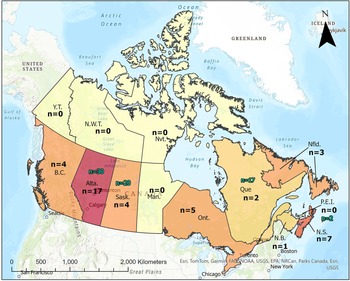
Four provincial regulators (Alberta, Saskatchewan, Quebec, and Prince Edward Island) responded to our request for information, 187 respondents completed the employee survey, and 65 respondents completed the employer/company survey. Those completing the employer/company survey were asked to indicate the provinces and/or territories in which their company/branch does business (Figure 1). Response rates were distinctly higher from Alberta. While this was not unexpected since Alberta is one of the provinces with the highest number of active CRM companies (29.6% of industry employees; Rowinski Reference Rowinski2023), a similar spike was not seen in Ontario where the largest number of companies are based (43.6% of industry employees; Rowinski Reference Rowinski2023). Although we do not have geographic data for the employee survey, we assume that responses show a similar differential distribution. Survey data are thus biased to Western Canada and may not completely represent the CRM landscape across the country. This is further evidenced in the disconnect between the number of active companies and the number of company respondents in each province where these data are available, with the number of active companies significantly exceeding the number of respondents. For example, although data from provincial regulators demonstrate that in 2024 at least 17 and 20 firms were actively conducting CRM assessments in Quebec and Saskatchewan, respectively, only two (Quebec) and four (Saskatchewan) responses from employers in these provinces reported revenue. Similarly, none of the three active consultants in Prince Edward Island in 2023 reported employee or revenue data (Figure 1). This bias toward Western Canada is likely, in part, a result of the fact that our research team is based in Alberta and the survey saw the widest initial distribution in Western Canada. Language barriers are not believed to be a factor in lower response rates from Eastern Canada because both official languages (French and English) were used in our survey distribution email and in the survey itself. Further, one of the authors (Holyoke) conducts research in Eastern Canada and previously worked in CRM there.
Employer/company survey respondents by region. Numbers in black show number of survey respondents. Numbers in blue show number of active CRM companies reported by provincial regulators (where available).

Figure 1 Long description
The map of Canada displays the number of survey respondents and active CRM companies by province. Numbers in black indicate survey respondents, while numbers in blue show active CRM companies. Alberta has the highest number of active companies (n=29) and respondents (n=4). Quebec shows 17 active companies with 2 respondents. Saskatchewan has 20 active companies and 4 respondents. Prince Edward Island has 3 active companies but no respondents. Other provinces like British Columbia, Manitoba, Ontario and Nova Scotia have varying numbers of respondents and active companies, with some provinces showing no active companies or respondents. The map includes a scale bar and a north arrow for orientation.
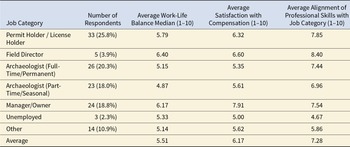
Table 1 includes a breakdown of employee survey respondents based on job category. Although representation is slightly higher for those holding PLHP positions, all job categories are well represented. The low number of respondents identifying themselves as field directors is striking but results from the fact that this job category only exists in a single jurisdiction (British Columbia).

Table 1 Long description
The table compares job categories by respondent count and average ratings (1–10) for work–life balance, satisfaction with compensation, and alignment of professional skills with the job category. Respondents are mostly permit/license holders (33; 25.8%), full-time archaeologists (26; 20.3%), managers/owners (24; 18.8%), and part-time/seasonal archaeologists (23; 18.0%). Work–life balance averages range from 4.87 for part-time/seasonal archaeologists (lowest) to 6.40 for field directors (highest), with an overall average of 5.51. Compensation satisfaction is highest for managers/owners at 7.91 and lowest for unemployed respondents at 5.00; the overall average is 6.17. Skills alignment is generally higher than the other measures, led by field directors at 8.40 and permit/license holders at 7.85, while unemployed respondents report the lowest alignment at 4.67; the overall average is 7.28. Small groups (for example, unemployed n=3 and field directors n=5) may be less reliable for comparison than larger categories.
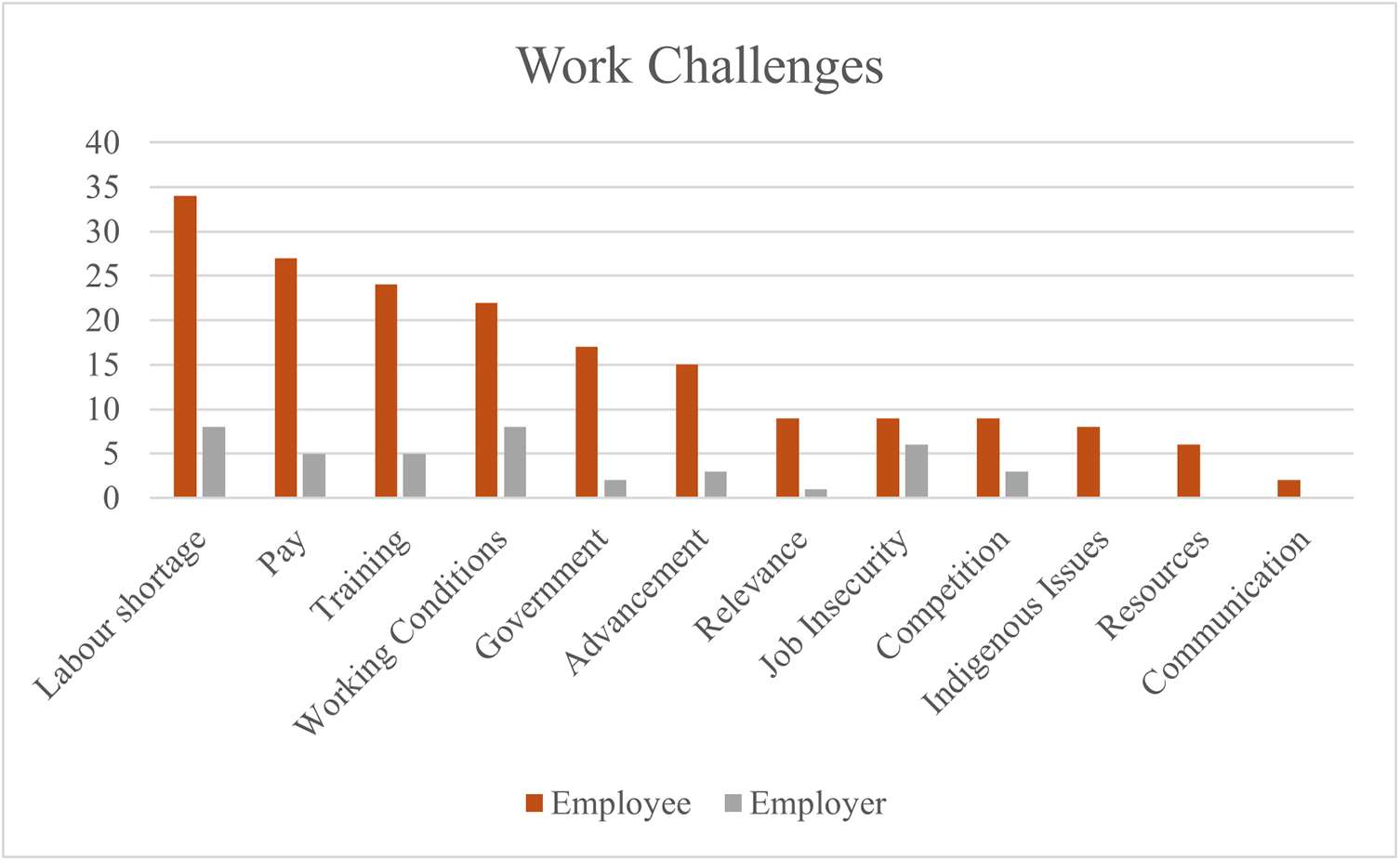
Figure 2 shows themes identified as challenges within the CRM sector. These challenges are further broken down to show coding references in both the employer/company and employee datasets. Although the frequency of these challenges differs in the two datasets, in both surveys the recurrent themes are labor shortages, working conditions, compensation/pay, and training. Each of these challenges is discussed in detail here.
Challenges identified with the Canadian CRM industry by employer and employee respondents, showing challenge theme frequency.

Figure 2 Long description
Work Challenges. Legend: Employee; Employer. X-axis categories: Labour shortage; Pay; Training; Working conditions; Government; Advancement; Relevance; Job insecurity; Competition; Indigenous issues; Resources; Communication. Y-axis scale: 0 to 40. Labour shortage: Employee 34; Employer 8. Pay: Employee 27; Employer 5. Training: Employee 24; Employer 4. Working conditions: Employee 23; Employer 7. Government: Employee 18; Employer 0. Advancement: Employee 15; Employer 0. Relevance: Employee 9; Employer 0. Job insecurity: Employee 8; Employer 0. Competition: Employee 8; Employer 0. Indigenous issues: Employee 7; Employer 0. Resources: Employee 6; Employer 0. Communication: Employee 0; Employer 0.
Labor Market/Shortage
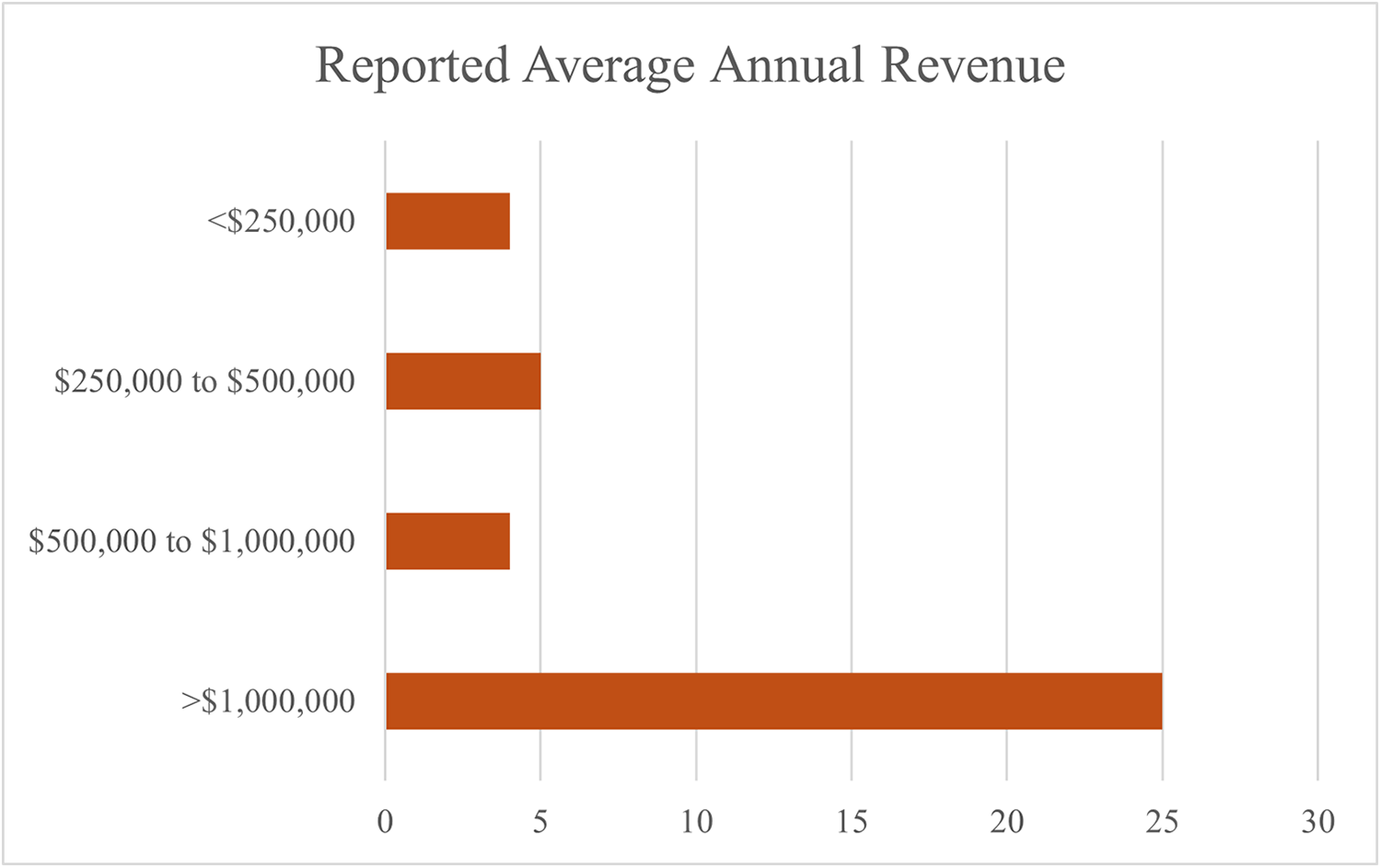
Our survey results indicate that the CRM sector in Canada is a multimillion dollar industry, with 25 (of 38) companies reporting average annual revenue from archaeology work at more than $1,000,000 (Figure 3). These data indicate a low-end estimate for industry value at between $28.25 and $32.5 million. An average of eight full-time and 11 part-time archaeology employees were reported at responding firms across the country (see Supplementary Material 1). An estimate of industry-employed archaeologists can be derived from data from 34 firms that reported the number of employees in ranges. This data suggests between 419 and 713 archaeologists are employed in CRM in Canada. These are almost certainly underestimates of the actual value of the industry and size of the workforce, given the few responding firms from Ontario, for example. Other estimates suggest that the industry is much larger, arguing that CRM in Canada is “at least an 80- to 100-million-dollar annual enterprise not including Indigenous monitoring costs and employs thousands of individuals” (Williamson Reference Williamson2018:13). Indeed, the HBI (2024:4) nominal dollars estimates point to figures from Alberta alone that exceed the total dollar value that our survey estimated. The disconnect between these numbers and our survey is partly explained by the fact that some responding companies chose not to report revenue and, as noted earlier, survey response rates were not consistent across the country. For example, they do not reflect the robust industry in Ontario.
Self-reported average annual revenue from archaeology projects.

Figure 3 Long description
Reported Average Annual Revenue. Horizontal axis labels: 0, 5, 10, 15, 20, 25, 30. Vertical axis categories, top to bottom: less than 250 comma 000; 250 comma 000 to 500 comma 000; 500 comma 000 to 1 comma 000 comma 000; greater than 1 comma 000 comma 000. Bar lengths by category: less than 250 comma 000 equals 4; 250 comma 000 to 500 comma 000 equals 5; 500 comma 000 to 1 comma 000 comma 000 equals 4; greater than 1 comma 000 comma 000 equals 25.
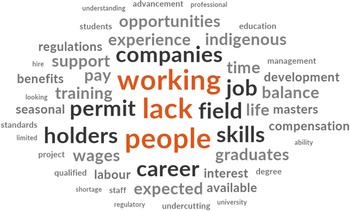
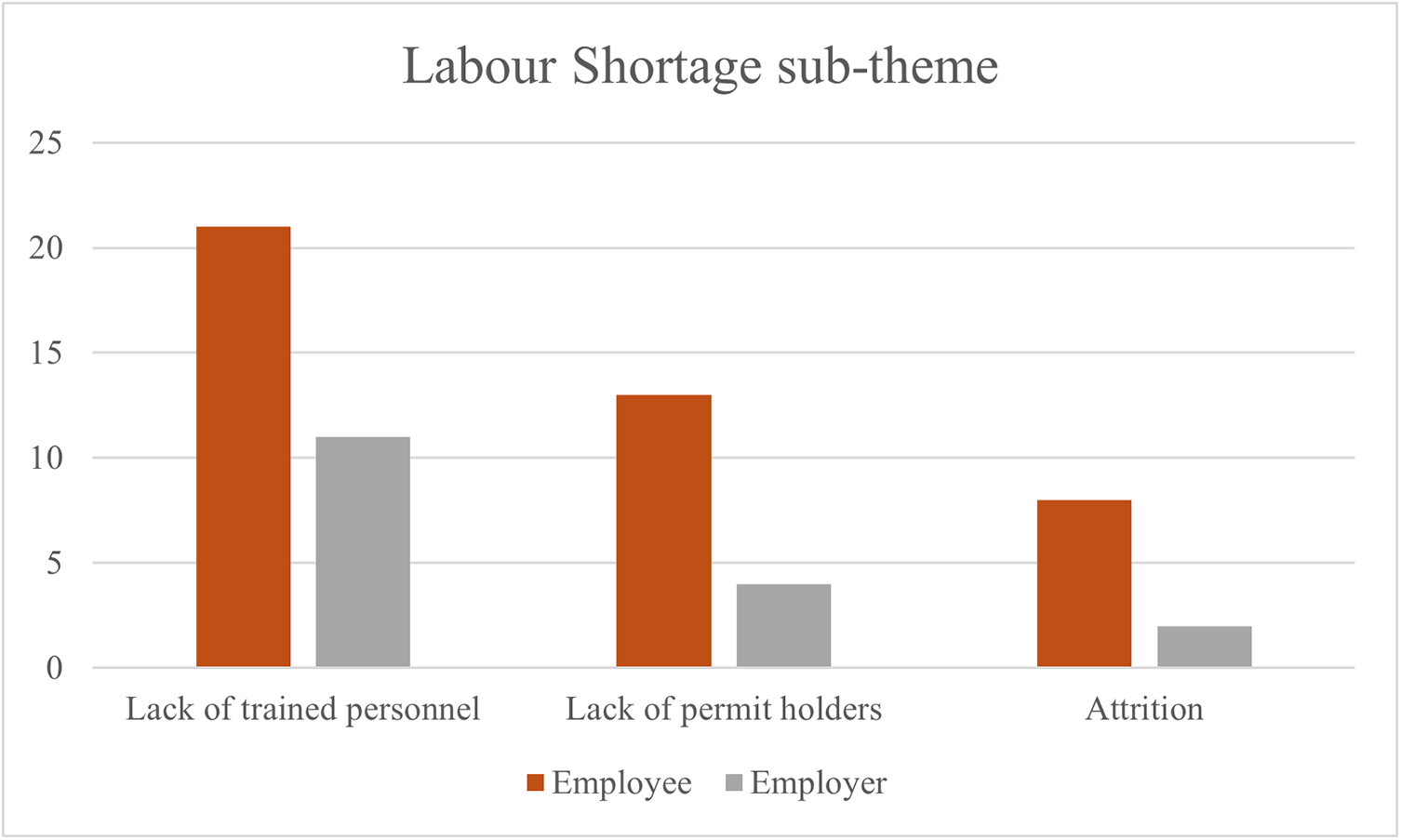
Despite the inconsistencies in revenue estimates for the industry, survey responses clearly suggest that labor market demand is outpacing supply. Fifty-five responding employers across the country reported unfilled positions, including postings at all levels of experience (n = 14 PLHPs, n = 11 field directors, n = 11 archaeologists full-time/permanent, n = 15 archaeologists part-time/seasonal, and n = 4 other). This labor shortage is the most frequent challenge identified by employees and employers alike (Figure 2) and is clearly evidenced in the word cloud created from textual data on challenges within the industry that highlights “lack” and “people” as two of the most frequently used words in this context (Figure 4). When broken down further, respondents discussed a lack of trained personnel generally, a lack of PLHP archaeologists specifically, and the ongoing attrition of trained personnel (Figure 5). These labor shortages may relate to structural issues identified in the survey relating to working conditions, compensation/pay, and opportunities for career growth.
Word cloud highlighting the 50 most frequently used words in the textual responses to CRM challenges (aggregated employer/employee datasets). Size of words corresponds with frequency.

Figure 4 Long description
A word cloud infographic about CRM challenges. Word size varies across the cloud. Text in the cloud includes: working, lack, people, permit, field, career, skills, job, holders, companies, opportunities, experience, indigenous, regulations, support, training, pay, wages, balance, time, development, management, benefits, compensation, graduates, life, masters, education, students, degree, university, professional, advancement, understanding, expected, available, interest, ability, hire, looking, seasonal, labour, shortage, qualified, staff, project, standards, limited, regulatory, undercutting.
Labor shortage subthemes by frequency.

Figure 5 Long description
The bar graph title reads Labour Shortage sub-theme. The x-axis lists Lack of trained personnel, Lack of permit holders, Attrition. The y-axis shows values from 0 to 25. A legend lists Employee and Employer. For Lack of trained personnel, Employee 21 and Employer 11. For Lack of permit holders, Employee 13 and Employer 4. For Attrition, Employee 8 and Employer 2.
Working Conditions
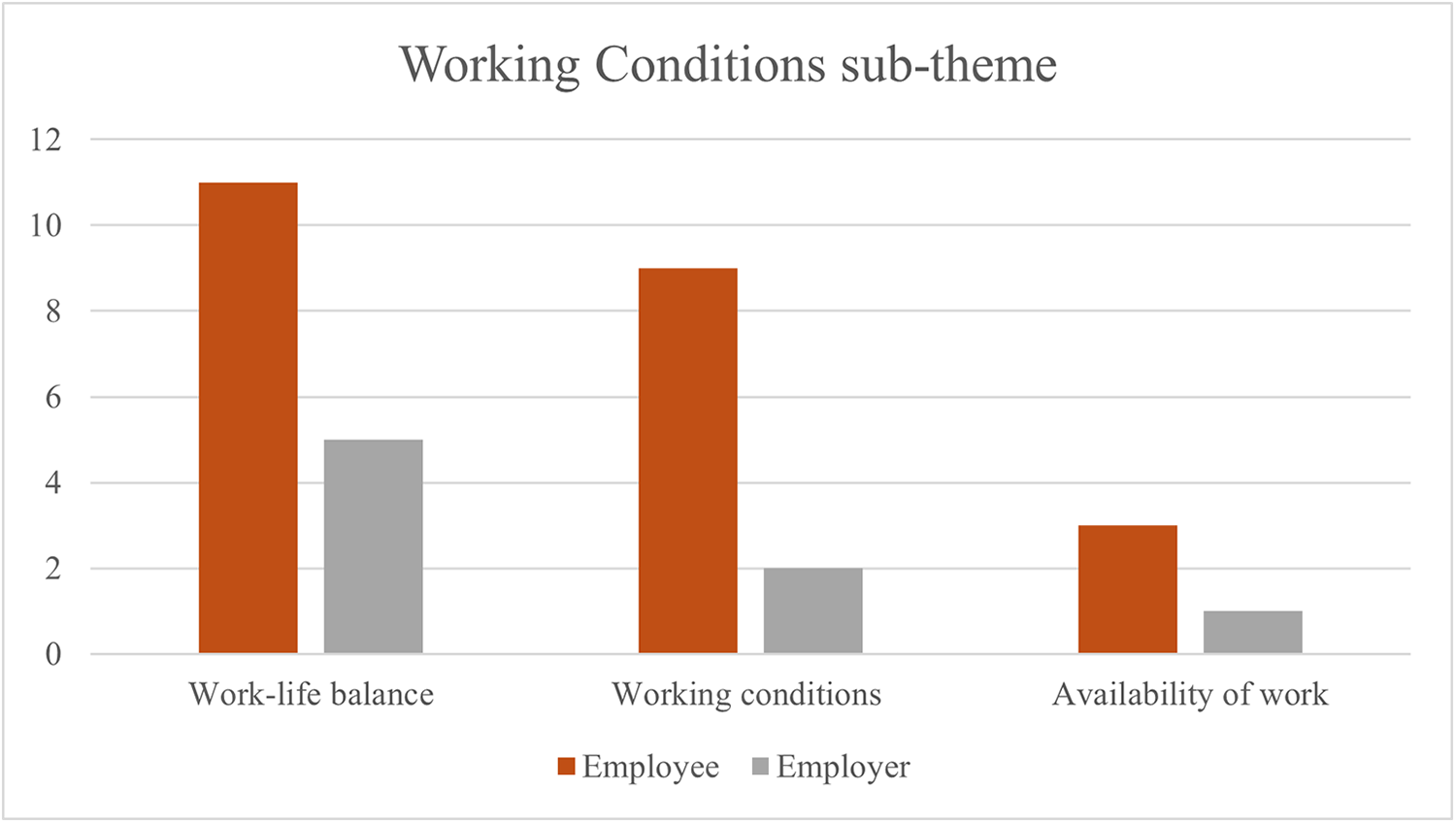
Both employees and employers highlighted working conditions as a key challenge within the CRM industry (Figure 2), with this theme further broken down into working conditions generally, work-life balance specifically, and the availability of work (Figure 6). Additional themes of advancement opportunities and job insecurity (Figure 2) are also highly correlated with perceptions of working conditions within the CRM sector.
Working conditions subthemes by frequency.

Figure 6 Long description
The bar graph title is Working Conditions sub-theme. The x axis categories are Work dash life balance, Working conditions, Availability of work. The y axis shows values from 0 to 12. A legend lists Employee and Employer. Work dash life balance: Employee 11, Employer 5. Working conditions: Employee 9, Employer 2. Availability of work: Employee 3, Employer 1.
Poor work-life balance was the most frequently identified challenge within the working conditions theme, though it is less prevalent within employer data than in the employee data (Figure 6). When asked to rate their work-life balance on a scale of 1–10, employee respondents averaged only a 5.5, suggesting a lack of balance is prevalent within the industry (Table 1). Those in project management positions (PLHP, field director, and manager) reported slightly better work-life balance than those in seasonal or full-time archaeology technician roles, although none of these values exceeded an average of 6.5 (Table 1). This lack of work-life balance relates, in part, to the number of hours these individuals work on an annual basis, where field season hours routinely exceed a 40-hour work week and office season hours can be highly variable, and in part to the precarity of seasonal work. A chi-squared test identified a statistically significant relationship between work-life balance and the number of hours worked during the field season, wherein perceived work-life balance decreases as the number of hours worked increases (p-value 0.06). No similar relationship was identified for work hours during the office season. This suggests that the long hours and ever-increasing length of the CRM field season are contributing factors to poor work-life balance and burnout.
Consistent with these values, employees repeatedly expressed that the difficult work-life balance of the CRM industry is not worth the poor pay and the physically and mentally demanding working conditions. For example, one respondent stated, “CRM currently leaves little room for a healthy home life, hobbies, sports, pets, and I can only do this for so long. I don’t see many new students staying in this field for the duration of their careers before moving on to a different industry that pays more and allows for a better work/life balance.” In contrast, employers/companies identified working conditions as an issue because employees are reluctant to work away from home for long periods and “have false expectations of workload and conditions.” This highlights a disconnect between expectations among employers and those in the labor pool.
Though classified as a separate theme, job insecurity was identified as a challenge in CRM and is highly integrated with working conditions in the industry. Both employers and employees identified the seasonal nature of fieldwork and employment as a barrier to careers within the CRM industry, with employers further expressing that the unpredictability of projects and contracts compounds this issue.
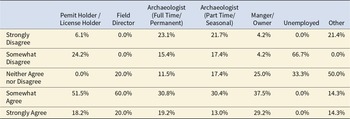
One way in which job security could be increased is through advancement within an organization (another theme in our qualitative analysis), given that permit holders and managers tend to have more consistent year-round employment. However, respondents overall perceive that there are limited opportunities for career growth within the CRM industry (Table 2). This perceived lack of opportunity for advancement is more pronounced among those in full- or part-time archaeological technician roles, with many respondents discussing how in many provincial frameworks one cannot advance into more senior roles without a graduate education and suggesting that higher education is inaccessible for some individuals. For example, one respondent stated, “Having to get a masters, and the emphasis on Canadian Masters mean you need to take 2-4 years of your life, often without pay, to advance and not everyone can do that.” A lack of opportunities for advancement is not entirely due to the CRM companies themselves but also relates to regulations and legislation at the provincial level about who can and cannot hold archaeological permits (related to government, a less frequently noted theme that is not discussed here).

Table 2 Long description
The table reports response percentages (Strongly Disagree to Strongly Agree) by job role: permit/license holder, field director, full-time archaeologist, part-time/seasonal archaeologist, manager/owner, unemployed, and other. Permit/license holders show the strongest overall agreement: 51.5% somewhat agree and 18.2% strongly agree (69.7% agree total), with 30.3% disagreeing and 0% neutral. Field directors are even more positive, with 60.0% somewhat agree and 20.0% strongly agree (80.0% agree), and 20.0% neutral. Full-time archaeologists are more mixed: 30.8% somewhat agree and 19.2% strongly agree (50.0% agree), while 38.5% disagree and 11.5% are neutral. Part-time/seasonal archaeologists also split, with 43.4% agree, 45.2% disagree, and 17.4% neutral. Managers/owners lean toward agreement (37.5% somewhat agree, 29.2% strongly agree; 66.7% agree) but have a sizable neutral share (25.0%). Unemployed respondents are concentrated in disagreement (66.7% somewhat disagree, 4.2% strongly disagree; 70.9% disagree) with 33.3% neutral and 0% agreement. The “Other” category is polarized, with 50.0% neutral, 21.4% strongly disagree, and 28.6% agree; results may be sensitive to small group sizes not shown in the table.
Junior employees are not the only ones who feel that opportunities for career growth are limited. About 30% of PHLP respondents also indicated that there are limited opportunities for advancement in their career (Table 2). One respondent noted, “There’s not much room for advancement within archaeology. Once you get your master’s and do fieldwork for several years, still making the same wage you did when you started, leaves few options for what to do next.”
Compensation (Pay and Benefits)
Compensation was the second most common challenge theme identified by employee respondents, with employer/company respondents also identifying this theme but less frequently (Figure 2). When employees were asked to rate whether they feel they are being fairly compensated on a scale of 1–10 (Table 1), the average across all job categories was 6.17. Notably, only those individuals in manager positions reported relatively high satisfaction with their compensation (7.91). Those in full- or part-time archaeological technician roles reported the lowest satisfaction with compensation (5.31 and 5.65, respectively).
Overwhelmingly, survey responses demonstrate that archaeologists are not satisfied with their compensation and feel they are underpaid for the levels of education and experience required to fill these positions. Many are aware that other professionals with a similar schedule and fieldwork demands, such as biologists and geologists, are paid more than archaeologists (often without a graduate education). One respondent summed this up succinctly, stating, “When compared to other disciplines that work in the same industries as archaeologists, the pay is not comparable for the work being completed. For example, an environmental monitor that is construction monitoring the same development as an archaeologist will have a significantly higher pay rate than the archaeologist. I have personally been made aware that there can be up to $40–50/hour difference (i.e., $30 vs. $90).”
Although the employer/company survey also identified low/inadequate compensation as a challenge to the CRM industry, it was characterized differently. Several employer respondents noted that they would like to pay their employees more, but stated it was simply not possible because of their limited profit margins. Some respondents went further to argue that this inability to increase employee compensation is a result of the devaluation of historic resources and projects caused by the increasing frequency of companies “low-balling” bids. This concern with low-balling bids was expressed frequently enough (n = 12) that it became its own theme in our analysis (competition; see Figure 2). Analysis of the CRM industry in the United States foreshadowed this concern, with Altschul and Klein (Reference Altschul and Klein2022:365) noting that, in response to a significant labor shortage, “to speed up project compliance, there will be attempts to lower professional standards.”
Educational Preparedness
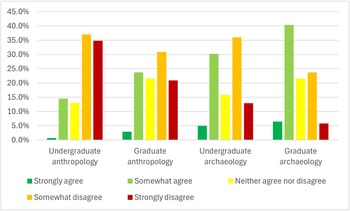
Finally, the survey found that practicing professional archaeologists and those entering the workforce feel that postsecondary education does not adequately prepare students for roles in the CRM industry (Figure 7). We asked respondents to indicate how well they feel that undergraduate and graduate degrees in archaeology or anthropology prepare students for a career in CRM. Archaeology degrees outperformed anthropology degrees in this regard. Yet only 45% of respondents agree or somewhat agree that an undergraduate archaeology degree prepares students for the workforce, with a graduate degree in archaeology faring somewhat better, reaching 60% of agree/somewhat agree responses.
Perceptions of degree preparedness.

Figure 7 Long description
The grouped bar graph has four x axis categories: Undergraduate anthropology, Graduate anthropology, Undergraduate archaeology, Graduate archaeology. The y axis shows percent, ranging from 0.0 percent to 45.0 percent. A legend lists five response levels: Strongly agree, Somewhat agree, Neither agree nor disagree, Somewhat disagree, Strongly disagree. Undergraduate anthropology bars: Strongly agree about 1 percent; Somewhat agree about 12 percent; Neither agree nor disagree about 10 percent; Somewhat disagree about 37 percent; Strongly disagree about 35 percent. Graduate anthropology bars: Strongly agree about 3 percent; Somewhat agree about 24 percent; Neither agree nor disagree about 21 percent; Somewhat disagree about 31 percent; Strongly disagree about 21 percent. Undergraduate archaeology bars: Strongly agree about 5 percent; Somewhat agree about 30 percent; Neither agree nor disagree about 12 percent; Somewhat disagree about 36 percent; Strongly disagree about 10 percent. Graduate archaeology bars: Strongly agree about 6 percent; Somewhat agree about 40 percent; Neither agree nor disagree about 21 percent; Somewhat disagree about 24 percent; Strongly disagree about 6 percent.
This perceived lack of preparedness results from a disconnect between the skills that CRM practitioners feel are most important in their careers and those skills that are prioritized in traditional academic archaeology programs. In our survey, respondents ranked a list of skills based on what they felt were most important for CRM archaeologists (Supplementary Material 2). The top-five skills identified by respondents were (1) fieldwork, (2) critical thinking, (3) archaeological survey, (4) artifact identification/analysis, and (5) outdoor skills. Notably, excavation skills are not in the top-five skills, and knowledge taught prevalently in academia such as culture history and research skills are near the bottom. At the same time, across all job categories, respondents reported fairly good alignment between their professional skills and daily tasks (Table 1). This suggests that a significant amount of on-the-job learning is occurring and that postsecondary education may need to adapt to better align with the skills and knowledge our graduates require to succeed in the workplace.
Discussion
Labor Market in Crisis
It is difficult to forecast what the next decade will look like for CRM across Canada. Clearly, however, the demand for archaeologists at all levels is outpacing supply, particularly for PLHPs. Understanding the reasons for this supply glut will be essential to addressing the labor market crisis.
When asked about key challenges facing CRM today, respondents noted the following:
Wages have not caught up in the industry and many people I know have made the decision that the difficult work-life balance of this industry is not worth the pay or hardship.
Not attracting enough people which I believe is partly due to low compensation compared to the level of education and experience required.
I don’t see many new students staying in this field for the duration of their careers before moving on to a different industry that pays more and allows for a better work/life balance.
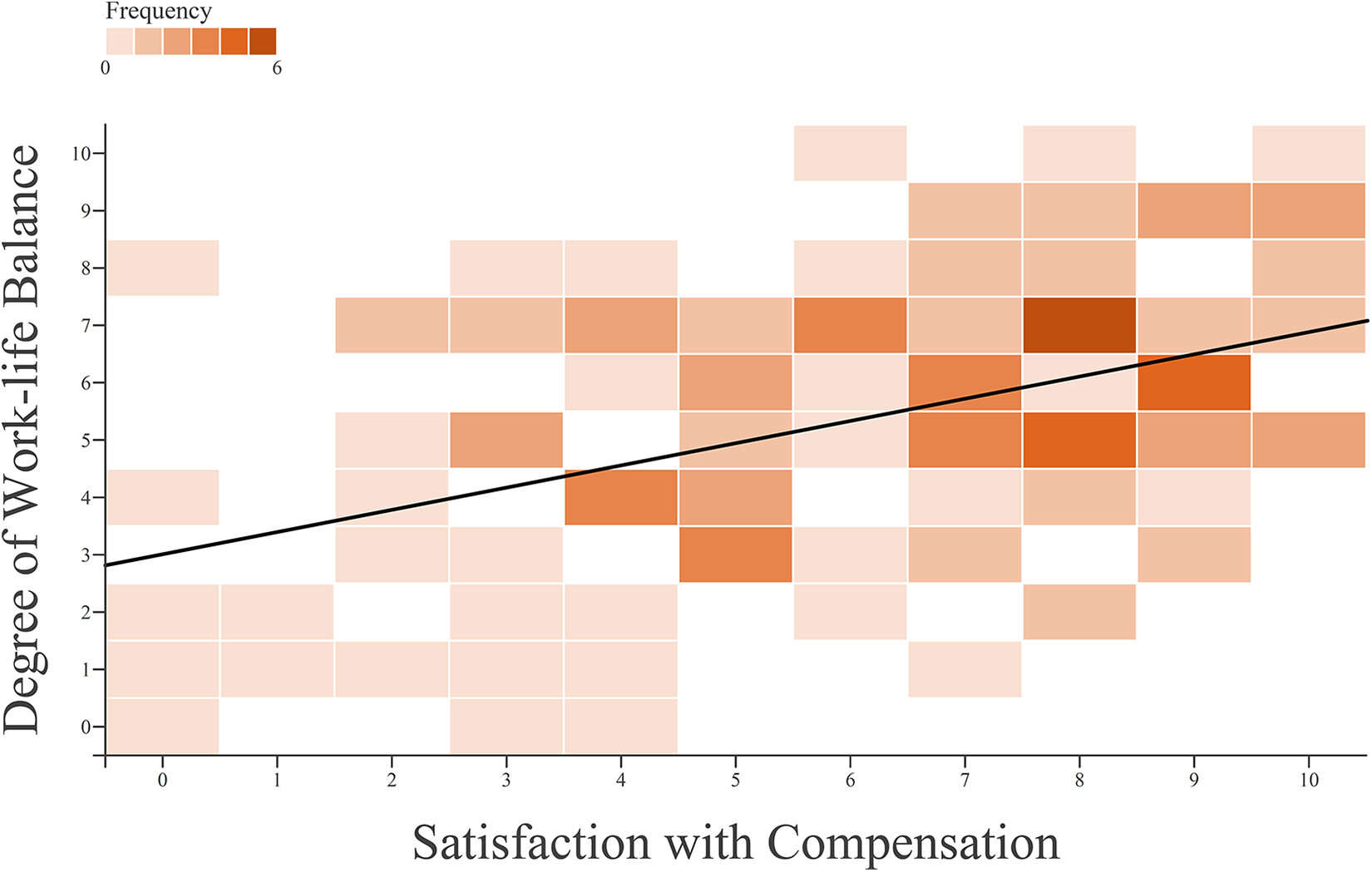
These quotes are only a small sample of those expressing similar sentiments. Together, they suggest that compensation (specifically the perception of low or inadequate compensation) and working conditions (specifically poor work-life balance) are interrelated issues contributing to the labor market crisis. Indeed, there is a positive correlation between these two variables, wherein satisfaction with work-life balance increases as satisfaction with compensation increases (Figure 8). A one-way ANOVA test demonstrates that there is a statistically significant relationship between job satisfaction and compensation (p-value = 0.001; Cohen’s f 0.56) and between job satisfaction and work-life balance (p-value = 0.0007; Cohen’s f 0.54). These tests demonstrate that the independent variables (satisfaction with compensation and work-life balance) have an influence on the dependent variable (job satisfaction). The negative perceptions of work in the CRM industry appear to be specific to the industry and do not reflect broader societal issues or the overall outlook of Canadians during the period in which we collected our survey data. In fact, more than half of respondents to the Quality of Life assessment for Q3 in 2024, collected as part of the Canadian Social Survey, reported that they often or totally have a hopeful outlook on the future, with an additional 30% reporting that they sometimes have a hopeful outlook (StatsCan 2024b).
Correlation of self-reported satisfaction with compensation and levels of work-life balance.

Figure 8 Long description
The heatmap illustrates the correlation of self-reported satisfaction with compensation and levels of work-life balance. The horizontal axis is labeled Satisfaction with Compensation, ranging from 0 to 10. The vertical axis is labeled Degree of Work-life Balance, ranging from 0 to 10. A legend at the top indicates frequency, with darker shades representing higher frequency values from 0 to 6. A trend line is overlaid, showing a positive correlation between satisfaction with compensation and work-life balance. Higher frequencies are concentrated in the middle to upper-right areas of the grid, indicating that as satisfaction with compensation increases, so does the degree of work-life balance.
Arguably, then, to attract and retain trained personnel, the CRM industry must first raise compensation rates to be competitive with other professional disciplines and make efforts to improve the work-life balance of personnel in an industry characterized by shiftwork and long field seasons. Although employees and employers/companies alike highlighted both pay and working conditions as key challenges, their perception of these issues differed. Employees argue that improvements to both compensation and working conditions are necessary in the industry. In contrast, company respondents argued that they cannot pay employees more because of tight profit margins and identified a workforce unwilling to engage in shiftwork or to work long periods away from home as a challenge. Systemic change will be necessary to address these issues.
To create this systemic change, we believe archaeologists will need to organize to create a professional designation for themselves through a formalized professional industry, equivalent to other disciplines within the environmental assessment space, such as biologists and geologists. Doing so may provide the impetus required to drive up wages to match those of comparable disciplines. The creation of professional standards by a professional organization of archaeologists or government could lead to minimum work standards that would reduce CRM companies’ ability to “low-ball” bids, a major barrier to increasing wages identified by employers. Additionally, CRM companies need to recognize that the archaeologists of today expect higher wages and demand a better work-life balance. A recent move toward unionization of field personnel in some provinces attests to these demands (e.g., Kolhatkar Reference Kolhatkar2022; Press Reference Press2024; Roden Reference Roden2024). CRM companies will need to consider ways to increase wages and benefits and to reduce the overall precarity of seasonal employment if they wish to attract and retain highly qualified personnel. This is not an easy task and may result in an initial impact on revenues. Nevertheless, raising salaries will result in long-term economic benefits by reducing turnover and lowering the costs of employee onboarding and training. A knock-on benefit will likely be more consistent and quality archaeological work.
Finally, many survey respondents identified a lack of career mobility as an important issue. This challenge is tied to retention issues and quality-of-work in the CRM industry generally. Government regulators play a critical role in this regard by recognizing the accreditation of PLHPs across multiple jurisdictions within Canada. Done properly, federal heritage legislation could partially address these labor mobility challenges. At the same time, CRM companies need to provide consistent and meaningful mentorship and should consider providing additional professional development opportunities for archaeologists at all levels to enhance upward mobility.
Postsecondary Education
Postsecondary institutions have a role to play in addressing the CRM labor crisis by creating robust archaeology degree programs that will attract students and demonstrate that there are viable career pathways in archaeology outside academia (see also Altschul and Klein Reference Altschul and Klein2022:356). Additionally, these academic institutions must renew curricula to focus not only on academic archaeology but also on industry-relevant skills and knowledge.
Overall, our survey respondents felt that their postsecondary education did not train them adequately for a job in the CRM industry. This perception of preparedness is significantly improved for those graduating from a dedicated archaeology program as opposed to those from a generalized anthropology program, with graduate degrees also performing notably better (Figure 7). These results are consistent with sentiments expressed in other Canadian studies. Rowinski (Reference Rowinski2023:92–94) reported that only 17% (n = 9/53) of surveyed participants “agreed” or “strongly agreed” that their education prepared them for entry-level field technician positions and only 9% (n = 5/53) for management positions. Similarly, Jalbert (Reference Jalbert2019:183–198) outlined the lack of alignment between education and careers in archaeology, including CRM.
This disconnect between training and CRM is further visible in the skills that respondents identified as most important to jobs within the CRM industry (Supplementary Material 1), results that are again generally consistent with studies elsewhere. Based on a survey of CRM professionals in Colorado, Larkin and Slaughter (Reference Larkin and Slaughter2021) identified pedestrian survey, excavation, artifact identification, completion of state or federal forms, and running specialized equipment or analyses as the five most important skills for students to acquire before entering the workforce. Morgan (Reference Morgan2023) took a different approach, scanning 674 archaeological job postings in the United States to assess in-demand archaeological knowledge, skills and abilities. Through this analysis, the key competencies were identified as fieldwork, technical writing, research (here, meaning researching state files and compiling desktop studies), artifact analysis/curation, GIS, and experience working with Indigenous communities. Although some of the skills identified in our survey and elsewhere—most commonly, excavation and artifact identification/analysis—are routinely taught in postsecondary archaeology programs, others such as technical writing, archaeological survey, and knowledge of legislation and regulatory forms/processes are rarely part of the postsecondary curriculum. Even where these skills and knowledge are taught, CRM respondents in Larkin and Slaughter’s (Reference Larkin and Slaughter2021) survey felt that students were nevertheless poorly prepared in these areas on entering the workforce.
Why do graduates entering the workforce not feel prepared by their education? Whitley (Reference Whitley2004:23) notes that there is
a disconnect between how traditional undergraduate curriculum and field schools are structured and the tasks that CRM professionals spend the majority of their time doing. From an academic perspective, the disconnect is a problem because most of our department’s graduates who pursue a career in anthropology seek jobs in cultural or heritage resource management. Workforce analyses indicate that there are approximately five times more archaeologists employed in the cultural resource management field than in academia.
Although the divide between Canadian archaeologists working in academia and CRM has lessened in recent years, many postsecondary archaeology programs in Canada remain focused on traditional problem-oriented research programs, rather than CRM or industry-focused programs that consider the specific needs of graduates entering the primary industry that hires archaeologists. The University of Lethbridge in Alberta and Simon Fraser University in British Columbia are two exceptions, having developed CRM-oriented archaeology master-level programs (see also Welch et al. Reference Welch, Burley, Driver, Hogg, Jayasundera, Klassen, Maxwell, Nicholas, Pivnick and Dore2018). Several Canadian universities, including the University of Lethbridge and the University of Calgary, have a CRM-specific course or courses at the undergraduate level. The general lack of CRM oriented programs and coursework at postsecondary institutions is particularly problematic when we consider that the majority of graduates who stay in archaeology will enter the CRM industry (e.g., Banks et al. Reference Banks, Childs, Douglass, Hawkins, Jones, Klein and Lindsay2025).
Jalbert (Reference Jalbert2019:192) notes, “Traditionally, it can be argued that the role of the University has been to provide knowledge within an archaeological unit rather than practical training. But, in an era of increased commercialization and corporatization at the university level, there exists some question as to whether the role of the university has changed: is it the obligation of universities to prepare graduates for employment or does this lay outside their mission statements?”
This identity crisis in postsecondary archaeology programs has created a resistance among academics to develop undergraduate and graduate programs to align with the job market (Larkin and Slaughter Reference Larkin and Slaughter2021). To be clear, we are not arguing here for creation of a CRM trade school for archaeologists. Rather, like Larkin and Slaughter (Reference Larkin and Slaughter2021), we believe that small changes to curriculua and programs can enhance the student experience and career successes without compromising academic objectives and rigor (see also Kelley Reference Kelley2000; Williamson Reference Williamson2018:17). Postsecondary institutions need to create degree programs that are aligned with the skills and knowledge identified as relevant by practicing industry professionals so they can better prepare students for their future careers. Further, postsecondary institutions need to introduce CRM to students early in their undergraduate programs. This can happen as part of CRM-specific courses or through discussion of industry contexts and regulations in existing classes. There should also be departmental events about CRM so that students realize that a viable career pathway exists within the archaeological discipline outside academia (see also Rowinski Reference Rowinski2023). Doing so will not only create more robust and future-proofed degree programs that are aligned with and respond to the needs of industry but also programs that attract students to a relevant education where they see a viable career path, a first step to addressing the CRM labor market crisis. Thus, we echo Altschul and Klein (Reference Altschul and Klein2022:355) in seeing “a compelling need to (a) stop the trend to close or decrease the size of current graduate programs, (b) reorient academic programs to give a greater emphasis to the skills needed to be successful in CRM, and (c) better integrate academic and applied archaeology to leverage the vast amount of data that will be generated in the next decade to best benefit the public.”
Conclusion
Our study underestimates the labor market and value of CRM in Canada. The highly conservative estimates generated suggest there were between 419 and 713 archaeologists working in the Canadian CRM industry in 2024 and that this industry generated between $28.25 and $32.5 million in revenue for consulting companies alone. Annual public monies invested in heritage management and archaeological regulation are estimated to be in the hundreds of millions at the federal level and likely in the tens of millions for each provincial and territorial office. The CRM industry in Canada has seen significant growth since the early 1990s (e.g., Dow et al., Reference Dow, Hrynick and Holyoke2023; Insituated Heritage 2025; Jalbert Reference Jalbert2019). Despite the torrid pace of industry growth, the labor market has not kept pace. Perhaps because of this mismatch between demand and supply, the CRM workforce has experienced many challenges. Our survey identified primary challenges in four broad categories: labor market shortages, working conditions, compensation, and educational preparedness.
To address labor market shortages and educational preparedness, program coordinators for postsecondary institutions will need to work both within their institutions and outside with industry partners to identify programmatic and curricular innovations that better respond to student and industry needs. CRM is the largest employer of archaeology graduates in Canada. Despite this, postsecondary programming has lagged in responding to the growth of CRM through the development of industry-focused curricula, in part a result of the early divide between academic and industry archaeology but also due to persistent erosion of funding for postsecondary institutions since the 1990s. As professional archaeologists who have worked in both industry and academia, one of our goals as educators is to increase the preparedness of our students for careers in industry so that they will graduate with the knowledge and skills required to succeed as professional archaeologists in the CRM context. Thus, as Morgan notes, “We must argue forcefully that archaeology is a subject worthy for universities to invest in, and we must convince those training future archaeologists that CRM is a subject worthy of study” (Reference Morgan2023:371; see also Banks et al. Reference Banks, Childs, Douglass, Hawkins, Jones, Klein and Lindsay2025).
Addressing challenges related to working conditions and compensation will require actions by industry participants—both employers and employees—and a recognition that as archaeological laborers organize (e.g., Kolhatkar Reference Kolhatkar2022; Press Reference Press2024; Roden Reference Roden2024), tensions within the CRM industry will be exposed. Altschul and Klein (Reference Altschul and Klein2022:365) argue that, “The best means of maintaining standards [within archaeology] is through some form of certification, registration, or licensing.” Similarly, one survey respondent stated that the largest challenge in CRM is a “lack of professional designations (e.g., something similar to APEGGA for engineers and geologists), which in turn causes a devaluation of our industry.” The recently established Canadian Cultural Resources Association—a CRM trade association with a mandate similar to that of the American Cultural Resources Association in the United States—could be a venue where these matters are resolved. Recent discussions about breaking down interprovincial trade barriers (e.g., Buckley Reference Buckley2025; Robertson Reference Robertson2025) heightens the need for a robust consideration of labor mobility for permit holders (e.g., harmonized qualifications criteria) across Canadian provincial and territorial jurisdictions.
There is also a pressing need to correct the labor shortage within the CRM industry. Concerns shared by many survey respondents echo Altschul and Klein’s (Reference Altschul and Klein2022:365) warning that “without a sufficient labor force, CRM . . . will be seen as an impediment to federal infrastructure projects.” Respondents are concerned that if archaeology does not remain timely and relevant, it will be seen as a barrier to development and lose political and public backing, something that recent news articles (e.g., Amiri Reference Amiri2024; Galea Reference Galea2024; Kshatri Reference Kshatri2023) and provincial governments (e.g., Syed Reference Syed2025) in Canada are picking up on. Righting the ship to fill labor demand in the Canadian CRM industry will take a concerted, joint effort from within CRM, academia, and government and should be prioritized by all sectors to ensure the continued preservation and celebration of Canada’s heritage.
Acknowledgments
A note of thanks is due to the nearly 200 individuals across Canada who responded to our survey. Any errors or omissions are the authors’ alone. This study was approved by the University of Calgary Conjoint Faculties Research Ethics Board (REB19-1882). We are also grateful to Chris Dore and Heritage Business International, who provided their report gratis, and Bronwyn Bragg (ULeth Geography & Environment) and Aaron Chubb (ULeth Faculty Association) for helping us navigate StatsCan data. Thanks to Yanick Vallière for assistance with the survey’s translation into French and Patricia Campos Díaz (UCalgary Anthropology and Archaeology) for translation of the abstract into Spanish.
Funding Statement
Portions of this research were funded by a University of Lethbridge Faculty of Arts & Science Start-Up Fund issued to Holyoke.
Data Availability Statement
This study was approved by the University of Calgary Conjoint Faculties Research Ethics Board (REB24-0347). The terms of our ethics approval for the project require that the data collected from the survey be housed on encrypted servers only accessible to the project team. Thus, survey data are not available in an open-access format.
Competing Interests
Amundsen-Meyer and Holyoke have no competing interests. Munro is currently employed by Stantec Consulting. As PI in an academic position, Amundsen-Meyer reviewed all data collected before releasing it to the research team to ensure anonymity of the data and that no conflict of interest or potential competitive advantage or disadvantage was provided through having access to this information.
Supplementary Material
The supplementary material for this article can be found at https://doi.org/10.1017/aap.2025.10105.
Supplementary Material 1. Reported Number of Employees by Job Category and Region (table).
Supplementary Material 2. Skills Needed within CRM Archaeology, Ranked by Level of Importance (table).


 Open access

