
Skip to main content Accessibility help
×
  • Cited by 32
    • Show more authors
    • You may already have access via personal or institutional login
    • Select format
    • Publisher:
      Cambridge University Press
      Publication date:
      26 February 2010
      21 January 2010
      ISBN:
      9780511674600
      9780521117142
      9781107685451
      Dimensions:
      (228 x 152 mm)
      Weight & Pages:
      0.47kg, 206 Pages
      Dimensions:
      (229 x 152 mm)
      Weight & Pages:
      0.31kg, 208 Pages
    You may already have access via personal or institutional login
  • Selected: Digital
    Add to cart View cart Buy from Cambridge.org

    Book description

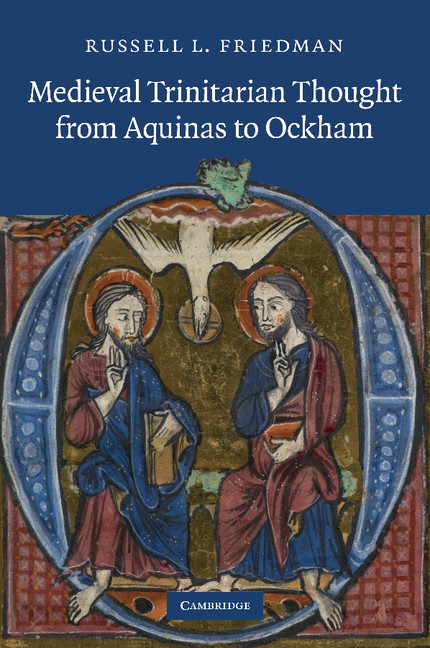
    How can the Father, the Son, and the Holy Spirit be distinct and yet identical? Prompted by the doctrine of the divine Trinity, this question sparked centuries of lively debate. In the current context of renewed interest in Trinitarian theology, Russell L. Friedman provides the first survey of the scholastic discussion of the Trinity in the 100-year period stretching from Thomas Aquinas' earliest works to William Ockham's death. Tracing two central issues - the attempt to explain how the three persons are distinct from each other but identical as God, and the application to the Trinity of a 'psychological model', on which the Son is a mental word or concept, and the Holy Spirit is love - this volume offers a broad overview of Trinitarian thought in the thirteenth and fourteenth centuries, along with focused studies of the Trinitarian ideas of many of the period's most important theologians.

    Reviews

    Review of the hardback:‘This brilliant book uncovers a key phase in the history of Trinitarian doctrine, from ca. 1250 to 1350. It discusses a number of thinkers whose works have remained largely unknown outside of a small group of specialists, and in doing so dispels the view that there was no significant Trinitarian development after Bonaventure, Aquinas and Duns Scotus. Friedman combines outstanding scholarly knowledge of primary texts with utmost readability, revealing the extraordinary diversity, coherence, and vitality of later-medieval theology of the Trinity. This book is a marvellous achievement, and essential reading for anybody who has an interest in Trinitarian theology.’

    Rik Van Nieuwenhove - University of Limerick

    Review of the hardback:'With his clear presentation of background philosophical categories and his selection of texts from well-known and, happily, not so well-known theologians, Friedman has achieved a three-fold project … To have achieved each of these projects in so short a volume reveals the author’s acumen and expertise. To have done so in such a readable style reveals his pedagogical gifts. The volume is suitable for advanced undergraduate and graduate students. Complete with a helpful appendix, bibliographies … and index.'

    Mary-Beth Ingham Source: Heythrop Journal

    Review of the hardback:'In this highly specialized yet decidedly accessible work, Friedman … provides an overview of Trinitarian thought in the Latin West during the thirteenth and fourteenth centuries … For those interested in learning about or deepening their understanding of later-medieval Trinitarian thought, this is a crucial resource … Summing up: essential. [4 stars].'

    F. A. Grabowski Source: Choice

    Review of the hardback:'Russell Friedman has succeeded in writing a book on an abstruse area of medieval scholastic theology that is at once sophisticated and user-friendly … [He] does the introductory reader to the field a double service in creating an extremely readable account and in introducing one to an incredible spectrum of opinions on Trinitarian theology during the thirteenth and fourteenth centuries.'

    Jonathan Warren Source: Reviews in Religion and Theology

    Review of the hardback:'It is hardly possible to imagine a book that could better lead its reader to the very heart of medieval culture than Russell Friedman's study … The book is a perfect starting point for any reader interested in how medieval theologians coped with the most difficult conceptual problems, using not only theological but also metaphysical, logical, and psychological analyses.'

    Pekka Kärkkäinen Source: Speculum

    ‘… a welcome addition to academic discourse exploring medieval theologians’ understanding … clear and concise when dealing with complex ideas and intricate arguments … includes an appendix … The book delivers a detailed exposition of the different ways the two schools of thought approach the construction of the doctrine of the Trinity and the roles which ‘the psychological model’, ‘opposed relation’ and the interplay of faith and reason have in the development of these constructions … the reader is provided with a detailed analysis of these different ‘takes’ on Trinitarian doctrine.’

    Paul M. Collins Source: Scottish Bulletin of Evangelical Theology

    Refine List

    Actions for selected content:

    Select all | Deselect all
    • View selected items
    • Export citations
    • Download PDF (zip)
    • Save to Kindle
    • Save to Dropbox
    • Save to Google Drive

    Save Search

    You can save your searches here and later view and run them again in "My saved searches".

    Please provide a title, maximum of 40 characters.
    ×

    Contents

    Bibliography of primary sources
    Annotated bibliography of selected secondary literature
    Wodeham, OFM Adam, Lectura Secunda, ed. Wood, Rega and Gál, Gedeon, 3 volumes. St. Bonaventure, NY: Franciscan Institute, 1990.
    ,Alphonsus Vargas of Toledo, OESA, In primum Sententiarum, ed. Spilimbergo, Thomas. Venice,1490 (rpt. Cassiciacum: Studies in St. Augustine and the Augustinian Order, vol. 2, 1952).
    Aristotle, , The Complete Works of Aristotle: The Revised Oxford Translation, ed. Barnes, Jonathan. Princeton: Princeton University Press, 1984.
    Augustine, , De trinitate, ed. Mountain, W. J. and Glorie, Fr., 2 volumes. (Corpus Christianorum Series Latina, vols. 50–50a.) Turnhout: Brepols, 1968.
    Augustine, , De trinitate, ed. Mountain, W. J. and Glorie, Fr., The Trinity, trans. McKenna, Stephen, CSSR. (The Fathers of the Church, vol. 45.) Washington, D.C.: Catholic University of America Press, 1963.
    ,The Bible: The New Oxford Annotated Bible with the Apocrypha. Expanded edition (Revised Standard Version), ed. Herbert, G. May and Metzger, Bruce M.. New York: Oxford University Press, 1977.
    Boethius, , De trinitate, in De consolatione philosophiae. Opuscula theologica, ed. Moreschini, C.. (Biblioteca Teubneriana.) Munich, and Leipzig: K. G. Saur Verlag, 2000, pp. 165–81.
    Boethius, , De trinitate, in Tractates de consolatione philosophiae, ed. Stewart, H. F., Rand, E. K., and Tester, S. J.. Cambridge, Mass.: Harvard University Press, 1973, pp. 2–31.
    Bonaventure, OFM , Opera Omnia. Quaracchi, 1882–1902.
    Denzinger, Heinrich (with Peter Hünermann), Enchiridion Symbolorum definitionum et declarationum de rebus fidei et morum. Freiburg: Herder, 2005 (40th edn.).
    ,Durand of Saint Pourçain, OP, D. Durandi a Sancto Porciano in Petri Lombardi Sententias theologicas commentariorum libri IIII (= redactio tertia). Venice, 1571 (rpt. Ridgewood, N.J.: Gregg Press, 1964).
    Durandellus, (Nicolaus Medensis), Evidentiae contra Durandum, ed. Stella, P. T. with Lanczkowski, M., 2 volumes. (Corpus Philosophorum Medii Aevi: Opera Philosophica Mediae Aetatis Selecta, vol. 3.) Tübingen and Basel: Francke, 2003.
    ,Francis of Marchia, OFM, Quodlibet cum quaestionibus selectis ex Commentario in librum Sententiarum, ed. Mariani, Nazareno. (Spicilegium Bonaventurianum, 29.) Grottaferrata: Collegii S. Bonaventurae ad Claras Aquas, 1997.
    ,Francis of Marchia, OFM, Scriptum super primum Sententiarum, d. 11, ed. Friedman, Russell L., in “Francis of Marchia and John Duns Scotus on the Psychological Model of the Trinity,” Picenum Seraphicum: Rivista di studi storici e francescani n.s. 18 (1999), (pp. 11–56), pp. 46–56.
    ,Francis of Marchia, OFM, Scriptum super primum Sententiarum, d. 27, ed. Friedman, Russell L., in “In principio erat Verbum: The Incorporation of Philosophical Psychology into Trinitarian Theology, 1250–1325.” Ph.D. dissertation, University of Iowa, 1997 (UMI number 9731795), Appendix 10, pp. 555–72.
    ,Giles of Rome, OESA, In primum librum Sententiarum. Venice, 1521 (rpt. Frankfurt: Minerva, 1968).
    ,Godfrey of Fontaines, Les Quodlibets de Godefroid de Fontaines, ed. Wulf, M. and Hoffmans, J.. (Les Philosophes Belges: Textes et études.) Louvain: Institut supérieur de philosophie de l'Université, 1904–37.
    ,Gregory of Rimini, OESA, Lectura super primum et secundum Sententiarum, ed. Trapp, D.et al., 7 volumes. (Spätmittelalter und Reformation: Texte und Untersuchungen, 6–12.) Berlin and New York: Walter de Gruyter, 1981–87.
    ,Henry of Ghent, Quodlibet VI, ed. Wilson, G. A.. (Henrici de Gandavo Opera Omnia, vol. 10.) Leuven: Leuven University Press, 1987.
    ,Henry of Ghent, Quodlibet VI, ed. Wilson, G. A.. Summa quaestionum ordinariarum, ed. Badius, , 2 volumes. Paris, 1520 (rpt. St. Bonaventure, N.Y.: Franciscan Institute, 1953).
    ,Henry of Ghent, Quodlibet VI, ed. Wilson, G. A.. Summa quaestionum ordinariarum, a. 55, q. 6, ed. Flores, Juan Carlos, in Henry of Ghent: Metaphysics and the Trinity. Leuven: Leuven University Press, 2006, pp. 207–17.
    Natalis, OP Hervaeus, In quatuor libros Sententiarum commentaria. Paris, 1647 (rpt. Farnborough: Gregg International Publishers Ltd, 1966).
    Baconthorpe, OCarm John, Quaestiones in quatuor libros Sententiarum. Cremona, 1618.
    Scotus, OFM John Duns, Ioannis Duns Scoti opera omnia, ed. Balić, Charles. Vatican City, 1950–.
    ,John of Naples, OP, Quaestio disputata 13, “Utrum Spiritus Sanctus distingueretur a Filio, si non procederetur ab eo,” ed. Schmaus, Michael, in Der “Liber propugnatorius” des Thomas Anglicus und die Lehrunterschiede zwischen Thomas von Aquin und Duns Scotus, II Teil: Die trinitarischen Lehrdifferenzen. Münster: Aschendorff, 1930, pp. 128*–42*.
    ,John of Naples, OP, Quaestiones variae Parisius disputatae. Naples, 1618 (rpt. Ridgewood, N.J.: Gregg Press, 1966).
    Pecham, OFM John, Commentarium in I Sententiarum, mss. Firenze, Biblioteca nazionale centrale, conv. soppr. G.4.854; Napoli, Biblioteca nazionale, VII C 2.
    Bonet, OFM Nicholas, Theologia naturalis, in Habes Nicholai Bonetti viri perspicacissimi quattuor volumina: Metaphysicam videlicet, Naturalem phylosophiam, Predicamenta nec non Theologiam naturalem. Venice, 1505.
    Auriol, OFM Peter, Commentariorum in primum librum Sententiarum pars prima. Rome, 1596.
    Auriol, OFM Peter, Electronic Scriptum (selected texts), on Russell L. Friedman (site administrator), The Peter Auriol Homepage (www.peterauriol.net).
    Auriol, OFM Peter, Scriptum super primum Sententiarum, Prologue – d. 8, ed. Buytaert, Eligius M., 2 volumes. (Franciscan Institute Publications, Text Series 2.) St. Bonaventure, N.Y.: Franciscan Institute, 1952–56.
    ,Richard of St. Victor, De trinitate, ed. Ribaillier, Jean. (Textes Philosophiques du Moyen Âge 6.) Paris: J. Vrin, 1958.
    Holcot, OP Robert, Exploring the Boundaries of Reason: Three Questions on the Nature of God by Robert Holcot, OP, ed. Gelber, Hester Goodenough. (Studies and Texts, 62.) Toronto: Pontifical Institute of Medieval Studies, 1983.
    Aquinas, OP Thomas, Quaestiones disputatae de potentia, in Quaestiones disputatae, vol. 2, ed. Bazzi et al. (9th revised edn.). Rome: Marietti, 1953.
    Aquinas, OP Thomas, Scriptum super quatuor libros Sententiarum, many editions, but I have used the one found in S. Thomae Aquinatis Opera Omnia, vol. 1. Stuttgart and Bad Cannstatt, 1980.
    Aquinas, OP Thomas, Summa theologiae, many editions.
    Aquinas, OP Thomas, Super Evangelium S. Ioannis Lectura, ed. Cai, Raphaelis. Rome: Marietti, 1952.
    ,Thomas of Sutton, OP, Quaestiones contra Robertum Cowton in I Sent., q. 13 (“Utrum Spiritus Sanctus distingueretur a Filio si non procederet a Filio”), ed. Russell, L. Friedman, in “Trinitarian Theology and Philosophical Issues: Trinitarian Texts from the Late Thirteenth and Early Fourteenth Centuries,” Cahiers de l'Institut du Moyen Âge grec et latin 72, (pp. 89–168), pp. 157–68.
    ,Thomas of Sutton, OP, Quaestiones Ordinariae, ed. Schneider, Johannes. Munich: Bayerische Akademie der Wissenschaften, 1977.
    ,Thomas of Sutton, OP, Quodlibeta, ed. Schmaus, Michael with Haba, Maria González. Munich: Bayerische Akademie der Wissenschaften, 1969.
    Chatton, OFM Walter, Reportatio super Sententias, 2 volumes: Liber I, distinctiones 1–9; Liber I, distinctiones 10–48, ed. Wey, Joseph C. and Etzkorn, Girard J.. (Studies and Texts, 141 and 142.) Toronto: Pontifical Institute of Medieval Studies, 2002.
    ,William of Auxerre, Summa aurea, Liber I, ed. Ribaillier, Jean. (Spicilegium Bonaventurianum, 16.) Grottaferrata: S. Bonaventura, 1980.
    Ockham, OFM William, Ordinatio in primum Sententiarum (= Opera theologica, I–IV). St. Bonaventure, N.Y.: Franciscan Institute, 1967–79.

    Metrics

    Altmetric attention score

    Full text views

    Total number of HTML views: 0
    Total number of PDF views: 0 *
    Loading metrics...

    Book summary page views

    Total views: 0 *
    Loading metrics...

    * Views captured on Cambridge Core between #date#. This data will be updated every 24 hours.

    Usage data cannot currently be displayed.

    Accessibility standard: Unknown

    Why this information is here

    This section outlines the accessibility features of this content - including support for screen readers, full keyboard navigation and high-contrast display options. This may not be relevant for you.

    Accessibility Information

    Accessibility compliance for the PDF of this book is currently unknown and may be updated in the future.
