




1. Introduction
Queering an artistic practice requires queering its tools and processes. Definitions of ‘queering’ and queer methods are left deliberately open and changeable, ‘unclear, fluid and multiple’ (Nash and Browne Reference Nash and Browne2010: 20). This is because queering signifies subverting and bending boundaries, embracing messiness and failure and finding new forms of survival outside of heteronormative structures (Halberstam Reference Halberstam2011; Campbell and Farrier Reference Campbell and Farrier2015). To fix it within a single definition would impose a structure restricting the possibilities of queer methods to expand, destabilise and stretch disciplines, finding new responses to problems by approaching them in anti-normative ways. In this article, I apply queer theoretical approaches to the problem of music notation, examining existing works and composing new experiments that show how notation can be bent beyond its traditions. Through connecting facets of queer theory with experimental scores and notation techniques, I investigate how queering notation can lead to a composition practice that prioritises collaboration and community, breaks down hierarchies in performance and engages with queer temporalities.
My attempt to queer notation is necessitated by desire. I desire to dissolve the barriers that I feel between my body and the bodies of my collaborators, to make visible what rigid lines of manuscript obscure. As an improviser as well as a composer, I have learned to respond to time and space and to the sound in the room as it penetrates the bodies of the audience. Improvising solo, however, is not always enough to express all my musical ideas and conceptual goals, and so I often need some form of notation to translate complex concepts to other musicians. I want to express queer lines of desire and eroticise the process of communicating musical ideas with performers, to negotiate sound and silence and to lead a performance without unintentionally restricting the creativity of my collaborators.
I desire to dissolve time – to fill the gaps in queer history and imagine alternate pasts and futures. I often find myself tangled in stories of undocumented performances in the short history of experimental music, missing scores and the ghosts of unperformed works by composers who did not have the privilege of having their works premiered. This extends to time in the short moments of performance. Concert music is a live art and fixing it ahead of time on a printed page sometimes takes away from the temporal possibilities of its liveness. I want to create experiences that are not easy to reproduce, that cannot be predicted and whose futures open out into multiple paths.
These desires are not unique to queer identifying people, but they are desires that accepting, understanding and living queerness have put me in touch with. Queer temporalities are lived – we live with different timelines and life stages, feeling our way across gaps in our histories and archives and pushing against heterosexual measures of success (Dinshaw et al. Reference Dinshaw, Edelman, Ferguson, Freccero, Freeman and Halberstam2007). Our desires defy social structures, breaking out of social scripts to follow our own tangled paths of self-exploration and community-forming. Out of necessity, queer people often become skilled in reading and performing gaps and silences (Smilges Reference Smilges2022). If queer thinking can change so much about the way we understand the world, it surely can change the way we think about music and the way it is communicated through notation. Luke Nickel (in Dharmoo et al. Reference Dharmoo, Brosin, Green, Nickel, Doolittle, Henry and Kasahara2021: 60) writes:
Rejecting written musical notation may put me at odds with much of my niche field of eurological music composition, but it places me in resonance with—and in debt to—many other practices of music making. My feeling of otherness within my field is at once familiar because of my lived queer experience, and also somewhat false because it is an otherness that is at least partially of my own choosing.
There is no universal experience of queerness, and therefore, there can be no universal definition of queering. Terms such as ‘queer temporality’, referred to in this article, have multiple meanings expounded upon by different theorists and are living definitions in constant debate (Dinshaw et al. Reference Dinshaw, Edelman, Ferguson, Freccero, Freeman and Halberstam2007). The varied and intersectional experiences of queer thinkers with different lives, different communities and different experiences of identity and marginalisation allow them each to queer the world in their own ways. We also cannot discount the contributions of those excluded from primarily academic conversations, which invoke countless barriers (Moreton-Robinson Reference Moreton-Robinson2020). My exploration of queernotation is open-ended, and I do not aim to define what musical notation means to anyone else or decide which forms of music-making are queer enough. As one contributor to a small but growing conversation around queering the materials and methods of composition (beside the more established discipline of queer musicology), I begin with my own desires and understandings of queerness and composition. The range of musical works referenced in this article each reflect facets of this line of thinking and are works that have expanded on what musical notation can be and how it can inform different relationships between composers, performers and artefacts. At its heart, this investigation is practice-based. I read theory and history through making, and each step of my thinking on this topic has been through composing, performing and conducting live experiments with different collaborators. As an artistic research project, the notation experiments leading towards my chamber opera, Knots that Bind (Reference Robertson2024), have been the key impetus for any discovery in this article. Queering notation is a practical act, an experiment to find queerer ways of relating to collaborators and audiences.
2. Queering notation
Music notation, as the primary communication medium for composers of western art music, allows musical ideas to be transferred to performers who then interpret them for the audience’s ears. Notation has been a key agent in the power dynamics between composers and performers, reinforcing what can be seen as a heteronormative relationship between them. Queering notation has the potential to challenge this heteronormativity, facilitating alternative power structures and relationships in performance. This article introduces the concept of queernotation, after Jacqueline Rhode’s term queertext (Reference Rhodes2004), as an approach that enables composers to engage with queer modes of thinking through music notation. Queernotation aims to apply queer knowledge to compositional practice, subverting the restrictive stability of traditional scores. While there are infinite possibilities for forms of notation that could be considered queer, I propose to open the conversation with three engagements of queernotation that I consider artistic expressions of queer ways of being; real-time notation, erotic embodied notation and speculative notation. These three forms correlate closely to the concepts of queer temporalities, lesbian musicality and queer erotics and queer futurity. Integrating these concepts into a compositional medium and practice offers new ways of collaborating and problem-solving. In practice, harnessing queernotation as the notational approach for my experimental opera, Knots that Bind (Reference Robertson2024), allowed me to experiment with social and political concepts while engaging in ethical collaboration.
In ‘Homo Origo: The queertext manifesto’, Rhodes (Reference Rhodes2004) proposes queertext as a form of writing that subverts the dominance of The Word. The exploratory 56-point manifesto fleshes out Rhodes’ definition of The Word as the dominant form of textual communication, shaped by heteronormativity, colonialism, classism and other forms of exclusionary normativity. The text dissolves from instructional propositions on how to ‘write queer’ into single-word, conversational dot points that speak in direct dialogue to the reader, queertext-ing the manifesto document itself. While certain approaches laid out in Rhodes’ text illustrate actions of queering that I align with musical notation in this article, the boundary-dissolving nature of the manifesto illustrates Rhodes’ most important statement; that queering is indefinable and infinitely open. To queer is to subvert structures of normativity but is not limited by being defined through its otherness.
We resist the grammar of the Word. We have used Words and grammar to control political/economic institutions and to prevent access to those institutions. (Rhodes Reference Rhodes2004)
Queering is allowed to be messy and embraces overflow (Campbell and Farrier Reference Campbell and Farrier2015). As Rhodes’ manifesto spirals out, it enacts its process onto itself – what starts as a list of strong statements dissolves into single-word utterances. My proposal for queernotation is a speculation that does not enforce a framework or a definition of the correct way of composing queer; it is a proposition for experimentation and play that morphs and changes during my artistic explorations. I translate many of Rhodes’ assertions about The Word to apply to The Score.
We’ll still play with you, but keep your grammar in your pants. (Rhodes Reference Rhodes2004)
We’re both inside The Word and outside it. (Rhodes Reference Rhodes2004)
While subverting The Score, we can still be in dialogue with it, taking the parts of traditional notation that arouse us without adhering to its boundaries. Awareness of the baggage The Score carries can help us to avoid its pitfalls. Resisting the heteronormative, colonialist, classist and ableist afflictions of The Score’s history, queernotation proposes an alternative method of communication between performers and composers that engages queer knowledge to form a more radical engagement.
Rhodes does not specify that queertext is only engaged by queer writers. I similarly avoid placing any such restriction on queernotation. Many heterosexual, cisgender composers eroticise their notation, engage with non-normative temporalities and compose speculatively. Likewise, many queer composers write music that is closely tied to tradition and derive queer joy and collaborative relationships from doing so – in fact, these composers have largely been favoured in queer musicology (Bouque Reference Bouque2024). However, we can trace a connection between queer identity and the bending of compositional mediums through many of western experimental notation’s pioneers, including John Cage, Pauline Oliveros, Annea Lockwood, Sylvano Bussotti and Julius Eastman to name a few. Additionally, a number of contemporary composers experimenting with notation and its possibilities to subvert power dynamics do so with aims to decolonise musical practice. Some examples are Raven Chacon, inti figgis-vizueta and Olivia Shortt. Considering composers with intersectional experiences of marginalisation, it might not always be useful to draw a line between the practice of queering and decolonising notation, and each work must be analysed within context. This article references a range of works by queer and non-queer composers, as well as some who do not identify their sexual orientation publicly. I do not always specify the way each composer identifies in part to avoid mis-identifying or outing any person, and because the identity of each composer does not impact the extent to which they engage queer compositional methods, though it may well impact their intension. It is worth noting that some of these composers do not speak or write on the queerness of their work, or even of their work as notated, and my application of queernotation to their practice is purely speculative as I aim to trace a non-existent path leading towards my own practical explorations. Queernotation has roots in queer identity and modes of unbelonging, as do the aspects of queer theory I draw from, but its practice is collectively applicable.
The following article proposes and unpacks ways of composing with queernotation as a tool. This approach shapes the composition of my opera and artistic research project, Knots that Bind. The three forms of notation interrogated here stem from responses to Rhodes’ points on writing, examination of existing works that subvert The Score, and from my own experimentation with queernotation leading to new iterations of ideas to untangle myself from normative performance structures. Three identified synergies between queer concepts and forms of notation are:
-
1. Queer erotics and embodied notation.
-
2. Queer temporalities and real-time or durational notation.
-
3. Queer futurity and speculative notation.
In narrowing the idea of a queernotation into these categories, I already fail at allowing it to be ‘unclear, fluid and multiple’. Perhaps I also fail by relying on any form of notation, placing emphasis on the difference between composer and performers and creating a power imbalance. The Score itself can be felt as a restriction, binding us to tradition, rules, restrictions and boundaries based on education, class, race and gender. Reaching for new forms of notation does not solve all or any of those issues, but for me it is an important starting point to imagine a different way of creating. As the queertext manifesto does over the progression of its 56 points, I want to categorise so that those categories can fall away and dissolve into a new way of being. Throughout this article, I address each category in turn.
3. Queer erotics: embodied notation
The first of three propositions for queernotation is notation based on desire and sensory experience. Rather than scoring music through traditional forms of notation, which prioritises practical communication of musical ideas, this approach treats notation as a space that can engage with the bodies of performers. Expanding on Vear’s (Reference Vear2019) proposal that mixed-media environments can be a type of digital score, I consider how a sensory or multi-sensory environment can become a score, constituting a queer approach to composing and transferring ideas to performers. Erotic and sensory forms of notation directly follow the pull of desire, embracing interdisciplinary artistic approaches and connecting the composer’s body to the score. This way of creating queers dominant Western approaches to composing and notating in numerous ways; drawing on lesbian musicality, facilitating collaborative conceptual works and considering neurodivergent ways of feeling, thinking and creating. Sensory notation has the possibility to be accessible to people for whom western notation is alienating. In a time of political and environmental instability, following desire and erotics across multiple disciplines can be an act of resistance (Loveless Reference Loveless2019). Looking outwards from the Score as the dominant method for communicating musical ideas in an ensemble context, this section explores sensory notation and how it queers modes of performance.
Allowing eroticism and sensual, sensory experience to lead the musical experience pushes against heteronormative structures of power. Suzanne Cusick (Reference Cusick2012) writes of ‘primal joys’ and ‘immersion’ while interrogating her lesbian relationship with music. Pauline Oliveros spoke of the sensual nature of sound, and this heavily shaped her practice of Deep Listening (Mockus Reference Mockus2008). While queer musicology has often prioritised tonality and pitch as the hallmarks of queer aesthetics and expressions of desire, several experimental queer composers evidence their queerness in the political dimensions of their work, resisting structures of restriction and normativity (Bouque Reference Bouque2024). Queer eroticism is linked to a sensory, embodied experience of music. This is particularly evident in Oliveros’ works, which facilitate collaborative improvisation that breaks down the typical power relationships between composers, performers and audiences. Bussotti’s La Passion selon Sade (Reference Bussotti1965) expresses queer eroticism through directly messing and breaking the symbols of musical notation, expanding noteheads into erotic forms rather than dismissing them altogether. These approaches to eroticising notation and performance show the potential of queer tactics to disrupt stifling and censored musical contexts. The concept of queer sensory notation furthers these ideas by tightening the space between communication and the body, scoring music directly through sensory experience.
The hyperlink is an erotic textual moment, when idea and action collide. (Rhodes Reference Rhodes2004)
As Rhodes asserts that web-based text expands queer possibilities for the written word, the possibilities of erotic notation are extended through composing with electronics and digital notation. Perhaps as a push-back to the performance of electronic is characterised as cold or visually inexpressive on a stage, numerous musicians and composers are working to create embodied, gestural ways of performing electronic music. Jennifer Walshe’s New Discipline Manifesto (Reference Walshe2018) speaks of ‘how to make and maintain sexualised eye contact with audience members whilst manipulating electronics’, exemplifying how reversing the gaze onto the audience implicates them in a multisensory erotic experience. This practice is extended into notation in Natacha Diels’ Nystagmus (Reference Diels2011–Reference Diels2012), where electronics are controlled by tracking on two performers’ eyes. The bodies of the performers literally become the score for triggered synths and samples. Watching the video release of the work, the eyes of the two performers never look directly into the camera but move rapidly in performance. Rather than gaze back at the audience in ‘sexualised eye contact’, the eyes ignore the viewer and focus on the musical results. However, this aversion to acknowledge the camera creates an erotic tension, and the performance feels intimate and human rather than cyborg.
Bringing the erotic and sensory in music to the forefront through notation deliberately queers it. Pulling these concepts into notation allows the practice of music-making to reflect queer and neurodivergent approaches. This subverts heteronormative power structures inherent in music performance contexts dominated by the traditionally notated score. Conceptual approaches to the erotic and sensory can be communicated to performers via queer notation, resulting in the relationships between performers and audiences becoming destabilised with the emergence of new relationships and understandings.
4. Queer temporality: real-time notation
Cyberspace and its avatar, the hyperlink, open further the text of our open margins; the hyperlink is eminently queer, not in where it starts or where it goes, but in its imminent possibility. (Rhodes Reference Rhodes2004)
Queer time is the concept that queer ways of life can lead to divergent relationships with time and history, first illustrated in Jack Halberstam’s book In a Queer Time and Place: Transgender Bodies, Subcultural Lives (Reference Halberstam2005). Queer time is shaped by the potential of lives that reject heteronormative milestones around marriage, family, self-discovery and death. The AIDS crisis particularly changed the way queer people often view pasts and futures and created a significant gap in queer history that is still felt in the community. Halberstam (Reference Halberstam2005: 11) writes, ‘Obviously not all gay, lesbian and transgender people live their lives in radically different ways from their heterosexual counterparts, but part of what has made queerness compelling as a form of self-description in the past decade or so has to do with the way it has the potential to open up new life narratives and alternative relations to time and space’. They assert that queer identity can extend beyond sexuality into alternative relationships with time. To embrace a queer temporality might mean allowing time to move flexibly and untying oneself from normative milestones and measures of success. Another facet of queer temporality is extending the concept of queer time to the way we view and relate to history. Given the gaps in queer histories due to invisibility in incomplete archives and a generation of queer people lost to AIDS, queer temporality addresses ‘a desire for a different kind of past, for a history that is not straight’ (Dinshaw et al. Reference Dinshaw, Edelman, Ferguson, Freccero, Freeman and Halberstam2007: 185). This can also lead to differences in the way we perceive ourselves within history, with Carla Freccero (Dinshaw et al. Reference Dinshaw, Edelman, Ferguson, Freccero, Freeman and Halberstam2007: 184) writing ‘I often work on the dead, and as time goes by I have begun to think of myself as a future dead person writing myself out of my time while time is running out’. Both sides of thinking around queer temporalities – a way of living outside temporal structures assigned to us by heterosexual timelines and a way of viewing history as non-linear, speculative and invisible – are proposals to queer the ways we relate to time. These can be applied to musical structures and durations, and I view queernotation as a way to push against fixed notions of time in musical composition.
On the longer scale of queer temporality across history, durational works by queer composers can be seen as representations of queer time. Annea Lockwood’s Piano Transplants (Reference Lockwood1968–1982) are notated through text and expand into works that illustrate the openness of time and decay. Piano Garden (1969–70) is an instruction to leave a small grant piano outdoors, planting fast-growing trees and creepers around it and leave it there forever. Piano Drowning 1 (1972) instructs to place an upright piano in a shallow pond and to photograph and play it monthly as it sinks. These two examples, and the other works in Piano Transplants, are durational explorations of death and decay with timelines determined by the natural erosion of the objects. Lockwood forms history by placing these pianos in different environments as an intervention into these spaces, marking and creating a new timeline and allowing it to progress naturally rather than as shaped by social expectations.
As text was impacted by the digital through the introduction of the hyperlink, digital technologies reveal possibilities for music notation. Malleable notation is queer in its imminent possibility, with digital notation facilitating new ways of relating time and chance to musical structure. Real-time and aleatoric compositions are possible without technology, but digital processes and media expand the possibilities of notation (Hope Reference Hope2017). A hyperlink takes the reader to an unexpected place, expanding the space of the written page infinitely outwards. Digital scores can lead beyond not only the audience’s expectation but also the performer and composer’s, reversing the power the composer has over the performance and the musicians involved. This mode of composing pushes back against the expectation of a composer to reinforce heteronormative power structures by being in full control of every moment of the performance.
Digital processes enable a flexibility that offers up ways of exploring queernotation. In real-time scores, often facilitated by digital processes, the notation can change as the performance unfolds. In comparison to traditional, fixed forms of music notation, digital and real-time scores change the structures of agency and freedom for performers. Smith (Reference Smith2015) writes, ‘agency lies primarily with the performer to activate or dynamise the conventional score, whereas the dynamic score has agency over the performer; movement is perceptible, not of the eye, but to the eye’. Real-time scores are not reproducible in the sense that one performance will be the same as another. Of course, this is true of any scores, as variables beyond the scope of the score change with each iteration. The real-time score emphasises that fact and exploits it as a key part of the composition. Its inability to be reproduced exactly destabilises the objective of the traditional Score as a concrete object that encapsulates the definitive performance. From a queer perspective, reproducibility is not always a priority. Queer and transgender histories are incomplete – censorship of queer lives throughout the past means it comes naturally to queers to eschew fixed perceptions of time and definitive documents (Halberstam Reference Halberstam2005).
Real-time scores created in the time of performance demonstrate an approach that queers the assumption that musical notation is fixed in time. Their flexibility offers a queer temporality that questions traditional understandings of musical structure. In the way, queer real-time scores can form non-linear histories and narratives and illuminate an alternative to musical structure as something set before the beginning of a performance. With the aid of electronic processes, scores created in real-time queer the process of composing. Swedish composer Ann Rosén creates scores in real-time with graphite pencils, treating the pencil as both the instrument and the tool for notating her work (Rosén and Cowley Reference Rosén and Cowley2021). The notation is realised live in her performances, the scratching motions of the pencils synthesised into sound through her own software. Her performances break down the time between notation and sound, scoring and performing music simultaneously. However, they still evoke scores, and she often works in horizontal lines that resemble staves. The resulting sounds mirror the shapes she draws – harsh and crackly when she makes quick angular scrawls and more static when she drags the pencils smoothly. This breaking down of time between the traditionally slow, solitary act of writing scores and the live act of interpreting them is in part a playful approach to queering our understandings of composition and performance, removing the curtain between audiences and the compositional process and presenting music-making as a lively activity. Rosén states that play is a part of this method, and the ‘composing pencil’ was first designed for a workshop with children (Rosén and Cowley Reference Rosén and Cowley2021: 14). While her performances are sculptural and entrancing rather than comedic, the commentary they make plays with the illusory nature of composition and collapses its boundaries.
Another real-time score by queer composer inti figgis-vizueta is composed not specifically to queer performance, but to decolonise it. Open Space (figgis-vizueta Reference figgis-vizueta2019) is a piece for four performers with charcoal, marker, pencil and felt pen and twenty sheets of paper. The graphic score directs performers to draw particular shapes, with arrows showing the direction to move the writing utensils and pathways to move between implements. As the performers draw the graphic shapes on sheets of paper, the sounds of charcoal, pencils and markers creating these different patterns result in scratches and squeaks that have their own characteristics depending on the combination of shape and implement. The ‘scores’ are placed aside when each performer moves onto their next sheet of paper and never performed on instruments or voice. Creating these documents is the performance, and inti figgis-vizueta (Reference figgis-vizueta2019) describes the ritual as ‘entirely for the performers and facilitators’. Open Space places the act of creating notation on the stage in real-time to engage performers in ritual without subjecting the performance to a colonial gaze. The work is as commentary on colonising representations of ritual, however it simultaneously queers the temporal assumption that scores are composed before the moment of performance and fixed in their structural progression.
5. Queer futurity: speculative notation
The third medium of composing that I consider a form of queernotation is notation that facilitates speculative composition. Evident in many conceptual compositions since Fluxus text scores is music that does not need to be performed literally to exist as a work – the notation itself is the final product, as a conceptual artwork through the medium of text scores. This approach can be reactive against censorship and barriers to having work actualised – if I can’t have an opera performed, I’ll imagine it. It speaks directly to Muñoz’s (Reference Muñoz2009) concept of queer utopianism, considering an alternate future and creating it through art. While speculative notation could be classified as a subcategory of verbal notation, its purpose is very different to an instructive text score. Speculative works such as those by Yoko Ono and La Monte Young are intended as provocations more than as performance directions, a challenge for the reader to imagine a work that cannot be literally performed.Footnote 1 In a present/future of digitisation, where compositional tools are becoming more accessible, Lehmann (Reference Lehmann2010) argues that the New Music composer’s technical skills will become secondary to the conceptual ideas behind their work. Doing away with traditional musical notation to create pieces that are entirely conceptual means speculative pieces challenge the traditions and barriers of composition practice, pushing us further into that future. Speculative notation can embrace camp and conceives of a utopia where the Score is no longer an obstacle between conceptualisation and existence.
John Cage’s Imaginary Landscapes No. 4 (Reference Cage1951) can be seen as a speculative work that embraces numerous outcomes outside of its notation. The score, though composed with the aleatoric methods of I Ching, is fixed in its notation. However, the resulting sounds of the composition open into utopian possibility, as they instruct performers to adjust the controls of radios. The sound of each radio excerpt will never be the same in two performances – like Rhodes’ hyperlink with its ‘imminent possibility’, each action leads to endless possible results, denying any fixed future or reproducibility and finding a queer utopia in its imaginative results.
Øyvind Torvund’s Plans for Future Operas (Reference Torvund2022) captures the possibilities of speculative notation to access opera. With only a soprano and pianist on stage performing in front of a projection of sketches of opera concepts, Torvund presents his operatic dreams to the audience to fill in the gaps with their imaginations and realise the full works. While more traditionally notated music plays a part for the two performers, the speculative notation placed on the projection is the key element of the work as notation for the audience to read and perform in their own minds. Torvund’s concepts range from the possible but logistically complicated – a car horn opera in a parking lot, to the science fiction – a telepathically communicated opera and a séance opera where the audience is made to levitate. This work queers notation and opera by speculating an erasure of boundaries in performance and opera, expanding conceptions of what opera can be and allowing the audience to engage their imaginations as a solution to the restrictions of the stage. This approach to the problematic space of opera exemplifies how queernotation offers creative ways to work through restriction. Through a different medium, Mary Fallon’s novel Working Hot (Reference Fallon1989) imagines lesbian opera and writes speculative libretto and descriptions of scenes.
Queer futurity expands perspectives and possibilities in the face of suppression and categorisation, and ‘queerness’s ecstatic and horizonal temporality is a path and a movement to a greater openness to the world’ (Muñoz Reference Muñoz2009: 25). By harnessing speculation and conceptualism as modes of composing realised through their notation, queer ideas can be actualised. We can use these forces to take a back door into discriminatory spaces. Instead of trying to fit ourselves into the heteronormative misogynistic world, we can take a concept like ‘opera’ and break it apart in our own hands, taking away its power. As a composer, this possibility comforts me. Instead of trying to claw my way through normative systems into measures of success, I can envision my own future and force it into existence any way I can. Queer utopia is not about naivety, ignoring the real issues we face, or engaging in neoliberal models of resilience. It is about queering the way we approach problems and creating the future we dream of now, however we can, and queernotation is one approach to doing that.
6. Knots that bind
Knots that Bind (Reference Robertson2024) is an opera and artistic research project that experiments with queernotation in each act. Written for six improvising performers, performing composer, 8.2 reactive electronics and live projection, the 60-minute work includes experiments notated through light, sound, graphic and text scores and sensory textile notation. Knots that Bind is a collaboration with librettist Eloise Grills and fashion designer Alison Pyrke, exploring my relationship to queer censorship, neurodivergence and silence. The premiere at the Ian Potter Centre for Performing Arts, Monash University, included performers Tina Stefanou (vocals), Darlene Aaron (guitars), Elizabeth Jigalin (accordion), Niki Johnson (percussion), Jane Aubourg (violin) and Iran Sanadzadeh (pressure-sensitive floors, objects and electronics). Having established a broad framework for possible forms of queernotation, these concepts are tested in practice through this artistic project.
Considering that a score can be an environment that shapes music produced within it, engaging other senses (touch and hearing) and other visual sensations (light) can create a more enveloping sensory experience for the performers and audience. Scoring through methods such as notation with light and notation through physical sensation connects the score to the body, enabling the development of a sensory notation that queers the boundaries between score, movement and performance. This approach also draws from a connection to autistic and neurodivergent perception, where we can question how sensory input is processed and understood. Act 1 of Knots that Bind, ‘Shadow Aria’, is an experiment with light as sensory, real-time notation to draw attention to gaps and silences in history. Spotlights aimed at each performer are programmed through Max MSP to turn on and off randomly, while spatialised electronic tape tracks surround the performance. The performers are instructed to improvise when they are in darkness and freeze when their allocated light turns on. Effectively, light becomes a sensory notation that instructs the changes in performance mode, shocking the performers out of their improvisation. Light effects the bodies of the musicians in multiple ways: visual reception, the heat of the strong stage lights and the awareness of being visible under the audience’s gaze. This combination of intense sensory and rational input has an extreme effect on the performers, interrupting their improvisation and sometimes causing them to fail and move under the bright spotlights and eyes of the audience. Oliveros experimented with light as a signal for musical change in To Valerie Solanas and Marilyn Monroe in Recognition of their Desperation (Reference Oliveros1970), where a change in colour of the lighting indications changes in movements. As a score or part of one, light has an embodied impact on performers that allowed me to connect with the performers on a sensory level, queering the composer-performer relationship.
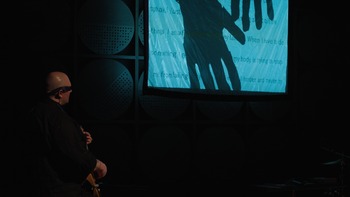
In Act 2 of Knots that Bind, I experiment further with erotic and real-time notation through forming graphic scores with a projection of my hands live in front of performers and audience. Apart from being a conceptual study of self-censorship, the act tests the possibility that the composer’s body can directly form a score. Focusing specifically on the hands as the notation medium, I draw attention to my hands as queer sex organs imbued with eroticism,Footnote 2 highlighting the erotic potential of musical notation (Illustration 1). The hands also invoke the body of a conductor, as I conduct both the live musicians performing and the electronic tape track, which is reactive and changes the volume of different tracks based on how much of my hands are in the frame. Non-male conductors are subjected to a heteronormative male gaze (Milligan Reference Milligan2023), unlike composers whose bodies most often stand behind the curtain, directing the gaze. Placing my sexualised queer body directly on the stage as both the composer and conductor, mediated by a webcam that transforms my hands into shadowy shapes, reclaims my own eroticism and allows me to take control over the gaze. The experience of performing the work is sensual, being able to move my hands and immediately hear the sensory feedback of both the tape track and guitarist; the effect is antithetical to the traditional (or imagined) composer’s experience of writing music alone ‘at the desk’ (Craenen Reference Craenen2014). Composition of electronic music in a DAW slightly alters this perception by allowing for immediate audible feedback, bringing the composition process closer to a sensory experience. However, the idealised eroticism of compositional practice is largely divorced from direct feedback between gesture, body and sound. By creating work that deliberately leans into desire through physical manifestation, I queer my own position as a composer while also asking the performers and audiences to tune into their own erotic forms of listening and perception.
Darlene Aaron performing the erotic graphic score created on stage in Knots that Bind (Reference Robertson2024). Image from video by Cobie Orger.

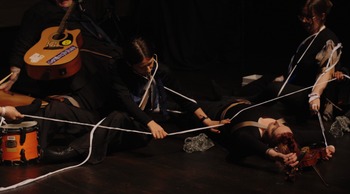
The third act of Knots that Bind is when I reach furthest into the idea of sensory input as queernotation. A short text score instructs the performers with cues on different sections of the work and suggestions for interpretation of the piece, but the real score is tactile. The performers are tied together in a web of ribbons crafted with fashion designer Alison Pyrke, each person having at least three strings tied to different limbs or their instruments, as seen in Illustration 2. This causes each musician to have a point of contact with each other performer, allowing them to receive sensory input in their bodies, and to pull the bodies of the other musicians. An electronic part is mixed based on MIDI input from Iran Sanadzadeh’s terpsichora pressure-sensitive floors, which react to pressure and weight placed upon them as well as audio input from contact microphones on their surface (Sanadzadeh Reference Sanadzadehn.d.). Because each person is linked with the bindings, every performer has the ability to change both what the other performers are doing and the spatialised electronic part. As opposed to the second act, where I conduct the ensemble with my hands, the ensemble itself controls the resulting sound and performance, with each person equally restricted and equally in control. The idea for this act comes from earlier experiments with tactile scores and motion control. It is also supported by previous experiments with dancers, who very easily understand the notion of a score as anything that informs an improvisation. Sensory queernotation allows the performers to embody the work and concept and reach beyond neurotypical sensory interpretation and response.
Iran Sanadzadeh, Darlene Aaron, Tina Stefanou, Jane Aubourg and Elizabeth Jigalin exploring the textile binding score in Knots that Bind (Reference Robertson2024). Image from video by Cobie Orger.

Engaging queernotation in Knots that Bind led to complex results. The performers, who were mostly queer women and all experienced improvisers with histories of working with experimental notation, easily understood the idea that light, live graphics, text and bindings could make up a score. They each had no reservations towards the intense sensory and physical nature of the work and even pushed its boundaries further by wrapping themselves precariously in the ribbons and taking control over my body during the live score. The work felt undeniably queer, and I felt that my body was part of the performance even in the acts when I was not on the stage. I did not know what would happen in the performance, and it varied vastly from the dress rehearsal that took place earlier that day. Somehow, the possibility of failure made it feel more alive, electric and surrounded by ghosts of possibilities and histories.
7. Conclusion
Queernotation could take many more forms than the three I’ve outlined here. My goal is not to provide a fixed definition, as queering cannot and should not be encased into clean categories. By proposing the possibilities of notations informed by queer erotics, queer temporalities and queer futurity, I imagine extending divergent relationships with time, desire and utopia into the way we create and communicate music. These categories are not extensive, and not mutually exclusive – many of the examples pointed to engage with more than one. Through interactions with electronics and digital technology, the tools available allow for further experimentation that connects scores to interactive elements of a work, forming new relationships between notation and sound and inviting audiences into a score. By queering the tools of composition, I propose a way of composing informed by queer experience that can facilitate new ways of communicating musical concepts.
Acknowledgements
The development and premiere performance of Knots that Bind was supported by the Australian Government through Music Australia and Creative Australia, its arts funding and advisory body. All images, recordings and photos are used with permission.

 Open access

