




1 Introduction
A nonempty class of algebras of a fixed type, such as groups, rings, and semigroups, is a variety if it is closed under the formation of subalgebras, homomorphic images, and arbitrary direct products. By Birkhoff’s theorem [Reference Birkhoff3], varieties are precisely equationally defined classes of algebras, and, hence, can be investigated by both semantic and syntactic methods. Finiteness conditions relevant to these methods naturally receive much attention: a variety is finitely based if its equational theory is finitely axiomatizable, finitely generated if it is generated by a finite algebra, and small if it has a finite lattice of subvarieties. These three conditions are independent in the sense that a variety satisfying any two of these conditions need not satisfy the third [Reference Sapir31]. Following Higman [Reference Higman14], any variety satisfying all three conditions is said to be Cross.
Finite members from well-studied classes of algebras, such as groups [Reference Oates and Powell29], associative rings [Reference Kruse18, Reference L’vov19], Lie rings [Reference Bahturin and Ol’shanskiĭ2], and lattices [Reference McKenzie28], generate Cross varieties. However, this result does not hold for more general algebras, a striking counterexample being the Brandt monoid
 $$ \begin{align*} B = \begin{Bmatrix} \begin{bmatrix}0&0\\0&0\end{bmatrix}, \begin{bmatrix}1&0\\0&0\end{bmatrix}, \begin{bmatrix}0&1\\0&0\end{bmatrix}, \begin{bmatrix}0&0\\1&0\end{bmatrix}, \begin{bmatrix}0&0\\0&1\end{bmatrix}, \begin{bmatrix}1&0\\0&1\end{bmatrix} \end{Bmatrix} \end{align*} $$
under usual matrix multiplication. Not only is the variety generated by B nonfinitely based [Reference Sapir30], its subvarieties also form an uncountable lattice [Reference Jackson and Lee16] that embeds every finite lattice [Reference Gusev7]. For any class of algebras that contains non-Cross varieties, one approach to characterizing Cross varieties is to identify its minimal non-Cross varieties, which are commonly called almost Cross varieties. It follows from Zorn’s lemma that the exclusion of almost Cross subvarieties is not only necessary but also sufficient for a variety to be Cross.
The present article is concerned with varieties of monoids. Classical examples of almost Cross varieties include the varieties
 $$ \begin{align*} \mathbf{Com} = {\textsf{var}}\{xy \approx yx\} \quad \text{and} \quad \mathbf{Idem} = {\textsf{var}}\{x^2 \approx x \} \end{align*} $$
of commutative monoids [Reference Head13] and idempotent monoids [Reference Wismath35], respectively, which are both nonfinitely generated. Since a variety of groups is Cross if and only if it is finitely generated [Reference Oates and Powell29], describing all almost Cross varieties of groups might not seem challenging. However, the task is actually closer to being impossible, as there are already uncountably many of them covering just the variety
 $$ \begin{align*} \mathbf{Z}_p = {\textsf{var}}\{x^p \approx 1,\, xy \approx yx\} \end{align*} $$
generated by the cyclic groups of each sufficiently large prime order p [Reference Kozhevnikov17]. Consequently, a characterization of all Cross varieties of monoids is infeasible. It is therefore logical to focus on monoids without nontrivial subgroups; such a monoid satisfies the identity $x^{n+1} \approx x^n$
for some
$x^{n+1} \approx x^n$
for some $n \geq 0$
and is said to be aperiodic.
$n \geq 0$
and is said to be aperiodic.
Some classes in which almost Cross varieties have been completely described are the class $\mathbb {A}^{\mathrm {com}}$
of aperiodic monoids with commuting idempotents and its subclass
$\mathbb {A}^{\mathrm {com}}$
of aperiodic monoids with commuting idempotents and its subclass $\mathbb {A}^{\mathrm {cen}}$
of aperiodic monoids with central idempotents. In 2005, Jackson [Reference Jackson15] published the first two examples of almost Cross subvarieties of
$\mathbb {A}^{\mathrm {cen}}$
of aperiodic monoids with central idempotents. In 2005, Jackson [Reference Jackson15] published the first two examples of almost Cross subvarieties of $\mathbb {A}^{\mathrm {cen}}$
; these varieties, denoted by
$\mathbb {A}^{\mathrm {cen}}$
; these varieties, denoted by $\mathbf {Y}_1$
and
$\mathbf {Y}_1$
and $\mathbf {Y}_2$
(see Section 4.3), inspired the investigation of Cross subvarieties of
$\mathbf {Y}_2$
(see Section 4.3), inspired the investigation of Cross subvarieties of $\mathbb {A}^{\mathrm {cen}}$
[Reference Lee21]. In 2013, a third almost Cross subvariety of
$\mathbb {A}^{\mathrm {cen}}$
[Reference Lee21]. In 2013, a third almost Cross subvariety of $\mathbb {A}^{\mathrm {cen}}$
, denoted by
$\mathbb {A}^{\mathrm {cen}}$
, denoted by $\mathbf {L}$
(see Section 3.3), was published. Not only are
$\mathbf {L}$
(see Section 3.3), was published. Not only are $\mathbf {L}, \mathbf {Y}_1,\mathbf {Y}_2$
the only almost Cross subvarieties of
$\mathbf {L}, \mathbf {Y}_1,\mathbf {Y}_2$
the only almost Cross subvarieties of $\mathbb {A}^{\mathrm {cen}}$
[Reference Lee23], they are also the only almost Cross subvarieties of
$\mathbb {A}^{\mathrm {cen}}$
[Reference Lee23], they are also the only almost Cross subvarieties of $\mathbb {A}^{\mathrm {com}}$
satisfying the identity
$\mathbb {A}^{\mathrm {com}}$
satisfying the identity ${x^2 h x \approx xhx^2}$
[Reference Lee25]. In the years that followed, further examples of almost Cross subvarieties of
${x^2 h x \approx xhx^2}$
[Reference Lee25]. In the years that followed, further examples of almost Cross subvarieties of $\mathbb {A}^{\mathrm {com}}$
were found [Reference Gusev5, Reference Gusev6, Reference Gusev and Vernikov12]. A description of all almost Cross subvarieties of
$\mathbb {A}^{\mathrm {com}}$
were found [Reference Gusev5, Reference Gusev6, Reference Gusev and Vernikov12]. A description of all almost Cross subvarieties of $\mathbb {A}^{\mathrm {com}}$
was eventually completed by Gusev [Reference Gusev8]. Specifically, there are precisely nine such varieties: the subvarieties
$\mathbb {A}^{\mathrm {com}}$
was eventually completed by Gusev [Reference Gusev8]. Specifically, there are precisely nine such varieties: the subvarieties $\mathbf {L}, \mathbf {Y}_1, \mathbf {Y}_2$
of
$\mathbf {L}, \mathbf {Y}_1, \mathbf {Y}_2$
of $\mathbb {A}^{\mathrm {cen}}$
and the subvarieties
$\mathbb {A}^{\mathrm {cen}}$
and the subvarieties $\mathbf {F},\mathbf {I},\mathbf {P}$
of
$\mathbf {F},\mathbf {I},\mathbf {P}$
of $\mathbb {A}^{\mathrm {com}}$
together with their duals
$\mathbb {A}^{\mathrm {com}}$
together with their duals $\overleftarrow {\mathbf {F}}, \overleftarrow {\mathbf {I}},\overleftarrow {\mathbf {P}}$
(see Sections 3.1, 3.3, and 4.1).
$\overleftarrow {\mathbf {F}}, \overleftarrow {\mathbf {I}},\overleftarrow {\mathbf {P}}$
(see Sections 3.1, 3.3, and 4.1).
An obvious next step in the investigation is to extend the description of almost Cross varieties to other classes of monoids. A natural candidate is the class $\mathbb {J}$
of J-trivial monoids, as it already contains all nine almost Cross subvarieties of
$\mathbb {J}$
of J-trivial monoids, as it already contains all nine almost Cross subvarieties of $\mathbb {A}^{\mathrm {com}}$
. Recall that a monoid
$\mathbb {A}^{\mathrm {com}}$
. Recall that a monoid ${M}$
is J-trivial if distinct elements in
${M}$
is J-trivial if distinct elements in ${M}$
generate distinct principal two-sided ideals; that is,
${M}$
generate distinct principal two-sided ideals; that is, $MaM \neq MbM$
for all distinct
$MaM \neq MbM$
for all distinct $a,b \in {M}$
. The fundamental importance of J-trivial monoids lies in automata theory and formal language theory; in particular, finite J-trivial monoids correspond precisely to the class of recognizable languages known as the piecewise testable events [Reference Simon34]. Prior to the present study, 12 subvarieties of
$a,b \in {M}$
. The fundamental importance of J-trivial monoids lies in automata theory and formal language theory; in particular, finite J-trivial monoids correspond precisely to the class of recognizable languages known as the piecewise testable events [Reference Simon34]. Prior to the present study, 12 subvarieties of $\mathbb {J}$
were known to be almost Cross: the nine aforementioned subvarieties of
$\mathbb {J}$
were known to be almost Cross: the nine aforementioned subvarieties of $\mathbb {A}^{\mathrm {com}}$
, a certain variety
$\mathbb {A}^{\mathrm {com}}$
, a certain variety $\mathbf {K}$
from Gusev and Sapir [Reference Gusev and Sapir11] with its dual
$\mathbf {K}$
from Gusev and Sapir [Reference Gusev and Sapir11] with its dual $\overleftarrow {\mathbf {K}}$
, and a certain variety
$\overleftarrow {\mathbf {K}}$
, and a certain variety $\mathbf {Z}$
from Zhang and Luo [Reference Zhang and Luo37] (see Sections 4.2 and 4.4).
$\mathbf {Z}$
from Zhang and Luo [Reference Zhang and Luo37] (see Sections 4.2 and 4.4).
The objective of this article is to characterize all Cross subvarieties of $\mathbb {J}$
by providing a complete description of its almost Cross subvarieties. Necessary background information and preliminary results are first established in Section 2. Then, the almost Cross subvarieties of
$\mathbb {J}$
by providing a complete description of its almost Cross subvarieties. Necessary background information and preliminary results are first established in Section 2. Then, the almost Cross subvarieties of $\mathbb {J}$
and related information required to establish the main result are presented in Sections 3 and 4. In particular, a new almost Cross variety
$\mathbb {J}$
and related information required to establish the main result are presented in Sections 3 and 4. In particular, a new almost Cross variety $\mathbf {H}$
and its dual
$\mathbf {H}$
and its dual $\overleftarrow {\mathbf {H}}$
are introduced in Section 3.2, bringing the total number of identified almost Cross subvarieties of
$\overleftarrow {\mathbf {H}}$
are introduced in Section 3.2, bringing the total number of identified almost Cross subvarieties of $\mathbb {J}$
to 14. In Section 5, it is shown that a subvariety of
$\mathbb {J}$
to 14. In Section 5, it is shown that a subvariety of $\mathbb {J}$
is Cross if and only if it excludes these 14 almost Cross varieties, thus completing the classification of all almost Cross subvarieties of
$\mathbb {J}$
is Cross if and only if it excludes these 14 almost Cross varieties, thus completing the classification of all almost Cross subvarieties of $\mathbb {J}$
.
$\mathbb {J}$
.
2 Preliminaries
Acquaintance with rudiments of universal algebra is assumed of the reader; refer to [Reference Almeida1] and [Reference Burris and Sankappanavar4] for any undefined concepts. For more information on varieties of monoids, see [Reference Gusev, Lee and Vernikov10] and [Reference Lee26, Section 1.6].
2.1 Words and identities
Let $\mathscr {A}$
be a countably infinite alphabet. For any subset
$\mathscr {A}$
be a countably infinite alphabet. For any subset $\mathscr {X}$
of
$\mathscr {X}$
of $\mathscr {A}$
, let
$\mathscr {A}$
, let $\mathscr {X}^+$
and
$\mathscr {X}^+$
and $\mathscr {X}^{\ast }$
denote the free semigroup and free monoid over
$\mathscr {X}^{\ast }$
denote the free semigroup and free monoid over $\mathscr {X}$
, respectively. Elements of
$\mathscr {X}$
, respectively. Elements of $\mathscr {A}$
and
$\mathscr {A}$
and $\mathscr {A}^{\ast }$
are called variables and words, respectively. The empty word, written as
$\mathscr {A}^{\ast }$
are called variables and words, respectively. The empty word, written as $1$
, is the identity element of the monoid
$1$
, is the identity element of the monoid $\mathscr {A}^{\ast }$
; in other words,
$\mathscr {A}^{\ast }$
; in other words, $\mathscr {A}^{\ast } = \mathscr {A}^+ \cup \{1 \}$
. The content of a word
$\mathscr {A}^{\ast } = \mathscr {A}^+ \cup \{1 \}$
. The content of a word $\mathbf {w}$
, denoted by
$\mathbf {w}$
, denoted by ${\textsf {con}}(\mathbf {w})$
, is the set of variables occurring in
${\textsf {con}}(\mathbf {w})$
, is the set of variables occurring in $\mathbf {w}$
. The number of times a variable x occurs in
$\mathbf {w}$
. The number of times a variable x occurs in $\mathbf {w}$
is denoted by
$\mathbf {w}$
is denoted by $|\mathbf {w}|_x$
. A variable x in
$|\mathbf {w}|_x$
. A variable x in $\mathbf {w}$
is simple if
$\mathbf {w}$
is simple if $|\mathbf {w}|_x= 1$
; otherwise, it is nonsimple.
$|\mathbf {w}|_x= 1$
; otherwise, it is nonsimple.
An identity is an expression $\mathbf {u} \approx \mathbf {v}$
, where
$\mathbf {u} \approx \mathbf {v}$
, where $\mathbf {u}, \mathbf {v} \in \mathscr {A}^{\ast }$
; it is nontrivial if
$\mathbf {u}, \mathbf {v} \in \mathscr {A}^{\ast }$
; it is nontrivial if $\mathbf {u} \neq \mathbf {v}$
. A monoid
$\mathbf {u} \neq \mathbf {v}$
. A monoid ${M}$
satisfies an identity
${M}$
satisfies an identity $\mathbf {u} \approx \mathbf {v}$
, indicated by
$\mathbf {u} \approx \mathbf {v}$
, indicated by ${M} \models \mathbf {u} \approx \mathbf {v}$
, if for any substitution
${M} \models \mathbf {u} \approx \mathbf {v}$
, if for any substitution $\varphi :\mathscr {A} \to {M}$
, the equality
$\varphi :\mathscr {A} \to {M}$
, the equality $\varphi \mathbf {u} = \varphi \mathbf {v}$
holds in
$\varphi \mathbf {u} = \varphi \mathbf {v}$
holds in ${M}$
. A class
${M}$
. A class $\mathbb {M}$
of monoids satisfies an identity
$\mathbb {M}$
of monoids satisfies an identity $\mathbf {u} \approx \mathbf {v}$
, indicated by
$\mathbf {u} \approx \mathbf {v}$
, indicated by $\mathbb {M} \models \mathbf {u} \approx \mathbf {v}$
, if
$\mathbb {M} \models \mathbf {u} \approx \mathbf {v}$
, if ${M} \models \mathbf {u} \approx \mathbf {v}$
for all
${M} \models \mathbf {u} \approx \mathbf {v}$
for all ${M} \in \mathbb {M}$
.
${M} \in \mathbb {M}$
.
An identity $\mathbf {u} \approx \mathbf {v}$
is directly deducible from an identity
$\mathbf {u} \approx \mathbf {v}$
is directly deducible from an identity $\mathbf {p} \approx \mathbf {q}$
if some substitution
$\mathbf {p} \approx \mathbf {q}$
if some substitution $\varphi : \mathscr {A} \to \mathscr {A}^{\ast }$
and words
$\varphi : \mathscr {A} \to \mathscr {A}^{\ast }$
and words $\mathbf {a},\mathbf {b} \in \mathscr {A}^{\ast }$
exist such that
$\mathbf {a},\mathbf {b} \in \mathscr {A}^{\ast }$
exist such that $\{\mathbf {u},\mathbf {v} \} = \{\mathbf {a}(\varphi \mathbf {p})\mathbf {b},\, \mathbf {a}(\varphi \mathbf {q}) \mathbf {b} \}$
. An identity
$\{\mathbf {u},\mathbf {v} \} = \{\mathbf {a}(\varphi \mathbf {p})\mathbf {b},\, \mathbf {a}(\varphi \mathbf {q}) \mathbf {b} \}$
. An identity $\mathbf {u} \approx \mathbf {v}$
is deducible from a set
$\mathbf {u} \approx \mathbf {v}$
is deducible from a set $\Sigma $
of identities, indicated by
$\Sigma $
of identities, indicated by $\Sigma \vdash \mathbf {u} \approx \mathbf {v}$
, if there exists a sequence
$\Sigma \vdash \mathbf {u} \approx \mathbf {v}$
, if there exists a sequence $\mathbf {u} = \mathbf {w}_0,\, \mathbf {w}_1, \, \ldots , \, \mathbf {w}_k = \mathbf {v}$
of distinct words such that each identity
$\mathbf {u} = \mathbf {w}_0,\, \mathbf {w}_1, \, \ldots , \, \mathbf {w}_k = \mathbf {v}$
of distinct words such that each identity $\mathbf {w}_i \approx \mathbf {w}_{i+1}$
is directly deducible from some identity in
$\mathbf {w}_i \approx \mathbf {w}_{i+1}$
is directly deducible from some identity in $\Sigma $
. Informally, a deduction
$\Sigma $
. Informally, a deduction $\Sigma \vdash \mathbf {u} \approx \mathbf {v}$
holds if the identities in
$\Sigma \vdash \mathbf {u} \approx \mathbf {v}$
holds if the identities in $\Sigma $
can be used to convert
$\Sigma $
can be used to convert $\mathbf {u}$
into
$\mathbf {u}$
into $\mathbf {v}$
. Two sets of identities
$\mathbf {v}$
. Two sets of identities $\Sigma _1$
and
$\Sigma _1$
and $\Sigma _2$
are equivalent, indicated by
$\Sigma _2$
are equivalent, indicated by $\Sigma _1 \sim \Sigma _2$
, if the deductions
$\Sigma _1 \sim \Sigma _2$
, if the deductions $\Sigma _1 \vdash \Sigma _2$
and
$\Sigma _1 \vdash \Sigma _2$
and $\Sigma _2 \vdash \Sigma _1$
hold.
$\Sigma _2 \vdash \Sigma _1$
hold.
2.2 Some basic properties of varieties
For any set $\Sigma $
of identities, the variety defined by
$\Sigma $
of identities, the variety defined by $\Sigma $
, denoted by
$\Sigma $
, denoted by ${\textsf {var} }\ \Sigma $
, is the class of all monoids that satisfy every identity in
${\textsf {var} }\ \Sigma $
, is the class of all monoids that satisfy every identity in $\Sigma $
. A variety is finitely based if it is defined by some finite set of identities; otherwise, it is nonfinitely based. The subvariety of a variety
$\Sigma $
. A variety is finitely based if it is defined by some finite set of identities; otherwise, it is nonfinitely based. The subvariety of a variety $\mathbf {V}$
defined by
$\mathbf {V}$
defined by $\Sigma $
is
$\Sigma $
is $\mathbf {V}\Sigma = \mathbf {V} \cap {\textsf {var} }\ \Sigma $
.
$\mathbf {V}\Sigma = \mathbf {V} \cap {\textsf {var} }\ \Sigma $
.
For any monoid ${M}$
, the variety generated by
${M}$
, the variety generated by ${M}$
is the smallest variety containing
${M}$
is the smallest variety containing ${M}$
. A variety is finitely generated if it is generated by a finite monoid; it is locally finite if every finitely generated member is finite. It is well known that every finitely generated variety is locally finite; see [Reference Burris and Sankappanavar4, Theorem II.10.16].
${M}$
. A variety is finitely generated if it is generated by a finite monoid; it is locally finite if every finitely generated member is finite. It is well known that every finitely generated variety is locally finite; see [Reference Burris and Sankappanavar4, Theorem II.10.16].
Lemma 2.1.
-
(1) Each variety that satisfies any of the following identities is locally finite:
(◂) $$ \begin{align} x^2hx & \approx xhx, \end{align} $$
(▸)
$$ \begin{align} xhx^2 & \approx xhx. \end{align} $$
$$ \begin{align} x^2hx & \approx xhx, \end{align} $$
(▸)
$$ \begin{align} xhx^2 & \approx xhx. \end{align} $$
-
(2) Each locally finite variety that is small is also finitely generated.
-
(3) Each finitely generated variety has finitely positively many maximal subvarieties.


Proof.
-
(1) This follows from a general result; see [Reference Sapir30, Proposition 3.1].
-
(2) See [Reference Jackson and Lee16, Lemma 2.1].
-
(3) See [Reference Lee, Rhodes and Steinberg27, Proposition 4.1].
The dual of a monoid ${M}$
, denoted by
${M}$
, denoted by $\overleftarrow {{M}}$
, is the monoid obtained by reversing the multiplication of
$\overleftarrow {{M}}$
, is the monoid obtained by reversing the multiplication of ${M}$
; in other words, the multiplication tables of
${M}$
; in other words, the multiplication tables of ${M}$
and
${M}$
and $\overleftarrow {{M}}$
are transposes of one another. The dual of a variety
$\overleftarrow {{M}}$
are transposes of one another. The dual of a variety $\mathbf {V}$
is
$\mathbf {V}$
is $\overleftarrow {\mathbf {V}} = \{ \overleftarrow {{M}} \,|\, {M} \in \mathbf {V} \}$
. Equivalently, if
$\overleftarrow {\mathbf {V}} = \{ \overleftarrow {{M}} \,|\, {M} \in \mathbf {V} \}$
. Equivalently, if $\mathbf {V}$
is defined by some set
$\mathbf {V}$
is defined by some set $\{ \mathbf {u}_i \approx \mathbf {v}_i \,|\, i \in I \}$
of identities, then its dual
$\{ \mathbf {u}_i \approx \mathbf {v}_i \,|\, i \in I \}$
of identities, then its dual $\overleftarrow {\mathbf {V}}$
is defined by
$\overleftarrow {\mathbf {V}}$
is defined by $\{ \overleftarrow {\,\mathbf {u}_i} \approx \overleftarrow {\,\mathbf {v}_i} \,|\, i \in I \}$
, where
$\{ \overleftarrow {\,\mathbf {u}_i} \approx \overleftarrow {\,\mathbf {v}_i} \,|\, i \in I \}$
, where $\overleftarrow {\,\mathbf {u}_i}$
and
$\overleftarrow {\,\mathbf {u}_i}$
and $\overleftarrow {\,\mathbf {v}_i}$
are respectively the words
$\overleftarrow {\,\mathbf {v}_i}$
are respectively the words $\mathbf {u}_i$
and
$\mathbf {u}_i$
and $\mathbf {v}_i$
written in reverse order. A variety
$\mathbf {v}_i$
written in reverse order. A variety $\mathbf {V}$
is self-dual if
$\mathbf {V}$
is self-dual if $\mathbf {V} = \overleftarrow {\mathbf {V}}$
.
$\mathbf {V} = \overleftarrow {\mathbf {V}}$
.
A variety $\mathbf {V}$
is small if its lattice
$\mathbf {V}$
is small if its lattice $\mathfrak {L}(\mathbf {V})$
of subvarieties is finite. The interval
$\mathfrak {L}(\mathbf {V})$
of subvarieties is finite. The interval $[\mathbf {U},\mathbf {V}]$
is the lattice of all subvarieties of
$[\mathbf {U},\mathbf {V}]$
is the lattice of all subvarieties of $\mathbf {V}$
containing
$\mathbf {V}$
containing $\mathbf {U}$
; in particular,
$\mathbf {U}$
; in particular, $\mathfrak {L}(\mathbf {V}) = [\mathbf {0},\mathbf {V}]$
, where
$\mathfrak {L}(\mathbf {V}) = [\mathbf {0},\mathbf {V}]$
, where $\mathbf {0}$
is the variety of trivial monoids.
$\mathbf {0}$
is the variety of trivial monoids.
2.3 Varieties of J-trivial monoids
Recall that $\mathbb {J}$
denotes the class of all J-trivial monoids. The definition of subvarieties of
$\mathbb {J}$
denotes the class of all J-trivial monoids. The definition of subvarieties of $\mathbb {J}$
involves the aperiodicity identities
$\mathbb {J}$
involves the aperiodicity identities
 $$ \begin{align} x^{n+1} \approx x^n, \quad n \geq 0 \end{align} $$
and the eventual commutativity identities
 $$ \begin{align} (xy)^n \approx (yx)^n, \quad n \geq 0. \end{align} $$
Let ⓐ ${}_{n}$
and ⓒ
${}_{n}$
and ⓒ ${}_{n}$
denote the n th identities in ⓐ and ⓒ, respectively, and let
${}_{n}$
denote the n th identities in ⓐ and ⓒ, respectively, and let

Note that $\mathbf {J}_0 = {\textsf {var}}\{x \approx 1\} = \mathbf {0}$
and
$\mathbf {J}_0 = {\textsf {var}}\{x \approx 1\} = \mathbf {0}$
and $\mathbf {J}_1 = {\textsf {var}}\{x^2 \approx x,\; xy \approx yx\}$
is the variety of semilattice monoids, that is, monoids that are idempotent and commutative.
$\mathbf {J}_1 = {\textsf {var}}\{x^2 \approx x,\; xy \approx yx\}$
is the variety of semilattice monoids, that is, monoids that are idempotent and commutative.
Lemma 2.2.
-
(1) The inclusions
$\mathbf {J}_0 \subset \mathbf {J}_1 \subset \mathbf {J}_2 \subset \cdots \subset \mathbb {J}$
hold and are proper. -
(2) The class
$\mathbb {J}$
is not a variety, but every subvariety of
$\mathbb {J}$
is a subvariety of
$\mathbf {J}_n$
for all sufficiently large
$n \geq 0$
.


Proof.
-
(1) This is routinely verified.
-
(2) See [Reference Gusev and Sapir11, Fact 2.1].
A word $\mathbf w$
is an isoterm for a variety
$\mathbf w$
is an isoterm for a variety $\mathbf {V}$
if
$\mathbf {V}$
if $\mathbf {V}$
does not satisfy any nontrivial identity of the form
$\mathbf {V}$
does not satisfy any nontrivial identity of the form $\mathbf {w} \approx \mathbf {w}'$
. A monoid that is a union of groups is completely regular. A variety is completely regular if it consists of completely regular monoids. It is well known that a periodic variety is completely regular if and only if it satisfies the identity
$\mathbf {w} \approx \mathbf {w}'$
. A monoid that is a union of groups is completely regular. A variety is completely regular if it consists of completely regular monoids. It is well known that a periodic variety is completely regular if and only if it satisfies the identity $x^{n+1} \approx x$
for some
$x^{n+1} \approx x$
for some $n \geq 1$
.
$n \geq 1$
.
Lemma 2.3. Let $\mathbf {V}$
be any subvariety of
$\mathbf {V}$
be any subvariety of $\mathbb {J}$
. Then:
$\mathbb {J}$
. Then:
-
(1)
$\mathbf {V}$
is completely regular if and only if
$\mathbf {V} \subseteq \mathbf {J}_1$
; -
(2)
$\mathbf {V}$
is commutative if and only if
$xy$
is not an isoterm for
$\mathbf {V}$
; -
(3)
$\mathbf {V}$
is commutative implies that
$\mathbf {V}$
is Cross and for some
$n \geq 0$
.


 for some
Proof. By Lemma 2.2(2), the variety $\mathbf {V}$
satisfies the identities
$\mathbf {V}$
satisfies the identities  for some $k \geq 2$
.
$k \geq 2$
.
(1) Suppose that $\mathbf {V}$
is completely regular and so satisfies the identity
$\mathbf {V}$
is completely regular and so satisfies the identity $\sigma : x^{n+1} \approx x$
for some
$\sigma : x^{n+1} \approx x$
for some $n \geq 1$
. Then,
$n \geq 1$
. Then, $\mathbf {V}$
satisfies ⓐ
$\mathbf {V}$
satisfies ⓐ $_1$
because
$_1$
because

and $\mathbf {V}$
satisfies ⓒ
$\mathbf {V}$
satisfies ⓒ $_1$
because
$_1$
because

Therefore, the inclusion $\mathbf {V} \subseteq \mathbf {J}_1$
holds. Conversely, every idempotent monoid, and so every subvariety of
$\mathbf {V} \subseteq \mathbf {J}_1$
holds. Conversely, every idempotent monoid, and so every subvariety of $\mathbf {J}_1$
, is completely regular.
$\mathbf {J}_1$
, is completely regular.
(2) If $\mathbf {V}$
is commutative, then it satisfies
$\mathbf {V}$
is commutative, then it satisfies $xy \approx yx$
and so
$xy \approx yx$
and so $xy$
is not an isoterm for
$xy$
is not an isoterm for $\mathbf {V}$
. Conversely, suppose that
$\mathbf {V}$
. Conversely, suppose that $xy$
is not an isoterm for
$xy$
is not an isoterm for $\mathbf {V}$
. Then, it is easily shown that
$\mathbf {V}$
. Then, it is easily shown that $\mathbf {V}$
is either commutative or idempotent; see, for instance, [Reference Gusev and Sapir11, Lemma 2.7]. If
$\mathbf {V}$
is either commutative or idempotent; see, for instance, [Reference Gusev and Sapir11, Lemma 2.7]. If $\mathbf {V}$
is idempotent, then it is completely regular and so is commutative by part (1).
$\mathbf {V}$
is idempotent, then it is completely regular and so is commutative by part (1).
(3) This follows from the description of all commutative varieties [Reference Head13].
2.4 Rees quotients of free monoids
For any set $\mathscr {W} \subseteq \mathscr {A}^{\ast }$
, let
$\mathscr {W} \subseteq \mathscr {A}^{\ast }$
, let ${Rq}\,\mathscr {W}$
denote the Rees quotient of
${Rq}\,\mathscr {W}$
denote the Rees quotient of $\mathscr {A}^{\ast }$
over the ideal of all words that are not factors of any word in
$\mathscr {A}^{\ast }$
over the ideal of all words that are not factors of any word in $\mathscr {W}$
. Equivalently,
$\mathscr {W}$
. Equivalently, ${Rq}\,\mathscr {W}$
is the monoid that consists of every factor of every word in
${Rq}\,\mathscr {W}$
is the monoid that consists of every factor of every word in $\mathscr {W}$
, together with a zero element
$\mathscr {W}$
, together with a zero element $0$
, with binary operation
$0$
, with binary operation $\cdot $
given by
$\cdot $
given by
 $$ \begin{align*} \mathbf{u} \cdot \mathbf{v} = \begin{cases} \mathbf{u}\mathbf{v} & \mathrm{if}\ \mathbf{u}\mathbf{v}\ \mathrm{is\ a\ factor\ of\ some\ word\ in}~\mathscr{W}, \\ 0 & \mbox{otherwise}. \end{cases} \end{align*} $$
If there is a uniform upper bound n on the length of the words in $\mathscr {W}$
, then
$\mathscr {W}$
, then ${Rq}\,\mathscr {W}$
satisfies the identities
${Rq}\,\mathscr {W}$
satisfies the identities  and so is J-trivial; in particular, ${Rq}\,\mathscr {W}$
is J-trivial for all finite
${Rq}\,\mathscr {W}$
is J-trivial for all finite $\mathscr {W} \subseteq \mathscr {A}^{\ast }$
.
$\mathscr {W} \subseteq \mathscr {A}^{\ast }$
.
Let $\mathbf {Rq}\,\mathscr {W}$
denote the variety generated by
$\mathbf {Rq}\,\mathscr {W}$
denote the variety generated by ${Rq}\,\mathscr {W}$
. Some easy examples of Rees quotients of
${Rq}\,\mathscr {W}$
. Some easy examples of Rees quotients of $\mathscr {A}^{\ast }$
that appear later in this article are
$\mathscr {A}^{\ast }$
that appear later in this article are
 $$ \begin{align*} {Rq}\{x^n\} & = \langle x,1 \,|\, x^{n+1} = 0 \rangle = \{ 0,\, x,\, x^2,\, \ldots,\, x^n,\, 1\}, \\ {Rq}\{xy\} & = \langle x,y,1 \,|\, x^2=y^2=yx=0 \rangle = \{ 0,\, x,\, y,\, xy,\, 1\}, \\ {Rq}\{ xhx\} & = \langle x,h,1 \,|\, x^2=h^2=hxh=0\rangle = \{ 0,\, x,\, h,\, xh,\, hx,\, xhx,\, 1\}. \end{align*} $$
Since the monoid ${Rq}\{x^n\}$
is commutative, it is easily shown that
${Rq}\{x^n\}$
is commutative, it is easily shown that
 $$ \begin{align*} \mathbf{Rq}\{x^n\} = {\textsf{var}}\{ x^{n+2} \approx x^{n+1}, \; xy \approx yx \}; \end{align*} $$
see [Reference Almeida1, Corollary 6.1.5]. In particular, $\mathbf {Rq}\{x^0\} = \mathbf {Rq}\{1\} = \mathbf {J}_1$
coincides with the variety of semilattice monoids. The varieties generated by the other two monoids can be found in [Reference Jackson15]:
$\mathbf {Rq}\{x^0\} = \mathbf {Rq}\{1\} = \mathbf {J}_1$
coincides with the variety of semilattice monoids. The varieties generated by the other two monoids can be found in [Reference Jackson15]:
 $$ \begin{align*} \mathbf{Rq}\{xy\} & = {\textsf{var}}\{ xyx \approx x^2y, \; xyx \approx yx^2 \}, \\ \mathbf{Rq}\{xhx\} & = {\textsf{var}}\bigg\{\!\! \begin{array}{l} x^2h \approx hx^2, \; xhxtx \approx x^2ht, \; xyhxty \approx yxhxty, \\ xhxyty \approx xhyxty, \; xhytxy \approx xhytyx \end{array} \!\!\bigg\}. \end{align*} $$
Lemma 2.4 (Jackson [Reference Jackson15, Lemma 3.3]).
For any variety $\mathbf {V}$
and any set
$\mathbf {V}$
and any set $\mathscr {W}$
of words, the inclusion
$\mathscr {W}$
of words, the inclusion $\mathbf {Rq}\,\mathscr {W} \subseteq \mathbf {V}$
holds if and only if every word in
$\mathbf {Rq}\,\mathscr {W} \subseteq \mathbf {V}$
holds if and only if every word in $\mathscr {W}$
is an isoterm for
$\mathscr {W}$
is an isoterm for $\mathbf {V}$
.
$\mathbf {V}$
.
Lemma 2.5.
-
(1) Suppose that
$\mathbf {V}$
is any subvariety of
$\mathbb {J}$
such that
${Rq}\{xhx\} \notin \mathbf {V}$
. Then,
$\mathbf {V}$
is a subvariety of one of the following varieties: (2-1)
$$ \begin{align} \mathbf{J}_2\{({\blacktriangleleft})\}, \quad \mathbf{J}_2\{(\blacktriangleright)\}, \quad \mathbf{J}_n\{xhx \approx x^2h\}, \quad \mathbf{J}_n\{xhx \approx hx^2\}, \quad n \geq 2. \end{align} $$
-
(2) For each
$n \geq 1$
, the varieties and are Cross.


 and
and  are Cross.
Proof. (1) By Lemma 2.2(2), the variety $\mathbf {V}$
satisfies the identities
$\mathbf {V}$
satisfies the identities  for some $n \geq 2$
. By Lemma 2.4, the assumption
$n \geq 2$
. By Lemma 2.4, the assumption ${Rq}\{xhx\} \notin \mathbf {V}$
implies that
${Rq}\{xhx\} \notin \mathbf {V}$
implies that $\mathbf {V}$
satisfies a nontrivial identity
$\mathbf {V}$
satisfies a nontrivial identity $\sigma : xhx \approx \mathbf {w}$
for some
$\sigma : xhx \approx \mathbf {w}$
for some $\mathbf {w} \in \mathscr {A}^{\ast }$
. Let
$\mathbf {w} \in \mathscr {A}^{\ast }$
. Let $p = |\mathbf {w}|_x$
and
$p = |\mathbf {w}|_x$
and $q = |\mathbf {w}|_h$
. There are two cases.
$q = |\mathbf {w}|_h$
. There are two cases.
Case 1: $p \leq 1$
or
$p \leq 1$
or $q \neq 1$
or there exists
$q \neq 1$
or there exists $z \in \mathscr {A} \backslash \{x,h\}$
such that
$z \in \mathscr {A} \backslash \{x,h\}$
such that $|\mathbf {w}|_z = r \geq 1$
. Then,
$|\mathbf {w}|_z = r \geq 1$
. Then, $\mathbf {V}$
satisfies
$\mathbf {V}$
satisfies $x^2 \approx x^p$
or
$x^2 \approx x^p$
or $h \approx h^q$
or
$h \approx h^q$
or $1 \approx z^r$
, whence
$1 \approx z^r$
, whence $\mathbf {V}$
is completely regular. Therefore, the inclusion
$\mathbf {V}$
is completely regular. Therefore, the inclusion $\mathbf {V} \subseteq \mathbf {J}_1$
holds by Lemma 2.3(1), so that
$\mathbf {V} \subseteq \mathbf {J}_1$
holds by Lemma 2.3(1), so that $\mathbf {V}$
is a subvariety of all the varieties in (2-1).
$\mathbf {V}$
is a subvariety of all the varieties in (2-1).
Case 2: $p \geq 2$
and
$p \geq 2$
and $q = 1$
with
$q = 1$
with ${\textsf {con}}(\mathbf {w}) = \{ x,y\}$
. Then,
${\textsf {con}}(\mathbf {w}) = \{ x,y\}$
. Then, $\mathbf {w} = x^{p_1}hx^{p_2}$
for some
$\mathbf {w} = x^{p_1}hx^{p_2}$
for some $p_1,p_2 \geq 0$
such that
$p_1,p_2 \geq 0$
such that $p_1+p_2 = p \geq 2$
and
$p_1+p_2 = p \geq 2$
and $(p_1,p_2) \neq (1,1)$
. If
$(p_1,p_2) \neq (1,1)$
. If $p = 2$
, then
$p = 2$
, then $(p_1,p_2) \in \{ (2,0),(0,2)\}$
, so that either
$(p_1,p_2) \in \{ (2,0),(0,2)\}$
, so that either $\mathbf {V} \subseteq \mathbf {J}_n\{xhx \approx x^2h\}$
or
$\mathbf {V} \subseteq \mathbf {J}_n\{xhx \approx x^2h\}$
or $\mathbf {V} \subseteq \mathbf {J}_n\{xhx \approx hx^2\}$
. Therefore, suppose that
$\mathbf {V} \subseteq \mathbf {J}_n\{xhx \approx hx^2\}$
. Therefore, suppose that ${p_1+p_2 = p \geq 3}$
, so that either
${p_1+p_2 = p \geq 3}$
, so that either $p_1 \geq 2$
or
$p_1 \geq 2$
or $p_2 \geq 2$
. Then,
$p_2 \geq 2$
. Then, $\mathbf {V}$
satisfies the identity
$\mathbf {V}$
satisfies the identity $\tau : x^2 \approx x^{2+k}$
with
$\tau : x^2 \approx x^{2+k}$
with $k = p-2$
and so also the identities
$k = p-2$
and so also the identities  because

Now, if $p_1 \geq 2$
, then
$p_1 \geq 2$
, then

similarly, if $p_2 \geq 2$
, then
$p_2 \geq 2$
, then $\mathbf {V} \models (\blacktriangleright )$
. Consequently, either
$\mathbf {V} \models (\blacktriangleright )$
. Consequently, either $\mathbf {V} \subseteq \mathbf {J}_2\{(\blacktriangleleft )\}$
or
$\mathbf {V} \subseteq \mathbf {J}_2\{(\blacktriangleleft )\}$
or $\mathbf {V} \subseteq \mathbf {J}_2\{(\blacktriangleright )\}$
.
$\mathbf {V} \subseteq \mathbf {J}_2\{(\blacktriangleright )\}$
.
(2) This is [Reference Lee25, Corollary 3.6].
2.5 The variety
$\mathbf {O} \cap \mathbf {J}_2$

Let $\mathbf {O}$
denote the variety defined by the identities
$\mathbf {O}$
denote the variety defined by the identities
 $$ \begin{align} xhxyxty \approx xhyxty, \quad xhytxyx \approx xhytyx. \end{align} $$
Since the identity (▸) is directly deducible from the first identity in (2-2), the variety $\mathbf {O}$
is locally finite by Lemma 2.1(1).
$\mathbf {O}$
is locally finite by Lemma 2.1(1).
The variety $\mathbf {O} \cap \mathbf {J}_2$
plays an important role later in this article in the description of some Cross varieties. The main goal of this subsection is to show that every noncommutative subvariety of
$\mathbf {O} \cap \mathbf {J}_2$
plays an important role later in this article in the description of some Cross varieties. The main goal of this subsection is to show that every noncommutative subvariety of $\mathbf {O} \cap \mathbf {J}_2$
can be defined by identities of very restricted types (Proposition 2.8). Some Cross subvarieties of
$\mathbf {O} \cap \mathbf {J}_2$
can be defined by identities of very restricted types (Proposition 2.8). Some Cross subvarieties of $\mathbf {O} \cap \mathbf {J}_2$
are also identified.
$\mathbf {O} \cap \mathbf {J}_2$
are also identified.
Lemma 2.6.
-
(1) Each subvariety of
$\mathbf {O}$
for which
$xy$
is an isoterm is defined by (2-2) and finitely many identities from the following sets: (2-3)
$$ \begin{align} & \begin{Bmatrix} x^{e_0} \prod_{i=1}^m (h_ix^{e_i}) \approx x^{f_0} \prod_{i=1}^m (h_ix^{f_i}) \; \; \left | \begin{array}{l} e_0,f_0, e_1,f_1,\ldots,e_m,f_m \geq 0; \\ \sum_{i=0}^me_i,\, \sum_{i=0}^mf_i \geq 2;\; m \geq 0 \end{array} \right.\!\!\!\! \end{Bmatrix}; \end{align} $$
(2-4)
$$ \begin{align} & \begin{Bmatrix} \; \mathbf{h}\mathbf{p}\mathbf{c} \approx \mathbf{h}\mathbf{q}\mathbf{c} \; \; \left | \begin{array}{l} \mathbf{h} \in \{ 1,\, yh\}; \; \mathbf{p},\mathbf{q} \in \{x,y\}^+; \\ \mathbf{c} \in \{ 1,\, txy,\, \prod_{i=1}^m (t_i\mathbf{c}_i) \,|\, \mathbf{c}_i \in \{ 1,x,y\},\, m \geq 1 \}; \\ 1 \leq |\mathbf{p}|_x = |\mathbf{q}|_x,\, |\mathbf{p}|_y = |\mathbf{q}|_y \leq 2; \\ |\mathbf{h}\mathbf{p}\mathbf{c}|_x = |\mathbf{h}\mathbf{q}\mathbf{c}|_x,\, |\mathbf{h}\mathbf{p}\mathbf{c}|_y = |\mathbf{h}\mathbf{q}\mathbf{c}|_y \geq 2 \end{array}\right.\!\!\!\! \end{Bmatrix}. \end{align} $$
-
(2) Each noncommutative subvariety of
$\mathbf {O} \cap \mathbf {J}_2$
is defined by for some
$\Sigma _1 \subseteq $
(2-3) and
$\Sigma _2 \subseteq $
(2-4).


Proof.
-
(1) This part can be extracted from [Reference Gusev and Sapir11, Proof of Proposition 3.1].
-
(2) This part follows from Lemma 2.3(2) and part (1).
Lemma 2.7. For any $\Sigma _1 \subseteq $
(2-3), the equivalence (▸)
$\Sigma _1 \subseteq $
(2-3), the equivalence (▸) $\cup\ \Sigma _1 \sim $
(▸)
$\cup\ \Sigma _1 \sim $
(▸) $\cup\ \Sigma $
holds for some possibly empty set
$\cup\ \Sigma $
holds for some possibly empty set $\Sigma $
that consists of some of the following identities:
$\Sigma $
that consists of some of the following identities:
 $$ \begin{align} xhx \approx hx^2, \quad x^2hx \approx x^2h, \quad x^2hxtx \approx x^2htx, \quad (\blacktriangleleft). \end{align} $$
Proof. It follows from [Reference Gusev9, Lemma 6.7] that the equivalence

holds for some possibly empty set $\Sigma $
that consists of some of the following identities:
$\Sigma $
that consists of some of the following identities:
-
(a)
$xhx^2 \approx hx^2$
,
$x^2hx \approx x^2h$
,
$x^2hxtx \approx x^2htx$
; -
(b)
$(\prod _{i=1}^{n-1} (xh_i))xh_nx^2 \approx (\prod _{i=1}^{n-1} (xh_i))xh_nx$
for some
$n \geq 1$
; -
(c)
$(\prod _{i=1}^{n-1} (xh_i))x^2h_nx \approx (\prod _{i=1}^{n-1} (xh_i))xh_nx^2$
for some
$n \geq 1$
.


(Note that if $n=1$
, then the identities (b) and (c) are
$n=1$
, then the identities (b) and (c) are $xh_1x^2 \approx xh_1x$
and
$xh_1x^2 \approx xh_1x$
and $x^2h_1x \approx xh_1x^2$
, respectively.) It is easily seen that the deduction (▸)
$x^2h_1x \approx xh_1x^2$
, respectively.) It is easily seen that the deduction (▸)  holds, so the equivalence (▸) $\cup\ \Sigma _1 \sim $
(▸)
$\cup\ \Sigma _1 \sim $
(▸) $\cup\ \Sigma $
follows. Since it is routinely checked that the equivalence {(▸),
$\cup\ \Sigma $
follows. Since it is routinely checked that the equivalence {(▸), $\text {(a)}, \text {(b)}, \text {(c)} \} \sim $
{(▸), (2-5) } holds, the identities in
$\text {(a)}, \text {(b)}, \text {(c)} \} \sim $
{(▸), (2-5) } holds, the identities in $\Sigma $
can be chosen from (2-5).
$\Sigma $
can be chosen from (2-5).
Proposition 2.8. Each noncommutative subvariety of $\mathbf {O} \cap \mathbf {J}_2$
is defined by
$\mathbf {O} \cap \mathbf {J}_2$
is defined by

for some $\Sigma _1 \subseteq $
(2-5) and some subset
$\Sigma _1 \subseteq $
(2-5) and some subset $\Sigma _2$
of
$\Sigma _2$
of
 $$ \begin{align} \begin{Bmatrix} \; \mathbf{h}\mathbf{p}\mathbf{c} \approx \mathbf{h}\mathbf{q}\mathbf{c} \; \; \left| \begin{array}{l} \mathbf{h} \in \{ 1,\, yh\}; \; \mathbf{p},\mathbf{q} \in \{x,y\}^+; \\[0.05in] \mathbf{c} \in \{ 1,\, txy,\, \prod_{i=1}^m (t_i\mathbf{a}_i), \,\prod_{i=2}^{m+1} (t_i\mathbf{a}_i) \,|\, m \geq 1 \}; \\[0.05in] 1 \leq |\mathbf{p}|_x = |\mathbf{q}|_x, \, |\mathbf{p}|_y = |\mathbf{q}|_y \leq 2; \\[0.05in] |\mathbf{h}\mathbf{p}\mathbf{c}|_x = |\mathbf{h}\mathbf{q}\mathbf{c}|_x,\, |\mathbf{h}\mathbf{p}\mathbf{c}|_y = |\mathbf{h}\mathbf{q}\mathbf{c}|_y \geq 2 \end{array}\right.\!\!\!\! \end{Bmatrix}, \end{align} $$
where $(\mathbf {a}_1,\mathbf {a}_2,\mathbf {a}_3,\mathbf {a}_4,\ldots )$
is the alternating sequence
$(\mathbf {a}_1,\mathbf {a}_2,\mathbf {a}_3,\mathbf {a}_4,\ldots )$
is the alternating sequence $(x,y,x,y,\ldots )$
.
$(x,y,x,y,\ldots )$
.
Proof. Let $\mathbf {V}$
be any noncommutative subvariety of
$\mathbf {V}$
be any noncommutative subvariety of $\mathbf {O} \cap \mathbf {J}_2$
. Then, by Lemma 2.6(2), the variety
$\mathbf {O} \cap \mathbf {J}_2$
. Then, by Lemma 2.6(2), the variety $\mathbf {V}$
is defined by {(2-2),
$\mathbf {V}$
is defined by {(2-2),  for some $\Sigma _1 \subseteq $
(2-3) and some
$\Sigma _1 \subseteq $
(2-3) and some $\Sigma _2 \subseteq $
(2-4). Since the deduction (2-2)
$\Sigma _2 \subseteq $
(2-4). Since the deduction (2-2) $\vdash $
(▸) holds, it follows from Lemma 2.7 that the identities in
$\vdash $
(▸) holds, it follows from Lemma 2.7 that the identities in $\Sigma _1$
can be chosen from (2-5). Hence, it remains to show that the identities in
$\Sigma _1$
can be chosen from (2-5). Hence, it remains to show that the identities in $\Sigma _2$
can be chosen from (2-6).
$\Sigma _2$
can be chosen from (2-6).
Let $\mathbf {h}\mathbf {p}\mathbf {c} \approx \mathbf {h}\mathbf {q}\mathbf {c}$
be any identity in
$\mathbf {h}\mathbf {p}\mathbf {c} \approx \mathbf {h}\mathbf {q}\mathbf {c}$
be any identity in $\Sigma _2 \subseteq $
(2-4). If
$\Sigma _2 \subseteq $
(2-4). If $\mathbf {c} \in \{ 1,\, txy\}$
, then by definition, the identity
$\mathbf {c} \in \{ 1,\, txy\}$
, then by definition, the identity $\mathbf {h}\mathbf {p}\mathbf {c} \approx \mathbf {h}\mathbf {q}\mathbf {c}$
is already in (2-6). Therefore, it suffices to consider the case when
$\mathbf {h}\mathbf {p}\mathbf {c} \approx \mathbf {h}\mathbf {q}\mathbf {c}$
is already in (2-6). Therefore, it suffices to consider the case when
 $$ \begin{align*} \mathbf{c} = \prod_{i=1}^m (t_i\mathbf{c}_i) = t_1\mathbf{c}_1 t_2 \mathbf{c}_2 \cdots t_m \mathbf{c}_m, \end{align*} $$
where $\mathbf {c}_1,\mathbf {c}_2,\ldots ,\mathbf {c}_m \in \{ 1,x,y \}$
and
$\mathbf {c}_1,\mathbf {c}_2,\ldots ,\mathbf {c}_m \in \{ 1,x,y \}$
and $m \geq 1$
. In the remainder of this proof, it is shown that if either
$m \geq 1$
. In the remainder of this proof, it is shown that if either $\mathbf {c}_k = 1$
or
$\mathbf {c}_k = 1$
or $\mathbf {c}_k = \mathbf {c}_{k+1} \in \{ x,y \}$
for some k, then the equivalence
$\mathbf {c}_k = \mathbf {c}_{k+1} \in \{ x,y \}$
for some k, then the equivalence
 $$ \begin{align} \{ (2\hbox{-}2),\, \mathbf{h}\mathbf{p}\mathbf{c} \approx \mathbf{h}\mathbf{q}\mathbf{c}\} \sim \{ (2\hbox{-}2),\, \mathbf{h}\mathbf{p}\mathbf{c}' \approx \mathbf{h}\mathbf{q}\mathbf{c}'\} \end{align} $$
holds, where $\mathbf {c}'$
is obtained from
$\mathbf {c}'$
is obtained from $\mathbf {c}$
by removing the factor
$\mathbf {c}$
by removing the factor $t_k\mathbf {c}_k$
. It follows that the identity
$t_k\mathbf {c}_k$
. It follows that the identity $\mathbf {h}\mathbf {p}\mathbf {c} \approx \mathbf {h}\mathbf {q}\mathbf {c}$
can be chosen so that
$\mathbf {h}\mathbf {p}\mathbf {c} \approx \mathbf {h}\mathbf {q}\mathbf {c}$
can be chosen so that $(\mathbf {c}_1,\mathbf {c}_2,\ldots ,\mathbf {c}_m) \in \{ (x,y,x,y,\ldots ),\, (y,x,y,x,\ldots ) \}$
; in other words,
$(\mathbf {c}_1,\mathbf {c}_2,\ldots ,\mathbf {c}_m) \in \{ (x,y,x,y,\ldots ),\, (y,x,y,x,\ldots ) \}$
; in other words, $\mathbf {h}\mathbf {p}\mathbf {c} \approx \mathbf {h}\mathbf {q}\mathbf {c}$
can be chosen from (2-6).
$\mathbf {h}\mathbf {p}\mathbf {c} \approx \mathbf {h}\mathbf {q}\mathbf {c}$
can be chosen from (2-6).
Case 1: $\mathbf {c}_k = 1$
with
$\mathbf {c}_k = 1$
with $1 \leq k \leq m$
. If
$1 \leq k \leq m$
. If $\mathbf {c}_m=1$
so that
$\mathbf {c}_m=1$
so that $\mathbf {c} = ( \prod _{i=1}^{m-1} (t_i\mathbf {c}_i) ) t_m$
and
$\mathbf {c} = ( \prod _{i=1}^{m-1} (t_i\mathbf {c}_i) ) t_m$
and $\mathbf {c}' = \prod _{i=1}^{m-1} (t_i\mathbf {c}_i)$
, then it is obvious that
$\mathbf {c}' = \prod _{i=1}^{m-1} (t_i\mathbf {c}_i)$
, then it is obvious that $\mathbf {h}\mathbf {p}\mathbf {c} \approx \mathbf {h}\mathbf {q}\mathbf {c} \sim \mathbf {h}\mathbf {p}\mathbf {c}' \approx \mathbf {h}\mathbf {q}\mathbf {c}'$
. Thus, assume that
$\mathbf {h}\mathbf {p}\mathbf {c} \approx \mathbf {h}\mathbf {q}\mathbf {c} \sim \mathbf {h}\mathbf {p}\mathbf {c}' \approx \mathbf {h}\mathbf {q}\mathbf {c}'$
. Thus, assume that $1 \leq k < m$
so that
$1 \leq k < m$
so that
 $$ \begin{align*} \mathbf{c} = \bigg( \prod_{i=1}^{k-1} (t_i\mathbf{c}_i) \bigg) t_k \bigg( \prod_{i=k+1}^m (t_i\mathbf{c}_i) \bigg) \quad \text{ and } \quad \mathbf{c}' = \bigg( \prod_{i=1}^{k-1} (t_i\mathbf{c}_i) \bigg) \bigg( \prod_{i=k+1}^m (t_i\mathbf{c}_i) \bigg). \end{align*} $$
The deduction $\mathbf {h}\mathbf {p}\mathbf {c} \approx \mathbf {h}\mathbf {q}\mathbf {c} \vdash \mathbf {h}\mathbf {p}\mathbf {c}' \approx \mathbf {h}\mathbf {q}\mathbf {c}'$
is obvious. Conversely, since
$\mathbf {h}\mathbf {p}\mathbf {c} \approx \mathbf {h}\mathbf {q}\mathbf {c} \vdash \mathbf {h}\mathbf {p}\mathbf {c}' \approx \mathbf {h}\mathbf {q}\mathbf {c}'$
is obvious. Conversely, since $\mathbf {c}$
is obtained by making the substitution
$\mathbf {c}$
is obtained by making the substitution $t_{k+1} \mapsto t_kt_{k+1}$
in
$t_{k+1} \mapsto t_kt_{k+1}$
in $\mathbf {c}'$
, the deduction
$\mathbf {c}'$
, the deduction $\mathbf {h}\mathbf {p}\mathbf {c}' \approx \mathbf {h}\mathbf {q}\mathbf {c}' \vdash \mathbf {h}\mathbf {p}\mathbf {c} \approx \mathbf {h}\mathbf {q}\mathbf {c}$
holds. It follows that the equivalence (2-7) holds.
$\mathbf {h}\mathbf {p}\mathbf {c}' \approx \mathbf {h}\mathbf {q}\mathbf {c}' \vdash \mathbf {h}\mathbf {p}\mathbf {c} \approx \mathbf {h}\mathbf {q}\mathbf {c}$
holds. It follows that the equivalence (2-7) holds.
Case 2: $\mathbf {c}_k = \mathbf {c}_{k+1} \in \{ x,y\}$
with
$\mathbf {c}_k = \mathbf {c}_{k+1} \in \{ x,y\}$
with $1 \leq k < k+1 \leq m$
. Then,
$1 \leq k < k+1 \leq m$
. Then,
 $$ \begin{align*} \mathbf{c} = \bigg( \prod_{i=1}^{k-1} (t_i\mathbf{c}_i) \bigg) t_k\mathbf{c}_k t_{k+1} \mathbf{c}_k \bigg( \prod_{i=k+2}^m (t_i\mathbf{c}_i) \bigg) \quad \text{and} \quad \mathbf{c}' = \bigg( \prod_{i=1}^{k-1} (t_i\mathbf{c}_i) \bigg) t_{k+1}\mathbf{c}_k \bigg( \prod_{i=k+2}^m (t_i\mathbf{c}_i) \bigg). \end{align*} $$
Deleting the variable $t_{k+1}$
from both sides of
$t_{k+1}$
from both sides of $\mathbf {h}\mathbf {p}\mathbf {c} \approx \mathbf {h}\mathbf {q}\mathbf {c}$
followed by making the substitution
$\mathbf {h}\mathbf {p}\mathbf {c} \approx \mathbf {h}\mathbf {q}\mathbf {c}$
followed by making the substitution $t_k \mapsto t_{k+1}$
results in the identity
$t_k \mapsto t_{k+1}$
results in the identity
 $$ \begin{align*} \mathbf{h}\mathbf{p}\bigg( \prod_{i=1}^{k-1} (t_i\mathbf{c}_i) \bigg) t_{k+1}\mathbf{c}_k^2 \bigg( \prod_{i=k+2}^m (t_i\mathbf{c}_i) \bigg) \approx \mathbf{h}\mathbf{q}\bigg( \prod_{i=1}^{k-1} (t_i\mathbf{c}_i) \bigg) t_{k+1}\mathbf{c}_k^2 \bigg( \prod_{i=k+2}^m (t_i\mathbf{c}_i) \bigg); \end{align*} $$
since $\mathbf {c}_k \in \{ x,y \} = {\textsf {con}}(\mathbf {p}) = {\textsf {con}}(\mathbf {q})$
, the identity (▸) deducible from (2-2) can be used to eliminate from both sides the occurrence of
$\mathbf {c}_k \in \{ x,y \} = {\textsf {con}}(\mathbf {p}) = {\textsf {con}}(\mathbf {q})$
, the identity (▸) deducible from (2-2) can be used to eliminate from both sides the occurrence of $\mathbf {c}_k$
that immediately follows
$\mathbf {c}_k$
that immediately follows $t_{k+1}$
, resulting in
$t_{k+1}$
, resulting in $\mathbf {h}\mathbf {p}\mathbf {c}' \approx \mathbf {h}\mathbf {q}\mathbf {c}'$
. Thus, the deduction
$\mathbf {h}\mathbf {p}\mathbf {c}' \approx \mathbf {h}\mathbf {q}\mathbf {c}'$
. Thus, the deduction $\{$
(2-2),
$\{$
(2-2), $\mathbf {h}\mathbf {p}\mathbf {c} \approx \mathbf {h}\mathbf {q}\mathbf {c} \} \vdash \mathbf {h}\mathbf {p}\mathbf {c}' \approx \mathbf {h}\mathbf {q}\mathbf {c}'$
holds. Conversely, making the substitution
$\mathbf {h}\mathbf {p}\mathbf {c} \approx \mathbf {h}\mathbf {q}\mathbf {c} \} \vdash \mathbf {h}\mathbf {p}\mathbf {c}' \approx \mathbf {h}\mathbf {q}\mathbf {c}'$
holds. Conversely, making the substitution $t_{k+1} \mapsto t_k\mathbf {c}_kt_{k+1}$
on both sides of
$t_{k+1} \mapsto t_k\mathbf {c}_kt_{k+1}$
on both sides of $\mathbf {h}\mathbf {p}\mathbf {c}' \approx \mathbf {h}\mathbf {q}\mathbf {c}'$
results in
$\mathbf {h}\mathbf {p}\mathbf {c}' \approx \mathbf {h}\mathbf {q}\mathbf {c}'$
results in $\mathbf {h}\mathbf {p}\mathbf {c} \approx \mathbf {h}\mathbf {q}\mathbf {c}$
, so the deduction
$\mathbf {h}\mathbf {p}\mathbf {c} \approx \mathbf {h}\mathbf {q}\mathbf {c}$
, so the deduction $\mathbf {h}\mathbf {p}\mathbf {c}' \approx \mathbf {h}\mathbf {q}\mathbf {c}' \vdash \mathbf {h}\mathbf {p}\mathbf {c} \approx \mathbf {h}\mathbf {q}\mathbf {c}$
holds. Hence, the equivalence (2-7) holds.
$\mathbf {h}\mathbf {p}\mathbf {c}' \approx \mathbf {h}\mathbf {q}\mathbf {c}' \vdash \mathbf {h}\mathbf {p}\mathbf {c} \approx \mathbf {h}\mathbf {q}\mathbf {c}$
holds. Hence, the equivalence (2-7) holds.
Although not every subvariety of $\mathbf {O} \cap \mathbf {J}_2$
is Cross, some identities from (2-5) and (2-6) do define Cross subvarieties of
$\mathbf {O} \cap \mathbf {J}_2$
is Cross, some identities from (2-5) and (2-6) do define Cross subvarieties of $\mathbf {O} \cap \mathbf {J}_2$
. For instance, the identity
$\mathbf {O} \cap \mathbf {J}_2$
. For instance, the identity $x^2hxtx \approx x^2htx$
from (2-5) and the restrictive identities from (2-6):
$x^2hxtx \approx x^2htx$
from (2-5) and the restrictive identities from (2-6):
 $$ \begin{align} xy \prod_{i=1}^m (t_i\mathbf{a}_i) \approx yx \prod_{i=1}^m (t_i\mathbf{a}_i), \quad m \geq 2. \end{align} $$
Let Ⓡ $_m$
denote the m th identity in Ⓡ.
$_m$
denote the m th identity in Ⓡ.
Corollary 2.9.
-
(1) The variety
$\mathbf {O} \cap \mathbf {J}_2\{ x^2hxtx \approx x^2htx \}$
is Cross. -
(2) For each
$m \geq 2$
, the variety
$\mathbf {O} \cap \mathbf {J}_2\{\circledR _m \}$
is Cross.


Proof. Let $\sigma \in \{ x^2hxtx \approx x^2htx,\, \circledR _m \}$
. Since
$\sigma \in \{ x^2hxtx \approx x^2htx,\, \circledR _m \}$
. Since $\mathbf {O} \models $
(2-2)
$\mathbf {O} \models $
(2-2) $\vdash $
(▸), the finitely based variety
$\vdash $
(▸), the finitely based variety $\mathbf {O} \cap \mathbf {J}_2\{ \sigma \}$
is locally finite by Lemma 2.1(1). In what follows, this variety is shown to be small and so is Cross by Lemma 2.1(2).
$\mathbf {O} \cap \mathbf {J}_2\{ \sigma \}$
is locally finite by Lemma 2.1(1). In what follows, this variety is shown to be small and so is Cross by Lemma 2.1(2).
Let $\mathbf {V}$
be any subvariety of
$\mathbf {V}$
be any subvariety of $\mathbf {O} \cap \mathbf {J}_2\{ \sigma \}$
. By Lemma 2.3(3), only three subvarieties of
$\mathbf {O} \cap \mathbf {J}_2\{ \sigma \}$
. By Lemma 2.3(3), only three subvarieties of $\mathbf {O} \cap \mathbf {J}_2\{ \sigma \}$
are commutative; specifically, they are
$\mathbf {O} \cap \mathbf {J}_2\{ \sigma \}$
are commutative; specifically, they are  , where $n \in \{ 0,1,2\}$
. Therefore, assume that
$n \in \{ 0,1,2\}$
. Therefore, assume that $\mathbf {V}$
is not commmutative, so that by Proposition 2.8, it is defined by
$\mathbf {V}$
is not commmutative, so that by Proposition 2.8, it is defined by  for some $\Sigma _1 \subseteq $
(2-5) and
$\Sigma _1 \subseteq $
(2-5) and $\Sigma _2 \subseteq $
(2-6). Since (2-5) is finite, there are only finitely many choices for the set
$\Sigma _2 \subseteq $
(2-6). Since (2-5) is finite, there are only finitely many choices for the set $\Sigma _1$
. As for the set
$\Sigma _1$
. As for the set $\Sigma _2$
, there are infinitely many choices due precisely to identities from (2-6) of the following types:
$\Sigma _2$
, there are infinitely many choices due precisely to identities from (2-6) of the following types:
 $$ \begin{align*} \lambda_m: \mathbf{h}\mathbf{p} \prod_{i=1}^m (t_i\mathbf{a}_i) \approx \mathbf{h}\mathbf{q} \prod_{i=1}^m (t_i\mathbf{a}_i) \quad \text{and} \quad \rho_m: \mathbf{h}\mathbf{p} \prod_{i=2}^{m+1} (t_i\mathbf{a}_i) \approx \mathbf{h}\mathbf{q} \prod_{i=2}^{m+1} (t_i\mathbf{a}_i), \quad m \geq 1. \end{align*} $$
However, in each of the following cases, it is shown that whenever $\lambda _m$
or
$\lambda _m$
or $\rho _m$
is required for the definition of
$\rho _m$
is required for the definition of $\mathbf {V}$
, it is possible to choose m from a fixed finite set. It follows that there are only finitely many choices for
$\mathbf {V}$
, it is possible to choose m from a fixed finite set. It follows that there are only finitely many choices for $\Sigma _2$
. Consequently, there are only finitely many choices for
$\Sigma _2$
. Consequently, there are only finitely many choices for $\mathbf {V}$
, whence
$\mathbf {V}$
, whence $\mathbf {O} \cap \mathbf {J}_2\{ \sigma \}$
is small.
$\mathbf {O} \cap \mathbf {J}_2\{ \sigma \}$
is small.
Case 1: $\sigma $
is
$\sigma $
is $x^2hxtx \approx x^2htx$
. Consider the identity
$x^2hxtx \approx x^2htx$
. Consider the identity $\lambda _m$
with
$\lambda _m$
with $m \geq 7$
. Removing the variables
$m \geq 7$
. Removing the variables $t_3$
and
$t_3$
and $t_4$
from both sides of
$t_4$
from both sides of $\lambda _m$
results in
$\lambda _m$
results in
 $$ \begin{align} \mathbf{h}\mathbf{p} \cdot t_1x \cdot t_2y \cdot x \cdot y \cdot t_5x \cdot t_6y \prod_{i=7}^m (t_i\mathbf{a}_i) \approx \mathbf{h}\mathbf{q} \cdot t_1x \cdot t_2y \cdot x \cdot y \cdot t_5x \cdot t_6y \prod_{i=7}^m (t_i\mathbf{a}_i); \end{align} $$
in other words, $\lambda _m \vdash $
(2-8). Recall that (2-2)
$\lambda _m \vdash $
(2-8). Recall that (2-2) $\vdash $
(▸) and
$\vdash $
(▸) and $x,y \in {\textsf {con}}(\mathbf {p}) = {\textsf {con}}(\mathbf {q})$
; hence, the deduction
$x,y \in {\textsf {con}}(\mathbf {p}) = {\textsf {con}}(\mathbf {q})$
; hence, the deduction $\{$
(2-2),
$\{$
(2-2), $\sigma ,\lambda _m\} \vdash \lambda _{m-2}$
holds because
$\sigma ,\lambda _m\} \vdash \lambda _{m-2}$
holds because
 $$ \begin{align*} \{(2\text{-}2),\sigma,\lambda_m\} \vdash\! \mathbf{h}\mathbf{p} \cdot t_1x \cdot t_2y \cdot t_5x \cdot t_6y \hspace{-1pt}\prod_{i=7}^m (t_i\mathbf{a}_i) & \stackrel{(\blacktriangleright)}{\approx} \mathbf{h}\mathbf{p} \cdot t_1x^2 \cdot t_2y^2 \cdot t_5x \cdot t_6y \prod_{i=7}^m (t_i\mathbf{a}_i) \\ & \stackrel{\sigma}{\approx} \mathbf{h}\mathbf{p} \cdot t_1x^2 \cdot t_2y^2 \cdot x \cdot y \cdot t_5x \cdot t_6y \prod_{i=7}^m (t_i\mathbf{a}_i) \\ & \stackrel{(2\text{-}8)}{\approx} \hspace{-1pt}\mathbf{h}\mathbf{q} \cdot t_1x^2 \hspace{-1.5pt}\cdot t_2y^2 \hspace{-1.5pt}\cdot x \cdot y \cdot t_5x \cdot t_6y \hspace{-1pt}\prod_{i=7}^m (t_i\mathbf{a}_i) \\ & \stackrel{\sigma}{\approx} \mathbf{h}\mathbf{q} \cdot t_1x^2 \cdot t_2y^2 \cdot t_5x \cdot t_6y \prod_{i=7}^m (t_i\mathbf{a}_i) \\ & \stackrel{(\blacktriangleright)}{\approx} \mathbf{h}\mathbf{q} \cdot t_1x \cdot t_2y \cdot t_5x \cdot t_6y \prod_{i=7}^m (t_i\mathbf{a}_i) \vdash \lambda_{m-2}. \end{align*} $$
The deduction $\lambda _{m-2} \vdash \lambda _m$
is obvious, so that
$\lambda _{m-2} \vdash \lambda _m$
is obvious, so that $\{(2\text{-}2),\sigma ,\lambda _m\} \sim \{(2\text{-}2),\sigma ,\lambda _{m-2}\}$
. If
$\{(2\text{-}2),\sigma ,\lambda _m\} \sim \{(2\text{-}2),\sigma ,\lambda _{m-2}\}$
. If ${m - 2 \geq 7}$
, then the same argument gives
${m - 2 \geq 7}$
, then the same argument gives $\{$
(2-2),
$\{$
(2-2), $\sigma ,\lambda _{m-2}\} \sim \{$
(2-2),
$\sigma ,\lambda _{m-2}\} \sim \{$
(2-2), $\sigma ,\lambda _{m-4}\}$
. This can be repeated to obtain
$\sigma ,\lambda _{m-4}\}$
. This can be repeated to obtain
 $$ \begin{align*} \{(2\text{-}2),\sigma,\lambda_m\} \sim \{(2\text{-}2),\sigma,\lambda_{m-2}\} \sim \cdots \sim \{(2\text{-}2),\sigma,\lambda_k\} \end{align*} $$
for some $k \leq 6$
. Similarly,
$k \leq 6$
. Similarly, $\{(2\text{-}2),\sigma ,\rho _m\} \sim \{(2\text{-}2),\sigma ,\rho _k\}$
for some
$\{(2\text{-}2),\sigma ,\rho _m\} \sim \{(2\text{-}2),\sigma ,\rho _k\}$
for some $k \leq 6$
. Therefore, whenever any of the identities
$k \leq 6$
. Therefore, whenever any of the identities $\lambda _m$
and
$\lambda _m$
and $\rho _m$
are required for the definition of
$\rho _m$
are required for the definition of $\mathbf {V}$
, it is possible to choose it from
$\mathbf {V}$
, it is possible to choose it from $\{\lambda _k,\rho _k \,|\, 1 \leq k \leq 6\}$
.
$\{\lambda _k,\rho _k \,|\, 1 \leq k \leq 6\}$
.
Case 2: $\sigma $
is Ⓡ
$\sigma $
is Ⓡ $_m$
. Since
$_m$
. Since $\mathbf {p},\mathbf {q} \in \{x,y\}^+$
are such that
$\mathbf {p},\mathbf {q} \in \{x,y\}^+$
are such that $1 \leq |\mathbf {p}|_x = |\mathbf {q}|_x, \, |\mathbf {p}|_y = |\mathbf {q}|_y \leq 2$
, it is easily seen that the deduction Ⓡ
$1 \leq |\mathbf {p}|_x = |\mathbf {q}|_x, \, |\mathbf {p}|_y = |\mathbf {q}|_y \leq 2$
, it is easily seen that the deduction Ⓡ $_m \vdash \{ \lambda _k, \rho _k\}$
holds for all
$_m \vdash \{ \lambda _k, \rho _k\}$
holds for all $k \geq m$
. Therefore, whenever any identity from
$k \geq m$
. Therefore, whenever any identity from $\{\lambda _k,\rho _k \,|\, k \geq 1\}$
is required for the definition of
$\{\lambda _k,\rho _k \,|\, k \geq 1\}$
is required for the definition of $\mathbf {V}$
, it is possible to choose it from
$\mathbf {V}$
, it is possible to choose it from $\{\lambda _k,\rho _k \,|\, 1 \leq k \leq m-1\}$
.
$\{\lambda _k,\rho _k \,|\, 1 \leq k \leq m-1\}$
.
2.6 The variety
$\mathbf {A_0} \vee \mathbf {Q}$

Let $\mathbf {A_{0}}$
,
$\mathbf {A_{0}}$
, $\mathbf {B_0}$
,
$\mathbf {B_0}$
, $\mathbf {E}$
, and
$\mathbf {E}$
, and $\mathbf {Q}$
denote the varieties generated by the monoids
$\mathbf {Q}$
denote the varieties generated by the monoids
 $$ \begin{align*} {A_0} & = \langle e,f,1 \,|\, e^2=e,\, f^2=f,\, fe=0 \rangle = \{ 0,\, e,\, f,\, ef,\, 1\}, \\ {B_0} & = \langle a,e,f,1 \,|\, af=ea=a,\, e^2=e,\, f^2=f,\, ef=fe=0 \rangle = \{ 0,\, a,\, e,\, f,\, 1\}, \\ {E} & = \langle a,e,1 \,|\, ae=a,\, ea=0,\, e^2=e \rangle = \{ 0,\, a,\, e,\, 1\}, \\ \text{and }\, {Q} & = \langle a, b, e, 1 \,|\, ae=ba=eb=0,\, be=b,\, ea=a,\, e^2=e \rangle = \{ 0,\, a,\, b,\, e,\, ab,\, 1 \}, \end{align*} $$
respectively. These monoids satisfy the identities $\{$
ⓐ
$\{$
ⓐ $_2$
, ⓒ
$_2$
, ⓒ $_2 \}$
and so
$_2 \}$
and so $\mathbf {{A_0}},\mathbf {{B_0}},\mathbf {E},\mathbf {Q} \subseteq \mathbf {J}_2$
.
$\mathbf {{A_0}},\mathbf {{B_0}},\mathbf {E},\mathbf {Q} \subseteq \mathbf {J}_2$
.
Lemma 2.10 (Lee [Reference Lee20, Reference Lee25]).
The varieties $\mathbf {{A_0}}$
,
$\mathbf {{A_0}}$
, $\mathbf {{B_0}}$
,
$\mathbf {{B_0}}$
, $\mathbf {E}$
, and
$\mathbf {E}$
, and $\mathbf {Q}$
are Cross. Specifically:
$\mathbf {Q}$
are Cross. Specifically:
-
(1)
; -
(2)
$\mathbf {{B_0}} = {\textsf{var}}\{ xhxtx \approx xhtx,\; x^2y^2 \approx y^2x^2 \}$
; -
(3)
; -
(4)
$\mathbf {Q} = {\textsf{var}}\{({\blacktriangleleft}), ({\blacktriangleright }),\; x^2y^2 \approx y^2x^2\}$
.
 ;
;
 ;
;
It is clear that the varieties $\mathbf {{A_0}}$
,
$\mathbf {{A_0}}$
, $\mathbf {{B_0}}$
, and
$\mathbf {{B_0}}$
, and $\mathbf {Q}$
are self-dual, but the variety
$\mathbf {Q}$
are self-dual, but the variety $\mathbf {E}$
is not.
$\mathbf {E}$
is not.
Lemma 2.11. Let $\mathbf {V}$
be any locally finite subvariety of
$\mathbf {V}$
be any locally finite subvariety of $\mathbf {J}_n$
for some
$\mathbf {J}_n$
for some $n \geq 2$
. Then:
$n \geq 2$
. Then:
-
(1)
${A_0} \notin \mathbf {V}$
if and only if
$\mathbf {V} \models (x^ny^n)^2 \approx x^ny^n$
; -
(2)
${Q} \notin \mathbf {V}$
if and only if
$\mathbf {V} \models x^nhxtx^n \approx x^nhtx^n$
; -
(3)
${B_0} \notin \mathbf {V}$
if and only if
$\mathbf {V} \models x^2 \approx x$
or
$\mathbf {V} \models x^2hx^2 \approx x^2h$
or
$\mathbf {V} \models x^2hx^2 \approx hx^2$
.


Proof.
-
(1) This follows from [Reference Lee, Rhodes and Steinberg27, Theorem 5.23].
-
(2) If
$\mathbf {V}$
is completely regular, then
$\mathbf {V} \subseteq \mathbf {J}_1$
by Lemma 2.3(1), so that both
${Q} \notin \mathbf {V}$
and
$\mathbf {V} \models x^nhxtx^n \approx x^nhtx^n$
hold. If
$\mathbf {V}$
is not completely regular, then the equivalence holds by [Reference Gusev8, Lemma 2.12]. -
(3) This follows from [Reference Almeida1, Proposition 11.10.2].


Corollary 2.12. Let $\mathbf {V}$
be any subvariety of
$\mathbf {V}$
be any subvariety of $\mathbf {J}_2\{$
(◂), (▸)
$\mathbf {J}_2\{$
(◂), (▸) $\}$
. Then:
$\}$
. Then:
-
(1)
${A_0} \notin \mathbf {V}$
if and only if
$\mathbf {V} \subseteq \mathbf {Q}$
; -
(2)
${Q} \notin \mathbf {V}$
if and only if
$\mathbf {V} \subseteq \mathbf {{A_0}}$
; -
(3)
$\mathbf {{A_0}} \vee \mathbf {Q} \subseteq \mathbf {V}$
implies that
$\mathfrak {L}(\mathbf {V}) = \mathfrak {L}(\mathbf {{A_0}} \vee \mathbf {Q}) \cup [\mathbf {{A_0}} \vee \mathbf {Q},\mathbf {V}]$
.


Proof. By assumption, the variety $\mathbf {V}$
satisfies the identities
$\mathbf {V}$
satisfies the identities  and so is locally finite by Lemma 2.1(1).
(1) Suppose that ${A_0} \notin \mathbf {V}$
. Then,
${A_0} \notin \mathbf {V}$
. Then, $\mathbf {V}$
satisfies
$\mathbf {V}$
satisfies $\sigma : (x^2y^2)^2 \approx x^2y^2$
by Lemma 2.11(1) so that
$\sigma : (x^2y^2)^2 \approx x^2y^2$
by Lemma 2.11(1) so that

Therefore, the inclusion $\mathbf {V} \subseteq \mathbf {Q}$
holds by Lemma 2.10(4). Conversely, if
$\mathbf {V} \subseteq \mathbf {Q}$
holds by Lemma 2.10(4). Conversely, if $\mathbf {V} \subseteq \mathbf {Q}$
, then
$\mathbf {V} \subseteq \mathbf {Q}$
, then $\mathbf {V}$
satisfies the identity
$\mathbf {V}$
satisfies the identity $x^2y^2 \approx y^2x^2$
; but since
$x^2y^2 \approx y^2x^2$
; but since ${A_0}$
does not satisfy this identity,
${A_0}$
does not satisfy this identity, ${A_0} \notin \mathbf {V}$
.
${A_0} \notin \mathbf {V}$
.
(2) Suppose that ${Q} \notin \mathbf {V}$
. Then,
${Q} \notin \mathbf {V}$
. Then, $\mathbf {V}$
satisfies
$\mathbf {V}$
satisfies $\tau : x^2hxtx^2 \approx x^2htx^2$
by Lemma 2.11(2) so that
$\tau : x^2hxtx^2 \approx x^2htx^2$
by Lemma 2.11(2) so that
 $$ \begin{align*} \mathbf{V} \models xhxtx \stackrel{(\blacktriangleleft),(\blacktriangleright)}{\approx} x^2hxtx^2 \stackrel{\tau}{\approx} x^2htx^2 \stackrel{(\blacktriangleleft),(\blacktriangleright)}{\approx} xhtx \vdash xhxtx \approx xhtx. \end{align*} $$
Therefore, the inclusion $\mathbf {V} \subseteq \mathbf {{A_0}}$
holds by Lemma 2.10(1). Conversely, if
$\mathbf {V} \subseteq \mathbf {{A_0}}$
holds by Lemma 2.10(1). Conversely, if $\mathbf {V} \subseteq \mathbf {{A_0}}$
, then
$\mathbf {V} \subseteq \mathbf {{A_0}}$
, then $\mathbf {V}$
satisfies the identity
$\mathbf {V}$
satisfies the identity $xhxtx \approx xhtx$
; but since
$xhxtx \approx xhtx$
; but since ${Q}$
does not satisfy this identity,
${Q}$
does not satisfy this identity, ${Q} \notin \mathbf {V}$
.
${Q} \notin \mathbf {V}$
.
(3) Suppose that $\mathbf {{A_0}} \vee \mathbf {Q} \subseteq \mathbf {V}$
. Let
$\mathbf {{A_0}} \vee \mathbf {Q} \subseteq \mathbf {V}$
. Let $\mathbf {U}$
be any variety in
$\mathbf {U}$
be any variety in $\mathfrak {L}(\mathbf {V})$
that is not in
$\mathfrak {L}(\mathbf {V})$
that is not in $\mathfrak {L}(\mathbf {{A_0}} \vee \mathbf {Q})$
. Then,
$\mathfrak {L}(\mathbf {{A_0}} \vee \mathbf {Q})$
. Then, $\mathbf {U} \nsubseteq \mathbf {Q}$
and
$\mathbf {U} \nsubseteq \mathbf {Q}$
and $\mathbf {U} \nsubseteq \mathbf {{A_0}}$
so that
$\mathbf {U} \nsubseteq \mathbf {{A_0}}$
so that ${A_0},{Q} \in \mathbf {U}$
by parts (1) and (2). Hence,
${A_0},{Q} \in \mathbf {U}$
by parts (1) and (2). Hence, ${\mathbf {U} \in [\mathbf {{A_0}} \vee \mathbf {Q},\mathbf {V}]}$
.
${\mathbf {U} \in [\mathbf {{A_0}} \vee \mathbf {Q},\mathbf {V}]}$
.
A word $\mathbf {u}$
is written in natural form if
$\mathbf {u}$
is written in natural form if
 $$ \begin{align*} \mathbf{u} = \mathbf{u}_0 \prod_{i=1}^m (h_i\mathbf{u}_i), \end{align*} $$
where the variables $h_1,h_2,\ldots ,h_m \in \mathscr {A}$
are precisely all simple variables of
$h_1,h_2,\ldots ,h_m \in \mathscr {A}$
are precisely all simple variables of $\mathbf {u}$
and the variables of
$\mathbf {u}$
and the variables of $\mathbf {u}_0,\mathbf {u}_1,\ldots ,\mathbf {u}_m \in \mathscr {A}^{\ast }$
are all nonsimple in
$\mathbf {u}_0,\mathbf {u}_1,\ldots ,\mathbf {u}_m \in \mathscr {A}^{\ast }$
are all nonsimple in $\mathbf {u}$
. Note that if all variables of
$\mathbf {u}$
. Note that if all variables of $\mathbf {u}$
are simple, then
$\mathbf {u}$
are simple, then $\mathbf {u} = h_1h_2 \cdots h_m$
; if all variables of
$\mathbf {u} = h_1h_2 \cdots h_m$
; if all variables of $\mathbf {u}$
are nonsimple, then
$\mathbf {u}$
are nonsimple, then $\mathbf {u} = \mathbf {u}_0$
.
$\mathbf {u} = \mathbf {u}_0$
.
Lemma 2.13 (Lee [Reference Lee25, Lemma 5.1]).
Suppose that the words
 $$ \begin{align*} \mathbf{u} = \mathbf{u}_0 \prod_{i=1}^m (h_i\mathbf{u}_i) \quad \text{and} \quad \mathbf{v} = \mathbf{v}_0 \prod_{i=1}^n (t_i\mathbf{v}_i) \end{align*} $$
are written in natural form. Then, $\mathbf {Q} \models \mathbf {u}\approx \mathbf {v}$
if and only if
$\mathbf {Q} \models \mathbf {u}\approx \mathbf {v}$
if and only if $m=n$
;
$m=n$
; $h_i = t_i$
for all
$h_i = t_i$
for all $i \in \{ 1,2,\ldots , m\}$
; and
$i \in \{ 1,2,\ldots , m\}$
; and ${\text{con}}(\mathbf {u}_i) = {\text{con}}(\mathbf {v}_i)$
for all
${\text{con}}(\mathbf {u}_i) = {\text{con}}(\mathbf {v}_i)$
for all $i \in \{ 0,1,\ldots ,m\}$
.
$i \in \{ 0,1,\ldots ,m\}$
.
Proposition 2.14. The variety $\mathbf {{A_0}} \vee \mathbf {Q}$
is Cross. In particular:
$\mathbf {{A_0}} \vee \mathbf {Q}$
is Cross. In particular:
-
(1) the variety
$\mathbf {{A_0}} \vee \mathbf {Q}$
is defined by the identities (2-9)
$$ \begin{align} (\blacktriangleleft), \quad (\blacktriangleright), \quad xyhxty \approx yxhxty, \quad xhytxy \approx xhytyx; \end{align} $$
-
(2) the lattice
$\mathfrak {L}(\mathbf {{A_0}} \vee \mathbf {Q})$
is given as
$$ \begin{align*}\begin{array}{ccccccrcccl} & & & & & & & & \mathbf{{A_0}} & \subset & \mathbf{{A_0}} \vee \mathbf{Q} \\ & & & & & & & & \cup & & \cup \\ & & & & & & \mathbf{E} & \subset & \mathbf{{B_0}} & \subset & \mathbf{Q} \\ & & & & & & \cup & & \cup & & \\ \mathbf{0} & \subset & \mathbf{Rq}\{1\} & \subset & \mathbf{Rq}\{x\} & \subset & \mathbf{Rq}\{xy\} & \subset & \overleftarrow{\mathbf{E}} & & \end{array}. \end{align*} $$


Proof. (1) It is easily checked, either directly or by referring to Lemma 2.10, that the monoids ${A_0}$
and
${A_0}$
and ${Q}$
satisfy the identities (2-9). It follows from [Reference Sapir32, Theorem 4.5] that the variety
${Q}$
satisfy the identities (2-9). It follows from [Reference Sapir32, Theorem 4.5] that the variety $\mathbf {{A_0}} \vee \mathbf {Q}$
can be defined by (2-9)
$\mathbf {{A_0}} \vee \mathbf {Q}$
can be defined by (2-9) $\cup\ \Sigma $
for some set
$\cup\ \Sigma $
for some set $\Sigma $
of identities from (2-3). Consider any identity
$\Sigma $
of identities from (2-3). Consider any identity
 $$ \begin{align*} \sigma: x^{e_0} \prod_{i=1}^m (h_ix^{e_i}) \approx x^{f_0} \prod_{i=1}^m (h_ix^{f_i}) \end{align*} $$
from $\Sigma $
where
$\Sigma $
where $e_0,f_0, e_1,f_1,\ldots ,e_m,f_m \geq 0$
;
$e_0,f_0, e_1,f_1,\ldots ,e_m,f_m \geq 0$
; $\sum _{i=0}^me_i, \sum _{i=0}^mf_i \geq 2$
; and
$\sum _{i=0}^me_i, \sum _{i=0}^mf_i \geq 2$
; and $m \geq 0$
. It follows from Lemma 2.13 that for each
$m \geq 0$
. It follows from Lemma 2.13 that for each $i \in \{ 0,1,\ldots ,m \}$
, either
$i \in \{ 0,1,\ldots ,m \}$
, either $e_i = f_i = 0$
or
$e_i = f_i = 0$
or $e_i,f_i \geq 1$
. If
$e_i,f_i \geq 1$
. If ${m \geq 1}$
, then the identity
${m \geq 1}$
, then the identity $\sigma $
is clearly deducible from
$\sigma $
is clearly deducible from $\{$
(◂), (▸)
$\{$
(◂), (▸) $\}$
; if
$\}$
; if $m = 0$
, then the identity
$m = 0$
, then the identity $\sigma $
is
$\sigma $
is $x^{e_0} \approx x^{f_0}$
with
$x^{e_0} \approx x^{f_0}$
with $e_0,f_0 \geq 2$
and so is deducible from the consequence
$e_0,f_0 \geq 2$
and so is deducible from the consequence $x^3 \approx x^2$
of (◂). Therefore, the identities in
$x^3 \approx x^2$
of (◂). Therefore, the identities in $\Sigma $
are not required in the definition of the variety
$\Sigma $
are not required in the definition of the variety $\mathbf {{A_0}} \vee \mathbf {Q}$
, whence
$\mathbf {{A_0}} \vee \mathbf {Q}$
, whence $\mathbf {{A_0}} \vee \mathbf {Q} = {\textsf {var}}\{ $
(2-9)
$\mathbf {{A_0}} \vee \mathbf {Q} = {\textsf {var}}\{ $
(2-9) $\}$
.
$\}$
.
(2) If $\mathbf {V}$
is any proper subvariety of
$\mathbf {V}$
is any proper subvariety of $\mathbf {{A_0}} \vee \mathbf {Q}$
, then either
$\mathbf {{A_0}} \vee \mathbf {Q}$
, then either ${A_0} \notin \mathbf {V}$
or
${A_0} \notin \mathbf {V}$
or ${Q} \notin \mathbf {V}$
, whence by Corollary 2.12, either
${Q} \notin \mathbf {V}$
, whence by Corollary 2.12, either $\mathbf {V} \subseteq \mathbf {Q}$
or
$\mathbf {V} \subseteq \mathbf {Q}$
or $\mathbf {V} \subseteq \mathbf {{A_0}}$
. Therefore,
$\mathbf {V} \subseteq \mathbf {{A_0}}$
. Therefore, $\mathbf {{A_0}}$
and
$\mathbf {{A_0}}$
and $\mathbf {Q}$
are the only maximal subvarieties of
$\mathbf {Q}$
are the only maximal subvarieties of $\mathbf {{A_0}} \vee \mathbf {Q}$
. Now, the variety
$\mathbf {{A_0}} \vee \mathbf {Q}$
. Now, the variety $\mathbf {{B_0}}$
is the unique maximal subvariety of both
$\mathbf {{B_0}}$
is the unique maximal subvariety of both $\mathbf {{A_0}}$
and
$\mathbf {{A_0}}$
and $\mathbf {Q}$
, and the lattice
$\mathbf {Q}$
, and the lattice $\mathfrak {L}(\mathbf {{B_0}})$
is as given in the proposition [Reference Lee20, Reference Lee25].
$\mathfrak {L}(\mathbf {{B_0}})$
is as given in the proposition [Reference Lee20, Reference Lee25].
3 Nonfinitely generated almost Cross varieties
This section presents almost Cross subvarieties of $\mathbb {J}$
that are nonfinitely generated. Results related to these varieties that are required later are also established.
$\mathbb {J}$
that are nonfinitely generated. Results related to these varieties that are required later are also established.
3.1 The varieties
$\mathbf {F}$
and
$ \overleftarrow {\mathbf {F}}$


Let $\mathbf {F}$
denote the variety defined by the identities
$\mathbf {F}$
denote the variety defined by the identities
 $$ \begin{align*} (\blacktriangleright), \quad x^2hx \approx x^2h, \quad x^2y^2 \approx y^2x^2. \end{align*} $$
It is routinely checked that
 $$ \begin{align*} \mathbf{F} = \mathbf{J}_2 \{ (\blacktriangleright),\, x^2hx \approx x^2h \}. \end{align*} $$
Since ${E} \in \mathbf {F} \backslash \overleftarrow {\mathbf {F}}$
, the variety
${E} \in \mathbf {F} \backslash \overleftarrow {\mathbf {F}}$
, the variety $\mathbf {F}$
is not self-dual.
$\mathbf {F}$
is not self-dual.
Proposition 3.1 (Gusev and Vernikov [Reference Gusev and Vernikov12, Proposition 6.1]).
-
(1) The variety
$\mathbf {F}$
is nonfinitely generated and almost Cross. -
(2) The lattice
$\mathfrak {L}(\mathbf {F})$
is isomorphic to the infinite chain
$1<2<3<\cdots <\infty $
.


A description of every proper subvariety of $\mathbf {F}$
is omitted since it is neither straightforward nor required in this article. However, one subvariety of
$\mathbf {F}$
is omitted since it is neither straightforward nor required in this article. However, one subvariety of $\mathbf {F}$
that is useful later is
$\mathbf {F}$
that is useful later is
 $$ \begin{align*} \mathbf{F}_1 = \mathbf{F}\{xyhxy \approx yxhxy\} = {\textsf{var}}\{ (\blacktriangleright), \; x^2hx \approx x^2h, \; xyhxy \approx yxhxy\}, \end{align*} $$
whose subvarieties constitute a lower region of the lattice $\mathfrak {L}(\mathbf {F})$
:
$\mathfrak {L}(\mathbf {F})$
:
 $$ \begin{align*} \mathbf{0} \subset \mathbf{Rq}\{1\} \subset \mathbf{Rq}\{x\} \subset \mathbf{Rq}\{xy\} \subset \mathbf{E} \subset \mathbf{F}_1 \subset \cdots \subset \mathbf{F}; \end{align*} $$
see [Reference Gusev and Vernikov12, Ch. 6.1] for more information on all subvarieties of $\mathbf {F}$
. In particular,
$\mathbf {F}$
. In particular, $\mathbf {E}$
is the unique maximal subvariety of
$\mathbf {E}$
is the unique maximal subvariety of $\mathbf {F}_1$
. It follows that
$\mathbf {F}_1$
. It follows that $\mathbf {F}_1$
is generated by any one of its monoids that does not belong to
$\mathbf {F}_1$
is generated by any one of its monoids that does not belong to $\mathbf {E}$
, for instance,
$\mathbf {E}$
, for instance,
 $$ \begin{align*} {F}_1 & = \langle a,b,1 \,|\, a^2=b^2a=0,\, ab=a,\, b^3 = b^2\rangle \\ & = \{ 0,\, a,\, b,\, ba,\, b^2,\, 1\}. \end{align*} $$
Lemma 3.2. Let $\mathbf {V}$
be any subvariety of
$\mathbf {V}$
be any subvariety of $\mathbf {J}_2\{$
(▸)
$\mathbf {J}_2\{$
(▸) $\}$
. Then:
$\}$
. Then:
-
(1)
${F}_1 \notin \mathbf {V}$
if and only if
$\mathbf {V} \models $
(◂); -
(2)
$\mathbf {F} \nsubseteq \mathbf {V}$
and
$\overleftarrow {{E}} \notin \mathbf {V}$
imply that
$\mathbf {V}$
is Cross.


Proof. (1) If $\mathbf {V}$
is completely regular, then
$\mathbf {V}$
is completely regular, then $\mathbf {V} \subseteq \mathbf {J}_1$
by Lemma 2.3(1), so that both
$\mathbf {V} \subseteq \mathbf {J}_1$
by Lemma 2.3(1), so that both ${F}_1 \notin \mathbf {V}$
and
${F}_1 \notin \mathbf {V}$
and $\mathbf {V} \models $
(◂) hold. If
$\mathbf {V} \models $
(◂) hold. If $\mathbf {V}$
is not completely regular, then the result follows from [Reference Gusev8, Lemma 2.10].
$\mathbf {V}$
is not completely regular, then the result follows from [Reference Gusev8, Lemma 2.10].
(2) Suppose that $\mathbf {F} \nsubseteq \mathbf {V}$
and
$\mathbf {F} \nsubseteq \mathbf {V}$
and $\overleftarrow {{E}} \notin \mathbf {V}$
. Then, since
$\overleftarrow {{E}} \notin \mathbf {V}$
. Then, since $\overleftarrow {\mathbf {E}} \subseteq \mathbf {{B_0}}$
by Proposition 2.14(2), it follows from the assumption
$\overleftarrow {\mathbf {E}} \subseteq \mathbf {{B_0}}$
by Proposition 2.14(2), it follows from the assumption $\overleftarrow {{E}} \notin \mathbf {V}$
that
$\overleftarrow {{E}} \notin \mathbf {V}$
that ${B_0} \notin \mathbf {V}$
. Therefore, by Lemma 2.11(3), one has
${B_0} \notin \mathbf {V}$
. Therefore, by Lemma 2.11(3), one has $\mathbf {V} \models x^2 \approx x$
or
$\mathbf {V} \models x^2 \approx x$
or $\mathbf {V} \models x^2hx^2 \approx x^2h$
or
$\mathbf {V} \models x^2hx^2 \approx x^2h$
or $\mathbf {V} \models x^2hx^2 \approx hx^2$
.
$\mathbf {V} \models x^2hx^2 \approx hx^2$
.
Case 1: $\mathbf {V} \models x^2 \approx x$
. Then,
$\mathbf {V} \models x^2 \approx x$
. Then, $\mathbf {V}$
is completely regular and so is Cross by Lemma 2.3.
$\mathbf {V}$
is completely regular and so is Cross by Lemma 2.3.
Case 2: $\mathbf {V}$
satisfies
$\mathbf {V}$
satisfies $\sigma : x^2hx^2 \approx x^2h$
. Then, since
$\sigma : x^2hx^2 \approx x^2h$
. Then, since
 $$ \begin{align*} \mathbf{V} \models x^2h \stackrel{\sigma}{\approx} x^2hx^2 \stackrel{(\blacktriangleright)}{\approx} x^2hx \vdash x^2hx \approx x^2h, \end{align*} $$
the inclusion $\mathbf {V} \subseteq \mathbf {J}_2 \{$
(▸)
$\mathbf {V} \subseteq \mathbf {J}_2 \{$
(▸) $,\, x^2hx \approx x^2h \} = \mathbf {F}$
holds. However, this inclusion is proper due to the assumption
$,\, x^2hx \approx x^2h \} = \mathbf {F}$
holds. However, this inclusion is proper due to the assumption $\mathbf {V} \neq \mathbf {F}$
. It follows that
$\mathbf {V} \neq \mathbf {F}$
. It follows that $\mathbf {V}$
is Cross since
$\mathbf {V}$
is Cross since $\mathbf {F}$
is almost Cross by Proposition 3.1(1).
$\mathbf {F}$
is almost Cross by Proposition 3.1(1).
Case 3: $\mathbf {V}$
satisfies
$\mathbf {V}$
satisfies $\tau : x^2hx^2 \approx hx^2$
. Then, since
$\tau : x^2hx^2 \approx hx^2$
. Then, since

it follows from Lemma 2.5(2) that $\mathbf {V}$
is Cross.
$\mathbf {V}$
is Cross.
3.2 The varieties
$\mathbf {H}$
and
$ \overleftarrow {\mathbf {H}}$


Let $\mathbf {H}$
denote the variety defined by the identities ⓒ
$\mathbf {H}$
denote the variety defined by the identities ⓒ $_2$
, (◂), (▸), and
$_2$
, (◂), (▸), and
 $$ \begin{align} xhxy^2x \approx xhy^2x; \end{align} $$
in other words,
 $$ \begin{align*} \mathbf{H} = \mathbf{J}_2 \{ ({\blacktriangleleft}),\, ({\blacktriangleright}),\, (3\text{-}1) \}. \end{align*} $$
It is routinely checked that $\mathbf {H} \neq \overleftarrow {\mathbf {H}}$
, and that the monoids
$\mathbf {H} \neq \overleftarrow {\mathbf {H}}$
, and that the monoids ${A_0}$
and
${A_0}$
and ${Q}$
belong to both
${Q}$
belong to both $\mathbf {H}$
and
$\mathbf {H}$
and $\overleftarrow {\mathbf {H}}$
.
$\overleftarrow {\mathbf {H}}$
.
The main goal of this subsection is to show that the variety $\mathbf {H}$
is almost Cross and to provide a complete description of its lattice
$\mathbf {H}$
is almost Cross and to provide a complete description of its lattice $\mathfrak {L}(\mathbf {H})$
of subvarieties. Since
$\mathfrak {L}(\mathbf {H})$
of subvarieties. Since
 $$ \begin{align*} \mathfrak{L}(\mathbf{H}) = \mathfrak{L}(\mathbf{{A_0}} \vee \mathbf{Q}) \cup [\mathbf{{A_0}} \vee \mathbf{Q},\,\mathbf{H}] \end{align*} $$
by Corollary 2.12(3) and a description of the lattice $\mathfrak {L}(\mathbf {{A_0}} \vee \mathbf {Q})$
can be found in Proposition 2.14(2), it suffices to describe the interval
$\mathfrak {L}(\mathbf {{A_0}} \vee \mathbf {Q})$
can be found in Proposition 2.14(2), it suffices to describe the interval $[\mathbf {{A_0}} \vee \mathbf {Q},\,\mathbf {H}]$
.
$[\mathbf {{A_0}} \vee \mathbf {Q},\,\mathbf {H}]$
.
Recall that Ⓡ $_m$
denotes the restrictive identity
$_m$
denotes the restrictive identity
 $$ \begin{align*} xy \prod_{i=1}^m (t_i\mathbf{a}_i) \approx yx \prod_{i=1}^m (t_i\mathbf{a}_i), \end{align*} $$
where $(\mathbf {a}_1,\mathbf {a}_2,\mathbf {a}_3,\mathbf {a}_4,\ldots )$
is the alternating sequence
$(\mathbf {a}_1,\mathbf {a}_2,\mathbf {a}_3,\mathbf {a}_4,\ldots )$
is the alternating sequence $(x,y,x,y,\ldots )$
. For each
$(x,y,x,y,\ldots )$
. For each $m \geq 2$
, define
$m \geq 2$
, define
 $$ \begin{align*} \mathbf{H}_m = \mathbf{H}\{\circledR_m \}. \end{align*} $$
Lemma 3.3. The equality $\mathbf {H}_2 = \mathbf {{A_0}} \vee \mathbf {Q}$
holds.
$\mathbf {H}_2 = \mathbf {{A_0}} \vee \mathbf {Q}$
holds.
Proof. It is easy to check that ${A_0}$
and
${A_0}$
and ${Q}$
satisfy the identities
${Q}$
satisfy the identities $\{$
ⓒ
$\{$
ⓒ $_2$
, (◂), (▸), (3-1), Ⓡ
$_2$
, (◂), (▸), (3-1), Ⓡ $_2 \}$
that define
$_2 \}$
that define $\mathbf {H}_2$
, so the inclusion
$\mathbf {H}_2$
, so the inclusion $\mathbf {{A_0}} \vee \mathbf {Q} \subseteq \mathbf {H}_2$
holds. To establish the reverse inclusion, it suffices to show that
$\mathbf {{A_0}} \vee \mathbf {Q} \subseteq \mathbf {H}_2$
holds. To establish the reverse inclusion, it suffices to show that $\mathbf {H}_2$
satisfies the four identities from (2-9) that define
$\mathbf {H}_2$
satisfies the four identities from (2-9) that define ${\mathbf {{A_0}} \vee \mathbf {Q}}$
; see Proposition 2.14(1). The first three identities {(◂), (▸), Ⓡ
${\mathbf {{A_0}} \vee \mathbf {Q}}$
; see Proposition 2.14(1). The first three identities {(◂), (▸), Ⓡ $_2 \}$
from (2-9) are clearly satisfied by
$_2 \}$
from (2-9) are clearly satisfied by $\mathbf {H}_2$
. The fourth identity
$\mathbf {H}_2$
. The fourth identity $xhytxy \approx xhytyx$
from (2-9) is also satisfied by
$xhytxy \approx xhytyx$
from (2-9) is also satisfied by $\mathbf {H}_2$
because
$\mathbf {H}_2$
because

Lemma 3.4. The variety $\mathbf {H}$
satisfies the identities
$\mathbf {H}$
satisfies the identities
 $$ \begin{align} xy^2x & \approx xyxy, \end{align} $$
 $$ \begin{align} xy^2x & \approx yxyx, \end{align} $$
 $$ \begin{align} \ \ xyhxy & \approx yxhxy, \end{align} $$
 $$ \begin{align} xhxyxty & \approx xhyxty, \end{align} $$
 $$ \begin{align} xhytxyx & \approx xhytyx. \end{align} $$
Proof. The variety $\mathbf {H}$
satisfies the identities (3-4)–(3-6) because
$\mathbf {H}$
satisfies the identities (3-4)–(3-6) because

The deduction (3-4) $\vdash $
(3-3) holds vacuously, so that
$\vdash $
(3-3) holds vacuously, so that $\mathbf {H} \models $
(3-3). Hence,
$\mathbf {H} \models $
(3-3). Hence,

Lemma 3.5. The equality $[\mathbf {{A_0}} \vee \mathbf {Q},\, \mathbf {H}] = \{ \mathbf {H}_m \,|\, m \geq 2\}$
holds.
$[\mathbf {{A_0}} \vee \mathbf {Q},\, \mathbf {H}] = \{ \mathbf {H}_m \,|\, m \geq 2\}$
holds.
Proof. It is easily seen that $\mathbf {H}_m \in [\mathbf {{A_0}} \vee \mathbf {Q},\, \mathbf {H}]$
for all
$\mathbf {H}_m \in [\mathbf {{A_0}} \vee \mathbf {Q},\, \mathbf {H}]$
for all $m \geq 2$
. Conversely, let
$m \geq 2$
. Conversely, let $\mathbf {V}$
be any variety in
$\mathbf {V}$
be any variety in $[\mathbf {{A_0}} \vee \mathbf {Q},\, \mathbf {H}]$
. By Lemma 3.4, the variety
$[\mathbf {{A_0}} \vee \mathbf {Q},\, \mathbf {H}]$
. By Lemma 3.4, the variety $\mathbf{H}$
is a subvariety of
$\mathbf{H}$
is a subvariety of $\mathbf{O} \cap \mathbf{J}_2$
because it satisfies the identities
$\mathbf{O} \cap \mathbf{J}_2$
because it satisfies the identities $\{$
(3-5), (3-6)
$\{$
(3-5), (3-6) $\}$
=
$\}$
= $\{$
(2-2)
$\{$
(2-2) $\}$
. Hence, it follows from Proposition 2.8 that
$\}$
. Hence, it follows from Proposition 2.8 that $\mathbf {V} = \mathbf {H}(\Sigma _1 \cup \Sigma _2)$
for some
$\mathbf {V} = \mathbf {H}(\Sigma _1 \cup \Sigma _2)$
for some $\Sigma _1 \subseteq $
(2-5) and some
$\Sigma _1 \subseteq $
(2-5) and some $\Sigma _2 \subseteq $
(2-6). Since
$\Sigma _2 \subseteq $
(2-6). Since $\mathbf {{A_0}} \vee \mathbf {Q} \subseteq \mathbf {V} = \mathbf {H}(\Sigma _1 \cup \Sigma _2)$
:
$\mathbf {{A_0}} \vee \mathbf {Q} \subseteq \mathbf {V} = \mathbf {H}(\Sigma _1 \cup \Sigma _2)$
:
-
(a)
${A_0}$
and
${Q}$
satisfy every identity in
$\Sigma _1 \cup \Sigma _2$
.


However, any identity in $\Sigma _1 \cup \Sigma _2$
that is satisfied by
$\Sigma _1 \cup \Sigma _2$
that is satisfied by $\mathbf {H}$
is redundant in the definition of
$\mathbf {H}$
is redundant in the definition of $\mathbf {V} = \mathbf {H}(\Sigma _1 \cup \Sigma _2)$
. Hence, it can further be assumed that:
$\mathbf {V} = \mathbf {H}(\Sigma _1 \cup \Sigma _2)$
. Hence, it can further be assumed that:
-
(b)
$\mathbf {H}$
does not satisfy any identity in
$\Sigma _1 \cup \Sigma _2$
.


It is easily checked that each identity from (2-5) is either not satisfied by ${Q}$
or satisfied by
${Q}$
or satisfied by $\mathbf {H}$
. Therefore, by (a) and (b), none of the identities from (2-5) belong to
$\mathbf {H}$
. Therefore, by (a) and (b), none of the identities from (2-5) belong to $\Sigma _1$
. Hence,
$\Sigma _1$
. Hence, $\Sigma _1$
is empty and so
$\Sigma _1$
is empty and so $\mathbf {V} = \mathbf {H}\Sigma _2$
. Consider any identity from
$\mathbf {V} = \mathbf {H}\Sigma _2$
. Consider any identity from ${\Sigma _2 \subseteq }$
(2-6), say
${\Sigma _2 \subseteq }$
(2-6), say
 $$ \begin{align*} \sigma: \mathbf{h}\mathbf{p}\mathbf{c} \approx \mathbf{h}\mathbf{q}\mathbf{c}, \end{align*} $$
where $\mathbf {h} \in \{ 1,\, yh\}$
,
$\mathbf {h} \in \{ 1,\, yh\}$
, $\mathbf {p},\mathbf {q} \in \{x,y\}^+$
, and
$\mathbf {p},\mathbf {q} \in \{x,y\}^+$
, and $\mathbf {c} \in \{ 1,\, txy,\, \prod _{i=1}^m (t_i\mathbf {a}_i), \,\prod _{i=2}^{m+1} (t_i\mathbf {a}_i) \,|\, m \geq 1 \}$
with
$\mathbf {c} \in \{ 1,\, txy,\, \prod _{i=1}^m (t_i\mathbf {a}_i), \,\prod _{i=2}^{m+1} (t_i\mathbf {a}_i) \,|\, m \geq 1 \}$
with
 $$ \begin{align*} 1 \leq |\mathbf{p}|_x = |\mathbf{q}|_x,\, |\mathbf{p}|_y = |\mathbf{q}|_y \leq 2; \quad |\mathbf{h}\mathbf{p}\mathbf{c}|_x = |\mathbf{h}\mathbf{q}\mathbf{c}|_x,\, |\mathbf{h}\mathbf{p}\mathbf{c}|_y = |\mathbf{h}\mathbf{q}\mathbf{c}|_y \geq 2; \end{align*} $$
and $(\mathbf {a}_1,\mathbf {a}_2,\mathbf {a}_3,\mathbf {a}_4,\ldots ) = (x,y,x,y,\ldots )$
. In the following, it is shown that
$(\mathbf {a}_1,\mathbf {a}_2,\mathbf {a}_3,\mathbf {a}_4,\ldots ) = (x,y,x,y,\ldots )$
. In the following, it is shown that $\mathbf {H}\{\sigma \} = \mathbf {H}_m$
for some
$\mathbf {H}\{\sigma \} = \mathbf {H}_m$
for some $m \geq 2$
. The proof is then complete since the inclusions
$m \geq 2$
. The proof is then complete since the inclusions $\mathbf {H}_2 \subseteq \mathbf {H}_3 \subseteq \mathbf {H}_4 \subseteq \cdots $
are easily checked.
$\mathbf {H}_2 \subseteq \mathbf {H}_3 \subseteq \mathbf {H}_4 \subseteq \cdots $
are easily checked.
Now, according to the above conditions, the words $\mathbf {p}$
and
$\mathbf {p}$
and $\mathbf {q}$
can be any of
$\mathbf {q}$
can be any of
 $$ \begin{align*} x^ry^s, \quad y^rx^s, \quad xy^rx, \quad yx^ry, \quad xyxy, \quad yxyx, \quad r,s \in \{1,2\}. \end{align*} $$
Since x and y are nonsimple variables of both $\mathbf {h}\mathbf {p}\mathbf {c}$
and
$\mathbf {h}\mathbf {p}\mathbf {c}$
and $\mathbf {h}\mathbf {q}\mathbf {c}$
, the identities
$\mathbf {h}\mathbf {q}\mathbf {c}$
, the identities $\{$
(◂), (▸)
$\{$
(◂), (▸) $\}$
can be used to convert the identity
$\}$
can be used to convert the identity $\sigma $
into
$\sigma $
into $\mathbf {h}\mathbf {p}'\mathbf {c} \approx \mathbf {h}\mathbf {q}'\mathbf {c}$
, where
$\mathbf {h}\mathbf {p}'\mathbf {c} \approx \mathbf {h}\mathbf {q}'\mathbf {c}$
, where $\mathbf {p}'$
and
$\mathbf {p}'$
and $\mathbf {q}'$
can be any of
$\mathbf {q}'$
can be any of
 $$ \begin{align*} x^2y^2, \quad y^2x^2, \quad xy^2x, \quad yx^2y, \quad xyxy, \quad yxyx. \end{align*} $$
The identities $\{$
ⓒ
$\{$
ⓒ $_2$
, (3-2), (3-3)
$_2$
, (3-2), (3-3) $\}$
can then be used to convert the identity
$\}$
can then be used to convert the identity $\mathbf {h}\mathbf {p}'\mathbf {c} \approx \mathbf {h}\mathbf {q}'\mathbf {c}$
into
$\mathbf {h}\mathbf {p}'\mathbf {c} \approx \mathbf {h}\mathbf {q}'\mathbf {c}$
into $\mathbf {h}\mathbf {p}"\mathbf {c} \approx \mathbf {h}\mathbf {q}"\mathbf {c}$
, where
$\mathbf {h}\mathbf {p}"\mathbf {c} \approx \mathbf {h}\mathbf {q}"\mathbf {c}$
, where $\mathbf {p}",\mathbf {q}" \in \{ x^2y^2,\, y^2x^2,\, yxyx \}$
. In summary, we can use the identities
$\mathbf {p}",\mathbf {q}" \in \{ x^2y^2,\, y^2x^2,\, yxyx \}$
. In summary, we can use the identities $\{$
(◂), (▸), ⓒ
$\{$
(◂), (▸), ⓒ $_2$
, (3-2), (3-3)
$_2$
, (3-2), (3-3) $\}$
of
$\}$
of $\mathbf {H}$
to convert the identity
$\mathbf {H}$
to convert the identity $\sigma $
into
$\sigma $
into $\mathbf {h}\mathbf {p}"\mathbf {c} \approx \mathbf {h}\mathbf {q}"\mathbf {c}$
. Therefore,
$\mathbf {h}\mathbf {p}"\mathbf {c} \approx \mathbf {h}\mathbf {q}"\mathbf {c}$
. Therefore, $\mathbf {H}\{ \sigma \} = \mathbf {H}\{\mathbf {h}\mathbf {p}"\mathbf {c} \approx \mathbf {h}\mathbf {q}"\mathbf {c}\}$
, whence one may assume that:
$\mathbf {H}\{ \sigma \} = \mathbf {H}\{\mathbf {h}\mathbf {p}"\mathbf {c} \approx \mathbf {h}\mathbf {q}"\mathbf {c}\}$
, whence one may assume that:
-
(c)
$\mathbf {p},\mathbf {q} \in \{ x^2y^2,\, y^2x^2,\, yxyx \}$
.

Suppose that $\mathbf {h} = yh$
. Then, by (b) and (c), the identity
$\mathbf {h} = yh$
. Then, by (b) and (c), the identity $\sigma $
can be any of the following:
$\sigma $
can be any of the following:
 $$ \begin{align*} \sigma_1: yh \cdot x^2y^2\mathbf{c} \approx yh \cdot y^2x^2\mathbf{c}, \!\quad \sigma_2: yh \cdot x^2y^2\mathbf{c} \approx yh \cdot yxyx\mathbf{c}, \!\quad \sigma_3: yh \cdot y^2x^2\mathbf{c} \approx yh \cdot yxyx\mathbf{c}. \end{align*} $$
Since $\mathbf {H} \models \{$
(▸), (3-1), (3-2)
$\mathbf {H} \models \{$
(▸), (3-1), (3-2) $\}$
by Lemma 3.4, and that the deductions
$\}$
by Lemma 3.4, and that the deductions
 $$ \begin{align*} yh \cdot x^2y^2\mathbf{c} \stackrel{(3\text{-}1)}{\approx} yh \cdot yx^2y^2\mathbf{c} \stackrel{(\blacktriangleright)}{\approx} yh \cdot yx^2y\mathbf{c} \stackrel{(3\text{-}2)}{\approx} yh \cdot yxyx\mathbf{c} \end{align*} $$
hold, it follows that $\mathbf {H} \models \sigma _2$
and
$\mathbf {H} \models \sigma _2$
and $\mathbf {H}\{\sigma _1\} = \mathbf {H}\{\sigma _3\}$
. Hence,
$\mathbf {H}\{\sigma _1\} = \mathbf {H}\{\sigma _3\}$
. Hence, $\sigma $
cannot be
$\sigma $
cannot be $\sigma _2$
due to (b), and it suffices to assume that
$\sigma _2$
due to (b), and it suffices to assume that $\sigma $
is
$\sigma $
is $\sigma _3$
. In fact,
$\sigma _3$
. In fact, $\sigma $
can be assumed to be the simpler identity
$\sigma $
can be assumed to be the simpler identity $\sigma _3':y^2x^2\mathbf {c} \approx yxyx\mathbf {c}$
, obtained by removing the prefix
$\sigma _3':y^2x^2\mathbf {c} \approx yxyx\mathbf {c}$
, obtained by removing the prefix $\mathbf {h} = yh$
from both sides of
$\mathbf {h} = yh$
from both sides of $\sigma _3$
. Indeed, the inclusion
$\sigma _3$
. Indeed, the inclusion $\mathbf {H}\{\sigma _3'\} \subseteq \mathbf {H}\{\sigma _3\}$
clearly holds, while the reverse inclusion also holds because
$\mathbf {H}\{\sigma _3'\} \subseteq \mathbf {H}\{\sigma _3\}$
clearly holds, while the reverse inclusion also holds because

so that $\mathbf {H}\{\sigma \} = \mathbf {H}\{\sigma _3\} = \mathbf {H}\{ \sigma _3'\}$
. Consequently, one may assume that
$\mathbf {H}\{\sigma \} = \mathbf {H}\{\sigma _3\} = \mathbf {H}\{ \sigma _3'\}$
. Consequently, one may assume that $\mathbf {h}=1$
.
$\mathbf {h}=1$
.
The identity $\sigma $
is thus
$\sigma $
is thus $\mathbf {p}\mathbf {c} \approx \mathbf {q}\mathbf {c}$
. Then, it follows from (b) and (c) that
$\mathbf {p}\mathbf {c} \approx \mathbf {q}\mathbf {c}$
. Then, it follows from (b) and (c) that $\mathbf {H}\{\sigma \}$
can be any of the following varieties:
$\mathbf {H}\{\sigma \}$
can be any of the following varieties:
 $$ \begin{align*} \mathbf{H}\{ x^2y^2\mathbf{c} \approx y^2x^2\mathbf{c}\}, \quad \mathbf{H}\{ x^2y^2\mathbf{c} \approx yxyx\mathbf{c}\}, \quad \mathbf{H}\{ y^2x^2\mathbf{c} \approx yxyx\mathbf{c}\}; \end{align*} $$
but since $\mathbf {H} \models xyxy \approx yxyx$
, the second and third varieties coincide. Therefore, it remains to assume that:
$\mathbf {H} \models xyxy \approx yxyx$
, the second and third varieties coincide. Therefore, it remains to assume that:
-
(d)
$\sigma $
is either
$x^2y^2\mathbf {c} \approx y^2x^2\mathbf {c}$
or
$y^2x^2\mathbf {c} \approx yxyx\mathbf {c}$
.


It is routinely checked that if $\mathbf {c}=1$
, then
$\mathbf {c}=1$
, then ${A_0} \not \models \sigma $
; and if
${A_0} \not \models \sigma $
; and if $\mathbf {c} = txy$
, then the deduction (3-4)
$\mathbf {c} = txy$
, then the deduction (3-4) $\vdash \sigma $
holds, so that
$\vdash \sigma $
holds, so that $\mathbf {H} \models \sigma $
by Lemma 3.4. However, these contradict (a) and (b). Hence,
$\mathbf {H} \models \sigma $
by Lemma 3.4. However, these contradict (a) and (b). Hence, $\mathbf {c} \notin \{1,txy\}$
and so
$\mathbf {c} \notin \{1,txy\}$
and so $\mathbf {c} \in \{ \prod _{i=1}^m (t_i\mathbf {a}_i), \,\prod _{i=2}^{m+1} (t_i\mathbf {a}_i) \,|\, m \geq 1 \}$
. Equivalently:
$\mathbf {c} \in \{ \prod _{i=1}^m (t_i\mathbf {a}_i), \,\prod _{i=2}^{m+1} (t_i\mathbf {a}_i) \,|\, m \geq 1 \}$
. Equivalently:
-
(e) either
$\mathbf {c} = \prod _{i=1}^m (t_i\mathbf {a}_i)$
for some
$m \geq 1$
or
$\mathbf {c} = \prod _{i=2}^m (t_i\mathbf {a}_i)$
for some
$m \geq 2$
.


There are three cases to consider.
Case 1: $\sigma $
is
$\sigma $
is $x^2y^2\mathbf {c} \approx y^2x^2\mathbf {c}$
. If
$x^2y^2\mathbf {c} \approx y^2x^2\mathbf {c}$
. If $y \notin {\textsf {con}}(\mathbf {c})$
, then
$y \notin {\textsf {con}}(\mathbf {c})$
, then $\mathbf {c} = t_1x$
and it is straightforwardly checked that
$\mathbf {c} = t_1x$
and it is straightforwardly checked that ${A_0} \not \models \sigma $
, contradicting (a). If
${A_0} \not \models \sigma $
, contradicting (a). If $x \notin {\textsf {con}}(\mathbf {c})$
, then a similar contradiction is obtained. Therefore,
$x \notin {\textsf {con}}(\mathbf {c})$
, then a similar contradiction is obtained. Therefore, $x,y \in {\textsf {con}}(\mathbf {c})$
so that
$x,y \in {\textsf {con}}(\mathbf {c})$
so that $\mathbf {c}$
is either
$\mathbf {c}$
is either $\prod _{i=1}^m (t_i\mathbf {a}_i)$
or
$\prod _{i=1}^m (t_i\mathbf {a}_i)$
or $\prod _{i=2}^{m+1} (t_i\mathbf {a}_i)$
for some
$\prod _{i=2}^{m+1} (t_i\mathbf {a}_i)$
for some $m \geq 2$
. Then, the equivalence
$m \geq 2$
. Then, the equivalence
 $$ \begin{align*}\{(\blacktriangleleft), x^2y^2 \mathbf {c} \approx y^2x^2 \mathbf {c}\} \sim \{(\blacktriangleleft), xy \mathbf {c} \approx yx \mathbf {c}\} \end{align*} $$
holds so that
 $$ \begin{align*} \mathbf{H}\{\sigma\} = \mathbf{H}\{x^2y^2\mathbf{c} \approx y^2x^2\mathbf{c}\} = \mathbf{H}\{xy\mathbf{c} \approx yx\mathbf{c}\} = \mathbf{H}\{\circledR_m \} = \mathbf{H}_m. \end{align*} $$
Case 2: $\sigma $
is
$\sigma $
is $y^2x^2 \prod _{i=2}^m (t_i\mathbf {a}_i) \approx yxyx \prod _{i=2}^m (t_i\mathbf {a}_i)$
for some
$y^2x^2 \prod _{i=2}^m (t_i\mathbf {a}_i) \approx yxyx \prod _{i=2}^m (t_i\mathbf {a}_i)$
for some $m \geq 2$
. Then, the inclusion
$m \geq 2$
. Then, the inclusion $\mathbf {H}\{\sigma \} \subseteq \mathbf {H}\{$
Ⓡ
$\mathbf {H}\{\sigma \} \subseteq \mathbf {H}\{$
Ⓡ $_m\}$
holds because
$_m\}$
holds because

while the reverse inclusion $\mathbf {H}\{\sigma \} \supseteq \mathbf {H}\{$
Ⓡ
$\mathbf {H}\{\sigma \} \supseteq \mathbf {H}\{$
Ⓡ $_m\}$
holds because
$_m\}$
holds because
 $$ \begin{align*} \mathbf{H}\{\circledR_m\} \models \circledR_m \vdash xyx\prod_{i=2}^m (t_i\mathbf{a}_i) \approx yx^2\prod_{i=2}^m (t_i\mathbf{a}_i) \vdash \sigma. \end{align*} $$
Consequently, $\mathbf {H}\{\sigma \} = \mathbf {H}\{\circledR _m\} = \mathbf {H}_m$
.
$\mathbf {H}\{\sigma \} = \mathbf {H}\{\circledR _m\} = \mathbf {H}_m$
.
Case 3: $\sigma $
is
$\sigma $
is $y^2x^2 \prod _{i=1}^m (t_i\mathbf {a}_i) \approx yxyx \prod _{i=1}^m (t_i\mathbf {a}_i)$
for some
$y^2x^2 \prod _{i=1}^m (t_i\mathbf {a}_i) \approx yxyx \prod _{i=1}^m (t_i\mathbf {a}_i)$
for some $m \geq 1$
. If
$m \geq 1$
. If $m = 1$
, then
$m = 1$
, then $\sigma $
is
$\sigma $
is $y^2x^2 t_1 x \approx yxyx t_1 x$
and it is easily checked that
$y^2x^2 t_1 x \approx yxyx t_1 x$
and it is easily checked that ${A_0} \not \models \sigma $
, which contradicts (a). Hence,
${A_0} \not \models \sigma $
, which contradicts (a). Hence, $m \geq 2$
, so that
$m \geq 2$
, so that $\prod _{i=1}^m (t_i\mathbf {a}_i) = t_1xt_2y \cdots $
. Consider the identity
$\prod _{i=1}^m (t_i\mathbf {a}_i) = t_1xt_2y \cdots $
. Consider the identity
 $$ \begin{align*} \sigma' : y^2x^2 \prod_{i=2}^m (t_i\mathbf{a}_i) \approx yxyx \prod_{i=2}^m (t_i\mathbf{a}_i) \end{align*} $$
obtained by removing the factor $t_1\mathbf {a}_1$
from both sides of
$t_1\mathbf {a}_1$
from both sides of $\sigma $
. Then, the inclusion
$\sigma $
. Then, the inclusion ${\mathbf {H}\{\sigma \} \subseteq \mathbf {H}\{\sigma '\}}$
holds because
${\mathbf {H}\{\sigma \} \subseteq \mathbf {H}\{\sigma '\}}$
holds because

while the reverse inclusion $\mathbf {H}\{\sigma \} \supseteq \mathbf {H}\{\sigma '\}$
holds because
$\mathbf {H}\{\sigma \} \supseteq \mathbf {H}\{\sigma '\}$
holds because $\sigma $
is obtained by making the substitution
$\sigma $
is obtained by making the substitution $t_2 \mapsto t_1xt_2$
in
$t_2 \mapsto t_1xt_2$
in $\sigma '$
. It follows that
$\sigma '$
. It follows that $\mathbf {H}\{\sigma \} = \mathbf {H}\{\sigma '\} = \mathbf {H}_m$
by Case 2.
$\mathbf {H}\{\sigma \} = \mathbf {H}\{\sigma '\} = \mathbf {H}_m$
by Case 2.
Since the three cases cover all scenarios from (d) and (e), the proof is complete.
Proposition 3.6.
-
(1) The variety
$\mathbf {H}$
is nonfinitely generated and almost Cross. -
(2) The lattice
$\mathfrak {L}(\mathbf {H})$
is given in Figure 1.Figure 1The lattice
$\mathfrak {L}(\mathbf {H})$
.


Proof. As observed earlier, the lattice $\mathfrak {L}(\mathbf {H})$
coincides with
$\mathfrak {L}(\mathbf {H})$
coincides with $\mathfrak {L}(\mathbf {{A_0}} \vee \mathbf {Q}) \cup [\mathbf {{A_0}} \vee \mathbf {Q},\,\mathbf {H}]$
. It is easily seen that the deductions Ⓡ
$\mathfrak {L}(\mathbf {{A_0}} \vee \mathbf {Q}) \cup [\mathbf {{A_0}} \vee \mathbf {Q},\,\mathbf {H}]$
. It is easily seen that the deductions Ⓡ $_2 \vdash $
Ⓡ
$_2 \vdash $
Ⓡ $_3 \vdash $
Ⓡ
$_3 \vdash $
Ⓡ $_4 \vdash \cdots $
hold, so it follows from Lemmas 3.3 and 3.5 that the interval
$_4 \vdash \cdots $
hold, so it follows from Lemmas 3.3 and 3.5 that the interval $[\mathbf {{A_0}} \vee \mathbf {Q},\,\mathbf {H}]$
coincides with the chain
$[\mathbf {{A_0}} \vee \mathbf {Q},\,\mathbf {H}]$
coincides with the chain
 $$ \begin{align} \mathbf{{A_0}} \vee \mathbf{Q} = \mathbf{H}_2 \subseteq \mathbf{H}_3 \subseteq \cdots \subseteq \mathbf{H}. \end{align} $$
It is easily checked that for any $k> m$
, the identities
$k> m$
, the identities $\{$
ⓐ
$\{$
ⓐ $_2$
, ⓒ
$_2$
, ⓒ $_2$
, (◂), (▸), (3-1), Ⓡ
$_2$
, (◂), (▸), (3-1), Ⓡ $_k \}$
defining
$_k \}$
defining $\mathbf {H}_k$
can only convert
$\mathbf {H}_k$
can only convert $xy \prod _{i=1}^m (t_i\mathbf {a}_i)$
into a word of the form
$xy \prod _{i=1}^m (t_i\mathbf {a}_i)$
into a word of the form $x^py^q \prod _{i=1}^m (t_i\mathbf {a}_i^{r_i})$
, where
$x^py^q \prod _{i=1}^m (t_i\mathbf {a}_i^{r_i})$
, where $p,q,r_1,r_2,\ldots ,r_m \geq 1$
. Hence,
$p,q,r_1,r_2,\ldots ,r_m \geq 1$
. Hence, $\mathbf {H}_k \not \models $
Ⓡ
$\mathbf {H}_k \not \models $
Ⓡ $_m$
so that
$_m$
so that $\mathbf {H}_k \neq \mathbf {H}_m$
. It follows that the inclusions in (3-7) are all proper. By Proposition 2.14(2), the lattice
$\mathbf {H}_k \neq \mathbf {H}_m$
. It follows that the inclusions in (3-7) are all proper. By Proposition 2.14(2), the lattice $\mathfrak {L}(\mathbf {H})$
is shown in Figure 1.
$\mathfrak {L}(\mathbf {H})$
is shown in Figure 1.
The variety $\mathbf {H}$
satisfies
$\mathbf {H}$
satisfies $\{$
(◂), (▸)
$\{$
(◂), (▸) $\}$
and so is locally finite by Lemma 2.1(1). It is clear that every proper subvariety of
$\}$
and so is locally finite by Lemma 2.1(1). It is clear that every proper subvariety of $\mathbf {H}$
is finitely based and small, and so also finitely generated by Lemma 2.1(2). Consequently,
$\mathbf {H}$
is finitely based and small, and so also finitely generated by Lemma 2.1(2). Consequently, $\mathbf {H}$
is almost Cross. Since
$\mathbf {H}$
is almost Cross. Since $\mathbf {H}$
has no maximal subvarieties, it is nonfinitely generated by Lemma 2.1(3).
$\mathbf {H}$
has no maximal subvarieties, it is nonfinitely generated by Lemma 2.1(3).
Remark 3.7.
-
(1) The variety
$\mathbf {H}_2 = \mathbf {{A_0}} \vee \mathbf {Q}$
is self-dual because
$\mathbf {{A_0}}$
and
$\mathbf {Q}$
are self-dual, but the varieties
$\mathbf {H}_3, \mathbf {H}_4, \ldots , \mathbf {H}$
are not. For instance, the monoid belongs to
$$ \begin{align*} {H_3} & = \langle a,e,f,1 \,|\, ae=fa=a,\, af=fe=0,\, e^2=e,\, f^2=f \rangle \\ & = \{ 0,\, a,\, e,\, f,\, ea,\, ef,\, 1\} \end{align*} $$
$\mathbf {H}_3 \subset \mathbf {H}_4 \subset \cdots \subset \mathbf {H}$
, but not to
$\overleftarrow {\mathbf {H}}$
.
-
(2) Since
${H_3} \in \mathbf {H}_3$
and
${H_3} \notin \mathbf {H}_2$
, the variety
$\mathbf {H}_3$
is generated by
${H_3}$
.


3.3 The varieties
$\mathbf {L}$
,
$\mathbf {P}$
, and
$ \overleftarrow {\mathbf {P}}$


Let $\mathbf {L}$
denote the variety defined by the identities
$\mathbf {L}$
denote the variety defined by the identities

and let $\mathbf {P}$
denote the variety defined by the identities
$\mathbf {P}$
denote the variety defined by the identities
 $$ \begin{align*} (\blacktriangleright), \quad x^2y^2 \approx y^2x^2, \quad xyhxy \approx yxhxy, \quad xyxhy \approx x^2yhy, \quad xyxhy \approx yx^2hy. \end{align*} $$
It is easily seen that $\mathbf {L}$
is self-dual, while
$\mathbf {L}$
is self-dual, while $\mathbf {P}$
is not self-dual because
$\mathbf {P}$
is not self-dual because ${F}_1 \in \mathbf {P} \backslash \overleftarrow {\mathbf {P}}$
.
${F}_1 \in \mathbf {P} \backslash \overleftarrow {\mathbf {P}}$
.
Proposition 3.8 (Lee [Reference Lee24, Proposition 4.1]).
-
(1) The variety
$\mathbf {L}$
is nonfinitely generated and almost Cross. -
(2) The lattice
$\mathfrak {L}(\mathbf {L})$
coincides with the chain where
$$ \begin{align*} \mathbf{0} \subset \mathbf{Rq}\{1\} \subset \mathbf{Rq}\{x\} \subset \mathbf{Rq}\{xy\} \subset \mathbf{Rq}\{\mathbf{x}_1\} \subset \mathbf{Rq}\{\mathbf{x}_2\} \subset \mathbf{Rq}\{\mathbf{x}_3\} \subset \cdots \subset \mathbf{L}, \end{align*} $$
$\mathbf {x}_m = x \prod _{i=1}^m (h_ix)$
.


Proposition 3.9 (Gusev [Reference Gusev8, Proposition 3.1]).
-
(1) The variety
$\mathbf {P}$
is nonfinitely generated and almost Cross. -
(2) The lattice
$\mathfrak {L}(\mathbf {P})$
is given in Figure 2; the varieties in this lattice that have not been introduced are
$$ \begin{align*} \mathbf{P}_m & = \mathbf{P}\{\circledR_m\}, \,\ m \geq 2, \\ \mathbf{W} & = \mathbf{P}\{xh_1xh_2xh_3x \approx xh_1xh_2h_3x\}, \\ \mathbf{F}_1 \vee \overleftarrow{\mathbf{E}} & = \mathbf{P}_2 \cap \mathbf{W} = \mathbf{P}\{\circledR_2,\, xh_1xh_2xh_3x \approx xh_1xh_2h_3x\}. \end{align*} $$
Figure 2The lattice
$\mathfrak {L}(\mathbf {P})$
.


Lemma 3.10 (Gusev [Reference Gusev8, Proposition 3.1 and Lemma 3.3]).
Let $\mathbf {V}$
be any variety in the interval
$\mathbf {V}$
be any variety in the interval $[\mathbf {F}_1 \vee \mathbf {Q},\, \mathbf {J}_2\{$
(▸)
$[\mathbf {F}_1 \vee \mathbf {Q},\, \mathbf {J}_2\{$
(▸) $\}]$
. Suppose that
$\}]$
. Suppose that $\mathbf {P} \nsubseteq \mathbf {V}$
. Then
$\mathbf {P} \nsubseteq \mathbf {V}$
. Then $\mathbf {V} \models$
Ⓡ
$\mathbf {V} \models$
Ⓡ $_m$
for some
$_m$
for some $m \geq 2$
.
$m \geq 2$
.
4 Finitely generated almost Cross varieties
This section presents almost Cross subvarieties of $\mathbb {J}$
that are finitely generated. Results related to these varieties that are required later are also established.
$\mathbb {J}$
that are finitely generated. Results related to these varieties that are required later are also established.
4.1 The varieties
$\mathbf {I}$
and
$ \overleftarrow {\mathbf {I}}$


Let $\Pi _m$
denote the set of permutations on the set
$\Pi _m$
denote the set of permutations on the set $\{ 1,2,\ldots ,m\}$
and let
$\{ 1,2,\ldots ,m\}$
and let $\mathbf {I}$
denote the variety defined by the identities
$\mathbf {I}$
denote the variety defined by the identities
 $$ \begin{align} & (\blacktriangleright), \quad x^2y^2 \approx y^2x^2, \quad xyhxy \approx yxhxy, \quad xh_1xh_2xh_3x \approx xh_1xh_2h_3x, \end{align} $$
 $$ \begin{align} & \quad x \bigg(\prod_{i=1}^m y_{\pi(i)}\bigg)x \bigg(\prod_{i=1}^m (h_iy_i)\bigg) \approx x^2 \bigg(\prod_{i=1}^m y_{\pi(i)}\bigg)\bigg(\prod_{i=1}^m (h_iy_i)\bigg), \quad m \geq 1, \; \pi \in \Pi_m. \end{align} $$
It is routinely checked that ${F}_1 \models $
(4-1) and
${F}_1 \models $
(4-1) and ${F}_1 \models xhxyty \approx xhyxty \vdash $
(4-2), so that
${F}_1 \models xhxyty \approx xhyxty \vdash $
(4-2), so that ${F}_1 \in \mathbf {I}$
. But since
${F}_1 \in \mathbf {I}$
. But since ${F}_1$
does not satisfy the identity (◂) of
${F}_1$
does not satisfy the identity (◂) of $\overleftarrow {\mathbf {I}}$
, the variety
$\overleftarrow {\mathbf {I}}$
, the variety $\mathbf {I}$
is not self-dual.
$\mathbf {I}$
is not self-dual.
Proposition 4.1 (Gusev [Reference Gusev5]).
-
(1) The variety
$\mathbf {I}$
is nonfinitely based, finitely generated, and almost Cross. -
(2) The lattice
$\mathfrak {L}(\mathbf {I})$
is given in Figure 3; the variety in this lattice that has not been introduced is
$$ \begin{align*} \mathbf{T} = \mathbf{I}\{xhxyty \approx xhyxty\} = {\textsf{var}} \{(4\text{-}1),\, xhxyty \approx xhyxty \}. \end{align*} $$
Figure 3The lattice
$\mathfrak {L}(\mathbf {I})$
.


Remark 4.2. The variety $\mathbf {I}$
is generated by a certain monoid of order 31 [Reference Sapir33].
$\mathbf {I}$
is generated by a certain monoid of order 31 [Reference Sapir33].
4.2 The varieties
$\mathbf {K}$
and
$ \overleftarrow {\mathbf {K}}$


Let $\mathbf {K}$
denote the variety generated by the monoid
$\mathbf {K}$
denote the variety generated by the monoid
 $$ \begin{align*} {K} & = \langle a,b,e,\, 1 \,|\, a^3=a^2,\; be=b,\; e^2=e,\; a^2b=ae=eab=eb=0,\; aba^2=aba \rangle \\ & = \{ 0,\, a,\, b,\, e,\, a^2,\, ab,\, ba,\, ea,\, aba,\, ba^2,\, ea^2,\, 1\}. \end{align*} $$
The variety $\mathbf {K}$
is not self-dual because
$\mathbf {K}$
is not self-dual because ${K} \models $
(▸) and
${K} \models $
(▸) and ${K} \not \models $
(◂).
${K} \not \models $
(◂).
Proposition 4.3 (Gusev and Sapir [Reference Gusev and Sapir11, Propositions 5.1 and 6.5]).
-
(1) The variety
$\mathbf {K}$
is nonfinitely based, finitely generated, and almost Cross. -
(2) The lattice
$\mathfrak {L}(\mathbf {K})$
is given in Figure 4; the varieties in this lattice that have not been introduced are
$$ \begin{align*} \mathbf{F}_1 \vee \mathbf{{A_0}} & = {\textsf{var}}\bigg\{\!\! \begin{array}{l} (\blacktriangleright), \; xyhxty \approx yxhxty, \; xhytxy \approx xhytyx, \\ xh_1xh_2xh_3x \approx xh_1xh_2h_3x \end{array} \!\!\bigg\} \\ \text{and } \quad \mathbf{N} & = {\textsf{var}}\{ (\blacktriangleright),\; xyhxty \approx yxhxty,\; x^2y^2 \approx y^2x^2,\; xh_1xh_2xh_3x \approx xh_1xh_2h_3x \}. \end{align*} $$
Figure 4The lattice
$\mathfrak {L}(\mathbf {K})$
.


Remark 4.4. The equivalence relation $\sim $
on
$\sim $
on ${K}$
with nonsingleton classes
${K}$
with nonsingleton classes $\{ba,ba^2\}$
and
$\{ba,ba^2\}$
and $\{ea,ea^2\}$
is a congruence on
$\{ea,ea^2\}$
is a congruence on ${K}$
. The quotient
${K}$
. The quotient
 $$ \begin{align*} {{K}/\sim} \, = \{ 0,\, a,\, b,\, e,\, a^2,\, ab,\, ba,\, ea,\, aba,\, 1\} \end{align*} $$
does not satisfy the identity $xhytxy \approx xhytyx$
of
$xhytxy \approx xhytyx$
of $\mathbf {F}_1 \vee \mathbf {{A_0}}$
because
$\mathbf {F}_1 \vee \mathbf {{A_0}}$
because $abe1ae \neq abe1ea$
. Since
$abe1ae \neq abe1ea$
. Since $\mathbf {F}_1 \vee \mathbf {{A_0}}$
is the unique maximal subvariety of
$\mathbf {F}_1 \vee \mathbf {{A_0}}$
is the unique maximal subvariety of $\mathbf {K}$
, it follows that
$\mathbf {K}$
, it follows that $\mathbf {K}$
is also generated by
$\mathbf {K}$
is also generated by ${K}/\sim $
.
${K}/\sim $
.
Lemma 4.5. Let $\mathbf {V}$
be any variety in the interval
$\mathbf {V}$
be any variety in the interval $[\mathbf {F}_1 \vee \overleftarrow {\mathbf {E}},\, \mathbf {J}_2\{$
(▸)
$[\mathbf {F}_1 \vee \overleftarrow {\mathbf {E}},\, \mathbf {J}_2\{$
(▸) $\}]$
. Suppose that
$\}]$
. Suppose that $\mathbf {I},\mathbf {K} \nsubseteq \mathbf {V}$
. Then,
$\mathbf {I},\mathbf {K} \nsubseteq \mathbf {V}$
. Then, $\mathbf {V} \subseteq \mathbf {O} \cap \mathbf {J}_2$
.
$\mathbf {V} \subseteq \mathbf {O} \cap \mathbf {J}_2$
.
Proof. The assumption $\mathbf {I},\mathbf {K} \nsubseteq \mathbf {V}$
implies that
$\mathbf {I},\mathbf {K} \nsubseteq \mathbf {V}$
implies that $\mathbf {V}$
satisfies the identities
$\mathbf {V}$
satisfies the identities
 $$ \begin{align} xhxyxty & \approx xhyxty, \end{align} $$
 $$ \begin{align} \qquad\!\! xhy^2x & \approx xhy(yx)^2; \end{align} $$
see [Reference Gusev8, Lemma 4.1] and [Reference Gusev and Sapir11, Lemma 4.3]. Since
 $$ \begin{align*} & \mathbf{V} \models xhytxyx \stackrel{(4\text{-}3)} {\approx} xhyt(yx)^2 \stackrel{(\blacktriangleright)}{\approx} xhyty(yx)^2 \stackrel{(4\text{-}4)}{\approx} xhyty^2x \stackrel{(\blacktriangleright).}{\approx} xhytyx \vdash xhytxyx \approx xhytyx, \end{align*} $$
the variety satisfies the identities (2-2) so that $\mathbf {V} \subseteq \mathbf {O} \cap \mathbf {J}_2$
.
$\mathbf {V} \subseteq \mathbf {O} \cap \mathbf {J}_2$
.
4.3 The varieties
$\mathbf {Y}_1$
and
$\mathbf {Y}_2$


Proposition 4.6 (Jackson [Reference Jackson15]).
-
(1) The varieties
where
$$ \begin{align*} \mathbf{Y}_1 = \mathbf{Rq}\{xhxyty\} \quad \text{ and } \quad \mathbf{Y}_2 = \mathbf{Y}_3 \vee \overleftarrow{\mathbf{Y}}\!{}_3, \end{align*} $$
are nonfinitely based, finitely generated, and almost Cross.
$$ \begin{align*} \mathbf{Y}_3 & = \mathbf{Rq}\{xhytxy\} = {\textsf{var}}\bigg\{\!\! \begin{array}{l} x^2h \approx hx^2, \; xhxtx \approx x^2ht, \; xhxyty \approx xhyxty, \\ xyhxy \approx xyhyx, \; xyhxty \approx yxhxty \end{array} \!\! \bigg\} \\ \text{and } \quad \overleftarrow{\mathbf{Y}}\!{}_3 & = \mathbf{Rq}\{xyhxty\} = {\textsf{var}}\bigg\{\!\! \begin{array}{l} x^2h \approx hx^2, \; xhxtx \approx x^2ht, \; xhxyty \approx xhyxty, \\ xyhxy \approx yxhxy, \; xhytxy \approx xhytyx \end{array} \!\! \bigg\}, \end{align*} $$
-
(2) The lattices
$\mathfrak {L}(\mathbf {Y}_1)$
and
$\mathfrak {L}(\mathbf {Y}_2)$
are given in Figure 5.Figure 5The lattices
$\mathfrak {L}(\mathbf {Y}_1)$
and
$\mathfrak {L}(\mathbf {Y}_2)$
.


Lemma 4.7. Let $\mathbf {V}$
be any subvariety of
$\mathbf {V}$
be any subvariety of $\mathbb {J}$
such that
$\mathbb {J}$
such that ${Rq}\{xhx\} \in \mathbf {V}$
. Then,
${Rq}\{xhx\} \in \mathbf {V}$
. Then, $\mathbf {V}$
is Cross if and only if
$\mathbf {V}$
is Cross if and only if $\mathbf {L}, \mathbf {P}, \overleftarrow {\mathbf {P}}, \mathbf {Y}_1, \mathbf {Y}_2 \nsubseteq \mathbf {V}$
.
$\mathbf {L}, \mathbf {P}, \overleftarrow {\mathbf {P}}, \mathbf {Y}_1, \mathbf {Y}_2 \nsubseteq \mathbf {V}$
.
Proof. The varieties $\mathbf {L}, \mathbf {P}, \overleftarrow {\mathbf {P}}, \mathbf {Y}_1, \mathbf {Y}_2$
are almost Cross by Propositions 3.8, 3.9, and 4.6. Hence, if
$\mathbf {L}, \mathbf {P}, \overleftarrow {\mathbf {P}}, \mathbf {Y}_1, \mathbf {Y}_2$
are almost Cross by Propositions 3.8, 3.9, and 4.6. Hence, if $\mathbf {V}$
is Cross, then clearly
$\mathbf {V}$
is Cross, then clearly $\mathbf {L}, \mathbf {P}, \overleftarrow {\mathbf {P}}, \mathbf {Y}_1, \mathbf {Y}_2 \nsubseteq \mathbf {V}$
.
$\mathbf {L}, \mathbf {P}, \overleftarrow {\mathbf {P}}, \mathbf {Y}_1, \mathbf {Y}_2 \nsubseteq \mathbf {V}$
.
Conversely, suppose that $\mathbf {L}, \mathbf {P}, \overleftarrow {\mathbf {P}}, \mathbf {Y}_1, \mathbf {Y}_2 \nsubseteq \mathbf {V}$
. Then, since
$\mathbf {L}, \mathbf {P}, \overleftarrow {\mathbf {P}}, \mathbf {Y}_1, \mathbf {Y}_2 \nsubseteq \mathbf {V}$
. Then, since
 $$ \begin{align*} \mathbf{Rq}\{xhx\} \subseteq \mathbf{V}, \,\ \mathbf{Rq}\{ xhxyty \} \nsubseteq \mathbf{V}, \quad \text{and} \quad \mathbf{Rq}\{ xhytxy \} \vee \mathbf{Rq}\{ xyhxty\} \nsubseteq \mathbf{V}, \end{align*} $$
by Lemma 2.4, one of the following holds:
-
(a)
$xhx$
is an isoterm for
$\mathbf {V}$
, and
$xhxyty$
and
$xhytxy$
are not isoterms for
$\mathbf {V}$
; -
(b)
$xhx$
is an isoterm for
$\mathbf {V}$
, and
$xhxyty$
and
$xyhxty$
are not isoterms for
$\mathbf {V}$
.


It follows that $\mathbf {V}$
is contained in the variety
$\mathbf {V}$
is contained in the variety $\mathbf {D} = {\textsf {var}}\{ xhxyty \approx xhyxty,\; xhytxy \approx xhytyx \}$
or its dual
$\mathbf {D} = {\textsf {var}}\{ xhxyty \approx xhyxty,\; xhytxy \approx xhytyx \}$
or its dual $\overleftarrow {\mathbf {D}}$
[Reference Lee22, Lemma 2.2]. However,
$\overleftarrow {\mathbf {D}}$
[Reference Lee22, Lemma 2.2]. However, $\mathbf {L}$
and
$\mathbf {L}$
and $\mathbf {P}$
are the only almost Cross subvarieties of
$\mathbf {P}$
are the only almost Cross subvarieties of $\mathbf {D}$
, while
$\mathbf {D}$
, while $\mathbf {L}$
and
$\mathbf {L}$
and $\overleftarrow {\mathbf {P}}$
are the only almost Cross subvarieties of
$\overleftarrow {\mathbf {P}}$
are the only almost Cross subvarieties of $\overleftarrow {\mathbf {D}}$
[Reference Gusev8, Proposition 4.1]. Consequently,
$\overleftarrow {\mathbf {D}}$
[Reference Gusev8, Proposition 4.1]. Consequently, $\mathbf {V}$
does not contain any almost Cross subvarieties and so is Cross.
$\mathbf {V}$
does not contain any almost Cross subvarieties and so is Cross.
4.4 The variety
$\mathbf {Z}$

Recall from Remark 3.7 that variety $\mathbf {H}_3 = \mathbf {H}\{$
Ⓡ
$\mathbf {H}_3 = \mathbf {H}\{$
Ⓡ $_3 \}$
is generated by the monoid
$_3 \}$
is generated by the monoid ${H_3}$
. Although the varieties
${H_3}$
. Although the varieties $\mathbf {H}_3$
and
$\mathbf {H}_3$
and $\overleftarrow {\mathbf {H}}\!{}_3$
are finitely based, their join
$\overleftarrow {\mathbf {H}}\!{}_3$
are finitely based, their join
 $$ \begin{align*} \mathbf{Z} = \mathbf{H}_3 \vee \overleftarrow{\mathbf{H}}\!{}_3 \end{align*} $$
is nonfinitely based [Reference Zhang and Luo36]. In fact, Zhang and Luo [Reference Zhang and Luo37] have shown that $\mathbf {Z}$
is almost Cross; however, their result has remained unpublished. An independent, shorter proof of this result is given in the present subsection.
$\mathbf {Z}$
is almost Cross; however, their result has remained unpublished. An independent, shorter proof of this result is given in the present subsection.
Lemma 4.8. Let $\mathbf {V}$
be any variety in the interval
$\mathbf {V}$
be any variety in the interval $[\mathbf {Q},\, \mathbf {J}_2\{$
(◂),(▸)
$[\mathbf {Q},\, \mathbf {J}_2\{$
(◂),(▸) $\}]$
. Then:
$\}]$
. Then:
-
(1)
${H_3} \notin \mathbf {V}$
implies that
$\mathbf {V} \subseteq \overleftarrow {\mathbf {H}}$
; -
(2)
$\overleftarrow {\,{H_3}} \notin \mathbf {V}$
implies that
$\mathbf {V} \subseteq \mathbf {H}$
.


Proof. (1) Suppose that ${H_3} \notin \mathbf {V}$
. Then, since
${H_3} \notin \mathbf {V}$
. Then, since $\mathbf {H} = \mathbf {J}_2 \{$
(◂), (▸),
$\mathbf {H} = \mathbf {J}_2 \{$
(◂), (▸), $xhxy^2x \approx xhy^2x \}$
, it suffices to show that
$xhxy^2x \approx xhy^2x \}$
, it suffices to show that $\mathbf {V}$
satisfies the identity
$\mathbf {V}$
satisfies the identity
 $$ \begin{align} xy^2xtx \approx xy^2tx. \end{align} $$
Now, since ${H_3}$
is embeddable in the monoid
${H_3}$
is embeddable in the monoid $M_\gamma (\texttt {a^+b^+ta^+})$
from [Reference Sapir33, Remark 4.4(ii)], the assumption
$M_\gamma (\texttt {a^+b^+ta^+})$
from [Reference Sapir33, Remark 4.4(ii)], the assumption ${H_3} \notin \mathbf {V}$
implies that
${H_3} \notin \mathbf {V}$
implies that $M_\gamma (\texttt {a^+b^+ta^+}) \notin \mathbf {V}$
[Reference Sapir33, Corollary 3.6]; and since
$M_\gamma (\texttt {a^+b^+ta^+}) \notin \mathbf {V}$
[Reference Sapir33, Corollary 3.6]; and since $\mathbf {Q} \subseteq \mathbf {V}$
by assumption, it follows from Lemma 2.13 that
$\mathbf {Q} \subseteq \mathbf {V}$
by assumption, it follows from Lemma 2.13 that $\mathbf {V}$
satisfies an identity
$\mathbf {V}$
satisfies an identity ${xy^2tx \approx \mathbf {w} tx}$
for some word
${xy^2tx \approx \mathbf {w} tx}$
for some word $\mathbf {w} \in \{x,y\}^{\ast }$
containing
$\mathbf {w} \in \{x,y\}^{\ast }$
containing $yx$
as a factor. Multiplying both sides of this identity on the left by x and making the substitution
$yx$
as a factor. Multiplying both sides of this identity on the left by x and making the substitution $t \mapsto yt$
result in the identity
$t \mapsto yt$
result in the identity $x^2y^3tx \approx x\mathbf {w} ytx$
of
$x^2y^3tx \approx x\mathbf {w} ytx$
of $\mathbf {V}$
. Then,
$\mathbf {V}$
. Then,

(2) This is symmetrical to part (1).
Proposition 4.9 (Zhang and Luo [Reference Zhang and Luo37]).
-
(1) The variety
$\mathbf {Z}$
is nonfinitely based, finitely generated, and almost Cross. -
(2) The lattice
$\mathfrak {L}(\mathbf {Z})$
is given in Figure 6.Figure 6The lattice
$\mathfrak {L}(\mathbf {Z})$
.


Proof. The variety $\mathbf {Z}$
is nonfinitely based by [Reference Zhang and Luo36]; see also [Reference Sapir33, Corollary 5.5]. Since
$\mathbf {Z}$
is nonfinitely based by [Reference Zhang and Luo36]; see also [Reference Sapir33, Corollary 5.5]. Since $\mathbf {Z}$
is generated by the monoids
$\mathbf {Z}$
is generated by the monoids ${H_3}$
and
${H_3}$
and $\overleftarrow {\,{H_3}}$
, it is routinely checked that:
$\overleftarrow {\,{H_3}}$
, it is routinely checked that:
-
(a)
$\mathbf {Z} \subseteq \mathbf {J}_2\{$
(◂),(▸), Ⓡ
$_3\}$
and
$\mathbf {Z} \subseteq \overleftarrow {\;\mathbf {J}_2\{({\blacktriangleleft }),({\blacktriangleright }),\, \circledR _3\}}$
.


Let $\mathbf {V}$
be any proper subvariety of
$\mathbf {V}$
be any proper subvariety of $\mathbf {Z}$
, so that either
$\mathbf {Z}$
, so that either ${H_3} \notin \mathbf {V}$
or
${H_3} \notin \mathbf {V}$
or $\overleftarrow {\,{H_3}} \notin \mathbf {V}$
. If
$\overleftarrow {\,{H_3}} \notin \mathbf {V}$
. If ${Q} \notin \mathbf {V}$
, then
${Q} \notin \mathbf {V}$
, then $\mathbf {V} \subseteq \mathbf {{A_0}}$
by Corollary 2.12(2), so that
$\mathbf {V} \subseteq \mathbf {{A_0}}$
by Corollary 2.12(2), so that $\mathbf {V} \subseteq \mathbf {H}_3$
by Figure 1. If
$\mathbf {V} \subseteq \mathbf {H}_3$
by Figure 1. If ${Q} \in \mathbf {V}$
, then by Lemma 4.8, either
${Q} \in \mathbf {V}$
, then by Lemma 4.8, either $\mathbf {V} \subseteq \overleftarrow {\mathbf {H}}$
or
$\mathbf {V} \subseteq \overleftarrow {\mathbf {H}}$
or $\mathbf {V} \subseteq \mathbf {H}$
, so that by (a), either
$\mathbf {V} \subseteq \mathbf {H}$
, so that by (a), either
 $$ \begin{align*} \mathbf{V} \subseteq \overleftarrow{\mathbf{H}} \cap \overleftarrow{\;\mathbf{J}_2\{({\blacktriangleleft}),({\blacktriangleright}),\, \circledR_3\}} = \overleftarrow{\mathbf{H}}\!{}_3 \quad \text{or } \ \mathbf{V} \subseteq \mathbf{H} \cap \mathbf{J}_2\{({\blacktriangleleft}),({\blacktriangleright}),\, \circledR_3\} = \mathbf{H}_3. \end{align*} $$
Therefore:
-
(b)
$\mathbf {H}_3$
and
$\overleftarrow {\mathbf {H}}\!{}_3$
are the only maximal subvarieties of
$\mathbf {Z}$
.


By Lemma 3.3 and Figure 1, the variety $\mathbf {H}_2 = \mathbf {{A_0}} \vee \mathbf {Q}$
is the unique maximal subvariety of
$\mathbf {H}_2 = \mathbf {{A_0}} \vee \mathbf {Q}$
is the unique maximal subvariety of $\mathbf {H}_3$
. However, since
$\mathbf {H}_3$
. However, since $\mathbf {H}_2$
is self-dual (see Remark 3.7), it is also the unique maximal subvariety of
$\mathbf {H}_2$
is self-dual (see Remark 3.7), it is also the unique maximal subvariety of $\overleftarrow {\mathbf {H}}\!{}_3$
. In other words:
$\overleftarrow {\mathbf {H}}\!{}_3$
. In other words:
-
(c)
$\mathbf {H}_2$
is the unique maximal subvariety of
$\mathbf {H}_3$
and of
$\overleftarrow {\mathbf {H}}\!{}_3$
.


The description of $\mathfrak {L}(\mathbf {Z})$
in Figure 6 now follows from (b), (c), and the description of
$\mathfrak {L}(\mathbf {Z})$
in Figure 6 now follows from (b), (c), and the description of $\mathfrak {L}(\mathbf {H}_2)$
in Figure 1. Since the varieties
$\mathfrak {L}(\mathbf {H}_2)$
in Figure 1. Since the varieties $\mathbf {H}_3$
and
$\mathbf {H}_3$
and $\overleftarrow {\mathbf {H}}\!{}_3$
are Cross by Proposition 3.6, the nonfinitely based variety
$\overleftarrow {\mathbf {H}}\!{}_3$
are Cross by Proposition 3.6, the nonfinitely based variety $\mathbf {Z}$
is almost Cross.
$\mathbf {Z}$
is almost Cross.
Remark 4.10. The reference items that cited [Reference Zhang and Luo37] are the three articles by Gusev [Reference Gusev9], Gusev and Sapir [Reference Gusev and Sapir11], and Sapir [Reference Sapir33]; the precise results from these three articles that are required in the present article are:
-
(1) Gusev and Sapir [Reference Gusev and Sapir11, Lemma 2.7];
-
(2) Gusev and Sapir [Reference Gusev and Sapir11, Proof of Proposition 3.1];
-
(3) Gusev [Reference Gusev9, Lemma 6.7]; and
-
(4) Sapir [Reference Sapir33, Corollary 3.6 and Remark 4.4(ii)].
Specifically, (1)–(4) are used to establish Lemmas 2.3(2), 2.6(1), 2.7, and 4.8, respectively. However, one can routinely check that (1)–(4) were established without using any results from Zhang and Luo [Reference Zhang and Luo37]. Consequently, the proof of Proposition 4.9 is independent of Zhang and Luo [Reference Zhang and Luo37].
5 Characterization of Cross varieties
Theorem 5.1. A variety of J-trivial monoids is Cross if and only if it excludes every one of the following almost Cross varieties:
 $$ \begin{align} \mathbf{F}, \ \overleftarrow{\mathbf{F}}, \ \mathbf{H}, \ \overleftarrow{\mathbf{H}}, \ \mathbf{I}, \ \overleftarrow{\mathbf{I}}, \ \mathbf{K}, \ \overleftarrow{\mathbf{K}}, \ \mathbf{L}, \ \mathbf{P}, \ \overleftarrow{\mathbf{P}}, \ \mathbf{Y}_1, \ \mathbf{Y}_2, \ \mathbf{Z}. \end{align} $$
Consequently, these 14 varieties exhaust all almost Cross varieties of J-trivial monoids.
Proof. The varieties from (5-1) were shown to be almost Cross in Sections 3 and 4, so they are excluded from any Cross variety. Conversely, suppose that $\mathbf {V}$
is a Cross variety of J-trivial monoids, so that:
$\mathbf {V}$
is a Cross variety of J-trivial monoids, so that:
-
(a)
$\mathbf {V}$
contains none of the varieties from (5-1).

If $\mathbf {V}$
is either commutative or completely regular, then it is Cross by Lemma 2.3. Therefore, suppose that
$\mathbf {V}$
is either commutative or completely regular, then it is Cross by Lemma 2.3. Therefore, suppose that $\mathbf {V}$
is neither commutative nor completely regular, whence by Lemma 2.2(2), it is a subvariety of
$\mathbf {V}$
is neither commutative nor completely regular, whence by Lemma 2.2(2), it is a subvariety of $\mathbf {J}_n$
for some
$\mathbf {J}_n$
for some $n \geq 2$
.
$n \geq 2$
.
If ${Rq}\{xhx\} \in \mathbf {V}$
, then
${Rq}\{xhx\} \in \mathbf {V}$
, then $\mathbf {V}$
is Cross by Lemma 4.7. Hence, assume that
$\mathbf {V}$
is Cross by Lemma 4.7. Hence, assume that ${Rq}\{xhx\} \notin \mathbf {V}$
, so that by Lemma 2.5(1),
${Rq}\{xhx\} \notin \mathbf {V}$
, so that by Lemma 2.5(1), $\mathbf {V}$
is a subvariety of one of the following varieties:
$\mathbf {V}$
is a subvariety of one of the following varieties:
 $$ \begin{align*} \mathbf{J}_2\{({\blacktriangleleft})\}, \quad \mathbf{J}_2\{({\blacktriangleright})\}, \quad \mathbf{J}_n\{xhx \approx x^2h\}, \quad \mathbf{J}_n\{xhx \approx hx^2\}, \quad n \geq 2. \end{align*} $$
Since the varieties $\mathbf {J}_n\{xhx\approx x^2h\}$
and
$\mathbf {J}_n\{xhx\approx x^2h\}$
and $\mathbf {J}_n\{xyx \approx hx^2\}$
are Cross by Lemma 2.5(2), by symmetry, it suffices to assume that:
$\mathbf {J}_n\{xyx \approx hx^2\}$
are Cross by Lemma 2.5(2), by symmetry, it suffices to assume that:
-
(b)
$\mathbf {V} \subseteq \mathbf {J}_2\{$
(▸)
$\}$
.


If $\overleftarrow {{E}} \notin \mathbf {V}$
, then since
$\overleftarrow {{E}} \notin \mathbf {V}$
, then since $\mathbf {F} \nsubseteq \mathbf {V}$
by (a), it follows from (b) and Lemma 3.2(2) that
$\mathbf {F} \nsubseteq \mathbf {V}$
by (a), it follows from (b) and Lemma 3.2(2) that $\mathbf {V}$
is Cross. Hence, assume that:
$\mathbf {V}$
is Cross. Hence, assume that:
-
(c)
$\overleftarrow {{E}} \in \mathbf {V}$
.

There are two cases to consider.
Case 1: ${F}_1 \notin \mathbf {V}$
. Then,
${F}_1 \notin \mathbf {V}$
. Then, $\mathbf {V} \models $
(◂) by Lemma 3.2(1), so that
$\mathbf {V} \models $
(◂) by Lemma 3.2(1), so that $\mathbf {V} \subseteq \mathbf {J}_2\{$
(◂),(▸)
$\mathbf {V} \subseteq \mathbf {J}_2\{$
(◂),(▸) $\}$
by (b). If
$\}$
by (b). If ${Q} \notin \mathbf {V}$
, then
${Q} \notin \mathbf {V}$
, then $\mathbf {V} \subseteq \mathbf {{A_0}}$
by Corollary 2.12(2), so that
$\mathbf {V} \subseteq \mathbf {{A_0}}$
by Corollary 2.12(2), so that $\mathbf {V}$
is Cross by Proposition 2.14. If
$\mathbf {V}$
is Cross by Proposition 2.14. If ${Q} \in \mathbf {V}$
, so that
${Q} \in \mathbf {V}$
, so that $\mathbf {V} \in [\mathbf {Q},\, \mathbf {J}_2\{$
(◂),(▸)
$\mathbf {V} \in [\mathbf {Q},\, \mathbf {J}_2\{$
(◂),(▸) $\}]$
, then since
$\}]$
, then since ${H_3}, \overleftarrow {\,{H_3}} \in \mathbf {Z} \nsubseteq \mathbf {V}$
by (a), it follows from Lemma 4.8 that either
${H_3}, \overleftarrow {\,{H_3}} \in \mathbf {Z} \nsubseteq \mathbf {V}$
by (a), it follows from Lemma 4.8 that either $\mathbf {V} \subseteq \overleftarrow {\mathbf {H}}$
or
$\mathbf {V} \subseteq \overleftarrow {\mathbf {H}}$
or $\mathbf {V} \subseteq \mathbf {H}$
, whence
$\mathbf {V} \subseteq \mathbf {H}$
, whence $\mathbf {V}$
is Cross due to
$\mathbf {V}$
is Cross due to $\mathbf {V} \neq \mathbf {H}, \overleftarrow {\mathbf {H}}$
and Proposition 3.6.
$\mathbf {V} \neq \mathbf {H}, \overleftarrow {\mathbf {H}}$
and Proposition 3.6.
Case 2: ${F}_1 \in \mathbf {V}$
. Then,
${F}_1 \in \mathbf {V}$
. Then, $\mathbf {V} \in [\mathbf {F}_1 \vee \overleftarrow {\mathbf {E}},\, \mathbf {J}_2\{$
(▸)
$\mathbf {V} \in [\mathbf {F}_1 \vee \overleftarrow {\mathbf {E}},\, \mathbf {J}_2\{$
(▸) $\}]$
by (b) and (c). Since
$\}]$
by (b) and (c). Since $\mathbf {I},\mathbf {K} \nsubseteq \mathbf {V}$
by (a), the inclusion
$\mathbf {I},\mathbf {K} \nsubseteq \mathbf {V}$
by (a), the inclusion $\mathbf {V} \subseteq \mathbf {O}$
holds by Lemma 4.5, so that
$\mathbf {V} \subseteq \mathbf {O}$
holds by Lemma 4.5, so that $\mathbf {V} \subseteq \mathbf {O} \cap \mathbf {J}_2\{$
(▸)
$\mathbf {V} \subseteq \mathbf {O} \cap \mathbf {J}_2\{$
(▸) $\} = \mathbf {O} \cap \mathbf {J}_2$
. If
$\} = \mathbf {O} \cap \mathbf {J}_2$
. If ${Q} \notin \mathbf {V}$
, then it follows from Lemma 2.11(2) that
${Q} \notin \mathbf {V}$
, then it follows from Lemma 2.11(2) that $\mathbf {V} \models x^2hxtx \approx x^2htx$
, whence
$\mathbf {V} \models x^2hxtx \approx x^2htx$
, whence $\mathbf {V}$
is Cross by Corollary 2.9(1). If
$\mathbf {V}$
is Cross by Corollary 2.9(1). If ${Q} \in \mathbf {V}$
, so that
${Q} \in \mathbf {V}$
, so that $\mathbf {V} \in [\mathbf {F}_1 \vee \mathbf {Q},\, \mathbf {J}_2\{$
(▸)
$\mathbf {V} \in [\mathbf {F}_1 \vee \mathbf {Q},\, \mathbf {J}_2\{$
(▸) $\}]$
, then since
$\}]$
, then since $\mathbf {P} \nsubseteq \mathbf {V}$
by (a), it follows from Lemma 3.10 that
$\mathbf {P} \nsubseteq \mathbf {V}$
by (a), it follows from Lemma 3.10 that $\mathbf {V} \models $
Ⓡ
$\mathbf {V} \models $
Ⓡ $_m$
for some
$_m$
for some $m \geq 2$
, whence
$m \geq 2$
, whence $\mathbf {V}$
is Cross by Corollary 2.9(2).
$\mathbf {V}$
is Cross by Corollary 2.9(2).
Acknowledgement
The authors thank the reviewer for helpful feedback.

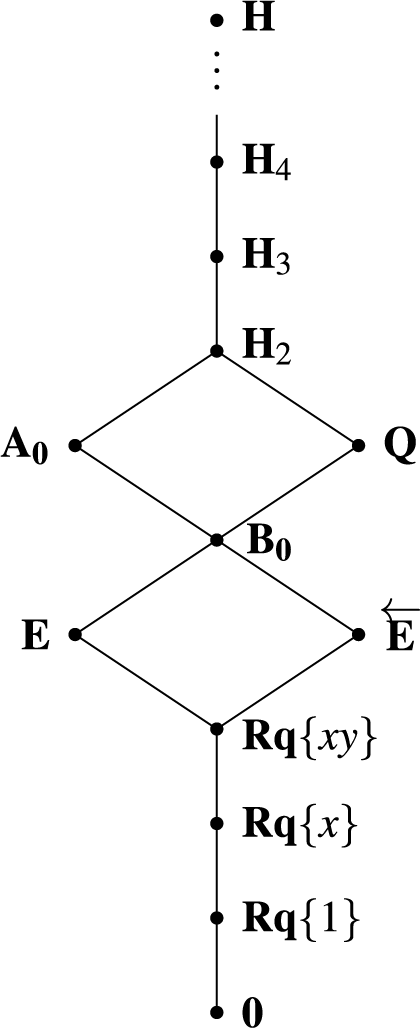

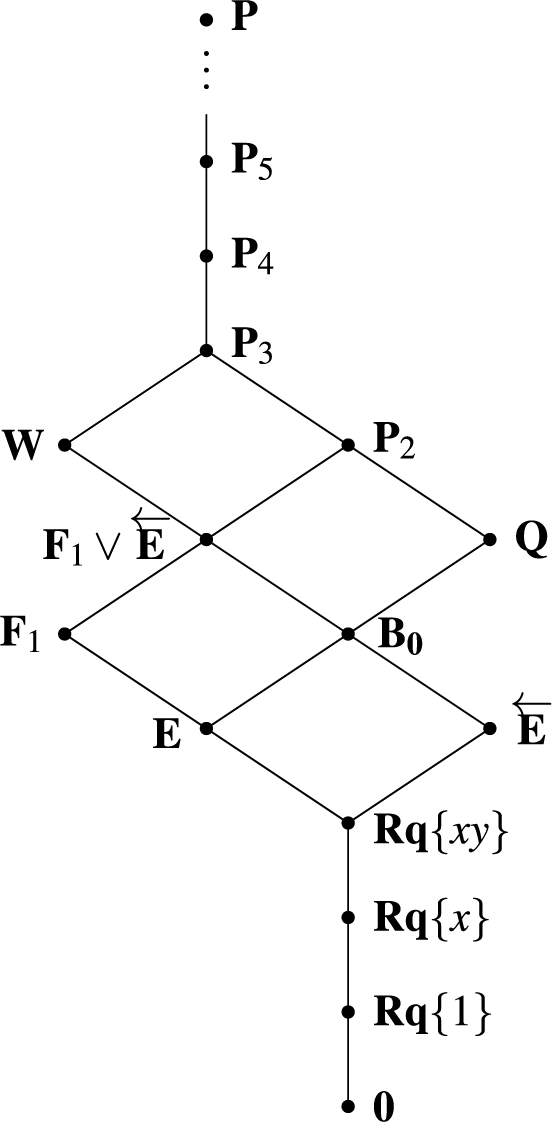

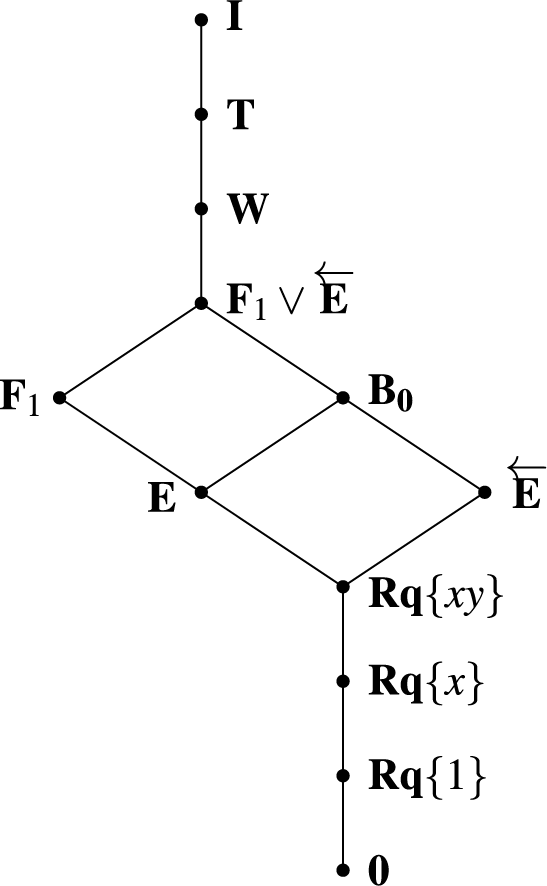

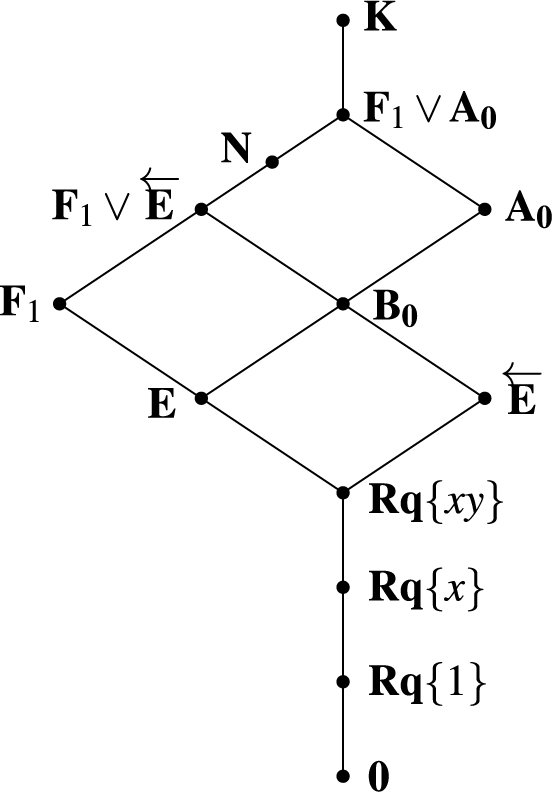

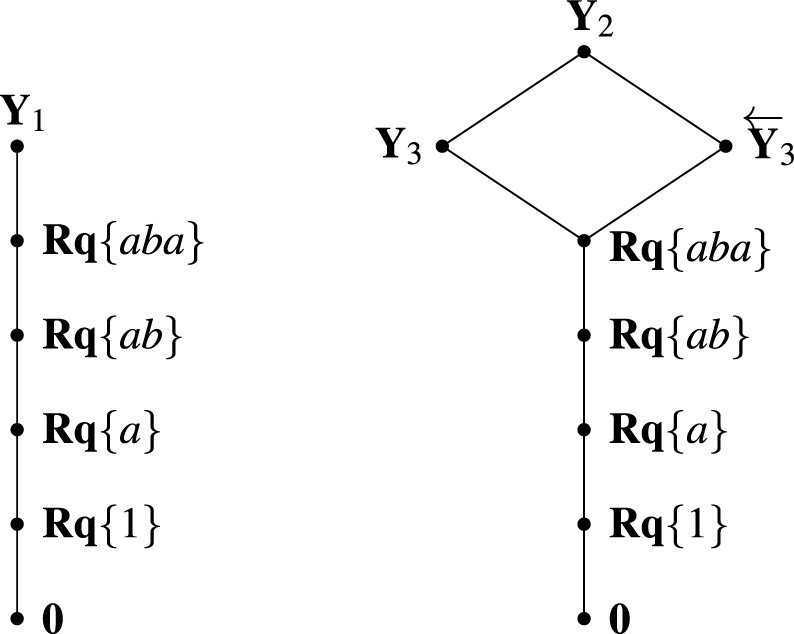


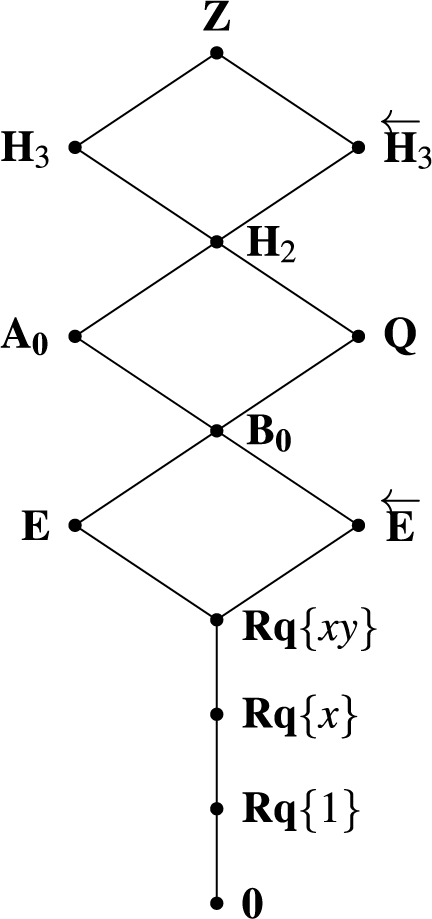


 Open access

