


Peer bullying, a widespread phenomenon among school-age children, can have detrimental consequences on childhood development. Both bullies and victims of bullying suffer more from a variety of problems than their uninvolved peers, including psychosomatic problems (Gini & Pozzoli, Reference Gini and Pozzoli2009), low self-esteem, anxiety, depression, loneliness, and low social self-concept (Hawker & Boulton, Reference Hawker and Boulton2000). Consequently, this topic has attracted a lot of attention from educational practitioners, mental health services, and academics. This study compares the prevalence rates of bullying and victimization in twins and singletons to learn something about the potentially protective effects of having a close peer companion during childhood.
It still remains an open question whether children with a close peer companion — for example, twins — are at higher, lower, or similar risk for bullying and victimization. One might, on the one hand, think that these strong companionship dyads are more vulnerable to be victimized than singletons. For example, Hay and Preedy (Reference Hay and Preedy2006) suggest that the strong relationship in twins might restrict the interaction with other children. Research indeed showed that twins show less prosocial behavior than singletons when they play with an unfamiliar peer (DiLalla, Reference DiLalla2006), which could make twins more often the target of peer victimization. On the other hand, it is well known that the presence of friends protects children from being bullied (Goldbaum et al., Reference Goldbaum, Craig, Pepler and Connolly2003; Hodges et al., Reference Hodges, Boivin, Vitaro and Bukowski1999), and it seems that sibling relationships provide protection against peer bullying as well (Lamarche et al., Reference Lamarche, Brendgen, Boivin, Vitaro, Pérusse and Dionne2006).
To our knowledge, only three studies have been carried out to detect twin-singleton differences and all three only looked at victimization (Barnes & Boutwell, Reference Barnes and Boutwell2013; Oshima et al., Reference Oshima, Nishida, Fukushima, Shimodera, Kasai, Okazaki and Sasaki2010; Weissenberg et al., Reference Weissenberg, Landau and Madgar2007). The results of these studies are contradictory. Barnes and Boutwell (Reference Barnes and Boutwell2013) found that singletons are at higher risk, whereas Weissenberg et al. (Reference Weissenberg, Landau and Madgar2007) found the opposite effect, and Oshima et al. (Reference Oshima, Nishida, Fukushima, Shimodera, Kasai, Okazaki and Sasaki2010) reported no effect at all. It should be noted that all these studies were based on unrelated singletons, meaning that the twin and singleton samples may differ on important family background factors, which hampers twin-singleton comparisons. Furthermore, the latter two studies suffered from low power (n = 341 and n = 72, respectively). In contrast, we employed a large sample (n ≈ 10,000) of twins and their non-twin siblings, making them closely matched on family background. Importantly, the three previous studies solely focused on victimization. Our study is the first to examine twin-singleton differences in bullying as well. For bullying, we might speculate that twins are more involved than singletons. Twins have a pal with whom they could bully together, which is not the case for singletons.
Questions also remain about whether bullying in twins depends on twin-specific characteristics, such as the pair's zygosity and gender composition. Studies so far have shown no effect of zygosity on the proportion of bullies and victims in twins (e.g., Ball et al., Reference Ball, Arseneault, Taylor, Maughan, Caspi and Moffitt2008; Brendgen et al., Reference Brendgen, Boivin, Vitaro, Dionne, Girard and Pérusse2008; Lamarche et al., Reference Lamarche, Brendgen, Boivin, Vitaro, Dionne and Pérusse2007; Shakoor et al., Reference Shakoor, McGuire, Cardno, Freeman, Plomin and Ronald2015). However, it is still unknown whether the prevalence of bullying is affected by the gender composition of the pair (same gender or mixed gender) and whether this effect changes as children age. Given that children increasingly play with same-sex peers (Rose & Rudolph, Reference Rose and Rudolph2006), it might be hypothesized that the effect of gender composition is absent in the beginning and is present at the end of primary school.
All the potential twin-specific influences discussed so far are not malleable, but whether a twin pair attends the same or different classrooms is usually a choice. Hence, an important question for education is whether the risk of bullying in twins is related to whether or not they attend the same classroom, and whether that effect differs for monozygotic (MZ) and dizygotic (DZ) twins. The previously mentioned effects for twins may be more pronounced for twin pairs placed in the same classrooms. Twins in the same classroom always have their close relative by their side, which can give them support and protect them from being bullied. Classroom sharing might, therefore, have a protective effect regarding victimization. We hypothesized that this effect might be stronger for MZ twins, since they tend to be more attached to each other than are DZ twins (Tancredy & Fraley, Reference Tancredy and Fraley2006). There is one relatively small study so far that has addressed this classroom-sharing question, suggesting that class sharing might protect against victimization (Lamarche et al., Reference Lamarche, Brendgen, Boivin, Vitaro, Pérusse and Dionne2006). In the current study, this previous finding was tested in a 20-times larger sample to overcome power issues. Classroom sharing might also affect the proportion of bullies, because twins in same classrooms can bully classmates together. To our knowledge, previous research has not addressed this issue. This study, therefore, tested classroom-sharing effects in bullying as well.
In previous research, some non-twin specific characteristics have been tested, namely gender and age. Most studies show that boys are more likely to bully than girls (e.g., Bowes et al., Reference Bowes, Maughan, Ball, Shakoor, Ouellet-Morin, Caspi and Arseneault2013; Kokkinos & Antoniadou, Reference Kokkinos and Antoniadou2013; Von Marées & Petermann, Reference Von Marées and Petermann2010). An explanation for why boys are more prone to be bullies than girls is that they are generally more aggressive. Aggression is the overarching concept of which bullying is a subset (Griffin & Gross, Reference Griffin and Gross2004). For victimization, findings are less consistent. There is also no agreement about the trend of bullying and victimization during primary school. Some studies show that the prevalence rate of bullying rises as children age (Atik & Güneri, Reference Atik and Güneri2013), whereas others show the opposite or no clear effects at all (e.g., Camodeca et al., Reference Camodeca, Goossens, Terwogt and Schuengel2002; Pellegrini & Long, Reference Pellegrini and Long2002).
First, the current study investigated whether twins are at higher, lower, or similar risk compared to their non-twin siblings for both bullying and victimization. Second, this study tested whether the risk for bullying and victimization differs for MZ versus DZ twins, same-sex versus opposite-sex twins, and twins attending the same versus separate classes. Meanwhile, age and gender effects were investigated. Third, it explored whether a possible classroom effect differs for MZ and DZ twins and whether the effect of gender composition changes over time.
Method
Participants
The current study used participants from the Netherlands Twin Register (NTR) (van Beijsterveldt et al., Reference Van Beijsterveldt, Groen-Blokhuis, Hottenga, Franić, Hudziak, Lamb and Boomsma2013). The NTR was established by the Department of Biological Psychology at the Vrije Universiteit Amsterdam. The reported project was approved by the medical ethical committee of the Vrije Universiteit Amsterdam (NTR/25-05-2007). Parents of the twins, aged 7, 9–10, and 12 years, were asked for their consent to approach the teachers of the twins and their non-twin siblings with a survey. Since 2010, the survey for the primary school teachers has included items on bullying and victimization. The current study includes data collected between 2010 and 2015. A subset of the final sample of twins and singletons had data on two (twins: n = 1,579 individuals; siblings: n = 162) or three (twins: n = 92 individuals; siblings: n = 1) time points due to the longitudinal data collection protocol. Multiple time points were included as multiple cases, while statistically controlling for their non-independence (see section Statistical Analyses).
The twins and siblings were born between 1997 and 2008. The following figures refer to number of data points, not individuals. Surveys of twins were excluded if twin zygosity was unknown (n = 193), if they were filled out by someone other than the regular teacher (n = 81), if familiarity with the student was below average (n = 74), if the survey was filled out by the same teacher while the twins were in separate classes (n = 11), or if twin pairs attending the same class were rated by different teachers (n = 108). This resulted in a total twin sample of 10,063 cases for the calculation of bullying and victimization scores. This sample included mostly cases for twin pairs for whom data was available for both twins (n = 4,337 pairs). Incomplete data (n = 1,389) were mostly due to only one of the teachers returning the survey (when twins were in separate classes, n = 1,230). In addition, sibling data (n = 1,534) were included in order to compare the prevalence rates of bullying and victimization for twins and singletons. Subsequently, surveys were excluded when there were more than two missing values on the bullying and victimization scale, described in the measurement section (n = 167, n = 154, respectively). This resulted in a total sample of 9,896 cases for bullying and 9,909 cases for victimization. Only a few twins (n = 73) and siblings (n = 10) had a missing value on one of the traits. The age of the twins ranged from 6.52 to 12.94 years (M = 9.49, SD = 2.01); for the siblings this was 4.68–13.43 years (M = 9.99, SD = 1.67).
Measurements
Bullying and victimization were measured by four items each, scored on a five-point scale: from 0 (never), 1 (once or twice), 2 (two or three times a month), 3 (about once a week), and 4 (several times a week). The items for victimization assessed (1) ‘how often has the child been victimized in the past couple of months? (in general)’, (2) ‘how often has the child been teased, laughed at, or called names in the past couple of months? (verbal victimization)’, (3) ‘how often has the child been physically victimized, such as being hit, kicked, and pushed in the past couple of months? (physical victimization)’, and (4) ‘how often has the child been excluded by other children, ignored, or have other students spread false rumors? (relational victimization)’. Bullying was assessed with the same items, but in the perpetration form (see Jansen et al. (Reference Jansen, Verlinden, Dommisse-Van Berkel, Mieloo, Van der Ende, Veenstra and Tiemeier2012)). The total score of both phenotypes could range from 0 to 16.
The reliability of the questions was good for both bullying (α = 0.84) and victimization (α = 0.80). Sum scores were computed when there was at most one missing item for a scale. Other missing items were imputed by the rounded averaged-item score of the scale for that child. The sum scores had an ‘L’-shaped distribution, which was divided into three categories to determine the prevalence rates of bullying and victimization. The first category for both bullying and victimization was defined by a sum score of zero and was labeled as ‘never bullied/was never victimized’. The second category was defined by a sum score of 1 or 2, ranging from (very) mild to moderately bullied/victimized and was labeled as ‘moderately bullied/was moderately victimized’. The last category was defined by a score of at least 3 and ranged from substantial to very severe, labeled as ‘severely bullied/was severely victimized’. A score of 3 means that someone scored ‘once a week’ on one of the four items. In subsequent statistical analyses, raw item data was used to avoid bias in parameter estimates due to non-normality of the sum scores. The four items for bullying and victimization were combined into factor scores for each child. Simultaneously, the factorial level of the model was used to explain the effects of our predictors on bullying and victimization.
Statistical Analyses
Data were prepared in the statistical software R, version 3.2.0 (R core team, Reference Core Team2015) and analyzed in Mplus version 6 (Muthén & Muthén, 1998–Reference Muthén and Muthén2012). To accommodate multiple testing, we used adjusted p values according to the Holm–Bonferroni method (Holm, Reference Holm1979). This method is a less strict correction for multiple testing than the Bonferroni method. It is a sequential procedure that uses a less strict rejection criterion for each subsequent comparison to reduce the Type II (false negative) errors. Type II errors arise from decreasing Type I errors in multiple testing.
Twins and siblings came from the same family and thus were well matched for confounders. To correct for non-independent observations, which results in underestimated standard errors when not taken into account, the analyses were corrected by using tests based on the sandwich or Huber/White variance estimator (Williams, Reference Williams2000). The subset of children that had data on multiple time points was also used in the analyses, since the sandwich variance estimator also corrected for this dependency.
The statistical analyses included descriptive statistics on prevalence rates for the total sample, as well as for twins versus singletons, boys versus girls, MZ twins versus DZ twins, and twins attending same versus separate classrooms. Subsequently, main and interaction effects were statistically tested.
Main Analyses
To test for differences in prevalence rates for the different subgroups, a regression was performed. First, it was tested whether twins are at higher, lower, or similar risk compared to their non-twin siblings for both bullying and victimization.
Second, it was tested whether the risk for bullying and victimization differs for MZ and DZ twins, same-sex versus opposite sex-twins, and whether the risk is lower if twins attend the same or separate classrooms. At the same time, age and gender effects were investigated.
The second model included the main effects of age (both linear and curvilinear), classroom sharing, gender, and zygosity. One variable that indicates whether the twins are of same or opposite sex was added as a covariate to correct for confounding gender effects in the zygosity variable, as DZ pairs can and MZ pairs cannot be of mixed genders. The age predictor variables in the model were entered as mean-centered continuous variables, whereas the other variables were entered as dichotomous variables.
In previous research, it has been shown that classroom assignment is associated with socio-economic status (SES) and externalizing problems (van Leeuwen et al., Reference Van Leeuwen, van den Berg, van Beijsterveldt and Boomsma2005). If an effect of classroom sharing were to be found, the model would be extended with the possible confounders SES and externalizing and internalizing problems to see whether the outcome changes. Data on these variables at age three, that is, before children went to school, are present for two-thirds of our full sample (see van Leeuwen et al. (Reference Van Leeuwen, van den Berg, van Beijsterveldt and Boomsma2005), for measurement details).
Interaction Analyses
If a classroom-sharing effect were to be found, a simplified model would be fitted to test whether the effect of classroom sharing differs for being a girl–girl, boy–boy, or opposite-sex twins. To test this interaction effect, the covariates gender composition (same-sex vs. opposite-sex), gender, and zygosity were deleted from the main model to test this interaction effect fairly. In addition, the variable that specifies the type of twin pair was added as two dummy variables in the two interaction terms with classroom placement. The first dummy variable was coded 1 for girl–girl twins, and the second coded 1 for opposite-sex twins, leaving the boy–boy twin pairs to represent the reference group.
In the follow-up analyses, we first examined whether gender composition (same-sex vs. opposite-sex) interacts with age in predicting bullying and victimization. By adding this interaction term, it was tested whether the effect of being a same-sex versus opposite-sex twin on bullying and victimization changes as children age. In addition, it was tested whether the effect of attending the same versus separate classrooms was different for MZ and DZ twins. The main effects were still included in the model to correct for possible confounding effects.
Results
Descriptive Statistics
Table 1 presents the prevalence rates of bullying and victimization for the total sample, for twins versus singletons, boys versus girls, MZ versus DZ twins, and twins in same versus separate classes. As can be seen, 36.2% of the total sample (including twins and siblings) has bullied others, whereas 34.8% has been victimized in the past couple of months.
Prevalence Rates of Bullying and Victimization

Main Analyses
Twins did not differ significantly from singletons with respect to bullying (β = -0.015, SE = 0.017, p = .384) and victimization (β = 0.018, SE = 0.018, p = .313).
Table 2 shows that there was a significant main effect of gender, indicating that boys were more likely to bully than girls. Also, a curvilinear age effect was found. The negative beta of the quadratic term implies that the curve for the age effect regarding bullying has an inverted U-shape. The raw data showed that bullying peaks around 9-years old. No other predictors approached significance.
Influences of the (Non) Twin-Specific Factors on Bullying (n = 9,788)a

Note: SE = standard error, NS = not significant. a n = 108 missing values on class-variable.
bCorrected α level according to the Holm–Bonferroni method (Holm, Reference Holm1979).
Table 3 shows that for victimization, both gender and classroom sharing appeared to be significant predictors. Boys were more often victim than girls.
Influences of the (Non) Twin-Specific Factors on Victimization (n = 9,800)a

Note: SE = standard error; NS = not significant. a N = 109 missing values on class-variable.
bCorrected α level according to the Holm- Bonferroni method (Holm, Reference Holm1979).
As for bullying, a curvilinear age effect was also found for victimization. The negative beta of the quadratic term implies that the curve for the age effect regarding victimization has an inverted U-shape. The raw data showed that the score peaked around age 9, so this pattern for victimization mirrors that of bullying. With respect to the twin-specific factors, the significant main effect of classroom sharing indicates that twins attending the same class were less often a victim than those in separate classes. This effect is shown in Figure 1. Due to a possible non-random assignment of twins to same or separate classrooms, we redid the analysis, taking SES and pre-existing differences in externalizing and internalizing problems into account. After controlling for these possible confounders, classroom placement still had an effect of similar magnitude (β = -0.138, SE = 0.036, p < .001). The other predictors, zygosity, and gender composition, were not significant. In the follow-up analysis, we explored possible interaction effects.
Prevalence rates of bullying and victimization for twins attending same and different classes. Twins in the same classroom do not bully more often (left panel), but are bullied less often than those in separate classrooms (right panel). Follow-up analyses showed that this effect only holds for girl–girl twin pairs.

Interaction Results
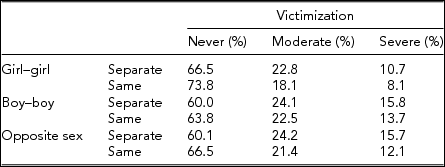
The subsequent analysis showed that for boy–boy twins there is no effect of classroom sharing (β = -0.002, SE = 0.044, p = .967). Compared to boy–boy twins, the effect of classroom sharing does not differ for opposite-sex twins (β = -0.062, SE = 0.055, p = .261), but does for girl–girl twins (β = -0.335, SE = 0.057, p < .001), indicating that the classroom effect only holds for girl–girl twin pairs. This effect can also be seen in Table 4.
Victimization Rates for Girl–Girl, Boy–Boy and Opposite Sex-Twin Pairs in Same Versus Separate Classrooms
The second interaction term showed that the effect of gender decomposition (same vs. opposite) does not change as children age with respect to bullying (β = -0.019, SE = 0.016, p = .216) and victimization (β = -0.011, SE = 0.016, p = .475). The third interaction term showed that the effect of classroom sharing does not differ for MZ and DZ twins for bullying (β = -0.090, SE = 0.064, p = .159) and victimization (β = -0.019, SE = 0.064, p = .772).
Discussion
The goal of this study was to advance knowledge about protective and risk factors for bullying and victimization. By addressing important questions about twin-singleton differences and the influences of twin-specific characteristics, we examined whether having a close companion during childhood increases or decreases risk of victimization and bullying. We report no twin-singleton difference, but do show that girl–girl twins are bullied less often when placed in the same classroom. Gender composition of the twin pair (same vs. opposite sex) and twins’ zygosity (MZ vs. DZ) had no effect.
Our finding that twins are not at a higher or lower risk than singletons for bullying and victimization is in agreement with one of the three studies about twin-singleton differences regarding victimization (Oshima et al., Reference Oshima, Nishida, Fukushima, Shimodera, Kasai, Okazaki and Sasaki2010). Our finding, however, is inconsistent with the results of Barnes and Boutwell (Reference Barnes and Boutwell2013) and Weissenberg et al. (Reference Weissenberg, Landau and Madgar2007), which showed higher risk and lower risk for twins, respectively. The comparison between the studies, though, is hampered by the use of unrelated singletons, which do not match on important family background factors. The first two studies (Oshima et al., Reference Oshima, Nishida, Fukushima, Shimodera, Kasai, Okazaki and Sasaki2010; Weissenberg et al., Reference Weissenberg, Landau and Madgar2007) had power problems as well. Our study reduces both limitations by using large groups of twins and their non-twin siblings. Given the large sample size and the non-significant result, it can be concluded that no twin-singleton differences exist in prevalence rates regarding bullying and victimization. This finding supports the generalizability of twin studies regarding bullying and victimization to the non-twin population.
We furthermore, showed that boys were significantly more likely to bully and to be victimized than girls and that the risk for both bullying and victimization peaks around 8–9 years. With respect to gender, this result is in line with the body of the literature on bullies (e.g., Bowes et al., Reference Bowes, Maughan, Ball, Shakoor, Ouellet-Morin, Caspi and Arseneault2013) and victims (e.g., Sentse et al., Reference Sentse, Kretschmer and Salmivalli2015; Takizawa et al., Reference Takizawa, Maughan and Arseneault2014). For age, the existing literature was less clear. Some studies showed that the victimization decreases as children age (e.g., Sapouna, Reference Sapouna2008), while others showed the opposite (Atik & Güneri, Reference Atik and Güneri2013). Bullying seems to be more stable. The current study, however, found a significant curvilinear age effect for both traits, showing that the risk for both traits peaks around 8–9 years. Although the effect of gender is large, the effect of age is rather small.
The risk for bullying and victimization is not influenced by twins’ zygosity and the gender composition of the twin pairs. This is in line with previous studies that show no effect of twins’ zygosity on involvement in bullying, either as bully or victim (e.g., Ball et al., Reference Ball, Arseneault, Taylor, Maughan, Caspi and Moffitt2008). Also for traits related to bullying, such as reactive and proactive aggression, no zygosity differences exist (Lamarche et al., Reference Lamarche, Brendgen, Boivin, Vitaro, Dionne and Pérusse2007). Regarding gender composition, Lamarche et al. (Reference Lamarche, Brendgen, Boivin, Vitaro, Pérusse and Dionne2006) found that 6-year-old twins of opposite sex are bullied more often. Our results, however, suggested that for both bullying and victimization same- versus opposite-sex twins do not differ. Their study included 246 twin pairs, while we had the advantage of a nearly 20-times larger sample. In addition, they did not correct for multiple testing. For related phenotypes, such as social independence, friendship, and behavior problems, no effect of gender composition has been found as well (Laffey-Ardley & Thorpe, Reference Laffey-Ardley and Thorpe2006), which supports our results.
We hypothesized that the effect of gender composition is absent at the beginning and present at the end of primary school, given that children increasingly play with same-sex peers (Rose & Rudolph, Reference Rose and Rudolph2006). However, we found no interaction and concluded that the effect of gender composition does not change as children age.
The most notable finding of our study was that twin pairs who attend the same classroom do not bully more or less than separated pairs, but they seem to be less victimized. This effect is restricted to girl–girl twin pairs, independent of zygosity, as it does not hold for boy–boy twin pairs or twin pairs of opposite sex. We know of only one study that investigated classroom effects regarding victimization (Lamarche et al., Reference Lamarche, Brendgen, Boivin, Vitaro, Pérusse and Dionne2006). This study seemed to indicate that classroom sharing has a protective effect against victimization; however, their study and the effect size of the classroom effect were probably too small to reach significance. With our large sample, the difference in victimization scores did reach significance. The finding that girl–girl twins in the same classroom are bullied less often seems to indicate that classroom sharing has a protective effect for victimization. DiLalla and Mullineaux (Reference DiLalla and Mullineaux2008) showed a protective effect of classroom sharing on peer problems as well; their peer-problems scale included one item (out of four items) about victimization. The protective effect of classroom sharing on victimization might be explained by, for instance, children's self-esteem. It is known that victims of bullying often suffer from low self-esteem (O'Moore & Kirkham, Reference O'Moore and Kirkham2001). Girl twins in the same classroom might feel more self-confident by having a sister by their side and are consequently less vulnerable for bullies. Another possible explanation might be the existence of sibling gender composition differences in the sibling relationship quality. The sibling relationship quality is best for girl–girl dyads (Buist, Reference Buist2010), which might explain why the protective classroom effect is only present for girl–girl twin pairs. It is known that MZ twins are more likely than DZ twins to rate their co-twin as their best-friend (Foy et al., Reference Foy, Vernon and Jang2001), but apparently this did not lead to a more pronounced classroom effect for MZ twins.
The result that girl–girl twins in the same classroom tend to be less victimized should be interpreted against the background of non-random classroom assignment. For example, the class assignment could have been influenced by pre-existing cognitive, emotional, and behavioral differences between the twins or other external factors. Indeed, van Leeuwen et al. (Reference Van Leeuwen, van den Berg, van Beijsterveldt and Boomsma2005) showed that Dutch twin pairs from high SES families are more often separated. In addition, they showed that classroom assignment in the Netherlands is based on early childhood externalizing but not internalizing symptoms. However, after controlling for SES and pre-existing differences in externalizing and internalizing problems at age 3, we showed that classroom sharing still had a protective effect of similar magnitude. This indicates that the protective effect of classroom sharing on victimization holds when taking factors linked to non-random classroom assignment into account.
To further investigate classroom assignment, we looked at the data of a small subsample (n = 66 twin pairs) who answered the question ‘Who decided to separate the twins?’ The answer options of ‘school’, ‘parents’, and ‘parents in agreement with the school’ were each chosen by one-third of the sample. This indicates that assignment of twins to the same or separate classrooms is not systematic. We can conclude that the decision is at least not entirely based on child-specific characteristics.
Notably, from all twin-specific factors discussed, classroom sharing is the only malleable factor. Classroom sharing is a malleable factor for schools that are large enough to have parallel year groups. Schools may have a set policy regarding classroom placement of twins (Saudino et al., Reference Saudino, Ronald and Plomin2005), depending on national context and beliefs of the principle and teachers. Nevertheless, most young twins and their parents prefer not to be separated (Gordon, Reference Gordon2015; Staton et al., Reference Staton, Thorpe, Thompson and Danby2012). The protective effect of classroom sharing regarding victimization for girl–girl twins should be taken into account when twins enter primary school. We furthermore, showed that twins in the same classroom do not bully more often. This is in line with our earlier findings that twins in the same classroom do not differ from twins in separate classrooms for other phenotypes as well, such as academic achievement, problem behavior (Polderman et al., Reference Polderman, Bartels, Verhulst, Huizink, van Beijsterveldt and Boomsma2010; van Leeuwen et al., Reference Van Leeuwen, van den Berg, van Beijsterveldt and Boomsma2005), and academic motivation (Kovas et al., Reference Kovas, Garon-Carrier, Boivin, Petrill, Plomin, Malykh and Tremblay2015). Taken together, the placement of twins in the same classroom might be beneficial regarding victimization and is not harmful for other important behavioral outcomes.
While interpreting the results of our study, it is important to acknowledge that bullying and victimization is based on teacher ratings and thus applies to the daily school setting. It is known that teachers do not necessarily rate bullying behavior in the same way as parents and children themselves do (Rønning et al., Reference Rønning, Sourander, Kumpulainen, Tamminen, Niemelä, Moilanen and Almqvist2009), with agreement correlation in the range of 0.18–0.19 for bullying and 0.11–0.22 for victimization. Using teacher-reported data is, however, not necessarily a disadvantage, since the view of teachers might be more objective.
Future research might investigate the extent to which twin separation at school entry is random. A true randomized control trial, in which researchers decide whether a twin pair will be separated or not, will face ethical resistance. We can, however, ask the teacher whether their school has a set policy regarding classroom assignment of twins. For the subset of schools that are large enough to have parallel year groups and that have set policies, whether a twin pair attends the same or different classes ought not to be related to child characteristics. Therefore, such a prospective study comes closer to a randomized trial. Follow-up research could also focus on the protective effect of these girl–girl twins attending the same classrooms and try to uncover the underlying mechanisms. To speculate, this protective effect might be due to girl–girl twins feeling more self-confident when studying in the same classroom, which might not be the case for boy–boy and opposite-sex twins. It is well known that more self-confidence makes children less prone to be a victim of peer bullying. Although further research is needed to elucidate the mechanisms, this finding in itself offers an important new perspective on the question if twin pairs should be separated or not.
To conclude, we demonstrate that assigning twins to the same classroom seems to have a protective effect for girl–girl twins, but not for boy–boy or opposite-sex twins. Importantly, girl–girl twins in the same classroom do not bully more often. Our result indicates that it might be beneficial to keep girl–girl twins together when entering primary school.
Acknowledgments
We are grateful to the twin families and the teachers for their participation. This research was supported by ‘Spinozapremie’ (NWO/SPI 56-464-14192); ‘Twin-family database for behavior genetics and genomics studies’ (NWO 480-04-004); Genetics of Mental Illness: European Research Council (ERC-230374); Genetic influences on stability and change in psychopathology from childhood to young adulthood (NWO/ZonMW 91210020). EvB is supported by a VENI fellowship (NWO 451-15-017). The research conducted for this manuscript is part of The Consortium on Individual Development (CID), which is funded through the Gravitation program of the Dutch Ministry of Education, Culture, and Science and the Netherlands Organization for Scientific Research (NWO grant number 024.001.003).



