




INTRODUCTION
The chronology of the Shang ( ) Dynasty is the critical issue in the study of ancient Chinese history (e.g. Chang Reference Chang1980; Keightley Reference Keightley, Loewe and Shaughnessy1999). There is a large amount of historical literature about the Shang Dynasty, but it is difficult to obtain its absolute chronology. The earliest definite date recorded in Chinese historical literature is 841 BC, which was recorded in the book Shiji (
 ) (Records of the Historian). From this year on, all major events were recorded annually in the Shiji and additional Chinese historical books compiled subsequently. However, the chronological data of ancient China before 841 BC is fragmented in ancient Chinese literature. For Xia, Shang, and Zhou Dynasties before 841 BC, the Shiji recorded only lists of kings with their genealogy, without the years of their reign. For more than two thousand years, Chinese and foreign scholars have attempted to settle the chronological issues of Xia-Shang-Zhou with astronomical methods. However, the results were as diverse as the different calendar used and the astronomical records selected for study.
Recently, some results of chronology of late Shang Dynasty have been reported. Zhang Peiyu carried out systematic research of the records concerning five lunar eclipses on the oracle bones and determined the date of Wu Ding’s reign (Zhang Reference Zhang2002). Li Xueqin determined the last two kings’ chronology according to the periodicity of sacrifice recorded on oracle bones and the calendar at that time (Li Reference Li2002). Qiu Shihua dated the Yinxu site, which is believed to be the capital of late Shang (Qiu Reference Qiu2015).
Dating oracle bones can provide an independent approach to determine the chronology of the late Shang period. The inscriptions on oracle bones give the valuable information about Shang and some even refer to the kings of Shang. By selecting specific oracle bones related to certain Shang kings the dating results will be more credible and valuable. Richard Gillespie had tried to date oracle bones with inscription showing Wu Ding’s time period, but it was not very successful and only one radiocarbon (14C) age is acceptable (Gillespie Reference Gillespie and Bulbeck1997).
We took the bone samples for 14C dating from the precious oracle bones with the inscriptions, which have the clear chronological information. It is the first time those rare oracle bones are dated in series to establish the absolute chronology of the late Shang period. In our studies, oracle bone samples are collected from 9 major museums and institutions in mainland China. Their 14C ages are measured by AMS at Peking University with improved sample preparation (Yuan et al. Reference Yuan, Wu, Gao, Wang, Cai, Liu, Li and Ma2000, Reference Yuan, Wu, Liu, Guo, Cheng, Pan and Wang2007; Liu et al. Reference Liu, Guo, Lu, Ma, Li, Wang, Zhou, Yuan, Ren, Zhao, Zhang, Zhang, Yuan, Wu, Li and Chen2000, Reference Liu, Ding, Fu, Pan, Wu, Guo and Zhou2007). It is noted that the calibration of the 14C determination usually gives a wide range of calendar age due to the irregular shape of the 14C calibration curve, but this issue can be resolved by the application of Bayesian method (Bronk Ramsey Reference Bronk Ramsey1995, Reference Bronk Ramsey2001).
HISTORY OF THE RESEARCH ON ORACLE BONES
Discovering of Oracle Bones
Oracle bone script is the earliest Chinese writing known to date (Boltz Reference Boltz2003; Keightley Reference Keightley2014). Inscribed oracle bones were unearthed from time to time by local farmers in areas around Anyang city in Henan province and they were used as an ingredient of traditional Chinese medicine known as dragon bones. In 1899 Wang Yirong, chancellor of the Imperial College of Qing ( ) Dynasty, noted the markings on oracle bones as being comparable to the ancient Chinese characters inscribed on Zhou (
 ) Dynasty bronzes (Wilkinson Reference Wilkinson2000). Since then, similar inscribed oracle bones have been studied extensively.
Most oracle bones come from the site of Yinxu (Yin Ruins) near Anyang city, which was the capital of late Shang. In history, Yin is used as an alternate term for “late Shang”. Oracle bones are made of ox scapula or turtle plastron for divination practiced mainly during the late Shang period. To date, a total over 150,000 late-Shang oracle bones have been discovered. More than 4500 different characters of oracle bone inscriptions are in existence, and about 1200 characters have been deciphered and recorded by the academic societies.
Difficulties of Connecting Oracle Bone with the Shang Kings
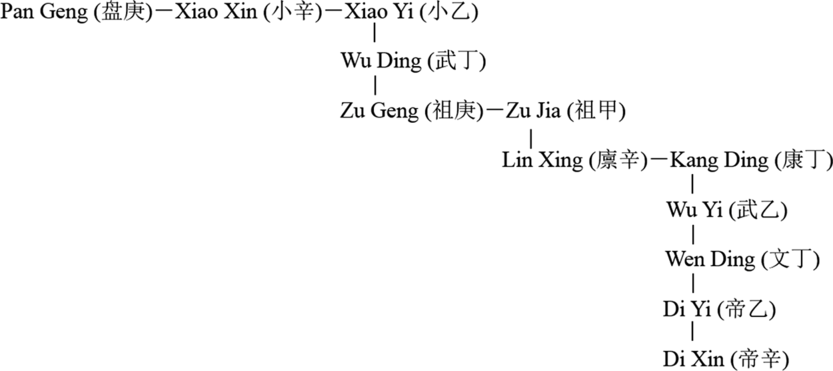
Extensively studies of oracle bone inscriptions testify that these materials pertain mostly to the divination records of royal family in the late Shang era. As shown in the Figure 1, 12 kings of 8 generations had lived in the late Shang period, but nearly all of the oracle bones known to date had belong to the last nine kings. On these bone objects, the reigning king was simply indicated as king while the former kings were referred by their posthumous names. The last character of each name of the former kings is one of the 10 celestial stems, such as Jia ( ), Yi (
 ), Bing (
 ), Ding (
 ) and so on. One can think of the 10 stems like the numbers from 1 to 10 used to sequence and categorize items. Due to the fact that the quantity of Shang kings mentioned in the bone inscription exceeds that of the celestial stems, the names of the kings are differentiated with the addition of prefixes such as Da (greater), Xiao (lesser), Zu (ancestor). If only one appellation, such as grandfather Ding or father Jia or brother Xin, is showing in the inscriptions on one piece of oracle bone, the historical date of the oracle bone is difficult to determine due to the duplication of name.
Kings’ genealogy of late Shang dynasty. There are 12 kings of 8 generations who lived in the late Shang period, and the kings in the same line are brothers.
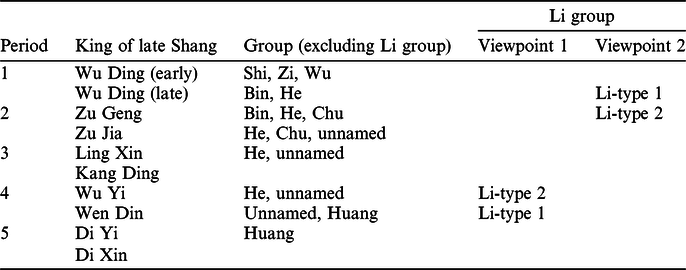
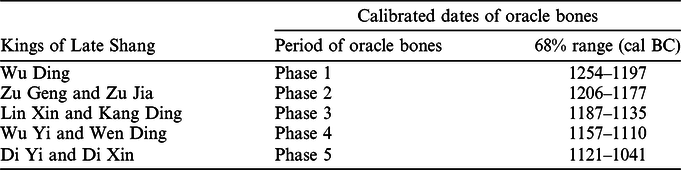
One of the main tasks for oracle bone studies is to figure out the associations between the oracle bone pieces and the names of the kings in their inscriptions. Dong Zuobin in 1933 divided the oracle bones into five time periods according to 10 criteria, such as genealogy, appellation, diviners, stylistic features of inscribed characters, styles of calligraphy (Dong Reference Dong1933; Keightley Reference Keightley1978). The five periods correspond with different kings, separately (Table 1). Chen Mengjia in 1949 divided the oracle bones into different groups on the basis of the diviners named on the bones (Chen Reference Chen1951). Following similar ideas, Li Xueqin in 1981 divided them into nine groups, which are Bin ( ), Shi (
 ), Zi (
 ), Wu (
 ), Chu (
 ), Li (
 ), unnamed (
 ), He (
 ) and Huang (
 ) (Li Reference Li1981).
Corresponding relationship of the five periods and nine groups of oracle bones vs. the kings of late Shang.
Corresponding Relation between Oracle Bone Groups and Their Periodization
The nine groups of oracle bones could be related to the five periods as shown in Table 1. Except for a few exceptions, most of the corresponding relationships of the nine groups and five periods of oracle bones have gained the consensus of scholars.
In fact, there was contention about the oracle bones of Shi, Zi and Wu groups at one time. In 1949, Dong Zuobin believed that Shi, Zi and Wu group oracle bones should have belonged to king Wen Din in the 4th Period of oracle bones (Dong Reference Dong1949). Subsequently, most scholars accounted the Shi, Zi and Wu groups as belonging to King Wu Ding of the first Period. Furthermore, they maintained that those three groups and Bin group have a chronological order, i.e. Shi, Zi and Wu groups belong to early and middle period of Wu Ding, while Bin group belongs to middle and late period of Wu Ding (Kaisuka and Ito Reference Kaisuka and Ito1953; Chen Reference Chen1956; Xiao Reference Xiao1976; Li Reference Li1981; Xie Reference Xie1981).
But scholars are still disputing the phase and date of Li group. It is believed that the character “Li,” which is present in the inscriptions on a number of oracle bones, is the name of a diviner. In 1928 Ming Yishi considered this specific group of oracle bones as belonging to the period of King Wu Ding or Zu Geng/Zu Jia (Chen Reference Chen1951; Huang Reference Huang2007). But both Dong Zuobin and Chen Mengjia believed that these bone artifacts were produced during King Wu Yi and Wen Ding’s time (Dong Reference Dong1933; Chen Reference Chen1951, Reference Chen1956; Wilkinson Reference Wilkinson2000). In 1977 Li Xueqin proposed that these oracle bones can be classified as Li group and they should have belonged to the time of late Wu Ding to Zu Geng (Li Reference Li1977). Since then many scholars have been involved in this discussion, and the debates are regarding the content of divination, appellation, stylistic features of inscriptions, and stratigraphic data of oracle bones of Li group. People such as Xiao Nan (Xiao Reference Xiao1980, Reference Xiao1984), Zhang Yongshan and Luo Kun (Zhang and Luo Reference Zhang and Luo1980), Xie Ji (Xie Reference Xie and Hu1982), Liu Yiman and Cao Dingyun (Liu and Cao Reference Liu and Cao2011) believe that Li group belongs to Wu Yi and Wen Din period, but others like Qiu Xigui (Qiu Reference Qiu1981), Li Xueqin and Peng Yushang (Li Reference Li1981; Peng Reference Peng1983; Li and Peng Reference Li and Peng1996), Huang Tianshu (Huang Reference Huang2007), Lin Yun (Lin Reference Lin1984, Reference Lin2013) suggest that Li group belongs to the period from late Wu Ding to Zu Geng.
Previous Attempt to Date Oracle Bones
Richard Gillespie in 1997 published two dates for an oracle bone piece. These dates were produced with samples taken from the same ox scapula, which is obtained from the Institute of History and Philology, Taipei and is purportedly from the reign of Wu Ding. The samples were measured in two laboratories. The 14C age of sample OxA-2904 is 2930±65 BP, which is reasonable. However, the result of sample NZA-2257 is 3170±96 BP, which is unconvincingly older. The possible reason is that the contamination on the second sample had not been removed completely. He also mentioned that “Measurements were also made on some other oracle bones from the same period, but have been omitted from this report for technical reasons such as low collagen content or possible contamination” (Gillespie Reference Gillespie and Bulbeck1997). Owing to the difficulties in collecting scripted oracle bone samples systematically and removing contamination from such samples, the systematic 14C dating of oracle bones has not been carried out so far.
MATERIALS AND METHODS
Sample Collection
The unearthed oracle bones were mainly made from ox scapula and turtle plastron. The turtle plastron is not good for 14C dating due to the reservoir effect of water, which makes the measured ages of samples older than their real ages. So only ox scapulae are selected for our 14C dating.
In order to obtain suitable samples with useful information, strict rules of sampling were followed: (1) selecting the oracle bones inscribed with the appellations, such as father Ding, brother Geng etc., especially one piece having two or three such appellations that could offer useful references for the periodization of the bone objects; (2) selecting oracle bones with the records, which may give a connection between the oracle bone and a certain king, such as the records of specific lunar eclipse and cyclical sacrifices; (3) selecting oracle bones recording important events or the diviners’ names; and (4) selecting oracle bones excavated from sites in good archaeological contexts. A picture of selected oracle bone with inscription recording divinations in the late period of Shang Dynasty is shown in Figure 2.
An oracle bone (identification number Tun 2707) with inscription recording divinations. Its 14C age has been measured at Peking University (Table 5). The inscriptions include the appellations of grandfather Yi and father Ding, and this piece was classified as belonging to the Li group. The inscriptions state that the ruling King carried out divination activities in the ancestral temples of Da Yi, Da Jia, grandfather Yi and Father Ding; sacrifice to the former Kings descending from Shang Jia is carried out in order to ward off disasters that could possibly occur to the current King; the sacrificial animals used are white boars and bulls. The red rectangle in the photo image indicates the area for sampling after restoration. (Please see electronic version for color figures.)

About 100 oracle bone samples are collected from the Institute of Archaeology of CASS (Chinese Academy of Social Science), the Institute of History of CASS, the National Library of China, the National Museum, the Palace Museum, Shandong Museum, Tianjin Museum, Peking University and Jilin University for this study. About 1 g of bone material is sampled from each oracle bone piece. The sampling processes are conducted carefully to keep away from the inscriptions areas as well as the divination markings on the back of the oracle bones. After sampling, these oracle bones are repaired.
The oracle bone specimens selected for 14C dating are those whose group can be determined and which pertain to a Shang king. Thus, each of the samples is herein assign to one of the five periods of oracle bones.
Most of the oracle bones are identified by their serial numbers in the book Compilation of Oracle Bone Inscription ( ) (Guo and Hu Reference Guo and Hu1999). Others archaeologically excavated more recently but not included in that book, are assigned numbers according to their respective archaeological sites. For example, the documentation system used for oracle bones excavated from village Xiao Tun is shown by a number preceded by a Chinese character Tun. A small quantity of oracle bones collected by the Institute of Archaeology, CASS are identified with the collection number of the Institute.
Besides inscribed oracle bones, two bone samples associated with the kings of the late Shang period are also collected for 14C dating. One of them is a bone-made hairpin excavated from the tomb of Fu Hao ( ), the wife of King Wu Ding; the other is a piece of sheep bone excavated together with a bronze artifact, on which the inscription referring to the seventh year of King Di Xin (
 ).
).
Sample Preparation and Measurements
Sample preparation includes three steps. The first step is pretreatment, i.e. to remove the contamination and extract the effective dating component from the samples of oracle bones; the second is combustion, to oxidize the extracted component to CO2, and the third step is reduction and graphitization, to convert the CO2 into graphite.
The selection process of components from bone is important for effectively obtaining accurate dating results of oracle bones. As past experiments have showed that gelatin is more reliable than collagen, gelatin is selected for dating oracle bones. Firstly, the collagen extracted from bone, decalcified with 0.5N HCl and subsequently soaked with 0.5N NaOH, and then gelatin was extracted from collagen by means of hydrolyzing with pH 2−3 HCl at 90°C. The resulting solution was filtered or centrifuged and then lyophilized to dryness (Yuan et al. Reference Yuan, Wu, Gao, Wang, Cai, Liu, Li and Ma2000). During our earlier studies the results from some measurements came up with unconvincingly old age, which are 400–700 years older than the range of expected ages. Our investigation shows that these unacceptable ages have resulted from contaminations introduced from protective agents and adhesives during the conservation treatment for oracle bones at museums. We indeed found tripolymethacrylic, nitrocellulose lacquer and chain alkanes etc. in the oracle bone samples. So, we purified the contaminated oracle bone samples by ultrasonicating physically cleaned bone samples, placing the material in 50 mL ground-glass stopped conical flasks, and rinsing the material with 30 mL each of tetrahydrofurane, trichloromethane, petroleum ether, acetone and methanol, respectively. The solutions were vibrated three times for 30 min each at middle vibration velocity (Yuan et al. Reference Yuan, Wu, Liu, Guo, Cheng, Pan and Wang2007). This is a method originally developed by Bruhn et al. to get rid of contaminations on wood samples (Bruhn et al. Reference Bruhn, Duhr, Grootes, Mintrop and Nadeau2001). After the oracle bone washed with different organic solvents, the gelatin and graphite were prepared by conventional process. There are 12 oracle bone samples with too little extracted gelatin, so graphite has not obtained for those samples.
Earlier 14C measurements of the oracle bones were carried out with EN-AMS at Peking University (PKU) (Liu et al. Reference Liu, Guo, Lu, Ma, Li, Wang, Zhou, Yuan, Ren, Zhao, Zhang, Zhang, Yuan, Wu, Li and Chen2000), and subsequently conducted with a new NEC compact AMS at PKU (Liu et al. Reference Liu, Ding, Fu, Pan, Wu, Guo and Zhou2007). The measuring accuracy is usually between 0.3%−0.5%.
Calibration
Age Calibration and Bayesian Analysis
Single sample calibration usually gives a wide time span of calendar age, which could be unacceptable for most studies of historical chronology. To narrow down the range of the calendar date probability distribution, Bayesian method was introduced into 14C calibration with series of samples by C.E. Buck and her colleagues in early 1990s (Buck et al. Reference Buck, Kenworthy, Litton and Smith1991). OxCal is a typical calibration programs using Bayesian method (Bronk Ramsey et al. Reference Bronk Ramsey1994), which was chosen for this work, and its latest version is OxCal v4.3.2 published in 2017 (Bronk Ramsey Reference Bronk Ramsey2017).
To use the Bayesian method, the oracle bone samples have to be organized according to a model consisting of a series of sequential phases. The sequence of the phases corresponds to the chronological order of archaeological periods. The posterior probability distribution functions obtained after calibration are no longer the normal distributions. The highest posterior density credible interval of calendar dates is still quoted at 68% (1 σ) and 95% (2 σ), which means the shortest range including such a percentage of probability in the probability density function (Bronk Ramsey Reference Bronk Ramsey2009). After calibration, each sample has an agreement index which is from the calculation to compare the calibration distribution of one sample with and without Bayesian modelling. On average, 1 in 20 agreement index values to drop below 60% might be expected, but if the index values are substantially lower or a large proportion fall below 60%, something internally inconsistent between the model and the data could have occurred (Bronk Ramsey Reference Bronk Ramsey2009).
Single-Phase Calibration
At times the single-phase calibration is also useful. A model of single phase including a certain number of samples with beginning and ending boundaries can give a good estimation to the date range of that phase after calibration. The result could be much better than the calibration of single sample.
Establishment and Adjustment of the Model OB
Since the oracle bones taken for our study can be divided into five periods, a Bayesian model OB is constructed for calibration to encompass five sequential phases. Each oracle bone piece is verified its correspondence with the relevant time period of the king and the phase. The boundaries were set up at the beginning and the end of the sequence, and the intermediate boundaries were inserted between adjacent phases in the sequence.
Considering that the periodization of the oracle bones of Li group is still controversial, these 19 Li group objects are not included in our calibration model but are calibrated as single-phase separately for comparison.
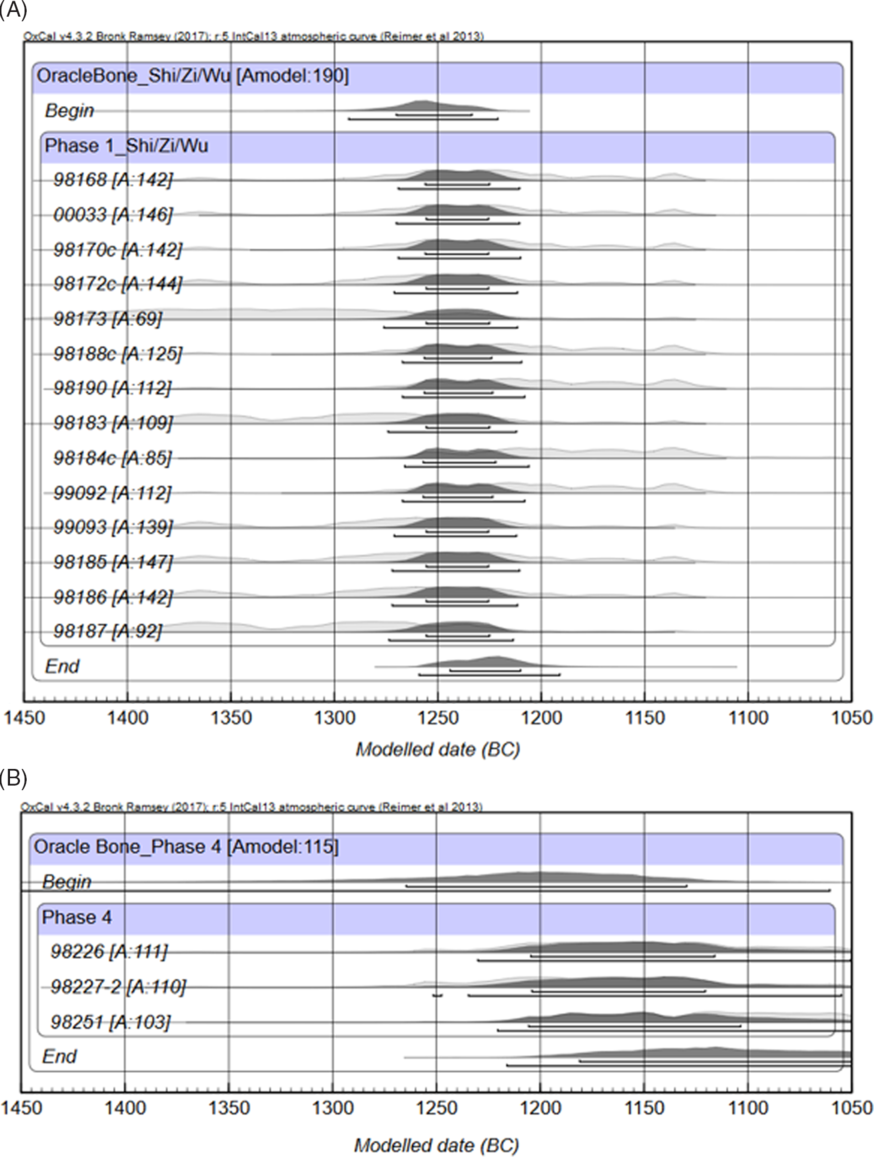
As mentioned above, there has been a debate on the periodization of the Shi, Zi and Wu group oracle bones, so we checked it again. We carried out the single-phase calibration for Shi, Zi and Wu groups as well as the single-phase calibration for phase 4 oracle bones based on our measurements. Figure 3 shows the comparison, which reveals no overlapping between the 1σ ranges of these two phases. Then we compared the ages of Shi, Zi and Wu groups and that of Bin group as showed in Figure 4. The result proves the groups’ chronological order and agrees with the views of most scholars. So, Shi, Zi, and Wu groups are included in Phase 1 of model OB.
Comparison of the single-phase calibration results of Shi, Zi and Wu groups (A) and Phase 4 oracle bones (B). There is no overlap between the 68% ranges of the two single-phases.
Comparison of the single-phase calibration results of Shi, Zi and Wu groups (A) and Bin group (B). The age of the two single-phases are quite closed, but the age of Shi, Zi and Wu groups is obviously older than the age of Bin group.
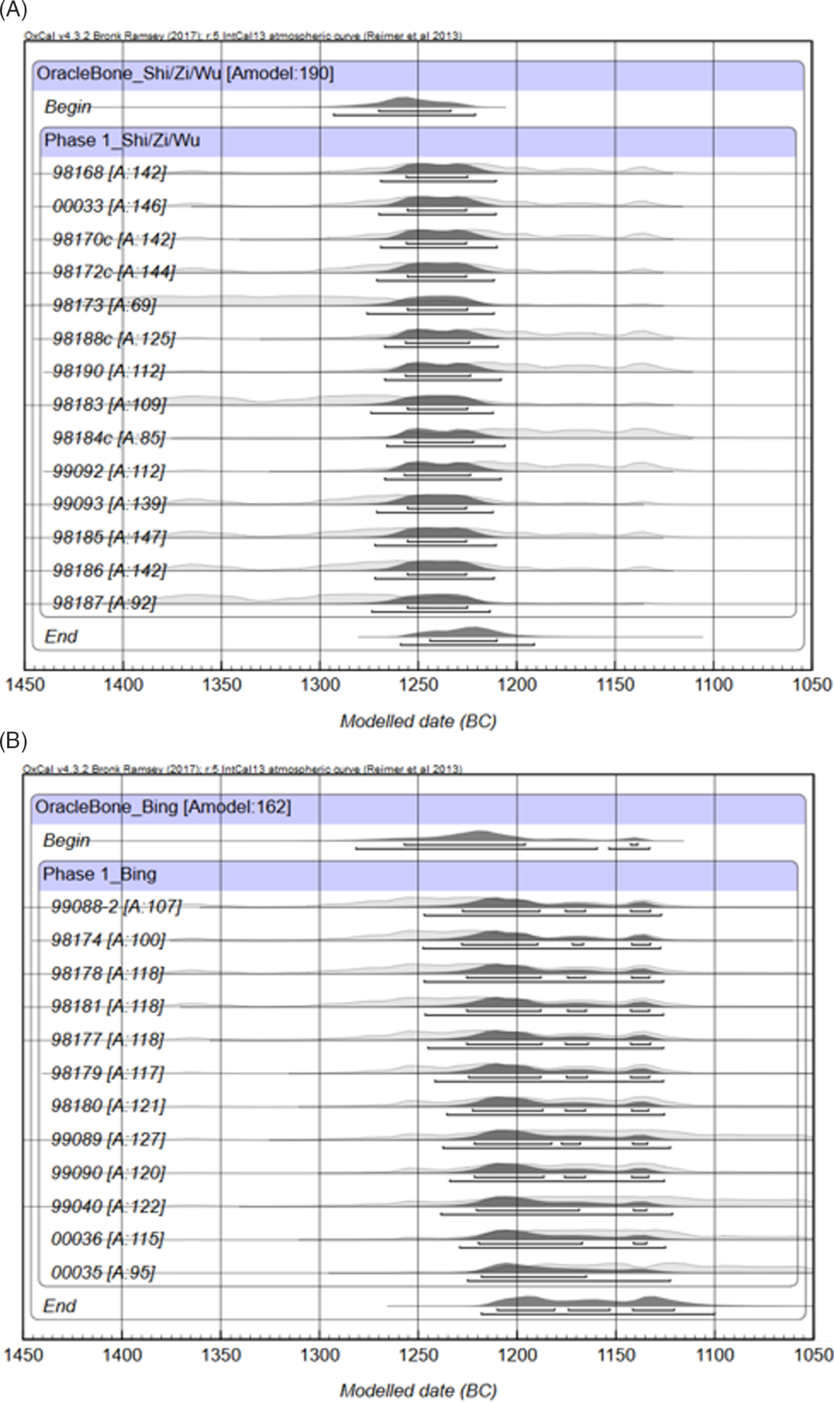
Because Wu Ding’s reign is documented as having lasted for 59 years in Chinese historical texts without argument, we use the OxCal command Interval to set the span of the first phase as 59 years. The reign of other kings, however, are not clear.
The primary calibration results of the model indicate that the agreement indexes of some samples are conspicuously lower, which might be due to contamination. The samples with significantly lower agreement indexes were removed from the calibration model, so as to make the percentage less than 5% for samples with agreement index lower than 60% but still higher than 50%.
After excluding the samples without enough graphite and the samples of Li group as well as removing the samples with unacceptable low agreement index, 50 samples are embedded in the model OB including 7 from Shi group, 3 from Zi group, 4 from Wu group, 11 from Bin group, 5 from Chu group, 1 from He group, 14 from unnamed group, 3 from Huang group, and two bone samples mentioned above.
Fall-In Ratio Simulating Experiments
To appropriately study the date range of a phase, the simulation using command R_Simulate was performed. The command R_Simulate provided by OxCal can produce a random 14C age according to the calibration curve from a particular calendar date with a given measuring error, so the real measurement can be simulated. By means of computer experiment we can check whether the setting date of truth value falls in the corresponding 68% or 95% calendar date range given by calibration. Unlike the actual measurement, in which case we do not know if the true age falls in the corresponding date range or not, the simulation process reveals the corresponding date range of true age. Thus, we can construct a simulated calibration model and set the true date of each sample by R_Simulate with simulated measuring error. After calibration we will know which samples’ true date fall into the corresponding date range. But due to the statistical uncertainties, it is totally random whether the true date of a sample falls in the 68% or 95% range for a single calibration. Using the batch command of OxCal we can repeat such a calibration for several hundred or even a thousand times to obtain good statistic results, and to count the frequencies that the true date of each sample had fallen in the corresponding date range. Here we define the Fall-in Ratio (FIR) of a sample in 68% (or 95%) range as the percentage of the number obtained by the times that the true age had fallen in the corresponding range over the total number of simulations. If a straight-line calibration curve is used, all the posterior probability distributions are still Gaussian. In such a case our simulation showed that the FIR is identical to corresponding credible level 68% or 95%. But for the real calibration curve the date range will be expanded after calibration, and its breadth depends on the shape of the calibration curve. The FIR of the sample also becomes larger than the corresponding credible level with the real calibration curve. To perform the simulation experiments a model of sequenced 5 phases is constructed using R_Simulate command, and each phase includes 6 simulated samples in a 40-year span. The true ages of the samples are set to distribute evenly in the 40-year span. Simulation for that model with a real calibration curve corresponding to late Shang period has been carried out, and the results showed that the FIR in 68% range is actually higher than 80% or even reach 90% with the fluctuations and plateaus on the calibration cure.
Furthermore, the simulation showed that the calibrated 68% range of the samples in a phase agreed well with the setting true age interval of the phase, so during the real calibration the intervals of each phase usually are estimated by the superposition of the 68% date ranges of all the samples in that phase.
Stability and Reliability of the Calibration Results
Due to the randomness that the command R_Simulate produces the 14C age, the main part of the probability distribution of a certain sample by single sample calibration may deviate from its true age, which will result in a low agreement index in the calibration of a model with sequential phases. Even so, the ranges of the calibrated ages of the sequential phases are not affected by the sample with low agreement index. Of course, we can also deliberately set a false true age, which is beyond the date range of its phase, then two situations could occur as following. One is to obtain a low agreement index, and we can reject it. The other is that its calibrated 68% date range may just coincide with the setting true age interval of the phase, and a high agreement index is obtained due to the randomness that the command R_Simulate produces the 14C age. This indicates that the structure of the sequential phases has high stability and fault-tolerance, and that the calibrated results of this structure by Bayesian method are reliable. Therefore, the data reliability with Bayesian method could be higher than that calibrated as single sample, although its date range has been narrowed substantially. However, the above conclusion is true only when the following conditions are satisfied. Firstly, the model construction should be reasonable, which means that the prior of the relationship between samples should be known well. In particular, it is necessary to clearly understand which sample should belong to which phase. Secondly, the measured precision of the sample cannot be too low. It is preferable to have the measured precision of 0.4%–0.5% (30–40 yr) and the precision of 0.7% (55 yr) for individual sample is acceptable. The simulation experiments indicate that the calibration results will be unstable and unrepeatable if the measured precision of all the samples is 0.7%.
Even so, the calibration results could still be affected by the non-uniform distribution of the samples in a phase and the shape of the calibration curve in a particular section. The simulation indicated that about 10 years of uncertainty could have existed for the calibrated ranges of each phase, and for an individual boundary the uncertainty might be up to 20 years in an extreme case.
RESULTS AND DISCUSSION
Calibration Results of OB
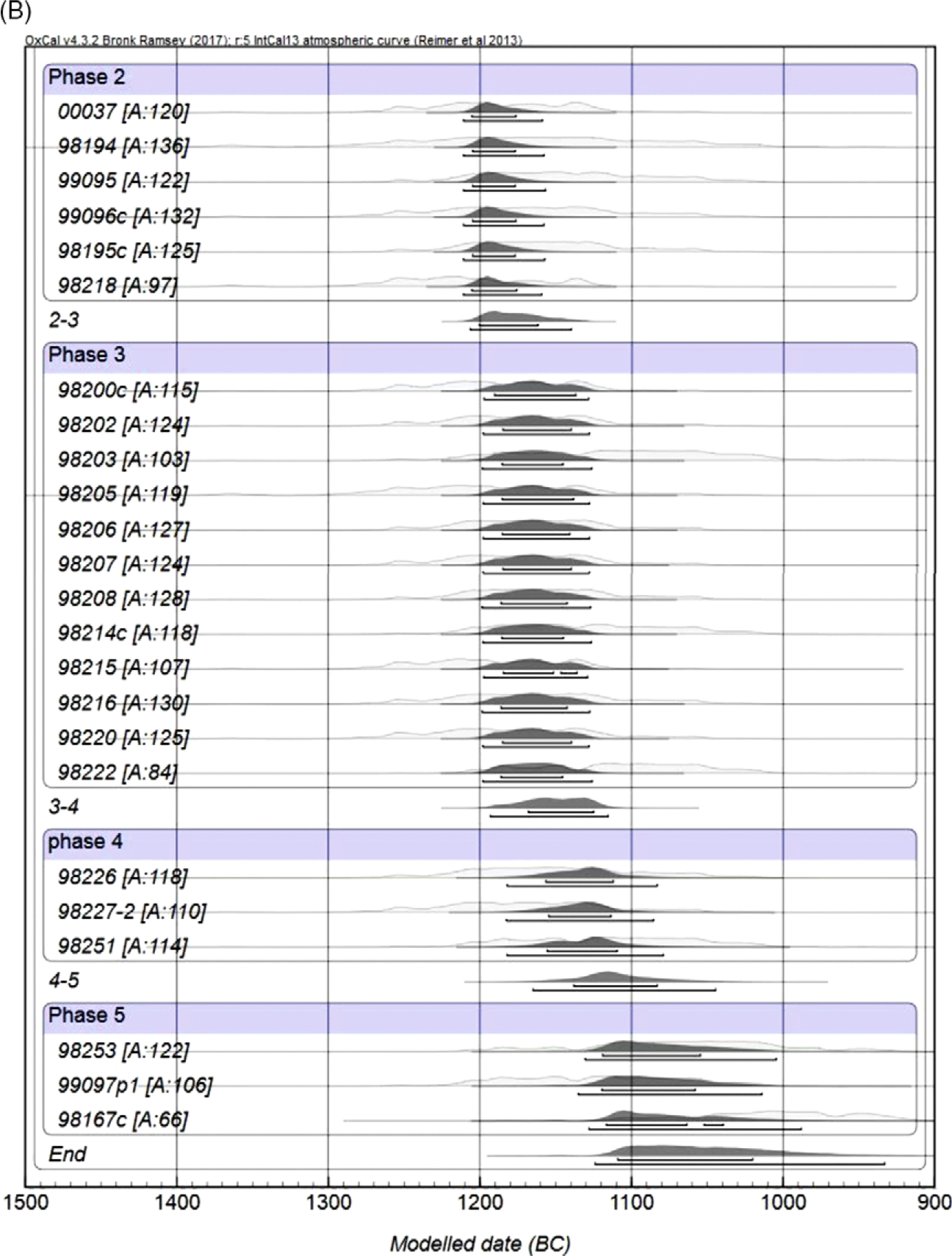
The calibration results are summarized in Table 2, which indicates the chronological interval from King Wu Ding to King Di Xin is 1254 cal BC−1041 Cal BC. The calibration was performed with the use of OxCal v4.3.2 (Bronk Ramsey Reference Bronk Ramsey2017) and calibration curve IntCal13 (Reimer et al. Reference Reimer, Bard, Bayliss, Beck, Blackwell, Bronk Ramsey, Buck, Cheng, Edwards, Friedrich, Grootes, Guilderson, Haflidason, Hajdas, Hatté, Heaton, Hoffmann, Hogg, Hughen, Kaiser, Kromer, Manning, Niu, Reimer, Richards, Scott, Southon, Staff, Turney and van der Plicht2013). Detailed results are shown in Table 3 and Figure 5, and the overall Agreement index of the model is 239.5%. As mentioned above, the calibrated age within the 68% range is assigned to every sample in the model, and then the range, which superposed the 68% ranges of all the samples in a phase, is taken as the 68% range of that phase. Actually, the probability of true age falling in 68% range is higher than 80% or even reach 90%. Our simulation study showed that this is reasonable and reliable for a well-constructed model of sequential phases, but considering the impacts of various factors, the uncertainty of about 10 years possibly exists for the calibrated age of a phase.
Oracle bone dating results.
14C ages of oracle bones and calibration results of model OB.
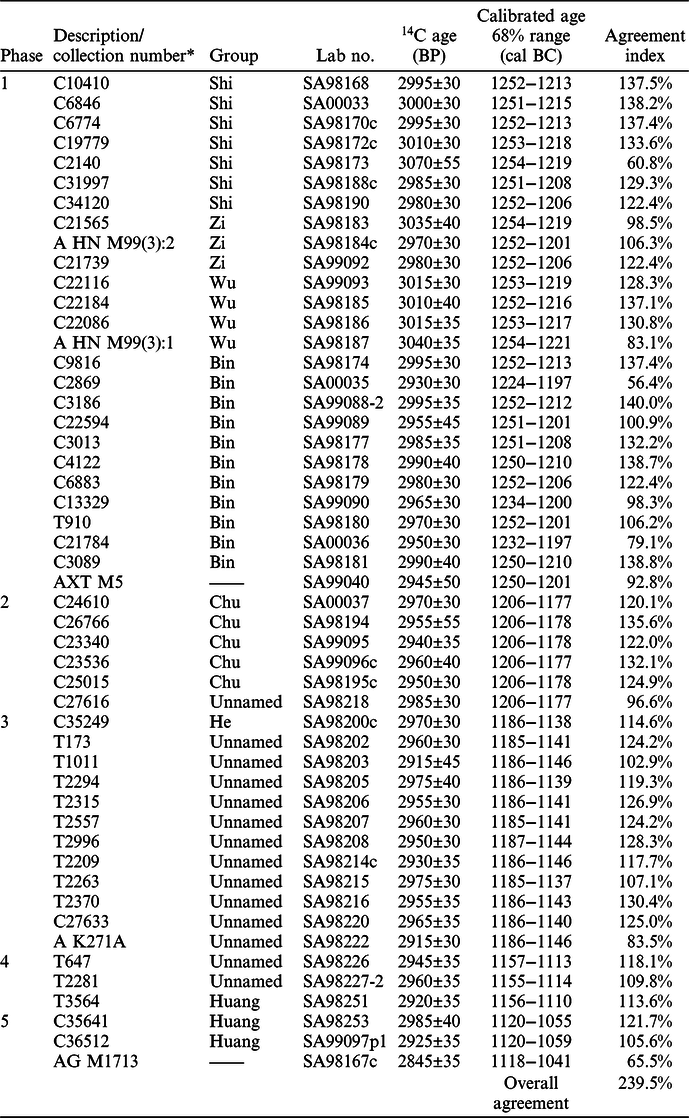
* C = Compilation of oracle bone inscription; T = Xiao Tun; A = Institute of Archaeology, CASS (collection number); AXT M5 = Tomb of Fu Hao; AG = Anyang Steel Plant; M = Tomb.
(Continued in Figure 5B) Oracle bone calibration results of model OB (Phase 1).
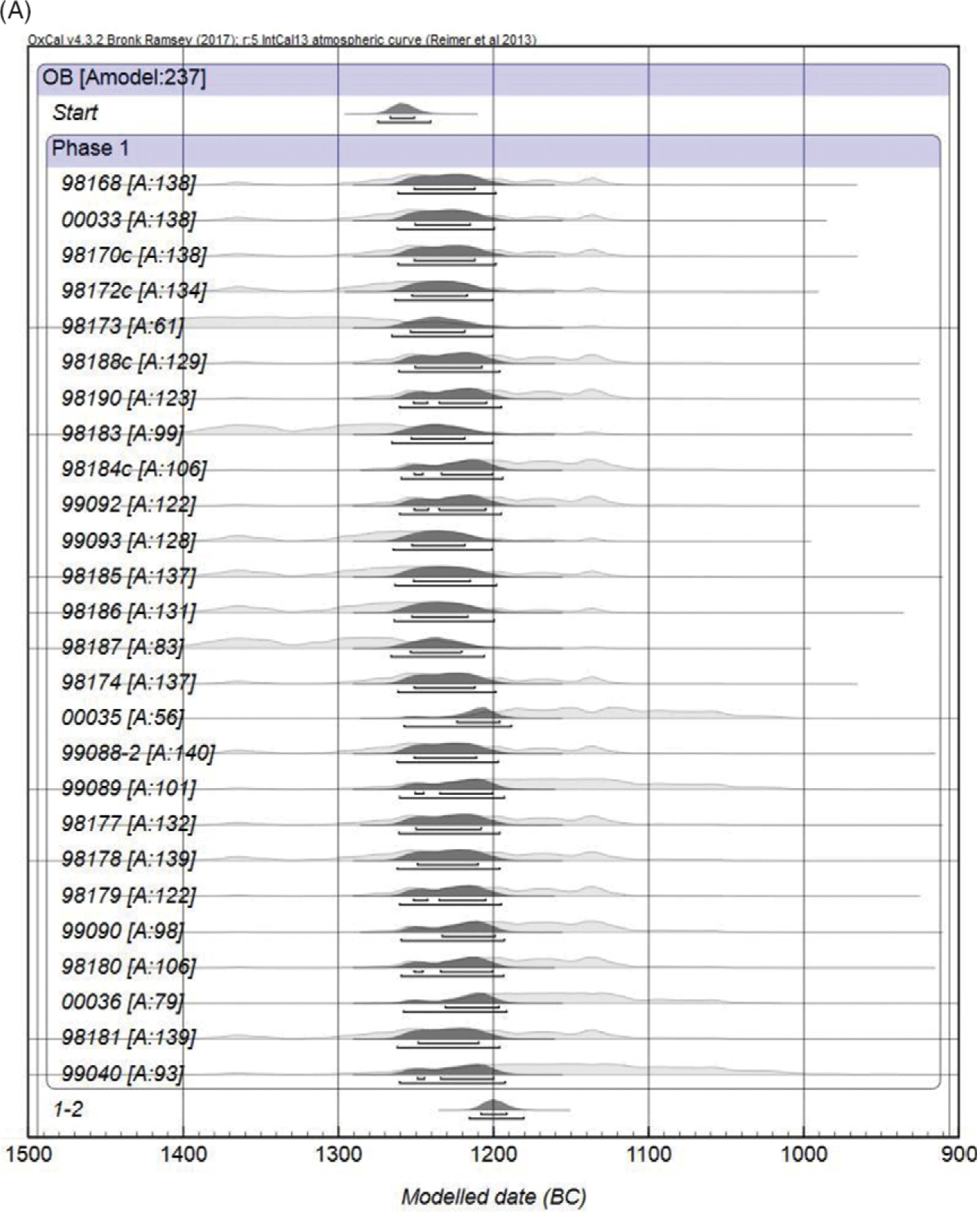
Continuation of Figure 5A. Oracle bone calibration results of model OB (Phases 2−5).
King Wu Ding’s Ruling Time
A general question about the study of Shang Dynasty is the exact dates of King Wu Ding, who is the 23rd king of Shang Dynasty and also is the most powerful king of late Shang period. His reign lasted for 59 years according to historical literature Wuyi  , which was written by Zhou Gong
  in around 1030 BC, and later on was included in Shang Shu
  by Konfucius (Keightley Reference Keightley1978; Chang Reference Chang1980; Kong Reference Kong2015). Although there is no disagreement about the total ruling years of Wu Ding, various dates for the beginning and the end year of his time in power have been proposed. The date of Wu Ding’s reign has been determined by Zhang Peiyu as 1250 BC–1192 BC based on the systematic research of the records concerning five lunar eclipses on the oracle bones of the Bin group (Zhang Reference Zhang2002). Our calibration results of OB showed that Wu Ding ruled during 1254 Cal BC–1197 Cal BC (Table 2). We also performed the calibration for the samples of Wu Ding by a single-phase model, which shows similar results of 1254 cal BC–1196 cal BC as Wu Ding’s ruling time. Considering the 10-year uncertainty mentioned above, the 14C results of the ruling year of King Wu Ding are agree well with the results of astronomic researches.
The End of Shang
A second general question about Shang Dynasty is the year of conquest of Shang by King Wu of Zhou Dynasty. A Western Han scholar named Liu Xin (? –AD 23) dated this year as 1122 BC using Santong calendar, a calendar written by himself. Since then, at least 44 different hypotheses about the year of the conquest, ranging from 1130 BC to 1018 BC have been proposed. Li Xueqin et al. suggest that this event occurred in 1046 BC based on a comprehensive research in combination with the 14C dating results of various sites, the astronomical calculation based on the records sorting out after the textual researches, and the calendric chronology deduced from the inscriptions on Western Zhou bronzes (Li Reference Li2002). The calibration results of OB indicate that the end of the fifth phase of oracle bones is around 1041 cal BC (Table 1). This matches the result of 1046 BC in which year the Western Zhou was established (Li Reference Li2002).
The calibration results of oracles bones in this study also coordinate well with the 14C dating results from the archaeological sites Fengxi and Yinxu. Fengxi, a site in Shaanxi province, was King Wu’s capital prior to his victory over Shang. The cultural deposits at Fengxi site formed during the time periods of Pre-Zhou, early Western Zhou, middle Western Zhou, and late Western Zhou. The event of conquest should have taken place around the transition between pre-Zhou and early Western Zhou, which is 1060 cal BC–1000 cal BC according to the AMS 14C dating for Fengxi site conducted at PKU (Guo et al. Reference Guo, Liu, Yuan, Wu, Li, Lu, Wang, Ma, Gao and Xu2002). Yinxu site is in Henan province in which the Xiao Tun ( ) village represents the main area that yielded most of the oracle bones of Yin or late Shang period known to date. According to the excavated oracle bones, pottery and bronze artifacts, the time span of Yinxu site is divided into four periods. A Series of samples taken from the four periods, mainly the human bones from the burials, were measured by Qiu et al. (Reference Qiu2015). The result turned out that the terminus of the fourth period of Yinxu is around 1040 cal BC, which corresponds to the final year of the fifth phase of oracle bones in our study.
The Periodization of Li Group Oracle Bones
As mentioned above, there are two viewpoints on the periodization of Li group oracle bones. Someone thought that they should belong to King Wu Yi and Wen Ding’s time, i.e. phase 4 of OB. But others believed that they should belong to the time period from Wu Ding to Zu Geng, i.e. phase 1 to phase 2 of OB.
The oracle bones of Li group are divided into two categories according to the king names in the inscriptions, type 1 (Father Yi) and type 2 (Father Ding). Different opinions expressed about these oracle bones led to different order of type 1 and type 2. Some suggest that Li group belong to the fourth period and that the Father Yi is Wu Yi (divined by Wen Ding) and the Father Ding is Kang Ding (divined by Wu Yi). Therefore, the oracle bones of type 2 should be older than type 1. Others, instead, propose that the oracle bones of type 1 belong to the first period and Father Yi is actually Xiao Yi (divined by Wu Ding), and that the oracle bones of type 2 belong to the second period while Father Ding is Wu Ding (divined by Zu Geng). Therefore, the oracle bones of type 1 should be older than type 2.
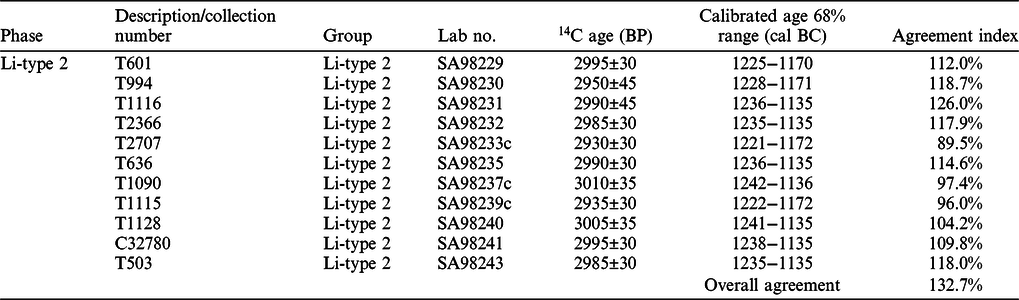
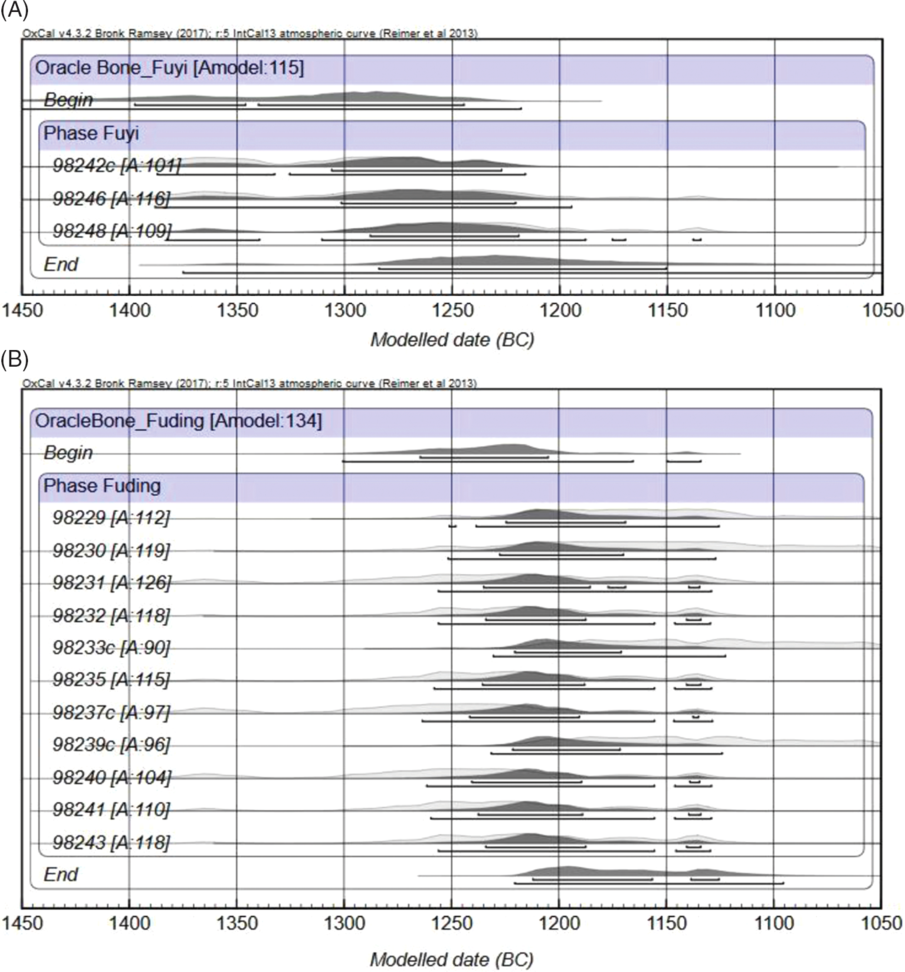
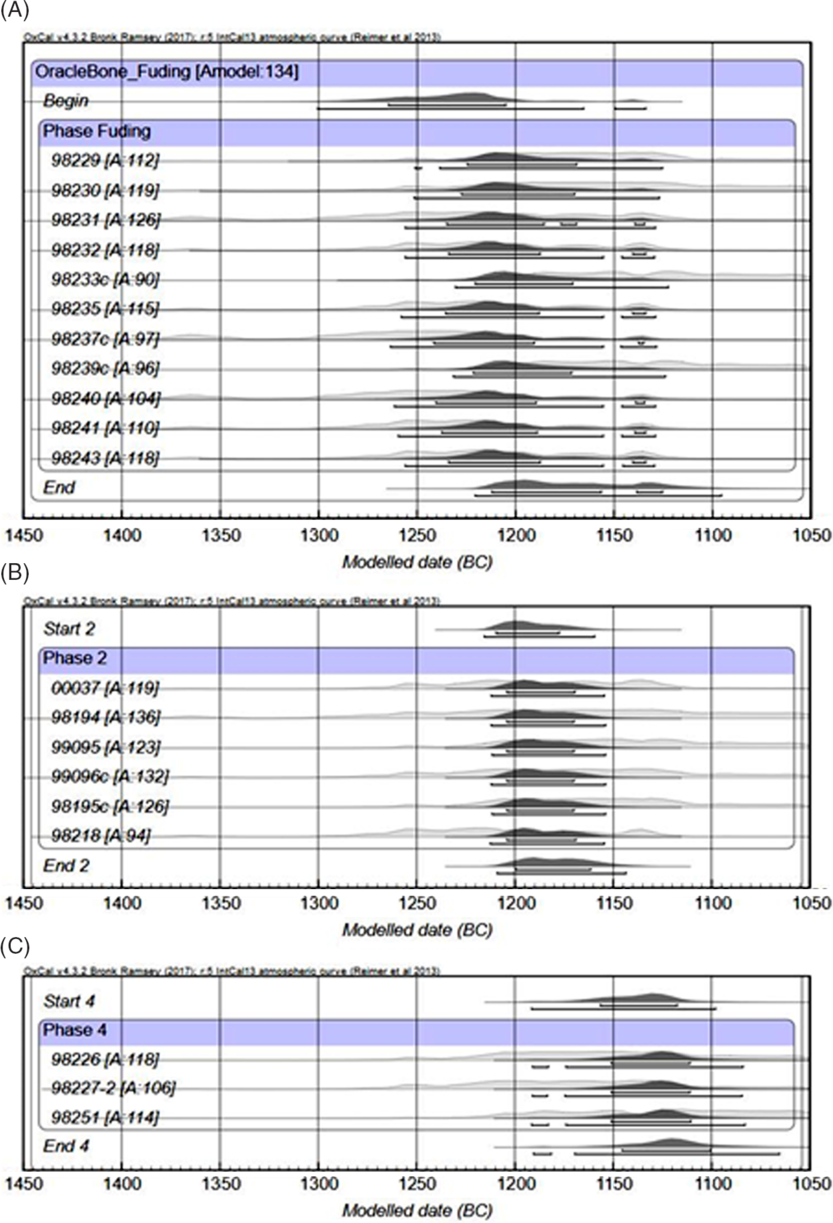
The dating and calibration results of 14 oracle bones of Li group are listed in the Tables 4 and 5. The 14C dating results of oracle bones of Li group may help to clarify those chronological issues through a comparison of the calibrated ages of type 1 and type 2. We compared the calibrated results of type 1 and type 2 by the single-phase model with the results of Phase 2 and Phase 4 of OB model. There are 3 oracle bone samples of type 1 and 11 oracle bone samples of type 2. It is evident that the dates of type 1 are older than those of type 2, which is shown in Figure 6. On the other hand, the time span of type 2 overlaps with that of the Phase 2 of OB and older than that of the Phase 4 of OB, see Figure 7. In this case, the opinion that of the oracle bones of Li group as belonging to the first and second periods rather than fourth period is consistent with our current 14C dating results.
Single-phase calibration results of Li group-type 1 oracle bones.

Single phase calibration results of Li group-type 2 oracle bones.
Calibrated date comparison of the oracle bones of Li groups type 1 (A) and type 2 (B). The plots of type 1 (Father Yi) and type 2 (Father Ding) are calibration results of single-phase model.
Calibrated date comparison of the oracle bones of Li group type 2 (A) with Phase 2 (B) and Phase 4 (C) of OB. The plot of type 2 (Father Ding) is calibration results of single-phase model, and the plots of Phase 2 and Phase 4 are part of the calibration plot of whole series OB (Figure 5B).
CONCLUSION
The chronology of late Shang period has been studied by several different means, such as cultural phasing and 14C dating of Yinxu site, calculating the dates of lunar eclipses recorded on oracle bones by astronomical method, determining the chronicle of last two kings according to the periodicity of sacrifice and the calendar at that time, etc. However, dating the oracle bone can provide an independent chronological sequence of late Shang, which is directly connected with the chronicles of Shang kings.
That is because oracle bones have been studied extensively, and some oracle bones can be related to certain Shang kings and then be included in one of the five periods, if the inscriptions on those bones could supply enough information. By selecting such kind of oracle bones, the calibration model with five phases can be constructed for Bayesian analysis. Our dating results indicate that King Wu Ding reigned during 1254 cal BC to 1197 cal BC, and the Shang Dynasty was terminated around 1041 cal BC. The possible other Shang king’s reign duration was also given.
There were some contentions about the correspondence of oracle bone groups and their periodization among the researchers of oracle bones. Direct 14C dating of related oracle bones and using single-phase calibration might give valuable reference information. Our study showed that Shi, Zi and Wu groups belong to the early and middle period of Wu Ding, while Bin group belongs to the middle and late period of Wu Ding. For the Li group of oracle bones, our results indicated that the dates of type 1 (Father Yi) are older than those of type 2 (Father Ding), and the time span of type 2 overlaps with that of the Phase 2 of OB but is older than that of the Phase 4 of OB. So the Li group in the sequence of oracle bones is most probably related to the time of King Wu Ding and King Zu Geng.
ACKNOWLEDGMENTS
We thank Yiman Liu, Dingyun Cao, and Tianshu Huang for collection of the samples and supplying the periodization information of oracle bones, as well as for their helpful discussions. Many thanks to the Institute of Archaeology of CASS, the Institute of History of CASS, the National Library of China, the National Museum, the Palace Museum, Shandong Museum, Tianjin Museum, Peking University and Jilin University for providing the oracle bones used to sampling. We thank Dr. TzeHuey Peng Qiu for her help in revising and polishing the paper to improve the English expression. This work was supported by the National Natural Science Foundation of China and the Ministry of Science and Technology of China. K.L. and X.W. contributed equally to this work.
 ):
): 


 Open access

