We are living in an age of rapid technological change. Technological breakthroughs occur regularly, and we see major advances more frequently. Driven by progress in artificial intelligence (AI), robotics, the Internet of Things, and biotechnology, the Fourth Industrial Revolution has transformed industries and created new paradigms in manufacturing, healthcare, and communication. Marking a significant shift in technological applications, this revolution is characterised by a fusion of the physical, digital, and biological worlds that has led to unprecedented changes in the way we live and work.
At the same time, the generative artificial intelligence (GenAI) models that appeared in the early 2020s (such as OpenAI’s GPT series) were the outcome of rapid evolution beginning when GenAI emerged as a significant field in the early 2010s. Within a ten-year period, GenAI had become accessible and visible in real-world applications ranging from creative industries to text-based customer support systems. This has brought profound opportunities and challenges both to the field and to society.
In today’s interconnected world, these emerging digital technologies and the overall technology revolution play a pivotal role in driving economic growth and development. By facilitating faster and more efficient communication, digital technologies break down geographical barriers and enable businesses to reach global markets. Customers, too, can now access a wider range of products and services. The digital economy enhances productivity through automation and data analytics, allowing companies to streamline operations, reduce costs, and innovate rapidly. Digital platforms foster entrepreneurship by lowering entry barriers for start-ups and small enterprises. They create social and economic value by bridging gaps, creating connectivity, and facilitating engagement between two or more individuals or economic agents. They foster business activities alongside income, as well as create more inclusive jobs. As digital infrastructure expands, digital platforms also promote financial inclusion and access to education and healthcare. Overall, such contributions are leading to more equitable and sustainable economic development.
As a result, American internet companies and platform-based enterprises have dominated global market capitalisation rankings in recent years. Giants such as Apple, Amazon, Alphabet (Google’s parent company), and Microsoft consistently occupy the top positions in market capitalisation, reflecting their massive influence and financial power. According to Forbes’s (2019) top 100 digital companies list, ten of the world’s top fifteen digital companies were founded in the United States, the world leader in innovation and the first mover in digital technology. These companies are at the forefront of technological innovation, leveraging their substantial market capitalisation, extensive user bases, and cutting-edge research to maintain their leadership positions.
In the meantime, the rise of internet companies in emerging economies, particularly in China, signifies a transformative shift in the global digital economy. Three of the remaining top digital companies are from China: China Mobile, Alibaba, and Tencent (Forbes, 2019). The other two are from South Korea (Samsung) and Japan (Softbank). On the Boston Consulting Group’s (BCG) 2021 most innovative companies list, Huawei, Alibaba, Tencent, Lenovo, and Xiaomi are among the top fifty (BCG Global, 2021). Several digital companies from China have also rapidly gained global recognition in recent years, transforming industries and reshaping global markets through innovative business models and advanced technologies. Companies in sectors ranging from e-commerce and social media to transport, such as Pinduoduo, Shein, TikTok, Xiaohongshu, and Didi, have positioned themselves at the forefront of global trends to become influential players in the digital economy. Many observers might be curious to know how China’s internet giants became the leaders at the frontiers of innovation. Are there any differences in the Chinese approach?
Among such companies, Tencent (one of China’s largest and the most influential technology companies in the world) has consistently maintained a market capitalisation of more than USD 400 billion.Footnote 1 This makes it not only one of the most valuable companies in Asia, but also the world’s fifteenth most valuable company by market capitalisation as of October 2024 (CompaniesMarketCap, 2024a). The three giants of China’s internet industry were once known as BAT, which stood for Baidu, Alibaba, and Tencent. However, Tencent has grown and is now in a class of its own as the most valuable publicly listed internet company in China. Tencent’s market capitalisation surpasses the combined valuations of Pinduoduo (in second place) and Alibaba (in third). With over 1.3 billion users, its flagship social media platform WeChat seamlessly integrates messaging, payments, e-commerce, and entertainment into daily life. Tencent has thus become a dominant force in digital communication.
This dominance extends to other areas as well. As the world’s largest video game company by revenue, Tencent owns or holds stakes in iconic gaming companies such as Riot Games (which produces League of Legends) and Epic Games (Fortnite), both of which have millions of daily active players worldwide and have captured 13.2 per cent of the market share across the world’s gaming market (Elad, Reference Elad2023). Its extensive investment in digital content, social networking, and gaming has positioned Tencent as a central hub in the daily lives of billions of users. The company’s ecosystem includes globally recognised products such as QQ, Tencent Games, and Tencent Cloud, along with a vast presence in sectors ranging from gaming and social media to financial technology (fintech) and AI. It consistently delivers impressive financial results, generating profits of over RMB 150 billion (around USD 20 billion) in 2023 (Tencent, 2024). This impressive outcome is driven by its diversified revenue streams from social networking, digital content, fintech, and enterprise services. Tencent’s ability to innovate and integrate various digital services into a seamless user experience has made it a formidable force and cornerstone of the digital economy – not just in China but also globally.
Founded in November of 1998 in Shenzhen, China, as a mobile messaging service provider, Tencent has developed rapidly over the past two decades. Although Tencent enjoys a large domestic market, it is the company’s capacity for innovation that has driven its rise in the digital world. In 2018, Tencent was ranked fourth in the world and first in China on the list of the World’s Most Innovative Companies for ‘honouring content as king’ (Fast Company, 2018), showing its mastery of creating and distributing high-quality digital content across platforms. In 2022, Forbes magazine listed Tencent among the world’s top five technology companies (Ponciano, Reference Ponciano2022). Currently, Tencent ranks first in patent applications among all Chinese information technology (IT) companies – far ahead of peer competitors in the domestic internet field, such as Alibaba, Baidu, and Qihoo 360.Footnote 2 Globally, the number of patent applications Tencent has filed is second only to Google’s.
Tencent uses first-class technologies to support its provision of stable, high-quality IT services. Since 2018, Tencent’s total investment in research and development (R&D) has exceeded RMB 300 billion (about USD 43 billion). In 2023, Tencent was the second-highest investor in R&D among all private Chinese enterprises. The company’s R&D investment totalled RMB 64.078 billion, with only Huawei spending more on R&D.Footnote 3 By the end of 2024, Tencent had filed for over 85,000 patents globally and received over 45,000 patents.Footnote 4 Of those granted patents, inventions accounted for 90 per cent. Tencent has about 104,500 employees, of whom 74 per cent are R&D personnel.Footnote 5 Tencent invests significantly in R&D with a focus on cutting-edge technologies, such as AI, blockchain, and quantum computing, ensuring that its technologies remain capable and can adapt to changing market demands.
So far, Tencent has become a leading internet company by providing numerous innovative products and services that prioritise user experience and security. These include communication and social media, high-quality digital content, and cloud services geared towards improving quality of life and supporting the growth and digital transformation of businesses throughout the world. The company has unquestionably set benchmarks for technological growth and business success. As a world-leading, internet-based platform company, how did Tencent achieve innovation in the digital era? What can companies in other countries, whether developed or developing, learn from the Tencent model?
In this book, we provide an in-depth and pioneering analysis of the innovation story of Tencent, which we call ‘China’s everything online company’. Tencent’s approach to innovation combines technology, product, process, organisational, and social innovation, which is unusual. However, this multiplicative method of innovation is conducted at scale in a company that had over 100,000 employees at the end of 2023 – comparable in size to the largest internet companies in Western countries – and with a scope that combines many of the activities of Amazon, Alphabet (Google), Meta (Facebook), eBay, PayPal, and YouTube. All of this converges to establish Tencent as an all-encompassing, ‘everything online’ company. We are especially interested in how WeChat developed into a super app that provides a wide range of functions and services in various scenarios while also connecting and supporting partners (including users, businesses, and third-party service providers) in its ecosystem.
We are also interested in exploring how Tencent’s internal organisational management has contributed to the company’s success in the digital economy, as this is not yet clear. For example, Tencent’s mix of internal ‘coopetition’, small team autonomy, and internal mobility has yielded organisational agility and stimulated creativity and breakthroughs. For this reason, we focus on discovering how Tencent developed into a digital giant by exploring the innovative mechanisms and models that have propelled its growth.
1.1 The Literature and Our Approach
Digital platforms and companies at the forefront of innovation have been the subject of wide-ranging interest amongst scholars of organisation management, strategy, and innovation for decades. As Western companies pioneered the digital and innovation sectors, setting global standards with ground-breaking technologies, much academic attention has been devoted to the success stories and innovations of top IT companies in the United States. These include Google (Schmidt and Rosenberg, Reference Schmidt and Rosenberg2014; Vise and Malseed, Reference Vise and Malseed2008), Amazon (Stone, Reference Stone2013), Apple (Isaacson, Reference Isaacson2014), Microsoft (Stross, Reference Stross1996), and Facebook (Kirkpatrick, Reference Kirkpatrick2011). In contrast, very little attention has been paid to the paths that Chinese IT companies have forged towards innovation.
The story of the rise and innovation of Chinese IT companies remains under-researched, even though China’s IT companies have emerged on the world frontier in the digital era and despite the increasing importance of innovation in China (Fu, Reference Fu2015; Fu et al., Reference Fu, Avenyo and Ghauri2021; Greeven et al., Reference Greeven, Yip and Wei2019; Yip and McKern, Reference Yip and McKern2016). Several English-language books have introduced emerging and world-leading companies from China, such as Tencent (Chen, Reference Chen2022; Tang, Reference Tang2019) and Alibaba (Clark, Reference Clark2016) in the IT sector, Huawei (Fu, Reference Fu2015; Tian et al., Reference Tian, David and Wu2018; Tian and Wu, Reference Tian and Wu2015; Wu et al., Reference Wu, Murmann, Huang and Guo2020) in the information and communication technologies (ICT) sector, and Haier in the manufacturing sector (Fischer et al., Reference Fischer, Lago and Liu2013; Yi and Ye, Reference Yi and Ye2003). However, the scope of these books is relatively limited as they mainly focus on corporate development without paying particular attention to the innovation model.
When considering the development of China’s internet and digital economy, Tencent is an essential part of the discussion. The rise and innovation of Tencent have changed the internet landscape in the digital era, creating multipolarity in platform businesses throughout the world. As a representative internet company from China, Tencent has developed many innovative products and services – some of which have been investigated by scholars in recent years (Birkinshaw et al., Reference Birkinshaw, de Diego and Ke2019; Luo et al., Reference Luo, Jiao and Xu2015; Yang et al., Reference Yang, Sun and Lee2016). While several books have been published on Tencent in particular, these books mainly focus on perspectives of political economy (Tang, Reference Tang2019), leadership (Hu, Reference Hu2017), or business development (Chen, Reference Chen2022; Wu, Reference Wu2016). They do not analyse the company’s internal micro-mechanisms for innovation, relevant management practices, and innovative achievements. Existing research publications that mention Tencent are also largely qualitative case studies based on secondary data or indirect interview material (Casanova et al., Reference Casanova, Cornelius and Dutta2018; Chen, Reference Chen2022; Tang, Reference Tang2019).
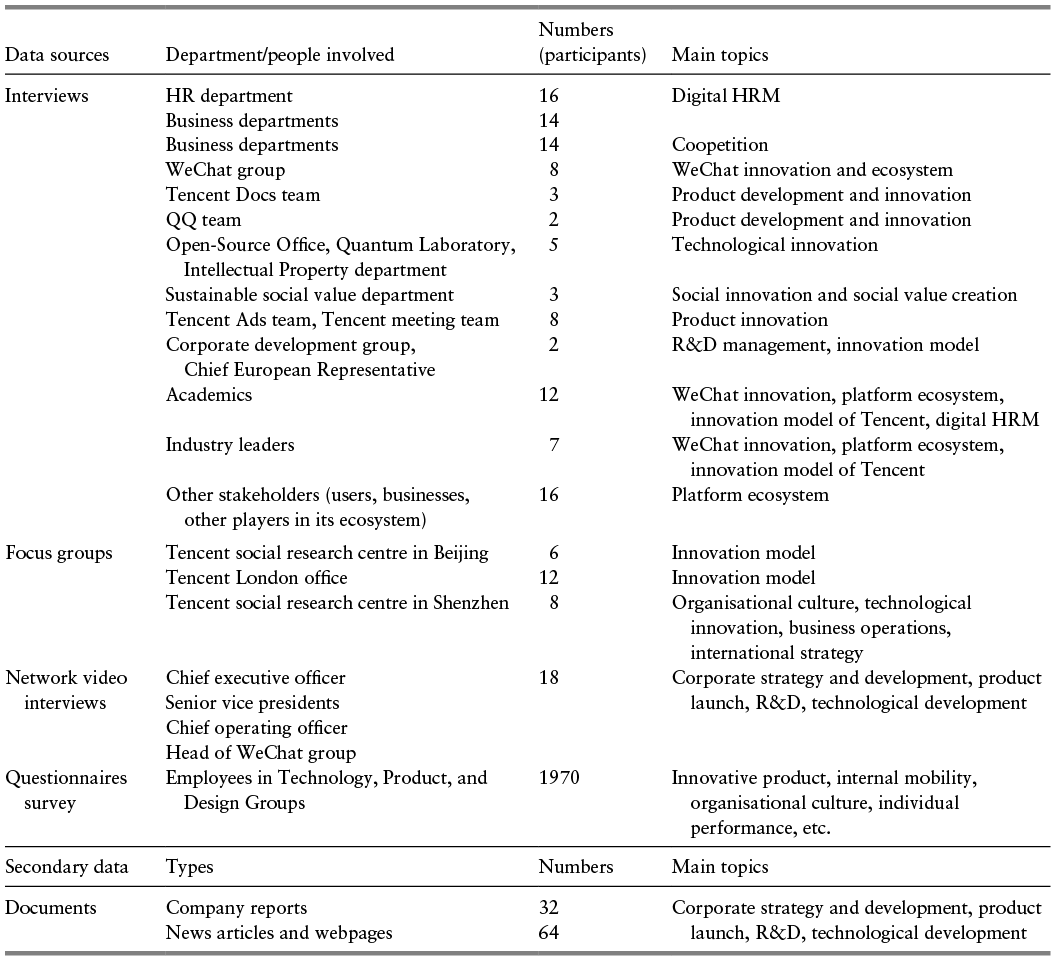
In response to this void, we offer an in-depth and pioneering analysis of the innovation story behind Tencent. This book aims to fill a gap in the literature by examining the forms and mechanisms for innovation at Tencent in terms of technologies, products, management, ecosystem development, and social value – all of which have gone unexplored or under-examined in existing studies. The findings of the book are based on a four-year, in-depth case study undertaken from a mixed-methods approach that integrates qualitative and quantitative methods with multi-source combined data. In addition to a comprehensive review of a large volume of public information, internal documents, reports, news articles, and literature about the company, we conducted a large-scale survey within Tencent. The survey was sent out to a total of 30,000 employees in the technology, design, and product groups, who are more likely to participate in innovation activities in relevant areas. We collected and comprehensively analysed 1,970 valid responses. Moreover, we conducted in-depth interviews with over 100 stakeholders from both Tencent’s internal departments and external organisations. Within Tencent, our interviewees included senior executives, such as vice presidents and the general manager of corporate marketing and public relations, as well as scientists, product managers, R&D managers, marketing managers, software engineers, and human resources (HR) staff. These participants represented a variety of business units and groups, such as the Intellectual Property Department, the WeChat Group, and the Sustainable Social Value Department. Beyond Tencent, we also interviewed academics, industry leaders, customers, and partner companies. The interviews addressed a broad range of topics, including digital human resource management (HRM), coopetition, product development, technological innovation, and social innovation. Table 1.1 presents the data sources for our research.
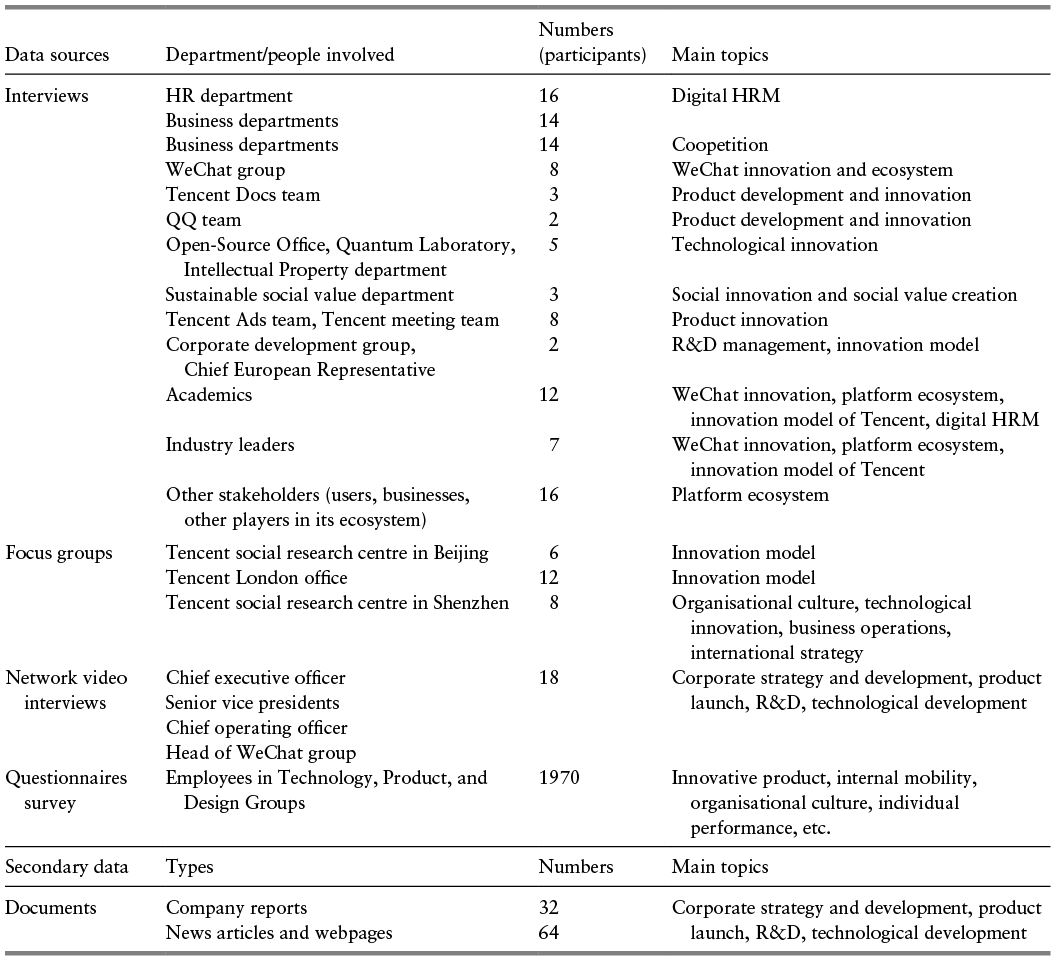
Table 1.1 Long description
Table outlines research data sources and their scope. Interviews include HR, business, WeChat, Tencent Docs, QQ, open-source, intellectual property, social value, R&D, and corporate development teams, as well as industry leaders, totaling varying participant numbers and covering topics such as digital HRM, coopetition, product development, technological innovation, social value creation, R&D management, and WeChat platform ecosystems. Focus groups involve Tencent social research centers in Beijing and Shenzhen, as well as Tencent London office, addressing innovation models and organisational culture. Network video interviews include senior executives and heads of WeChat, focusing on corporate strategy, innovation models, R&D, and technological development. A survey covers 1,970 technology, product and design employees, examining innovative product, internal mobility, organisational culture, and individual performance. Secondary data sources include company reports and news articles, supporting analysis of corporate strategy, product launch, R&D, and technological development.
1.2 Highlights of the Book
Our in-depth analysis revealed that Tencent’s approach to innovation is building a market-type organisation with an ecosystem, characterised by openness, coopetition, empowerment, autonomy, and needs (or, briefly, OCEAN). As the semi-legendary ancient Chinese philosopher Lao Tzu once wrote in Tao Te Ching, ‘The supreme good is like water, which benefits all of creation without trying to compete with it’ (in Chinese:上善若水,利万物而不争). Like the ocean, Tencent supports and nourishes its members to create value for everyone without seeking to dominate. This reflects a powerful yet gentle strength as the organisation embraces inclusivity and freedom, flows around challenges with ease, and gracefully adapts to change. Through this harmony and humility, Tencent unites individuals and the players in its ecosystem into a collective force, achieving meaningful impact and competitiveness with quiet resilience. With this approach, Tencent has achieved a distinctive type of sequoia-like innovation, characterised by deep, directed, invisible, and compound (or, briefly, DDIC) innovation, making it a leading internet-based platform company – despite fierce competition – with the ability to adapt to the complex demands of today’s dynamic markets.
1.2.1 Chapter 2: ‘Tencent: A Rising Technology Giant in China’
Chapter 2 describes the history of Tencent’s development, the transformation of its corporate strategies, its core business distribution, the adjustments made to its organisational structure, and its innovations in both product offerings and underlying technology. These details are provided within the larger context of the development of the internet industry in China. The chapter summarises innovation milestones for Tencent products and services, and then shows how the company developed its businesses through the use of major strategic investment and venture capital in several fields. It also describes Tencent’s R&D endeavours in an attempt to provide a detailed picture of its technological innovation over the past two decades. The chapter ends with a comparison between Tencent’s patent applications and those of other foreign and domestic companies, revealing Tencent’s leading position in this category both globally and domestically.
1.2.2 Chapter 3: ‘Competition and Cooperation: Using Organisational Resilience to Foster Innovation’
Chapter 3 illustrates how a combination of cooperation and competition – or what we call ‘coopetition’ – has driven innovation processes at Tencent. The outcome was the creation of a variety of excellent products for the market, including a national-level product (WeChat) and the online game Honor of Kings. Coopetition led to innovation not only by sparking creativity and driving significant efforts on the part of employees and teams but also by fostering the recombination of diverse yet complementary areas of knowledge. This knowledge recombination occurred between similar and competitive teams, as well as teams from different functional departments.
The chapter also highlights how Tencent’s recent reform of strategy changed the role of competition and cooperation in organisational development. One of our surprising findings was that this reform was not designed by executives through a top-down mechanism but rather occurred naturally as a result of the autonomy the company provides its employees, along with its tolerance of risk. Rich interview material provided more evidence of how coopetition promotes the individual growth of employees and the development of work teams, leading to innovation within the company.
1.2.3 Chapter 4: ‘Serving Talents through Digital Human Resource Management: Motivating Great Creativity’
Chapter 4 sheds light on how Tencent leveraged digitalised HRM practices to enhance employee creativity and drive organisational innovation. Recognising that organisational innovation depends on employees’ skills, motivation, and engagement, Tencent has taken a leading role in applying digital technologies and products to HRM practices. Given the company’s drive to produce leading internet-based platforms and its ‘born digital’ nature, one of Tencent’s greatest goals is to provide a superior user value through its products and services. Such a user-oriented corporate principle also affects its digitalisation of HRM. Emphasising providing service to employees, Tencent adopted a ‘productisation’ approach, treating employees as internal users and focusing on their needs and experiences. As a result, HR teams design and provide various products that go beyond administrative functions to serve, support, and empower staff. These digital HR products are designed not only to enhance service quality but also to foster motivation and creativity, aligning HRM innovation with the company’s broader goal of value creation through digital transformation.
1.2.4 Chapter 5: ‘Flowing Water for Dynamism: Internal Mobility to Boost Innovation’
In 2012, Tencent established an internal mobility programme called Flowing Water (活水 huoshui). The programme was recognised as a representative managerial strategy for fostering employee innovation and enhancing organisational agility. Chapter 5 illustrates how Tencent carried out its internal mobility policies and how the Flowing Water programme promoted dynamic minds, stimulated employee self-motivation, sustained organisational agility, and drove the company’s innovation. Tencent not only fostered an open ‘flowing water’ culture but also developed an employee-friendly digital product to improve internal mobility policies. The company enabled information sharing and transparency in the process, engaging more employees with the programme.
The successful operation of the programme not only supported employee skills and career development but also offered employees autonomy as they were able to take an active role in shaping their own professional journeys even amid organisational changes. Flowing Water provided a continuous and dynamic supply of talent to the organisation; it also retained that talent despite a fiercely competitive environment. The programme promoted knowledge sharing and cooperation while avoiding organisational rigidity, which generally advances innovation. Such free and dynamic talent flows further supported the development of key businesses and departments within the company, especially during periods of organisational transformation, which helped the organisation remain agile and adaptive.
1.2.5 Chapter 6: ‘Building an Open and Inclusive Ecosystem: WeChat’s Rise to a Super App’
Chapter 6 focuses on WeChat, an all-in-one super app with over 1.3 billion active monthly users. Launched in 2011, WeChat has expanded beyond instant messaging and social media to include voice messaging, WeChat Pay, Moments, Mini Program, and video channels, making it a super app for daily needs. This chapter examines WeChat’s development, key sources of innovation success, and the ecosystems it created. We argue that WeChat’s emergence as a super app benefited from the evolution of functions, its connective nature between internal functions and with external users, and reactions between product features. One distinctive feature of WeChat’s innovation was its depth; this deep innovation is captured in the ‘first principles’ orientation of its product design. At the same time, the WeChat team also had a deep understanding of the essential needs of the app’s users. The team continues to design products and explore functions from a long-term perspective of those needs. The success of WeChat as a super app arguably also benefited from invisible, compound, and continuous innovation that promotes the interaction of multiple innovations and amplifies the overall value created. Finally, WeChat established an open, decentralised, and inclusive ecosystem for co-growth through three main approaches. The first approach involved enhancing product capabilities internally. The second was to empower players in the WeChat ecosystem, which included individual consumers and business enterprises. In doing so, the company was able to provide services and create value for players based on the principles of fairness and decentralisation. The third approach was to support third-party service providers, offering them space for growth.
1.2.6 Chapter 7: ‘Developing Leading Products through Continuous Innovation: The Case of QQ and Tencent Docs’
A strong product gene has been embedded in Tencent since its birth and the company has developed a wide range of superior products over the past two decades. Chapter 7 examines how Tencent achieved leadership in relevant fields for both old and new products. What approaches did Tencent adopt to maintain the vitality of its original products, while also ensuring that its new products remained competitive in the market? Through a comparative study of an old Tencent product, QQ, and the much newer Tencent Docs, we identified differences and similarities in the company’s approach to developing each product.
We found that QQ differentiated itself from foreign competitors (e.g. ICQ and MSN) and similar internal products (e.g. WeChat) through iterative innovation and radical innovation. This prompted a self-transformation led by the product development team in order to adapt to contemporary youth culture. The overall approach helped QQ to overcome growth bottlenecks, generate substantial revenue, and retain a high user percentage. Developed in 2017, Tencent Docs became a leading file collaboration product in China by leveraging Tencent’s user base and experience in social media. Initially adopting a Business-to-Consumer (B2C) strategy, Tencent Docs switched to a Business-to-Business (B2B) approach to gain a competitive market edge. The success of Tencent Docs can be attributed to strategic innovation and technological catch-up. Teams for both products focused on creating user-oriented product value and actively capturing user needs. Their focus was enabled by strong technological capabilities accumulated in-house, internal collaboration, and an open, intrapreneurial, and inclusive culture fostered by Tencent.
1.2.7 Chapter 8: ‘Maximising the Value of Platforms: Social Innovation and Social Value Creation’
Chapter 8 examines how, as a leading internet-based platform company, Tencent created social value and fostered social innovation to maximise platform value. It highlights key aspects of Tencent’s social innovation and social value creation, including its motivation, manifestations, approaches, and mechanisms. Social innovation at Tencent is driven by strategic upgrades based on social needs with an emphasis on social value creation on a strategic level. Tencent has established a mechanism for social innovation to create social value that involves three key approaches: First, the involvement of various business departments in social innovation, leading to the integration of social value creation into daily business operations – social innovation benefits from the interplay of technological, product, and business model innovations; second, the co-creation of social value within the Tencent ecosystem – Tencent leverages its digital capabilities to build platform ecosystems and facilitate connections and collaborations among a diverse array of external stakeholders; and third, use of the so-called CBS trinity, which is crucial for social innovation – Tencent aims at creating value for customers (C), industries/businesses (B), and society (S). As a result, Tencent has created multifaceted social value across diverse scenarios involving social inclusion and the promotion of industry digitalisation, and, in service of the public interest, rural revitalisation, disaster response and relief, and carbon neutrality.
1.2.8 Chapter 9: ‘Conclusions: Tencent’s Innovation Model’
Chapter 9 summarises the key features of Tencent’s innovation, which we call DDIC. Much like a towering sequoia tree, Tencent’s innovation is anchored in deep and expansive roots which are interconnected and mutually reinforcing, and is guided by a strong sense of direction. This foundational strength extends outward, supporting the growth of a broader ecosystem. This tightly integrated innovation system gives Tencent exceptional resilience, allowing it to withstand market uncertainties – just as a sequoia endures the storms of nature. We then present an overall model for Tencent’s innovation mechanism: OCEAN. Tencent is a market-type organisation with an OCEAN ecosystem in that it pursues Openness, encourages Coopetition, focuses on Empowerment, promotes employee Autonomy, and values the Needs of users, employees, and society.
We connect OCEAN to each chapter to reveal how the model works. In this way, Tencent provides ample resources for competition and collaboration, fostering creativity and viability. Tencent supports and motivates employees through autonomy while creating an open and inclusive platform ecosystem that empowers various stakeholders and facilitates co-growth. Aside from strong in-house R&D, Tencent’s competitiveness stems from deep innovation, namely, first-principles product design, a deep understanding of user needs, product features, and keen market awareness. We show how Tencent excels at developing superior products and creating social value through invisible and compound innovation, or the integration and interaction of process, product, strategy, and business model and social innovations that users may not notice. Tencent’s digital-enabled management innovations serve and create value for employees, managers, and the organisation. Tencent’s value-directed innovation development then aims to create business value and broader value for customers, the market, industry, government, and society.
Combining these findings, we also propose how these important factors and mechanisms work with an open corporation innovation system framework. Finally, the chapter closes with a discussion of the contributions and managerial implications for related fields.
1.3 Contributions
In today’s era of technological transformation, research into the mechanisms for innovation created by enterprises is of crucial importance. After all, innovation drives economic growth. It does so by increasing productivity and efficiency along with creating new industries and subsequent job opportunities. Through learning about the successes and experiences of leading companies, other companies can identify ways to foster a culture of innovation, encourage their employees to think creatively, and collaborate effectively to generate new ideas and nurture innovation. Beginning at this starting point, our book digs deep into Tencent’s internal and micro-mechanisms for innovation. We focus on its distinctive approaches to innovation in order to provide implications from which other companies can learn.
This book contributes to the academic literature and business management in the following ways. First, this book fills a gap in the study of China’s leading internet companies, particularly Tencent, by providing a systematic analysis of its multi-dimensional innovations – technological, product, managerial, social, and so on. Unlike existing works focusing on leadership or corporate development, it explores how Tencent emerged as a global tech leader and reveals that Tencent is a market-type organisation with an OCEAN ecosystem.
In terms of the research content, this book provides deep insights into Tencent’s culture, organisational structure, incentive policies, product development, talent management, platform ecosystem, and social value creation, and highlights Tencent’s overlooked innovation drivers, including coopetition, talent mobility, and social value creation, offering valuable insights for both scholars and business leaders. Existing research on Tencent often relies on secondary sources or limited first-hand data, which restricts its depth and reliability. Our book stands out as the first academic study to analyse Tencent’s innovation management through a four-year, mixed-methods case study, combining extensive fieldwork and individual-level survey data, offering comprehensive insights and advancing the field with micro-level analysis.
Additionally, this book advances the concept of a corporate innovation system (Granstrand, Reference Granstrand2000; Lundvall and Rikap, Reference Lundvall and Rikap2022) by offering theoretical and empirical insights into its construction and interconnectedness. Using Tencent as a case, it introduces an open corporate innovation system, where innovation performance is shaped by capabilities, incentives, and internal organisational policies and institutions. These elements interact to drive co-growth between Tencent and its ecosystem partners, enabling the company’s DDIC innovations over the past two decades.
Overall, this book adds greater depth to insights into Tencent’s mechanisms for innovation, challenging existing stereotypes of Chinese IT companies and extending our understanding of the micro-mechanisms of innovation management within a world-leading internet-based platform company in China. We show that Tencent’s uniqueness is its DDIC innovations driven by a market-type organisation and OCEAN ecosystem. We examine how it achieves value creation through the innovative application of basic technology and the development of an innovation-empowered ecosystem, and how an orientation towards social impact drives inclusive innovation at the new development stage. We believe that this book offers valuable managerial insights regarding innovation in the digital era to other companies in both developing and developed countries.