


Colombia has been one of the Latin American countries in which right-wing political forces have been consistently strongest. A long history of armed conflict both thwarted the consolidation of left-leaning democratic forces and gave preeminence to ideologically centrist, pragmatic, and/or right-leaning politicians. Indeed, the twenty-first century has been one in which national politics has been dominated by representatives of the right and the center right, until the electoral victory of leftist Gustavo Petro who became president in 2022. The most important figure of the contemporary Colombian right, Álvaro Uribe, was a hugely popular president between 2002 and 2010 and went on to establish the most important right-wing party, the Centro Democrático (CD). Uribe was central to his defense minister and heir apparent, Juan Manuel Santos, winning the presidency in 2010, though Santos later turned his back on Uribe. Still a formidable force after the Santos presidency, the CD and Uribe’s blessing brought Ivan Duque to power for the period 2018–2022. Given the preeminence of the right, and in particular the crucial importance of Uribe and Uribismo as a political identity in Colombian politics until recently (Albarracín et al., Reference Albarracín, Gamboa, Milanese, Borges, Lloyd and Vommaro2024; Gamboa, Reference Gamboa2019), at first glance it might appear puzzling that a strong far right has not yet emerged as an organized force. This is in sharp contrast to other countries like Brazil and Chile where the contemporary far right has gained prominence with good electoral performances, varying levels of organization, and even presidential victories.
Is there a far right in Colombia? To what extent are far-right ideas present in Colombian politics today, and what are their prospects going forward? Given the internal conflict, a militaristic and anti-guerrilla right has been historically strong and dominant in Colombia. At the same time, cultural and socioeconomic issues that have been politicized in other countries by a radicalized right have not dominated the national political agenda. Instead, many such issues have been discussed in the judicial arena – particularly through the Constitutional Court’s progressive rulings. Presently, Colombia lacks an organized far-right party, but this should not be taken to mean that far-right ideas are not relevant to understanding present and future political dynamics. We rely on the framework presented in the introductory chapter of this volume to analyze the extent to which contemporary far-right ideas are espoused by key figures in the Colombian political elite.
In the first section we introduce the outlines and ideological concerns of the Colombian right, as necessary context. In the second and third sections we analyze the speeches, interviews, and social media presence of two key figures in recent right-wing electoral politics, Álvaro Uribe and Rodolfo Hernández, to explore the extent to which they can be understood as exponents of the contemporary far right. Former president Uribe is the waning patriarch and Hernández was the wild-card presidential candidate in whom right-wing forces invested their hopes to beat leftist Petro in 2022. We argue that neither should be understood as exponents of the contemporary far right, though – as we will show – some far-right ideas can be identified in their discourse at different points, with varying degrees of coherence. The seeds of the contemporary far right are to be found elsewhere: in leaders embedded among established parties and emerging in their shade.
In the fourth section we focus on the ideas and discourse of Colombia’s most prominent far-right politician: Maria Fernanda Cabal. Cabal, senator (2022–2026) for the CD political party, is a key personality in regional far-right circles. Domestically, she straddles two worlds: a personal brand that emphasizes her radicalism and deliberately reaches out to Latin American and Hispanic far-right networks, while being part of a political party which is not far right “in the contemporary sense.” We explore the evolution of Cabal’s discourse as a congress member, and identify an inflection point toward greater radicalization and moral conservatism starting in 2020, coinciding with her more active involvement in international far-right networks. In closing, we analyze the prospects of the Colombian far right in light of current political dynamics, the fragmented nature of the party system, and the dynamics of the 2026 presidential campaign.
As this book shows, the contemporary far right in Latin America has some important commonalities with far-right forces in other regions, but also its own distinctive characteristics. The case of Colombia is interesting because, though no formal far-right electoral vehicle exists at present, the right has been historically strong, and, for example, former president Alvaro Uribe led the way for the punitivist approach that the regional contemporary far right so strongly favors. At the same time, Uribe himself does not neatly fit the contemporary far-right label: he does not deny climate change, he is not anti-immigration, and moral conservatism (though sometimes present in his discourse, especially in recent years) has not been at the center of his concerns. Cabal, the Colombian politician that most neatly fits the label of Latin American far right, is fueled in no small part by the visibility and ideas provided to her by a dense network of international connections with like-minded figures. The human and organizational ties binding and driving the spread of far-right ideas in Latin America seems a particularly important dimension. We should keep in mind both domestic and transnational dynamics as we seek to understand the evolution of the radical right.
8.1 The Colombian Right’s Midlife Crisis
In Colombian politics today, two forces can be seen as exemplifying the two ideological opposites of the spectrum: to the left, the Pacto Histórico, a young left-wing coalition of parties and grassroots movements led by current president, Gustavo Petro, and to the right, the CD, an established political party led by the former president, Uribe. We begin by describing the ideas and players that are central to the Colombian right, to better understand the context. There are, surely, other political parties aside from the CD which can be located to the right – including the Partido Conservador, Movimiento Independiente de Renovación Absoluta (MIRA), Colombia Justa y Libres (see Montilla et al., Reference Montilla, Liendo, Barrero, Barrero and Richard2020) – but Uribe and his party have been the pivot and the purveyors of ideological coherence at the national level.
Colombia’s decades-old civil war included several armed leftist guerrillas, which not only hindered the consolidation of a democratic left – until recently – but also configured right-wing forces whose main distinguishing feature from the center and the center left was the opposition to any negotiation with these armed actors. Uribismo and the CD built and thrived on that division, which lent the Colombian right some particularities when compared to other Latin American countries, as the cleavage was not rooted in socioeconomic or cultural inequality but rather in a hawkish approach to the internal conflict (the stance defended and built up by Uribismo) against those who favored negotiations with the armed guerrillas (the approach that centrist leaders from traditional parties and the incipient center left advocated). Until recently, the right’s ideological message has been unified and consistent. Wills Otero (Reference Wills Otero, Luna and Rovira Kaltwasser2014) summarizes the key ideas of that message as follows: a militaristic, confrontational, and warlike discourse that prioritized security, coupled with a welfarist social approach. Gutiérez Sanin (2020) also highlights the decided emphasis on militarized security, and on building trust and security for business and investors.
The lack of overtly leftist governments meant that the right did not have to resort to rejecting progressive government reforms as their electoral strategy, at least until Petro’s victory in 2022. In other words, Colombia is not a case in which the radicalization of the right might be explained as a backlash to leftist cultural or economic policies. Interestingly, Colombia’s comparatively progressive legal framework guaranteeing access to abortion, LGBTQ+ rights, and generous enforcement of socioeconomic rights is associated with the liberal jurisprudence of its Constitutional Court. The Court itself has suffered backlash for its activist profile, and certainly these issues have at times been the subject of strong controversy and organized attempts to punish the Court and roll back its progressive rulings (Botero, Reference Botero, Falleti and Parrado2018). However, it is worth noting that, for example, a majority of Colombians support abortion rights and, as Figure 8.1 (Panel A) shows, the proportion has only increased in recent years. The country is much more conservative with regard to attitudes toward the LGBTQ+ population, though overall those numbers have also improved in recent years (see Figure 8.1, Panel B). In any case, the judicial route for the expansion of those rights, and the continued relevance of the internal conflict and its associated violence, meant that the politicization of cultural issues, while not absent, has not been at center stage of party politics and national electoral politics.
Percentage who justify abortion and percentage who approve of homosexuality in Colombia
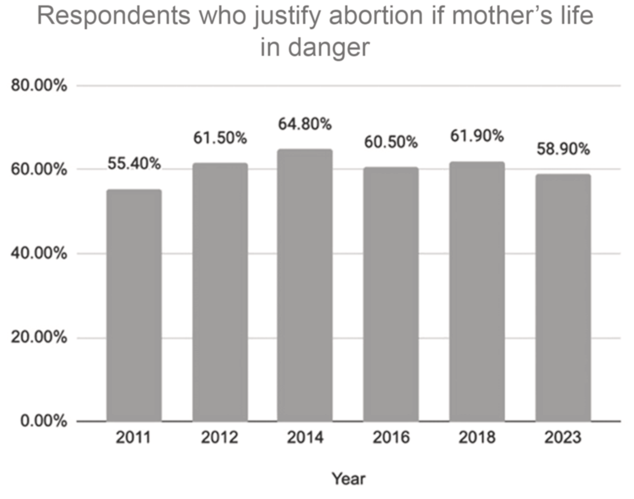
Figure 8.1a Long description
The chart displays the percentage of respondents who justify abortion when the mother's life is in danger. It reveals significant fluctuation in approval for life-saving abortion. Support began at 55.40% in 2011, which follows 61.50% in 2012, 64.80% in 2014, 60.50% in 2016, 61.90% in 2018, and 58.90% in 2023. This represents a notable increase, despite some intermediate decreases.
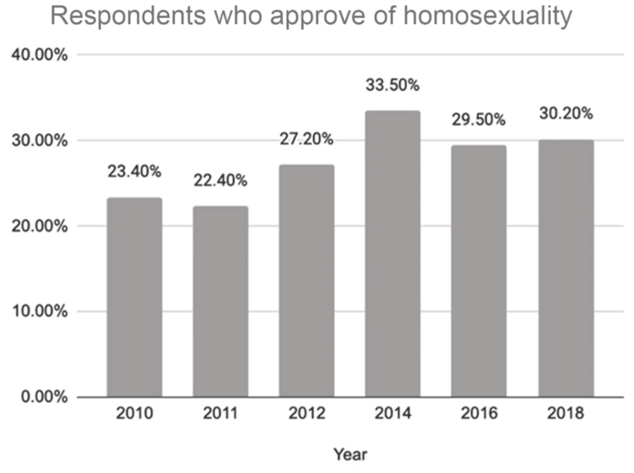
Figure 8.1b Long description
The chart shows the percentage who approve of homosexuality. It shows a more positive trend for LGBTQ+ acceptance. Approval of homosexuality started at 23.40% in 2010, dropped to 22.40% in 2011, gradually increased to 27.20% in 2012, and to 33.50% in 2014, then declined to 29.50% in 2016 and to 30.20% in 2018. Overall, this reflects a net increase of nearly 8 percentage points in approval over the surveyed period.
Starting around 2020, it became clear that the Colombian right was undergoing a midlife crisis as Uribismo – once its defining political identity and binding agent – and the CD – its organizational muscle – have both weakened. The old focus on a militarized approach to the internal conflict, which used to articulate the CD’s program and dominated their messaging, showed signs of having worn too thin following President Santos’ successful peace negotiations with the Fuerzas Armadas Revolucionarias de Colombia (FARC). The demobilization of this guerrilla in 2016 created more political space for left-leaning political actors, eliminated the FARC as the main enemy, and allowed for redistributive and social justice concerns to emerge in political debates, ultimately leading to the election of Colombia’s first leftist and progressive president, Petro (Botero et al., Reference Botero, García-Montoya, Otero-Bahamón and Londoño-Mendez2023). Thus, when the FARC ceased to exist formally, the right’s main physical and ideological foe all but vanished.Footnote 1 Though some might have predicted that the FARC’s transformation into a political party after their demobilization would have meant that the communist scare remained relevant, the reality is that as a political party, the FARC (now known as Partido Comunes) is extremely small, faced considerable difficulties appealing to the Colombian public or fostering new leaderships, and failed to consolidate its own electoral base (Rettberg & Martínez, Reference Rettberg and Martínez2023).
Additionally, during the government of Iván Duque (2018–2022), Uribe’s heir, there was an increase in organized violence in urban and rural areas, which evidenced a difficulty for the right wing to respond to the new dynamics of crime and violence. Faced with profound changes in the electorate’s priorities and leftist forces consolidating under Petro’s leadership, right-wing parties struggled mightily to adjust their messaging and strategy to this new reality in which security challenges remain, but the old messaging frames focusing exclusively on the guerrilla threat were (and remain) insufficient to Colombian voters.
In terms of the party itself, the CD’s process of institutionalization brought its own challenges. Over the years, in order to grow, the party sacrificed ideological coherence (Gutiérrez Sanín, Reference Gutiérrez Sanín2020), broadened its message, and saw its electoral base shrink (Albarracín et al., Reference Albarracín, Gamboa, Milanese, Borges, Lloyd and Vommaro2024). More recently, key figures within the party vie for control as Uribe’s popularity decreases and right-wing leaders emerge outside the CD’s own fold. Once upon a time the CD reigned supreme and was virtually synonymous with Colombia’s right. Starting in 2020, Uribe and the CD’s leadership continue to be important, but right-wing forces have fragmented, and new leaders emerge.
8.2 Álvaro Uribe: The Waning Patriarch
Although the contemporary far right does not have its own electoral vehicle in Colombia, certain political figures have played at different times with ideas and elements of the contemporary far right in Latin America, as defined by Rovira Kaltwasser in this volume. In this section we analyze the relationship between the patriarch of the Colombian right, Álvaro Uribe, Uribismo, and far-right ideas. We show that though Uribe has defended and espoused some ideas that are key to the right and to the contemporary far right – namely, his mano dura (hawkish) stance and illiberal attitudes toward democracy. However, unlike more straightforward far-right contemporaries such as Javier Milei, Jair Bolsonaro, or José Antonio Kast, Uribe cannot be fully understood as a full-fledged contemporary far-right politician, particularly because one of the key shared characteristics of such parties and figures in Latin America is their moral conservatism, which was not central to Uribe’s discourse historically and has only begun to center it in recent years. To better understand Uribe’s importance and the evolution of his discourse, we need to analyze it over time.
As the defining figurehead of the contemporary Colombian right, Uribe’s political trajectory and his discourse can be broken down into three periods: presidency (2002–2010), opposition senator (2014–2018), and the latest phase in which he plays the role of a backstage advisor and is less prominent, though not totally absent, from the public arena (2021–2025).
Starting with his first presidential bid in 2002, in which Uribe became a national figure running for the presidency on an outsider platform (deftly distancing himself from his prior membership of the Liberal Party), the hallmark of his politics was quickly apparent: a defense of a mano dura approach to Colombia’s internal conflict. In his staunch defense of the military and his punitivist discourse, Uribe was in many ways the precursor of present-day mano dura politicians throughout the region.
Although previous presidents used authoritarian security policies to try to rein in the growing internal conflict, Uribe’s government was the first to focus so heavily on the armed forces and on a military victory against guerrillas, both in discourse and in policies. His first presidential campaign and presidency revolved around a single main political goal: “to defeat through military force outlawed armed groups and to recover the legitimate monopoly on the use of force for the government,” as Wills Otero (Reference Wills Otero, Luna and Rovira Kaltwasser2014, p. 206) sums it up. His first government plan read: “The President shall direct public order as befits a democratic society in which the public force respects the popularly elected rulers. In the Presidency I will be the first soldier of the Nation, dedicated day and night to recover the tranquility of all Colombians.”Footnote 2 The public policy that materialized these goals, known as seguridad democrática (democratic security), intensified military action against guerrillas and decimated the FARC but also resulted in grave human rights violations, ranging from illegal wiretapping of Supreme Court justices to extrajudicial killings of citizens who were wrongly presented by the armed forces as neutralized guerrilla fighters in order to increase body counts.
The dramatic rise in violence in the last decade of the twentieth century created an internal crisis and facilitated Uribe’s rise to power. The internal conflict included confrontations between and among left-wing guerrillas, paramilitary forces, drug cartels, and military forces, with innocent civilians bearing the worst part. Uribe’s discourse emphasized the need for military victory over guerrillas and singled them out as enemies of the whole nation. Starting from his own experience with the FARC – his father was killed by this guerrilla in 1983 – Uribe often connects with audiences by making the case that he suffered the same way many Colombians suffered: “I grew up in the coffee-growing region of Antioquia, I opened my eyes to the world in the midst of that political violence, and I have lived through so much violence in the Colombian countryside.”Footnote 3
Uribe’s staunch defense of the military connects with a specific tradition of right-wing politics in Colombia present to this day: anti-communism, or, in Uribe’s own term, the rejection of “Castro-Chavismo.” Anti-communism is part of the historical bloodline of the Colombian right, one that intensified during the Cold War (Trejos Rosero, Reference Trejos Rosero2011). The anti-communist doctrine was central during his presidency: Uribe argued that guerrillas lacked political legitimacy, and he stressed that Colombia was fighting “narco-terrorism,” not undergoing a civil war. His rejection of communist guerrillas linked with his condemnation of Castro-Chavismo when he was elected to the Senate in 2014, and again in 2018, thus becoming the leader of the opposition to President Santos.
In 2013, Uribe founded the CD, a political party built around defending his legacy, and one that would go on to be very successful. Senator Uribe and the CD focused their messaging and campaigning on opposing the government by attacking the peace negotiations with the FARC, relying on rhetoric that directly alluded to Castro-Chavista tropes like the need to prevent “the country from being handed over to Castro-Chavismo and becoming a replica of Maduro’s tyranny.”Footnote 4 During the massive wave of protests that started in late 2019, in keeping with this anti-communist tradition, in a November 15 tweet Uribe referred to protesters as vandals sent by Maduro.
Uribe’s resolute support of the armed forces never wavered, despite proven links between members of the military and paramilitary forces resulting in human rights violations like those in the Operación Orión (Operation Orion) carried out in Medellín in October 2002. Orion stands as the biggest urban military operation in Colombia’s history; it was intended to strike and weaken the guerrillas’ control of Comuna 13, on the city’s outskirts. The operation was carried out jointly by army units and police special forces, and it involved coordination between the national government and the mayor’s office. According to paramilitary chief “Don Berna,” paramilitary units collaborated with government agents in this operation: they participated in raids and acted as informants, providing information that was used to accuse civilians of being guerrilla collaborators.Footnote 5 Inhabitants of Comuna 13 were tortured to obtain intelligence, illegally detained, or disappeared.Footnote 6 When faced with criticisms about this operation during a press conference, Uribe in turn accused his critics of “never criticizing terrorist groups in Medellín, but rather criticizing Operación Orión.”Footnote 7
Cas Mudde (Reference Mudde2019) argues that one characteristic that clearly distinguishes parties and leaders that are part of the extreme right in Europe is their antidemocratic stance. In contemporary Latin America, some radical leaders at both extremes of the ideological spectrum have exhibited an utter lack of democratic commitment: Maduro and Ortega preside over authoritarian Venezuela and Nicaragua, but the region has also witnessed a long string of right-wing military dictatorships, so this characteristic is less useful as a benchmark. As president, Uribe himself sent mixed signals with regard to his democratic commitment. In Uribe’s first government program, we find no overt attacks on democratic foundations. Some of his words and actions while in office indicate otherwise: many consider his referendum initiative to cut the size of Congress an attack on that institution. As president, his discourse straddled democratic and anti-democratic rhetoric; the latter was evident in his forceful verbal attacks on members of the opposition and his insistence on Colombia striving toward becoming an “Estado de opinión.” In his view, “Estado de Opinión” was a more advanced stage of the “Estado de derecho” (rule of law) in that public opinion (majoritarianism) stood beyond and above the judiciary and many democratic institutions (Montoya Brand, Reference Montoya Brand2010). Beyond rhetoric, Uribe engaged in a number of practices during his presidency that indicate that he had authoritarian and illiberal tendencies, including wiretapping justices and verbally and forcefully attacking the judiciary (Gamboa, Reference Gamboa2022). At the same time, Uribe had a major moment of democratic restraint when, after trying to push through a referendum that would have allowed him to run for a second reelection, he respected the Constitutional Court’s ruling declaring the referendum unconstitutional and effectively barring him from seeking a third term. As a senator, and in recent years, Uribe has carefully played up his democratic credentials, rejecting the far-right label and explicitly clarifying that he defends democracy.Footnote 8
The latest stage in Uribe’s public trajectory began in 2020 when he resigned from the Senate. He quit when the Supreme Court of Justice ordered his detention as part of a legal inquiry that had started in 2012 in which he was accused of witness tampering. The resignation sought to avoid the former president being investigated by that tribunal, which has jurisdiction over lawmakers, and instead transfer his process to the Fiscalía (Attorney General’s Office), which at that time was headed by someone friendly to him. Aside from the advancement of that legal process – which began to suggest there was evidence to indicate Uribe could have been implicated in wrongdoingFootnote 9 – the stormy and unpopular ending of his protege Duque’s presidency was another reason for Uribe to have maintained a low profile. After being the defining figure of Colombian politics for decades, the great patriarch began to lose wider appeal. In 2022 Uribe hit his lowest approval ratings since 1996 with a mere 19 percent. Throughout 2023, the first year of Petro’s government, he played a loyal and democratic opposition role, stating that he did not want to “polarize” the country and promising to “work to contribute to make Petro’s government a government of social democracy.”Footnote 10 Meanwhile, the CD lost electoral clout. For example, from having the largest groups of senators with thirty-two seats in 2018, in the 2022 elections the party won only half that number of seats (sixteen). Within the party, infighting grew.
Uribe’s waning years coincided with the growing domestic and regional backlash against minority rights, particularly LGBTQ+ rights. Some important figures in the CD (for example, Senator Maria Fernanda Cabal, see Section 8.4 below) and in other right-wing parties openly cater to precisely the sociocultural far-right issues, such as opposition to abortion and LGBTQ+ rights, which Uribe never placed at the center of his political agenda while he was president or senator. While not a sexual diversity champion himself, at landmark moments such as the Constitutional Court ruling that legalized same-sex unions, Uribe opted for a middle path, declaring that “[while] in the name of respect for intimacy, the homosexual couple relationship must be respected, [the Court should have] found a way to respect homosexual intimacy without equating these couples to heterosexual marriage.”Footnote 11 At the same time, Uribe himself has occasionally used the rhetoric of gender ideology for electoral purposes, particularly in recent years. Also in 2016, he was a key figure in the campaign led by the CD urging people to vote no on the plebiscite to approve the Havana Peace Accords (Botero, Reference Botero2017). In some areas of the country, part of the strategy to stir the No vote was to claim that the gender perspective in the peace accords threatened traditional marriage and Colombia’s legal system (Corredor, Reference Corredor, Payne, Zulver and Escoffier2023). He argued on Twitter against “gender ideology” in sex-ed programs for children, citing the conservative mantra of keeping kids’ education in the hands of parents, not the state.Footnote 12
Yet Uribe has not, thus far, consistently expressed the vitriolic hate of sexual minorities that has fueled openly homophobic politicians in other countries in which US “culture wars” and radicalization on sociocultural issues have completely taken hold of the political agenda. He was and remains a punitivist, an anti-communist, and a staunch defender of the military – a combination that justified some of the worst human rights violations and illiberal actions during his presidency. Clearly Uribe held and still holds radical right-wing views, but the lack of a nativist component to his discourse, the fact that anti-LGBTQ+ issues are not his linchpin and the very wide coalition he built with ideologically diverse politicians make his classification as far right in the contemporary sense of the term murky. Uribe did not and does not at present follow the radical-right playbook that fuels Bolsonaro, Kast, or Abascal. That niche belongs to other leaders within and adjacent to the CD. In this, Uribe (and Uribismo) resemble Fujimori (and Fujimorismo) in Perú (see Meléndez, Reference Meléndez, Luna and Rovira Kaltwasser2014): both leaders and their supporters built a discourse that solidified the right in their respective countries in contexts of internal conflict, which does not automatically make them an integral part of the contemporary far right.
8.3 Rodolfo Hernández
The 2022 presidential race brought Rodolfo Hernández, the runner up against Gustavo Petro, briefly to the center stage of Colombian politics. In stark contrast to presidential races in other Latin American countries such as Argentina’s in 2023 or Brazil’s in 2022, the far right did not figure prominently in the 2022 Colombian race. A common mistake was to label Hernández as a representative of the far right. As we will show in this section, calling him the “tropical Trump” is catchy, but misleading. As a presidential candidate Hernández did not turn to politicizing the themes that are central to other far-right leaders in Latin America. Once the presidential race was over, he vanished from politics. Many hoped he would use his electoral capital to organize the opposition to Petro’s government. Instead, he stepped aside from public life until his death from cancer in late 2024.
When the campaign for the presidential election began in earnest in January 2022, Rodolfo Hernández was relatively unknown, at least on the national level. Hernández had a long trajectory as a successful construction businessman and was famous in the Santander department (where he had been mayor of the capital city, Bucaramanga, between 2016 and 2019) but he had held no other elected or public office, nor was he backed by any political party. Known as the King of Tik Tok, he ran an extremely successful and small-scale campaign that relied heavily on WhatsApp and social media (Piñeiro-Rodriguez et al., 2024) and a simple anti-corruption message: “no stealing, no lying, no betraying.” As Barrenechea and Otero-Bahamón (Reference Barrenechea, Otero-Bahamón, Petro and Hernández2023) argue, the newcomer populist–who lacked a fully formed program of government – successfully appealed to voters on the right but also to a wide cross-section of centrists and undecideds who were anti-establishment and ready for change, just not Petro’s leftist brand of change. Within a matter of weeks, he rose meteorically in the polls and came second in the first round of voting in May 2022, leaving in his wake a trail of hopefuls, many of whom were renowned and experienced career politicians.
Hernández was often perceived as a right-wing candidate, which is inaccurate. When he became Petro’s sole opponent as the presidential race headed to the runoff, Hernández also became, by default, the right’s preferred choice, which is a different matter. Upon making it to the runoff, he was quickly claimed by the candidate of the center-right coalition, Federico Gutiérrez, and by most high-profile leaders and congress members of the right, as the ideal choice for the presidency. Note that Hernández explicitly stated that he did not accept any alliances or endorsements: the day after the first round he announced on social media: “I am grateful for the support anyone is willing to offer, but my only alliance is with the Colombian people.” That same day, he had a viral Twitter thread that began: “Don’t be fooled: here are twenty ways in which I am different from Uribismo.” The thread included references to respecting LGBTQ+ rights, the right to protest, and support for the legalization of marihuana. Furthermore, as we saw previously, the defining feature of the Colombian right is its hawkish stance with regard to the solution to the armed conflict. In contrast, Hernández openly supported the peace agreement in his program, a position in which he was consistent across interviews and social media posts. Support for a military solution to the armed conflict figured nowhere in any of his communications.
Indeed, Hernández was hard to locate in the left–right ideological spectrum, or as a defender of any other thick ideology. He is better understood as a pure populist, without an accompanying thick ideology that gave content to his anti-corruption discourse (Zanotti & Botero, Reference Zanotti and Botero2023). His central message revolved around criticizing politicians as corrupt and politiqueros and presenting himself as the person who stood ready to balance the checkbook, implement austerity, and stop the stealing. Corruption was the single most common theme in all his interventions and social media (Gamboa et al., Reference Gamboa, Botero and Zanotti2024). A review of his (thin) program and few interviews suggests an eclectic mix of positions and often underspecified policy proposals which, as a whole, did not fall squarely in the right or the left.
Another fact that contributed to Hernandez sometimes being wrongly perceived as a right-wing politician, and more specifically as far right, were the too common and misleading comparisons between him and Donald Trump. The catchy “Tropical Trump” moniker was an easy shortcut that many, especially the international press, used during the last stretch of the campaign to try to make sense of a duel between two anti-establishment populists, Petro and Hernández, that few analysts foresaw. As Zanotti and Botero (Reference Zanotti and Botero2023) show, this comparison to Trump is misleading: though they are both populists and share some background characteristics, where Trump’s nativism makes him a good example of populist radical right, nativism was not central to Rodolfo Hernández’s project. The politicization of migrant minorities has not been that common in contemporary Latin America as it is usually indigenous and other minorities (like LGBTQ+) who are othered (Zanotti & Roberts, Reference Zanotti and Roberts2021). In Colombia, nativism of the contemporary variety would entail stigmatizing Venezuelan migrants in particular. When he was mayor of Bucaramanga, Hernández made news with xenophobic remarks with regard to Venezuelan migrant women.Footnote 13 However, nowhere in his proposed program of government or throughout his presidential campaign did he stoke fears of massive migration waves, claimed that he would work to stop the migrant influx, or presented migrants as dangerous. If anything, he was open in his wish to reestablish diplomatic relations with Venezuela, which President Duque had ended.
Moreover, there is no evidence that Hernández’s political project included opposing minority rights, in particular, LGBTQ+ rights. Indeed, in his program Hernández spoke favorably of defending the rights of this group and he went out of his way to clearly and decidedly present himself as an LGBTQ+ ally during the campaign. On June 2, 2022, for example, he tweeted: “This pride month I want you to rest assured that in my government the rights of the LGBTQ+ community will be guaranteed. There is no possibility of unity while discrimination persists.”
Though Hernández cannot be accurately classified as right or radical right, in our review of his presidential campaign interventions and materials we identified occasional references to Castro-Chavismo, especially as election day neared. Though rare, we document this for transparency. In the final two weeks of the campaign, when Petro and Hernández were neck and neck in most polls, Hernández began to refer to Petro as Castro-Chavista, a turn of phrase that was new to the campaign and stood in contrast with his declarations prior to the first round of voting, according to which he would vote for Petro if he did not make it to the run-off himself. The Castro-Chavista accusations were made in a televised interview with Jaime Bayly, filmed in Miami just a few days before the election.Footnote 14 It is worth mentioning that these remarks stand in isolation from the usual tone of the campaign, in which he attacked Petro, but did not turn to the Castro-Chavista claim.
Hernandez’s rise to national politics was as meteoric as it was fleeting. After taking the presidential campaign by storm, winning over 10 million votes, and occupying the Senate seat offered to runners-up in the presidential election, many expected Hernandez to step up as opposition leader and use the electoral momentum to strengthen his political movement. Instead, he quit the Senate just two months into the new congressional term. After the presidential elections, Hernández did not devote any effort to buttressing his political movement or choosing and publicly anointing a political heir. His health declined as he faced corruption charges and withdrew from public life. He died of cancer in late 2024, without even attempting to capitalize on the millions of votes that almost won him the presidency.
8.4 Seeds of the Far Right: Maria Fernanda Cabal and Company
Though the contemporary far right has not yet come to be a political force with national reach in Colombia, some far-right ideas and leaders can be found. Enrique Gómez, heir of one of the most conservative families and leader of the small Movimiento de Salvación Nacional (National Salvation Movement), with confessed affinity for the international far right, was a presidential hopeful in 2022, and was elected to the Senate in early 2026. In the 2023 regional elections, pastor Jaime Andrés Beltrán was elected mayor after branding himself “Bucaramanga’s Bukele,” tough on crime and denouncing gender ideology. The far-right figure with the greatest national projection is Senator María Fernanda Cabal of the CD party. Cabal is a frequent participant in regional far-right circles but, in domestic terms, her status is mixed, since she is part of a political party, the CD, which is not far right.
Born into a landowning family in the city of Cali, Cabal’s early political career took off alongside that of her husband, José Félix Lafaurie, a leader of the national cattle rancher association (Federación Colombiana de Ganaderos, FEDEGAN). She worked in the Attorney General’s Office as director of international affairs, appointed by Mario Iguarán, attorney general during the presidency of Álvaro Uribe. She resigned from this position after publicly questioning a prosecutor’s decision to link sixty-nine military personnel to the investigation of the massacre perpetrated by paramilitaries in the village of San José de Apartadó.Footnote 15 After leaving the Attorney General’s Office, Cabal created the Colombia Ganadera Foundation (FUNDAGAN), the social arm of FEDEGAN. In 2014, she was elected to the House of Representatives for Bogotá, running for the CD, at that time a new party. According to journalist Laura Ardila,Footnote 16 Uribe had offered Lafaurie a spot on the party’s list to the Senate, but Lafaurie proposed that his wife, who wanted to enter electoral politics, take it in his stead. Cabal was not satisfied with being placed in the twenty-seventh slot on the Senate list, and she took on the challenge of leading the list for the House of Representatives for Bogotá. She won. Since entering electoral politics, Cabal has been one of the most radical figures of the CD. We reviewed her Twitter (now X) profile, her legislative bills, and public interviews: we find – particularly starting in 2020 – evidence of strong affinity with the Iberian and Latin American far right. Cabal herself has linked her success to connecting with people who support her for “saying things in public which they themselves do not dare [to say].”Footnote 17
From early on in her political career, Cabal has presented herself as an heir and defender of Uribismo, capitalism, emphasizing punitivism, support for the armed forces, and the “iron fist” approach of the former president Uribe. For example, in 2016, during a public forum in the context of the campaign that her party led to promote the No vote in the plebiscite to ratify the Peace Agreement with the FARC, she stated “the Army are not pink ladies, the Army is a lethal combat force that goes in to kill. It does not go in to ask questions.”Footnote 18 She is also a determined advocate of more expansive legal carry legislation – in Colombia, legal carry of weapons for civilians is limited to handguns with strict permits.
She has also stood out as explicitly anti-left from the beginning of her career. When she was a representative to the House, she made headlines for posting on Twitter, following the death of writer Gabriel García Márquez, that he was “in hell” given his closeness to Fidel Castro.Footnote 19 Statements such as “everything that the left touches, rots”Footnote 20 (Cabal, 2023a) are illustrative of her usual repertoire. In a public debate, Cabal equated citizen protests to a guerrilla attack financed by drug traffickers.Footnote 21 This is another recurrent strategy in her anti-left rhetoric: by associating the left with criminal actors, she delegitimizes it and denies it standing as a valid interlocutor. Like Uribe, and as is common in the contemporary far right, she often described Petro and his co-partisans as communists, using this word as an insult. For example, in late 2024, she derided the government for rising utility costs in Colombia’s Caribbean in her X profile by saying: “Inept communists. The only thing they are good at is promoting class warfare, hate, and resentment. Governing is not their strong suit.”Footnote 22
Another characteristic of Cabal’s political discourse throughout her career has been the revisionism of history associated with the Colombian armed conflict and her criticism of human rights. During the peace negotiations between the Santos government and the FARC, she harshly criticized these efforts for leading to a rewriting of history by the guerrillas. Likewise, she was critical of the institutions that emerged as a result of the Havana Peace Accords, describing the Truth Commission and the Special Jurisdiction for Peace as co-opted by Marxism and the extreme left. These criticisms of efforts to bring justice and memory to human rights abuses in Colombia share some common threads with criticisms that Javier Milei and Jair Bolsonaro have made of efforts to promote memory and justice following military dictatorships in their respective countries.
Moral conservatism is central to Cabal’s public discourse. Throughout her political career, she has attacked advances in rights and guarantees for the LGTBQ+ population and has been critical of gender ideology and what she calls “the gay lobby.” On several occasions the senator has clarified that she has nothing against homosexuals, but what bothers her ideological indoctrination indoctrination. In our review of interviews and on her social media profiles we find that she has opposed same-sex marriage from the start. In March 2014, for example, in a debate with other candidates to the House of Representatives, she stated that she was against the political participation of FARC members following their demobilization, against abortion, and against same-sex marriage. In her Twitter profile she clarified, in March of that same year, that “marriage is the basis of the family, a fundamental pillar of society. It cannot be equated with a homosexual union.”Footnote 23 More recently, in response to a campaign launched by the President’s Office to celebrate pride month in June 2023, she countered: “one does not celebrate diverse sexual tastes.”Footnote 24
Cabal has been making statements stigmatizing the LGBTQ+ population since she became a politician. In contrast, her skeptical stance on climate change – another common trait among Latin American far-right leaders – is more recent. For example, on her X profile, a platform in which she is very active, we only found mentions of climate change starting in 2022, the year Petro became president. Since environmental concerns are central to Petro’s political agenda, the rise in Cabal mentions of climate change are probably not a mere coincidence: it is likely that she found in this topic a strategic area in which to differentiate herself from him and criticize him. Without denying its existence, Cabal considers climate change part of a questionable agenda promoted by an international leftist minority, as she recently explained in an interview, where she also makes derogatory allusions to gender issues:
This [Petro’s presidency] is another Santos government, with a much more communist leftist bent, something that Santos does not care about, because Santos belongs to the Colombian revolutionary elite that enjoys sitting at the table with globalist meta-capitalist elite, a few families of madmen […] They sell us a lot of crazy talk of inclusive language … They sell us perversion … They normalize perversion … this is what are known as “modern degenerates.” They make the abnormal normal, but they do not do the same with their families […] It is the same 2030 agenda that pushes all those climate change theories that freak people out […] and then Colombia, which emits practically nothing, is practically schizophrenic.Footnote 25
For her, climate change is a secondary problem paid far too much attention by Petro’s government. Anti-immigration stances have also not been (so far, at least) central to her discourse. In her public appearances and social media, we found some very occasional allusions to Venezuelan illegal migrants, though, in general, the main theme was her calling for solidarity with the Venezuelan people facing a criminal dictatorship.
Cabal admires and draws inspiration from far-right leaders and movements in the Americas and Europe. She publicly praises Vox, Giorgia Meloni, José Antonio Kast, and Donald Trump. This is not just cheap talk: the senator has made decided efforts in recent years to connect with regional and Ibero-American far-right networks. In February 2020, Cabal joined the Foro Madrid, an international alliance of representatives and parties of the Hispanic far right. Foro Madrid is an initiative of the Disenso Foundation, a think tank created by Vox. Disenso has as one of its objectives promoting “coordination between personalities from Latin America and Spain for the development of projects and ideas.”Footnote 26 The founding document of the Foro is the “Madrid Charter,” a manifesto that delegitimizes left-wing governments in the Americas, declaring that they are “under the umbrella of the Cuban regime and initiatives such as the São Paulo Forum and the Puebla Group, which infiltrate the centers of power to impose their ideological agenda.”Footnote 27 Cabal is listed as a signatory of the manifesto alongside Milei and Kast.
Between 2021 and 2023, Vox invested €5 million in the Disenso foundation, which, as González (Reference González2023) explains, has been “a powerful platform for its [VOX’s] deployment in Latin America.” In February 2022, Senator Cabal represented the most radical wing of the CD at the first regional meeting of the Foro Madrid which took place in Bogotá, organized by VOX, with Javier Milei and Ernesto Araújo (Bolsonaro’s former minister of foreign relations) in attendance. In her interventions during the Bogotá event, Cabal spoke of social movements, from environmentalists to LGTBQ+, as follows: “When class struggle fails them […] and they realize that social classes are not agents of change, then they turn to the tribalization of society. [The turn] to embracing the gay, indigenous, black, environmental, and human rights movements as just causes and they pervert them, because everything about them is perverted.”Footnote 28
Following the Foro Madrid event, Cabal became an assiduous participant in regional far-right networking events. A few months after the Foro Madrid she was a guest of Eduardo Bolsonaro (Jair Bolsonaro’s son) in a virtual event streamed through multiple platforms. In March 2023, she visited the Peruvian Congress, invited by Fundación Disenso together with VOX deputy Rocío Monasterio and Hermann Tertsch, member of the European Parliament. In May 2023, she was invited by Santiago Abascal, leader of VOX, to give a speech during a campaign event in Guadalajara (Spain).
Cabal’s increased networking with regional and international far-right leaders and organizations since 2020 coincides with a shift in her discourse that brought her political messaging and her proposals closer to the topics that are near and dear to the Latin American far right. Certain topics have been important to her from the beginning of her career in Congress (punitivism, anti-communism) but other issues – particularly those associated with what Mayka and Smith (Reference Mayka and Smith2021) refer to as “sexuality politics” – have gained prominence in her repertoire more recently, coinciding with her increased networking with the far right. We can see this very clearly if we analyze her legislative proposals. Relying on Congreso Visible’s public database of legislative bills and their floor trajectories, we reviewed all the bills that Cabal has authored or coauthored since she entered Congress in 2014, and classified them according to themes (see Figure 8.2).
Bills authored or co-authored by Maria Fernanda Cabal (2014–2025).
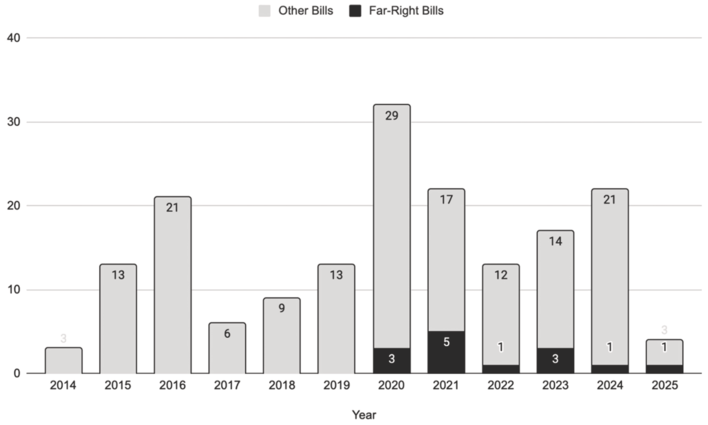
Figure 8.2 Long description
The horizontal axis of the bar chart represents the timeline, divided by legislative periods or years, while the vertical axis shows the quantity of bills proposed.
The chart displays her legislative activity patterns across different periods, revealing no far-right-themed bills produced between 2014 and 2019, and very few produced between 2020 and 2025. The values are 3 each in 2020 and 2023, 5 in 2021, and 1 each in 2022, 2024, and 2025. In contrast, other bills show a higher volume of production with the peak value of 29 in 2020.
During her time as a representative (2014–2018) and then as a senator (2018–2026), she has authored or coauthored 175 bills in total. In her decade in Congress, Cabal has penned fourteen bills individually. During this time, she has taken an interest in a wide range of topics, from cultural commemorations, promoting the agricultural sector, pensions, education, social security, to school lunches. We reviewed the content of all the Cabal bills, to ascertain when and with what insistence she proposed to legislate on topics that are close to those of the Latin American far right. We classified bills as far right if they touched on the following issues: moral conservatism, anti-migration, punitivism, climate denialism, anti-left, and/or aggressively pro-market. As Figure 8.2 shows, we can see that between 2014 and 2019 no bill that Cabal authored or signed qualifies thematically as aligning with the themes of the contemporary far right.
However, starting in 2020, there is a clear change, and these themes begin to appear in her legislative work (see black area in Figure 8.2). For example: In 2020 she proposed a bill to ban abortion (decriminalized in Colombia following a Constitutional Court rulingFootnote 29) and another one that would impose life sentences on those found guilty of femicide (the Colombian constitution forbids life sentences). In 2021 she introduced another life sentence bill, but this time as punishment for those convicted of corruption, and she also introduced a bill to expand legal carry. In 2023 two of her legislative initiatives aligned directly with similar initiatives against “gender ideology” in the United States: one bill sought to combat “child indoctrination” in public schools (directly referencing similar legislative efforts in more than eighteen state-level legislatures in the US) and another that would prohibit gender reassignment treatments and surgeries for minors. None of the fourteen bills we classified as far right were approved. Cabal began to put forth contemporary far-right ideas and proposals in Congress in 2020 – and that is also the year when, as we already discussed, Cabal began to appear more consistently in international forums and far-right events. If these trends are indicative, we can expect the supply of such initiatives and discourse to continue. Cabal’s active participation in regional and international far-right fora, her trajectory, as well as the growing alignment of her discourse with that of other regional far-right leaders make her, at least so far, the most prominent leader of the contemporary far right in Colombia.
8.5 Conclusion: Looking Ahead, What Future for the Colombian Far Right?
The future of the far right in Colombia is uncertain: at the time of writing there is no organized political party or movement. Maria Fernanda Cabal is the most seasoned and clearly identifiable far-right figure of national import, but she is part of a political party that is not fully far right and which she does not control. In the short and medium term, we see four possible paths for the Colombian far right: (1) far-right ideas and far-right politicians continue to come and go within and outside existing parties (as candidates, mayors, congress members, local politicians), but neither a far-right leader nor a far-right party consolidate as a dominant electoral force at the national level; (2) the CD transforms into a far-right party from within; (3) a new, distinct, far-right political party rises up; or (4) a far-right personalist leader emerges in national politics, outside the confines of an institutionalized electoral vehicle.
Before discussing these four paths, we want to highlight three key contextual features that shape them. First, the flexibility of Colombia’s multiparty system, which is moving toward greater fragmentation (Wills Otero, Reference Wills Otero2023). As Colombia entered a new presidential campaign in 2026, flexible electoral rules allow multiple hopefuls to run for the highest office with or without the backing of an existing political party. At the time of writing, the thirty-plus political parties were in negotiations to define who their candidates would be, often through informal and changing procedures. A new unified party was attempting to consolidate itself to the left, while the CD (as we chronicled) had several aspiring candidates, none of whom polled above 8 percent in favorability. Outside established political parties, fifteen people aspired to run for the presidency, backed by citizen support campaigns (an option explained in more detail below). Flexibility creates fluidity and different opportunities for personalist leaders within such a system.
Second, this fragmented party system is also one in which partisan identities are not only fragmented, but they have little hold among the electorate, plus a huge swath of voters do not have strong ideological attachments. A 2025 Cifras y Conceptos national survey found that 53 percent of respondents were not attached to any political party and the remaining 47 percent were split among more than nine collectives, with no single party claiming over 15 percent. As for ideological placement, the vast majority of survey respondents locate themselves to the center. The Americas Barometer LAPOP national representative surveys carried out between 2004 and 2018 asked respondents to state which extreme they felt closest to (1 being left and 10 being right); the average response hovered around the center with 5.4 at its most left-leaning in 2018 and 6.6 at its most right-leaning in 2004. Cifras y Conceptos polls between 2020 and 2023 still located the average Colombian at the center, with the percentage of people clearly identifying to the right averaging 20 percent for the years 2020, 2021, and 2023 and to the left at 22 percent. In 2025, the same poll showed left wing identification at 25 percent, center at 40 percent, and right wing at 27 percent. Both the absence of strong party identification and the existence of a significant portion of self-identified centrists signal the existence of a large chunk of persuadable voters who could potentially move in different directions. In that sense, a significant portion of the support toward Cabal or other popular right-wing figures does not necessarily stem from a strong ideological identity but more from the anti-Petro label. As Tufano points out, although that identification possesses a right-wing connotation, it lacks consistency.Footnote 30
Third, it matters how the Petro government wraps up its term. In other Latin American countries, the right has radicalized and strengthened as an electoral strategy in response to the left focusing on economic redistribution and certain cultural agendas once in power. As the Petro government enters its final legislative year, its ambitious reform agenda has seen some victories (like successfully passing the reform to the pension system), but it has also been toned down, voted down, and/or delayed given the governing party’s lack of a congressional majority and governance difficulties. Its progressive policies have generated backlash, particularly among the more radical elements of the right (including Cabal; see Restrepo, Reference Restrepo2024), but as Petro’s term ends and the 2026 presidential campaign begins, it is not cultural issues that dominate the national agenda and take priority among right-wing forces. Instead, it is the worsening violence due to criminal actors – including the assassination of Miguel Uribe Turbay, a CD senator and presidential hopeful – and the lower court decision that found Alvaro Uribe guilty of bribery and procedural fraud, sentencing him to twelve years under house arrest, a decision that was revoked. Uribe’s popularity had been decreasing in recent years, but he remains the kingmaker among right-wing forces, and this episode has once again thrown him into the limelight. His co-partisans have found a unifying battle cry in criticizing this legal challenge, and presenting it as politically motivated lawfare.
In this chapter we have shown that in Colombia, at present, there is no strong far-right party or leadership with nationwide electoral appeal – not in the form and with the policy concerns that the contemporary Latin American far right shares. Though the Colombian far right has comparatively low electoral strength, crucially, the traditional right is strong and far-right ideas and sympathizers do exist. Maria Fernanda Cabal has been the key figure thus far, but other political leaders sympathize and rely on rhetoric that evokes and celebrates leaders like Bolsonaro, Javier Milei, and Nayib Bukele. At the subnational level, new figures are emerging, such as “the Bukele of Bucaramanga,” mayor Beltrán. Beltrán’s run for a mayorship was backed by a coalition that included two small right-wing parties, Colombia Justa y Libre and Movimiento de Salvación Nacional, as well as the more traditional and larger Partido de la U. We are likely to see more of those figures and coalitions at the subnational level going forward.
A second possible path for Colombia’s far right is that the CD transforms into a radical right party from within. This appears unlikely at the moment: for Cabal to lead that transformation, she would have to become the party’s, and the right’s, presidential candidate, a feat that necessitates her receiving the support of her co-partisans as well as Uribe’s endorsement. She announced her intent to run for president in 2023, just a year into Petro’s presidency. When she first tried to become the party’s nominee in 2022, the selection process (a combination of surveys and Uribe’s approval) ended up favoring more centrist politicians, just as in 2026. She is one of the staunchest critics of the incumbent party and its leader, President Petro, but she does not appear as frontrunner among public opinion, nor was she the party’s choice for the presidency in 2026. While Uribe remains the party’s leader, that transformation from within has to go through him. However, although close to Uribe, Cabal is not his natural heir, nor is she primus inter pares.
The genesis of a separate far-right party, the third possible path, did not happen in time for the 2026 presidential campaign. Though the requirements for creating parties have relaxed considerably in Colombia in recent years, building a party is a long-term, costly option: it requires resources, cadres, and significant human and organizational effort. Crucially, there is little need to put in that effort, as presidential races offer the perfect opportunity for a different option. As noted earlier, the country’s electoral rules generate an opening for any citizen to enter the presidential competition without necessarily having the support of a political party. This route opens a fourth pathway for a far-right leader: running for office with the support of a one-time citizen-backed petition. Candidates may run for office without the backing of a political party if they can certify before the National Registrar’s Office that their bid is supported by a given percentage of lawful voters in their electoral district, an option known as “candidaturas por firmas.” This is an increasingly common choice for mayors, governors, and presidential candidates, who can take advantage of the additional time frame allowed by the electoral authority to collect such support (in the form of physical signatures) as a way to start campaigning early and, in doing so, improve their visibility (Basset & Franco, Reference Basset, Franco, Barrero and Richard2020).Footnote 31 As of August 2025, forty-eight people had declared their intent to run for the presidency in this manner, the highest number since a new Constitution created this option in 1991. Fifteen ultimately fulfilled the requirements: in 2022, six citizen-backed candidates competed in the primaries.
A citizen-backed political campaign could be the ideal way for a personalist far-right leadership to emerge, without the support, or the constraints, of an institutionalized party. This is also an option for candidates within established parties – they may step aside from their party briefly or run a signature-gathering drive in parallel. While in theory this was an option for Cabal, in practice her poor performance in early polls meant it was not realistic.
Further to the right of Cabal, two personalist outsiders intending to run without a party could do so under a far-right banner: journalist Vicky Davila and criminal lawyer and influencer Abelardo de la Espriella. A seasoned journalist, Dávila developed even greater name recognition and notoriety when she was named director of Semana magazine in 2020. Dávila led the transformation of Colombia’s most traditional investigative journalism magazine into a powerful online right-wing news portal. She announced her intention to seek the presidency in early 2025. In all major voting intention polls conducted in the first half of 2025, Dávila was the leader among right-wing candidates. De La Espriella, who has represented Uribe in several legal proceedings and has close ties to the CD, announced his intention to seek the presidency through a signature collection campaign later on, in July 2025, and rose steadily in the polls, eventually overtaking Dávila.
Are Dávila or De La Espriella representatives of the contemporary Latin American far right? Davila’s interviews and declarations as a candidate suggest she welcomes far-right ideas and is open to far-right regional influences. Semana’s coverage, and Dávila personally, have been unrelenting critics of the Petro presidency, and this anti-Petro identity is her political hallmark. Dávila identifies as anti-Petro and right wing, but beyond that, she shirks more specific ideological labels and is a mixed bag in terms of her discourse. She shares the commitment of the Colombian right to the armed forces and is a critic of peace negotiations with guerrillas and armed actors. She has been a consistent defender of Bukele’s authoritarian policies, arguing that Colombia could benefit from mega prisons that follow the Salvadoran model.Footnote 32At the same time, she has distanced herself from discussing culturally conservative issues, and has even defended the constitutionalization of abortion and trans people’s struggle for self-identification.Footnote 33 In eluding the far-right label, but embracing some of its themes, Dávila wanted to strike a delicate balance that has proven difficult for Cabal: she wanted to appeal to both radical and center-right voters. This balancing act was also evident in her choice of economic advisors: representing the far right, Axel Kaiser (advisor to Javier Milei) and Daniel Raisbek (leading advocate of libertarianism in Colombia); representing the more traditional Uribista right, Lisandro Junco (former head of the taxing authority under Ivan Duque) and Juan Andres Bernal (former president of one of Colombia’s biggest investments groups).
De la Espriella was not trying to strike a balance or appeal to the center right. Like Dávila, he is furiously anti-Petro and anti-left, but his public persona and presentation evoke military themes, using a rhetoric that openly invited the physical elimination of leftist sympathizers and/or the use of violence toward them. He is also a punitivist, and a supporter of far-right regional leaders. Like Dávila, neither abortion nor LGBTQ rights are central to his pitch, though he has stated on social media his opposition to the initiative to decriminalize abortion.Footnote 34 In sum, the seeds of the far right are evident in both Dávila’s and De la Espriella’s push for the presidency. It remains to be seen whether these candidates enter into an alliance with other right-wing forces and or continue alone. As their political aspirations evolve, either could easily come to fully embrace the far-right label if political strategy suggests it would be beneficial – perhaps following a similar path to the one Manuel Melendez maps for Nayib Bukele in this volume (Chapter 4).
Colombia, like many other Latin American countries, faces a crisis of democratic representation and a deep disenchantment of the electorate with institutions and democratic processes. The 2022 presidential elections were the perfect manifestation of that deep discontent, with two populist finalists – Petro and Hernández – who exploited that void and outflanked traditional parties, including the traditional right (Barrenechea & Otero Bahamón, 2025). In an increasingly polarized context, the conditions might be fertile ground for the seeds of the far right to take root.
If you ask me, “which side would you choose?” Well, I’d stick with the most authoritarian ones and not with the “woke” progressives (“progres buena ondita”) because the most authoritarian are more authentic and don’t pretend.
While the far right has been electorally relevant in Europe and the United States for decades, Latin America has only recently witnessed the success of far-right leaders such as Jair Bolsonaro in Brazil, Nayib Bukele in El Salvador, and Javier Milei in Argentina. Far-right parties like Chile’s Republican Party, Uruguay’s Cabildo Abierto, and Perú’s Renovación Popular are also becoming increasingly influential in presidential and legislative elections. This chapter examines why far-right parties, particularly populist radical-right (PRR) parties, have not emerged in Mexico. In many Latin American countries, far-right forces have arisen as a backlash against leftist parties and presidents (Madariaga & Rovira Kaltwasser, Reference Rovira Kaltwasser2020; Zanotti & Roberts, Reference Zanotti and Roberts2021). In Mexico, however, no significant far-right party or movement has materialized in response to the country’s leftward turn following the electoral victory of Andrés Manuel López Obrador (AMLO) and his party, MORENA (Movimiento de Regeneración Nacional), in the 2018 presidential election.
The Mexican party system experienced an electoral shock in 2018 when López Obrador won the presidency. Since Mexico’s transition to democracy in 1997, the Institutional Revolutionary Party (PRI), the National Action Party (PAN), and the Party of the Democratic Revolution (PRD) had been the main contenders in every election. In 2018, however, the electorate largely rejected these parties, which together received roughly 40 percent of the vote, compared to nearly 90 percent in previous election cycles. This study argues that the left’s victory did not trigger a significant far-right backlash because López Obrador’s ideological agenda did not provide the incentives necessary for the rise of a populist radical-right party, a pattern common in Latin America and Europe (Bale & Rovira Kaltwasser, Reference Rovira Kaltwasser, Zanotti and Greve2021; Ignazi, Reference Ignazi1992; Inglehart & Norris, Reference Inglehart and Norris2017; Rovira Kaltwasser, Reference Rovira Kaltwasser2023).
López Obrador’s government employed left-wing populist rhetoric, particularly on economic issues, framing itself as the defender of the “people” against the “corrupt elite” – the PRI and PAN. However, it did not actively pursue progressive policies on sociocultural issues such as gender equality, abortion rights, and LGBTQ+ rights, which often mobilize far-right grievances; this chapter terms this approach “leftism without progressivism.” For the most part, cultural issues were overshadowed by economic priorities – increasing the coverage of welfare policies and the minimum wage, reinvigorating Mexico’s state-owned oil industry and infrastructure projects such as the new Mexico City airport, a new oil refinery, and the Mayan Train – and issues of criminal violence, the increasing militarization in the country, and López Obrador’s attacks on democratic institutions (Aguilar et al., Reference Aguilar, Cornejo and Monsiváis-Carrillo2025).
At the national level, when sociocultural issues emerged, López Obrador often avoided taking clear positions or argued that such issues – e.g., abortion or LGBTQ+ rights – should be decided via referenda (Díaz Domínguez, Reference Díaz Domínguez2020). Consequently, most culture war issues remained confined to local politics or were largely addressed by the courts, preventing strong politicization. When López Obrador did take a stance, it frequently reflected conservative positions on topics ranging from public morality and drug legalization to climate change and immigration. The first left-wing government since Mexico’s democratic transition did not mobilize far-right grievances. López Obrador’s administration did not create a perceived threat to traditional values; instead, it partially satisfied voters who might otherwise have been drawn to a populist radical-right party. In fact, conservative voters are a key group within the Lopezobradorista voting coalition. In the 2021 midterm election, 76 percent of leftist voters and 56 percent of rightist voters supported MORENA. In the 2024 presidential campaign, 71 percent of leftist voters and 63 percent of conservative voters backed MORENA’s presidential candidate, Claudia Sheinbaum (Mexican Election Study – Estudio Nacional Electoral de México; Beltrán et al., 2021, Reference Beltrán, Castro Cornejo, Altamirano and Singer2024).
This chapter is organized as follows. The first section reviews short-lived far-right movements and parties that emerged in Mexico before and after the country’s democratization in 1997. The second section analyzes why López Obrador’s leftism without progressivism failed to provide incentives for the rise of a populist radical-right party. Section 9.3 argues that there is latent demand for such a party in the Mexican electorate, drawing on data from the Mexican Election Study (Beltrán et al., 2021, Reference Beltrán, Castro Cornejo, Altamirano and Singer2024). The last section argues that a window of opportunity may be opening for far-right actors seeking to mobilize conservative voters in the context of Mexico’s first woman-led government, headed by Claudia Sheinbaum, and the emergence of new far-right movements aiming to participate in future elections – such as Eduardo Verástegui’s Viva México movement and emerging conservative figures like businessman Ricardo Salinas Pliego.
9.1 Is There a Far Right in Mexico?
In Mexico, several attempts to establish far-right and extreme-rightFootnote 2 alternatives to the PAN, the mainstream center-right party, have largely failed. Founded in 1939, the PAN emerged as a conservative response to President Lázaro Cárdenas’s reforms, which expanded the state’s economic role, nationalized the oil industry, and promoted land redistribution and socialist education (Loaeza, Reference Loaeza, Mainwaring and Scully2003; Shirk, Reference Shirk2005). The PAN’s electoral coalition included businessmen, liberal intellectuals, and Catholic activists (Mizrahi, Reference Mizrahi2003). While officially advocating for Catholic social teachings (Shirk, Reference Shirk2005), the party tried to remain separate from the Catholic Church, like many Christian democratic parties in Europe (Wuhs, Reference Wuhs2013). Contrary to most conservative political forces in Latin America, the PAN was a consistent pro-democratic party (Wuhs, Reference Wuhs, Luna and Rovira Kaltwasser2014) that helped consolidate a democratic/authoritarian divide in electoral competitions (Moreno, Reference Moreno2007).
During the 1980s and 1990s, the PAN became a “catch-all” party (Loaeza, Reference Loaeza, Mainwaring and Scully2003; Mantilla, Reference Mantilla2016), broadening its appeal beyond Catholic western states to industrial northern regions and major urban centers. To avoid alienating core voters – including the urban middle class – its national campaigns often downplayed conservative stances on issues such as abortion and sexual freedom, emphasizing democracy and market-oriented reforms instead (Díaz Domínguez, Reference Díaz Domínguez2020; Magaloni & Moreno, Reference Magaloni, Moreno, Mainwaring and Scully2003). At the local level, however, the party maintained a more conservative agenda (Beer, Reference Beer2017; Reutersward, 2021), particularly in the Catholic western region of the Bajío, where it dominated subnational elections.
9.1.1 The Political Right before Mexico’s Democratization
Table 9.1 identifies the parties and candidates that have attempted far-right mobilization before and after Mexico’s democratization, as well as the sociocultural issues they emphasized. The National Sinarchist Union, linked to the Catholic extreme right, and its successors – the Popular Front Party and Mexican Democratic Party – sought to mobilize far-right voters from the late 1930s to the 1990s. The Sinarquismo movement gained influence in western Mexico, particularly in states affected by the Cristero War (1926–1929), a conflict in which the Cristeros – a rural Catholic militia – opposed socialist education and the Mexican state’s postrevolutionary anticlerical policies. The 1917 Constitution had ended the legal recognition of the Church, banned confessional parties and political speech by clergy, prohibited religious education, and placed Catholic property under state control.Footnote 3 Tensions eased in the 1940s after negotiations allowed for peaceful coexistence. The National Sinarchist Union dissolved in the 1950s, and its successors sought to offer a more conservative alternative to the PAN. Between the 1970s and 1990s, the Mexican Democratic Party won a few congressional seats, but in 1997 it lost its legal status due to weak electoral performance. As Mantilla (Reference Mantilla and Haynes2019) notes, these failed attempts illustrate the limits of far-right mobilization in Mexico.
Before democratization in 2000, electoral competition centered on support for democracy versus the PRI’s hegemonic regime rather than a clear ideological divide. Although electoral laws allowed the formation of new parties, ideologically driven groups often joined major opposition parties – the PAN on the center right and the PRD on the center left – to improve their chances of success, particularly as the PRI’s authoritarian dominance waned in the late 1990s, when it lost its congressional majority in 1997 and, for the first time since 1929, the presidency in 2000.
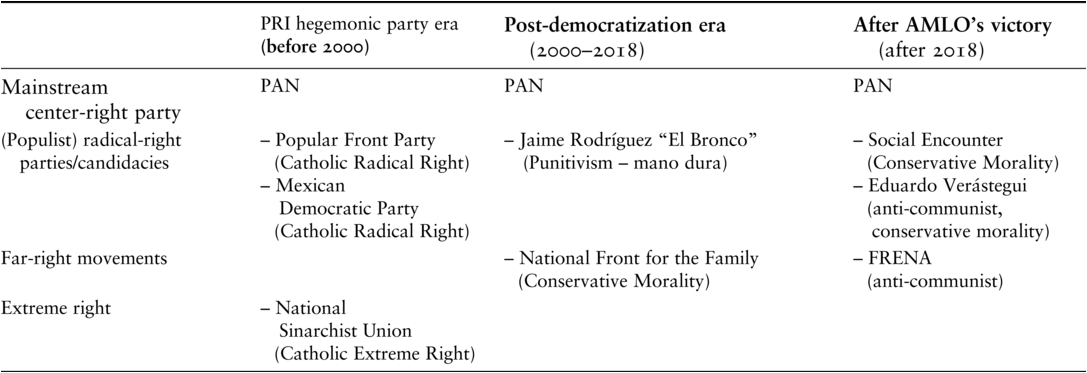
Table 9.1 Long description
The table has three columns titled P R I hegemonic party era, before 2000. Post-Democratization era, 2000 to 2018. After AMLO’s victory, after 2018.
Row 1 is titled Mainstream Center-Right Party.
Column 1 reads. PAN.
Column 2 reads. PAN.
Column 3 reads. PAN.
Row 2 is titled Populist, Radical-Right Parties/Candidacies.
Column 1 reads. Popular Front Party, Catholic Radical Right. Mexican
Democratic Party, Catholic Radical Right.
Column 2 reads. Jaime Rodríguez El Bronco, Punitivism mano dura.
Column 3 reads. Social Encounter, Conservative Morality. Eduardo Verastegui, anti-communist, conservative morality.
Row 3 is titled Far-Right Movements.
Column 1 reads. Blank.
Column 2 reads. National Front for the Family, Conservative Morality.
Column 3 reads. FRENA, anti-communist.
Row 4 is titled Extreme Right.
Column 1 reads. National Sinarchist Union, Catholic Extreme Right.
Column 2 reads. Blank.
Column 3 reads. Blank.
The note below reads. Source: Author’s own elaboration.
9.1.2 The Political Right after Mexico’s Democratization
The PAN won the presidency in 2000 with a heterogeneous anti-PRI coalition, combining its traditional base among the urban, educated middle class of northern and western Mexico with support from across the ideological spectrum, including center-left strategic voters defecting from the PRD (Moreno, Reference Moreno2007; Cornejo, Reference Cornejo2022). However, the Fox (2000–2006) and Calderón (2006–2012) administrations disappointed socially conservative groups, whose expectations for strong opposition to abortion and defense of traditional marriage were unmet.Footnote 4 Fox further alienated conservative Catholics by appointing a liberal physician as Secretary of Health and mandating emergency contraception in public clinics (Amuchástegui et al., Reference Amuchástegui, Cruz, Aldaz and Mejía2010). After the 2006 election, disillusioned conservative PAN activists attempted to form a party to the right of the PAN – the Humanist Party, also known as the Movement for Solidarity Participation – but failed to gather the 200,000 signatures required by law. This first episode highlights the challenges faced by parties in Mexico, where electoral law sets high requirements for new parties.
Because Mexican states regulate marriage and abortion, courts and local politics have played a central role in the country’s culture wars (Beer, Reference Beer2021a). In 2009, Mexico City legalized same-sex marriage, becoming the first jurisdiction in Mexico and Latin America to do so. Although the PAN and the Catholic Church opposed the law, it passed without significant protests. At the time, the PAN was simply not prepared to actively block or delay the legislative process (Diez, 2015). Instead, the party responded at the federal level by challenging the law’s constitutionality before the Supreme Court. In 2010, however, the Court upheld the constitutionality of Mexico City’s same-sex marriage law. Furthermore, in 2015, the Court declared that any law defining marriage as the “union of a male and a female” – several of which had been passed by state congresses in response to Mexico City’s reform – was unconstitutional, thereby legalizing same-sex marriage de facto nationwide.
When the PRI returned to power in 2012, Peña Nieto proposed a constitutional amendment to codify the Court’s ruling. By then, many conservatives had grown disillusioned with the PAN and turned to nonpartisan grassroots organizations. Conservative groups – including far-right organizations such as Unión Nacional de Padres de Familia, Red Familia, Consejo Mexicano de la Familia, and Hazte Oír – formed the Frente Nacional por la Familia (National Pro-Family Alliance). The coalition denounced Peña Nieto’s proposal as an imposition of “gender ideology” and successfully mobilized against it, prompting him to abandon the reform. Although the constitutional amendment failed, all state legislatures eventually legalized same-sex marriage,Footnote 5 even in conservative western states where the PAN held majorities.
Abortion politics followed a similar trajectory. With a few exceptions,Footnote 6 debates largely took place at the state level. In 2007, Mexico City legalized first-trimester abortion. As with same-sex marriage, the Supreme Court was essential to upholding progressive change. The Supreme Court upheld the law in 2008, rejecting challenges from the federal PAN government. In response, between 2008 and 2013, seventeen of Mexico’s thirty-one states passed constitutional amendments protecting “life from the moment of conception.” The conservative movement relied on backroom deals (Reutersward, 2021) backed by Catholic organizations and the PRI and PAN. Their efforts even gathered some support from leftist legislators (Lopreite, Reference Lopreite2014). Once again, however, the Supreme Court advanced progressive change, ruling that embryos do not have the same rights and protections as persons. More recently, in 2023, the Court decriminalized abortion nationwide. By 2025, local congresses in twenty-three of Mexico’s thirty-two states had legalized it.
These battles over abortion and LGBTQ+ rights reveal the central dynamics of Mexico’s culture wars. First, in conservative states, the PAN – often allied with the PRI and supported by Catholic organizations – advanced conservative reforms in reaction to progressive measures passed in Mexico City. Nationally, instead of actively opposing progressive reforms, the PAN largely relied on reactive strategies, such as challenging laws in court, which led far-right actors to view it as an unreliable ally. Second, grassroots organizations on both the right and the left played a major role in channeling activists’ demands beyond parties. On abortion rights, the marea verde movement successfully pushed MORENA – at the local level – to the left and advanced pro-choice reforms in local congresses. On LGBTQ+ rights, the PAN’s unwillingness or inability to mobilize in the streets created an opening for far-right mobilization. Yet the Frente Nacional por la Familia ultimately failed to prevent state legislatures from legalizing same-sex marriage and abortion, and its rapid decline underscored the weakness of far-right mobilization.
Third, the Supreme Court’s assertive jurisprudence has been decisive, forging a progressive coalition despite polarized public opinion on same-sex marriage (Reyes & Cornejo, Reference Reyes and Cornejo2023) and abortion.Footnote 7 Taken together, the Court’s rulings on abortion and same-sex marriage demonstrate its role as the ultimate arbiter of Mexico’s culture wars, advancing progressive change even when elites and public opinion remained divided. This also enabled major parties at the national level to avoid taking clear stances, with politicians repeatedly insisting during campaigns that “the issue was already decided by the Court.”
The Supreme Court’s decisions also allowed the PAN to downplay these issues and, in some cases, adopt a more moderate programmatic stance. For example, presidential candidates Ricardo Anaya (2018) and Xóchitl Gálvez (2024) endorsed same-sex marriage and the Court’s invalidation of state laws defining marriage as the “union of a man and a woman.” While still opposing abortion, they also recognized the Court’s decision striking down laws criminalizing the procedure – originally advanced by conservative Catholics, including PAN activists. As the next section discusses, these dynamics also activated grievances among far-right activists, who denounced the PAN as a “cowardly right-wing” party.Footnote 8
In the 2018 presidential election, the closest figure to a populist radical-right candidate was Jaime Rodríguez, “El Bronco.” Running as an independent, he used anti-establishment, law-and-order rhetoric, claiming that “the very problem of Mexico was the “partidocracia” (partyocracy).Footnote 9 While he did not frame society as elite versus people, as most populist radical-right candidates in Latin America do (Rovira Kaltwasser, Reference Rovira Kaltwasser2023), he argued that citizens “should have the power, and not political parties.”Footnote 10 Rodríguez adopted a hardline stance on organized crime and violence, exceeding even President Calderón’s approach, and proposed reinstating the death penalty for cartel members – a measure abolished in 2005 and unused since 1961. Though his campaign largely avoided sociocultural issues, he explicitly opposed same-sex marriage and abortion. Ultimately, the 2018 election highlighted the limits of reactionary mobilization: Rodríguez captured only 5.4 percent of the vote.
9.1.3 The Political Right after AMLO’s Electoral Victory in 2018
Andrés Manuel López Obrador began his political career in the PRI, working for the federal government in his home state of Tabasco. In the late 1980s, he joined the PRD – an alliance of the PRI’s dissenting left-wing faction and historical leftist groups – rising to the position of party president in the late 1990s. Elected mayor of Mexico City in 2000, he ran for the presidency in 2006 and 2012. In his 2018 campaign, he faced the PRI and PAN, which he commonly called the “PRIAN,” accusing them of being a “corrupt elite,” the mafia del poder, responsible for his previous electoral defeats and the country’s impoverishment under neoliberal policies (Bruhn, Reference Bruhn, Mudde and Rovira Kaltwasser2012). Since 2006, he has framed Mexican society as divided between the pueblo and the mafia del poder (Bruhn, Reference Bruhn, Mudde and Rovira Kaltwasser2012; Castro Cornejo et al., Reference Castro Cornejo, Ley and Beltrán2020; Dussauge-Laguna, Reference Dussauge-Laguna, Bauer, Peters, Pierre, Yesilkagit and Becker2021), asserting that “the greatest wealth of Mexico is the honesty of its people” and that his movement rests on “the conviction that the people are good – they are honest.”Footnote 11
In 2015, López Obrador resigned from the PRD and founded a personalistic party, MORENA (Movimiento de Regeneración Nacional). In the 2018 presidential election, he built a broad, multi-class coalition, receiving similar support across gender, education, age, and urban–rural divides (Aparicio & Cornejo, Reference Aparicio and Cornejo2020). Like his previous campaigns, he avoided detailed policy proposals, focusing instead on valence issues such as condemning corruption in the PRI and PAN governments and criticizing the neoliberal economic model. He also refrained from taking clear stances on contentious issues like abortion or same-sex marriage (Díaz Domínguez, Reference Díaz Domínguez2020). Consistent with his record as mayor of Mexico City, where he governed as a moderate center leftist (Bruhn, Reference Bruhn, Mudde and Rovira Kaltwasser2012), his 2018 platform was less ideologically liberal than the PRD’s, his former party. In the 2018 presidential election, his victory reflected widespread rejection of mainstream parties, fueled by affective polarization and negative partisanship toward the PRI and PAN (Castro Cornejo, Reference Castro Cornejo2023).
Unlike other leftist governments in Latin America, López Obrador did not provoke a strong conservative backlash. The only notable attempt was the short-lived FRENA (Frente Nacional Anti-AMLO), which sought to emulate movements like Spain’s Vox or France’s Yellow Vests. In September 2020, FRENA supporters camped in Mexico City’s main square, demanding López Obrador’s resignationFootnote 12 and framing his government as a “communist” threat tied to the “Foro de São Paulo” (Hernández, 2020). Lacking a clear political agenda, the movement faded after police removed the tents in February 2021 amid the COVID-19 emergency, highlighting the limited appeal of far-right mobilization.
By the end of López Obrador’s presidency, ultra-conservative actor and pro-life activist Eduardo Verástegui attempted an independent run in the 2024 presidential election. Like FRENA, he denounced López Obrador as a “communist who is destroying the country”Footnote 13 but also promoted traditional conservative issues, including defending traditional marriage and opposing same-sex marriage. Verástegui built a more organized network with ties to the American conservative movement and the Trump organization, even hosting the Conservative Political Action Conference (CPAC) in Mexico, with figures such as Eduardo Bolsonaro, Santiago Abascal, José Antonio Kast, and Javier Milei attending. Despite this, he failed to secure the support of 1 percent of registered voters – roughly one million signatures – preventing him from appearing on the ballot.
These examples show that recent attempts to occupy the far right in Mexico – including law-and-order candidates such as Jaime “El Bronco” Rodríguez, movements opposing gender ideology (National Front/Frente Nacional), anticommunist groups like FRENA, and independent campaigns such as Verástegui’s – have largely failed. In 2024, the PAN, PRI, and PRD formed an anti-Lopezobradorista coalition, nominating moderate Xóchitl Gálvez, former PAN senator, while Movimiento Ciudadano – a small opposition, social-democrat party – ran congressman Jorge Álvarez Máynez. MORENA and its allies nominated López Obrador’s close ally Claudia Sheinbaum, former mayor of Mexico City. No far-right – or even traditionally conservative – candidate competed. After six years of Lopezobradorismo, there was no conservative backlash. By avoiding a progressive sociocultural agenda and advancing conservative stances on issues such as immigration, climate change, and public morality, López Obrador’s government appears to have limited the mobilization of far-right voters, illustrating the dynamic of “leftism without progressivism,” as the next section argues.
9.2 No Far-Right Backlash in Mexico: AMLO’s Leftism without Progressivism
This section argues that López Obrador’s government did not provoke a strong conservative backlash. In large part, this is because his administration – while leftist – did not actively advance progressive policies on issues such as gender equality, abortion rights, and LGBTQ+ rights (Ahmari, Reference Ahmari2023; Angelo & Freeman, Reference Angelo and Freeman2021; Rojas, Reference Rojas2022), which often mobilize far-right voters in Latin America and Europe (Bale & Rovira Kaltwasser, Reference Rovira Kaltwasser, Zanotti and Greve2021; Ignazi, Reference Ignazi1992; Inglehart & Norris, Reference Inglehart and Norris2017). This chapter terms that dynamic “leftism without progressivism.” López Obrador often avoided clear stances, downplayed these issues, suggested referendums, and occasionally expressed openly conservative positions, reducing the perception of a threat to traditional values.
9.2.1 Leftism without Progressivism in the Sociocultural Dimension
While leftist parties in the US or Europe rarely combine leftist economic policies with a non-progressive sociocultural agenda, this pattern is common in Latin America (Angelo & Freeman, Reference Angelo and Freeman2021). Leaders such as Hugo Chávez and Nicolás Maduro in Venezuela, Evo Morales in Bolivia, Pedro Castillo in Peru, and Rafael Correa in Ecuador all avoided championing progressive sociocultural policies once in office – either by action or omission. Similarly, López Obrador maintained vague positions on abortion and LGBTQ+ rights during his 2018 campaign, often suggesting these issues be resolved by referendum (Díaz Domínguez, 2021).Footnote 14 In office, he continued to avoid explicit stances: “I am also the owner of my silence; I simply do not have an opinion on this because I do not want to contribute to a confrontation.”Footnote 15 At other times, he argued that abortion was not a priority:
I believe that we should not open these debates. First, let’s manage to cleanse the regime of corruption, which is what has damaged the most and once that is achieved, we will look at other issues, there are many important issues, but we will prioritize. I think the most important thing is to clean the government of corruption.Footnote 16
During an interview in 2015, he went farther, explicitly underestimating the importance of abortion rights and LGBTQ+ politics: “The fundamental thing is honesty, that [the issues of abortion and same-sex marriage] with all due respect and authenticity, I consider it as something not so important, the important thing in Mexico is to end corruption.”Footnote 17
At the start of AMLO’s presidency, many expected Mexico’s first leftist government since the transition to democracy to be an ally of the feminist movement. Instead, López Obrador repeatedly clashed with feminists, whom he labeled “conservative” – a term he often used to delegitimize the opposition: “They have become conservative feminists only to harm us, only for that purpose.”Footnote 18 As several studies argue, this tension reflects a broader pattern in left-wing populism, where gender issues are often subordinated to class interests, favoring the “people” over “women” specifically (Beer, Reference Beer2021b). The AMLO administration did take symbolic steps toward gender equality, including achieving gender parity in the cabinet for the first time in Mexico. Yet, under its policy of “republican austerity,” key institutions such as the Institute for Women (Instituto de las Mujeres), which address gender-based violence, and public nursery and childcare programs, faced drastic budget cuts. Moreover, according to the feminist movement, he was largely indifferent to the record levels of feminicides in Mexico – nearly 5,000 during his administration, a historic highFootnote 19 – and at times appeared to misunderstand the feminist agenda. In a 2017 interview, when asked if he considered himself a feminist, López Obrador responded: “I am respectful of women […] women deserve to go to heaven.”Footnote 20 Later, during his presidency, he questioned whether gender-based violence concerns only women: “Everything they say to me – isn’t that gender-based violence? Or is gender only female? ”Footnote 21
Similar to LGBTQ+ rights, although the López Obrador government did not prioritize gender equality, MORENA as a party has supported certain gender issues, such as abortion rights at the state level. This mirrors the PAN’s approach, where parties at the local level often advance programmatic agendas – for example, promoting pro-life and traditional marriage laws in conservative states. MORENA played a key role in legalizing abortion during the first twelve weeks of pregnancy in twenty-three of Mexico’s thirty-two states. At the federal level, however, both MORENA and López Obrador have been less willing to support this agenda. In his daily press conferences, López Obrador has stated that he considers progressive issues secondary to the economy and even suggested that these topics are, in fact, advanced by neoliberal interests:
What did neoliberalism do? One of the things that they promoted in the world to be able to loot at ease was to create or promote the so-called new rights. So, feminism, environmentalism, the defense of human rights, and the protection of animals were greatly encouraged, even by themselves. All these causes are very noble, but the purpose was to create or promote, develop all these new causes so that people would not turn to see that they were plundering the world and that the issue of inequality in the economy would be left out of the center of the debate.Footnote 22
And not only that, he often explicitly criticizes progressive activists as “allies of the right.” When talking about his political adversaries during his daily press conference, he said: “If you ask me, ‘which side would you choose?’ Well, I’d stick with the most authoritarian ones and not with the ‘woke’ progressives [progres buena ondita] because the most authoritarian are more authentic and don’t pretend.”Footnote 23
Not only did López Obrador fail to endorse a clear progressive agenda, but his government also promoted socially conservative rhetoric (Angelo & Freeman, Reference Angelo and Freeman2021; Dussauge, 2021). For example, the acronym of his party, the National Regeneration Movement (Movimiento de Regeneración Nacional, MORENA), is also the Spanish word for a dark-skinned woman, implicitly referencing Our Lady of Guadalupe (“la Virgen Morena,” as she is colloquially known in Mexico).Footnote 24 López Obrador not only named his party MORENA but also registered his 2018 presidential campaign at the National Electoral Institute on the same day as the celebration of Our Lady of Guadalupe, the country’s most important religious festivity.Footnote 25 In daily press conferences, he frequently criticized opposition politicians for not being “good Christians,” condemned modern society as overly materialistic, and emphasized that the family is the most “important social institution” in Mexico.Footnote 26 In fact, his 2018 candidacy appealed both to observant Catholics and to his traditional left-wing base, with church attendance and support for leaders with religious principles increasing the likelihood of voting for Lopez Obrador (Diaz Domínguez, 2020).
López Obrador also condemned the legalization of marijuana, particularly in the US, on moral grounds: “They [the USA] are not concerned with well-being, only money. Nor do they strengthen moral, cultural, and spiritual values. Nor do they limit drug use; on the contrary, they encourage it even in sports. It’s sad and decadent.”Footnote 27 He also attributed the US fentanyl crisis to the “disintegration of families” and prevailing “individualism,” which he argues have eroded “family values” (Ahmari, Reference Ahmari2023). Early in his presidency, citing a “loss of cultural, moral, and spiritual values” in Mexico, he introduced a “Cartilla Moral” (moral handbook) designed to promote “a way of living based on love for family, neighbor, nature, homeland, and humanity,” reflecting his emphasis on both spiritual and material well-being.Footnote 28 This initiative aligns with his broader rhetoric of “purifying public life”Footnote 29 and the belief that Mexicans already possess the “moral, cultural, and spiritual values” needed to regenerate the country.Footnote 30 As journalist Jorge Zepeda Patterson, closely aligned with López Obrador’s movement, observes, “regeneration” lies at the heart of Lopezobradorismo.
A national regeneration movement involves the improved recovery of something that was there and was lost, suspended or did not reach its potential […] In reality, the Tabasco native comes from a faction emanating from the Mexican Revolution that was truncated in its social aspirations […] López Obrador understands that there was a tendency in the PRI in that direction that fell short and frustrated … [López Obrador] would like to explore it in an updated version the potential that the PRI outlined in its best moments.Footnote 31
On immigration – another key sociocultural issue – López Obrador’s administration was inconsistent. Before taking office, he promised a welcoming approach – “We will offer employment, jobs to Central American immigrants”Footnote 32 – and framed Mexico as a “country of refuge,” issuing thousands of humanitarian visas in his first months.Footnote 33 Yet, only a few months later, his government adopted a more restrictive policy in coordination with the Trump administration, deploying unprecedented numbers of troops to the southern border.Footnote 34 Media reports frequently documented the National Guard teargassing and arresting migrants, reflecting record levels of detentions and human rights violations.Footnote 35
López Obrador’s government also prioritized reviving Mexico’s state-owned oil industry. During his 2018 campaign, he denounced a 2013 reform by the PRI and PAN that opened oil, gas, and electricity to private and foreign investment, especially in renewables. His administration reasserted government control over the energy sector, prioritized fossil fuel development, and dismantled the publicly funded National Institute for Climate Change. These policies align with the economic nationalism of the populist left in Latin America, emphasizing sovereignty and national dignity through resource exploitation (Mudde & Rovira Kaltwasser, Reference Mudde and Rovira Kaltwasser2013). Unlike the progressive left in Latin America and Europe, which opposes extractive industries and promotes renewable energy, the López Obrador administration built a $20 billion oil refinery in southern Mexico, rehabilitated existing refineries, and purchased a US refinery, declaring it “part of the Mexican nation.”Footnote 36 He stated: “We are going to be self-sufficient [stop importing gas and diesel] and make sure that oil prices do not increase,”Footnote 37 adding, “Oil is the best business in the world.”Footnote 38
9.2.2 Leftism without Progressivism: Conservative Political Alliances and Democratic Erosion
Politically, López Obrador’s government built alliances with a range of conservative actors, including the military, evangelical groups, and the Trump administration. During the 2018 presidential campaign, his coalition included a conservative evangelical party, Encuentro Social (Social Encounter). Although less visible than the Frente Nacional por la Familia, Encuentro Social had previously mobilized against “gender ideology,” abortion, and same-sex marriage. In the 2018 election, the party failed to secure the 3 percent of the vote required to maintain national party status, yet it still gained fifty-six seats in the Chamber of Deputies and eight in the Senate, remaining part of López Obrador’s legislative coalition alongside MORENA and the PT (Workers’ Party). While the coalition with Encuentro Social can be seen as a pragmatic move to broaden MORENA’s electoral appeal, evangelical churches enthusiastically supported López Obrador’s distribution of the Cartilla Moral (Moral Handbook),Footnote 39 and several party members later joined his administration.
In law and politics, López Obrador abandoned the more progressive elements of his 2018 campaign, including transitional justice and amnesty laws. In office, he condemned drug legalization, expanded pre-trial detention, and increased the military’s role in civil governance and combating organized crime.Footnote 40 While previous administrations relied on the military for public security, López Obrador went further (Ibarra del Cueto, Reference Ibarra del Cueto2023; Ley & Aparicio, Reference Ley and Aparicio2023). His government dissolved the civilian Federal Police and created the National Guard, two-thirds of whose members came from the military.Footnote 41 Although it was originally intended to have civilian oversight, in 2025 MORENA and its allies approved a constitutional reform formally subordinating the National Guard to the military.
Under López Obrador, the military gained a level of economic and political influence unprecedented since the end of military-led government in the 1940s. It oversaw major infrastructure projects that represented a priority of the AMLO administration – hospitals, highways, stadiums, hotels, Mexico City’s new airport, and the southern tourist train – managed the new publicly owned airline, and policed airports and customs. For the first time in recent history, military officers have held leadership positions in civil government, heading agencies such as the national medicine distribution authority and serving on key federal committees, including the National Committees of Science and Technology and Public Health.
These examples illustrate that López Obrador’s leftism, without accompanying progressivism, did not generate the incentives for a conservative backlash or the emergence of a populist radical right party, due to his government’s weak defense of progressive values. If anything, his administration exhibits several characteristics typical of populist radical-right parties: populist rhetoric that frames Mexican society as divided between the “people” and a “corrupt elite,” socially conservative rhetoric, and conservative stances on numerous sociocultural issues. At the same time, his government took a range of illiberal actions against democratic institutions – another hallmark of populist radical right parties.
Following his inauguration, López Obrador concentrated executive power, weakened civilian control of the military, attacked courts and bureaucratic agencies, and undermined autonomous institutions and democratic checks (Aguilar et al., Reference Aguilar, Cornejo and Monsiváis-Carrillo2025; Aguilar Rivera, Reference Aguilar Rivera2022; Ibarra del Cueto, Reference Ibarra del Cueto2023). He also targeted the Instituto Nacional Electoral (INE) and constitutional safeguards, including the Supreme Court and judiciary (Petersen & Somuano, Reference Petersen and Somuano2021; Ríos-Figueroa, Reference Ríos Figueroa2022). In 2025, his constitutional majority approved a judicial reform that purged the courts and the Supreme Court, proposed to elect all judges by popular vote, and eliminated the judicial career system – fundamentally undermining the separation of powers and raising concerns about the politicization of the courts (Aguiar et al., Reference Aguilar, Cornejo and Monsiváis-Carrillo2025). López Obrador also eroded pluralistic politics by demonizing the opposition, media, and independent institutions, while refusing to recognize dissenting views as legitimate (Sánchez Talanquer, Reference Sánchez Talanquer2020).
9.2.3 Leftism without Progressivism: Economic Austerity and Leftist Rhetoric
Although the López Obrador administration advanced a strong leftist rhetoric on economic issues, its policy record often fell short of progressivism. While rejecting the “neoliberal” model pursued by PAN and PRI governments from 1982 to 2018 and pledging to build an economy that favored “the people,” the administration nonetheless embraced core elements of the Washington Consensus. Central to its economic strategy was fiscal austerity – described by López Obrador as “Franciscan poverty” – under the premise that “there cannot be a rich government in a poor country.” Equating expansive public spending with despilfarro (waste), he vowed not to raise taxes, claiming that curbing corruption and maintaining an “austere” government would suffice to fund social programs (Sánchez Talanquer & Greene, Reference Sánchez-Talanquer and Greene2021). Unsurprisingly, however, decreasing government spending undermined the capacity of the Mexican state to deliver public goods, particularly to the poor who depend on public services the most (Sánchez Talanquer, Reference Sánchez Talanquer2020). For instance, during the COVID-19 pandemic, López Obrador refused to wear a mask and stop organizing political rallies. Mexico also reported the lowest level of fiscal support to mitigate the economic consequences of COVID-19 (e.g., targeted transfers or tax cuts) compared to other countries in Latin America (De la Cerda & Martinez-Gallardo, Reference De la Cerda, Martinez-Gallardo, Ringe and Rennó2022). Moreover, the termination of the Seguro Popular program – a public health insurance scheme covering roughly 60 million informal-sector workers – left 15 million without access to public healthcare. Branded as “neoliberal” by López Obrador, Seguro Popular was replaced with programs lacking comparable coverage (Sánchez Talanquer, Reference Sánchez Talanquer2020).
Nonetheless, López Obrador’s government implemented several economic measures more consistent with its leftist rhetoric. While terminating the conditional cash transfer (CCT) program Progresa–Oportunidades, his administration introduced new direct transfers to marginalized groups, including students, single mothers, and young professionals. It also substantially increased the minimum wage, a reform that is perceived as the main factor why poverty decreased in Mexico during the AMLO administration: extreme poverty decreased from 7 to 5 percent and moderate poverty decreased from 42 to 30 percent of the population.Footnote 42 The AMLO administration also enacted legislative reforms to strengthen labor unions, and expanded infrastructure investment – particularly in the economically disadvantaged south – through flagship projects such as the Mayan Train and the “Dos Bocas” oil refinery. In this sense, Lopezobradorismo reflects a blend of economic leftism – marked by a high degree of politicization – and an absence of progressivism, or even explicit conservatism, on sociocultural issues, which are less politicized and at times muted.
Constitutionally barred from seeking reelection, López Obrador was succeeded by Claudia Sheinbaum, former head of government of Mexico City. It remains uncertain whether MORENA under her leadership will preserve the party’s current ideological coalition. A scientist and longtime collaborator of López Obrador, Sheinbaum has consistently articulated leftist economic and sociocultural positions. Yet her explicit goal of securing a strong legislative majority in Congress – enabling constitutional reforms to further exacerbate executive aggrandizement – heightened her incentive to maintain López Obrador’s broad electoral base. After her formal nomination as MORENA’s presidential candidate, Sheinbaum appeared at a political rally with the same conservative allies who supported López Obrador in 2018: the ultraconservative evangelical party Encuentro Social and the ultraconservative Christian church La Luz del Mundo,Footnote 43 both of which endorsed her candidacy. This was not an isolated case. Unlike the PRD, MORENA actively courts conservative voters and at times nominates former members of the PAN, including figures from its most conservative factions, for national and local offices. During the 2024 electoral cycle, for example, four former PAN members sought MORENA’s gubernatorial nominations: the ultraconservative José María Martínez, as well as Ricardo Sheffield, Alma Alcaraz, and Joaquín Díaz Mena.
9.3 Is There a Demand for the Populist Radical Right in Mexico?
To assess demand for a populist radical right in Mexico, this section relies on data from the Mexican Election Study (Beltrán et al., Reference Beltrán, Castro Cornejo, Altamirano and Singer2024), post-electoral surveys conducted one to two weeks after presidential and legislative elections. On the left–right scale (0 = left, 10 = right), the average voter scored 5.4 in 2018, 6.3 in 2021, and 6.5 in 2024 (Figure 9.1), indicating a generally moderate electorate. Nevertheless, as Table 9.2 shows, except in 2015 and 2018, a sizable share of voters placed themselves at “9” or “10”; in both 2021 and 2024, roughly one-third identified with the far-right end of the spectrum.
Voters’ self-placement on the left–right scale in Mexico (1997–2024).
In politics people sometimes talk of left and right. Where would you place yourself on a scale from 0 to 10 where 0 means the left and 10 means the right?
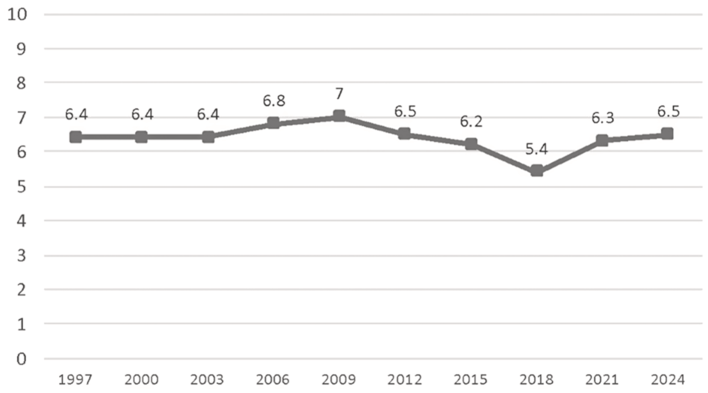
Figure 9.1 Long description
The 27-year data for the line chart comes from the Mexican Election Study and uses the standard survey question where respondents place themselves on a scale from 0 (left) to 10 (right). The chart tracks the mean or median position of the Mexican electorate across ten measurement points between 1997 and 2024. The trend line shows how the average ideological placement has shifted over time, potentially revealing periods of movement toward the left, right, or political center. The chart provides a comprehensive overview of the Mexican electorate's ideological evolution across multiple presidential administrations and party systems, showing both short-term fluctuations and longer-term trends in political identity.
| 0–1 | 2–3 | 4–6 | 7–8 | 9–10 | |
|---|---|---|---|---|---|
| 1997 | 12% | 6% | 32% | 13% | 37% |
| 2000 | 12% | 6% | 32% | 16% | 34% |
| 2003 | 11% | 5% | 34% | 18% | 32% |
| 2006 | 11% | 4% | 23% | 23% | 38% |
| 2009 | 4% | 5% | 26% | 37% | 29% |
| 2012 | 9% | 7% | 30% | 25% | 29% |
| 2015 | 5% | 10% | 37% | 33% | 15% |
| 2018 | 10% | 16% | 37% | 26% | 11% |
| 2021 | 10% | 6% | 34% | 20% | 29% |
| 2024 | 12% | 4% | 32% | 18% | 34% |
Figure 9.1 presents voters’ perceptions of the ideological placement of Mexico’s major parties. No party is generally viewed as occupying an extreme position, either on the left (0–2) or right (8–10). López Obrador’s party, perceived as leftist in 2015 (2.9), shifted toward the center – 4.3 in 2018 and around 5.5 and 5.6, respectively, in 2021 and 2024. Why is a party that self-identifies as a leftist party increasingly perceived as a centrist party? This trend may reflect the recurrent pattern – except in 2018 – of the incumbent party being placed to the right of the opposition (1997: PRI; 2000–2009: PAN; 2012–2015: PRI; 2021: MORENA), suggesting that for some voters “right” signifies “incumbent” rather than a specific ideology.
A second possibility is that, once in office, incumbent parties are perceived as supporting center-right policies. This pattern was evident in the final years of both PRI and PAN administrations: from 1994 to 2000, the PRI administration advanced market-oriented policies opposed by the PAN in Congress, while from 2000 to 2012 the roles reversed. From 2012 to 2015, however, both parties jointly approved a series of economic reforms under the “Pacto por México,” producing the smallest recorded ideological gap between them in the 2015 midterm elections. In MORENA’s case, incumbency likely contributes to its centrist perception, but the shift is also consistent with this chapter’s broader argument: López Obrador’s government has not consistently advanced a progressive agenda, particularly on sociocultural issues.
After analyzing left–right identification of the major parties in Mexico, Figure 9.2 focuses on voters’ programmatic preferences – rather than a symbolic attachment to the labels “left” and “right” – particularly on the two major components of populist radical-right parties: nativism and authoritarianism (Rovira Kaltwasser, Reference Rovira Kaltwasser2023). Table 9.3 presents data from two indices constructed from two battery questions included in the 2018 Mexican Election Study (Beltrán et al., Reference Beltrán, Ley and Castro Cornejo2020). These indices aim to identify voters’ anti-immigration attitudesFootnote 44 and conservative attitudes on sociocultural issues (abortion and same-sex marriageFootnote 45). The two indexes were rescaled from 0 to 1 to facilitate interpretation (e.g., higher values mean a more conservative position). As Table 9.3 shows, although few voters in Mexico report a high level of anti-immigration attitudes (scoring 0.66 or more on the 0–1 index: 15 percent), almost a third of voters – 31 percent – report conservative sociocultural values. In other words, the data suggest that there is demand for conservative policies, at least on topics like abortion and same-sex marriage. However, as discussed in the previous sections, a populist radical-right candidate has not mobilized those voters. In fact, as Table 9.2 shows, despite being a leftist candidate, in 2018 López Obrador received fairly similar support from conservative and progressive voters across these two components.
How voters perceive parties’ ideology in Mexico (1997–2024).
Where would you place… on a scale from 0 to 10 where 0 means the left and 10 means the right?
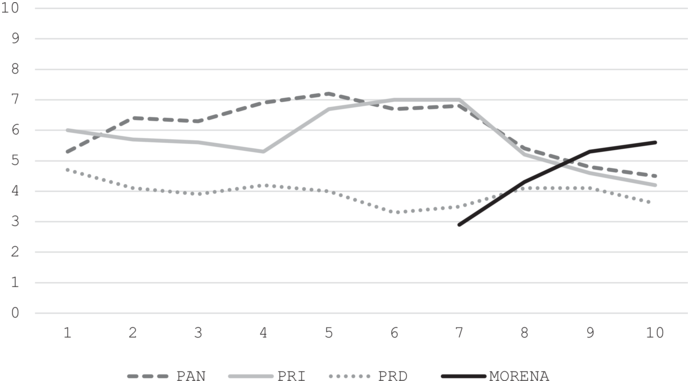
Figure 9.2 Long description
Using data from the Mexican Election Study, the chart employs the standard 0-10 scale where 0 represents the far left and 10 represents the far right. The chart displays separate trend lines for each major Mexican political party, likely including PRI, PAN, PRD, and Morena, showing how voters have positioned these parties ideologically over time. The chart shows whether parties have maintained consistent ideological positioning in the public's view or have experienced notable shifts in their perceived placement. It also illustrates the relative distances between parties on the spectrum and how these perceptual gaps have changed over nearly three decades of Mexican democracy, providing insight into the evolving structure of political competition as seen through voters' eyes.
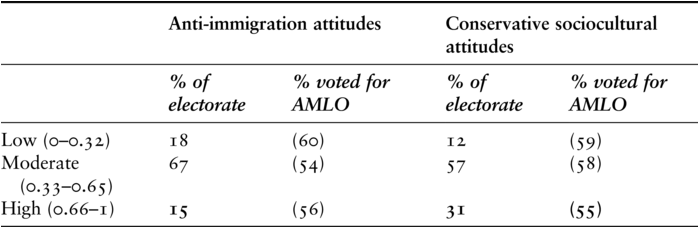
Table 9.3 Long description
The table has two columns titled anti-immigration attitudes and conservative sociocultural attitudes. Each columns have two sub-columns titled percentage in the electorate and percentage voted for AMLO.
For the row titled low, 0 to 0.32 has the following percentages. 18 percent. 60 percent. 12 percent. 59 percent.
For the row titled moderate, 0.33 to 0.65 has the following percentages. 67 percent. 54 percent. 57 percent. 58 percent.
For the row titled high, 0.66 to 1 has the following percentages. 15 percent. 56 percent. 31 percent. 55 percent.
The note below reads. Source: Mexican Election Study, Beltran et al 2024.
Figure 9.3 shows support for PAN, PRI, and AMLO–MORENA from López Obrador’s first presidential election in 2006 to the most recent presidential election in 2024, across ideological groups based on the left–right scale (0–10 scale). In his first two presidential campaigns, AMLO drew more support from leftist voters than from rightist ones. Beginning with his 2018 presidential campaign, however, the slope in Figure 9.3 becomes less pronounced, and by 2024 it is almost flat. In other words, AMLO in 2018, and MORENA – in the 2021 midterm election and in 2024 with Claudia Sheinbaum as its presidential candidate – received not only strong support from leftist voters but also substantial support from rightist ones.
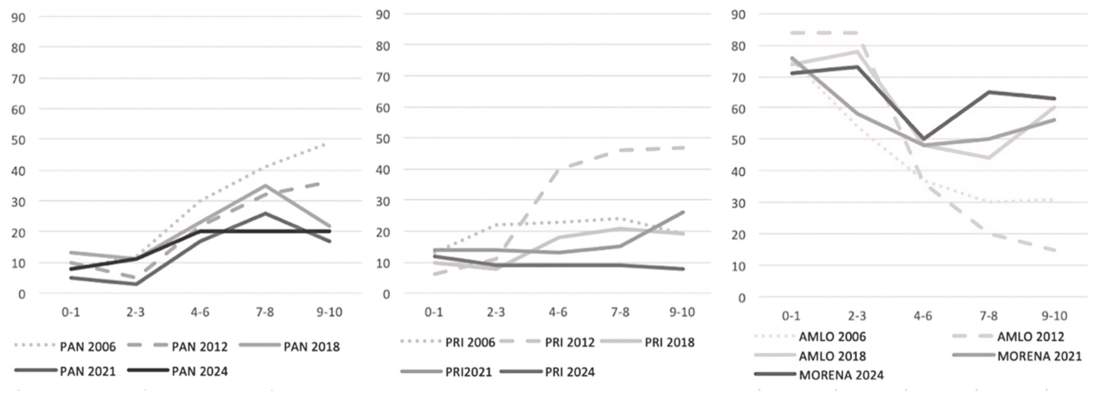
Figure 9.3 Long description
Using data from the Mexican Election Study, it displays voting patterns for the three major political forces, PAN, PRI, and MORENA across different ideological segments of the electorate.
The charts group voters by their self-placement on the left-right spectrum and shows the percentage of each ideological group that voted for each major party coalition in different election years. This visualization reveals how party support is distributed across the political spectrum and how these patterns have evolved over two decades.
The data shows PAN's strength among right-leaning voters, MORENA's dominance among left-leaning segments, and PRI's historical support among centrist voters. The chart also illustrates important shifts, particularly MORENA's ability to capture center-left voters and make inroads into the political center since its emergence.
In 2006 and 2012, AMLO received only 31 percent and 15 percent, respectively, of the vote from respondents placing themselves at 9 or 10 on the left–right scale. By 2018, López Obrador captured 60 percent of this group; MORENA won 56 percent in the 2021 midterms; and Claudia Sheinbaum reached 63 percent in 2024 – the party’s highest level. Thus, Mexico’s first left-wing governments since the democratic transition appealed not only to their traditional base but also consolidated substantial support among rightist voters. In fact, conservative voters became a key group within MORENA’s cross-ideological coalition.
9.4 Conclusion
While populist radical-right parties have emerged as a backlash against leftist parties and presidents in some Latin American countries (Zanotti & Roberts, Reference Zanotti and Roberts2021), no significant far-right party or movement appeared in Mexico in response to López Obrador’s 2018 electoral victory. This chapter argues that because his government did not strongly support progressive policies on gender equality, LGBTQ+ rights, family structures, or racial equality, conservative grievances did not emerge. In other words, there was no perceived threat to traditional values that could trigger far-right mobilization. While some elites have attempted to do so – for example, the FRENA movement, which aimed to activate anti-communist/anti-Foro de São Paulo mobilization against AMLO’s administration – these efforts were largely unsuccessful.
In the 2024 presidential election, MORENA reinforced its catch-all profile, securing unprecedented conservative support: 63 percent of voters who placed themselves at 9–10 on the left–right scale backed Claudia Sheinbaum, including 55 percent who held conservative views on abortion or LGBTQ+ rights. Although a longtime leftist activist, Sheinbaum – like López Obrador – often sidestepped divisive issues during the 2024 campaign, avoiding explicit support for abortion rights.Footnote 46 More recently, she adopted a conservative stance on marijuana legalization, warning that it “can lead to the consumption of other drugs,”Footnote 47 and has continued the Lopezobradorista policy of reinvigorating the state-owned oil industry – despite her background as a climate scientist. Her government has also preserved two core features of Lopezobradorismo: populist rhetoric framing society as a struggle between a corrupt elite and “the people,” and support for a range of illiberal actions against democratic institutions (Aguiar et al., 2025). Sheinbaum championed a judicial reform that purged the Supreme Court and the judiciary, supported the dismantling of the Instituto Nacional de Acceso a la Información (National Institute of Transparency for Access to Information – INAI) – formerly an independent guarantor of public information, now under executive control – and further blurred the boundaries between civil and military authority, entrenching the military’s political and economic role in non-military areas of public life.
While Sheinbaum is likely to maintain leftist economic policies alongside moderate-to-conservative sociocultural stances, two factors could enable far-right mobilization. First, unlike López Obrador – who tightly controlled MORENA and confined progressive initiatives to the local level – Sheinbaum appears less preeminent, potentially reducing her ability to block progressive demands nationally, which could trigger a conservative backlash. Second, a new window of opportunity is opening for the far right. Eduardo Verástegui – who failed to qualify as an independent candidate in 2024 – recently launched the “Viva México” movement to seek party registration for the 2027 midterms. Positioning himself as the voice of an “orphaned” right, Verástegui denounces the PAN as a “cowardly right wing” party,Footnote 48 appealing to a substantial, largely untapped conservative bloc in Mexico: 32 percent oppose same-sex marriage, 48 percent oppose adoption rights for same-sex couples, and 50 percent oppose abortion rights (2024 Mexican Election Study). Other leaders, like multimillionaire businessman Ricardo Salinas Pliego, have also recently emerged in the public arena. An ally of former President López Obrador, and adopting rhetoric similar to that of libertarian, anti-system Javier Millei, Salinas Pliego has harshly criticized the Sheinbaum government and has used his television network to amplify his conservative rhetoric.
Despite stringent legal restrictions, the inclusion of an explicitly far-right party in the electoral ballot could activate conservative voters, reconfigure electoral competition, and erode MORENA’s cross-ideological coalition. Survey evidence shows that highly sexist individuals were less likely to vote in 2024, when both major coalitions nominated women presidential candidates (Konzevik & Castro Cornejo, Reference Konzevik Makowski and Castro Cornejo2025). If able to compete in future elections, a far-right party could mobilize conservative voters, particularly in the context of the administration of Mexico’s first woman president.
Significant political transformations are reshaping the contemporary world, and Latin America is no exception. Among the most notable developments attracting both academic and public attention is the rise of far-right forces, whose relationship with liberal democracy remains deeply contentious. The reelection of Donald Trump in 2024 and the strong electoral performance of populist radical-right parties across Eastern and Western Europe suggest that the far right is not an ephemeral phenomenon but rather part of a broader process of electoral realignment. As noted at the outset of this book, only recently have Latin American countries witnessed the electoral emergence of far-right actors, some of whom have even attained presidential office. Given the relative novelty of this phenomenon, empirical evidence remains limited regarding both the commonalities and differences among these Latin American far-right forces and their global counterparts.
Drawing from the preceding chapters and existing academic literature, this concluding chapter provides a comparative discussion divided into four sections. We begin by analyzing the ideological (dis)similarities among the case studies presented in the book. This analysis allows us to identify core ideological features that are prevalent across all instances of the far right in Latin America, as well as secondary ideological attributes unique to specific cases. After this, we examine how different party system dynamics influence the emergence, electoral strength, and competitive behavior of the far right across Latin America. In the subsequent section, we highlight some unexpected findings – comparative outcomes that were not anticipated in our initial analytical framework but are crucial for understanding the current situation and potential trajectory of the far right in the region. Finally, we place the Latin American far right in a broader comparative perspective, distinguishing unique aspects of the far right in Latin America and identifying features shared with far-right forces globally.
10.1 Ideological (Dis)Similarities
After the Third Wave of Democratization, the distinction between right and left in Latin America primarily centered on the socioeconomic dimension, particularly the roles assigned to the “market” versus the “state.” In this context, right-wing political leaders and parties were characterized by their support for free-market policies (Roberts, Reference Roberts2012). In fact, the public and scholarly debate surrounding the “Pink Tide” was heavily focused on differentiating various left-of-center forces, mainly in terms of their stance on the economic model. Academic literature often distinguished between moderate and radical versions of the left, based on their willingness to either adapt to or dismantle the capitalist system (Weyland et al., Reference Weyland, Madrid and Hunter2012; see also Levitsky & Roberts, Reference Levitsky and Roberts2011).
However, the emergence of the far right in recent years has shifted the focus of the political distinction between the right and left from socioeconomic to sociocultural issues. Part of this political shift is related to the fact that debates and reforms on sexuality politics in Latin America have created conditions for electoral realignments in favor of religious attitudes at the expense of economic preferences (Smith & Boas, Reference Smith and Boas2024). As highlighted in several chapters of this book, the far right indeed prioritizes the sociocultural dimension, with moral conservatism being a core tenet across the region. Far-right leaders and parties champion traditional values, particularly regarding the role of family and religious institutions within the state. This stance has led to widespread opposition to gender and LGBTQ+ equality policies, with a central element of their discourse being the fight against the so-called gender ideology they claim is corrupting society (Biroli & Caminotti, Reference Biroli and Caminotti2020).
This emphasis on the sociocultural dimension encompasses far-right leaders with diverse trajectories. For instance, José Antonio Kast’s, Jair Bolsonaro’s, and Guido Manini Ríos’s entire careers have been closely associated with moral conservatism (see Chapters 3, 5, and 7, respectively). In contrast, far-right forces in countries like Argentina and El Salvador have gradually incorporated these themes. As highlighted by Meléndez-Sánchez (Chapter 4), Bukele has shifted from his earlier progressive positions on sociocultural issues to adopting strong conservative stances on topics such as abortion and gay marriage. Similarly, the analysis of Argentina shows that Javier Milei has increasingly embraced conservative positions on moral issues, often criticizing the left for allegedly seeking to undermine the moral foundations of Western societies (see Chapter 2). Far-right actors in Peru and Colombia are moving in diverse directions. As pointed out in Chapter 6, Rafael López Aliaga is a member of Opus Dei who re-founded Renovación Popular relying on an ultra-conservativist agenda to distinguish himself from other right-wing electoral platforms. In Colombia, Maria Fernanda Cabal has radicalized the stances of the mainstream right Centro Democrático (CD). At the center of her discourse is the politicization of gender and sexuality, with special emphasis on the “gay lobby” and “gender ideology” (see Chapter 8).
As argued in the introductory chapter and several other chapters, the growing emphasis of far-right actors on sexuality politics and moral conservatism in Latin America is closely connected to recent expansions of rights for historically marginalized groups. The region has witnessed important transformations, including the legalization of abortion in countries such as Uruguay (2012), Argentina (2020), Mexico (2021), and Colombia (2022). Progress has also been notable in the sphere of LGBTQ+ rights, with measures such as the recognition of same-sex marriage and the introduction of legal protections against discrimination (Abreu Maia et al., Reference Abreu Maia, Chiu and Desposato2023). This broader trend toward greater inclusion has triggered a cultural counter-reaction, reflected in the adoption of anti-gender and anti-LGBTQ+ rhetoric by both conservative sectors of society and segments of the political elite (Smith & Boas, Reference Smith and Boas2024). Within this context, debates often framed as “culture wars” serve as an ideological foundation for the far right in Latin America, illustrating how processes of social inclusion unfold alongside intensified conservative resistance. From this perspective, the rise of the far right in the region can be understood through the lens of Ignazi’s (Reference Ignazi1992) canonical work on Western Europe: the expansion of liberal values – the “silent revolution” – paved the way for a backlash – the “silent counter-revolution” – now articulated by diverse far-right actors.
Another ideological element that the far right has emphasized across the region is penal punitivism – that is, a preference for law-and-order policies grounded in the use of force and a punitive state response to crime. This stance reflects the far right’s broader belief in a strictly ordered society, where transgressions against authority must be punished severely (Mudde, Reference Mudde2007, p. 23). Indeed, it is not far-fetched to argue that
key to the far right’s programs around the globe are tough law-and-order issues … For the far right, crime is not related to socioeconomic conditions … and has to be confronted with ruthless law enforcement. It therefore calls for more police on the streets and tougher sentences … as well as less “political meddling” in law enforcement. Many groups also emphasize the need for schools to return to teaching youth discipline, respect, and “traditional values.” (Mudde, Reference Mudde2019, pp. 34–35)
However, penal punitivism holds greater salience in Latin America than in Europe or the United States, where crime levels have remained relatively stable or even declined over time. In contrast, criminality in Latin America has been rising, as scholars have documented the expansion of drug cartels and informal markets that seriously challenge state capacity to impose order (e.g., Arias, Reference Arias2017; Dammert, Reference Dammert2025; Feldman & Luna, Reference Feldman and Luna2022). Under these circumstances, it is hardly coincidental that far-right actors across the region politicize public security and advocate for strengthening the state’s coercive apparatus to combat crime – even if this entails transgressing the formal and informal norms of liberal democracy. Their proposals typically include greater investment in prisons, harsher sentencing, and easier access to firearms.
The most emblematic case is El Salvador, where Nayib Bukele built the largest prison in the Americas and became known in the region for his “war on gangs” (see Chapter 4). With the support of his legislative caucus, Bukele approved an exceptional regime in 2022 that suspended several constitutional rights and has since been characterized by systematic human rights violations, according to several national and international organizations. Penal punitivism is also linked to denying international human rights standards, as Rennó shows in Chapter 3. In addition to promoting punitive policies, Bolsonaro divides society into “normal people” and “delinquents” whose rights should not be respected, even giving the police “license to kill” and “normal people” weapons to defend themselves against these “delinquents.” Nevertheless, even in Colombia, where the far right is just in a “germination process,” this kind of discourse is also present. Maria Fernanda Cabal has renewed and radicalized Uribismo in the country through a strong mano dura discourse, moving beyond firm opposition to the peace processes that have been underway in the country over the last decade and being a constant advocate of tough-on-crime policies such as legal gun ownership (see Chapter 8). In the case of Chile, the far right also advocates for iron-fist policies, often arguing that crime is linked to terrorism in the Araucanía region and to the influx of migrants across the country (see Chapter 5). In Uruguay, Cabildo Abierto followed a similar path to the Latin American far right by defending law-and-order policies on public security. As shown in Chapter 7, this position allows the party to differentiate itself from the mainstream right, whose program was originally focused mainly on socioeconomic issues. Finally, Javier Milei adopts ambiguous positions on penal punitivism, often changing his mind on the free carrying of weapons, for example. As a hallmark of Argentina’s far right, the defense of this agenda is accompanied by a robust neoliberal discourse, proposing to deregulate the legal market (see Chapter 2).
In essence, the far right across Latin America converges on two key ideological pillars: moral conservatism and penal punitivism. These principles form the bedrock, the basic shared ideology, among the far-right examples examined in this book, encompassing countries like Argentina, Brazil, Chile, Colombia, El Salvador, Peru, and Uruguay. Captured in Table 10.1, these commonalities serve as the “minimal common denominator” of far-right forces in the region. However, beyond this foundational alignment, Table 10.1 also delineates additional ideological distinctions specific to certain cases. In the following, we delve into these nuances, elucidating how they contribute to the varied ideological landscapes within the far right. This discussion enables a more fine-grained understanding of the ideological spectrum, discerning between projects of differing levels of complexity and ideological depth.
Populism is one aspect that has received wide attention in the scholarly debate on the far right in Europe and beyond. In fact, there is wide agreement that European radical-right parties tend to articulate a populist worldview, understood as a set of ideas that not only distinguishes between “the pure people” and “the corrupt elite,” but also defends that politics should respect the popular will at any cost (Mudde, Reference Mudde2007; Mudde & Rovira Kaltwasser, Reference Mudde and Rovira Kaltwasser2017). As Table 10.1 reveals, this aspect is present in almost all instances of the far right discussed in this volume. The only exception is Colombia, where the absence of populism may be due to Maria Fernanda Cabal’s association with Uribismo. Given that she is a senator and is part of the political elite, it is not easy for her to use populist rhetoric in a convincing manner (see Chapter 8).
To illustrate how populist tropes are employed by the far right in Latin America, we draw on the case studies analyzed in this book. For example, Rafael López Aliaga, the mayor of Lima, uses populism to distinguish himself from other Peruvian right-wing parties and to oppose elites allegedly involved in corruption scandals as well as those supporting progressive cultural positions (see Chapter 6). In Chile, populism also addresses the broader political elites, but it is more focused on the left and more present in the party than in the leader, most likely because José Antonio Kast originally comes from the establishment and belongs to a family with a long tradition in Chilean politics (see Chapter 5). In Chapter 3 on Brazil, Rennó shows that Jair Bolsonaro is a peculiar populist figure, because he has strong far-right ideological positions, combining elements of the populist radical right and the extreme right. Moreover, in Chile and in Brazil, the “pure people” are very much connected to individuals with specific moral convictions associated with the traditional family and Christian values linked to Catholics and Evangelicals. The far right in Uruguay, which is led by a former army general, leverages populism to revalue the homeland and the military and to revive a nostalgic vision of the country’s past. This blend of populism and (neo)patriotism allows the Uruguayan far right to target the “corrupt elite” while portraying the armed forces as the true representatives of the “pure people,” capable of safeguarding the nation’s fundamental interests (see Chapter 7). In El Salvador, Bukele adopted a populist discourse from the start while only later incorporating far-right positions, especially when he became president. As Chapter 4 shows, Bukele transcends the left–right divide and addresses the traditional parties as corrupt and part of the same oligarchy. In Argentina, Milei also used populist rhetoric from the beginning of his career, except that he combined populism with a strong anti-state discourse, in line with his libertarianism (see Chapter 2).
Another widely shared aspect of the far right in Latin America is a negative political identity toward the left, framed not only in programmatic terms but predominantly in moral language. Scholars have demonstrated that this rhetoric fosters affective polarization, characterized by a strong affinity toward one’s own party and fellow partisans (in-group) and pronounced hostility toward opposing political parties or compatriots with differing political identities (out-group) (Gidron et al., Reference Gidron, Adams and Horne2020; Iyengar et al., Reference Iyengar, Lelkes, Levendusky, Malhotra and Westwood2019; Mason, Reference Mason2018). Left-wing actors are portrayed as malevolent agents intent on undermining the social fabric and the democratic regime. The far right in the region frequently employs terminology targeting both transnational antagonists (e.g., anti-communism, anti-Chavismo) and national enemies (e.g., anti-Peronismo, anti-Petismo, anti-Frenteamplismo). By depicting the left as a sinister force, the far right often merges critiques of local actors with a broader narrative about global agents who are purportedly collaborating and sharing perilous ideologies, such as “cultural Marxism” and “socialism.” This constant critique of left-wing forces and their allies often leads the far right to adopt an anti-pluralist discourse, in which the left is not regarded as a legitimate rival but as an enemy. As Levitsky and Ziblatt (Reference Levitsky and Ziblatt2018) argue in their groundbreaking book, such rhetoric can be understood as an indicator of authoritarian behavior, particularly the denial of the legitimacy of political opponents.
In Argentina, Brazil, and Uruguay, the far right focuses on national enemies due to the existence of solid left-wing political identities in these countries. Milei, again using opportunistic discourse, moved from an anti-establishment to an anti-Peronismo and anti-Kirchnerismo discourse in the second round of the presidential elections. As Chapter 2 shows, this served to form a broader right-wing political coalition and compete against the left-wing candidate, Sergio Massa. Bolsonaro employs an extremely aggressive discourse against the left, associating anti-Petismo with anti-communism to glorify the armed forces and defend the family and God. In the 2022 presidential election, the former president even suggested that his opponent, the then-former and now-current president, Lula da Silva, was the Devil who wanted to install communism in Brazil (see Chapter 3). Manini Ríos’ leadership in Uruguay is marked by a rejection of the fifteen years of Broad Front governments that have allegedly ruined two “family ideals”: the Uruguayan family, with its agenda of gender equality and LGBTQ+ rights, and the military family, in the face of the trial of military personnel linked to human rights violations during the dictatorship (see Chapter 7).
In Chile and Peru, the emphasis on anti-communism predominates. José Antonio Kast uses anti-communism to oppose all the parties of the Chilean left, as well as the government of Salvador Allende and Popular Unity. In this context, it is important to note that the use of anti-communist rhetoric is shared between the far right and the mainstream right to target the left (see Chapter 5). In Peru, anti-communism is also shared by the variety of right-wing actors that exist in the country, who use communism to associate the left with terrorism, alluding to the guerilla past widely rejected in the country. According to Chapter 6, Rafael López Aliaga is the most frequent user of the anti-communist rhetoric, linking the international left with progressive political actors. Last but not least, in Colombia, Maria Fernanda Cabal shows a constant hostility to everything she considers an exponent of the extreme left, whether it’s Fidel Castro, Hugo Chávez, social mobilization, or even the winner of the Nobel Prize for Literature, Gabriel García Márquez (see Chapter 8).
Finally, scholars have been paying growing attention to the link between the far right and climate change denialism, particularly regarding the European populist radical right (Forchtner, Reference Forchtner2019; Huber, Reference Huber2020; Moore & Roberts, Reference Moore and Roberts2022). This attribute is conceived as skepticism concerning global warming and disbelief in the seriousness of climate change and its consequences (Stoll Kleeman et al., 2001). Examining the case studies within this book, two instances stand out where the far right presents rhetoric that contradicts the scientific consensus on issues like global warming and climate change: Brazil and Colombia. In Brazil, the government under President Jair Bolsonaro has frequently downplayed the significance of environmental concerns, advocating for increased deforestation of the Amazon rainforest and casting doubt on climate change science (see Chapter 3). Similarly, in Colombia, the far right has adopted rhetoric minimizing the importance of addressing climate change. This stance often aligns with interests in extractive industries, such as mining and oil drilling, which have significant environmental impacts (see Chapter 8).
While the far right in Latin America has indeed placed significant emphasis on the sociocultural dimension, it would be erroneous to overlook the presence of the socioeconomic dimension within their discourse and policy proposals. On the contrary, a steadfast defense of neoliberal ideas emerges as a prevalent theme across all the cases examined, with the exception of El Salvador. Neoliberalism, broadly defined, encompasses a set of economic principles advocating for limited government intervention in markets, deregulation, privatization of public services, and a focus on free trade and individual responsibility. In the context of Latin America, neoliberal policies have been associated with measures such as austerity programs, structural reforms, and trade liberalization, often promoted under the auspices of fostering economic growth and development (Roberts, Reference Roberts2012).
In the cases under examination, the far right consistently advocates for neoliberal economic agendas, prioritizing market mechanisms and private enterprise while advocating for reduced government intervention in the economy. One striking example is Javier Milei in Argentina, whose unconventional libertarian discourse as a presidential candidate encompassed proposals for fiscal austerity, privatization, currency dollarization, and the closure of the central bank (see Chapter 2). Similarly, in Chile, the far right’s support for a free market economy harks back to the neoliberal policies implemented by the Chicago Boys during Augusto Pinochet’s military dictatorship. This stance also represents a deliberate departure from the mainstream right’s gradual tendency to accommodate the public demand for more involvement of the state in the economy (see Chapter 5). Moreover, the defense of neoliberalism is evident in Brazil and Peru, where figures like Jair Bolsonaro and Rafael López Aliaga have co-opted existing parties (the Liberal Party and Popular Renewal, respectively) to propagate neoliberal discourses. Popular Renewal identifies itself as a defender of a social market economy, reaffirming that although it adopts a neoliberal economic model, it accepts that on some occasions, it needs to be regulated (see Chapter 6). Jair Bolsonaro defends a liberal economic agenda in favor of reducing state intervention in the economy, and it is not for nothing that he privatized the state electricity company Eletrobrás during his presidential term (see Chapter 3). In Colombia, the socioeconomic issue is a recent feature in the electoral and political competition. In this sense, Cabal has presented herself not only as a staunch opponent of the left and Gustavo Petro’s government but also as an open defender of capitalism, without really developing her ideas and discourses on this issue (see Chapter 8). Finally, Uruguay is a country where the neoliberal agenda is less present among the Latin American far right, which instead advances an agenda that remains ambiguous regarding neoliberalism while centered on moral conservatism and penal punitivism. Chapter 7 explains that it might be due to the lack of support for neoliberalism in the country or the fact that the neoliberal agenda is monopolized by the mainstream right, which does not allow Cabildo Abierto to differentiate itself from the rest of the political right.
The exceptional case of El Salvador is analyzed by Meléndez-Sánchez in Chapter 4. Nayib Bukele comes from a left-wing background and even criticized his former party, the Frente Farabundo Martí para la Liberación Nacional (FMLN), for proposing neoliberal measures. In effect, his government agenda concerning socioeconomic issues aims to reduce material inequalities and expand or maintain the state’s economic role. At the same time, in the context of the apparent success of his public security agenda, there is a growing demand for more attention to be paid to the socioeconomic agenda. However, the country’s future is uncertain in the context of authoritarian stabilization.
Interestingly, anti-immigration discourse is notably scarce within the rhetoric of the far right in Latin America, with the exception of Chile. The influx of migrants, primarily from Colombia and Venezuela, in recent years has catalyzed the politicization of this issue in Chilean politics (see Chapter 5; Rovira Kaltwasser et al., Reference Rovira Kaltwasser2023). However, in other Latin American countries where significant increases in migrant populations have not been experienced, there appears to be little interest among the far right in prioritizing this issue. This stands in stark contrast to contemporary Europe and the US, where nativism is often a central or even the paramount issue advocated by far-right forces (Mudde, Reference Mudde2019).
Nevertheless, the absence of an explicit anti-immigration or nativist agenda does not mean that discourses centered on race and ethnicity are absent. While this is not a defining feature of the far right in Latin America as a whole, it can be observed in several national contexts. The most evident case is Chile, where far-right actors have systematically targeted the Mapuche population, portraying their territorial claims and demands for autonomy as threats to national security and public order. This framing is often accompanied by calls for harsher policing, the militarization of Indigenous territories, and the depiction of Mapuche activism as violent or criminal (see Chapter 5). In Brazil, racial and ethnic dimensions are also central, reflected in Bolsonaro’s constant attacks on Indigenous peoples, such as his repeated attempts to reduce protections for Indigenous lands, and his firm opposition to racial quota policies (see Chapter 3). Similar dynamics appear elsewhere. For instance, in Colombia, Cabal has framed Black and Indigenous populations within a discourse of otherization (see Chapter 8). Finally, it is important to highlight the racialization of Venezuelan and Haitian migrants, who are frequently constructed as second-class foreigners, revealing how migration debates also intersect with racial hierarchies in the region.
Overall, there are significant ideological similarities and differences among far-right actors in Latin America. Across the board, they share morally conservative positions and advocate for penal punitivism. Additionally, many cases exhibit further ideological elements such as neoliberalism, populism, and strong rejection of the left (anti-communism/anti-Chavismo). However, issues like climate change denialism and anti-immigration rhetoric are relatively rare within the discourse of the far right in Latin America. Upon examining all the cases presented in this book and summarized in Table 10.1, it becomes evident that El Salvador’s President Bukele represents a unique instance. Bukele’s ideology is characterized by a selective combination of populism, penal punitivism, and moral conservatism. As convincingly argued by Meléndez-Sánchez in Chapter 4, this uniqueness can be attributed to Bukele’s trajectory, starting as a left-wing figure and gradually adopting critical stances toward the political establishment, while also adjusting his policy proposals to maintain popularity. In contrast, other instances of the far right offer more intricate discourses that amalgamate various ideological traits to construct political narratives that resonate with prevalent social grievances in different national contexts.
Table 10.1 Long description
The table has eight columns titled Case studies, attributes. Argentina, Milei. Brazil, Bolsonaro. Chile, Kast. Colombia, Cabal. El Salvador, Bukele. Peru, Lopez-Aliaga. Uruguay, Ríos Manini.
Anti-immigration has an X-mark for Chile.
Climate change denialism has an X-mark for Argentina, Brazil, and Colombia.
Moral conservatism has an X-mark in all columns.
Neoliberalism has an X-mark in all columns except for the column, El Salvador.
Penal punitivism has an X-mark in all columns.
Populism has an X-mark in all columns except for the column, Colombia.
Radical rejection of the left, anti-communism or Anti-Chavismo has an X-mark in all the columns except for the column El Salvador.
The rest of the cells are blank.
The note below reads. Author’s own elaboration.
10.2 Party System Dynamics
There is a rich body of academic literature that seeks to explain the rise of far-right parties in Europe since the 1980s. Scholars such as Ignazi (Reference Ignazi1992), Bornschier (2010), and Best (Reference Best2013) have extensively studied the conditions under which far-right parties emerge and gain traction. These conditions include sustained political polarization, the erosion of trust in traditional parties, ideological convergence between mainstream left and right, and increased party system fragmentation. Under such circumstances, far-right actors can position themselves as authentic outsiders or defenders of lost principles, filling programmatic or representational voids left by traditional parties. We think that these arguments could also be relevant to understanding the rise of far-right leaders and parties in Latin America. However, the diversity of right-wing forces in this region complicates the application of a single theory to all the cases examined in this volume.
For instance, Ignazi (Reference Ignazi1992) argues that far-right parties often emerge in response to the perceived ideological convergence of traditional right-wing and left-wing parties, creating a “void” that far-right parties exploit by offering more radical alternatives. This perspective applies to the case of Chile, where the Partido Republicano (PR) emerged as a reaction to the gradual ideological convergence of the mainstream right and mainstream left (Madariaga & Rovira Kaltwasser, Reference Rovira Kaltwasser2020). The PR capitalized on the perceived moderation of the mainstream right, positioning itself as a defender of ultra-conservative values (Díaz et al., Reference Díaz, Rovira Kaltwasser and Zanotti2023). The centrist shift of the traditional right-wing coalition was interpreted by José Antonio Kast as an “abandonment of principles” (see Chapter 5). Thus, the PR seized the space left at the far-right end of the political spectrum after the mainstream right’s moderation, a pattern similar to the emergence of Frente Amplio on the left. In Chile’s case, as Chapter 5 explains, the rise of a far-right party can be seen as the response of ultra-conservative sectors to the increasing ideological convergence between mainstream right and mainstream left coalitions.
In the case of Uruguay, Ignazi’s (Reference Ignazi1992) argument is also relevant. The two traditional right-wing parties, Partido Colorado and Partido Blanco, experienced ideological convergence during the 1990s (Chasquetti & Buquet, Reference Chasquetti and Buquet2004). As Chapter 7 explains, while these parties did not abandon the core issues of the right-wing agenda – in economic and cultural dimensions – and maintained their opposition to the left (which was in power from 2005 to 2020), their distinct party identities became diluted due to growing programmatic overlap. Despite this, the anti-incumbent sentiment was strong, so that there remained space for a right-wing anti-establishment opposition. Cabildo Abierto emerged by challenging the “consensus particracy” (spanning from left to right) and emphasizing punitive measures and moral conservatism. However, its rise did not prevent the electoral victory of the conventional right (Queirolo, Reference Queirolo2020). In fact, after the Partido Blanco returned to power, Cabildo Abierto did not follow the Chilean PR’s example of opposing the new government from a more extreme right-wing stance. Instead, it joined the incumbent Multicolor Coalition and supported the new government, led by the mainstream right.
In turn, Bornschier (2010) argues that far-right parties often thrive in highly polarized political environments, where they can present themselves as the only viable alternative to the established political order. This dynamic is evident in Brazil, where Jair Bolsonaro’s ascent was fueled by widespread disillusionment with both the leftist Partido dos Trabalhadores (PT) and the traditional right-wing parties – Partido da Social Democracia Brasileira (PSDB) and Movimento Democrático Brasileiro (MDB) – particularly after the impeachment of Dilma Rousseff, which was orchestrated by the mainstream right. Bolsonaro capitalized on the discrediting of the political establishment, as both the left (PT) and the right-wing opposition (PSDB and MDB) were embroiled in major corruption scandals. The heightened confrontation between PT and the mainstream right deepened societal polarization (Fuks & Marques, Reference Fuks and Marques2020), undermining the tradition of pluralistic cooperation that had characterized Brazilian coalitional presidentialism from 1994 to 2014 (Power, Reference Power2010). Bolsonaro positioned himself as the only candidate capable of confronting the PT after the decline of the conventional right (PSDB and MDB, with the latter leading the interim government under Temer). As Chapter 3 outlines, Bolsonarismo emerged as a formidable force in the 2018 election by intensifying polarization and replacing the discredited conventional right, aiming to monopolize the right-wing spectrum with a radical anti-establishment platform during a period of moral crisis. The absence of credible right-wing competitors enabled Bolsonarismo to push the boundaries further, reaching an anti-systemic extreme that poses a potential threat to Brazil’s democratic regime.
Polarization also played a crucial role in Argentina, where Javier Milei’s rise occurred amidst a heightened confrontation between Peronism and anti-Peronism (Torcal & Carty, Reference Torcal and Carty2023). Milei’s political movement, La Libertad Avanza, capitalized on the economic failures of both the mainstream right’s previous administration and the incumbent Peronist government’s inability to control inflation. As Chapter 2 explains, this situation allowed Milei to promote an anti-establishment discourse, adopting radical positions on both economic and cultural issues to distinguish himself from the mainstream right, particularly Macri’s Propuesta Republicana (PRO). Once he qualified for the 2023 runoff, Milei shifted strategies. Despite being an outsider with minimal representation in the legislature and no subnational support, Milei secured backing from the anti-Peronist camp, taking advantage of the deep polarization during the runoff. Ultimately, mainstream right-wing sectors rallied behind Milei to avoid becoming temporary allies of Peronism. Upon assuming power, Milei had to rely on the support of mainstream right cadres to sustain his administration.
The rise of Nayib Bukele in El Salvador provides another example of far-right leadership emerging in polarized political contexts. Bukele’s ascent can be understood against a backdrop of widespread disillusionment with traditional parties on both the right Alianza Republicana Nacionalista (ARENA) and the left Frente Farabundo Martí para la Liberación Nacional (FMLN). As Chapter 4 highlights, Bukele exploited the perception of corruption and ineffectiveness in previous governments, positioning himself as a fresh, anti-establishment alternative. His ability to tap into public discontent and political polarization enabled him to solidify his outsider status and challenge the political status quo (Perelló & Navia, Reference Perelló and Navia2022). This approach resonated particularly with younger voters and those weary of traditional politics, allowing him not only to win the presidency in 2019 but also to consolidate power in the 2021 legislative elections, where his party, Nuevas Ideas, secured a significant majority. Bukele’s strategy of positioning himself as the sole leader capable of reforming the system in a time of moral and political crisis closely mirrors the approaches taken by Bolsonaro in Brazil and Milei in Argentina.
Finally, Best (Reference Best2013) highlights the role of party system fragmentation in the success of far-right parties. In Peru, the fragmentation of the right-wing camp, once dominated by Fujimorismo and Peruanos por el Kambio (Meléndez, Reference Meléndez2019), opened the door for Renovación Popular (RP) to emerge as a distinct far-right force. The disintegration of traditional right-wing parties allowed RP to gain autonomy and attract voters disillusioned with existing options. While the Peruvian political landscape is polarized, it differs from Brazil and Argentina due to its extreme fragmentation. According to Chapter 6, the rise of RP is largely explained by the breakdown of the right-wing bloc that was once controlled by Fujimorismo and Peruanos por el Kambio, but has since splintered into smaller factions. In the 2021 presidential election, RP finished third, presenting an ultra-social conservative agenda with a more radicalized style than Fujimorismo, which had adopted a more conventional right-wing economic platform, and Avanza País, a pro-market, culturally liberal party. The simultaneous rise of a radical-left candidate, who ultimately won the presidency, intensified political polarization and prompted conservative voters to abandon the discredited Fuerza Popular and join this new movement (Coronel, Reference Coronel2024). The combination of fragmentation and centrifugal competition among niche parties helped create space for the far-right RP to establish itself as an autonomous force in Peru.
In terms of party-system dynamics, far-right parties in Latin America have emerged in two distinct ways: either incubated within traditional right-wing parties, such as the PR as a spin-off of the Unión Demócrata Independiente (UDI) in Chile, or through the departure of members no longer aligned with the mainstream agenda, as seen with Cabildo Abierto in Uruguay. However, Latin America has yet to witness a case where a mainstream right-wing party fully radicalizes to the far right. In Colombia, María Fernanda Cabal had been positioning herself as a political leader capable of radicalizing the Uribista party CD from within. However, recent developments – such as the assassination of a CD-aligned presidential pre-candidate and the ongoing judicial process that has provisionally sentenced Álvaro Uribe – have reinforced the former president’s control over the party’s security and violence agenda. This dynamic has sidelined other issues, such as the moral conservatism that Cabal had been promoting, and thus diminished her ability to redefine the party’s programmatic direction. These distinct trajectories of party-system engagement by far-right actors are schematically summarized in Figure 1.2 in Chapter 1. The figure illustrates how some actors create new electoral vehicles, others appropriate existing parties, and a few attempt to transform the mainstream right from within – though, as the Colombian case shows, not always successfully. These pathways are shaped by both structural and contingent conditions, including the openness of party systems, elite fragmentation, and the degree to which mainstream right parties maintain internal coherence or ideological distinctiveness.
In summary, the analysis of the cases in this book demonstrates that there is no single pattern of party-system dynamics or competition that fully explains the emergence of far-right parties across Latin America. Both centripetal and centrifugal forms of competition have contributed to the rise of these forces, underscoring the diverse and context-specific pathways involved. As shown in Figure 1.2, these pathways range from outsider-driven party formation to internal contestation within established right-wing parties, each shaped by specific combinations of elite dynamics, electoral incentives, and political opportunity structures. While dominant theories from European contexts offer valuable insights, they are insufficient to provide a comprehensive framework for all instances of far-right emergence in Latin America. This suggests that although some European explanations are relevant, they must be adapted and supplemented to account for the distinct political landscapes of Latin American countries. As in Europe, it is clear that no singular institutional factor, party-system dynamic, or strategic response from establishment parties – whether left or right – can entirely explain the rise of the far right in the region. This variability underscores that far-right emergence is not automatic, but conditional upon a combination of demand- and supply-side factors: voter discontent, elite polarization, and the institutional flexibility of the party system all interact to create (or constrain) opportunities for far-right actors. This means that the far right can emerge under varying party-system conditions, illustrating that a combination of multiple factors and unique contextual circumstances contributes to the success of far-right forces.
10.3 Unexpected Findings
After analyzing the ideological similarities and differences among the far-right cases discussed in this volume, we now turn to several unexpected findings. In this section, we examine aspects that were not fully anticipated when we developed the analytical framework in Chapter 1 but that emerged from the case studies. As we emphasize below, these findings have broader implications for understanding not only region-specific dynamics but also the global evolution of the far right.
10.3.1 The Role of the Judiciary
An intriguing and somewhat unforeseen feature of far-right politics in Latin America concerns the role of the judiciary in shaping the political landscape. While in some countries progressive actors – (new) left-wing forces and/or civil society organizations – have led the politicization of cultural issues, in other contexts, the judiciary has been the key actor in pushing progressive reforms. This shift in the agent of change toward more culturally liberal policies has profound implications for the “political opportunity structure” within which the far right emerges and operates. As Mudde (Reference Mudde2007) notes, the electoral and political success of far-right forces depends not only on internal resources (discursive or organizational), but also on external factors that can facilitate or obstruct their influence (e.g., crises and strategies adopted by civil society, political parties, and international organizations).
Taking this argument into account, a notable pattern across Latin American cases of the far right is the way judicial activism in progressive policymaking alters the dynamics of accountability and blame attribution. Far-right actors in Latin America and elsewhere often gain visibility by attacking political opponents who defend policies they oppose – such as reforms expanding LGBTQ+ rights or promoting multiculturalism – claiming that such initiatives undermine the nation’s well-being. However, when these policies are introduced or upheld by the judiciary – an institution perceived as detached from everyday politics, employing technical legal language, and seldom engaging in public debate – the far right’s ability to directly challenge these progressive changes becomes significantly constrained. This institutional displacement of agency fundamentally reshapes both whom the far right can blame and how it articulates that blame.
Because mobilizing a base against a non-partisan judicial body is more difficult than contesting partisan opponents, the far right in some Latin American contexts encounters a hostile political opportunity structure. Traditionally adept at rallying against progressive political actors, far-right forces must navigate a more complex landscape when the “enemy” is a judiciary that, by virtue of its legalistic and ostensibly non-partisan character, is less vulnerable to the politics of blame attribution typical of the far right. Under these conditions, far-right actors are compelled to reevaluate and recalibrate how they seek to influence both public policy and public opinion. New opportunities emerge through narratives that portray the judiciary as politically biased and denounce international treaties for exerting excessive and corrosive influence.
Colombia exemplifies this phenomenon (Chapter 8). The Constitutional Court has played a crucial role in shaping public policy, especially in areas like LGBTQ+ rights and abortion. Ruling C-355/2006 (Corte Constitucional) recognized the voluntary interruption of pregnancy on three grounds as a fundamental right that the health system must guarantee, with confidentiality protections to avoid revictimization, discrimination, guilt, or stigma. More recently, ruling C-055/2022 decriminalized abortion up to the twenty-fourth week. Despite facing numerous attacks from anti-abortion groups, this ruling positioned Colombia among the most progressive countries in the world regarding reproductive rights for women, trans men, and non-binary individuals who seek to abort; the Ministry of Health and Social Protection later issued Resolution 051 of 2023 to regulate the Voluntary Interruption of Pregnancy (IVE). On marriage equality, ruling C-577/2011 recognized same-sex couples as a family form protected under law, addressing a documented deficit of legal protection (Páez Ramírez, Reference Páez Ramírez2013). Taken together, these rulings have significantly impacted political discourse, challenging far-right actors who usually oppose progressive political forces; attacking a respected judicial institution is more complex than rallying against partisan adversaries (Ruibal, Reference Ruibal2021).
The judiciary’s role in Mexico offers another compelling example, akin to the situation in Colombia. As Castro Cornejo notes in Chapter 9, the Supreme Court’s September 2023 decision to decriminalize abortion at the national level – a reform already legalized in ten of thirty-two states – highlights the distinctive dynamics at play (Payne, Reference Payne, Payne, Zulver and Escoffier2023). Notably, abortion, despite its potential for cultural contention, had been comparatively underdiscussed in Mexico’s public debate, exemplifying the lower level of politicization of culture-war issues relative to other regions.
It is worth emphasizing that both the Colombian and Mexican cases combine judicially driven progressive reforms with the relative absence (until recently) of strong progressive forces deliberately politicizing these issues. As Chapter 9 shows, Andrés Manuel López Obrador (AMLO)’s presidency has been relatively silent on cultural matters or has adopted conservative cues; in Colombia, left-wing actors with clear pro-equality discourses gained traction only very recently (under President Gustavo Petro). This configuration is particularly challenging for the far right. As Bustikova (Reference Bustikova2020) argues, far-right actors are more likely to gain influence when further social advancement of historically marginalized groups is promoted simultaneously by state institutions (e.g., courts) and progressive political entrepreneurs. Given that the latter condition was largely absent in Colombia (until very recently) and Mexico (at the time of writingFootnote 1), this helps explain the relative weakness of far-right forces in these countries.
10.3.2 The Double Meaning of Authoritarianism
As the academic literature on the far right has noted, the latter is characterized – among other things – by its authoritarian nature (Mudde, Reference Mudde2007). In fact, in Chapter 1, an analytical framework has been presented, in which the far right is distinguished by maintaining a semi-loyal or disloyal relationship toward liberal democracy. However, when looking at far-right forces across Latin America, we observe a complex engagement with two different notions of authoritarianism, reflecting both historical legacies and contemporary social attitudes.
The first notion is linked to the authoritarian past, and how its legacies are dealt with by the contemporary expression of the far right in the region. Historically, numerous Latin American countries have experienced authoritarian regimes, particularly during the 1970s and 1980s. These regimes were often characterized by military dictatorships that seized power through coups, justified by the need to combat perceived threats of communism and social unrest (Weyland, Reference Weyland2019). These dictatorships typically centralized power, suppressed political opposition, controlled the media, and employed state violence and repression to maintain control. Countries such as Argentina, Chile, Brazil, and Uruguay experienced some of the most notorious dictatorships of this era, where human rights abuses, including torture, forced disappearances, and extrajudicial killings, were rampant. These historical experiences have had a profound impact on the region’s political culture and societal attitudes toward authority and governance.
Far-right groups and leaders across Latin America, particularly in the Southern Cone, frequently draw upon the legacy of former authoritarian regimes as a foundation for their political ideologies. This involves glorifying past dictatorships and/or incorporating elements of these regimes into their contemporary political platforms. This historical authoritarianism is not merely a remembrance of the past but actively shapes their current political stance, particularly in governance and social policy. For example, during the 2021 presidential election campaign, José Antonio Kast distinguished between the current dictatorship in Nicaragua and Chile under Pinochet by stating: “I believe what happened in Nicaragua reflects what did not happen in Chile; [in Chile] democratic elections were held, and political opponents were not imprisoned.” This statement illustrates how far-right leaders use historical narratives to legitimize their current political agendas and shape public perception. In fact, the rise of José Antonio Kast and the Republican Party signify a ‘re-mainstreaming’ of far-right ideas, reflecting not just continuity but also an evolution in right-wing politics (Chapter 5). This resurgence and renewed visibility of far-right discourse in Chile’s national political arena underscore a period where once-marginalized far-right views are gaining new momentum.
Brazil’s political landscape during Jair Bolsonaro’s presidency vividly demonstrates how the idealization of an authoritarian past functions as a core component of far-right discourse. As Rennó shows in Chapter 3, the evocation of controversial figures from the military regime and the use of nationalist rhetoric are not merely nostalgic gestures but deliberate strategies to shape contemporary political narratives and influence governance and social policy. This approach reflects a sophisticated manipulation of historical authoritarianism, connecting with a significant segment of the Brazilian population (Zanotti et al., Reference Zanotti and Botero2023). Furthermore, Bolsonaro’s actions and statements have consistently reflected his authoritarian inclinations. In 2020, he participated in protests against lockdowns, even calling for a military coup, which he later retracted under media and political pressure. As a federal deputy, Bolsonaro staunchly defended the 1964 military coup and the subsequent dictatorship, openly supporting military torturers and lamenting that the regime did not kill more socialists. He famously stated that the coup should be celebrated as a new Independence Day for Brazil. As president, he appointed numerous military personnel to civilian government positions and repeatedly questioned the integrity of the electoral system. Toward the end of his tenure, he fostered doubt among his followers about the legitimacy of the election results. Following the 2022 elections, Bolsonaro contested the outcome and was subsequently sentenced to twenty-seven years in prison for his involvement in a plot to stage a military coup, a development that further illustrates his authoritarian disposition (Chapter 3).
The second notion of authoritarianism evident in the discourse of the Latin American far right aligns with Theodor Adorno’s concept of social authoritarianism, which is characterized by a strong inclination toward law and order, strict enforcement of social norms, and a preference for traditional, often conservative, social structures. The European experience demonstrates that authoritarianism frequently manifests as support for harsher law-and-order measures or other hardline policies (Mudde, Reference Mudde2007). Moreover, far-right forces often display social authoritarianism in their defense of a “traditional society,” upholding moral values such as the preservation of the heteronormative family and the maintenance of traditional gender roles, while opposing sexual minorities (Mudde, Reference Mudde2019).
In Latin America, these dynamics are not merely theoretical but vividly manifest in political and social discourse, shaping the strategies and ideological foundations of the region’s far right. Understanding this blend of historical and social authoritarianism – with its emphasis on otherization, conformity, and traditionalism – is essential for grasping the logics that drive far-right actors across Latin America. The various cases discussed in this volume reveal that the emphasis on authoritarianism is not only about maintaining order but also reflects a reactionary response to the perceived threat posed by the growing influence of historically marginalized groups. These include ethnic minorities, migrants, and other communities whose increasing visibility and demands for equal rights challenge long-standing hierarchies and power structures (Bustikova, Reference Bustikova2020; Rovira Kaltwasser & Zanotti, Reference Rovira Kaltwasser and Zanotti2023).
Perhaps the most striking example is Nayib Bukele, whose repressive policies against the maras (Salvadoran gangs) have profoundly shaped perceptions of his government both domestically and internationally. This “iron fist” approach represents a radical shift to the right in terms of security policy (Chapter 4) and reflects a broader authoritarian disposition marked by discomfort with pluralism and a desire for control and uniformity. Similarly, Bolsonaro’s policies and rhetoric frequently target these same groups, framing them as threats to national security and social cohesion. By doing so, far-right leaders seek to rally their supporters around a shared nostalgia for a supposedly more “orderly” past and a collective opposition to the progress of marginalized groups. This strategy mobilizes political support by exploiting fears of social change and reinforcing existing prejudices, thereby perpetuating a cycle of exclusion and repression.
Stenner (Reference Stenner2009) argues that authoritarianism is often activated by experiences of normative threat – situations that challenge group authority, cohesion, and uniformity. Such threats tend to produce heightened levels of intolerance, a central behavioral manifestation of authoritarianism. This intolerance frequently takes the form of unease or hostility toward individuals from particular groups, generating dynamics of otherization. Otherization, a core mechanism in far-right ideology, entails constructing certain groups as fundamentally different or alien, thereby reinforcing a stark “us versus them” dichotomy (Chapter 5). This mechanism is central to the rhetoric and policy agendas of far-right leaders and parties, as it enables them to mobilize support by identifying common “enemies” or scapegoats – often defined in terms of nationality, ethnicity, or political belief. Moreover, as Feldman and Stenner (Reference Feldman and Stenner1997) note, this authoritarian orientation encompasses a conformist disposition that is intolerant not only of divergent political opinions but also of any views or behaviors perceived as threatening to the established social order. This extends to religious beliefs, ethnic and racial identities, and even norms of dress and comportment.
In the Latin American context, one of the civic groups most readily cast as “threatening others” are women and sexual minorities. Once symbolically positioned as endangering a shared moral order, gender-equality norms become a privileged vehicle for otherization and a focal point of policy contestation (Bustikova, Reference Bustikova2020; Feldman & Stenner, Reference Feldman and Stenner1997; Kuhar & Paternotte, Reference Kuhar and Paternotte2017). This dynamic connects directly to a second cross-cutting pattern evident in our cases: the centrality of gender and anti-feminism in far-right mobilization (Reyes-Housholder et al., 2025). Anti-feminism – often articulated as resistance to so-called gender ideology – functions as a master frame that unites disparate actors, moralizes policy disputes, and provides a vocabulary of grievance and threat (Fangen & Skjelsbæk, Reference Fangen and Skjelsbæk2020; Kuhar & Paternotte, Reference Kuhar and Paternotte2017). The increasing prominence of gender in both scholarship and politics helps explain why these issues have become a privileged terrain for coalition-building and agenda-setting among far-right entrepreneurs (Fangen & Skjelsbæk, Reference Fangen and Skjelsbæk2020).
The repertoire of “threatening others” remains highly flexible. In some contexts, it fuels a full-fledged anti-gender backlash – targeting sex education, LGBTQ+ rights, and gender studies – while in others it appropriates ostensibly “pro-women” or “pro-gay” claims through strategies of femonationalism and homonationalism to police cultural boundaries and reassert national hierarchies (Fangen & Skjelsbæk, Reference Fangen and Skjelsbæk2020; Farris, Reference Farris2017; Puar, 2018). Even where immigration is not the primary political cleavage, appeals to “protect women and children” from the supposed dangers of “gender ideology” serve to recast equality policies as foreign impositions and to legitimize expansive state intervention in education, family policy, and civil society (Fangen & Skjelsbæk, Reference Fangen and Skjelsbæk2020).
Leaders such as Bolsonaro in Brazil (see Chapter 3), Kast in Chile (see Chapter 5), and López Aliaga in Peru (see Chapter 6) exemplify how the dual nature of authoritarianism – historical and social – can be articulated by the far right in contemporary Latin America. They combine a nostalgic affiliation with historical authoritarian regimes with a contemporary social authoritarianism that champions strict law and order and traditional values. This dual approach highlights a complex relationship with democratic norms and principles and underscores the multifaceted nature of far-right ideologies in the region. Understanding this combination of historical and social authoritarianism is crucial for grasping the discourse that the far right in Latin America is trying to advance across the region.
10.3.3 Different Political Styles
The third unexpected finding in our study of far-right forces in Latin America concerns the markedly divergent political styles of their leaders. In some countries, we observe the rise of figures who are very confrontational and outspoken, while in others, better-behaved and calmer actors emerge. This divergence, while not entirely unforeseen, mirrors similar patterns observed in other contexts, such as in Europe. To better understand this phenomenon, it is important to consider the argument regarding “high” versus “low” politics (Ostiguy, Reference Ostiguy2009; Ostiguy & Roberts, Reference Ostiguy and Roberts2016). “High” politics is characterized by formal, institutional, and policy-focused approaches, often embodied by leaders who maintain measured manners and utilize refined language. In contrast, “low” politics is defined by more confrontational and emotionally charged rhetoric and behavior, appealing directly to the masses with a more informal and provocative style.
Extant research shows that far-right leaders can exhibit both styles. For example, in the European context, Nigel Farage exemplifies “low” politics with his populist, confrontational approach and informal manners, while Marine Le Pen (National Rally) represents “high” politics with her structured and policy-focused behavior. This demonstrates that the far right can encompass both “high” and “low” political styles, and neither of them is a defining characteristic of the far right, something that is reinforced by looking at the case studies included in this book. On the one hand, there is no doubt that figures such as Bolsonaro in Brazil and Milei in Argentina appeal to “low” politics. Bolsonaro, with his inflammatory rhetoric and frequent confrontations with the media, typifies the “low” political style. Similarly, Javier Milei’s aggressive speeches and controversial statements have garnered mass appeal through his provocative approach. On the other hand, leaders such as Kast and Manini Ríos clearly appeal to “high” politics. José Antonio Kast, with his formal demeanor, controlled public discourse, and more formal attire, exemplifies this style. Likewise, Guido Manini Ríos, with his composed and measured speeches and formal dress, also illustrates this approach.
Despite these different political styles, one notable commonality across these leaders is the predominance of masculine leadership. The far right in Latin America, as in many other parts of the world, tends to be dominated by male figures, with few exceptions. Colombia with Maria Fernanda Cabal presents a potential outlier, but overall, the trend remains consistent (see Chapter 8). “Macho politics” is particularly evident in the use of overt displays of traditional masculinity by leaders like Jair Bolsonaro and Javier Milei. Bolsonaro frequently invokes the image of a strong, authoritarian father, often appearing in military attire and making statements that emphasize traditional male roles and toughness. He projects an image of decisiveness and control, which appeals to voters who favor traditional patriarchal values. Similarly, Milei’s public persona is marked by aggressive rhetoric and a flamboyant style that reinforces his image as a non-conformist, alpha-male leader. His outspoken and provocative mannerisms are designed to resonate with a segment of the population that is disillusioned with conventional political figures and is drawn to a more assertive, masculine approach. Leaders such as José Antonio Kast and Rafael López Aliaga also reflect these gendered dynamics, albeit in a more subdued manner. Kast often dons formal attire and speaks in a measured, composed manner that aligns with a more traditional, conservative masculinity (Chapter 5; Díaz et al., Reference Díaz, Rovira Kaltwasser and Zanotti2023). His image is crafted to evoke the classic role of men as calm, rational, and authoritative figures who provide stability and order. Similarly, López Aliaga presents himself as a disciplined, business-oriented leader, emphasizing his role as a protector and provider, which aligns with classic patriarchal ideals (Chapter 6). His rhetoric often includes references to traditional family values and national integrity, positioning himself as a guardian of these principles in the face of modern societal changes.
The prominence of masculine imagery and rhetoric among these leaders aligns with growing literature on the far right and anti-feminism in Latin America and beyond. Far-right forces often intertwine their political ideologies with a rejection of feminist advancements, advocating for a return to traditional gender roles and presenting themselves as defenders of the traditional family and national integrity against perceived external threats. This can be seen in the broader context of their anti-feminist positions, which are used to consolidate their base by appealing to traditional values and a nostalgic vision of gender relations (Berg, Reference Berg, Maik and Thurston2019; Biroli & Caminotti, Reference Biroli and Caminotti2020; Reyes-Housholder et al., 2025).
10.4 The Far Right in Latin America in Broader Comparative Perspective
This edited volume delves into the complexities of the Latin American context against the backdrop of a rising global trend of far-right forces. While the surge of the latter is evident worldwide, cross-regional comparative studies are still in their infancy. To start addressing this research gap and initiating a cross-regional dialogue, this section endeavors to analyze the far right in Latin America within a broader comparative framework. Two central inquiries guide our exploration. Firstly, how does the manifestation of the far right in Latin America differ within the global context of this phenomenon? Secondly, by juxtaposing the far right in Europe and other world regions, what commonalities emerge?
10.4.1 The Peculiarities of the Far Right in Latin America
This edited volume highlights the escalating influence of far-right forces throughout Latin America, underscoring a common ideological thread among them. These groups fervently advocate for conservative stances on moral issues such as abortion, gender equality reforms, and LGBTQ+ rights, alongside endorsing stringent law-and-order measures, even at the expense of disregarding the rule of law. Interestingly, unlike their European and various global counterparts, the discourse of the Latin American far right notably sidelines migration as a central theme.Footnote 2 In fact, scholarly research underscores that xenophobic rhetoric is intrinsic to populist radical-right actors (Mudde, Reference Mudde2007; Mudde & Rovira Kaltwasser, Reference Mudde and Rovira Kaltwasser2013). Some academics argue that nativism, rather than populism, defines radical-right parties in Western Europe and beyond (Art, Reference Art2022). Noteworthy examples such as Donald Trump in the US accentuate this anti-immigrant stance by propagating intolerant narratives targeting Black, Latino, and Muslim communities (Cremer, 2023). Similarly, figures like Narendra Modi in India echo a xenophobic narrative by championing the interests of the native (Hindu) populace against perceived outsiders (Muslims), advocating for their expulsion or secondary status (Leidig & Mudde, Reference Leidig and Mudde2023).
Given that many Latin American countries experience significant emigration rather than substantial immigration inflows, it is unsurprising that xenophobic sentiments are not prominently echoed within far-right forces in this region. However, the absence of overt xenophobia within the Latin American far-right spectrum does not necessarily indicate a higher level of tolerance compared to counterparts in other regions or a resolute endorsement of multiculturalism. Ethnicity remains a pivotal focal point in political discussions within Latin American societies, with Indigenous communities progressively gaining influence, particularly in countries characterized by inchoate party systems and robust social movements that facilitate the formation of new political entities (Van Cott, Reference Van Cott2005; Yashar, Reference Yashar2005).
It is worth noting that emerging research exploring the far right outside of Europe has unveiled the presence of nativist sentiments in the Latin American milieu. However, in this context, the emphasis on preserving the homogeneity of the nation-state primarily revolves around internal rather than external threats, notably Indigenous populations (Rovira Kaltwasser & Zanotti, Reference Rovira Kaltwasser and Zanotti2023). For instance, far-right actors in Brazil and Chile advocate for a unified national identity, challenging the recognition of distinct Amazonian and Mapuche nations, respectively (Díaz et al., Reference Díaz, Rovira Kaltwasser and Zanotti2023; Tanscheit, Reference Tanscheit2023). In this context, reevaluating the concept of “nativism” within the Latin American and broader contexts becomes crucial for comprehending how the far right delineates boundaries between native (in-group) and alien (out-group) populations.Footnote 3 In the case of Latin America, this often involves opposing affirmative action measures aimed at promoting the social advancement of marginalized groups such as Black and Indigenous communities.
Another notable peculiarity of the far right in Latin America is its strong discursive emphasis on neoliberalism. Almost all the case studies analyzed in this book reveal that far-right actors across the region advocate for free-market policies and oppose state intervention in the economy. This contrasts with the far right in most advanced economies of the world. In Europe, scholars have observed a growing shift toward welfare chauvinism, where the far right defends a robust welfare state exclusively for the native population (Schumacher & Van Kersbergen, Reference Schumacher and Van Kersbergen2016). In the US, the far right combines nationalist and producerist rhetoric, supporting the free market to target undeserving groups domestically (Roth et al., 2018) while endorsing economic protectionism internationally (Wraight, Reference Wraight2019).
Part of the explanation for the association between neoliberalism and the far right in Latin America is rooted in recent historical developments. The far right often positions itself as a staunch opponent of the radical left-wing forces that emerged in the region during the 2000s – commonly referred to as the Bolivarian left. The latter pursued an agenda of revolutionary change through constitution making, heavy state intervention in the economy, and anti-imperialism (de la Torre, Reference De la Torre2017). Because the Latin American far right views these radical left-wing forces, as well as more moderate left-wing actors, as their primary adversaries in the political arena, it is unsurprising that they emphasize promoting the free market. Interestingly, most of these radical left-wing forces were not particularly strong proponents of progressive sociocultural positions. While many did advance the recognition of certain rights for historically marginalized groups, they often exhibited significant contradictions and shortcomings in their adherence to feminist and LGBTQ+ agendas (Friedman, Reference Friedman2019). This complexity underscores the distinct ideological battleground in Latin America, where the far right’s neoliberal focus contrasts sharply with the left’s varied commitment to sociocultural progressivism.
Finally, it is important to highlight another distinct characteristic of the far right in Latin America: its tendency to establish links with the military and to reinterpret the authoritarian era. Research on European politics has shown that the rise of populist radical-right parties is marked by their efforts to distance themselves from fascist associations, which are generally viewed as toxic by the electorate (Ignazi, Reference Ignazi1992). To present themselves as legitimate political actors, populist radical-right parties in Europe invest significant energy and resources in combining their nativist agenda with other legitimate ideological elements (e.g., populism). This strategy serves as a shield against accusations of right-wing extremism and anti-democratic tendencies (Ivarsflaten et al., Reference Ivarsflaten, Blinder, Bjånesøy, Suhay, Grofman and Trechsel2020).
In contrast, many far-right actors in Latin America tend to embrace their connections to past authoritarian regimes. They often reframe the authoritarian era in a positive light, portraying it as a time of order and stability. This approach contrasts with their European counterparts, who usually criticize the fascist era while still advocating for authoritarian and nativist ideas. The Latin American far right’s openness to military ties and its redefinition of the authoritarian past highlight a unique regional dynamic that distinguishes it from the European context. As mentioned earlier, in discussing the dual nature of authoritarianism, far-right actors in Latin America often redefine past dictatorships as necessary administrations that confronted the communist threat. They frequently argue that combating crime requires granting more power to the armed forces, often disregarding the potential for human rights violations. In this light, Weyland’s (Reference Weyland2019) approach becomes particularly relevant. He posits that to understand the spread of authoritarian rule in Latin America during the 1960s and 1970s, one must consider that, despite the failures of insurgencies imitating the Cuban Revolution, right-wing elites experienced acute loss aversion. This fear prompted them to support the establishment of dictatorships across the region. Consequently, the current far right’s tendency to be apologetical of the authoritarian era can be seen as a continuation of the same reflex that operated among right-wing elites at the time. Although radical left-wing projects, such as Chavismo in Venezuela, are not particularly strong in the region, they have paved the way for a strong right-wing backlash among certain elites, who employ global far-right frames and tactics while adapting them to the Latin American context.
10.4.2 Similarities between the Far Right in Latin America and Other World Regions
One of the key topics in the scholarly debate about the far right is whether economic or cultural theories better explain its rise (see, e.g., Berman, Reference Berman2021; Norris & Inglehart, Reference Norris and Inglehart2019; Noury & Roland, Reference Noury and Roland2020; Schäfer, Reference Schäfer2022). Economic theories emphasize that growing disparities between the rich and poor, along with declining welfare provisions, are crucial for understanding the emergence of the far right. This perspective suggests that the least protected and poorest sectors of society, whose economic conditions have worsened due to capitalist globalization and transnational economic processes, form a group of “modernization losers” who feel abandoned by the establishment and thus turn to the far right (Arzheimer, Reference Arzheimer and Rydgren2018; Goodhart, Reference Goodhart2017). Conversely, cultural theories argue that increasing societal diversity and the advancement of progressive values have fueled the electoral expansion of far-right forces. According to this perspective, the perception of status loss, rather than actual economic decline, drives support for the far right (Gidron & Hall, Reference Gidron and Hall2017). In effect, scholars note that those who vote for the far right in Europe are often not job market outsiders but job market insiders who feel threatened by ongoing societal transformations that impact their status (e.g., Häusermann et al., Reference Häusermann, Picot and Geering2013).
Given that the evidence in this book focuses primarily on the supply side – that is, the ideas advanced by the far right in Latin America – we do not provide empirical material to determine whether economic or cultural theories better explain the rise of far-right forces in the region at the individual level. However, the different chapters of this edited volume present sufficient evidence to argue that far-right leaders and parties in Latin America actively politicize the sociocultural dimension. While they also tend to adopt neoliberal economic ideas, one of their key strategies is to embrace conservative positions on moral issues, particularly regarding gender and LGBTQ+ rights. This mirrors a significant aspect of the far right in Europe and the United States, where the continuous politicization of cultural rather than economic issues is a defining characteristic.
If “politics of recognition” rather than “politics of redistribution” is indeed the main marker of the far right in a broader comparative perspective, scholars and pundits alike must acknowledge that, at least in terms of the supply side, cultural debates have become significantly more relevant than economic ones. This is not a minor issue. Historically, much of the debate on the resilience of democracy has focused on the level of conflict between the rich and the poor: when the disparities between these groups become too pronounced and neither side is willing to compromise, democratic regimes struggle to survive (e.g., Przeworski, Reference Przeworski1985, Reference Przeworski1991).Footnote 4 Yet, after the third wave of democratization, most Latin American democracies have endured, despite limited progress in addressing the high levels of socioeconomic inequality characteristic of the region. As Bermeo (Reference Bermeo2009) aptly noted, persistent economic inequality does not inherently constitute an insurmountable barrier to democratic durability. Meanwhile, Piketty’s (Reference Piketty2013) groundbreaking study reveals that economic inequalities in Europe and the United States have become so pervasive that inherited wealth is nearing levels reminiscent of the eighteenth century.
How can we then understand that, despite increasing levels of socioeconomic disparities, far-right forces across the globe are gaining traction by promoting ideas centered on the sociocultural dimension? To answer this question properly, it is crucial to emphasize once more that when analyzing the dispute between right and left, we must consider that the inequalities being politicized can be both socioeconomic and sociocultural. From this perspective, the right can differentiate itself from the left by focusing on sociocultural issues that resonate with people’s concerns about issues such as abortion, equal marriage, and migration. Indeed, the far right emerging in Latin America recently distinguishes itself from both the left and the mainstream right through its targeted attacks on political correctness and criticism of progressive ideas (Stefanoni, Reference Stefanoni2021). This strategy is similar to that of the far right in Europe and the United States, which has shifted the focus to cultural rather than economic issues, prompting electoral realignments (Smith & Boas, Reference Smith and Boas2024).
The chapters in this volume reveal that there is little evidence of a widespread backlash in public opinion toward more conservative positions. Consequently, there is no indication that the rise of far-right forces in Latin America stems from a mass-level shift toward extreme right-wing attitudes. This argument resonates with recent scholarship in comparative politics that questions the existence of a large-scale turn against progressive values. Instead, these studies emphasize that the so-called cultural backlash should be understood primarily as a process of politicization from above, rather than a spontaneous reaction from below (Abreu Maia et al., Reference Abreu Maia, Chiu and Desposato2023; Bartels, Reference Bartels2023; Walter, Reference Walter2021). In line with Mudde’s (Reference Mudde2007, Reference Mudde2010) argument, we contend therefore that explaining the rise of the far right requires moving beyond the demand side to examine the supply side of politics. By strategically politicizing certain issues they seek to “own,” far-right actors can become central players in the electoral arena, compelling both their ideological neighbors on the mainstream right and their adversaries on the left to recalibrate their programmatic positions.
This focus on the supply side is the organizing principle of this book. Our goal has been to document the ideas advanced by far-right actors across Latin America and to assess the extent to which these ideas resemble – or diverge from – those promoted by their counterparts elsewhere. While more empirical research is needed on the bases of support and rejection of far-right forces in the region (e.g., Rovira Kaltwasser et al., Reference Rovira Kaltwasser, Espinoza, Meléndez, Tanscheit and Zanotti2024a), it is important to underscore that voters with deeply conservative and even anti-democratic attitudes are not new. The novelty lies instead in the emergence of political actors who have chosen to articulate an explicitly far-right discourse to mobilize constituencies that have long existed.
From this perspective, we urge caution toward the popular narrative claiming that the alleged “wokeness” of the left has left large segments of the working class politically orphaned and ripe for far-right mobilization (e.g., Lilla, Reference Lilla2017; Neiman, Reference Neiman2023). Although intuitively appealing, there is limited empirical evidence supporting this argument (Abou-Chadi et al., Reference Abou-Chadi, Mitteregger and Mudde2021; Häusermann & Kitschelt, Reference Häusermann and Kitschelt2024; Rovira Kaltwasser et al., Reference Rovira Kaltwasser, Arriaza and Tanscheit2025). Moreover, conservative forces have historically found electoral support among segments of the working class holding conservative moral or cultural positions (e.g., Evans & Tilley, Reference Evans and Tilley2017; Lipset, Reference Lipset1959; Van Kersbergen, Reference Van Kersbergen1995). Thus, the current pattern in Latin America is not fundamentally different from developments in Europe or the United States: far-right actors are capitalizing on feelings of status loss and declining political relevance among groups unsettled by the gradual incorporation of historically marginalized populations.
The absence of a large-scale conservative shift in public opinion, however, does not imply that policy backlash is not occurring. The evidence presented in this volume shows that where far-right forces have achieved sufficient electoral strength to capture the executive – such as in Argentina, Brazil, and El Salvador – they have enacted reforms with profound implications, often undermining the liberal component of democracy and weakening the state’s capacity to accommodate marginalized groups. Moreover, in countries where the far right is electorally present but confined to opposition or junior coalition roles – such as Chile, Peru, and Uruguay – these actors nonetheless exert significant influence on the political agenda and the positions of other parties.
In this respect, our findings parallel existing research on Europe, which shows that even when populist radical-right parties remain in opposition, they can meaningfully shift political agendas toward the issues they “own,” thereby generating transformations with major consequences for liberal democracy (Abou-Chadi, Reference Abou-Chadi2016; de Lange & Böckmann, Reference De Lange and Böckmann2025; Minkenberg, Reference Minkenberg2013; Mudde & Rovira Kaltwasser, Reference Mudde and Rovira Kaltwasser2013, Reference Mudde and Rovira Kaltwasser2017; Wagner & Meyer, Reference Wagner and Meyer2017). This influence is often amplified when mainstream parties – particularly on the right – adopt their rhetoric, policy proposals, and political attitudes (Abou-Chadi & Krause, Reference Abou-Chadi and Krause2020; Bale & Rovira Kaltwasser, Reference Rovira Kaltwasser, Zanotti and Greve2021; Minkenberg et al., Reference Minkenberg, Florian, Végh and Zobel2021).
Finally, another striking similarity between the far right in Latin America and their counterparts in Europe, the United States, and elsewhere is their emphasis on nostalgia. The case studies discussed in this book consistently illustrate that the Latin American far right often evokes a golden past characterized by the reverence for specific traditions and values. Figures such as Bolsonaro in Brazil, Milei in Argentina, and Kast in Chile employ rhetoric reminiscent of global far-right leaders who frequently “invoke visions of a glorious past to critique the present, fostering a narrative of national greatness and unity tied to shared sentiments of resentment, pride, and nostalgia” (Homolar & Löfflmann, Reference Homolar and Löfflmann2021, p. 2). This observation reinforces a central argument of this edited volume: the rise of the far right in Latin America and beyond is a reactionary response to the success of democratic regimes in effectively integrating historically marginalized groups. As democracies have become more inclusive compared to previous decades – consider the expanded electoral participation of women and their increasing roles in political parties, representative bodies, and various organizations – far-right actors exploit public sentiment against ongoing cultural transformations affecting societies worldwide. It is precisely the democratic achievement of broadening inclusion that fuels far-right discourses centered on nostalgia for a bygone status quo. Ultimately, this is why combating the far right implies defending democracy itself.
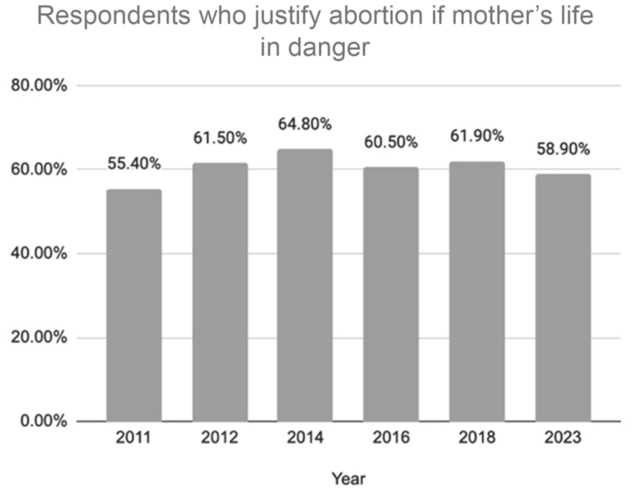
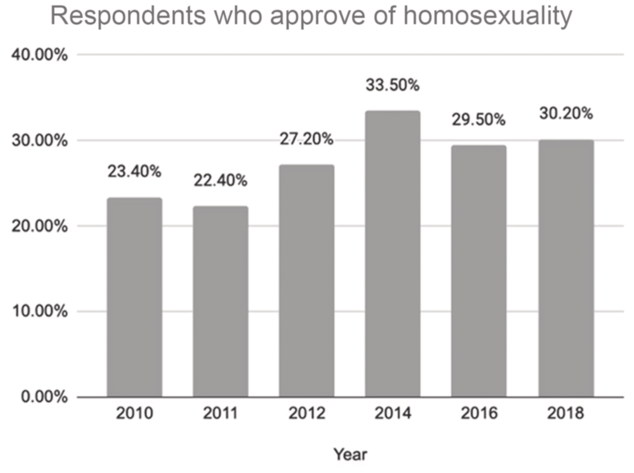
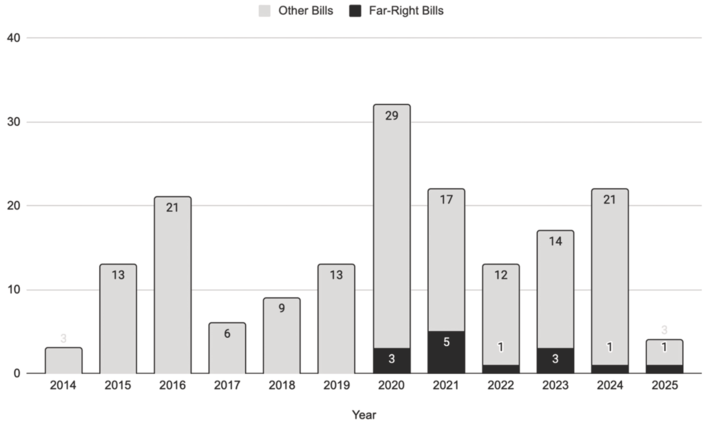
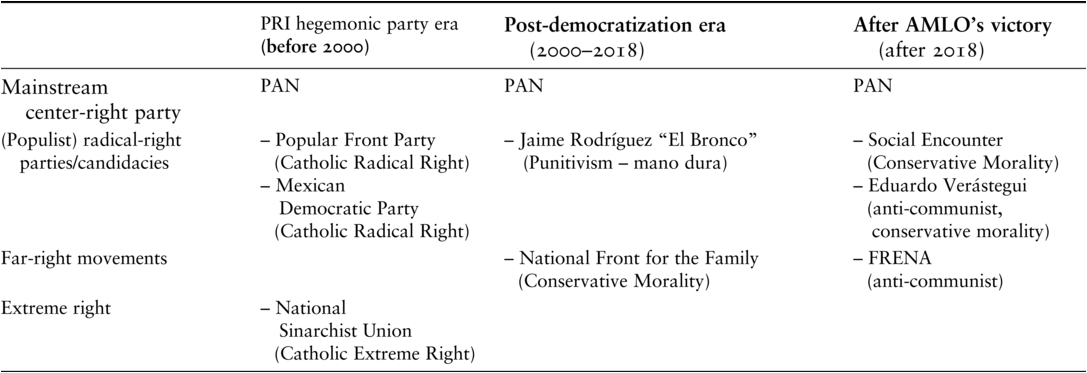
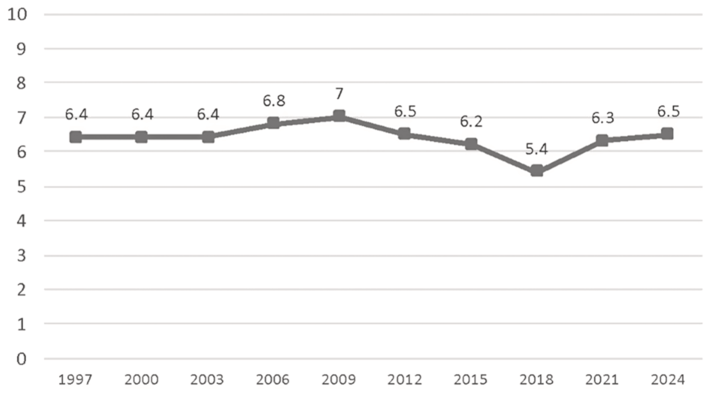
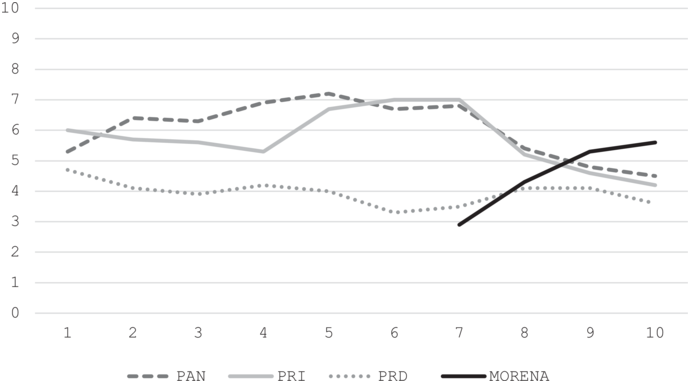
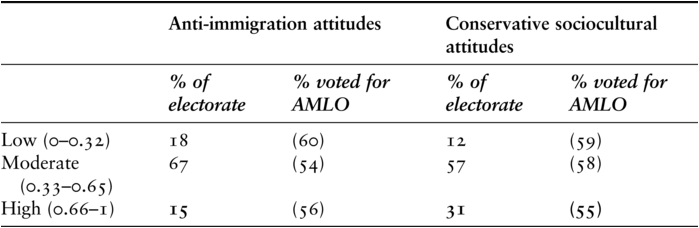
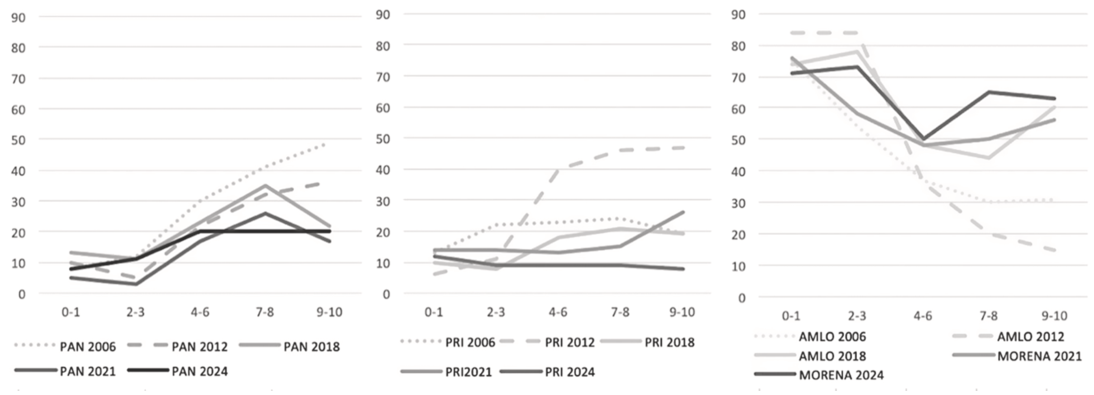
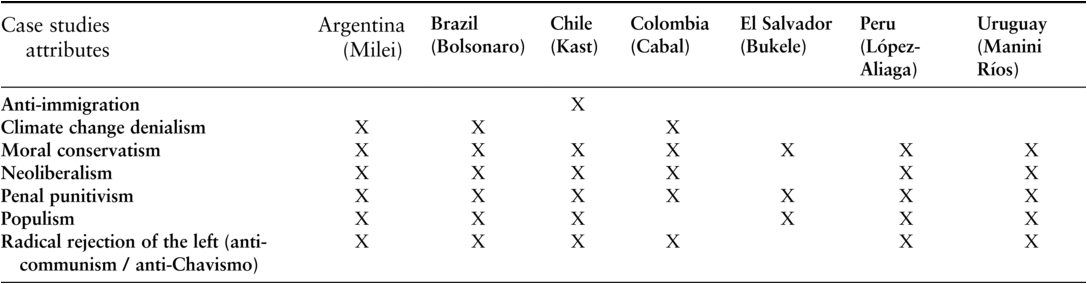

 Open access