

Panel XXII-XXIV of the Galería del Sílex (G.E.E.).

The site of Galería del Sílex, part of the Atapuerca complex in Burgos, Spain, is exceptional for the conditions of its discovery, as well as for the good state of preservation of the graphic manifestations and archaeological assemblage it contains. As a result, it has been possible to learn about some of the burial practices and ritual behavior of the Bronze Age societies that lived in this region. Certain charcoal-drawn figures have been found in the Galería del Sílex, a rare form for Post-Paleolithic rock art, that is commonly dominated by engravings and red paintings located in open-air sites or rockshelters. Under the exceptional cave conditions, we have obtained dates of 3,530±110 yr BP and 3,670±40 yr BP for Galería del Sílex drawings, representing one of the first (Sanchidrián et al. 2001) results of this kind obtained for Post-Palaeolithic rock art in Western Europe. These results provide us with a solid evidence for the development of graphic manifestations in early complex societies and bring into question previous stylistic proposals (Reference BreuilBreuil 1933-35; Reference ObermaierObermaier 1924; Reference AcostaAcosta 1968; Gómez-Barrera 1999), that were mainly based on artistic arguments and comparisons with limited ceramic decorated assemblages.
Anthropomorphic cross-shaped drawing.

The Sierra de Atapuerca (Burgos, Spain), a small arched hill range about 15 km to the East of the city of Burgos, is located on the Western plateau of the Iberian Peninsula, at the NE rim of the Duero Basin. The Sierra contains a karstic system developed in Cretaceous calcareous bedrock containing several Lower and Middle Pleistocene archaeological and paleoanthropological infillings (Trinchera Dolina -Bermúdez de Castro et al. 1999-, Trinchera Galería -Carbonell et al. 1999-, Trinchera Elefante -Rosas et al. 2001- and Sima de Los Huesos -Arsuaga et al. 1997-) representing some of the earliest human occupations of Europe. Additionally in this complex, two Holocene sites, El Mirador rockshelter and Portalón of Cueva Mayor, have been excavated and studied by the current research team since 1999. The latter has yielded evidence of Middle Age, Roman, Bronze Age (Early, Middle and Late) and Chalcolithic occupations.
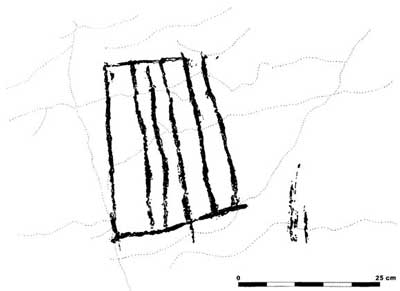
Grill-shaped black-painted motif (G.E.E.).

Galería del Sílex, consisting of winding 920 meters long corridor, belongs to the upper level of the Cueva Mayor-Cueva del Silo karstic complex (Martín et al. 1981), that was discovered during a entrance clearing by speleologists in 1972. The current entrance, substitutes for the original one that was sealed at some time after Bronze Age. Thanks to this, the archaeological and paleoanthropological record of the last human activities carried out in the gallery were found in situ on the surface and exhibit an excellent state of preservation .The Gallery was closed immediately after the discovery of the art to preserve it and to prevent disturbance of materials found of the floor, thus avoiding any alteration or contamination of this exceptional karstic chamber. Work carried out between the 70's and 80's (Apellániz & Domingo 1987) documented the following archaeological materials: a) lithic assemblage: 10 hammerstones, a minimum of 80 flint nodules extracted from a flint quarry located at the end of the gallery, 7 blades, 6 flakes, 3 foliate points -2 of them with a central stem, 1 sickle element and 1 circle segment, b) worked bone assemblage: 6 objects, mainly pointed elements, c) domestic faunal assemblage: remains of 11 individuals of Ovis aries and Capra hircus, 3 Sus scrofa, 1 Bos taurus, Sus domesticus and Canis familliaris; and wild faunal assemblage: 5 Lepus capensis, 4 Oryctolagus conniculus and 1 Cervus elaphus, Sus scrofa, Ursus arctos, Vulpes vulpes and Felis silvestris, d) human skeletal remains: at least 25 individuals (8 adults, 5 juveniles and 12 infant), e) 9 stone circles, f) 3 storage pits or silos, g) a large structure constructed with clay and speleothem fragments for water accumulation, associated with a filtration and dripping area, and h) a large ceramic assemblage displaying forms and decorations reflective of an interrupted occupation of the gallery spanning from the Neolithic to the Late Bronze Age.
Lithics collected in the survey.

A major iconographic ensemble was also documented on the gallery walls (Apellániz & Uribarri 1976), featuring black and red paintings, as well as engravings distributed along 53 different panels (FIGURE 1). The themes are mainly composed by linear and geometrical shapes (simple reticules and others with lateral appendices, grids, simple marks, row-forming dots, tree-shaped, comb-shaped and roof-shaped signs, zigzags and undulating shapes).
All of these shapes are evocative of abstract aesthetic, anthropomorphic shapes or, in fewer cases, with schematic human or animal representations. A temporal framework for the human occupations at Galería del Sílex was proposed (Apellániz & Domingo 1987), based on the chrono-cultural characterization of the ceramic remains, as well as on morpho-stylistic relationships between decorative motifs on pottery and on rock art.
The associations and spatial distribution of the lithic, faunal, paleoanthropological, ceramic and artistic remains do not activities of an economic nature. The small lithic and faunal assemblages show a distribution pattern different of the habitation settings. The study of the ceramics reveals a spatial dispersal in which the fragments from a single vessel were found at different places of the cave. This suggests that humans were responsible for breaking the vessels in the gallery and dispersing the fragments. The distribution of the human remains in small individualized groups suggests a secondary deposition of the corpses, represented by several incomplete skeletal groups from various individuals; moreover, one of the skulls displays anthropogenic scrapings, which would point to a previous treatment of the corpses prior to their final deposition inside the gallery. All of these elements suggest the development of activities related with the funerary world, where the collective nature of the burials and ritual elements (mainly ceramics and art) probably played an important role. For all this, we consider that the term sanctuary to designate the Galería del Sílex site is appropriate.

The fact that Galería del Sílex represents a closed space, the exceptional conditions of its discovery and the existence of charcoal-painted figures make this site of great significance for Post-Palaeolithic rock art research. Most of the other evidence for this period is composed of engraved or red-painted (Fe2O3) motifs and most of the graphic assemblages are found in exterior spaces (rock shelters or open air sites), and thus exposed to climatic regimes and biological contaminations. The black-painted motifs provide the opportunity to obtain direct AMS a dates for prehistoric Post-Palaeolithic rock art for the first time.
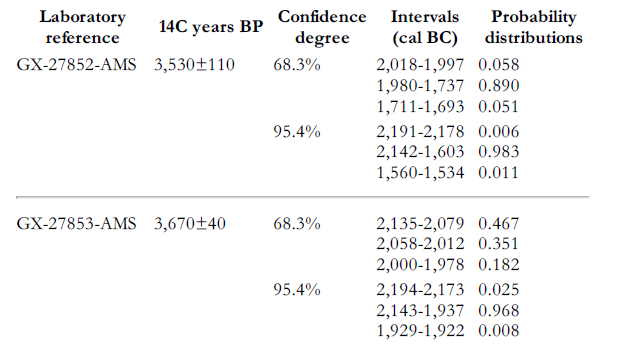
Several small charcoal samples were collected from two different figures. Samples were pre-treated for AMS analysis and dated by Dr. Alexander E. Cherkinsky at Geochron Laboratories. The treatment of the samples followed the required laboratory protocols (Valladas et al. 1992; Russ et al. 1990, Lorblanchet et al. 1990). In particular, the procedure carried out, according to the report is as follows: "The charcoal fragments were separated from sand, silt, rootlets and other foreign matter. The sample was then treated with hot dilute 1N HCl to remove any carbonates; with 0.1N dilute NaOH to remove humic acids and other organic contaminants; and a second time with dilute HCl. The sample was then rinsed and dried and the clean charcoal was combusted to recover carbon dioxide for the analysis". An anthropomorphic cross-shaped motif (Figure 2) was dated to 3,530±110 14C years BP (GX-27852-AMS); the δ13CPDB content, based on the 95% modern standard from the National Bureau of Standard Oxalic Acid, is -23.4%; the gross sample weight was 0,15 mg with 0,08 mg of dateable carbon. The other side, a grill-shaped sign (rectangle divided for four lines) (Figures 3, 4), was dated to 3670±40 14C years BP (GX-27853-AMS); the δ13CPDB content is -24.8%; the gross sample weight was 0.8 mg with 0.6 mg of dateable carbon. The establishment of corrected dates according to the INTCAL 98 (Stuiver et al. 2000) calibration curve (Table 1) shows a chronological range that spans the early 3rd Millennium to the late 2nd Millennium BC for the grid motif, and early 3rd Millennium to mid 2nd Millennium BC for the cross-shaped anthropomorphic figure. The dispersion of the GX-27852 sample is reduced and tends to concentrate around the early 2nd Millennium BC when considering the intervals that show a greater degree of probability in their distribution. This motif is superimposed by a wide range of linear motifs, especially vertical parallel lines.

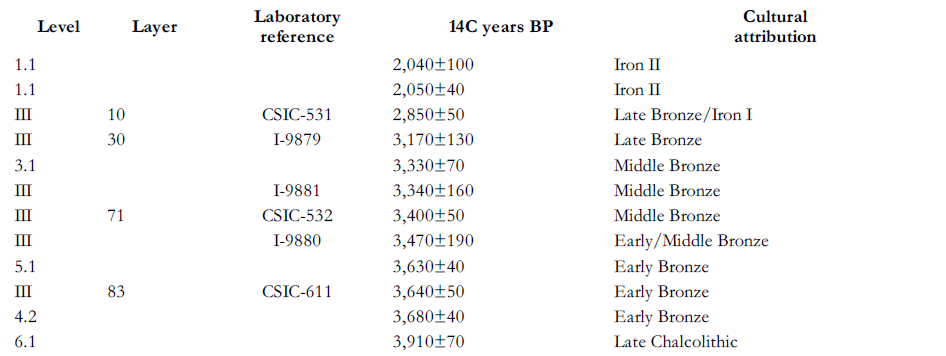
These results and their comparison with dates from the inland Portalón site at the entrance of the Cueva Mayor (Table 2), which was a habitation locus, show a continuity for the occupation of the cave during the initial moments of intensification of social complexity among the inhabitants of this region. The different functions given to spaces is evidence for a high degree of organization and management of the karstic space during the Early Bronze Age (Delibes & Fernández 2000). There is also an open-air Bronze Age site on the slope outside the Cueva Mayor (Reference ClarkClark 1979).
Most of the stylistic arguments (Reference BreuilBreuil 1933-35; Reference ObermaierObermaier 1924; Reference AcostaAcosta 1968; Gómez-Barrera 1999) that have been set forward regarding Post-Palaeolithic art support the existence of a long artistic cycle with common developmental trends, which would have started in the Neolithic, with sub-naturalistic figures followed by a progressive tendency towards a concentration and simplification of forms up to the Late Bronze Age, finally reaching an abstract style at in several geographic settings. The data presented here document the coexistence of complex geometric and figurative forms showing a high level of schematization around the mid 4th millennium BC in the peninsular plateau region. Systematic use of AMS dating techniques on black-painted art work will continue to provide information to build a prehistoric rock art graphic developmental scheme that pays attention to regional stylistic variables. Hence it will be possible to present a diachronic sequence ranging from the Upper Palaeolithic to the Late Iron Age. Finally, it will be possible to define the specificity and idiosyncrasy of artistic creation in human groups as well as some of the aesthetic concepts behind the earliest evidences of symbolic creation.
Acknowledgements
The field work was supported by the Junta de Castilla y León and the Research Project by the Ministerio de Educación y Ciencia (DGICYT, project no. BXX2000-1258-C03). The dates were financed by Grupo de Espeleología Edelweiss of the Excma. Diputación Provincial de Burgos. We thank C. Mallol for help with the traduction and L. G. Straus and J. Bischoff for their comments and help in the final text.