





Introduction
The Speaker is an important actor in parliamentary politics (Jenny and Müller Reference Jenny, Müller and Döring1995; Martin Reference Martin2002). Often, the Speaker has considerable leeway in deciding what happens in the parliament they chair: many Speakers have the power to set the agenda, decide who speaks, and they can sanction MPs when their speeches violate the rules of procedure and well-established norms. Despite their central role in parliaments, we know surprisingly little about Speakers and how they make decisions (Martin Reference Martin2002). It is an open question whether Speakers act as neutral arbiters between MPs, whether they operate in a partisan way, or in coalition systems, whether they operate as an asset of the coalition.
To get a grasp of how Speakers operate, we look at oral questions. In many parliaments, Speakers select who will speak during question hours. As Wiberg (Reference Wiberg and Döring1995: 204) noted thirty years ago, ‘[l]ittle is known about the true status of the Speaker in this context’. In the UK House of Commons, MPs ‘bob’, standing up when there is the opportunity to ask a question hoping to catch the eye of the Speaker or their clerks.Footnote 1 In the Dutch House of Representatives (Tweede Kamer der Staten-Generaal), a parliament with more bureaucratic and less romantic traditions, MPs submit their oral questions to the Speaker before the start of the ‘little hour of questions’. The Dutch Speaker selects a limited number of questions that will be asked. Examining this selection process provides an important and unprecedented opportunity to look at how Speakers make decisions. Our main question, therefore, is as follows: Under what conditions is the Speaker more likely to select an oral question?
The availability of the list of all proposed questions in the Dutch House gives a unique opportunity to study how Speakers make decisions about the political agenda. Using these decisions about question time gives a rare chance to test which considerations guide the decisions of the speakers. This study has clear relevance outside the confines of the Dutch case: many parliaments have a question time where MPs can ask questions to ministers (Russo and Wiberg Reference Russo and Wiberg2010; Serban Reference Serban2022). Here, MPs also send their questions to the Speaker, but this list is not made public. For example, in the House of Commons, urgent questions are submitted to the Speaker and they decide which ones are asked.Footnote 2 Our study has value beyond the case of oral questions: every house or unicameral parliament has a Speaker who has the ability to make decisions about who gets to speak and which issues are on the agenda (Jenny and Müller Reference Jenny, Müller and Döring1995). In many parliaments, if multiple MPs want to speak, the Speaker decides who is recognized. This is the case in floor speeches in the New Zealand House of Representatives and catch-the-eye remarks in the European Parliament, after the time for the ‘foreseen’ speakers on the list of the EP president. Because of the unique documentation that is available in the Netherlands, we can see which factors drive their decision-making. As the Dutch Speaker is representative of other Speakers in Europe, if we find evidence of bias in oral question selection, there is good reason to search for evidence of bias in other countries and in other procedures.
We develop three perspectives on the Speaker: the first sees the Speaker as a neutral arbiter between the different parties. The second perspective sees the Speaker as a partisan asset, who will operate in the interest of their own party. Finally, there is the Speaker as the asset of the coalition, who will seek to keep the coalition stable.
The speaker
In 2002, Martin noted that ‘[w]hile other areas of legislative scholarship have benefited from the use of theoretical foundations … research on the Speaker has not progressed at the same pace’ (132). Though this observation is now more than two decades old, it still rings true. Academic work on Speakers of subnational assemblies (Clucas Reference Clucas2001; Richman Reference Richman2010) understands parliamentary leadership from a principal-agent perspective (Cox and McCubbins Reference Cox and McCubbins2007). That is: all MPs give up some of their power to a Speaker to allow for a more organized decision-making process. This, however, means that the Speaker is not an independent agent. They serve at the pleasure of their principal. To understand the Speaker, we must know who their principal is: they can be an agent of the house as a whole or an agent of their party. This reflects a British and American conception of how the Speaker should operate. We will present these two as ideal types and add a third type: the Continental European Speaker, who is an agent of the coalition.
Neutral arbiter
In the British conception, the Speaker is a neutral actor. The Speaker is seen as occupying a high office, above party competition (for a critical discussion, see Martin Reference Martin2002). This idea is pervasive in the literature: ‘[i]mpartiality is the absolute keystone to the Westminster style of Speakership’ (Laban Reference Laban2014: 144). Martin (Reference Martin2002) unpacks this notion of ‘neutrality’. Firstly, the Speaker is impartial: they do not take a side between the coalition and the opposition, or between the different parties represented in their parliament. We can see the neutrality of the position by the lack of contestation of the election of the Speaker (Jenny and Müller Reference Jenny, Müller and Döring1995). This neutrality can go even further into ‘non-partisanship’ where the Speaker breaks all ties with their previous party (Martin Reference Martin2002).Footnote 3 Yet, this neutrality is not the same as disinterest: a neutral arbiter will seek to defend the rights and privileges of the institution that they chair (Reuse and Verhelst Reference Reuse and Verhelst2024). The Speaker is ‘the servant of the House’ (Martin Reference Martin2002: 72). This Speaker thus is the agent of the parliament as a whole, as the power of the Speaker relies on the goodwill of the MPs. Moreover, neutrality may also be understood as part of the historically evolved role of the Speaker, guided by norms rather than rules (Martin Reference Martin2002).
Partisan speaker
This ideal-typical ‘British’ Speaker can be contrasted with the Speaker of the US House of Representatives. In the American conception, the Speaker holds a political office: The US Speaker is the leader of their party in the House (Cox and McCubbins Reference Cox and McCubbins2007). Their powers are an asset of the party that put them into office (Martin Reference Martin2002). They control the agenda, committee assignments, and chair positions and thus have considerable capacity to help or hinder the executive. The Speaker ‘is not only allowed but expected to use his position to advance party interests’ (Follett Reference Follett1902: 300). Perhaps this is exemplified best by the Hastert Rule (Cox and McCubbins Reference Cox and McCubbins2007), which holds that the Speaker will not advance a bill to the floor unless a majority of their caucus supports it. This reflects a principal-agent relationship: the Speaker’s real principal is their party, which in many systems is responsible for their reselection and re-election (Clucas Reference Clucas2001).
The American Speaker is sometimes described as an exception: most Speakers are expected to follow the British example (Martin Reference Martin2002). Martin (Reference Martin2002) questions the notion that Speakers in general will behave according to the British ideal of neutrality. He notes that as Speakers are only human, their preferences and beliefs are likely to guide their actions (Martin Reference Martin2002). In his analysis of the Irish Ceann Comhairle, Martin concludes that they often act as agents that prop up the government, or, as he cites the Teachta Dála Frank Aiken, ‘I think you [the Ceann Comhairle] are … nothing but a party machine’ (cited in Martin Reference Martin2002: 219). Jenny and Müller (Reference Jenny, Müller and Döring1995) observe that some Western European parliaments, like in Greece, Italy, France, Portugal, and Finland, Speakers are selected in a partisan fashion.
Asset of the coalition
Some aspects of European party politics are difficult to square with both the American and British conception of the Speaker (Bergougnous Reference Bergougnous1997). Both ideal types fit into a two-party system. Coalition politics changes the role of the Speaker. A key feature of coalition systems is their instability (Lijphart Reference Lijphart2012): disagreement in the coalition can bring about the end of a government and, with that, the dissolution of parliament. That has consequences for the Speaker as well. If the Speaker wants to keep their job, they have to act as an agent of the coalition: In the elections, the Speaker could lose their seat,Footnote 4 and if they are re-elected, they may lose their Speakership in the subsequent internal elections. Speakers have a lot to lose: their status, the increase in income, and the car with driver. In order not to risk this, they have an interest in keeping the current coalition in power.
About one in four Speakers in Western Europe comes from opposition parties (Jenny and Müller Reference Jenny, Müller and Döring1995). At the core of our notion of the Speaker as ‘an asset of the coalition’ is that they will seek to keep the coalition in power regardless of whether they are a member of a coalition party or of an opposition party. This may seem counterintuitive, as Speakers from opposition parties are likely to be dissatisfied with the government’s policies. Yet, new elections risk not just their position as MPs but their Speakership. Given that there are often more than one hundred MPs and only one Speaker, and that the incoming coalition may have strong views about the Speakership, their continuation in the Speakership is not necessarily ensured. Offering an opposition MP the Speakership may be an important strategic resource that coalition parties can use to secure support for their government (Pukelis Reference Pukelis2016). Cooperation between this opposition chairperson and the local executive can be constructive (Reuse and Verhelst Reference Reuse and Verhelst2024).
Question time
Speakers call on individuals to speak in the parliament they preside. The freedom they have to recognize particular MPs differs from debate to debate and from parliament to parliament. In many parliaments, there is no way to bring forward an oral question without the consent of the Speaker (Wiberg Reference Wiberg and Döring1995). MPs who want to ask a question during question time may indicate this to the Speaker. In many parliaments, such as the Dutch Tweede Kamer, the Danish Folketing, the Japanese Diet, the UK House of Commons, and the Irish Dáil (Bergougnous Reference Bergougnous1997; Martin Reference Martin2002; Serban Reference Serban2024), the Speaker decides which questions can be asked. This role may be limited by both the rules of the Chamber and precedent (Martin Reference Martin2002): for instance, the Speaker of the House of Commons alternates between the MPs in the governing majority and the opposition benches (Martin Reference Martin, Bouhadana, Gilles and Nguyên-Duy2016).
Question time is a feature of many parliaments: a specific time of day, week, or month is allotted to ask oral questions (Russo and Wiberg Reference Russo and Wiberg2010; Serban Reference Serban2022). We can understand this scrutiny tool from different perspectives (Borghetto and Chaqúes-Bonafont Reference Borghetto, Chaqués-Bonafont, Baumgartner, Breunig and Grossman2019). On the one hand, to assess and judge the appropriateness of government action (Auel Reference Auel2007), oral questions are a way to get information about the actions and inactions of the government. Otjes and Louwerse (Reference Otjes and Louwerse2018: 497) argue that parliamentary questions can also be used as strategic party tools: ‘parliamentary questions are the continuation of election campaigns with different means’. They thus understand the use of parliamentary questions in the context of issue competition (Green-Pedersen Reference Green-Pedersen2007).
Oral questions may be more likely to be guided by political considerations than written questions: they are often televised, can thus reach a larger audience, get more attention, and affect mass political engagement (Salmond Reference Salmond2014). This has implications for the process that generates questions: individual MPs and PPGs have different incentives. Individual MPs have an incentive to use parliamentary questions to signal to voters that they are working for them and to signal their competence to party leaders (Bailer Reference Bailer2014). Party leaders have an incentive to present a clear, unified party label.
The neutral arbiter & questions
Neutrality can express itself in two ways: by treating everyone equally or by following rules. A neutral arbiter should treat all MPs equally, independent of party and coalition participation. This would mean that the Speaker is likely to give every MP an equal opportunity to ask a question. Some MPs may be more enthusiastic in submitting questions than other MPs, and others may be more reticent. A judicious Speaker is likely to give the floor to the MP who has gone the longest without asking questions (Dewdney and Ross Reference Dewdney and Ross1986; in the online Appendix, we further discuss different normative approaches to speaking order).
-
1. MP Time Hypothesis: The longer it has been since an MP last asked a question, the more likely they are to be given an opportunity to ask one.
Second, we can identify a neutral Speaker by seeing to what extent they keep to established norms. Specifically, where it comes to question selection, norms exist to ensure this neutrality. These norms differ from country to country. We focus on the norms that have been laid down for the Dutch Tweede Kamer. Speaker Khadija Arib (Reference Arib2017) wrote down her practice: the first norm she wrote down is that there should be no procedural concerns, in particular that there should not be other places where the subject can be brought to the attention of the government, there should not be an forthcoming (committee) debate where the same question can be asked or a recent debate where it could have been asked.Footnote 5 The second norm she identified is that the question should be current, that is, it should concern information that recently became public. The third norm she noted is that the question should concern an urgent matter. The final norm she wrote down is that the subject matter should be of sufficient importance to merit discussion. One way to see whether the Speaker is a neutral arbiter is to identify whether they select questions that meet these norms.
-
2. Norm Hypothesis: The Speaker is more likely to approve questions that meet existing norms.
The partisan speaker & questions
In the American tradition, the Speaker is a partisan actor who pursues partisan interests. There are different ways to approach this partisan interest.Footnote 6 Firstly, they can have a defensive strategy. MPs are likely to use questions to criticize the minister, to portray their policy in a negative light, and signal to journalists, interest groups and voters that the government party is incompetent (Borghetto and Chaqúes-Bonafont Reference Borghetto, Chaqués-Bonafont, Baumgartner, Breunig and Grossman2019; Otjes and Louwerse Reference Otjes and Louwerse2018). The Speaker can quash questions directed at ministers who are members of their own party. This prevents a negative direction towards their own party.
-
3. Partisan Minister Hypothesis: The Speaker is less likely to approve a question directed towards a minister of their own party than to a minister of another party.
Opposition and coalition parties have different incentives when asking questions: opposition parties tend to ask what Wiberg and Koura (Reference Wiberg, Koura and Wiberg1994: 23) call ‘inconvenient questions’, while coalition parties ask questions meant ‘to help the cabinet distribute information that is believed to be politically expedient for the cabinet’ (ibid.). Kukec (Reference Kukec2024) shows that questions from a co-partisan of the minister are different from other questions. Ministers are likely to coordinate with co-partisans about the questions they ask beforehand, allowing them to tailor an effective response (Kukec Reference Kukec2024). The questions might even be drafted by the ministers’ staff instead of by the MP (Kukec Reference Kukec2024; Young Reference Young2007). A partisan Speaker may be ‘in’ on this game and may therefore be more likely to allow questions from MPs of their own party to ministers of their own party.
-
4. Co-Partisan Hypothesis: The Speaker is more likely to approve a question submitted by a member of their own party directed to a member of their own party than another question.
Not every MP is equal within a party. Party leaders are important figures: the party leader often plays a major role in the reselection of MPs (Van Dijk Reference Van Dijk2023).Footnote 7 Therefore, Speakers may be more likely to approve the request to ask a question from their own party leader.
-
5. Partisan Leader Hypothesis: The Speaker is more likely to approve a question of a leader of their own party than another MP.
Asset of the coalition & questions
Our final perspective is the Continental European perspective.Footnote 8 As we observed above, independent of whether the Speaker themself is a member of an opposition or a coalition party, in a coalition system, Speakers are an agent of the coalition: if the government falls, the parliament is dissolved, and the Speaker’s future in that chair is uncertain. This may affect which questions they select. As observed above, the notion of the Speaker as an asset of the coalition requires that both Speakers who are members of a coalition party as well as those who are members of an opposition party serve the interests of the coalition. We, therefore, formulate expectations that only coalition Speakers behave this way and that both coalition and opposition Speakers behave this way.
One way of serving the coalition would be for the Speaker to suppress ‘inconvenient’ questions from opposition parties. When the Speaker is an asset of the coalition, they may allow fewer questions from the opposition than from the coalition. Indeed, when it comes to requesting debates, we can see that coalition parties often act as one bloc to block requests from the opposition (Otjes Reference Otjes2019). We examine whether any Speaker acts to give more coalition MPs more opportunities to ask questions, or whether only Speakers who are members of a coalition party do so.
-
6. Coalition MP-Coalition Speaker Hypothesis: A Speaker from a coalition party is more likely to approve a question from a member of a coalition party.
-
7. Coalition MP Hypothesis: The Speaker is more likely to approve a question from a member of a coalition party.
A Speaker thus has a special interest in keeping the coalition together. To understand the incentives of the Speaker as the asset of the coalition, we draw on the work of Van de Wardt, De Vries and Hobolt (Reference Van de Wardt, De Vries and Hobolt2014), who propose that opposition parties will try to politicize wedge issues: parties that negotiate to form a coalition do not agree on everything. There is always some degree of conflict between coalition partners, and parties in the opposition may seek to destabilize the coalition by directing attention to the wedge issues that divide them (Van de Wardt et al. Reference Van de Wardt, De Vries and Hobolt2014). An oral question is a way to direct the attention of journalists to the weak point in the coalition (Van Aelst et al. Reference Van Aelst, van Santen, Melenhorst and Helfer2016). A single oral question may only be one maneuver in a sustained strategy to politicize the weak point in the coalition in order to weaken the coalition and force early elections. The role of the asset of the coalition is clear: quash questions that emphasize the issue differences in the coalition. As an asset of the coalition, both coalition and opposition Speakers will downplay questions that would divide the coalition. For this reason, we propose hypotheses both for all Speakers and coalition Speakers only.
-
8. Coalition Speaker-Coalition Issue Division Hypothesis: A Speaker from a coalition party is less likely to approve a question on an issue that divides the coalition than on an issue that unites the coalition.
-
9. Coalition Issue Division Hypothesis: The Speaker is less likely to approve a question on an issue that divides the coalition than on an issue that unites the coalition.
Case selection and description
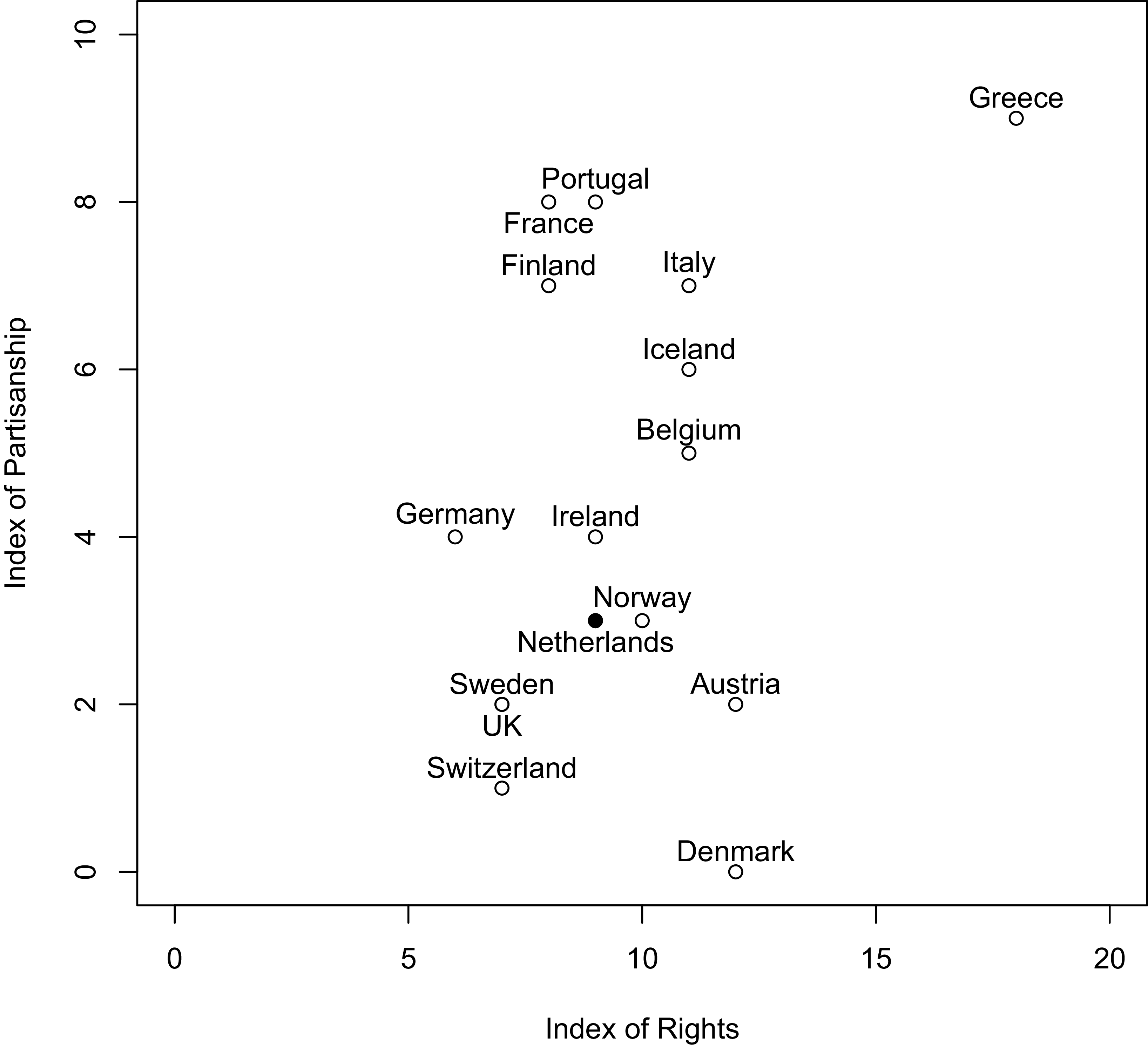
The Netherlands, because of the availability of a list of proposed questions, is a unique opportunity to study how Speakers make decisions. Our study thus focuses on the Speaker of the Dutch House of Representatives (Voorzitter). It may be useful to consider to what extent this Voorzitter is representative of other Speakers. Jenny and Müller (Reference Jenny, Müller and Döring1995) provide – despite being thirty years old to our knowledge – the most recent overview of the rights and partisanship of Speakers of Western European parliaments, as shown in Figure 1. The Index of Rights aggregates the number of powers the Speaker has. The Index of Partisanship reflects the breadth of their support when elected, whether opposition MPs could serve in the position, and whether Speakers belong to the top party personnel. On the Index of Rights, the Voorzitter has the median score. On the Index of Partisanship, they score a three, just below the median. As we will see below, for about a third of the research period, the Voorzitter was a member of an opposition party. On average, one in five Speakers in Western Europe comes from opposition benches (Jenny and Müller Reference Jenny, Müller and Döring1995). So even in this respect, the Tweede Kamer is similar to their Western European colleagues and, in general, the Voorzitter appears to be quite representative of these colleagues.
Speakers of West European Parliaments.
Based on Jenny and Müller (Reference Jenny, Müller and Döring1995).

The Voorzitter is selected by a secret ballot among MPs. Formally, the House has had the right to choose its own chair since 1983 (Van den Braak Reference Van den Braak2016).Footnote 9 Yet, competitive elections have been held since the mid-1800s (Van den Braak Reference Van den Braak2016). Different traditions have governed the appointment of the Speaker: since the late 1800s, the norm was that the biggest party in the House had a claim to the Speakership (Van den Braak Reference Van den Braak2016), yet sometimes another party in the governing coalition would get the Speakership or even an opposition MP would get elected. Since the late 1990s, competitive elections have been the norm. However, some Voorzitters are still selected after coordination within the coalition.Footnote 10 Since the introduction of universal suffrage, three out of four Voorzitters were members of coalition parties, and seven out of ten Speakers were a member of the largest party in parliament.
Table 1 lists the Voorzitters in the research period: in 2012, Liberal MP Anouchka van Miltenburg was elected, beating Khadija Arib (Labour Party) among others. Already during the election of the Voorzitter, the Liberal and Labour parties were in talks to form a coalition. At the end of 2015, Van Miltenburg had to step down because her actions in a whistleblower case were seen as partisan.Footnote 11 At the beginning of 2016, her vacancy was filled by Arib. After the 2017 election, Arib was re-elected to the Speakership unopposed. The Labour Party did not return to government after a major electoral defeat. Arib thus served as Voorzitter and a member of the opposition at the same time. In 2021, Vera Bergkamp from the social-liberal coalition party D66 was elected, beating Arib among others.
Speaker of the Dutch house of representatives

The Dutch question hour occurs weekly (every Tuesday at 14.00). Beforehand, MPs (or their staffers) submit their questions to the Speaker. They make a list, and just before question hour, they indicate which questions will be asked. In the Dutch system, MPs are the spokespersons of their party on a specific issue and have considerable leeway to take initiatives, including submitting oral questions (Otjes and Louwerse Reference Otjes, Louwerse, Back, Debus and Fernandes2021). One may argue that the Speaker as an asset of the coalition only matters if the coalition is precarious. As Table 1 shows, each cabinet had a razor-thin majority.
Methods
Dependent variable
Our analysis looks at how the Speaker of the Lower House of the Dutch Parliament selects questions. Their role in selecting oral questions goes back to the institution of the right in the early 20th century (Visscher Reference Visscher, Van Baalen, Bos, Breedveld, Van der Heiden, Ramakers and Secker2006). The basis for our analysis is the list of all proposed questions. This was made available by the Clerk of the Lower House for the period between 1 January 2013 and 18 October 2022. There are 9521 requests. We compared this to a list of 1254 questions, which were actually posed in this period (Louwerse and Otjes Reference Louwerse and Otjes2019, with our own additions). With computer-assisted text comparison, which we hand-checked, we identified which questions had been asked, resulting in a binary variable indicating whether a question was asked. The list of proposed questions has been available since 2013 because a new computer system allowed the clerks to systematically keep track of question requests. The question proposals are generally short and factual. The average question proposal is fifteen words long. Most proposals merely list the news item that the question refers to. Table A3 in the online Appendix lists the descriptives between the variables in the paper, and Table A4 lists the correlations between them.
Variables related to the neutral arbiter
Above, we presented three hypotheses that were related to the conception of the Speaker as the neutral arbiter. To test the MP Time Hypothesis, we look at how much time has passed since the MP last asked a question for the variable MP Time Elapsed. To this end, we integrate our list of proposed questions with the list of actually asked questions based on Louwerse and Otjes (Reference Louwerse and Otjes2019) for the period 2010–2017, Timmerman and Breeman (Reference Timmermans, Breeman and Van Baalen2010) for the period 1984–2010, and our own additions. For every proposed question, we can thus calculate the difference between the date of the question hour and the last question hour the MP participated in.
For the Norm Hypothesis, we look at the norms that we know matter in the Dutch context. We look at the formal criteria set down by Arib (Reference Arib2017). To identify the procedural concerns for the Question on Agenda variable, we need to compare the issue on the agenda with what the plenary and committee agendas looked like at the time of the decision-making. This is possible because every week, the Speaker also makes the agenda of the house available. We need to manually identify whether the issue that the question concerns is related to recently held and forthcoming debates. This is labor-intensive. Therefore, we have drawn a sample of 1439 proposed questions, and for these we examine whether the question is related to an issue on the agenda (see Appendix A1). For ease of coding, we drew a stratified sample: we selected weeks for which we coded all questions. For every period an MP was Speaker, we randomly selected weeks so that the number of coded questions is roughly proportional to the number of question requests that they received.
To identify the novelty of the information, for the variable Question Novelty, we use the difference between the date of the question and the date of the news item on which the question is based (this is shared with the proposed question). The date of the news item is available for 96 per cent of the questions.
To identify the urgency of the news we use the news source (this is shared with the proposed question) for the variable Question Urgency. The underlying idea is that the Speaker uses the news outlet in which the news was published, as an indicator of urgency. Nearly all questions are based on news sources. This can be a small local newspaper, a media outlet oriented at a specific sector or one of the major news outlets in the country: If the question is based on a news item from the national broadcasting organization (NOS) or its largest commercial competitor (RTL), or from one of the five main national newspapers (De Telegraaf, Algemeen Dagblad, De Volkskrant, Trouw or NRC), we code that the news is urgent. Journalists of these main national outlets select news on the basis of its urgency. They have limited ‘column inches’ so publish only urgent news, while local or sectoral news outlets may publish news that is less urgent. About 60 per cent of the questions are based on these major news outlets. To illustrate the mix of question sources, Table A5 lists the news sources that were cited 20 or more times and how we classified them. The selection is, by necessity, arbitrary. These sources represent a very narrow interpretation of main news media. In the Appendix A8, we look at a broader interpretation, which is essentially all news media except media that focus on specific regions or sectors. This different interpretation raises the share of questions referring to major media to about 70 per cent.
Our final variable is Question Salience. What makes an issue important is a political question. We therefore look at the aggregate attention to an issue as an indicator of its importance. We first identified which policy domain the question belonged to, using the Comparative Agenda Project’s manifesto coding (Green-Pedersen and Otjes Reference Green-Pedersen and Otjes2019). We then gave every issue a value equal to the seat-weighted average attention to that issue in the election manifesto.
Variables related to the partisan speaker
Three hypotheses were related to the conception of the partisan Speaker. To test the Partisan Minister Hypothesis, we identified the party of the minister to whom the question was directed to and checked whether this was the same as the party of the Speaker (for the variable Minister Speaker Co-Partisan).
To test the Co-Partisan Hypothesis, we constructed a variable which checked whether the question asker and the minister are from the same party. This is how we constructed our variable MP Minister Co-Partisan. We interacted this variable with the previous variable.
To test the Partisan Leader Hypothesis, we constructed a variable that checked whether the question asker was a PPG leader (MP Leader). We interacted this variable with the previous variable.
Variables related to the asset of the coalition
Finally, we propose four hypotheses related to the ideal type of the Speaker as an asset of the coalition. To test the Coalition MP Hypothesis and Coalition MP-Coalition Speaker Hypotheses, we examined the effect of the MP being from the coalition (for the variable MP Coalition). To test the notion that both coalition and opposition Speakers have the same bias towards giving the floor to coalition MPs, we interact this variable with a variable that identifies whether the Speaker is from the coalition (Speaker Coalition).
To test the Coalition Issue Division Hypothesis and Coalition Speaker-Coalition Issue Division Hypothesis, we built further on the CAP coding above. We assigned each policy domain to an issue dimension from the most recent Chapel Hill Expert Survey (CHES) (Jolly et al. Reference Jolly, Bakker, Hooghe, Marks, Polk, Rovny, Steenbergen and Vachudova2022). Where this was not available, we used the Populism and Political Parties Expert Survey (POPPA) codes instead (Zaslove, Huber and Meijers Reference Zaslove, Huber and Meijers2024). An overview of the combination of CHES and CAP codes can be found in Table A2. We examined the distance between each possible pair of coalition parties on that issue, and we recorded the maximum value across coalition parties to construct the variable Coalition Issue Distance. To test the coalition Speaker versions of this hypothesis, we interact this with the variable Speaker Coalition.
Control variables
We control for the share of questions that the Speaker allowed in that session. The number of questions that will be allowed is decided beforehand. During the Corona pandemic, because of lockdown procedures, fewer questions could be allowed than before. The chance that a question is allowed decreases as more questions are proposed. Therefore, we constructed the variable Share of Proposed Questions Accepted: For each session, we counted the number of questions that were allowed and divided this by the number of questions that were proposed. We expect that the greater the share of questions that are allowed at the aggregate, the more likely the Speaker is to allow the question.
Results
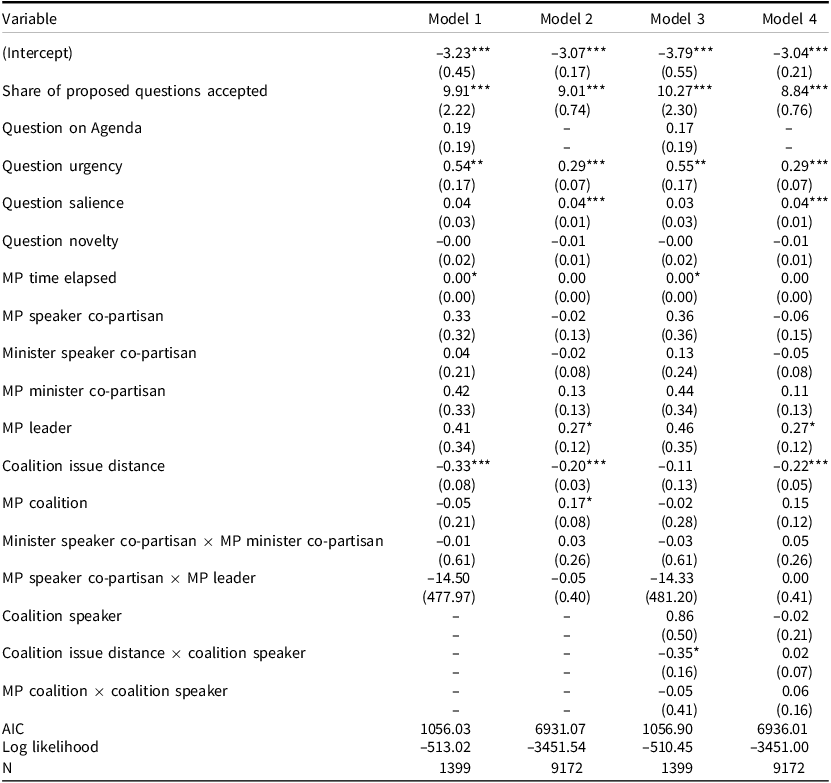
Table 2 and Figures 2 to 11 present our core results. Table 2 shows the following four models: The even models use all variables, including Question Agenda, which we only have for 15 per cent of the cases. The odd models drop this variable and look at (nearly) all cases. The second two models include interactions to separate the effect of the periods when the Speaker was a member of a coalition party and when they were not.
Logistic regressions
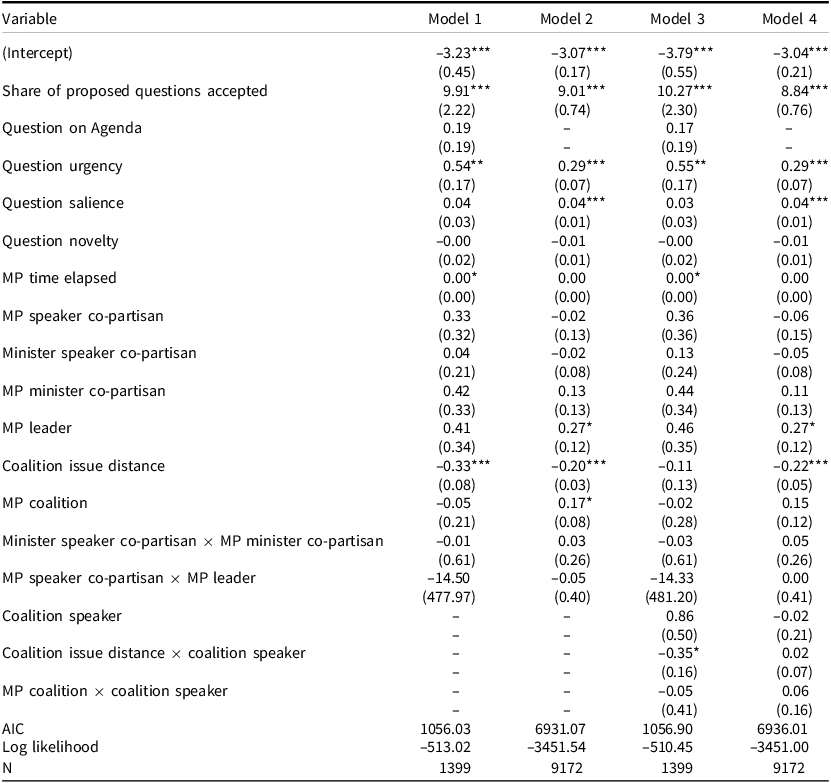
***p < 0.001; **p < 0.01; *p < 0.05.
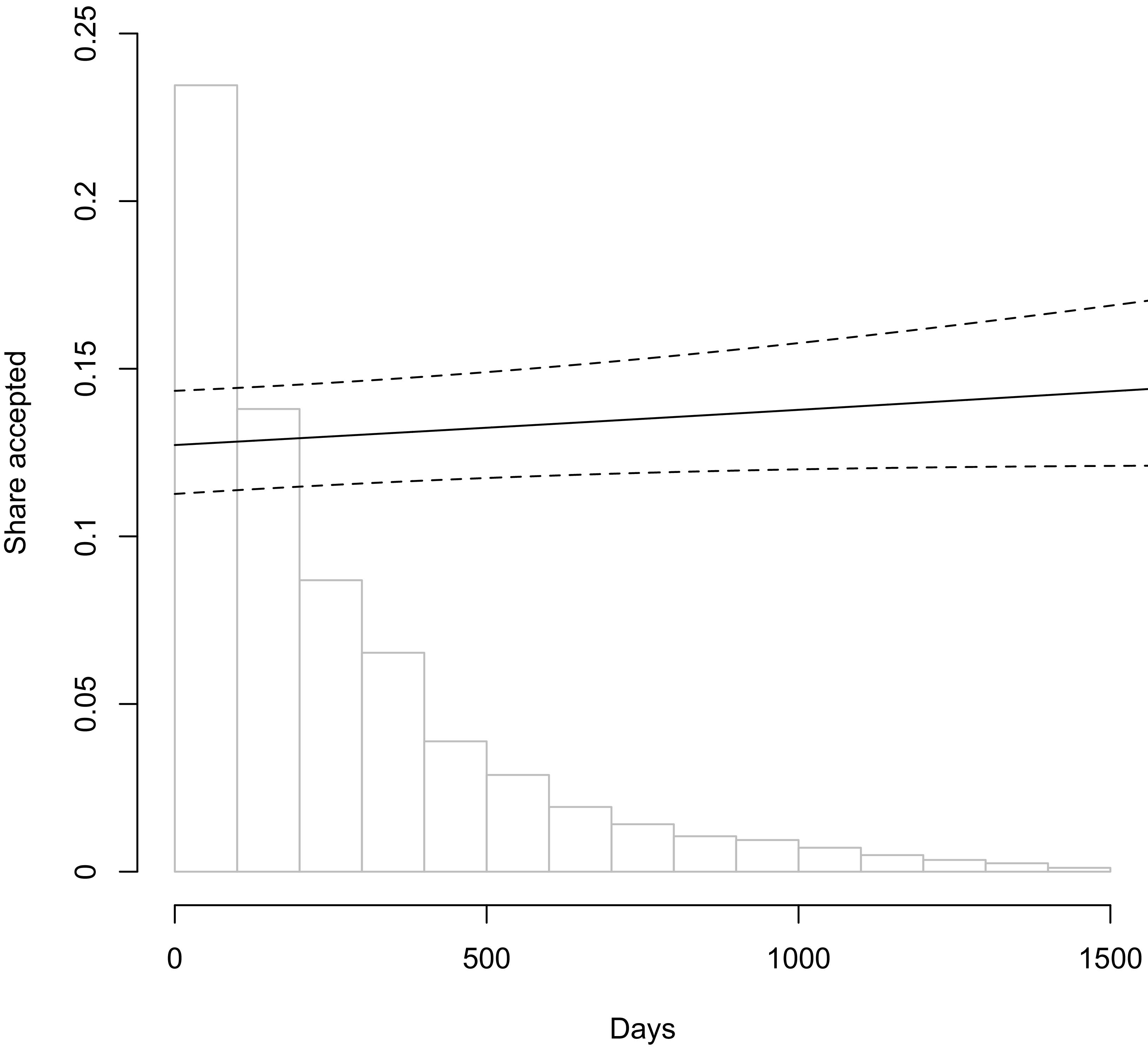
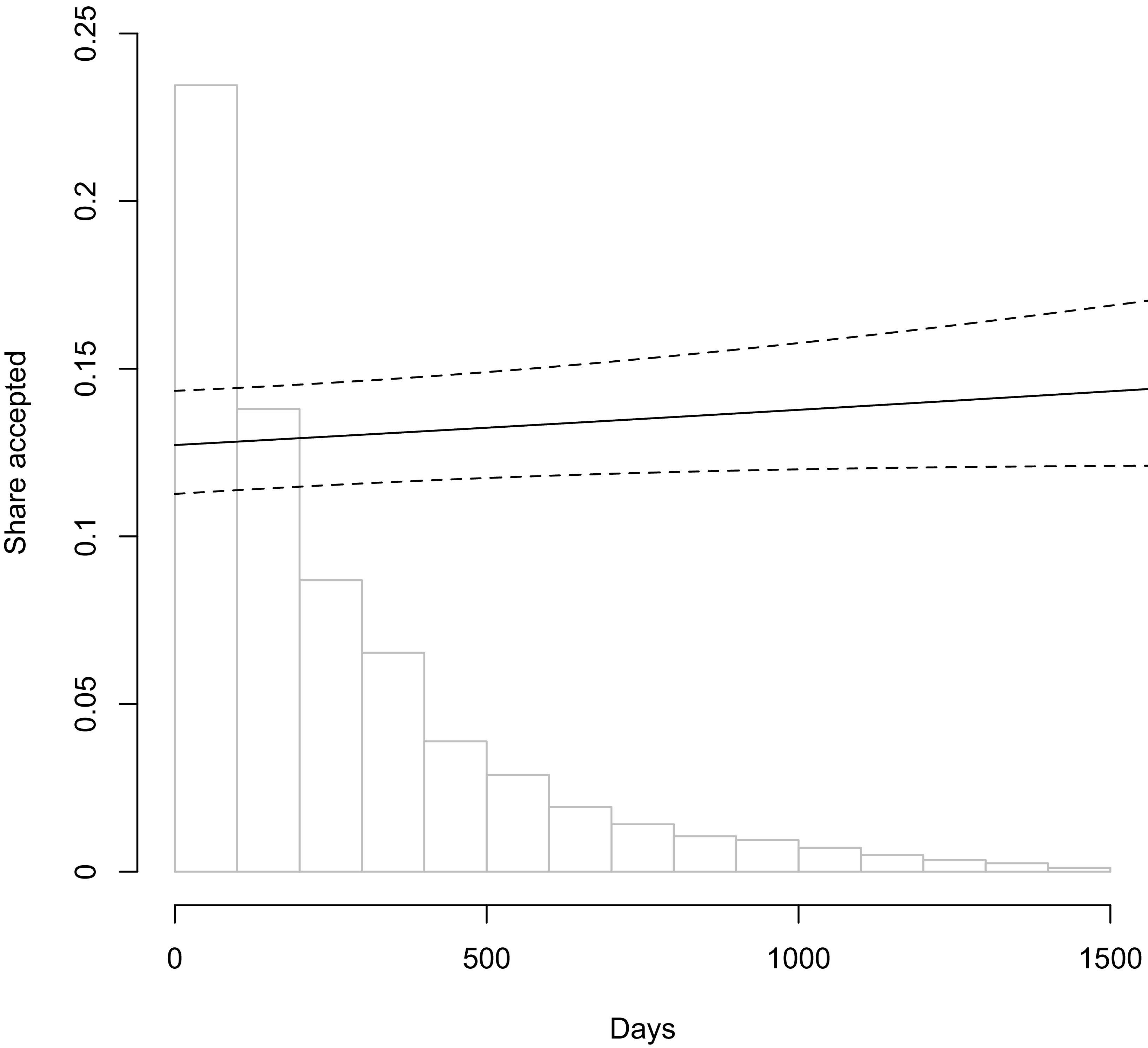
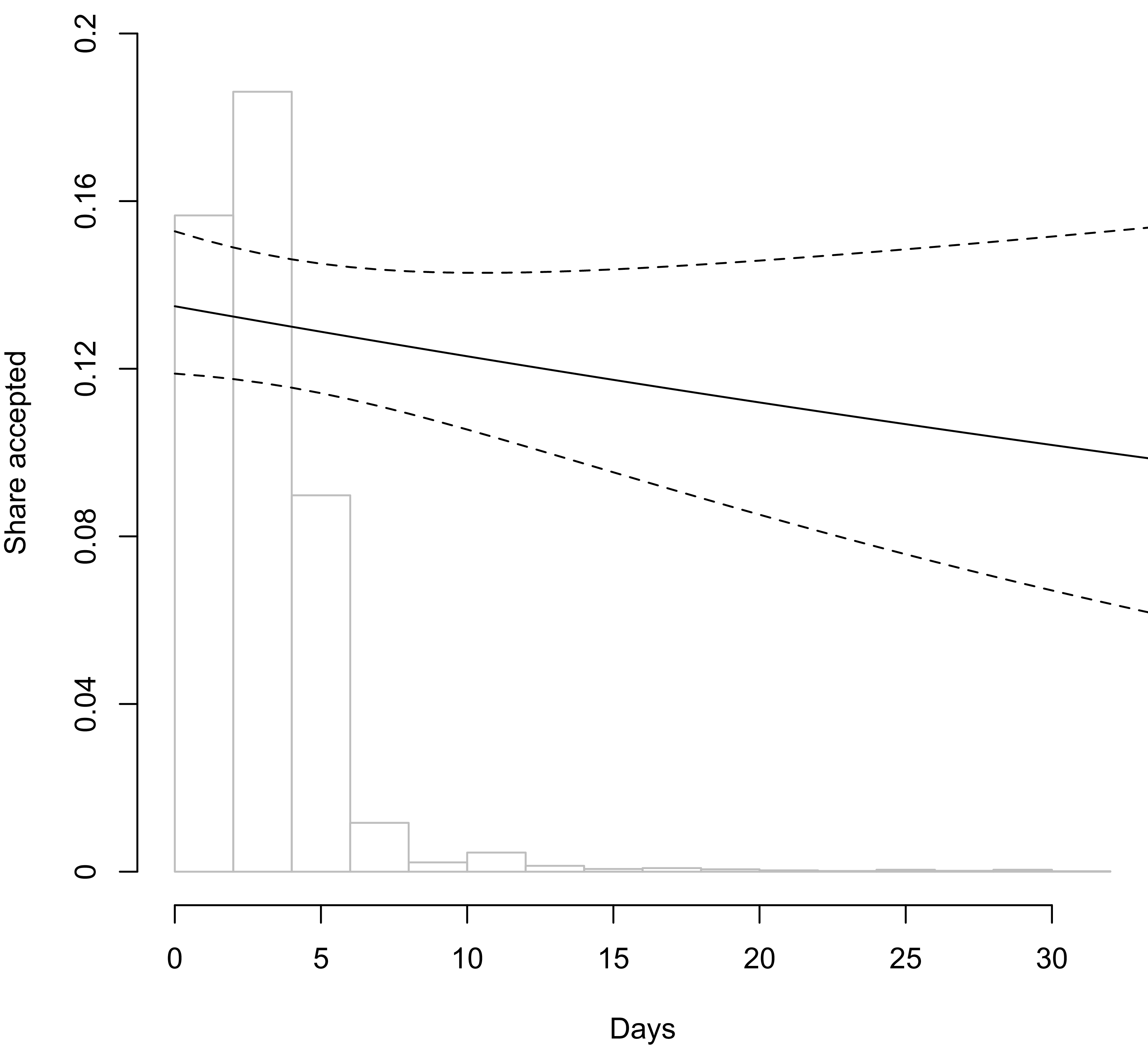
Time since MP asked question.
Estimate with 95% confidence interval; bars show distribution of independent variable. Based on Model 4. 2% of MPs did not ask a question for more than 1500 days.
Results for the neutral arbiter
We first examine the expectations related to the neutral arbiter: we first look at the MP Time Hypothesis. The neutral arbiter gives every MP an equal chance to ask a question. Therefore, we looked at the time since an MP last asked a question as an indicator. Figure 2 shows a flat line. The odd-numbered models, with a smaller N, even show a significant positive effect. All in all, there is no evidence that an MP who has not asked a question for a while has a greater chance than an MP who asked a question last week.
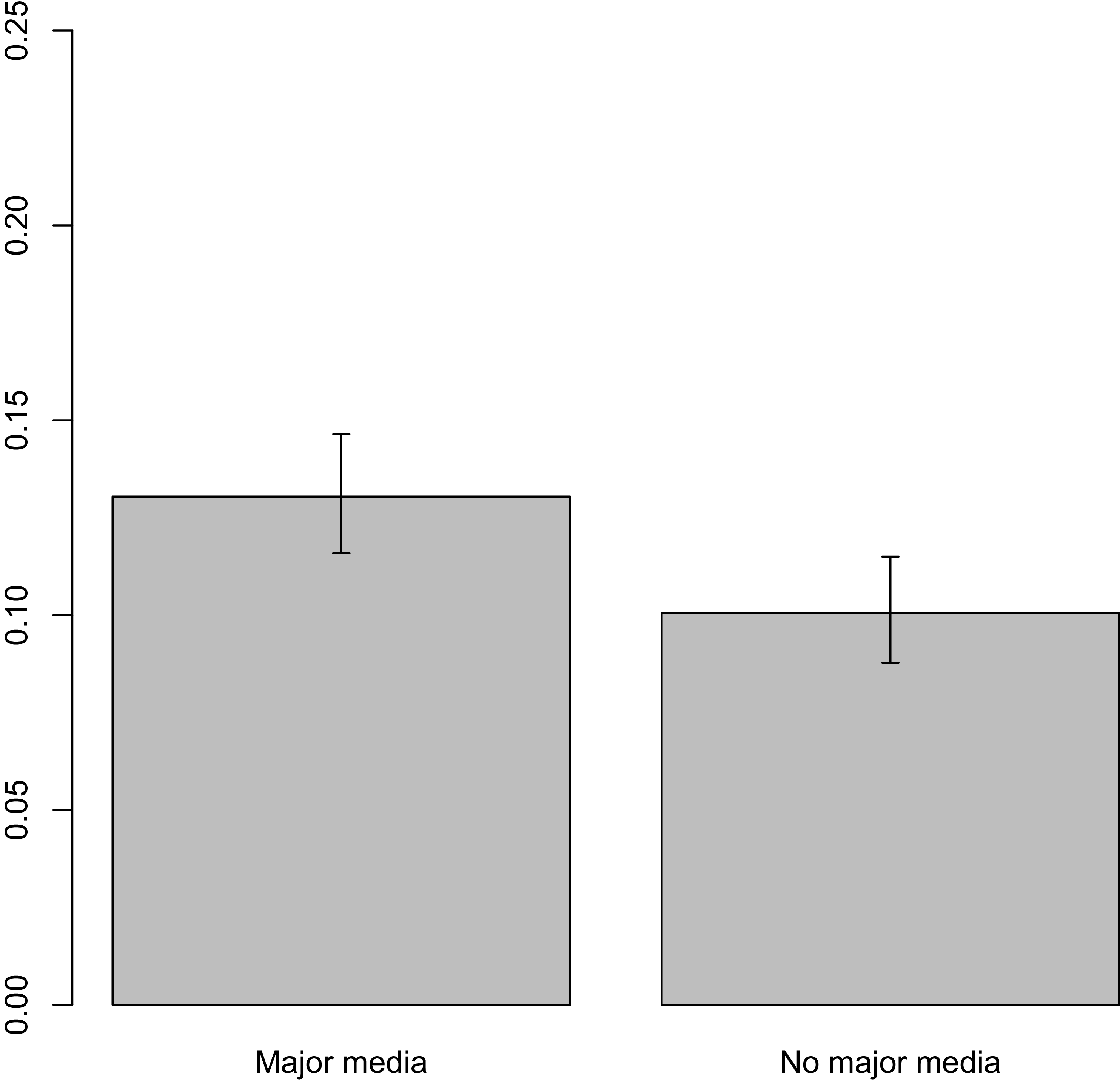
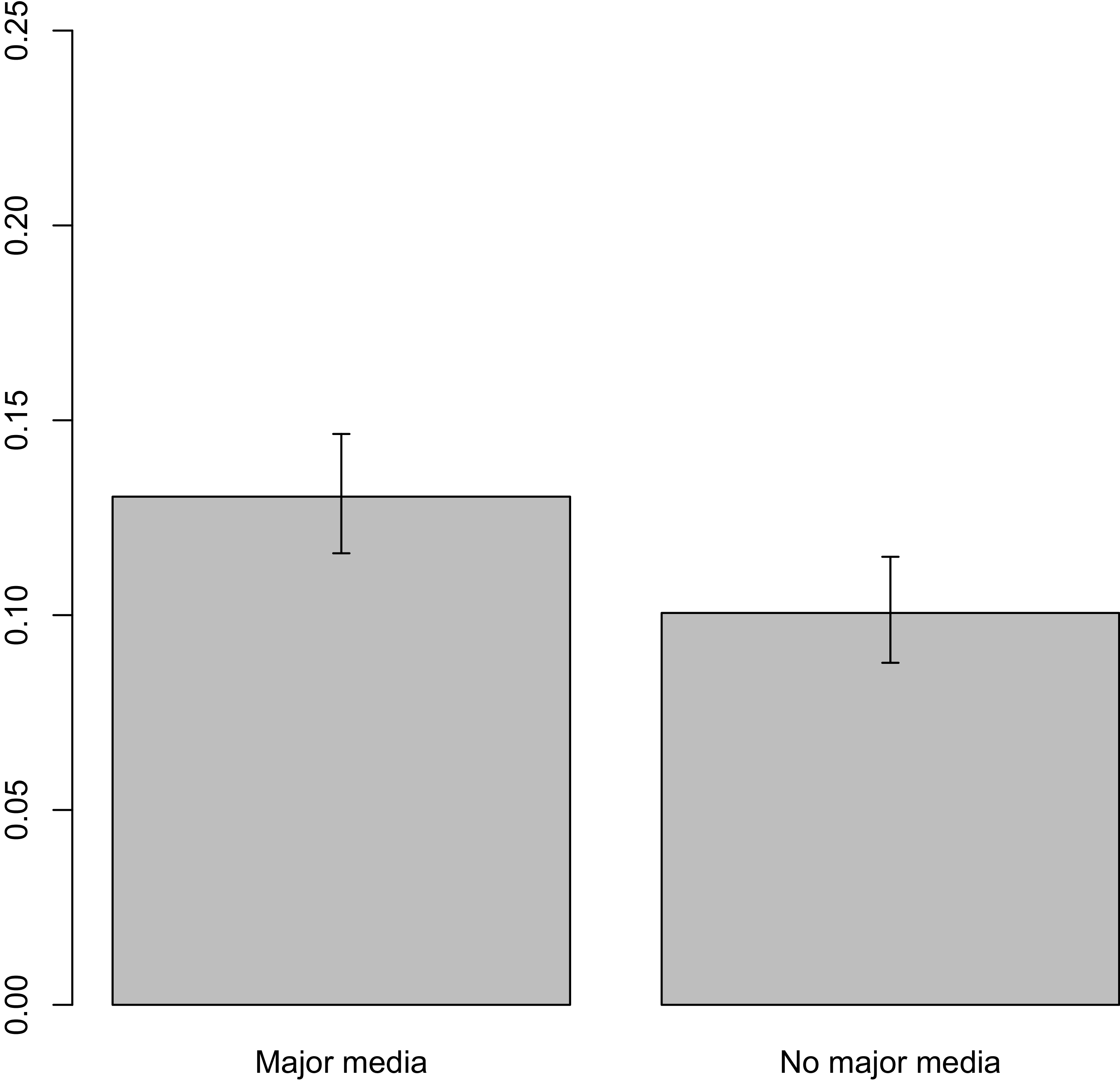
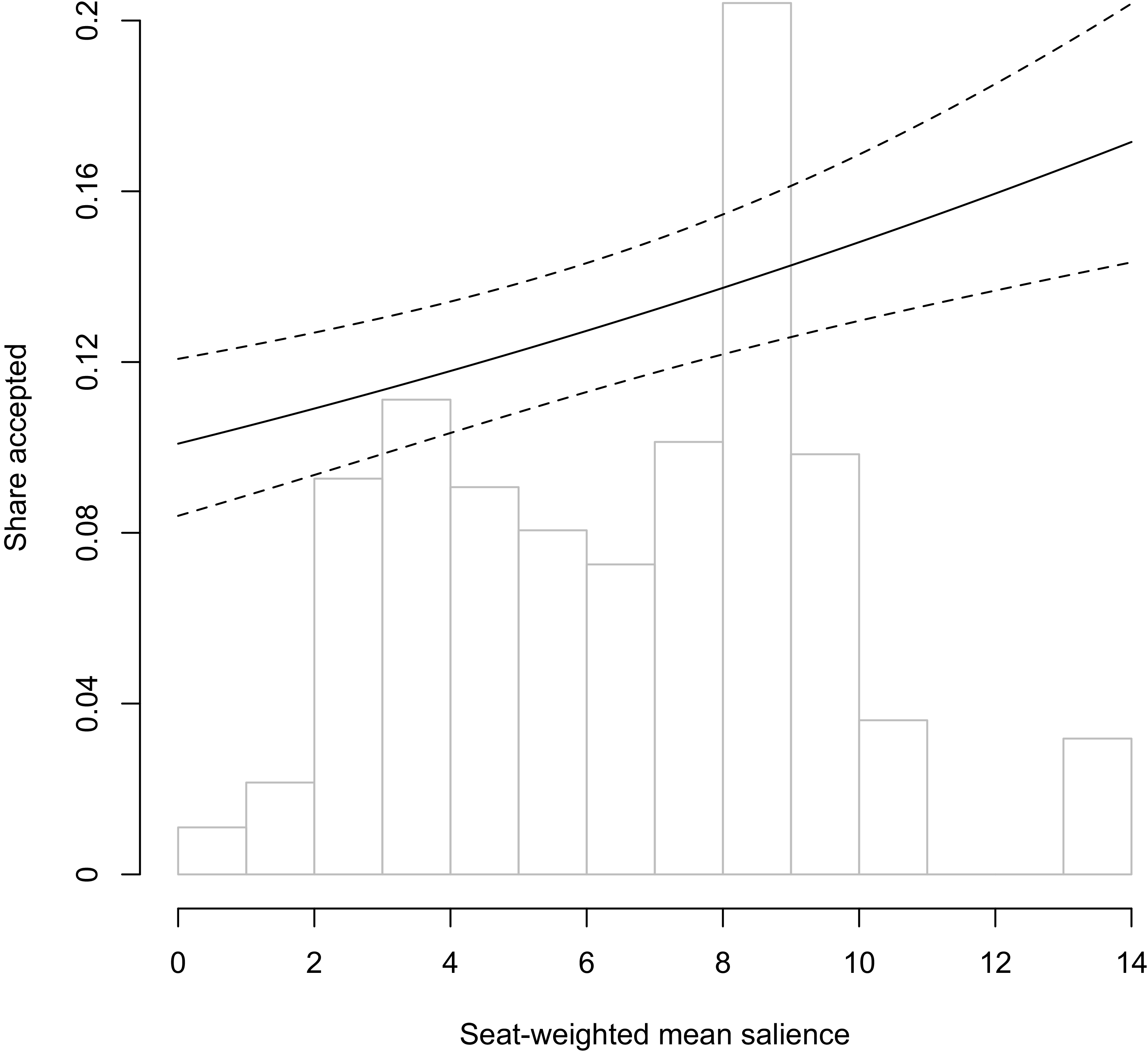
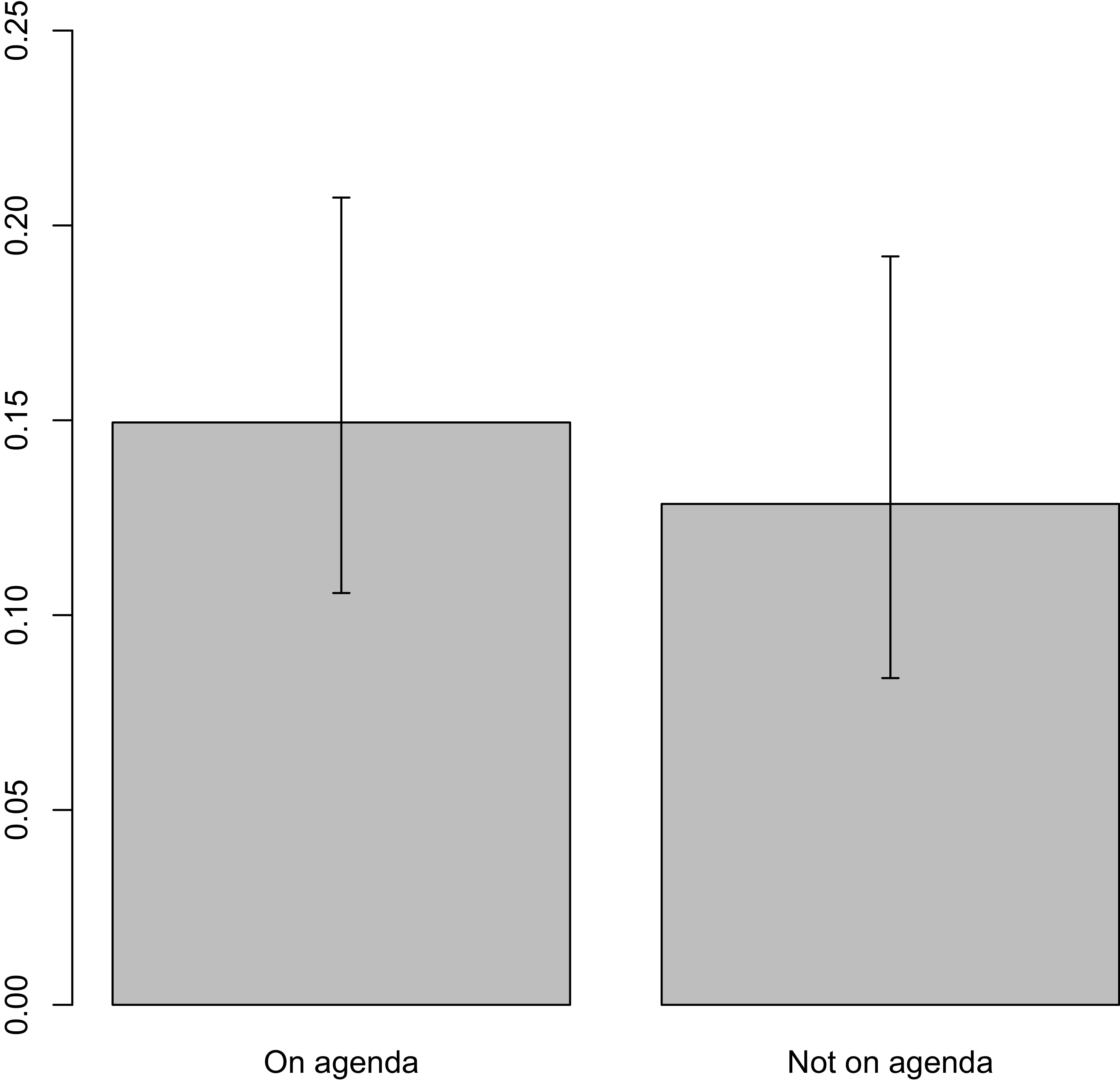
Our second expectation under this header is the Question Norm Hypothesis, which proposes that questions fit the specific local norms that exist in the House. We look at four norms: the urgency of the question, its importance, its novelty, and whether the issue has been or is on the agenda already. We operationalized question urgency on the basis of the source, assuming that the major media would report on more urgent news than other media. All four models show strongly significant results. This is reflected in Figure 3, which shows indeed that questions based on major media are 30 per cent more likely to be accepted by the Speaker than other questions. Figure 4 looks at question importance. We operationalized this as the average salience of the issue in the party manifestos. We indeed find a significant effect: a proposal on an issue that parties hardly spent any attention on has a 10 per cent chance of being accepted. The issue that gets the most attention in party manifestos has a 17 per cent chance of being accepted. Models 1 and 3, which have a much smaller N, do not show a significant pattern, although the effect size is similar; this suggests that the lack of result is not because of another variable picking up on this variance but merely the lower N. We will further examine this below. Next, we look at question novelty. We operationalized this as how recent the news item was that the question was based on. Figure 5 shows that there is no relationship between question novelty and the chance of being accepted. There is no significant effect in any of the four models. Figure 6 concerns the procedural concerns: we coded whether a debate where this question could be addressed was already on the agenda or had been recently held. We find no evidence for this. Given the lack of results for this variable, we will base our assessment for the other variables on the entire data set. Where it comes to the Speaker using norms to select questions, the glass is half full. We find evidence for two norms, but not for two others.
Question urgency.
Estimate with 95% confidence interval. Based on Model 4.
Question importance.
Estimate with 95% confidence interval; bars show distribution of independent variable. Based on Model 4.

Question novelty.
Estimate with 95% confidence interval; bars show distribution of independent variable. Based on Model 4. 4% of questions concerned news that was more than 31 days old.

Question on Agenda.
Estimate with 95% confidence interval. Based on Model 3.

Results for the partisan speaker
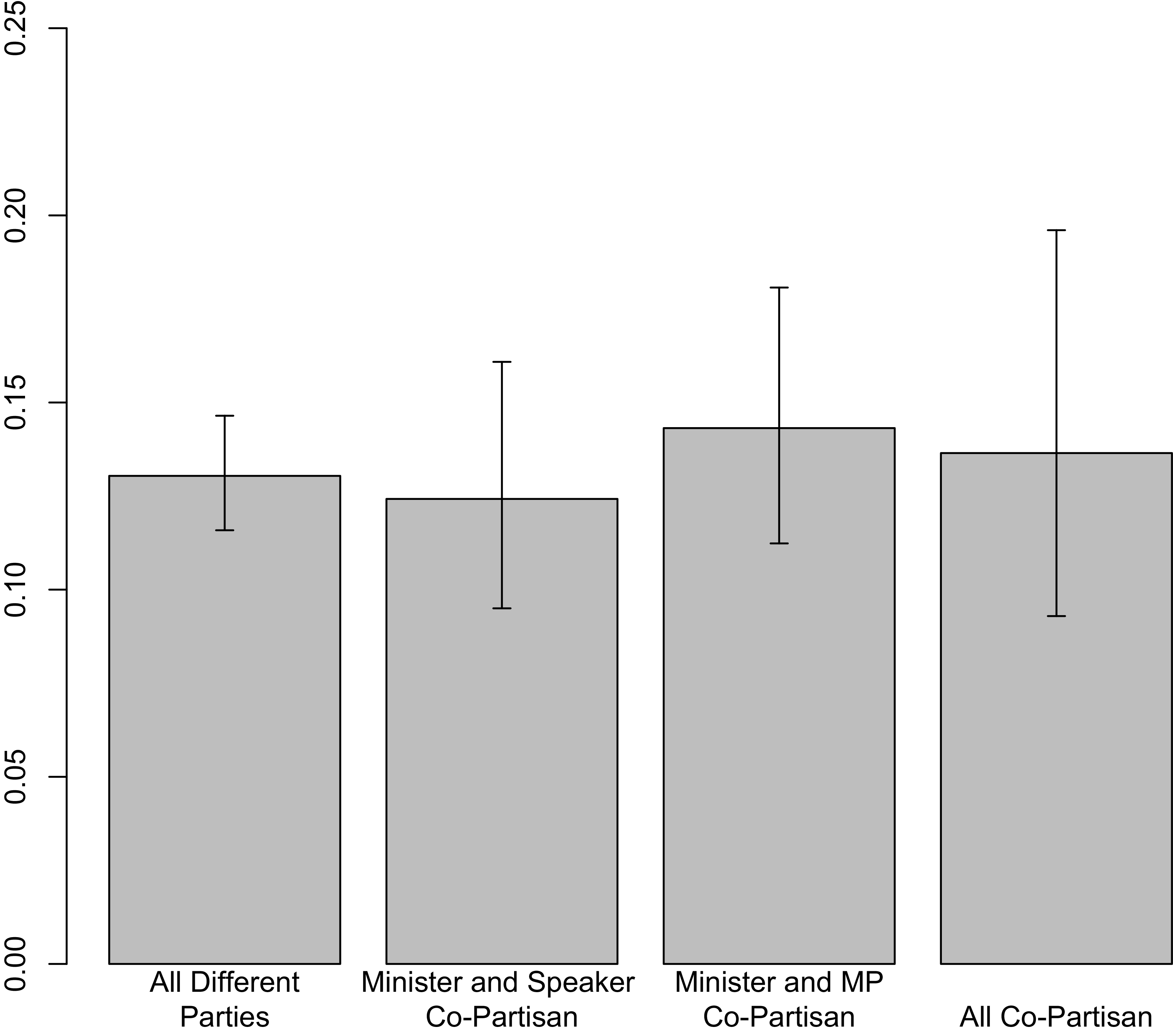
Next, we turn to the partisan Speaker. We look at the three expectations in two figures. Figure 7 concerns the Partisan Minister Hypothesis, that Speakers will prevent questions to their own minister, and the Co-Partisan Hypothesis, that they will allow questions of members of their own party to ministers of their own party. Figure 7 and all four models in Table 2 show no significant differences: it is not the case that if the minister and the Speaker are co-partisan, the question is more or less likely to be allowed than if they are from different parties. Also, when the minister and the MP are co-partisan, the Speaker also coming from that party does not increase the chance of the question being accepted.
MP, Minister and speaker co-partisan.
Estimate with 95% confidence interval. Based on Model 4.

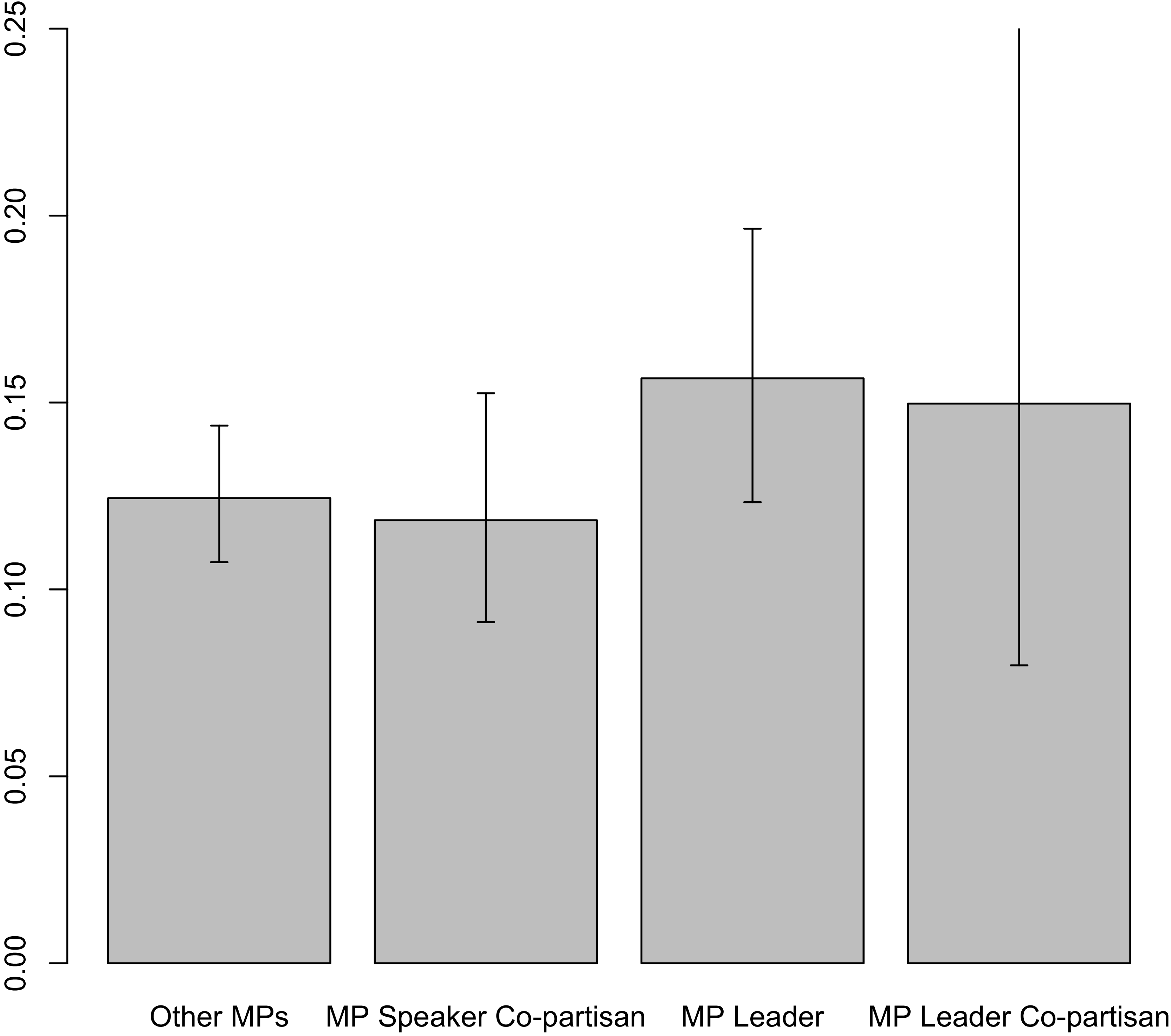
Another interpretation of the partisan Speaker is one that is more sensitive to their political leader (Partisan Leader Hypothesis): Figure 8 shows the interaction between the MP and the Speaker being co-partisan and that MP being the leader. We find that if the MP is a PPG leader the chance of their question being accepted is about 30 per cent greater than otherwise, but the leader of the Speaker’s own party does not have a greater chance of getting their question accepted: this happens quite rarely (less than 1 per cent of the cases), and therefore, the uncertainty is quite large. Rather than specific deference to their own leader, there appears to be a general deference to PPG leaders. We can also see here whether Speakers are more likely to allow questions from their own party. We do not see this. In Models 1 and 3 with a more constrained N, the coefficient is of the same size, but the uncertainty is larger, leading to non-significant results. Why do leaders get their questions accepted more than other MPs? Party-internal reasoning does not hold because the effect does not concern the Speaker’s own leader. It may be that leaders requesting a chance to speak reflects the question importance: it may signal to the Speaker that the issue is ‘Chefsache’. Unimportant issues are left to backbenchers. All in all, the evidence for the partisan Speaker is weak.
MP, leader and speaker co-partisan.
Estimate with 95% confidence interval. Based on Model 4.

Results for the Asset of the coalition
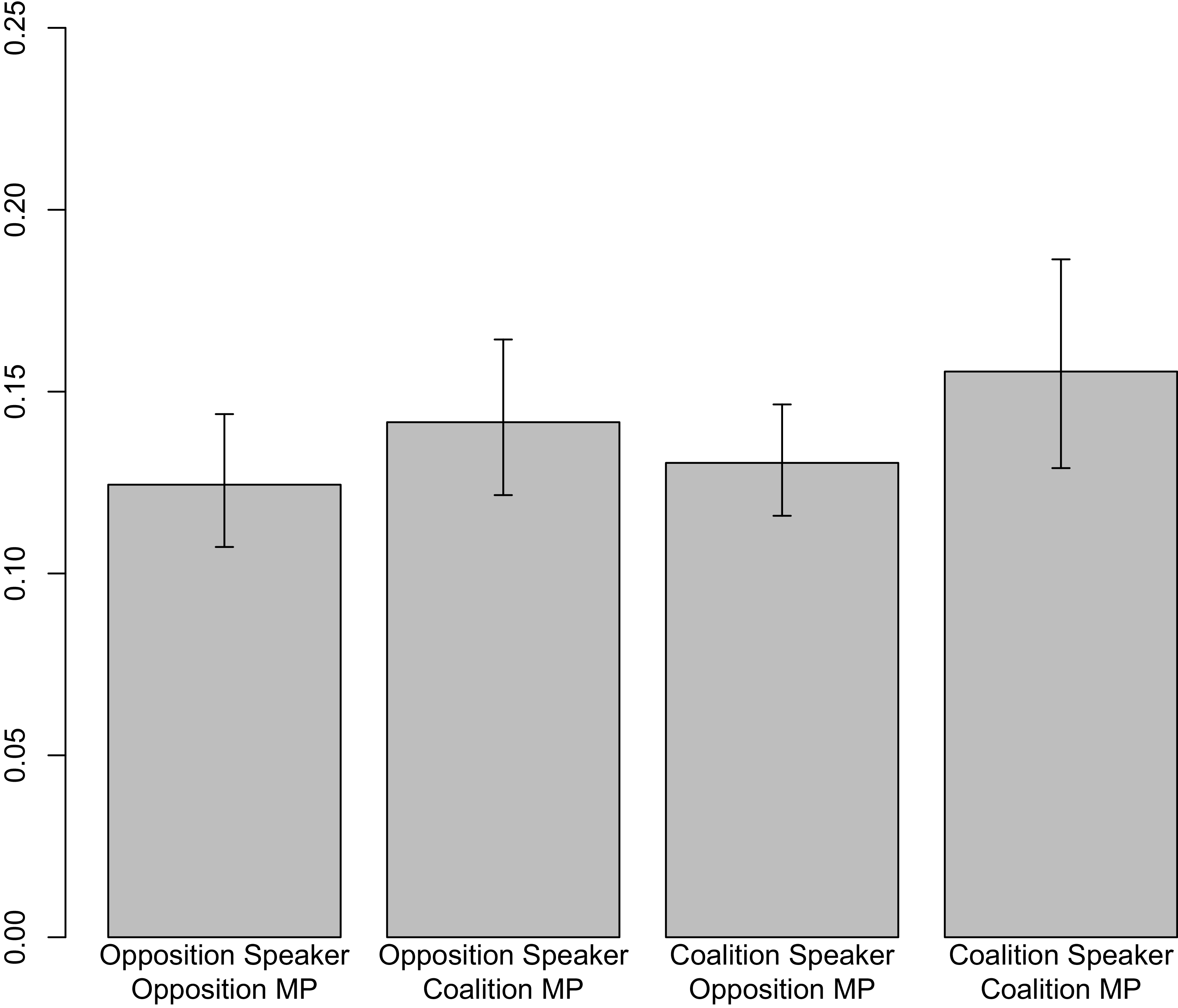
Our final ideal type of the Speaker was the asset of the coalition. In this case, the Speaker would try to keep the coalition in office. The first thing we examine is whether Speakers from coalition parties are more likely to accept questions from coalition MPs, as per the Coalition MP-Coalition Speaker Hypothesis. Figure 9 shows a non-significant pattern. We see thus the same pattern for coalition and for opposition MPs (independent of the affiliation of the Speaker). This does not support the Coalition MP-Coalition Speaker Hypothesis or the Coalition MP Hypothesis.
Coalition MP and speaker.
Estimate with 95% confidence interval. Based on Model 4.

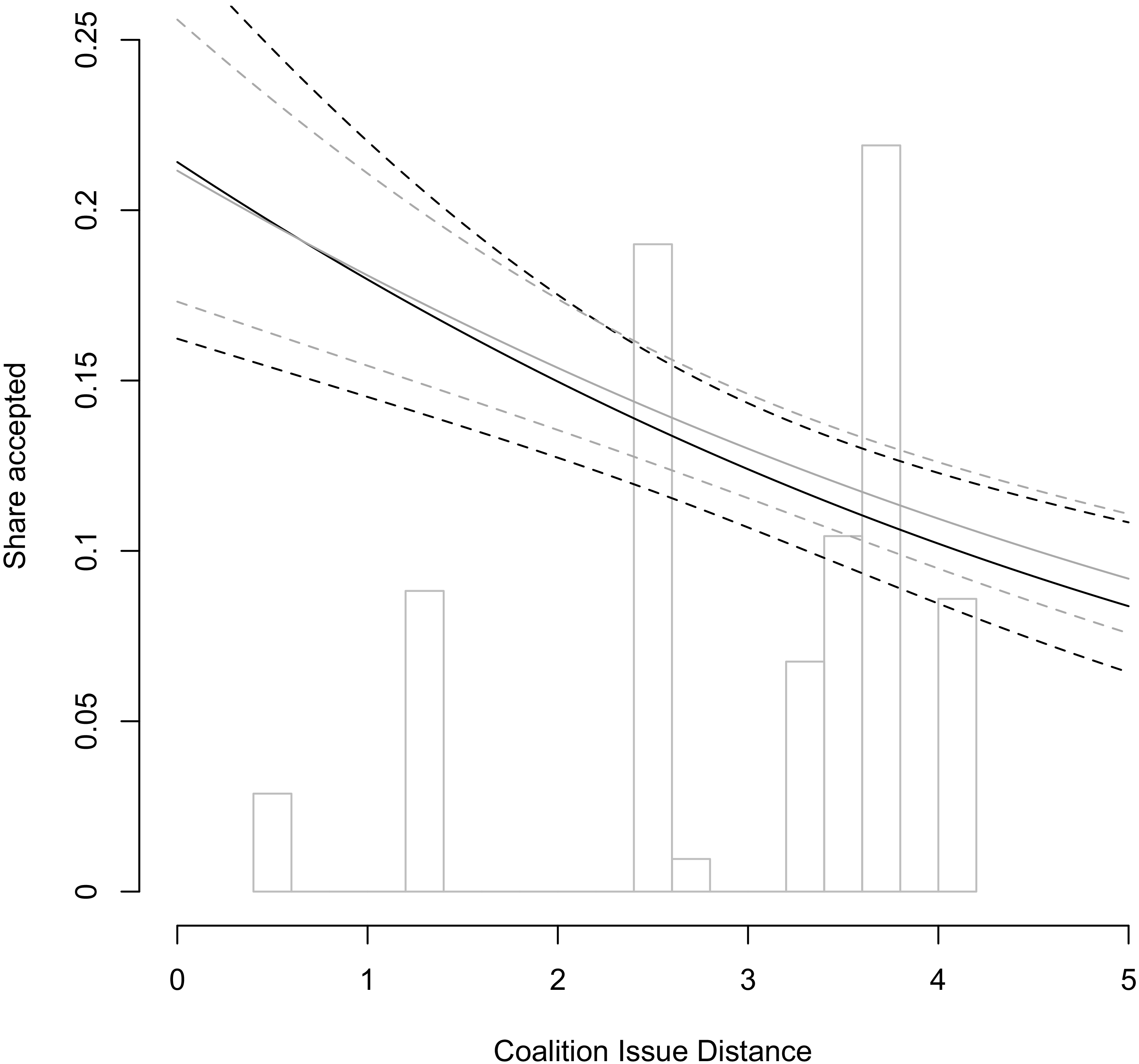
Next, we argued that the Speaker would seek to suppress issues that may divide the coalition. The Coalition Speaker-Coalition Issue Division Hypothesis proposed that this pattern would only be visible for Speakers from coalition parties, while the Coalition Issue Distance Hypothesis proposed that it would be visible for all Speakers, independent of partisan affiliation. Figure 10 (based on Model 4) shows that when coalition parties agree completely on an issue, the chance of having accepted the question is just over 20 per cent. On the issue the coalition is most divided, the chance of getting one’s proposal accepted is less than 10 per cent. Figure 10 shows that the lines for Speakers from coalition and opposition parties overlap. In Models 1 and 2, we replicate this downward trend without the interaction. In Model 3, we find that in line with the Coalition Speaker-Coalition Issue Division Hypothesis, only Speakers from coalition parties are less likely to select questions that divide the coalition. In this smaller subsample, we find support for the more specific pattern, but we do not see this if we look at all cases. All in all, we find some evidence that suggests that Speakers act in a way that would benefit the longevity of the coalition.
Coalition issue distance and coalition speaker.
Estimate with 95% confidence interval; bars show distribution of independent variable. Black line: Opposition Speaker; Gray line: Coalition Speaker. Based on Model 4.

Control variables & robustness
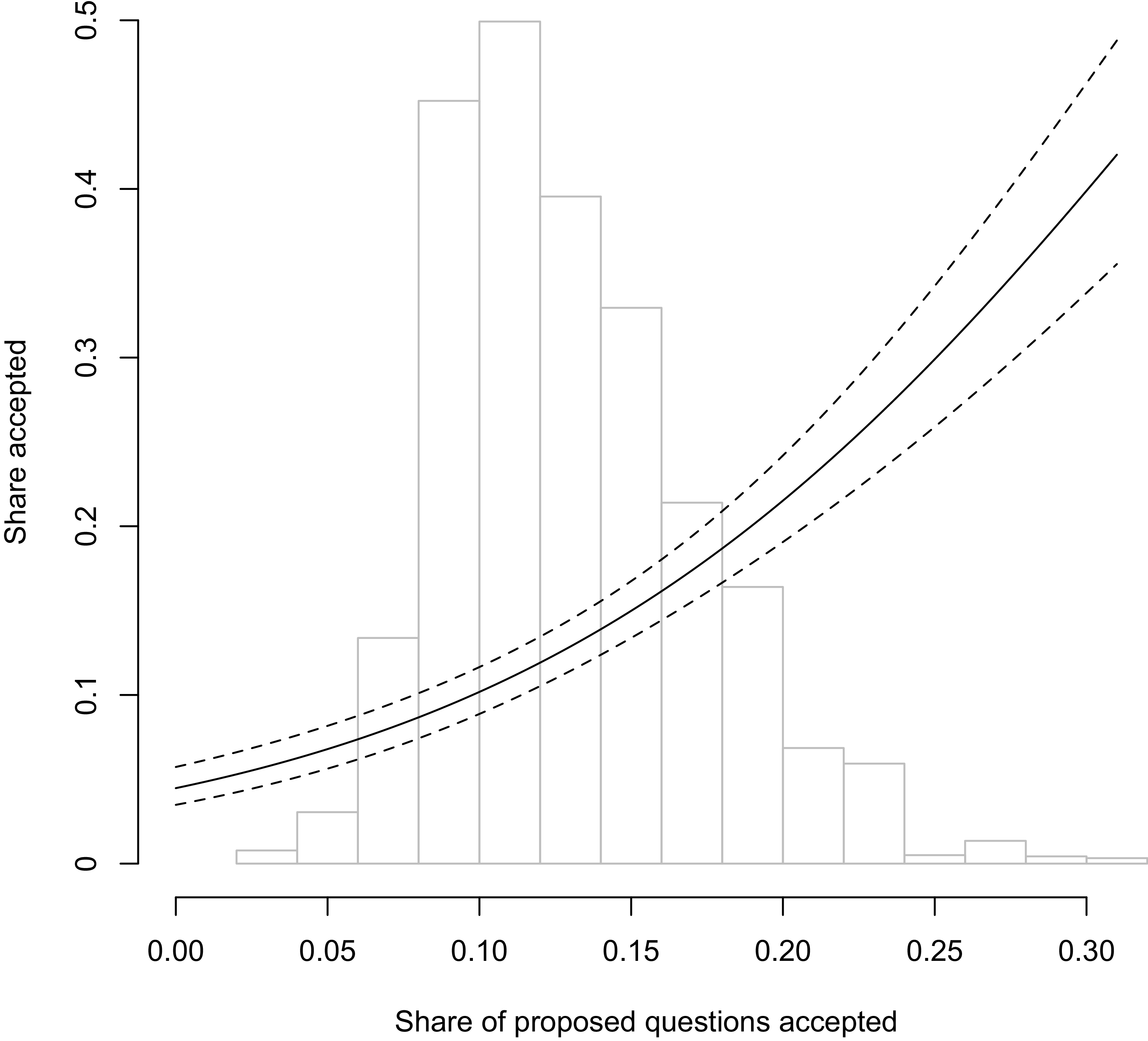
In Table 2, we included one control variable, and in the Appendix, we looked at a number of alternative specifications and robustness tests. In all models, we included the aggregate share of questions that were accepted as a control variable. This reflects, on the one hand, changes in the supply of questions (as more MPs submit questions, fewer can be accepted) and changes in the number of slots (for instance, because of Corona regulations). Figure 11 shows that there is a clear effect of the aggregate share of questions that are accepted and the chance of being accepted.
Share of proposed questions accepted.
Estimate with 95% confidence interval; bars show distribution of independent variable. Based on Model 4.

Tables A6 and A7 show 21 additional regressions. The first table lacks the interaction between whether the Speaker is a member of a coalition party and whether the proposer is a member of a coalition party, and between whether the Speaker is a member of a coalition party and the coalition issue’s divisiveness.
The first three models in either table add additional variables based on different approaches to party competition. In addition to the variables in Model 2, the first model in both tables in the Appendix (Models A1 and A11) adds the left-right distance between the MP and the Speaker and between the minister and the MP. The underlying notion is that Speakers may be less likely to allow questions from parties that are ideologically far from themselves and that are ideologically far from the minister. We find no evidence of this. The second model in both tables (Models A2 and A12) looks at the possibility that questions are suppressed if the issue-specific distance (to either the Speaker or the minister) is too far. We find no evidence of this. The third model in each table (Models A3 and A13) looks at the possibility that questions from electoral competitors are quashed (using average propensity to vote from the Dutch Parliamentary Election Studies), but we find no evidence of this. In these six models, the patterns presented above, where it comes to coalition issue distance, party leaders, urgency, and salience, persist, except for the bias towards coalition MPs.
Models A4 and A14 add a multilevel structure to adress the fact that the selection of questions per week is not independent. Adding these levels does not change the central results for leadership, issue distance, urgency, salience, and coalition MPs (which is significant without the interaction with whether the Speaker is from the coalition, but significant if absent in this interaction). The fifth model includes the same variables as Model 2 (Model A5; Model 4 for Model A15) but the same cases as Model 1 (Model A5; Model 3 for Model A15). This allows us to show that the differences between these pairs of models are the result of selection effects, not of the in- or exclusion of the agenda variable. It remains the case that the coalition issue divisiveness, question issue salience, and the submitter is leader variables are not significant (but the first is significant for a coalition Speaker), suggesting that the non-significance is because of a selection effect, not a suppression by the inclusion of the agenda variable.
Models A6 and A16 introduce a measure of question novelty without missing values (the missing values are replaced by the 0.01 percentile latest question). This does not affect the results for urgency, salience, leadership, coalition issue distance, and coalition MPs (the latter is still not significant in interaction with the coalition membership of the Speaker). Models A7 and A17 include a variable if the oral question is based on an unanswered written question: In the Tweede Kamer specifically, there is the opportunity to turn an unanswered written question into an oral question if the government exceeds the allotted time to answer. As the defender of the institution, the Speaker may be more likely to allow a question when the executive has not respected the right of an MP to information. Whether the question is based on a written question is visible in the question name. We find no evidence that questions that are based on written questions are more likely to be accepted.
Models A8 and A18 drop the interaction between the question asker being a party leader and a co-partisan of the Speaker, to show that indeed the Speaker is more likely to let questions from the leaders, in general, through. Models A9 and A19 add the salience of the issue to the party of the Speaker and to the party of the MP, and an interaction between the MP being a co-partisan of the Speaker and salience to the party of the MP. We operationalize salience as the share of the specific party’s manifesto devoted to the issue. The negative effect here suggests that when controlling for the effect of collective salience, the Speaker’s party’s priority has a negative effect, showing that there is no evidence of bias towards issues the Speaker’s party prioritizes.
Models A10 and A20 add an interaction between being a coalition MP and being a leader. The evidence shows Speakers are more likely to let through questions from leaders of coalition parties. Model A20 shows that this pattern is independent of the Speaker being a member of a coalition or opposition party. The effect of coalition MPs being selected more often than opposition MPs is driven by the high chance of including questions by coalition party leaders. Both these pieces of evidence suggest that the bias towards party leaders does not reflect selectoral pressures.
Model A21 provides a direct contrast for the period in which Khadija Arib was a Speaker when her party (Labour Party) was in the coalition and the opposition. It shows that for Arib’s Speakership, all the main results are the same: she too lets through more urgent and salient questions and questions of party leaders, is less likely to let through questions that divide the coalition (both when being a coalition MP and when being an opposition MP). We do not find a bias towards questions from coalition MPs, but we do see that she was less likely to let through questions posed to Labour Party ministers.
Table A8 replicates the results in Table 2, looking at a broader definition of national major news outlets for the measurement of question urgency. As in Table 2, if we expand our definition of news determining urgency to cover all Dutch non-regional and non-specialized outlets, the results are very much the same: questions based on these national, generalist media are still 30 per cent more likely to be accepted by the Speaker than other questions.
Looking at these robustness tests, a number of explanatory variables come out very well (question urgency), some show consistent significant patterns except when looking at the smaller-N subsample (question salience and coalition issue distance), some indicate that the main result is driven by a subset of MPs (party leaders) and some show an inconsistent pattern (bias towards coalition MPs).
Conclusion
Our analysis provided a unique insight into the considerations of Speakers when making decisions over an issue over which they have discretionary power over. Building on the well-established ideal types of the American partisan Speaker and the British neutral arbiter, we proposed a third ideal type: the Continental European asset of the coalition. By examining which of more than 9,000 proposed questions were accepted by three Speakers, we were able to identify whether they behave like neutral arbiters, partisan Speakers, or assets of the coalition.
We found mixed evidence for the Speaker as a neutral arbiter. We operationalized the Norm Hypothesis on the basis of four norms: questions would be selected if they were important, urgent, novel, and lacked procedural concerns. We find that Speakers were more likely to allow questions that met the criteria of ‘importance’ and ‘urgency’. We find no evidence that Speakers give greater speaking opportunities to those who asked a question a long time ago. We also did not find evidence of clear favoritism towards co-partisans (partisan Speaker): no indication that Speakers give more opportunities to co-partisans, give more leeway to planted questions, or allow questions from their own party leader more often than questions from other leaders. This fits with the literature on speakers which emphasizes the importance of neutrality. Yet, we also find some cracks in this neutrality. The first crack concerns party leaders in general. All PPG leaders are more likely to see their questions accepted. This likely reflects the norm of ‘importance’ as a PPG leader, submitting a question is an indication that the issue is Chefsache. This is supported by the robustness tests, which show a greater deference to leaders of coalition parties. This brings us to the notion of the Speaker as an asset of the coalition. We tested four hypotheses here, two of which proposed that all Speakers would be more deferential to coalition interests and two of which proposed that only Speakers from coalition parties would find this bias. The strongest evidence here points to Speakers quashing questions that would divide the coalition. In all but two analyses, we found this pattern both for coalition and for opposition Speakers. Some analyses also point towards a bias of Speakers to coalition parties in general. The robustness tests show that this effect is not robust and that it is mainly driven by the deference towards coalition party leaders. We find some evidence for the Speaker as an asset of the coalition. We believe that this curious outcome is the result of the specific individual incentives of this opposition politician: her serving as Speaker depends upon the continuation of the coalition. All in all, though, we find some evidence for the Speaker being an asset of the coalition, and we mainly find evidence for the Speaker acting as a neutral arbiter.
Our results speak to two literatures. On the one hand, the literature on Speakers. We selected the Netherlands because of the unique data availability. Yet, in terms of rights and partisanship, the Dutch Speaker is an average Speaker in Western Europe. Therefore, it is reasonable that, in general, Speakers elsewhere will also be primarily norm-driven and will not be directly biased to their own party. Our results give us a reason to suspect that in other coalition systems, Speakers have an incentive to keep issues that would threaten the stability of the cabinet off the agenda. At the same time, however, the exact incentives strongly depend on country-specific norms and rules regarding re-election to parliament and the Speakership. For instance, in Ireland, Ceann Comhairle is assured of their return to the Dáil when elections are held. This may immunize them to considerations about coalition stability. We believe that future work looking at the decisions made by Speakers in multiparty coalition systems is fruitful in order to go beyond the image of the neutral and partisan Speaker. So far, this paper has used an ideal-typical approach to think of Speakers. We do not claim and our evidence does not suggest that all Speakers in coalition systems always act as assets of the coalition. Instead, we use this ideal type to consider how Speakers would act if purely motivated by their willingness to stay in office. Future research may want to move from these ideal types to a more rigorous set of measurement instruments to examine in a comparative way to what extent Speakers act as a neutral arbiter, partisan Speaker, or asset of the coalition.
On the other hand, our study also contributes to the literature on parliamentary questions, in particular oral questions (eg Poljak Reference Poljak2025). We show here what kind of considerations the Speaker may have when selecting questions: Speakers are more likely to allow questions on important and urgent matters and from PPG leaders. Like students of roll call votes (Høyland Reference Høyland2010), students of oral questions should be wary of bias in their sample. The list of selected questions will not completely reflect a party’s priorities, nor will the number of selected questions reflect the number of questions sent in.
Supplementary material
The supplementary material for this article can be found at https://doi.org/10.1017/S1475676526101236
Data availability statement
Data is available upon request.
Acknowledgements
This paper was based on Wouter Nelen’s Master’s thesis at Leiden University, supervised by Simon Otjes. We thank Tim Mickler, who acted as second supervisor, for his comments. This paper was previously presented at the 2025 Conference of the ECPR Standing Group on Parliaments. We are grateful for the comments of the participants at that session, as well as Željko Poljak and the anonymous reviewers of the EJPR for their careful comments and suggestions.
Funding statement
No funding was provided for this project. Open access funding provided by Leiden University.
Competing interests
The authors report none.
Use of AI
Generative AI was not used in the writing of this paper, though it was used in the copy editing of the paper.



 Open access

