

Introduction
In the context of modern welfare states, labour market policies and employment service delivery are often only discussed in conjunction to economic growth and the employment level. At the same time, however, the negative latent effects of unemployment, including social marginalisation and decreased life satisfaction, have been long recognised by researchers, activists and unemployed individuals alike (Danneris & Nielsen, Reference Danneris and Nielsen2018; Layard & De Neve, Reference Layard and De Neve2023, pp.167–177; Raffass, Reference Raffass2017). At the heart of this issue is the paradigm of activation, which has been characterised as the turn from ‘welfare to workfare’ in welfare states in the late twentieth century. In essence, the idea of activation connects income security and employment promotion by demanding the unemployed participate in services which are designed to bring them closer to the job market. These policies centre the activation of jobseekers as the main tool to improve employment levels and set varying conditions as a precondition for the payment of unemployment benefit (Brodkin & Larsen, Reference Brodkin, Larsen, Brodkin and Marston2013; Dwyer, Reference Dwyer2018; Wright, Reference Wright2012). Simultaneously, claims about the wellbeing benefits of activation policies, such as increased social inclusion, improved motivation and restored routine, are frequently advanced by a broad coalition of actors. Most prominently, these include policymakers and politicians who use such narratives to justify conditional welfare reform (see Brodkin & Larsen, Reference Brodkin, Larsen, Brodkin and Marston2013; Wright, Reference Wright2012). At the discursive level, these claims often function as normative justifications for activation, even as empirical evaluations of wellbeing outcomes remain limited or contradictory (Andersen & Larsen, Reference Andersen and Larsen2024; Sunnerfjell, Reference Sunnerfjell2023).
Consequently, the future of activation policies is a part of larger debates around the direction of the welfare state and the centrality of labour market participation as a means of social inclusion (Dukelow & Murphy, Reference Dukelow and Murphy2022). Employment services sit at the intersection of two key welfare state functions: fostering wellbeing amongst its citizens and stimulating economic growth (Hirvilammi, Reference Hirvilammi2020). Unemployment is widely recognised as a condition that undermines multiple dimensions of wellbeing, often producing long-term psychosocial and health-related harms. Decades of empirical research have consistently shown that joblessness is associated with increased psychological distress, reduced life satisfaction and heightened risk of mental health problems (Gedikli et al., Reference Gedikli, Bryson, Watson and Wooden2023). Importantly, longitudinal studies confirm that these effects are not merely correlative but causally linked to the experience of joblessness itself (Paul and Moser, Reference Paul and Moser2009). Unemployment’s lasting, scarring effects, such as declines in mental health, agency and life satisfaction, reveal activation as a potential site of harm or support, depending on whether it reinforces neoliberalism or is operated according to principles of a de-commodified welfare structure (Dukelow & Murphy, Reference Dukelow and Murphy2022; Hooley et al., Reference Hooley, Sultana and Thomsen2018).
This article examines the wellbeing experiences of long-term unemployed jobseekers in Finland who have engaged with public employment services (PES) provided activation measures. Using a phenomenological approach and the sustainable wellbeing framework, the analysis assesses how activation services function from the perspective of service users as need satisfiers in the four basic need dimensions of having, loving, doing, and being. The focus on lived experiences enables the analysis to ‘observe and articulate commonalities across participants practical everyday understandings and knowledge’ (Benner, Reference Benner1994, p. 103), giving voice to an often-marginalised group and counteracting some of the democratic deficit apparent in social security and service design (Mcintosh & Wright, Reference Mcintosh and Wright2019; Speed & Reeves, Reference Speed and Reeves2023).
This article draws on twenty-four individual and four focus group interviews conducted in Espoo, Finland (2023–2024) with participants in activation services such as rehabilitative work and joint services. The next sections outline the role of wellbeing in the activation paradigm, the Finnish policy context and the theoretical and methodological framework. The empirical analysis explores how activation services can satisfy wellbeing needs, whilst also examining how conditionality can create need barriers.
Activation and wellbeing: complimentary or contradictory goals?
Existing research has noted the malleability of the activation paradigm, and its continued use in social policy through economic circumstances and national welfare regimes (Bonoli, Reference Bonoli2010; Clasen & Mascaro, Reference Clasen and Mascaro2022). The concept of activation has evolved into a broad paradigm encompassing a range of policy approaches aimed at promoting labour market participation amongst the unemployed. Traditionally, activation regimes are often distinguished along a continuum from ‘work-first’ to ‘life-first’ models. Work-first approaches prioritise rapid reintegration into employment, typically through job search requirements, strict conditionality and benefit sanctions. These regimes, often associated with Anglo-American welfare states, emphasise individual responsibility and employability, sometimes at the expense of personal wellbeing or long-term labour market integration (Dwyer, Reference Dwyer2018; Raffass, Reference Raffass2017). In contrast, life-first approaches aim to address broader personal, social and health-related barriers to employment before job placement. They emphasise developing human capital through enabling services such as education, psychosocial support and rehabilitative work activities, and are more common in Nordic welfare states such as Finland (Walker et al., Reference Walker2016; Whelan et al., Reference Whelan, Murphy and McGann2021). However, many national systems defy a simple binary and instead adopt hybrid models that combine elements of both approaches. These hybrid regimes reflect a pragmatic response to competing policy pressures: the economic imperative to reduce benefit dependency and the social imperative to foster inclusion and capability (Clasen & Mascaro, Reference Clasen and Mascaro2022). Importantly, the form activation takes is not just a technical matter, but reflects political values and assumptions about citizenship, work and deservingness (Andersen & Larsen, Reference Andersen and Larsen2024; Postan-Aizik & Strier, Reference Postan-Aizik and Strier2021).
However, the assumed wellbeing benefits of activation, particularly claims that participation fosters self-esteem, autonomy or social inclusion, remain under-examined and often contradicted by empirical evidence. Moreover, as critics have noted, activation can blur the line between support and coercion, embedding normative expectations about individual behaviour and attitudes that risk pathologising unemployment as a personal failure (Carter and Whitworth, Reference Carter and Whitworth2017; Friedli and Stearn, Reference Friedli and Stearn2015). The activation paradigm’s normative assumptions about passive welfare recipients needing activation measures for their own good has been increasingly challenged, often by the recipients themselves. Rather than being inert, unemployed individuals are often actively engaged in problem-solving and goal setting but face systemic barriers to fulfilling their needs (Danneris & Nielsen, Reference Danneris and Nielsen2018). Consequently, the discourse on unemployment has moved towards a demand for more personalised employment services which support the clients’ inherent agency (Larsen & Caswell, Reference Larsen and Caswell2022). The necessity of activation, however, is not challenged (Andersen & Larsen, Reference Andersen and Larsen2024).
However, the critique of activation policies also reveals their potential in increasing the wellbeing of unemployed individuals. Activation policies are characterised by an ethical plurality within which two competing ideas of the common good exist simultaneously (Sunnerfjell, Reference Sunnerfjell2020). The political justification of activation carries not only neoliberal behavioural assumptions but also notions of care, albeit in a highly paternalistic manner (Eriksen & Molander, Reference Eriksen and Molander2019). The harmful effects of long-term unemployment on individual wellbeing are well documented across decades of empirical research. Alongside diminished income, the psychosocial experience of joblessness, including disrupted time structure, social exclusion and thwarted agency, erodes mental health and life satisfaction (Fryer, Reference Fryer1986; Jahoda, Reference Jahoda1982; Waters & Moore, Reference Waters and Moore2002). Research consistently finds that unemployment is causally associated with increased psychological distress and diminished wellbeing, even after individuals re-enter the labour market (Layard & De Neve, Reference Layard and De Neve2023; Paul & Moser, 2009). These persistent ‘scarring effects’ underline why employment services cannot be viewed solely as economic instruments. They also constitute a critical wellbeing infrastructure, with the potential to either exacerbate or mitigate the cumulative harms of unemployment (Kampen & Tonkens, Reference Kampen and Tonkens2019; Wright et al., Reference Wright, Fletcher and Stewart2020).
To move beyond a binary evaluation of activation as either enabling or restrictive, this study adopts the framework of sustainable wellbeing to examine how activation measures function as a broader wellbeing structure. This approach understands wellbeing as the satisfaction of fundamental human needs, including material, relational and existential, shaped by both subjective experience and structural context. By acknowledging the tension between psychological deprivation and constrained agency, the analysis shifts focus from activation as behavioural correction towards its capacity to support basic psychological needs. This orientation lays the groundwork for a phenomenological analysis of the ways in which activation services act as need satisfiers or barriers across different wellbeing dimensions, providing a lens through which to examine participants’ lived experiences more holistically.
Activation services in Finland
In Finland, activation measures primarily target long-term unemployed jobseekers, defined as individuals with 12 months of continued unemployment (Karjalainen, Reference Karjalainen, Karjalainen and Keskitalo2013). Compared internationally, Finland ranks moderately in benefit conditionality, with more cautious sanctioning practices and greater discretion for frontline workers than in highly conditional systems such as the UK (Immervoll & Knotz, Reference Immervoll and Knotz2018). Finnish PES services traditionally emphasise long-term employability and wellbeing, often through collaboration with social services in rehabilitative activities (Karjalainen, Reference Karjalainen, Karjalainen and Keskitalo2013). Conditionality is enforced through employment plans, which are drafted between employment services and the client. Long-term unemployed clients can be obliged to draft an activation plan instead, a process which additionally involves social services in a tripartite meeting (Kotkas, Reference Kotkas, Karjalainen and Keskitalo2013). Local PES can offer a variety of services within the employment plan which can be used as activation measures, including skills and development courses, work placements and career counselling. In this article, I am using the catch-all term of activation services to refer to these services, which are often offered to long-term unemployed jobseekers as a way of satisfying the requirements of their activation plan.
In the Finnish framework, the main activation services are rehabilitative work activities, which are mandated services under the Social Welfare Act (Finlex, 2022). Delivered in workshop settings, covering tasks such as crafts, kitchen work, cleaning and information technology (IT), these services are run by local social services and are meant to involve multisectoral cooperation with PES. In practice, however, this cooperation is often lacking, and rehabilitative work tends to serve as a default for clients unable to access other services (Elonen et al., Reference Elonen, Niemelä and Saloniemi2017). Studies have found some wellbeing benefits for participants, most notably increased social inclusion, but the services have also been criticised for not supporting the agency of the participants (Blomgren, Reference Blomgren2023; Isola & Mäntyneva, Reference Isola and Mäntyneva2019; Turunen & Hiilamo, 2022). Other activation services, such as the career coaching course examined in this article, combine peer support and professional guidance with modules that can include, for example, life mapping, goal setting and job/education options delivered in a class-like environment with regular one-on-one time with the career coach conducting the course. Unlike rehabilitative work, these non-standardised courses vary by location and remain understudied.
Despite the traditionally significant social services involvement, the direction of Finnish labour market policy has consistently leaned more and more towards restrictive activation measures targeting the individual jobseeker (Outinen, Reference Outinen2021). Finnish scholars have pointed out that the tendency in the Finnish system is to simultanously move towards higher conditionality and away from offering comprehensive social services (Mäkinen & Ojala, Reference Mäkinen and Ojala2024). Whilst research from countries such as the UK or Australia documents the negative effects of sanctions on mental health, financial security and labour market participation, Finland has only recently begun to examine these broader impacts, leaving a gap in the current literature (Griggs & Evans, Reference Griggs and Evans2010; Mäkinen & Ojala, Reference Mäkinen and Ojala2024).
Framework: sustainable wellbeing
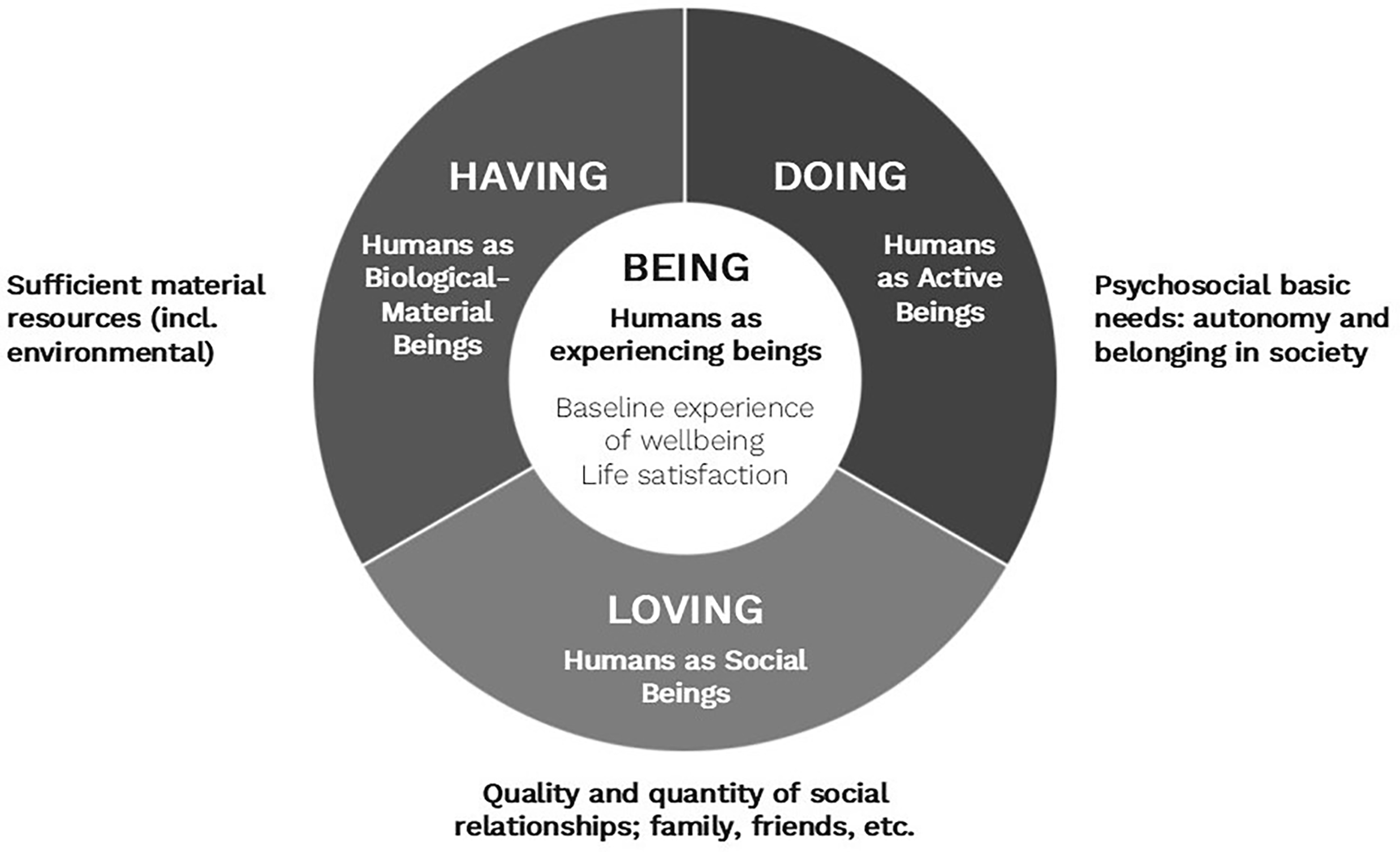
The theory of sustainable wellbeing offers a multidimensional and needs-based framework that is particularly well suited for analysing the complex effects of activation policies on the lives of the long-term unemployed. Building on the work of Erik Allardt and further developed by Hirvilammi and Helne (Reference Hirvilammi and Helne2014) and Martela (Reference Martela2024), the framework identifies four interrelated dimensions of wellbeing: having, loving, doing, and being. Having refers to material and biological necessities, such as sufficient income, housing and access to healthcare. Loving captures the importance of social bonds and feelings of connection to others. Doing encompasses the need for purposeful activity, agency and opportunities to act in alignment with one’s values. Finally, being concerns existential and affective states, including self-image, internal motivation and overall life orientation.
These dimensions interact dynamically, allowing for the possibility of a reinforcing circle of wellbeing, in which improvement in one area leads to gains in others. Conversely, when basic needs are unmet or when structures constrain agency, this can generate a reverse circle of wellbeing, where deficits in one dimension cascade into others. Importantly, the framework also emphasises that human needs are universal, but the means by which they are satisfied, that is, need satisfiers, are socially and institutionally mediated. This lens foregrounds the role of social practices, rather than individual behaviour alone, in shaping wellbeing outcomes. It also allows for an evaluation of activation not solely in terms of employability or labour market efficiency, but in terms of how service structures act as need satisfiers or need barriers across the interconnected dimensions of sustainable wellbeing (Figure 1).
Theory of sustainable wellbeing. Translated and adapted from Iivonen et al. (Reference Iivonen, Jernström, Korhonen, Luonsinen, Malin, Malkamäki, Ruottunen, Smolej, Sunnari, Tanner and Hiilamo2024, p. 34). © 2024 Writers and THL. Reproduced with permission.

Methodology
This study employed a qualitative methodology comprising twenty-four individual and four focus group interviews, conducted in Espoo, Southern Finland, between November 2023 and March 2024. Participants (n = 46; twenty women, twenty-five men, one undisclosed) were aged 25–63 years and varied in unemployment duration from several months to more than a decade; some had never held paid employment. All had been referred to activation measures, indicating classification by employment services as requiring intensive support. Focus groups took place at two rehabilitative work providers and a 7-week course for the long-term unemployed (Pakki-valmennus). Individual interviewees were recruited from these group activities via employment service referrals or direct contact at a public event for unemployed clients. One individual participated in both an interview and a focus group. Most participants lived alone and had completed upper secondary education. Whilst demographics varied, participants reported similar experiences with unemployment and activation services. Some gender and age differences were present: women were more often constrained by caregiving responsibilities, and younger participants tended to be more hopeful about re-employment.
All four focus groups and twenty-three individual interviews were recorded and transcribed; one unrecorded interview was documented through detailed notes. Interviews were semi-structured, lasting 17 minutes to 1 hour and 41 minutes. Data were analysed thematically, guided initially by the sustainable wellbeing framework, with sub-categories developed inductively from the data. Interviewees are anonymised, and quotations are presented with age range and gender. All quotes were translated from Finnish with attention to meaning over literal phrasing.
The study acknowledged the power dynamics and vulnerabilities associated with long-term unemployment and participation in activation services. Participation was fully voluntary and had no effect on participants’ benefits or access to services. Each participant provided written informed consent after receiving both oral and written information about the study. Each participant received a €10 gift card to a national retail chain, equivalent to the daily expense allowance (€9/day), as modest compensation for time and travel. The study was approved by the Finnish Institute for Health and Welfare’s (THL) Ethics Committee and conducted in accordance with the guidelines of the Finnish National Board on Research Integrity (TENK, 2023); all data were anonymised and stored securely on THL’s encrypted servers.
Results and discussion
This section presents three key themes showing how activation services functioned as need satisfiers or barriers across the four dimensions of sustainable wellbeing: having, loving, doing, and being. First, it explores how group activities supported wellbeing by offering the need satisfiers of meaningful activity and time structure (doing), sometimes generating a self-reinforcing circle of wellbeing (being). Second, it examines how providing need satisfiers related to the self-actualisation needs of autonomy, capability (doing) and social connection (loving) were integral in creating positive wellbeing experiences described in the previous paragraphs. Finally, it considers how bureaucratic processes and conditionality posed barriers, particularly to autonomy and basic security (having and loving). Findings are discussed in relation to the sustainable wellbeing framework and activation literature.
Group activities and creating a circle of wellbeing
Activation services experienced by interviewees fell into two main types: individual meetings with employment service staff and group activities, primarily rehabilitative work activities. The latter featured more prominently in interviewees’ wellbeing accounts, offering continuity and daily structure, whereas individual meetings were often brief, bureaucratic and inconsistent due to staff turnover. Group activities typically occurred 3–4 days a week for 4 hours and varied in content. Since participation is time-limited, long-term unemployed individuals often cycled through or repeated services. The analysis below first explores the wellbeing impacts of group activities, followed by the role of one-on-one meetings.
The interviewees’ experiences echoed the classic scholarly understanding of lowered psychosocial wellbeing linked to decreased experiences of meaningfulness as one of the central ill-effects of unemployment (see Buzzanell & Turner, Reference Buzzanell and Turner2003; Jahoda, Reference Jahoda1982; Waters & Moore, Reference Waters and Moore2002). Consequently, the group activities provided a need satisfier to a major wellbeing need in the doing dimension of wellbeing, namely meaningful activity. When asked why they wanted to participate in a service through PES, most interviewees highlighted the benefit of having an established time structure. A male interviewee participating in rehabilitative work summarised his motivation succinctly:
I just wanted to have something to do, that I’m not just at home all the time. That I have some structure in my life (Individual interview 5, male, 25–29 years).
Meaningfulness was therefore close related to a given time structure. Not having anything to do was described as having a dulling effect, and aggravating already present issues, such as mental health struggles or substance abuse problems. Whilst time structure acted as a need satisfier because it removed a sense of dullness, it was also closely connected to the idea of ‘getting out of the house’. Group activities became a need satisfier because participation entailed taking part of ‘normal’ time structure outside of the home sphere, acquiring social contacts and allowing participants to demonstrate they were not unemployed by choice to both the employment services and to wider society.
Notably, the interviewees’ experiences highlighted the connection between improvement in the doing and being dimensions of wellbeing. Offering the need satisfier of a time structure in the doing dimension translated to improvements in the being dimension, affective and evaluative wellbeing, as well, notably through an improved functional ability, internal motivation and self-image. A male interviewee described his motivation to participate in rehabilitative work:
Rehabilitative work is good in the sense that it’s four hours per day and you get into … a routine. And its unbelievably boring to just to be at home for someone that’s used to doing things. So, I was hoping to get back to that and yeah my mood and everything got a lot better (Individual interview 6, male, 56–60 years).
These improvements in turn enabled the interviewees to engage in more meaningful activities in their everyday life, resulting in a circle of wellbeing which would re-enforce itself. In a focus group, a female interviewee remarked that:
I have more energy to do things in my own life, when there’s more difficult things at home, I have more energy to help and just manage better. My parents have also commented that I’m not so quiet anymore, that there’s some light in my eyes for once (Focus group 4, female, 36–40).
The meaningfulness derived from an established time structure therefore formed an important need satisfier and an integral part of any potential wellbeing benefits for the interviewees. However, the meaningfulness of the group activities was not automatic. The time structure was not a sufficient need satisfier if the content of the activity did not offer any other sources of meaningfulness for the participant. One interviewee, for example, reported that he was seeking to attend rehabilitative work now that he was eligible again, because he was sick of sitting at home. Yet, in the same breath he described group activities as ‘slave labour’. Another interviewee, who had been directed to rehabilitative work activities after only a few months of unemployment, described the activity as ‘a daycare for adults’. These contrasting experiences of the same service highlight how even in a human-capital-focussed system activation can have coercive underpinnings. The positive description of group activities aligns with the life-first model of activation (Whelan et al., Reference Whelan, Murphy and McGann2021), prioritising addressing psychosocial needs before labour market outcomes. The mere existence of such activities itself is not enough, however. The time structure that for others is a need satisfier can appear as a need barrier to others, something they are forced to perform to remain eligible for support. The next section will discuss the additional need satisfiers that contributed to the experience of meaningfulness.
Meaningful work: capability, autonomy and relatedness
As noted in existing research, meaningfulness is comprised of subjective experiences and is connected to issues such as personal values and beliefs (Eakman, Reference Eakman2013). A discussion in a focus group at the 7-week group course highlighted the differences between participants’ conception of meaningfulness:
R1: At the rehabilitative workplace, we took it one day at a time, but in the end, it’s just like, ‘take care, bye, bye. Let’s get the new ones in.’ … [to the group] you probably agree with me?
[general agreement from the group]
R2: But it’s good just to have somewhere to be.
R1: Yeah of course, I wasn’t denying that…
R2: Like, the last place, I really got on well there.
(Focus group 4, several interviewees).
For interviewees with acutely lowered functional ability, for example, active substance abuse problems or moderate-to-severe mental health challenges, the regular scheduled activity itself could go far as a need satisfier in the doing dimension of wellbeing, creating meaning in the everyday life of the individual. However, for many, rehabilitative work specifically seemed too monotonous and divorced from skills required in the current job market to be meaningful. A female focus group interviewee described feeling like rehabilitative work was ‘a storage place’ for her, remarking:
I feel like that this rehabilitation doesn’t rehabilitate me in any way. It’s been a huge disappointment, the tasks are unbelievably simple, monotone (Focus group 1, female, 46–50 years).
This experience mirrors previous studies’ findings on the low intensity of work activation regimes and their low impact on skill levels and employability (Fervers, Reference Fervers2018). It also highlights the situational nature of need satisfiers. Whilst the need for meaningful activity was shared by all interviewees, the appropriate need satisfier could look different depending on the individual’s life story and stage of rehabilitation.
At the same time, however, the interviewees’ experiences highlight three key needs that had to be met to establish a circle of wellbeing between the doing and being dimensions of wellbeing. Significantly, these needs comply with the same self-actualisation needs that are featured heavily in scholarly definitions of meaningful work in general (Martela & Pessi, Reference Martela and Pessi2018). In the doing dimension of wellbeing, these were autonomy, the ability to control one’s own behaviour, and decisions and capability, the ability to achieve desired outcomes in one’s own environment (Eakman, Reference Eakman2013). Need satisfaction for these two needs was reciprocal in the interviewees’ experiences. A female interviewee described her frustration about not being allowed to start a work trial in a workplace she had been a few years earlier before dropping out due to mental health reasons:
‘What’d be important is testing my own [mental] capital, like I’d be able to test my own resources and grab a hold of that by myself again. That’s what it really was [last time]’ (Individual interview 2, female, 36–40 years).
Instead, she was offered a rehabilitative work activity, which she was sceptical of based on a previous introductory visit to a work activity location, saying: ‘I thought that yeah sure, I’ll do it if I have to, I mean I can do laundry and all that’. As illustrated in this experience, a key need barrier for the interviewees was the lack of autonomy to determine what a desired outcome for their service participation would be, which in turn led to diminished sense of capability. When the needs in the doing dimension were not met, it was unlikely that participants experienced improvements in the being dimension either, such as improved functional ability or improved self-image. In contrast, a significant need satisfier in terms of autonomy and capability was providing a variety of tasks from which the interviewees had a degree of freedom to choose. Alongside strengthening old skills, some of interviewees also found new strengths, such as teaching others.
Aside from the key doing needs of autonomy and capability, the third key need that fostered meaningfulness in the interviewees’ experiences was a sense of relatedness, the existence of caring and embedded relationships, from the loving dimension of wellbeing (Martela, Reference Martela2024). Not only doing needs contributed to the creation of a circle of wellbeing, but need satisfiers in the loving dimension, namely individual guidance and relationships to group coaches and peers, also played an integral supporting role. Part of the individual guidance was practical, such as searching for job or training options, but crucially, it also included getting to know the interviewees as people and reflecting on the different possibilities they had. A male interviewee remarked that whilst he previously had to some extent enjoyed task-focussed group activities, he got more out of a guidance and discussion-focussed group-based activity:
I like that we have discussions and things like that in the group, and then with the coach, you get new viewpoints. And having a coach who knows something and knows how to look at the whole situation. Before in rehabilitative work … it’s been mostly … working with your hands, and maybe seeing some random coach at some point (Individual interview 24, male, 36–40 years).
When the interviewees reported positive changes to their wellbeing, they regularly tied them to personal relationships with individual, stand-out coaches who had taken time to know them personally. The extended time spent in the group activities, ranging from 2 months to up to 1 year, allowed the interviewees to create close relationship with coaches and other participants. A female interviewee credited the help she received from a coach in a group activity for being accepted to study in a vocational programme and stated that the best part of the activity was the personal help she received:
It was almost like [the coach] is kind of like my psychologist, but at the same time, not in that psychologist way, but more like a friend. She always listens and asks how I’m doing, and if she notices something, she’ll ask more, and that was, yeah, I got a lot of help from that (Individual interview 21, female, 25–30 years).
The importance of these relationships highlights the significance of relatedness as a central wellbeing need as well as the interrelation of the doing and loving dimensions of wellbeing. To act as an effective need satisfier for capability and autonomy in the doing dimension, the group activities also had to address relatedness in the loving dimension. According to the interviewees, a renewed sense of relatedness could act as a corrective experience, with their trust in their own skills and value improving in the long term. A female interviewee, who had completed the training course, described her outlook on the future:
Of course, I still have a lot of the same challenges as a I did before [the course] … but I’m bolder in pushing things forward, I’ve had thoughts like I can do this, I can handle it, I just gotta trust myself. And I’ve had some successes like applying for school and I’m making progress with the debt thing, so I feel like I just gotta try and things will get sorted (Individual interview 12, female, 41–45 years).
Notably, however, the newly formed circle of wellbeing was notably fragile for the interviewees. Many interviewees expressed anxiousness about the future, even in the case that they were able to find employment. A male interviewee explained how his time in rehabilitative work activities had improved his wellbeing and he was more hopeful for finding paid employment. However, he was still anxious about how he would fare:
I’m most afraid of going back into that pit, that something doesn’t line up just right. That the motivation to go to work … isn’t there and everything goes downhill again, like last time when it came out of nowhere and hit me in the face (Individual interview 14, male, 41–45 years).
This sense of precarity illustrates the limits of short-term psychosocial gains under activation regimes where broader structural security is lacking. The interviewees’ wellbeing experiences highlight the need for consistent support over a long period of time. The interviewees’ experiences underscore the need for sustained, long-term support, particularly to satisfy the need for relatedness, echoing existing research on effective career guidance and the lasting impact of unemployment (Hooley et al., Reference Hooley, Sultana and Thomsen2018; Whiston et al., Reference Whiston2017). The coaches created the sense of relatedness through not only respecting the life stories of the participants, but also by making a commitment to supporting the future goals of the participants (Kampen & Tonkens, Reference Kampen and Tonkens2019). However, interviewees often reported a lack of continuity after services ended, frequently cycling through multiple rounds of activation, especially rehabilitative work activities. Even services with recruitment pathways could result in disappointment. These repeated negative experiences created need barriers in both the doing and loving dimensions, eroding trust and making participation feel performative, fostering cynicism and disengagement. The next section explores how interactions with frontline workers and benefit conditionality further shape these wellbeing experiences.
Welfare conditionality as a need barrier
Mandatory meetings are a central element of benefit conditionality and are meant to occur every 3 months to update clients’ employment or activation plans. In practice, however, meetings take place irregularly. Frontline workers, who often come from diverse professional backgrounds rather than social work (Haikkola, Reference Haikkola2019), vary greatly in how they engage with clients. Some interviewees described frequent staff changes that hindered trust-building, whilst others valued long-term relationships with a consistent worker. As with coaches, positive experiences were grounded in personal connection: empathy, genuine interest in clients’ life situations and goals, and reliable information all strengthened autonomy and sense of agency, especially when following successful group activities. A male interviewee described his experiences explaining his substance abuse problems to his employment service frontline workers:
I’ve had these two really good frontline workers… they’ve been really nice, encouraged me for real and helped me with everything possible. They’ve been very understanding, understood my struggle with substances, that I might not be able to do an 8-hour workday right away (Individual interview 7, male, 41–45 years).
As with group activities, empathetic interactions had a beneficial impact on the interviewees’ sense of relatedness in the loving dimension of wellbeing. However, whilst meetings with frontline workers are meant to serve the unemployed client, they also act as a tool for monitoring and directing the clients’ behaviour as demanded by the activation paradigm. The interviewees often reported feeling as though the meetings with frontline workers followed a predetermined pattern in which they were expected to sign up to group activities regardless of their own view of their needs. A male interviewee remarked that:
I dunno, with employment services it’s like you gotta do something. And even if there’s nothing that really feels like a good option you still gotta do it. And that’s something that doesn’t feel meaningful and it’s frustrating, and makes you anxious, too (Individual interview 4, male, 41–45 years).
Rather than being provided with genuine options, the interviewees felt they were not treated as individuals but objects. Interviewees consistently reported difficulties in finding reliable information on what the service entailed. Once they were locked in, they could not drop out of the service without risking sanctions to their employment benefits. Overall, the interviewees had a strong sense that the way they would be encountered was down to luck. The experience of powerlessness within the system acted as a major need barrier to many of the interviewees’ basic needs in the doing dimension of wellbeing, notably the autonomy to determine what meaningful participation would look like, as discussed above. Overall, the interviewees interactions reflected the ethical plurality within activation services even in a life-first focussed system. Whilst individual interactions with frontline workers could be positive, the overall goal of the meetings was often to control their behaviour and use of time to fit a predetermined pattern (Haikkola, Reference Haikkola2019).
The overall bureaucratic system in the background governing welfare conditionality was consistently presented as a need barrier. In the interviewees’ accounts, all contacts with the employment office presented a potential risk of losing their employment benefits. Interviewees in a focus group at a rehabilitative work location discussed their trepidation when it came to interacting with the employment office:
R1: …I think that it’s still very prejudiced and they stereotype and shoehorn you – R2: That’s why I’ve tried to get rid of the employment office, because always when they call I’m all like ‘[gasps] oh no, what is going on, am I gonna lose my benefits?’ (Focus group 2, several interviewees).
Most interviewees had encountered benefit sanctions, often resulting from misunderstandings or unclear conditionality rules. These typically involved minor administrative errors, such as failing to report required job applications, but also de facto restrictions on activities such as volunteering or studying under threat of losing benefits. Persistent anxiety over benefit eligibility reflected the primacy of the having dimension of wellbeing, where basic income constitutes both a deficit and instrumental need essential for survival and for enabling other wellbeing domains (Martela, Reference Martela2024).
This instrumental, deficit-driven nature is further demonstrated in the way the interviewees describe their relationship to the extra monetary rewards some group activities offer. These include an expense compensation of 9€ per day as well as a possibility for raised unemployment benefit. In addition, participants in rehabilitative work activities were paid a monthly bus fare. However, even though the extra amount of money is seen as significant, in the interviewees accounts it is not a central motivation in taking part in activities provided by employment services. Rather, it is seen as a necessary precondition for participation. A male interviewee, who was interviewed at a rehabilitative work activity location on the same day he had popped in to sign a contract to start the activity for the second time, described his frustration after hearing he had to wait 2 weeks for the contract to be approved by both employment and social services:
I can voluntarily start tomorrow, which I will do. I was so annoyed when I heard that I can’t come here to do anything for two weeks. … But now it doesn’t matter, when I found out that I can still come here as a volunteer and work, that’s the main point (Individual interview 7, male, 41–45 years).
Rather than increasing wellbeing in and of itself, the monetary gain the participants receive enables them to pursue wellbeing in other dimensions. In many cases, interviewees participating in rehabilitative work activities reported a willingness to continue onto a work trial after the maximum time at rehabilitative work activities, 12 months in Espoo, but were worried about their ability to pay for bus fare after the guaranteed payment stopped. Social services can use discretionary funds for bus fare for participants in work trials, but this requires a separate application, and this possibility is generally not known unless the participants are made aware of it by coaches or frontline workers. A female interviewee described how participants weighed the costs against the benefits of participating in group activities:
There’s a bit of a negative thing that … how much extra money do you have after paying for the bus ticket and taxes. Not very much. But it’s wonderful when, even here, they say you’re so great, and you come in such a good mood in the morning (Individual interview 10, female, 56–60 years).
The monetary gain from rehabilitative work activities was not seen as important because the improvement in the having dimension is not large enough to translate to improvements in the being dimension as a salary might. However, the preconditions of unemployment benefit stipulate that unemployed job seekers cannot engage in unpaid activity, which could impede their ability to undertake paid employment. Only services agreed upon with the employment services, typically rehabilitative work and work trials, are guaranteed not to lead to loss of employment benefit, but as demonstrated above, this is not always a simple process and includes mandatory bureaucracy such as contracts and time limits. Therefore, to maintain the minimum level required in the having dimension of wellbeing, unemployed jobseekers’ may have to be willing to have constrain placed on their autonomy, lessening the positive changes group activities might lead to in the doing dimension. The contradictory nature of the different needs and dimensions of wellbeing can in turn be reflected in the being dimension as well, worsening the individuals overall experienced wellbeing, in a reverse circle of wellbeing.
Conclusions
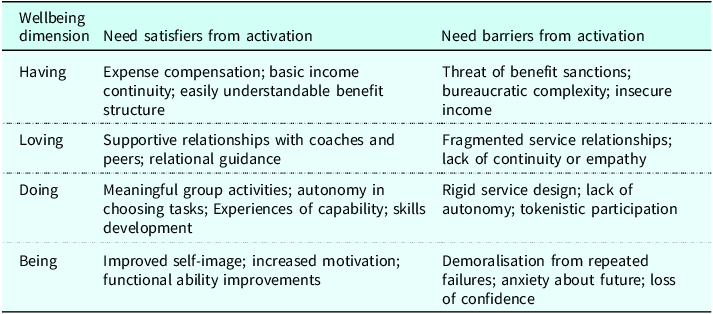
This study advances understanding of activation policies by applying a sustainable wellbeing lens to long-term unemployed jobseekers’ lived experiences. Its key contribution lies in illuminating how activation services can serve as both need satisfiers and need barriers across the four dimensions of wellbeing, each with distinct implications for service design. The accompanying table synthesises these findings, providing a framework for evaluating current activation measures and guiding future service design (Table 1).
Activation services can support wellbeing when they meet core needs across the doing, loving, having, and being dimensions. Group activities offered meaningful structure, and when supporting autonomy and capability, enhanced self-worth and motivation, creating a self-reinforcing ‘circle of wellbeing’. Yet, if activities felt imposed or meaningless, they undermined these gains.
Relational continuity in the loving dimension through empathetic, consistent support was crucial but often disrupted. Whilst financial incentives were not primary motivators, they enabled participation; conversely, sanctions and bureaucracy in the having dimension created stress and disengagement. Ultimately, the being dimension reflects the cumulative effect of these interactions: services that respect autonomy and build trust can foster resilience and hope; those that rely on coercion risk deepening marginalisation.
The phenomenological approach in this study adds depth to the study of activation policies by centring the voices of service users, revealing how meaningful activity, autonomy and relatedness can foster a self-reinforcing ‘circle of wellbeing’. However, the study’s findings are limited to one local context in Finland, which constrains broader generalisations and comparative insight. Future research should explore comparative cross-national experiences of activation, particularly contrasting enabling and restrictive policy models. There is also a need for longitudinal studies that track the sustainability of wellbeing improvements beyond short-term programme participation.
The use of the sustainable wellbeing framework offers a multidimensional view often absent in activation policy evaluation. These findings suggest that to make credible claims about wellbeing benefits to participants, activation policies must be reoriented towards holistic, person-centred support that prioritises needs satisfaction across all four wellbeing dimensions. Rather than seeing wellbeing as a by-product of labour market integration, policies truly designed to address the wellbeing harms of unemployment should integrate sustainable wellbeing as a central objective. Activation services that provide flexibility, relational continuity and genuine opportunities for self-directed progress can better support not only employability, but also human dignity and social inclusion.
Wellbeing need satisfiers and barriers identified in activation services. Note: Authors’ analysis of interview data drawing on the sustainable wellbeing framework (Hirvilammi & Helne, 2014; Martela, 2024)

Acknowledgements
I would like to express my gratitude to the interviewees who participated in this study. I would also like to thank Dr Peppi Saikku and Prof Heikki Hiilamo for their advice and comments as well as the anonymous reviewers for their insight.
Funding statement
This article is a part of the project ‘Building a Knowledge-Based Wellbeing Economy in Finland – A Project to Develop Policy Tools [Hyvinvointitaloudellisten vaikutusten arviointimekanismi]’; a part of Sustainable Growth Programme for Finland funded by NextGenerationEU.
Competing interests
The author declares none.

 Open access

