





The role of perceptual salience in L2 morphology acquisition: Attention, awareness, and intake
Learning a second language (L2) is a challenging endeavor that requires learners to allocate their attention to specific aspects of the input that are relevant to their learning needs and objectives. The acquisition of morphology, in particular, is known to be a formidable task, primarily attributable to the inconspicuous nature of many morphological elements (DeKeyser, Reference DeKeyser2005). Nevertheless, mastering morphological knowledge is essential for overall language development.
Attention and awareness are important cognitive mechanisms in Second Language Acquisition (SLA). According to Schmidt (Reference Schmidt1990, Reference Schmidt and Robinson2001), noticing—the conscious processing of the input, involving both attention and awareness—is necessary for acquisition, although there is ongoing debate regarding the necessity of awareness in this process (e.g., Schmidt, Reference Schmidt2010; Williams, Reference Williams2005). In the linguistic input, where multiple cues compete for attention, salience has been hypothesized to play an important role in modulating attention to, awareness of, and intake of linguistic features and, ultimately, of their acquisition. A feature is considered salient when it stands out from its surrounding environment (Gass et al., Reference Gass, Spinner and Behney2017). Certain linguistic features can attract more attention than others based on their experiential, psycholinguistic, or perceptual properties (Ellis, Reference Ellis2016). However, the concept of salience and its various manifestations, although theorized extensively in SLA and often post hoc invoked to explain L2 acquisition outcomes, still lack adequate empirical testing (cf. Knell et al., Reference Knell, Cipitria, De Cuypere, Housen and Struys2025). As part of a larger research program that aims to help address this gap by experimentally manipulating and comparing the effects of different manifestations of salience, this study focuses on perceptual salience and investigates its impact on attention, awareness, and ultimately, the intake of morphology in an L2.
Eye-tracking measures were used to evaluate the effect of perceptual salience, operationalized as the length of two grammatical morphemes in a semi-artificial language (Englishti, Simoens et al., Reference Simoens, Housen, De Cuypere, Gass, Spinner and Behney2017), on language learners’ attention. A retrospective interview was used to tap into the learners’ awareness of the two target morphemes. A Grammatical Sensitivity Index (GSI; Godfroid, Reference Godfroid2016; Granena, Reference Granena2013) based on eye-tracking measures was used to gauge their intake (or implicit acquisition). We additionally differentiated between incidental and intentional learning contexts (Robinson, Reference Robinson2001) and controlled for individual differences (IDs) in L2 proficiency, implicit learning ability, and working memory (WM).
This paper begins with a comprehensive review of attention and awareness, salience, L2 morphology acquisition, explicit and implicit contexts, and individual learner variables, followed by the research questions guiding this study. The methods section describes the experimental setup, after which the results from the eye-tracking measures, the awareness interviews, and the intake measure are presented.
Attention and awareness in second language acquisition
Attention refers to the cognitive mechanisms enabling the mind to allocate cognitive resources to detect and select specific stimuli or information from the vast array available in the environment (Driver, Reference Driver2001). This selectivity allows individuals to prioritize and process relevant information while filtering out less relevant stimuli. Tomlin and Villa (Reference Tomlin and Villa1994) propose that attention consists of three key cognitive mechanisms: alertness, orientation, and detection. Alertness denotes the state of readiness to receive linguistic input, which can be influenced by factors such as L2 motivation. Orientation, which is modulated by alertness, entails selectively attending to the relevant information while disregarding irrelevant stimuli. These two attentional states support detection, which involves the cognitive registration of stimuli and the selection of information for further processing.
While attention involves the selective focus on specific stimuli, awareness includes a broader range of conscious experiences, extending beyond the immediate focus of attention. Similar to attention, awareness manifests in varying degrees or strengths, exemplified by differences in the depth of processing (e.g., shallow or low-level awareness observed in sensory processing vs. deep or high-level awareness, such as reasoning or comprehension). Schmidt (Reference Schmidt1990) distinguished between three levels of awareness, differentiating awareness as perception (i.e., a shallow form of awareness), awareness at the level of noticing (i.e., recognition of the form), and awareness at the level of understanding (i.e., identifying the underlying rule).
The relationship between attention and awareness is contingent upon theoretical assumptions. While it is widely accepted that attention to novel linguistic input is crucial for successful language learning, the importance of awareness remains a subject of debate. Tomlin and Villa (Reference Tomlin and Villa1994) proposed that detection may occur with or without awareness, whereas Schmidt’s (Reference Schmidt1990) Noticing Hypothesis originally posited that awareness is a necessary condition for the intake and acquisition of new linguistic items—a view he later revised to suggest that awareness, while not essential, can facilitate acquisition (Schmidt, Reference Schmidt and Robinson2001, Reference Schmidt2010). Lamme (Reference Lamme2004) identified four possible combinations of [±attention] and [±awareness], with the combination +attention +awareness being what SLA researchers refer to as “noticing.” Once input (i.e., linguistic information available in the environment) has become noticed, it may turn into intake (i.e., temporary registration in short-term memory), thereby increasing the probability of it being acquired (i.e., cognitively registered in long-term memory; Godfroid et al., Reference Godfroid, Boers and Housen2013; Schmidt, Reference Schmidt1990). In addition, the acquisition of a new language requires the establishment of form-meaning-function mappings, where attention needs to be directed to both linguistic form and its corresponding meaning(s).
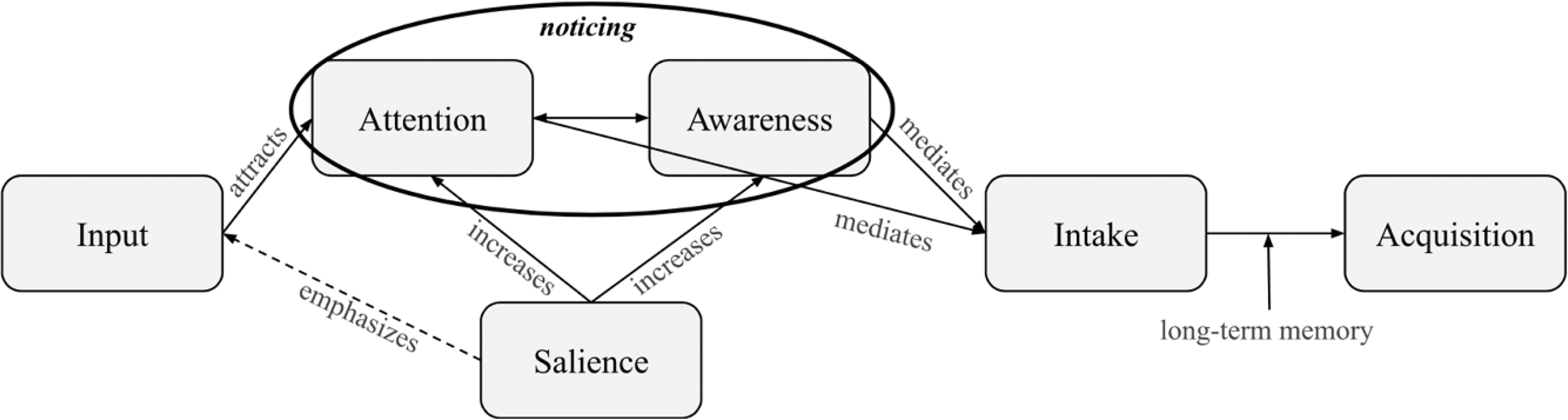
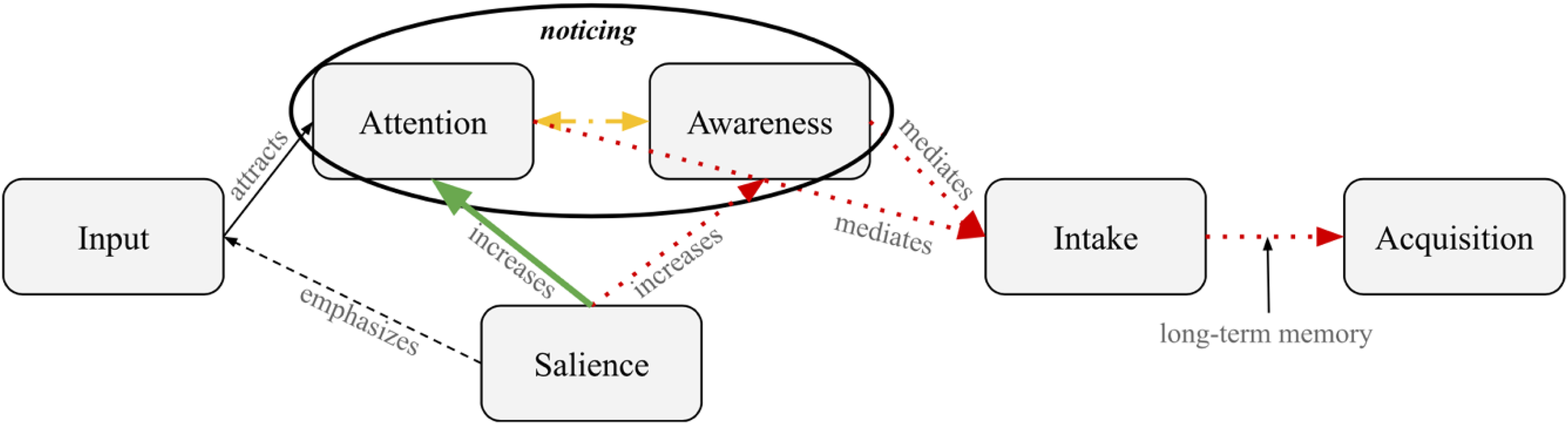
Attention is guided by top-down (or learner-driven) and bottom-up (or stimulus-driven) mechanisms: a learner can actively pay attention to a feature, or a feature itself can attract the learner’s attention. Top-down or learner-driven mechanisms are driven by the learner’s learning intentions or goals and the nature of the learning context. For instance, a learner aiming to master the English question construction will allocate particular attention to sentence structures preceding a question mark in a written text. Learning context factors, including task demands and instructional support, may impact levels of attention and awareness, with different task requirements guiding attention to different features: a comprehension-focused task directs the learner’s focus towards meaning, whereas a Grammaticality Judgment Task (GJT) prompts attention to the sentence’s form (Lim & Christianson, Reference Lim and Christianson2015; Robinson, Reference Robinson2001). In contrast, bottom-up or stimulus-driven attention is determined by intrinsic properties of the input. For instance, longer words naturally stand out and attract more attention than shorter ones (Goldschneider & DeKeyser, Reference Goldschneider and DeKeyser2001; Rayner, Reference Rayner1998). In such cases, attention is involuntarily allocated as a response to the characteristics of the stimuli, and the role of salience in directing attention becomes crucial to the acquisition process (cf. Figure 1; more details in Section Salience in second language acquisition).
Conceptualization of the relationship between the constructs.

Researchers have utilized various measures and methods to examine attention and awareness. Attention has been assessed through techniques such as note-taking, underlining, and think-aloud protocols. More recently, eye-tracking has emerged as an online method that captures eye movements, believed to capture underlying cognitive processes (as posited by the eye-mind link hypothesis, Reichle et al., Reference Reichle, Pollatsek and Rayner2006). A systematic review by Knell et al. (Reference Knell, Cipitria, De Cuypere, Housen and Struys2025) identified eye-tracking as one of the most refined methods for detecting salience effects on attention, as compared to offline measures. Common awareness assessment methods include verbal reports (e.g., think-aloud protocols, stimulated recalls, oral interviews) and behavioral tests (e.g., Grammaticality Judgment Task, intuition-based tasks), as outlined in Robinson et al. (Reference Robinson, Mackey, Gass, Schmidt, Gass and Mackey2012). Although GJTs do not directly reveal learners’ awareness states, previous SLA research has argued and demonstrated that untimed GJTs index explicit L2 knowledge (Godfroid et al., Reference Godfroid, Loewen, Jung, Park, Gass and Ellis2015; Godfroid & Kim, Reference Godfroid and Kim2021), which by most definitions entails some level of awareness (see Section Explicit and implicit learning, knowledge, and exposure in second language acquisition, below).
As illustrated in Figure 1, the path from input to acquisition is a complex and multifaceted process. When a specific feature within the input captures attention, it initiates its path towards acquisition. Attending to a particular feature might enhance awareness of its form and meaning (e.g., Schmidt, Reference Schmidt1990; Tomlin & Villa, Reference Tomlin and Villa1994). In this context, two distinct pathways emerge: a direct route from attention to intake, without awareness, and an indirect route, involving awareness. Salience, whether from the input, the learner, or the context, is believed to be key in boosting attention and awareness, thus having an impact on both pathways (Gass et al., Reference Gass, Spinner and Behney2017; Sagarra & Ellis, Reference Sagarra and Ellis2013). These factors contribute to the initial intake of a feature. Only information processed as intake has the potential to be further processed and enter the learner’s long-term memory, thus culminating in the acquisition of the feature (e.g., Godfroid et al., Reference Godfroid, Boers and Housen2013).
Salience in second language acquisition
In SLA, salience is defined following Goldschneider and DeKeyser (Reference Goldschneider and DeKeyser2001, p. 22) as “how easy it is to hear or perceive a given structure”. It refers to the prominence of a feature within its context, and is influenced by both form-intrinsic, learner-internal, and context-induced factors.
Form-intrinsic salience, inherent to the linguistic form itself, pertains to physical properties of the input that cause a feature to stand out—be it at the acoustic or visual level (Gass et al., Reference Gass, Spinner and Behney2017). For instance, orthographic length constitutes a form-inherent cue that can enhance its perceptual salience: longer words are more likely to be fixated upon, and are thus more salient, compared to shorter words (Goldschneider & DeKeyser, Reference Goldschneider and DeKeyser2001; Rayner, Reference Rayner1998). Learner-internal salience is driven by the learner’s characteristics and expectations based on their language experience. For instance, if a morphosyntactic structure is shared between the learner’s L1 and L2, it becomes salient due to the potential for cross-linguistic transfer (e.g., Lowie, Reference Lowie2000). Context-induced factors refer to external learning conditions, such as task demands and instructional support (Gass et al., Reference Gass, Spinner and Behney2017).
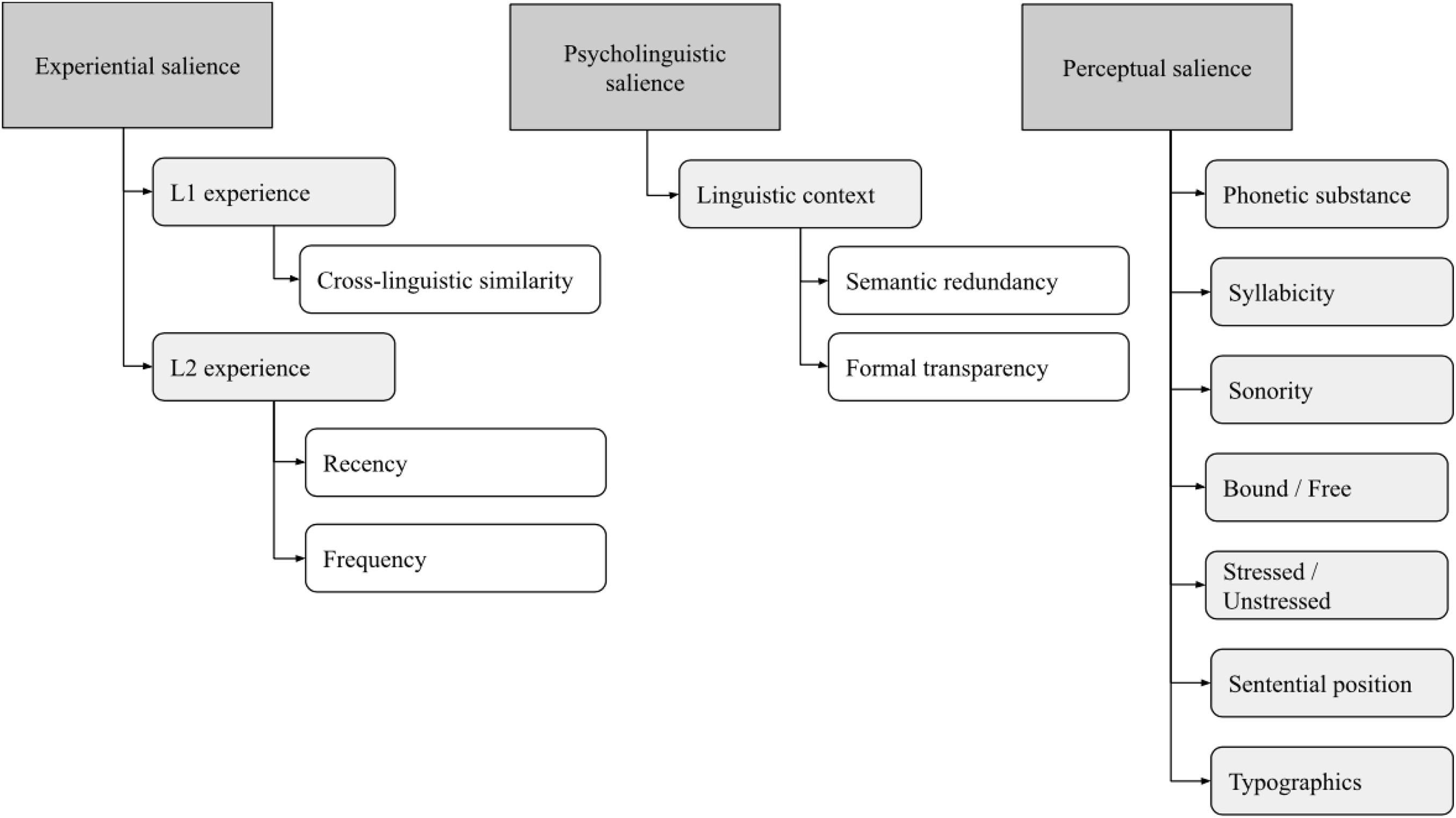
Goldschneider and DeKeyser (Reference Goldschneider and DeKeyser2001) conducted a meta-analysis examining the natural order of morpheme acquisition, identifying five objective properties of grammatical morphemes: perceptual salience, semantic complexity, morphophonological regularity, syntactic category, and frequency. Their findings suggested that a composite salience factor was the strongest predictor of the acquisition order. Ellis (Reference Ellis2016) and Sagarra and Ellis (Reference Sagarra and Ellis2013) later classified the various properties into three categories (cf. Figure 2): perceptual salience, which relates to the physical properties of linguistic elements in the input (e.g., length, syllabicity, word attachment); psycholinguistic salience, which is determined by the impact of larger linguistic context on the learner’s cognitive processes; and experiential salience, which emanates from the learner’s linguistic background (L1 and L2). In this study, we focus on perceptual salience as inherent to the form.
Salience types and their manifestations (based on Ellis, Reference Ellis2016; Sagarra & Ellis, Reference Sagarra and Ellis2013).

Despite the wide acceptance of the theoretical importance of salience in SLA, empirical studies on salience remain limited (cf. Knell et al., Reference Knell, Cipitria, De Cuypere, Housen and Struys2025). The edited volume by Gass et al. (Reference Gass, Spinner and Behney2017) reflects a shift from the post hoc treatment of salience in research towards a more direct empirical examination of the effects of salience. Two of the studies in this volume will be discussed here, given their immediate relevance for the present study. Behney et al. (Reference Behney, Spinner, Gass, Valmori, Gass, Spinner and Behney2017) explored L2 Italian learners’ attention (as measured by fixation length) to (in)congruous adverb-verb markings (an example of such incongruence is: * Vedo che la figlia ha studiato francese adesso con un’amica [* I see that the daughter studied French now with a friend]) and whether attention was influenced by verb length, given the greater perceptual salience of the past tense (e.g., ha studiato [he has studied]) compared to the present tense (e.g., studia [he studies]). The results revealed increased attention to the more salient past tense verbs compared to present tense verbs, as well as a higher number of regressions (i.e., eye movements opposite to normal reading) in response to incongruent past tense verbs than to incongruent present tense verbs. This study suggests that verb length affects the perceptual salience of verbal morphology, which in turn influences attention. Further, Simoens et al. (Reference Simoens, Housen, De Cuypere, Gass, Spinner and Behney2017) investigated the impact of orthographic length on L2 inflectional morphology processing by developing Englishti, an English-based semi-artificial language incorporating high- and low-salient morphemes reflecting the meaning of possessive determiners (his–olp and her–u, respectively; see Section Englishti: A semi-artificial language). Using an eye-tracking study, their findings indicated that the high-salient morpheme (-olp) led to more attention and facilitated intake compared to the less salient morpheme (-u), which subsequently improved the learners’ ability to decode the meaning of the morpheme.
Additional evidence is provided by Zalbidea (Reference Zalbidea2021), who investigated the influence of output modality (no output, oral, written) on the acquisition of L2 Spanish grammatical forms differing in salience. The future tense (Él preparará una cena), considered perceptually salient due to its stress and sonority, showed greater noticing and form-meaning integration than the less salient indirect object clitic (le), comparatively low in salience due to its reduced semantic weight, despite its perceptual salience as a free-standing lexical item (cf. Knell et al., Reference Knell, Cipitria, De Cuypere, Housen and Struys2025). Production and judgment tasks revealed that higher salience (i.e., the future tense) promoted attention and accuracy, whereas the written modality facilitated learning of less salient forms, likely due to slower pacing and the availability of visual input.
While research has shown a growing interest in empirically examining salience and its effects on language acquisition, research addressing specific manifestations of salience (cf. Figure 2) remains scarce. To help redress this gap, this study particularly builds on the study by Simoens et al. (Reference Simoens, Housen, De Cuypere, Gass, Spinner and Behney2017) and seeks to explore the effect of perceptual salience operationalized in terms of orthographic-phonological length on attention, awareness, and intake using a semi-artificial language paradigm.
Morphology in second language acquisition
Inflectional morphology poses a major learning challenge for L2 learners, due to the redundancy and lack of transparency of morphological form-meaning relationships as well as the relatively low (perceptual) salience of inflections (DeKeyser, Reference DeKeyser2005; see Ellis, Reference Ellis2022, for a recent review). Morphological cues are often phonologically or orthographically short and unstressed, such as the stem-vowel change for third person singular present tense in German irregular verbs (Koch et al., Reference Koch, de Vos, Housen, Godfroid and Lemhöfer2023). The meaning aspect of grammatical morphology also presents challenges for L2 learners, as its role in converting meaning can be redundant for understanding the overall sentence (Schmidt, Reference Schmidt and Robinson2001). For instance, verbs are frequently accompanied by adverbs providing a more specific temporal meaning than that expressed by the inflectional verb markers (e.g., “Yesterday he walked in the park”). Given the salience of adverbs in terms of their phonemic and orthographic length and stand-alone nature as compared to many grammatical morphemes (cf. Goldschneider & DeKeyser’s (Reference Goldschneider and DeKeyser2001) predictors), the high salient nature of adverbs, as opposed to the less conspicuous morphological marker, makes them more likely to capture the learner’s attention. But, despite morphology being a “weak cue” (DeKeyser, Reference DeKeyser2005), both in terms of meaning and form, research has shown that L2 learners are still sensitive to L2 morphology. A deeper understanding of morphological salience can shed light on the underlying mechanisms of SLA and L2 morphology learning in particular.
Explicit and implicit learning, knowledge, and exposure in second language acquisition
The distinction between explicit and implicit learning, knowledge, and exposure is based on the learner’s awareness of the learning process (i.e., aware vs. unaware of acquiring knowledge), the nature of the resulting knowledge (i.e., can vs. cannot be verbalized), and the type of learning context (i.e., whether rules are taught through metalinguistic information vs. inferred without awareness) (DeKeyser, Reference DeKeyser, Doughty and Long2003; Ellis, Reference Ellis, Ellis, Loewen, Elder, Reinders, Erlam and Philip2009). These constructs are not to be conflated with intentional and incidental learning, which refer to the presence or absence of a deliberate intention to learn language during a given task (see Hulstijn, Reference Hulstijn, Doughty and Long2003). While intentional learning falls under explicit learning, incidental learning is not necessarily implicit, as incidental learning allows for some fluctuating awareness (Ortega, Reference Ortega2009): even in the absence of intentional learning, learners may still become aware of the element that is being learned in the linguistic input. Due to the methodological difficulty of measuring intentionality, incidental learning is often operationalized as learning that occurs during apparently meaning-focused, language-unrelated activities, without knowing that one is actually engaging in an L2 learning task (e.g., Hulstijn, Reference Hulstijn, Doughty and Long2003).
The type of learning, knowledge, and exposure may impact the L2 acquisition process, particularly in terms of how attention and awareness are allocated during input processing. Implicit learning relies on bottom-up attentional processes, where learners are influenced by the perceptual salience of input without awareness (Ellis, Reference Ellis, Ellis, Loewen, Elder, Reinders, Erlam and Philip2009). In contrast, in explicit learning, bottom-up attentional processes driven by perceptual salience may be overridden by top-down attentional mechanisms activated by the task demands—e.g., when learners are instructed to attend to grammatical form—(Robinson, Reference Robinson2001).
The relationship between learning type and salience has received limited attention in research, though the type of learning may differentially affect salience. In particular, explicit exposure could enhance learners’ attention to low-salient linguistic features, promoting greater attention, awareness, and acquisition. Fukuta and Yamashita (Reference Fukuta and Yamashita2021) explored the relationship between implicit and explicit learning and knowledge and the salience of form–meaning mappings in terms of their redundancy and meaningfulness. Forty participants were incidentally exposed to a semi-artificial language featuring an artificial determiner system characterized by [±plural] (a taught rule), [±actor] (a less redundant, more salient hidden rule), and [±animate] (a more redundant, less salient hidden rule). Using think-aloud protocols and source attributions, they examined participants’ awareness of the determiners. Their findings indicated that the more salient rule elicited greater awareness than the less salient one, which in turn facilitated learning. Additionally, the retention of explicit knowledge in both immediate and delayed post-tests supports that awareness contributes to the retention of new linguistic input. Similarly, Simoens et al. (Reference Simoens, Housen, De Cuypere, Gass, Spinner and Behney2017) included implicit and explicit processing conditions in their study on perceptual salience: in the second phase of the experiment, participants either answered yes/no comprehension questions (implicit condition) or completed an untimed grammaticality judgment task (explicit condition). Learners in the explicit condition showed sensitivity to ungrammatical forms of the high-salient morpheme, an effect not observed for the low-salient morpheme or under the implicit condition. This study further supports that explicit mechanisms facilitate the process towards the acquisition of novel grammatical forms.
Individual differences in second language acquisition
IDs in cognitive abilities significantly influence the learning process and outcomes, as evidenced by the variability observed in language learning success (Robinson, Reference Robinson2001). This line of research has become increasingly prominent in SLA studies. As Williams (Reference Williams, Wen, Mota and McNeill2015) observed, “there is a current trend in the field to use individual differences as a means of distinguishing the contribution of different cognitive systems to learning” (p. 302). In this study, we will focus on three cognitive skills that are assumed to have an individual variable impact on SLA: L2 proficiency, implicit learning ability, and WM.
L2 proficiency influences how learners process an L2. Research indicates that lower proficiency learners read more slowly and exhibit more regressions, while high-proficient learners demonstrate more native-like reading behaviors, such as longer reading times for ungrammatical sentences, indicating deeper processing (Lim & Christianson, Reference Lim and Christianson2015; Sagarra & Ellis, Reference Sagarra and Ellis2013). Regarding morphological processing, Sagarra and Ellis (Reference Sagarra and Ellis2013) highlighted that L2 experience plays a crucial role: beginners often overlook verbal morphology because it is redundant and less salient compared to temporal adverbs, while intermediate learners attend to it but may not analyze it for function. Koch (Reference Koch2022) examined the predictive processing of morphosyntactic markers in L2 German, where 30 L1 Dutch speakers listened to verb-subject-object (VSO) sentences and selected corresponding images, relying on verb affixes and stem vowels to infer grammatical number. Results showed that higher L2 proficiency and WM capacity facilitated predictive processing. These results suggest that both linguistic competence and cognitive resources play an important role in sentence processing.
Implicit learning ability, often included as a component of language learning aptitude, encompasses cognitive and perceptual abilities essential for predicting L2 development, particularly in the domain of morphosyntax (Granena, Reference Granena2013; Robinson et al., Reference Robinson, Mackey, Gass, Schmidt, Gass and Mackey2012). Granena (Reference Granena2013) examined the relationship between sequence learning ability and SLA, using the LLAMA-D for acoustic sequence learning and the Serial Reaction Time (SRT) task for visual sequence learning ability. The findings revealed a correlation between SRT performance and implicit grammar learning, suggesting that (visual) sequence learning ability is relevant to implicit L2 knowledge. Godfroid and Kim (Reference Godfroid and Kim2021) explored how IDs in implicit learning aptitude influence the development of implicit L2 knowledge. By employing various linguistic and aptitude tests, they examined the correlations between the aptitude measures and linguistic performance. Their findings indicated that, among the aptitude measures, only the alternating SRT task significantly predicted learners’ performance on timed, accuracy-based language tests, which are indicative of implicit knowledge; thus, reinforcing the multidimensional nature of implicit learning ability.
WM denotes the capacity to temporarily store and manipulate a limited amount of information in one’s mind while engaging in cognitively demanding tasks (Baddeley, Reference Baddeley1992). Research in SLA has extensively explored the link between WM and attention, as WM capacity significantly influences comprehension and processing skills (Robinson et al., Reference Robinson, Mackey, Gass, Schmidt, Gass and Mackey2012), particularly in explicit contexts (Williams, Reference Williams, Wen, Mota and McNeill2015; for further insight into the role of WM in SLA, see the special issue by Wen et al., Reference Wen, Mota and McNeill2015). Zalbidea and Sanz (Reference Zalbidea and Sanz2020) examined the influence of WM on L2 acquisition outcomes of more and less salient L2 grammar (high-salience: Él preparará una cena, low-salience: Ella le da un abrazo) across oral and written production tasks. Their findings indicated that WM capacity significantly predicted L2 performance for both grammatical forms, but only in the oral production condition, suggesting that WM demands may interact with task modality to influence L2 learning outcomes.
IDs may interact with the salience of linguistic features to influence L2 learning. Regarding L2 proficiency, beginners typically prioritize comprehension, which often limits their ability to analyze the linguistic form. Consequently, learners with lower proficiency may overlook less salient features in the input, such as the past tense -ed morpheme, particularly when a more specific meaning is conveyed through more overt lexical elements like the adverb “yesterday.” As Ellis and Sagarra (Reference Ellis and Sagarra2010) noted, “beginning learners’ limited cognitive resources forces them to only attend to the most salient and reliable cue” (p. 87). As proficiency grows, learners develop more efficient processing, and grammatical forms become meaningful cues in their own right. Thus, intermediate–advanced learners are less constrained by comprehension demands and are more likely to attend to both the form and meaning of grammatical markers (Ellis & Sagarra, Reference Ellis and Sagarra2010). Additionally, individuals with higher implicit learning ability may be more adept at noticing less obvious linguistic patterns compared to those with a lower ability (Tagarelli et al., Reference Tagarelli, Ruiz, Moreno Vega and Rebuschat2016). Similarly, learners with a high WM may have enhanced resources for storing and manipulating low-salient features, whereas those with a lower WM may be more prone to overlooking such subtle cues.
The present study
Morphology acquisition presents a significant challenge for language learners. The cognitive mechanisms of attention and awareness play an important role in acquiring new linguistic input (Schmidt, Reference Schmidt1990, Reference Schmidt2010; Williams, Reference Williams2005). Salience is believed to be a key factor influencing both attention and awareness and, ultimately, intake and acquisition (Goldschneider & DeKeyser, Reference Goldschneider and DeKeyser2001). However, empirical research on the nature and role of salience in impacting attention, awareness, and intake, and the mediating role of learning context and learner variables remains scarce (cf. Knell et al., Reference Knell, Cipitria, De Cuypere, Housen and Struys2025). This study thus aims to provide empirically-based insights into these crucial matters by investigating the effect of perceptual salience on L2 processing and acquisition. The study addresses the following overarching research question:
-
● How does perceptual salience, operationalized by the contrastive length of two artificial grammatical morphemes (the suffixes -ulp and -o), impact attention allocation, awareness, and L2 intake?
To explore this question in greater depth, the study also investigates two subquestions:
-
● How does the perceptual salience of the two morphemes differentially affect their attention, awareness, and intake in incidental versus intentional learning contexts?
-
● How do individual learner variables (i.e., implicit learning ability, WM, and English proficiency) affect or interact with perceptual salience to influence attention, awareness, and intake?
We hypothesize that the longer, perceptually more salient morpheme (-ulp) enhances attention compared to the shorter, less salient one (Behney et al., Reference Behney, Spinner, Gass, Valmori, Gass, Spinner and Behney2017; Simoens et al., Reference Simoens, Housen, De Cuypere, Gass, Spinner and Behney2017). Using eye-tracking, attention is measured through fixation durations (FDs) on the target morphemes (Godfroid, Reference Godfroid2016). Prolonged fixations are accordingly interpreted as indicative of increased levels of attention. We further predict that greater attention leads to increased awareness, which we examine by a retrospective interview (Koch et al., Reference Koch, de Vos, Housen, Godfroid and Lemhöfer2023; Rebuschat, Reference Rebuschat2013; Williams, Reference Williams2005). Finally, we hypothesize that higher perceptual salience leads to an enhanced intake (a first stage of implicit learning, Godfroid, Reference Godfroid2016) of grammatical L2 morphemes, as expressed by the Grammaticality Sensitivity Index (GSI) score (Granena, Reference Granena2013; Godfroid, Reference Godfroid2016). Participants in the intentional learning group, who are explicitly encouraged to learn the L2 by focusing on the linguistic form of the input, are anticipated to demonstrate higher awareness compared to those in the incidental learning group, who are encouraged to process the input for its meaning but not to focus on form. To account for IDs, we consider English proficiency, implicit learning ability, and WM measures in subsequent analyses.
Methodology
Participants
Sixty–eight participants took part in this study (M age = 22.5; range = 18–35). They were L1 Dutch speakers, highly proficient in English, averaging a C-test score of 84.2%, equivalent to the C1 level in the Common European Framework of Reference (CEFR) (Council of Europe, 2001; Keijzer, Reference Keijzer2007). A background questionnaire considered knowledge of other languages, and individuals with a self-perceived intermediate or high proficiency in a language in which the target morphemes of this study (-o, -ulp) occurred (i.e., Spanish, Italian, or Portuguese) were excluded. WM capacity was assessed through the Reading Span Test (RST) (van den Noort et al., Reference van den Noort, Bosch, Haverkort and Hugdahl2008), while implicit learning ability was measured using the SRT task (Kaufman et al., Reference Kaufman, DeYoung, Gray, Jiménez, Brown and Mackintosh2010). All participants had normal or corrected-to-normal vision, and none had diagnosed dyslexia or other language-related issues. Participants completed the experiment within a maximum of two hours and received compensation for their participation, either in monetary form or course credit. Ethical approval was granted by the Ethische Commissie Humane Wetenschappen [Ethics Committee for Humanities] of the Vrije Universiteit Brussel (reference number: ECHW_320.02) on December 21, 2021. All participants provided a written consent form prior to their participation in the study.
Englishti: a semi-artificial language
The use of (semi-)artificial languages aims to replicate and analyze the acquisition of linguistic features in natural language but with greater control over mediating factors (e.g., Rogers et al., Reference Rogers, Revesz, Rebuschat and Rebuschat2015; Williams, Reference Williams2005). A semi-artificial language is characterized by the combination of natural language and artificially introduced meaning-bearing features that closely resemble those found in natural languages and their learning. Examples include the incorporation of additional inflections (Rogers et al., Reference Rogers, Revesz, Rebuschat and Rebuschat2015; Simoens et al., Reference Simoens, Housen, De Cuypere, Gass, Spinner and Behney2017) or articles (Williams, Reference Williams2005) or the merging of features from two distinct languages, such as merging Japanese syntax with English lexicon (Williams & Kuribara, Reference Williams and Kuribara2008). We opted to use a semi-artificial language due to the considerable time and effort required to recognize the vocabulary or grammatical patterns in a fully artificial language (or in a completely unknown natural language), as well as the difficulty in disentangling the distinct salient properties inherent in natural languages.
This study draws on the work of Simoens et al. (Reference Simoens, Housen, De Cuypere, Gass, Spinner and Behney2017), who created an English-based semi-artificial language called Englishti, which uses standard English vocabulary and morphosyntax but with a number of additional artificial pseudowords (which serve as distractors in our stimuli) and artificial grammatical morphemes (-olp and -u). In this study, we adopted a modified version of Englishti using the morphemes -ulp and -o as target features. This adjustment was motivated by cross-linguistic considerations: in our participants’ L1 Dutch, u corresponds to the formal pronoun “you,” which could lead to semantic interference. The primary motivation for selecting English as the base language of our semi-artificial language is the high levels of English L2 proficiency among L1 Dutch speakers, which reduces the learning burden of the participants (compared to a completely unknown artificial or natural language) and thus allows them to potentially allocate more cognitive resources to the novel (artificial) target features. As compared to English, Englishti includes a morphological marker to indicate the subject’s gender, mirroring the meaning of the possessive pronouns “his” and “her.” The following sentence provides an example of a target sentence: Suzy had to take her showero at six, with the suffix -o agreeing with the possessive determiner her to mark feminine gender.
Target morphemes
Englishti contains two inflectional morphemes, which are manipulated in terms of their bottom-up perceptual salience, operationalized as morpheme length: the longer “-olp” suffix and the shorter “-u” suffix (Simoens et al., Reference Simoens, Housen, De Cuypere, Gass, Spinner and Behney2017). The longer three-letter morpheme is more perceptually salient and is thus hypothesized to attract more attention than the shorter one-letter morpheme.
Similar to Simoens et al. (Reference Simoens, Housen, De Cuypere, Gass, Spinner and Behney2017), the following criteria were considered when choosing the artificial morphemes: a) they have no morpheme status in the participants’ L1 and L2s; b) they do not consist of frequent graphemes in English nor in Dutch, while still c) ensuring phonotactic permissibility; d) both morphemes start with a vowel and attach to consonant-ending nouns.
Englishti intentionally incorporates semantically redundant morphemes, as both the traditional possessive marker (his/her) and the artificial morpheme (-ulp/-o) are present in the sentence. This redundancy mirrors a common feature in natural languages, often related to concordance (e.g., “las casas bonitas” [the pretty houses] in Spanish, with repetitive female and plural markers -as). Additionally, the morphemes are bound in nature (i.e., attached to the noun).
The two target morphemes were attached to carefully selected nouns, ensuring they were five-to-seven-letter long, bi-syllabic, and monomorphemic. Highly frequent nouns were chosen (Davies, Reference Davies2015: COCA corpus) to ensure comprehension. Potential gender bias was addressed by exploring the bigram frequency per gender (i.e., his/her + noun) and avoiding strongly gender-associated nouns. Moreover, cognate status between English and Dutch was controlled for: no exact cognates were used, yet nouns with a one-grapheme difference were accepted. Cross-linguistic neighborhood density was calculated across English and Dutch according to a one-grapheme difference (Marian et al., Reference Marian, Bartolotti, Chabal and Shook2012). Animate nouns were excluded. Noun concreteness was considered using the Brysbaert et al. (Reference Brysbaert, Warriner and Kuperman2014) database, with only nouns scoring higher than 4.5 (out of 5) included. In total, 40 nouns were selected for the experiment.
Stimuli
The stimuli comprised 240 sentences: 160 for the learning phase and 80 for the testing phase. These were created for the specific purpose of this experiment and were carefully reviewed by a native English speaker. The stimuli are available at: https://doi.org/10.18710/GBMBYF.
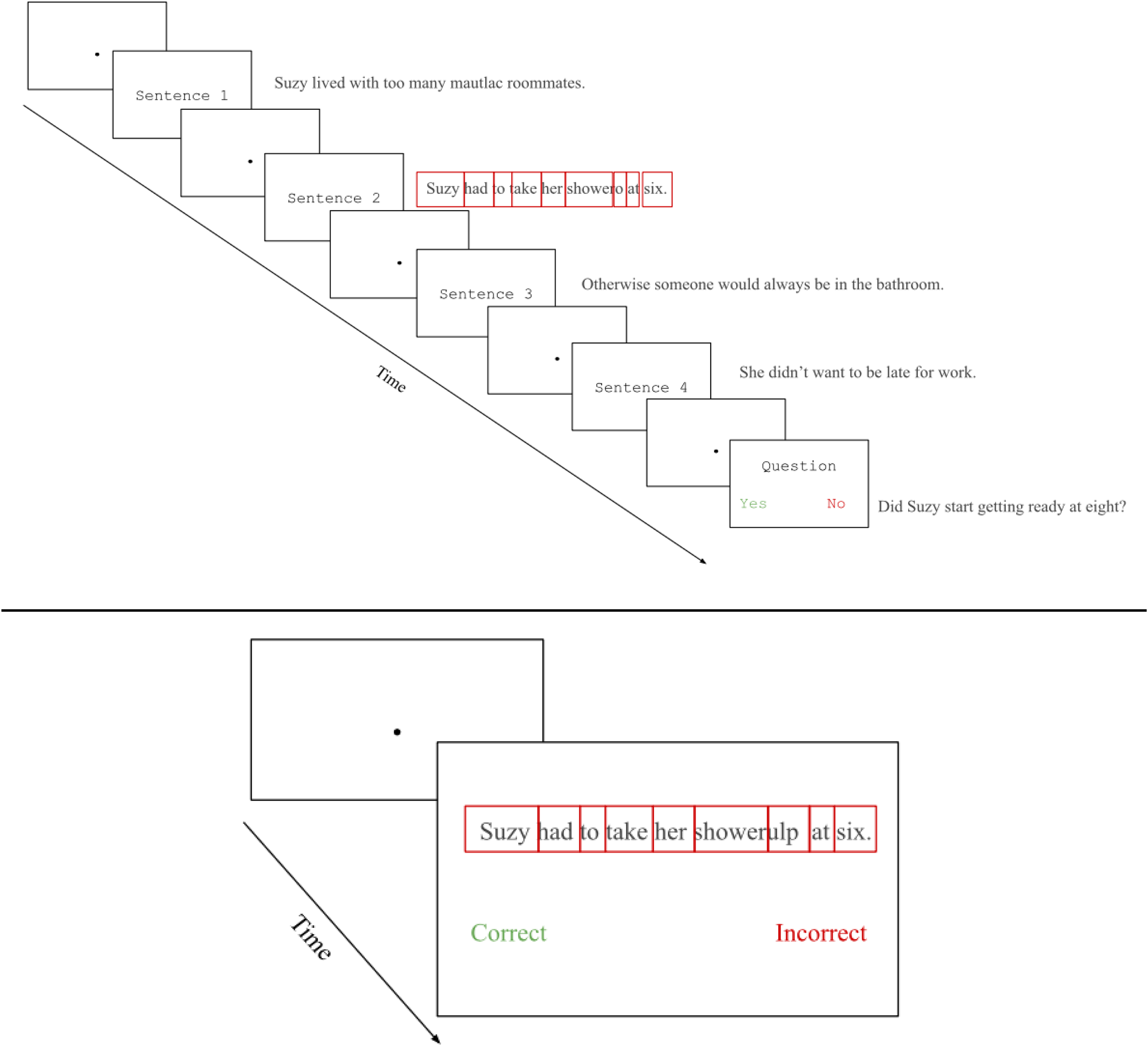
The learning phase consisted of four-sentence stories, each containing a target sentence (n = 40), a distractor sentence (n = 40), and two filler sentences (n = 80), presented sequentially and without the possibility to revisit previous sentences (see Figure 3). After each story, participants answered a content-related yes/no question to assess their comprehension. Target sentences contained the target morpheme (-ulp/-o). Their length was limited to eight words, and they shared a similar morphosyntactic structure. Subjects consisted of four-letter English names clearly marked by gender. Distractors and fillers diverted participants’ attention from the experiment’s purpose. Distractors featured pseudowords (Duyck et al., Reference Duyck, Desmet, Verbeke and Brysbaert2004: WordGen) in adjectival or adverbial positions, while fillers consisted of plain English sentences.
Trial design: learning (above) and testing (below) phases.
Note 1: Areas of Interest of the target sentences are marked in red.
Note 2: In this example, the first sentence serves as a distractor, the second sentence is the target sentence, and sentences 3 and 4 are filler sentences. The windows in between represent the fixation dot.
Note 3: Morphosyntactic structure of target sentences: (time adverbial)—subject—transitive verb—possessive marker (his/her)—direct object + target morpheme (ulp/o)—prepositional phrase. The target morpheme was always presented in sixth position.

In the testing phase, individual sentences were presented, with 40 target sentences and 40 distractors. Half of the sentences were ungrammatical according to the previously learned rule: target sentences violated the gender-morpheme combination rule (e.g., her–ulp), and distractor sentences included a distractor in a different morphosyntactic position. Half of the target sentences were familiar, having appeared during the learning phase, while the remaining half were unfamiliar or new, enabling the assessment of rule generalization (Williams, Reference Williams2005). Participants also rated these sentences for their grammaticality in Englishti.
Procedure and design
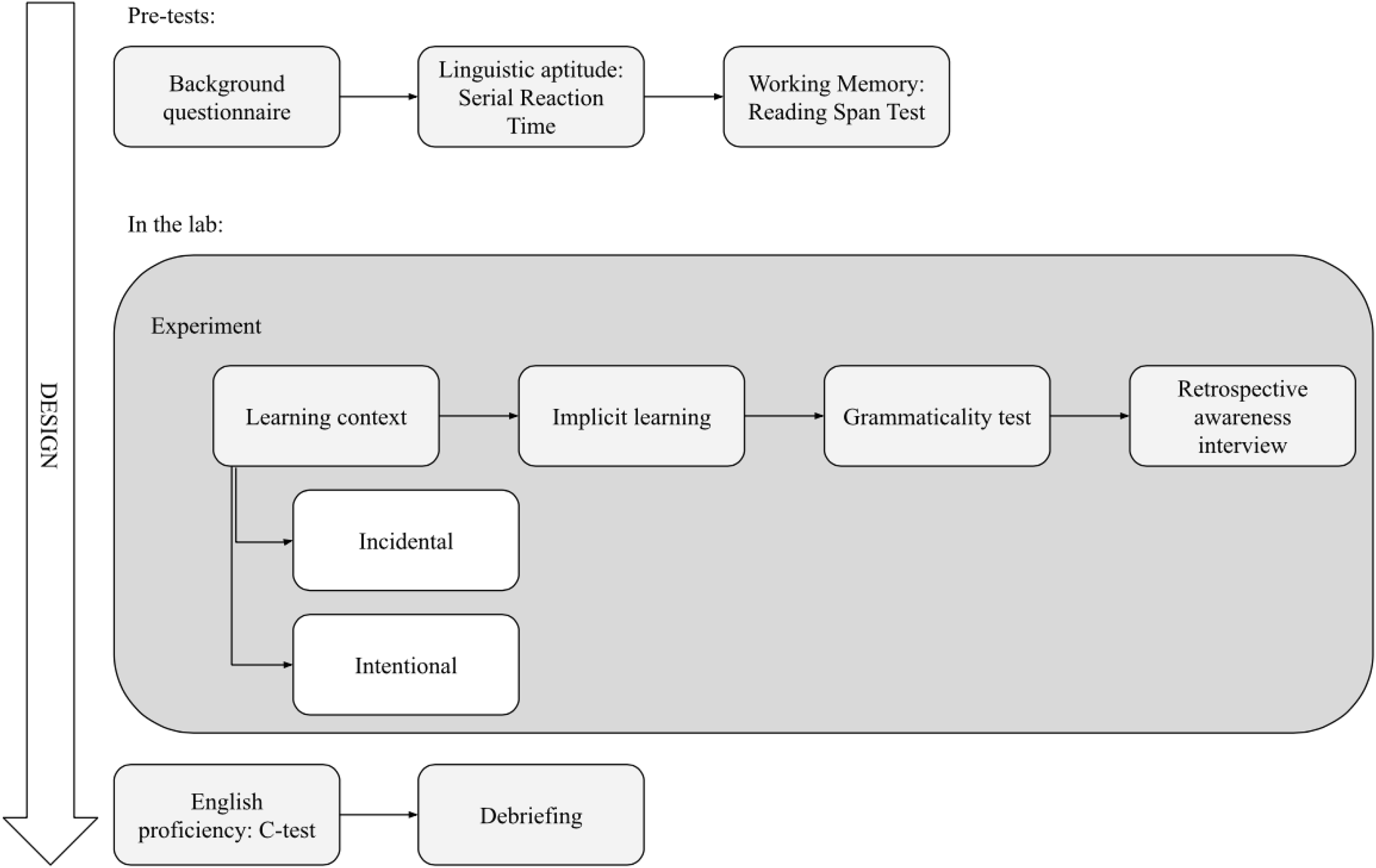
Participants first filled in a demographic and linguistic background questionnaire (Qualtrics, 2005). In addition, they completed the SRT task, which measures implicit learning ability (Kaufman et al., Reference Kaufman, DeYoung, Gray, Jiménez, Brown and Mackintosh2010), and the RST in their L1 Dutch, which taps into WM (van den Noort et al., Reference van den Noort, Bosch, Haverkort and Hugdahl2008), through Gorilla (gorilla.sc; Anwyl-Irvine et al., Reference Anwyl-Irvine, Massonié, Flitton, Kirkham and Evershed2019). The main experiment was performed in the lab and consisted of three parts: an implicit learning phase, a grammaticality test phase (untimed GJT), and a retrospective awareness interview (see Figure 4). The purpose of the study was concealed from the participants. Participants were randomly assigned to either the incidental or intentional learning condition, each with different learning goals: the incidental group was instructed to read stories and sentences in Englishti for content, while the intentional group was instructed to pay attention to the linguistic form of the Englishti sentences—though not to the target morphemes specifically—and was made aware of a subsequent test. The specific instructions provided to participants in the intentional learning condition were as follows: “We would like to see whether you can pick up any Englishti. There will be a second task to test this. Pay attention to the form of the sentences.”
Study design.

The target morphemes were counterbalanced across gender: half of the participants observed the high-salient morpheme related to the masculine gender (his–ulp, her–o), whereas, for the other half, the high-salient morpheme was associated with the feminine gender (her–ulp, his–o). Moreover, grammaticality and familiarity were balanced during the testing phase. The sentences were pseudorandomized, as a maximum of three target sentences could appear after each other.
Eye-tracking was used to measure participants’ attention to Interest Areas (IA; in this case, the target morpheme). An individual IA was drawn around each word, in addition to a specific IA for the target morpheme (see Figure 3). All sentences and questions had a maximum display time of 10 seconds, which ensured enough time for the participants to read (and, if necessary, reread) the sentences at a normal reading pace. Four short breaks were included throughout the experiment.
A retrospective interview, lasting approximately 10 minutes, assessed participants’ awareness of the target form and meaning (see Appendix). The questions about the target form followed a general-to-specific order (Koch et al., Reference Koch, de Vos, Housen, Godfroid and Lemhöfer2023; Rebuschat, Reference Rebuschat2013; Simoens et al., Reference Simoens, Housen, De Cuypere, Gass, Spinner and Behney2017). The interview was audio-recorded and later transcribed. In line with recent methodological recommendations (e.g., Zalbidea, Reference Zalbidea2021), we introduced a principle gradient score to categorize participants’ awareness as (0) unaware, (1) aware of form with prompt, (2) aware of form by themselves, (3) aware of form and approximate meaning, and (4) aware of form and specific meaning. Finally, participants performed the C-test that measured their English proficiency (Keijzer, Reference Keijzer2007), followed by a debriefing.
The main experiment was conducted individually in a quiet room. The experiment was created and displayed in Experiment Builder (v. 2.3.38), and eye-tracking data were collected with an EyeLink Portable Duo (SR Research Ltd.). A 13-point manual calibration was completed before the start of the experiment, and we did not start recording until the validation error was below one degree of visual angle. The eye-tracking sample was set to 500 Hz. The optimal distance to the participant was set to 52 centimeters. The resolution of the screen was 1920 × 1080, and the refresh rate was set to 120 Hz. Since this was a text-based eye-tracking experiment, a chinrest was used to restrict head movements to maximize eye-movement data collection accuracy. Only the participant’s dominant eye was recorded.
The reading task was displayed in Courier New (20 pt), a monospace font that guarantees an equal division of space between the characters. The sentences were centered on the screen and fitted in a single line. The fixation dot only allowed participants to move forward when their gaze was upon it, which ensured participants’ attention and allowed us to control for saccade length. A drift check was performed every four sentences to ensure the accuracy of the data recorded.
Data preprocessing
The answers to the C-test (Keijzer, Reference Keijzer2007), SRT (Kaufman et al., Reference Kaufman, DeYoung, Gray, Jiménez, Brown and Mackintosh2010), and Reading Span (van den Noort et al., Reference van den Noort, Bosch, Haverkort and Hugdahl2008) were computed in accordance with the procedures outlined in the original publications. The assessment of language proficiency involved two independent raters—the first two authors of this paper—who individually evaluated responses and later convened to ensure agreement on the accuracy of the answers. The awareness interviews were transcribed and later categorized based on the established awareness scale.
Eye-tracking data were pre-processed in Data Viewer (SR Research Ltd., v. 4.2.1.). Filler and distractor sentences were excluded, focusing solely on target sentences. Data quality checks revealed minimal fixation loss, with a maximum of 7% for one participant, leading to the inclusion of all participants in subsequent analyses. Data analysis focused exclusively on fixations, excluding blinks and saccades. A four-stage cleaning process merged or removed fixations based on predefined duration thresholds (default in program), following established research practices (Carrol et al., Reference Carrol, Conklin and Gyllstad2016; Godfroid, Reference Godfroid2020). This resulted in the deletion of 25,878 fixations and the merging of 463 others, leaving 64,633 fixations for subsequent analysis.
Common eye-tracking measures specific to reading research were extracted using Get Reading Measures (SR Research Ltd.). This creates one row per trial, resulting in a total of 5433 observations. The analysis was performed on two IAs: (1) examining the target morpheme (IA7: -ulp/-o), and (2) exploring the areas around it (IA5–8, e.g., “her showero at” in the lower part of Figure 3), which aimed to account for parafovealFootnote 1 vision, as lexical and semantic information can be extracted parafoveally (Frisson, Reference Frisson2023). To answer the research questions, we focus on the IA containing the target morpheme. The analysis of the wider IA can be found in our online materials: https://doi.org/10.18710/GBMBYF [06_EYESAL_Exp1_IA58_Eye.html].
The skipping rate, which indicates the absence of fixations during the first-pass reading of a particular IA, was calculated. Given the nature of our target IA (i.e., an inflectional morpheme), a relatively high skipping rate was anticipated, as shorter linguistic elements consisting of 2–3 letters tend to be fixated only about 25% of the time during reading (Rayner, Reference Rayner1998). We incorporated two measures to capture both early and late processing aspects. First Fixation Duration (FFD) is an early processing measure that focuses on the duration of the first fixation on a target region when it is encountered for the first time. Total Duration (TD) is a late, but compiled, processing measure, representing the duration of all fixations within a given target region (and, hence, also including FFD).Footnote 2
A Grammaticality Sensitivity Index (GSI) was computed in order to explore participants’ sensitivity to ungrammatical sentences (Granena, Reference Granena2013), that is, sentences in which the agreement of the artificial morpheme with the possessive determiner was different from what the participants had previously been exposed to. The GSI was derived by subtracting the FDs of grammatical Englishti sentences from those of ungrammatical sentences (i.e., FDungrammatical − FDgrammatical). Prolonged fixation times for the morpheme-gender mismatch are taken to indicate that participants implicitly acquired the grammatical rule.
Statistical analysis
A mixed-effects logistic regression model was fitted for Skipping Rate (a binary outcome in non-aggregated format), and a separate mixed-effects linear regression was performed for FFD and TD. Following the initial model that included all the data, we conducted an additional model for durational measures, excluding outliers (±2.5 SD from the mean). For this purpose, the glmer and lmer functions from the lme4 package were used (Bates et al., Reference Bates, Mächler, Bolker and Walker2015). Model comparison enables us to determine the best-fitting model based on the data. We followed a stepwise forward selection, adding variables one at a time (Wieling, Reference Wieling2018). We used a two-tailed criterion, where a variable (or an interaction between variables) was regarded as significant when t ≥ 1.96 (Bates et al., Reference Bates, Mächler, Bolker and Walker2015). Model selection was further guided by the Akaike Information Criterion (AIC) score, with the model possessing a lower AIC score indicating a better fit. A difference of at least 2 in AIC scores was required to favor the more complex model over the simpler one.
The dependent variables were attention, operationalized as the eye-tracking measures Skipping Rate, FFD, and TD, as well as intake, reflected by the GSI. We investigated several predictors that potentially influenced the eye-tracking data:
-
● Perceptual salience: Length (within-participant, binary: long vs. short)
-
● Learning context (between-participant, binary: intentional vs. incidental)
-
● Grammaticality (within-participant, binary: grammatical vs. ungrammatical)
-
● Familiarity (within-participant, binary: familiar vs. new)
-
● Awareness of the morphemes (ordinal: 0–4)
-
● English proficiency (ordinal: 0–100)
-
● Implicit learning ability: SRT (ordinal: 0–6)
-
● Working Memory: Reading Span (ordinal: 0–60)
In addition, based on Simoens et al.’s (Reference Simoens, Housen, De Cuypere, Gass, Spinner and Behney2017) results, we examined the following two-way and three-way interactions:
-
● Perceptual salience: Length × Learning context
-
● Perceptual salience: Length × Grammaticality
-
● Perceptual salience: Length × Learning context × Grammaticality
Since the data exhibited positive skewness, we centered the independent variables and applied a log transformation to the dependent durational variables (i.e., FFD and TD). The statistical analyses were performed on these transformed data. Participant and item were consistently included as random intercepts ((1|Participant) + (1|Item)). Our analysis focused specifically on the data corresponding to the testing phase. For the durational measures, different datasets were created to exclude invalid data points (i.e., 0sFootnote 3 and NAs), resulting in 801 observations that fell on the target morpheme for FFD and 1419 for TD.
To examine intake, we employed a linear regression model with the GSI as the dependent variable. The main factors of interest, salience and learning context, were treated as independent variables, both as main effects and in interaction. These variables were hypothesized to exert the most significant influence on intake. To assess explicit knowledge, results from the untimed GJT are briefly reported; yet, given the nature of the task, the GSI was expected to provide more insights. All analyses were conducted in RStudio (v. 4.3.1, RStudio Team, 2023).
Results
In this section, we first provide results regarding the eye-tracking measures, followed by the inferential statistics conducted using (g)lmer (Bates et al., Reference Bates, Mächler, Bolker and Walker2015) for IA7 (i.e., the target morpheme), excluding outliers (±2.5 SD). We also report on the awareness data obtained from the retrospective interview and measure intake through the GSI. All research materials, data, and analysis code are available at https://doi.org/10.18710/GBMBYF.
Attention: eye-tracking data
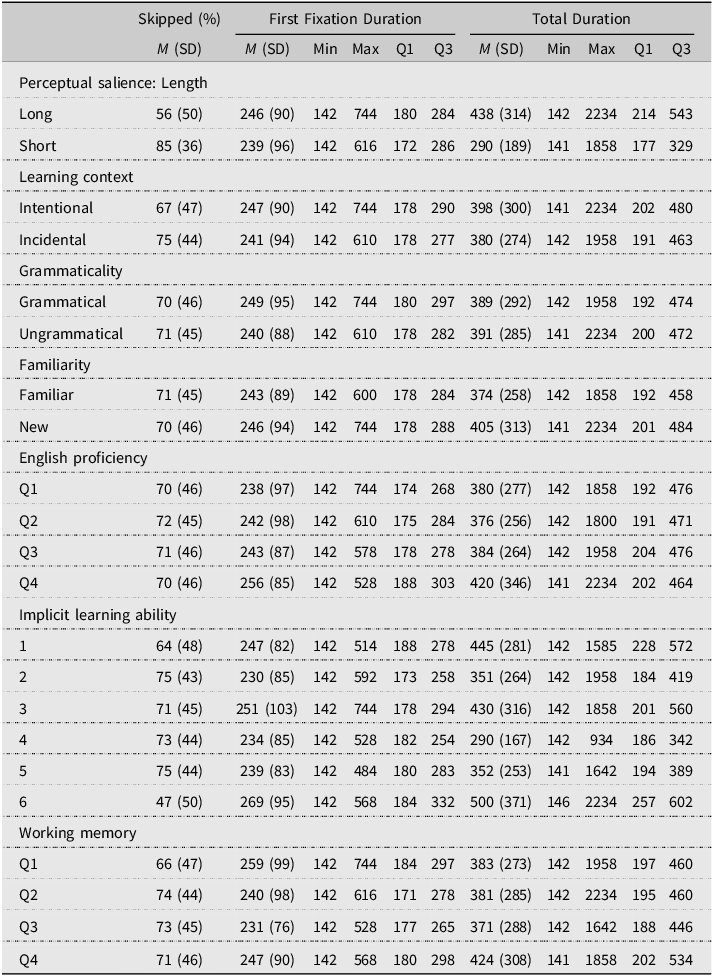
Attention was measured using eye-tracking data, namely Skipping Rate, FFD, and TD. The descriptive statistics for these measures are provided in Table 1.
Descriptive statistics on the morpheme area (IA7) pertaining to the testing phase

Note: Q1 = lowest; Q4 = highest.
Note1: 0 values have been excluded from First Fixation Duration and Total Duration measures.
Skipping rate
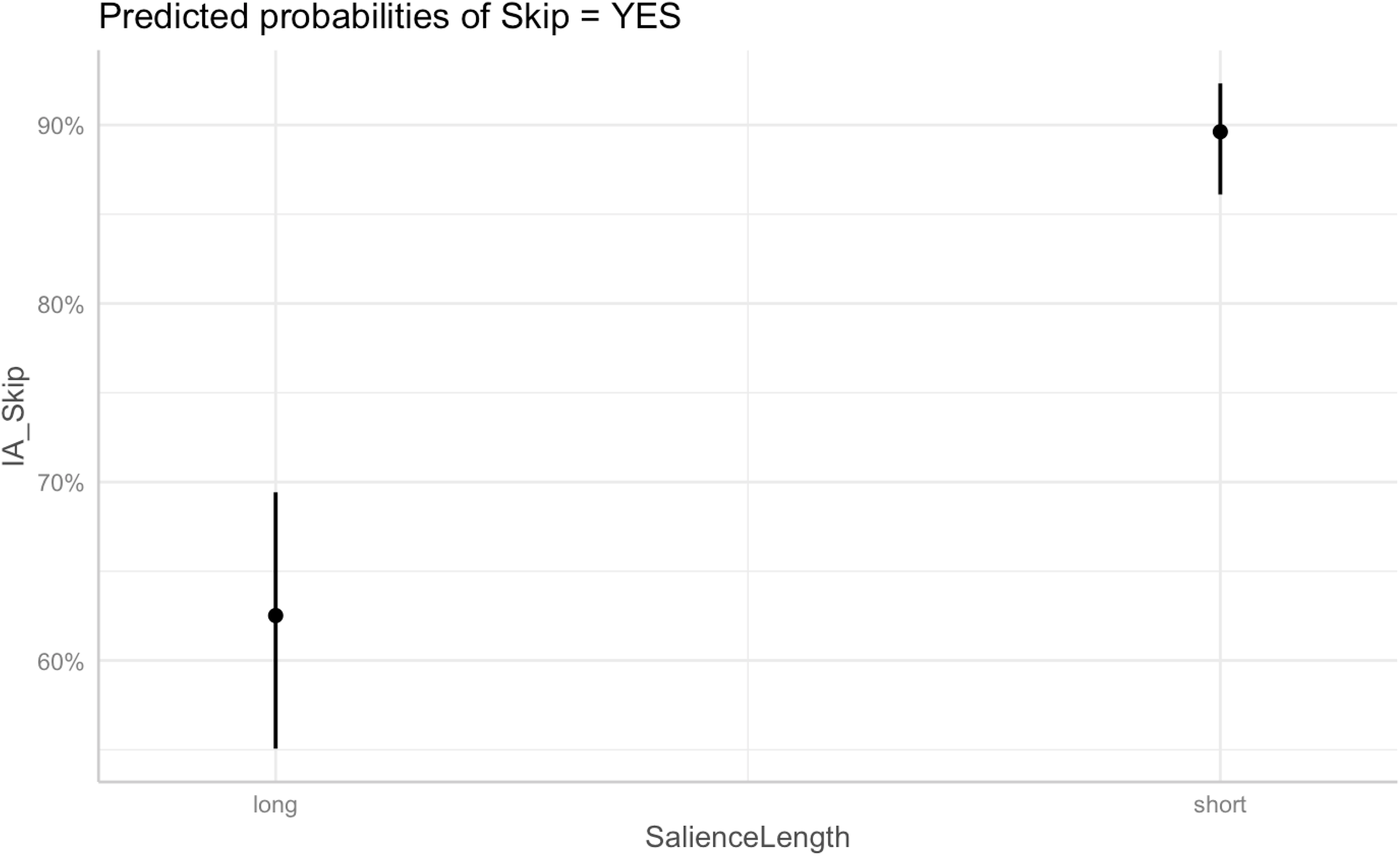
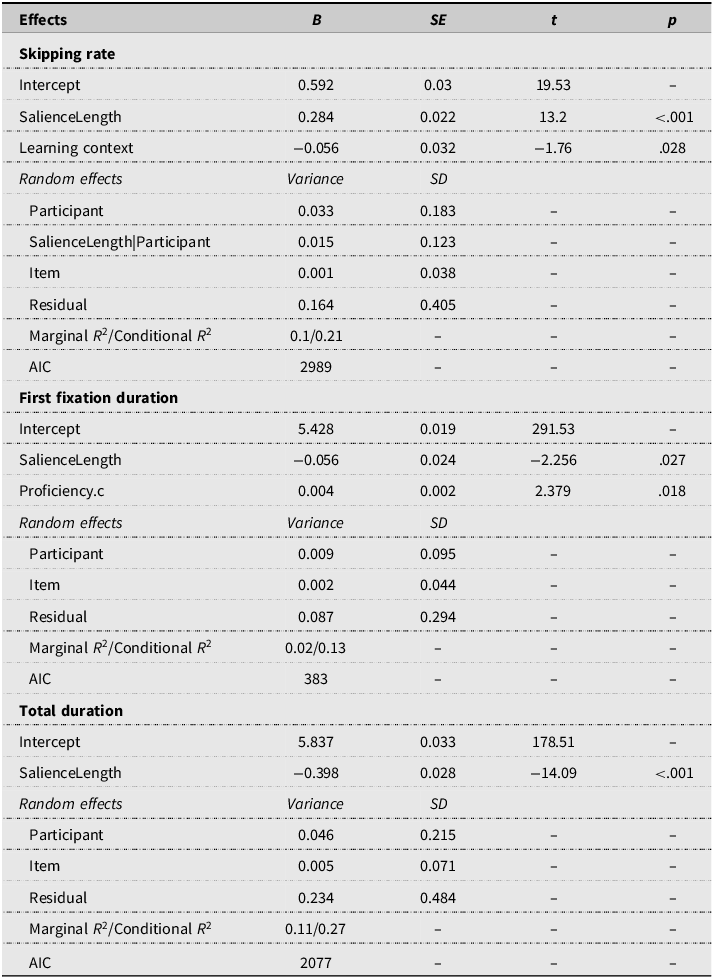
The mean skipping rate was 67%, consistent with prior literature on short 2–3 letter words (Rayner, Reference Rayner1998). Yet, we observed that the skipping rates differ per morpheme: the high-salient morpheme (-ulp) exhibited a 50% skipping rate, whereas the low-salient morpheme (-o) was skipped 84% of the time. We fitted a glmer model for the IA7 region (i.e., target morpheme) to predict the effect of our independent variables on Skipping Rate. The following model was determined to be the minimally adequate model:
glmer(Skip ∼ SalienceLength + LearningContext + (1|Participant) + (1|Item), family = binomial)
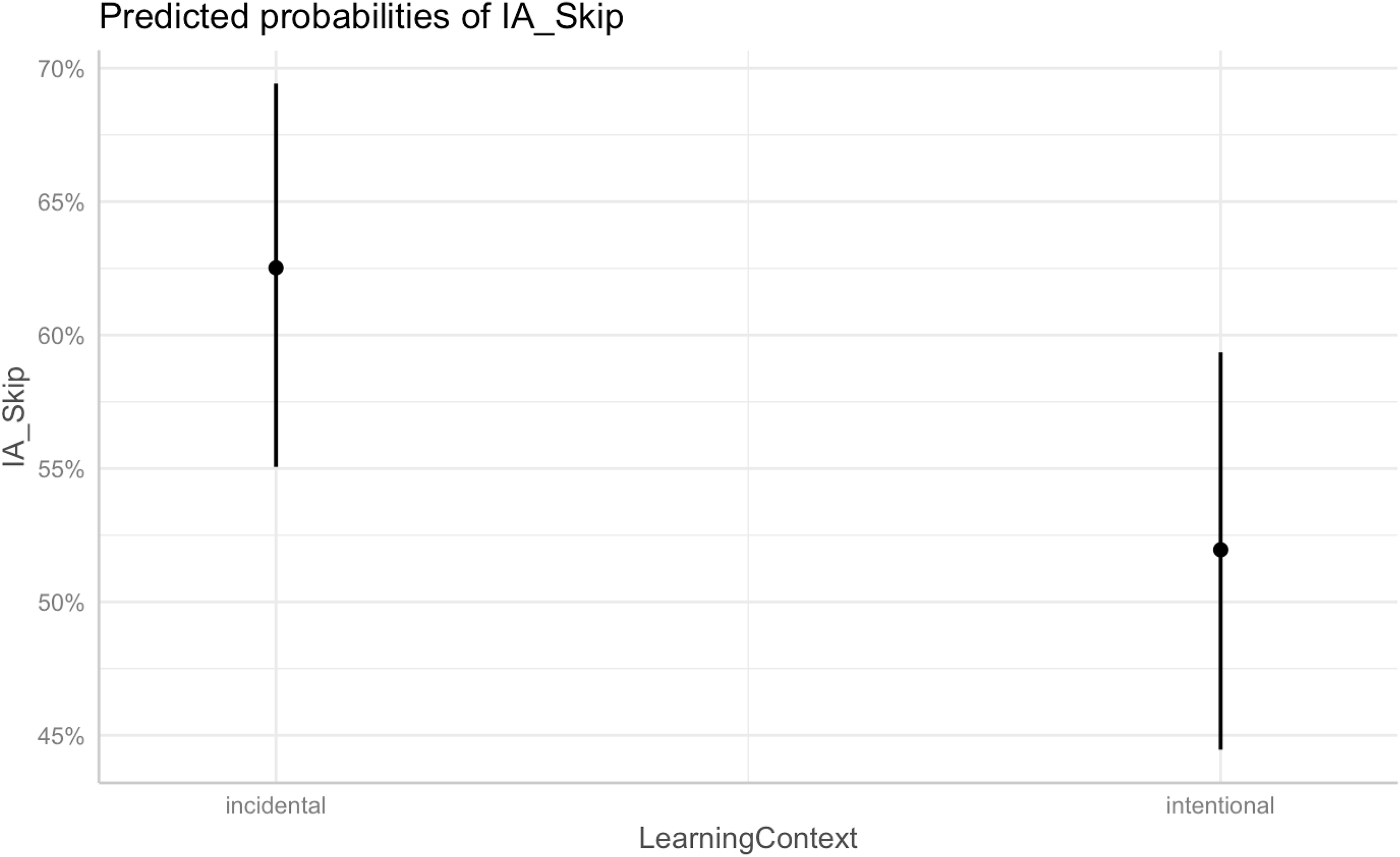
A main effect of salience was observed (t = 16.29): the model predicted that the high-salience morpheme (M = 0.59, 95% CI [0.53, 0.65]) exhibited significantly lower skipping than the low-salient morpheme (M = 0.88, 95% CI [0.83, 0.92]; M difference = 0.29, p < .001; see Figure 5). Furthermore, a main effect of learning context emerged (t = -2.08). Participants in the intentional condition (M = 0.54, 95% CI [0.48, 0.59]) skipped less often compared to those in the incidental group (M = 0.59, 95% CI [0.53, 0.65]; M difference = 0.05, p = .038; see Figure 6). Detailed statistics can be found in Table 2. The model accounts for 29% of the data, as indicated by the conditional R 2 (Table 3).
Salience effect on skipping rate.

Learning context effect on skipping rate.

Eye-tracking measures: inferential statistics

Note: B = Unstandardized estimate. SE = Standard Error. t = test statistic. P = p-value. AIC = Akaike Information Criterion. B for First Fixation Duration and Total Duration are on the log scale.
Model performance: skipping rate, first fixation duration, and total duration

Note. SR = Skipping Rate; FFD = First Fixation Duration; TD = Total Duration; AIC(c) = Akaike Information Criterion (corrected); BIC = Bayesian Information Criterion; ICC = Intraclass Correlation Coefficient; RMSE = Root Mean Square Error.
First fixation duration
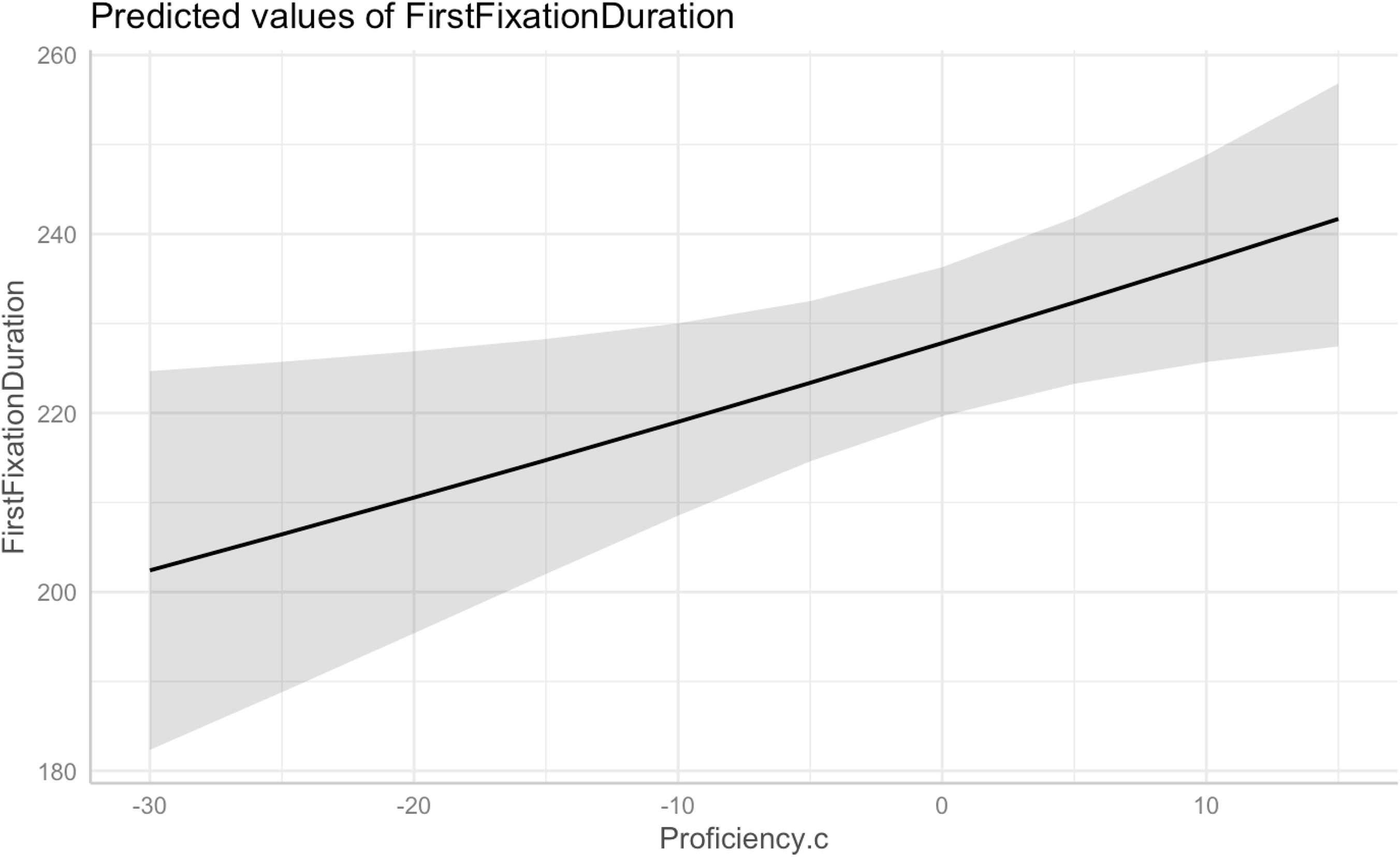
We fitted a lmer model for the IA7 region to examine the effect of our independent variables on (log-transformed) FFD. Our analysis revealed a significant main effect of salience, indicating that the high-salient morpheme (M = 228, 95% CI [220, 236]) elicited longer FFDs compared to the low-salient morpheme (M = 216, 95% CI [205, 227]; M difference = 12, p = .027). Additionally, English proficiency was found to be a significant predictor, with higher proficiency associated with longer FFDs toward the target morpheme (p = .018; see Figure 7). The following model was identified as the minimally adequate model:
English proficiency effect on first fixation duration.

lmer(log(FirstFixationDuration) ∼ SalienceLength + Proficiency.c + (1|Participant) + (1|Item))
Comprehensive statistical information is available in Table 2. The model accounts for 13% of the data, as indicated by the conditional R 2 (Table 3).
Total duration
An additional lmer was employed to analyze the impact of the independent variables on (log-transformed) TD within the same IA region. The following model was determined to be the minimally adequate model:
lmer(log(TotalDuration) ∼ SalienceLength + (1|Participant) + (1|Item))
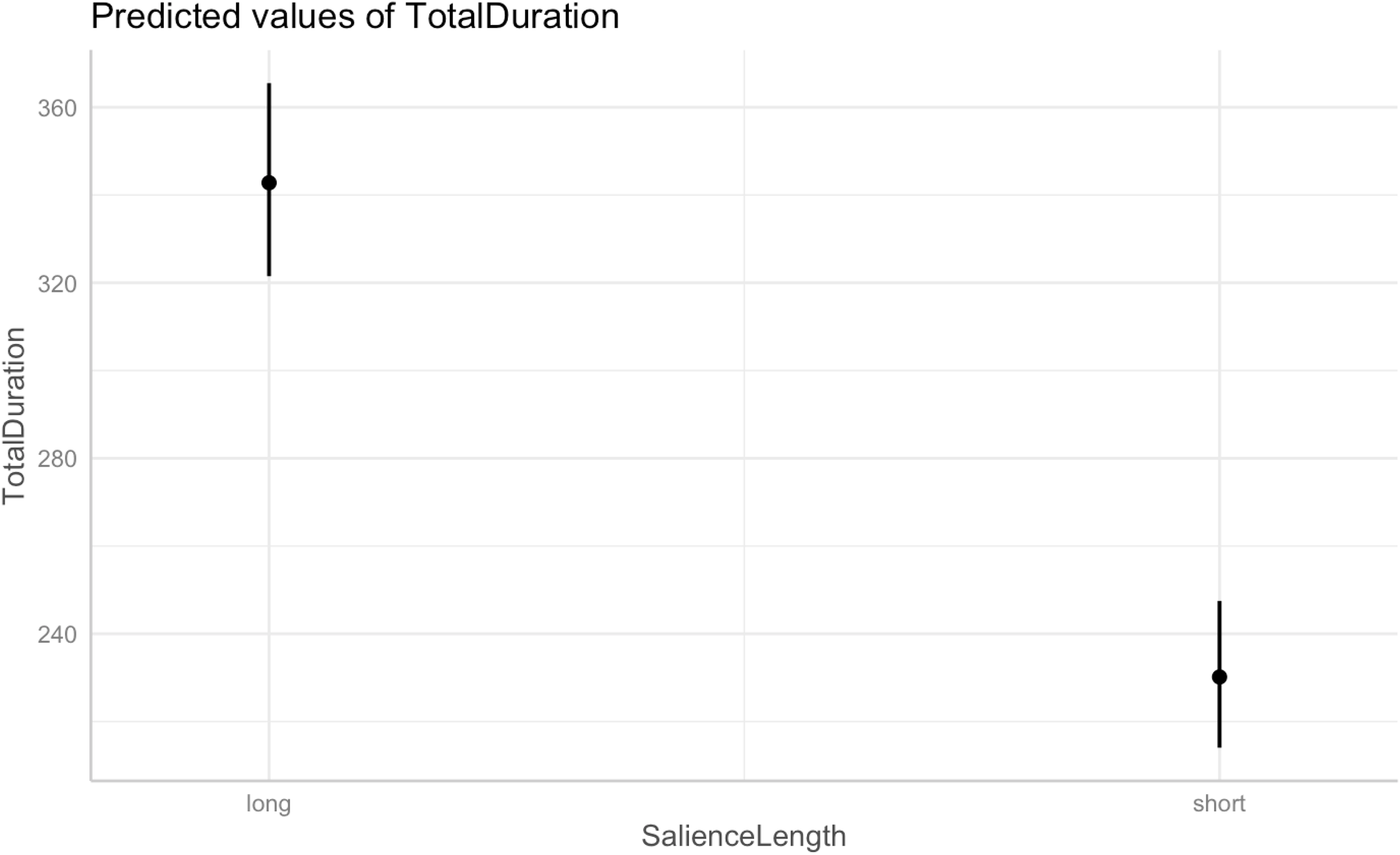
Once again, the high-salient morpheme (M = 343, 95% CI [321, 365]) received significantly longer fixations than the low-salient morpheme (M = 230, 95% CI [214, 247]; M difference = 123, p < .001; see Figure 8). Table 2 provides detailed statistics. The model accounts for 27% of the variability of TD, as indicated by the conditional R2 (Table 3).
Perceptual salience effect on Total Duration.

Awareness
A retrospective interview gauged participants’ explicit awareness of the target morphemes’ form and meaning. The awareness of high- and low-salient morphemes was recorded separately. Most participants demonstrated awareness of the forms by themselves, but not their meaning. On our awareness scale, for the high-salient morpheme, the distribution of awareness levels was as follows: (0) unaware (n = 4), (1) aware of form with prompt (n = 15), (2) aware of form by themselves (n = 43), (3) aware of both form and approximate meaning (n = 6), and (4) aware of both form and specific meaning (n = 0). Similarly, for the low-salient morpheme, the distribution of awareness levels was: (0) unaware (n = 3), (1) aware of form with prompt (n = 13), (2) aware of form by themselves (n = 45), (3) aware of both form and meaning (n = 7), and (4) aware of form and specific meaning (n = 0). Table 4 shows that the average awareness scores exhibit minimal variation between the salience and learning contexts. The assessment of the accuracy scores in the untimed GJT contributes to this picture: a mean accuracy score of 50% suggests that participants’ performance was at chance levels, indicating a limited ability to discern the correct meanings marked by the morphemes. This score remained consistent across the various salience conditions, with 49.7% for the low-salient condition and 50% for the high-salient condition. This highlights the limited explicit knowledge of participants in relation to morpheme meanings.
Mean awareness across salience and learning context, based on awareness scale

Note: 4 = aware of form and specific meaning, 0 = completely unaware.
Intake: grammaticality sensitivity index
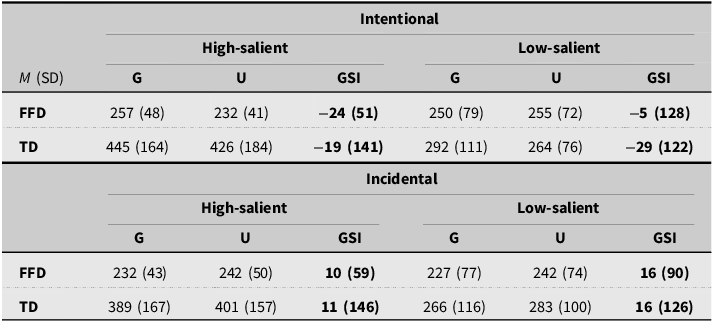
The Grammaticality Sensitivity Index (GSI) serves as a metric for assessing a low-level form of implicit knowledge (intake) resulting from the treatment, with a higher GSI value signaling a slowdown in the ungrammatical condition, thereby suggesting an increased sensitivity to grammar (Godfroid, Reference Godfroid2016; Granena, Reference Granena2013). Conversely, null or negative values imply a lack of implicit knowledge. Descriptive values for the GSI can be found in Table 5. The standard deviation (SD) values reveal a substantial variability in the GSI scores.
Grammaticality sensitivity index: descriptive statistics

Note: G = Grammatical. U = Ungrammatical. GSI = Grammaticality Sensitivity Index. FFD = First Fixation Duration. TD = Total Duration.
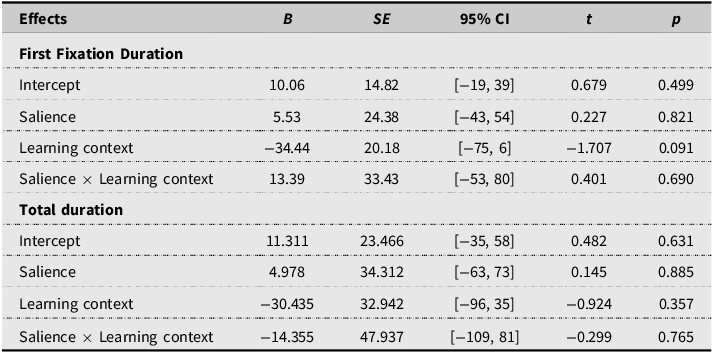
We conducted two linear regression models, using the GSI of FFD and TD as the dependent variables. The independent variables in both models were salience and learning context, as these were hypothesized to have the most substantial effect on the learning outcomes. In the FFD model, participants in the incidental group exhibited marginally higher scores than those in the intentional group (M incidental = 12 milliseconds, M intentional = −18 milliseconds), but this difference was not significant (p = .091). Neither salience (p = .821) nor the interaction between salience and learning context (p = .69) was significant. The model exhibited a small effect size (R 2 = 0.042). In the TD model, no statistical significance was found for salience (p = .89), learning context (p = .357), or their interaction (p = .765). The model explained 2% of the variance in the data, as indicated by R 2. Both models, allowing for interactions, are described in Table 6. In summary, our analysis suggests that salience and learning context did not exert a discernible effect on GSI and, hence, intake.
Grammaticality sensitivity index: inferential statistics

Note: B = Unstandardized estimate. SE = Standard Error. t = t-value. p = p-value.
Discussion
This study sought to investigate the impact of perceptual salience on the attention, awareness, and intake of bound grammatical morphemes in an L2. Sixty–eight L1 Dutch speakers engaged in reading 240 sentences in Englishti (cf. Simoens et al., Reference Simoens, Housen, De Cuypere, Gass, Spinner and Behney2017), which includes two artificial morphemes: high-salient -ulp and low-salient -o. We assessed attention, awareness, and intake to gauge the effects of perceptual salience (operationalized as length), learning context (incidental vs. intentional), and individual learner variables (implicit learning ability, WM, and English proficiency).
Salience, attention, and awareness in second language acquisition
The primary inquiry of our research centered around the influence of perceptual salience on implicit L2 morphology acquisition. Perceptual salience in this study was operationalized as orthographic and phonemic length (-ulp vs. -o), which arguably represents the most straightforward approach to explore salience in written input: a longer morpheme is more visually prominent than a shorter one (Goldschneider & DeKeyser, Reference Goldschneider and DeKeyser2001). We anticipated that the high-salient morpheme would capture more attention compared to its less salient counterpart, which would lead to more awareness and acquisition (Behney et al., Reference Behney, Spinner, Gass, Valmori, Gass, Spinner and Behney2017; Simoens et al., Reference Simoens, Housen, De Cuypere, Gass, Spinner and Behney2017). Overall, our analyses suggested that high salience leads to enhanced attention, but it did not provide clear evidence of an effect on learning.
Salience is a critical factor influencing attention in our study, as evidenced by its pervasive impact across all statistical analyses conducted. Compared to its shorter, low-salient counterpart -o, the high-salient morpheme -ulp was less often skipped and consistently attracted more attention as shown by both early and late attentional measures. This finding aligns with our initial hypothesis (based on Simoens et al., Reference Simoens, Housen, De Cuypere, Gass, Spinner and Behney2017), reinforcing the notion that salience draws heightened attention. Participants seemed to allocate cognitive resources to detect, select, and integrate the information conveyed by the high-salient morpheme, leading to prolonged attention. Notably, a few participants reported during the retrospective interviews that they had interpreted the low-salient morpheme (-o) as a typographical error, prompting them to skip over it. Overall, these findings suggest that salience exerts its influence across both early and late stages of cognitive processing.
Attending to and becoming aware of a linguistic feature in the input constitutes the first step in the acquisition process (Schmidt, Reference Schmidt1990). Our study, however, only found evidence for participants’ awareness of the form, without clear indications of awareness of its associated meaning. This finding aligns with the results reported by Simoens et al. (Reference Simoens, Housen, De Cuypere, Gass, Spinner and Behney2017), who observed that only one participant attained full awareness of the morpheme’s meaning—comparable to awareness level (4) as defined in the current study. Additionally, no evidence was found for the subsequent step in the acquisition process—intake. These results may suggest that awareness and intake do not necessarily and automatically follow from attention. The discrepancy between participants’ attention and awareness may be attributed to several factors, with the lack of awareness of the meaning being a crucial component. In line with Schmidt’s (Reference Schmidt1990) distinction between different levels of awareness, participants appeared to exhibit “awareness at the level of noticing”—that is, recognition of the morpheme’s form—without achieving “awareness at the level of understanding,” or a deeper comprehension of the meaning within the sentence.
One possible explanation for the lack of awareness regarding meaning might be the semantic redundancy of the target morpheme: just like many other morphemes in English, the target morpheme in this study was not essential for sentence comprehension, and language learners tend to overlook redundant grammatical forms, due to their low psycholinguistic salience (Sagarra & Ellis, Reference Sagarra and Ellis2013). Another influencing factor could be the morpheme’s boundedness to the noun within the presented sentences, as free grammatical morphemes are believed to be more perceptually salient than bounded ones (Goldschneider & DeKeyser, Reference Goldschneider and DeKeyser2001). Despite differences in the salience of the target morphemes relative to each other, both morphemes may have been relatively low in overall salience, as both redundancy and boundness could jointly reduce the overall salience of both morphemes (Goldschneider & DeKeyser, Reference Goldschneider and DeKeyser2001; Knell et al., Reference Knell, Cipitria, De Cuypere, Housen and Struys2025). This overall low salience might have contributed to the observed low levels of attention, awareness, and intake. Figure 9 (adapted from Figure 1) illustrates how salience influences attention, which may lead to awareness of the form; however, our data did not indicate an effect of awareness of the meaning or intake, and thus offer no clear evidence for acquisition.
Conceptualization of the relationship between the constructs: integration of our findings.
Note: The thick green line indicates a relationship was observed, the yellow line shows partial effects, and the dotted red lines show that no effect was detected.

Learning context in second language acquisition
The first subquestion concerned the impact of the learning context (incidental vs. intentional) on the acquisition of L2 morphology. Drawing on insights from previous research (Koch et al., Reference Koch, de Vos, Housen, Godfroid and Lemhöfer2023; Robinson, Reference Robinson2001; Simoens et al., Reference Simoens, Housen, De Cuypere, Gass, Spinner and Behney2017), we hypothesized that participants in the intentional group, who were directed towards learning Englishti and focusing on its form, would demonstrate increased attention to both the form and meaning of Englishti features, and thus exhibit a heightened awareness and intake of the morphemes compared to those in the incidental group. Our findings suggest that such a learning context influences some elements of attention allocation but does not appear to impact awareness or learning.
Learning context exhibited a significant impact on the skipping rate of the target morphemes, as individuals belonging to the intentional group demonstrated fewer skips compared to their counterparts in the incidental group. This observation suggests that intentional contexts may prompt participants to adopt a more careful reading strategy (Philipp & Huestegge, Reference Philipp and Huestegge2015). However, this pattern was not consistently reflected in other attentional measures. Furthermore, neither the awareness interview nor the intake assessment provided evidence of an effect attributable to the learning context.
Notably, our study did not yield evidence supporting implicit or explicit knowledge gains. The GSI score served as an indicator of intake, where a high positive value would have suggested intake. However, the results did not show significant differences in reading times between the grammatical and ungrammatical sentences, and neither salience nor learning context appeared to exert an influence. This may be due to participants failing to grasp the function or meaning of the morphemes. However, the lack of significant findings should not be interpreted as evidence that learning did not occur, but rather it may reflect the limited sensitivity of our measures to detect intake. As for explicit knowledge, according to the untimed GJT administered after the input flood, participants responded at chance levels, suggesting limited explicit knowledge. Similarly, insights gathered from awareness interviews revealed that most participants were aware of the form of the morphemes, yet struggled to articulate their meaning. These findings suggest that the participants had limited explicit knowledge concerning the meanings of the target morphemes.
Individual differences in second language acquisition
The second subquestion sought to investigate the influence of IDs in learning. Here, we analyzed the impact of English proficiency, assessed through a C-test (Keijzer, Reference Keijzer2007), WM capacity, as gauged by the Reading Span Task (van den Noort et al., Reference van den Noort, Bosch, Haverkort and Hugdahl2008), and implicit learning ability, assessed by the SRT task (Kaufman et al., Reference Kaufman, DeYoung, Gray, Jiménez, Brown and Mackintosh2010), via our linear mixed-effects regression models predicting attention.
Although our participants were all relatively proficient in English, our findings revealed a significant English proficiency effect on FFD, with higher proficient participants exhibiting prolonged fixations on the target morpheme compared to participants with lower proficiency. This observation may be attributed to a surprisal effect: individuals with more advanced proficiency, having more linguistic experience and knowledge, may have more robust expectations of the upcoming input, rendering the presence of artificial morphemes less predictable or more surprising (cf. L1 vs. L2 surprisal in de Varda & Marelli, Reference de Varda and Marelli2022). They may notice the discrepancy with English faster, directing their attention to the morpheme. In addition, compared to lower-level learners, the highly proficient individuals may not need to disperse their limited cognitive resources over a greater number of unknown or partially acquired linguistic features in the input, freeing up cognitive resources for attending to the target morphemes, including their meaning.
In contrast, we did not observe significant effects for WM or implicit learning ability. We assumed that higher WM capacity might provide more cognitive resources for attending to less salient features. However, the nature of the task may not have imposed enough cognitive demands for such effects to emerge. Since sentence comprehension did not require understanding the morpheme’s meaning, attention measures may have remained unaffected by WM capacity. Comparatively, Zalbidea and Sanz (Reference Zalbidea and Sanz2020) reported significant effects only in oral tasks, with no corresponding WM effects in written tasks, a pattern that aligns with our findings. Implicit learning ability may have failed to influence attentional data because intake effects were not detectable in the experiment. Taken together, our findings tentatively suggest that the effect of perceptual salience was consistent across participants, though future work may need to explore this further using different tasks.
Limitations
This study empirically examined the effect of perceptual salience, operationalized as orthographic length, on attention, awareness, and intake. The specific operationalization of the morphemes (-ulp as high-salient and -o as low-salient) may be a limitation, as both forms are inherently low in salience, a common characteristic of morphological markers. A wider range of high- and low-salient morphemes would enhance the generalizability of our findings. Caution should then be taken to ensure different morphemes convey different meanings (see Williams, Reference Williams2005), akin to real-language usage. Additionally, as previously mentioned, despite the difference in salience between the two morphemes, their redundancy with the possessive markers and their boundness to the target nouns diminishes their overall salience, which may have constrained our results. Future research may consider exploring linguistic features with different linguistic properties.
Conclusion
This study set out to examine the role of one type of salience, perceptual salience, in the processing and acquisition of inflectional morphology in a second language, drawing on a controlled semi-artificial language paradigm and a multi-method approach integrating eye-tracking, awareness interviews, and grammaticality judgment data. By operationalizing perceptual salience as morpheme length in written input, we demonstrated that longer, visually more salient morphemes consistently drew greater attention during reading than shorter, less salient counterparts. This effect held across early and late eye-tracking measures and was modulated by the type of learning context and IDs in English proficiency, though not by WM or implicit learning ability.
Crucially, while perceptual salience significantly influenced attention allocation, it did not lead to enhanced awareness of morpheme meaning or to evidence of intake, as reflected by the GSI. These findings provide empirical support for the view that attention is a necessary but not sufficient condition for L2 acquisition, and suggest that the path from input to intake and eventual acquisition may be interrupted when semantic redundancy and low functional relevance diminish the perceived need to process certain grammatical features.
The study contributes to ongoing debates about the nature and role of cognitive processes and mechanisms in SLA theory, particularly those concerning attention and awareness in input processing. It also reinforces the value of integrating implicit and explicit learning conditions in experimental designs. While instructional focus influenced some aspects of participants’ reading behavior, it did not substantially enhance awareness or learning outcomes in this case. The results further call for a nuanced understanding of salience—not as a monolithic construct, but as one whose effects depend on linguistic properties, cognitive capacities, and contextual demands.
Future research should explore additional dimensions of salience—such as other manifestations of perceptual salience but also psycholinguistic and experiential salience—and their interactions with various learning conditions and individual learner differences. Expanding the range of morphemes and target features will help clarify the mechanisms by which salience facilitates or fails to facilitate L2 morphological acquisition. Ultimately, this line of research can enrich cognitive theories of SLA by unpacking the complex relationship between input cues, cognitive processing, and the learner’s evolving mental representation of a new language.
Funding Statement
This research was supported by the Fonds Wetenschappelijk Onderzoek (FWO) through project G038321N and the pre-doctoral fellowship 11B4124N. Open access funding provided by University of Groningen.
Appendix
Retrospective interview script
General questions
-
1. How did it go?
-
2. Do you think the tasks were difficult or easy?
-
3. What do you think the experiment was about?
-
4. Did you notice anything special or unusual during the experiment?
-
a. Yes: What was special or unusual to you?
-
i. Move to next question not addressed in their answer—if they mention weird word endings but don’t define them, move to question 6.a.i/ii, if o or ulp are already addressed, move to question 6.b for only one or 7 for both
-
-
b. No: Continue
-
Target morphemes: Language-related questions
-
5. Did you notice anything special about some words during the reading experiment?
-
a. Yes: What was it?
-
b. No: Continue
-
-
6. The experiment was about morphology, the smallest part of words with meaning (e.g., driver). Did you notice that some familiar words had a new ending?
-
a. Yes:
-
i. Do you remember what the endings were?
-
1. Yes: [What were they]?
-
a. Did you notice any other endings?
-
i. Mentioned -o and -ulp: Move to question 7
-
ii. Mentioned -o or -ulp, not both: Move to question 6.b
-
iii. Mentioned neither: Move to question 6.b
-
-
-
2. No: Move to question 6.b
-
-
ii. Do you remember any words with these endings?
-
1. Yes: If they do not mention them → [What were they]?
-
a. Did you notice any other words with these endings?
-
i. Yes: [What were they]?
-
ii. No: Move to question 4.a.ii

-
-
-
2. No: Move to question 4.a.ii
-
-
-
b. No: Show set of possible options - Page 3
-
i. Do you recognize (any of) these (other) word endings?
-
1. Yes: [Which ones do you recognize]?
-
a. Move to 6.ii (Do you remember any words with these endings?)
-
-
2. No: Move to question 5 [after explaining presence of o and ulp/8]
-
-
-
-
7. What do you think -o and -ulp could mean?
-
a. Answer related to gender: Good, question 8.
-
b. Do not know: Say ‘They are related to the gender of the subject’.
-
i. Do you know which morpheme refers to which gender?
-
1. Correct answer: Good, question 8.
-
2. Do not know: Debrief his-ulp / her-o (or vice versa)
-
-
-
-
8. Taking the breaks as a reference, when during the experiment did you notice these word endings?
-
9. Did you notice a difference in how often -o and -ulp appeared during the experiment?
-
a. Yes: Which ending appeared more often?
-
b. No: Continue.
-
-
10. Debrief about experiment (additional questions?)

Set of possible options



 Open access

