


1. Introduction
Design science enables a broad spectrum of creative and scientific solution developments. The design science research methodology (DSRM) according to Reference HevnerHevner (2007) and Reference Peffers, Tuunanen, Rothenberger and ChatterjeePeffers et al. (2007), defines methodological steps and three cycles (relevance, rigor and design) to ensure scientific artifact design. These scientific artifacts can include system models created by means of systems engineering (SE). SE aims to analyze and demonstrate entities, interrelationships, dependencies, and dynamics of systems to capture their complexity. This enables a holistic perspective without reducing systems to separate segments. Model-based systems engineering (MBSE) supports systems thinking and enables the development of complex system models. MBSE provides methods, tools, and languages that support the design, communication, and simulation of (socio-)technical systems (INCOSE, 2015). Beside technical elements, this can also include the mapping of roles, tasks and processes (Reference HaberfellnerHaberfellner, 2019).
Sustainable manufacturing (SM) describes a socio-technical system, that aims at achieving the three dimensions of the triple bottom line (TBL), i.e., environmental, economic and social sustainability in manufacturing. SM research often focuses technology-oriented issues and largely neglects social aspects (Reference Henao, Sarache and GomezHenao et al., 2021; Reference Jamwal, Agrawal, Sharma and KumarJamwal et al., 2021; Reference Martín-Gómez, Ávila-Gutiérrez, Lama-Ruiz and Aguayo-GonzálezMartín-Gómez et al., 2024). This is a misguided approach, as the social well-being of employees is important for the successful implementation of SM and the pursuit of sustainable development (Reference Ahuja, Panda, Luthra, Kumar, Choudhary and Garza-ReyesAhuja et al., 2019; Reference Gbededo and LiyanageGbededo & Liyanage, 2018). Leadership plays a decisive role in SM, but is hardly considered in the scientific discourse (Reference Dubey, Gunasekaran and ChakrabartyDubey et al., 2015; Reference Hariyani, Mishra, Sharma and HariyaniHariyani et al., 2022; Reference Vinkhuyzen and Karlsson-VinkhuyzenVinkhuyzen & Karlsson-Vinkhuyzen, 2014). However, the human dimension including motivation, culture, values, and needs are crucial to SM processes and managerial success (Reference Snyder, Ingelsson and BäckströmSnyder et al., 2024; Reference Sutherland, Richter, Hutchins, Dornfeld, Dzombak, Mangold, Robinson, Hauschild, Bonou, Schönsleben and FriemannSutherland et al., 2016). The field of sustainable leadership (SL) describes human-centered factors and requirements for leaders to promote sustainable development. It is based on ethics and values, and follows the TBL (Reference Hallinger and SuriyankietkaewHallinger & Suriyankietkaew, 2018). SL can complement SM knowledge in terms of organizational development and broaden the field towards a human-centered leadership perspective (Reference Nowak-Meitinger, Lübbe, Ammon, Kohl, Seliger, Dietrich and CampanaNowak-Meitinger et al., in press). To develop a combined model that integrates SL into SM, an appropriate design approach is needed (Reference Nowak-Meitinger, Lübbe, Ammon, Kohl, Seliger, Dietrich and CampanaNowak-Meitinger et al., in press).
Since neither SM nor SL offer a standardized and formalized modeling language for representing complex relationships, we strive for a modeling approach that captures the complexity of systems and ensures clarity in their representation. This requires a methodical approach and a formal modeling language. We aim to design artifacts that strengthen the social and human perspective in SM and uncover leadership needs with their integral components. In this context, this paper presents MBSE and the System Modeling Language (SysML) as a suitable solution. The following research questions are addressed:
-
• Is SysML suitable to support the development of a model that integrates SL into SM?
-
• How can MBSE support the development of such an integrated model?
-
• Which new stereotypes and extensions are needed to represent the system of interest?
In order to answer these research questions, section 2 first presents literature on SM and SL. The modeling gap is identified. This is followed by the description of the methodological context and the evaluation of the suitability of SysML by assessing the fulfillment of requirements derived from literature. Section 3 outlines the MBSE modeling approach and introduces a black box perspective as well as an initial meta-model. Finally, we discuss our findings in section 4 and draw conclusions in section 5.
2. Material and methods
The following literature review on the modeling of SM systems and SL frameworks leads to requirements for a new, integrated modeling approach, which is described subsequently.
2.1. Sustainable manufacturing systems and their representation in models
Sustainable manufacturing (SM) is a multi-layered discipline that examines the aspects, factors and structures of sustainable products and their manufacturing. Its aim is to reduce the negative impact on the environment and to avoid any negative social impact, e.g., ensuring operational safety and improving personal health (Reference Jawahir, Badurdeen, Rouch and SeligerJawahir et al., 2013). This is realized through the value creation factors (VCF), i.e., product, process, equipment, organization and human (Reference SeligerSeliger, 2007). SM deals with sustainability in all product life cycle stages (pre-manufacturing, manufacturing, use and post-use) and implements the 6R value recovery strategies (reduce, reuse, recycle, recover, redesign, and remanufacture) (Reference Badurdeen and JawahirBadurdeen & Jawahir, 2017; Reference Jawahir, Badurdeen, Rouch and SeligerJawahir et al., 2013; Reference Jayal, Badurdeen, Dillon and JawahirJayal et al., 2010). To address this complexity, frameworks and measurement systems are developed that include requirements for sustainable solutions. Although SM is a socio-technical system based on the three sustainability dimensions, research often neglects the social perspective (Reference Henao, Sarache and GomezHenao et al., 2021; Reference Jamwal, Agrawal, Sharma and KumarJamwal et al., 2021; Reference Martín-Gómez, Ávila-Gutiérrez, Lama-Ruiz and Aguayo-GonzálezMartín-Gómez et al., 2024). Nevertheless, a human-centered perspective and socio-technical systems thinking are needed to progress SM (Reference Davis, Challenger, Jayewardene and CleggDavis et al., 2014). Further, SM assessment methods are typically not designed to consider interdependencies of the three sustainability dimensions and thus they are either segmented or processed in a sequential order and do not support effective decision-making for sustainable development (Reference Gbededo, Liyanage and Garza-ReyesGbededo et al., 2018).
To determine the current state-of-the-art in the modeling of SM systems, we conducted a literature search on SM in the Scopus and Web of Science databases. We focused on review articles on the concept of SM as well as on holistic frameworks and models. We used the search terms “sustainable manufacturing”, “model”, “framework” and “concept”. Furthermore, with the aim of expanding SM in the area of leadership, we combined “sustainable manufacturing” and “sustainable leadership” in our search and added related terms such as “enterprise”, “factory”, “leader”, “human”, “people”, “social”, “ethic”, and “responsibility”. We selected frameworks and modeling approaches that visualize general SM factors and their relationships and effects. The selection aims to highlight the diversity in the field by presenting different modeling approaches and languages with their respective strengths and weaknesses. We finally selected 18 representative articles that present modeling approaches related to our modeling goal (Table 1). The literature review shows that SM literature widely lacks MBSE applications with formal modeling languages such as SysML. This leads to difficulties in visualizing complexity and thus to partially unclear models or frameworks.
Literature review on frameworks and modeling of SM systems

Table 1 Long description
A table summarizing literature review on frameworks and modeling of sustainable manufacturing systems. The table has 13 rows and 4 columns. The columns are labeled ID, Reference, Key findings and modeling goal, Modeling strengths and advantages, and Modeling gaps and weaknesses. Row 1: ID, 1; Reference, Agote-Garrido et al. (2023); Key findings and modeling goal, Theoretical model for the design of SM systems in Industry 5.0.; Modeling strengths and advantages, Multi-layered and multi-perspective representation of SM.; Modeling gaps and weaknesses, Non-formalized modeling language. Row 2: ID, 2; Reference, Amrina et al. (2016); Awan et al. (2018); Malek and Desai (2019); Subramanian and Suresh (2022); Key findings and modeling goal, Interpretive Structural Modeling (ISM) on: sustainability barriers in manufacturing firms; SM enablers; KPIs; and social sustainability factors in SM.; Modeling strengths and advantages, ISM models show interrelationships, dependencies and cause-effect relationships.; Modeling gaps and weaknesses, The ISM models do not provide a larger contextualization and require further text descriptions. Row 3: ID, 3; Reference, Fantini et al. (2013); Key findings and modeling goal, Reference model for SM to improve social sustainability.; Modeling strengths and advantages, The model represents a holistic perspective on social sustainability.; Modeling gaps and weaknesses, No formalized layer definition. Row 4: ID, 4; Reference, Henao et al. (2021); Key findings and modeling goal, Social performance metrics framework that maps different timescale levels to internal and external areas, with social metrics listed in different clusters.; Modeling strengths and advantages, This presentation provides a solid overview.; Modeling gaps and weaknesses, No links to other sustainability dimensions and assignments to product, process, or organizational structure included. Row 5: ID, 5; Reference, Jain and Kibira (2010); Thirupathi et al. (2019); Hao Zhang et al. (2013); Key findings and modeling goal, System Dynamics is used to describe causal effect structures in SM.; Modeling strengths and advantages, Models contain causal effect structures with directional information to describe dynamics.; Modeling gaps and weaknesses, Cross-level and multiple-factor representations are difficult to grasp. Row 6: ID, 6; Reference, Jamwal et al. (2021); Key findings and modeling goal, MCDM based framework for SM practices.; Modeling strengths and advantages, Different layers included.; Modeling gaps and weaknesses, Interrelations of factors remain unclear. Row 7: ID, 7; Reference, Martín-Gómez et al. (2024); Key findings and modeling goal, Characterization of industrial metabolism for design circularity in manufacturing systems.; Modeling strengths and advantages, Includes clustering, multiple levels, illustrations, and symbols.; Modeling gaps and weaknesses, Graphical representation is limited. Row 8: ID, 8; Reference, Nakano (2010); Key findings and modeling goal, Explore how SE can describe supply chains in SM and their risks.; Modeling strengths and advantages, Use of SE for SM, feasibility conceptually shown.; Modeling gaps and weaknesses, No specific, in-depth, MBSE model created. Row 9: ID, 9; Reference, Ocampo (2015); Key findings and modeling goal, A model to represent SM sustainability indicators.; Modeling strengths and advantages, The hierarchical structure is useful.; Modeling gaps and weaknesses, The graphical and tabular form is limited. Row 10: ID, 10; Reference, Ocampo and Clark (2015); Key findings and modeling goal, Integrative framework to develop a SM strategy.; Modeling strengths and advantages, Different layers and process steps included.; Modeling gaps and weaknesses, Interrelations of elements remain unclear. Row 11: ID, 11; Reference, Psarommatis and Bravos (2022); Key findings and modeling goal, Holistic framework for achieving sustainable manufacturing with zero defects and zero waste.; Modeling strengths and advantages, Consideration of pillars, processes and layers, highlighted in colored boxes.; Modeling gaps and weaknesses, Non-formalized modeling language lacks adaptability and scalability. Row 12: ID, 12; Reference, Sulistiarini et al. (2018); Key findings and modeling goal, Sustainable development strategy model for the manufacturing industry as a framework and guideline to support SM implementation.; Modeling strengths and advantages, Comprehensive model structured into strategy principles, indicators, and structure at management and operational level.; Modeling gaps and weaknesses, The presentation in tabular form has its limitations, the added graphical representation is not clear. Row 13: ID, 13; Reference, Heng Zhang et al. (2015); Key findings and modeling goal, Process-oriented information model using UML to simulate products and processes in SM.; Modeling strengths and advantages, Formalized language, includes a large amount of information.; Modeling gaps and weaknesses, Only visualization of product and process level.
2.2. Sustainable leadership and its visualization in frameworks
Literature on sustainable leadership (SL) provides theoretical and empirical insights on leadership for sustainability and an inherently sustainable, i.e., social and human-centered, leadership. Using the search terms “sustainable leadership”, “sustainability leadership”, “regenerative leadership”, “model”, “framework” and “concept” we identified relevant literature in the Scopus and Web of Science databases. SL includes moral and responsible leadership and provides frameworks and cause-effect relationships that present information and recommendations for leaders and organizations striving for sustainable performance. SL describes factors and needs that enhance sustainable development and is based on ethics and values, such as prudence, mutual respect, value of individuals, innovation, and quality (Reference Hallinger and SuriyankietkaewHallinger & Suriyankietkaew, 2018). SL characteristics include long-term vision; far-reaching goals that connect organizations with society; social responsibility of leaders and organizations; ethical behavior; ability to innovate; systemic change; and engagement and skills development of stakeholders (Reference Hallinger and SuriyankietkaewHallinger & Suriyankietkaew, 2018). SL is presented in the form of plain text and simplified graphical frameworks. Reference Avery and BergsteinerAvery and Bergsteiner (2011) created a commonly recognized SL pyramid with levels for SL practices, drivers and outcomes. Since there is no uniform definition of SL, a wide range of heterogeneous frameworks exist. Important aspects of SL include the consideration of context, stakeholder involvement and engagement, and a cultural perspective (Reference Gerard, McMillan and D’Annunzio-GreenGerard et al., 2017; Reference Hallinger and SuriyankietkaewHallinger & Suriyankietkaew, 2018). Further, SL categorization is made between personal and organizational aspects and skills (Reference Armani, Petrini and SantosArmani et al., 2020; Reference Fernandez, Kullu, Shankar, Vanka, Rao, Singh and PulaparthiFernandez et al., 2020) as well as between micro- and macro-levels in organisations (Reference Galpin and Lee WhittingtonGalpin & Lee Whittington, 2012; Reference Jayashree, El Barachi and HamzaJayashree et al., 2022). Since SL is not uniformly defined, the term sustainability leadership is used synonymously in some cases, with frameworks being equally diverse and ambiguous, e.g., in Reference Jayashree, El Barachi and HamzaJayashree et al. (2022) and Reference Sajjad, Eweje and RaziqSajjad et al. (2024).
In the related area of Corporate Social Responsibility (CSR), multi-level frameworks to describe drivers and factors of CSR exist to ensure responsible organizational development. Examples show non-formalized modeling languages and limited representability in frameworks, as in Reference Fallah Shayan, Mohabbati-Kalejahi, Alavi and ZahedFallah Shayan et al. (2022) with an additional link to the Sustainable Development Goals (SDGs); Reference LozanoLozano (2015) with internal and external CSR drivers; Reference Mukhuty, Upadhyay and RothwellMukhuty et al. (2022) with the description of HR practices that enable socially responsible development of Industry 4.0; and Reference Oliveira, Menezes and FernandesOliveira et al. (2023) with representing barriers.
Common to all these organizational frameworks is the use of informal modeling languages, the lack of a uniform definition of SL, and a lack of clarity regarding structural levels and layers. SE and MBSE are not yet used for SL visualization and modeling.
2.3. Methodological context
This work is part of a larger design project that applies the DSRM consisting of a relevance cycle, design cycle, and rigor cycle (Reference HevnerHevner, 2007), to systematically develop a leadership model for SM (Reference Nowak-Meitinger, Lübbe, Ammon, Kohl, Seliger, Dietrich and CampanaNowak-Meitinger et al., in press). This article focuses the aspect of implementing a suitable modeling language as part of the design cycle. In this context, the preceding literature review on modeling SM systems and SL frameworks reveals the modeling gap. Below, we present a list of requirements that have been derived from the modeling approaches and frameworks in the literature. We examine the applicability and usefulness of SysML in the given context and propose to use MBSE for the artifact design. The MBSE Grid/MagicGrid 101 method (Reference Aleksandraviciene and MorkeviciusAleksandraviciene & Morkevicius, 2021; Reference Morkevicius, Aleksandraviciene, Mazeika, Bisikirskiene and StroliaMorkevicius et al., 2017) is a clearly defined and holistic method to develop systems and therefore selected for our study. The Dassault Systèmes CATIA Magic Systems of Systems Architect is used as MBSE tool. We present examples of the initial artifact design (section 3). However, the comprehensive rigor and relevance cycles, as well as the complete, detailed, and evaluated design artifacts, will be part of future work.
2.4. Using SysML to develop a leadership model for sustainable manufacturing
Our work aims to support the design of a leadership model for SM, i.e., describing and visualizing complex dependencies and relationships in SM to impact decision-making, behavior and mindsets of leaders. We do not focus on mathematical approaches, such as multiple criteria decision-making (MCDM). Instead, we aim to create clear visualizations that support leaders in identifying important aspects and dependencies that they need to consider and reflect on in their leadership behavior.
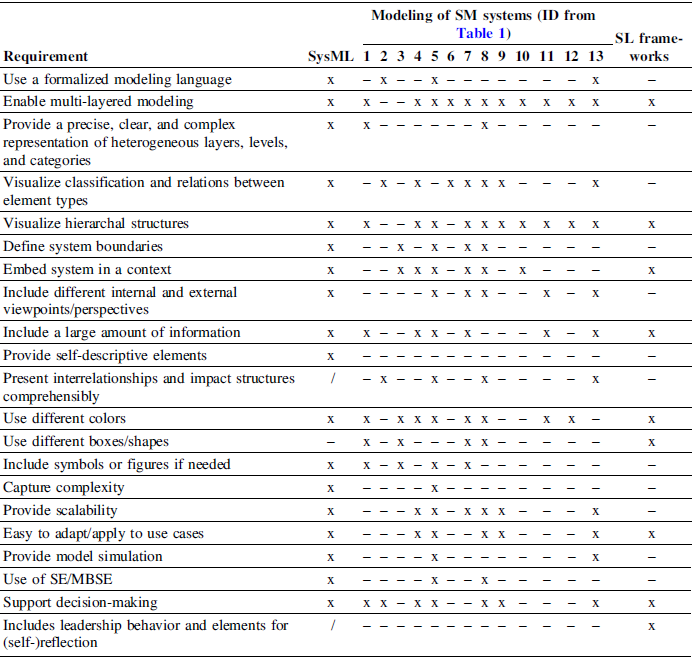
SysML is a modeling language used to specify, analyze, design, and verify complex systems (The Object Management Group® [OMG®], 2026). It is a powerful language that enables simulation and graphical modeling. To evaluate the suitability of SysML in comparison to existing modeling approaches in SM and SL, we derived a list of requirements from our findings in the literature review. Table 2 shows that SysML meets most of these requirements. Systems Dynamics [5] provides an alternative approach that leads to a different visualization and pursues modeling goals focusing cause-and-effect relationships and impact structures. The formalized modeling languages ISM [2] and UML [13] fulfill fewer requirements and are less suitable. The semi-formalized framework by Reference Martín-Gómez, Ávila-Gutiérrez, Lama-Ruiz and Aguayo-GonzálezMartín-Gómez et al. (2024) [7] and the basic SE approach by Reference NakanoNakano (2010) [8] are interesting for comparison.
The identified SL frameworks are non-formalized but support a leadership perspective that includes values, personal qualities, and organizational practices. SysML has not yet been used in SL theory. A related work deals with the modeling of leadership variables and their interrelationships (Reference LathamLatham, 2010).
Research on SysML in the context of SM reveals that SysML can provide functional and logical models, such as architecture and schematic diagrams as well as physical, production and logistics models (Reference Estridge, Eveleigh and TanjuEstridge et al., 2016). SysML can model data and processes including policies, procedures, and tacit knowledge (Reference Estridge, Eveleigh and TanjuEstridge et al., 2016). As an information modeling language, SysML is particularly suitable for modeling the Who, i.e., stakeholders with their structures and requirements; the What, i.e., information and knowledge; and the How, i.e., processes of business systems (Reference PankowskaPankowska, 2019). Taking this into account, the VCF of SM, i.e., product, process, equipment, organization, and human, can be modeled using SysML. Several studies on modeling organizational processes and structures in the field of manufacturing underline the feasibility and potential of our approach: Reference Bataleblu, Rauch, Fitch and CochranBataleblu et al. (2024) present a sustainable factory design using MBSE and SysML. Reference Ahram and KarwowskiAhram and Karwowski (2013) present how sustainable complex systems can be engineered using SysML and computer-based design tools to build an information model. Reference Zheng, Hu, Lu, Arista, Lentes and KiritsisZheng et al. (2024) develop an aircraft assembly process formalism and verification method including an ontology and object-oriented, clustered information and process models based on SysML. Reference Fayoumi and WilliamsFayoumi and Williams (2021) present an integrated socio-technical enterprise modeling without using SysML but including viewpoints, structures and factors.
Meeting requirements through the use of SysML compared to existing modeling approaches

[x] requirement fulfilled, [/] requirement fulfillment to be evaluated, [-] requirement not fulfilled
3. Towards a model-based integrated sustainable manufacturing
In this section we present a meta-model to create the diverse functions and levels of SM and SL. SysML offers versatile meta-modeling and various model types that can be linked and nested within each other.
3.1. Procedure according to MagicGrid® and selection of modeling components
According to the MagicGrid 101 method (Reference Aleksandraviciene and MorkeviciusAleksandraviciene & Morkevicius, 2021; Reference Morkevicius, Aleksandraviciene, Mazeika, Bisikirskiene and StroliaMorkevicius et al., 2017), modeling starts with the problem domain, divided into black box and white box to describe a system of interest (SoI) within its context. MagicGrid 101 pillars include requirements, structure, behavior, and parameters. These pillars allow a comprehensive description of the SoI with multiple perspectives. Since this method is primarily designed for technical systems, its application to our modeling goal requires a transfer and redefinition of typical modeling practices. However, MagicGrid 101 forms a guide for the modeling. In the following we describe the problem domain from a black box perspective. The white box and the solution domain with internal system elements and processes are considered in the outlook and will be specified in future work. Since the pillar safety and reliability is not relevant to this work and the implementation domain it is not part of MBSE, both are neglected.
3.2. The black box perspective in the problem domain
Modeling the problem domain starts with capturing stakeholder needs (requirements), followed by describing the system context (structure). The SoI remains a black box in these steps, thus the interaction of the SoI with its context is focused on and the system boundaries are defined. Our work aims to identify and represent linkages between SL and SM, and to integrate SL practices into SM theory in order to broaden and deepen sustainable performance in SM. The modeling shall support the representation and accessibility of the results. This means that the SoI is a model that represents and supports leadership practices and processes in SM, but does not execute them directly. The execution remains with the people, i.e., leaders and independent employees. Stakeholder needs can be derived from SL and SM theory or other sources provided in the relevance cycle and rigor cycle of the DSRM. Stakeholder needs may include building a motivated, committed, capable, and healthy workforce, (self-)reflection on leadership behavior as well as high performance in sustainable practices and compliance with standards and guidelines for successfully passing audit processes.
The system context can include other systems such as the cultural, institutional, industrial, historical, and political context and be presented in an internal block diagram (ibd). Furthermore, context elements include users who are defined as different types of leaders, e.g., team leaders, department heads, division managers, and managing directors or project managers and independent employees. In this system context, use cases (behavior) are defined. Each type of leader can be associated with different use cases. These are modeled in use case diagrams (uc) and activity diagrams (act) and may include: reviewing the implementation of ethical values in organizational practices, improving the understanding and application of SL, and promoting a holistic implementation of SM. In the final step of the black box perspective, measures of effectiveness (MoE, parameters) are added as higher-level performance indicators. These MoEs are diverse and can include, e.g., employee satisfaction, well-being, motivation, performance, absenteeism, and audit success.
All elements modeled in the black box should be described as detailed as needed for users to receive relevant information. The white box will describe the SoI in its conceptual subsystems and functional analysis. Multiple levels are conceivable in the problem and solution domains. However, since this model design is a wicked problem (Reference Rittel and WebberRittel & Webber, 1973), in-depth analysis and elaboration of model components and their complexity does not claim to be complete. Due to its scalability, variations in the abstraction levels are to be elaborated in future work. It is important to note that in the design discipline, which lies between theory and practice, practicality is more important than completeness (Reference AicherAicher, 2015). The focus of our work is on designing the model, i.e., transferring a complex, interdisciplinary knowledge base into a multidimensional SysML model with several levels, layers, and perspectives.
3.3. Meta-model using SysML
To start modeling, a meta-model with a preliminary selection of entities is created. The meta-model provides stereotypes that should be included in the model. Figure 1 lists blocks used for internal and external elements, relations to connect entities, and diagrams to represent different perspectives. Furthermore, requirements are categorized by their type and the model is managed through the use of legends. This overview is presented in packages that can include several entities. We recommend to start modeling according to MagicGrid 101 using these initial stereotypes and elements for SysML diagrams.
Meta-model with initial stereotypes

4. Discussion
To answer the first research question, we compared the suitability of the formal and adaptable modeling language SysML with existing modeling approaches in SM. To do this, we derived modeling requirements from the literature. The comparison shows that SysML stands out because it offers possibilities for clear, graphical representation of complex, multi-layered, and diverse systems. It can integrate descriptions for elements and relations and is flexible and scalable in its use. This leads to the effective implementation of SysML in SM with a human-centered leadership perspective.
The second and third research questions could be answered by describing a modeling approach using MagicGrid 101 and presenting an initial meta-model to design and implement a model-based integrated SM. The initial black box perspective demonstrates the feasibility of applying MBSE to SM and SL by the use of the MagicGrid 101 pillars requirements, structure, behavior, and parameters. However, a new interpretation and application of the MBSE methods, tools, and languages is required, since the conventional use in a technical context is not suitable. New paradigms and approaches are needed to ensure MBSE and SysML are usable for the purpose of supporting leadership practices in SM. The overview of new stereotypes in the meta-model forms a basis for creating conceptual design artifacts.
The first design steps presented in this study cover two important aspects: Firstly, the context perspective, because sustainable practices can only be fully implemented if leaders in SM take the context into account. Secondly, the application of systems thinking, which is based on the contextual perspective and system boundaries. Diagrams can be created that describe and link various levels, layers and perspectives. Model users can interactively navigate from one element to another, gaining a holistic view of the system.
Future work will include detailed design studies and the evaluation of the resulting artifacts. Models will demonstrate how MBSE and SysML capture interrelationships and dependencies, and thus the resulting complexity of sustainability requirements and measures in SM combined with leadership aspects. Value-adding processes along the product life cycle and links to the organizational structure, i.e., roles and structures will be integrated in the modeling. The final model can serve as a guide for leaders and support the sustainable transformation of manufacturing companies.
Our work is currently based on SysML v1. Since the more compact SysML v2 is now also integrated into graphical tools, it may become relevant for future work. Applicability and transferability to SysML v2 should be considered in the model development as it may increase interoperability of the model. However, both SysML versions are functional and suitable for the modeling goal.
5. Conclusions
This paper introduces a MBSE and SysML modeling approach for sustainable manufacturing (SM) and sustainable leadership (SL) to support the visualization and communication of complex information in socio-technical systems. Since the fields of SM and SL are hardly interlinked and both are diverse and extensive, it is necessary to use a formalized and integrated modeling approach to capture complexity. Based on a literature review, modeling requirements were derived and SysML was evaluated as suitable. The applicability of MBSE is outlined from a black box perspective, and an initial meta-model includes SM and SL elements that are relevant for modeling. The design science research methodology (DSRM) frames this work. We focus on the design cycle with the aim of providing an approach that uses MBSE and SysML to capture SM and SL for designing a model-based integrated SM.



 Open access

