




From its earliest days, the saxophone encountered resistance in its native Europe. In 1841, Adolphe Sax prepared a prototype of his eponymous instrument for presentation at the Belgian Industrial Exposition, but this was reportedly damaged by competitors and deemed unfit for exhibition.Footnote 1 Sax relocated to Paris in 1842, where he sought to cultivate relationships with military and Opéra musicians, but these efforts were also met with hostility. Despite chicanery on the part of his rivals,Footnote 2 Sax won a public competition on the Champ des Mars in 1845 that led to his instruments, including saxophones, being adopted by bands of the French military.Footnote 3 While this created a commercial base and institutional home for the instrument that would lead to dedicated classes at the Paris Conservatoire between 1857 and 1870, it was not a case of widespread acceptance or incorporation. Hector Berlioz’s limited advocacy exemplified its generally lukewarm reception: he wrote encouragingly in the Journal des débats that ‘we must rejoice that it is impossible to misuse the saxophone and thus destroy its majestic nature by forcing it to render mere musical futilities’;Footnote 4 however, with the exception of a lone bass saxophone part in an 1844 arrangement of his Chant sacré, Berlioz’s favour did not extend to including the instrument in his own scores.
Beyond Europe, the saxophone was first heard in the United States in December 1853, when it was featured in New York’s Metropolitan Hall among the promenade orchestra of Louis-Antoine Jullien.Footnote 5 This brief appearance marked the beginning of a transition in the instrument’s orientation, in which the ‘epicentre of saxophone development travelled westwards across the Atlantic’.Footnote 6 Later US American saxophonists caught public interest worldwide, from virtuosic performances in the prolific concert bands led by Patrick Sarsfield Gilmore and John Philip Sousa, through to the untold thousands of amateurs and professionals alike whose saxophonic endeavours embodied the ‘democratic, inclusive, egalitarian’ qualities of US-led popular modernity in the Jazz Age.Footnote 7
While this narrative is firmly established, the saxophone also captured popular imagination in a fascinating, largely unknown antecedent to its New York introduction. Predating the saxophone’s occidental shift, the saxophone publicly debuted on the concert stage of British colonial Australia in June 1853 – six months before it was first heard in the United States, by which time it had been on antipodean shores since the prior December. This article establishes the genesis of the act that brought the saxophone to Australia, contextualizes the Australian setting in which the instrument was heard, and details how the reception its colourful exponent’s performances earned stood in stark contrast to the difficulties of its European origin story. In the hands of an exotic musical entrepreneur, the saxophone evoked remarkable notions of freedom and cultural diplomacy in its first Australian sojourn.
Cosmopolitan Inspirations
Charles Jean-Baptiste Soualle was born in Arras in 1824. He studied clarinet at the Paris Conservatoire in the class of Hyacinthe Klosé, graduating in 1844 with a first prize on clarinet, and subsequently worked abroad as a musician alongside French marine troops in Senegal.Footnote 8 Following his service, he performed in the orchestra of the Opéra Comique in 1848, before relocating to England. Here Soualle ‘had the honor of the first solo [saxophone] appearance in London’,Footnote 9 when he performed as part of a nineteenth-century musical institution, the famed promenade concerts led by Jullien.Footnote 10
Jullien was renowned as a master entertainer, possessing a fondness for light music and showmanship that he prioritized over his (incomplete) studies at the Paris Conservatoire. In London and regional centres, he led large ensembles – typically comprising one hundred musicians, but scaling up to even double this number – performing ‘populist admixtures’ of dances, songs and occasional extracts from orchestral repertoire,Footnote 11 for audiences often between one- and five-thousand strong. As Katherine Preston describes, a heady combination of ‘the music, the orchestra’s virtuoso instrumentalists, Jullien’s conducting prowess, and a barrage of publicity worked collectively to create a mid-century musical furore that escaped the notice of no one’,Footnote 12 filling the likes of London’s Covent Garden. Jullien’s energy and industry easily lent itself to caricature (his skills on multiple instruments such as flute and violin, as well as with the baton, are illustrated in Figure 1), but he was also an important node in the network of mid-nineteenth century saxophonists: he knew of the saxophone from his time in Paris, and was one of Sax’s associates. In 1856, the two developed a model military band based on new French regulations, and toured England under the French-Algerian title of the Zouaves, showcasing saxhorns and a complement of five saxophones.Footnote 13
Benjamin Roubaud, Louis-Antoine Jullien, Bibliothèque nationale de France, Est. Jullien LA 003, https://gallica.bnf.fr/ark:/12148/btv1b8421378x.

In November 1850, at London’s Theatre Royal on Drury Lane, Soualle first performed on the ‘corno musa’ with Jullien’s ensemble. This neologism was a pseudonym for the saxophone, as well as a play on the bagpipe-like cornemuse from France; the new instrument featured in Jullien’s Great Exhibition Quadrille, a work celebrating the Great Exhibition of the Works of Industry of All Nations. Held from May to October 1851 in Hyde Park’s Crystal Palace, the Great Exhibition attracted an estimated six million visitors – nearly a third of the population of Britain at the time. As the first of many world’s fairs and universal exhibitions shaping the industrial, commercial, and cultural aspects of nineteenth-century life, some 13,000 exhibits were on show from all corners of Britain, its colonies and dependencies, Europe, and the Americas; a commercial legacy of this event was the establishment of department stores, whose sections emulated the separate pavilions in the Great Exhibition.Footnote 14
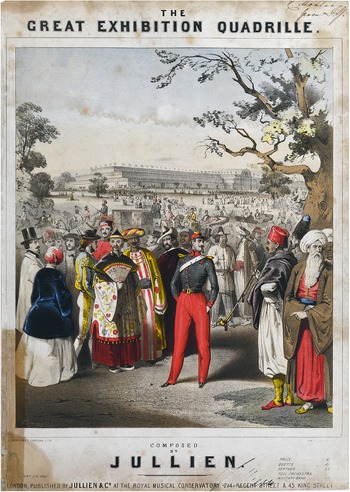
Expressive of growing musical globalism, Jullien’s Great Exhibition Quadrille reflected the diversity of its namesake event by combining dances and melodies from Spain, Italy, Syria and India among others, and won the affection of audiences enough to be considered a success.Footnote 15 The saxophone featured only briefly, alongside the harp in a delicate feature titled the Aurora Serenade;Footnote 16 the Aurora Serenade appears in the introduction to the third movement of the band score, and is not present in surviving piano reductions or short scores.Footnote 17 Covers of piano reductions of this composition showcase the exotic dress of the varied cultures represented at the Exhibition (see Figure 2). Following a reprise of the work in 1852, also performed by Soualle, reviews echoed something of Berlioz’s earlier descriptions of the instrument’s pathos:
[A] new instrument was introduced, called the ‘Corno Musa’, performed on by M. Soualle. He performed the Aurora Serenade, of a Sicilian lover to his mistress, in the [Great] Exhibition Quadrille. The tone is of the loveliest description, and no instrument could convey more pathetically and languishly [sic] the sad sighs of a desperate lover.Footnote 18
John Brandard, cover image for Louis-Antoine Jullien’s Great Exhibition Quadrille, (London: Jullien & Co., 1851), Elton Collection, Ironbridge Gorge Museum Trust, Shropshire UK.

Beyond the Great Exhibition Quadrille, Stephen Cottrell notes that Soualle could draw from a wellspring of cosmopolitan influences.Footnote 19 In 1851, Soualle helped to render the Indian Quadrille as a member of Jullien’s orchestra; however, this was more an imagination of India than any true rendition. A London critic commented that its ‘familiar Scotch melodies and Tylorean [sic] airs’ sounded ‘more promenadish than Indianic perhaps, but nonetheless piquant and quaint’.Footnote 20 That same year, Soualle returned to Paris and performed on saxophone in Félicien David’s oratorio Le désert, a work composed after David’s visits to Egypt and the Middle East.Footnote 21 Soualle had indeed been enculturated into these cultural tropes, for as Edward W. Said observed, ‘in the first half of the nineteenth century, Paris was the capital of the Orientalist world’.Footnote 22
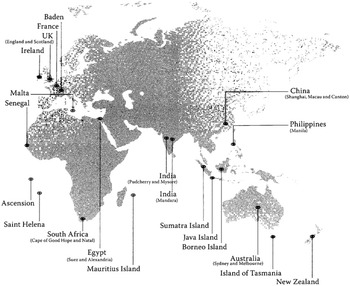
Suffused by these ideas and examples, Soualle remade his performing identity into an exotic new guise. He titled himself ‘Ali Ben Sou Alle’, styling himself as a Turk with a turbaned and robed appearance – in José-Modesto Diago Ortega’s estimation, applying some of the publicity techniques of Jullien,Footnote 23 and undeterred by an apparent lack of lived experience in Ottoman territory (see Figure 3).Footnote 24 In 1852 he commenced an extensive solo tour, ‘prodigious by the standards of the time’,Footnote 25 in which he performed in Scotland, Ireland, South Africa, Australia, New Zealand, Singapore, the Philippines, China and India – a remarkable individual feat of musical globalism in itself. Ralph Whiteoak comments that Soualle ‘electrified colonial audiences’ wherever he performed,Footnote 26 and Australia was to be no exception.
José-Modesto Diago Ortega, Map of Sou Alle’s Travels Around the World, 2019. From Diago Ortega, ‘Ali-Ben-Sou-Alle’s Turcophone Patent (1860)’, 176. Reproduced with permission.

Antipodean Lustre
Goldrush-era Melbourne, having been only recently settled by the British in 1835, was a nascent setting for theatre and concertgoing. Concerts as a fixture of public life were in an emerging state across the Australian colonies: Sydney, settled as a penal colony from 1788, saw its first public concert performances staged by merchant and theatre director Barnett Levey in 1826,Footnote 27 after which these activities became ‘tenuously but also tenaciously established’ during the 1830s and 1840s.Footnote 28 The Pavilion, Melbourne’s first theatre, opened in 1841 as a rudimentary structure known to sway in the wind, with audiences possessing little of the sophistication that might have been hoped for by its proprietors or the authorities. Here, traditional values of popular recreation inherited from England, such as disorder, exaggerated behaviour, and challenges to morality, coloured cultural life.Footnote 29 Riots were not uncommon, leading to the stationing of police among audiences to keep order, and audience conduct, combined with the conspicuous presence of so many sex workers, meant that by the mid-1840s the Melbourne theatre was ‘regarded as so disreputable that “respectable” women no longer attended’.Footnote 30
An egalitarian streak pervaded this new society. Unlike more stratified European social orders, in Australia the officer class, gentry, and ‘lower orders’ participated together in a range of recreational activities, a dynamic largely driven by demographics, given free settlers only attained majority status across the continent in the 1830s. Audience diversity, however, did not preclude critical disapproval, and reviews espoused high-minded endorsements of the civilizing role of art, alongside a corresponding disapproval of acts earning popular acclaim but encouraging antisocial or subversive behaviour. Following the fourth of Barnett Levey’s concerts in August 1826, which featured comic songs performed ‘with the most irresistible drollery’,Footnote 31 the Sydney Monitor commented:
Mr Paul and Mr Levey executed two comic songs in such good style as to be received with raptures. In these raptures, however, we could not join. A theatre and a concert are diverse; and we think it scarcely candid to intrench on the character of the latter by pantomime and farce.Footnote 32
For the city of Melbourne and colony of Victoria, the discovery of gold in 1851 transformed a remote British dependency into a land of wealth and opportunity, with a rapidly rising population possessing growing disposable income for leisure. In the realm of entertainment, concerts held a more limited capacity for undesirable messaging – actors were known to ad-lib ‘indelicate compositions’ to win the favour their audiences, either on a whim or to cover if they had forgotten their lines – helping them enjoy a more upstanding image than plays or pantomimes.Footnote 33 Operas were even occasionally staged, including by overseas touring companies, albeit with adapted casting and orchestration, and a weighting towards audience entertainment over strict musical fidelity. In an era of shared public culture, even touring minstrel shows succeeded in attracting the elite: an 1850 Melbourne performance of the Blythe Waterland Serenaders, the first professional minstrel company to perform in Australia, was patronised by the city’s superintendent, mayor, and resident judge.Footnote 34 Regardless of the genre, however, stakes were high for performers who were known to contend with ‘hissing, heckling, and thrown fruit’ should they displease their audiences.Footnote 35
Soualle sailed into Port Philip Bay on Christmas Eve 1852, disembarking in Geelong among a party of French mechanics.Footnote 36 Further records of his early months in the colony are scarce: one wonders whether he attended Melbourne’s first promenade concerts, modelled on Jullien’s and run by Jullien’s former bassoonist John Winterbottom, which began in January 1853 at the Olympic Circus at the eastern end of Bourke Street.Footnote 37 He was unlikely to have restricted his travels to Geelong and Melbourne: in an 1861 interview, he confirmed that one of his motives for travelling to Australia was to seek his fortune prospecting for gold.Footnote 38 Surviving accounts of musical life on the goldfields from this period are limited, and Ballarat’s first regular newspaper, the Ballarat Times, only commenced publication in March 1854.Footnote 39 In any case, by June 1853 Soualle was billed to perform in one of Melbourne’s first public buildings, the Mechanics’ Institute on Collins Street (see Figure 4; today, this renovated venue is known as the Melbourne Athenaeum).
Samuel Thomas Gill, Mechanics Institution Melbourne (Melbourne: J.J. Blundell & Co., 1855), National Library of Australia, https://nla.gov.au/nla.obj-133103377.

The Mechanics’ Institute advertised a ‘grand concert’, appealing to the kind of audience for whom John Whiteoak notes ‘“Novelty! Novelty!! Novelty!!!” was the catch-cry’.Footnote 40 Publicized alongside Soualle was a cast of ‘eminent artistes’ including the full military band of the British 40th Regiment then stationed in Melbourne, led by bandmaster Henry Johnson; two vocalists; a violinist; a cornetist; and a pianist. The notion of a ‘foreign gentleman … with very considerable skill’, and his unknown instrument suitable for both soloistic and orchestral musical settings, drew enthusiastic coverage in the Argus newspaper:
Amongst the flood of talent of various sorts which is setting in upon our shores, a foreign gentleman has lately arrived who performs with very considerable skill upon a newly invented and most remarkable instrument, styled the saxophone. This instrument is a sort of combination of the clarionet and the ophicleide, if our readers can understand such a union. The sound is produced by a reed, as in the manner of the clarionet, but the body of the instrument being metallic, of large size, and very elaborately keyed, a power is given to it of a most startling kind, a very astonishing compass, and a certain solidity combined with sweetness which is calculated to make the saxophone a very valuable addition to the orchestra, as well as a pleasing instrument for solo performances. Its first introduction is to take place at a grand concert on Monday evening at the Mechanics’, the preparations for which are on a very extensive scale … it will be very well worth hearing, as no such music was ever before heard in this colony.Footnote 41
On this ‘most remarkable’ instrument, Soualle was to close the first act with two items, performing variations on the popular song In My Cottage, before sharing the stage with a vocalist for the ballad Come Back! Come Back!.Footnote 42 Two days later, the same outlet updated its readership on what to expect of the performance, at least concerning matters of presentation (for a later representation of Soualle in the Australian press, see Figure 10 below):
We perceive that the saxophone, of which we made honourable mention on Saturday, is christened for this evening’s concert by a new name. M. Sou-alle, availing himself of the fact of his being of Turkish extraction (literally, we believe, the son of a Turk), to add a little novelty to his entertainment, will appear in the picturesque costume of that country. The concert is expected to be a very good one.Footnote 43
Soualle’s act’s combination of ‘picturesque costume’ and popular songs recalls something of Jullien’s Indian Quadrille two years prior, affirming Derek Scott’s observation that orientalist musical styles required ‘only a knowledge of orientalist signifiers’.Footnote 44 Nevertheless, in the afterglow of the concert, local enthusiasm that had anticipated his debut was sustained. A report in the Argus the following day captured patrons’ fascination with his masculine appearance, elaborate dress, poise on stage, and unique cast of instruments. Moreover, as if to emphasize his act’s exotic appeal, Soualle’s heretofore mentioned saxophone is now dubbed a ‘turkophone’:Footnote 45
As a proof of the strong appreciation of the people of Melbourne of any novelty in the musical way, the concert-room of the Mechanics’ was crowded last evening to excess; in spite of the threatening weather, and the almost impassable condition of the streets. M. Sou Alle made his debut in full Turkish costume, and being a fine-looking man, with a magnificent beard, he did full justice to the dress. His performance upon the new instrument, the turkophone, was extremely successful; and he was vehemently encored no fewer than three times, each time returning with a different instrument; to the intense amusement of the audience. These instruments dwindled gradually away till the last was a mere squeaking pipe, with a sound precisely resembling the bagpipe; and a few bagpipe tunes (if there be such things) were blown through very successfully, and with a great deal of humor … The experiment on the whole was very successful, and will, we have no doubt, lead to another exhibition of those fine new instruments before long.Footnote 46
A second concert – for patrons paying above earlier admission feesFootnote 47 – followed a month later, and leaned further into the Turkish theme. The Mechanics’ Institute was extensively decorated: the Argus detailed ‘a row of thirteen elegant variegated lamps, each bearing a letter of the singular name’ (‘Ali Ben Sou Alle’) hung over the doorway; inside, one end of the hall was ‘covered with variegated drapery, supposed to represent a Turkish pavilion; the musicians’ seats and music stands being also richly hung, while the profusion of lights was dazzling to behold’.Footnote 48 Soualle’s instruments were also diverse, as in addition to the turkophone and clarinet, the ‘turkophonini’ or soprano saxophone is also mentioned in later Australian reviews,Footnote 49 to say nothing of the bagpipe-like ‘squeaking pipes’ of his debut.Footnote 50
Musically, Soualle’s novel timbres conveyed a more familiar repertoire including fantasias on opera themes, minstrel show tunes, popular ballads, and, perhaps spurred by Jullien’s concerts, colourfully embellished national anthems. Soualle’s variations on these melodies were central to his act: in an era when all music was performed and heard live, and in an Australia where the ‘tyranny of distance’ influenced the kinds of works that could be sourced to perform locally, musical items were known to be repeated until they were very familiar.Footnote 51 Here, Soualle’s florid musicality thrived, with goldrush-era Melbourne proving a welcome complement to his saxophone’s silver hue. Later in winter 1853 Soualle returned to Geelong, where a critic writing in the Geelong Advertiser and Intelligencer offered representative praise:
We can appreciate a good thing, and without making any pretensions to talents of criticism on the Divine Art, fully accord to his Highness Ali-Ben-Sou-Alle the celebrity he has attained. His performance is as extraordinary as the shape of the instruments he makes discourse such exquisite music. Nobody, under the rank of a Pacha, could make a silver meershaum [sic] emit such soul-stirring sounds, rich, full, sonorous, and streaming out with liquid beauty. He is an illustrious Turk, possessed of dangerous powers over our susceptibilities, with many instruments to enforce it.Footnote 52
This esteem is commensurate to that which reviewers extended to other international musicians concurrently touring Australia,Footnote 53 such as Austrian violinist Miska Hauser.Footnote 54 Moreover, references to an ‘illustrious Turk’, and ‘soul-stirring’ performances earning the title of Pacha, an Ottoman equivalent of a peerage, speak to a warmth perhaps unusual for a non-European act of the time. In his survey of the Australian popular stage to 1914, Richard Waterhouse writes of this time as when racial tropes of the minstrel show held mass appeal, and the British applied racial slurs to ‘any non-white’ to degrade any ethnic group of their choosing, including indigenous Australians.Footnote 55 In such light, the affection afforded to Soualle’s brand of ‘otherness’ is striking – even if the Geelong reviewer’s choice of language, in speaking to ‘dangerous powers over our susceptibilities’, suggests a degree of frisson.
Crimean Echoes
Supplementing novel instruments, exotic dress, familiar repertoire, and prodigious musicality, geopolitical events were a fifth element working to win Soualle the favour of Australian audiences. In October 1853 the Crimean War erupted, which aligned the British, French, and Ottoman empires against the growing perceived threat of Tsarist Russia. Resonances from the conflict reached the concert stage to favourably inflect the saxophone’s Australian reception.
For newly wealthy Australian colonies far from their imperial capital, fears of a Russian invasion grew over the nineteenth century. To the north-east, the Russian Empire had controlled Alaska since 1799, and, in the words of historian Clem Lack, ‘considered the Pacific a Russian lake’ (see Figure 5 illustrating Australia’s relative proximity and exposure).Footnote 56 Earlier Russian voyages to the antipodes had caused alarm: the warship Suvorov visited Sydney’s Port Jackson in 1814, the cruiser Amerika docked in Sydney in 1832 and 1835, and expeditions as far south as Antarctica were undertaken.Footnote 57 For their part, Australian colonies were hardly well defended: in 1839, an unheralded squadron of US naval vessels dropped anchor in Sydney Harbour, and were not detected until the following morning.Footnote 58
Joseph Meyer, ‘Map of the Pacific Ocean: Currents, Temperature, Trade Routes, and Voyages of Discovery’, National Library of Australia, http://nla.gov.au/nla.obj-232358696.

Consequently, for many Australians the Crimean conflict was of almost existential interest. News of Britain’s declaration of war was published in Melbourne on 2 January 1854,Footnote 59 adding concern to earlier reports of a Russian fleet prowling Pacific waters.Footnote 60 Sir Robert Nickle, commander of military forces in Australia, was tasked with reorganizing the colonies’ defence, which led to the stationing of new ships and construction or fortification of coastal batteries to defend Sydney and Melbourne.Footnote 61 A campaign to raise money for a patriotic fund attracted some £65,000 in donations – a considerable sum that a colonial government might otherwise spend on a major road, or what a new hospital in England might cost.Footnote 62 Local volunteer militia such as the Royal Melbourne Regiment were also formed, to help calm fears of Russian raids.Footnote 63
For Soualle, this alarm accelerated his good fortune. On 13 March 1854 Melbourne’s Mechanics’ Institute hosted a reunion of the 40th Regiment and ‘Ali Ben Sou Alle’, as part of a second ‘grand concert’ whose programme included a new piece by Soualle titled the Turko-Russian Historical Polka. This was ‘composed on the arrival of the news of the late victories of the Turks at Kalafat and Oltenitza’, the first engagements of the conflict.Footnote 64 Afterwards, an Argus critic noted: ‘the orchestra composed of the band of the 40th, was, as might have been expected, au fait of the peculiar pieces in which M. Soualle delights, and the Turco-Russian Polka and the Storm piece were therefore effectively produced’.Footnote 65
Indeed, astute programming underscored much of the favour Soualle garnered with Australian audiences. He regularly performed well-received selections of British airs, embellished renditions of La Marseillaise,Footnote 66 and newly composed musical tributes to his audiences, such as the Australian Waltz performed in Melbourne in May 1854,Footnote 67 and Queen of the South, dedicated to Lady Hotham, wife of the Governor of Victoria, which was premiered in Geelong that August.Footnote 68 Following his Victorian introduction, Soualle toured the colonies of Van Diemen’s Land (known as Tasmania from 1856) and New South Wales, where he performed in capital cities as well as regional centres, and his reception grew even more fond. The New South Welsh town of Goulburn expressed particular amity, with an 1855 review admiring both his instrument and musicianship:
The range of the turkophone runs from the rich breadth of the sax-horn of the fullest timbre to the tenderest note of the clarionet. Ali-Ben-Sou-Alle rendered Mozart’s music as we have never before heard it in Australia. His manipulation is exquisite; indeed there is in the performer more that intimates the musician of genius than we have seen in any artiste for years. His execution has an individuality of its own – a character of sensibility, or rather of passion – passion subjugated and calm – full of rich, mellow repose; disciplined, we conceive, by a perception the most exquisite of that symmetry which is the true beau ideal classique. His performances on the turkophone included a selection from Le prophète. Into the superb shadows – the dusky magnificence of Meyerbeer’s music, glided this wonderful instrument with an adequacy of power that was in point of fact orchestral. Here Ali-Ben-Sou-Alle gave us interpretation of high musical art, in which no little of a maestro’s thought and learning lay beneath the skill of the musician. To the connoisseur, we believe this to have been the most perfect gratification that the present carnival of sweet sounds in Goulburn has furnished.Footnote 69
One piece composed around this appearance survives. Soualle’s Goulburn Waltz: à mes amis de Goulburn was dedicated to the people of Goulburn in February 1855, and mailed to them following a successful performance there two weeks earlier;Footnote 70 this stay was also marked by a breakfast in Soualle’s honour attended by Miska Hauser.Footnote 71 The Goulburn Waltz itself is a fairly conventional waltz, with only occasional (and diatonic) grace notes in the melody hinting at European ‘Turkish style’ musical signifiers from the preceding century,Footnote 72 suggesting that Soualle’s virtuosity and manner of presentation did much of the work to charm his audiences.Footnote 73 Having been published and advertised for sale in Goulburn later that year,Footnote 74 a copy of the Goulburn Waltz is held by the National Library of Australia (see Example 1 for its closing stanza).
Ali Ben Sou Alle, Goulburn Waltz: a mes amis de Goulburn (n.p., 1855), 4, bars 149–183. National Library of Australia, http://nla.gov.au/nla.obj-181800081.

Soualle concluded his antipodean engagements in July 1855, with performances advertised in Brisbane,Footnote 75 preceded by a brief stint in New Zealand and concerts in Wollongong and nearby Kiama (see Figure 6 for a map of Soualle’s currently confirmed Australian performance locations).Footnote 76 Australian colonies, which had been ‘vicariously at war’ in Crimea,Footnote 77 had not only warmly welcomed this turban-clad virtuoso, but would go on to designate streets and entire towns after locations and figures from the conflict: main roads named Inkerman, Alma, Cardigan, and Napier in broader Melbourne, and the Victorian towns of Balaclava and Sebastopol, indicate this strength of feeling.Footnote 78 Given the redolence of the saxophone’s introduction to local audiences, one is given to wonder whether in central Melbourne a Turkophone Lane (or, perhaps, a Sou Alle Alley?)Footnote 79 was ever mooted.
Soualle’s confirmed appearances around Australia, from his arrival in Geelong in December 1852, to a performance in Kiama in June 1855. Concerts in Maitland (Newcastle) in January and February 1855, and Moreton Bay (Brisbane) in July 1855, were also advertised. Locations sourced from Skinner, ‘Ali-Ben Sou Alle in Australia’, Australharmony, and mapped by the author.

Subsequently, Soualle’s travels continued apace. Sailing north on a tour around southeast Asia, he introduced the saxophone to audiences in Manila, Singapore, Batavia (Jakarta), Shanghai, and Hong Kong. During a subsequent stay in Rajdah, India, he reportedly converted to Islam and so bewitched the locals that he was named the area’s musical director.Footnote 80 He then returned to France, where his Caprice for alto saxophone and piano was independently published in 1861,Footnote 81 and his fame drew invitations to perform for the French imperial family. An audience with the Prince of Wales followed, where he presented a compendium of his pieces, the Royal Album pour saxophones par Ali Ben Sou Alle of 1865, now held by the British Library,Footnote 82 and contained within the Royal Album is Soualle’s Souvenirs d’Australie et de Manille. A kind of populist admixture of its own, this piece combines: an opening aria at moderato; a rendition with variations of Pennsylvania-born Stephen Foster’s song Old Folks at Home, popular in Australia at the time; and a bolero in tribute to the Spanish-ruled Philippines. The choice of Foster’s song reflects something of what Percy Grainger would later describe as the ‘patiently yearning, inactive sentimental wistfulness that we find so touchingly expressed in much American art’, which found favour among nineteenth-century Australian audiences.Footnote 83 In Soualle’s hands, Foster’s famed melody is introduced and then decorated in increasingly lively variations; following the bolero, a rousing coda marked più animato brings the piece to a triumphant close.Footnote 84
Contrary to his Australian reception, however, on his European return Soualle’s 1860s performances drew mixed reviews. Fading praise was especially marked among London critics attuned to prevailing cultural winds, and following another performance of In My Cottage at the Royal Opera House’s popular concerts in 1864 (around which time he was first photographed in costume, and with a rare straight alto saxophone; see Figure 7), a Musical Times critic commented:
In the attempt to offer sufficient attraction to the educated and uneducated in art, a middle course is pursued, which has the effect of disappointing both. The programme of the opening concert contained the usual number of classical works, mixed up with vapid fantasias (including one on the ‘turkophone’, a new instrument [by] a gentleman with the unmistakably Oriental name of Ali Ben Sou-Alle), quadrilles, and hashes from operas.Footnote 85
Adolphe Naudin, Ali Ben Sou Alle, 1864. UK National Archives, reproduced in Cottrell, ‘Charles Jean-Baptiste Soualle and the Saxophone’, 195.

Set against the broader story of the saxophone’s challenging nineteenth-century introduction, the fascination evoked by Soualle’s performances proved more an exception than rule. Legacies were not entirely absent: in Australia, Henry Johnson, who led the band of the 40th Regiment in Soualle’s 1853 Melbourne debut, is documented as performing on saxophone for Victorian audiences between 1860 and 1868. At a series of promenade concerts at Covent Garden in 1865, saxophone solos were performed by players going by pseudonyms of ‘Ali Ben Mustapha’, and, somewhat less plausibly, ‘Ali Ben Jenkins’.Footnote 86 However, just as in the concert halls of Paris, novelty did not translate into sustained or widespread incorporation in England, or even recognition. Two decades hence, George Bernard Shaw observed: ‘There are whole families of genuine additions to the resources of the orchestra that have not yet got further than a place in a few of our military bands. Probably not one student in the Royal Academy or Royal College of Music could “spot” a saxophone blindfold’.Footnote 87 For his part, Soualle later returned to Paris and, powers of advertising evidently intact, promoted elixirs drawing on his knowledge of plants and herbs gleaned from his voyages (see Figure 8). He died in Paris in 1899.Footnote 88
Advertisement for Soualle’s ‘New Treatment for Neuralgia, Gout, Rheumatism’, Le Figaro, 17 January 1877, quoted in Diago Ortego, ‘Ali-Ben-Sou-Alle’s Turcophone Patent (1860)’: 176.

‘More than Ordinary Curiosity’ and a Russian Scare
Any scholarly appraisal of Soualle’s Australian performances must reflexively engage with ideas of representation, power, and invention that were addressed so influentially in Said’s 1978 text.Footnote 89 Orientalism, Said argued, could best be understood as a ‘[Western] knowledge of the Orient that places things Oriental in class, court, prison, or manual for scrutiny, study, judgment, discipline, or governing’,Footnote 90 with sociologically derived latent (passive, positivistic) and manifest (explicit and more judgement-laden) aspects.Footnote 91 If Soualle’s musical ties to the Orient proved elusive, his choices of name, costume, and mise-en-scène reflected mercantile self-promotion – in Adam Geczy’s reckoning, ‘one of the nineteenth-century artist’s most important tools in the Romantic box of vainglorious tricks’.Footnote 92 Buoyed by events in Crimea, what Said might call ‘worldly circumstance’,Footnote 93 Soualle’s sense of enterprise corresponded with a wave of Turkish taste across the British Empire, made real in London through the establishment of an Oriental & Turkish Museum in Hyde Park in November 1854, whose advertisement’s figure shares a kind of resemblance with the ‘Ali Ben Sou Alle’ depicted in the Australian press (see Figs. 9 and 10).
Catalogue of the Oriental & Turkish Museum, St. George’s Gallery, Hyde Park Corner, Piccadilly (London: W.J. Golbourn, 1854), Look and Learn, Peter Jackson Collection.

‘Ali Ben Sou Alle’ as represented in the Illustrated Sydney News (Sydney), 23 December 1854, 460; in Skinner, ‘Ali-Ben Sou Alle in Australia’, Australharmony.

Yet Said observed that sympathetic European representations of the Orient do not, by themselves, defy his broader thesis. From the eighteenth century, a European sensibility had been invited to ‘see hidden elements of kinship between himself and the Orient … [Mozart’s] The Magic Flute (in which Masonic codes intermingle with visions of a benign Orient) and The Abduction from the Seraglio locate a particularly magnanimous form of humanity in the Orient’,Footnote 94 which nevertheless belong to a broader sweep of Western-led othering and marginalization.Footnote 95 To Australian audiences in a burgeoning concert-going society, for whom Soualle ‘rendered Mozart’s music as [they] have never before heard [it]’,Footnote 96 the extent of these connections may ultimately remain speculative. Other more exoticized language from Soualle’s Australian reviews, such as Meyerbeer’s music’s ‘dusky magnificence’,Footnote 97 or ‘soul-stirring’ sounds ‘possessing dangerous powers over our susceptibilities’,Footnote 98 blur lines of timbre and repertory to speak to what Matthew Head describes as an ‘ambiguity over where orientalist/exoticist reference begins and ends [which] is foundational to Romanticism’.Footnote 99
In important ways, Soualle’s act complexifies a Saidian view of orientalist cultural representations. Rather than casting the Orient as being ‘a place isolated from the mainstream of European progress in the sciences, arts, and commerce’,Footnote 100 the novelty of the ‘turkophone’, as a piece of musical technology,Footnote 101 worked to defy the trope of Oriental timelessness and backwardness, or an otherwise ‘indolent Ottoman East’.Footnote 102 Nor, through Soualle’s masculine stylings, did his act embody a ‘feminine penetrability’ requiring Western intervention and salvation, even if a slowly ailing Ottoman Empire was increasingly advanced upon by European powers over the course of the nineteenth century.Footnote 103 Instead, in a martially charged antipodean atmosphere, ‘Ali Ben Sou Alle’ manifested a spirit of inquiry in his audiences to add a degree of perceived connection to local intrigue about developments in Crimea. In an 1855 Bathurst Free Press and Mining Journal review, following a concert in which the hall was ‘crowded to excess’, a correspondent reflected:
Situated though we be – almost a world’s width from the theatre of events, which are now absorbing the attention of civilized mankind over the face of the globe – we nevertheless feel a lively interest in everything appertaining to Turkey and the East; and, therefore, are disposed to regard Ali-Ben-Sou-Alle with more than ordinary curiosity.Footnote 104
This review concludes by lauding how ‘our Bathurst atmosphere never before lent its aid in the manufacture of melody at once so sweet, polished, and powerful’, before criticizing the French vocalist performing after Soualle for his broken English,Footnote 105 to hint at some of the specific conditions Australian audiences placed on (even allied) outsiders. To the extent that Soualle’s persona was entirely convincing to Australian eyes and ears, however, other reports noted scepticism. Contrary to any suspension of disbelief expressed after his Melbourne debut, a later Bathurst review enounced a wiseness to the act’s provenance:
Many have been the guesses at the nationality of Ali-Ben-Sou-Alle. He has been fixed as an Irishman, under the name of Alick Ben Sullivan – again as a Scotchman, with the patronymic McSewell, joined to the christianized Alexander Benjamin … At all events, whether familiar with mosques, minarets, and the Alcoran, his music is much more French than Turkish, but sounds none the worse from a turbaned head, and a body in embroidered jacket, with thighs clad in loose silk breeches, and well rounded calves in hose of the same texture. Nobody, however, believes Ali-Ben-Sou-Alle to be a Turk, whilst a few profess to know that the turkophone, turkophonini, and clarionet are instruments played upon by a clever and polished Celt, whose native country is bounded on one side by the Straits of Dover and another by the Rhine.Footnote 106
To be sure, Soualle’s tour coincided with growing projections of Western military and political power, in a ‘golden age of Orientalism’ bookended by Napoleon’s Egyptian military campaign and the outbreak of the Franco-Prussian War.Footnote 107 Said articulated that Orientalism is ‘fundamentally a political doctrine willed over the Orient because the Orient was weaker than the West, which elided the Orient’s differences with its weakness’.Footnote 108 In Australia’s hemisphere, British campaigns in China during the Opium Wars of 1839–42 and 1856–60 stand as proof, a hostility echoed in the widespread discrimination faced by Chinese miners on Australian goldfields, and, by extension, their musical endeavours.Footnote 109 Elsewhere, European colonial administrations in the lands of Soualle’s south-east Asian performance itinerary also illustrate this dynamic. From a European standpoint, martial themes and orientalist cultural expressions share a long history: Jonathan Bellman credits the 1683 repulse of Ottoman armies from the gates of Vienna as giving rise to the ‘Turkish style’ of European music, which supposedly ‘evolved from a sort of battle music played by Turkish military bands’ during that siege, [which] was so little heard or remembered that the music itself ‘was thus almost entirely the product of the European imagination’.Footnote 110
Soualle’s Australian context both reflected and refracted ideas from the European imagination. In distant, diasporic British outposts beginning to be seen as a new nation in their own right,Footnote 111 the local reception of this self-styled ‘Ottoman’ virtuoso pushes against Said’s 1978 frame, which posited that ‘European culture gained in strength and identity by setting itself off against the Orient as a sort of surrogate and even underground self’.Footnote 112 At a time when great power politics allied the British, French, and Ottoman empires, this episode evoked more amity than prejudice in Australian audiences, who, functioning as Roger Covell described as ‘a transplanted and more or less subsidiary culture’ to that in Europe,Footnote 113 wielded the least power in a global political equation. Indeed, the role distance played in the refraction of ideas of political and cultural value was later supported by Said, in a series of essays published in 1994: ‘The one relationship that does not change is the hierarchical one between the metropole and overseas generally’, between (in this instance) Britain, and ‘those peoples who geographically and morally inhabit the realm beyond Europe (Africa, Asia, plus Ireland and Australia in the British case)’.Footnote 114 Even more pointedly, Said contended that from a British vantage point, white colonist Australians were perceived, alongside US Americans and the Irish, as ‘an inferior race well into the twentieth century’.Footnote 115
Perhaps most remarkably, at this particular historical moment, Soualle’s powers of invention coalesced with Saidian ‘worldly circumstance’ to inspire a particularly vivid expression of the Australian imagination. In 1854, at the height of the Crimean War, local reports appeared claiming that ‘the price of rifles has superseded the price of gold’,Footnote 116 in response to rumours that a ‘Russian fleet is now in the Pacific Ocean, with no pacific intention towards the Felician Land’.Footnote 117 A 29 June article in the Geelong Advertiser and Intelligencer outlined how Geelong locals might arm and conduct themselves to resist a Russian incursion, in twelve clear steps, and perhaps not entirely in jest. The tenth item reads:
That the services of a foreign ally being desirable and the employment of the same consistent with the custom of nations, it shall be lawful for the said burghers to enter into alliance with Ali-Ben-Sou-Alle, and the better to achieve the downfall of the said hordes, he, the said Ali-Ben-Sou-Alle, shall, if he object not therein, advance before the said burghers’ beat, playing the Turkophone, or Turkophant, or any other phone or phant, save the sychophant, so hereby the souls of the burghers may be in arms and eager for the fray.Footnote 118
While this particular event did not transpire, the threat was evidently felt. A notable Russian scare took place ten weeks later, when celebratory gun salutes from ships in Port Philip Bay were misinterpreted as signs of an impending raid, and a flurry of cannon fire and fireworks sparked alarm in Melbourne,Footnote 119 with Soualle likely across the bay in Geelong at the time.Footnote 120 In any case, that a saxophone would be proposed to help lead the putative defence of Australia, in the hands of a turbaned musician, is one of the more unlikely possibilities Adolphe Sax might have envisioned during its challenging genesis a decade earlier.
Subsequently, such strong ties between the saxophone and ideas of freedom would not resonate in Australia again until 1918,Footnote 121 at the advent of the Australian Jazz Age, when in the throes of the Great War Australians once again looked to cultural exemplars from overseas allies.Footnote 122 Although some six decades separate these episodes, historical records and musicological scholarship suggest an alignment between the meanings encoded in Soualle’s saxophone, and those conveyed by the saxophone that helped to open the freewheeling vaudevillian performances of Fuller’s Jazz Band in 1918 – in John Whiteoak’s summation, more an ‘imaginative burlesque of [a] new [US] American craze’ than any kind of authentic reproduction.Footnote 123 Whiteoak notes that Soualle performed ‘presumably improvised fantasias’, and can be considered ‘almost a mid-nineteenth-century counterpart of visiting star American jazz saxophonists’, who visited Australia in the Australian Jazz Age’s second stanza from 1923.Footnote 124 ‘Ali Ben Sou Alle’ could scarcely be called a burlesque act, but these performances’ creative forays in both compositional and performance domains spoke to cultural diplomacy in a manner concordant with later saxophonic endeavours.
Set to the charged atmosphere of goldrush-era Australia, Soualle’s act proved a deft match for local musical tastes, cultural appetites, and geopolitical fears and favours. In a manner both validating and challenging subsequent scholarly frames, on 1850s Australian stages this ‘illustrious Turk’ demonstrated a worldly interplay of culture, commerce, and camaraderie, with novel instruments possessing a symbolic malleability of their own to shed new light on musical globalism and nineteenth-century music’s broader cultural reach. Moreover, as today’s lingering spectre of Russian irredentism reminds us, some themes underlying the Australian reception of ‘Ali Ben Sou Alle’ are not wholly consigned to the past. Perhaps, then, this remarkable episode is deserving of a greater space in contemporary consciousness to reflect the attention, wonder, and delight it originally held.
Dr Ross Chapman is Lecturer in Communication at Deakin University, Australia, and recently concluded his term as Editor of Context Journal of Music Research. A saxophonist, educator, and researcher, his award-winning PhD from the University of Melbourne (2023) examined the untold early history of the saxophone in Australia to World War II, which also informed an article on the Sousa Band’s 1911 Australasian tour published in Musicology Australia (2024). Ross’ current research focuses on notions of cultural value and musical exchange, advancing Australian connections to international musical developments of the long nineteenth century and beyond.



 Open access

