


Introduction
Fertility rates in Iran have experienced a significant decline in recent decades. Total fertility was around 6.9 children in the early 1980s but has dropped to less than two children in the past two decades (Abbasi-Shavazi et al., Reference Abbasi-Shavazi, Philip Morgan, Hossein-Chavoshi and McDonald2009; Shojaei and Erfani, Reference Shojaei and Erfani2019). In 2020, the total fertility rate in Iran was 1.8. For 2025, this rate is projected to be below 1.5 (Aghayari Hir et al., Reference Aghayari Hir, Farokhi Nekarestan and Latifi Mojreh2016). Therefore, Iran is among the countries with a fertility level below the replacement rate. As a result, the decline in fertility intentions has entered the list of social issues in Iran (Hosseini and Bagi, Reference Hosseini and Bagi2014). When the fertility rate approaches or falls below the replacement level (1.2 children per woman), a proportion of families are expected to settle for one child, and the proportion of definite and potential single-child families is expected to increase (Shojaei and Erfani, Reference Shojaei and Erfani2019). At the same time, evidence shows that although having two children is considered the ideal number of children in Iran, the intention and behaviour of single-childing, especially in cities, are on the rise (Khalajabadi Farahani and Saraei, Reference Khalajabadi Farahani and Saraei2016). The rate of single-childing in Iran increased from 23.9% in 2006 to 28.5% in 2011 (Fekri Kia and Pazhohan, Reference Fekri Kia and Pazhohan2015). In 2016, the general rate of single-childing in Iran was 23% (Shojaei and Erfani, Reference Shojaei and Erfani2019). It is predicted to reach 50% by 2050 (Fekri Kia and Pazhohan, Reference Fekri Kia and Pazhohan2015).
Single-childing can have a multitude of consequences, including population ageing and labour force decline (Torabi and Abbasi-Shavazi, Reference Torabi and Abbasi-Shavazi2016), individual and family issues such as the lack of siblings and its impact on child development and growth (Behmanesh et al., Reference Behmanesh, Taghizadeh, Vedadhir, Ebadi, Pourreza and Abbasi Shavazi2019), loneliness and maladjustment among children (Breton and Prioux, Reference Breton and Prioux2009), increased anxiety and depression (Settles et al., Reference Settles, Sheng, Zang, Zhao and Chan2013), and poor life skills and weak independence (Zhong, Reference Zhong2005; Shojaei and Erfani, Reference Shojaei and Erfani2019). The results of a study showed that most single children feel lonely, dependent on their parents, and helpless, are unable to form close relationships with peers, and perform poorly in school (Zhong, Reference Zhong2005).
Single-childing can occur for various reasons, including increased female education, educational and health policies, declining infant mortality, economic challenges, increased time between marriage and first pregnancy, rising marriage age, and changing attitudes (Khalajabadi Farahani and Saraie, Reference Khalajabadi Farahani and Saraie2013; Pradhan and Sekher, Reference Pradhan and Sekher2014; Basu and Desai, Reference Basu and Desai2016; Vedadhir et al., Reference Vedadhir, Taghizadeh, Behmanesh, Ebadi, Pourreza and Abbasi-Shavazi2017; Behmanesh et al., Reference Behmanesh, Taghizadeh, Vedadhir, Ebadi, Pourreza and Abbasi Shavazi2019; Foroutan and Bijani, Reference Foroutan and Bijani2020). Additionally, modern changes in families and the formation of nuclear families (Khalajabadi Farahani and Saraei, Reference Khalajabadi Farahani and Saraei2016), increased access to opportunities and a higher likelihood of success in modern social structures with a single-child pattern (Blake, Reference Blake1981), extreme individualism (Foroutan and Bijani, Reference Foroutan and Bijani2020), high cultural growth and lack of appropriate economic growth, and preference for having one child (Basu and Desai, Reference Basu and Desai2016) have been cited as other reasons for single-childing. Pradhan and Sekher (Reference Pradhan and Sekher2014), in a study in India, found that urbanization, education, employment, and economic status are the most important reasons and grounds for the tendency towards single-childing (Pradhan and Sekher, Reference Pradhan and Sekher2014). In a study by Mobasheri et al. (Reference Mobasheri, Alidosti, Sorshajani, Khosravi, Khalafian and Jalilian2013) in Iran, increased costs and economic pressure, lack of government support for childbearing, and a societal perception that having more children is a sign of cultural weakness were the main reasons for the desire for single-childing (Mobasheri et al., Reference Mobasheri, Alidosti, Sorshajani, Khosravi, Khalafian and Jalilian2013). Khalajabadi Farahani and Saraei (Reference Khalajabadi Farahani and Saraei2016) in a study in Iran showed that the decision to have one child is a type of strategy to create a balance between individual, marital, family, and environmental conditions. This decision is the result of an interaction between the outcome of individual attitudes, feelings, and skills in favour of single-childing, the unsupportive environment of marital interaction for childbearing, the unsupportive environment of the extended family for childbearing, and the unsupportive environment of society for childbearing (Khalajabadi Farahani and Saraei, Reference Khalajabadi Farahani and Saraei2016). These authors showed in another study that the odds of single-childing in women aged 40 and over increased by about 2.6 times as their education level increased from a diploma to a bachelor’s degree (Khalajabadi Farahani and Saraie, Reference Khalajabadi Farahani and Saraie2013).
As discussed, single-childing has roots in various causes and has significant consequences. The rise of single-childing is perhaps one of the most essential concerns of population officials in Iran. Therefore, in recent years, policies have been announced and implemented to encourage families to have more children. The necessity of this research stems from the fact that, first, single-childing is one of the most prominent aspects and manifestations of the ‘demographic transformation’ process (Foroutan, Reference Foroutan2019) that contemporary societies are increasingly experiencing. In addition, although emerging phenomena such as single-childing have historically been more prevalent and severe in developed and industrialized societies than in developing countries, this phenomenon has increasingly emerged and expanded in developing countries such as Iran. However, perhaps the most important reason and necessity for research in this field is the wide gap in studies on single-childing. An extensive review of the literature revealed that few studies, especially in Iran, have been conducted on single-childing and often with a demographic approach to analysing the emergence of single-childing. Therefore, the need for a comprehensive explanation of the reasons for single-childing from a qualitative perspective is highly felt to identify the hidden reasons, meanings, and mental perceptions of parents with only one child and to pave the way for promoting childbearing. The study’s findings can provide a fundamental basis for macro-policymaking and planning in the field of single-childing and interventions to promote increased fertility. Based on the above, using a qualitative approach, this study was conducted to explain the reasons for having only single-childing in Western Iran.
Methods
Design
This qualitative study employed a conventional qualitative content analysis approach in Lorestan province, western Iran. Qualitative content analysis involves collecting, structuring, and interpreting qualitative data to understand its representation. In conventional content analysis, categories are extracted from the text data (Flick, Reference Flick2018).
Participants
Study participants were parents with only one child who explicitly reported no current desire or intention to have additional children. This intention was assessed during recruitment using a direct screening question (‘Do you intend or desire to have more children in the future?’), and it was reconfirmed during the interview through follow-up probes. Couples whose single-child status was solely due to involuntary reasons (such as diagnosed infertility, medical contraindications to pregnancy, or permanent reproductive health problems) were excluded from the study. However, participants with a history of medical or fertility-related concerns were included if they clearly stated that, regardless of these conditions, they did not wish to have more children and perceived their single-child status as a deliberate decision.
Key informants were also included to enrich data triangulation. They were purposively selected based on their professional experience or academic expertise related to fertility, family studies, psychology, or social determinants of health and their familiarity with the phenomenon of single-childing in Iran. Key informants did not represent personal childbearing experiences but contributed expert perspectives on social, cultural, psychological, and structural factors influencing single-childing. Their interviews were analysed alongside parent interviews to support analytical depth, contextual interpretation, and triangulation of findings.
Data collection
Participant selection began with purposive sampling and continued with snowball sampling. Individuals who met the inclusion criteria were identified and interviewed at various public and cultural locations. At the end of each interview, participants were asked to refer others who met the inclusion criteria to the researcher. Semi-structured face-to-face interviews were used to collect data. The entire interview process was recorded with the consent of the participants. Sampling began from three independent initial entry points, including a comprehensive health centre in Khorramabad, two active cultural centres in middle- and upper-income areas of the city, and a private kindergarten. The interviews were conducted in other locations such as parks, shopping centres, cultural centres, schools, health centres, and universities. These sites were selected due to the socioeconomic diversity of their clients. During the interviews, no one other than the researcher and the participant was present. To minimize snowball sampling bias, three independent referral chains were initiated simultaneously, a maximum of three referrals from each participant was accepted, and referrals of first-degree relatives were avoided. Furthermore, diversity in age, education, and economic status was continuously monitored and maintained throughout the sampling process. Regarding the selection of Lorestan province, this province was chosen as the study setting because of its high rate of single-child families, its significant population residing in both urban and rural areas, and its specific cultural context representing a mixture of tradition and modernity. Additionally, access to the target population was feasible in this province, and the necessary permissions had been obtained.
An interview guide was used to ensure that participants answered questions in line with the study objectives. Due to the diversity of the sample, the questions for each interview were adapted to the individual’s circumstances but generally revolved around the following themes (Table 1). The semi-structured interview guide covered five core domains. These included general attitudes towards single-child families, factors influencing the decision to have only one child, the most important barriers to having another child, the role of society and significant others in decision-making, and the process of spousal agreement on single-child status. During recruitment, eligibility was first assessed through brief screening questions regarding the number of children and fertility intentions. During the interviews, participants’ stated lack of intention for further childbearing was explored in greater depth through probing questions to ensure consistency between their initial responses and their lived experiences. This process helped distinguish voluntary single-child preferences from involuntary single-child situations. All interviews were conducted in Persian, the official and common language of Lorestan province. The interview guide was piloted with three eligible couples who did not participate in the final analysis. Following the pilot, one item regarding barriers to childbearing was split into two separate questions, namely, economic barriers and emotional-psychological barriers, to improve clarity. The order of questions was also adjusted to facilitate a more natural conversational flow. Regarding interviewer positionality, the interviewer introduced himself at the beginning of each session. He emphasized that the study aimed to understand participants’ decisions rather than judge them. The interviewer refrained from expressing personal views on childbearing. When participants asked about the interviewer’s marital status or number of children, brief and neutral responses without personal details were provided to minimize potential influence on participants’ answers. Field notes were written immediately after each interview. These notes included descriptions of participants’ non-verbal cues such as crying, long silences, and tone of voice. They also included contextual factors affecting the interview, for example, noise or the presence of others in public locations. In addition, the researcher’s reflections on interview dynamics and preliminary ideas for coding were recorded. These field notes were used as a supplementary source for data interpretation during analysis. Additional detailed questions were also asked to complete the interviews and extract the necessary information. At the beginning of each interview, the researcher first provided a brief biography of their field of study, age, and occupation, followed by general information about the purpose and importance of the research topic, and then the interview began. The type and order of interview questions were adapted to the information provided by the participants. The interviews continued until data saturation was reached, meaning that codes became repetitive and no new information was obtained. A total of 36 interviews were conducted, including 29 interviews with parents (13 men and 16 women) from single-child households who no longer wished to have more children and seven interviews with key informants (sociologists, psychologists, and other experts familiar with the phenomenon of single-child families). The demographic characteristics of parents and key informants are summarized in Tables 2 and 3, respectively. Data saturation was operationalized separately for the two groups. Saturation was defined as the point at which three consecutive interviews yielded no new codes or themes. For parents, saturation was reached at interview 24, after which five additional interviews (interviews 25–29) confirmed the stability of the identified categories and no new codes emerged. For key informants, saturation was achieved at interview six, and one additional interview (interview seven) provided no new information. The timing and location of the interviews were determined by the participants. The interviews were conducted by the first author of the article in a private setting without the presence of anyone other than the researcher and the participant. The average duration of the interviews was 47 minutes, with the most extended interview lasting 69 minutes and the shortest lasting 24 minutes.
Interview Guide Questions

Table 1. Long description
A table with two columns labeled No and Questions. The table contains five rows, each with a question number and the corresponding question. Row 1: No 1, Question What is your opinion on single-childing? Row 2: No 2, Question What factors led you to have only one child? Row 3: No 3, Question What was the most significant barrier to having another child? Row 4: No 4, Question Did society and those around you play a role in your decision to have only one child? Please explain. Row 5: No 5, Question How did you and your spouse agree to have only one child? Please explain.
Demographic Characteristics of Participating Single-Child Couples
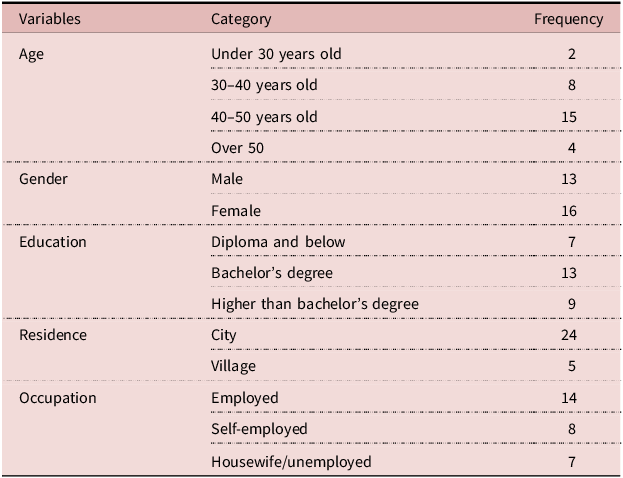
Table 2. Long description
A table summarizing demographic characteristics of participating single-child couples. The table has five rows and two columns. The columns are labeled ‘Variables’ and ‘Category and Frequency’. The rows are labeled ‘Age’, ‘Gender’, ‘Education’, ‘Residence’, and ‘Occupation’. Under ‘Age’, the categories are ‘Under 30 years old’ with a frequency of 2, ‘30-40 years old’ with a frequency of 8, ‘40-50 years old’ with a frequency of 15, and ‘Over 50’ with a frequency of 4. Under ‘Gender’, the categories are ‘Male’ with a frequency of 13 and ‘Female’ with a frequency of 16. Under ‘Education’, the categories are ‘Diploma and below’ with a frequency of 7, ‘Bachelor’s degree’ with a frequency of 13, and ‘Higher than bachelor’s degree’ with a frequency of 9. Under ‘Residence’, the categories are ‘City’ with a frequency of 24 and ‘Village’ with a frequency of 5. Under ‘Occupation’, the categories are ‘Employed’ with a frequency of 14, ‘Self-employed’ with a frequency of 8, and ‘Housewife/unemployed’ with a frequency of 7.
Demographic Characteristics of Key Informants

Table 3. Long description
A table titled Demographic Characteristics of Key Informants with seven rows and six columns. The columns are labeled No, Age, Gender, Education, Occupation, and Marital status. Row 1: No, 1; Age, 40; Gender, Male; Education, PhD; Occupation, University professor; Marital status, Married. Row 2: No, 2; Age, 31; Gender, Female; Education, Master’s degree; Occupation, Teacher; Marital status, Single. Row 3: No, 3; Age, 45; Gender, Male; Education, PhD; Occupation, University professor; Marital status, Married. Row 4: No, 4; Age, 35; Gender, Female; Education, Master’s degree; Occupation, Employee; Marital status, Married. Row 5: No, 5; Age, 38; Gender, Female; Education, PhD; Occupation, Employee; Marital status, Married. Row 6: No, 6; Age, 46; Gender, Male; Education, Master’s degree; Occupation, Teacher; Marital status, Divorced. Row 7: No, 7; Age, 51; Gender, Female; Education, PhD; Occupation, University professor; Marital status, Married.
Data analysis
Data analysis was conducted concurrently with data collection. MAXQDA-2018 software was used to manage and organize the data. Data analysis was performed using the method proposed by Granheim and Lundman (Graneheim and Lundman, Reference Graneheim and Lundman2004). Data analysis and coding were performed by the first author and the corresponding author of the paper and were finally approved by all members. In the first step, after conducting the first interview, the recorded interview file was transcribed in WORD-2017 on the same day, and the analysis began. The codes generated in each interview were reviewed in subsequent interviews to ensure that the codes were constantly reviewed. In the second step, the text of each interview was carefully reviewed by the researchers to gain a general understanding of the text. In the third step, all interview texts were read line by line and word by word with great care, and any segment considered meaningful and could be selected as a code was highlighted and included in another file as codes. In the fourth step, the researchers categorized the codes and concepts that were similar in meaning and concept and could be placed in one category and determined how they were related. In the fifth step, the codes and categories were placed in main categories that are more comprehensive and abstract in terms of concept, and the categories were extracted. Finally, in a joint session, the entire data analysis process was shared, and the opinions of all authors of the paper were taken into account.
Trustworthiness
To enhance the quality of the research results, the criteria of Guba and Lincoln were observed (Lincoln et al., Reference Lincoln, Lynham and Guba2011). To increase the credibility of the research, a maximum variation sampling strategy was used to select participants with different economic, social, and demographic characteristics. Key informants with different expertise also participated in the study. In each interview, the researcher expressed their general understanding of the participants’ statements several times during the interview and at the end to see if they had understood the participants’ statements correctly or not. If not, the necessary corrections were made. Additionally, at the end of the study, a table of categories, subcategories, and codes along with quotes was provided to six of the participants to determine whether participants’ statements and experiences had been accurately represented, which was confirmed by all of them. To achieve confirmability, the data analysis and findings were reviewed by three experienced qualitative researchers in the field of qualitative research, and minor revisions were made according to their comments, which were then confirmed. To increase dependability, all project colleagues were involved in the analysis and coding and expressed their opinions in online sessions. Finally, the names of the categories and subcategories were finalized with the approval of all authors. To enhance the transferability of the research, a complete description of all stages of the research process was provided, and direct quotes from the participants were included in large numbers. Additionally, the research findings were provided to four people (two men and two women) who had one child and met the inclusion criteria for the study but did not participate in the study, and the research findings were confirmed by them as well.
Ethical considerations
In this research, to ensure adherence to research ethics principles, the ethics code (IR.LUMS.REC.1402.115) was obtained from the Ethics Committee of Lorestan University of Medical Sciences after submitting the proposal. Additionally, during the research process, issues such as explaining the conditions for participation in the research and interviews, including how data is collected, the confidentiality of participants’ names and addresses, the right to determine the time and place of the interview and to terminate it at will, and the right to withdraw from the research, were observed, and informed written consent was obtained from the participants.
Results
The study included 29 parents with only one child (Table 2) and seven key informants (Table 3). Analysis of the interview data yielded four categories, 16 subcategories, and 205 initial codes (Table 4).
Codes, Subcategories, and Categories Derived from Interviews

Table 4. Long description
A table categorizing codes, subcategories, and categories derived from interviews. The table has four main categories: Past negative experiences, Weak support systems, Changing social discourses on childbearing and parenting, and Inability to overcome challenges. Each category is divided into subcategories and further broken down into specific codes. The table has 4 rows and 3 columns. Column headers are Categories, Subcategories, and Codes. Row 1: Categories, Subcategories, Codes. Row 2: Past negative experiences, Concerns about the mother and child’s health, Concerns about having a high-risk pregnancy, concern about the child’s health. Row 3: Past negative experiences, Negative experiences with the first child, Difficult and childbirth, having a child with physical disabilities, having a child with behavioural cognitive problems, a difficulty raising the first child. Row 4: Weak support systems, Lack of a supportive environment, Lack of spouse’s help in raising the child, lack of family support for having another child, being away from families and lack of support for childcare, low support from society and organizations for childbearing. Row 5: Weak support systems, Dissatisfaction with married life, Dissatisfaction with spouse, spouse’s addiction, lack of hope for the future of married life, lack of love and affection for spouse. Row 6: Changing social discourses on childbearing and parenting, Spread of individualism, Growth of nuclear families, more attention to personal relaxation and recreation, the complacency of couples, the prevalence of a culture of affluence and welfare among families, prioritizing one’s own physical and health. Row 7: Changing social discourses on childbearing and parenting, Normalization of single-childing in society, Positive parental attitudes towards single-childing, positive societal attitudes towards single-childing, prevalence of single-childing in society, negative societal attitudes towards having too many children. Row 8: Changing social discourses on childbearing and parenting, Considering having a child as more of a limitation, Job limitations, educational limitations, social limitations, limitations in choosing a desired lifestyle. Row 9: Changing social discourses on childbearing and parenting, Formation of new gender attitudes among women, Formation of modern gender attitudes, belief in gender equality, setting aside traditional gender beliefs, challenging maternal roles and responsibilities. Row 10: Changing social discourses on childbearing and parenting, Change in parental expectations of children, Decrease in gender preference, lack of hope for children to support parents in their tasks, lack of hope for children in their old age. Row 11: Changing social discourses on childbearing and parenting, Fading of religious beliefs encouraging childbearing, Fading trust in God, decrease in belief in God as the provider, not considering children as a gift from God, decrease in belief in God’s provision of sustenance, decrease in religious belief that whoever gives teeth gives bread. Row 12: Changing social discourses on childbearing and parenting, Idealism in child rearing, Providing all the necessities of life for the child, high cost of the first child, idealism in securing the child’s future. Row 13: Changing social discourses on childbearing and parenting, Increased knowledge and access to contraceptives, Effective knowledge of contraceptives by couples, access to contraceptives, increased sexual literacy of parents. Row 14: Inability to overcome challenges, Financial challenges, Unsuitable employment and economic situation, costs and economic pressure, high cost of raising children such as school and university, difficulty in providing expenses and costs and welfare facilities for children. Row 15: Inability to overcome challenges, Lack of a suitable living environment, Lack of housing, living in small apartments, lack of trust in a nanny to care for the child, lack of a suitable kindergarten in the neighbourhood. Row 16: Inability to overcome challenges, Social hopelessness, Despondency about the family’s economic situation in the future, despondency about the economic situation of society, despondency about the social conditions of society. Row 17: Inability to overcome challenges, Missing opportunities for re-parenthood, Late marriage, having children late, wanting to have an age gap between children.
1- Past negative experiences
The first category derived from the data was past negative experiences, which included two subcategories: concerns about the mother and child’s health and negative experiences with the first child. Parents, and especially mothers, had not had very positive experiences with their previous child, which made them hesitant to have another child.
Concerns about the mother and child’s health
Some participants, particularly mothers, were concerned about their health and the health of their child, which led them not to have another child. Additionally, some couples believed that they could not handle the stress of a high-risk pregnancy.
‘My husband and I don’t want to have another child at all because we’re afraid our child will have a problem and our whole life will be ruined‘. (43-year-old man)
‘I was terrified of getting pregnant and having a problem, so I never thought about getting pregnant again’. (39-year-old woman)
‘We see how some couples are struggling with their child’s treatment or are always seeing doctors during pregnancy, I’m afraid to think about having another child‘. (46-year-old man)
Negative experiences with the first child
Some women had faced significant physical problems during their previous pregnancy, which made them fearful of experiencing similar difficulties in a subsequent pregnancy. As a result, they were hesitant to have another child. Some mothers had challenging experiences with the pregnancy and childbirth process of their first child and faced significant challenges in raising and educating their child. This was because their first child was disabled or had behavioural and cognitive problems that caused the parents significant difficulties. It could be said that parents who had negative experiences with their first child were less inclined to have another child.
‘My first pregnancy was complicated. I went to the brink of death several times and suffered a lot. I decided then and there that I would never get pregnant again‘. (44-year-old woman)
‘Both my pregnancy and childbirth were complicated. I was always at the doctor, so I didn’t want to have any more children at all‘. (46-year-old woman)
‘My child has a congenital disorder and cannot walk. Our lives are ruined. I can’t convince myself to have another child. I’m afraid he will have a problem too‘. (38-year-old woman)
‘Raising a child is hard. I can’t put in the energy to raise another child anymore because I put all my energy into my first child‘. (40-year-old woman)
2- Weak support systems
Another category identified was weak support systems, which consisted of two subcategories. Having another child requires support, some of which comes from within the family and the other from social organizations that can pave the way for having another child. However, the lack of this support had prevented couples from having another child.
Lack of a supportive environment
Some female participants were dissatisfied with the cooperation and performance of their husbands in caring for their children and believed that the main burden of childcare fell on them, which made them hesitant to have another child. Others hesitated to have another child because they lived far from their families and did not have childcare support. This was especially true in families where both spouses were employed. Another reason for single-childing was the lack of support from society and social organizations for childbearing. Although in recent years Iran has provided some incentives for population growth to mothers and families with one child, many participants believed that these incentives were not attractive enough to make them want to have another child.
‘My husband didn’t help with the baby at all. I was all alone with him. It took up all my time, so it’s hard for me to have another baby. Maybe if my husband were more supportive, I would have another baby‘. (41-year-old woman)
‘My husband and I live far from our families. If we have another baby, we will have trouble because there is no one to support us‘. (44-year-old man)
‘I’m a worker, and I can barely handle one child. When I see other children having more toys than my son or having a better life, I feel embarrassed. The help they give is not enough for me to have another child‘. (47-year-old man)
Dissatisfaction with married life
Some participants cited dissatisfaction with their married life and hopelessness about stable family relationships as a reason for having only one child. Some couples did not have a deep connection with each other and were in fact in a kind of emotional divorce, and they had not officially separated only for the sake of their first child. This made them less inclined to have another child. Of course, in some cases, having a specific problem on the part of the man, such as addiction, was the main reason for not having children. It can be said that a lack of hope for the future of married life was one of the reasons why couples did not have another child.
‘I’m not very happy with my husband. I don’t know how long our marriage will last, so I don’t want to have another child‘. (41-year-old woman)
‘My husband is an addict. I only quit because of my daughter. I didn’t want to have another child and ruin her life too‘. (48-year-old woman)
‘It takes a happy heart to have a child, which we don’t have. My husband and I don’t have a good relationship. We both decided not to have any more children and to separate after our son grows up‘. (42-year-old man)
3- Changing social discourses on childbearing and parenting
Another category was the prevalence of anti-childbearing teachings, which was related to the broad social changes in Iranian society. Part of these changes is related to the spread of individualism in society, which has led to new attitudes towards family and children. Another part of modern changes is related to changes in attitudes towards childbearing and family, as well as the decline of religious beliefs that encourage childbearing, which has led to changes in childbearing and fertility.
Spread of individualism
One of the reasons for the tendency towards single-childing was the spread of individualism. In recent decades, the family structure in Iran, and especially the society under study, has undergone significant changes, and most families have changed from extended families to nuclear families. This has led to changes in childbearing. Individualism has also led to more people in Iranian society seeking personal interests and comfort rather than devoting their time to family. With the spread of individualism, attention to personal well-being has increased more than ever before. Since having children can be an obstacle to this well-being, couples decide to have as few children as possible. Some women also believe that pregnancy damages their health and appearance and reduces their attractiveness. This affects their self-confidence, and therefore, they believe that having one child is enough.
‘In the past, families were extended, and no matter how many children you had, it was useful because children started working from a young age. But now children are nothing but trouble and families have become nuclear, there is no one else to help‘. (40-year-old man, university professor)
‘I think having a child takes a few years of life away from parents, especially mothers, and leaves them with no peace of mind, so it’s tough for me to try to get pregnant again’. (38-year-old woman)
‘My husband and I have a specific lifestyle. We both don’t have much patience for children. We love our peace and relaxation more than we want to spend time raising children’. (29-year-old man)
‘I gained much weight with my first child, and my face broke out so much that I had to torture myself for years to get back to the way I was before. I don’t want my body to change, so I don’t want to get pregnant again under any circumstances’. (39-year-old woman)
‘Some men and women find children to be a nuisance, so they don’t have children to be comfortable and live however they want. Even some women don’t have children because they don’t want their bodies to change’. (31-year-old woman, teacher)
Normalization of single-childing in society
In Iran, up to three or four decades ago, most families had at least five children. However, with the development of population control policies, this population growth was gradually curbed to the point where today single-child families have become the norm and families have developed a positive attitude towards this phenomenon. At the same time, families with a large number of children are stigmatized as being irresponsible towards the future of their children. Many families, especially the younger generation today, are satisfied with having one child and are unwilling to have more children. It can be said that single-child families have somehow become the norm in Iranian society, and deviating from it and having a large number of children can lead to stigma and ostracism from the general public.
‘Today’s parents, especially the educated ones, mostly prefer to have only one child’. (Woman, 35 years old, employee)
‘Single-child parents are more often seen as responsible parents. If someone wants to have more children today, they are generally stigmatized by society’. (Woman, 51 years old, university professor)
‘Having many children is no longer classy these days, and people who have many children are called thoughtless and all sorts of other things’. (Man, 46 years old, psychologist)
‘Most of our friends and family have one child and live a good life. We also decided not to have any more children, and that’s enough’. (Man, 55 years old)
Considering having a child as more of a limitation
Most parents, especially female parents, believed that having another child would impose more limitations on their lives and keep them from work and education. In addition, most parents believed that having a child would disrupt the lives of the husband and wife, and they would not be able to live as they wanted because their lifestyle would be affected by the child’s presence. It can be said that given the patriarchal foundations of Iranian society, it is women who are responsible for raising and caring for children. Therefore, this issue can challenge the lives of working women or women studying, which is why most working women are not very willing to have another child.
‘My male colleague and I were hired together. He is now an associate professor, but I am still an assistant professor. I work harder than he does, and I am more talented, but I was busy raising my first child for two whole years. Now if I want to have another child, I will fall behind again’. (42-year-old woman)
‘A child stops the lives of parents, especially women, for a few years, and this is very difficult for a woman who wants to continue her education’. (Woman, 39 years old)
‘My husband and I returned to the lifestyle we wanted as soon as our first son grew up. When a child comes, the husband and wife can no longer live comfortably and the way they want because they always have to be careful that the child does not have any problems‘. (Woman, 55 years old)
‘A child takes away your freedom and doesn’t let you live the way you want, so we decided not to have children at all’. (Man, 47 years old)
Formation of new gender attitudes among women
One of the significant changes that has taken place in Iranian society in recent decades has been the change in the status and position of women, which has been brought about by their entry into universities and their taking on managerial and other positions. This has led women to rethink their traditional position and challenge the patriarchal foundations that expected women to stay at home and have children. This has led to the formation of new gender attitudes among women. These new attitudes challenge the traditional role of women as housewives and the responsibility of raising children. These issues have also led to a change in the way women look at the issue of childbearing. In Iranian society, some women no longer consider motherhood to be the central role of a woman, so they are not very willing to have children.
‘Women’s attitudes towards themselves and motherhood and childcare have changed, and they are more in favor of gender equality and justice’. (Man, 40 years old, university professor)
‘I don’t want to stay at home and keep having children and being a mother. Who said that it’s a woman’s job to raise children?’. (Woman, 46 years old)
‘A good mother does not have children one after the other, but one who has one child and raises him or her well’. (Woman, 53 years old)
Changes in parental expectations of children
Iranian society has undergone significant social and cultural changes in recent decades, transforming family lifestyles and expectations. In the past, Iranians believed that children would be their support in old age. Therefore, they tried to have as many children as possible to rely on in their old age. This was the case until a few decades ago, with most older adults living with their children. However, this is no longer the case, as children are less inclined to care for their parents. As a result, parental expectations of children have changed, and they no longer expect them to take care of them and support them in their old age. This has led to a decrease in their desire to have children. In addition, in traditional patriarchal Iranian society, there have always been gender preferences, mostly favouring males. Most families preferred to have at least one son who could take care of their parents in the future or keep the family name alive. Therefore, many families, even with many daughters, would still have more children to have a son. However, this is no longer the case today, and gender preferences have become less pronounced, with some families not wanting to have more children even after having a daughter.
‘You can no longer rely on today’s children to be with you in your old age. You have to spend so much on them, and in the end, they don’t help you at all, so it’s not worth having many children anymore’. (48-year-old man)
‘Today’s children are nothing but trouble and pain for their parents. When they grow up, they go off to live their own lives and don’t even ask about us’. (52-year-old woman)
‘In the past, it was necessary for every couple to have at least one son, which is why many families would not stop having children until they had a son. But now, for many people, it doesn’t matter if their child is a girl or a boy’. (45-year-old university professor)
Fading of religious beliefs encouraging childbearing
In Iranian society, which is predominantly Muslim, there used to be a set of religious beliefs that encouraged childbearing. However, these beliefs have faded in recent times, and this can have an impact on families’ willingness to have children. One of these religious beliefs was that every child born brings their sustenance. This meant that parents did not have to worry about the expenses of raising a child, a belief that has become less prevalent in most Iranian families today. Another belief was that having a child is a blessing and a gift from God, who will provide for the child’s needs. Just as God has given them teeth, He will also provide them sustenance.
‘In the past, when someone wanted to have a child, they would say that God would provide, but that is no longer the case. People are less religious now’. (Man, 47 years old)
‘People have become less religious. In the past, they would put everything in God’s hands and have children because they believed that God would somehow provide for the child’s needs. But that’s not the case anymore’. (Woman, 31 years old, teacher)
‘They used to say that “he who gives teeth gives bread,” but now before you decide to have a child, you have to think about how you are going to provide for them and create a better life for them’. (Man, 45 years old, university professor)
Idealism in child-rearing
Another reason for single-childing was idealism in child-rearing. This meant that parents tried to be the best parents in the world for their first child and provided them with all the best opportunities. This puts much financial strain on the family, making couples hesitant to have a second child. In recent decades, there has been fierce competition among parents in Iran to provide the best possible opportunities for their children and be the best parents they can be. This has made it more difficult for them to have more children.
‘I don’t want my child to miss out on anything, so I’m afraid if I have another child, I won’t be able to take care of them both’. (Woman, 38 years old)
‘It’s better to have one child and be sure of their future than to have several children and not be able to provide for them. Then they’ll always criticize you for not giving them enough. My brother and I always criticized our parents for having so many children’. (Man, 45 years old)
‘I think you should either not have children or if you do, provide everything for them and ensure their future in every way. It’s better to raise one high-quality child than ten low-quality ones’. (Woman, 39 years old)
Increased knowledge and access to contraceptives
In the past two decades, there have been significant changes in Iran in terms of increasing couples’ knowledge and awareness of contraception and access to it. This has had an impact on reducing unwanted pregnancies, which is one of the reasons for single-childing. In fact, following the population policies of three decades ago, when Iran was seeking to reduce population growth, couples’ awareness and access to contraception increased. This has also impacted the emergence of single-childing in recent decades. In addition, social networks and increased access to them by Iranians have also been effective in raising sexual literacy and awareness of how to control pregnancy.
‘People didn’t know much about prevention before, so they had many children, but now they are aware’. (Woman, 35 years old, employee)
‘People have a higher level of sexual knowledge and access to contraception so that can control their fertility much more easily than before. In the past, even if they didn’t want to have children, they didn’t know how or even have access to contraception’. (Woman, 51 years old, university professor)
4- Inability to overcome challenges
Another reason for single-childing was the inability to overcome challenges. Iranian couples face numerous challenges when considering having another child, such as financial challenges, lack of adequate living space, social despair, and loss of opportunities for suitable marriage. They lack the power and ability to overcome these challenges, so they resort to single-childing.
Financial challenges
The economic situation of the people has become more complicated in recent years due to US sanctions and other problems. Inflation has also risen, and the cost of living for many families is beyond their income. This has affected their ability to have children. In addition, the costs of raising and educating children have increased, and Iranian families are forced to spend much money on their children’s education to ensure their success. These issues have made it possible for them to afford only one child and not consider having another.
‘Our financial situation is not good, we can barely manage with this one child, we can’t think of having another child’. (Woman, 33 years old, employee)
‘The cost of rent and food has gone up so much today that it’s enough just to be able to survive and take care of my son. We can’t think about having another child anymore’. (Man, 46 years old)
‘More than half of our total income goes towards my daughter’s tuition and other expenses. The costs are very high. We would have loved to have another child, but when we thought about the costs, we changed our minds’. (Woman, 48 years old)
Lack of a suitable living environment
Some participants cited the lack of adequate living space for single-childing. Some couples did not own a home and believed it was difficult to consider having another child while living in rented accommodation and tiny houses. Others, both working parents, stated that they did not have enough time to raise another child. They also did not trust babysitters to care for their children, or there were no suitable daycare centres in their area that parents could trust to leave their children with.
‘Maybe if I owned a house, I would have another child, but with rented accommodation, you can’t think about having another child’. (Woman, 40 years old)
‘Our house is small, we don’t have enough space even now, let alone if we want to have another child’. (Man, 37 years old)
‘We would have loved to have another child, but there was no one to take care of it. You can’t trust babysitters these days. There was no reliable daycare center or place to leave your child with peace of mind. My wife and I both work, we really can’t have another child’. (Man, 43 years old)
Social hopelessness
Social despair was another reason for single-childing. Some participants did not have a positive view of the future economic and social situation of Iran and therefore did not want to have another child. It can be said that economic and social concerns about raising a child in the future were one of the most important challenges facing families.
‘Every day there is a new law and events that make you worry about the future. With the way our society is and getting worse every day, you can’t think about having children’. (Woman, 36 years old)
‘Raising a child is difficult nowadays. Society has gone bad, and you have to worry all the time that they won’t do anything wrong, that they won’t disgrace you or become an addict. It’s not worth it’. (Man, 50 years old)
‘My income and purchasing power are decreasing day by day. With this economic situation that is getting worse every day, you can’t have a child’. (Man, 46 years old)
‘Our people are worried about the future, both economically and socially. That’s why they don’t want to have too many children’. (Man, 45 years old, university professor)
Missing opportunities for re-parenthood
Another reason for single-childing was the loss of opportunities for further childbearing. In recent decades, the age of marriage has increased in Iranian society, and this has led to young people marrying at an older age so that they no longer have the opportunity to have another child after giving birth to one child. Of course, one factor that has played a role in this is that families want to have a gap between children, and this gap itself delays further pregnancy and may deprive women of the opportunity to have more children. In addition, many couples prefer not to have children for the first few years of their marriage until they have a more stable economic situation and social status, and then they decide to have children.
‘I got married late, I had my child late, so I don’t have the opportunity to have another child’. (Woman, 53 years old)
‘Sometimes people make the age gap between their children so long that they no longer have the opportunity to have more children. In the past, the age gap between children in Iran was not so long, and they were born one after the other, but now families want at least a 7-year gap, or even when they get married, they want to wait a few years before having children’. (Woman, 51 years old, university professor)
Discussion
The present study aimed to explain the reasons behind single-child using a qualitative approach in Lorestan province, western Iran. The results showed that a set of factors, including past negative experiences, weak support systems, the changing social discourses on childbearing and parenting, and the inability to overcome challenges, are leading to the choice of single-childing among Iranian couples. This study makes a distinct contribution to the Iranian literature on single-child families by moving beyond structural and economic explanations and focusing on changing parental meanings attached to childbearing. The most novel finding of this research is the identification of a shift in parental expectations regarding children’s role in providing care and support in old age. Unlike the traditional norm in which children, particularly sons, were perceived as the primary source of security and eldercare, participants in this study explicitly stated that they no longer expect practical support or co-residence from their children in later life. This transformation in meaning, which has not been explicitly highlighted in previous Iranian qualitative studies on single-childing, plays a significant role in reducing motivation for having more than one child and reflects a broader transition from viewing children as future security to perceiving them as emotionally valuable but costly individual projects.
Past negative experiences
One of the main reasons for single-childing in the present study was past negative experiences. Concerns about the health of the mother and child and the complex experiences of previous pregnancy and childbirth led couples to choose single-childing. In fact, the more challenging the previous pregnancy experience, the more likely couples are to avoid repeating the pregnancy and settle for one child. In line with this finding, Behmanesh et al. (Reference Behmanesh, Taghizadeh, Vedadhir, Ebadi, Pourreza and Abbasi Shavazi2019) in a study in Iran showed that a difficult first pregnancy and childbirth are significant obstacles to the desire for a second child (Behmanesh et al., Reference Behmanesh, Taghizadeh, Vedadhir, Ebadi, Pourreza and Abbasi Shavazi2019). Similarly, Razeghi-Nasrabad et al. (Reference Razeghi-Nasrabad, Hosseini and Sheykhi2016) found that a problematic first childbirth and a sick first child can lead to fear and anxiety about a second pregnancy (Razeghi-Nasrabad et al., Reference Razeghi-Nasrabad, Hosseini and Sheykhi2016). The fear of repeating unpleasant events, both psychologically and physically, has a significant impact on couples, especially the mother, and can affect their desire to repeat the process of pregnancy and childbirth.
Weak support systems
The second category of factors determining single-childing was the weakness of support systems. This lack of support includes support from family members during pregnancy and child-rearing. In line with this situation, the neglect of organizations responsible for supporting couples during pregnancy and childbirth contributes to the exacerbation of this crisis for families. Razeghi-Nasrabad et al. (Reference Razeghi-Nasrabad, Hosseini and Sheykhi2016) and Yousefi-Nayer et al. (Reference Yousefi-Nayer, Poorolajal and Cheraghi2019) have referred to a lack of family and close relatives’ support for childcare and a lack of formal support and policies as one of the determinants of single-childing (Razeghi-Nasrabad et al., Reference Razeghi-Nasrabad, Hosseini and Sheykhi2016; Yousefi-Nayer et al., Reference Yousefi-Nayer, Poorolajal and Cheraghi2019). Similar results were obtained in the study by Khalajabadi Farahani and Saraei (Reference Khalajabadi Farahani and Saraei2016), where the lack of organizational and policy support, in addition to the lack of support from the wife’s and husband’s families in childcare, was a factor in the couple’s reluctance to have a second child (Khalajabadi Farahani and Saraei, Reference Khalajabadi Farahani and Saraei2016). Another study cited the lack of government support for childbearing as a reason for single-childing (Mobasheri et al., Reference Mobasheri, Alidosti, Sorshajani, Khosravi, Khalafian and Jalilian2013). The transformation of the family from extended to nuclear and the separation of couples from parents and relatives has led to a lack of family support during pregnancy and after childbirth, and couples are often alone, which plays a significant role in their reluctance to have more children. However, in the area of support policies, laws in Iran have recently been revised to support childbearing, and due to the low population growth rate in recent years, the focus of policymakers and the government has been on increasing the birth rate.
Dissatisfaction and disappointment with marital life also contributed to the desire for single-childing. The study by Erfani and Shojaei (Reference Erfani and Shojaei2019) also found that dissatisfaction with marital life was a factor in not having more than one child (Erfani and Shojaei, Reference Erfani and Shojaei2019). In line with this, the results of another study in Iran showed that marital conflict and the wife’s dissatisfaction with her husband were significant factors preventing them from having more than one child (Behmanesh et al., Reference Behmanesh, Taghizadeh, Vedadhir, Ebadi, Pourreza and Abbasi Shavazi2019). The lack of a supportive marital environment for childbearing has also been shown in other studies (Khalajabadi Farahani and Saraei, Reference Khalajabadi Farahani and Saraei2016; Razeghi-Nasrabad et al., Reference Razeghi-Nasrabad, Hosseini and Sheykhi2016). Lack of support and incompatibility of marital life are fundamental grounds for having one child. A woman who is unsatisfied with her husband or does not have a good emotional connection and interaction with her spouse may not want to bring a new child into this challenge and prefer not to have more children.
Changing social discourses on childbearing and parenting
In the present study, the changing social discourses on childbearing and parenting emerged as a critical determinant of single-child families. These ideologies, permeating various spheres, have steered couples towards single-child preferences. Individualism, convenience, and self-prioritization over childbearing are among these ideologies. Bagi (Reference Bagi2022) also reported a lack of interest in having and raising children as a reason for single-child choices (Bagi, Reference Bagi2022). Other studies have indicated that single parents, often prioritizing their own needs over those of their children, may refrain from having additional siblings for their offspring. This self-centeredness, rooted in individualism, is a barrier to having multiple children (Jefferies, Reference Jefferies2001; Kohler et al., Reference Kohler, Behrman and Watkins2001; Khalajabadi Farahani and Saraie, Reference Khalajabadi Farahani and Saraie2013; Razeghi-Nasrabad et al., Reference Razeghi-Nasrabad, Hosseini and Sheykhi2016; Behmanesh et al., Reference Behmanesh, Taghizadeh, Vedadhir, Ebadi, Pourreza and Abbasi Shavazi2019). The modern world, underpinned by individualism, poses a significant challenge to procreation and childbearing. In this transformed world, individuals prioritize their needs and desires over those of their children. These waves of modernity have also reached Iran, influencing fertility decisions.
As part of the changing social discourses on childbearing and parenting, the normalization and positive social perception of single-child families were identified in this study as another factor affecting the preference for having only one child. Consistent with the findings of the present study, Behmanesh et al. (Reference Behmanesh, Taghizadeh, Vedadhir, Ebadi, Pourreza and Abbasi Shavazi2019) demonstrated that the social acceptance of single-child families as a norm plays a crucial role in perpetuating single-child choices in Iran (Behmanesh et al., Reference Behmanesh, Taghizadeh, Vedadhir, Ebadi, Pourreza and Abbasi Shavazi2019). Similarly, Mobasheri et al. (Reference Mobasheri, Alidosti, Sorshajani, Khosravi, Khalafian and Jalilian2013) identified the societal perception of having multiple children as a sign of cultural backwardness as a significant factor contributing to single-child preferences (Mobasheri et al., Reference Mobasheri, Alidosti, Sorshajani, Khosravi, Khalafian and Jalilian2013). However, in contrast to the findings of this study, Foroutan and Bijani (Reference Foroutan and Bijani2020) reported that single-child families are not perceived as an expected or desired model of childbearing among Iranian couples. Their study suggests that single-child preferences do not enjoy widespread acceptance or approval (Foroutan and Bijani, Reference Foroutan and Bijani2020). Likewise, Mahmoudiani (Reference Mahmoudiani2021) found that the predominant pattern of childbearing involves more than one child, with over 70% of participants having more than one child (Mahmoudiani, Reference Mahmoudiani2021). These discrepancies in findings can be attributed to several factors. First, the methodological approaches of the studies differ. The two latter studies employed quantitative methods and secondary data analysis, while the present study utilized a qualitative approach. Second, Mahmoudiani’s study sample exclusively comprised women, excluding the men’s perspectives.
Another aspect of the changing social discourses on childbearing and parenting revolves around the perceived limitations that having multiple children imposes on parents’ careers, social lives, and lifestyles. Raising children entails a multitude of responsibilities that couples increasingly view as burdensome. In line with this, Bagi (Reference Bagi2022) conducted a study in Iran and found that the heavy responsibilities associated with children were a significant reason for single-child preferences (Bagi, Reference Bagi2022). Similarly, another study in Iran revealed that the perceived interference of childbearing with parents’ interests, leisure activities, and work and educational plans played a crucial role in single-child choices (Erfani and Shojaei, Reference Erfani and Shojaei2019). Given the prevailing social and economic conditions, coupled with couples’ aspirations for career advancement, childbearing is often perceived as an obstacle to their goals. This newfound perspective has emerged as a deterrent to procreation. Furthermore, gender-egalitarian ideologies and a reassessment of traditional female roles have also influenced single-child preferences. Consistent with the present findings, Foroutan and Bijani (Reference Foroutan and Bijani2020) reported that the lowest rates of single-child families were observed among couples with more traditional gender attitudes. Conversely, as traditional gender norms, which emphasize women’s primary responsibility as childbearing and rearing multiple children, diminish, single-child preferences are on the rise (Foroutan and Bijani, Reference Foroutan and Bijani2020). Moeini et al., (Reference Moeini, Taheri, Shirahmadi and Otogara2021), and Khalajabadi Farahani and Saraie (Reference Khalajabadi Farahani and Saraie2013) also identified gender equality as a significant factor contributing to single-child preferences (Khalajabadi Farahani and Saraie, Reference Khalajabadi Farahani and Saraie2013; Moeini et al., Reference Moeini, Taheri, Shirahmadi and Otogara2021). These changes stem from women’s increased participation in higher education and the labour market, exposing them to modern societal transformations. This exposure has provided a platform for them to reevaluate their roles and break free from the confines of traditional family structures as they seek to pursue better opportunities. Childbearing is often perceived as an impediment to achieving these aspirations.
A noteworthy finding in the context of changing social discourses on childbearing and parenting is the transformation in parental expectations regarding offspring’s support in old age, influencing the preference for single-child families. Tu M. (Reference Tu2016), in a study conducted among Chinese migrants, reported a similar shift in eldercare practices characterized by replacing practical and co-residential support with distant emotional support (Tu, Reference Tu2016). Societal transformations and evolving parent–child relationships appear to have weakened traditional expectations regarding children’s caregiving responsibilities in later life. Participants in the present study increasingly perceived that their children might not be physically available or willing to care for them in old age, reducing the perceived necessity of having multiple children as a source of future security. Importantly, this study makes a distinct conceptual contribution to the Iranian literature on single-child families by moving beyond structural and economic explanations and focusing on changing parental meanings attached to childbearing. While previous studies in Iran have primarily emphasized economic pressures, women’s role conflicts, inadequate institutional support, and the spread of individualistic values as key drivers of single-child preference, the present study reveals a less visible but conceptually important mechanism. The findings of the present study suggest that even in the absence of severe economic constraints, the erosion of expectations that children will provide care and support in old age can independently contribute to fertility limitation. Unlike the traditional norm in which children, particularly sons, were viewed as the primary source of security and eldercare, participants in this study no longer expected practical support or co-residence from their children in later life. This transformation in meaning, which has not been explicitly highlighted in previous Iranian qualitative studies on single-childing, reflects a broader transition from viewing children as future security to perceiving them as emotionally valuable but costly individual projects. This insight adds a new conceptual layer to the understanding of single-childing in Iran and challenges population policies that continue to rely on traditional assumptions about intergenerational support.
The erosion of religious beliefs that encourage procreation emerged as a significant determinant of the declining desire for multiple children. Aligned with the findings of the present study, Foroutan and Bijani (Reference Foroutan and Bijani2020) conducted a study in Iran and revealed an inverse relationship between single-child preferences and religious attitudes. Their findings suggest that stronger religious beliefs among couples are associated with lower rates of single-child choices. Conversely, a decline in religious intensity correlates with increased single-child preferences (Foroutan and Bijani, Reference Foroutan and Bijani2020). The link between religious beliefs, procreation tendencies, and the weakening of these beliefs leading to a preference for single-child families or childlessness has been documented in various studies (Hosseini et al., Reference Hosseini, Askari and Moradi2016; Bagi, Reference Bagi2022). Religious doctrines, by promoting childbearing and discouraging contraception, play a crucial role in driving higher fertility rates. However, as these beliefs lose their hold on individuals, their influence on procreation diminishes, paving the way for preferences for one child or even childlessness. In the context of Islam, the predominant religion in Iran, procreation is consistently encouraged. This belief instils in adherents the notion that sustenance is predetermined by God and that each child born carries their provision. Therefore, families should not be concerned about the financial burden of additional children. However, these beliefs have begun to wane in recent times.
Pursuing an idealized upbringing for their children, with all the desired amenities and conditions, and the subsequent inability to achieve this goal emerged as another determinant of single-child preferences. In line with this, Khalajabadi Farahani and Saraie (Reference Khalajabadi Farahani and Saraie2013) highlighted the role of parenting idealism as a barrier to having a second child (Khalajabadi Farahani and Saraie, Reference Khalajabadi Farahani and Saraie2013). Foroutan and Bijani (Reference Foroutan and Bijani2020) conducted a study in Iran and found that couples perceived child-rearing and upbringing as challenging in the current context (Foroutan and Bijani, Reference Foroutan and Bijani2020). Another study in Iran identified child-centeredness and anxiety associated with it, lifestyle perfectionism, child-rearing, and providing complete amenities for children as contributing factors to single-child preferences among parents (Yousefi-Nayer et al., Reference Yousefi-Nayer, Poorolajal and Cheraghi2019). Similar findings have been reported in other studies, highlighting the difficulties of child-rearing and the inability to meet the financial demands of raising children in the modern world as deterrents to having more than one child (Hosseini and Bagi, Reference Hosseini and Bagi2014; Tavousi et al., Reference Tavousi, Esmaeili-Motlagh, Eslami, Haeri-Mehrizi, Hashmi and Montazeri2016; Erfani and Shojaei, Reference Erfani and Shojaei2019; Moeini et al., Reference Moeini, Taheri, Shirahmadi and Otogara2021).
Finally, increased sexual knowledge and awareness of contraception methods emerged as a determinant of single-child preferences. Consistent with this finding, Khalajabadi Farahani and Saraei (Reference Khalajabadi Farahani and Saraei2016) conducted a study in Iran and revealed that self-efficacy and the ability to prevent pregnancy, particularly effective contraceptive use by the spouse, were fundamental factors associated with single-child choices (Khalajabadi Farahani and Saraei, Reference Khalajabadi Farahani and Saraei2016). Enhanced sexual knowledge among couples, coupled with access to contraception, empowers them to consciously control their fertility and the number of children they have. This, in turn, facilitates the prevention of unintended pregnancies.
Inability to overcome challenges
The final major determinant of single-child preferences in this study was the inability to overcome various life challenges. Financial and economic difficulties, inadequate living environments, and the inability to meet the costs of living prompted parents to opt for a single child. Foroutan and Bijani (Reference Foroutan and Bijani2020) conducted a study in Iran and found that material and economic issues were also significant determinants of single-child preferences (Foroutan and Bijani, Reference Foroutan and Bijani2020). Similarly, Bagi (Reference Bagi2022) identified the economic costs of children as a primary reason for the preference for single-child families in Iran (Bagi, Reference Bagi2022). Other studies in Iran have highlighted economic challenges such as insufficient income, inadequate budgets for child-rearing, and a lack of housing and necessary amenities for children as reasons for single-child preferences (Razeghi-Nasrabad et al., Reference Razeghi-Nasrabad, Hosseini and Sheykhi2016; Yousefi-Nayer et al., Reference Yousefi-Nayer, Poorolajal and Cheraghi2019). Additional research has underscored the crucial role of economic factors and financial constraints in influencing preferences for single-child families or childlessness (Mosavi and Ghafelebashi, Reference Mosavi and Ghafelebashi2013; Tavousi et al., Reference Tavousi, Esmaeili-Motlagh, Eslami, Haeri-Mehrizi, Hashmi and Montazeri2016; Behmanesh et al., Reference Behmanesh, Taghizadeh, Vedadhir, Ebadi, Pourreza and Abbasi Shavazi2019). Economic conditions serve as a driving force behind procreation, and challenges in this domain directly impact the desire to have children.
Furthermore, social hopelessness and despair regarding improving current and future conditions emerged as another determinant of single-child preferences. Consistent with the findings of the present study, Bagi (Reference Bagi2022) identified hopelessness about the future of children as a factor contributing to single-child choices (Bagi, Reference Bagi2022). Similarly, Hosseini and Bagi (Reference Hosseini and Bagi2014) found that concerns about managing children’s futures played a significant role in single-child preferences (Hosseini and Bagi, Reference Hosseini and Bagi2014). Mahmoudian and Rezaei (Reference Mahmoudian and Rezaei2013) demonstrated that perceived risky social environments lead parents to refrain from having additional children to protect themselves and their offspring from these hazards, opting for a single child (Mahmoudian and Rezaei, Reference Mahmoudian and Rezaei2013; Khalajabadi Farahani and Saraei, Reference Khalajabadi Farahani and Saraei2016). The role of social adversities and hopelessness towards the future in single-child preferences or the lack of desire for procreation has also been documented in other studies (Razeghi-Nasrabad et al., Reference Razeghi-Nasrabad, Hosseini and Sheykhi2016; Behmanesh et al., Reference Behmanesh, Taghizadeh, Vedadhir, Ebadi, Pourreza and Abbasi Shavazi2019; Erfani and Shojaei, Reference Erfani and Shojaei2019; Moeini et al., Reference Moeini, Taheri, Shirahmadi and Otogara2021). Overall, favourable social conditions and security, particularly for children, along with optimism about the future and a clear path forward, serve as fundamental motivators for the desire to have children. Conversely, individuals who perceive social conditions to be deteriorating and risks to be increasing, coupled with an uncertain and unclear future, may opt for smaller families.
Finally, the loss of opportunities for repeated childbearing due to various factors, such as late marriage and delayed childbearing, reduced the chances of having more than one child. Yousefi-Nayer et al. (Reference Yousefi-Nayer, Poorolajal and Cheraghi2019) conducted a study in Iran and found that late marriage and decreased parental patience were reasons for single-child preferences (Yousefi-Nayer et al., Reference Yousefi-Nayer, Poorolajal and Cheraghi2019). Numerous studies have demonstrated the negative impact of late marriage on reduced fertility (Mcallister et al., Reference Mcallister, Gurven, Kaplan and Stieglitz2012; Pradhan and Sekher, Reference Pradhan and Sekher2014; Razeghi-Nasrabad et al., Reference Razeghi-Nasrabad, Hosseini and Sheykhi2016; Behjati-Ardakani et al., Reference Behjati-Ardakani, Navabakhsh and Hosseini2017). In the past, marriages occurred at younger ages, leading to earlier childbearing and providing couples with ample opportunities to have multiple children. However, recent shifts in fertility patterns have delayed or postponed first-time childbearing. This change in the timing of childbearing has concentrated the childbearing period within a narrower age range, with an increasing proportion of women postponing marriage and childbearing due to education or career advancement. These circumstances limit the opportunities for having more than one child.
Limitations and strengths of the study
This study has several methodological strengths. First, although few studies have been conducted on single-child parenthood in Iran, and most of them are quantitative with a specific group perspective, this study is qualitative. It has investigated the phenomenon from the perspective of single-child parents and key informants, providing valuable information for policymakers to design appropriate social interventions to increase childbearing. Second, the use of a conventional qualitative content analysis approach allowed for a deep, contextualized, and nuanced exploration of the factors underlying single-child parenthood. Unlike quantitative studies that measure pre-determined variables, the study design enabled participants to express their experiences, perceptions, and decision-making processes in their own words. This provided rich, in-depth insights into the complex interplay of past negative experiences, weak support systems, changing social discourses around childbearing and parenting, and the inability to overcome challenges. Third, the inclusion of both parents, men and women, and key informants including sociologists, psychologists, and other experts from diverse socioeconomic backgrounds enhanced the comprehensiveness of the findings.
Several limitations should be acknowledged. First, as with most qualitative research, the results of the present study are context-specific and derived from a sample of participants from Lorestan province, western Iran. Therefore, the findings have limited generalizability and may not be directly transferable to other populations or geographical contexts within or outside Iran. Second, this study was geographically limited to one province, which may not represent the diverse cultural, economic, and demographic conditions of other regions in Iran. Third, potential social desirability bias may be present, as participants might have responded in ways they believed were socially acceptable rather than fully expressing their true beliefs and feelings about childbearing. Fourth, this study excluded unmarried individuals, so the perspectives of single people or couples who have not yet had children are not reflected in the findings. Fifth, gender differences in willingness to disclose personal experiences may have influenced the data; for example, some female participants preferred a female interviewer, and some male participants may have been more reserved in expressing certain emotions or marital difficulties. Sixth, recall bias is another methodological limitation, as participants reflected on past experiences related to pregnancy, childbirth, and child-rearing. Seventh, some practical limitations included the reluctance of some participants to have their interviews recorded, which was addressed by explaining the study objectives and ensuring confidentiality, as well as the preference of some female participants for a female interviewer, which was addressed by using a trained female interviewer. Finally, while strategies such as member checking and peer debriefing were employed to enhance trustworthiness, the interpretive nature of qualitative content analysis inevitably involves some degree of researcher subjectivity.
Conclusion
The study results revealed that the decision to have a single child is affected by a set of factors at different levels, and a single child is a complex phenomenon that requires intervention at different levels of the individual, family, and society. By highlighting the declining expectation of intergenerational eldercare as a meaningful driver of single-child preference, this study demonstrates that fertility-related policies in Iran must address not only economic barriers but also profound shifts in familial meanings and generational relationships. Therefore, interventions, policies, and educational programmes should be developed with consideration of this complexity. Particular attention should be given to increasing material support for families, expanding social support services such as high-quality childcare centres, promoting positive norms towards childbearing, strengthening social and economic security, reinforcing family relationships, supporting religious values that encourage childbearing, and providing effective parenting models.
Acknowledgements
The authors would like to thank all the participants who patiently participated.
Author contributions
All authors participated and approved the study design. JYL, SFI, and RH contributed to designing the study. AA, MS, and BKh collected the data and analysed it by JYL, MY, and SFI. The final article was written by SFI, JYL, AA, and RH. All authors read and approved the final manuscript.
Funding statement
No funding was received for this work.
Competing interests
The authors have no conflicts of interest to declare.
Ethical standard
All procedures performed in studies involving human participants were in accordance with the ethical standards of the institutional and/or national research committee and with the 1964 Helsinki declaration and its later amendments or comparable ethical standards. The study was provided ethical approval by the Lorestan University of Medical Sciences (IR.LUMS.REC.1402.115). Written informed consent was obtained from all participants.
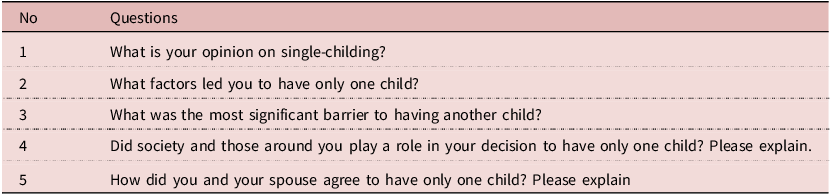
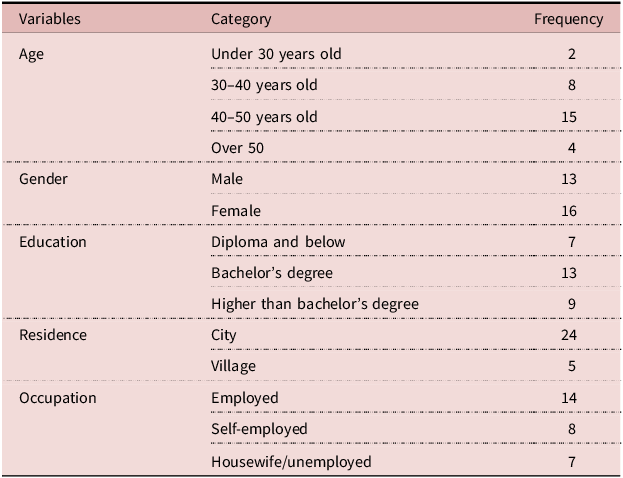
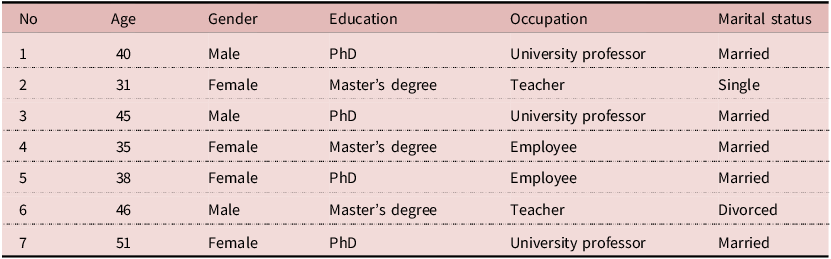
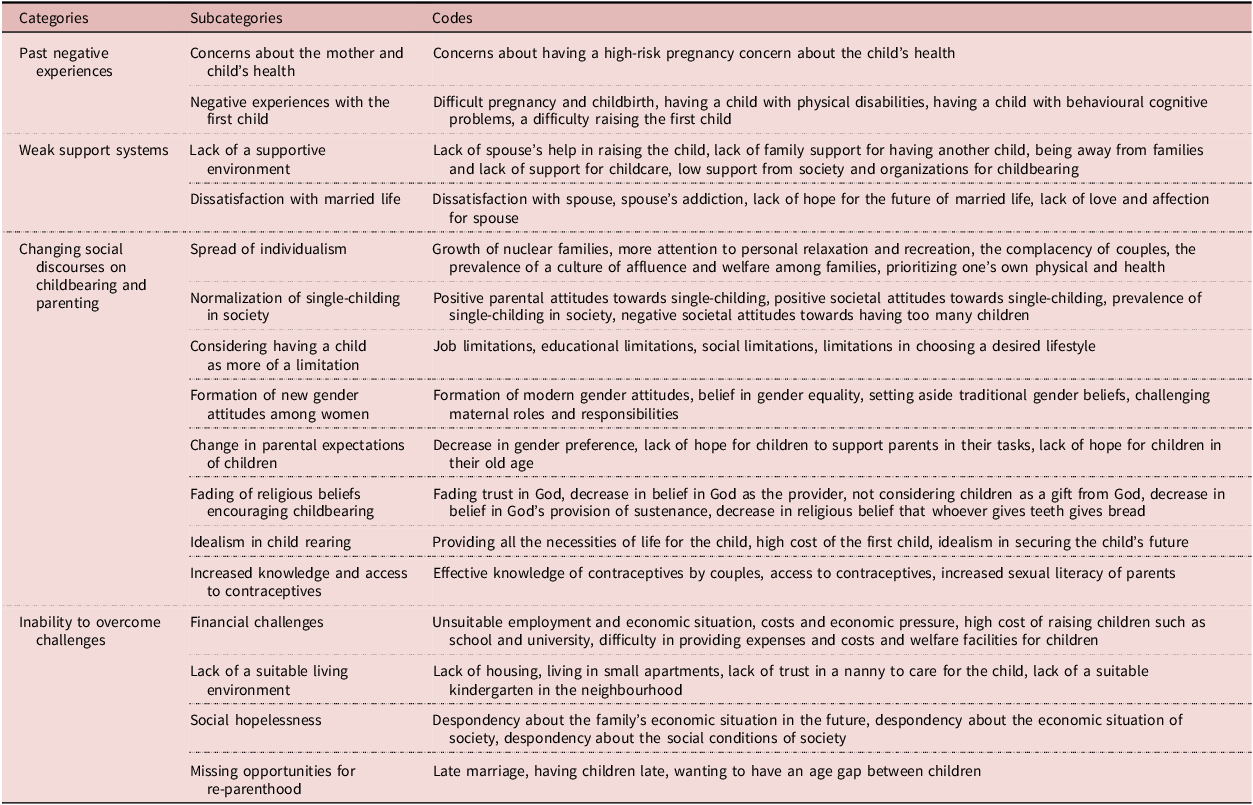

 Open access

