




Introduction
Wilding dust
Dust is plentiful, connecting human and all matter of earthly and interplanetary life. Media theorist Jussi Parikka’s extensive work on technological waste and the materiality of media (particularly on nanoparticles as smart dust) describes dust as a milieu of its own environmental connotation. It comprises temporalities of matter, processually accumulating and sedimenting through its million-year transformative process (Parikka, Reference Raina2013). Dust maps and holds connections to our ancestors and the memories of historical experiences, and its thickness is a measure of time. To Lushetich (Reference Malone2018), dust is “a four-dimensional map” that connects us to unvisited places, unexperienced events, unknown people and unwitnessed happenings. Like others, it is through relational and mutual connections that it creates meaning and matter in the world.
The translation of dust in Spanish, one of Yanina’s mother tongues, is Tierra. Tierra, in Spanish (a feminine pronoun), means planet Earth, soil, dust and Pachamama, the Earth Mother. Pachamama is a goddess revered by the Indigenous Peoples of the Andes in South America, Yanina’s birth Land, for bringing fertility (planting and harvesting), embodying the mountains and causing earthquakes. According to Pachamama beliefs, humans and nonhuman companions depend solely on what the earth offers, and “Mother Earth or Pachamama is the source of all life, human, non-human, soil, air, water” (Malone, Reference Margulis and Sagan1997, p. 170). Indigenous people of the Andes have a profound sense of respect and appreciation for Pachamama, and in this essay we refer to dust using Tierra, and feminine pronouns, as our own measure of respect.
Reactions to dust vary depending on how it is sensed and the level of the reactor’s sensitivity. Lushetich (Reference Malone2018), for example, associates dust with melancholy: when a body is covered in dust, humans search in our meta sense, which comprises all other senses, for the precise presentness, shape, angle, texture, colour and brightness of the objects that reassure us (humans) that there is a continuing presence. On the other hand, the relationship with dust is informed by feelings of disgust, irritation and refusal, as it is often associated with poverty, dirt or waste. When humans breathe air, and its pollution, Tierra makes itself present and can be sensed through our throat and nose. Lagerspetz (Reference Latour2018) explains that there is an implicit relation between an ideal state and an abnormality. The implication is that bodies require cleaning as they are impure and contaminated when dusty or dirty.
The nature of dirt influenced the original shaping of the ontology of western philosophy and science (Lagerspetz, Reference Latour2018). Human culture seems utterly unimaginable without the categories of the dirty and the clean. Descriptions of dirt and how it attaches to objects describe material reality. However, “dirt” is not a physics concept even though physics is supposed to be the science of material reality. According to Lagerspetz (Reference Latour2018), the concepts of clean (pure) and dirty (polluted) carry the potential to be applied everywhere as soon as there is culture and a systematic transformation of nature into man-made reality.
Bakke (Reference Bakke2015) describes dust as a “living, dead and undead matter” (p. 267). According to Bakke (Reference Bakke2015), since the beginning of the germ theory of disease, dust has been associated with matter with similarly threatening properties. This is despite “its presence in the atmosphere linked to meteorological events crucial for life” (p. 266). Parikka and Bakke offer a rethinking of the cultural politics of dust and its negative connotations. Dust is a gathering of multispecies particles. Its peculiar materiality challenges bounded ideas of what a body “is,” and concepts of individuality and independence. Dust particles are microecologies of minerals, seeds, pollen, insects, moulds, bacteria, hair, skin, blood and from earth-moving activities like wars, mining and construction (Johnston, Reference Kirksey, Schuetze, Helmreich and Eben2020).
For us, dust is a “creative (micro)ecology” (Harris, Reference Johnston, Henning and Walsh2021). In its diverse materiality, it is formed from the softest materials, such as flesh, to the hardest such as stone; from the largest mountain to the smallest grain of sand. Dust is continuously creating and re-creating itself and others. It leaps in different directions; it keeps flying in synchrony and intimacy with the wind. Sometimes it crusts, clogs and clumps.
Some bodies, such as the vacuum cleaner, the dustpan and human hands, try to control her and restrict her movements. These nonhuman bodies might achieve this temporarily, but she gets wild with the wind. Many take dust seriously, such as the photographers who make great efforts to remove her from the camera lens and who learn to recognise her nomadic patterns. The environment and other matter can be sensed and classified as “clean” when she is absent, and “dusty” or “dirty” when she is present. Dust can expose, blur and transform body silhouettes, textures and colours in a mutation process. When bodies dissolve, decompose and die, dust becomes the living evidence of their disappearance in a spirit-like form. Cosmic dust connects humans to other planetary lives as she is the protagonist in the formation of stars and planets, the development of meteorological phenomena, and the distribution of microbial life and mineral nutrients fundamental for ecosystems (Bakke, Reference Bakke2015). Dust can be regarded as an agentic wild matter that entangles humans with capitalism, colonialism, and pollution but also creates creative ecological microworlds.
Wilding early childhood education
In the study this essay draws, we trouble educational frameworks and practices and establish how current approaches to early childhood education prioritise separation and hierarchies between the human and the rest of the world. We stay-with “wild pedagogies” as “a way of thinking about education such that the interconnection, interdependence, and relationality of childhoodnature is not a theory without practice but a lived curriculum pointed toward, and moving in the direction of, the change being sought” (Blenkinsop et al., Reference Blenkinsop, Jickling, Morse, Jensen, Cutter-McKenzie, Malone and Hacking2018, p. 2).
Humanist logics continue to dominate the field of early childhood education. Despite early childhood leading the field of posthuman theorising in its application to educational thought and practice (Somerville & Williams, Reference Taylor and Pacini-Ketchabaw2015), Taylor & Pacini-Ketchabaw (Reference van Dooren, Kirksey and Münster2018) have observed that many scholars in childhood studies retain an ongoing commitment to human-centred conceptions of social justice and inclusion. This means they advocate for exclusively child-centred approaches encompassing children’s agency, rights and development within sociocultural contexts. The early childhood educational frameworks worldwide generally follow child-centred and individualist approaches. For example, in Australia, the Victorian Early Years Learning and Development Framework, the theories of Vygotsky (Reference Vygotsky1978) and psychologist Urie Bronfenbrenner (Reference Bronfenbrenner1979) have shaped teacher education, curriculum, pedagogy and research for over four decades (Elliott & Davis, Reference Elliott, Davis, Reis and Scott2018). Taylor & Pacini-Ketchabaw (Reference van Dooren, Kirksey and Münster2018) argue that although children grow and develop in geographically, biologically and culturally diverse communities, it is imperative to emphasise that these societies are not only human but are also comprised of many other nonhuman partners. They are also committed to inclusion and justice in their scholarship, but they approach them from more-than-human framings.
Posthumanism moves away from considering the humanist ideal of “Man” as universal and the measure of all things and from anthropocentrism, which criticises species hierarchy and human exceptionalism (Braidotti, Reference Braidotti2019). Posthumanism has found common ground with the notion of agency as something that is relational to the political position in which matter (human and other-than-human) are defined, distributed and organised by their relationality to other matter that does not possess a pre-existing ontology.
In this essay, we theorise, re-materialise and decolonise dust in an early childhood educational space to attune to the wildness of microworlds and reimagine more experimental, relational and alternative ways of thinking about environmental and ecological education. We then establish how anthropocentric and individualistic teaching and learning practices can be expanded by exploring how dust enables children to learn about microworlds and their relations with them. We consider how dust helps reimagine early childhood education through a posthuman approach that acknowledges the agency of nonhuman others and current ecological crises. This essay and the project ask readers to think beyond the child, engaging with dust as nonhuman matter and a more-than-human agent in the kindergarten. Focusing on dust allows opportunities to examine how the human, nonhuman and more-than-human are becoming-with pollution, climate change and ecological injustice.
Colonising ecological microworlds
Microworlds have shaped and continue to have significant roles in our lives, but they are not often acknowledged for their capabilities. Margulis & Sagan (Reference Murris1997) point out that we must stop viewing ourselves as superior and recognise our partnership with the photosynthetic organisms that provide oxygen and the bacteria and fungi that get rid of our waste and transform it. Microbial communities have key roles and responsibilities in ocean ecology and planetary health and participate in nutrient cycles supporting crucial ocean food webs (Rinaldo, Reference Sjögren2022).
Every human cell’s mitochondria or energy powerhouses originated from the permanent enslavement of purple non-sulphur bacteria. These endosymbionts (mutually dependent organisms) evolved into organelles, the cell’s machinery responsible for life itself (Cavalier-Smith, Reference Cavalier-Smith2006). Child bodies are immersed in the microbial worlds embedded in them. The influence of gut microbiota (bacteria, fungi, archaea, and parasites) on modulating the human brain is now a well-known phenomenon. Communication between the microbiota, brain, and gut is bi-directional, involving a complex play of endocrine, neural, and immune pathways that co-create versions of themselves (Liu et al., Reference Lushetich2023).
Microbial life invented basic metabolic processes. Each child is an ecology of multiples. Margulis & Sagan (Reference Murris1997) affirm that “no political will or technological advance can dissolve that partnership” (p. 16). After all, we are recombined and rematerialised from strong and diverse bacterial communities with a multibillion-year-old history. We are a fragment of a complex network originating from Earth’s first bacterial takeover. Therefore, our powers of cognition and technology are not attributed only to us, but to all forms of life. Bacteria have a particular and respectful relationship with water. Bacteria, single and multicellular, are minuscule in size and massive in environmental impact.
Considering the human population, only .01% of the biomass of life on Earth is “human” and yet our bodies are not fully human. According to Margulis and Sagan, “We are all of us walking communities of bacteria. The world shimmers, a pointillist landscape made of tiny living beings” (1997, p. 191). Deleuze & Guattari (Reference Deleuze and Guattari1987) suggest the image of “the body without organs” as a mode of thinking about the unsettled autonomy of assemblages that lack foundational structure or order. Recent work in microbiology affirms that humans are all bodies without organs, or perhaps the organs of various, multispecies bodies (Ogden et al., Reference Parikka2013). A virus is so small that 500 million rhinoviruses, the quantity required to make us ill, could fit onto the head of a pin (Microbiology Society, n.d.).
New approaches to microbiology, a post-anthropocentric, posthumanist and post-dualist interpretation, allow progress in decentering the human and disrupting the notion of the human as a confined and materially identifiable entity. Bradshaw (Reference Bradshaw2020, p. 1) defines the human body as an “open ecosystem, linked by chains of connection to microbial life-worlds beyond its own skin and extending into every environment,” but that “in this loss of identity, however, the human becomes more strongly integrated into an ecological understanding” (p. 1). Microbes govern every biological system, from insects to humans. Human bodies have a historically mutualistic relationship with microbes, and they serve as environmental hosts for these tiny living factories to succeed, while human bodies benefit from vital chemicals and nutrients industriously produced by the microbes (Raina, Reference Rinaldo2022). Microbial life continuously shapes and determines our ecosystems and our interspecies relationships. The environments that humans occupy are becoming progressively unliveable, and to rediscover the connections that have been lost, we humans must acknowledge and incorporate these invisible microworlds into our consciousness and sociality.
Children’s relations to ecological microworlds
To young children, dust may seem invisible. However, dust particles connect children and nonhumans to all forms of cosmological life and times, producing and reproducing past traces. Gan et al., assert that “every landscape is haunted by past ways of life” (Reference Gan, Tsing, Swanson, Bubandt, Tsing, Bubandt, Gan and Swanson2017, p. 2). Dust takes children on a journey to the multiplicities of human and nonhuman pasts. The fragments of many animals, some extinct from the Ice Age, and plants that are no longer with us but remain present through dust, are gathered, blown and dispersed by the wind of the Anthropocene (Gan et al., Reference Glăveanu2017). Dust interrupts the concept of linear time by simultaneously existing in the past, present, and future.
We as teachers know that children seem to be less troubled than adults by its materiality, engaging with dust in playful experiences, particularly when it is moist and becomes versatile in texture and composition. Dust, sand and sometimes mud cohabit with children in the kindergarten space daily, playing-with children in the sandpit and other sensory activities. Yet the agency of dust is hardly acknowledged in everyday life, let alone our partnerships with bacteria and other infinitesimal matter. This study connects children to dust, and dust connects children to many other playful and productive microscopic communities.
In this study, dust and other matter from those infinitesimal worlds are magnified by microscopes and manifest themselves aesthetically through enlarged images. Yanina’s understanding of microworlds is deeply and personally entangled with the agency of microscopes. Having minus 23 degrees of myopia (short-sightedness) in each eye, Yanina has always relied on magnifying technologies to make sense of the worlds — microscopic and others — which have opened up multisensorial experiences for her. She brings this ability to see in unusual ways to the work, helping the children to understand that engagement with other nonhuman matter activates unexpected encounters. These intra-actions help us as co-authors, Yanina, the children and their teachers to reimagine early childhood educational practices.
The creative ecologies of early childhood education
Harris has called for an ecological approach to creativity (Reference Harris2016, Reference Harris2021) and a rejection of human-centred, individualist measures of its “value,” “success” or commodification (Reference Harris2014). By attending to the interdependent communities of practice that inform fostering creativity, a socio-cultural approach (Glăveanu, Reference Glăveanu2015) allows for more attention to sustainability, to planetary wellbeing, and to the affective role of creativity in education. An ecological approach to creativity recognises that “Creativity has its own affective agency, independent of human action or intent” (Harris & Holman Jones Reference Harris and Holman Jones2022, p. 523). Ecological creativity also aligns with Donna Haraway’s concept of “always natureculture-emergent” (Haraway, Reference Harris2003), an emergence that materialises recursive cycles of “decay, making, repair, re-making and growth” (in Harris & Holman Jones Reference Harris and Holman Jones2019, p. 4). Harris’ creative ecologies heuristic attends to the five areas of people, place, process, products and policies, as does this study. Together, they can provide an interwoven landscape of creative impulses and gaps, opportunities for working collaboratively across fields of enquiry or endeavour, even/especially in early childhood education.
The concepts of emergence and creative ecologies can also be associated with wilding and wildness — and indeed with the wilderness — as improvisatory, messy and uncontrolled impulses that are seldom welcome in formal education settings (Blenkinsop et al., Reference Blenkinsop, Jickling, Morse, Jensen, Cutter-McKenzie, Malone and Hacking2018). Importantly, a creative ecological approach as articulated here brings education scholarship out of the individualised endeavour and assessment into a more collectivist wilding which offers expansion for the human participants benefiting from such wild pedagogies, and their environments. While education (including early childhood education) remains dominated by capitalist and individualist logics, a wilding of creativity or of education itself is controversial. In their Manifesto for Posthuman Creativity, Harris and Holman Jones call for a “Creative Wilding” in which creativity is “released back into the wild, its cage of use-value discarded” (Reference Harris and Holman Jones2022, p. 528), a wild creativity that offers a sustainable future, not a romanticised Rousseauian past. Creative ecologies offer the context of early childhood centres like the one in Yanina’s study another way of approaching the risk and possibility of these unique environments. It suggests that attuning to the microscopic environments in which children (and later adolescents) are learning are more than just backdrops or “resources” for learning, but instead potential fellow-travellers, fellow learning enquirers, with which to be engaged.
Wild dustly pedagogies
This study adopts a “multispecies ethnographic approach” (Kirksey & Helmreich, Reference Lagerspetz2010), an innovative mode of interdisciplinary inquiry for producing data on the relational agency (Barad, Reference Barad2007) of dust, to examine how dust is affecting-with and becoming-with child-earth relations. The fieldwork for this study had a duration of ten months between February and October 2021. The data was collected from and with nine children of four to five years of age in a kindergarten in Melbourne, Australia. The initial engagement involved an introductory meeting with the kindergarten management team and an introductory meeting and a workshop with the participating children. The data collection encompassed collection and examination with dust; inefficient mapping (Knight, Reference Knight2021); and observations of natural intra-actions with dust. The data collected included photos, videos, sound recordings, mappings and field notes of experiences, affects, doings and becomings, such as how children sense dust and how the child-dust relation transforms. These are shared in multivocal descriptive narrations, poems, dialogues, photographs and notes. Permission from parents and children was sought to publish their voices and photographs. Pseudonyms have been used for children’s names.
In the past decade, ethnographers have experimented with diverse modes of storytelling, and anthropologists have rediscovered the meaning of the Greek word “ethnos,” which is defined as a multitude (human and nonhuman) associated or living together (Kirksey, Schuetze & Helmreich Reference Kirksey and Helmreich2014). While multispecies ethnography has some similarities to conventional ethnographies, it varies in its focus on decentring the human and permitting other bodies to be incorporated into the research (Somerville & Powell, Reference Somerville and Williams2019). Kirksey & Helmreich (Reference Lagerspetz2010) point out that “the adjective “multispecies” already travels in biological and ecological research worlds, referring to patterns of multispecies grazing, the co-construction of niches, and wildlife management” (p. 546). As a result, ethnographers now explore how the human is not singular; it is “formed and transformed amid encounters with multiple species of plants, animals, fungi, and microbes” (Kirksey et al., Reference Kirksey and Helmreich2014, p. 4).
All living entities emerge from and make their lives within multispecies communities, as life cannot begin and be sustained in isolation (van Dooren et al., Reference van Dooren, Kirksey and Münster2016). Ethnographers have turned to microbes as social agents, on land, in the sea and in food and there has been increasing awareness of new microbiological realities of life, which suggests that essential boundaries between species are blurrier than earlier believed (Kirksey & Helmreich, Reference Lagerspetz2010).
Multispecies ethnographers study contact zones between nature and culture and encounters between Homo sapiens and other beings. These observations activate mutual ecologies such as human-animals, human-plants and humans-microbes (Kirksey & Helmreich, Reference Lagerspetz2010). Genes, cells and organisms have been studied by multisited ethnographers, who trace how elements of Homo sapiens are forming becomings in the bodies of other species, and vice versa (Kirksey & Helmreich, Reference Lagerspetz2010).
Scholars in the humanities and social sciences experiment with innovative ways of engaging with more-than-human worlds to open “new understandings, relationships, and accountabilities” (van Dooren et al., Reference van Dooren, Kirksey and Münster2016, p. 1) of their diverse ways of life and their multiplicity of connections. Pacini-Ketchabaw et al. (Reference Pacini-Ketchabaw, Taylor, Blaise, Taylor and Hughes2016) explain from an early childhood education perspective that multispecies ethnography is a relatively new experimental and hybrid methodology that arrived with the birth of the animal or more-than-human turn in the social sciences. According to Lloro-Bidart (Reference Lloro-Bidart2018), the more-than-human turn has challenged the nature/culture and human/non-human divide binaries in the fields of environmental education and early childhood studies.
The application of multispecies ethnography is appropriate to this study as it brings diverse (human and other-than-human) agentic bodies of knowledge, such as children and dust into conversation. This view disrupts the child-centred approach, which is evident in frameworks (DEEWR, 2009, 2011) that currently inform the Australian early childhood education system. Instead of separating human child bodies from all that surround them, ethnography pays attention to intra-actions in which all bodies are matters of concern (Barad, Reference Barad2007) that make meaning and affect learning and the world collectively.
This multispecies ethnography and the experimental methods selected allow for recognising dust as agentic, with a voice, concerning other bodies and exploring the possibilities that exist when different species meet and exercise their agency in a kindergarten space. Ritchie (Reference Ritchie2019) describes how important a decentred human approach is to disrupt and transform the dominator culture because it asks, “educators to reconsider the narratives that are either consciously or inadvertently promoted in our work” (p.86).
Story 1: Getting into the dust matter(s)
On the morning of the 8th of September 2021, Yanina and the children have their first session of fieldwork. Ideas about the project and dust are discussed. It quickly gets the name of “the dust project” by the children, their teachers and the management team of the kindergarten. It seems organically the dust has taken centrality in the project. The neat and clean multipurpose room located on the first floor gets filled up with children. Yanina becomes aware of the space humans take, not only physically, but also sonorally. She hears a lot of voices at the same time, yet Tierra (dust) was already there from the moment of arrival. The dust is plentiful; the human bodies seem to be the minority group. Despite efforts from teachers to keep the dust out of the room, she comes back, stays on the surfaces of the furniture and the floor. The sunlight helps to visualise particles in the air. Tierra flies and gets suspended at different heights in the room, triggered by the movements of other bodies. Yanina pays attention to the synchronised dance performed by numerous particles in front of the windows. She notices the flows, energies and manifestations of the dust as it enters, sticks to, and exits my body and other bodies. Yanina is curious to know what the children think they are doing here. When she asks them why they believe they are there, they respond all at once: “to learn about dust!”
Learning about, with and from dust and viruses
The children’s response that they learn about dust and viruses, rather than with and from as this study’s research questions suggest, leads us to consider the nonhuman bodies as (distant) objects of inquiry, still current in early childhood education. First, the binary division of human/nonhuman and the children-as-subjects learning about the nonhuman-as-object was rooted in Newtonian physics to mark, recognise and control the borders of ourselves (Ambrozy, Reference Ambrozy2020). This conception promotes unequal relations and positions between children, dust and viruses (Sjögren, Reference Sjögren2023). According to the Common Worlds Research Collective (2021), this position of the (rational) child as the knowing subject creates an artificial separation that privileges human agency and sees the nonhuman, including dust and viruses, as passive (Malone, Reference Margulis and Sagan2018). Such inequality blurs the characteristics of agentic nonhuman others, such as waves, patterns, flows and forces and all bodies are entangled in this learning together. The Australian Early Years Learning Framework also reflects the child’s position at the centre. (Elliott & Davis, Reference Elliott, Davis, Reis and Scott2018), it is imperative to reconsider human-centric frameworks as they fall short to address environmental issues because they lack connection and recognition of the agency of the more-than-human. This human-centric approach is particularly present in Australian early years education whose foundation draws on the Bronfenbrenner’s model (proposed in 1979). (Elliott & Davis, Reference Elliott, Davis, Reis and Scott2018) critique the little connection this model has with the nonhuman interrelationships and state that it does not lead us to understanding existing and future environmental problems such as climate change. This event already provoked children to engage with microscopic matter, be curious about and make connections between dust and viruses. The children were eager to learn and seemed to imply a responsibility for gaining that knowledge to understand more about the world. They expressed the connection between learning about dust and learning about viruses.
Child-dust-virus entangled and wild relationship
Despite the separation between children as the knowing subject and dust and viruses as objects of study, the entangled relationship child-dust and child-viruses seemed to be acknowledged by the children when they discussed how “dust gets onto our hands.” They understood that dust is a porous matter that enters and exits their body through the actions of sneezing, coughing and touching and it gets into their skin. The context of the COVID-19 pandemic (when this study was conducted) may have heightened the children’s connection between dust, viruses and illness. Apart from understanding the porosity of their bodies in relation to dust and viruses, Ellie perhaps accepts that dust is part of their world, and it lives everywhere in the environment, travelling by our shoes, and other carriers.
Murris (Reference Ogden, Hall and Tanita2022) states that narratives about COVID-19 frame the virus “as an extraordinary threat outside ‘us’ humans that needs to be overcome and eliminated” (p. 26), a story in which bodies are disciplined to comply with safety measures such as wearing masks, physically distancing and being isolated for quarantining. It is also assumed that the virus can be controlled through human agency. We argue how it is even possible to consider learning about human viruses without disrupting the binary and material human-virus boundaries and without taking into consideration our relations with them. For Murris (Reference Ogden, Hall and Tanita2022), “the human-virus entanglement troubles “being” (onto) philosophically. For an agential realist, each cell, virus, and organism are a dynamic multiplicity of a host of others. We depend on one another “all the way down” (to micro-scales)” (p. 27). Karen Barad’s relational ontology reminds us too of the mutual formation of entangled agencies. Microorganisms and hosts exist, emerge and make meaning through their continuing and mutual engagement or doings. Similarly, Latour develops an inclusive notion of agency in his Actor-Network Theory through the term “actant,” which he borrows from narratology. Latour defines an actant merely as something that acts or to which activity is provided by others. While Rosi Braidotti is centred on life, other new materialists like Jane Bennett explicitly assign vitality to inanimate matter, describing vitality as the “capacity of things — edibles, commodities, storms, metals — not only to impede or block the will and designs of humans but also to act as quasi agents or forces with trajectories, propensities, or tendencies of their own” (Bennett, Reference Bennett2010, p. viii). In this study, we focus on how dust only comes to matter and make meaning when intra-acting or doing with other entities–human and nonhuman–and how they become affected by each other and agentic through their mutual engagement.
Margulis & Sagan (Reference Murris1997) argue that we should accept “we are not higher than other organisms but equal to them-really just different recombinations of the same old microbial ancestors” (p. 229). Aloi (Reference Aloi2022) adds that learning from microbial agencies as well as the global pandemic is crucial to life on this planet, and it is only by acknowledging and engaging with them that humans will increase our interconnectedness to be able to share other kinds of stories we really need for our time and future. This part of the story works very closely with new materialist theory, which exposes the porosity and entanglement of (human and nonhuman) bodies. The children understand how their bodies can be penetrated and affected by microscopic matter. The event activated children’s knowledge and thinking about the agency of dust. This story leads us to two key findings or doings: how children position themselves as learners and knowing subjects, and how they position dust and viruses as the object or matter of the inquiry. However, the events and dialogues in the story suggest that the children understand the entangled relationship they have with the microscopic matter, highlighting the porous properties of their bodies and the agency of dust and viruses. Children’s statements mirror materialist theories. They were able to acknowledge and articulate their fluid relationships and embodied practices with the more-than-human by attuning to dust.
Story 2: Paying attention to the tensions
From the voice of Tierra (dust):
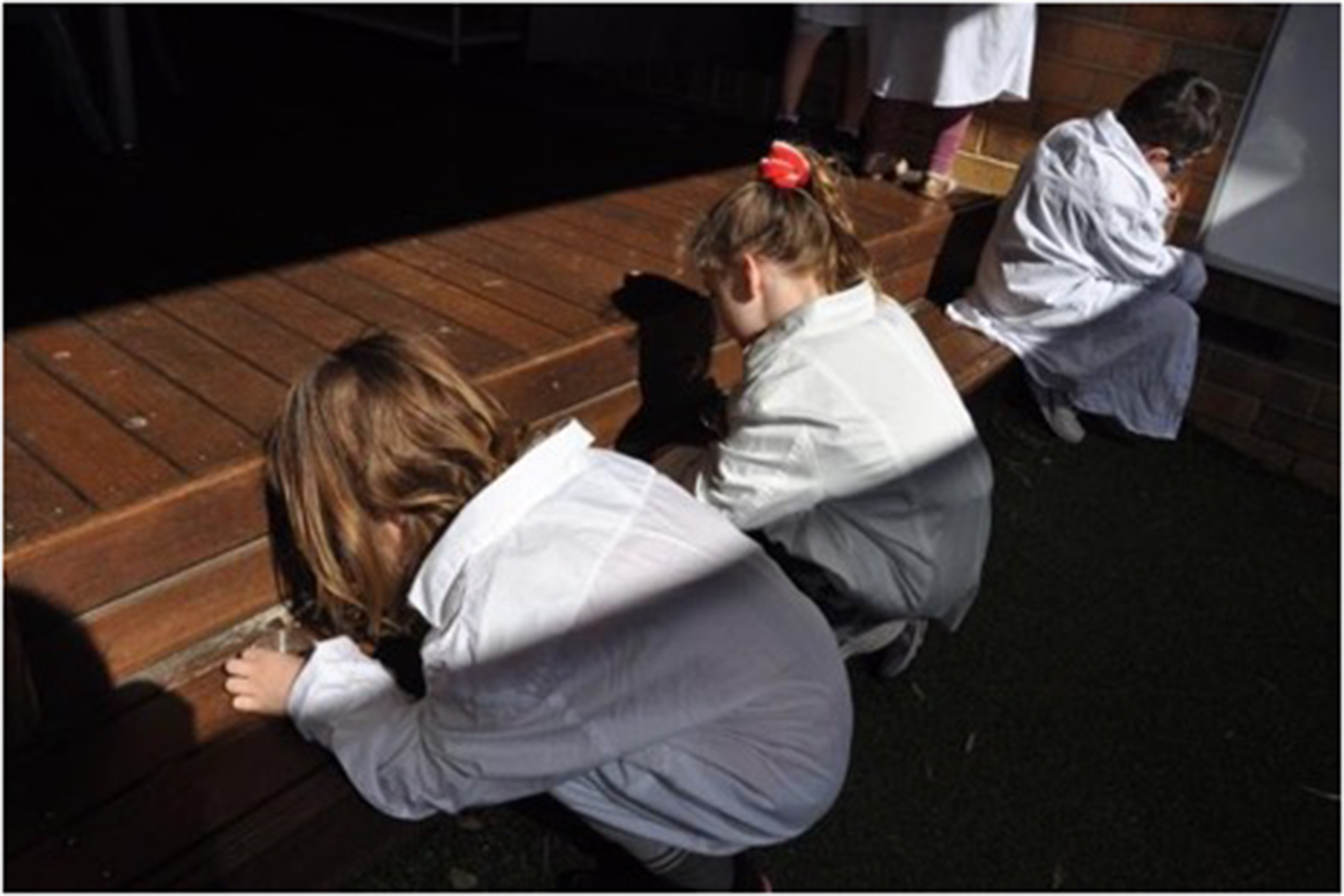
I hear children’s voices discussing where I live and when and how they can find me around the kindergarten. I let them know with my material presence that my favourite place to be is around the stairs (Fig. 1).
Dust hanging around the stairs. Note: Photo of fieldwork taken by Carrizo.
I share with them that I also like to hang around outside a lot as it is where I often find my friend, the wind. The wind and I have a strong connection, and our intra-actions are generally playful despite that sometimes he gets a little rough. The wind loves to live in Victoria, which is one of Australia’s windiest places. The southern tip of Greenland, Cape Farewell, is another place where the wind gets very strong. I also achieve world records with my agency in intra-action with the wind. For example, in the Saharan dessert, my particles are plentiful and blow so forcefully that it is considered one of the dustiest places on Earth. I cannot see or hold my friend, the wind, but I can sense his power and observe him when intra-acting with others. He is a good equaliser of the atmosphere: he carries heat, moisture, pollutants, and me of course, long distances sometimes. I am not really an independent or individual matter (I guess nobody, and nothing, is). We are all interdependent. It’s hard to define the boundaries between our bodies. I clearly notice this when I spread myself around the kindergarten, over the tables, the floor, the essay, the clothes, the hands and over many other bodies. I find it challenging to identify my own body anymore. I like to play tricks on those looking for me by camouflaging my individual and collective self. My presence becomes stronger and bigger when others pay attention to me, come very close and have a sharp vision or lens.
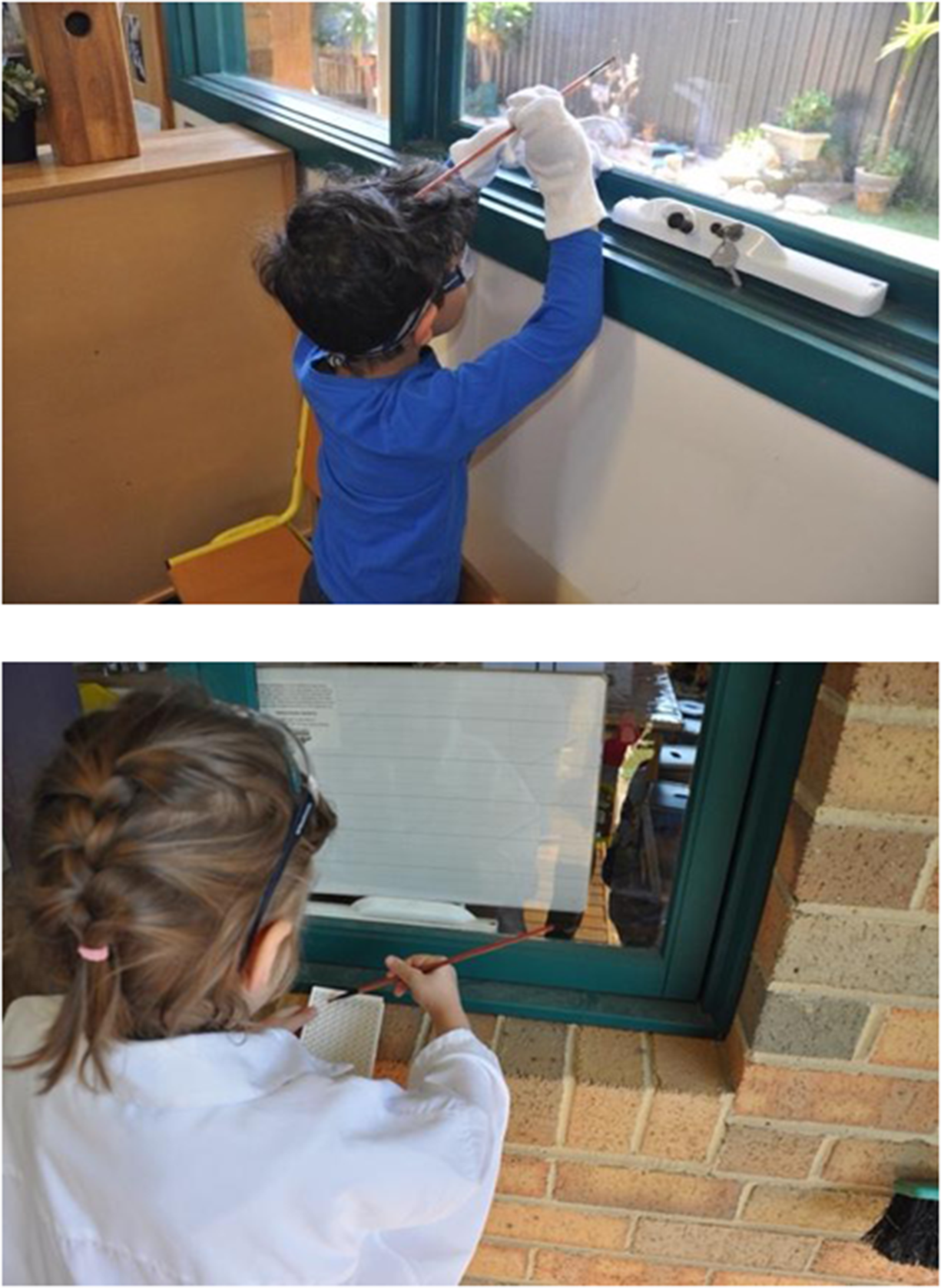
In 2021, I joined this experiment about dust. I was happy that the humans involved considered me an active participant. I got to be one of the subjects, rather than being the object of the inquiry, as it usually is. We played diverse games, and I was part of some microscopic and mapping encounters. The children and the researcher came to the kindergarten with different materials to intra-act with me, such as brushes, cupcake essay moulds, microscopes, essay and white gloves. One day, the children were looking for me everywhere. Some would spot me easily; others would take a while to find me. They were trying to catch me to then invite me to perform some examinations under the microscope (Fig. 2).
Materials and children collecting dust. Note: Photos of fieldwork taken by Carrizo.
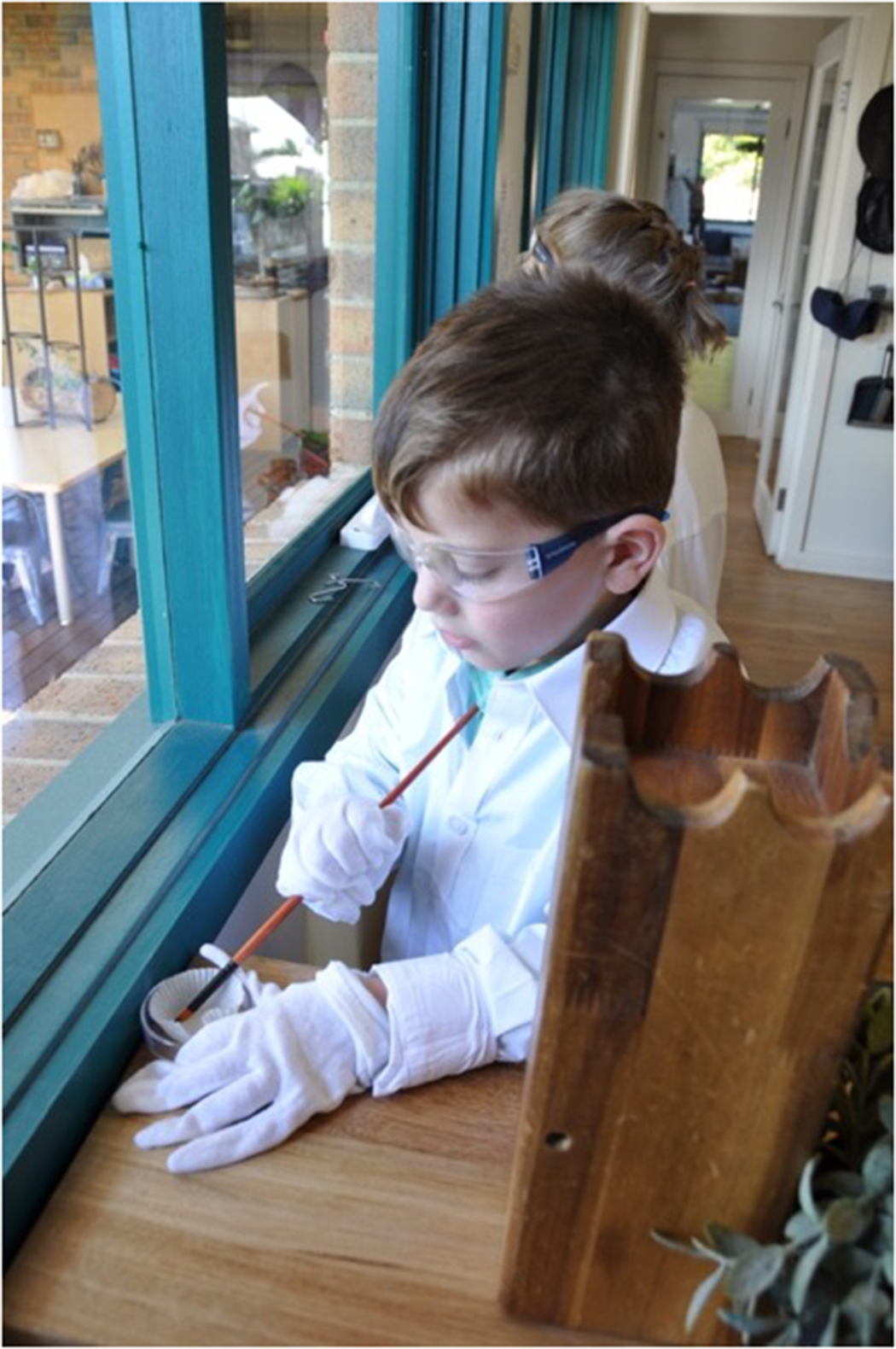
When the children approached me, their hands and the brushes helped me slide from different surfaces around the kindergarten into some cupcakes essay moulds (Fig. 3).
Dust particles sliding into the cupcake essay moulds. Note: Photo of fieldwork taken by Carrizo.
Suddenly I sensed something like being trapped in between an earthquake and a rollercoaster. The cupcake essay mould fell and turned with me inside a few times in the air. I protected myself by sticking onto the cupcake essay mould. A child screamed. I realised that Erwin’s hands had let go of the cupcake essay mould and now I was facing the consequences. Then, he picked us (particles) up. I was intrigued to know about what the children would think of me not following the course of the gravity force. I immediately heard someone shouting, the dust didn’t fall!. The other children came to see me. I saw their puzzled eyes and heard surprised voices wondering why I have not fallen off the cupcake essay mould. As Ellie explained, “dust sticks to the essay.” Erwin commented, “It did not fly away, sometimes it’s too heavy.” Then, Ellie added, “it’s fluffy and bigger.” With all the flashes from a large camera and the GoPro cameras around, I really felt bigger, like a movie star!
When I was at the window, two children started to push each other to get closer to me. Suddenly, I heard someone screaming. After a moment, we continued with the experiment. Some of my particles gathered in each petri dish to get ready for the microscopic examinations. I noticed a strong reaction from a child who was staring at me, but I did not worry too much as a fun part of the experiment was coming.
This is one of the children’s and my favourite moments. I get to be on the camera. This is a truly collective event! A visual, creative microecology.
The tensions that emerged during the experiment were not only spatial, but also attentional. The children would show the petri dish with the assemblage of particles to the researcher. Each child would comment on their collection while pointing at it, look at how much dust I collected; look at how much stuff I got; look at all my dust; mine is very dusty; I found a lot of dust; definitely I got a lot of dust (Fig. 4).
Look at how much dust I collected. Note: Photo of fieldwork taken by Carrizo.
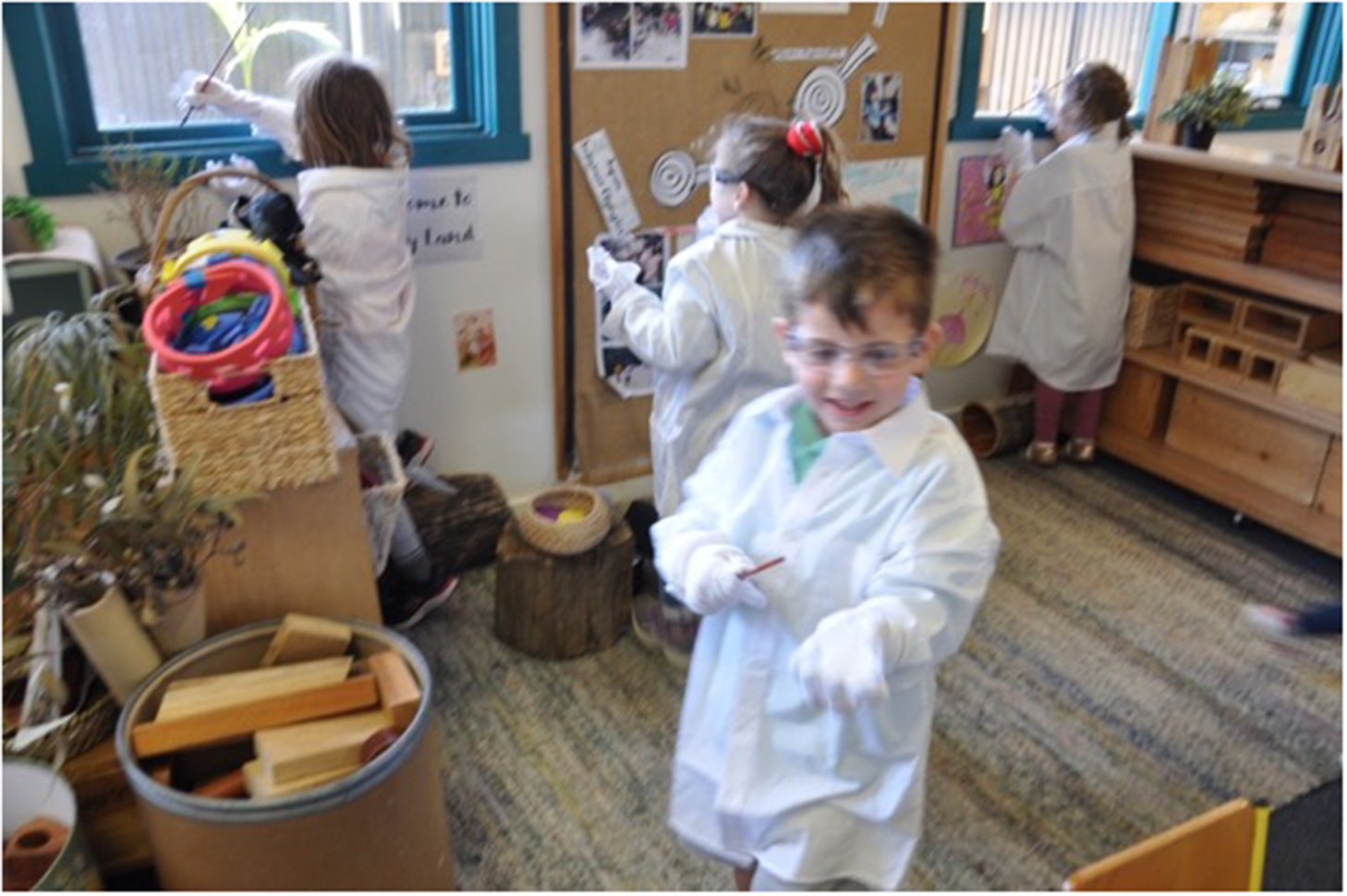
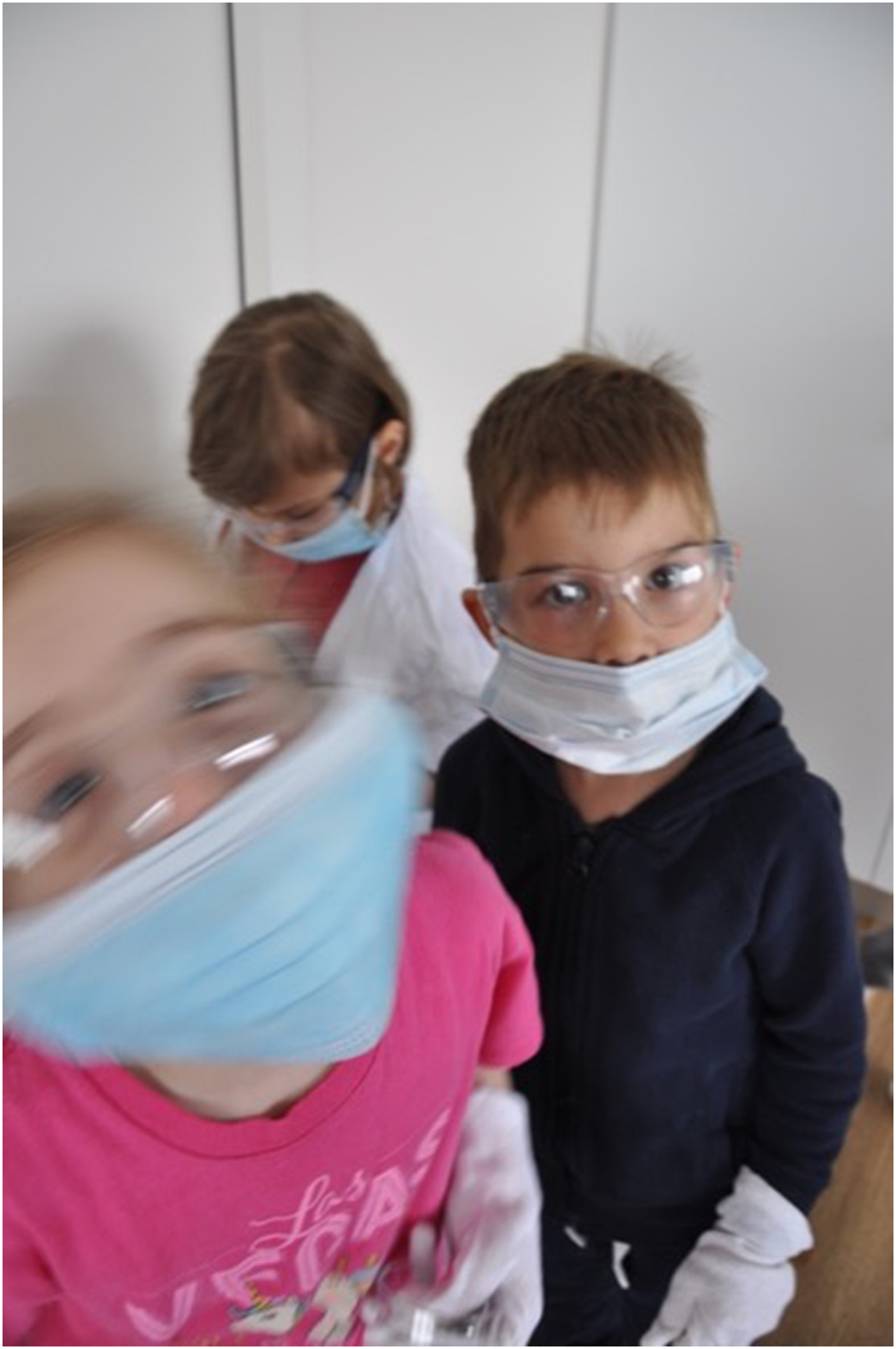
The researcher made some encouraging comments in response. After noticing that I was often being photographed, I realised that some children started to ask to be photographed. Erwin claimed, “you didn’t take a photo of me!” (Fig. 5).
Children asking to take a photo of them. Note: Photo of fieldwork taken by Carrizo.
The wild dusty experience of becoming-with the voice of dust
It has been a dusty experience for us to think and write-with and from the voice of dust. We first connected with dust through the materiality of my body and then we immersed in the happenings and doings from the dust’s perspective. We tried to imagine and sense the world through the body of dust. Kirksey et al. (Reference Kirksey and Helmreich2014) state that while cultural anthropologists have focused on issues of representation and interpretation, ethnographers have been interested in the more-than-human, including microbes, and have been asking: who should be speaking for other species. These scholars argue that anthropologists face similar issues when representing other people which becomes a problem of voice, “speaking for” and “speaking to.”
Arjun Appadurai (Reference Appadurai1998) writes, “anthropology survives by its claim to capture other places (and other voices) through its special brand of ventriloquism. It is this claim that needs constant examination” (p. 20). The same should apply when anthropologists communicate with biologists, nature lovers, or land managers about the entities they represent. Latour (Reference Liu, Wang, Chen, Zhang, Zhang and Xie2004) argues that the right for the nonhuman to speak is paramount to the new assembly of humans and nonhumans. This leads the collective to come together democratically. Latour affirms that “democracy can only be conceived if it can freely traverse the now-dismantled border between science and politics, in order to add a series of new voices to the discussion” (p. 69). The voices of the nonhuman have often been quiet or even silenced and the discussion has been limited “to humans, their interests, their subjectivities, and their rights” (p. 69). Latour states that this limitation has been as strange as having denied slaves, people under poverty and women the right to vote in the past. It is critical to notice that there are numerous delicate ways of “adding new voices to the chorus” (p. 69). In this story, we have stayed as close as possible to the nonhuman, noticing their agency, doings and becoming.
We believe that thinking, writing and experimenting with and from the voices of the nonhuman may bring both together for a reconsideration of ethical reactions. Despret (Reference Despret2016) highlights that humans should no longer consider animals, particularly farm animals, as victims, but rather to see the relationship as capable of being other than an exploitative one, one in which “farmers give, receive, exchange, and grow along with their animals” (Despret, Reference Despret2016, p. xi).
Re-(at)tension and (re)cognition of wild dust
The different patterns, textures, forces and doings of dust throughout this story create some attention and tension amongst the children. The dust itself opens up possibilities for the children to be surprised by the microevent. The dust particles falling and then not falling off the cupcake essay mould allows the children to notice that the other-than-human have their own relational agency which does not occur primarily under their control, but is affected by an entanglement of collective forces. The children’s comments illustrate that they were able to notice and be affected by the presence and agency of the dust, recognising its stickiness, weight, texture and size. The children showed a desire for attention and relationality when asking for photos of them together with the dust. Generally, and as per the Australian early childhood learning framework, children are always at the centre of the learning activities, while the other-than-human matter comes into view only in relation to them. Here though the children progressed toward thinking of themselves becoming-with the dust as their companions in learning.
This story brings the field of science and arts together in a playful way through the voice of dust. The agency of dust and the posthuman lens makes possible a multiplicity of connections and events; the dust offers surprising events in terms of its presence and performance which the children are able to embrace and co-perform. The children notice the dust’s capabilities to move and stick by paying close attention to it. The children’s bodies compete over the space to collect dust. In this story, dust is portrayed as a decision maker, photogenic, storyteller, citizen and fellow-traveller of the kindergarten space and more.
Conclusion
Rewilding early childhood environmental education
Importantly, the children in this study demonstrated an interest in learning about, from, and with dust, including its materiality. They realised that dust could help them learn about viruses, germs and colds (perhaps a characteristic of post-COVID knowledge?). Yet they maintained a dualistic approach to us/them, subject/object learning relationships, aligned with the current child-centred Australian educational framework. Even though this research study has provided examples of how knowledge is produced collectively, and how experiences are co-created by the humans and other-than-humans including microorganisms, energies and learning forces, further work is required to continue to disrupt these hierarchical constructions and binary systems, including continuing to advance pedagogical approaches that acknowledge and build connections with the other-than-human world, approaches that position the other-than-humans as co-creators of meaning-making and learning. We suggest that adopting wild pedagogies and more experimental studies like this one are necessary to challenge and rethink the positionings of children and teachers in current educational frameworks and practices.
Continuing to explore and learn with and from the microworlds, particularly in early childhood education, will certainly lead to valuable new understandings and knowledges. The children showed an understanding of how their bodies are porous and vulnerable to dust particles and viruses. They recognised (with more comfort than the adults in most cases!) that they are not in total control of dust, how and where it travels, and what it can do with their bodies. They discussed the ways that dust can get into their skin, body, hands, nose, mouth and inside their bones. The children’s observations demonstrated that their notion of boundaries of individuality between dust and their body blur. They appeared to be familiar with the intra-active encounters of dust and their bodies materially and scientifically. The stories of our time are about mass species extinctions, disastrous events, and the acceleration of climate change. We must adopt actions and ways of being that are less anthropocentric, less hierarchical and more just. Education has a critical role to play in this process. We suggest wild pedagogies respond to modernity’s troubled relations within a more-than-human world. This understanding of children regarding their bodies and the more-than-human can have powerful implications for teaching and learning, suggesting a pathway to engage with environmental issues. Applying new materialist theories and paying attention to the corporeality and materiality of all bodies was clearly of interest to these children.
Humans are likely to continue noticing and valuing the more charismatic forms of life, such as beautiful flowers, unusual plants and cute animals, while bodies like rodents, viruses and bacteria continue to be more actively targeted for destruction. Dust and dirt have been considered unwanted and uninvited agents over history, particularly in educational and colonising narratives of “progress.” By rejecting these narratives, we wonder how more room might be made for co-constructed knowledges with the more-than-human? How might educators and students collectively work with abandoned industrial sites such as factories and mining sites? Dust invites a consideration of the possibility of developing alternative aesthetic, social and cultural sensibilities. Dust, despite our construction of it as being abject matter, activated curiosity and displayed new aesthetic appreciation in the children in this study, which transformed our collective perception of it. We offer to readers the possibility that this study on child-dust becoming can stimulate alternative pedagogies for thinking, learning and living with emergent uncanny presences and for enacting more just futures.
Acknowledgements
We acknowledge the children, the early learning centre and the more-than-human participating in this research project.
Financial support
Yanina Carrizo was the recipient of an Australian Government Research Training Program Scholarship.
Ethical standards
Ethical approval for this research was obtained from the Research Ethics Committee (HREC) of RMIT University (ethics application 24,151).
Author Biographies
Yanina Carrizo (she/her) is a lecturer in education at CQUniversity, Australia, with a PhD in education from RMIT University. Her research uses emergent experimental methods to explore “dust” and microworlds, focusing on the intra-actions between humans and the more-than-human world and ecological and social justices. By drawing on posthuman and new materialist theories, she challenges and reimagines early childhood education practices, addressing issues of colonialism and capitalism. With over 15 years of experience in kindergartens and primary schools locally and internationally, Yanina combines practical teaching expertise with innovative research to transform early childhood education.
Linda Knight is an associate professor at RMIT University, is the director of the RMIT Mapping Future Imaginaries research network, www.mappingfutureimaginaries.com. This global multidisciplinary network creates projects focused on our future lives and the world. Using drawing and critical stitching practices, Linda Knight explores the possibilities of experimental cartographies as a reparative practice. Linda’s international profile as an award-winning artist and theorist includes transdisciplinary, experimental mapping projects that critically explore mainstream counter-narratives of colonial histories and devised Inefficient Mapping as an investigative practice.
Daniel X. Harris (they/them) is a Professor in the School of Education, and the Director of Creative Agency research lab: www.creativeresearchhub.com. Harris is editor of the book series Creativity, Education and the Arts (Palgrave), and has authored, co-authored or edited 22 books and over 150 chapters and articles as well as plays, films and spoken word performances. They are committed to the power of collaborative creative practice and social justice research to inform social change.


 Open access

