


Introduction
The term “stimuli” in design research refers to sources of information that support designers in generating ideas during design processes by providing possible sources of inspiration (Gonçalves et al., Reference Gonçalves, Cardoso and Badke-Schaub2014). The combination of multiple pieces of information improves the development of innovative solutions and creative concepts as solutions to design problems (Borgianni et al., Reference Borgianni, Maccioni, Fiorineschi and Rotini2020; Kirjavainen and Hölttä-Otto, Reference Kirjavainen and Hölttä-Otto2020). This topic has been continuously studied from the design literature and recent contributions are leading to evidence about different and under-investigated features of stimuli that – along with other external factors – affect idea generation. More often, these studies refer to idea generation in constrained design problems (i.e. problem-solving problems where the solution space is defined) rather than in unstructured design explorations.
There, the sources of inspiration are investigated through two alternative approaches, protocol analysis and neurophysiological measurements, which focus on the cognitive aspects of the design process. These methods are applied both in the case of engineering design and industrial design.
Protocol analysisFootnote 1 is the traditional methodology adopted in the design literature to investigate cognitive activity related to design processes; it bases its results and observations on the interpretation of verbal reports, sketches, and gestures of designers during experimental activities (Hay et al., Reference Hay, Duffy, McTeague, Pidgeon, Vuletic and Grealy2017).
Design researchers have recently adopted cognitive neuroscience and physiology approaches, including the investigation of designers’ biometric signals to investigate neurophysiological processes, especially in conceptual design (Gero and Milovanovic, Reference Gero and Milovanovic2020).
Although these two methods pursue the same research objectives, they generally focus on different traits of the cognitive processes in design. Unfortunately, the experimental protocols adopted in the literature lack homogeneity. The design tasks used are varied and often differ in the structure of the problems and difficulty levels. Thus, the conclusions reached by experimental studies are often difficult to compare and sometimes conflict with each other.
Consequently, a systematic review is appropriate to overcome these issues, comparing results obtained from the contributions that adopt protocol analysis and neurophysiological measurements (subsequently simply named “protocol studies” and “neurophysiological studies”). It allows us to investigate the role of stimuli as sources of inspiration for design problem-solving, when designers explore possible alternatives and propose design solutions that satisfy the problem constraints (Kryssanov et al., Reference Kryssanov, Tamaki and Ueda1999). One previous review paper collected inspiration sources’ findings in the design process (Vasconcelos and Crilly, Reference Vasconcelos and Crilly2016); still, no papers or reviews have compared the evidence obtained by the different investigation methods. Similarly, no paper has yet provided a framework to clarify how to select the correct type of stimuli, given factors such as the designer's characteristics and the desired performance.
Therefore, the present paper aims to summarize and structure the evidence obtained from protocol and neurophysiological studies about the effect of different types of stimuli on idea generation in structured design problems and their outcomes. In fact, on the one hand, investigating how stimuli are involved in solution generation is fundamental to comprehending ideas and justifying designers’ performance. On the other hand, the analysis of the outcomes of ideation indicates which are the most appropriate features of stimuli. It also suggests how to properly provide stimuli during the design process, so that designers’ performance will be directly enhanced. Therefore, comparing results from different sources of inspiration is related to factors that depend on the designer and the design task. Finally, this paper aims to present a structured agenda for future research and to improve designers’ and design managers’ idea generation.
Two research questions have driven the literature analysis in this contribution by investigating if:
• the results from neurophysiological studies are consistent with protocol studies about the role of stimuli during the idea generation phase of the design process;
• external factors, and specifically individual characteristics of designers, suggest the selection of specific types of stimuli, in order to achieve better performance in idea generation.
The methodology adopted consisted of a systematic literature review conducted through Snowballing, combined with PRISMA. The former was based on an initial set of papers searched for relevant contributions by looking at reference lists and citing papers (as in Wohlin, Reference Wohlin2014); the latter focused on the selection of relevant contributions through a checklist and a flowchart (as suggested by Moher et al., Reference Moher, Liberati, Tetzlaff and Altman2009). Subsequently, the resulting contributions were fully reviewed and classified based on the stimuli's features and the other factors, distinguishing the protocol and the neurophysiological studies.
The paper is divided into four sections. The first section describes all stages of the method adopted for the literature search. The second section illustrates the comparison of the results that emerged from the analysis of the papers on the role of stimuli in idea generation for bounded design problems. The third section focuses on the other factors impacting idea generation. Finally, the last section includes the resulting framework and suggests new directions for future work.
Methodology for the review
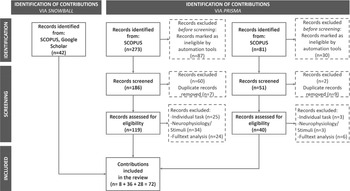
The Snowballing methodology (Wohlin, Reference Wohlin2014) adopted for initially selecting contributions highlighted the rapid diffusion that occurred since 2016 of the use of methods from neurophysiology in the engineering and industrial design literature. During this first phase of the review, 8 out of 42 of the selected contributions focus on studying conceptual design through the use of biomedical devices. However, only two of these eight contributions of design neurocognition show useful elements in understanding the role of stimuli.
Consequently, the work was structured to search the contributions related to idea generation during conceptual design for (1) the role of stimuli in conceptual design and (2) if this role was consistent in the neurophysiological studies. For these two strands, two different queries were run. The literature review followed the PRISMA methodology (Moher et al., Reference Moher, Liberati, Tetzlaff and Altman2009; Torres-Carrion et al., Reference Torres-Carrion, Gonzalez-Gonzalez, Aciar and Rodriguez-Morales2018) and was structured in three phases: Identification, screening, and inclusion. The whole selection process is summarized in Figure 1.
Selection process.

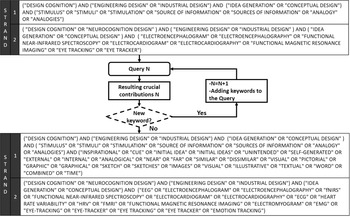
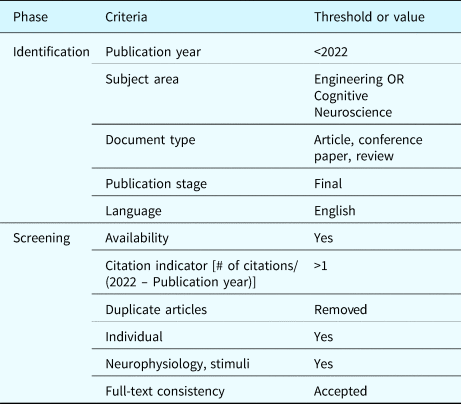
During the identification step, two queries were applied to the Scopus database; they focused on the whole document and had a common structure for “Aim” AND “Domain” AND “Design Phase”. The first focused on “Stimuli” AND “Stimuli Features”, while the second focused on “Biometric Measures”, including techniques for recording neurophysiological activities, through the use of noninvasive biomedical devices to collect relevant data for the cognition of engineering and industrial design processes. In this review, the neurophysiological measurements already adopted in the design literature were included in the research query, as shown in strand 2, Figure 2. Each query was run iteratively: at each launch, the resulting main keywords were gradually included, improving the precision of the outcomes. In the end, the results were consistent with other reviews (e.g. the list of included biometrics in the reviews of Borgianni and MacCioni (Reference Borgianni and MacCioni2020) and Gero and Milovanovic (Reference Gero and Milovanovic2020). This process is summarized in Figure 2, and the selection criteria are listed according to the application order in Table 1. The identification phase criteria were applied automatically through the Scopus engine. The authors manually checked the papers’ availability and citation indicator, in the screening phase. They removed duplicates to select the relevant contributions to answer the initial research questions for both the strands identified. Given their objective and relevance, papers were checked based on the experimental activities and topics covered. At this phase, only experimental papers involving individual design tasks were selected. This is due to the fact that the dynamics of team design activities have been widely investigated through protocol analysis, but no research contribution on team experimental tasks has currently adopted Neurophysiological measurements, making a comparison of findings not possible.
Query definition process and final queries.

Selection criteria and threshold

Successively, a full-text screening assessed the consistency of selected papers with the analysis of different sources of inspiration for designers during the idea generation activity, distinguishing protocol analysis from neurophysiological measurements approaches.
Finally, in the inclusion, the authors selected the crucial contributions identified for the two strands, reaching a total of 64 contributions, considered relevant for this research because of their influence in the literature.
Results from the review
Features of stimuli
In the literature, stimuli are defined as possible sources of inspiration for designers during the idea-generation process (Borgianni et al., Reference Borgianni, Maccioni, Fiorineschi and Rotini2020). They are described in different ways, with terms that are not always consistent. In the present work, we adopted the most used terms, also included in the most relevant contributions (Goldschmidt and Smolkov, Reference Goldschmidt and Smolkov2006; Gonçalves et al., Reference Gonçalves, Badke-Schaub and Cardoso2011; Goucher-Lambert et al., Reference Goucher-Lambert, Moss and Cagan2018).
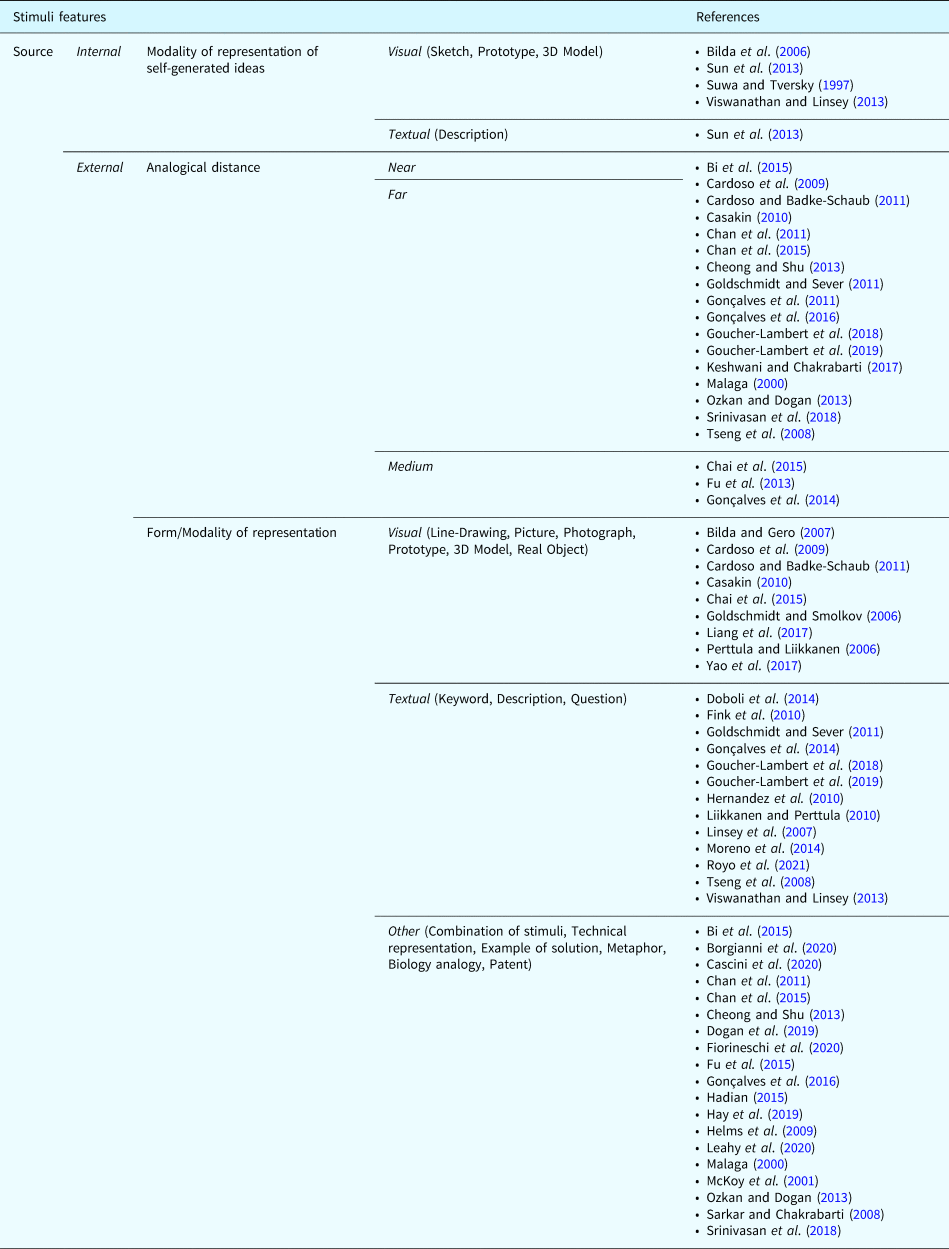
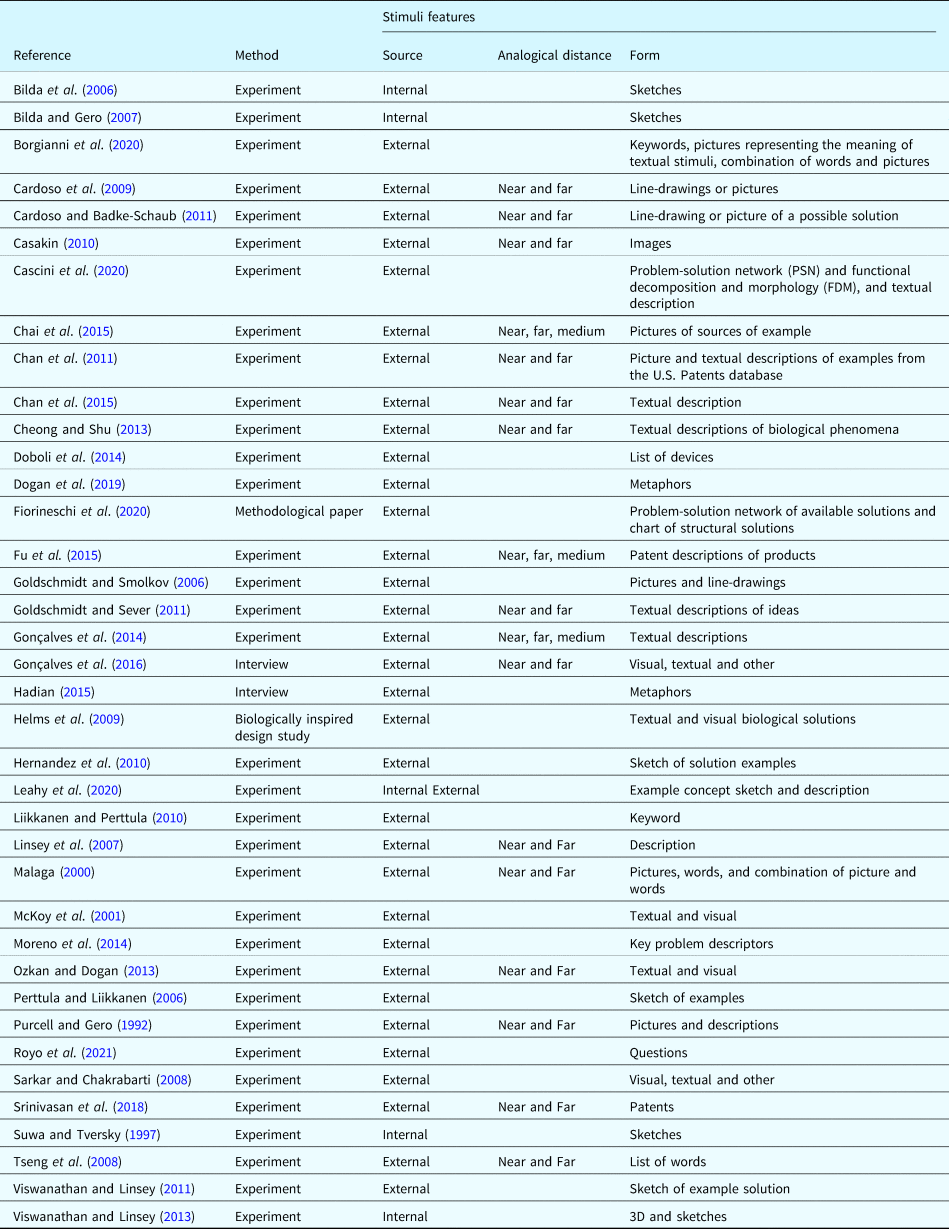
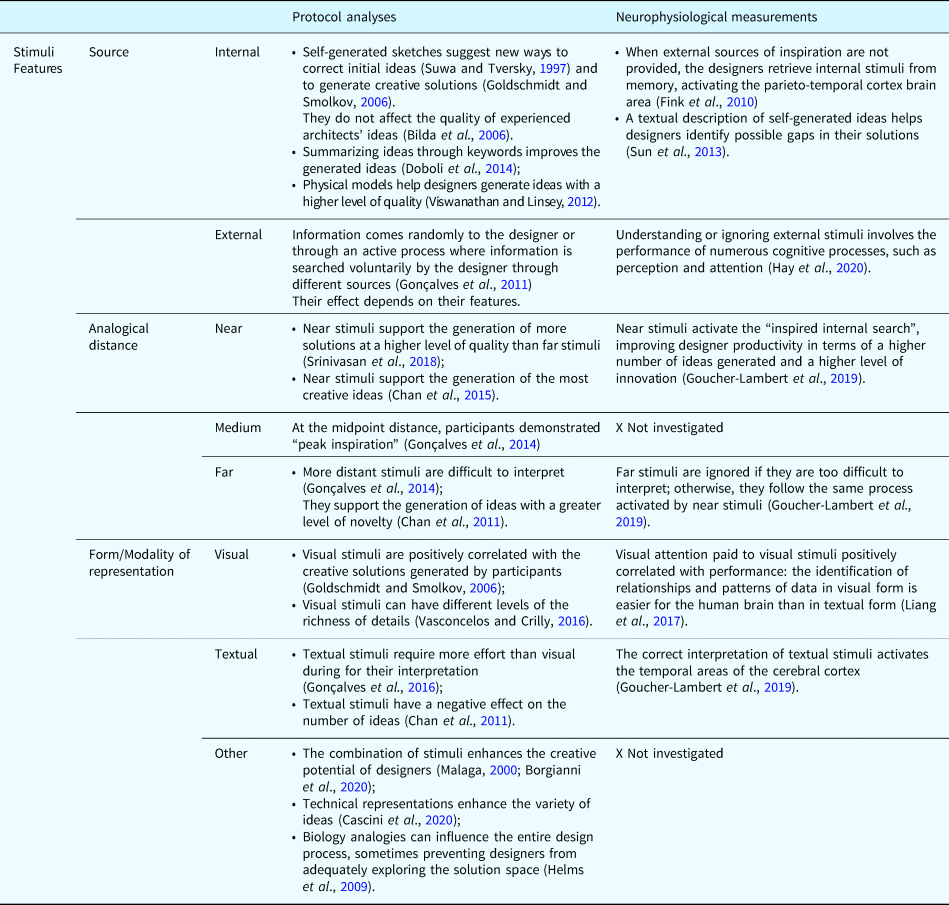
From the final set of papers, 47 out of the 72 contributions discuss the role of stimuli and their features, as in Table 2.
Stimuli features

The first feature (“source”, in the first column) refers to the source of the stimuli, which can be internal or external. Internal stimuli are those obtained from memory retrieval of past experiences, personal memories, and knowledge (Gonçalves et al., Reference Gonçalves, Cardoso and Badke-Schaub2014). These, called self-generated ideas, can be externalized by designers through different modalities of representation as sketches, prototypes, 3D models, and textual descriptions. Such stimuli have the potential to inspire designers to generate other new solutions to design problems when no external stimulus is intentionally provided (Suwa and Tversky, Reference Suwa and Tversky1997). External stimuli, on the other hand, refer to the external sources of inspiration that can be found through a passive process, in which information comes randomly to the designer, or through an active process, in which information is searched voluntarily by the designer through different sources, such as the internet and books (Gonçalves et al., Reference Gonçalves, Badke-Schaub and Cardoso2011). External stimuli can also be distinguished by analogical distance and the form/modality of representation.
When designers consider a stimulus as a good source of inspiration for generating new ideas, they build a series of connections between the stimulus and the problem according to “analogical reasoning” (Goucher-Lambert et al., Reference Goucher-Lambert, Moss and Cagan2018). The analogical distance is investigated in 20 of the 47 contributions. This analogical distance is also called “proximity to the problem” (Vasconcelos and Crilly, Reference Vasconcelos and Crilly2016) and it has been defined as “a measure of the degree of structural (relational or functional) similarity and surface (attributional) similarity to the problem” (Jia et al., Reference Jia, Becattini, Cascini and Tan2020). Moreover, some authors have distinguished “near” analogy from “far” analogy, suggesting the analysis of analogies at intermediate distances (Fu et al., Reference Fu, Chan, Cagan, Kotovsky, Schunn and Wood2013; Gonçalves et al., Reference Gonçalves, Cardoso and Badke-Schaub2014).
The form, sometimes labeled “modality of representation” (Vasconcelos and Crilly, Reference Vasconcelos and Crilly2016), looks at the modality with which a stimulus is represented, and it is investigated in 47 of the included contributions. This variable distinguishes between visual and textual stimuli, as in Table 2, and it can be analyzed conjunctly or independently to the analogical distance. The visual stimuli class includes sketches, photographs, prototypes, 3D models, and real objects; textual stimuli include keywords, texts, or questions. The literature has also investigated the effects of visual and textual stimuli alone and the effects of combining stimuli of different forms (Borgianni et al., Reference Borgianni, Maccioni, Fiorineschi and Rotini2020; Malaga, Reference Malaga2000).
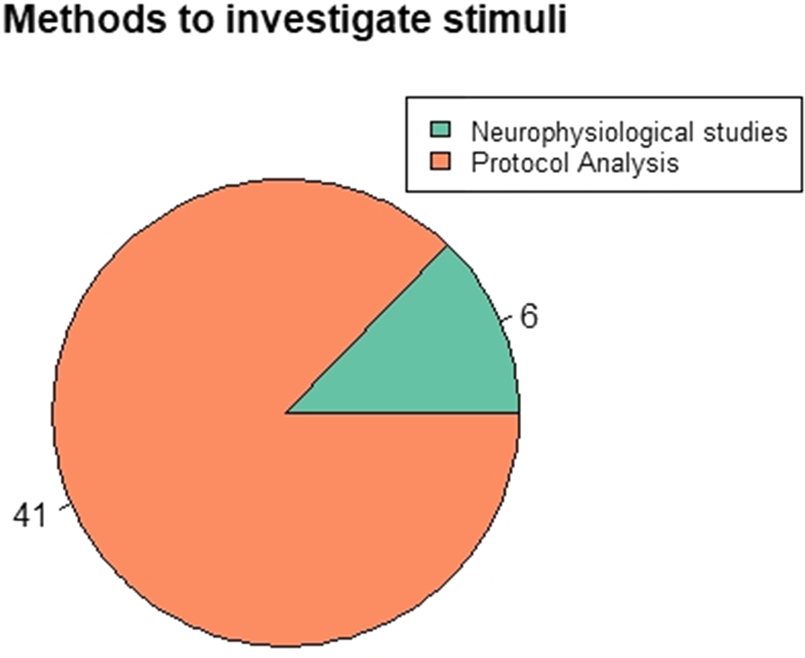
Furthermore, we distinguish papers according to the methodology adopted, between protocol analysis (41 out of 47) and neurophysiological studies (6 out of 47), as depicted in Figure 3.
Methods of investigation.

Metrics for performance evaluation and the problem of fixation
The investigation of the role of stimuli in idea generation, as a process and its outcomes, requires the introduction of metrics for evaluating the participants’ performance. Currently, the literature has shown no official standards in the number and type of metrics adopted.
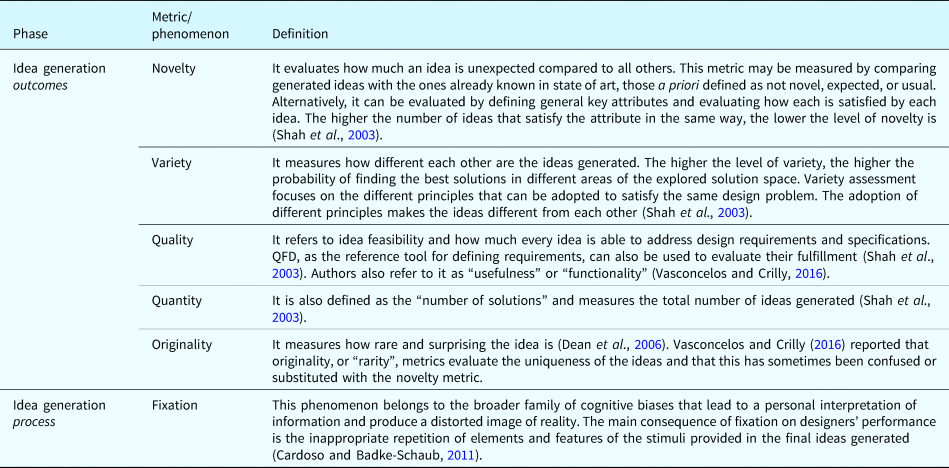
This review refers to metrics such as novelty, variety, quality, and quantity, proposed by Shah et al. (Reference Shah, Vargas-Hernandez and Smith2003) for assessing ideation effectiveness, since they are the most commonly used in the literature. In addition, some of the papers included in the review also evaluate the ideas’ originality level (Dean et al., Reference Dean, Hender, Rodgers and Santanen2006; Vasconcelos and Crilly, Reference Vasconcelos and Crilly2016). The mentioned metrics are listed and defined in Table 3.
Idea generation outcomes metrics and phenomenon bias

Fixation has been investigated in 10 contributions, this review included. It represents a subconscious phenomenon that occurs especially when the designer has sufficient time to resolve a design problem with a very low degree of uncertainty (Mohan et al., Reference Mohan, Chen and Shah2011). This process narrows the solution space explored by the designer, who remains “fixed” to the initial ideas (Nelius et al., Reference Nelius, Doellken, Zimmerer and Matthiesen2020). Although the fixation is a phenomenon related to the idea generation process, it is often evaluated in combination with other performance metrics since it has a negative impact on the quality and originality of ideas (Cardoso et al., Reference Cardoso, Badke-Schaub and Luz2009), and on the number, the variety, and the novelty of ideas (Mohan et al., Reference Mohan, Chen and Shah2011).
In some cases, fixation is due to the stimuli themselves (Hay et al., Reference Hay, Cash and McKilligan2020) or to the repeated use of only a small portion of the external stimuli available (Hwang et al., Reference Hwang, Choi, Bae and Park2021). For example, visual stimuli, such as images of everyday life scenes or line drawings and photographs, can both guide the designer to inappropriately repeat some features of the stimuli in their final ideas (respectively, Purcell and Gero, Reference Purcell and Gero1992; Hernandez et al., Reference Hernandez, Shah and Smith2010).
Comparing internal and external stimuli, Leahy et al. (Reference Leahy, Daly, McKilligan and Seifert2020) found that participants were more fixated on their initial ideas when stimulated by an external example of a solution provided during the experiment.
Moreover, designers’ expertise can affect the performance with fixation. Viswanathan and Linsey (Reference Viswanathan and Linsey2013) showed that both expert and novice designers exhibited a state of design fixation due to a solution example; previous experience and knowledge support experts in generating more ideas, but these elements can cause design fixation.
New methods have been developed in the literature to help novice designers recognize and avoid the fixation phenomenon. Hwang et al. (Reference Hwang, Choi, Bae and Park2021) developed a support system that keeps track of designers’ use of the available external stimuli and guides individuals in redistributing their attention to unused stimuli. Design by analogy can help reduce design fixation by supporting designers in constructing distant analogies from the design problem domain while still relying on prior knowledge, experience, or external stimuli (Moreno et al., Reference Moreno, Blessing, Yang, Hernández and Wood2016). Finally, alternative representations of the design task, such as a brief functional description of the problem, have great benefits for expert engineers in reducing fixation. In contrast, they have a negligible effect on novices (Viswanathan and Linsey, Reference Viswanathan and Linsey2011).
The study of stimuli by protocol studies
Protocol analysis involves conducting a qualitative interpretation of participants’ gestures, sketches, videos, and audio recordings to investigate cognitive aspects related to the idea generation activity. Most of the contributions included in this review study the role of stimuli and their features in design by applying this method, as in Table 4.
Stimuli features investigated in protocol studies

Internal stimuli
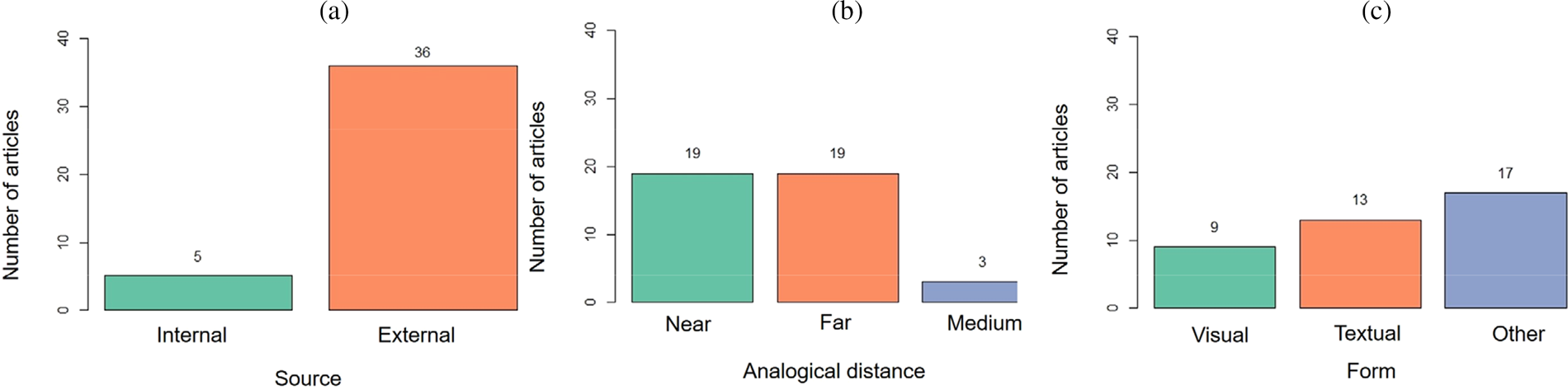
The design literature focuses on investigating external sources of inspiration, as in Figure 4a, since only 7 of 47 contributions deal with the role of internal stimuli.
• Visual. Suwa and Tversky (Reference Suwa and Tversky1997) found that designers’ inspection of self-generated sketches suggests new ways to improve their initial ideas. In addition, Goldschmidt and Smolkov (Reference Goldschmidt and Smolkov2006) observed that the sketches, as internal stimuli, are fundamental to generate creative solutions. Bilda et al. (Reference Bilda, Gero and Purcell2006) compared the idea generation process in a “blindfolded” and a “sketching” condition for experienced architects. They observed that the inability to sketch did not affect the quality of the information in the generated ideas. On the contrary, the overall performance, in making connections between different ideas, was lower in the blindfolded mode. Moreover, physical and 3D samples and mental images can aid designers in refining their initial ideas (Gonçalves et al., Reference Gonçalves, Cardoso and Badke-Schaub2014, Reference Gonçalves, Cardoso and Badke-Schaub2016). Viswanathan and Linsey (Reference Viswanathan and Linsey2012, Reference Viswanathan and Linsey2013) noted that building physical models helps designers to generate more functional solutions with a higher level of quality than the condition in which they produce only sketches, but it can cause a degree of fixation directly proportional to the amount of time taken to build the 3D model.
• Textual. Among self-generated stimuli, one can also consider the description of own ideas. Doboli et al. (Reference Doboli, Umbarkar, Subramanian and Doboli2014) found that summarizing own ideas through keywords or titles improves the level of innovation of generated solutions.
Stimuli features investigated in protocol studies: (a) source of stimuli, (b) analogical distance, (c) form.

External stimuli
The analogical distance
Concerning analogical distance, 19 papers out of 47 investigate the role of near and far analogies, and only 3 contributions have focused on intermediate analogies, as in Figure 4b.
• Methods for analogical distance evaluation. For the selection of textual stimuli with different levels of distance, Goucher-Lambert and Cagan (Reference Goucher-Lambert and Cagan2017) adopted the crowdsourcing method, asking online workers to summarize in six keywords their solutions to proposed problems. Next, the most frequent keywords were considered near stimuli, and words used only once were called far stimuli. On the other hand, given a list of words extrapolated from the initial solutions to the design problems, Malaga (Reference Malaga2000) let two experts individually evaluate the distance of each word from the problem. Regarding the distance of visual stimuli, Chai et al. (Reference Chai, Cen, Ruan, Yang and Li2015) evaluated the analogical distance of images related to an outdoor furniture design problem. The authors evaluated pictures depicting outdoor furniture as close stimuli, images of mostly abstract furniture as medium-distance stimuli, and images with elements of nature as distant stimuli.
• Near versus far stimuli. Gonçalves et al. (Reference Gonçalves, Cardoso and Badke-Schaub2014) classified stimuli into “close”, “distant”, and “too distant”, and noted that the latter resulted in difficult to interpret and exploit for generating new ideas. Conversely, close stimuli limited the exploration of the solution space, leading to frequent repetition of the same ideas. Finally, the authors observed a midpoint of distance, defined “distant” stimuli, at which participants demonstrated “peak inspiration”. However, most of the papers suggest that near stimuli provide better support. Srinivasan et al. (Reference Srinivasan, Song, Luo, Subburaj, Elara, Blessing and Wood2018) demonstrated that near stimuli support the generation of more solutions at a higher level of quality than far stimuli; Jia et al. (Reference Jia, Becattini, Cascini and Tan2020) found that near stimuli result in higher quality, novelty, and variety of ideas generated. Finally, Chan et al. (Reference Chan, Fu, Schunn, Cagan, Wood and Kotovsky2011, Reference Chan, Dow and Schunn2015) showed that near stimuli aided participants in generating the most creative ideas.
The form/modality of representation
Among the modalities of representation, the “other form”, including the combination of visual and textual stimuli, examples of a solution, biology analogies, and technical representations, is the most investigated form of stimuli in the Design literature, as in Figure 4c.
• Visual. Goldschmidt and Smolkov (Reference Goldschmidt and Smolkov2006) stated that visual stimuli support the generation of creative solutions, and even random features of the external environment sometimes inspire participants. The richness of details of visual stimuli, defined by Vasconcelos and Crilly (Reference Vasconcelos and Crilly2016) as “Fidelity of the representation”, can influence the creative performance of designers. Borgianni et al. (Reference Borgianni, Maccioni, Fiorineschi and Rotini2020) pointed out that low-fidelity stimuli, such as abstract drawings and pictures, result in non-obvious analogies in idea generation, though with no improvement in quality, originality, and quantity metrics. On the other hand, Cardoso et al. (Reference Cardoso, Badke-Schaub and Luz2009) found that high-fidelity visual stimuli, concrete sketches, and pictures cause the repetition of some features of stimuli in the final solutions. However, “raw” drawings and line-drawing illustrations led to the generation of more novel ideas, while photographs resulted in less original ideas. In addition, Chan et al. (Reference Chan, Dow and Schunn2015) observed a higher level of novelty with abstract stimuli, but participants rated concrete stimuli as more useful. The effect of pictures on ideas also depends on the designer's familiarity with the portrayed image (Purcell and Gero, Reference Purcell and Gero1992).
• Textual. Moreno et al. (Reference Moreno, Hernández, Yang, Otto, Hölttä-Otto, Linsey, Wood and Linden2014) observed that keywords, key-problem descriptors, have a negative effect on the number of ideas, probably because of a high cognitive effort for their comprehension and interpretation. Chan et al. (Reference Chan, Fu, Schunn, Cagan, Wood and Kotovsky2011) observed that textual stimuli decreased the number of ideas generated both when supplied alone and in addition to visual stimuli. Finally, Royo et al. (Reference Royo, Mulet, Chulvi and Felip2021) observed that questions, as textual stimuli, resulted in the generation of fewer ideas, with higher levels of quality and lower levels of novelty and variety.
• Combination of stimuli. Gonçalves et al. (Reference Gonçalves, Cardoso and Badke-Schaub2016) investigated designers’ preferences in the use of different types of stimuli. All the designers preferred visual stimuli because accessing and storing this type of information requires less effort than the textual one, which also calls for concepts that are more abstract and, therefore, more complex to interpret. Mckoy et al. (Reference McKoy, Vargas-Hernández, Summers and Shah2001) pointed out that visual/graphical sources of inspiration are more effective than textual ones since the design is an image-oriented process and visual senses are more involved than the others (Mougenot et al., Reference Mougenot, Bouchard, Aoussat and Westerman2008). On the combination of different forms, Malaga (Reference Malaga2000) found that visual combined with textual stimuli resulted in ideas with a higher level of creativity than textual stimuli alone. Moreover, Borgianni et al. (Reference Borgianni, Maccioni, Fiorineschi and Rotini2020) noted that this combination leads to a higher number of ideas generated. Conversely, switching from a textual stimulus to a visual one does not increase the number, quality, and originality of ideas. Finally, Sarkar and Chakrabarti (Reference Sarkar and Chakrabarti2008) suggested providing respectively videos, pictures, and textual stimuli to generate higher-quality ideas.
• Technical representation. Technical reports, charts, maps, and methods for representing solutions, can aid designers in defining initial ideas and using these as stimuli for improvements, or generate new ones. Fiorineschi et al. (Reference Fiorineschi, Frillici and Rotini2020) noted that the problem-solution network (PSN) and the chart of structural solution Alternatives could be adopted as frameworks both for generating and sharing ideas to inspire other designers. Finally, Cascini et al. (Reference Cascini, Fiorineschi and Rotini2020) found that stimuli coming from a functional structure, a tree graph (with hierarchical alternation of problems and their solutions), or a morphological map (functions vs. solutions), inspire ideas with greater variety.
• Example of solution. Hernandez et al. (Reference Hernandez, Shah and Smith2010) observed that the visual examples of solutions improve the variety and the novelty of the ideas, but this effect is not homogeneous on the whole sample of participants. Differently, Koronis et al. (Reference Koronis, Silva and Kang2018) found that visual examples of solutions in the presentation of the design problem might reduce the novelty of ideas while representing generic requirements might be more effective. Providing textual solutions, Chan et al. (Reference Chan, Fu, Schunn, Cagan, Wood and Kotovsky2011) observed that examples may cause the fixation phenomenon. It is due to the designers’ tendency to be more adept at reusing parts of the provided solutions to develop new ideas, regardless of the analogical distance. In architectural design, stimuli composed by the explanation of previous design problems and their context through textual descriptions, pictures, and diagrams are defined as “cases” and are the most used stimuli for solving design problems (Akin, Reference Akin2002; Eilouti, Reference Eilouti2009). Finally, Stacey and Sketch (Reference Stacey and Sketch1997) observed that previous designs work as useful stimuli for new ideas and as references during communication among designers.
• Metaphor. Metaphors are usually words or phrases through which an implicit relationship of similarity between two objects is generated; they are considered apart from analogies because the latter presents a relation of similarity explicit and evident (Dogan et al., Reference Dogan, Taneri and Erbil2019). In Architecture, they have wide applications as a potential source of inspiration. Hadian (Reference Hadian2015) interviewed professional architects and found that metaphors are the most effective form of stimuli for generating creative solutions to design problems; while analogies are equally effective, but used more for idea generation. Specifically, Al-Assadi (Reference Al-Assadi2022) states that, among the metaphors, bio-metaphors are a simulation of nature that also allows architects to be inspired by stimuli of the domain of biology for the generation of innovative solutions.
• Biology analogy. Cheong and Shu (Reference Cheong and Shu2013) highlighted the difficulty in developing analogies from these kinds of stimuli, so participants often ignore them. Furthermore, Helms et al. (Reference Helms, Vattam and Goel2009) showed that biology analogies could influence the entire design process, sometimes preventing designers from adequately exploring the solution space, thus causing an improper analogical transfer. Keshwani and Chakrabarti (Reference Keshwani and Chakrabarti2017) suggested that providing biology analogies with explanations and textual descriptions of the natural phenomenon increases the “level of comprehensiveness in explanation of an analogy”. Therefore, biology stimuli are a more understandable and effective source of inspiration even for designers without a biology background.
• Patent. Fu et al. (Reference Fu, Murphy, Yang, Otto, Jensen and Wood2015) observed that the patent descriptions of products as stimuli have no impact on the number of ideas generated and that they generally do not cause the negative phenomenon of fixation. Srinivasan et al. (Reference Srinivasan, Song, Luo, Subburaj, Elara, Blessing and Wood2018), using patents of many technological classes as stimuli, noted that patents from the same technology class as the design problem lead to higher quality and lower novelty solutions. Conversely, stimuli from different domains support the generation of ideas with a higher level of novelty and a lower level of quality.
Table 5 highlights the main findings from the protocol analysis approach.
Main findings on the role of stimuli from protocol studies

The study of stimuli with neurophysiological measurements
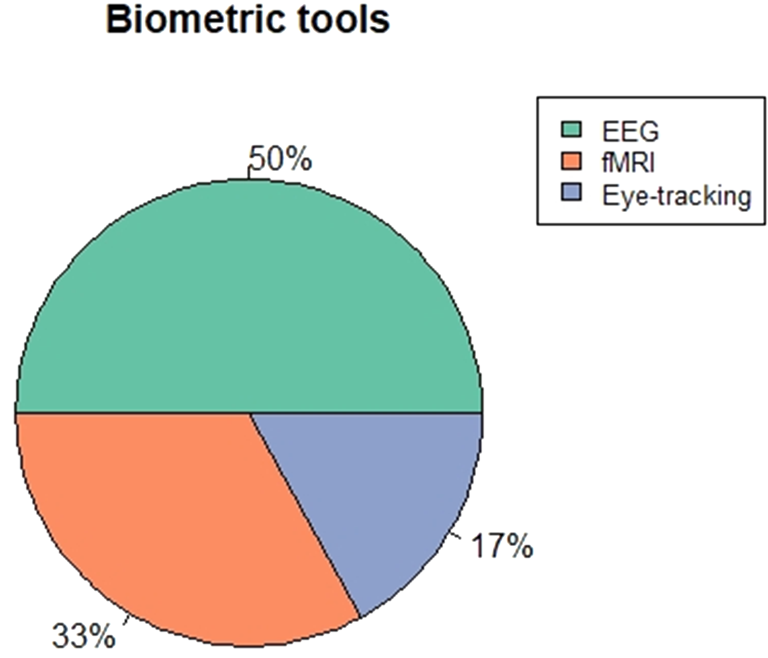
The study of biometric measurements during design activities has been developing since 2005. The currently most implemented devices are electroencephalography (EEG) and functional magnetic resonance imaging (fMRI), while eye-tracking is in the minority, as depicted in Figure 5. Furthermore, no contribution has adopted functional near-infrared spectroscopy (fNIRS) or electromyography (EMG) techniques. Gero and Milovanovic (Reference Gero and Milovanovic2020) present a deeper understanding of these tools and their adoption in design research.
Biometric measures.

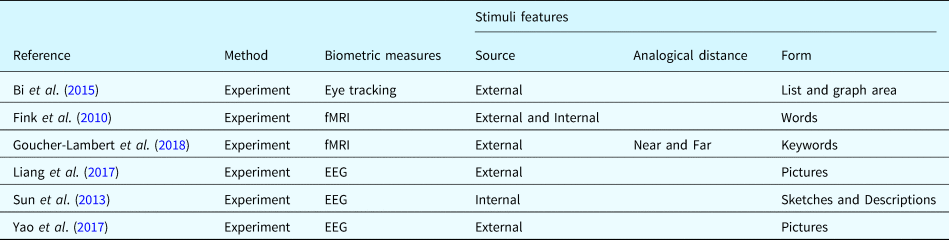
There is limited research on neurophysiological aspects of idea generation investigating the role of stimuli. Although the study of these processes at the neurocognitive level is fundamental for deepening the understanding of design cognition, only a small minority of contributions (6 out of 47) included in this review have investigated the role of stimuli by analyzing neurophysiological signals, as depicted in Table 6. Consequently, only certain features of inspirational stimuli have been investigated adopting the neurophysiological approach and the comparison with the protocol studies results is not always possible.
Stimuli features investigated in neurophysiological studies

The limited number of articles may be due to neurophysiological measurements’ constraints on the definition of protocols and experimental setups. For example, fMRI techniques require the subject to be still and supine for the recording, which particularly limits the movements and gestures of the participants during the experimental activities. In EEG recording, even minor movements, such as breathing or eye-moving, can impair the quality of the recorded signal. Despite their limitations, biometric techniques offer great advantages as their precision and sensitivity allow the collection of objective and realistic data for design cognition.
Internal stimuli
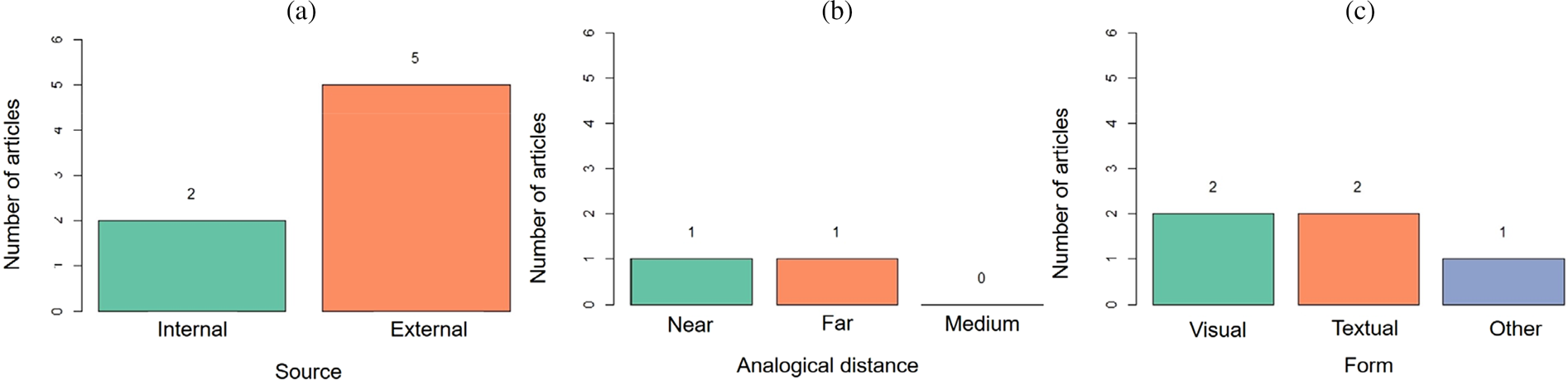
Most of the neurophysiological contributions included in this review (four out of six) have investigated only the role of external sources of inspiration; one paper has focused on internal sources, and the last contribution has compared internal and external stimuli, as in Figure 6a.
Stimuli features investigated in neurophysiological studies: (a) source of stimuli, (b) analogical distance, (c) form.

Fink et al. (Reference Fink, Grabner, Gebauer, Reishofer, Koschutnig and Ebner2010), by investigating fundamental cognitive processes in the early stages of design from the neuropsychological perspective, observed that the unfolding of creative processes at the cognitive level involves the deactivation of parieto-temporal regions, which is crucial during the activity of retrieval from memory of internal stimuli occurring in the initial stages of design. The same authors, investigating idea generation tasks, noted that in the experimental condition without stimuli, such activation is greater than in the conditions in which participants exploit their initial ideas (internal stimuli), or ideas generated by other people (external stimuli). The deactivation of parieto-temporal regions and activity in the alpha band results in the inhibition of potential external stimuli. Sun et al. (Reference Sun, Xiang, Chai, Wang and Liu2013) proved that describing ideas helps designers identify possible gaps in their solutions.
External stimuli
Regarding the active research for external stimuli as sources of inspiration, Hay et al. (Reference Hay, Cash and McKilligan2020) observed that understanding and interpreting stimuli or ignoring them involves the performance of numerous cognitive processes that interact with each other, including perception, which consists of the processing of sensory information, semantic processing, and attention.
The analogical distance
Although analogical distance largely influences the idea generation process, only one of the neurophysiological studies focused on it, as in Figure 6b.
• The analogical reasoning. Through fMRI, Goucher-Lambert et al. (Reference Goucher-Lambert, Moss and Cagan2018) observed that the cognitive mechanisms related to the valuable exploitation of stimuli differ based on analogical distance. The authors pointed out that the pre-frontal cortex is the area most involved during the analogical reasoning processes in the early stages of the design, since it is responsible for retrieving from memory information regarding the analogies and assessing the analogical distance. In addition, the authors noted that, in general, stimuli are helpful when they guide internal attention to memory, as shown by near stimuli.
• Near versus far stimuli. Goucher-Lambert et al. (Reference Goucher-Lambert, Moss and Cagan2018), through fMRI, observed that the cognitive processes carried out by designers when they are provided with a near stimulus recognized as useful, differ from the case when the designer individually seeks new sources of inspiration as a reaction to stimuli considered to be too distant to be a good source of inspiration. Experimental results have shown that near stimuli in textual form involve a process defined as “inspired internal search”, activating the left hemisphere's bilateral temporal and parietal areas, enhancing abstract thinking, and ensuring greater productiveness in design problem-solving. On the other hand, the condition with a far stimulus activated both the process of inspired internal search and unsuccessful external search since a far stimulus is not always considered a good source of inspiration by the designer. The designer, therefore, activates an inspired internal search process if the far stimulus is perceived to be useful. Otherwise, the stimulus is ignored, according to the process of unsuccessful external search. Consequently, a new phase of primary visual elaboration is activated, resulting in an active search for stimuli in the external environment. Finally, the results of this experimental study highlighted that nearer stimuli improved the usefulness and feasibility of new solutions, thus being the type of stimuli with the greatest impact in assisting designers during the generation of new ideas.
The form/modality of representation
The form/modality of representation is investigated in five out of six neurophysiological contributions, as in Figure 6c.
• Visual. Through eye-tracking, Bi et al. (Reference Bi, Shergadwala, Reid and Panchal2015) demonstrated that visual stimuli make the human brain more able to identify data relationships and patterns. Liang et al. (Reference Liang, Lin, Yao, Chang, Liu and Chen2017) investigated the phenomena of visual attention and visual association in the case of expert participants, because these two phenomena influence designers’ creativity. Visual attention is the process carried out by the frontoparietal region of the cerebral cortex, through which the selection of received information and input and its reprocessing based on the designer's goals takes place, neglecting all other received information. Visual association is the phenomenon through which a connection is built between the source and target of the analogy; it is related to alpha band activation in the central region of the cortex and gamma band activation in different areas of the brain. Yao et al. (Reference Yao, Lin, King, Liu and Liang2017) found that this process is strongly related to frontal and pre-frontal brain activity, focusing on visual association through EEG signals.
• Textual. Employing fMRI, Goucher-Lambert et al. (Reference Goucher-Lambert, Moss and Cagan2019) found that temporal brain regions are particularly important for the interpretation of this form of stimuli. These regions are involved in the semantic processing activity of texts and the recognition of textual concepts. In the same way, Fink et al. (Reference Fink, Grabner, Gebauer, Reishofer, Koschutnig and Ebner2010) noted temporoparietal activation in the right hemisphere in experimental conditions involving textual stimuli, while Sun et al. (Reference Sun, Xiang, Chai, Wang and Liu2013) observed centrotemporal activity in their experimental contribution.
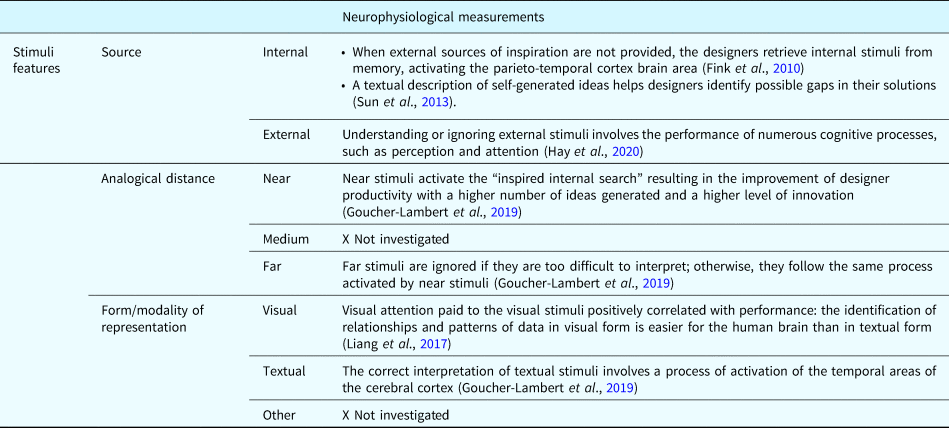
Summarizing again, Table 7 highlights the main findings from neurophysiological measurements.
Main findings on the role of stimuli from neurophysiological studies

Stimuli features comparison between the two approaches
Table 8 presents the main findings from the studies that have adopted protocol analyses and neurophysiological measurements. This table shows the comparison of results for each feature of stimuli. Contributions from the two approaches have often investigated the role of stimuli and cognitive processes using different experimental protocols and identifying nonstandard or differently defined variables.
Comparison of protocol and neurophysiological studies on the role of stimuli

In view of that, we now attempt to assess the consistency of the results of the protocol and neurophysiological studies, based on the features of the stimuli investigated.
Other factors influencing idea generation
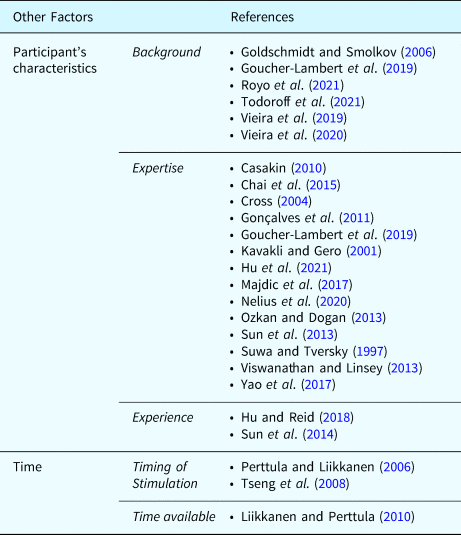
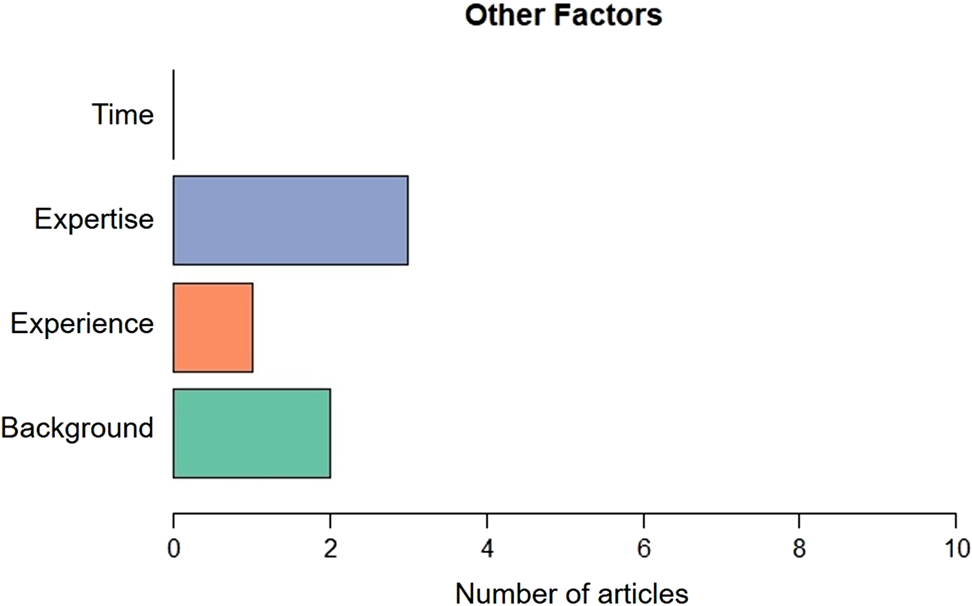
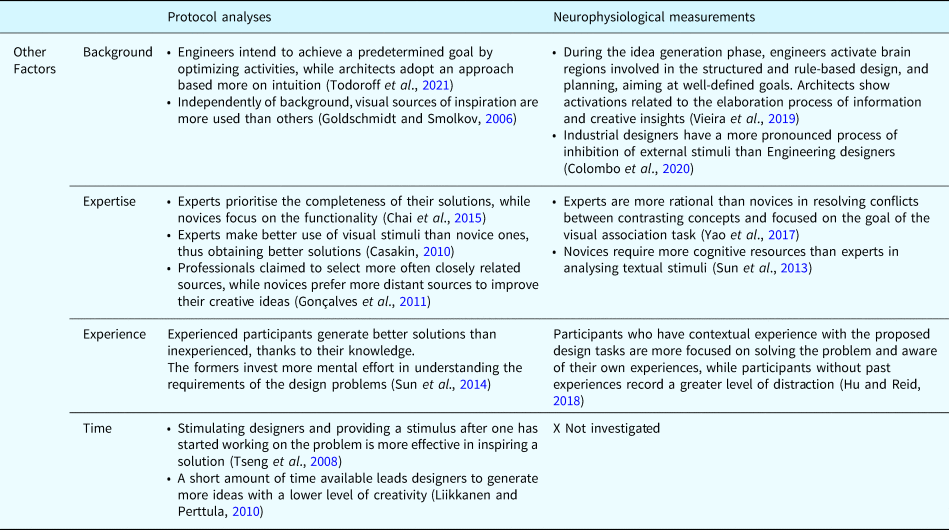
Some other factors were identified during the literature analysis as factors influencing participants’ performance in experimental studies. External factors in this review include the concept of background, expertise, and personal experience of participants, as well as the time, as in Table 9.
Other factors in the design literature

Other factors from protocol studies
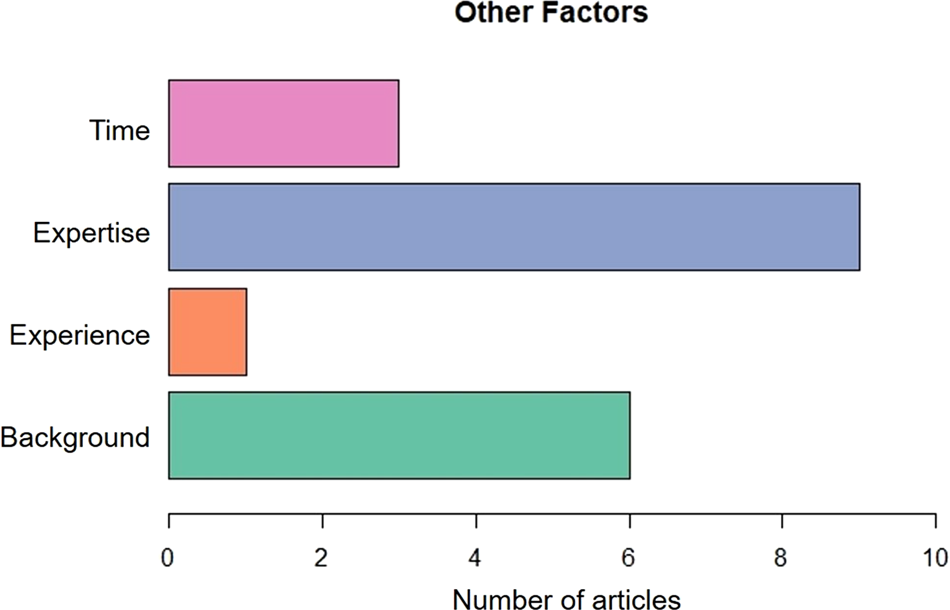
Knowledge background and expertise, as shown in Figure 7, are the mainly investigated factors concerning participants, because they can influence designers’ approach to generating more original ideas (Cardoso and Badke-Schaub, Reference Cardoso and Badke-Schaub2011).
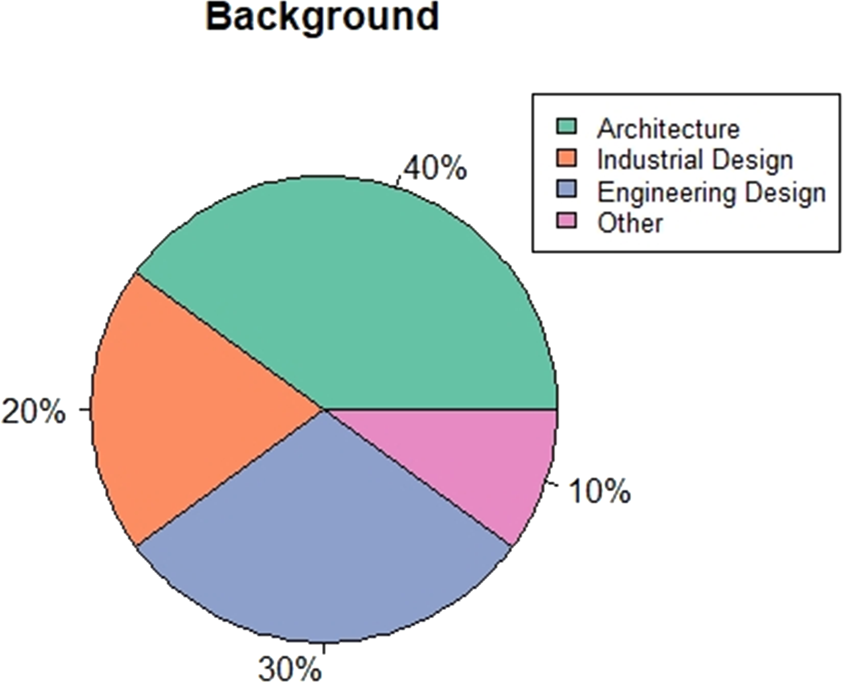
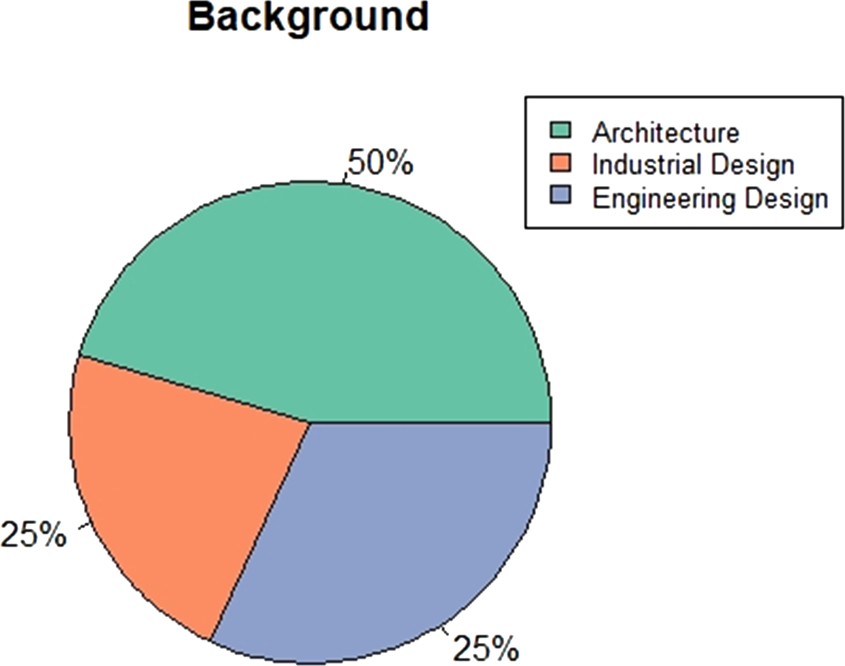
• Background. The majority of experiments conducted in the engineering and industrial design domain involve especially architects and engineers as participants, as in Figure 8. A small proportion of the selected experimental studies also involved participants from other backgrounds, such as Civil Engineering, Mechanical Engineering, Computer Science, Social Science, and Fine Arts disciplines. These disciplines have been included under a single category called “Other” in Figure 8. Investigating the background influence on the design process, Todoroff et al. (Reference Todoroff, Shealy, Milovanovic, Godwin and Paige2021) pointed out some differences between engineers and architects. The former intend to achieve a predetermined goal by optimizing activities, while the latter adopt an approach based more on intuition. Goldschmidt and Smolkov (Reference Goldschmidt and Smolkov2006) stated that visual information is used more than textual, which is fairly independent of the background. However, experiments that involved participants from the engineering or industrial design domain tended to explore the role of stimuli with different and mixed features (Goucher-Lambert et al., Reference Goucher-Lambert, Moss and Cagan2019; Royo et al., Reference Royo, Mulet, Chulvi and Felip2021), but these studies seldom control for the background factor. Conversely, experiments involving participants from architecture focused mainly on visual stimuli and on the practice of sketching self-generated ideas (Purcell and Gero, Reference Purcell and Gero1992; Suwa and Tversky, Reference Suwa and Tversky1997; Goldschmidt and Smolkov, Reference Goldschmidt and Smolkov2006; Ozkan and Dogan, Reference Ozkan and Dogan2013), probably because sketching is the way architects are trained to improve their ideas during their studies (Bilda et al., Reference Bilda, Gero and Purcell2006). Focusing on external stimuli, Akin (Reference Akin2002) observed that architects exploit design “cases” more for comparing and evaluating their own ideas than as a source of inspiration. In fact, information and data from design “cases” and examples are often unstructured and implicit, and their use as potential sources of inspiration requires a lot of effort. In this regard, Eilouti (Reference Eilouti2009) proposed precedent based-design models that recycle the intrinsic knowledge in the previous solution examples representing the information and data in more explicit forms, such as prototypes, to make stimuli more accessible to designers.
• Expertise is the external factor most investigated by the contributions with the protocol analysis approach cited in this review. Casakin (Reference Casakin2010) observed that experts use visual stimuli better than novices, thus obtaining better solutions. In experimental conditions with no explicit instructions to use stimuli, expert architects were more able to spontaneously search for visual sources of inspiration and concrete objects as stimuli in the external environment. Gonçalves et al. (Reference Gonçalves, Badke-Schaub and Cardoso2011) highlighted some differences between expert and novice designers searching for and managing external stimuli during the initial phase of the design process. Professionals claim to select closely related sources, while novices prefer more distant sources to improve their creative ideas. In the end, Chai et al. (Reference Chai, Cen, Ruan, Yang and Li2015) noted that experts and senior students prioritize the completeness of their solutions, while junior students focus on functionality.
• Experience. The influence of experience is investigated in only one study with Protocol Analysis. Sun et al. (Reference Sun, Yao and Carretero2014) investigated the effect of this factor on the creative performance of engineers in solving a design task consisting of a textual delivery and a picture. Experienced participants obtained better solutions than the inexperienced, thanks to their knowledge and strategies to improve new concepts, but invested more mental effort in understanding the requirements of the design problems. Consequently, more work experience and prior knowledge about the task domain and design process imply a better use of design strategy.
• Time. In this review, only three papers based on protocol analysis studied the idea generation process focusing on the time factor; other contributions mention the time factor but do not use it as a control variable.
Vasconcelos and Crilly (Reference Vasconcelos and Crilly2016) defined the instant when stimuli are provided to the participant as the “timing of stimulation”. Perttula and Liikkanen (Reference Perttula and Liikkanen2006) showed that the exposition of participants to examples of existing solutions, before the process of idea generation, caused the exploration of fewer new possible solutions categories than those explored providing the stimulus during the process. Tseng et al. (Reference Tseng, Moss, Cagan and Kotovsky2008) observed that providing stimuli after designers have started working on the problem is more effective, but the effect of the timing of stimulation also depends on the analogical distance. Stimuli that are more distant from the task domain have a greater impact on generated ideas if provided after the participant has received the problem. Conversely, stimuli related to the task domain seem to affect the generation of new ideas even if provided before the problem.
In the end, Malaga (Reference Malaga2000) observed that the number of participants’ ideas depends not only on the form of the stimulus or the distance of the analogy but also on the amount of time available to generate new solutions. Liikkanen and Perttula (Reference Liikkanen and Perttula2010), focusing on the time factor, demonstrated that a short amount of time available could lead designers to generate more ideas with less creativity.
Other factors investigations in protocol studies.

Background in protocol studies.

Other factors from neurophysiological studies
Among the other factors in neurophysiological studies, the expertise is the most investigated, followed by background and experience, as in Figure 9.
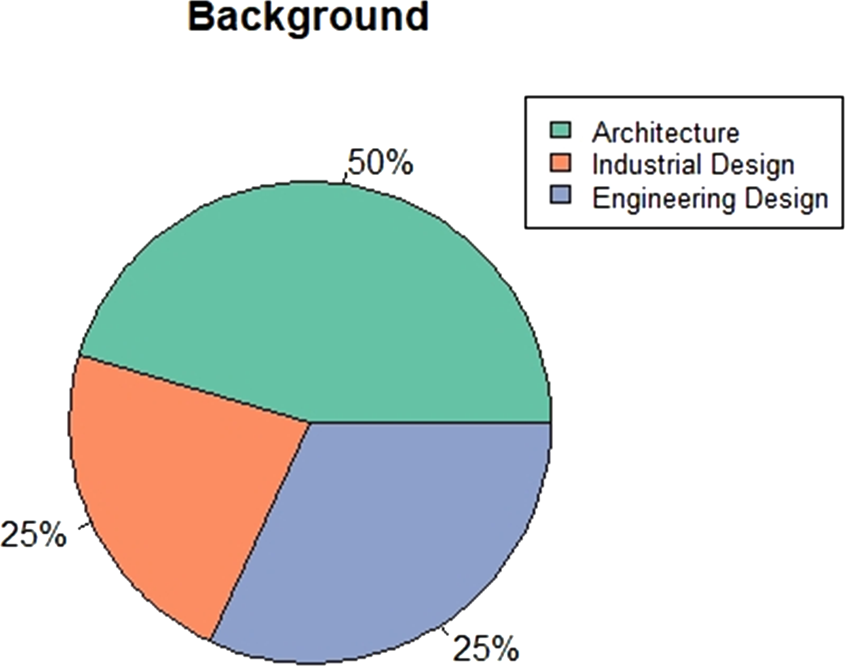
• Background. The experimental results of neurophysiological contributions show that educational background impacts design activities; in most experimental studies, participants have an engineering background, followed by industrial design and architecture, as in Figure 10. Vieira et al. (Reference Vieira, Gero, Delmoral, Gattol, Fernandes and Fernandes2019), comparing EEG signals from experts in mechanical engineering and architecture during the resolution of a textual task combined with visual stimuli, demonstrated that the formers activate regions (left pre-frontal cortex) involved in the structured, rule-based design, and in planning aimed at well-defined goals. In contrast, the latter show different activations (temporal and occipital right cortex) related to the elaboration process of information and creative insights while generating new ideas. Investigating the differences between engineering and industrial design students, Colombo et al. (Reference Colombo, Mazza, Montagna, Ricci, Dal Monte and Cantamessa2020) found that in the latter, the process of inhibition of external stimuli is more pronounced than in engineers.
From the analysis of selected contributions for this review, there is no evidence of the difference in neurophysiological signals due to different features of stimuli and different participants’ backgrounds.
• Expertise. As with Protocol Analyses, expertise is the most investigated external factor among neurophysiological studies. Vieira et al. (Reference Vieira, Gero, Gattol, Delmoral, Li, Cascini and Fernandes2020) found that novice designers generating new ideas for a textual problem with visual stimuli, showed more brain activity than the experts and, as a consequence, different levels of cognitive effort. In other experimental conditions with visual stimuli, Yao et al. (Reference Yao, Lin, King, Liu and Liang2017) observed differences in EEG signals between expert and novice participants. Both hemispheres’ activation resulted in experts, while novices showed only the activation of the right hemisphere. Moreover, experts appear to be more rational than novices in resolving conflicts between contrasting concepts and focused on the goal of the visual association task. Analyzing the effect of textual stimuli, Sun et al. (Reference Sun, Xiang, Chai, Wang and Liu2013) pointed out that novices require more cognitive resources than experts, probably because of their unfamiliarity with the design process. In addition, recorded signals from novice designers’ posterior and occipital brain regions indicate a low level of creativity among these participants.
• Experience. The definition of expertise has rarely been distinguished from the contextual experience in the Design literature, with only one contribution from the Neurophysiological approach. Hu and Reid (Reference Hu and Reid2018) defined contextual experience as the tacit knowledge accumulated in real and concrete personal experience in using a particular product or solving a situation in a given context. This particular distinction is due to the different points of view adopted by Cognitive Neuroscience in Design research. Contextual experience influences the cognitive processes during design, since it can cause changes in the level of distraction and in the use of the working memory that is usually related to creative performances leading to novel ideas. As a consequence, the authors noted that participants with contextual experience with the proposed design tasks are more focused on solving the problem and aware of their own experiences. Conversely, those without past experiences recorded a greater level of distraction. Usually, they try to recover from memories of past experiences and remote ideas that could be adopted for solving the design task.
Other factors investigations in neurophysiological studies.

Background in neurophysiological studies.
The effect of other factors, such as the timing of stimulation and the time available, have not yet been studied, and this gap in the Design literature might suggest future studies.
A comparison between the two approaches on the other factors
In the end, Table 10 compares the results between studies that adopted protocol analysis and neurophysiological measurements to investigate each factor.
Comparison of protocol and neurophysiological studies on the other factors

The analysis of the literature has shown that the gender of participants is a factor scantly explored in experimental studies about stimuli. In the literature, Vieira et al. (Reference Vieira, Benedek, Gero, Cascini and Li2021) investigated the frequency bands and brain areas of activation of males and females during idea generation for problem-solving tasks. The analysis revealed males involve cognitive functions of visual–spatial memory coordination, planning, inductive reasoning, and search for originality. Females activate visuospatial information, visual mental imagery, and reasoning cognitive functions. However, this study, although investigating open versus constrained design tasks, did not consider the role of stimuli. About the effect of gender in stimuli exploration, only two contributions are present in the literature and they are with protocol analysis. Through a survey, Todoroff et al. (Reference Todoroff, Shealy, Milovanovic, Godwin and Paige2021) observed that women outperform men in design thinking ability, but the effects of gender are negligible if compared with the background factor. In addition, Goldschmidt and Sever (Reference Goldschmidt and Sever2011) found no significant difference between male and female participants in using textual stimuli to solve a design problem.
The limited investigation in the literature of the gender variable, specifically in gender effect on the use of inspirational stimuli, has led to not including it as a criterion of comparison in this review. If this gap represents a limitation for such a review, on the other side, it offers insights for future analyses and contributions to the literature.
The resulting framework
The literature analysis on the role of stimuli has revealed the lack of shared evidence from experimental studies or conflicting results; in some cases, this is due to the diversity in the methodological approaches adopted.
Studies from neurophysiology are still in their infancy and not all the studies exhibit the same depth of investigation. In other cases, the experimental variables from protocol and neurophysiological studies have the same object of design research but are investigated differently; consequently, comparing the evidence gained from these two approaches is often not possible.
Moreover, experimental results are difficult to generalize due to the lack of homogeneity of experimental protocols. Design tasks are countless due to the pervasive nature of Design (Gero, Reference Gero2011) and different authors rarely reuse the same design problems (Patel et al., Reference Patel, Elena and Summers2019). Moreover, researchers have not yet defined a standard structure for design problems nor a standard indicator for their difficulty nor a standard evaluation approach (Kumar and Mocko, Reference Kumar and Mocko2016; Sosa, Reference Sosa2019). Also, the research methodology, protocol analysis or neurophysiological measurement influences the design of the experiment and the experimental setup. Therefore, it is not unsurprising to see some contradictions emerge from the different experiments.
Finally, the literature analysis highlights the use of different metrics to evaluate idea generation performance. Some contributions evaluate only some performance metrics or metrics specific to the protocol employed, regardless of the level of detail of the solutions provided and the available time for idea generation. Hence, the comparison of the results becomes complicated.
Nevertheless, the comparison of the protocol and the neurophysiological studies has evidenced a fundamental difference. According to the neurophysiological measurements approach, only stimuli that activate the “inspired internal search” process are useful to the designer and these are the only ones that support the designer in improving creative performance. On the other hand, the protocol studies affirm that the designers’ performance is better than when no stimulus is provided, regardless of the form and timing presentation of the stimulus.
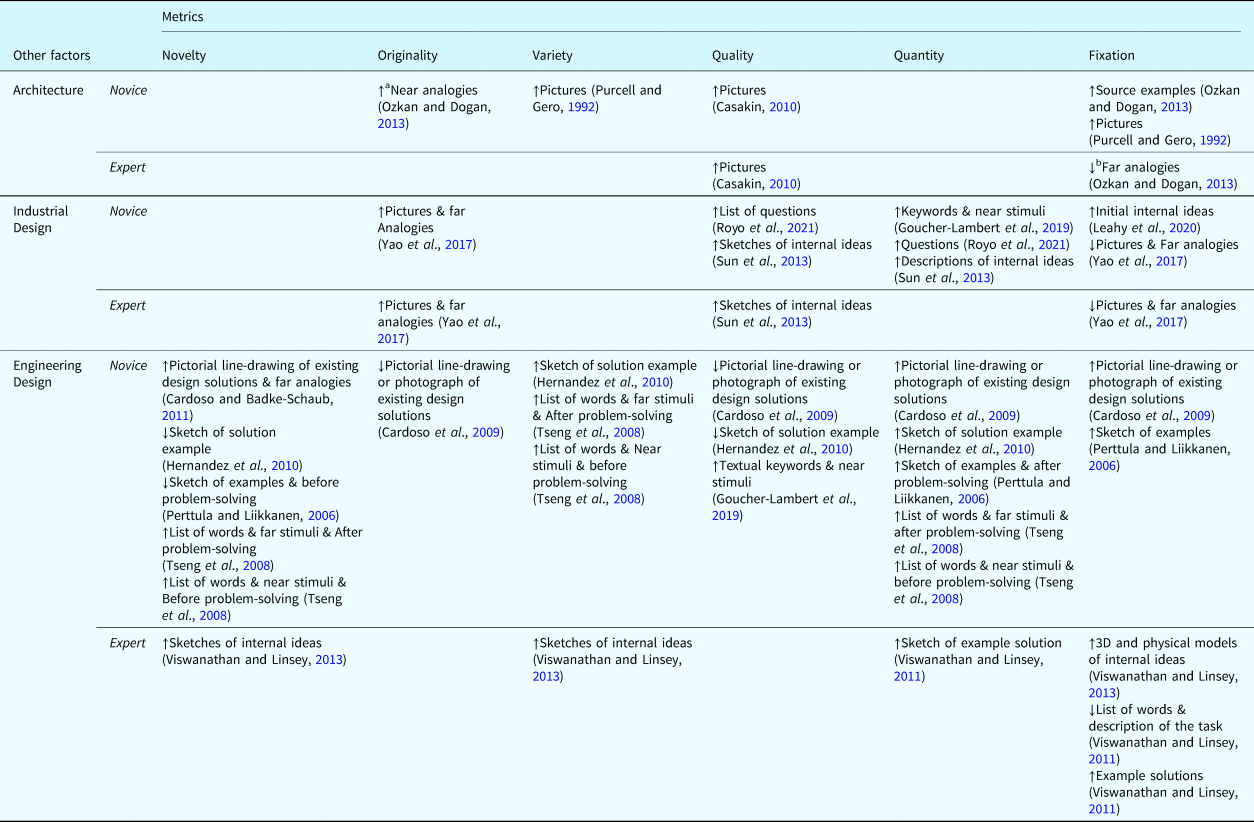
Moreover, both strands of research have shown the effect of stimuli in design also depends on other factors, such as subjects’ background, expertise, and experience. These findings, combined with the idea generation evaluation metrics, can therefore be incorporated into an original framework for selecting the most appropriate stimuli. The framework shows how metrics such as novelty, originality, variety, quality, and quantity of ideas generated by designers can be improved by specific types of stimuli, according to their backgrounds, such as Architecture, Industrial Design, or Engineering, and according to their level of expertise, novice or expert.
Therefore, the paper attempts to propose a framework that aims to deepen the literature by tidying up and clarifying the research results on the role of stimuli in design. The framework, as in Table 11, combines evidence from the contributions with protocol analyses and neurophysiological measurements that analyze the features of the stimuli, together with at least one of the other factors.
The framework of stimuli selection

a ↑Stimuli associated with this symbol have a positive effect on the performance metric.
b ↓Stimuli associated with this symbol have a negative effect on the performance metric.
Hence, the background factor on the table's rows distinguishes between Architecture, Industrial Design, and Engineering Design. Two levels of expertise are determined for each background: novice and expert. Due to the low number of contributions focused on the role of experience in design with stimuli, the factor “experience” is not included here.
The columns contain the most relevant and common performance metrics highlighted in the literature. In the cells, the results from the literature regarding the most appropriate types of stimuli concerning the background and expertise in the row are entered, considering the effect of these sources of inspiration on the metrics reported in the column. Each result in the cell, with the respective reference, is preceded by an arrow, upwards or downwards, depending on whether the stimulus cited has, on the performance metric considered, a positive or negative effect, respectively.
Consequently, the framework provides aid in two different ways. On the one hand, it shows what kind of stimuli can enhance each metric if the background and the level of expertise are defined a priori. For example, selecting “Industrial Design” as the background and “novice” as the level of expertise, the description of initial ideas results in increasing the quantity metric and raising the fixation level. On the other hand, knowing the metric of interest, it is possible to find out the stimuli features that can impact it based on background and expertise. For a practical example, the “fixation” column shows that distant analogies are the best solution to prevent this phenomenon in experts from architecture and industrial design.
This framework shows how this structured review is not only a useful classification of the literature, summarizing the most significant and recent results but also a guide for professionals who need sources of inspiration in their design activity. Design managers may also use this guide not only to define optimal working conditions for designers, by selecting the most appropriate stimulus and the best combination of possible sources of inspiration but also to achieve better results in terms of performance metrics.
Finally, the framework can be used as a guide by researchers in the design literature as it represents a seminal literature framework to place new findings and newly acquired evidence. Therefore, it can be enriched and updated and represent an evolving guide for those involved in this field of research. The framework also highlights those aspects of the literature that still need to be investigated, thus providing researchers with pointers to new research opportunities.
Conclusion
This review aims to explore the role of stimuli and other factors during the idea generation phase in design problem-solving, comparing two main streams of the design literature, the ones that adopt protocol analysis and those supported by neuropsychological measurement.
From the perspective of protocol studies, stimuli always improve the performance of designers. On the other hand, from the perspective of neurophysiological studies, only stimuli that activate the “inspired internal search” cognitive process are useful for generating new ideas.
In order to answer the research question about the consistency of findings on stimuli features from the protocol and neurophysiological studies, complementary results have been found.
Both protocol and neurophysiological approaches agree that the textual representation of self-generated ideas can concretely act as sources of inspiration.
Regarding the external stimuli, protocol studies conclude that distant stimuli are often ignored since they require much effort for interpretation. Neurophysiological studies point out that design cognitive processes change according to analogical distance; distant stimuli involve the same cognitive process of near stimuli if recognized as a potential source of inspiration; otherwise, they are ignored and new sources of inspiration are sought in the external environment.
Regarding the form, visual stimuli are preferred to textual ones since, from neurophysiological studies, they improve the designer's ability to recognize data connections. Conversely, textual stimuli require much effort, probably because they need specific cognitive processes for comprehension.
For a comprehensive analysis of the role of stimuli and to answer the research question about the external factors that influence the idea generation process and outcomes, it has been found that the background of designers affects the individual approach to design activities; as consequences, engineers and architects activate different cognitive processes while generating ideas. Both protocol and neurophysiological studies agree that engineering designers follow well-structured processes to achieve predetermined design goals. In contrast, others adopt approaches based on processing information through intuition and creativity. No detailed results about industrial designers are available from protocol and neurophysiological studies for a consistent comparison.
Regarding expertise, both protocol and neurophysiological results agree on the higher ability of experts to be inspired by stimuli with less effort than novices. No specific conclusions are drawn from protocol and neurophysiological studies about how novices and experts handle different types of stimuli.
Finally, experienced designers may perform better due to their prior knowledge; the neurophysiological studies add that they are more focused on the design problem without distractions, in line with protocol studies results pointing out that experienced designers invest more mental effort than inexperienced designers.
For some stimuli’ features, such as the other forms of internal and external stimuli, and other factors, such as time and gender, the comparison has not been possible, due to the absence of findings in the literature.
The final framework summarizes the literature results based on individual characteristics of the designers, such as background and expertise with performance metrics, also referring to the phenomenon of fixation. It finds application as a guideline for designer managers to select stimuli with ad hoc features, improving design performance and concretely supporting designers with a specific background and expertise. As a research tool, the framework consists of empty cells to be filled. It highlights the gaps in the literature and suggests new aspects yet to be investigated. In the future, the framework provides a base to be enriched with new evidence. It can also be used to collect new results from the literature.
Data availability statement
The contributions that support the findings of this study are available on Scopus and Google Scholar.
Funding
This work received no specific grant from any funding agency, commercial or not-for-profit sectors.
Competing interests
The author(s) declare none.
Graziana Blandino is a first-year Ph.D. student at the Department of Management and Production Engineering of Politecnico di Torino. The main objective of her Ph.D. study is to identify the main causes of human stress at the neurophysiological level within manufacturing contexts. She graduated from Politecnico di Torino with a bachelor's degree in Biomedical Engineering and a master's degree in Management Engineering. Her current research activities involve collaboration with a multidisciplinary consortium on a European-funded project aimed at developing a real-time stress monitoring system to be used in real manufacturing applications. She is member of A.I.TE.M. and of Design Society.
Francesca Montagna (PhD), is Associate Professor at Politecnico di Torino. Research topics rangefrom Innovation Management, Technology Management and Engineering Design. Lecturing has been carried out at Industrial Engineering and Management programs, Mechanical Engineering, Industrial Design and Data Science ones. She is member of Design Society, serving its advisory board. She usually serves as reviewer on conferences (e.g. ICED, DESIGN and IFAC-INCOM) and journals (e.g.RED, IJATM, JPME), collaborates with public or private organizations on research and consultancy projects in the fields of Innovation Management, Product and Service Design, Marketing. She is evaluator of projects at national as international level.
Marco Cantamessa is Professor at the Department of Management and Production Engineering of Politecnico di Torino, where he teaches Management of Innovation and Product Development. He has lectured at European universities and business schools and authored papers in the fields of manufacturing systems engineering, management of innovation and engineering design. He has covered senior academic positions at Politecnico di Torino and currently serves as Rector's delegate for Strategic Assessment and Planning. He has been founding member of The Design Society, serving on its Boards, and covered a number of board-level positions in public and private institutions.
Samuele Colombo is a third-year PhD sudent at the Department of Management and Production Engineering at Politecnico di Torino (Italy). His research focuses on the neurophysiological and psychological aspects of decision-making,especially during conceptual design activities. His background is in engineering and management. Indeed, his research group and his teaching activities focus on innovation management and product development. He has actively collaborated with several university both at national and international level. As international experiences, he has spent visiting periods at University of California, Berkeley (USA) and Lulea Technological University(Sweden). He is member of The Design Society.