





The brain is specialised in processing rewards, a function essential for survival from an evolutionary perspective. Reference Schultz1 In today’s industrialised world, accessing rewards is much easier, and the brain responds strongly to rewards that are not necessarily related to survival, including intense effects of certain drugs and online behaviours such as gaming, buying and/or shopping, pornography use and social networking. Reference Nall, Heinsbroek, Nentwig, Kalivas and Bobadilla2,Reference Brand3 Although principally advantageous, the reward system can now drive excessive engagement in specific internet activities, leading to types of problematic usage of the internet (PUIs), with severe consequences for physical, mental and social health. Reference Brand3,Reference Fineberg, Menchón, Hall, DellOsso, Brand and Potenza4
The term PUI encompasses a broad spectrum of behaviours that are associated with negative consequences owing to excessive engagement. Reference Fineberg, Menchón, Hall, DellOsso, Brand and Potenza4 Although certain forms of PUI share aetiological similarities with addictive behaviours (e.g. gaming, buying and/or shopping, pornography use and social network use), others may resemble features of obsessive–compulsive disorders (e.g. cyberchondria Reference Vismara, Caricasole, Starcevic, Cinosi, Dell’Osso and Martinotti5 ). Global prevalence rates for PUIs are estimated at 7–9%, with specific behaviours such as gaming showing lower rates of 2–6%. Reference Pan, Chiu and Lin6,Reference Meng, Cheng, Li, Yang, Zheng and Chang7 The clinical relevance of PUIs has led to the classification of online gaming disorder as a disorder due to addictive behaviours in the ICD-11. 8 These disorders are marked by impaired control, prioritisation of the behaviour and continuation despite negative consequences, causing distress or functional impairment for at least 12 months. The classification of other addictive PUIs in addition to gaming and gambling in this category has been discussed; these PUIs include buying and/or shopping, pornography use and social network use. Reference Brand, Rumpf, Demetrovics, Mu, Stark and King9,Reference Rumpf and Montag10 In the present study, we focused specifically on those PUIs that have been discussed in the literature as potentially addictive in nature.
Cue reactivity in PUIs
The brain’s reward system directs our attention toward cues associated with rewards and guides our behaviour to pursue them, a process known as cue reactivity. Reference Drummond11 Cue reactivity has been shown to evoke intense desires to engage in rewarding behaviours, referred to as craving in the context of addiction. Craving is recognised as a clinical feature of addictive disorders in the ICD-11, and both cue reactivity and craving are linked to engagement in the relevant behaviours, Reference Antons, Trotzke, Wegmann and Brand12,Reference Serre, Fatseas, Swendsen and Auriacombe13 as well as relapse. Reference Vafaie and Kober14,Reference Hawker, Merkouris, Youssef and Dowling15 Cue-reactivity responses develop through associative and instrumental learning and incentive sensitisation of the brain’s mesolimbic dopamine system and cognitive biases regarding the motivation to engage in the behaviour or expected value. Reference Brand3,Reference Rose, Field, Franken, Munafò and Miller16 These responses can be triggered in the natural environment. For example, a person with gaming disorder may experience cue reactivity when seeing an in-game scene in an advertisement for a computer game or even just a computer or smartphone. Today, as most people carry mobile devices that enable constant access to internet activities, avoiding these cues is increasingly difficult. Therefore, cue reactivity is assumed to be a central mechanism leading to diminished control in individuals with PUIs.
In laboratory settings, cue-reactivity paradigms are used to investigate the mechanism of cue reactivity. The paradigms generally consist of addiction-related stimuli and neutral or addiction-unrelated stimuli that can be visual, auditive, audio-visual, olfactory or gustatory. After presentation of a stimulus or after blocks of one type of stimulus, subjective ratings (e.g. urge, arousal and valence) are assessed as indicators of the symbolic–expressive component of cue reactivity. Some studies have also assessed physiological (electrodermal response and heart rate), neural or behavioural cue-reactivity responses (e.g. with neuroimaging techniques and ambulatory assessments). Reference Vafaie and Kober14,Reference Starcke, Antons, Trotzke and Brand17
Evidence from classical cue-reactivity studies indicates that individuals with specific behavioural addictions, especially gambling disorder and gaming disorder, may present similar cue-reactivity responses to individuals with substance use disorders. Reference Starcke, Antons, Trotzke and Brand17,Reference Antons, Brand and Potenza18 However, these studies have often included convenience samples without clinical diagnosis, and there has been a lack of studies investigating cue reactivity in specific forms of PUI with samples of individuals with non-problematic or recreational use, risky use and pathological use, as indicated by diagnostic interviews. In addition, most such studies have used explicit behaviour-related stimuli, for example, explicit images from gaming scenes Reference Dong, Wang, Liu, Liang, Du and Potenza19 or explicit pornographic material. Reference Laier, Pawlikowski, Pekal, Schulte and Brand20 As explicit images represent the rewarding content of the internet activity, it has been argued that the responses may not be due to learned cue reactivity but are rather simple reactions to rewards themselves. Reference Gola, Wordecha, Marchewka and Sescousse21 The rewarding content could, for example, be explicit pornographic material or ‘likes’ in social networks. Reference Gola, Wordecha, Marchewka and Sescousse21,Reference Hendrikse and Limniou22 However, on the basis of conditioning theories, it is expected that with increasing symptom severity, individuals will show cue reactivity not only to the direct rewarding content but also to more distal cues, such as devices displaying starting or log-in screens without any explicit content related to the internet activity. Reference Brand3,Reference Brand, Wegmann, Stark, Müller, Wölfling and Robbins23 Cues can be even more distal, such as items in the environment present during the behaviour (e.g. a coffee mug on the table while engaging in the activity). However, these highly distal cues may vary from person to person, making systematic investigation more challenging. Therefore, devices displaying starting and/or log-in screens may represent cues that are distal enough to exclude explicit rewarding content yet proximal enough to be relevant across individuals engaging in the internet activity. Similarly, distal cues have been successfully used to induce craving in individuals with nicotine dependence. Reference Conklin, Robin, Perkins, Salkeld and McClernon24 As individuals with PUIs are constantly exposed to internet-enabled devices that may display content linked to their problematic behaviour, investigating cue reactivity in response to distal cues is crucial for understanding impaired control in such individuals. Another advantage of such cues is that they may be highly comparable across different target behaviours (e.g. the same pictures with devices showing log-in pages related to gaming, pornography, buying and/or shopping, and social network use); this allows fair comparison of PUI types and may also be useful in studies of potential generalisation of cue reactivity to devices themselves, regardless of the content displayed on the screen.
Objective of the current study
Building on theoretical considerations and previous empirical findings, in the current preregistered study, we aimed to investigate cue reactivity towards distal cues in specific addictive PUIs. Although the inclusion of specific PUIs in current diagnostic classification systems such as the ICD-11 and the DSM-5 supplement has been accompanied by proposed diagnostic criteria, addictive behaviours are understood to be multidimensional in nature and lack clear diagnostic thresholds. Reference Hasin, O’Brien, Auriacombe, Borges, Bucholz and Budney25 Moreover, the development of addiction is typically gradual and nonlinear and involves complex changes in affective and cognitive processes. Reference Konkolÿ, Woodin, Hodgins and Williams26,Reference Brand, Müller, Wegmann, Antons, Brandtner and Müller27 To explore the full spectrum of PUIs, it is therefore essential to investigate individuals who do not currently have the full clinical presentation of an addiction syndrome but may present with not completely unproblematic behaviours. Although it is possible that the risky use group in a cross-sectional study may also include, for example, individuals in remission or those who have remained in a risky state for an extended period without progressing to pathological use, we assumed that cue-reactivity in this group would be heightened compared with that of non-problematic users but less pronounced than that of individuals with pathological use. This heterogeneity is considered in the interpretation of the results.
Accordingly, we compared cue-reactivity responses (a) among individuals with pathological, risky and non-problematic use of the internet as indicated by structured diagnostic interviews (between-participants comparisons) and (b) between types of distal cues, i.e. distal cues related to the specific problematic internet activity (target behaviour) and those showing other (non-target behaviour) internet activities (within-participants comparison). We expected that subjective cue-reactivity responses towards distal cues showing the target internet activity would be higher in individuals with pathological engagement in internet activities compared with the corresponding responses towards non-target (control) cues. Overall, we expected that effects would be similar across different types of PUI. In this study, we focused on gaming, buying and/or shopping, pornography use and use of social networks. In addition, we (c) investigated associations between cue-reactivity responses assessed in the laboratory and measures of temptation and engagement in the behaviour in the natural environment; this was assessed for 14 days after the laboratory assessment using end-of-day-assessments. We expected that the cue-reactivity responses in the laboratory would be highly predictive of the degree of temptation and behavioural engagement in the natural environment.
Method
Preregistration
Preregistrations of the data acquisition procedures (https://osf.io/6x93n) as well as the analysis plan (https://osf.io/6btnm) can be found at the Open Science Framework (OSF) repository.
Study design and procedure
The data acquisition process and overall inclusion and exclusion criteria used by the multicentre addiction research unit FOR2974, funded by the Deutsche Forschungsgemeinschaft (DFG, German Research Foundation), have been described in detail by Brand et al. Reference Brand, Müller, Stark, Steins-Loeber, Klucken and Montag28 Data from four projects with recruitment at multiple sites in Germany between October 2021 and 31 August 2024 were included in the current analyses. For the within–between participants design, participants for the specific target groups of each project were recruited at treatment facilities (e.g. in-patient and out-patient clinics for psychosomatic medicine and psychotherapy) and universities, as well as via mailing lists, social media and local advertisements. Before coming to the laboratory, participants were prescreened by telephone for specific types of (potential) PUI on the basis of the DSM-5 criteria for gaming disorder modified for the specific target behaviour, potential group assignment, and further inclusion and/or exclusion criteria. Participants were assigned to one of three groups (non-problematic, risky or pathological) for specific PUIs (see the ‘Measures’ section for details). The diagnostic interview was repeated in the laboratory to confirm group allocation. All participants underwent the same diagnostic procedure and extensive laboratory testing, plus further project-specific measures which are not reported here (see OSF preregistrations for details).
Participants
Overall, n = 617 individuals were matched on the basis of age, gender and type of PUI. The final sample consisted of n = 536 (end-of-day-assessment: n = 501) participants between 18 and 65 years of age (mean 26.12, s.d. = 6.79, interquartile range: 22–28 years). Within these samples, there were no missing data regarding the variables included in the analyses. On the basis of the structured diagnostic interviews, the sample was divided into three groups, consisting of those with pathological (n = 133), risky (n = 135) or non-problematic (n = 268) use of the respective online activity. Characteristics of the sample by group are described in Table 1. Owing to the recruitment strategies of the individual projects, full matching was impossible. For example, one project included participants with non-problematic and pathological use of social networks but did not include individuals with risky use of social networks, leading to a low number of participants in this group. In addition, projects that investigated gaming and pornography use predominantly included male participants (gaming: male n = 94.5%; pornography use: male n = 100%), whereas projects in the context of shopping and social network use predominantly included female participants (buying and/or shopping: female n = 84.5%; social network use: female n = 98.6%). Accordingly, information on PUI type and gender may have been confounded. A brief description of the reasons for exclusion or drop-out is provided in Supplementary Material 1 available at https://doi.org/10.1192/bjp.2025.10379. The distribution of subprojects within the current sample and relevant project specifics are provided in Supplementary Material 2.
Descriptive statistics of the sample characteristics per PUI group

ACSID-11, 11-item Assessment of Criteria for Specific Internet-use Disorders; BSI, Brief Symptom Inventory Reference Derogatis and Spencer29 ; max., maximum; min., minimum; PUI, problematic usage of the internet.
a. Variables used in matching procedure.
b. Sample sizes slightly differed at end-of-day: non-problematic, n = 252; risky, n = 127; pathological, n = 122.
Measures
Definition of PUI groups
An adapted version of the Structured Clinical Interview for specific PUIs (AICA-SKI:IBS) by Müller et al Reference Müller, Beutel and Wölfling30 was used for structured diagnostic interview screening for symptoms of specific (potential) PUIs. The AICA-SKI:IBS is based on the nine DSM-5 diagnostic criteria for gaming disorder 31 and was supplemented with questions on functional impairment. Participants who fulfilled at least five criteria and reported functional impairments due to the respective online behaviour were classified as having pathological use. Those who fulfilled no more than one criterion without functional impairment were assigned to the non-problematic use group. The remaining individuals (with more than one and fewer than five criteria (n = 128) or with at least five criteria but without functional impairment (n = 7)) were assigned to the risky use group. Importantly, only individuals with one specific type of PUI were included; that is, those who fulfilled the diagnostic criteria for more than one type of PUI were excluded. The interviews were conducted by doctoral students in psychology, neuroscience or medicine who had received clinical diagnostic training and regular supervision by experienced clinicians.
Symptoms based on ICD-11 criteria
The 11-item Assessment of Criteria for Specific Internet-use Disorders (ACSID-11 Reference Müller, Wegmann, Oelker, Stark, Müller and Montag32,Reference Oelker, Rumpf and Brand33 ) was used to assess symptom severity of specific PUIs on the basis of the ICD-11 criteria: ‘impaired control’, ‘increased priority’, ‘continuation/escalation’ and ‘functional impairment/marked distress’. Each item was answered on two four-point Likert scales (frequency: ‘never’ to ‘often’; intensity: ‘not intense’ to ‘intense’). We used the frequency scale and dichotomised scoring of the ACSID-11 Reference Oelker, Rumpf and Brand33 with possible values between 0 and 4, reflecting the number of ICD-11 criteria fulfilled.
Cue-reactivity paradigm with distal cues
The cue-reactivity paradigm (Fig. 1) has been previously described by Diers et al Reference Diers, Müller, Mallon, Schmid, Thomas and Klein34 and was implemented using Presentation (version 22.1 for Windows; Neurobehavioral Systems, Inc., Berkeley, CA, USA; www.neurobs.com). A detailed description of the task and an overview of all relevant variables are presented in Supplementary Material 3. The distal cues showed devices displaying starting and/or log-in screens of either the target or a non-target internet activity, as well as hands interacting with one of four devices (smartphone, tablet, laptop or desktop computer; see examples of cues with devices in Fig. 1(a)). Given that specific devices (e.g. smartphones) can be used for multiple internet activities in addition to use of social networks, Reference Sohn, Rees, Wildridge, Kalk and Carter35 and that almost all specific internet activities can be done on multiple devices, participants were allowed to choose two of the four devices on the basis of the ones they normally used to engage in internet activity (see Supplementary Material 3c for frequencies of chosen devices per target behaviour and age group). The types of activity presented as non-target cues depended on the control group of the subproject. For example, in a project investigating gaming and pornography use, individuals invited owing to their gaming behaviour were presented with distal gaming cues as target cues and distal pornography cues as non-target cues. Conversely, the participants in the pornography groups were presented with the pornography cues as target cues and the gaming cues as non-target cues. The same approach was applied to social networks and shopping cues (i.e. buying and/or shopping pictures were used as target cues and social network pictures as non-target cues for the buying and/or shopping group, and vice versa; see Supplementary Material 2 for details). A schematic representation of the task consisting of four blocks (two with target cues and two with non-target cues) with 12 images per block is presented in Fig. 1. During each block, either target or non-target cues were presented. Pictures were rated regarding arousal, urge to engage in the behaviour shown in the picture and valence (representing the subjective cue-reactivity response as an immediate response towards the pictures). Viewing times were measured from the start of cue presentation until completion of the final rating. Before the first trial and after each (target or non-target) block, urges to engage in the target and non-target activities were rated on a visual analogue scale (0 ‘no urge at all’ to 10 ‘very strong urge’). These measures at the block-level represented a more picture-independent measure of the current urge to engage in the specific behaviour after viewing a block of one specific type of cue. Before and after the cue-reactivity paradigm (i.e. after two blocks of target cues and two blocks of non-target cues), craving (conceptualised as a multidimensional construct including reward craving, relief craving and urgency to engage in the target behaviour) was assessed using the Craving Assessment Scale for Behavioral Addictions and Substance-use Disorders (CASBAS Reference Antons, Trotzke, Wegmann and Brand12 ) (details of a further publication are available from the author on request). As the assessment followed presentation of both target and non-target cues, this measure of craving represented a persistent response to cues that lasted across blocks of varying stimuli. Accordingly, cue reactivity and craving were assessed at three levels: task level (before and after the task, multidimensional current craving), block level (before the first block and after each block, current urge) and picture level (after each picture had been presented, picture-specific subjective cue reactivity).
Experimental paradigm. (a) Examples of distal cues showing starting pages of the four internet activities and the four possible devices (all activity × device combinations were possible). (b) Structure of the cue-reactivity paradigm. The paradigm involved cue reactivity and craving measures at three different levels. Task level: before the cue-reactivity paradigm and directly after the cue-reactivity paradigm, participants were asked to answer questions from the CASBAS with respect to the target behaviour. Block level: at baseline before the experiment and after each block of 12 pictures, participants were asked to indicate their current overall craving with respect to both the target and non-target behaviours. Picture level: each picture was evaluated with respect to valence, arousal and urge to use the specific application shown at the picture.

Temptation and usage assessment in the natural environment
Following the laboratory assessment, most participants took part in a 14-day end-of-day assessment. Participants were asked questions about their level of temptation to engage in the behaviour (response scale: 1, not strong at all; 10, very strong), whether they engaged in the target behaviour and, if so, for how long they engaged in it (response scale: hours and minutes). Mean scores for temptation and total usage time over the 14 days were calculated.
Ethics
The authors assert that all procedures contributing to this work comply with the ethical standards of the relevant national and institutional committees on human experimentation and with the Helsinki Declaration of 1975, as revised in 2013. All procedures involving human participants were approved by the local ethics committee of the University of Duisburg-Essen (ID: 1911APBM0457), as well as the local ethics committees at each site. All participants were informed about the study protocol and provided written informed consent before participation. For pseudonymisation of the participant data across projects and to comply with the General Data Protection Regulation of the European Union, we used encryption-based pseudonymisation framework ALIIAS. Reference Englert, Schedlowski, Engler, Rief, Büchel and Bingel36
Statistical analyses and tools
R Studio (version 2024.04.02 for Windows; Posit Software, PBC, Boston, MA, USA; http://www.posit.co/) and the library MatchIt Reference Ho, Imai, King and Stuart37 were used for the two-step matching procedure with the nearest-neighbour matching method. Groups were matched with regard to age, gender and PUI type. For age matching, dummy variables for age groups in 5-year steps were generated. Nearest-neighbour matching is a straightforward and transparent approach that effectively reduces selection bias by pairing individuals with similar covariate profiles. This method is particularly suitable when a large pool of control participants allows for close matches. Here, we were primarily interested in comparisons between the pathological use group and the other two use groups. For this reason, and because the sample of individuals with pathological use was the smallest (n = 135), followed by the risky use (n = 214) and non-problematic use (n = 268) groups, we first matched the risky use group to the pathological use group. In a second step, the non-problematic use group was matched to the previously matched group of individuals with pathological and risky use. This procedure enabled us to adequately match participants regarding age and gender; however, we were unable to fully match groups regarding PUI type (see descriptive statistics of the prematched data in Supplementary Material 4), partially owing to the recruitment strategies used in the subprojects.
Statistical analyses were conducted with SPSS (version 29 for Windows; IBM, Armonk, NY, USA; https://www.ibm.com); t-tests were used for simple comparisons, and a chi-squared test of independence was used to analyse associations between group assignment and categorical variables. Repeated-measures analyses of variance were performed, with group (non-problematic, risky or pathological) as the between-participants factor and type of cue (non-target or target) or time point of rating (block level: at baseline, after non-target block, after target block; task level: at baseline, post-task) as the within-participants factor. Bonferroni correction was applied to post hoc pairwise comparisons between groups. We expected that effects would be similar across target behaviours. To account for possible differences across different target behaviours, we repeated analyses with type of target behaviour, age, gender and ethnicity (born in Germany) as covariates.
Results
Picture level: subjective cue reactivity (for each picture)
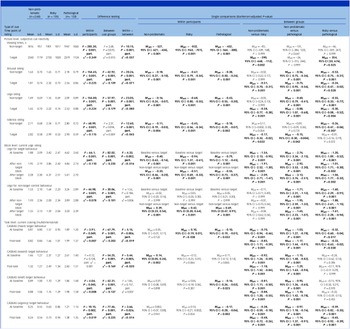
At the picture level (Table 2 and Fig. 2(a)–(d)), key findings included the following. (a) The pathological use group reported higher arousal ratings across both non-target and target cues compared with the other groups (Fig. 2(a)). Elevated arousal in response to non-target cues may indicate a generalised cue-reactivity response to internet-related devices, regardless of specific screen content. (b) For target images (but not non-target images), arousal (Fig. 2(a)) and urge (Fig. 2(b)) ratings differed significantly among the three groups, with the non-problematic use group showing the lowest ratings and the pathological use group showing the highest. (c) Valence ratings (Fig. 2(c)) for target cues were lower (less positive) in the non-problematic use group compared with both the risky and pathological use groups, with no significant difference in valence ratings between the risky and pathological use groups for target cues. (d) Participants in the risky use group exhibited significantly longer viewing times (Fig. 2(d)) for target cues than those in the other groups, suggesting greater attentional bias towards target cues among individuals in the risky use group. (e) The risky use group showed greater effects for the within-participant comparison between target and non-target images with respect to viewing times, arousal, urge and valence after target cues (see single comparisons in Table 2) compared with the other two groups. (f) The pathological use group showed greater effects for the within-participant comparison between target and non-target images in terms of arousal and urge after target cues compared with the non-problematic use group.
Group differences and within-participant differences for cue reactivity at picture level (a–d), block level (e, f) and task level (g–i). Bars show group means, and error bars indicate standard deviations. Significance levels were corrected using Bonferroni correction. REW, reward craving; REL, relief craving; URG, urgency. *P < 0.05; **P < 0.01; ***P < 0.001.

Descriptive statistics and comparison of measures assessed at picture level, block level and task level

CASBAS, Craving Assessment Scale for Behavioral Addictions; M diff, mean difference; part., partial.
Results with a significance level of P = 0.05 or lower are presented in bold.
The results were similar when we controlled for target behaviours, age, gender and ethnicity. For viewing times only, the results changed after inclusion of the covariates, resulting in a significant between-group effect for use group that had previously been non-significant (see Supplementary Material 5 for details).
In summary, the results at the picture level confirmed our hypothesis of increased cue-reactivity responses towards single pictures among individuals with risky and pathological use. Individuals with pathological use showed increased cue reactivity towards both target and non-target cues, indicating generalisation of the cue-reactivity response.
Block level: current urge ratings (after each block of pictures)
Key findings at the block level (Table 2 and Fig. 2(e) and (f)) included the following. (a) For all use groups, urges for the target behaviour were higher following target blocks compared with non-target blocks and baseline (Fig. 2(e)); similarly, urges for the non-target behaviour were highest following non-target blocks (Fig. 2(f)). These results suggest that both target and non-target cues could induce an urge to engage in the behaviour. (b) Across all time points (baseline, target blocks and non-target blocks) and for both target and non-target behaviours, participants in the pathological use group reported the highest subjective urge levels (Table 2 and Fig. 2(e) and (f)). (c) Individuals with risky use (M diff = −0.99) and pathological use (M diff = −0.71) showed greater changes in urges from baseline to target block compared with the non-problematic use group (M diff = −0.41). (d) Individuals with pathological use also showed greater increases in urges for the non-target behaviour after non-target blocks (compared with target blocks, M diff = 0.70) in comparison with individuals with risky (M diff = −0.40) and non-problematic use (M diff = −0.39). These results suggest that individuals in the pathological use group experienced the most intense urge responses for both the target and non-target behaviours; this may indicate generalisation of cue-reactivity responses across different cue types. The results were similar when we controlled for type of PUI, age, gender and ethnicity (Supplementary Material 5).
Overall, and similar to our findings at the picture level, these results suggest that all use groups had a form of cue reactivity towards target cues. Cue-reactivity responses for the target behaviour were greatest for the risky and pathological use groups. In addition, the pathological use group showed increased cue-reactivity responses towards the non-target behaviour, possibly indicating generalisation.
Task level: craving ratings (before and after the whole cue-reactivity paradigm)
At the task level (Table 2 and Fig. 2(g)–(i)), the following results were obtained. (a) Across both time points and all craving qualities, the risky and pathological use groups reported the highest levels of subjective craving (Fig. 2(g)–(i)). (b) The risky and pathological use groups did not differ significantly with respect to reward craving (Fig. 2(g)) or relief craving (Fig. 2(h)), but they did show a difference in urgency (Fig. 2(i)), with higher urgency levels in the pathological use group. (c) Although the non-problematic use group showed a significant decrease in reward craving from baseline to post-task, only the pathological use group showed significant increases in both relief craving and urgency (see single comparisons in Table 2).
Controlling for target behaviour, age, gender and ethnicity led to slight changes in the results (Supplementary Material 5), resulting in non-significant within-participant effects for CASBAS (mean), relief craving and urgency, which had previously been significant. Descriptive statistics for the cue-reactivity measures at the task level stratified by target behaviour can be found in Supplementary Material 6. These findings suggest heightened and more persistent cravings in the pathological use group, with specific increases in urgency and relief craving following the cue-reactivity task.
Associations with temptation to use and engagement in the behaviour in the natural environment
For the overall sample, almost all measures of cue reactivity (arousal, urge and craving) towards the target behaviour after target blocks and after the task were significantly associated with both the mean temptation to engage in the specific behaviour (r ≥ 0.396) and the sum of usage time (r ≥ 0.122) assessed at end of day during the 14 days (Supplementary Material 7). These results indicate that cue reactivity towards distal cues measured in the laboratory can be an important indicator of temptations and actual engagement in the natural environment.
Discussion
This study is among the first to demonstrate that individuals with risky and pathological engagement in specific internet activities show heightened cue reactivity to distal behaviour-related cues compared with those with non-problematic use, with small to medium effect sizes. Among individuals with pathological use, cue reactivity persisted across task blocks and generalised to device-related cues displaying non-specific content from other internet activities. Indicators of changes in craving quality were also observed in this group. These effects were consistent across types of PUI (target behaviours). Differences between target behaviours relevant to the current results could be detected only for viewing times and craving (CASBAS mean). Cue reactivity was correlated with temptations and engagement in natural environments, suggesting persistent cravings that may impair control over online activities.
Highest craving and arousal levels in individuals with pathological use
Individuals with pathological internet use exhibited the highest levels of arousal, urge and craving across all levels of the task, consistent with the findings of prior research on cue reactivity in PUIs and other addictions. Reference Starcke, Antons, Trotzke and Brand17,Reference Thomas, Joshi, Trotzke and Steins-Loeber38 We also found elevated but less intense responses in individuals with risky internet use.
The incentive–sensitisation theory proposes that cue-elicited craving increases as years of engagement in the behaviour accumulate, eventually reaching an asymptote. Reference Robinson and Berridge39 These elevated craving states may interfere with self-control and self-efficacy in addiction. Reference Brand, Wegmann, Stark, Müller, Wölfling and Robbins23,Reference Bechara40,Reference Goldstein and Volkow41 Although the current data are cross-sectional, our results obtained in diagnostically validated samples indicate that the intensity of cue reactivity may increase over the course of PUIs. It is important to consider that a broad definition was applied to the risky use group; thus, individuals may have exhibited characteristics that were aligned more closely with those of either the non-problematic use group or the pathological use group. In addition, the risky use group may have included both individuals in the early stages of PUIs and those in recovery (naturally or by treatment), neither of whom would have exhibited the full symptom spectrum of PUIs. It remains unclear whether symptom reduction is accompanied by proportional reductions in cue reactivity and craving. Future research should examine whether cue-induced craving levels are comparable between individuals in the early stages of PUIs and those in recovery, provided both groups display similar symptom severity. The validity of the results and the relevance of laboratory cue reactivity in understanding actual behaviours were demonstrated by the associations observed between cue-reactivity responses and measures of temptation and usage during the 14 days after the laboratory assessment.
Generalisation of cue-reactivity response in individuals with pathological use
Individuals with pathological use displayed high arousal, urge and craving responses, as well as the most positive valence ratings for both target and the non-target cues. This generalisation of cue reactivity was not observed in the risky use group, who responded to non-target images similarly to individuals with non-problematic use, even if they showed increased arousal and urge and more positive valence in response to target images. The non-target cues featured internet devices (e.g. computers, laptops, tablets or smartphones) displaying starting or log-in screens of alternative internet activities (e.g. gaming starting or log-in screens as target cues and pornography starting or log-in screens as non-target cues). This generalised cue-reactivity response in individuals with pathological use may reflect a response to the devices themselves (i.e. independent of the specific content, the device has become a conditioned cue). The response to the device, independent of specific target content, may develop over the course of the disorder and therefore may not yet have been present in participants in the risky use group. Alternatively, cue reactivity to non-target stimuli could reflect a response to alternative internet activities depicted on the screens. It is possible that in individuals with pathological use, cue reactivity may extend beyond the specific target content to encompass a broader array of internet activities. An illustrative example of cross-activity engagement comes from April 2018, when a 24-h server outage of the popular video game Fortnite coincided with a 10% increase in traffic to the pornography platform Pornhub, suggesting that pornography use may be prevalent among gamers and could serve as a substitute during forced abstinence. Reference Castro-Calvo, Ballester-Arnal, Potenza, King and Billieux42 Similarly, online social networks often feature and promote shopping content with direct links to e-commerce pages, blending different activities within a single platform. Reference Wegmann, Müller, Kessling, Joshi, Ihle and Wolf43 These convergent activities may have been part of PUIs or may have indicated comorbid tendencies or disorders that had not yet manifested in the risky use group. Although our current findings indicate generalisation of cue-reactivity responses, further research is needed to investigate the mechanisms underlying this generalisation.
Quality of craving may change over the course of PUIs
Task-level results across various blocks indicated that individuals with pathological use had more persistent craving responses compared with both individuals with non-problematic use and those with risky use. Notably, individuals with pathological use showed significant increases from baseline to post-task in relief craving and urgency, whereas these changes were not observed in the other groups. These findings suggest that the quality and nature of cue-reactivity responses may evolve with the progression of PUIs, although the small effect sizes need to be considered. A similar distinction in craving response types has been observed in alcohol use disorder research, in which participants were classified as reward or relief drinkers. Relief drinkers displayed higher levels of baseline craving, and membership in this group was a predictor of sustained craving over a 12-week period. Reference Grodin, Baskerville, Meredith, Nieto and Ray44 The presence of cue-induced relief craving and heightened urgency to engage in the behaviour suggests a shift from ‘liking’ to ‘wanting’, indicating that the behaviour may have become more compulsive over time. Reference Brand3,Reference Robinson and Berridge45 This differentiation highlights the potential value of categorising craving qualities within PUIs, as well as suggesting that relief craving and urgency could be markers of chronicity and persistence in pathological use. Future studies should explore whether these craving dimensions can similarly predict long-term outcomes in PUIs.
Changes in arousal, urge and craving due to cue reactivity
Although all use groups exhibited significant increases in arousal, urge and craving in response to distal target cues, the degree of increase (mean difference) was generally highest for individuals with risky use across most measures. These results could be explained by the presence of a ceiling in the group with pathological use, as has been found for nicotine dependence. Reference Karelitz46
Consistent results across target behaviour groups
Overall, the results were largely consistent across target behaviour groups. Inclusion of covariates led to changes in the results only for viewing time and craving (CASBAS mean), with target behaviour showing a significant effect. At a descriptive level, individuals in the buying and/or shopping and social network use groups may have responded faster, whereas those in the gaming and pornography use groups may have responded more slowly (Supplementary Material 6). These effects warrant further investigation in future research and could be attributed to increased attentional bias or impulsivity in individuals with PUIs related to buying and/or shopping or to social networks.
Methodological considerations
As previously noted by Diers et al Reference Diers, Müller, Mallon, Schmid, Thomas and Klein34 with respect to gaming disorder, distal cues appear to be effective for inducing cue reactivity and craving in PUIs. The advantage of using cues displaying devices with starting and/or log-in screens for specific internet activities lies in their high comparability across behaviours and their lack of specific rewarding content. Although specific on-screen content may elicit varying degrees of cue reactivity, differences may also arise depending on whether the device’s screen is on or off. Reference Schmitgen, Horvath, Mundinger, Wolf, Sambataro and Hirjak47
Furthermore, these group differences were consistently reflected across multiple cue-reactivity measures. Given that repeated questioning on urge may itself intensify cue reactivity and craving, the stability of responses across measures suggests that future cue-reactivity paradigms could be streamlined. Comparing the effect sizes of the within–between interaction for measures of current urge and/or craving across task levels, the effect size was higher at the picture level (partial η 2 = 0.080) than at the block level (partial η 2 = 0.016) or task level (partial η 2 = 0.019). Although all three measures required some form of cognitive evaluation of the current urge, the rating at the picture level may have been more concrete, as it referred to a specific image. By contrast, the ratings at the block and task levels may have demanded greater interoceptive abilities. These could be biased in specific types of PUI (e.g. gaming or pornography use Reference Turel and Bechara48,Reference Antons and Brand49 ), as conscious desire thinking when confronted with addiction-related cues in the early stages may become increasingly automatic and unconscious during the development of cue reactivity. Reference Brand, Müller, Wegmann, Antons, Brandtner and Müller27 Therefore, individuals with pathological use may have difficulties with these explicit ratings. Future studies should incorporate both explicit and implicit measures of cue reactivity such as neuroimaging or psychophysiological methods (e.g. galvanic skin response or electroencephalography).
When generating distal cues for cue-reactivity studies, it is important to ensure that the cues are relevant to all participants. (Semi-)individualisation of cues – for example, allowing participants to select relevant devices or content, as was done in the current study – may help to reduce confounding effects (e.g. older participants may use specific devices, such as tablets, less frequently).
Limitations
The current sample was assessed across multiple projects. Each project focused on specific target samples related to internet activity and gender. Consequently, complete matching of participants in terms of both internet activity and gender was not feasible. This limitation may have affected the generalisability of the findings and indicates a need for careful interpretation of the results across diverse user groups. In addition, the current study focused on adults. Symptoms of PUI and resulting negative consequences may develop earlier in adolescence. Reference Ben, Najma, Olivia, Oliver, Marilia and Clare50,Reference Carter, Payne, Rees, Sohn, Brown and Kalk51 Future studies should investigate cue reactivity in younger samples.
Craving responses have been shown to be related to both emotional state Reference Sayette52,Reference Mestre-Bach and Testa53 and abstinence, Reference Venniro, Reverte, Ramsey, Papastrat, D’Ottavio and Milella54 neither of which were assessed in the current study. Therefore, it will be essential for future studies to control for emotional states and time elapsed since last use of the behaviour, to allow better understanding of the impact of these factors on cue reactivity and craving dynamics.
A key strength of comparing devices displaying different starting and/or log-in pages is that the cues remain highly comparable, particularly when contrasted with other less-similar stimuli (e.g. hands holding a book). Nevertheless, different types of devices may engage distinct mechanisms of action. Smartphones, for instance, are typically carried on the person and are readily accessible, whereas laptops and desktop computers tend to be more stationary and less immediately available. These differences in accessibility and in the handling of specific applications across devices may have led to the activation of different underlying mechanisms; this should be explored in future research.
Finally, as the study’s design was cross-sectional, the causes and consequences of associations between symptoms of PUI and cue reactivity remain unclear.
Clinical implications
This study demonstrated robust effects and multiple clear indicators that cue reactivity and craving are important key mechanisms in PUIs. Notably, even distal cues – those that individuals cannot easily avoid in everyday life – trigger significant cue-reactivity and craving responses, and these effects are generalisable. Thus, the cue-reactivity response is linked not only to the temptation to engage in the behaviour but also to the actual engagement in it in the natural environment. This highlights the critical relevance of these findings, as such cues are pervasive in everyday life. The inability to escape these omnipresent triggers helps to explain why individuals with PUIs struggle to control their behaviour in daily situations. These findings represent a substantial contribution to our understanding of PUIs, particularly regarding the challenges of managing behaviour in environments saturated with unavoidable cues. Moreover, the results have implications for preventive and treatment approaches.
Supplementary material
The supplementary material is available online at http://doi.org/10.1192/bjp.2025.10379
Data availability
The data that support the findings of this study are openly available via the OSF at https://osf.io/n5cd7/.
Acknowledgements
We thank Sofie Behrens, Stefan Blümel, Nicolas Erdal, Alexia Feier, Ferdinand Gut, Felix Heublein, Jarl Möhring and Katja Tilk for help with data collection and preparation and/or recruitment of participants. We also thank to all the individuals who participated in our study for their time and effort.
Author contributions
S.A., S.M.M., S.S.-L., C.M., K.W., O.T.W., T.K., H.-J.R., A.B., R.S., A.M., M.D., E.W. and M.B.: study concept and design; S.A., S.M.M., E.W. and M.B.: analysis and interpretation of data; S.A.: statistical analysis; S.M.M.: data curation; C.M., K.W., O.T.W., T.K., H.-J.R., S.S.-L., R.S., A.M., M.D., E.W. and M.B.: funding acquisition; K.W., O.T.W., T.K., H.-J.R., S.S.-L., R.S., A.M., M.D., E.W. and M.B.: study supervision; T.A.T., A.M.S., A.K., M.J., K.K., M.K., L.M., L.D.S., L.K., N.D., K.B., A.O., A.B.: participant recruitment and data assessment. S.A. and M.B. wrote the article. All authors had full access to all data in the study and take responsibility for the integrity of the data and the accuracy of the data analysis. All authors discussed the results, commented on the manuscript and approved the final version.
Funding
S.A., S.M.M., C.M., K.W., O.T.W., M.D., T.K., H.-J.R., R.S., A.M., E.W., S.S.-L. and M.B. receive funding from the Deutsche Forschungsgemeinschaft (DFG). The work of all authors on this article was carried out in the context of the Research Unit Assessment of Criteria for Specific Internet-use Disorders, FOR2974, funded by the DFG – 411232260.
Declaration of interest
None.




 Open access


eLetters
No eLetters have been published for this article.