

1. Introduction
The 2024 Taiwan presidential election’s competitive landscape revealed two markedly different campaign strategies between the Kuomintang (KMT; Chinese Nationalist Party) and the Democratic Progressive Party (DPP). The KMT centred its campaign on promoting fear of war and, in turn, evoking voters’ profound concerns about a potential cross-strait conflict. Conversely, the DPP maintained its “Resist China, Protect Taiwan” approach, emphasising the need to engage in resistance against China and actively safeguard Taiwan’s sovereignty (Liu, Reference Liu2023). These differing strategies reflect the complex psychological landscape of Taiwanese voters when it comes to issues of war and peace as well as their varying expectations regarding cross-strait relations moving forward.
In the leadup to the 2024 presidential campaign, multiple social phenomena underscored the salience of war-related threats in the minds of voters. For instance, in August 2023, the chief of Fengtian Village in Taichung City displayed a large roadside billboard featuring the following: “I love Taiwan, anyone can be president, but there must be no war. My grandson is only two years old” (Yen, Reference Yen2023). This billboard vividly displayed Taiwanese voters’ deep fear and anxiety about war while, at the same time, revealing their hope that the future president is capable of mitigating cross-strait tensions. Surveys have also pointed to a rising number of Taiwanese citizens believing that a war between the two sides of the Taiwan Strait is likely (Wang, Reference Wang, Hsiao, Chen and Cheng2022) as well as growth in the general level of concern felt with regard to the possibility of an armed conflict (Rich et al., Reference Rich, Banerjee and Tkach2023). Reflecting these sentiments, the KMT’s campaign prominently featured the slogan “Voting for the DPP Sends Youth to the Battlefield,” linking voters’ fear to the DPP’s cross-strait policy positions.
Nevertheless, despite the KMT’s success in bringing the threat of war to the forefront of the campaign cycle, DPP candidate Lai Ching-te ultimately won the presidency, garnering the support of a majority of voters. This outcome raises a series of critical research questions: Why did the KMT’s campaign strategy fail to evoke strong emotional responses that translated into tangible voting behaviour?
According to Campbell (Reference Campbell1980), the manipulation of electoral issues is a critical determinant of campaign success. A successful issue must be clear, easily understandable, and capable of connecting with voters’ everyday experiences (Nicholson, Reference Nicholson2021). Moreover, it should possess emotional appeal to elicit voters’ affective responses (Dragu and Fan, Reference Dragu and Fan2016). Most importantly, a successful issue needs to clearly delineate each party’s stance, allowing voters to easily identify which party aligns most closely with their preferences. Within this framework, issue manipulation serves not only as a campaign tool but also as a core strategy with which parties can influence voter behaviour. Thus, from Campbell’s (Reference Campbell1980) perspective, the KMT leveraged the “war-threat” issue in an attempt to sway voters. By simplifying the complexities of cross-strait relations, the KMT portrayed the election as a stark binary choice: “Voting for the DPP Turns Taiwan into a Battlefield.”
From a theoretical standpoint, the KMT’s campaign strategy was guided by Affective Intelligence Theory (AIT; Marcus et al., Reference Marcus, Neuman and MacKuen2000). AIT posits that when emotions are aroused, voters temporarily suspend habitual decision-making and instead engage in deeper information search and evaluation. Such emotional activation may, in turn, unsettle their existing political attitudes and voting intentions (Marcus et al., Reference Marcus, Neuman and MacKuen2000).
The KMT’s aforementioned slogans were rooted in manipulating such psychological mechanisms, designed to evoke voters’ deep-seated fears of cross-strait conflict. Their campaign sought to frame DPP candidate Lai Ching-te’s potential election as a path toward war while positioning KMT candidate Hou You-yi as the way toward peace and stability. By reducing complex issues into easily digestible and emotionally resonant messages, the KMT sought to activate voters’ fear of war, convincing them that supporting the KMT candidate was essential to securing peace.
This study examines the effects of the KMT’s war threat strategy. More specifically, the analysis covers affective factors behind voter behaviour in Taiwan’s 2024 presidential election, including war threat perception and candidate security perceptions. Furthermore, the study explores how these senses of security-related factors affected the voting behaviour. Ultimately, this research seeks to elucidate the core drivers of voter decision-making in the 2024 election.
2. Fear of war and the 2024 Taiwanese presidential election
2.1. Taiwan presidential elections and strategies
Since 1996, Taiwan’s presidential elections have transitioned to direct voting, showcasing political pluralism and diverse strategic approaches. As a highly competitive democracy, Taiwan’s electoral strategies have come to consistently revolve around voters’ party preference and unification/independence stance, both of which profoundly influence electoral outcomes. According to the Michigan School theory, party preference represents a stable emotional bond for voters, effectively mitigating the influence of short-term issues on their voting behaviours and providing a long-term foundation for their electoral choices (Lazarsfeld et al., Reference Lazarsfeld, Berelson and Gaudet1968; Campbell, Reference Campbell1980). Taiwan’s electoral history reflects this pattern, with party preference (Campbell, Reference Campbell1980; Wu and Hsu, Reference Wu and Hsu2003) and unification/independence stance (Lin, Reference Lin2015) playing pivotal roles in campaign dynamics. However, as the media landscape and campaign strategies have evolved, short-term agenda-setting and emotional mobilisation have become increasingly decisive factors behind electoral outcomes.
During Taiwan’s first direct presidential election in 1996, Lee Teng-hui successfully emphasised “Taiwanese subjectivity” as his core appeal, strengthening local identity and addressing cross-strait relations to garner widespread support from voters (Hsieh et al., Reference Hsieh, Lacy and Niou1998). This election highlighted the importance of agenda-setting and revealed voters’ heightened concerns over sovereignty issues. Subsequent elections increasingly centred on issue manipulation and candidate-image construction. For instance, in the 2008 election, Ma Ying-jeou’s campaign slogan – “Peaceful Development, Economic Progress” – successfully attracted centrist voters and those focused on economic issues, underscoring the significant influence of economic factors and societal context on electoral success (Dumbaugh, Reference Dumbaugh2008). In 2016, the combination of the KMT’s failures in economic management and cross-strait relations alongside the rise of Taiwanese nationalism contributed to Tsai Ing-wen’s victory. Across these elections, a common theme emerges: whether it emphasises sovereignty, nationalism, or economic issues, effective agenda-setting must incorporate emotional mobilisation to resonate with voters and shape their ultimate electoral decisions.
2.2. Campaign strategies in Taiwan’s 2024 presidential election
The 2024 Taiwan presidential election revealed a highly polarised political environment and diverse strategic approaches. Three major parties – the KMT, DPP, and TPP (Taiwan People’s Party) – employed distinct combinations of agenda-setting and emotional mobilisation to attract support from voters amid intense competition.
The KMT centred its campaign on the “war-threat” issue, utilising the slogan “Voting for the DPP Sends Youth to the Battlefield” to link voters’ security concerns with their adversary’s policy positions. When mortality threats are perceived as uncontrollable or insurmountable, individuals often adopt avoidance strategies to mitigate their anxiety; they ignore threats, downplay the salience of death-related topics, or seek protective frameworks to indirectly cope with fear (Sequestro et al., Reference Sequestro, Serfaty, Grèzes and Mennella2024). The KMT’s approach sought to evoke voters’ longing for peace. Traditionally, the KMT has advocated for closer ties with China and emphasised economic cooperation to ease tensions, seeking to reinforce its image as the stable and peaceful choice (Kashin et al., Reference Kashin, Pyatachkova, SGoncharenko and Alexandrova2024). However, the effectiveness of fear-based messaging hinges on its dominance in the electoral agenda and its ability to overshadow competing issues. Previous research indicates that issue manipulation must strongly align with candidates’ characteristics and be consistently reinforced through narrative framing to be effective (Hayes, Reference Hayes2008). Although the KMT’s strategy captured short-term public attention, its influence may have been limited by the stability of party preference and interference from competing issues (Oxford Analytica, 2023).
Conversely, the DPP sustained its “Resist China, Protect Taiwan” theme, framing its candidate as a “defender” of Taiwan’s sovereignty. This confrontational approach functionally represents a problem-focused coping strategy, through which individuals support assertive policies, engage in retaliatory actions, or strengthen self-protective measures to regain a sense of control and mitigate their anxiety (Sequestro et al., Reference Sequestro, Serfaty, Grèzes and Mennella2024). The DPP’s strategy capitalised on voters’ emotional identification with sovereignty issues and underscored the threat of the People’s Republic of China in order to solidify its core base. In line with its longstanding emphasis on safeguarding Taiwan’s sovereignty and democracy, the DPP adopted a “recognition for survival” strategy, advocating for enhancing cooperation with the United States and other democratic allies to counterbalance China’s influence (He and Magcamit, Reference He and Magcamit2024). Simultaneously, the party broadened its appeal to centrist voters by emphasising public policy and social issues, thereby diluting the KMT’s fear-based tactics (Chou, Reference Chou2023; Liu, Reference Liu2023; Yang, Reference Yang2023). In contrast to the KMT’s emotional mobilisation, the DPP prioritised the cultivation of a positive and progressive image, positioning itself as a symbol of stability and advancement.
Meanwhile, the TPP adopted a distinct approach, targeting centrist voters and younger demographics through a focus on pragmatic dialogue and domestic reform. Ko Wen-je’s campaign emphasised rationalism and technocracy in sharp contrast with the emotion-driven mobilisation efforts of the KMT (Chou, Reference Chou2023; Liu, Reference Liu2023; Yang, Reference Yang2023). While the TPP has emerged as a significant political force in Taiwan, offering voters an alternative to the KMT and DPP (Kashin et al., Reference Kashin, Pyatachkova, SGoncharenko and Alexandrova2024), its ambiguous stance on core issues like national security may have limited its appeal, particularly in today’s emotionally charged electoral environment.
The 2024 election underscored the pivotal roles played by agenda-setting and emotional mobilisation in determining campaign effectiveness. The KMT leveraged fear to tap into voters’ security concerns, the DPP reinforced its defender image through appeals to sovereignty, and the TPP offered a rationalist alternative. However, the effectiveness of these strategies ultimately largely relied on candidates’ attributes (e.g., perceived security). These multilayered factors highlight the complexity of Taiwan’s electoral landscape and lay a rich empirical foundation for future electoral research.
2.3. Voter emotions and affective intelligence
One characteristic of elections in Taiwan is that the possibility of war with China is often employed by candidates to manipulate voters’ emotions. AIT is particularly suitable for explaining this unique electoral context (Marcus et al., Reference Marcus, Neuman and MacKuen2000). AIT argues that in political settings, individuals activate different emotional systems to respond to environmental stimuli, especially when familiar political environments are disrupted or when uncertainty arises. In such moments, emotions intervene in cognitive processes. The most significant contribution of AIT lies in its interpretation of voter behavioural shifts as a result of emotional responses, thereby challenging the stable predictive power of traditional rational voter models. In particular, when the anxiety system is activated, voters temporarily suspend habitual decision-making and instead engage in deeper information search and evaluation. Such emotional activation can destabilise existing political attitudes and voting intentions (Marcus et al., Reference Marcus, Neuman and MacKuen2000).
Another important aspect of AIT is its explanatory power regarding the effects of short-term political messaging. Traditionally, long-term variables such as party identification and positions on the issue of unification with China versus Taiwanese independence have been regarded as stable political foundations. However, AIT suggests that under highly uncertain or threatening conditions, even these long-term stable attitudes may temporarily lose their dominance. Brader (Reference Brader2005), through experimental research, found that when voters were exposed to political advertisements containing negative emotional cues (such as fear-inducing music and crisis imagery), not only did their attention to information significantly increase, but their candidate preferences also shifted. Such studies demonstrate that when issues become highly emotionalised, voters tend to process information in an emotion-driven manner, thereby weakening the effects of traditional factors such as party loyalty. Consequently, in an electoral process, if a candidate successfully activates the anxiety system, it may destabilise voters’ prior political orientations, prompting them to reevaluate their political choices and even switch their support to candidates whose positions differ from their original political inclinations (Brader, Reference Brader2005; Marcus et al., Reference Marcus, Neuman and MacKuen2000).
2.4. War threat, perceived candidate security, and voting behaviour
The theoretical framework of AIT is particularly well-suited for analysing electoral contexts characterised by high risk and uncertainty. When certain issues carry the potential to trigger anxiety (such as the threat of war), they can prompt voters to restructure their political attitudes and behaviours. Empirical studies have shown that in the face of major societal threats such as terrorism, national security crises, or pandemics, emotional activation exerts a significant influence on voting behaviour (Valentino et al., Reference Valentino, Hutchings, Banks and Davis2008; Albertson and Gadarian, Reference Albertson and Gadarian2015).
According to AIT, when voters confront uncertain and high-risk situations, their anxiety system is activated, leading to increased information search and a reevaluation of political choices. In this context, war threat functions as a powerful emotional stimulus and thus becomes a highly influential electoral issue. Valentino et al. Reference Valentino, Hutchings, Banks and Davis(2008) found that when voters experience fear or anxiety, their media consumption and depth of information processing significantly increase, and they tend to seek candidates or policies that can alleviate their sense of threat. Similarly, Marcus and MacKuen (Reference Marcus, MacKuen, Jost and Sidanius2004) demonstrated that under conditions of anxiety, voters’ sensitivity to candidate images and policy stances increases, making them more susceptible to attitude shifts and electoral defection. This psychological mechanism is crucial for understanding how political parties mobilise emotions through war-related issues. In Taiwan’s context of facing China’s military threat, such messages are especially likely to become sources of voter anxiety.
Applied to the 2024 Taiwan presidential election, when the KMT employed slogans such as “A vote for the DPP means sending young people to the battlefield,” it was effectively attempting to evoke voters’ anxiety through the framing of a war scenario. This, in turn, was designed to prompt voters to temporarily suspend partisan loyalty and instead seek an alternative perceived as capable of reducing risk. By advancing this peace-oriented appeal, the KMT sought to increase support for its candidate. Based on this reasoning, we propose the first hypothesis:
H1: Voters who perceived there to be a higher war threat were more likely to support the KMT candidate Hou You-yi, who adopted a peace-oriented campaign strategy, and were less likely to support the DPP candidate Lai Ching-te, whose campaign emphasised confrontation.
In addition to policy appeals, voters’ perceptions of emotional security are also tied to how they evaluate the candidates themselves, specifically through candidate security perception, defined as voters’ subjective evaluation of the extent to which a candidate is able to provide protection, stability, and a sense of safety in the face of external or internal threats. AIT emphasises that emotions are not the opposite of rationality but rather function as a regulatory mechanism in information processing. Under conditions of anxiety, voters actively seek leaders who can provide a sense of security (Valentino et al., Reference Valentino, Hutchings, Banks and Davis2008). For example, studies of U.S. elections show that when voters feel anxious due to terrorist attacks or public health crises, they adjust their candidate evaluations and prioritise leadership qualities that are associated with providing security (Albertson and Gadarian, Reference Albertson and Gadarian2015). Thus, whether a candidate can instil a sense of security becomes a central criterion in Taiwan’s electoral decision-making. Accordingly, voters’ perceptions of candidate security are likely to influence their level of support. From this reasoning, we derive the second hypothesis:
H2: The higher the perceived sense of security provided by a candidate, the more likely voters are to support that candidate.
2.5. Interaction effects of war threat and perceived candidate security
War threat and perceptions of candidate security may interact to influence voter support. As noted earlier, when external threats such as war increase, voters’ anxiety systems are activated. This prompts them to suspend routine decision-making, search for more information, and prioritise cues that promise safety and risk reduction (Marcus et al., Reference Marcus, Neuman and MacKuen2000; Valentino et al., Reference Valentino, Hutchings, Banks and Davis2008; Albertson and Gadarian, Reference Albertson and Gadarian2015). In addition, prior research has shown that the persuasiveness of messages depends not only on their content but also on the characteristics of the messenger; when these two are consistent, the positive impact on attitudes is significantly enhanced (Druckman, Reference Druckman2001; Hayes, Reference Hayes2005; Egan, Reference Egan2013). Thus, when war threats heighten voters’ need for safety, the consistency between a candidate’s security image and campaign appeal should shape the effect of perceived security on electoral support. If the sense of security provided by a candidate is congruent with their campaign appeal – for example, the KMT emphasising a peace-oriented strategy – the positive relationship between perceived candidate security and voter support (as proposed in Hypothesis 2) should be strengthened. Conversely, when the sense of security conveyed by a candidate is inconsistent with their campaign appeal – for example, the DPP emphasising a confrontational strategy – the positive relationship may be weakened. This reasoning leads to the following hypotheses:
H3a: There is a strengthening moderating effect of war threat and perceived candidate security on support for Hou You-yi. Specifically, when the level of war threat increases, the positive relationship between perceived candidate security and support for Hou You-yi will be reinforced.
H3b: There is a weakening moderating effect of war threat and perceived candidate security on support for Lai Ching-te. Specifically, when the level of war threat increases, the positive relationship between perceived candidate security and support for Lai Ching-te will be diminished.
2.6. Research purpose
In sum, this study takes into account Taiwan’s unique geopolitical context of being constantly under the threat of war and examines the key factors that may influence the 2024 presidential election. Specifically, it explores how voters’ need for security, triggered by candidates’ campaign appeals, is shaped by factors related to a sense of security (i.e., war threat and perceptions of candidate security).
3. Research methods
3.1. Data collection and sample composition
This study utilises data from the “Taiwan Election and Democratization Study 2024” (TEDS2024-T) conducted by the Election Study Center at National Chengchi University. Data collection was done through telephone interviews conducted between December 22, 2023, and January 12, 2024. Respondents were Taiwanese residents aged 20 and over who were eligible to vote. Respondents for the survey were selected using proportionate stratified sampling based on population size and geographic region, ensuring that the sample accurately reflected the distribution of the general population across different areas. The analytic sample comprised 743 respondents. Gender was balanced (51.1% men, n = 370; 48.9% women, n = 354). By age, 12.9% were 20–29 (n = 93), 18.3% were 30–39 (n = 133), 20.2% were 40–49 (n = 146), 19.2% were 50–59 (n = 139), and 29.4% were 60 or older (n = 213). Educational attainment was 4.9% elementary or below (n = 36), 9.7% junior high (n = 71), 28.1% high school/vocational (n = 203), 13.6% junior college (n = 99), and 43.6% university or higher (n = 316). Party identification was 45.9% Democratic Progressive Party (DPP; n = 333), 31.9% Kuomintang (KMT; n = 231), and 22.2% Taiwan People’s Party (TPP; n = 161).
3.2. Conceptual and operational definitions
3.2.1. Voter support for candidates
Voting behaviour is defined by respondents’ expressed support for a particular candidate pair when asked the following question: “Which pair of candidates did you vote for in the presidential election?” Respondents could select from three options: “Ko Wen-je and Wu Hsin-ying” (hereafter referred to as Ko), “Lai Ching-te and Hsiao Bi-khim” (Lai), and “Hou You-yi and Chao Shao-kang” (Hou). Based on the respondents’ choices, we coded the data as Ko = 1, Lai = 2, and Hou = 3. This serves as the primary dependent variable of the study.
3.2.2. War-threat perception
War-threat perception refers to “the anticipated negative consequences or losses from intergroup conflict, particularly regarding power, status, security, and values” (Tausch, Reference Tausch and Christie2012). This concept encompasses perceived threats from external groups as well as challenges within one’s own group. Importantly, perceived threat is highly subjective; individuals’ attitudes and behaviours toward external groups are often shaped more by perceived threats than by actual conditions. Such subjective perceptions frequently incite hostility and antagonistic responses in intergroup contexts. Previous studies have highlighted the profound impact of war-threat perception on political choices. For example, during the 1952 U.S. presidential election, the ongoing spread of communism intensified voters’ fears of military confrontation. Although both candidates promised to ease Cold War tensions, Eisenhower’s military background garnered greater trust among voters and ultimately secured his victory (Johns, Reference Johns2019). In this study, “war threat” refers specifically to perceived threats from external entities (e.g., People’s Republic of China) with a focus on respondents’ expectations of short-term conflict. The survey item used was the following question: “How likely do you think it is that the Chinese Communist Party will attack Taiwan?” Responses ranged from 0 (completely unlikely) to 10 (extremely likely).
3.2.3. Candidate security perception
Candidate security perception pertains to voters’ trust in a candidate’s ability to ensure national security after being elected (Higgins, Reference Higgins, Marsden and Savigny2016). During times of national crisis, voters often prioritise a candidate’s perceived capacity to safeguard the country. For instance, following the 9/11 terrorist attacks, U.S. voter preferences were significantly influenced by candidates’ perceived security competence (Higgins, Reference Higgins, Marsden and Savigny2016). To measure this perception, respondents were asked the following question: “How secure do you feel with each of the main candidates?” Ratings for Ko, Lai, and Hou ranged from 0 (very insecure) to 10 (very secure).
3.2.4. Control variables
Traditionally, the presidency has been male-dominated, although female candidatures are becoming increasingly common. Women constitute half of the voting population, making female voters a key target for presidential campaigns. Racial differences may explain varying political preferences among female voters; for instance, white women in the U.S. tend to support Republican candidates, while women of colour predominantly support Democratic candidates (Junn and Masuoka, Reference Junn and Masuoka2024). Age is also a significant factor behind voter preferences: younger voters generally favour candidates with open, progressive, and reformist images, whereas middle-aged and older voters prefer candidates who emphasise economic stability, traditional values, and conservatism (Kamalipour, Reference Kamalipour2010). Moreover, education tends to influence voters’ values, priorities, and political engagement; higher-educated voters are typically more concerned with public education, expertise, and electoral integrity (Pomper, Reference Pomper and Crotty2016). In addition, previous studies have indicated that party affiliation exerts a substantial influence on individuals’ voting behaviour (Fell, Reference Fell2006; Chen, Reference Chen2021; Chang and Fang, Reference Chang and Fang2024). Recognising these complexities, this study includes gender, age (with the 40–49 age group as the reference category), education level (with high school as the reference category), and party preference (with KMT as the reference category) as control variables.
In addition, since the unification/independence stance represents a distinctive value orientation in Taiwan, with some viewing China as an enemy while others regard Taiwan and China as sharing common ancestry and thus holding neutral or more favourable attitudes toward China, this value is closely related to one of the key variables of this study – perceived war threat – and may influence voters’ candidate choice. Therefore, we also include the unification/independence stance as a control variable. This variable was measured using item “Regarding the relationship between Taiwan and Mainland China, which stance do you lean toward?” Respondents answered on a six-point scale ranging from “Unify as soon as possible” to “Declare independence as soon as possible.”
3.3. Statistical modelling strategy
This study employs multinomial logistic regression for the analyses. As a member of the generalised linear model family, this method is specifically designed for categorical (nominal) dependent variables. Compared with binary logistic regression, multinomial logistic regression allows for outcomes with more than two categories, estimates odds ratios relative to a reference category, and accommodates interaction terms to test conditional effects, making it well suited for the needs of this study. A preliminary inspection of the data also confirmed that this method was appropriate. The distribution across the three categories was reasonably balanced (Y = 1: 23.6%; Y = 2: 42.4%; Y = 3: 34.1%). The initial model converged after 17 iterations, with finite parameter estimates and no signs of separation (Log-Lik = −198.01; McFadden R 2 = .751; LR test p < 0.001), indicating stable estimation and sufficient signal.
Analyses were conducted using R 4.5.1, primarily with the multinom function from the nnet package (data management was assisted by dplyr). The dependent variable was the three-category voting choice: Ko = 1, Lai = 2, and Hou = 3. Since the central focus of this study is on how voters respond under conditions of heightened war threat to Hou You-yi, who adopted a peace-oriented campaign strategy, compared with Lai Ching-te, whose campaign emphasised confrontation, Lai was designated as the reference category. This setup allows the results to directly present the contrast between Hou and Lai.
Independent variables included war threat (WT) and the security perception variables for each of the three candidates (Ko_Sec, Lai_Sec, and Hou_Sec), along with their interaction terms (WT × Ko_Sec, WT × Lai_Sec, WT × Hou_Sec). Control variables included gender, age, education, unification/independence stance, and party identification. The analysis reports odds ratios for all effects, together with p-values calculated using the Wald normal approximation.
We also report average marginal effects (AME) to aid interpretation. AME summarise the association between a predictor and the predicted probability of each outcome, based on the observed data rather than assuming unrealistic settings (e.g., fixing other variables to zero).
4. Results
4.1. The effects of war-threat perception
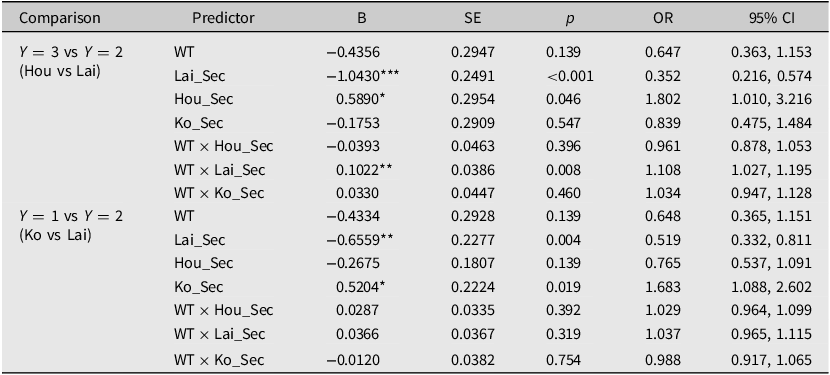
The results are presented in Table 1. As shown in Table 1, after controlling for gender, age, education, unification/independence stance, and party identification, the overall main effect of war-threat perception (WT) was not significant. In the comparison of Ko versus Lai, the odds ratio (OR) for WT was 0.648, p = 0.1387; in the comparison of Hou versus Lai, the OR was 0.647, p = 0.1394. In other words, an increase in perceived war threat alone did not significantly alter voters’ choice between Hou and Lai in this model. Therefore, Hypothesis 1 was not supported.
Multinomial logistic regression results (Reference × Y = 2, Lai)

Note: OR = exp(B). Two-tailed p-values reported; 95% CI for OR shown in brackets.
* p < 0.05. ** p < 0.01. *** p < 0.001.
4.2. The effects of security perception for candidates
As shown in Table 1, when the dependent variable was “choosing Hou relative to Lai” (upper panel of Table 1), Lai’s security perception had a significant negative effect on the odds of choosing Hou over Lai (OR = 0.352, p < 0.001), indicating that the more secure voters felt with Lai, the more likely they were to support him rather than Hou. Conversely, Hou’s security perception had a significant positive effect on the odds of choosing Hou over Lai (OR = 1.802, p = 0.046), suggesting that the more secure Hou was perceived to be, the more likely voters were to support him.
In the comparison between Ko and Lai, a similar pattern was observed: Lai’s security perception had a negative effect on the odds of choosing Ko over Lai (OR = 0.519, p < 0.004), while Ko’s security perception had a positive effect (OR = 1.683, p < 0.019). Therefore, Hypothesis 2 was supported.
4.3. Moderating effects of war-threat and security perception for candidates
Hypothesis 3a proposed that there is a strengthening moderating effect of war threat and perceived candidate security on support for Hou You-yi. Specifically, when the level of war threat increases, the positive relationship between perceived candidate security and support for Hou You-yi should be strengthened. As shown in Table 1, however, in the Hou–Lai comparison, the interaction term WT × Hou_Sec was not significant (p = 0.396). Thus, Hypothesis 3a was not supported.
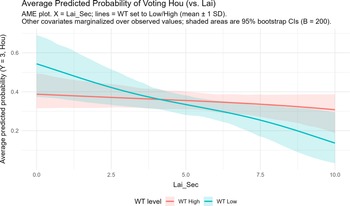
Nevertheless, Table 1 also shows that in the Hou–Lai comparison, the interaction term WT × Lai_Sec had a significant effect (OR = 1.108, p = 0.008). We plotted the interaction by using the average predicted probability of choosing Hou (Y = 3 vs. Lai, Y = 2) from a multinomial logit as a function of Lai_Sec, with curves setting war-threat to low/high (mean ±1 SD, truncated), as shown in Figure 1. The results indicate that under higher levels of perceived war threat, the negative effect of Lai’s security image on choosing Hou over Lai was attenuated. In other words, as the war threat increases, the impact of Lai’s security image on discouraging voters from choosing Hou becomes weaker, thereby increasing the odds of supporting Hou relative to Lai. Therefore, Hypothesis 3b was supported.
Predicted probability of voting for Hou relative to Lai by Lai’s perceived candidate security and war-threat perception.

5. Discussion
In the 2024 Taiwan presidential election, the KMT sought to overcome its party-identification disadvantage by employing the war threat as a campaign strategy, invoking the war threat to influence voter behaviour. Drawing on affective intelligence theory, this study investigates how two key variables – perceived war threat and perceived candidate security – influence voters’ electoral choices. Our study revealed some interesting findings.
5.1. War threat may elicit multiple emotional responses
First, contrary to Hypothesis 1, an increase in perceived war threat alone did not significantly influence voters’ choice between a candidate emphasising peace and one emphasising confrontation. This unexpected result may suggest that the war threat simultaneously activates two distinct needs among voters: the need to avoid war (aligned with Hou’s narrative) and the need to resist China (aligned with Lai’s narrative). Because these two motivations were activated simultaneously, their effects cancelled each other out, producing a non-significant relationship between perceived threat and voting behaviour. In other words, perceptions of war threat are not irrelevant; rather, they influence voter choice through different emotional pathways, leading to the null main effect. Huddy et al. Reference Huddy, Feldman, Taber and Lahav(2005) found that perceived threats can evoke both anxiety and anger: while anxiety leads individuals to prefer risk avoidance, anger reduces the perception of risk and fosters tendencies toward retaliation or confrontation. Vasilopoulos et al. Reference Vasilopoulos, Marcus, Valentino and Foucault(2019) reported similar findings in their study on terrorist attacks in France and far-right voting. The results of this study may suggest that manipulating electoral issues through perceptions of war threat could not only evoke anxiety among KMT supporters, leading them to back Hou You-yi, but also trigger confrontational emotions among DPP supporters, thereby strengthening their support for Lai Ching-te – an outcome that the KMT may not have anticipated. Such complexity – where the same campaign appeal can evoke different emotions – has been underexplored and warrants further investigation in future research.
5.2. Perceptions of security may originate from different motivations
Second, the results for Hypothesis 2 show that each candidate’s security-perception score significantly influenced their likelihood of being chosen, indicating that voters are more inclined to back leaders who provide them with a sense of security and stability. Although the KMT employed a war threat as a campaign strategy in the 2024 presidential election, some voters also strongly resonated with Lai’s projected sense of security. Consequently, the KMT’s strategy of invoking a war threat to heighten voter anxiety ultimately benefitted not only Hou but also Lai. Some voters, when faced with war threats, perceived Lai as the source of security and thus were more likely to support him. In line with the dual-emotion perspective discussed earlier, the findings seem to suggest that voters may adopt two modes of response when confronted with threats to their survival: (1) favouring candidates who promote peace and stability to avoid war (e.g., Hou), or (2) supporting strong leaders who are capable of confronting external threats (e.g., Lai). These two modes of response – avoidance and confrontation – also divided voters into two main groups in Taiwan’s 2024 presidential election. Hou’s emphasis on “peace and stability” sought to attract voters who prioritised the avoidance of war, and some voters indeed perceived him as likely to reduce the risk of conflict. Conversely, another segment of voters adopted a confrontational stance, believing that a strong, uncompromising approach was necessary for Taiwan’s security. These voters were more inclined to project “security” onto Lai, thus diminishing their support for Hou.
Taken together, these findings highlight an important implication: when faced with war-related issues, voters did not directly shift their support out of fear; rather, their choices were guided by how effectively candidates conveyed a sense of security, demonstrating that campaigns must focus on constructing a candidate’s image rather than relying solely on issue manipulation.
5.3. Different emotions cannot be considered equivalent
Hypothesis 3 received only partial support. The positive relationship between perceptions of Lai’s ability to provide security and voting for him was weakened under conditions of heightened war threat. In other words, when the perceived threat of war was high, even voters who felt secure with Lai were less likely to support him. This finding echoes earlier arguments that inconsistency between a politician’s personal characteristics and the content of their message may undermine public attitudes toward that politician (Druckman, Reference Druckman2001; Hayes, Reference Hayes2005; Egan, Reference Egan2013). However, the same interaction effect did not emerge for Hou.
One possible explanation, as noted earlier, relates to different motivational pathways. Hou’s perceived security appeal was more closely tied to eliciting fear in the context of a war threat, whereas Lai’s appeal was linked to eliciting anger. Although fear and anger are both negative emotions, they evoke different motivational tendencies. Fear tends to elicit avoidance motivation, leading individuals to withdraw or seek additional information to reduce uncertainty. In contrast, anger activates approach motivation, driving individuals to confront threats and take action to remove obstacles (Carver and Harmon-Jones, Reference Carver and Harmon-Jones2009). Prior research shows that approach-oriented emotions are more likely than avoidance-oriented emotions to translate into action. For instance, Valentino et al. Reference Valentino, Brader, Groenendyk, Gregorowicz and Hutchings(2011) found that anger significantly increased electoral participation and protest activity, whereas anxiety mainly promoted information seeking without necessarily fostering participation. Similarly, Brader (Reference Brader2006) demonstrated through experiments on political advertising that anger-inducing messages were more likely than anxiety-inducing ones to immediately alter voting intentions and policy preferences. Taken together, these findings suggest that approach motivation is a stronger driver of political action than avoidance motivation.
Accordingly, the differing strength of the interaction effects of war threat and perceived candidate security for Hou and Lai may stem from the distinct emotions and motivational states their political appeals evoked. Because Lai’s confrontation-oriented appeal elicited the approach-oriented emotion, which was more effective in mobilising voter action, the interaction effect was stronger for him than for Hou, whose peace-oriented appeal primarily elicited the avoidance-oriented emotion. Although this interpretation remains a tentative explanation offered by the researchers, it highlights a complex and dynamic interplay between candidate characteristics, political appeals, and voters’ motivational states – a relationship that has received limited attention in prior research and thus warrants further exploration in future studies.
5.4. Limitations and suggestions
While this study contributes new theoretical insights and empirical evidence to the literature on electoral behaviour, it has several limitations. First, the findings are specific to Taiwan’s 2024 presidential election. Although timely, the findings’ generalisability may be limited due to the unique electoral context. Future research could examine different election cycles or cross-national contexts to test the universality of emotional mobilisation and the effects of voters’ perceived candidate security. Second, this study focused on fear of war, but other emotions (e.g., anxiety, hope, anger) could also influence voter behaviour; future research could incorporate a broader range of emotional variables to improve the findings’ explanatory power. Third, this study draws on AIT, which posits that voters’ behaviour shifts in response to emotions: when certain emotions are activated, voters may suspend habitual decision-making and engage in more intensive information search and evaluation. However, this study did not directly measure emotions or potential mediators such as information seeking. Future research should directly measure these variables to more precisely assess how emotions influence voter behaviour. Fourth, the measurement of candidate security perception warrants refinement. Experimental designs could be employed to manipulate candidate images and explore in greater depth how security perceptions influence voter decisions. Finally, future studies should consider longitudinal designs to track how voters’ attitudes toward war-related issues and candidate images evolve over different electoral stages. Such an approach would offer a more comprehensive understanding of the dynamic effects of emotional mobilisation during elections. Such improvements could give way to a deeper understanding of voting behaviour and offer more concrete theoretical foundations for future campaign strategies.
Funding statement
The authors declare none.
Competing interests
The authors declare none.

 Open access

