


INTRODUCTION
Salmonellosis is one of the most frequently reported foodborne zoonoses in Europe [1]. In response to the high number of salmonellosis cases reported in humans over the last few years, the European Commission has set the objective of reducing Salmonella prevalence in pigs and poultry [1, 2]. Pork is considered to be a significant source of Salmonella to humans next to eggs and poultry meat [1, 3, Reference Berends4]. Two baseline studies were conducted aimed at estimating the prevalence of Salmonella in finisher pigs at slaughter and in breeding pigs with the objective of collecting comparable data among EU countries [5, 6]. Baseline study results in slaughter pigs showed that Salmonella prevalence varied widely between EU countries, ranging from 0% to 29% in lymph nodes and from 0% to 20% in carcass swabs. These findings suggest that different control strategies should be in place, accounting for the country-specific Salmonella prevalence as well as the herd and abattoir structures.
Some countries have already started different control efforts. However, cost-effective surveillance and control strategies should be identified, because resources are scarce for addressing public health risks [Reference Stärk7]. Studies conducted in different countries show that abattoir interventions might be more socio-economically profitable and effective to further reduce Salmonella carcass prevalence compared to additional interventions at the herd level [Reference Berends4, Reference Goldbach and Alban8–Reference van der Gaag10]. At the abattoir, different interventions could include relatively new methods such as (1) hot-water decontamination, in which carcasses are exposed to 80°C water for 15 s in a cabinet, (2) hand-held steam vacuum, in which areas with visible faecal contamination are exposed to vacuum suction and steam to deactivate bacteria, and (3) steam ultrasound, which includes exposing the carcass to a 130°C steam to kill the bacteria and to a 30–40 kHz ultrasound that increases access to bacteria on the surface. Lawson et al. [Reference Lawson11] quantified the cost-effectiveness of these decontamination interventions and found that steam ultrasound was the most cost-effective intervention followed by hot-water decontamination. Nonetheless, previous studies did not simultaneously evaluate the herd and abattoir structures and the control costs associated with each given intervention. Furthermore, hygiene levels might also vary between abattoirs which significantly impact the contamination of carcasses with Salmonella [Reference Delhalle12–Reference Baptista, Dahl and Nielsen15]. Herds also differ in Salmonella prevalence and hence, it might be necessary to handle them differently on the way to and at the abattoir. Furthermore, abattoirs have different slaughtering capacities, so an intervention could be economically more efficient in one abattoir than another given the associated investment and running costs. Thus, the ranking of interventions might change accordingly.
In 1993, Denmark implemented a surveillance and control programme in the pig production sector, following a peak in the number of human salmonellosis cases attributed to pork. Since then, the proportion of human cases attributed to Danish pork has been significantly reduced. However, since 2001, the prevalence of Salmonella in carcasses after chilling has remained at 1·0–1·5% [3]. A target has recently been set to reduce the individual carcass prevalence of Salmonella to <1% by late 2013 [16]. This implies that other strategies should be further investigated. In this study we therefore focus on strategies that are able to reduce the carcass prevalence to <1%.
This study aimed at evaluating the food safety and economic consequences of different surveillance and control strategies for Salmonella in pigs and pork using stochastic simulation modelling.
METHODS
A stochastic simulation model with two modules – epidemiological and economic – was developed. The epidemiological module estimated the resulting Salmonella carcass prevalence whereas the economic module was used to assess the economic efficiency of each of the given surveillance and control scenarios. These models were developed in @Risk 5.5.0 (Palisade Inc., USA) using Monte Carlo simulation techniques. Monte Carlo simulation allowed for the examination of parameters as probability distributions rather than single expected values. The model was run for 10 000 iterations using Latin hypercube sampling to assure balanced sampling from all parts of the distributions. Sensitivity analysis was performed to identify influential input variables using tornado diagrams [Reference Vose17]. Scenario analysis was used to explore the impact of variation of herd seroprevalence and energy prices.
Epidemiological module
The epidemiological module simulated the number of Salmonella-seropositive pigs delivered to an abattoir and the consequential Salmonella carcass prevalence on an average weekday given the abattoir size, for each of the scenarios. This module was based on a previous study that evaluated factors affecting Salmonella carcass prevalence in 23 Danish abattoirs based on data from 2002 to 2008 [Reference Baptista, Dahl and Nielsen15]. Carcass surveillance consisted of bacteriological testing of pooled carcass swabs from five pigs, collected daily at the abattoirs after chilling. In brief, that study showed that both the overall Salmonella input to the abattoir (measured as the estimated number of Salmonella-seropositive pigs) and the Salmonella input to the carcass pool (measured as the probability that at least one of the swabbed pigs originated from a seropositive herd) were the most influential factors for Salmonella carcass pool prevalence. Underlying practices at slaughter were also indirectly measured by the random variation at the abattoir level, indicating different hygiene levels at different slaughterhouses and slaughter days. The number of Salmonella-seropositive pigs delivered to slaughter was estimated as the proportion of positive meat-juice samples from each herd during the previous 12 months, summarized per herd level and adjusted for the number of pigs delivered to each abattoir on a slaughter day.
The general epidemiological model is a two-level hierarchical model given by the following equation:

where p is the probability of a Salmonella-positive pooled carcass sample i; β0 is the constant; X 1, X 2 and X 3 represent different fixed effects, namely the Salmonella input to the abattoir, the Salmonella input to the carcass pool and weekday; and u is the random effect of the abattoir containing the pooled carcass sample i.
In the epidemiological module, distributions based on the range of values from that study were used to determine the Salmonella carcass prevalence on an average weekday. According to a large-scale study conducted in Danish abattoirs, a conversion factor of 3 (95% confidence interval 2·0–3·7) was applied to calculate the individual carcass prevalence from a pooled prevalence containing five individual samples [Reference Sørensen, Wachmann and Alban18].
Herd surveillance data from finisher pig herds delivering pigs to slaughter in 2007 and 2008 were obtained from the Danish Agricultural & Food Council (DAFC). Animal movement data in 2008 were obtained from the Danish Veterinary and Food Administration (DVFA) to estimate the number of pigs delivered to each abattoir on a slaughter day. Abattoir sizes were classified based on the average number of pigs slaughtered, on each slaughter day as: small (<1000 pigs), medium (1000–6000 pigs) and large (>6000 pigs). Based on the abattoir structure in 2008 and for modelling purposes it was assumed that four abattoirs were small, five were medium and eight were large. Data used for the epidemiological module together with the sources of information are presented in Table 1.
Description of variables used in the epidemiological simulation module estimating Salmonella pig carcass prevalence based on surveillance data

DAFC, Danish Agricultural & Food Council; DVFA, Danish Veterinary and Food Administration.
* Levels 0–3 refer to official herd classifications in the Danish surveillance programme for slaughter pigs.
Economic module
A partial budgeting module was included to estimate the change in costs for each of the given scenarios in relation to a default scenario [Reference Dijkhuizen and Moris19]. The module consisted of (1) additional returns: a list of returns from the alternative scenario that will not be received from the default scenario; (2) reduced costs: a list of costs for the default scenario that will be avoided with the alternative scenario; (3) returns forgone: a list of returns from the default scenario that will not be received from the alternative scenario; and (4) additional costs: a list of costs of the alternative scenario that are not required with the default scenario. In the analyses shown here, the additional returns and the returns forgone were zero. Therefore, only the additional and reduced costs and returns were used for further analysis and are presented in the Results section. Additional public health benefits and healthcare cost savings resulting from a Salmonella carcass prevalence reduction were not included in the calculations. The costs of hot-water decontamination, steam ultrasound and steam vacuum were obtained from Lawson et al. [Reference Lawson11]. The costs were then recalculated based on the abattoir size, in which the capital costs of the machinery were assumed not to change with abattoir size (number of slaughtered pigs). Other cost factors including labour, water and energy, and other variable costs changed according to the number of slaughtered pigs. The costs per intervention and abattoir size are listed in Table 2 together with the sources of information. The costs of applying a specific intervention given the abattoir size were calculated as the number of carcasses submitted to slaughter in an abattoir under that specific intervention multiplied by the costs of that intervention per carcass. The overall costs of a scenario were calculated as the total cost of applying that intervention in small, medium, and large abattoirs and adjusted for the number of abattoirs of each size and number of pigs slaughtered at these abattoirs. This was performed to quantify the cost of a scenario at a national level. To estimate the cost-effectiveness of the different scenarios and to define a suitable parameter for comparison, the method of Belli et al. [Reference Belli20] was used to calculate a prevalence-cost ratio. Prevalence-cost ratios were calculated as Salmonella carcass prevalence reduction divided by the additional costs per pig using the alternative scenario compared to the default scenario. The prevalence-cost ratio represents the efficacy of applying a specific scenario given the resources. The most cost-effective scenario is that with the highest prevalence-cost ratio, given that there are both additional costs and decreased prevalence associated with this alternative scenario.
Input values for the economic module of a Salmonella simulation model including the number of slaughter pigs per year and the cost of each of the applied interventions per pig for each abattoir size (small, medium, large), together with the source of information

DAFC, Danish Agricultural & Food Council.
Surveillance and control scenarios
In the Danish Salmonella surveillance and control programme, control options were based upon herd classification in seroprevalence levels as an indicator of the Salmonella risk [Reference Alban, Stege and Dahl21]. Every month, pig herds were allocated to one of four seroprevalence levels, based on results from the previous 3 months, the ‘so-called’ Salmonella index (SI). Herds with SI <40 were assigned to level 1; herds with SI from 40 to 70 were in level 2; herds with SI >70 were in level 3. Herds with no positive meat-juice samples during the previous 5 months were assigned to level 0. From herds in level 0 only one sample was collected per month. In January 2008, the proportion of herds assigned to each level was: level 0 (53·7%), level 1 (43·2%), level 2 (2·3%) and level 3 (0·8%). To reduce the risk of Salmonella carcass contamination, level 3 carcasses were subjected to hot-water decontamination or sanitary slaughter in one of two specific abattoirs, respectively. This required that pigs subjected to specific control measures at the abattoir were transported and kept in lairage separately and slaughtered at the end of the day. This is designated as logistic slaughter throughout the paper. Furthermore, sanitary slaughter implied that the speed in the slaughter line was reduced to allow for increased hygiene [Reference Alban and Sørensen22].
Alternative control scenarios were modelled including different post-harvest interventions (sanitary slaughter, hot-water decontamination, steam ultrasound, steam vacuum), for different proportions of pigs and for each given abattoir size. Only scenarios in which 90% of the iterations yielded Salmonella carcass prevalence <1% for each abattoir size and at a national level were further evaluated in the economic module. These can be described as follows:
Scenario 1. Default control scenario (assuming no herd or abattoir interventions except standard hygienic procedures along the slaughter line).
Scenario 2. Hot-water decontamination at small, medium and large abattoirs.
Scenario 3. Steam ultrasound at small, medium and large abattoirs.
Scenario 4. Steam vacuum at small, medium and large abattoirs.
Scenario 5. Steam vacuum at small abattoirs, steam ultrasound at medium and large abattoirs.
Scenario 6. Hot-water decontamination at small abattoirs, steam ultrasound at medium and large abattoirs.
Scenario 7. Hot-water decontamination at small abattoirs, steam vacuum at medium abattoirs, and steam ultrasound at large abattoirs.
Scenario 8. Steam vacuum at small and medium abattoirs, steam ultrasound at large abattoirs.
For illustration purposes, one alternative scenario was also modelled and can be described as follows:
Scenario 5a. The same as scenario 5 but assuming that herd surveillance activities stopped (serology of meat-juice samples) and carcass surveillance continued. Herd seroprevalence was assumed to remain unchanged.
Subsequently, scenario analysis was conducted and selected variables were changed to represent changed conditions, namely herd seroprevalence (±40% and ±95%) and energy price (±40%).
RESULTS
Sanitary slaughter did not result in achieving Salmonella carcass prevalence <1% in 90% of the iterations (data not shown) and was therefore left out of the economic analysis. In the same way, when only level-1, -2 and -3 pigs were subjected to logistic slaughter and interventions at slaughter and level-0 pigs were slaughtered without additional abattoir interventions, it was not possible to achieve the targeted Salmonella carcass prevalence consistently (data not shown).
The model predictions of the estimated Salmonella carcass prevalence, additional cost per pig and prevalence-cost ratio for alternative control scenarios are presented at national level in Table 3 and illustrated for each abattoir size in Figure 1 with 90% credibility intervals. The results of this study suggest that abattoir interventions are more cost-effective in large abattoirs, compared to small- and medium-sized abattoirs, interpreted as a higher prevalence-cost ratio. Scenario 2 presented the most effective alternative, i.e. the highest Salmonella carcass prevalence reduction compared to the default scenario. It resulted in a national average carcass prevalence of 0·07% (0·02–0·15%). The most cost-effective scenarios, expressed as the ones with the highest prevalence-cost ratio were scenarios 5 and 8. Scenarios 6 and 7 were almost as cost-effective but scenario 8 presented lower costs at a national level.
Simulation output of estimated Salmonella carcass prevalence, additional cost per slaughtered pig and prevalence-cost ratio (mean and 90th percentiles) using different strategies (NI, no intervention; HD, hot-water decontamination; SU, steam ultrasound; SV, steam vacuum), for a small, medium and large abattoir, respectively.

Simulation output of the nationalFootnote * estimated Salmonella carcass prevalence, additional cost per slaughtered pig, prevalence-cost ratio and additional cost/year for each of the scenarios, using different interventions for each abattoir size (small, medium, large), for all pigs delivered to slaughter

HD, Hot-water decontamination; SU, steam ultrasound; SV, steam vacuum.
Values are mean (90% credibility intervals).
Values highlighted in bold represent the best alternatives given different criteria.
* To obtain national estimates, it was assumed that four abattoirs were small, five were medium and eight were large (Danish abattoir structure in 2008).
† Scenario 5a: the same as scenario 5 but assuming that herd surveillance activities stopped (carcass surveillance continued) and herd seroprevalence remained unchanged.
A substantial cost reduction of about €400 000 per year would be obtained if no herd surveillance activities were in place (Table 3, scenario 5a), but average additional costs per year were still €2·3 million.
Sensitivity analysis identified the following variables as the most influential for model output: underlying practices at the abattoir, Salmonella input to the carcass pool, and conversion factor used to calculate the individual Salmonella carcass prevalence from the pooled prevalence (data not shown).
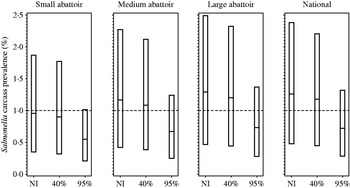
The effect on Salmonella carcass prevalence of reducing the proportion of seropositive pigs delivered to slaughter is presented in Figure 2. A change of within-herd seroprevalence did not significantly change the overall findings presented in Table 3. Energy price changes would noticeably change the additional cost per slaughtered pig, and consequently the prevalence-cost ratio. Nonetheless, it did not affect the ranking of the presented scenarios (data not shown).
Simulation output of estimated Salmonella carcass prevalence (mean and 90% credibility intervals) using different strategies (NI, no intervention; 40% and 95% indicate reductions of the proportion of seropositive pigs delivered to slaughter) for a small, medium and large abattoir, and at the national level, respectively.
DISCUSSION
We have demonstrated a model that provides a flexible and useful method to assess cost-effectiveness of new potential control strategies for Salmonella on pig carcasses. Danish data were used to provide input to the models, because there are extensive data available from the Danish surveillance programme. Nevertheless, the model framework and results are relevant for most countries with a pork industry. The method can easily be adapted to other countries with different herd and abattoir structures, other scenarios or other pathogens, as long as it is feasible to provide input distributions for the epidemiological parameters and economic values.
Extensive surveillance data and information from previous studies were useful for developing the presented model and kept reliance on expert opinion or use of rough estimates to a minimum. Apart from estimating the Salmonella carcass prevalence at the end of the slaughter process, this approach allowed us to incorporate herd information and estimate the effect, the cost-effectiveness and the total additional cost of different interventions in different abattoirs and at a national level. This included composite intervention scenarios with different decontamination methods used at different types of abattoirs. To our knowledge, this is the first model to include such types of data and options.
The effect of the slaughter processes (e.g. singeing, polishing, degutting, trimming, meat inspection) were not individually modelled because changed procedures during the slaughter line were not evaluated in this study. These have been assessed in another study [Reference Alban and Stark23] and were assumed constant in this study. However, they were represented here as underlying abattoir factors, which might include different hygiene and management practices [Reference Baptista, Dahl and Nielsen15]. Only decontamination interventions at the end of the slaughter line including use of hot water or steam, were evaluated since these are allowed by new meat hygiene EU regulations [24]. Besides Salmonella reduction, decontamination is also expected to reduce the prevalence of other pathogenic bacteria such as Yersinia and Campylobacter [Reference Wingstrand, Aabo, Sørensen and Rosenquist25], resulting in an increased protection of human health. Other interventions including the use of chemicals (e.g. lactic acid) were not evaluated as they require prior approval in the EU. Furthermore, few data were available to model the effect of such interventions.
The current Salmonella carcass prevalence in Denmark is already at a low level, which limits options for a further reduction. However, Denmark slaughters about 23 million pigs every year, and thus even a low percentage of positive carcasses might lead to quite a few contaminated carcasses. Control scenarios considered in this study represent relevant alternatives for the reduction of Salmonella carcass prevalence. Scenarios only including interventions at large abattoirs would have resulted in a cheaper strategy to achieve a national Salmonella carcass prevalence <1% (data not shown). However, these options would not significantly result in improved protection of Danish consumers, because large abattoirs supply a substantial part of their production to export markets. For this reason, it was decided to evaluate the economic efficiency of scenarios where it was possible to attain the target prevalence in all abattoir sizes. This also makes the analyses more relevant for countries which have mainly small abattoirs.
In agreement with previous studies, we found that abattoir interventions for level-3 (high-prevalence) herds alone resulted in a marginal reduction of the total number of positive carcasses. This is because they represent <1% of the total number of pigs slaughtered in Denmark [Reference Hurd9]. Accordingly, another study found that cost-effectiveness increases when all herds are included in the control programme [Reference van der Gaag10]. Therefore only scenarios where all pigs were subjected to interventions at slaughter were found to be of interest.
Cost-effectiveness analysis provided a valuable tool to compare the costs of different surveillance and control strategies with their expected effectiveness. Despite the limitations of the study, this model can be used to evaluate the relative cost-effectiveness of different surveillance and control alternatives. More than the absolute values, the relative ranking of the investigated alternatives can be used to inform the decision-making process. Stochastic simulation modelling showed that the cost-effectiveness of abattoir interventions might differ according to the abattoir size. Hot-water decontamination and steam ultrasound appeared to be cost-effective in medium and large abattoirs. However, these interventions imply large investments for both equipment acquisition and maintenance, which results in higher additional costs per slaughtered pig for small abattoirs compared to medium and larger abattoirs. Steam vacuum seems to be the most cost-effective intervention in small abattoirs due to the lower costs associated with equipment acquisition.
Both hot-water decontamination and steam vacuum are high energy and water demanding operations. As expected, scenario analysis showed that these interventions would be highly affected by an energy price increase scenario. However, the overall relation between the different scenarios would remain the same since steam ultrasound capital costs largely supplanted the energy costs of other methods.
By using different herd seroprevalence scenarios, it was possible to evaluate the hypothetical consequences of additional or reduced control interventions at the herd level. It was found that herd seroprevalence reductions would not have a significant impact on the overall findings (neither increased, nor decreased carcass prevalence). This is because large reductions in the number of Salmonella-seropositive pigs delivered to slaughter only result in minor reductions of the Salmonella carcass prevalence. In an average slaughterhouse, the 1% target might be achieved, if the number of seropositive pigs delivered to slaughter can be kept below ~50 [Reference Baptista, Dahl and Nielsen15]. This might be feasible in specific regions with very low seroprevalence at a herd level or no infected herds, or in small abattoirs that receive pigs from low-seroprevalence herds only [Reference Alban26]. Moreover, previous studies in different countries have shown that hygiene levels vary between abattoirs and significantly impact Salmonella carcass prevalence [Reference Delhalle12–Reference Baptista, Dahl and Nielsen15]. However, if a 95% herd seroprevalence reduction was achieved, <1% Salmonella carcass prevalence could be reached at small abattoirs if only level-0 and level-1 pigs were delivered to slaughter (data not shown). However, for medium and large abattoirs, specific interventions at the end of the slaughter line would be required. This strongly indicates that future nationwide control programmes focused on herd interventions might not be cost-effective for achieving a significant Salmonella carcass prevalence reduction. If eradication of Salmonella in pigs at herd level had been modelled, the results could have been different. However, for the Danish scenario, as for most EU countries, eradication of Salmonella in pig herds might not be economically feasible and consequently not a realistic option to consider. This is in agreement with previous studies that have shown that post-harvest interventions might be more effective to achieve a further reduction of the Salmonella carcass prevalence [Reference Berends4, Reference Goldbach and Alban8–Reference van der Gaag10].
Overall, the model results showed that a further reduction of Salmonella carcass prevalence can be achieved with post-harvest interventions. A scenario where no herd surveillance activities were in place would result in a reduction of the total costs of the scenario by about €400 000 per year for the finisher pig sector. However, pre-harvest surveillance and control interventions prevent a further herd Salmonella prevalence increase which could pose different challenges including further spread in the primary production, and to other species and the environment, resulting in an increased public health risk via direct transmission and contamination of vegetables and produce [Reference Pires27].
A study of hygiene at retail level suggested that butchers' shops had poorer hygiene compared to supermarkets [Reference Hansen, Christensen and Aabo28]. The effect of subsequent retail and food preparation interventions on Salmonella contamination at the point of consumption should also be considered important steps to further reduce human exposure [Reference Delhalle29, Reference Bollaerts30]. Moreover, in Denmark a large percentage of human salmonellosis cases have been attributed to travelling and imported pork which should not be disregarded since it poses further challenges to the protection of Danish consumers [Reference Pires and Hald31].
The distributions of the input variables identified by sensitivity analysis were defined based on extensive ongoing surveillance data which sustains the robustness of the results. The conversion factor used to calculate the individual prevalence from a pooled prevalence was based on a 1-year study covering about 19 000 samples. Ten carcass swabs were collected daily from five pigs; five were analysed as a single pooled sample and the other five were analysed as individual samples [Reference Sørensen, Wachmann and Alban18]. Random abattoir variation suggestive of different underlying practices at the abattoirs and the association between input of seropositive pigs and Salmonella carcass prevalence were estimated based on 6 years' surveillance data of 20 196 pooled carcass swabs collected from 23 abattoirs [Reference Baptista, Dahl and Nielsen15]. Moreover, sensitivity analysis results highlighted the importance of improving abattoir hygiene to achieve a further reduction of Salmonella carcass prevalence, which is agreement with previous studies conducted in Danish abattoirs [Reference Aabo32].
Models are limited representations of complex phenomena and can often be used as a tool to answer complex questions. In this paper we have presented a simple but robust model based on extensive data, which allowed estimation of the effect of different interventions on Salmonella carcass prevalence. Still, for simplification, different assumptions had to be made (e.g. classification of abattoirs into three size categories, distribution of input of seropositive pigs, and association between seropositivity of delivered pigs and probability of carcass positivity). To overcome this fact, we used a stochastic modelling approach which allows taking into account variability and uncertainty. Due to lack of data from large-scale studies in pig abattoirs, some variables like the effect of steam vacuum and steam ultrasound were associated with a large degree of uncertainty that might affect the model results. We have attempted to account for this by including large limits in the input parameters, leading to wide confidence limits in some of the results. As more information becomes available the model should be optimized to increase the precision of the estimates. Furthermore, underlying practices at each abattoir that affect hygiene and the probability of cross-contamination between carcasses at the abattoir were not included in this model but only included as variability across abattoirs. Thus, new and more detailed information might lead to different ranking of the scenarios.
In summary, results presented in this paper provide an insight into the complex issue of Salmonella control in pigs and pork, taking into account the herd and abattoir structure and evaluating the effect of herd interventions and the cost-effectiveness of new decontamination methods at the abattoirs. In general, abattoir interventions were found to be most effective in achieving reductions in Salmonella carcass prevalence and thereby contributing to the improvement of food safety. On average, small abattoirs have lower Salmonella carcass prevalence as a result of lower Salmonella input. Furthermore, it was shown that cost-effectiveness of abattoir interventions changes with abattoir size. Abattoir interventions requiring large capital investment result in higher costs and lower cost-effectiveness for small abattoirs.
The modelling framework presented here is useful as a tool to help the decision-making process for control of Salmonella in pigs and pork, but can easily be adapted to other infections for which reasonable input parameters and distributions are available. In the light of new findings, surveillance and control programmes should be continuously re-evaluated aiming for the identification of cost-effective strategies for control of Salmonella in pigs and pork, without disregarding public health.
ACKNOWLEDGEMENTS
Jan Dahl, Lene Lund Sørensen (Danish Agricultural & Food Council, Copenhagen, Denmark) and Lartey Lawson (Institute of Food and Resource Economics, University of Copenhagen, Denmark) are acknowledged for their contributions to the paper.
DECLARATION OF INTEREST
None.



