





1 Introduction
Logic programming languages in general, and Prolog in particular, have a long and fascinating history, having catapulted computing sciences from its old number-crunching, algorithm-focused and mostly imperative paradigm into the new, unique paradigm of inferential engines. Rather than measuring performance through the number of calculations per second, we can now do so through inferences per second – a qualitative leap, with import well beyond the natural language processing uses for which Prolog had been first conceived.
Logic programming’s truly novel characteristics distinguish it not only from traditional imperative programming but also from functional programming, some of whose aims and techniques it shares. The year TPLP celebrates its 20-year anniversary also marks the milestone of 50 years of evolution since the first steps toward Prolog, the first version of which was completed in 1972. Logic programming and Prolog have progressed over the years deeply intermingled with the evolution of the different areas they both resulted from, as well as those that they enabled.
The Prolog language in particular has attracted sustained academic and practical interest since its origins, yielding a large body of research. The language has been supported by numerous Prolog implementations, many of which are still in active development, while new ones keep appearing all the time. The large number of features added by different systems during this evolution were often motivated by the diverging needs of respective implementors. As a result, while sharing a core language including the main aspects of the ISO-Prolog standard, most Prolog systems also depart from each other in significant ways. This fertile evolution has also spawned many other new languages and paradigms that have created their own communities.
This article is structured in three major parts. In the first part, in Section 2, we outline the evolution of Prolog systems and the community approximately up to the development of the ISO standard in 1995, focusing on historic developments and scientific milestones. This provides a condensed description of the history of Prolog including the steps that got us to the first standard, along with the main motivations behind each step.
In the second part, in Section 3, we discuss the need for the ISO standard and analyze, with this standard in mind, how the Prolog implementations and community have evolved since. The section aims at documenting the vision, research, and development focus for each implementation. Since most systems have incorporated significant functionality beyond the Prolog ISO-standard, we survey these nonstandard features, with a special emphasis on portability. That section gathers very diffused information in one place; tables and small paragraphs allow for convenient comparison of implementations. We also consider logic programming languages that have considerably departed from Prolog, but were obviously strongly influenced by it.
In the third and last part, Section 4, we gaze into the crystal ball and answer a few questions such as: How might Prolog and its community evolve in the future? Can we better unify the new aspects that are offered by different implementations? How should efforts for increased portability be organized? Does it make sense to aim for a unified language? And, what tools could be provided to ease development? Furthermore, we propose a plan for future steps that need to be taken to evolve Prolog as a language. The plan is founded on needs expressed by the community in a consultation and on a comparison with successful evolution of other languages. Our goal is to achieve further standardization and easier portability of code among implementations. We argue for why this is important and discuss why previous similar attempts have failed.
2 Part I: The early steps of Prolog
This first part of the paper provides two major contributions. First, it provides a general definition of what “Prolog” is and what a current Prolog implementation generally looks like. This allows us to focus in the paper on this class of systems, although we also mention briefly other related ones. The second contribution of this section is a description of the evolution of Prolog systems approximately up to and including the appearance and gradual adoption the ISO standard. Given the high variability of features and technologies which characterized prestandard Prolog systems, some early systems may not perfectly fit a modern definition of Prolog. Nevertheless, we choose to include these also in our historical discussion – and consider them in any case Prolog systems – because of their importance in shaping Prolog as we know it today. More concretely, we consider Prolog systems essentially all those discussed in this paper, except of course the “systems influenced by Prolog” of Section 3.5.2.
Note that it is beyond the scope of our article to reconstruct all the initial steps and theoretical developments that led to Prolog. Fortunately, good recollections can be found for example by Kowalski* (Reference Kowalski1988, Reference Kowalski2013), Cohen* (Reference Cohen1988), Van Roy (Reference Van Roy1994), Colmerauer* (Reference Colmerauer1996) and van Emden* (Reference van Emden2006). Footnote 1 Here, we discuss those first steps that are useful for understanding the origin and evolution of the Prolog systems that have survived to the present day.
We also note that this paper is not aimed at providing a completely exhaustive list of Prolog systems: the list is very large and constantly changing, and many other implementations, such as Waterloo Prolog (Roberts Reference Roberts1977), UNSW Prolog (Sammut and Sammut Reference Sammut and Sammut1983), or the recently discontinued Jekejeke Prolog, to name just a few, have helped to spread Prolog throughout the world, but we simply cannot cover them all. Instead, we have tried to concentrate on implementations that constitute a milestone in the evolution of the language or offer some specially interesting characteristics. We redirect interested readers to the historical sources archive maintained by McJones (Reference McJones2021) to learn about many of the earlier systems.
Figure 1 provides a timeline overview of some of the most impactful of the early Prolog systems treated in this section, that is, approximately up to the development of the ISO standard.
Approximate timeline of some early Prolog systems (up to the ISO Standard).
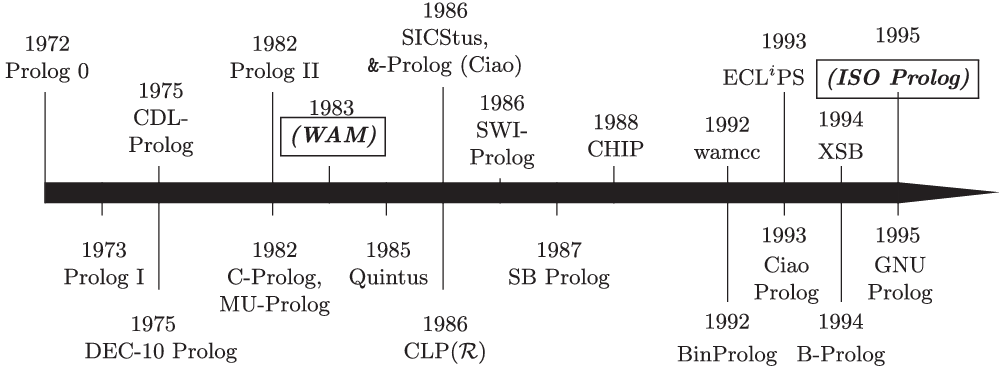
Throughout the paper we attempt to assign meaningful dates to the different Prolog systems covered. This is not always straightforward, and the dates should not be given too much significance. The strategy that we have followed is as follows: we first looked for some authoritative source explicitly stating the date the Prolog system was developed or made publicly available. We consider as “authoritative source” any paper from any logic programming-related conference or journal, as well as the Prolog system’s home page, or any technical report or manual of the system. In absence of these sources, we looked for resources on the web mentioning the Prolog system along with a date, and we selected the earliest date among all resources.
2.1 Defining Prolog
Prolog is arguably the most prominent language under the logic programming (LP) umbrella. However, as we elaborate in the remainder of this paper, the evolution of Prolog did not follow a linear path. Many contributions have been presented in the history of LP as implementations, extensions, variants, or subsets of Prolog. Interestingly, while in some other programming paradigms the custom is to create new language names when making modifications or extensions to a given language, the Prolog tradition has been instead to keep the name Prolog across this long history of very substantial evolution.
In the following, we attempt to draw a line between what can be considered a Prolog implementation and what not. We do so by defining Prolog from several perspectives. We first provide a conceptual and minimalist definition of the essential features of Prolog (in a post-ISO-standard world). We then overview a number of important (yet non-essential) features that any full-fledged implementation of Prolog should include. Finally, we present a technical test users may perform to verify whether a technology can be considered as Prolog or not.
The objective of our definition is in any case inclusive, in the sense that we aim at encompassing all systems that preserve the essence that is generally recognized as Prolog, while allowing the many extensions that have taken place and hopefully those that may be adopted in the future.
Conceptual Definition Any Prolog implementation must at least support:
-
1. Horn clauses with variables in the terms and arbitrarily nested function symbols as the basic knowledge representation means for both programs (a.k.a. knowledge bases) and queries;
-
2. the ability to manipulate predicates and clauses as terms, so that meta-predicates can be written as ordinary predicates;
-
3. SLD-resolution (Kowalski Reference Kowalski1974) based on Robinson’s* principle (1965) and Kowalski’s procedural semantics (Kowalski Reference Kowalski1974) as the basic execution mechanism;
-
4. unification of arbitrary terms which may contain logic variables at any position, both during SLD-resolution steps and as an explicit mechanism (e.g., via the built-in =/2);
-
5. the automatic depth-first exploration of the proof tree for each logic query.
Notably, item 1 aims at excluding strict subsets of Prolog which do not support function symbols or require knowledge bases to be ground. Item 2 rules out custom rule engines for Horn clauses which do not support meta-programming, while requiring Prolog implementations to support meta-predicates. In other words, real Prolog systems must at least support an efficient mechanism such as call/1, enabling programmers to write predicates accepting terms as arguments, to be interpreted as goals. ISO-compliant implementations, for instance, employ meta-predicates to support negation, disjunction, implication, and other aspects which are not naturally supported by Horn clauses. Item 4 requires implementations to expose the unification mechanism to the users, and it cuts off subsets of Prolog employing weaker forms of pattern matching (e.g., where variables can only appear once and only at the top-level). Items 3 and 5 constrain Prolog solvers to a backward (goal-oriented) resolution strategy where a proof tree is explored via some traversal strategy. ISO-compliant implementations support a sequential, depth-first, deterministic exploration of the proof tree, via backtracking. This is commonly achieved by selecting clauses in a top-down and subgoals in a left-to-right fashion. Other implementations may support further strategies: for instance, tabled Prologs can deviate from pure depth-first traversal for tabled predicates. Other Prologs may implement alternative search strategies in addition to depth-first, possibly for certain predicates. The important issue here is to have at least a (default) mode in which the system is a true programming language, predictable in terms of cost in steps and memory.
Common Relevant Features Any Prolog implementation may also support:
-
6. some control mechanism aimed at letting programmers manage the aforementioned exploration;
-
7. negation as failure (Clark Reference Clark1978), and other logic aspects such as disjunction or implication;
-
8. the possibility to alter the execution context during resolution, via ad hoc primitives;
-
9. an efficient way of indexing clauses in the knowledge base, for both the read-only and read-write use cases;
-
10. the possibility to express definite clause grammars (DCG) and parse strings using them;
-
11. constraint logic programming (Jaffar and Lassez Reference Jaffar and Lassez1987) via ad hoc predicates or specialized rules (Frühwirth Reference Frühwirth2009);
-
12. the possibility to define custom infix, prefix, or postfix operators, with arbitrary priority and associativity.
There, item 1 dictates that users should be provided with some mechanism to control the proof tree exploration. ISO-compliant implementations provide the cut for this purpose, while other Prologs may expose further mechanisms. For instance, in tabled Prologs users must explicitly specify which rules are subject to tabling, and in this way they retain some degree of control about the proof tree exploration. Similarly, delay declarations like when/2 allow one to influence the selection rule employed for SLD-resolution. Item 2 provides a practical way to realize negation on top of Horn clauses and SLD, which Keith Clark* gave a nonprocedural semantics to – namely, completion semantics – showing that negation as failure is theoretically sound (Clark Reference Clark1978). Furthermore, negation as well as other logic operators contribute to the perception of Prolog as a practical programming language. Item 3 requires implementations to support, via side effects, the dynamic modification of fundamental aspects that affect the resolution process, possibly as the resolution is going on. These aspects may include the knowledge base (a.k.a. the dynamic clause database), the flags, or the pool of currently open files, and their modification should be exposed to the user via ad hoc meta-predicates. For instance, ISO-compliant implementations rely upon built-in predicates like assert/1, retract/1, set_prolog_flag/1, etc. to serve this purpose. In particular, to make both the access and modification of clauses efficient, item 4 plays a very important role: the satisfaction of this optional requirement is what distinguishes toy implementations from full-fledged Prolog systems. Finally, while not strictly essential, items 5 and 6 are two very successful features many modern Prolog system support. Item 7 is a nice-to-have feature which allows a more natural notation when extending Prolog systems with custom functionalities, without requiring a bare new language to be designed from scratch.
In particular, probabilistic extensions of Prolog such as ProbLog (de Raedt et al. Reference de Raedt, Kimmig and Toivonen2007), and cplint (Riguzzi Reference Riguzzi2007) benefit from custom operator definitions.
Of course, many other features may enrich (or be lacking from) a Prolog implementation. Consider for instance, full ISO library support, presence/lack of a module system, and so on. While these are technical aspects that greatly affect the efficiency, effectiveness, and usability of Prolog implementations, we do not consider them as fundamental.
Technical Test As a rule of thumb, one can check if a logic solver can be considered as a Prolog system or not via the following test. The test requires that the well-known append/3 predicate can be written exactly as follows:
append([], X, X).
append([H | X], Y, [H | Z]) :- append(X, Y, Z).
and can be queried in variety of ways, e.g., to append two lists: append([1, 2], [c, d], R), deconstruct a list as in: append(A, B, [1, 2]), or with any arbitrary instantiation of the arguments, such as append([X | T], [c], [Z, Z, Z]).
Note that the above test excludes some logic programming languages, such as Datalog (Maier et al. Reference Maier, Tekle, Kifer and Warren2018), as it does not support functors (just constants); traditional ASP (Answer Set Programming) (Brewka et al. Reference Brewka, Eiter and Truszczyński2011), as it does not cater for fully recursive first-order terms with no bound; or Mercury (Somogyi et al. Reference Somogyi, Henderson and Conway1996), as it is based on pattern-matching and not on unification and only caters for linear terms. CORAL (Ramakrishnan et al. Reference Ramakrishnan, Srivastava, Sudarshan and Seshadri1994), on the other hand, is an interesting edge case: while its default proof tree exploration strategy does not meet our definition, it can be instantiated to behave like Prolog. Thus, we would consider the entire system not to be a Prolog (but it would qualify as an extension). Other systems we choose not to consider as Prolog systems (but rather as systems derived from Prolog) are Gödel (Hill and Lloyd Reference Hill and Lloyd1994), Curry (Hanus et al. Reference Hanus, Kuchen and Moreno-Navarro1995), and Picat (Zhou et al. Reference Zhou, Kjellerstrand and Fruhman2015). Nevertheless, we do discuss these systems in some detail in Section 3.5, where we discuss Prolog derivatives. However, as mentioned before, we consider all other systems that are discussed in the paper to be Prologs.
2.2 Ancestors of Prolog
Prolog descends from three main branches of research: AI programming, automatic theorem proving, and language processing.
The field of AI was born around 1956 and quickly gave rise to the functional programming language LISP (McCarthy Reference McCarthy1962). A host of other AI languages followed, sometimes grouped under the denomination of Very High Level Languages. These languages had features such as symbolic processing and abstraction that set them apart from more mundane languages.
Automatic theorem proving made a big step forward in a seminal paper by Alan Robinson introducing the resolution inference rule (Robinson Reference Robinson1965). Resolution extends modus ponens and modus tollens and includes unification. Resolution can be used to obtain a semi-decision procedure for predicate logic and is at the heart of most inference procedures in logic programming.
In the wake of these advances, an early visionary in the development of the logic programming field was Cordell Green, who already in the late 60s envisioned how to extend resolution to automatically construct problem solutions, and implemented this vision in particular for automatically answering questions based on first-order logic, illustrating it as well for plan formation, program synthesis, and program simulation, thus presaging the possibility of moving symbolic programming beyond functions and into logic (Green Reference Green1969a; Green Reference Green1969b). This represented perhaps the first zenith of logic in AI (Kowalski Reference Kowalski1988). Also notable is Ted Elcock, whose 1967 Aberdeen System, Absys, developed with Michael Foster, while not having directly influenced the development of Prolog, was a declarative programming language that anticipated some of Prolog’s features such as invertability, negation as failure, aggregation operators, and the central role of backtracking (Elcock Reference Elcock1990).
Meanwhile, Alain Colmerauer was seeking to automate human–machine conversation, which led him to develop Q-systems (Colmerauer Reference Colmerauer1970a; Colmerauer and Roussel Reference Colmerauer and Roussel1996; Colmerauer Reference Colmerauer1970b), a tree rewriting system that for many years served for English-to-French translation of Canadian meteorological reports. His aim of modifying Q-systems so that a complete question-answering system (rather than just the analyzer part of it) could be written in logic inspired him, among others, to create Prolog.
Floyd’s work on nondeterministic algorithms (Floyd Reference Floyd1967) (cf. the survey by Cohen Reference Cohen1979) was another important influence, as was Kowalski and Kuehner’s SL resolution (1971). SL resolution is a refinement of resolution which is still both sound and refutation complete for the full clausal form of first order logic, and underlies the procedural interpretation of Horn clauses (Kowalski Reference Kowalski1974).
A further simplification for the case of Horn clauses – SLD resolution (Kowalski Reference Kowalski1974) – resulted from Kowalski’s efforts to reconcile the declarative nature of logic based representations of knowledge with PLANNER’s procedural approach (Hewitt Reference Hewitt1969). The semantics of Horn clauses was explored by Kowalski and van Emden (1976).
2.3 The birth of Prolog
Colmerauer’s aim of creating a human–machine communication system in logic had led him to further research French language analysis with Pasero (Reference Pasero1973), and to numerous experiments with Philippe Roussel and Jean Trudel on automated theorem proving methods. Having learned about SL resolution, he invited Kowalski to visit Marseille in the summer of 1971. The visit led to Roussel’s use of SL resolution in his thesis on formal equality in automated theorem proving (1972). In addition to its attractions as a theorem prover, SL resolution had the additional attraction that its stack-type operating mode was similar to the management of procedure calls in a standard programming language, making it particularly well suited for implementation by backtracking à la Floyd, which Colmerauer adopted for efficiency, so as to avoid having to copy and save the resolvents. Yet, for language processing, Q-systems still seemed indispensable. During Kowalski’s 1971 visit to Marseille, Kowalski and Colmerauer discovered that a certain way of representing formal grammars in clausal logic enables certain general-purpose proof procedures for first-order logic to behave as special-purpose parsing methods: SL-resolution as top-down parsing, hyper-resolution as bottom-up parsing, similar to Q-systems.
Then, Colmerauer defined a way to encode grammar rules in clauses, known today as the difference-list technique, and introduced extra parameters into the nonterminals to propagate and compute information, through which the analyzer could extract, as in Q-systems, a formula representing the information contained in a sentence.
Colmerauer and Kowalski’s collaboration led in 1972 to a discovery analogous, for programs, to that made previously for grammars: that a certain style for representing programs in the clausal form of logic enables SL resolution to behave as a computational procedure for executing computer programs.
For this to happen, though, a simplification for efficiency of Kowalski’s SL-resolution was implemented at the cost of incompleteness: linear resolution was constrained to unify only between the head literals of ordered clauses with ordered literals. Footnote 2 This made Colmerauer’s aim of creating a human-machine communication system possible. The result was not only the first Natural Language (NL) application of what we now know as Prolog, but most importantly, the basis of Prolog itself: a linear resolution system restricted to Horn clauses that could answer questions (i.e., solve problems) nondeterministically in the problem domain described by the clauses input (Colmerauer et al. Reference Colmerauer, Kanoui, Pasero and Roussel1973).
However, the Marseille group was unaware of Horn clauses at the time. But Kowalski recognized that Marseille’s principal “heresy” (in Colmerauer’ words), a strategy of linear demonstration with unifications only at the heads of clauses, was justified for Horn clauses. Kowalski also clarified further simplifications that so far were only implicit: the elimination of “ancestor resolution” (which only works with non-Horn clauses) and the elimination of the “factoring” rule. Together with Maarten van Emden, he went on to define the modern semantics of Horn-clause programming (van Emden and Kowalski Reference van Emden and Kowalski1976).
2.4 The early Prolog systems
Prolog implementations evolved in interaction with ad hoc, initially meta-programmed extensions of the language itself, created for the often interdisciplinary needs of applications. In time, these extensions became, or evolved into, standard features of the language. In this section, we chronicle such early developments.
2.4.1 Prolog 0, Prolog I (1972–1973)
Basic Features: As reported by Cohen (Reference Cohen1988) and later by Colmerauer and Roussel (Reference Colmerauer and Roussel1996), the first system (“Prolog 0”) was written in Algol-W by Roussel in 1972. Practical experience with this system lead to a much more refined second implementation (“Prolog I”) at the end of 1973 by Battani, Meloni, and Bazzoli, in Fortran. This system already had the same operational semantics and most of the built-ins that later became part of the ISO standard, such as the search space pruning operator (the “cut”), relevant for Prolog to become a practical AI language. Efficiency was greatly improved by adopting the structure-sharing technique by Boyer and Moore (Reference Boyer and Moore1972) to represent the clauses generated during a deduction.
Higher-order logic extensions: Basic facilities for meta-programming higher-order logic extensions were present in Prolog systems from the very beginning, and many later systems include extended higher-order capabilities beyond the basic call/1 predicate – for example, $\lambda$
Prolog (Nadathur and Miller Reference Nadathur and Miller1988), BinProlog (Tarau 1992; Reference Tarau2012), Hyprolog (Christiansen and Dahl Reference Christiansen and Dahl2005). Some of the most influential early extensions are discussed into the following subparagraphs.
$\lambda$
Prolog (Nadathur and Miller Reference Nadathur and Miller1988), BinProlog (Tarau 1992; Reference Tarau2012), Hyprolog (Christiansen and Dahl Reference Christiansen and Dahl2005). Some of the most influential early extensions are discussed into the following subparagraphs.
Constraints: Interestingly, Prolog 0 already included the dif/2 ( $\neq$
) predicate, as a result of Roussel’s thesis (1972). The predicate sets up a constraint that succeeds if both of its arguments are different terms, but delays the execution of the goal if they are not sufficiently instantiated.
$\neq$
) predicate, as a result of Roussel’s thesis (1972). The predicate sets up a constraint that succeeds if both of its arguments are different terms, but delays the execution of the goal if they are not sufficiently instantiated.
Coroutining: Although dif/2 was neither retained in Prolog I nor became part of the ISO standard, it meant a first step towards the extension of unification to handle constraints: while it introduced the negation of unification, it also allowed an early form of coroutining. Building on this work, Verónica Dahl* introduced a delay meta-predicate serving to dynamically reorder the execution of a query’s elements by delaying a predicate’s execution until statically defined conditions on it become true, and used it to extend Prolog with full coroutining – that is, the ability to execute either a list of goals or a first-order logic formula representing a goal, by proving them in efficient rather than sequential order. With Roland Sambuc, she developed the first Prolog automatic configuration system, which exploited coroutining, for the SOLAR 16 series of computers (Dahl and Sambuc Reference Dahl and Sambuc1976).
Safe Negation as Failure: Dahl also used delay/2 to make negation-as-failure (NaF) (the efficient but generally unsafe built-in predicate of Prolog I which consists of assuming not(p) if every proof of p fails) safe, simply by delaying the execution of a negated goal until all its variables have been grounded. This approach to safe negation and to coroutining made its way into many NL consultable systems, the best known being perhaps Chat 80 (Warren and Pereira Reference Warren and Pereira1982), and more importantly, into later Prologs, as we discuss later.
Deductive Databases: Dahl then ushered in the deductive database field by developing the first relational database system written in Prolog (Dahl 1977; Reference Dahl1982). Other higher-order extensions to Prolog included in this system or in the one by Dahl and Sambuc (Reference Dahl and Sambuc1976), such as list/3 (now called setof/3), have become standard in Prolog.
Metamorphosis Grammars: Metamorphosis Grammars (MGs) (Colmerauer Reference Colmerauer1975) were Colmerauer’s language processing formalism for Prolog. They constituted at the time a linguist’s dream, since they elegantly circumvented the single-head restriction of Prolog’s Horn clauses, thus achieving the expressive power of transformational grammars in linguistics, which, as type-0 formal grammars, allow more than one symbol in their left-hand side. This allowed for fairly direct, while also executable, renditions of the linguistic constraints then in vogue: a single rule could capture a complete parsing state through unification with its left-hand (multi-head) side, in order to enforce linguistic constraints through specifying, in its right-hand side, how to re-write it.
The first applications of MGs were compilation (Colmerauer Reference Colmerauer1975); French consultation of automatic configuration systems (Dahl and Sambuc Reference Dahl and Sambuc1976), where a full first-order logic interlingua was evaluated through coroutining; and Spanish consultation of database systems (Dahl 1977; Reference Dahl1979), where a set-oriented, three valued logic interlingua (Colmerauer Reference Colmerauer1979; Dahl Reference Dahl1979) was evaluated, allowing among other things for the detection of failed presuppositions (Dahl 1977; Reference Dahl1982). Coroutining was used in the system by Dahl and Sambuc (Reference Dahl and Sambuc1976) not only for feasibility and efficiency, as earlier described, but also to permit different paraphrases of a same NL request to be reordered into a single, optimal execution sequence.
A simplification of MGs, Definite Clause Grammars (DCGs), was then developed by Fernando Pereira* and David H.D. Warren*, Footnote 3 in which rules must be single-headed like in Prolog, while syntactic movement is achieved through threading syntactic gap arguments explicitly. DCGs were popularized in 1980 (Pereira and Warren Reference Pereira and Warren1980) and became a standard feature of Prolog. It is worth highlighting that the “DCG” name does not refer to the fact that they can translate to definite clauses (since all four subsets of MGs can, just as a side effect of being included in MGs), but to their restriction to single heads, which makes them similar in shape to definite clauses.
More specialized Prolog-based grammars started to emerge. Their uses to accommodate linguistic theories, in particular Chomskyan, were studied as early as 1984 (Dahl Reference Dahl1986), leading to the new research area of “logic grammars” (Abramson and Dahl Reference Abramson and Dahl1989).
Further Theoretical Underpinnings: In 1978, Keith Clark published a paper that showed NaF to be correct with respect to the logic program’s completion (Clark Reference Clark1978). Simultaneously, Ray Reiter* provided a logical formalization of the related “Closed World Assumption” (Reiter Reference Reiter1978), which underlies NaF’s sanctioning as false of anything that cannot be proved to be true: since in a closed world, every statement that is true is also known to be true, it is safe – in such worlds – to assume that what is not known to be true is false. This then led to substantial research on nonmonotonic reasoning in logic programming, and to inspiring foundational work on deductive databases by Reiter himself, as well as Herve Gallaire*, Jack Minker*, and Jean-Marie Nicolas (1984). The work of Cohen (Reference Cohen1979) on nondeterminism in programming languages was also influential in these early stages.
2.4.2 CDL-Prolog (1975)
As discussed by Peter Szeredi* (Reference Szeredi2004), a group at NIM IGÜSZI in Hungary was trying to port the Marseille system to the locally available machine in 1975. At the same time, Szeredi, who was part of another group at NIM IGÜSZI, completed his first (unnamed) Prolog implementation using the Compiler Definition Language (CDL) developed by Cornelis Koster, one of the authors of the Algol 68 report, marking the beginning of a series of substantial contributions to Prolog.
2.4.3 DEC-10 Prolog (1975)
In 1974, David H.D. Warren visited Marseille and developed a plan generation system in Prolog, called Warplan (Warren Reference Warren1974). He then took Prolog with him as a big deck of punched cards and installed it on a DEC-10 in Edinburgh, where he enhanced it with an alternative “front-end” (or “superviser”) written in Prolog, to better tailor it to the Edinburgh computing environment and the wider character set available (the Marseille group had been restricted by a primitive, upper-case-only, teletype connection to a mainframe in Grenoble). He distributed this version to many groups around the world.
He then set out to address what he perceived as a limitation of the implementations of Prolog up to that point in time: they were comparatively slower and more memory hungry than other high-level AI-languages of the time and, in particular, than LISP. In what would eventually become his PhD thesis work (Warren Reference Warren1977), David H.D. Warren pieced away on one side the elements of Prolog that could be implemented in the same way as the most efficient symbolic programming languages (activation records, argument passing, stack- and heap-based memory management, etc.), and applied to them well-established compilation techniques. Then, for those elements of Prolog that were more novel, such as unification and backtracking, he developed or applied specific compilation and run-time techniques such as optimization of unification by clause head pre-compilation, fast recovery of space on backtracking, trailing, or structure sharing-based term representation (Boyer and Moore Reference Boyer and Moore1972) (the latter already present in Marseille Prolog). He used as target again the DEC-10 with the TOPS-10 operating system, and exploited architectural features of the DEC-10 such as arbitrary-depth indirect memory access, particularly suited for the structure-sharing technique. The product of this effort was the first compiler from Prolog to machine code. This resulted in a large leap in performance for Prolog, both in terms of speed and memory efficiency, rivaling that of Lisp systems. This was documented in Warren et al. (Reference Warren, Pereira and Pereira1977), in what was to be a landmark publication on Prolog in a mainstream Computer Science venue. A version of this compiler dated 1975 is part of the archive maintained by McJones (Reference McJones2021).
Fernando Pereira and Lus Moniz Pereira*, both at LNEC in Lisbon, also made major contributions to the development of the complete DEC-10 Prolog system, which also included now “classic” built-ins such as setof/3 and bagof/3. A significant element in DEC-10 Prolog’s popularity was the availability of an example-rich user guide (Warren Reference Warren1975; Pereira et al. Reference Pereira, Pereira and Warren1978). All these features, coupled with the improved syntax and performance, and the fact that the DEC-10 (and later DEC-20) were the machines of choice at the top AI departments worldwide, made DEC-10 Prolog available to (and used by) all these departments, and in general by the AI research community. This led to DEC-10 Prolog becoming very popular and it spread widely from about 1976 onward. By 1980, the system also featured a garbage collector and last-call optimization (Warren Reference Warren1980). Also in 1980, David H.D. Warren and Fernando Pereira adapted it to TENEX/TOPS-20, which had then become the operating system(s) and machines most widely used for AI research.
The contributions made by the authors of DEC-10 Prolog were fundamental for the coming of age of Prolog: they proved that Prolog could not only be elegant and powerful but it could also come with the usability, speed, and efficiency of a conventional programming language. As a result, DEC-10 Prolog had a large influence on most Prologs after it, and its syntax, now known also as the “Edinburgh syntax,” and many of its features constitute a fundamental component of the current Prolog ISO standard.
However, for all its merits, the one drawback of DEC-10 Prolog was that it was deeply tied to its computer architecture and thereby inherently not portable to new machines, in particular to the then-emerging 32-bit computer architectures with virtual memory. This prompted the development of other, more portable Prologs, described below, and eventually the Warren Abstract Machine (see Section 2.5).
2.4.4 Unix Prolog (1979)
As discussed by Mellish (Reference Mellish1979), there were a number of Prolog interpreters at the time that used the DEC-10 syntax but were internally quite different.
The objective of these other systems was to develop a portable, yet still reasonably-performing Prolog system, written in a mainstream source language, and that could be compiled on more mainstream, 32-bit machines (including later Unix systems such as, for example, the DEC VAX family, which became ubiquitous).
The first system to achieve portability was Unix Prolog by Mellish (Reference Mellish1979), written for PDP-11 computers running Unix, which was also ported to the RT-11 operating system. Unlike Marseille Prolog and DEC-10 Prolog, it used structure-copying rather than structure-sharing. It led to Clocksin and Mellish writing an influential textbook (1981) which describes a standard “core” Prolog, compatible with both DEC-10 Prolog and Unix Prolog.
2.4.5 LPA Prolog (1980)
Logic Programming Associates (LPA) was founded in 1980 out of the group of Kowalski at the Department of Computing and Control at Imperial College London, including, among others, Clive Spenser, Keith Clark, and Frank McCabe (LPA Ltd 2021). LPA distributed micro-PROLOG which ran on popular 8-bit home computers of the time such as the Sinclair Spectrum and the Apple II and evolved to be one of the first Prolog implementations for MS-DOS. LPA Prolog evolved to support the Edinburgh syntax around 1991 and is still delivered today as a compiler and development system for the Microsoft Windows platform.
2.4.6 MU-Prolog (1982)
In 1982, another implementation named MU-Prolog (Naish Reference Naish1982; Naish Reference Naish1986) was developed by Lee Naish at Melbourne University. It was initially a simple interpreter to understand the workings of Prolog, as the author could not find a Prolog system for his hardware.
The system offered efficient coroutining facilities and a delay mechanism similar to those discussed in Section to automatically delay calls to negation and if-then-else constructs, as well as meta-logical (e.g., functor/3) and arithmetic predicates. Its rendition of the delay predicate, here called wait, allows for declarations to be provided manually but also generated automatically.
MU-Prolog was one of the first shipping database connections, module systems, and dynamic loading of shared C libraries, as well as sound negation (through delay/2, as in Section 2.4.1) and a logically pure findall/3 predicate, a consequence of its variable binding-controlled delayed goal execution. MU-Prolog was later succeeded by NU-Prolog (Thom and Zobel Reference Thom and Zobel1987), bringing MU-Prolog’s features to the Warren Abstract Machine (see Section 2.5).
2.4.7 C-Prolog (1982)
As a first foray into getting Edinburgh Prolog on 32-bit address machines, Luís Damas created an Edinburgh-syntax Prolog interpreter for an ICL mainframe with Edinburgh-specific time sharing system (EMAS) and systems programming language (IMP). This interpreter used the structure sharing approach by Boyer and Moore (Reference Boyer and Moore1972) and copied as far as possible the built-in predicates of DEC-10 Prolog. When Fernando Pereira got access to a 32-bit DEC VAX 11/750 at EdCAAD in Edinburgh in 1981, he rewrote EMAS Prolog in C for BSD 4.1 Unix. This required many adaptations from the untyped IMP into the typed C, and he also made it even closer to DEC-10 Prolog in syntax and built-in predicates. The whole project became known as C-Prolog later on (Pereira Reference Pereira1983). The archive maintained by McJones (Reference McJones2021) contains a readme file from 1982.
Although implemented as an interpreter, C-Prolog was reasonably efficient, portable and overall a very usable system. Thus it quickly became influential among the Edinburgh implementations, helping to establish “Edinburgh Prolog” as the standard. It contributed greatly to creating a wider Prolog community and remained extensively used for many years.
2.5 From Prolog compilation to the WAM
Following David H.D. Warren’s first Prolog compiler, described in Section 2.4.3, there were a number of other compiled systems up until 1983, including Prolog-X (Bowen et al. Reference Bowen, Byrd, Clocksin and de Lisboa1983) and later NIP, the “New Implementation of Prolog” (for details, cf. the survey by Van Roy Reference Van Roy1994).
In 1983, funded by DEC in SRI, who wanted to have the Prolog performance of the DEC-10/20 implementation ported to the VAX line, David H.D. Warren devised an abstract machine, i.e., a memory architecture and an instruction set that greatly clarified the process of implementing a high-performance Prolog system (Warren Reference Warren1983). This machine became widely known as the Warren Abstract Machine, the WAM. The proposal was basically a reformulation of the ideas of the DEC-10 compiler, which translated Prolog source to a set of abstract operations which were then expanded to machine code (Warren Reference Warren1977), but expressed in a more accessible way. In particular, it was described in legible pseudo-code, as opposed to DEC-10 machine code. Warren made some changes with respect to the DEC-10 system, such as passing parameters through registers instead of the stack. Also, instead of the structure sharing approach used in the DEC-10 work, the WAM used the structure copying approach by Bruynooghe* (Reference Bruynooghe1976). The WAM also included the idea of compiling to intermediate code (bytecode), as introduced by the programming language Pascal and its p-code (Nori et al. Reference Nori, Ammann, Jensen and Nägeli1974), which made compiled code very compact and portable, an approach that is still advantageous today with respect to native code in some contexts. The first software implementation of the WAM was for the Motorola 68000 implemented for Quintus by David H.D. Warren, which he also adapted to the VAX line. Evan Tick, later designed a pipelined microprocessor organization for Prolog machines based on the WAM (Tick Reference Tick1984).
Copies of the SRI technical report describing the WAM were passed around widely among those who had an interest in Prolog implementations, and the WAM became the standard blueprint for Prolog compilers and continues to be today. The WAM was made even more widely accessible and easier to understand with the publication of Aït-Kaci’s Tutorial Reconstruction (1991), building on earlier tutorials by Hermenegildo (Reference Hermenegildo1989) and Nasr.
Much work was done after that on further optimization techniques for WAM-based Prologs, achieving very high levels of sequential performance. This very interesting topic is outside the scope of this paper, but is covered in detail in the excellent survey by Van Roy (Reference Van Roy1994), and much of this work is by Van Roy himself. Further work, beyond the survey, includes, for example, dynamic compilation (da Silva and Santos Costa Reference da Silva and Santos Costa2007), instruction merging (Nässén et al. Reference Nässén, Carlsson and Sagonas2001) (pioneered by Quintus), advanced indexing (Santos Costa et al. Reference Santos Costa, Sagonas and Lopes2007; Vaz et al. Reference Vaz, Santos Costa and Ferreira2009), optimized compilation (Van Roy and Despain Reference Van Roy and Despain1992; Morales et al. Reference Morales, Carro, Hermenegildo and Notes2004; Carro et al. Reference Carro, Morales, Muller, Puebla and Hermenegildo2006), optimized tagging (Morales et al. Reference Morales, Carro and Hermenegildo2008), etc. Also, the compilation of Prolog programs to WAM code was proven mathematically correct by Börger and Rosenzweig (Reference BÖrger and Rosenzweig1995), and the proof was machine verified by Schellhorn and Ahrendt (Reference Schellhorn and Ahrendt1998), Schellhorn (Reference Schellhorn1999).
2.6 The FGCS initiative
In 1982 Japan’s Ministry of International Trade and Industry (MITI) started the Fifth Generation Computer Systems (FGCS) initiative in order to boost Japan’s computer industry. The technical objective was to build large parallel computers and apply them in artificial intelligence tasks, with logic programming as the basis, and in particular Prolog. The research was conducted across Japanese computer industries and at a specific research center, ICOT. Among the first results were hardware sequential Prolog machines called PSI (for Personal Sequential Inference), similar to those developed for Lisp at the time by companies such as Lambda Machines, Thinking Machines, Xerox, and Borroughs. A series of parallel machines were also developed in the project.
However, at the point of combining parallelism and logic programming, a language shift occurred. During a visit to ICOT, Ehud Shapiro developed what he defined as a subset of concurrent Prolog (Shapiro Reference Shapiro1983; Shapiro Reference Shapiro1987). This referred to the fact that, in order to reduce the implementation complexity stemming from the interactions between concurrency and Prolog’s backtracking, the latter was left out in this initial design. As in other concurrent logic programming languages at the time, such as Parlog (Clark and Gregory Reference Clark and Gregory1986), committed choice was supported instead, where only the first clause whose guard succeeds is executed. This guard part consists of a marked set of literals (normally built-ins) at the beginning of the clause. This inspired the Guarded Horn Clauses (GHC) language of Ueda (Reference Ueda1985), as the Kernel Language 1 (KL1) (Ueda and Chikayama Reference Ueda and Chikayama1990), which became the core language of the FGCS project.
While the “kernel” denomination of KL1 indicated a desire to eventually recover the declarative search capabilities of Prolog, the basic characteristics of KL1 remained throughout the FGCS project. With the departure from Prolog, an essential part of the language’s elegance and functionality was lost, and this arguably detracted from the potential impact of the FGCS.
It can be argued that the fifth generation project was successful in a number of ways. From the technical point of view, in addition to the programming language work, it produced many results in parallel machines, scheduling, parallel databases, parallel automated theorem proving, or parallel reasoning systems. Perhaps most importantly, it accelerated much work elsewhere. This included a significant line of research into concurrent (constraint) logic languages (see Section 3.5.1). But, more relevant herein, all the work on parallel implementation of Prolog, which in the end was done at other centers throughout the world rather than in Japan (we return to this briefly in Section 2.7).
Beyond the technical part, the FGCS project developed very valuable expertise in computer architecture, parallelism, languages, software, etc. and nurtured a whole generation of researchers in areas that were hitherto not so well covered in Japan. Furthermore, the FGCS project spurred a number of similar initiatives around the world that led to important legislative changes and funding schemes that last until today. For example laws were developed that allowed companies to collaborate on “pre-competitive” research. This gave rise to the Microelectronics Computer and Technology Corporation (MCC) in the US and to the European Computer Research Center (ERC) in Europe, where hardware Prolog machines were also developed, and, most importantly, the EU ESPRIT program that has continued to the present day in the form of the current framework programs. An account of the outcomes of the FGCS project was presented by Shapiro et al. (Reference Shapiro, Warren, Fuchi, Kowalski, Furukawa, Ueda, Kahn, Chikayama and Tick1993).
2.7 Parallelism
In parallel to the FGCS project, logic programming and Prolog were soon recognized widely as providing good opportunities for parallel execution, largely because of their clean semantics and potentially flexible control. This spurred a fertile specialized research and development topic, and several parallel implementations of Prolog or derivatives thereof were developed, targeting both shared-memory multiprocessors and distributed systems. As mentioned before, many concurrent Prolog derivatives were also developed. Going over this very large and fruitful field of research is beyond the scope of this paper; good accounts may be found in the articles by Gupta et al. (Reference Gupta, Pontelli, Ali, Carlsson and Hermenegildo2001), de Kergommeaux and Codognet (Reference de Kergommeaux and Codognet1994) and Kacsuk and Wise (Reference Kacsuk and Wise1992). There is also a survey on this topic in this same special issue of the TPLP journal (Dovier et al. Reference Dovier, Formisano, Gupta, Hermenegildo, Pontelli and Rocha2022). However, it is worth mentioning that two of the current Prolog systems, SICStus and Ciao, have their origins in this body of work on parallelism.
Or-Parallelism: SICStus, Aurora, MUSE (1985) Around 1985, the Swedish Institute of Computer Science (SICS) was founded and Mats Carlsson joined SICS to develop a Prolog engine that would be a platform for research in or-parallelization of Prolog, that is, the parallel exploration of alternative paths in the execution. This work was performed in the context of the informal “Gigalips” project, involving David H.D. Warren at SRI and researchers from Manchester and Argonne National Laboratory, as well as and-parallel efforts (described below). This resulted in quite mature or-parallel Prologs, such as Aurora (Lusk et al. Reference Lusk, Butler, Disz, Olson, Overbeek, Stevens, Warren, Calderwood, Szeredi, Haridi, Brand, Carlsson, Ciepielewski and Hausman1990) and MUSE (Ali and Karlsson Reference Ali and Karlsson1990). The objective of these Prologs was to achieve effective speedups through or-parallel execution transparently for the programmer and supporting full Prolog. This led to SICS distributing SICStus Prolog, which quickly became popular in the academic environment.
And-Parallelism: RAP-WAM and &-Prolog (1986), a.k.a. Ciao Prolog Since 1983, the University of Texas at Austin conducted research on and-parallelization of Prolog, that is, executing in parallel steps within an execution path, complementary to or-parallelism. The appearance of the WAM led to &-Prolog’s abstract machine, the RAP-WAM (Hermenegildo Reference Hermenegildo1986), which extended the WAM with parallel instructions, lightweight workers, multiple stack sets, task stealing, etc. Richard Warren, Kalyan Muthukumar, and Roger Nasr joined the project, which continued now also at MCC (also funded by DEC). The RAP-WAM was recoded using early versions of SICStus, also becoming part of the “Gigalips” effort. &-Prolog extended Prolog with constructs for parallelism and concurrency, and incorporated a parallelizing compiler (Muthukumar and Hermenegildo Reference Muthukumar and Hermenegildo1990; Muthukumar et al. Reference Muthukumar, Bueno, de la Banda and Hermenegildo1999) which performed global analysis using the ProLog Abstract Interpreter, PLAI (Warren et al. Reference Warren, Hermenegildo and Debray1988; Muthukumar and Hermenegildo Reference Muthukumar and Hermenegildo1989), based on abstract interpretation (Cousot and Cousot Reference Cousot and Cousot1977). This allowed the exploitation of parallelism transparently to the user, while supporting full Prolog, and, on shared-memory multiprocessors, was the first proposed WAM extension to achieve effective parallel speedups (Bueno et al. Reference Bueno, García de la Banda and Hermenegildo1999). This infrastructure was later extended to support constraint logic programs (García de la Banda et al. 1996; 2000). &-Prolog evolved into Ciao Prolog (cf. Section 2.10.2).
2.8 Constraints
As discussed by Colmerauer (Reference Colmerauer1984), in 1982, a new version of Prolog, Prolog II (Colmerauer Reference Colmerauer1982a; van Emden and Lloyd Reference van Emden and Lloyd1984), was developed in Marseille by Alain Colmerauer, Henri Kanoui, and Michel van Caneghem, for which they shared in 1982 the award Pomme d’Or du Logiciel Français. This release brought two major contributions to the future paradigm of Constraint Logic Programming (CLP) (Jaffar and Lassez Reference Jaffar and Lassez1987; Jaffar and Maher Reference Jaffar and Maher1994; Marriott and Stuckey Reference Marriott and Stuckey1998): moving from unification to equations and inequations over rational trees, and innovative extensions to constraint solving and its semantic underpinnings driving into richer domains.
2.8.1 The CLP scheme and its early instantiations
CLP was presented by Jaffar and Lassez (Reference Jaffar and Lassez1987) in their landmark paper as a language framework, parameterized by the constraint domain. The fundamental insight behind the CLP scheme is that new classes of languages can be defined by replacing the unification procedure in the resolution steps by a more general process for solving constraints over specific domains. Jaffar and Lassez proved that, provided certain conditions are met by the constraint domain, the fundamental results regarding correctness and (refutation) completeness of resolution are preserved. Traditional LP languages and Prolog are particular cases of the scheme in which the constraints are equalities over the domain of Herbrand terms and can be represented as CLP( ${\cal H}$
). The CLP framework was first instantiated as the CLP(
${\cal H}$
). The CLP framework was first instantiated as the CLP( $\cal R$
) system (Jaffar et al. Reference Jaffar, Michaylov, Stuckey and Yap1992), which implemented linear equations and inequations over real numbers, using incremental versions of Gaussian elimination and the Simplex algorithm. CLP(
$\cal R$
) system (Jaffar et al. Reference Jaffar, Michaylov, Stuckey and Yap1992), which implemented linear equations and inequations over real numbers, using incremental versions of Gaussian elimination and the Simplex algorithm. CLP( $\cal R$
) was widely distributed, becoming a popular system. In the meantime, the research group at ECRC (the European Computer Research Centre)
Footnote 4
developed CHIP (Dincbas et al. Reference Dincbas, Hentenryck, Simonis and Aggoun1988) (for Constraint Handling in Prolog) over the late 1980s, which interfaced Prolog to domain-specific solvers stemming from operations research and successfully introduced constraints over finite domains, CLP(
$\cal R$
) was widely distributed, becoming a popular system. In the meantime, the research group at ECRC (the European Computer Research Centre)
Footnote 4
developed CHIP (Dincbas et al. Reference Dincbas, Hentenryck, Simonis and Aggoun1988) (for Constraint Handling in Prolog) over the late 1980s, which interfaced Prolog to domain-specific solvers stemming from operations research and successfully introduced constraints over finite domains, CLP( $\mathcal{FD}$
). CHIP also introduced the concept of global constraints (Beldiceanu and Contejean Reference Beldiceanu and Contejean1994), which is arguably a defining feature of CLP and Constraint Programming. Other instances of the CLP scheme supported constraints over intervals, as implemented by BNR-Prolog (Older and Benhamou Reference Older and Benhamou1993), and constraints over booleans, which are usually implemented as a specialization of finite domains and are useful to express disjunctive constraints, whereby a set of constraints may be placed which encode multiple alternatives, without resorting to Prolog-level backtracking.
$\mathcal{FD}$
). CHIP also introduced the concept of global constraints (Beldiceanu and Contejean Reference Beldiceanu and Contejean1994), which is arguably a defining feature of CLP and Constraint Programming. Other instances of the CLP scheme supported constraints over intervals, as implemented by BNR-Prolog (Older and Benhamou Reference Older and Benhamou1993), and constraints over booleans, which are usually implemented as a specialization of finite domains and are useful to express disjunctive constraints, whereby a set of constraints may be placed which encode multiple alternatives, without resorting to Prolog-level backtracking.
2.8.2 Later Marseille Prologs
Prolog III (1990) Colmerauer (Reference Colmerauer1990) focused on improving some limitations of Prolog II. It now included the operations of addition, multiplication, and subtraction as well as the relations $\leq,<,\geq,$
and
$\leq,<,\geq,$
and $>$
. It also improved on the manipulation of trees, together with a specific treatment of lists, a complete treatment of two-valued Boolean algebras, and the general processing of the relation
$>$
. It also improved on the manipulation of trees, together with a specific treatment of lists, a complete treatment of two-valued Boolean algebras, and the general processing of the relation $\neq$
. By doing so, the concept of unification was replaced by the concept of constraint solving in a chosen mathematical structure. By mathematical structure, we mean here a domain equipped with operations and relations, the operations being not necessarily defined everywhere.
$\neq$
. By doing so, the concept of unification was replaced by the concept of constraint solving in a chosen mathematical structure. By mathematical structure, we mean here a domain equipped with operations and relations, the operations being not necessarily defined everywhere.
Prolog IV (1996) Colmerauer (Reference Colmerauer1996) generalized to discrete and continuous domains the technique of constraint solving by enclosure methods. The solving of an elementary constraint, often qualified local, consists in narrowing the domain ranges of its variables, which generally are intervals. In a system where numerous constraints interact, interval narrowing and propagation is performed iteratively, until a fixed point is reached. It also moved closer to the ISO standard syntax.
2.8.3 Opening the box
While the early instantiations on the CLP scheme, such as CLP( $\cal R$
), the CLP scheme predecessor Prolog II, BNR Prolog, Prolog III and IV, etc. were all specialized systems, new technology incorporated into Prolog engines for supporting extensions to unification, such as meta-structures (Neumerkel Reference Neumerkel1990) and attributed variables (Holzbaur Reference Holzbaur1992), enabled a library-based approach to supporting embedded constraint satisfaction in standard Prolog systems. This approach was first materialized in Holzbaur’s libraries for supporting CLP over reals, as in CLP(
$\cal R$
), the CLP scheme predecessor Prolog II, BNR Prolog, Prolog III and IV, etc. were all specialized systems, new technology incorporated into Prolog engines for supporting extensions to unification, such as meta-structures (Neumerkel Reference Neumerkel1990) and attributed variables (Holzbaur Reference Holzbaur1992), enabled a library-based approach to supporting embedded constraint satisfaction in standard Prolog systems. This approach was first materialized in Holzbaur’s libraries for supporting CLP over reals, as in CLP( $\cal R$
), as well as the rationals, CLP(
$\cal R$
), as well as the rationals, CLP( $\cal Q$
) (Holzbaur Reference Holzbaur1995). On the CLP(
$\cal Q$
) (Holzbaur Reference Holzbaur1995). On the CLP( $\mathcal{FD}$
) side, work progressed to replace the segregated “black box” architecture of CHIP by a transparent one (Hentenryck et al. Reference Hentenryck, Saraswat, Deville and Notes1994), in which the underpinnings of the constraint solver are described in user-accessible form (indexicals): such is the proposal discussed and implemented by Diaz and Codognet (Reference Diaz and Codognet1993), Carlson et al. (Reference Carlson, Carlsson and Diaz1994), and Codognet and Diaz (Reference Codognet and Diaz1996). Having elementary constraints to compile to is an approach which has largely been adopted by the attributed variable-based Prolog implementations of CLP(
$\mathcal{FD}$
) side, work progressed to replace the segregated “black box” architecture of CHIP by a transparent one (Hentenryck et al. Reference Hentenryck, Saraswat, Deville and Notes1994), in which the underpinnings of the constraint solver are described in user-accessible form (indexicals): such is the proposal discussed and implemented by Diaz and Codognet (Reference Diaz and Codognet1993), Carlson et al. (Reference Carlson, Carlsson and Diaz1994), and Codognet and Diaz (Reference Codognet and Diaz1996). Having elementary constraints to compile to is an approach which has largely been adopted by the attributed variable-based Prolog implementations of CLP( $\mathcal{FD}$
), present in most Prolog systems. SICStus and GNU Prolog incorporate high-performance native implementations, which nevertheless follow this conceptual scheme.
$\mathcal{FD}$
), present in most Prolog systems. SICStus and GNU Prolog incorporate high-performance native implementations, which nevertheless follow this conceptual scheme.
Constraint Handling Rules (1991, cf. Frühwirth Reference Frühwirth2009, p. xxi) On the trail of providing finer-grained control over the implementation of constraints, Frühwirth (Reference Frühwirth1992); Frühwirth (Reference Frühwirth2009) introduced Constraint Handling Rules (CHR), in which syntactically enhanced Prolog clauses are used to describe and implement the progress of the constraint satisfaction process. CHR is both a theoretical formalism related to first-order and linear logic, and a rule-based constraint programming language that can either stand alone or blend with the syntax of a host language. When the host language is Prolog, CHR extends it with rule-based concurrency and constraint solving capabilities. Its multi-headed rules allow expressing complex interactions succinctly, through rule applications that transform components of a shared data structure: the “constraint store”. A solid body of theoretical results guarantee best known time and space complexity, show that confluence of rule application and operational equivalence of programs are decidable for terminating CHR programs, and show that a terminating and confluent CHR program can be run in parallel without any modification and without harming correctness. Applications are multiple, since CHR, rather than constituting a single constraint solver for a specific domain, allows programmers to develop constraint solvers in any given domain.
It should be noted that CLP has spurred the emergence of a very active research field and community, focusing on Constraints, with or without the Logic Programming part.
2.9 Tabling
Tabling is a technique first developed for natural language processing, where it was called Earley parsing (Kay Reference Kay1967; Earley Reference Earley1970). It consists of storing in a table (a.k.a. chart in the context of parsing) partial successful analyses that might come in handy for future reuse
Its adaptation into a logic programming proof procedure, under the name of Earley deduction, dates from an unpublished note from 1975 by David H.D. Warren, as documented by Pereira and Shieber (Reference Pereira and Shieber1987). An interpretation method based on tabling was later developed by Tamaki and Sato (Reference Tamaki and Sato1986), modeled as a refinement of SLD-resolution.
David S. Warren Footnote 5 and his students adopted this technique with the motivation of changing Prolog’s semantics from the completion semantics to the minimal model semantics.
Indeed, the completion semantics cannot faithfully capture important concepts such as the transitive closure of a graph or relation. The minimal model semantics is able to capture such concepts. Moreover, tabled execution terminates for corresponding programs such as for the transitive closure of a cyclic graph. This makes Prolog more declarative.
Tabling consists of maintaining a table of goals that are called during execution, along with their answers, and then using the answers directly when the same goal is subsequently called. Tabling gives a guarantee of total correctness for any (pure) Prolog program without function symbols, which was one of the goals of that work.
XSB Prolog (1994) The concept of tabled Prolog was introduced in XSB Prolog (Sagonas et al. Reference Sagonas, Swift and Warren1994). This resulted in a complete implementation (Rao et al. Reference Rao, Sagonas, Swift, Warren, Freire and Notes1997) of the well-founded semantics (Van Gelder et al. Reference Van Gelder, Ross and Schlipf1991), a three-valued semantics that represents values for true, false and unknown.
2.10 Prolog implementations after the WAM
As mentioned before, the WAM became the standard for Prolog compilers and continues to be today. In this section, we review how the main Prolog systems developed more or less until the appearance of the ISO standard. An overview of the most influential Prolog systems and their influence is given in Figure 2.
Prolog Heritage. Systems with a dark gray background are not supported any more. Arrows denote influences and inspiration of systems. The bottom section of each block includes just some highlight(s); see the text for more details. Quick legend: JIT $=$
“Just in Time [Compiler]”, JVM
$=$
“Just in Time [Compiler]”, JVM $=$
“Java Virtual Machine”, TOAM
$=$
“Java Virtual Machine”, TOAM $=$
“Tree-Oriented Abstract Machine”.
$=$
“Tree-Oriented Abstract Machine”.

2.10.1 Early proprietary Prologs
The WAM aroused much interest and many Prolog implementations started out as an exercise to properly understand it while others were aimed directly at commercialization. Three of the early commercial Prolog systems were Quintus Prolog, BIM-Prolog, and VM/Prolog by IBM.
Quintus Prolog (1984) Shortly after the WAM was proposed, Quintus Computer Systems was founded by David H.D. Warren, William Kornfeld, Lawrence Byrd, Fernando Pereira and Cuthbert Hurd, with the goal of selling a high-performance Prolog system for the emerging 32-bit processors. One of the earliest documents available about Quintus is a specifications note (Warren et al. Reference Warren, Kornfeld and Byrd1984). Quintus used the DEC-10 Prolog syntax and built-ins and was based on the WAM. Currently, Quintus is distributed by SICS (2021). Quintus quickly became the de facto standard at the time, influencing most Prolog systems that were created afterwards. For many years, it offered the highest-performance implementation and was the standard in terms of syntax, built-ins, libraries, and language extensions. Its success inspired many more Prolog systems to emerge, including the ones we discuss below.
BIM-Prolog (1984) In 1984, BIM (a Belgian software house) in cooperation with the Katholieke Universiteit Leuven, and under the guidance of Maurice Bruynooghe, started a project aiming at implementing a commercial Prolog system: BIM-Prolog. A collection of documents is still available on the internet (Bruynooghe Reference Bruynooghe2021) and notable contributions were made among others by Bart Demoen, Gerda Janssens, André Mariën, Alain Callebaut, and Raf Venken. BIM Prolog was funded by the Belgian Ministry of Science Policy and was based on the WAM. One of the earliest resources available is an internal report (Janssens Reference Janssens1984). BIM-Prolog developed into a system with the first WAM-based compiler to native code (as opposed to, e.g., threaded code by Quintus), with interfaces to several database systems (Ingres, Unify, etc.), a graphical debugger in the style of dbxtool, a bidirectional interface to C, decompilation even of static code, and multiargument indexing of clauses – which overcame the common practice of indexing Prolog clauses via their head’s first argument alone. Its first release was on SUN machines, and later it was ported to Intel processors. BIM was involved in the later ISO standardization effort for Prolog. BIM went out of business in 1996.
IBM Prolog (1985) Several Prolog systems that ran on specific IBM hardware remained unnamed and were referred to as IBM Prolog. Here, we focus on Prolog systems distributed by IBM. In 1985, IBM announced a tool named VM Programming in Logic or VM/Prolog (Symonds Reference Symonds1986), which was its Prolog implementation for the 370, focusing on AI research and development. Its development started in 1983 by Marc Gillet at IBM Paris according to Van Roy (Reference Van Roy1994). In 1990, a 16-bit Prolog system for OS/2 was announced, including a database and dialog manager. It was able to call programs written in other IBM languages, such as macro assembler, C/2 and REXX scripts. While its syntax was based on its predecessor, it also provided support for the Edinburgh syntax considering the ongoing ISO standard development. It was maintained until 1992, at which time it was succeeded to by the 32-bit implementation IBM SAA AD/Cycle Prolog/2 (Benichou et al. Reference Benichou, Beringer, Gauthier and Beierle1992). IBM withdrew from the market in 1994.
SICStus Prolog (1986) A preliminary specification of SICStus existed in 1986 (Carlsson Reference Carlsson1986), drawing inspiration from DEC-10 Prolog as well as from Quintus. As already mentioned, SICStus was at first an open-source project aimed at supporting or-parallelism research, and became the basis of much other research, turning into an invaluable tool for other research groups as well as for commercial applications. In addition to the open-source nature, powerful reasons for this popularity were the compatibility with the DEC-10 and Quintus Prolog de-facto standards, very good performance, and compact generated code. Execution profiling and native code compilation were also added later.
At the end of the 80s, the Swedish Funding Agency and several companies funded the industrialization of SICStus, which eventually became a commercial product. In 1998, SICS acquired Quintus Prolog and a number of its features made their way into newer SICStus Prolog versions. SICStus is ISO-conforming and provides support for web-based applications. It also supports several constraint domains, including a powerful finite domain solver. Notably, SICStus is still alive and well as a commercial product, and its codebase is still actively maintained.
2.10.2 Open-source and research-driven Prolog systems based on the WAM
Further, generally open-source Prologs were developed featuring extensions and alternatives arising from the needs of specific application areas or from experimentation with issues such as control, efficiency, portability, global analysis and verification, and, more recently, interoperability and multparadigm support and interaction. This section examines some of these.
YAP Prolog (1985) As further discussed by Costa et al. (Reference Costa, Rocha and Damas2012), the YAP Prolog project started in 1985. In contrast to other systems discussed here, early versions of it were cast as a proprietary system which was later released as open source software. Luís Damas, the main developer, wrote a Prolog compiler and parser in C (still used today). Since the emulator was originally written in m68k assembly, the result was a system that was and felt fast. As the 68k faded away, Damas developed a macro language that could be translated into VAX-11, MIPS, Sparc, and HP-RISC. Unfortunately, porting the emulator to the x86 was impossible, so a new one was designed in C, making it also easier for some excellent students to contribute. Rocha implemented the first parallel tabling engine (Rocha et al. Reference Rocha, Silva and Costa2005) and Lopes the first Extended Andorra Model emulator (Lopes et al. Reference Lopes, Costa and Silva2012). This work was well received by the community, but proved difficult to use in scaling up real applications. The problem seemed to be that many YAP applications used Prolog as a declarative database manager. In order to support them, the team developed JITI (Costa et al. Reference Costa, Sagonas, Lopes and Notes2007), a just-in-time multiargument indexer that uses any instantiated arguments to choose matching clauses, hoping to avoid shallow backtracking through thousands or millions of facts. JITI’s trade-off is extra space – the mega clause idea reduces overhead by compacting clauses of the same type into an array (Costa Reference Costa2007), and the exo-emulation saves space by having a single “smarter” instruction to represent a column of a table (Costa and Vaz Reference Costa and Vaz2013).
Ciao Prolog (1993) a.k.a. &-Prolog (1986) As mentioned before, &-Prolog started in 1986, based initially on early versions of SICStus. The early 90s brought much evolution, leading to its re-branding as Ciao Prolog (Hermenegildo and CLIP Group 1993). One of the main new aims was to point out future directions for Prolog, and to show how features that previously required a departure from Prolog (such as those in, e.g., Mercury, Gödel, or AKL, and from other paradigms), could be brought to Prolog without losing Prolog’s essence. A new module system and code transformation facilities were added that allowed defining many language extensions (such as constraints, higher-order, objects, functional notation, other search and computation rules, etc.) as libraries in a modular way (Hermenegildo et al. 1994; Hermenegildo et al. Reference Hermenegildo, Bueno, Cabeza, Carro, Garcia de la Banda, Lãpez-García and Puebla1996; Cabeza and Hermenegildo Reference Cabeza and Hermenegildo2000), and also facilitated global analysis. Also, the progressively richer information inferred by the PLAI analyzers was applied to enhancing program development, leading to the Ciao assertion language and pre-processor, CiaoPP (Hermenegildo et al. Reference Hermenegildo, Puebla and Bueno1999; Puebla et al. Reference Puebla, Bueno and Hermenegildo2000a; Hermenegildo et al. Reference Hermenegildo, Puebla, Bueno and Garcia2005), which allowed optionally specifying and checking many properties such as types, modes, determinacy, nonfailure, or cost, as well as auto-documentation. A native, optimizing compiler was also developed, and the abstract machine was rewritten in a restricted dialect of Prolog, ImProlog (Morales et al. Reference Morales, Carro, Puebla and Hermenegildo2005; Morales et al. Reference Morales, Carro and Hermenegildo2016).
SB-Prolog (1987) SB-Prolog was a Prolog system that, according to the CMU Artificial Intelligence Repository (1995) became available in 1987, and had been started as an exercise to understand the WAM. It was made freely available in the hope that its source code would be of interest to other Prolog researchers for understanding, use, and extension. Indeed, it became the foundation of two other Prolog systems, XSB (cf. Section) and B-Prolog (cf. Section 2.11). The goal of XSB Prolog (Sagonas et al. Reference Sagonas, Swift and Warren1994) at its release in 1993 was to allow new application areas of Prolog. As an example, a recent survey of its applications to NLP is given by Christiansen and Dahl (Reference Christiansen and Dahl2018).
Andorra I (1991) Sometimes also referred as Andorra Prolog, Andorra I is a Prolog system developed by Costa et al. (Reference Costa, Warren and Yang1991). This system exploited both (deterministic) AND-parallelism and OR-parallelism, while also providing a form of implicit coroutining, and ran on the shared-memory multiprocessors of the time, the Sequent Symmetry. OR-parallelism was supported by using binding arrays to access common variables and the Aurora scheduler (Lusk et al. Reference Lusk, Butler, Disz, Olson, Overbeek, Stevens, Warren, Calderwood, Szeredi, Haridi, Brand, Carlsson, Ciepielewski and Hausman1990). The implementation of AND-parallelism, that (dynamically) identified which goals in a clause are determinate and can be evaluated independently in parallel, came to be known as the Andorra Principle and is akin to the concept of sidetracking (Pereira and Porto Reference Pereira and Porto1979), itself a form of coroutining. Adherence to Prolog operational semantics meant that subgoal order sometimes needs to remain fixed and, also, that a cut may impact parallel execution. Implementing an efficient Prolog system which could exploit both forms of parallelism led to difficulties, for which solutions would follow in the guise of different computational models, namely the Extended Andorra Model (Warren Reference Warren1990) and the Andorra Kernel Language (AKL) (Janson and Haridi Reference Janson and Haridi1991).
GNU Prolog (1999) a.k.a. Calypso (1996), and wamcc (1992) As stated on the GNU Prolog home page (GNU Prolog Reference Prolog2021), the development of GNU Prolog started in January 1996 under the name Calypso. A few years later, in 1999, the first official release of GNU Prolog saw the light (Diaz et al. Reference Diaz, Abreu and Codognet2012).
GNU Prolog is derived from wamcc (Codognet and Diaz Reference Codognet, Diaz and Press1995), a system developed in 1992–1993 as a foundational framework for experiments on extensions to Prolog, such as intelligent backtracking techniques, coroutining, concurrency, and constraints. The wamcc Prolog system was designed to be easily maintainable, lightweight, portable, and freely available, while still reasonably fast. Its approach consisted in using the WAM as an intermediate representation in a multipass compilation process, producing C code which was subsequently compiled by GCC, to yield native code which was then linked to produce an executable. wamcc was used as the basis for the development of CLP( $\mathcal{FD}$
) (Codognet and Diaz Reference Codognet and Diaz1996), which introduced transparent user-defined propagators for finite domain (
$\mathcal{FD}$
) (Codognet and Diaz Reference Codognet and Diaz1996), which introduced transparent user-defined propagators for finite domain ( $\mathcal{FD}$
) constraint solving (CLP). In a later stage, when the ISO standard was being introduced in 1995, the CLP(
$\mathcal{FD}$
) constraint solving (CLP). In a later stage, when the ISO standard was being introduced in 1995, the CLP( $\mathcal{FD}$
) system was redesigned to become more standards-compliant and to increase its compile-time performance to compete with that of interpreted Prolog systems. As C was used as the intermediate language, compiled Prolog programs would map to considerably larger C programs which were very slow to compile using GCC, with little benefit as the code had very explicit and low-level control flow (e.g., labels and gotos.) This situation led to the replacement of C by a much simpler specialized miniassembly language (Diaz and Codognet Reference Diaz and Codognet2000) as the intermediate language for compiling Prolog. After it was approved by the Free Software Foundation, this system became GNU Prolog.
$\mathcal{FD}$
) system was redesigned to become more standards-compliant and to increase its compile-time performance to compete with that of interpreted Prolog systems. As C was used as the intermediate language, compiled Prolog programs would map to considerably larger C programs which were very slow to compile using GCC, with little benefit as the code had very explicit and low-level control flow (e.g., labels and gotos.) This situation led to the replacement of C by a much simpler specialized miniassembly language (Diaz and Codognet Reference Diaz and Codognet2000) as the intermediate language for compiling Prolog. After it was approved by the Free Software Foundation, this system became GNU Prolog. $\mathrm{ECL}^{i}\mathrm{PS}^e$
(1993)
$\mathrm{ECL}^{i}\mathrm{PS}^e$
(1993)
The earliest resource about the $\mathrm{ECL}^{i}\mathrm{PS}^e$
logic programming system (Schimpf and Shen Reference Schimpf and Shen2012) is the technical paper by Wallace and Veron (Reference Wallace and Veron1993). Originally, it was an integration of ECRC’s SEPIA, an extensible Prolog system, Mega-Log, an integration of Prolog and a database, and (parts of the) CHIP systems. It was then further developed into a Constraint Logic Programming system with a focus on hybrid problem solving and solver integration. It is data driven, allowing for array syntax and structures with field names. The system also contains a logical iteration construct that eliminates the need for most of the basic recursion patterns. Since September 2006,
$\mathrm{ECL}^{i}\mathrm{PS}^e$
logic programming system (Schimpf and Shen Reference Schimpf and Shen2012) is the technical paper by Wallace and Veron (Reference Wallace and Veron1993). Originally, it was an integration of ECRC’s SEPIA, an extensible Prolog system, Mega-Log, an integration of Prolog and a database, and (parts of the) CHIP systems. It was then further developed into a Constraint Logic Programming system with a focus on hybrid problem solving and solver integration. It is data driven, allowing for array syntax and structures with field names. The system also contains a logical iteration construct that eliminates the need for most of the basic recursion patterns. Since September 2006, $\mathrm{ECL}^{i}\mathrm{PS}^e$
is an open-source project owned by Cisco.
$\mathrm{ECL}^{i}\mathrm{PS}^e$
is an open-source project owned by Cisco.
2.11 Alternatives to the WAM
While most Prolog systems are based on the WAM, some alternatives were explored and are also used to date. In the following, we briefly describe some impactful implementations.
SWI-Prolog (1986) As stated on the project home page (SWI-Prolog 2021), SWI-Prolog (Wielemaker et al. Reference Wielemaker, Hildebrand, van Ossenbruggen and Schreiber2008) started in 1986 as a recreational project, though the main reason for its development was the lack of recursive calls between Prolog and C in Quintus. Hence, it soon gained a significant user community (which may be the largest user base for a Prolog system today), partially because it spread over the academic ecosystem as it could be used by universities for teaching.
At its very core, SWI-Prolog is based on an extended version of the ZIP virtual machine by Bowen et al. (Reference Bowen, Byrd, Clocksin and de Lisboa1983), that is, a minimal virtual machine for Prolog implementing a simple language consisting of only seven instructions. SWI-Prolog-specific extensions aim at improving performance in several ways: ad hoc instructions are introduced to support unification, predicate invocation, some frequently used built-in predicates, arithmetic, control flow, and negation-as-failure. Prolog can easily be compiled into this language, and the abstract machine code is easily decompiled back into Prolog. This feature is often exploited to interleave compiled and interpreted code execution – which may be needed, for example, in debug mode.
In the past, SWI-Prolog has incorporated technologies first implemented in other systems, for example, delimited continuations following the design by Schrijvers et al. (Reference Schrijvers, Demoen, Desouter and Wielemaker2013), BinProlog-like continuation passing style as designed by Tarau (Reference Tarau1992), or tabling based on XSB.
LIFE (1991) LIFE (Logic, Inheritance, Functions, and Equations) was an experimental language developed by Hassan Aït-Kaci and his group, first at MCC and later at the DEC Paris Research Lab (A t-Kaci and Podelski 1991; Aït-Kaci 1993). It extended Prolog with type inheritance and functions. Functions were implemented using residuation, where they are delayed until their arguments are sufficiently instantiated. Also, extensions to the WAM were developed for implementing unification of feature terms in order-sorted theories.
BinProlog (1992) Paul Tarau started work on BinProlog in 1991, researching alternatives to the then relatively mature WAM. The first trace of BinProlog in the literature is the paper from Tarau (Reference Tarau1992). In particular, Tarau was interested in a simpler WAM and in exploring what could be removed without too harsh performance losses. He was also specializing the WAM for the efficient execution of binary programs by compiling a program’s clauses into binary clauses, passing continuations explicitly as extra arguments. This approach has advantages for implementing concurrency and distributed execution and related mechanisms such as engines. However, it also has a cost, since it conflicts with tail- and last-call optimization. It is thus a veritable WAM alternative trading efficiency for flexibility.
BinProlog supports multithreading and networking. With human language processing needs in mind, hypothetical reasoning was built-in as well. This took the form of intuitionistic and linear (affine) implication plus a novel form of implication (timeless assumptions, designed and first meta-programmed by Verónica Dahl for dealing with backward anaphora) (Dahl and Tarau Reference Dahl and Tarau1998), later incorporated as well into Constraint Handling Rule Grammars (CHRG) and into Hyprolog (which will be discussed in Section 3.5.1).
B-Prolog (1994) The first version of B-Prolog (Zhou Reference Zhou2012) was released in 1994, as the reader may verify by scrolling the version history publicly available on the B Prolog Updates Note (Reference Prolog Updates Note2021). It uses a modified version of the WAM named TOAM (Tree-Oriented Abstract Machine). The TOAM differs from the WAM in three key aspects: first, arguments are passed through the stack rather than registers. Second, it uses a single stack frame for a predicate call rather than two (Zhou Reference Zhou1996). Lastly, the first-argument indexing of the WAM is improved by using matching trees inspired by Forgy’s Rete algorithm (Forgy Reference Forgy1989).
tuProlog (2001) and 2P-Kt (2021) Denti et al. (Reference Denti, Omicini and Ricci2001) proposed tuProlog, another successful attempt at supporting Prolog without compiling to the WAM. It consists of a lightweight Prolog implementation targeting the Java Virtual Machine (JVM). In particular, tuProlog relies on an original state-machine-based implementation of the SLDNF resolution mechanism for Horn Clauses, aimed at interpreting Prolog programs on the fly (Piancastelli et al. Reference Piancastelli, Benini, Omicini and Ricci2008), without requiring any compilation step.
More recently, the whole project has been re-written by Ciatto et al. (Reference Ciatto, Calegari and Omicini2021a) as a Kotlin multiplatform project (codename 2P-Kt) targeting both the JVM and JS platforms. The Prolog state machine has been slightly extended as well to support the lazy enumeration of data streams via backtracking, as discussed by Ciatto et al. (Reference Ciatto, Calegari, Omicini and Notes2021b).
2.12 Early steps in building the community
After the first successes in Marseille, the availability of Prolog systems such as DEC-10 Prolog and, especially, the explosion of widely available Prolog systems that followed the appearance of the WAM, an international community grew around Prolog and LP.
The First International Logic Programming Conference (ICLP) was held in Marseille, in September 1982 and the second in Uppsala, Sweden in July 1984. There have also been editions of the Symposium on Logic Programming and the North American Conference of Logic Programming.
In 1984, the first issue of the Journal of Logic Programming (JLP) with Alan Robinson as founding Editor-in-Chief was published, marking the solidification of the field of logic programming within computer science. The Association for Logic Programming (ALP) was founded at the 3rd ICLP conference in 1986 and JLP became its official journal. The ALP is the main coordination body within the community, sponsoring conferences and workshops related to logic programming, granting prizes and honors, providing support for attendance at meetings by participants in financial need, etc. The ALP was followed by other country-specific associations.
In 2001, the first issue of Theory and Practice of Logic Programming (TPLP) was published. TPLP is a successor to JLP established in response to considerable price increases by Elsevier and to provide the logic programming community with a more open-access journal (Apt Reference Apt2001), and took over from JLP as the official journal of the ALP. In 2010 ICLP started publishing its proceedings directly as special issues of TPLP, pioneering (together with VLDB and SIGGRAPH) a tendency that is now followed by top conferences in many areas (Hermenegildo Reference Hermenegildo2012).
3 Part II: The current state of Prolog
Currently, there are many Prolog implementations – the comp.lang.Prolog FAQ (2021) lists 35 different free systems at the time of writing (last modified May 2021). While many of those are not maintained anymore or have even become unavailable, many others are actively maintained and extended regularly. Thanks to the ISO-standardized core of Prolog, significant core functionality is shared among the different Prolog systems. However, implementations also diverge from the standard in some details. For the nonstandardized interfaces and the additional libraries, differences become more marked, which leads to incompatibilities between different Prologs. In addition, most systems have incorporated functionality that goes well beyond the Prolog ISO-standard.
In the following, the background, benefits, and shortcomings of the ISO standard, as well as contributions based on it, are discussed (Section 3.1). section 3.2 then discusses the more active current Prolog implementations and what renders them unique, documenting their visions for Prolog and their main development or research focus. Section 3.3 analyzes which nonstandard features are available throughout the many current Prolog systems, and what the state of these features is with a special emphasis on the differences. section 3.4 gives preliminary conclusions on the current state of Prolog features, whether they are important for portability, and if these differences can be easily reconciled. Finally, Section 3.5 takes a look over the horizon to discuss which nonstandard features have inspired other successful languages, as well as other interesting concepts that may be or become relevant for the Prolog community.
3.1 The ISO standard and portability of Prolog code
As discussed in Section 2, the success of the WAM gave rise to many Prolog systems in the 80s and early 90s. Yet, at this point, the Prolog language was evolving without central stewardship. While originally the two traditional camps in Marseille and Edinburgh steered their developments at their respective location, many Prolog systems around the world aimed for extensions and new uses of the language. However, the Edinburgh/DEC-10 syntax and functionality became progressively accepted as the de-facto standard, helped by the wide dissemination of systems such as C-Prolog and later the very influential Quintus system. Many popular systems, such as SICStus, YAP, Ciao, SWI, and XSB tried to maintain compatibility with this standard.
The Core ISO Standard: Work on a Prolog standard started in 1984 and was organized formally in 1987 (Neumerkel Reference Neumerkel2013). Its major milestone was the ISO Prolog standard in 1995 (ISO/IEC 13211-1 1995) that we will refer to as Part 1 or core standard (Deransart et al. Reference Deransart, Ed-Dbali and Cervoni1996). It solidified the Edinburgh/Quintus de-facto standard, and greatly helped establish a common kernel. Furthermore, it greatly increased the confidence of users in the portability of code between Prolog systems (especially important among industrial users), and the hope of having libraries that would be able to build on top of rich functionality and be shared as well. This was achieved to some extent, and indeed many libraries (for example, the excellent code contributed to the community by Richard O’Keefe Johnson and Rae Reference Johnson and Rae1983; Ireson-Paine Reference Ireson-Paine2010) are present today in almost identical form in many systems.
However, adoption of the ISO standard was not a painless process. It was a compromise among many parties that did not describe any particular single system and, thus, compliance did force the different Prolog systems to make changes that, even if often minor, were not always backwards compatible. This made many Prolog vendors face the difficult decision of choosing between fully adopting the standard and breaking existing user code, or allowing slight deviations that made user code remain compatible. Therefore, it took understandably some time for the standard to be adopted. At some point, the community even became concerned that the ISO standard might not be taken seriously, and some voices asked whether it should not be taken seriously. In a post in the ALP newsletter, Bagnara (Reference Bagnara1999) pointed out that many implementations differed from the standard in at least some way, and that those differences were poorly documented. Other shortcomings were pointed out by several Prolog system main contributors, such as, for example, by Carlsson and Mildner (Reference Carlsson and Mildner2012), Diaz et al. (Reference Diaz, Abreu and Codognet2012), and Wielemaker and Costa (Reference Wielemaker and Costa2011). However, both aspects, adoption of the core standard and precise documentation of where each system departs from the standard, have improved progressively. In practice, most systems tend to follow the kernel part of the standard, and many systems continue to evolve even today to complete aspects in which they are not compliant.
In addition to the battery of tests provided by Deransart et al. (Reference Deransart, Ed-Dbali and Cervoni1996), a useful tool to analyze compliance with the core standard was developed in by Szabó and Szeredi (Reference Szabó and Szeredi2006), where a test suite of about 1000 tests was developed and run on several Prolog systems, offering detailed test results. This suite is widely used for detecting areas of noncompliance in Prolog systems and was useful to improve compliance. It has also been useful as a means for detecting areas in which the ISO standard can be improved, based on failing tests, ambiguities, typos, and inconsistencies that have been found in the standard document. These tests and others were coded as assertions and unit tests in the Ciao assertion language by Mera et al. (Reference Mera, Lopez-Garcia, Hermenegildo and Notes2009); encoding and testing compliance (both statically and dynamically) was one of the design objectives of the Ciao assertion language. Ulrich Neumerkel has greatly contributed by testing and analyzing a comprehensive set of features and programs over many systems (Neumerkel Reference Neumerkel1992; Neumerkel Reference Neumerkel1994; Hoarau and Mesnard Reference Hoarau and Mesnard1998; Mesnard et al. Reference Mesnard, Payet and Neumerkel2002; Triska et al. Reference Triska, Neumerkel and Wielemaker2009). His attention to detail has been essential in bringing ISO standard compatibility to many implementations. Footnote 6
The fact that some aspects of the core standard still require additional work has been pointed out also by several authors. For example, Moura (Reference Moura2005), in another issue of the ALP newsletter, points out that revisions of the standard are necessary to close gaps in the built-in predicates (as well as other issues like exceptions, scopes of declared operators, or meta-predicates). He demands a strong standard and also requests mature libraries. In later reflections during a special session at ICLP 2008, Moura (Reference Moura2009b) reported on his interesting experiences when implementing Logtalk, which, as mentioned before, is portable between many Prolog compilers. Over the course of a decade, Moura was able to locate hundreds of bugs and incompatibilities between all the targeted Prologs. However, Moura also asserts that Prolog developers Footnote 7 have generally addressed these issues, and there has been considerable improvement in portability. Another very valuable result of these efforts by Moura is a very comprehensive set of compatibility tests and libraries covering the target Prolog systems.
Beyond the Core Standard: The Module System Despite leaving room for improvement, the adoption of the core standard can be considered a reasonable success. However, an important remaining shortcoming is that it does not address many features that modern Prolog systems offer, such as modules. The Prolog module system was addressed by the ISO standardization group in the second part of the standard (ISO/IEC 13211-2 2000) which appeared five years later. However, while the core standard was wise enough to reflect the de-facto standards of the time, this second part proposed a module system that was a radical departure from any module system used by any Prolog at the time. Instead, by the time this part came out, the Prolog developer community had already settled for the de-facto module standard, which was the Quintus module system. Thus, this second part of the standard was largely ignored. Fortunately, the Quintus-like module system is still widely supported currently. Some systems include extensions to this de-facto standard that while sometimes incompatible, generally preserve backward compatibility. This has allowed the development of some libraries that rely only on the Prolog ISO core, which are present in almost identical form in many systems. Only a few systems have module systems with radically differing semantics or no module system at all.
Beyond the Core Standard: Libraries and Extensions Other aspects that are outside the core standard are libraries and many extensions such as coroutining, tabling, parallel execution, exceptions, and constraints.
While, as mentioned before, many libraries are present in most systems, unfortunately the adoption of the de-facto module standard did not result in the establishment of a full set of common libraries across systems. Often, nonstandard Prolog features are required by more involved libraries, and in other cases, similar yet independent developments were not reconciled.
Schrijvers and Demoen (Reference Schrijvers and Demoen2008) published an article aptly named Uniting the Prolog Community discussing issues related to portability and incompatibility, specially in the structure and content of libraries. This prompted two Prolog implementations, SWI-Prolog and YAP, to work together more closely on the issue. A basic compatibility was established, that allowed writing Prolog programs in a portable manner by abstraction, emulation, and a small amount of conditional, dialect-specific code (Wielemaker and Costa Reference Wielemaker and Costa2011). The overall approach works fairly well and, as demonstrated in two case studies (reported in the same paper), large libraries can be ported between both Prologs with manageable effort.
Some time later, in 2009, the Prolog Commons Working Group (2021) was established, with the objective of developing a common, public domain set of libraries for systems that support the Prolog language. The group met a number of times in Leuven (Swift Reference Swift2009), with attendance from developers of most major Prolog systems, and some useful progress was made during this period. Leading Prolog system developers worked toward a set of common libraries, a common mechanism for conditional code compilation, and closer documentation syntax. During early discussions other interesting topics were raised, such as the necessity of a portable bidirectional foreign language interface for C. The work of the group also resulted in 17 libraries and 8 more in development.
While the standard initiatives like the Prolog Commons Working Group have been taking major steps forward in the coordination of the Prolog developer community, there has been unfortunately less activity lately on standardization. Clearly, a higher involvement of the Prolog developer community in the evolution of the standard and/or alternative standardization efforts such as the Prolog Commons seems to be a necessity.
3.2 Rationales and unique features of Prolog implementations
Naturally, there are different interests between the Prolog systems that are maintained for commercial usage and those maintained for research: while the former generally seek maturity and stability, the latter generally concentrate on advancing the capabilities and uses of the language. This divergence of interests raises the question of what features do work similarly between Prologs, what can be adapted, and what can be considered as a “de-facto” standard that is valid today. Along this line, we argue that two interesting questions deserving attention are the following:
-
can maintainers of Prolog systems agree on additional features and common interfaces?
-
can the Prolog Commons endeavor or similar efforts be continued?
Accordingly, this section takes another look at currently active Prolog implementations. In contrast to Section 2, it ignores their initial motivation and historic development, concentrating on their current development foci and unique features. A brief summary is presented in Table 1 and expanded in the following.
Unique features and Foci of Prolog systems
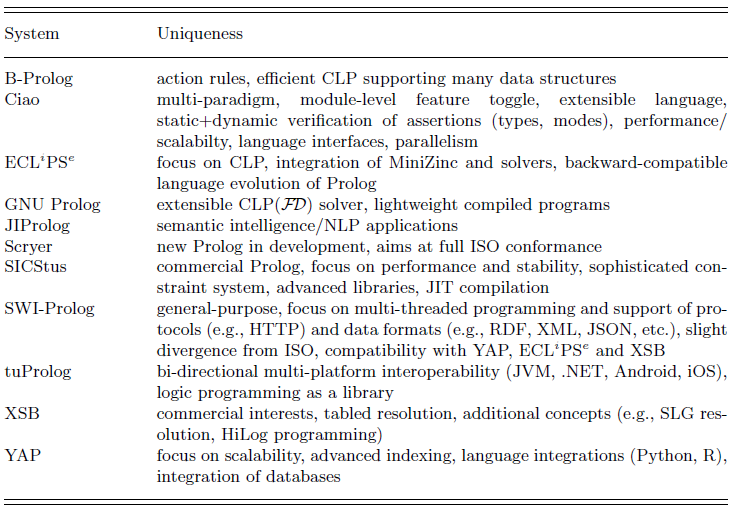
B-Prolog (Zhou Reference Zhou2012; BProlog Homepage Reference Homepage2021) is a high-performance implementation of ISO-Prolog. It extends the language with several interesting concepts, such as action rules (Zhou Reference Zhou2006), which allow delayable subgoals to be activated later. B-Prolog also offers an efficient system for constraint logic programming that supports many data structures.
Ciao Prolog (Hermenegildo et al. Reference Hermenegildo, Bueno, Carro, López-Garca, Mera, Morales and Puebla2012; Ciao Prolog Homepage Reference Homepage2021) is a general-purpose, open source, high-performance Prolog system which supports the ISO-Prolog and other de-facto standards, while at the same time including many extensions. A characteristic feature is its set of program development tools, which include static and dynamic verification of program assertions (see Section 3.3.3), testing, auto-documentation, source debuggers, execution visualization, partial evaluation, or automatic parallelization. Another characteristic feature is extensibility, which has allowed the development of many LP and multiparadigm language extensions which can be turned on and off at will for each program module, while maintaining full Prolog compatibility. Other important foci are robustness, scalability, performance, and efficiency, with an incremental, highly optimizing compiler, that produces fast and small executables. Ciao also has numerous libraries and interfaces to many programming languages and data formats. $\mathrm{ECL}^{i}\mathrm{PS}^e$
(Wallace and Schimpf Reference Wallace and Schimpf1999; Apt and Wallace Reference Apt and Wallace2007; ECLiPSe Prolog Homepage Reference Homepage2021) is a system that aims for backward compatibility with ISO Prolog (and, to some extent, compatibility with the dialects of Quintus, SICStus and SWI-Prolog), but also tries to evolve the language. Its research focus is constraint logic programming. The system integrates the popular MiniZinc constraint modeling language (Nethercote et al. Reference Nethercote, Stuckey, Becket, Brand, Duck and Tack2007), by means of a library that allows users to run MiniZinc models, as well as third-party solvers. While
$\mathrm{ECL}^{i}\mathrm{PS}^e$
(Wallace and Schimpf Reference Wallace and Schimpf1999; Apt and Wallace Reference Apt and Wallace2007; ECLiPSe Prolog Homepage Reference Homepage2021) is a system that aims for backward compatibility with ISO Prolog (and, to some extent, compatibility with the dialects of Quintus, SICStus and SWI-Prolog), but also tries to evolve the language. Its research focus is constraint logic programming. The system integrates the popular MiniZinc constraint modeling language (Nethercote et al. Reference Nethercote, Stuckey, Becket, Brand, Duck and Tack2007), by means of a library that allows users to run MiniZinc models, as well as third-party solvers. While $\mathrm{ECL}^{i}\mathrm{PS}^e$
is open-source software, commercial support is available.
$\mathrm{ECL}^{i}\mathrm{PS}^e$
is open-source software, commercial support is available.
GNU Prolog (Diaz et al. Reference Diaz, Abreu and Codognet2012; GNU Prolog Reference Prolog2021) is an open-source Prolog compiler and extensible constraint solver over finite domains ( $\mathcal{FD}$
). It compiles to native executable code in several architectures, by means of an intermediate platform-independent language which reduces compilation time. GNU Prolog strives to be ISO-compliant and compiled programs are lightweight and efficient, as they do not require a run-time interpreter. The system’s design eases the development of experimental extensions and attains good performance, despite being built on a simple WAM architecture with few optimizations and a straightforward compiler.
$\mathcal{FD}$
). It compiles to native executable code in several architectures, by means of an intermediate platform-independent language which reduces compilation time. GNU Prolog strives to be ISO-compliant and compiled programs are lightweight and efficient, as they do not require a run-time interpreter. The system’s design eases the development of experimental extensions and attains good performance, despite being built on a simple WAM architecture with few optimizations and a straightforward compiler.
JIProlog (Chirico Reference Chirico2021) was the first Prolog interpreter for a Java platform and, some years later, it was the first Prolog interpreter for a mobile platform with its implementation for J2ME. Its strengths include bidirectional Prolog-Java interoperability (meaning that Java programs can call Prolog and vice-versa), the possibility to let Prolog programs interoperate with JDBC-compliant data base management systems, and the possibility to run the Prolog interpreter on Android. Along the years, JIProlog has been exploited in the construction of expert systems, as well as semantic web or data mining applications.
Scryer Prolog (2021) is a quite recent Prolog implementation effort whose WAM-based abstract machine is written in the Rust language. Scryer is open source and aims for full ISO compliance. Since Scryer Prolog is a new, from scratch implementation, it has the opportunity to select different trade-offs and implementation choices. Scryer is still heavily in development at the time of writing, and thus its features are in relative flux. We have thus not included it in the feature overview table (Table 2). Nevertheless, it does already have at least preliminary support for features such as modules, tabling, constraint domains, indexing, attributed variables, and coroutines. The reader is directed to the evolving Scryer Prolog documentation to follow-up on this system.
Feature Overview of Several Maintained Prolog(-like) Systems. Constraint Logic Programming (CLP) abbreviations: $\mathcal{FD}$
= finite-domain,
$\mathcal{FD}$
= finite-domain, $\cal Q$
= rational numbers,
$\cal Q$
= rational numbers, $\cal R$
= real numbers,
$\cal R$
= real numbers, $\cal B$
= boolean variables. Indexing Strategy abbreviations: FA = first argument, N-FA = non-first argument, MA = multiple-argument, JIT = just-in-time, all = all aforementioned strategies
$\cal B$
= boolean variables. Indexing Strategy abbreviations: FA = first argument, N-FA = non-first argument, MA = multiple-argument, JIT = just-in-time, all = all aforementioned strategies
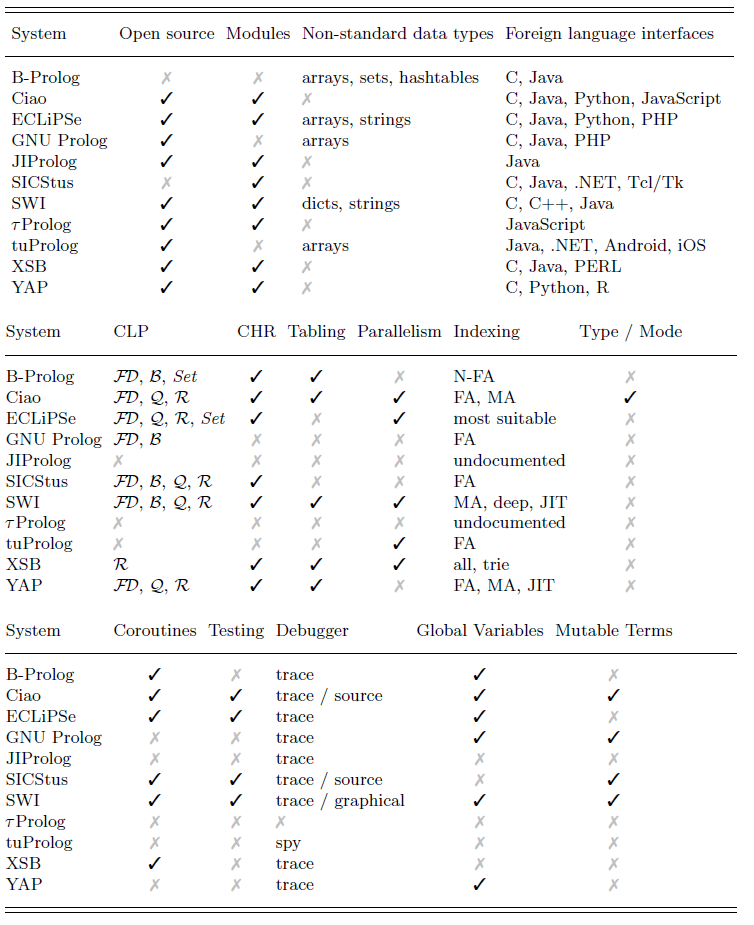
SICStus Prolog (Carlsson Reference Carlsson1986; Carlsson and Mildner Reference Carlsson and Mildner2012; SICStus Prolog Homepage Reference Homepage2021) is now a commercial Prolog system. It adheres to the ISO standard and has a strong focus on performance and stability. An additional trait of the system is its sophisticated constraint system, with advanced libraries and many essentials for constraint solvers, such as coroutines, attributed variables, and unbounded integers. The block coroutining declaration is particularly efficient. It also incorporates many of the characteristics, features, and library modules of Quintus Prolog. Since release 4.3, SICStus also contains a JIT (just-in-time) compiler to native code, but currently has no multithreading or tabling support. SICStus is used in many commercial applications – cf. Carlsson and Mildner (Reference Carlsson and Mildner2012), Section 6.
SWI-Prolog (Wielemaker et al. Reference Wielemaker, Schrijvers, Triska and Lager2012; SWI Prolog Homepage Reference Homepage2021) is a general-purpose Prolog system, intended for real-world applications. For this, it has to be able to interface with other (sub-)systems. Thus, the development focus lies on multithreaded programming, implementations of communication network protocols such as HTTP, and on libraries that can read and write commonly used data formats such as RDF, HTML, XML, JSON, and YAML. Notably, for the last two formats, specific data structures need to be supported, which has motivated the divergence from the ISO standard in favor of real strings, dictionaries, distinguishing the atom ‘[]’ from the empty list [], and non-normal floating-point numbers (Inf, NaN). Strings, extended floating-point numbers, and support for rational numbers have been synchronized with $\mathrm{ECL}^{i}\mathrm{PS}^e$
. Its top priorities are robustness, scalability and compatibility with both older versions of SWI-Prolog and the ISO standard, as well as with YAP,
$\mathrm{ECL}^{i}\mathrm{PS}^e$
. Its top priorities are robustness, scalability and compatibility with both older versions of SWI-Prolog and the ISO standard, as well as with YAP, $\mathrm{ECL}^{i}\mathrm{PS}^e$
(data types), and XSB (tabling).
$\mathrm{ECL}^{i}\mathrm{PS}^e$
(data types), and XSB (tabling).
tuProlog (Denti et al. Reference Denti, Omicini and Ricci2001; tuProlog Home 2021) is a relatively recent, research-oriented system which is the technological basis of several impactful works at the edge of the multiagent systems and logic programming areas, such as TuCSoN (Omicini and Zambonelli Reference Omicini and Zambonelli1998), ReSpecT (Omicini and Denti Reference Omicini and Denti2001), and LPaaS (Calegari et al. Reference Calegari, Ciatto, Mariani, Denti and Omicini2018). The main purpose of tuProlog is to make Prolog and LP ubiquitous (Denti et al. Reference Denti, Omicini and Calegari2013). It provides basic mechanisms such as knowledge representation, unification, clause storage, and SLDNF resolution as a library via multiplatform interoperability (e.g., to JVM,.NET, Android, and iOS) and multi-paradigm integration. Further, tuProlog also supports the direct manipulation of objects from within Prolog. Recent research efforts are focused on widening the pool of (i) logics and inferential procedures such as argumentation support (Pisano et al. Reference Pisano, Ciatto, Calegari and Omicini2020) and probabilistic LP, (ii) platforms it currently runs upon, for example, JavaScript (tuProlog Home 2021), and (iii) programming paradigms and languages it is interoperable with, cf. Ciatto et al. (Reference Ciatto, Schumacher, Omicini, Calvaresi and Notes2020). $\tau$
Prolog (2021), also referred to as Tau Prolog, is another noteworthy implementation of Prolog focusing on easing the use of logic programming in the Web. In particular, it provides a JavaScript-native library that facilitates the use of Prolog in web applications, both from the browser- and the server side. In other words,
$\tau$
Prolog (2021), also referred to as Tau Prolog, is another noteworthy implementation of Prolog focusing on easing the use of logic programming in the Web. In particular, it provides a JavaScript-native library that facilitates the use of Prolog in web applications, both from the browser- and the server side. In other words, $\tau$
Prolog pursues a similar intent with respect to tuProlog and JIProlog: bringing Prolog interpreters to high-level platforms and languages, except it focuses on another platform, JavaScript. Accordingly,
$\tau$
Prolog pursues a similar intent with respect to tuProlog and JIProlog: bringing Prolog interpreters to high-level platforms and languages, except it focuses on another platform, JavaScript. Accordingly, $\tau$
Prolog makes it very easy to run a Prolog interpreter in a web page, even without a server behind the scenes.
$\tau$
Prolog makes it very easy to run a Prolog interpreter in a web page, even without a server behind the scenes.
XSB (Sagonas et al. Reference Sagonas, Swift and Warren1993; Sagonas et al. Reference Sagonas, Swift and Warren1994; Warren Reference Warren1998; XSB Prolog Homepage Reference Homepage2021) is a research-oriented system, but its development is also influenced by continued use in commercial applications. Its most distinctive research contribution is tabled resolution (Swift and Warren Reference Swift and Warren2012) which has, since, been adopted in other systems. In the XSB manual, the developers explicitly refrain from calling it a Prolog system, as it extends the latter with concepts such as SLG-resolution and HiLog programming. We return to tabling below in Section.
YAP (Costa et al. Reference Costa, Rocha and Damas2012) is a general-purpose Prolog system focused on scalability, mostly based on advanced clause indexing, and on integration with other languages, specifically Python and R. There is a strong interest in trying to make Prolog as declarative as possible, looking at ways of specifying control (such as types), and in program scalability by considering modules. There is also a long term goal of integrating databases into Prolog by having a driver that allows YAP to use a database as a Prolog predicate. In the future, YAP’s strength lies in the ability to write and maintain large applications. Its team has worked on three key points toward this goal: interfacing with other languages (Angelopoulos et al. Reference Angelopoulos, Costa, Azevedo, Wielemaker, Camacho and Wessels2013), interfaces to enable collaboration between Prolog dialects, and tools for declaring and inferring program properties, such as types (Costa Reference Costa1999).
3.3 Overview of features
In this section, we survey the availability of features that are often appreciated by Prolog programmers. The goal is to find out whether there are commonalities and even a “de facto standard” with respect to features among most Prolog systems. An overview of which features are available in what Prolog system is given in Table 2. We give our conclusions regarding portability in Section 3.4. Due to the sheer number of existing Prolog systems, we consider only the more actively developed and mainstream ones. In the following, we will briefly discuss each surveyed feature, classifying them in four different groups: core features that usually cannot be reasonably emulated on top of simpler features; extensions to the language semantics and the execution model; libraries written on top of the core and (optionally, one or more) extensions; tools and facilities to debug, test, document, and perform static analysis.
A Note on Portability: The above classification sheds some light onto the challenges of attaining portability of sophisticated Prolog code. Compatibility at the core features (1) is relatively easy, and this enables the sharing of a substantial number of libraries (2). Extensions (3) represent a more complicated evolving landscape, where some of them require deep changes in the system architecture. It stands to reason that the existence of multiple Prolog implementations (or alternative cores) might be a necessary good step, that should be regarded as a healthy sign rather than an inconvenience. Nevertheless, this requires a periodic revisit, dropping what did not work and promoting cross-fertilization of ideas. On the other hand, tools (4), despite being more complex, have also the advantage of being more flexible: sometimes they can run on one system while still being usable with others (e.g., IDEs, documentation, analysis, or refactoring tools).
3.3.1 Core features
Module System As mentioned before, while most Prolog systems support structuring the code into modules, virtually no implementation adheres to the modules part of the ISO standard. Instead, most systems have decided to support as de-facto module standard the Quintus/SICStus module system. However, further convenience predicates concerning modules are provided by some implementations only and often have subtle differences in their semantics.
Interesting cases include GNU Prolog which initially chose not to implement a module system at all, although a similar functionality was later brought in by means of contexts and dynamic native unit code loading (Abreu and Nogueira Reference Abreu and Nogueira2005); Logtalk which demonstrates that code reuse and isolation can be implemented on top of ISO Prolog using source-to-source transformation (Moura Reference Moura2003); Ciao which designed a strict module system that, while being basically compatible with the de-facto standard used by other Prolog systems, is amenable to precise static analysis, supports term hiding, and facilitates programming in the large (Cabeza and Hermenegildo Reference Cabeza and Hermenegildo2000; Stulova et al. Reference Stulova, Morales and Hermenegildo2018); and XSB, which offers an atom-based module system (Sagonas et al. Reference Sagonas, Swift and Warren1994). The latter two systems allow controlling the visibility of terms in addition to that of predicates.
Built-in Data Types The ISO Prolog standard requires support for atoms, integers, floating-point numbers, and compound terms with only little specification on the representation limits, usually available as Prolog flags.
In practice, most limits evolve with the hardware (word length, floating-point units, available memory, and raw performance), open software libraries (e.g., multiple precision arithmetic), and system maturity. Since the standard does not specify minimum requirements for limits, special care must be taken in the following cases:
-
Integers may differ between Prolog systems. E.g., a given system may not support arbitrary precision arithmetic. Furthermore, the minimum and maximum values representable in standard precision may be smaller than implied by word length (due to tagging).
-
Maximum arity of compound terms may be limited (max_arity Prolog flag). Despite the arity of user terms usually falling within the limits, this is an issue with automatic program manipulation (e.g., analyzers) or libraries representing arrays as terms.
-
Atoms have many implementation-defined aspects, such as their maximum length, number of character codes (such as ASCII, 8-bit or Unicode), text encoding (UTF-8 or other), whether the code-point 0 can be represented, etc.
-
Strings are traditionally represented as list of codes or characters (depending on the value of double_quotes flag), or as dedicated data types. Although this can be regarderd as very minor issue, combining different pieces of code expecting different encodings is painful and error prone.
-
Garbage collection of atoms may not be available. This may lead to nonportability due to resource exhaustion in programs that create an arbitrary number of atoms.
-
Floating point numbers are not specified to be represented in a specific way. The IEEE double standard is most prevalent across all Prolog systems. However, support for constants such as NaN, -0.0, Inf as well as rounding behavior may differ. $\mathrm{ECL}^{i}\mathrm{PS}^e$
, for example, does interval arithmetic on the bounds.
$\mathrm{ECL}^{i}\mathrm{PS}^e$
, for example, does interval arithmetic on the bounds.

For convenience, systems may offer other data types by means of (nonstandard) extension of the built-in data types, for example, rational numbers (useful for the implementation of CLP( $\cal Q$
)), key-value dictionaries, and compact representations of strings. There is no consensus on those extensions or portable implementation mechanisms, thus more work is needed in this area.
$\cal Q$
)), key-value dictionaries, and compact representations of strings. There is no consensus on those extensions or portable implementation mechanisms, thus more work is needed in this area.
Foreign (Host) Language Interface Like any programming language, Prolog is more suited for some problems than for others. With a foreign language interface, it becomes easier to embed it into a software system, where it can be used to solve part of a problem or access legacy software and libraries written in another language. Since this is also a nonstandard feature, the interfaces themselves, as well as the targeted languages, differ quite a lot among different systems. An important case is interfacing Prolog with the host implementation language of the system (e.g., C, Java, JavaScript). The main issues revolve around the external representation for Prolog terms (usually in C or Java) and whether nondeterminism is visible to the host language or should be handled at the Prolog level. The latter aspect is usually resolved by hiding backtracking from the foreign language program, except in where there is a natural counterpart: such is the case when the language has consensual built-in support for features like iterators. A more detailed survey describing and comparing different features is given by Bagnara and Carro (Reference Bagnara and Carro2002).
3.3.2 Libraries
Constraint Satisfaction As mentioned in Section 2.8, advances such as finite domain implementation based on indexicals and, specially, progress in the underlying technology in Prolog engines for supporting extensions to unification, such as meta-structures (Neumerkel Reference Neumerkel1990) and attributed variables (Holzbaur Reference Holzbaur1992), enabled the library-based approach to supporting embedded constraint satisfaction that is now present in most Prolog systems. Since many constraint domains have been implemented as libraries, such as $\cal R$
and
$\cal R$
and $\cal Q$
(linear equations and inequations over real or rational numbers),
$\cal Q$
(linear equations and inequations over real or rational numbers), $\mathcal{FD}$
(finite domains),
$\mathcal{FD}$
(finite domains), $\cal B$
(booleans), etc.
$\cal B$
(booleans), etc.
Systems vary in how the constraint satisfaction process gets implemented. In SICStus and $\mathrm{ECL}^{i}\mathrm{PS}^e$
, the constraint library is partly implemented in C, in the case of GNU Prolog in a dedicated DSL designed to specify propagators. Several other systems, such as Ciao, SWI-Prolog, XSB, and YAP, use Prolog implementations built on top of attributed variables (as mentioned above), such as those of Holzbaur (Reference Holzbaur1992) or Triska (Reference Triska2012), or local ones. While the C-based implementations provide a performance edge, the Prolog implementations are small, portable, and may use unbounded integer arithmetic when provided by the host system.
$\mathrm{ECL}^{i}\mathrm{PS}^e$
, the constraint library is partly implemented in C, in the case of GNU Prolog in a dedicated DSL designed to specify propagators. Several other systems, such as Ciao, SWI-Prolog, XSB, and YAP, use Prolog implementations built on top of attributed variables (as mentioned above), such as those of Holzbaur (Reference Holzbaur1992) or Triska (Reference Triska2012), or local ones. While the C-based implementations provide a performance edge, the Prolog implementations are small, portable, and may use unbounded integer arithmetic when provided by the host system.
CHR (Frühwirth Reference Frühwirth2009), described also in Section 2.8.3, is available in several Prolog systems as a library which, rather than working on a single, specific domain, enables the writing of rule-based constraint solvers in arbitrary domains. CHR provides a higher-level way of specifying propagation and simplification rules for a constraint solver, although possibly at some performance cost.
Data Structures Different Prolog systems also ship varying numbers of included libraries such as code for AVL trees, ordered sets, etc. Because they are usually written purely in standard Prolog, those implementations can usually be dropped in place without larger modifications.
3.3.3 Extensions
Tabling As discussed in Section 2.9, tabling can be used to improve the efficiency of Prolog programs by reusing results of predicate calls that have already been made, at the cost of additional memory. It improves the termination properties of Prolog programs by delaying self-recursive calls. Tabling was first implemented in XSB and currently a good number of other Prolog implementations support it (e.g., B-Prolog, Ciao, SWI, YAP). XSB and recent SWI-Prolog versions improve support for negation using stratified negation and well-founded semantics. Both systems also provide incremental tabling which automatically updates tables that depend on the dynamic database, when the latter is modified. Some systems (YAP, SWI-Prolog) support shared tabling which allows a thread to reuse answers that are already computed by another thread. Ciao supports a related concept of concurrent facts for communication between threads (Carro and Hermenegildo Reference Carro and Hermenegildo1999), combines tabling and constraints (Arias and Carro Reference Arias and Carro2016), and supports negation based on stable model semantics (Arias et al. Reference Arias, Carro, Salazar, Marple and Gupta2018).
Parallelism Today, new hardware generations do not generally bring large improvements in sequential performance, but they do often bring increases in the number of CPU cores. However, ISO-Prolog only specifies semantics for single-threaded code and does not specify built-ins for parallelism. As already discussed in Section 2.7, several parallel implementations of Prolog or derivatives thereof have been developed, targeting both shared-memory multiprocessors and distributed systems. Support for or-parallelism is not ubiquitous nowadays, although systems like SICStus were designed to support it and this feature can possibly be easily recovered. Ciao still has some native support for and-parallelism and concurrency, and its preprocessor CiaoPP still includes auto-parallelization. A different, more coarse-grained form of parallelism is multithreading (this is what the parallelism column in Table 2 gathers).
Indexing Indexing strategies of Prolog facts and rules are vital for Prolog development as they immediately influence how Prolog predicates are written with performance in mind. The availability of different indexing strategies is an important issue that affects portability of Prolog programs: if a performance-critical predicate cannot be indexed efficiently, run-time performance may be significantly affected. There are several strategies for indexing:
-
First-argument (FA) indexing is the most common strategy where the first argument is used as index. It distinguishes atomic values and the principal functor of compound terms.
-
Nonfirst argument indexing is a variation of first-argument indexing that uses the same or similar techniques as FA on one or more alternative arguments. E.g., if a predicate call uses variables for the first argument, the system may choose to use the second argument as the index instead.
-
Multiargument (MA) indexing creates a combined index over multiple instantiated arguments if there is not a sufficiently selective single argument index.
-
Deep indexing is used when multiple clauses use the same principal functor for some argument. It recursively uses the same or similar indexing techniques on the arguments of the compound terms.
-
Trie indexing uses a prefix tree to find applicable clauses.
In addition to the above indexing techniques, one can also distinguish systems that use directives to specify the desired indexes and systems that build the necessary indexes just-in-time based on actual calls. One should note that the first form of indexing (FA) is the only one which may be effectively relied upon when designing portable programs, for it is close to universal adoption.
Type and Mode Annotations As Prolog is a dynamic language, it can be hard to maintain larger code bases without well-defined (and checkable) interfaces. Several approaches have been proposed to achieve or enforce sound typing in Prolog programs (Mycroft and O’Keefe Reference Mycroft and O’Keefe1984; Dietrich and Hagl 1988;; Gallagher and Henriksen Reference Gallagher and Henriksen2004; Schrijvers et al. Reference Schrijvers, Costa, Wielemaker and Demoen2008). While these approaches are closer to strong typing, they have not caught on with mainstream Prolog.
Many Prolog systems offer support, for example, for mode annotations, yet the directives usually have no effects except their usage for documentation. The few Prolog or Prolog-like systems that really address these issues and incorporate a type and mode system include Mercury (Somogyi et al. Reference Somogyi, Henderson and Conway1996) and Ciao (Hermenegildo et al. Reference Hermenegildo, Puebla and Bueno1999). The former is rooted in the Prolog tradition, but departs from it in several significant ways (see Sections 2.1 and 3.5). The latter aims to bridge the static and dynamic language approaches, while preserving full compatibility with traditional nonannotated Prolog. A fundamental component is its assertion language (Puebla et al. Reference Puebla, Bueno and Hermenegildo2000b) that is processed by CiaoPP (cf. Section 2.10.2). CiaoPP then is capable of finding nontrivial bugs statically or dynamically and can statically verify that the program complies with the specifications, even interactively (Sanchez-Ordaz et al. Reference Sanchez-Ordaz, Garcia-Contreras, Perez-Carrasco, Morales, Lopez-Garcia and Hermenegildo2021). The Ciao model can be considered an antecedent of the now-popular gradual- and hybrid-typing approaches (Flanagan Reference Flanagan2006; Siek and Taha Reference Siek and Taha2006; Rastogi et al. Reference Rastogi, Swamy, Fournet, Bierman and Vekris2015) in other programming languages.
Coroutining As discussed in Section 2.4.1, coroutining was first introduced into Prolog in order to influence its default left-to-right selection rule. From a logical perspective, logic programs are independent of the selection rule. However, from a practical, programming language perspective, procedural factors might influence efficiency, termination, and even faithfulness to the intended results. Consider for instance a program that tries to calculate the price of an as yet unknown object X (this could result from, say, some natural language interface’s ordering of different paraphrases). Coroutining can ensure that the program behaves as intended by reordering these goals so that objects are instantiated before attempting to calculate their prices.
Coroutining is an important feature of modern Prolog systems, allowing programmers to write truly reversible predicates and improve their performance. It represents a step forward towards embodying the equation of “Algorithm = Logic + Control” by Kowalski (Reference Kowalski1979). Early mechanisms for coroutining focused on variations of the delay primitive by Dahl and Sambuc (Reference Dahl and Sambuc1976), which dynamically reorders the execution of predicates according to statically, user-defined conditions on them. The freeze variation was present in Prolog II (Colmerauer Reference Colmerauer1982b; Boizumault Reference Boizumault1986), which delays the execution of its second argument (understood to be a goal) until its first argument, a single variable occuring in the second argument, is bound. A more flexible variation is the wait primitive present in MU-Prolog (Naish Reference Naish1985), which was subsequently generalized to when. This concern evolved into the block declaration found in modern Prologs, which supports the annotation of an entire predicate (rather than of each individual call), resembling a mode declaration. This approach thus leads to more readable programs and more efficient code. It can be argued that the coupling of goal evaluation to the binding of variables ultimately led to the development of Constraint Logic Programming (CLP) (3.3.2).
3.3.4 Tools
Unit Testing Structures One of the most important tools in software development is a proper testing facility. Some Prolog systems ship a framework for unit testing, and while the basic functionality is shared, usually they do not adhere to the same interface. SWI-Prolog ships a library named plunit, while SICStus uses a modified version of it. Both versions are entirely written in Prolog, yet they rely on system-specific code to function properly. Ciao relies on the test assertions of its assertion language, which also include test case generation. $\mathrm{ECL}^{i}\mathrm{PS}^e$
offers a library named test_unit with several test primitives that assert whether calls should succeed, raise errors, etc. Other systems seem to rely on the fact that a small ad hoc testing facility is rather easy to implement.
$\mathrm{ECL}^{i}\mathrm{PS}^e$
offers a library named test_unit with several test primitives that assert whether calls should succeed, raise errors, etc. Other systems seem to rely on the fact that a small ad hoc testing facility is rather easy to implement.
Debugging A good debugger is vital to understand and fix undesired behaviors of programs. Prolog control flow is different from that of most other programming languages because it has backtracking. To address this, most Prolog systems provide some form of tracing debugger based on the 4-port debugger introduced for DEC-10 Prolog by Byrd (Reference Byrd1980), which allows for the tracing of individual goals at their call, exit, redo, and failure ports (states). Most systems allow setting of spy points (similar to breakpoints) and some provide a very Prolog-specific and powerful debugging tool: the retry command which allows one to “travel back in time” to the entry point of a call that, for some reason, misbehaved. The latter feature assumes Prolog programs without side effects. A few systems, such as SWI, SICStus, and Ciao, additionally offer source-level debugging that allows following the steps of execution directly on the program text, thus providing a more conventional view.
3.4 Takeaways
When considering Table 2, one can see that, despite undeniable differences among Prolog systems, many Prolog systems offer similar features.
Available and Mostly Compatible Features
Mostly compatible module systems have been widely adopted, even if they virtually all diverge from the ISO document. The existence of a de-facto module standard makes it possible to write production-quality libraries that are portable across most Prolog systems. Facilities for multithreaded programming are also common: A number of systems offer predicates based on the corresponding technical recommendation document (Moura Reference Moura2007), sometimes with some differences in semantics or syntax.
Most systems also offer libraries for constraint programming, though they differ in performance and expressiveness. Yet, no standard interface or even a proposal for one exists.
Almost all Prolog systems embrace dynamic typing, and type and mode annotations are used for documentation or optimization, yet are not enforced or verified at all. Ciao, with its combination of the dynamic and static approaches, is the significant exception here.
While support for tabling is present in various systems, the features and interfaces can differ. Programs that rely on it (beyond simple answer memoization that can be implemented fairly simply using the dynamic database), specially if they use special features, can be hard to port. Thus, progress needs to be made toward better portability in this area.
Discrepancies
One gets a mixed result when considering support for other features: some systems, such as $\mathrm{ECL}^{i}\mathrm{PS}^e$
offer extensive library support of data structures, whereas others remain rather basic, without a large standard library.
$\mathrm{ECL}^{i}\mathrm{PS}^e$
offer extensive library support of data structures, whereas others remain rather basic, without a large standard library.
Coroutining is not available on all systems, and the various primitives (when, block, freeze, dif) sometimes have some variations among those systems that do support it. A similar situation occurs for global variables and mutable terms. Similarly, testing frameworks are missing in several systems, but usually can be provided in form of a portable library.
Almost all Prolog systems support at least one foreign language interface, in order to leverage existing libraries and to widen the domains where logic programming can be applied. Yet, there are different strategies on how the interfaces interact with Prolog, and, thus, the interfaces often differ between implementations.
An issue that can also hinder portability is the large discrepancy in indexing strategies. Solutions so far are of a very technical nature, rather than aimed toward a common interface, so work is needed if this issue is to be resolved.
Conclusions
Overall, most Prolog systems are not too different in what they offer. Many differences could be bridged by agreeing on certain interfaces, or, for example, sharing library predicates for testing, or data structures. Differences in constraint solving capabilities are harder to reconcile, as some solvers are of commercial nature. However, CHR’s embodiment of constraints is fairly ubiquitous and permits the implementation of constraint solvers in arbitrary domains of interest. Missing technical features, such as tabling or indexing strategies, may hinder portability or performance, but the relevance of this issue can greatly depend on the application. It is also possible to integrate tabling with constraints à la CHR (Schrijvers and Warren Reference Schrijvers and Warren2004). As differences with ISO-Prolog usually are very small now, the Prolog implementations’ cores are very similar today.
3.5 Influence on other languages
The concepts and ideas that have been explored during the long history of evolution of Prolog systems have influenced and given rise to other languages and systems, both within the LP paradigm and out to other programming paradigms. In the following (Section 3.5.1), we describe languages within the LP paradigm that are heavily inspired by or emerged from Prolog. These systems generally fail our definition of Prolog in Section 2.1. However, sometimes they bear witness to useful features or extensions that have not (yet) made their way into Prolog itself. Still others, such as, for example, s(ASP)/s(CASP) or Co-Inductive LP, are really extensions of Prolog whose support in Prolog systems could be generalized in the future, as has happened already with constraints or tabling. They could thus also have been listed in Section 3.3.3. Regarding the impact that Prolog and Prolog systems have had beyond LP, it is outside the scope of this paper to do a full analysis of this very interesting topic, but we briefly review in any case in Section 3.5.2 a few examples of other such influences outside the LP paradigm.
3.5.1 Influences on other languages in the LP paradigm
Datalog is a subset of Prolog, which does not allow compound terms as arguments of predicates. This topic has been worked on since the late 70s, although the term was coined later by David Maier and David S. Warren in the 80s. Datalog can be viewed as an extension of relational databases, allowing recursion within predicates. Datalog plays an important role in the research field of deductive databases (Ramakrishnan and Ullman Reference Ramakrishnan and Ullman1993). Datalog has found new applications in many areas (Huang et al. Reference Huang, Green and Loo2011), such as information extraction (Shen et al. Reference Shen, Doan, Naughton and Ramakrishnan2007), program analysis and synthesis (Whaley et al. Reference Whaley, Avots, Carbin and Lam2005; Alpuente et al. Reference Alpuente, Feliú, Joubert and Villanueva2010; Jordan et al. Reference Jordan, Scholz and Subotic2016; Madsen and LhotÁk Reference Madsen and Lhoták2020), security (Bonatti Reference Bonatti2010), graph processing (Seo et al. Reference Seo, Guo and Lam2015), reasoning over ontologies (Baumeister and Seipel Reference Baumeister and Seipel2010), or natural language processing (Dahl et al. Reference Dahl, Tarau, Moreno and Palomar1995). $\lambda$
Prolog
$\lambda$
Prolog
was developed in the late 80s, by Miller and Nadathur (1988). It was defined as a language for programming in higher-order logic based on an intuitionistic fragment of Church’s theory of types. It spawned several modern refinements and implementations ( $\lambda $
Prolog Home Page 2021). Higher-order extensions have also made their way into less specialized Prologs, as we discuss in Section 2.10.2. Miller and Nadathur (Reference Miller and Nadathur2012) discuss uses of higher-order logic in logic programming to provide declarative specifications for a range of applications.
$\lambda $
Prolog Home Page 2021). Higher-order extensions have also made their way into less specialized Prologs, as we discuss in Section 2.10.2. Miller and Nadathur (Reference Miller and Nadathur2012) discuss uses of higher-order logic in logic programming to provide declarative specifications for a range of applications. $\lambda$
Prolog applications are still surfacing, with the main focus being on meta-programming (Nadathur Reference Nadathur2001), program analysis (Wang and Nadathur Reference Wang and Nadathur2016), and theorem proving (Miller Reference Miller2021).
$\lambda$
Prolog applications are still surfacing, with the main focus being on meta-programming (Nadathur Reference Nadathur2001), program analysis (Wang and Nadathur Reference Wang and Nadathur2016), and theorem proving (Miller Reference Miller2021).
Committed-choice Languages As mentioned in Section 2.6, the implementation complexity of combining Prolog’s backtracking with concurrency and/or parallelism led to the development of logic languages supporting “committed choice” where only the first clause whose guard succeeds is executed, instead of the multiple execution paths supported by Prolog. This includes GHC (Guarded Horn Clauses) (Ueda Reference Ueda1985), KL1 (Ueda and Chikayama Reference Ueda and Chikayama1990), Parlog (Clark and Gregory Reference Clark and Gregory1986), and Concurrent Prolog (Shapiro Reference Shapiro1983; Shapiro Reference Shapiro1987). Erlang (Armstrong Reference Armstrong2007) (see later) also has its origins in this line of work. This line of work also yielded concurrent constraint languages, such as cc(fd) (Hentenryck et al. Reference Hentenryck, Saraswat, Deville and Notes1994), and distributed constraint languages, such as AKL (Janson and Haridi Reference Janson and Haridi1991) and Oz/Mozart (Roy et al. Reference Roy, Haridi, Schulte and Smolka2020) (see later). The concepts brought about by the committed-choice languages, such as guards and data-flow synchronization based on one-way unification and constraint entailment (Maher Reference Maher1987), have in turn made their way back into Prolog systems as part of extensions for concurrency and distributed execution (e.g., in &-Prolog/Ciao Cabeza and Hermenegildo Reference Cabeza and Hermenegildo1996; Hermenegildo et al. Reference Hermenegildo, Bueno, Cabeza, Carro, Garcia de la Banda, Lãpez-García and Puebla1996 or ACE Gupta and Pontelli Reference Gupta and Pontelli1999).
Turbo-Prolog (Hankley Reference Hankley1987) can be considered a precursor of other strongly typed logic programming languages. It was released as a full development environment in 1986 for PC/MS-DOS. It was strongly typed, had support for object-oriented programming, and it compiled directly to machine code. At that time, this pragmatic approach provided a safe and efficient language, but lacked important dynamic features of Prolog required in many applications. It has been continued as PCD Prolog and Visual Prolog, focusing on supporting good integration with Microsoft Windows APIs.
Gödel (Hill and Lloyd Reference Hill and Lloyd1994) is a logic programming language that first appeared around 1992. It is strongly typed, with a type system based on many-sorted logic, allowing for parametric polymorphism. It implemented a sound negation, delaying negated calls until they were ground. Gödel also supports meta-programming, using ground representation for meta-programs, which has the advantage of having a declarative semantics. This enabled the development of a self-applicable partial evaluator called sage by Gurr (Reference Gurr1994). The Gödel system was built on top of SICStus Prolog, employing a different syntax style. The development of the language came to a halt in the 1990s.
Curry (Hanus et al. Reference Hanus, Kuchen and Moreno-Navarro1995) was developed in 1995. It is a functional logic programming language that is mostly based on Haskell, but includes some features from logic programming languages such as nondeterminism and constraint solving. Curry is based on the technique of narrowing, which is also the basis of other functional logic programming work (Antoy and Hanus Reference Antoy and Hanus2010). The language has recently been used for typesafe SQL queries (Hanus and Krone Reference Hanus, Krone, Schwarz and Voigtländer2017), for research and for teaching both the logic and the functional paradigm (Hanus Reference Hanus and Notes1997).
Oz Another multiparadigm language is Oz (Henz et al. Reference Henz, Smolka, Würtz and Kaufmann1993), incorporating concurrent logic programming, functional programming, constraints, and objects. The design of the language started in 1991 and its logic programming aspects were greatly influenced by AKL, the Andorra Kernel Language (cf. Section 2.10.2). A recent synopsis of Oz’s history is available in the article by Roy et al. (Reference Roy, Haridi, Schulte and Smolka2020). The current incarnation of Oz is available as an open source implementation called Mozart.
Mercury (Somogyi et al. Reference Somogyi, Henderson and Conway1996) was created in 1995 as a functional logic programming language, with characteristics from both Prolog and Haskell. The main reasons for its development were threefold. First, idiomatic Prolog code at the time had short predicate and variable names, and also lacked type annotations and comments. This often rendered it hard for the reader to infer the meaning, types, and modes of a program. Second, multimode predicates and those without static-type information could not be compiled to the most efficient WAM code. Third, a lot of LP research was concerned with logic programs without any impure operations, and thus were not applicable to general Prolog programs (e.g., executing read(X), call(X)). Thus, Mercury features a strong, static, polymorphic type system, and a strong mode and determinism system. It has a separate compilation step, which allows for a larger variety of errors to be detected before actually running a program, and for generation of faster code. By removing nonlogical features, such as assert/1 and retract/1, a pure language was obtained, I/O could be implemented declaratively, and existing research could be implemented unaltered. Some interesting research has been done in the areas of program analysis and optimization (Becket and Somogyi Reference Becket and Somogyi2008), as well as parallelism (Bone et al. Reference Bone, Somogyi and Schachte2012).
Assumption Grammars and Assumptive Logic Programming (Dahl et al. Reference Dahl, Tarau and Li1997; Dahl and Tarau Reference Dahl and Tarau1998; Dahl and Tarau Reference Dahl and Tarau2004) extend Prolog with hypothetical reasoning, needed in particular for natural language processing applications (Dahl et al. Reference Dahl, Tarau and Li1997). They include specialized linear logic implications, called assumptions (Dahl and Tarau Reference Dahl and Tarau1998; Dahl and Tarau Reference Dahl and Tarau2004), that range over the computation’s continuation, can be backtracked upon, and can either be consumed exactly once (linear), at most once (affine linear), any number of times (intuitionistic), or independently of when they have been made: before or after consumption (timeless). The latter is a novel form of implication designed and first meta-programmed by Dahl for dealing with backward anaphora. Their uses for abduction were also researched by Dahl and Tarau (Reference Dahl and Tarau2004).
Answer Set Programming (ASP) is arguably one of the largest successes of logic programming. It is a logic programming paradigm that focuses on solving (hard) search problems, by reducing them to computing stable models. Note that ASP is not a Turing-complete programming language, but rather a language to represent aforementioned problems. It is based on the stable models semantics and uses answer set solvers to provide truth assignments as models for programs. The usual approach for ASP is to ground all clauses so that propositional logic techniques like SAT-solving can be applied to find stable models for the program. Unlike Prolog’s query evaluation, ASP’s computational process always terminates. The denomination “answer set” was first coined by Lifschitz (Reference Lifschitz1999). Its early exponents were Niemel Ä (1999) and Marek and Truszczynski (Reference Marek and Truszczynski1999); more recent developments include Smodels (Syrjänen and Niemelä Reference Syrjänen and Niemelä2001), DLV (Leone et al. Reference Leone, Pfeifer, Faber, Eiter, Gottlob, Perri and Scarcello2006), the Potassco toolset (Gebser et al. Reference Gebser, Kaminski, Kaufmann and Schaub2014; Gebser et al. Reference Gebser, Kaminski, Kaufmann, Ostrowski, Schaub and Thiele2008), and WASP Alviano et al. (Reference Alviano, Dodaro, Faber, Leone and Ricca2013). The interested reader may rely on the survey by Brewka et al. (Reference Brewka, Eiter and Truszczyński2011) and on the special issue of the AI Magazine dedicated to ASP (Brewka et al. Reference Brewka, Eiter and Truszczynski2016).
s(ASP) and s(CASP) s(ASP) (Marple et al. Reference Marple, Salazar and Gupta2017) is a goal-directed, top-down execution model which computes stable models of normal logic programs with arbitrary terms, supporting the use of lists and complex data structures, and, in general, programs which may not have a finite grounding. It supports both deduction and abduction. s(ASP) uses a non-Herbrand universe, coinduction, constructive negation, and a number of other novel techniques. Unlike in ASP languages, variables are (as in (C)LP) kept during execution and in the answer sets. s(CASP) (Arias et al. Reference Arias, Carro, Salazar, Marple and Gupta2018) is the extension of s(ASP) to constraint domains, while also including additional optimizations in the implementation. s(ASP) and s(CASP) can be seen as Prolog extended with negation as failure where this negation follows the stable model semantics. If negation is not used, the behavior is as in Prolog. Both s(ASP) and s(CASP) have been implemented in Prolog, originally in Ciao and also ported to SWI. For some applications, this approach leads to improved performance and expressivity compared to existing ASP systems. Another advantage is that it naturally provides explanations. At the same time, for some other classical ASP applications, the grounding to propositional logic remains currently the technology of choice. Goal-directed evaluation of ASP was also addressed in the work of Bonatti et al. (2001, Reference Bonatti, Pontelli and Son2008). In comparison, the s(ASP) and s(CASP) work handles unrestricted predicates and queries, with constraints. Other early work on query-driven computation of stable models includes that of Chen and Warren (Reference Chen and Warren1996) and the XNMR system within XSB.
Constraint Handling Rule Grammars (CHRG) by Christiansen (Reference Christiansen2002), extend Prolog with sophisticated language processing capabilities because, just like Prolog does, they allow writing grammar rules that become executable. They differ from the previous grammatical default of Prolog (DCGs) in that they work bottom up, are robust (i.e., in case of errors the recognized phrases so far are returned, rather than silently failing by default), can inherently treat ambiguity without backtracking, and, just as Hyprolog (see below), can produce and consume arbitrary hypotheses. This makes it straightforward to deal with abduction, which is useful for diagnostics, integrity constraints, operators À la Assumption Grammars. They can also incorporate other constraint solvers. Applications go beyond traditional NLP, including e.g., biological sequence analysis (Bavarian and Dahl Reference Bavarian and Dahl2006).
Hyprolog (Christiansen and Dahl Reference Christiansen and Dahl2005) is an extension to Prolog and Constraint Handling Rules (CHR) which includes all types of hypothetical reasoning in Assumption Grammars, enhances it with integrity constraints, and offers abduction as well. It compiles into Prolog and CHR through an implementation by Henning Christiansen available for SICStus, Prolog III and IV, and for SWI-Prolog. It can access all additional built-in predicates and constraint solvers that may be available through CHR, whose syntax can be used to implement integrity constraints associated to assumptions or abducibles. Due to the compiled approach, which employs also the underlying optimizing compilers for Prolog and CHR, the Hyprolog system is among the fastest implementations of abduction.
Co-Inductive logic programming (Simon et al. Reference Simon, Mallya, Bansal and Gupta2006) was proposed in order to allow logic programming to work with infinite terms and infinite proofs based on greatest fixed-point semantics. The co-logic programming paradigm by Gupta et al. (Reference Gupta, Bansal, Min, Simon and Mallya2007) is presented as an extension of traditional logic programs with both inductive and co-inductive predicates. This can be used, for example, for model checking, verification, and nonmonotonic reasoning (Gupta et al. Reference Gupta, Saeedloei, DeVries, Min, Marple, Kluzniak and Notes2011). These concepts were implemented based on modifying YAP’s Prolog engine and are also related to s(ASP)/s(CASP).
Probabilistic Logic Programming (PLP) is a research field that investigates the combination of LP with the probability theory. A comprehensive overview on this topic is provided by Riguzzi (Reference Riguzzi2018). In PLP, theories are logic programs with LPAD, that is, logic programs with annotated disjunctions (Vennekens et al. Reference Vennekens, Verbaeten and Bruynooghe2004), hence they may contain facts or rules enriched with probabilities. These may, in turn, be queried by the users to investigate not only which statements are true or not but also under which probability. To support this behavior, probabilistic solvers employ ad hoc resolution strategies explicitly taking probabilities into account. This makes them ideal to deal with uncertainty and the complex phenomena of the physical world.
From a theoretical perspective, the distribution semantics by Sato (Reference Sato1995) is one of the most prominent approaches for the combination of logic programming and probability theory. Sato, in particular, was among the first authors exploiting Prolog for PLP, by building on the ideas of Poole (Reference Poole1993). The very first programming language laying under the PLP umbrella was PRISM, by Sato and Kameya (Reference Sato and Kameya1997), which supported not only probabilistic inference but learning as well. Since then, many PLP solutions have been developed supporting this semantics, such as ProbLog by de Raedt et al. (Reference de Raedt, Kimmig and Toivonen2007) and cplint by Riguzzi (Reference Riguzzi2007). These were often implemented on top of existing Prolog implementations. For instance, ProbLog consists of a Python package using YAP behind the scenes, while cplint is based on SWI-Prolog. They reached a considerable level of maturity and efficiency by exploiting binary decision diagrams (Akers Reference Akers1978) or variants of them to speed up probabilistic inference.
Logtalk (Moura Reference Moura2011) can be considered to be an object-oriented logic programming language as well as an extension to Prolog. Its development started in 1998 with the goal of supporting programming in the large. Because it is object-oriented, Logtalk supports classes, prototypes, parametric objects, as well as definite clause grammars, term-expansion mechanisms, and conditional compilation. It addresses several issues of Prolog that have not been met with a standardized solution, including portability of libraries and tools (e.g., for unit testing, documentation, package management and linting), by compiling the code to a very wide range of Prolog systems.
Picat (Zhou et al. Reference Zhou, Kjellerstrand and Fruhman2015) is a logic-based multiparadigm language. Its development started in 2012, stemming from B-Prolog (Zhou Reference Zhou2012) and having its first alpha release in 2013 (Zhou and Fruhman Reference Zhou and Fruhman2021). It aims to combine the efficiency of imperative languages with the power of declarative languages. It is dynamically typed and uses rules in which predicates, functions, and actors are defined with pattern-matching. It also incorporates some features of imperative languages, such as arrays, assignments, and loops. Its main focus of research is constraint solving (Zhou Reference Zhou2021).
Womb Grammars (WG) (Dahl and Miralles Reference Dahl and Miralles2012), endow Prolog + CHRG with constraint solving capabilities for grammar induction, within a novel paradigm: they automatically map a language’s known grammar (the source) into the grammar of a different (typically under-resourced) language. This is useful for increasing the survival chances for endangered languages, with obvious positive socioeconomic potential impact (over 7000 languages are spoken in the world, of which, according to Ethnologue (2021), 2895 are endangered). They do so by feeding the source grammar a set of correct and representative input phrases of the target language plus its lexicon and using the detected “errors” to modify the source grammar until it accepts the entire corpus. WG have been successfully used for generating the grammars of noun phrase subsets of the African language Yorùbá (Adebara and Dahl Reference Adebara and Dahl2016) (for which a grammar that validated the system’s findings does exist) and the Mexican indigenous language Ch’ol (Dahl et al. to appear) (for which no grammar had been yet described).
3.5.2 Some influences on languages and systems beyond LP
Theorem proving Some aspects of the WAM, such as the compilation of clause heads, were adopted by different theorem provers, such as the Boyer-Moore theorem prover (Kaufmann and Boyer Reference Kaufmann and Boyer1995), as a result of the prover team and Prolog teams working together at MCC in the mid to late 80s. Another example of influence of these Prolog systems is the use of Prolog technology in theorem provers, for instance, by Stickel (Reference Stickel1984) or provers directly implemented in Prolog (Manthey and Bry Reference Manthey and Bry1988; Stickel Reference Stickel1992; Beckert and Posegga Reference Beckert and Posegga1995).
Java The design of the WAM and various other aspects of Prolog implementation influenced the design of the Java abstract machine, since some of the designers of this machine had formerly worked at Quintus and were Prolog implementation experts. For instance, the semantics of type checking for Java’s class files is provided as a Prolog script by Lindholm et al. (Reference Lindholm, Yellin, Bracha, Buckley and Smith2021).
Erlang The quite successful programming language Erlang (Armstrong Reference Armstrong2007) has its roots in Prolog and the concurrent constraint languages that derived from Prolog and was developed with the goal of improving the development of telephony applications. The first version of the Erlang interpreter was written in Prolog, which is the reason for syntactic similarities. Erlang is still used nowadays by many companies, including Cisco, Ericsson, IBM, and WhatsApp (Paxton Reference Paxton2021).
Language Embeddings Some languages outside LP nowadays include a Prolog or logic programming library or mode. Classical examples are the different embeddings of Prolog in Scheme, such as Schelog (Schelog Homepage Reference Homepage2018) and Racket’s RackLog sublanguage (RackLog Homepage Reference Homepage2021), which are generally based on the work of Felleisen (Reference Felleisen1985) and Haynes (Reference Haynes and Notes1986) (the former also done in part at MCC) and Carlsson (Reference Carlsson1984). These can provide useful Prolog-like functionality, although the performance is generally not comparable with, for example, native WAM-based systems.
Further influence outside the logic programming paradigm is apparent in languages with inferred types and polymorphic type systems, which sometimes include a rule system to specify and constrain the types. For example, the concepts of C++ 2020 (ISO/IEC 14882 2020) provide predicates that form rules to statically determine which of a set of implementations of a polymorphic function ought to be used, according to context.
4 Part III: The future of Prolog
While Section 3 establishes that some incompatibilities between Prolog systems are not too difficult to overcome, this section explores a different perspective: what are the perceived issues and potential future directions for Prolog to grow. In order to provide insights on the future of Prolog, we conducted a SWOT analysis. Its results can be found in Table 3. In the following, we discuss strengths (Section 4.1) and opportunities (Section 4.2), followed by weaknesses of the language (Section 4.3) currently, and external factors that may be threats to the adoption of Prolog, its future development, or to the compatibility of Prolog systems (Section 4.4). In Section 4.5, we aim at providing a foundation for community discussion and stimulus toward future development of the language. To this end, we make proposals and raise questions on which features could be useful future extensions for Prolog. Finally, in Section 4.6, we summarize and briefly discuss some possible next steps.
SWOT analysis
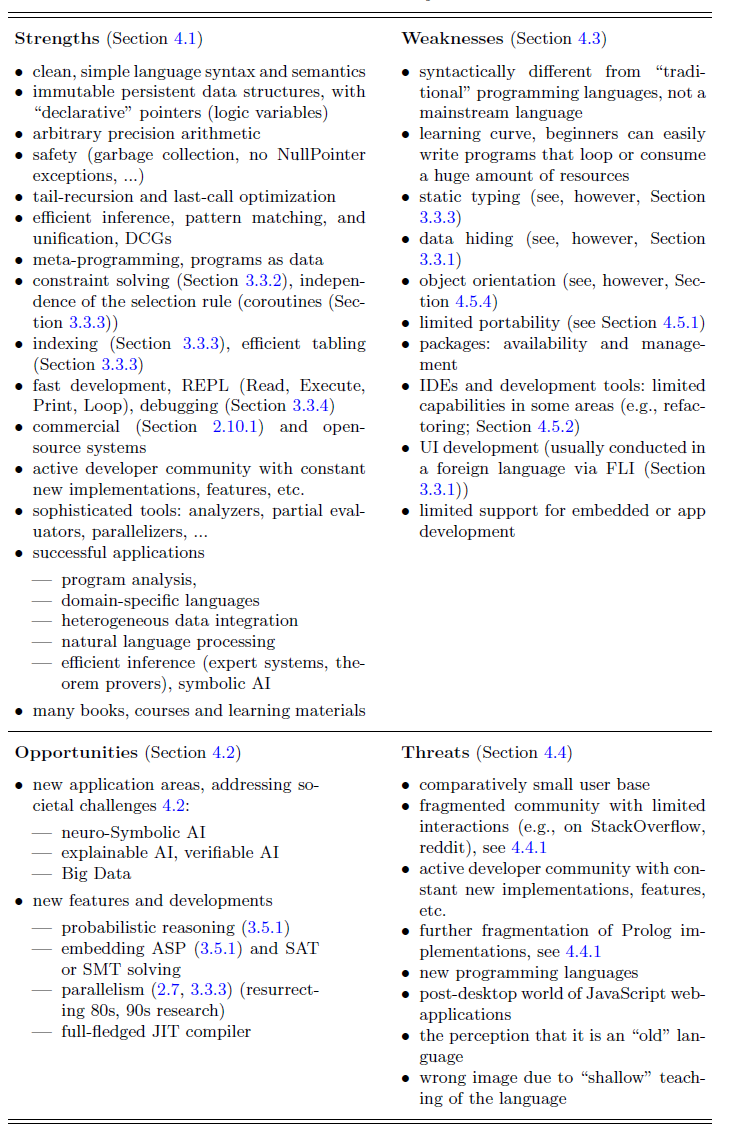
4.1 SWOT: Strengths of Prolog
Ease of Expression
Prolog is a language with a small core and a minimal, yet extremely flexible syntax. Even though some features can only be understood procedurally, such as the cut, the semantics remains very simple. Combined with automatic memory management and the absence of pointers or uninitialized terms makes Prolog a particularly safe language. Flexible dynamic typing completes the picture by placing Prolog among the most high-level programming languages available to date – a feature that makes it very close to how humans think and reason, and therefore ideal for Artificial Intelligence (AI).
The inspection and manipulation of programs at run-time also leads to faster programmer feedback and enables powerful debugging, in particular when coupled with Prolog’s interactive toplevel (a.k.a. REPL or Read-Eval-Print-Loop, although in the case of Prolog the print part is richer because of multiple solutions).
Declarativity is yet another important feature of Prolog: most programs just state what the computer should do and let the Prolog engine figure out the how. For pure logic programs, the resolution strategy may also be altered, and possibly optimized, without requiring the source code of those programs to be changed. Program analysis and transformation tools, partial evaluators, and automatic parallelizers can be used for Prolog programs and can be particularly effective for purely declarative parts. For partial evaluation, however, the techniques have still not yet been integrated into Prolog compilers (the discussion by Leuschel and Bruynooghe Reference Leuschel and Bruynooghe2002, Section 7 is mostly still valid today), with the exception of Ciao Prolog’s preprocessor (Hermenegildo et al. Reference Hermenegildo, Puebla, Bueno and Garcia2005) and abstract machine generator (Morales et al. Reference Morales, Carro, Puebla and Hermenegildo2005; Morales et al. Reference Morales, Carro and Hermenegildo2016). However, they have found their way into just-in-time compilers for other languages (Bolz et al. Reference Bolz, Cuni, Fijalkowski, Leuschel, Pedroni and Rigo2011).
Prolog’s data structure creation, access, matching, and manipulation are performed via the powerful and efficiently implemented unification operation. The logical terms used by Prolog as data structures are managed dynamically and efficiently. Logical variables within logical terms can encode “holes,” which can then be passed around arbitrarily and filled at other places by a running program. Furthermore, logical variables can be bound (aliased) together, closing or extending pointer chains. This gives rise to many interesting programming idioms such as difference lists and difference structures, and in general to all kinds of pointer-style programming, where logical variables serve as “declarative pointers” (since they can be bound only once). This view of logical variables as declarative pointers and related issues have been discussed by Hermenegildo (Reference Hermenegildo2000). Furthermore, Prolog’s automatic memory management ensures the absence of nuisances such as NullPointer exceptions or invalid pointer manipulations. Many Prolog systems also come with arbitrary precision integers, which are used transparently without requiring user guidance.
Prolog compilers and the many program analysis and transformation tools mentioned above are almost always written in Prolog itself, which is an excellent language for writing program processors. Interestingly, since the semantics of programming languages can be easily encoded as (Constraint) Horn Clauses (CHCs), Prolog tools can often be applied directly to the analysis of other languages (Méndez-Lojo et al. Reference Méndez-Lojo, Navas and Hermenegildo2007). The survey by De Angelis et al. (Reference De Angelis, Fioravanti, Gallagher, Hermenegildo, Pettorossi and Proietti2021) in this same special issue of the TPLP journal provides a comprehensive overview of work using analysis and transformation of (constrained) Horn clauses and techniques stemming from logic programming for program verification, including those techniques most related to Prolog.
Efficiency
In addition, Prolog is a surprisingly efficient language. Beginners will often write very inefficient Prolog programs. Yet, carefully written Prolog programs can build on many of the features provided by modern implementations, such as last call optimization (which generalizes tail recursion optimization), efficient indexing and matching, and fine-tuned memory management with efficient backtracking. For applications which are well-suited to Prolog, such as program analysis (Méndez-Lojo et al. Reference Méndez-Lojo, Navas and Hermenegildo2007), program verification (Leuschel Reference Leuschel2008), or theorem proving (see Section 3.5.2), this can lead to programs which are both more flexible and better-performing than counterparts written in traditional languages (Leuschel Reference Leuschel2020).
Successful Applications
Thanks to its simple foundation, the language makes it straightforward to read Prolog programs as data objects and it is almost trivial to implement meta-interpreters, as well as custom or domain-specific languages (such as Erlang Armstrong Reference Armstrong2007, which was initially implemented in Prolog). Therefore, it can be (and has been) used as a means to represent knowledge bases or bootstrap declarative languages in knowledge-intensive environments. Prolog has also been used for several successful formal methods tool developments, such as, for example, Leuschel and Butler (Reference Leuschel and Butler2008), Lopez-Garcia et al. (Reference Lopez-Garcia, Darmawan, Klemen, Liqat, Bueno and Hermenegildo2018). Moreover, Prolog supports the implementation of novel sorts of expert systems or logic solvers, relying for instance on probabilistic, abductive, or inductive inference, which can be simply realized as meta-interpreters. This is another reason why Prolog is well suited for symbolic AI applications. It can also be used to integrate and reason over heterogeneous data (Wielemaker et al. Reference Wielemaker, Hildebrand, van Ossenbruggen and Schreiber2008).
Prolog has also been successfully used for parsing, both for computer languages and for natural languages (see also Section 2.4.1). A relatively recent success story is IBM’s Watson system (Lally et al. Reference Lally, Prager, McCord, Boguraev, Patwardhan, Fan, Fodor and Chu-Carroll2012) which used Prolog for natural language processing, adapting techniques developed in logic grammars over the years for solving difficult computational linguistics problems, such as coordination (McCord Reference McCord2006; Dahl and McCord Reference Dahl and McCord1983). Regarding parsing algorithms, Prolog’s renditions of tabling admit especially succinct while elegant and efficient formulations, as demonstrated for the CYK algorithm on p. 37 of Frühwirth’s book on CHR (Frühwirth Reference Frühwirth2009). Indeed, Prolog lends itself particularly well for grammar development and grammatical theory testing, which has potential both for compilers and for spoken and other human languages. The simplest grammatical Prolog version, DCGs, extends context-free grammars with symbol arguments, while the first grammatical version, MGs, extends type-0 grammars with symbol arguments. Variants that are adequate to different linguistic theories can, and have been, developed (Dahl Reference Dahl1992; Dahl et al. Reference Dahl, Popowich and Rochemont1993; Dahl 1990; Reference Dahl1986). Most crucially, semantics can be straightforwardly accommodated and examined through symbol arguments, which allows for the increasingly important features of transparency and explainability to materialize naturally. Coupled with Prolog’s meta-programming abilities, grammar transformation schemes can help automate the generation of linguistic resources that most languages in the world typically lack, as shown by Dahl and Miralles (Reference Dahl and Miralles2012). Finally, tabling can be used for efficient parsing (Simpkins and Hancox Reference Simpkins and Hancox1990) of a wide range of grammars, even context-sensitive ones. Many more examples of practical applications can be found in the literature, in particular in the conference series PADL (Practical Applications of Declarative Languages, running since 1999) and INAP (International Conference on Applications of Declarative Programming and Knowledge Management, since 1998). ICLP, the premier conference in logic programming, regularly includes papers and sessions on applications and some editions have a special applications track.
Active Community
As we have seen throughout this paper, there are many implementations of the Prolog language, many of them quite mature and still being actively developed, with new features and libraries added continuously, while new implementations keep appearing, with new aims or targeting different niches.
There are many books and tutorials on the Prolog language. Good examples are texts by Clocksin and Mellish (Reference Clocksin and Mellish1981), Sterling and Shapiro (Reference Sterling and Shapiro1994), O’Keefe (Reference O’Keefe1990), Clocksin (Reference Clocksin1997), Blackburn et al. (Reference Blackburn, Bos and Striegnitz2006), Bratko (Reference Bratko2012), or Triska (Reference Triska2021). There is also significant teaching material publicly available in the form of slides, exercises, examples, contest problems, etc., as well as plenty of topical discussions in on-line fora. There are also some interactive learning environments and playgrounds, for example, GUPU (Neumerkel and Kral Reference Neumerkel and Kral2002), or those of SWI, Ciao, or LogTalk, although this is certainly an area that would be well worth improving.
A Prolog programming contest (which has now expanded to include other LP and CLP dialects) is held every year in the context of ICLP.
Even with Prolog being somewhat outside the mainstream of programming languages, it is taught at many universities for a simple reason: it introduces new concepts and features that are quite different from those of object-oriented as well as functional programming languages. Accordingly, it provides computer scientists with not only a simple yet powerful tool to understand and write elegant algorithms but also a new way of thinking about programming. Getting to know the ropes of Prolog expands one’s horizons and allows programmers to significantly improve their way of solving problems. One could easily argue that a computer scientist is not really complete without being familiar with First-Order Logic, Resolution, Logic Programming, and Prolog.
4.2 SWOT: Opportunities
There are several opportunities to considerably improve the performance of Prolog by resurrecting earlier research on parallelism (Sections 2.7, 3.3.3). A JIT compiler can also be beneficial and is provided, for example, by SICStus Prolog. There are certainly opportunities for combining just-in time compilation with specialization to achieve even better performance.
It is very natural to integrate into Prolog features like probabilistic reasoning (Section 3.5.1), ASP (Section 3.5.1), or other logic-based technologies like SAT solving and SMT solving. Making these features routinely available would make Prolog more appealing for a wider class of applications.
Artificial Intelligence
Symbolic AI: Prolog is undoubtedly among the most impactful ideas in symbolic AI. However, subsymbolic or data-driven AI is nowadays attracting most of the attention and resources, mostly because of the recent progress that has been achieved in machine and deep learning.
Despite these advances, state-of-the-art data-driven AI techniques are far from perfect. A common problem that shows up in critical fields such as Healthcare (Panch et al. Reference Panch, Mattie and Atun2019), Finance (Johnson et al. Reference Johnson, Pasquale and Chapman2019), or Law (Tolan et al. Reference Tolan, Miron, Gómez and Castillo2019) is that learning-based solutions tend to acquire the inherent biases of the contexts they are trained into. This often results in decision support systems exposing sexist, racist, or discriminatory behaviors, thus unwittingly permeating the digital infrastructure of our societies (Noble Reference Noble2018).
Similarly, subsymbolic techniques have been criticized for their inherent opacity (Guidotti et al. Reference Guidotti, Monreale, Turini, Pedreschi and Giannotti2019). In fact, while most techniques in this field (neural networks, support vector machines, etc.) are very good at learning from data, they easily fall short when it comes to explicitly representing what they have learned. For this reason, such techniques are often described as black boxes in the literature (Lipton Reference Lipton2018).
Explainable AI: While all such issues are being tackled by the eXplainable AI community (XAI) (Gunning Reference Gunning2016) by using a plethora of subsymbolic tricks (Guidotti et al. Reference Guidotti, Monreale, Turini, Pedreschi and Giannotti2019), an increasing number of works recognize the potential impact of symbolic AI models and technologies in facing these issues, such as the works by Calegari et al. (Reference Calegari, Ciatto, Mariani, Denti and Omicini2018, Reference Calegari, Ciatto and Omicini2020) or Cyras et al. (Reference Cyras, Rago, Albini, Baroni and Toni2021). It seems clear that symbolic inferential capabilities will be crucial for transitioning into the sustainable and humanity-serving AI that is urgently needed (Calegari et al. Reference Calegari, Ciatto and Omicini2020). Accordingly, we highlight two possible research directions where Prolog and LP may contribute further to the current AI picture. One direction concerns the exploitation of LP either (i) for making machine and deep learning techniques more interpretable or (ii) for constraining their behavior, reducing biases. There, Prolog and LP may be exploited as a lingua franca for symbolic rules extracted from subsymbolic predictors (Calegari et al. Reference Calegari, Ciatto, Dellaluce and Omicini2019; Ciatto et al. Reference Ciatto, Schumacher, Omicini, Calvaresi and Notes2020), or as a means to impose constraints on what a subsymbolic predictor may (or may not) learn (Serafini et al. Reference Serafini, Donadello, d’Avila Garcez, Seffah, Penzenstadler, Alves and Peng2017). The other direction concerns the exploitation of subsymbolic AI as a means to speed up or improve some basic mechanism of LP and Prolog. For example, in the field of inductive logic programming (Muggleton and de Raedt Reference Muggleton and de Raedt1994) neural networks have been exploited to make the inductive capabilities of induction algorithms more efficient or effective (d’Avila Garcez and Zaverucha Reference d’Avila Garcez and Zaverucha1999; Basilio et al. Reference Basilio, Zaverucha and Carneiro Barbosa2001). For instance, in the work of França et al. (Reference FranÇa, Zaverucha and d’Avila Garcez2014), the induction task is translated into an attribute-value learning task by representing subsets of relations as numerical features, and CILP++ neuro-symbolic system is exploited to make the process faster.
Along this path, more general approaches attempt to unify, integrate, or combine the symbolic and subsymbolic branches of AI, for the sake of advancing the state of the art. This is the case for instance of the neuro-symbolic initiatives (de Raedt et al. Reference de Raedt, Dumancic, Manhaeve and Marra2020; Lamb et al. Reference Lamb, d’Avila Garcez, Gori, Prates, Avelar and Vardi2020; Pisano et al. Reference Pisano, Ciatto, Calegari and Omicini2020; Tarau 2021) where LP and neural networks are combined or integrated in several ways following the purpose of engineering more generally intelligent systems capable of coupling the inferential capabilities of LP with the flexible pattern-matching capabilities of neural networks.
Inductive Logic Programming: Inductive Logic Programming (ILP), first coined by Muggleton and de Raedt (Reference Muggleton and de Raedt1994) is a subfield of machine learning that studies how to learn computer programs from data, where both the programs and the data are logic programs. Prolog in particular is typically used for representing background knowledge, examples, and induced theories. This uniformity of representation gives ILP the advantage, compared to other machine learning techniques, that it is easy to include additional information in the learning problem, thus enhancing comprehensibility and intelligibility. Muggleton first implemented ILP in the PROGOL system.
ILP has shown promise in addressing common limitations of the state-of-the-art in machine learning, such as poor generalization, a lack of interpretability, and a need for large amounts of training data. The first two affect quality and usability of results, and the latter affects accessibility and sustainability: the requirements of storing and processing exponentially growing amounts of data already make its processing prohibitive. In this context, ILP shows especial promise as a tool enabling a shift from using hand-crafted background knowledge to learning background knowledge, including learning recursive programs that generalize from few examples. These issues, as well as future promising directions, have been recently surveyed by Cropper et al. (Reference Cropper, Dumančić and Muggleton2020).
Further developing the ideas of ILP to encompass the automated learning of probabilistic logic programs is key to Statistical Relational AI (StaRAI), a successful hybrid field of AI (de Raedt et al. Reference de Raedt, Kersting, Natarajan and Poole2016), for which regular workshops have been held since 2010. Tools based on this paradigm aim to handle complex and large-scale problems involving elaborate relational structures and uncertainty.
Bridges to Established Research Areas
Novel opportunities may then arise by bridging Prolog with other well-established research areas. This is, for instance, what happened with the Multi-Agent System community, where Prolog and LP have been extensively exploited in the last decades as the technological or conceptual basis for tens of agent-oriented technologies (Calegari et al. Reference Calegari, Ciatto, Mascardi and Omicini2021). Similarly, the Prolog language has been proposed within the scope of Distributed Ledger Technologies (a.k.a. Blockchains), by Ciatto et al. (Reference Ciatto, Calegari, Mariani, Denti and Omicini2018), or as a means to provide more declarative sorts of smart contracts, as suggested by Ciatto et al. (Reference Ciatto, Maffi, Mariani, Omicini and Notes2019) and Ciatto et al. (Reference Ciatto, Schumacher, Omicini, Calvaresi and Notes2020). There, LP pursues the goal of making smart contracts declarative, hence easing their adoption, and increasing their expressiveness. More generally, begining with the Prolog implementation of the British Nationality Act, Prolog has been used extensively for applications to computational law and is proabably still the dominant approach. For example, the logic programming language in Oracle Policy Automation Footnote 8 was originally implemented in Prolog.
In data science, several data sources need to be cleaned and combined before applying statistical analysis and machine learning. This preprocessing step is often the most labor intensive phase of a data science project. Prolog, particularly when extended with tabling support, is a suitable tool for data preprocessing. It can transparently access data from different sources without needing to repeatedly import all the data, for example, from a relational database management systems. Subsequently, a view on the data can be established from small composable predicates that can be debugged separately and interactively. These ideas have been explored in SWISH datalab (Bogaard et al. Reference Bogaard, Wielemaker, Hollink and van Ossenbruggen2016) which provides a web front end for cooperative development of both Prolog data preprocessing steps and subsequent statistical analysis using R, and used in applications in Biology using large data (Angelopoulos and Wielemaker Reference Angelopoulos and Wielemaker2019). Other Prologs, such as Yap, include support for dealing with large data sets (Costa Reference Costa2007; Costa and Vaz Reference Costa and Vaz2013).
Summarizing, it might prove very useful for the community to anticipate what features may attract programmers for ends such as improving AI, the Internet, programming languages, or knowledge intensive systems in general.
4.3 SWOT: Weaknesses
Prolog is syntactically quite different from traditional mainstream programming languages. One could argue that this is a necessary side effect of many of its strengths, and that it is possibly a reason why Prolog has a place in many computer science curricula. However, it also means that Prolog can appear strange or unfamiliar to many beginners or even seasoned programmers. Mastering Prolog also implies a considerable learning curve and it certainly takes a while for a beginner to become truly productive in what is often a radically new language and paradigm.
While Prolog’s dynamic typing can be an advantage for rapid prototyping and meta-programming, it is also often considered a weakness. Optional static typing (see Section 3.3.3) would definitely help in catching many bugs early on.
Data hiding is also more difficult in Prolog. In the de-facto standard module system used by most Prologs one can decide which predicates are exported, but not which data types (i.e., functors and constants) are exported. One can typically not prevent another module from manipulating internal data structures (see, however, Section 3.3.1). This issue goes hand-in-hand with the limited support for object orientation (see, however, Section 4.5.4).
Another issue is the limited support for user interface (UI) development within Prolog. There was more attention to this issue in the past (e.g., BIM-Prolog had the Carmen library for this purpose), and there were interesting approaches in which declarativeness and/or constraints were exploited for this purpose, but nowadays UIs are usually developed in a foreign language via FLI (Section 3.3.1). Similarly, there is limited support for developing mobile applications or embedded software with Prolog, even if a number of Prologs can run on small devices and Prolog program optimization techniques have been shown to be up to the task (Carro et al. Reference Carro, Morales, Muller, Puebla and Hermenegildo2006).
Portability of Prolog code can also be nontrivial, despite the ISO standard (see Section 4.5.1). Also, the Prolog community does not have a standard package manager, making it more difficult to distribute libraries or modules. (On the upside, Prolog also does not have all the version management hell and security issues prevalent in other languages.) Finally, the support for Prolog in some integrated development environments can be less mature than for mainstream languages like Java (see Section 4.5.2). In particular, the available support for refactoring is often quite limited.
4.4 SWOT: Threats
Some threats to Prolog come from competing programming languages. Indeed, Prolog may be perceived as an “old” language, and new programming languages such as previously Java, or now Rust or Go, may be more appealing to new generations of programmers. Also, for some application domains, like web-based applications, which have obviously become increasingly important in recent years, other languages like JavaScript are much more popular and easier to deploy than Prolog, although this is being addressed by current Prolog implementations.
Another threat to the perception of Prolog comes from the fact that, when teaching it, if the presentation does not go deep enough to convey the real power and elegance of the language and the programming paradigm, it may instead leave the incorrect impression of being a shallow or just academic tool.
On the other hand, as mentioned before, Prolog systems are still very actively developed, with new features and new implementations appearing continuously. While this is obviously positive, some threats we see for Prolog stem precisely from a resulting divergence of implementations (which tends to fragment the community into several, changing user camps) and a lack of strong stewardship (which, in turn, may fuel further divergence of systems).
We discuss the aforementioned issues in more detail in the following two sections.
4.4.1 Fragmentation of the community
A large threat to the future of Prolog as an accessible programming language is further fragmentation of the community. This manifests itself in two dimensions:
User Bases Today, the Prolog language lacks a strong, united presence on the Web, especially when compared to other languages, such as the Python Homepage (Reference Homepage2021), Rust Homepage (Reference Homepage2021), R Homepage (Reference Homepage2021), Clojure Homepage (Reference Homepage2021) or Julia Homepage (Reference Homepage2021). Hence, there is limited exchange between users of Prolog, in particular of different Prolog systems. Only a few shared platforms exist, such as the venerable comp.lang.prolog newsgroup, the Prolog subreddit, or StackOverflow. They have in common that they are not very active and are mostly used for announcements or beginner questions. There are some exceptions, such as the SWI-Prolog discourse forum, hosting active discussions on the implementation, but, again, it is a barrier since it is essentially local to this system. The lack of an overarching presence, thus, lowers Prolog’s visibility, hinders development of shared libraries, and might be an entry barrier for new Prolog users. It may even deter programmers from adapting LP technology due to outdated or wrong information on Wikipedia pages on Prolog or Logic Programming in general, or due to missing FAQs, API documentation, and tutorials.
The current fragmentation of the Prolog community may be seen as a threat to the language standardization effort and, thus, the advancement of Prolog. Compilation of standardization documents takes a very long time and is currently driven by a few volunteers. While only experts can evaluate the impact of changes in the standard on existing Prolog systems, the community may assist such efforts by pinpointing differences between systems, prioritizing features that should be considered next, or by providing test cases. However, the community is hard to reach in a unified way and such contributions are often limited to motivated individuals and remain scarce.
Implementors While implementors of Prolog systems meet at the CICLOPS workshops and other conferences, they do not have a good shared infrastructure to revise syntax, discuss libraries, tools and technical questions, or to offer existing code or tests. Without such workflows and regular discussion of future directions, Prolog systems may further diverge in features, libraries, and possibly even from the ISO standard if no concerted effort is made to find common best solutions. New developers need a forum to ask questions and benefit from lessons learned. Otherwise, implementation work may be duplicated, no common Prolog tooling will be developed, etc.
4.4.2 Lack of strong stewardship
The largest single threat we see for the future compatibility of Prolog systems and attractiveness of the language in the long term is the lack of a strong stewardship. All implementors we were able to reach for comments agree with the need for compatibility, are willing to discuss issues and work on their systems to address them. However, the most lacking resource is time, as compatibility work diverts efforts from research and development.
A dedicated entity, which acts as a steward, calls meetings on a regular basis to ensure progress, and oversees open issues is missing and necessary, but establishing it is not without challenges. Sufficient financial and/or institutional backing to motivate implementors and to fund at least one steward position would be an asset. Additional human resource positions may be needed to address specific aspects, such as interoperability, source code compatibility, and website maintenance.
Two major collective efforts, the ISO process and the Prolog Commons group, have already been established that can be regarded as such entities and persist with varying success:
The ISO Process The ISO working group has the strong mission to provide a robust and concise standard that makes Prolog attractive for the industry, giving it a competitive advantage. The core standard was a huge leap in the right direction, providing a strong basis for compatibility. However, further progress has been rather slow, which may be due to the nature of ISO as well as the voluntary nature of the work of the participants and their aspirations for stability and high-quality work. Unfortunately, only a few of the actual system implementors are currently active in the ISO standardization efforts. Also, the process is complex and may be too slow despite steady progress, since even more and more features and libraries are developed independently.
Prolog Commons The Prolog Commons project started as a series of informal implementor meetings to improve the portability of Prolog code, in a more agile and interactive setting than the ISO process. This impetus pushed many participating systems in converging directions, producing changes in their documentation systems, improved compatibility/emulation layers, and plans for further integrations. The reason that the project has not fully materialized into a common code base is, again, the lack of stewardship, meeting schedules, and deadlines, combined with the available time of the implementors.
4.5 Improving Prolog
In preparation of this article, we reached out to researchers from different application areas of Prolog in order to gauge the most pressing topics, as well as to Prolog implementors in order to assess the potential for convergence of Prolog systems. Based on the results of this survey and on the SWOT analysis in Sections 4.1–4.4, we now discuss the issues and areas of improvements which we feel are most pressing.
4.5.1 Portability of existing features
The differences between the various Prolog implementations, either in the set of features provided (cf. Table 2) or in the way the features work, lead to a code portability problem between Prolog implementations. Circumventing this problem rather than solving it results in fragmenting the community into smaller, noncompatible subgroups. This makes it hard for users to find support and stay interested.
Strong and universally accepted standards for available features may raise interest from programmers and industry. Yet, if some combination of them are missing in many Prolog systems, it will negatively impact the perception of Prolog. One of the nonstandard offers of Prolog is constraint logic programming. Yet, choosing a Prolog system requires certain trade-offs concerning the available features. Many of these features concern performance, such as tabling, efficient coroutining via block annotations, and multiargument indexing. Some programmers may not want to give up what they are used to from other programming languages, like multithreaded, concurrent and distributed programming, standard libraries for formatting and pretty printing, efficient hash map data structures, and universally available data structures such as AVL trees or sets. Finally, some features are needed to embed Prolog as a component in a larger software system, for example, nonblocking IO, interfaces to other programming languages or (de-)serialization support, such as fastwrite/fastread, XML, JSON, YAML.
4.5.2 Improved development tools
An important area of future improvement is in the development tools available for the language. The dynamic nature and complex control of Prolog raises new challenges in the implementation of some of these features, but its clear logical foundations provide an advantage for others. We see a potential and a need for the following improvements to the Prolog tooling ecosystem:
-
Increased capabilities in debuggers (e.g., constraint debugging or graphical interaction), performance profiling tools, and testing frameworks. The combination of static and dynamic verification, debugging, and testing of Ciao is relevant here (Hermenegildo et al. Reference Hermenegildo, Puebla, Bueno and Garcia2005; Sanchez-Ordaz et al. Reference Sanchez-Ordaz, Garcia-Contreras, Perez-Carrasco, Morales, Lopez-Garcia and Hermenegildo2021).
-
Better experience using interactive shells: Prolog could also profit from being integrated within notebooks such as Jupyter, as has been done in SWISH (Wielemaker et al. Reference Wielemaker, Riguzzi, Kowalski, Lager, Sadri and Calejo2019).
-
More regular, user-friendly, and standardized ways of interfacing with other languages. Features that should be accounted for include nondeterminism, convenient and safe data types, and memory management coexistence.
-
More capable IDEs, in particular with good refactoring tools, which help the programmer to safely reorder or change the arguments of predicates, rename, or move predicates to other modules, etc., in the line of SICStus’ SPIDER (Carlsson and Mildner Reference Carlsson and Mildner2012). Prolog itself may be used as the GUI programming language in developing the IDE.
-
Linters that enforce community-sourced coding guidelines based on, for example, the proposals by Covington et al. (Reference Covington, Bagnara, O’Keefe, Wielemaker and Price2012) and Nogatz et al. (Reference Nogatz, Körner and Krings2019).
-
Improved code location facilities, such as Ciao’s Semantic Search (Garcia-Contreras et al. Reference Garcia-Contreras, Morales and Hermenegildo2016).
-
Other static program analysis tools, enabling for instance the inspection of dependencies among modules, and the existence of call hierarchies among predicates. Also, dynamic process inspection tools aimed at visualizing call stacks, choice points queues, proof trees, etc. (see also Section 4.5.3, State Inspection).
4.5.3 Application- and domain-specific needs
In this section, we consider a few domains that we think may influence Prolog in the future and try to anticipate future developments that are needed to satisfy their needs.
Parsing The parsing domain has implications both for computing sciences, in that it can be applied to compilers or other program transformations, and for sciences and the arts, in that many kinds of human languages (e.g., written, spoken, or those of molecular biology or music) can be computationally processed for various ends through parsing.
As far as pure parsing is concerned, one can of course easily write top-down recursive descent parsers in Prolog using DCGs. However, encoding deterministic parsing with lookahead requires the careful use of the cut, which is tedious and error-prone. Ideally, the cuts could be automatically generated by standard compiler construction algorithms (Nullable, First, Follow) and a Prolog-specific parser generator. Bottom-up parsers are also easy to write using, for instance, CHR. Another way to improve Prolog’s parsing capabilities is through memoing, which avoids the infinite loops that left-recursive grammars are prone to, thus needing to resort less to the cut, and avoids recomputations of unfinished constituents in the case of alternative analyses where one analysis is subsumed by another. This is done by storing them in a table so they need not be recomputed upon backtrack (e.g., in “Marie Curie discovered Polonium in 1898,” the partial analyses of the verb phrase as just a verb or as a verb plus an object are stored in a table for reuse rather than disappearing upon failure and backtrack). Memoing can be easily implemented in Prolog, for example, through assumptions, as discussed by Christiansen and Dahl (Reference Christiansen and Dahl2018), or through CHR, as discussed by Frühwirth (Reference Frühwirth2009), or using tabling as in XSB Prolog.
NLP and Neural Networks Neural-network approaches to NLP use word embedding strategies to generalize from known facts to plausible ones (e.g., BERT Devlin et al. Reference Devlin, Chang, Lee and Toutanova2019, GPT-3 Floridi and Chiriatti Reference Floridi and Chiriatti2020). They typically train only on form, in that they retrieve those responses that are statistically pertinent, with no regard to meaning. Their results are unstable, since they rely on ever larger and changing internet-mined data. While this approach has achieved noteworthy performance milestones in machine translation, sentence completion, and other standard benchmarking tasks, it offers a priori no way to learn meaning (Bender and Koller Reference Bender and Koller2020) and relies on undocumented, un-retraceable, or otherwise partial (and therefore unaccountable) data, which tends to perpetuate harm without recourse (Birhane Reference Birhane2021). It is also resource-intensive, both computationally and energetically, and prone to spectacular failure (Marcus and Davis Reference Marcus and Davis2020). It seems that overcoming such drawbacks will need inferential programming capabilities, which integrations with deductive reasoning might help achieve. We anticipate that efforts in that direction, which are already happening (Sun et al. Reference Sun, Arnold, Bedrax-Weiss, Pereira and Cohen2020), will be increasingly needed.
Another NLP area which we anticipate will require much attention and that Prolog can be ideal for is that of under-resourced human languages. Very few of the over 7000 languages in existence have at their disposal the computational tools that are needed for their adequate processing. Since texts on the Web are also overwhelmingly in mainstream languages, and the machine learning approaches that are in vogue typically rely on mining massive volumes of text, when these do not exist (or as soon as the existing ones become more protected) we need more logical approaches, such as grammatical inference by grammar transformation.
Problem Solving, Solvers Constraint programming blends nicely within Prolog (see Section 3.3.2), in the form of CLP( $\mathcal{FD}$
), CLP(
$\mathcal{FD}$
), CLP( $\cal B$
), CLP(
$\cal B$
), CLP( $\cal R$
), or CLP(
$\cal R$
), or CLP( $\cal Q$
), and also in the CHR form, which lets users define constraint solvers for their own domain of interest. However, the binding to SAT, SMT, or ASP solvers is often still quite awkward. In particular, ASP with its Prolog syntax could be made available as a seamless extension to Prolog. Similarly, SAT and SMT solving could also be linked in a seamless way to Prolog facts or clauses. In an ideal world, one could even link various solvers via shared variables and coroutines.
$\cal Q$
), and also in the CHR form, which lets users define constraint solvers for their own domain of interest. However, the binding to SAT, SMT, or ASP solvers is often still quite awkward. In particular, ASP with its Prolog syntax could be made available as a seamless extension to Prolog. Similarly, SAT and SMT solving could also be linked in a seamless way to Prolog facts or clauses. In an ideal world, one could even link various solvers via shared variables and coroutines.
Visualization and GUIs Visualization is nowadays most often performed via the foreign language interface or by exporting data to external tools (e.g., dot text files for GraphViz). While BIM-Prolog (cf. Section 2.10.1) had a declarative graphical toolkit, unfortunately Prolog systems have moved away from this approach. Other communities, however, are discovering the advantages of a “declarative approach” to visualization and user-interface design (e.g., React Gackenheimer and Paul Reference Gackenheimer and Paul2015 in the JavaScript world). Maybe it is time again to implement visualizations or user interfaces within Prolog itself.
State Inspection Prolog 0 already included primitives to programmatically inspect the computation state. These can be useful for example in debugging or in parsing, in order to implement context-sensitive grammars. Current Prologs allow different degrees of state inspection, including for example the classic facilities that enable meta-programming. Such primitives could acquire new relevance under the increasing needs for further transparency and inspectability in AI applications.
4.5.4 Prolog aspects that need joint, public, and earnest discussion
There are a number of issues that would need early discussion in the process of giving a new impetus to Prolog standardization. While we raise questions here, we cannot speak on behalf of the entire community. Thus, we think that a visible (in the sense of commonly-known) platform for public discussion between implementors and users is required. The Prolog language should eventually evolve on results of discussions and needs of (potential) programmers. For some issues we discuss below, several solutions have been offered by the research community. However, the Prolog community has to discuss what features shall be adapted as standard. Further, one might also consider whether purely declarative implementations are preferable or even feasible, since some features, such as assert and retract, do not even have a declarative, logical semantics. The following points are some examples:
Types, Modes, and Other Properties Often, during development, a Prolog program may terminate without finding a solution, get stuck in an infinite loop, backtrack unexpectedly, etc. Often, this sort of situation is due to type errors in the code. Should a type (and mode, etc.) system be part of an improved Prolog, allowing for more powerful static analysis? If so, what should it look like? What would have to be changed for a useful gradual static type system that allows one to progressively add types to existing code? Should more general properties than classical types and modes be supported? Should static types be combined with dynamic checks? With testing? The logic programming community has been pioneering in these areas with research, solutions, and systems well ahead of other languages, but it has not yet seen widespread use. Ciao’s comprehensive approach to this overall topic could shed some light here.
Reactivity A rule in Prolog can be viewed as a part of a definition that defines the predicate in the head of that rule in terms of the predicates in the body of the rule. In contrast, most rules in imperative languages are reactive rules that perform actions to change state, as in the case of condition-action rules in production systems and event-condition-action rules in active database systems. Extensions of logic programming to include reactive rules have been developed in CHR (see Chapter 6 in Frühwirth Reference Frühwirth2009) and in the Logic-based Production System Language LPS (Kowalski and Sadri Reference Kowalski and Sadri2015; DBLP:journals/tplp/WielemakerRKLSC19).
Module System As mentioned before, the second part of the ISO standard regarding modules was universally ignored and most Prolog systems settled for a Quintus-inspired module system. However, the implementations incorporate some deviations to support new features. Rules regarding visibility of operators, predicates, and perhaps atoms should be reconsidered. This is addressed to some extent, for example, in the Ciao and SWI module systems but, again, with some differences, which should however not be too difficult to bridge. Systems support some of the legacy code loading methods such as consult/1 and ensure_loaded/1 for backwards compatibility, but use_module/{1,2} is recommended, specially for large-scale applications. New solutions must address errors and inconsistencies that have already been uncovered by Haemmerlé and Fages (Reference Haemmerlé, Fages and Notes2006) and later by Moura (Reference Moura2009a).
Objects An aspect which is closely tied to the module system is that of integrating logic programming with object-oriented features. This has been an elusive goal but, nevertheless, several effective proposals have been put forward which achieve ways of doing whole-program composition more in line with the Logic Programming paradigm. Monteiro and Porto (Reference Monteiro and Porto1989) present the basic concepts of Contextual Logic Programming while Bugliesi et al. (Reference Bugliesi, Lamma and Mello1994) offers an extensive discussion on this topic. A more advanced design, in which modules (called units) may take parameters and where the context itself becomes a first-class object is provided by GNU Prolog/CX (Abreu and Diaz Reference Abreu and Diaz2003), which appears as both an object-oriented extension and a dynamic program-structuring mechanism. An application of this system is described by Abreu and Nogueira (Reference Abreu and Nogueira2005).
Another example is the O’Ciao model, which implements a source-to-source approach to objects as a conservative extension of the Prolog module system (Pineda and Bueno Reference Pineda and Bueno2002). Logtalk offers a different approach, also based on source-to-source transformations, that adds a separate object-oriented layer on top of many Prolog systems. Thus, it regards objects as a replacement for a module system.
Interfaces Beyond modules, programming in the large can be supported by mechanisms that allow describing and enforcing separation between interfaces and implementations. Such interfaces are typically sets of signatures, specifying types and other properties, to be matched by all implementations, and thus allow stating what a given implementation must meet, and making implementations interchangeable in principle. They should include at least constructs to express the external connections of a module, not only in terms of the predicates it should expose but also the types, modes, and other characteristics of their arguments, and a compiler/interpreter capable of enforcing those interfaces at compile- or loading time. Ciao’s assertion language, preprocessor, and interface definitions offer a possible solution in this area.
Syntactical Support for Data Structures One of Prolog’s strengths is a minimalistic syntax. SWI-Prolog’s syntactic support for strings and dictionaries responds to a demand for interfacing with prevalent protocols and exchange formats, for example, XML and YAML. Other systems have other extensions such as feature terms (Aït-Kaci 1993; Aït-Kaci et al. 1994).
Many questions need to be answered: Should syntactical support for data types such as associative data structures (feature terms) or strings be standardized? Would the current syntax be affected (e.g., a prevalent syntax for maps, "key”: “value", might break DCGs)? What are trade-offs the community is willing to take? Should other containers, such as linear access arrays, sets, and character types, be included? How should unification of variable elements work?
Library Infrastructure and Conditional Code As Moura’s efforts concerning Logtalk (cf. Section) showed, it is possible to support large portable applications across almost all Prolog systems. Yet, a nontrivial amount of conditional code for abstraction libraries is needed to provide support for each new Prolog system. Is the community willing to develop libraries supporting more than a couple of systems? Is a stronger standardized core library required to attract programmer? Is the language that emerges from the portability layer still Prolog?
Macro System Many Prolog systems support the source-to-source transformation of terms and goals, via the so-called term expanders. It is a powerful feature that is not part of the standard and in some cases can be clunky to use and error-prone since term expanders are often not local to a module, they are order dependent and every term or goal, relevant or not, is fed into the transformation predicate. Ciao shows how module locality and priorities can be used in this context. Or should a more lightweight macro system be made available for code transformation?
Functional Programming Influences Curry and Mercury (cf. Section 3.5) are well known for combining the functional and logic programming paradigms. Some Prolog systems such as Ciao have strong support for functional syntax and higher-order. Most Prolog systems provide support for meta-predicates such as call and some derivatives such as maplist, filter, and reduce. Should a notation for lambda expressions be introduced as done in, for example, Ciao’s predicate abstractions?
Standard Test Programs Beyond ISO While test suites for ISO Prolog exist, many features outside the core language are prevalent in a lot of Prolog systems. Unstandardized features, such as modules, constraint programming, or DCGs, are provided by almost all modern Prolog systems, yet implementors rarely share test programs. Obviously, creation of and agreement on tests is challenging, especially since some systems might want to maintain their features as they are. Availability of such shared tests can guarantee that systems behave similarly, allow implementors to test compatibility with other systems, and foster standardization of these features. As a positive example in this line, Logtalk’s Prolog test suite is quite comprehensive, covering not only ISO- and de-facto standard features, but many other tests of predicates and notable features such as modules, threads, constraints, coroutining, Unicode support or unbounded integer arithmetic.
4.6 Summary and next steps
Despite differences and incompatibilities between Prolog systems and thus user code, the ensuing divergences are not fundamental. It is our belief that the best initiatives that were put in place in the past, with some tweaks that we hope to have covered, can be re-applied to make much stronger progress in the future.
The necessary implementor involvement seems attainable: most surveyed implementors and users agree that efforts for a common ground should be made, namely by meetings and the sharing of ideas, implementations and even common infrastructure. It is important that the entire community be involved in creating and maintaining the existing core standard as well as debating desired features, in order that upcoming standards take hold and be respected. Since support tools are a must for all modern programming languages, it is important to pool resources. In particular, mature debuggers, as well as developing and testing environments, are often required by Prolog programmers. The diversity that is unique to Prolog’s ecosystem is a strength which should be taken advantage of. In short, Prolog systems need to be useful and usable so they can be more universally employed.
Accordingly, to coordinate converging efforts, an organization, perhaps a Foundation, could be established, either independently or as an initiative within, for instance, the ALP. With converging systems and tool infrastructures, possibilities in community participation and user documentation can vastly improve, rendering Prolog much more attractive to new users both in academia and industry, thereby building a more unified community.
Standard procedures already exist for Prolog improvement, such as the ISO standardization. We feel these would benefit from being complemented by less formal ones, such as the Prolog Commons.
A time- and cost-efficient first step could be to create a web platform to publicly share feature extensions and modifications and propose new ones. It could also provide the community with a forum for public debate and gather pointers to previous and complementary efforts. It could be linked to from the ALP website.
Another productive step would be to define a structured workflow aimed at tracking, supporting, and coordinating the evolution of proposals, efforts, and further initiatives.
Teaching Prolog to children could be most influential: they would be learning logic and computing at the same time, and Prolog literacy would spread much more rapidly through them. There was much activity in this area in the 1980s with the Prolog Education Group (PEG) with its annual workshops. More recently, “Logical English” (Kowalski Reference Kowalski2020), although focused primarily on legal applications, including smart contracts, is simply sugared syntax for “pure” Prolog, making it suitable for teaching to children (and others).
Finally, it could be useful for the community to analyze all the relevant Wikipedia pages and other web content in search of misinformation, outdated information, or in general inaccurate content on Prolog or logic programming, in the aim of correcting it.
5 Conclusions
We have provided an analysis of the Prolog language and community from the historical, technical, and organizational perspectives.
The first contribution of the paper (Section 2) has been a historical discussion tracking the early evolution of the Prolog language and the genealogy of the many implementations available nowadays. This discussion stemmed from a general definition of what constitutes a “Prolog system” and covered the most notable implementations and milestones in chronological order.
We have seen how Prolog implementations, and even the language itself, have experienced significant evolution and extensions over the years. Despite the common roots, the maintenance of the Prolog name throughout these transformations, and the rich exchange of ideas among system implementers, inevitably some parts of each system have progressed somewhat independently. This has naturally led to some divergence. In order to assess the current situation, the second contribution of the paper (Section 3) has consisted in a technical survey of the current status of the main Prolog systems available today, comparing them on a per-feature basis with the objective of identifying commonalities and divergences. In addition, we have also tried to identify the core characterizing aspect(s) of each Prolog system, that is, what makes each system unique.
We have observed that there is widespread adherence to the ISO standard and its extensions. More differences understandably appear in the added features that lie beyond ISO. At the same time we have seen that many of these extensions are common to many Prolog systems, even if there are often differences in the interfaces. We have also observed that some Prologs offer unique characteristics which would be very useful to have in other systems. Such differences in general affect portability and make it harder for a programmer to write Prolog programs that work and behave consistently across systems.
However, we have observed that the divergences between Prolog systems are not fundamental. It seems that a good number of the differences could be easily bridged by agreeing on interfaces and/or standard implementations that can be easily ported to all systems.
Wenger et al. (Reference Wenger, McDermott and Snyder2002) suggest that communities reach one or more crucial points where they either fade away, or, alternatively, they find new impetus to start further cycles. We believe that our community has reached such crucial points several times to date, at junctures such as the loss of interest in parallelism in the early 90s (only to come back in full swing, over a decade later), the end of the Fifth Generation project, the advent of Constraints, the long AI winter (also with a mighty comeback), the appearance of the Semantic Web, the advent of ASP, etc. In all previous occasions the community has been able to adapt to these environmental changes and incorporate new scientific and technological advances as extensions to the language and the different implementations, and has continued to produce truly state-of-the-art programming systems, with advanced characteristics that often appeared ahead of many other paradigms.
We believe we are now at one of these crucial points where action is needed. The present Prolog systems, and Prolog as a whole, continue being important and unique within the programming languages landscape, and it is encouraging to see that after all this time new Prolog implementations, new features, and new uses of Prolog appear continuously.
However, at the same time there is some risk of losing unity and strength in the community. This is partly due to its very success (in that it has spawned new communities or successfully complemented existing ones) and partly to community fragmentation and divergences in systems due to new functionalities.
Thus, the last contribution of the paper (Section 4) has been to provide an analysis, including strengths, weaknesses, opportunities and threats, as well as some proposals for the LP community aimed at addressing the most relevant issues concerning the Prolog ecosystem, in a coordinated way. We argue that a joint, inclusive, and coordinated effort involving Prolog implementers and users is necessary. The great initiatives consisting of a small group of experts, such as the ISO working group or the Prolog Commons project, with some tweaks that we hope to have covered, can be re-invigorated to make stronger progress in the future. However, they may not be enough to bring together a user community that contributes to the language and its growth. Accordingly, to apply the lessons learned from the past, we stress the need for both community involvement and stewardship, including perhaps the ALP, for ensuring that the effort is kept moving forward consistently.
Good initiatives are already being undertaken with the declaration of 2022 as the “Year of Prolog” Footnote 9 : its celebrations will include an Alain Colmerauer Prize awarded by an international jury for recent application-oriented work of Prolog-inspired technology and its potential for more human-oriented computing in the future, and a “Prolog School Bus” that will travel to reintroduce declarative programming concepts to the younger generation. It is expected that both initiatives will continue into the future, with a yearly prize also forseen for the “nicest” Prolog program written by a student participating in the school caravan.
Conflicts of interest
The authors declare none.


 Open access

