





Event Description:
Event Type: Tornado; 2025 ISC Hazard Definition and Classification Code MH0305 - Wind and Pressure-Related Meteorological Hazard
Event Date: April 26, 2024; 15:30–16:29
Location: Originated in Western Douglas County, Nebraska; Tracked Northeast for 31.2 miles through the Omaha Metropolitan Area (Elkhorn, Nebraska [41.2832°N, 93.2368°W] and Bennington, Nebraska [41.3647°N, 96.1578°W]) before Crossing into Washington County, Nebraska South of Blair, Nebraska (41.5447°N, 96.1351°W)
Response Type: Public Health Surveillance
Introduction
The United States accounts for nearly three-fourths of tornadoes globally. 1 With nearly 1,800 confirmed tornadoes, 2024 accounted for the second highest number of tornadoes recorded. 2 This was driven in part by an uncharacteristically active tornado season across the Great Plains. 2 The most severe tornado outbreak in eastern Nebraska in over a decade severely impacted communities from central Nebraska to central Iowa on Arbor Day, April 26, 2024. Major disaster declarations were granted for both Iowa and Nebraska. 3,4 Douglas and Washington Counties in Nebraska were impacted by an EF-4 tornado, with a maximum width of over one mile, wind speeds exceeding 170 miles per hour, and a track length of over 31 miles. 5 Despite the significant damage, there were no deaths or critical injuries resulting from the tornado outbreak. 5
The Community Assessment for Public Health Emergency Response (CASPER) methodology is the standard for post-disaster rapid needs assessment (RNA) in the United States. 6 This approach was adapted from the World Health Organization’s (WHO; Geneva, Switzerland) household survey sampling used to estimate vaccination coverage as part of its Expanded Program on Immunization activities. 6,Reference Malilay, Flanders and Brogan7 The CASPER’s two-stage cluster sampling has been widely used in both disaster and non-disaster contexts across the United States and Territories. However, this approach works best in well-defined communities with large population sizes and/or for disasters affecting large geographic areas. Accordingly, there have been few post-disaster RNAs considering health and well-being in rural areas and fewer following tornadoes in the United States.
In a systematic review of studies using RNAs globally, only one study assessed the impacts of a tornado. Reference Bosmans, Baliatsas, Yzermans and Dückers8 However, this study used medical records rather than community-based surveys. Reference Ablah, Tinius, Konda, Synovitz and Subbarao9 Most global studies on tornado-related health and well-being impacts are from China and similarly use clinical outcome data. Reference Dong, Wang, Deng, Yu, Chen and Zhang10–Reference Deng, Lv, Xue, Kang, Dong and Zhang13 Deng, et al (2019) conducted cross-sectional surveys in affected communities in Inner Mongolia Autonomous Region and Jiangsu Province, China in close temporal proximity to tornado events. However, impacts were measured at the individual-level, rather than the household-level, as is standard in CASPER-like RNAs. Reference Deng, Lv, Zhao, Yu, Dong and Zhang14
Other studies have assessed longer-term health impacts of tornadoes, rather than acute impacts captured by RNAs. A study of tornado-attributable mortality following a 2011 tornado outbreak used death certificates and mortality surveillance for seven months after the event rather than collecting perishable data. Reference Chiu, Schnall and Mertzlufft15 In a study assessing the impact of a tornado occurring during the COVID-19 pandemic, First and Houston (2022) found posttraumatic stress and depressive symptoms among adult survey respondents one year after the tornado event. Reference First and Houston16 Recognizing the need to capture acute impacts and perishable data, academic-practitioner partnerships were leveraged to pilot modifications to standard RNA methods to capture public health impacts experienced by affected populations in Douglas and Washington Counties, Nebraska.
The objectives of this modified RNA were to: (1) identify the strengths, limitations, and operational challenges for utilization of modified RNAs for post-disaster, quick response research; and (2) capture the acute mental and physical health impacts and lived experiences of communities affected by the Arbor Day tornado.
Source
Survey Design
Standard, validated CASPER questions were used to assess household characteristics, mental and physical health, disaster impact, and emergency preparedness at the household level. These questions were supplemented with questions from the National Oceanic and Atmospheric Administration’s (NOAA; Silver Spring, Maryland USA) Tornado Post-Event Survey, scaled to the household level, as well as questions developed in collaboration with local public health partners on community-specific needs, resource knowledge, and communications. The full surveys are available as Supplementary Material.
Study Population
Census blocks within a two-mile buffer zone of the 31-mile tornado path through Washington and Douglas County, Nebraska were eligible for selection and participation in the survey. Respondents were required to be 19-years of age or older (age of majority) and to sleep at the household most nights of the week.
Sampling Strategy
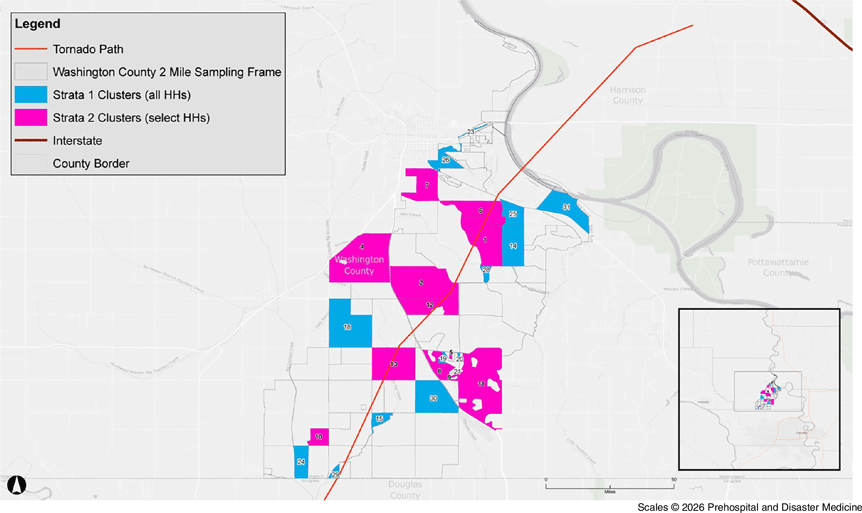
This study modified the standard two-stage cluster sampling used in CASPER surveys. For Washington County, a multi-tiered sampling strategy was used (Figure 1). Based on the estimated number of households in a given cluster – as determined from US Census and Nebraska Department of Revenue County Assessor and Parcel Data – clusters were stratified into those with nine or fewer households (Strata 1) and those with 10 or more (Strata 2) households. For Strata 1, clusters were randomly selected until the total number of available households were equal to approximately one-half of the required sample size (n = 96), with additional clusters selected to account for refusal or non-response to ensure adequate sample size. All available households within each Census block were sampled in Strata 1. For Strata 2, 20 clusters and five households within a given cluster were randomly selected, rather than seven households from 30 clusters, the standard sampling approach used in a CASPER. Strata weights for each cluster simplified to an equivalent shown in Formula 1:
Sampling Area and Tornado Path in Washington County, Nebraska.

Formula 1. Cluster Weights $\small{\eqalign{{\rm{Cluster}}\;{\rm{Weight}} = \quad\quad\quad\quad\quad\quad\quad\quad\quad\quad\quad\quad\quad\quad\quad\quad\quad\quad\;\quad \cr {{{\rm{Total}}\;{\rm{Households}}\;{\rm{in}}\;{\rm{Cluster}}} \over {{\rm{Households}}\;{\rm{Interviewed}}\;{\rm{in}}\;{\rm{Cluster*Number}}\;{\rm{of}}\;{\rm{Clusters}}\;{\rm{Selected}}}}}}$
Due to the significant damage to the homes in Washington County, field assessments were supplemented with an online survey option for displaced residents. Addresses of residents who had completed the Three Rivers Public Health Department’s (Three Rivers; Fremont, Nebraska USA) online tornado damage self-report form were geo-coded to one of the selected clusters, and postcard invitations to participate in the online survey were mailed out. It was assumed that displaced residents would be receiving postal mail through a forwarding address, or directly at the local post office, if mail was undeliverable due to damage.
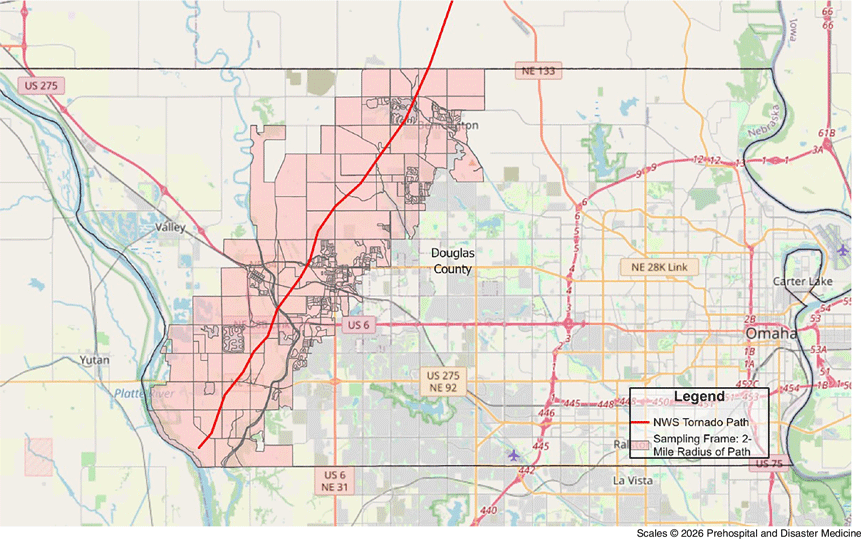
For Douglas County, a stratified simple random sample was used (Figure 2). Residential addresses were identified from a damage report dashboard from Douglas County Health Department (DCHD; Omaha, Nebraska USA; n = 900) and from the Douglas County Assessor’s Office (Omaha, Nebraska USA; n = 12,383) for households within a two-mile radius of the tornado track. From the damage reports, a simple random sample of 648 households was used, yielding a 72% probability of selection. Excluding duplicates from damage surveys, a simple random sample of 1,864 households from tax parcel data was used, with each household having a 16% probability of selection. Data from households selected from both sources were weighted using the inverse probability of selection. Households were invited to participate in the survey through mailouts, and all surveys were completed either online or telephonically. The required sample size for Douglas County was 168 surveys.
Sampling Area and Tornado Path in Douglas County, Nebraska.

Survey Implementation
This work is the byproduct of academic-practitioner collaboration between the University of Nebraska Medical Center (UNMC; Omaha, Nebraska USA), Three Rivers, and DCHD. Through existing relationships, UNMC proposed an RNA to Three Rivers and DCHD colleagues. University researchers worked collaboratively with each County to ensure questions were meeting the data needs for public health action and to ensure that survey implementation would not hinder local response efforts. Washinton County field surveys took place from May 16–18, 2024, with telephonic/online survey options open until June 17, 2024. Field teams received just-in-time training to ensure all surveyors were familiar with methods, safety measures, and best practices for administering surveys. In Douglas County, postcards were mailed out on May 24, 2024, with a follow-up mailing on June 3, 2024. The online survey for Douglas County remained open through June 24, 2024.
Data Analysis
To assess the success of the field implementation of the sampling methodology in Washington County, contact, cooperation, and completion rates were calculated. Only completion rate was calculated for Douglas County. For both Washington and Douglas Counties, weighted prevalences and 95% confidence intervals (CI), representative of households in the underlying communities, were generated in SAS v 9.4 (Cary, North Carolina USA). All reported household-level estimates are weighted as described in the sampling strategy.
Ethical Approval
The UNMC Institutional Review Board determined this work was not considered human subjects research but constituted public health surveillance/action.
Observations
Academic-practitioner partnerships were leveraged to implement RNAs in Washington and Douglas Counties and to capture perishable data on the experiences, impacts, and needs of tornado-affected communities. Community report-back of survey findings was done through mailouts, reports, council meetings, videos, and tabling at county fairs and recovery events. Field training for volunteers, including UNMC students and local health department staff from across the state of Nebraska, contributed to capacity building for the state’s public health and preparedness workforce.
Disaster-affected communities can be inundated with response personnel, as well as others from outside of their communities. In Douglas County, security concerns following adverse experiences with “disaster tourists” necessitated pivoting from boots-on-the-ground to online-only surveys. To address rurality and the small number of households in parts of Washington County, two different sampling frames were used. While this met the methodological needs of the survey, switching between sampling approaches for different clusters was confusing for field teams. Local volunteers in Washington County were instrumental for successful field experiences, particularly in the sparsest clusters. Given these field realities, the importance of buy-in from, and partnerships with, community stakeholders were vital for ensuring surveys met the needs of communities and were not disruptive.
While the RNAs conducted following the Arbor Day tornado outbreak offer examples of successful modifications for rural, displaced, or inaccessible communities, future work should continue to develop and refine ways to address operational challenges. For example, there is significant opportunity to better utilize online and telephonic surveys in conjunction with field assessments. Such approaches can be piloted through the integration of RNA methodologies into community health and other non-emergency needs assessments. This can also strengthen academic-practitioner partnerships and contribute to local capacity building.
Analysis
Survey Implementation
From May 16-18, 2024, a total of 110 field surveys were completed in Washington County, with an additional 28 surveys completed online or telephonically before June 17, 2024. Completion, contact, and cooperation rates for field surveys in Washington County are shown in Table 1. Because there was no field component of the RNA in Douglas County, only online response rate is reported in Table 1.
Survey Implementation Metrics for Douglas and Washington County, Nebraska

Note: Completion rate is the ratio of completed interviews to the number of interviews intended to be completed.
Contact rate is the ratio of completed interviews to the number of households where contact was attempted (ie, doors knocked on).
Cooperation rate is the ratio of completed interviews to the number of households where contact was successfully made (ie, doors answered).
Online survey response rate is the ratio of completed surveys to the number of postcard survey invitations mailed.
Households
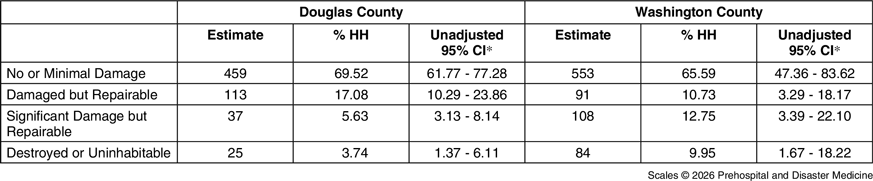
In both Counties, more than 96% of dwellings were single-family households, and most households spoke English as their primary language. More than 30% of households reported damage following the tornado, with nearly 10% of households reporting their homes being destroyed or uninhabitable in Washington County (Table 2).
Household Impacts Following the Arbor Day Tornado in Douglas and Washington County, Nebraska

Note: *95% confidence intervals are around weighted prevalence estimates. Therefore, the width of the 95% confidence intervals has not been adjusted for multiplicity, and they should not be used in place of hypothesis testing.
Mental and Physical Health
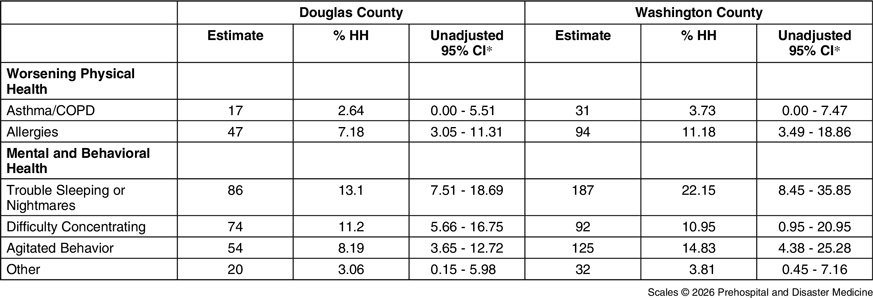
For both Counties, more than 97% of households reported having health insurance coverage for all members. Direct injuries from the tornado and following clean-up activities were limited. Less than 60% of Washington County households reported being up-to-date on tetanus vaccination (95% CI, 46.97 – 70.16%), while 65.4% of Douglas County households were up-to-date on vaccinations (95% CI, 56.5 – 74.4%). The most reported physical health impact following the tornado was exacerbated allergies. Negative mental health impacts were reported for both Washington and Douglas Counties, including trouble sleeping, agitated behavior, and difficulty concentrating (Table 3).
Exacerbated Health Conditions and Mental and Behavioral Health Impacts for Households in Douglas and Washington County, Nebraska, following the Arbor Day Tornado

Note: *95% confidence intervals are around weighted prevalence estimates. Therefore, the width of the 95% confidence intervals has not been adjusted for multiplicity, and they should not be used in place of hypothesis testing.
While nearly all Douglas County households with children reported their children to be in excellent or very good health, there were notable mental health impacts. In Washington County, more than 30% of children felt nervous or afraid following the tornado (Prev: 30.29%; 95% CI, 8.09 – 52.50%). Households also reported children having problems sleeping or experiencing concerns for physical safety and well-being. Mental health effects on children for households with children two-to-17 years of age are shown in Table 4.
Exacerbated Mental and Behavioral Health Impacts for Households with Children in Douglas and Washington County, Nebraska, following the Arbor Day Tornado

Note: *95% confidence intervals are around weighted prevalence estimates. Therefore, the width of the 95% confidence intervals has not been adjusted for multiplicity, and they should not be used in place of hypothesis testing.
Most morbidity and mortality in tornadoes result from crush injuries, fractures, wounds, and subsequent infections or accidents. Reference Bosmans, Baliatsas, Yzermans and Dückers8,Reference Dong, Wang, Deng, Yu, Chen and Zhang10 There were no attributable deaths and/or critical injuries resulting from the Arbor Day tornado, with fewer than five minor injuries captured by the National Weather Service (NWS; Silver Spring, Maryland USA) official damage estimates. 5 The reported exacerbation of allergies in Washington and Douglas County could be attributable to both the time of year in which the tornado occurred and the higher concentrations of aerosolized pollen in the immediate aftermath of storms. Reference D’Amato, Annesi Maesano, Molino, Vitale and D’Amato17 Allergies can also contribute to asthma exacerbations following severe storms, although the mechanisms for “thunderstorm asthma” are not well characterized, especially in rural areas. Reference Smith, MacLehose and Berman18
Reflective of findings throughout literature, negative mental health impacts affected households in both Washington and Douglas Counties. Broadly, extreme weather events – including storms, droughts, floods, wildfires, and extreme temperatures, among others – can contribute to new or exacerbated mental and behavioral health conditions. Reference Cruz, White, Bell and Coventry19,Reference Mishu, Rabbani and Vereeken20 For tornado hazards specifically, a literature review by Lee and First (2022) found elevated levels of posttraumatic stress, depression, and anxiety, with most literature resulting from tornado outbreaks in Joplin, Missouri (USA) and Tuscaloosa, Alabama (USA). Reference Lee and First21 Following 2024 tornadoes in Franklin County, Ohio, households with lower socioeconomic status and that experienced higher levels of tornado impact were more likely to report high levels of stress. 22
The mental health impacts of disasters are of particular concern for children. Reference Felix, Rubens and Hambrick23 Longitudinally, sleep disturbances, irritability, and behavioral changes were common among children who experienced the September 2011 Bastrop wildfire (Texas USA). Reference Kirsch, Feldt, Zane, Haywood, Jones and Horney24 Following tornadoes, displacement, level of destruction, and differential impacts among peers can contribute to stress and anxiety in children. Reference Peterson25 In this study, households in both Washington and Douglas Counties reported anxiety and concerns for safety among children in their households, affecting their behavior and ability to participate in extracurricular activities in the two-months following the tornado.
These findings informed Three Rivers, DCHD, and NWS community outreach, including through K-12 school programs following the Arbor Day tornado and in anticipation of the 2025 tornado season. The K-12 programming allowed students to learn from and ask questions of NWS meteorologists, helping to combat fear with a better understanding of storms and with protective actions to take during storms. Local public health collaborated with community and long-term recovery groups to connect affected households with resources, including mental health support and case management.
This work demonstrated the benefits of academic-practice partnerships. Across both Counties and the NWS, partners noted that time and resources limited their ability to engage as much as they would like with RNAs and field work outside of their duties following a disaster event. Therefore, the UNMC leading logistics and implementation removed resource barriers for practice partners. In Douglas County, there were significant physical accessibility challenges that were able to be managed through utilizing both Douglas County and UNMC resources. Partnership with Three Rivers gave credibility to UNMC teams and improved community buy-in for in-person surveys. Further, Three Rivers is a small department, with limited staffing and significant responsibilities across different public health programmatic areas. The UNMC team was able to support capacity for RNAs that otherwise would have been limited by personnel and resource constraints. Academic-practice partnerships can effectively increase capacity, improve evidence generation and integration of evidence into public health action, and create learning opportunities for both academic and practice partners.
Limitations
There are several important limitations to this study. As with all community-based surveys, the potential exists that the surveyed households are not generalizable to the underlying community. For example, in Washington County, the completion rate was lower than the 80% required. Given the realities on-the-ground, and in consultation with Three Rivers, analyses were weighted as intended. The inclusion of local volunteers on field teams, expert insights from local health departments, completion rates, and weighting mitigated generalizability concerns. However, low completion rates due to logistical concerns, rurality, and inaccessibility should be considered and accounted for in all modified RNAs. Because RNAs are cross-sectional, it is not possible to establish temporal relationships, and therefore causality, between tornado exposure and reported physical and mental health outcomes. This point is particularly salient for allergies, given the tornado outbreak occurred in the springtime when allergies are often exacerbated. Accordingly, prevalence estimates and 95% confidence intervals should not be used for hypothesis testing or causal inference, but rather to illustrate the lived experiences of affected communities at a given point-in-time.
Concluding Considerations
As disasters caused by weather-related hazards become more frequent and severe, post-disaster RNA methodologies must be malleable to account for on-the-ground realities of these changing hazard landscapes. This study shows the utility of academic-practice partnerships for conducting post-disaster RNAs and viable modifications to standard methodological approaches to capture the health impacts of disasters for rural, displaced, inaccessible communities.
Conflicts of interest
The authors declare no conflicts of interest, financial or otherwise.
Supplementary Material
To view supplementary material for this article, please visit https://doi.org/10.1017/S1049023X26108899
Author Contributions
SES and KWK (conceptualization; methodology; validation; formal analysis; investigation; resources; data curation; writing – original draft; writing – review and editing; visualization; supervision; project administration; funding acquisition). RLB (conceptualization; methodology; validation; formal analysis; investigation; resources; data curation; writing – review and editing; project administration; funding acquisition). TU, RB, CK, and JF (conceptualization; validation; investigation; resources; project administration; writing – review and editing).
Use of AI Technology
No artificial intelligence (AI) tools were used in constructing this manuscript.




 Open access

