


13.1 Introduction
Two issues arising from the new high seas regime on marine genetic resources (MGR) may stymie State ratification and impede effective implementation. The MGR regime is the cornerstone of the 2023 High Seas Treaty (UN 2023), formally titled the Agreement under the United Nations Convention on the Law of the Sea on the Conservation and Sustainable Use of Marine Biological Diversity of Areas beyond National Jurisdiction.Footnote 1 On June 19, 2023, a UN conference adopted the Treaty as part of a package of measures to protect biodiversity in areas beyond national jurisdiction (BBNJ). The Treaty is designed to provide access and benefits mainly for MGR to developing States. State parties are required to provide complete transparency for MGR research through an online portal. The principal feature of the Treaty, however, may also pose its most significant challenge to implementation because the required transparency bypasses intellectual property rights (IPRs) and may require the disclosure of biological research that implicates national security.
The regime does not protect IPR at all, thereby reducing incentives for advancing marine science and biotechnology on the high seas. Since advanced States conduct most MGR research, the lack of IPR protection makes the High Seas Treaty less likely to achieve full and energetic implementation. The Treaty also does not exempt specific national security research conducted on the high seas. Developed States are engaged in deep-sea biotechnology research for national defense, and the lack of exemption for most of these activities may weaken their resolve to implement the Treaty. These two issues may undermine the goal of attracting a large number of developed States to join the Treaty, thereby making it successful. Without the most technologically advanced States, the MGR regime will be unable to fulfill its vision of providing access and benefits to developing States.
This chapter proposes that the Conference of the Parties should address these shortcomings. There are two fixes the Conference could undertake once convened to encourage more developed States to join the Treaty. First, the type of access and benefits of MGR that flow to developing States could be formalized and oriented toward monetary contributions for capacity-building and technology transfer, rather than complete disclosure of market-sensitive IPR. The financial contributions may be complemented with in-kind contributions to the Global South, consistent with existing IPR. This approach safeguards IPR to encourage participation while also ensuring that benefits accrue to developing States. Second, the military activities exemption in the Treaty applies to research conducted on the high seas by warships and other public vessels. Yet a substantial amount of biological research at sea is funded through grants from the Office of Naval Research (ONR) and the Defense Advanced Research Projects Agency (DARPA), and carried out by civilian oceanographic vessels. The military activities exemption should be interpreted broadly to include this type of research that is funded by the armed forces, even if it is not conducted on board a warship.
13.2 Marine Genetic Resources
Marine biotechnology is a growing economic sector, with companies investing in new commercial products and medical treatments derived from marine genetics. MGR may be used in commercial, industrial, and manufacturing applications in healthcare, including for treating cancer and understanding the role of inflammation (Leary et al. Reference Leary, Vierros, Hamon, Arico and Monagle2009, 186–187). For example, drugs developed from marine organisms include remdesivir to fight COVID-19 and azidothymidine (AZT), the first approved treatment for HIV (Heffernan Reference Heffernan2022).
The High Seas Treaty defines MGR as “any material of marine plant, animal, microbial or other origin containing functional units of heredity of actual or potential value” (Article 1(8)). This definition does not include genetic material or digital information derived from fish or other living marine resources.
Finding and utilizing MGR requires advanced oceanographic technology and sophisticated integration of marine scientific research and biotechnology. Only the wealthiest States have the industrial base and technological capability to find and exploit MGR and produce digital data – called digital sequence information (DSI) – from them. The Treaty seeks to distribute or “share” access to and benefits of MGR and DSI throughout the world, especially inuring to the benefit of developing States. This goal has both an economic component to help accelerate the development of the Global South and an ethical component of distributive justice to atone for the perception that developed States rose to power through colonialism and the postcolonial exploitation of developing States. The effort to transform the maritime segment of biotechnology, however, skirts over the market incentive for companies to fund MGR and DSI research if they are required to give away their IPR. Furthermore, the unintended consequence of radical transparency on MGR is that marine genetic research related to military and security purposes is placed at risk. In the US, for example, ONR and DARPA fund significant amounts of marine scientific research. Much of this research is open source and unclassified, but with an eye toward military applications. Some research is classified. Under BBNJ, details on the research of these programs must be made globally transparent in a step-by-step fashion, from the initial stages to the research findings, including the sharing of DSI. These requirements imperil national security.
Section 13.3 explores the progressive emergence of the High Seas Treaty and its various key definitions, as well as the Treaty’s structure and various constructive ambiguities. The section discusses the tensions in State views that went into, and resulted in, the Treaty conceptions of MGR and DSI, which must be uploaded to a comprehensive, globally transparent online Clearing House Mechanism (ClHM).
Next, Section 13.4 underscores the remaining and critical problem of IPR by discussing the debate over the status of a treaty that contains no provision on the issue. Without robust IPR protections, the ClHM may reduce investments and risk-taking by the US marine biotechnology industry, perhaps putting jobs at risk and generating less science. The failure of the Treaty to protect IPR weakens American and allied biotechnology industries by compelling them to subsidize the rest of the world through transparency of their research, which will inevitably reduce their competitive posture and the economic prosperity of the States that fund such research. The exact requirements for complete transparency of all MGR damage national security, including homeland defensive biosecurity and biological applications that give US and allied forces an edge in advanced warfare. These shortfalls likely imperil any effort by States with advanced biotechnology sectors to ratify the Treaty. The flaws in the MGR framework mean that the US and its alliance partners are likely unable to comply with the Treaty’s requirements to share their most advanced research without undermining economic prosperity and national security.
Section 13.5 contextualizes the High Seas Treaty by considering the role of MGR research in national security. The ClHM’s laudable goal of transparency appears inconsistent with research and development of MGR for national defense, particularly in biological warfare defense and the application of bioelectrical organisms in undersea warfare. The US and its allies are pursuing this type of research to counter the People’s Republic of China. The Treaty’s provisions on exempting warships from the provisions of MGR are insufficient to cover these defensive equities. The Conference of the Parties, however, would be positioned to adopt an elastic interpretation of the warship exemption that may weaken US preparations for biological attack and biodefenses and would risk exposing military and intelligence research programs aimed at maintaining America’s competitive advantage.
13.3 The High Seas Treaty
The High Seas Treaty emerged from a twenty-year process to progressively develop the law to fill perceived gaps in the United Nations Convention on the Law of the Sea (UNCLOS).Footnote 2 The Convention was innovative in creating the 200-mile exclusive economic zone (EEZ) to bring living and nonliving resources under coastal State management. This solution was designed to address the “tragedy of the commons,” in which resources are overexploited because no single State has control over them (Hardin Reference Hardin1968). Whereas the resources of the EEZ immediately fell under the sovereign rights and jurisdiction of coastal States, it was apparent that ocean governance on the high seas was underdeveloped. While UNCLOS entered into force in 1994, member States were putting the final touches on the 1995 High Seas Fish Stocks Agreement to regulate stocks that moved back and forth between the high seas and a coastal State’s EEZ, or between EEZs.Footnote 3 The 1994 Implementation Agreement on deep-seabed mining was negotiated to amend the provisions on seabed mining in UNCLOS. It was the first implementing agreement under the Convention,Footnote 4 the second being the High Seas Fish Stocks Agreement. Although the High Seas Fish Stocks Agreement has helped bring high-seas fisheries under more effective management, the areas beyond national jurisdiction continue to lack strong protections for resource conservation and international marine environmental law. The High Seas Treaty was designed to address the protection of high-seas biodiversity and to strengthen the weak provisions on marine technology transfer in Part XI of UNCLOS. Along the way, the management of MGR captured the process and became the flagship issue of the negotiations.
The High Seas Treaty is the third implementing agreement under UNCLOS.Footnote 5 Because the formal name is too long to be catchy, the effort was, for most of the past two decades, called “biodiversity beyond national jurisdiction” or “BBNJ.” More recently, some proponents have settled on the name “High Seas Treaty.” While the need to protect high-seas biodiversity is pressing and universally accepted, the provisions on the transfer of marine technology and MGR broadly divide along a Global North–South divide. The wealthy developed States are active in MGR research, and the Global South seeks access and benefits to these new riches of the sea. In a 2018 study of 38 million records of genetic sequences associated with patents, entities located in just three developed States were responsible for more than 74 percent of all the patents related to MGR: Germany (49 percent), the US (13 percent), and Japan (12 percent; Blasiak et al. Reference Blasiak, Jouffray, Wabnitz, Sundström and Österblom2018, 1, 2). Ninety-eight percent of the patents in ocean genetics were registered by entities in just ten States. Hence, the MGR provisions in the Treaty are imbued with a sense of fulfilling postcolonial debts or advancing social justice for the least developed States. The Global South extracted new commitments on MGR and technology from the developed States in exchange for two major parts that support a stronger framework to protect marine biodiversity on the high seas. First, the Treaty contains provisions to advance the use and transparency of environmental impact assessments (EIAs) for activities on the high seas. The provisions on EIAs build upon the weaker requirements already contained in UNCLOS (Articles 204–206). Second, the Treaty provides a process for creating additional marine protected areas on the high seas to provide special protection for designated areas. This process complements existing routes for designating special areas under the various annexes of the Marine Pollution ConventionFootnote 6 and through the adoption process at the International Maritime Organization on particularly sensitive sea areas (IMO 2006, n.d.).
The elements of the High Seas Treaty designed to protect BBNJ gained widespread support. They were of particular interest to the developed States, increasingly concerned with the relationships among ocean health, climate change, and the global biosphere. On the other hand, the developing States focused on obtaining access and benefit-sharing for Western MGR and the transfer of advanced marine technology. In fact, the provisions regulating MGR constitute the core of the new Treaty, as they are the most transformative and impose tangible costs on States that provide access and benefits to other States.
13.3.1 Two Treaties Fused
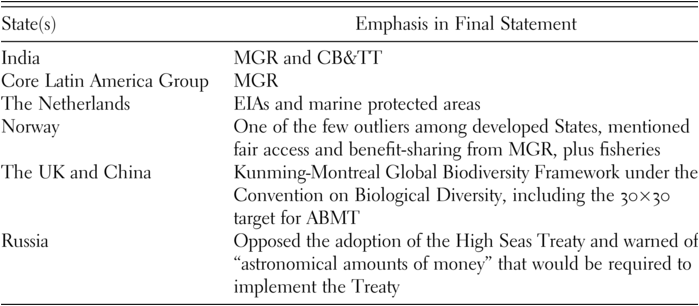
The High Seas Treaty may be thought of as two separate agreements fused. There are four parts to the Treaty. Part II regulates MGR, while Part III regulates marine protected areas, which are referred to as area-based management tools (ABMTs). Part IV addresses EIAs and progressively develops the requirements in UNCLOS for conducting environmental assessments of activities that may adversely affect the marine environment (Articles 204–206). Part V focuses on capacity-building and technology transfer (CB&TT). These four distinct parts reflect two treaties conjoined at birth, with Part III (ABMT) and Part IV (EIAs) providing tangible new protocols to protect the marine environment. Western governments mainly pursued these two parts. Part II (MGR) and Part V (CB&TT) are based on the transfer of advanced maritime biotechnology and marine technology from the developed world to the developing States. These provisions satisfied the Global South.
This division in North–South interests was reflected in the statements of governments upon the adoption of the instrument, when States uniformly stressed either side of this equation. A sample of statements is reflected in Table 13.1.
13.3.2 Constructive Ambiguities
Articles 9–16 of the High Seas Treaty aim to equitably share benefits arising from activities with respect to MGR and DSI for the conservation and sustainable use of BBNJ and to build the scientific and industrial capacity of developing States. Yet, even by the Further Resumed Fifth Session of the Intergovernmental Conference held from February 20 to March 3, 2023, there was little agreement on what this meant. Upon the adoption of the Treaty at the Further Resumed Fifth Session, the delegate from Iceland declared that “nothing has been protected yet, no benefits have been shared” (IISD 2023, 1, 7). Eritrea emphasized that there are “constructive ambiguities” in the Treaty, including on how to meet the 30×30 target for protecting 30 percent of the high seas with marine protected areas by 2030 and how best to ensure the fair and equitable sharing of benefits derived from MGR (IISD 2023, 6). The Russian Federation “lamented that many key issues in the text had not been resolved, including how the creation of a hierarchical structure [will operate alongside] existing, relevant, international organizations,” such as the World Intellectual Property Organization (WIPO; IISD 2023, 3). The Natural Resources Defense Council, speaking for the fifty-one‑member High Seas Alliance, lauded the Treaty as a historic agreement for the millions who depend on the ocean for their survival, but then noted that “now the real work begins” (IISD 2023, 8). Within the excitement that marked the completion of the Treaty, this remark reflects the sentiment that, on the core issues, the Treaty’s completion was really an agreement to keep negotiating at the Conference of the Parties. The hopes for the Treaty are as grand as they are divergent, and no one has a roadmap to reconcile the competing visions. Proponents are invested in future Conferences of the Parties to figure all this out, and it is uncertain whether the aspirations can ever be fully realized.
13.3.3 Marine Genetic Resources and Digital Sequence Information
Determining the legal status of MGR was the most challenging issue in the BBNJ process and the High Seas Treaty. States have competing ideas on how to treat MGR and DSI in areas beyond national jurisdiction. The Treaty states that parties shall be guided by the principle of the common heritage of humankind (Article 7(b)). But the Treaty does not explicitly describe MGR as the common heritage of humankind, although Part II establishes an access and benefit-sharing regime for MGR through a “Clearing-House Mechanism” or internet portal (Articles 9–16). States are required to register their MGR and DSI research and, through the online portal, provide detailed notifications of prospecting and exploration activities and discoveries related to marine genetics (Article 12). These requirements include cataloging physical materials associated with MGR and divulging DSI that would permit another user to reconstruct the genetics (Article 12).Footnote 7
Like UNCLOS, the High Seas Treaty relied on a process of constructive ambiguity to reach agreement on some of its most basic terms through text and definitions that are inherently vague. The Treaty also regulates DSI but does not define that term. There have been years of discussions on what might constitute DSI in other multilateral environmental forums, especially meetings of the Convention on Biological Diversity,Footnote 8 but the term has not been defined through those processes either. A study commissioned by the Conference of the Parties to the Convention on Biological Diversity provided the following range of what data are included in DSI:
Group 1 – Narrow definition consisting of DNA and RNA;
Group 2 – Intermediate definition consisting of DNA, RNA, and proteins;
Group 3 – Intermediate definition consisting of DNA, RNA, proteins, and metabolites; and
Group 4 – Broad definition favored by the G77, which includes DNA, RNA, protein, metabolites, traditional knowledge, and ecological interactions (Houssen et al. Reference Houssen, Sara and Jaspars2020, 32).
There were significant discussions on the issue at the BBNJ intergovernmental conference, although States did not reach consensus. Yet, requirements for the disclosure of DSI repeatedly appear in the High Seas Treaty because developing countries considered open access to the underlying digital data of marine genetic organisms to be as important as access to the physical specimens to fulfil their vision of access and benefit-sharing. Among scientific communities, the term “DSI” is generally considered a policy rather than a scientific term.
The key question in the entire High Seas Treaty is to what extent MGRs are considered the common heritage of humankind subject to a global regulatory scheme, versus freely available resources in the global commons as part of the freedom of the seas. Pursuant to the Treaty, seven entities under the jurisdiction of a party are relevant stakeholders:
1. academic and research institutions, with the Treaty providing a basis for States to exclude the most cutting-edge and consequential MGR and DSI because they support biotechnology industries; furthermore, the US approach to research is through grants to individual scientists who use, store, or transfer organisms collected in BBNJ, generate and/or use DSI on MGR of BBNJ, or engage in sample collection activities in BBNJ (Article 11);
2. businesses that house scientists who use, store, or transfer organisms collected in BBNJ, generate and/or use DSI on MGR of BBNJ, or engage in sample collection activities in BBNJ (Article 11);
3. institutions and businesses that are interested in utilizing traditional knowledge of Indigenous peoples and local communities (Article 13);
4. Indigenous peoples and local communities that may hold relevant traditional knowledge associated with MGR in BBNJ databases, maintained at the national and international levels (Article 13);
5. repositories, including collections (such as natural museums) and gene banks (Article 51(3)(c));
6. countries that ratify the Treaty; and
7. The Conference of the Parties (see, for example, Article 14(1)) and the access and benefit-sharing committee (Article 15) of the Treaty.
All State parties may conduct MGR and DSI activities on the high seas (Article 11(1)). In situ, these activities shall be carried out with due regard for the interests of other States in areas beyond national jurisdiction (Article 11(3)). Parties “shall endeavour to cooperate” through specific modalities, including the ClHM under Article 51 (Article 11(3)). The Group of 77 supported a notification system that applies both pre- and post-cruise to marine scientific research, including research externally funded by ONR or the National Science Foundation. Toward this end, States must take the necessary measures to ensure that information is provided to the ClHM (Article 12(1)). Notification to the ClHM shall be made six months before in situ collection and shall include the nature of the objectives of the collection, the scope of the research, the geographic area covered by the research, and a summary of the scientific methods to be applied (Article 11(2)). The information shall also include a data management plan. Upon notification, the ClHM shall generate a BBNJ “standardized batch identifier” to track the MGR (Article 12(3)). Once the standardized batch identifier is generated, State parties shall provide additional information, including the database where the DSI or MGR are deposited or held, details on the geographic area where they were collected, and updates to the data management plan (Article 12(5)). The batch identifier shall be attached to any utilization of these resources, including commercial applications (Article 12(8)). This includes the use of the standardized batch identifier for publications, granted patents, product development, and product sales. The regulations apply to the utilization of MGR and DSI collected or generated before the High Seas Treaty enters into force.
No State may claim or exercise sovereignty or sovereign rights over MGR in BBNJ, even if the work is done on board a vessel (Article 11(4)). Collection in situ does not constitute a legal basis for any claim over the marine environment or its resources (Article 11(5)). The benefits that flow from the resources “shall be shared in a fair and equitable manner” (Article 14(1)). Benefits may be either monetary or nonmonetary. Parties shall adopt the legislative, administrative, or policy measures to ensure that the MGR and DSI are “deposited in publicly accessible repositories and databases, maintained either nationally or internationally, no later than three years from the start of such utilization, or as soon as they become available” (Article 14(3)).
Monetary benefits shall be shared fairly and equitably through the financial mechanism set forth in Article 52 (Article 14(5)). States shall make annual contributions to the special fund in Article 52, with a party’s contribution constituting 50 percent of the assessed contribution to the budget adopted by the Conference of the Parties (Articles 14(6) and 47(6)). The payments shall be made as milestone payments; payments related to the commercialization of productions; a tiered fee paid periodically; or other forms of monetary payments (Article 14(7)). The structure for actual payments of monetary benefits remains somewhat elusive, and developed States strongly supported the application of nonmonetary benefits.
Nonmonetary benefits appear preferred by the terms of the Treaty. They include access to samples of MGR and DSI, open access to “findable, accessible, interoperable and reusable (FAIR) scientific data in accordance with current international practice and open and responsible data governance,” data associated with the standardized batch identifier in publicly searchable and accessible forms, the transfer of marine technologies in accordance with Part V of the Treaty, capacity-building, and technical cooperation (Article 14(2)). The Treaty established an access and benefit‑sharing committee to develop guidelines and provide transparency for the fair and equitable sharing of monetary and nonmonetary benefits (Article 15(1)). The committee also may make recommendations to the Conference of the Parties (Article 15(3)).
The ClHM is the key component for the monitoring and transparency of activities relating to MGR and DSI (Articles 16(1) and 36(2)). States must submit EIAs to the ClHM promptly when the activity in situ “may cause substantial pollution of or significant and harmful changes to the marine environment” (Article 28(2)). EIAs are published through the ClHM (Article 29(5)). Drafts of EIAs shall be placed on the ClHM and made available for public comment and consultation, which also provides an opportunity for the Scientific and Technical Body to consider and evaluate the report (Article 33(3)). On the other hand, if a party determines that an EIA is not required for the planned activity, it shall provide this determination and supporting information to the ClHM (Article 30(1)(a)(i)).
13.4 The Lingering Problem of IPRs
The High Seas Treaty’s requirements for States to reveal and share MGR encroach on existing national and international IPR by requiring radical transparency of all marine genetic science and technology conducted beyond national jurisdiction (the high seas). The Treaty requires State parties to provide details of MGR and related marine scientific research through an online internet portal, the ClHM, to be shared with the rest of the world under the theory that all humankind has an interest in, and indeed rights to, the data.
Rules to protect IPR never made it into the final text, and the problem was swept under the rug in the final push to get an agreement at any cost. The High Seas Treaty would require the emerging US marine biotechnology industry to share its IPR and trade secrets with the rest of the world. Foreign companies can leverage research and compete in global markets without funding their own programmatic research. The lack of IPR protections alone poses a potentially insurmountable obstacle to developed States becoming parties, but the Treaty has even greater strategic implications for economic and national security. The same provisions in the Treaty that require States to reveal and share MGR through the ClHM weaken the US economy and undermine national security. These provisions reflect a regime complexity that merges the Treaty with IPR treaties, making the entire architecture virtually impenetrable (Blasiak et al. Reference Blasiak, Wynberg, Grorud-Colvert, Thambisetty, Bandarra, Canario, da Silva, Duarte, Jaspars, Rogers, Sink and Wabnitz2020, 588). Literally no one knows how they will interact.
Delegates considered IPR in a draft Article 12, but the provision was cut. It was not included in the Treaty to avoid undermining the objectives of fair and equitable sharing of benefits. Insistence on a strict IPR regime could also undercut the effective implementation of traceability, which is essential to determine where on the high seas the MGR material or DSI originated. Throughout the negotiations, IPRs were regarded as “something of an outcast” (Thambisetty Reference Thambisetty2022, 3). Some States opposed including IPR in the High Seas Treaty, expressing concerns about the risks posed by the fragmentary nature of the obligations, the relationship between patents and territoriality, and the need to disclose the origin of MGR. There was a division between the developed States, which emphasized the incentive function of IPR, and the Global South, which was more interested in IPR’s allocative function as a source of development. The IPR issue was a fulcrum for success or failure, so it was deferred, presumably to be addressed by the Conference of the Parties after entry into force. As explained by Professor Siva Thambisetty:
The central problem in the negotiations is a lack of quid pro quo to heighten the IP elements. On the one hand, the status quo is favourable to those who engage in [marine scientific research] – so there is no political will on their part to change that. On the other hand, keeping existing arrangements on IP, minus mitigating measures, is almost certain to exacerbate the technological gap between developed and developing countries even further, and goes against growing domestic and international policy critiques of such IPR regimes – so accepting the status quo around intellectual property as fait accompli hits at the very need for this instrument. (Thambisetty Reference Thambisetty2022, 3
There are existing models that adopt a flexible approach to IPR that could fulfil the mandate of the High Seas Treaty. These models may be adopted, but would require specially designed provisions to accommodate the Treaty’s unique transparency mechanisms. Developing countries generally have greater latitude under WIPO and the 1995 Agreement on Trade-Related Aspects of Intellectual Property Rights (TRIPS),Footnote 9 administered by the World Trade Organization. TRIPS reflects different IPR standards across socioeconomic levels. It requires States to comply with the provisions of the Paris Convention for the Protection of Industrial PropertyFootnote 10 and the Berne Convention for the Protection of Literary and Artistic Works.Footnote 11 The latter has exceptions for “moral rights,” which permit developing States under certain conditions to limit the right of reproduction (Article 6bis). However, TRIPS explicitly excludes these moral rights exceptions from its member compliance requirements (Article 9(1)).
TRIPS recognizes Special and Differential Treatment (SDT) for developing and least developed countries. These provisions grant longer transition periods, providing more time for developing States to implement TRIPS-compliant laws. For example, least developed countries have an extended deadline for pharmaceutical patents until 2034. TRIPS also allows these countries to tailor their IP laws to their level of development, needs, and capacity to enforce IPR protections. These States may adopt weaker enforcement requirements to prioritize other socioeconomic goals – such as access to education, health, and technology transfer – over strict IPR enforcement. Compulsory licenses may be issued on patented products without the consent of the patent holder, especially in cases of national emergency. Public health exceptions are among the most compelling areas, with fewer IPR restrictions for developing States, and these are likely to be a feature of MGR research. Under the 2001 Doha Declaration on the TRIPS Agreement and Public Health (WTO 2001), developing States may issue compulsory licenses to produce generic versions of patented drugs during a health crisis. The licenses permit the production of more affordable medications to address diseases such as HIV/AIDS, tuberculosis, and malaria. Developing countries are also entitled to parallel importing, which allows them to import protected goods from States where they are sold at lower prices, bypassing restrictive IP rules. Favorable IPR terms may also be adopted in the agricultural sector to provide quick access to seeds and plant varieties. TRIPS includes provisions that encourage developed countries to promote technology transfer to the least developed States (Article 66(2)).
WIPO has assisted developing States in implementing the rules and exceptions to IPR, and we may expect that the High Seas Treaty will offer the same tailored aid, primarily through the ClHM. Since MGRs have potential applications in biotechnology and pharmaceuticals for developing new drugs, enzymes, and bio-based products, the issue of IPR will persist. The key concerns revolve around how States should balance the protection of IPR with the need for fair access to and benefit-sharing from MGR under the new Treaty. The fair and equitable sharing of benefits arising from the use of MGR is the cornerstone of the Treaty. Without the effective implementation of that vision, the Treaty will not succeed. The Global South is particularly focused on this issue, and the implementation of the Treaty hinges on this central goal.
The challenge for BBNJ, however, is how developed States and corporate investors in the developed world can remain incentivized without IPR protections. Unlike TRIPS, which provides special dispensation to developing States and least developed countries, MGR and DSI data under the High Seas Treaty must be uploaded to the ClHM for all States – including competitors in the developed world – to use. The Treaty requires complete transparency in research and development of MGR, including the disclosure of where the resources are collected and how they are being commercialized. This system is designed to ensure accountability in the exploration and exploitation of resources and to drive benefit-sharing.
How may access and benefits flow to developing States while still maintaining a competitive edge against other developed States? The Treaty establishes mechanisms for sharing both monetary and nonmonetary benefits. Monetary benefits include revenues from commercial products derived from MGR, while nonmonetary benefits may include access to research, technology transfer, and capacity-building efforts. Monetary benefits seem to be the easiest way to share the bounty of MGR with the Global South, although developed States seek to grow their own organic research and development enterprise and therefore prefer nonmonetary benefits.
13.4.1 The Nagoya Protocol Model
The Nagoya ProtocolFootnote 12 is a supplementary agreement to the Convention on Biological Diversity, focusing on the fair and equitable sharing of benefits arising from the utilization of genetic resources. It was adopted in 2010 in Nagoya, Japan, and entered into force on October 12, 2014. The Protocol is a key international agreement designed to ensure that countries and communities that provide genetic resources receive a fair share of the benefits from their use, while also promoting biodiversity conservation and sustainable development. The High Seas Treaty draws inspiration from the Nagoya Protocol, which applies to genetic resources within national jurisdictions. The Treaty seeks to extend similar principles to the high seas, ensuring that IPRs do not undermine benefit-sharing obligations. The Protocol promotes the equitable sharing of benefits derived from the use of genetic resources within national jurisdiction, including from plants, animals, and microorganisms. This genetic material has applications in biotechnology, pharmaceuticals, and agriculture. The Protocol operates on the principle that States have sovereign rights over their genetic resources. Researchers or companies can gain access to genetic resources from biodiversity-rich States through prior informed consent and pursuant to negotiated mutually agreed terms. When a company, researcher, or institution uses genetic resources for commercial or noncommercial purposes, the benefits arising from this use must be shared with the State of origin and/or Indigenous communities that provide the resource. Such benefits may be monetary, such as royalties, license fees, or profit-sharing from a commercial product, or nonmonetary, such as technology transfer, research collaboration, and capacity-building.
The High Seas Treaty does not contain provisions on IPR, although the Treaty states that it must not undermine existing international legal regimes. The debate over “not undermining” relevant frameworks and bodies was a recurring theme throughout the negotiation process. The provision on “not undermin[ing]” is included in the Treaty (Article 5). Still, many delegates argue for further clarification and for a standard definition to be agreed upon as implementation begins. One delegate remarked: “The sooner we clarify this notorious ‘not‑undermining provision,’ the better for the Ocean and for all of us” (IISD 2023, 10).
Developed States may seek to preserve their advantage in these areas, and this would require the enforcement of IPR. The lack of protection in this area may make it impossible for many States to join or effectively implement the Treaty. Whether the US becomes a party or not, however, US companies with a presence in the foreign markets of Treaty parties will be subject to the new regime. This reality guided US efforts in the Intergovernmental Conference and will continue to be the major issue for the US, whether it is a party or nonparty to the Treaty.
While sharing marine scientific research knowhow and technology with developing States is an admirable goal, the ClHM may have the opposite effect by reducing investments and risk-taking by the US marine biotechnology industry. Patents and IPR enable the life science industry to engage in the risky process of developing drugs and other products, putting their capital at risk in search of a reward.Footnote 13 The MGR requirements appear to assume that advances in biotechnology on the high seas will be made by scientific consortia or government-funded basic science programs. In such cases, sharing the results of the scientific program is a subsidy to the rest of the world funded by the governments of developed States. If private industry is funding the science, the transfer payment is made by private corporations that, unlike the US government, must realize profits to stay in business, pay their employees, and continue funding research. Forcing these companies to divulge their IP may weaken them, put jobs at risk, and lead to less science.
The idea that States and companies that discover MGR on the high seas have a duty to share their innovations with the developing world gained traction in 2014. The Nagoya Protocol called for the treatment of MGR in a globally transparent manner that would permit access and the sharing of benefits (COP 2010).Footnote 14 The Ad Hoc Open-Ended Informal Working Group held meetings between 2006 and 2015 (UN 2015), and the High Seas Treaty negotiations began in earnest in 2018 (UN n.d.). Normative questions circulated throughout the process, such as what was owed by the developed world to the developing world, whether sharing MGR would benefit the developing world, and whether benefits could be shared at an acceptable cost to induce the developed world to participate. In the end, the North wanted an environmental agreement, and the South wanted marine and biotechnology. The fear of failure drove both sides to sweep aside doubts about the Treaty’s practicality, with IPR being the most obvious casualty. The IPR issue was known but ignored.
The Global South can access and benefit from MGR and marine technologies produced by Western States. The costs of transferring technology to them are borne by Western States and businesses that share (give away) their IP. The provisions are unworkable in a globalized market economy and are inconsistent with the WIPO regime. This conclusion was well known during the negotiations. Still, apparently idealism overcame practicality, and the issue of IPR protections was quietly bypassed. Those chickens have yet to come home to roost. Biosecurity is the next shoe to drop.
13.5 The Unexpected Problem of National Security
The transparency requirements for MGR and DSI in the High Seas Treaty implicate national security research on biological defense and emerging technologies that anticipate the use of biological organisms in naval operations. The Conference of the Parties may address the challenges in this area after entry into force. Adjusting and expanding the interpretation of the exemption for military activities may be required to entice States to implement the Treaty. Biosecurity concerns and the use of marine organisms in naval operations were beyond the negotiators’ imagination, but these security technologies may have profound consequences for the Treaty’s viability. Biosecurity considerations were neglected because the world was in a very different place in the early 2000s, when the BBNJ process began. By 2023, when the final text of the High Seas Treaty was adopted, strategic and economic competition made it more difficult to achieve collective action. Furthermore, the Treaty was always considered an environmental treaty. Hence, the negotiators and experts leading national delegations approached it from that epistemological perspective, rather than focusing on its ramifications for national security.
Two related changes in the international security environment require a reset of the thinking on MGR and require action by the Conference of the Parties before implementation would be widespread and effective among the most developed States. The first is that, unlike in the early 2000s, there is consensus in the US, and increasingly in the West, Japan, Australia, and elsewhere, that China poses a geostrategic threat rather than simply a market competitor. The peace and goodwill of the end of the Cold War have entirely run their course. China has replaced its “peaceful rise” campaign of the early 2000s with new challenges to the international order. The second significant change is the COVID-19 pandemic, which has heightened global sensitivity to biological security and the importance of biotechnology. Neither of these two trends was anticipated when the BBNJ negotiations began twenty years ago. Yet both trends have reset the national security chessboard, making the MGR provisions of the High Seas Treaty more challenging to implement.
The shift in US thinking to consider Beijing not just as a competitor but as an all-spectrum threat began in the last years of the Obama administration and continued through the Biden administration and have accelerated in the second Trump administration.. There is now a bipartisan belief that China is a threat to the rules-based international order. Emerging technology is “the fulcrum of U.S.-China competition” (Strobel Reference Strobel2023). For example, the 2017 US National Security Strategy states:
For decades, U.S. policy was rooted in the belief that support for China’s rise and for its integration into the post-war international order would liberalize China. Contrary to our hopes, China expanded its power at the expense of others’ sovereignty. China gathers and exploits data on an unrivalled scale and spreads features of its authoritarian system, including corruption and the use of surveillance. It is building the most capable and well-funded military in the world, after our own. Its nuclear arsenal is growing and diversifying. Part of China’s military modernization and economic expansion is due to its access to the U.S. innovation economy, including America’s world-class universities.
Lawmakers on both sides of the aisle believe that China is harvesting American technology and innovation, threatening economic and national security (Trump White House 2020). Robert C. O’Brien, Trump’s National Security Advisor, called China a predatory power and the “threat of the century” (Hepher Reference Hepher2020). The Biden administration advanced those same themes. On this issue, the position of the 2022 Biden–Harris National Security Strategy was virtually indistinguishable from that of its predecessor:
The PRC is the only competitor with both the intent to reshape the international order and, increasingly, the economic, diplomatic, military, and technological power to do it. Beijing has ambitions to expand its sphere of influence in the Indo-Pacific and become the world’s leading power. It is using its technological capacity and increasing influence over international institutions to create more permissive conditions for its own authoritarian model, and to mold global technology use and norms to privilege its interests and values. Beijing frequently uses its economic power to coerce countries. It benefits from the openness of the international economy while limiting access to its domestic market, and it seeks to make the world more dependent on the PRC while reducing its own dependence on the world.
The Biden–Harris administration warned that China is the “pacing challenge” (White House 2022, 20, 22). The administration even extended the protectionism of US technology-intensive industries, surprising allies (Duehren and Mackrael Reference Duehren and Mackrael2024). The US CHIPS Act,Footnote 15 a cornerstone of Biden–Harris industrial policy, is a manifestation of this sense of the military risk associated with the technological rivalry with China (Swanson Reference Swanson2022, 15). China swiftly retaliated against the CHIPS Act by restricting the export of gallium and germanium, two minerals used in the technology industry (Areddy and Hua Reference Areddy and Hua2023). After the early 2023 incident of a Chinese spy balloon overflying the US, the Biden–Harris administration used even stronger words, warning that China was a threat to “our sovereignty” (Politi and Fedor Reference Politi and Fedor2023). Like his predecessor, Biden named China the greatest danger to American security, supply chains, and technology partnerships. The US and its allies are engaged in a struggle with authoritarian regimes to maintain the lead in advanced technologies – everything from AI to synthetic biology (Strobel Reference Strobel2023). The backbone of the provisions on MGR, and indeed the entire High Seas Treaty, is the transparency of marine biotechnology, which appears incompatible with US industrial and military security.
While the hallmark of the High Seas Treaty is the ClHM, transparency, shared access, and equitable benefits, the realities of the current world include deglobalization, the internalization of supply chains, and restrictions on sharing emerging technologies, from semiconductors to quantum key communications (White House 2023). Biotechnology is likely to follow the same course as other advanced technologies, such as semiconductor chips, diluting the goals of the ClHM. In short, the ClHM flies against the zeitgeist of the time, which is a product of great-power competition that did not fully manifest until about 2017. The pandemic only reinforced the economic and security trends. These developments cast doubt on the willingness of the most powerful States either to join the Treaty or, if they do, to implement its terms in the comprehensive manner envisioned by the Treaty and the ClHM.
Mindful of the China threat and the risk of another pandemic, the US and its allies are working to internalize research, development, and production of innovative, high-end, value-added technologies to gain greater economic autonomy and national security. While fissures in economic globalization emerged during the first Trump administration, they accelerated more recently, becoming a bipartisan feature of American politics and deepening economic protectionism. The US is not alone in these views. In Europe, these same trends toward economic security contributed to the Brexit movement and accelerated with the war in Ukraine and EU sanctions against Russia (Benson et al. Reference Benson, Steinberg and Alvarez-Aragones2024). Similarly, Japan has awakened to the threat from China. In 2021, Japan and the US singled out China as a threat to the international order in a joint statement (Siripala Reference Siripala2021). The National Security Strategy of Japan states that “China has intensified its attempts to unilaterally change the status quo by force” (NSC Japan 2022). Forming a trifecta, the US, the EU, and Japan are now energized against the technological threat of China, with other allies, especially in East Asia, also viewing China as a threat (European Council 2022; Jozuka and Essig Reference Jozuka and Essig2022; Silver et al. Reference Silver, Huang and Clancy2023).
The US signed the High Seas Treaty on September 20, 2023, stating that it may expand marine-protected areas to protect biodiversity (Blinken Reference Blinken2023). With that signature, the US acquired duties under the Vienna Convention on the Law of Treaties not to act inconsistently with the “object and purpose” of the Treaty.Footnote 16 But the core provisions of the Treaty regulate the discovery and exploitation of MGR. They are not directly related to protecting marine biodiversity, and yet they have significant implications for the US biotechnology sector and national security that are not widely appreciated.
The Treaty will require ONR and DARPA to disclose their programs and discoveries in high-seas biotechnology and share them with potential adversaries. The Department of Defense is studying how these genetic organisms and digital genomics may provide insights into biodefense for homeland security, and how they can be manipulated at the molecular and organism levels to accomplish national security missions, such as aiding the hunt for enemy submarines.Footnote 17 Marine scientific research involving genetic organisms also may be used to strengthen biological warfare defenses, not a trivial consideration in a post-COVID-19 world. Likewise, marine biotechnology has applications for a range of naval activities, from submarine detection to underwater communications.
13.5.1 National Security
Three aspects of national security are put at risk by the High Seas Treaty’s provisions on MGR. First, although the Treaty does have an exemption for military activities, it is narrowly construed. Notably, it would not exempt marine science funded by ONR or DARPA that is conducted by civilian scientists aboard civilian or government oceanographic ships. Second, the Treaty weakens US efforts to understand and prepare for biological attack and to strengthen biodefense by making public research derived from high-seas genetic organisms. Third, the Treaty risks exposing military and intelligence research programs aimed at enhancing the position of US forces in future armed conflicts, such as bioengineered organisms that can help locate enemy submarines or facilitate communication with friendly swarms of autonomous underwater vehicles. These three issues are discussed below.
13.5.1.1 Military Activities Exemption
The High Seas Treaty states: “The obligations in [Part II concerning MGR] shall not apply to a Party’s military activities, including military activities by government vessels and aircraft engaged in non-commercial service” (Article 10(3)). “Military activities” are not defined in the Treaty. Still, past practice suggests that they could include a broad remit for national security research, homeland security, intelligence, and related research and development, such as biotechnology and pharmaceutical research for biological weapons defense and response. Earlier, the Treaty states that it “does not apply to any warship, military aircraft or naval auxiliary” (Article 4). Even so, each party “shall ensure, by the adoption of appropriate measures not impairing the operations or operational capabilities of such vessels or aircraft owned or operated by it, that such vessels or aircraft act in a manner consistent, so far as is reasonable and practicable, with this Agreement” (Article 4). To the extent that the “military activities” are defined broadly, MGR provisions become weaker. The problem, however, is that military activities are exempt only when conducted from a government vessel or aircraft. In contrast, most of the research undertaken by ONR and DARPA is carried out on civilian oceanographic vessels and in university laboratories. Part II (on MGR) applies to “other vessels or aircraft owned or operated by a Party and used, for the time being, only on government non-commercial service” (Article 4). This provision means that other government vessels, such as those operated by the National Oceanic and Atmospheric Administration, are covered by the Treaty.
13.5.1.2 Homeland Biosecurity
The COVID-19 pandemic refocused the US on the need to contend with diffuse biological threats and, indeed, to explore the science behind the terrifying prospect of biological warfare (Healey Reference Healey2022; Lyon Reference Lyon2021). The COVID-19 pandemic, which originated in China in late 2019, has heightened concern about the development of biological warfare agents and reopened dormant biodefense research. The US intelligence community is split on the virus’s origin, with both natural and laboratory-leak theories plausible (BBC 2023; Manson Reference Manson2021). Regardless of its source, the pandemic underscored the vulnerability of global economic prosperity to pathogens, and understanding this threat vector is now a significant concern (Gordon and Forrest Reference Gordon and Forrest2022).
The US Department of Defense has embarked on building expertise in defensive biotechnology. Although research to defend against biological attack is not unlawful and complies with the Biological Weapons Convention,Footnote 18 it stands to reason that some of the technology could be weaponized or used to counter defensive responses if it fell into the wrong hands (Reeves et al. Reference Reeves, Voeneky, Caetano-Anollés, Beck and Boët2018). While pockets and individuals of excellence are sprinkled throughout the Department, as a whole the Pentagon lacks expertise, connections, and investments in life sciences and technology to the same extent as in areas such as computer science and aerospace technologies (Evans Reference Evans2020). It is unlikely that the US will invest heavily in biosciences only to put it all online under the High Seas Treaty’s transparency regime outlined in Part II and the ClHM framework in Article 51. At best, the US might participate through token reporting on a limited number of MGR and DSI initiatives. Furthermore, while the rules for implementing the Treaty may be ironed out in the Conference of the Parties, there is little to lend confidence that the Conference will fare better than the Intergovernmental Conference did in creating greater precision or fidelity in the rules.
13.5.1.3 Naval Biotechnology
Finally, perhaps the most significant challenge to national security posed by the High Seas Treaty is that it would require complete transparency into a variety of marine biogenetic research sponsored by the Navy but conducted from non-warship platforms. The US military is interested in genome sequencing, bioinformatics, genome editing, synthetic biology, new materials, immunology, the microbiome, and neuroscience (Defense Science Board 2020, 1).
DARPA is at the forefront of US biosecurity. A relatively flat organization with six technical program offices, DARPA is focused on homeland defense with programs to strengthen “active bio-surveillance and bio threat countermeasures” (DARPA 2019, 9). The program managers have great autonomy and are empowered to take risks on innovative ideas (Gallo Reference Gallo2021, 4–6). In the context of the High Seas Treaty, DARPA’s Biological Technologies Office is responsible for the “development and use of biotechnology for technological advantage, including neurotechnology, human-machine interface, human performance, infectious disease, and synthetic biology R&D programs” (Gallo Reference Gallo2021, 3).
The US is exploring the use of engineered marine organisms for a variety of tactical roles, including living camouflage, new drugs to help members of the armed forces survive harsh environments, and self-healing paint (Bird et al. Reference Bird, Kundu, Tschirhart, Corts, Su, Gralnick, Ajo-Franklin and Glaven2021). The Department of Defense sponsors a program called Applied Research for the Advancement of Science and Technology Priorities Program on Synthetic Biology for Military Environments (Alia-Novobilski Reference Alia-Novobilski2017). The cross-service program is focused on keeping US advantages in areas such as quantum computing and bioengineering. For example, Naval Research Laboratory scientists are working on electroactive bacteria and miniaturized, potentially high-throughput bioelectrochemical platforms (Yates et al. Reference Yates, Bird, Eddie, Onderko, Voigt and Glaven2021). One program is exploring the development of environmental “chassis” microbes to deliver “robust performance” outside the laboratory (US GAO 2018, 27). Navy scientists are also working on using common marine microorganisms that might be genetically engineered into living tripwires to signal the passage of enemy submarines, underwater vessels, or even divers. Scientists are exploring whether the genetic makeup of an abundant sea organism, such as Marinobacter, can be altered to make it respond to substances left by enemy vessels, divers, or equipment (Tucker Reference Tucker2018). These could be metals, fuel exhaust, human DNA, or some molecule not naturally found in the ocean but associated with diesel-powered submarines (Tucker Reference Tucker2018). The reaction could take the form of electron loss, which could be detectable to friendly submarine drones or prepositioned equipment on the seabed (Tucker Reference Tucker2018). Naval Research Laboratory researcher Sarah Glaven said at an event at the Johns Hopkins University’s Applied Physics Lab: “In an engineered context, we might take the ability of the microbes to give up electrons, then use [those electrons] to talk to something like an autonomous vehicle. Then you can start imagining that you can create an electrical signal when the bacteria encounter some molecule in their environment” (Tucker Reference Tucker2018).
13.6 Conclusion
From the beginning of the negotiations, the US and many developed States were somewhat circumspect about the lack of IPR protections in the High Seas Treaty, much as they had been skeptical of Part XI on deep-seabed mining in UNCLOS until the Implementation Agreement was adopted in 1994. In that case, UNCLOS received its sixtieth instrument of ratification on November 16, 1993, and was set to enter into force on November 16, 1994 (Article 308). Yet Iceland (June 1, 1985) was the only developed State to have ratified UNCLOS. Australia (October 5, 1994) and Germany (October 14, 1994) joined only after the implementing agreement had addressed the interests of the developed States. We are at a similar crossroads with the High Seas Treaty, at which developed States may be deterred from joining or fully implementing it because of weaknesses in the IPR regime and the narrowly drawn warship exemption.
The US asserted:
We do not interpret anything in this Agreement as authorizing or permitting any waiver or undermining of existing intellectual property rights and obligations under international or national law; requiring mandatory disclosure of trade secrets, protected undisclosed or confidential information; requiring mandatory disclosure in patent applications of the origin or source of marine genetic resources; or requiring compulsory licenses.
It is unclear under what conditions the US Senate would render advice and consent for presidential ratification of the High Seas Treaty, given the inability to accede to UNCLOS itself. If the US becomes a party to the new treaty, it will have to adopt implementing legislation applicable to US companies to enable them to participate in the access and benefit-sharing regime. It appears unlikely that the US and other developed States can paper over the conflict between the Treaty and the global framework for the protection of IPR or accept the risks to bio-naval research and development once they become manifest. As with the original Part XI, applicable to deep-seabed mining in 1982, the number of ratifications is key to the Treaty’s entry into force, but the quality is equally important. If major actors in high-seas activities – such as the US, Japan, and Germany – do not join the High Seas Treaty because of concerns over IPR and national security, its effectiveness will be severely compromised.

 Open access