

Introduction
Garlic (Allium sativum L. 2n = 16) is an important species belonging to the Allium genus of the Alliaceae family, and widely cultivated worldwide. It is the second most widely distributed and important species after onion (Kamenetsky et al., Reference Kamenetsky, Khassanov, Rabinowitch, Auger and Kik2007; Gurpree et al., Reference Gurpree, Hitesh, Vikas and Parmjit2013). Asia is the centre of origin and the primary area of production, with China and India as the major producers (Haiping et al., Reference Haiping, Xixiang, Di, Yang and Jiangping2014). Garlic is used as a spice, flavouring agent, and has medicinal properties against plant, animal and human diseases (Dugan et al., Reference Dugan, Hellier and Lupien2011; Kamkar et al., Reference Kamkar, Koocheki, Mahallati, Teixeira da Silva, Moghaddam and Kafi2011; Haiping et al., Reference Haiping, Xixiang, Di, Yang and Jiangping2014).
In Ethiopia, garlic is a widely cultivated bulb crop with a wide range of climatic and soil adaptation (Zeleke and Derso, Reference Zeleke and Derso2015). It is produced by small and commercial growers for various purposes, such as herbal medicine and flavouring traditional cuisines, and serving as a source of income for many smallholders. However, the quality and yield of garlic in Ethiopia are generally low due to biotic and abiotic stresses and management practices under field and storage conditions (Tabor and Zelleke, Reference Tabor and Zelleke2000; Shiferaw, Reference Shiferaw2016). Garlic is cultivated on 18,345 hectares of land, and 152.5 thousand tons of yields were harvested in the rainy season, with Arsi and East Shewa zones of Oromia region being the major producers (CSA, 2018). More than 37 thousand farmers were involved in garlic production in these two zones alone (CSA, 2018).
Despite being reproduced asexually, garlic cultivars showed inconsistent yield performance, and phenotypic traits across various locations (Bradley et al., Reference Bradley, Rieger and Collins1996; Islam et al., Reference Islam, Islam, Tania, Saha, Alam and Hasan2004; Baghalian et al., Reference Baghalian, Ali, Reza, Hassanali and Ahmad2005; Haiping et al., Reference Haiping, Xixiang, Di, Yang and Jiangping2014; Yeshiwas et al., Reference Yeshiwas, Negash, Walle, Gelaye, Melke and Yissa2018; Getahun and Getaneh, Reference Getahun and Getaneh2019; Atinafu et al., Reference Atinafu, Tewlolede, Asfaw, Tabor, Mengistu and Fekadu2021; Tesfaye, Reference Tesfaye2021). Evaluation of diversity in garlic is therefore important for selection and breeding purposes to improve yield and quality (Baghalian et al., Reference Baghalian, Ali, Reza, Hassanali and Ahmad2005; Haiping et al., Reference Haiping, Xixiang, Di, Yang and Jiangping2014).
An effective improvement programme in garlic, often based on clonal selection, depends on the availability of sufficient genetic variability in a collection (Gurpree et al., Reference Gurpree, Hitesh, Vikas and Parmjit2013; Kumar et al., Reference Kumar, Sharma, Kumar, Sirohi, Chaudhary, Sharma, Saripalli, Naresh, Yadav and Sharma2019). In Ethiopia, various diversity studies involving germplasm collection, characterization, and evaluation have resulted in the release of eight improved varieties (EAA, 2021). However, the shortage of high yielding and stable varieties remains a major constraint for the low productivity and production of garlic in the country (Belay et al., Reference Belay, Tekle and Chernet2020). To address this issue, it is crucial to select high yielding and stable genotypes under variable environments prior to release, which is the primary step for plant breeding. However, little has been reported on genotype by environment interaction (G × E) and stability analyses in garlic in Ethiopia, which are vital for breeders to rank genotypes and/or ideal environments for selection. Therefore, the present study assessed the performance of advanced garlic genotypes for different traits and tested their stability in variable environments for bulb yield.
Materials and methods
Experimental materials
The study evaluated thirteen promising garlic genotypes and one check variety, namely G-018/03, G-020/03, G-001/03, G-021/03, G-011/03, G-005/03, G-041/03, G-061/03, G-054/03, G-053/03, G-009/03, G-058/03, G-019/03 and Kuriftu (check variety). These genotypes were primarily collected from different parts of Ethiopia and selected for their bulb yield potential and desirable characteristics from previous evaluations. The study was conducted in six environments of three locations over two years, representing mid and high altitudes with different soil types and rainfall patterns in central and southeast Ethiopia during the main cropping seasons of 2018 and 2019 (Table 1).
Summary of site descriptions for the three testing locations in Ethiopia

Experimental design and agronomic practices
The genotypes were arranged in a field experiment using a Randomized Complete Block Design (RCBD) with three replications. Sprouted cloves from each genotype were planted on a plot size of 4.8 m2 with a spacing of 40 cm between double rows, 20 cm between rows and 10 cm between plants. Fertilizers were applied at the rate of 243 kg ha-1 NPS during planting and 130 kg ha-1 urea in split application once during planting and 45 days after emergence. Pesticides, including Tilt (0.5 l ha−1), Karate (0.3 l ha−1) and Ridomil Gold (2.5 Kg ha−1), were uniformly sprayed on all experimental plots to manage garlic rust, onion thrips and downy mildew, respectively. Other agronomic practices, including cultivation and weeding, were applied as recommended (Tabor et al., Reference Tabor, Yousuf, Derso and Damte2019).
Data analysis
Plant height (cm), days to maturity, number of cloves per bulb, average clove weight (g), bulb yield per plant (g) and per hectare (kg ha−1) were recorded. The collected data were subjected to analysis of variance (ANOVA) using SAS statistical software (SAS, 2008). When the ANOVA indicated a statistically significant difference (P < 0.05), the least significant difference (LSD) test was used to compare treatment means. Additionally, Additive Main Effects and Multiplicative Interaction (AMMI), genotype-by-environment interaction (G × E) and GGE biplot analyses were performed using the GGEBiplotGUI package in R to evaluate the test environments and genotypes for bulb yield stability (R Team, 2018).
Results
Significant differences (P < 0.05) in bulb yield were obtained among the garlic genotypes and their combinations, except at Debre Zeit in 2018 (Table 2). Individual ANOVA revealed that genotype G-020/03 (4778.29 kg ha−1), followed by G-005/03 (3526.09 kg ha−1), had the highest bulb yield at Debre Zeit, while G-001/03 (3297.25 kg ha−1) recorded the lowest yield. At Chefe Donsa, genotype G-009/03 (6196.90 kg ha−1), followed by G-001/03 (5251.82 kg ha−1), produced the highest bulb yield, while G-058/03 (3467.38 kg ha−1) had the lowest yield (Table 2). Similarly, at Kulumsa, G-054/03 (11,041.90 kg ha−1) and G-020/03 (10,694.55 kg ha−1) gave the highest bulb yield, while G-011/03 (2013.70 kg ha−1) gave the lowest yield. The combined ANOVA showed that G-020/03 and G-054/03 had the highest bulb yield over locations and years.
Mean of bulb yield and combined mean (kg/ha) of the 13 promising garlic genotypes evaluated over three locations in two years main cropping season

Means followed by the same letter within a column are not significantly different at 5% level of probability CV, coefficient of variation; LSD, least significant different; NS, non-significant.
In addition to bulb yield, significant variation among the genotypes was obtained for different traits such as plant height, date of maturity, number of cloves per bulb and bulb yield per plant (Table 3). However, a statistically non-significant result was obtained for average clove weight (Table 3). Genotypes G-054/03 (61.35 cm) and G-020/03 (60.42 cm) had the maximum plant height and were also relatively late in maturity. Genotype G-019/03 was the shortest in plant height (56.33 cm) and had a similar date of maturity with other genotypes. Genotype G-009/03 had the highest bulb yield per plant (21.35 g), while the check variety-Kuriftu had the lowest (15.16 g). The average number of cloves/bulb among the genotypes varied in the range of 10.71 to 14.44. Furthermore, the combined mean bulb yield of the genotypes over locations and years was statistically significant (P < 0.05) and ranged from 3829.6 kg ha−1 (G-011/03) to 6576.2 kg ha−1 (G-020/03) (Table 2). Based on the results obtained on bulb yield performance, G-020/03 and G-054/03 had a 25.39% and 18.89% yield advantage over the standard check variety-Kuriftu, respectively (Table 2). Furthermore, the yield performance of the genotypes varied highly between the locations and years owing to the significant effect of genotype by environment interaction (P < 0.05) (Table 4). The majority of the variability (81.4%) among the tested genotypes in bulb yield was explained by the first principal component (PCA 1), which was also statistically significant (P < 0.05). This variation in yield was evidenced by the results of the overall combined analysis, which showed differences in mean yield performances among the testing locations, with the highest obtained from Kulumsa followed by Chefe Donsa and Debre Zeit, respectively (Tables 2 & 3).
Mean of yield related traits for promising garlic genotypes for three locations in 2019

Means followed by the same letter within a column are not significantly different at 5% level of probability CV, coefficient of variation; LSD, least significant different; NS, non significant, plant height, date of maturity, number of cloves per bulb, weight of clove and bulb yield per plant. PH, plant height; DM, dry matter; NCB, number of cloves per bulb; WC, weight of clove; BYPP, bulb yield per plant.
Analysis of variance of main effects and multiple interactions for bulb yield of garlic genotypes

PCA, principal component analysis, *, **, and *** denote significant effects at p < 0.05, p < 0.01 and p < 0.001 respectively.
In addition to ANOVA, the GGE biplot analysis ranked the genotypes for bulb yield performance, with G-020/03 ranking first followed by G-054/03, while G-011/03 ranked last (Fig. 1-left). This analysis also showed the stability of the genotypes for bulb yield across the six environments, with G-020/03 showing better stability in the majority of the environments, while G-011/03 was the least stable genotype. Although G-054/03 was the second high yielder, it was found to be unstable in the majority of the environments, but showed specific stability at Kulumsa than the rest of the genotypes. Furthermore, the GGE biplot analysis identified three winning genotypes (G-009/03, G-020/03 and G-054/03), among which the two high yielders were situated on the vertex of the polygon (Fig. 1-right). G-020/03 did well in the majority of the environments, while the second high yielder (G-054/03) did well only at KU-19.
GGE biplots ranking garlic genotypes based on bulb yield performance in the six environments DZ 18, DZ 19, CD 18, CD 19, KU 18 and KU 19 (left) and the which-won-where view of the GGE biplot depicting the winning genotypes on the vertex of the polygon(right).

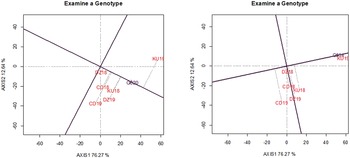
The analysis identified that the majority of the environments (DZ-18, DZ-19, CD-18, CD-19 and KU-18) were ideal for genotype G-020/03, while KU19 was ideal only for G-054/03. The two high-yielder genotypes were further examined in the GGE biplots, which showed their relative stability in the six environments. G-020/03 (Fig. 2-left) was closer to the five environments (DZ-18, DZ-19, CD-18, CD-19 and KU-18), which depicted its wider stability and adaptability, while G-054/03 (Fig. 2-right) was closer to KU-19 than any of the environments, affirming its specific stability and adaptation.
GGE biplots examining each of two selected garlic genotypes: G-020/03 (left) and G-054/03 (right) in relation to the seven environments (DZ 18, DZ19, CD 18, CD 19, KU18 and KU19).

Discussion
The results of the current study revealed significant variability in bulb yield and bulb-related traits among garlic genotypes, influenced by genetic factors and environmental conditions. Nevertheless high yield difference between the two testing years (2018 and 2019) for each genotype across the environments was experienced due to the difference in weather conditions, particularly the availability and distribution of rainfall. The improved rainfall conditions in 2019 likely created a more favourable environment for garlic cultivation, leading to higher yields compared to 2018.
Genotype by environment interaction plays a crucial role, necessitating the evaluation of genotypes across diverse environments to identify those with stable and high yield potential. Developing garlic cultivars with broad adaptation and stable performance is essential for enhancing productivity and profitability. Variability in bulb yield and bulb-related traits among garlic genotypes has been widely reported in numerous studies conducted in Ethiopia and other countries. For instance, Ayalew et al. (Reference Ayalew, Tadesse, GebreMedhin and Fantaw2015) and Getahun and Getaneh (Reference Getahun and Getaneh2019) observed significant variations in the performance of garlic cultivars from different locations in Gonder, Northern Ethiopia. Similarly, Belay et al. (Reference Belay, Tekle and Chernet2020) found substantial differences in bulb yield and yield-related traits among garlic genotypes across different locations, indicating the influence of both genetic and environmental factors. These findings align with the study by Bezu et al. (Reference Bezu, Gedamu, Dechassa and Hailu2014), which demonstrated the effects of environmental factors on the performance of garlic genotypes.
Furthermore, the influence of various factors, such as cultivar, location, soil type, agricultural methods and harvest date, on garlic yield and quality has been extensively documented. Raslan et al. (Reference Raslan, AbouZid, Abdallah and Hifnawy2015) emphasized the significant impact of these factors on garlic production outcomes. Studies conducted in India, such as Gurpree et al. (Reference Gurpree, Hitesh, Vikas and Parmjit2013) and Nandini et al. (Reference Nandini, Umamaheswarappa, Srinivasa, Abhishek, Sindhu and Lavanya2018), also reported geographically diverse garlic genotypes exhibiting variations in bulb and bulb-related traits, including yield ranges of 2180 to 6290 kg ha−1 (Islam et al., Reference Islam, Islam, Tania, Saha, Alam and Hasan2004), 551.3 to 1402.7 kg ha−1 (Aslam et al., Reference Aslam, Dudi, Pandav and Rana2016) and 2003 to 7328 kg ha−1 (Atinafu et al., Reference Atinafu, Tewlolede, Asfaw, Tabor, Mengistu and Fekadu2021). Additionally, Verma and Thakre (Reference Verma and Thakre2018) highlighted the influence of different agro-climatic conditions on the growth and quality of garlic varieties.
In Ethiopia, similar studies have identified significant variation in agro-morphological traits among evaluated garlic genotypes. For instance, Atinafu et al. (Reference Atinafu, Tewlolede, Asfaw, Tabor, Mengistu and Fekadu2021) observed variations in plant height, maturity and average clove weight, while Yeshiwas et al. (Reference Yeshiwas, Negash, Walle, Gelaye, Melke and Yissa2018) and Teshale and Tekeste (Reference Teshale and Tekeste2021) reported differences in plant height, maturity and bulb yield per plant. These findings highlight the genetic diversity present within garlic genotypes and the potential for selecting superior varieties with desirable traits.
Moreover, studies conducted in Ethiopia, such as those by Bezu et al. (Reference Bezu, Gedamu, Dechassa and Hailu2014) and Belay et al. (Reference Belay, Tekle and Chernet2020), demonstrated the influence of genotype by environment interaction on garlic performance. This interaction effect can complicate breeding programmes aimed at yield enhancement, leading to inconsistent genotype performance across different environments. To overcome this challenge, it is crucial to evaluate genotypes under diverse environmental conditions and select those with stable and high yield potential across locations and years. This approach, as suggested by Singh et al. (Reference Singh, Bubey and Gupta2016) and Belay et al. (Reference Belay, Tekle and Chernet2020), allows for the development of garlic cultivars adapted to various agro-ecologies, ultimately improving productivity and profitability in the garlic industry.
In conclusion, the studies reviewed in this discussion highlight the significant variability in bulb yield and bulb-related traits among garlic genotypes, both within Ethiopia and in other countries. The influence of genetic factors, environmental conditions, and their interaction necessitates the evaluation of genotypes across diverse environments to identify those with stable and high yield potential. Such evaluations are critical for developing improved garlic varieties that can thrive in different agro-ecologies, contributing to enhanced productivity and profitability in garlic production.
In summary, a study was conducted to evaluate the performance of thirteen garlic genotypes and one check variety for bulb yield and different morphological traits in six environments in central and southeast Ethiopia. The genotypes differed significantly for bulb yield and morphological traits, except for average clove weight. Two genotypes (G-020/03 and G-054/03) showed the highest bulb yield and had significant yield advantages over Kuriftu. AMMI analysis also resulted in significant results of genotype, environment and genotype × environment interactions for bulb yield. G-020/03 showed better stability in most of the environments tested, while G-054/03 had specific adaptability and stability. GGE biplot analysis identified three winning genotypes, among which only G-20/03 and G-054/03 were identified as promising genotypes for yield performance and relative stability. Therefore, G-020/03 and G-054/03 were selected as candidate varieties for release in the central and southeast garlic growing areas of Ethiopia. The study highlights the importance of evaluating the performance of genotypes under different environments and selecting those with stable and high yield potential across locations and years for developing new varieties that are adapted to different agro-ecologies, contributing to improving the productivity and profitability of the garlic industry.
Acknowledgements
The authors acknowledge the Ethiopian Institute of Agricultural Research for financing the study, which made this research possible. The authors also extend their special thanks to the researchers, technical assistants and field workers of the Debre Zeit and Kulumsa Agricultural Research Centers for managing the field experiments and collecting data. Their contributions were invaluable to the success of this study.



 Open access

