


Introduction
Increasing demand for urgent care services continues to challenge western health-care provision (Lega and Mengoni, Reference Lega and Mengoni2008; Scott et al., Reference Scott, Batal, Majeres, Adams, Dale and Mehler2009; Hughes et al., Reference Hughes, Volans, Higginson, Brayley and Benger2011). In the United Kingdom, it is commonly assumed that up to 60% of patients attending emergency departments (EDs) are non-urgent (Audit Commission, 2001; Ya'ish et al., Reference Ya'ish, Bitar and Sherriff2007); more recent figures using a standardised definition indicate that between 10% and 30% of cases could be classified as primary care (Carson et al., Reference Carson, Clay and Stern2010). In response, the United Kingdom has seen an expansion of unscheduled local care services including the introduction of general practitioner (GP)-led polyclinics/primary care resource centre (Department of Health, 2007a; 2007b), extended GP hours and implementation of urgent care centres (Department of Health, 2008; NHS, 2010;). Recent research indicates that two-thirds of EDs in England have primary care services operating within or alongside them (Carson et al., Reference Carson, Clay and Stern2010).
Expansion in service provision has been accompanied by an expanded workforce and primary care skill mix. Legislative changes in 2005 now permit qualified, independent and supplementary prescribers to write prescriptions using the full range of drugs available in the British National Formulary, depending on local policies, enabling autonomous non-medical practitioners to see, treat and discharge attendees at these services. The number of advanced health practitioner-led services is increasing and include services provided by physiotherapists, emergency care practitioners and pharmacists (Department of Health, 2009). Expanding the role of nurses and allied health professionals within an expanded primary care service creates opportunities to increase service capacity in response to increasing patient demand.
The policy literature indicates a lack of consensus about the future role and function of EDs. Both the British Association for Accident and Emergency Medicine and the Department of Health (British Association of Emergency Medicine, 1998; Department of Health, 2006) have advocated meeting increasing demand by applying a tighter definition of core activity to EDs in order to limit attendances and to ensure access to urgent care facilities, which reflect the severity of the presenting case and the level of care required. A similar distinction is made by Coleman and Nicholl (Reference Coleman and Nicholl2010) who used a consensus survey of experts to identify a comprehensive set of indicators to monitor the performance of systems of emergency and urgent care. The performance indicators identified focused predominantly on life-threatening events requiring specialist emergency interventions.
In contrast, the expansion of the role of the pharmacist, the introduction of primary care practitioners in EDs (Freeman et al., Reference Freeman, Meakin, Lawrenson, Leydon and Craig1999) and the introduction of walk-in centres (WiCs) and of GP services in or alongside EDs provide an expanded primary care role for EDs, which increasingly blurs the distinction between primary care and acute emergency medicine. This problem was recognised by Salisbury et al. (Reference Salisbury, Chalder, Manku-Scott, Nicholas, Deave, Noble, Pope, Moore, Coast, Anderson, Weiss, Grant and Sharp2002), who highlighted the importance of developing a coherent vision of what each service (WiC, GPs, pharmacists and EDs) offers and how the services fit together.
More recent policy directives advocate a whole system approach to emergency care provision in which the patient and their journey through the system become the focus for service delivery, rather than a more traditional service-centred approach, which focuses on defining the role and function of individual departments (Bell et al., Reference Bell, McNaney and Jones2006; Department of Health, 2007a; Mason and Snooks, Reference Mason and Snooks2010). Currently, there is a paucity of evidence available to support service re-configurations and re-design (Fisher et al., Reference Fisher, Salman and Cooke2010). In order to encourage service re-design, commissions are moving from block contracts to payment by results; however, indicators to measure results from urgent care are under-developed and are more likely to measure activity than results and this can give rise to perverse incentives (Carson et al., Reference Carson, Clay and Stern2010; Hughes et al., Reference Hughes, Volans, Higginson, Brayley and Benger2011). More recently, the 4-h waiting time standard for EDs has been replaced with a range of clinical quality indicators (Department of Health, 2010a) and with a more decentralised approach to the provision of primary and urgent care facilities introduced, enabling local commissioners to design services for local populations.
As well as routine data on patient utilisation of services, understanding the patients’ experience of urgent care and the choices made by patients is a necessary pre-requisite to service re-design. Expanded primary and urgent care provision leads to increasing complexity with patients expressing confusion as to which service to use and the need to negotiate access to the most appropriate service for their health-care problem (O'Cathain et al., Reference O'Cathain, Coleman and Nicholl2008; Salisbury and Coulter, Reference Salisbury and Coulter2010).
The study reported here builds on a pilot study (Bickerton et al., Reference Bickerton, Coats, Dewan, Procter and Allan2005) that aimed to see whether National Health Service (NHS) staff, using only the information available at initial presentation, could identify specific groups of patients who received treatment in ED, but who might have been more appropriately directed to a WiC. The pilot study found that experienced health-care professionals had difficulty in classifying patients on the basis of the information available at first presentation. However, as there was as much disagreement between the WiC staff as between the ED and WiC staff, it is unlikely that a lack of clarity about departmental function was the root cause. The pilot study was limited as a convenience sample of patients was used. The study presented here is designed to build on the pilot study and to incorporate information about patients’ decisions to use EDs or WiC services in order to better understand the behaviour of both patients and health-care professionals in response to non-critical use of urgent care facilities.
Aim of the study
This study aimed to identify the appropriate service provider for a sample of patients attending EDs and WiCs in North East London and to match this to local service provision and patient choice.
Objectives
-
• To conduct a survey of patients attending ED and WiCs to identify why they chose to use this service.
-
• To identify the level of agreement between NHS primary care staff on the appropriate service (ED, WiC, GP, pharmacist) to treat a random sample of patients attending ED and WiCs in North East London.
-
• To establish how many of the patients identified as more appropriately treated in primary care actually have recorded access to a GP locally.
This article focuses specifically on emergency and urgent care services for attendees in North East London and considers patient perceptions of need and service provision and professional agreement on the appropriate service using only the complaint presented by the patient upon arrival in the emergency or urgent service.
Methods
The research methods included a randomised user survey and a retrospective analysis of case notes. Validation and interpretation of the case note analysis were achieved by group discussion and interpretation of specific cases by clinical experts.
User survey
All non-critical users over the age of 16 years attending one of the five sites during 12 days staggered at each of the sites during March, May and July 2006 were asked by the receptionists to complete an anonymous questionnaire while waiting for treatment and to return it in a post box located by the reception desk. The questionnaire was piloted before the main study in one of the WiCs. The questionnaire was anonymous to encourage participation. The participants were asked demographic details, whether they considered their problem an emergency as well as questions around previous treatment. Questions were related to registration with a GP and why they were attending the urgent service as well as whom they expected to see and their expected outcome. User symptoms were coded and categorised and up to four symptoms were recorded for each person. Patients were excluded from the study if they came in an ambulance and/or if the staff advised us not to approach them.
Data collection was staggered to enable members of the research team to attend the data collection sites. Members of the team were present during peak hours and the team ensured that researcher support was available at least once during all opening times for each centre. Research staff supported both the clinical staff and patients in facilitating recruitment of patients and were requested in helping patients complete the questionnaire. At each site, arrangements were made for interpreters working at the site to alert non-English-speaking patients to the study and/or to use the language translation service. Arrangements were made for the questionnaire to be interpreted verbatim by the language translation service if a non-English-speaking patient wanted to complete the questionnaire. However, although a number of patients did not speak English, most were accompanied by a friend or relative who was able to translate for them and help to complete the questionnaire.
Randomised retrospective analysis of case notes
The dates of the survey were used to identify a randomised retrospective sample of patients who attended the Department during the survey period. The presenting symptoms as recorded in the users’ case notes were anonymised by the NHS staff and passed onto the research team, along with a range of demographic information about each patient sampled. The following information was made available from the case notes of each patient sampled:
-
• details of current complaint
-
• past medical history
-
• medications
-
• recent history of current complaint.
A spreadsheet with a drop-down menu listing was used independently by a GP, a nurse consultant and a community pharmacist (CP) with WiC and ED experience to identify the most appropriate service to meet each user's needs on the basis of the information provided. These choices included the following:
-
• suitable for ED
-
• suitable for GP
-
• suitable for CP
-
• suitable for WiC
-
• suitable for other NHS facility (eg, district nursing service, family planning clinic)
-
• suitable for other non-NHS facility (eg, social work referral, social care, housing).
Their choices were later compared using general descriptive statistics on the basis of Altman (Reference Altman1996).
Sample
The study was conducted in the area served by three inner city boroughs in North East London. All three areas have deprived, multi-ethnic populations that are younger than the national average, and there are high rates of migration into and out of these areas. The relevant services in three inner city boroughs of North East London agreed to take part in the study, which included two WiCs and their adjacent EDs as well as a primary urgent care centre (PUCC) based in an ED. Approval was given to undertake this study by the local NHS research ethics committee.
The sample size for the retrospective analysis of case notes was based on the calculation for inter-observer agreement (Donner, Reference Donner1998). A sample of 200 patients from each of the three participating sites (600 total) was required to detect an average kappa level of agreement of 0.42 on the basis of the pilot study (Bickerton et al., Reference Bickerton, Coats, Dewan, Procter and Allan2005) and the findings from a study of previous professional comparisons (O'Cathain et al., Reference O'Cathain, Webber, Nicholl, Munro and Knowles2003) with 90% power and 5% significance. This assumes that there is an agreed proportion of necessary attendances triaged to ED by each person of 62% (on the basis of average sensitivity; O'Cathain et al., Reference O'Cathain, Webber, Nicholl, Munro and Knowles2003).
Validation of case note analysis
The results of the retrospective analysis of patient case notes were validated by open discussion among a group of clinical experts including the assessors, nurses and pharmacists from the primary care trusts (PCTs), WiCs and EDs involved in the study. The findings were presented and cases selected about which there was total agreement, total disagreement and mixed agreement between the assessors as to which service the patient should attend. Discussants were invited to make their own suggestions for the right destination for these patients, and to explore possible reasons why assessors had made different decisions. The results of the studies are presented in detail in a report (Procter et al., Reference Procter, Bickerton, Allan, Davies, Davies and Abbott2009) and are summarised below.
Results
Results of patient survey
The demographic results are based on 1145 completed patient questionnaires of which 398 were from WiCs, 420 from the ED and 327 from the combined PUCC. It should be noted that there are missing data from incomplete questionnaires and it is difficult to determine the scope of the missing data and how these impact on the value of the overall data. It is not known what proportion of those eligible to participate in the survey did so.
The mean age of participants was 35.5 years (SD 16.1) for women and 36.2 years (SD 15.5) for men with a mean difference of 0.7 years (95% CI −1.26, 2.74). Women (55.6%) tended to use the services more than men (44.4%) and the use of services was dependent on age (χ 6 2 = 13.117, P = 0.041). In the WiCs, 9% of attendees were above the age of 55 years, whereas in the ED and PUCC 14% were above the age of 55 years. People aged 34 years or less were more likely to use WiCs (65.3%) than ED (55.2%).
The results identify younger rather than older people using the services as a whole with ages ranging from 16 to 100 years with a mean age of 35.6 years (SD 15.5) whose ethnicity was broadly similar to that of the general population. People attended the services for a variety reasons but accidental injuries was the most frequent reason, followed by head, eye, ear, nose and throat problems (HEENT), then abdominal and musculoskeletal problems. These are illustrated below in Table 1.
Presenting complaint

HEENT = Head, eye, ear, nose and throat.
Service users were more likely to identify their complaint as an emergency in ED (χ 2 2 = 30.782, P < 0.001), suggesting that patients do discriminate to a certain extent between services, with significantly more females (74%) considering their problem an emergency than males (66%; χ 1 2 = 6.740, P = 0.009) and with significantly fewer white people considering their problem to be an emergency than those from other ethnicities (χ 6 2 = 101.006, P < 0.001; Table 2).
Ethnicity by problem (whether an emergency or not)

The majority of WiC and mixed services people went because they were unable to obtain an emergency GP appointment but the majority of those who attended A&E services lived in the area. A substantial proportion either lived in the area of the service or hoped to be seen more quickly by that service (see Figure 1).
Reasons for choice by service type

The vast majority of all attendees were GP registered with significantly more females (462/535, 86%) than males (334/426, 78%; χ 1 2 = 10.543, P < 0.001) being registered. Significantly fewer 16–34-year olds were registered with GP (521/662, 79%) than the older age groups (35–54 years: 88%; 55–74 years: 91%; 75+ years: 100%; χ 3 2 = 26.359, P < 0.001) with WiC attendees more likely to be unregistered.
Of the 189 unregistered users, 141 (74.6%) were aged between 16 and 34 years and gave a wide range of reasons for not being registered such as it not being relevant, visiting from abroad, not knowing how to register, in the process of registering and ‘rarely fall sick’. Of the 189 unregistered users, only 23 (12.2%) said that they could not find a GP. ‘White’ (78% registered) and ‘other ethnic group’ (76% registered) were least likely to be registered with a GP and Bangladeshi (93% registered) were most likely to be registered (χ 10 2 = 28.568, P < 0.001).
Thirty five percent of the respondents had experienced their symptoms for less than 24 h, 33% had symptoms for up to a week and the remainder had a health problem that was ongoing for upward of six months. Approximately 7% had had their problem for more than six months. Of the 410 ED health users, 17% presented with symptoms of less than 24 h duration and a larger proportion of health consumers who defined their problem as an emergency attended ED (41.6% compared with 31.1% for WiC and with 27.3% for ED and PUCC).
Of the 1095 patients who answered the question, 779 thought their problem an emergency; of these, 41.7% (283/779) were already being treated for the problem and there were large differences (Table 3) in those that were already being treated and the service type. Significantly more people who were already being treated attended either the PUCC or ED than the WiC service (χ 2 2 = 16.173, P < 0.001). However, there were no significant differences between the services and how long ago it had been since they consulted about their problem (χ 6 2 = 9.512, P = 0.147).
Patients already being treated by health-care professionals by service

PUCC = primary urgent care centre; ED = emergency department; WiC = walk-in center.
Of the 360 patients who had already seen a health-care professional about their problem and answered the question on length of time since they saw a professional, 29.7% (107/360) had seen the professional within the last 24 h, 31.1% (112/360) had consulted within the last week, 16.1% (58/360) had consulted within the last month and 23.1% (83/360) had consulted within the last six months. This indicates that most people (60.8%) had consulted another health service between 24 h and a week before attendance.
Although the WiC and the PUCC is a nurse-led centre over half of the respondents expected to see a doctor whereas only a quarter expected to see a nurse. For those attendees who answered the question, more expected a prescription in the WiC than in ED. In all the services, 27.3% of attendees were seeking advice and reassurance as shown in Table 4.
Expected outcome of service use

ED = emergency department; WiC = walk-in centre; PUCC = primary urgent care centre.
Results from the retrospective analysis of presenting information
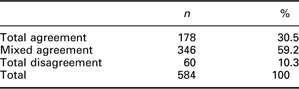
The results of the retrospective analysis support the earlier study (Bickerton et al., Reference Bickerton, Coats, Dewan, Procter and Allan2005) where no statistically significant agreement was found between clinicians on which was the appropriate service for the patient. In this study, there was total agreement on the service required in 30.5% of cases (178), mixed agreement by two assessors out of three for 59.2% of cases (346) and total disagreement for 10.3% of cases (60). This is illustrated in Table 5 and showed that there was only a fair kappa level of service agreement between clinicians for streaming attendees.
Agreement by the three assessors
Results of the validation exercise
The purpose of the validation exercise was to present and discuss the results of the study as a whole, and in particular to explore why the retrospective analysis of presenting information had showed a lack of consensus in many cases. All members of the research team were invited to attend this meeting but the meeting ultimately lacked representation from general practice due to unforeseen circumstances. The discussion led to the articulation of criteria for streaming decisions that might have led to the lack of consensus among clinicians. Factors included were as follows:
-
• the type of local services and what they offered
-
• the risks to health of delay
-
• availability of and access to services
-
• the knowledge and skills of staff at different services
-
• the equipment available at different services
-
• the convenience for health consumers.
This was at times difficult to discuss because of the limited information available. Discussants tried to infer risk from the duration of the episode and the severity of signs and symptoms, but the latter would be much clearer in real life when the clinician was talking with the patient. What was recorded in the notes was minimal. Some disagreements arose from different interpretations of this brief information, and may be regarded as an artefact of the exercise rather than evidence of actual differences between assessors and/or discussants. Nevertheless, there were instances when even the information available led discussants to different conclusions; for example, in the case of a man aged 28 years who presented with headache and nausea for a month and also reported a migraine and a cough (case 77), one view was that he was young and had had symptoms for some time, so the case was not urgent and he should be seen by a GP; another, that the migraine gave cause for concern, so a WiC consultation would be better because he would be seen more quickly. The discussants speculated on the reasons why one assessor had streamed him to ED, and thought this was probably to ensure that all the investigations likely to be relevant could be carried out straight away. Only one example exists where a 35-year-old male presenting with dizziness, vomiting, headache, neck pain and blurred vision where discussants agreed that an assessor's judgment was simply wrong and he should not be sent to a WiC but to ED.
Discussion
This study was conducted by reviewing presenting information rather than on consultation diagnosis and outcome. This approach better replicates the decision making that both patients and clinicians use when assessing an urgent care health problem presentation and is considered a better primary care streaming indicator for redirection. However, even with this prospective rather than retrospective approach, the results of this study continue to support earlier studies (Coleman et al., Reference Coleman, Irons and Nicholl2001), which estimated that as many as 55% of the service users being seen in the ED could be successfully treated in primary care. Chalder et al. (Reference Chalder, Montgomery, Hollinghurst, Cooke, Munro, Lattimer, Sharp and Salisbury2007) also found that users preferred to attend an ED even though the WiC attendees were likely to be as well satisfied with their care overall and were even better satisfied with specific aspects of care, including the consultation. Chalder et al. was included in a worldwide systematic review, which found that overall 20–40% of adult users were inappropriate attendees to ED (Carret et al., Reference Carret, Fassa and Domingues2009). The review found similar reasons to this study for attendance such as limited primary care access with longer waiting periods and suggested that it was important to develop health services away from ED that better met the needs of these inappropriate attendees.
In this study across six health-care trusts in the North East of London, the majority of health service users perceived their health problem as an emergency and this was particularly true of younger users attending EDs. In a survey carried out in 2005, access continues to be an issue for patients and the public who are seeking fast access to reliable health advice (Coulter, Reference Coulter2005). Over 40% of respondents were attending the services because they had been unable to obtain either a convenient or an emergency appointment with their general practice. This observation was also echoed by the validation group as a reason for attending WiCs, even though the problem maybe more appropriately treated in primary care. Perceived poor access to patients’ GPs is still an issue reported in some of the North East London PCTs (Department of Health, 2007c). If the urgent care services had not been available, one-fifth of the attendees would have gone back to their GPs, although a slightly lesser number were at a loss as to what to do.
Of the attendees who saw their problem as an emergency, nearly half were already being treated for the problem. Although measuring something slightly different, this finding is similar to the findings of Maheswaran et al. (Reference Maheswaran, Pearson, Jiwa, Maheswaran, Pearson and Jiwa2009) who found that 39% of all attenders at WiCs were repeat attenders at the WiC being studied. The results of this study suggest that more understanding is required of why patients choose to access services in order to better understand the impact on patient behaviour of expansion in service provision.
More than 50% of health-care consumers who attended urgent care services were not seeing another health professional for their problem. Approximately one-third of respondents came with a problem less than 24 h old, while nearly a further third had had their problem for up to a week.
The attendees top health presentations included accidental injuries, HEENT, abdominal and musculoskeletal complaints that may or may not have been identified by a health professional as an emergency. Health consumers appear to be self-selecting appropriately to either WiC or ED services in that they were more likely to have had their problem less than 24 h in ED, and from between one and seven days at the WiC.
The ethnic mix of service users is similar to that of the general population in North East London, although fewer white people in one borough and Bangladeshi people in another borough responded to the survey than the general population ethnicity of the respective boroughs would predict. Ethnic minorities are more likely than the white population to consider their health complaint to be an emergency and to attend ED rather than the WiC.
The fact that only approximately a third of cases were agreed upon by the professionals for streaming to primary care shows the discrepancies between professions and service perceptions. Ultimately, this was thought to be due to local service knowledge and personal clinical experience. Hence for example, patients, with their agreement, might be referred directly to Moorfields ED with an eye complaint that required expert care rather than to a consultant at the local hospital.
All three practitioners identified the majority of the patients as suitable for a WiC, with the ED as the next most frequent; however, they provided no agreement on individual cases. The best agreement was for ‘other NHS’, which included streaming to an NHS service such as dental, mental health and physiotherapy and there tended to be consensus with streaming to the ED, perhaps as the complaints required specific treatments such as a blood transfusion, to see gynaecologist/obstetrician or the surgeons.
Limitations of the study
There may be some inherent respondent bias in the findings in that it is based on the responses of those who chose to complete the questionnaire rather than those who chose not to. Analysis of the questionnaire data was complex as for some questions respondents gave more than one answer and some questions were dependent on answers to previous questions. Respondents did not always answer both questions. The information available to clinicians who analysed the research data to decide the appropriate health-care treatment centre was limited to the written record of presenting symptoms, which in some cases was minimal and no visual information was available, which might have indicated the severity of the condition. Lack of visual information in the case note analysis created difficulties in categorising individuals to services and may have contributed to the difficulties in achieving a consensus on the appropriate service. The GP was unable to attend the validation exercise and to explain his interpretation of the cases.
Conclusion
WiCs and PUCCs were introduced to address a number of policy issues including increasing patient choice, enabling easy access to primary care for people away from home, enabling GPs to meet the 48-h appointment target and EDs the 4-h waiting target. Previous research (Chalder et al., Reference Chalder, Montgomery, Hollinghurst, Cooke, Munro, Lattimer, Sharp and Salisbury2007; Maheswaran et al., Reference Maheswaran, Pearson, Munro, Jiwa, Cambell and Nicholl2007; Salisbury et al., Reference Salisbury, Hollinghurst, Montgomery, Cooke, Munro, Sharp and Chalder2007) all highlight the limited extent to which WiCs and PUCCs have been able to achieve these policy aspirations. This study highlights the complexity embedded in decision making at a micro level when developing referral processes and criteria for services not just for professionals but also for health consumers (Coulter, Reference Coulter2005). The study noted that professional choices were made on the basis of knowledge of local services available alongside personal clinical experience of these services as much as professional assessment of severity.
The national evaluation of WiCs (Salisbury et al., Reference Salisbury, Chalder, Manku-Scott, Nicholas, Deave, Noble, Pope, Moore, Coast, Anderson, Weiss, Grant and Sharp2002) highlighted the importance of developing a coherent vision of what each service (WiC, GPs, pharmacists and ED) offers and how services fit together. However, this coherent vision contrasts with more recent policy, which is concerned to find local solutions to local situations and to tolerate diversity in provision and access, focusing instead on promoting patient choice and equity in patient outcomes rather than process targets (Department of Health, 2010b). Our study indicates the importance of local knowledge in influencing both patient and practitioner decision making at a micro level. The study also identifies that urgent primary care services provide both patient choice and the opportunity for a second opinion, which is a patient's right and that patients were choosing to exercise this right through EDs, WICs and PUCCs. However, the underlying rationale for this choice requires further exploration in order to gain greater understanding of the links between expanded and diversified urgent care provision and patient outcomes.
The most recent policy development emphasises patient choice and consumer demand as a key consideration in service re-design (Department of Health, 2010b). Expanded urgent care provision has given rise to plurality of services, which is useful for providing service users with a range of alternative access points but can cause duplication of services and repeat attendance for the same problem. Maheswaran et al. (Reference Maheswaran, Pearson, Jiwa, Maheswaran, Pearson and Jiwa2009) found that the organisation and management of WiCs, as well as population demographics and density, account for variation in service use by repeat attenders. The movement away from process targets, such as the 4-h waiting time for EDs or the 48-h appointment time for GPs, to patient outcomes requires greater clarity about the links between patient choice and behaviour at a local level and the subsequent outcomes from care. Managing the continued increase in emergency and unscheduled care continues to be a challenge and if it is to be overcome the uncertainties in prospective decision making demonstrated in this study need to inform service development and delivery. Streaming patients to appropriate primary care facilities requires patients as well as practitioners to be able to make informed choices. The findings from this study indicate that primary care services need to be better informed about patient flows in order to develop more robust and informed demand management strategies, while maintaining patient satisfaction with access to services.
Acknowledgements
We thank Teresa Allan who provided all the statistical analysis and the substantive writing for the report from which this article summarises.
We also thank all those who participated in the collection of the data used in the original report, particularly Andrew Frazer, Sharon Germain, Toni Lynch, Patricia Nasskau, Ambi Nijjar, Gary Wych, Vinod Dewan, Tejas Khatau, Afia Khatun Ali, Susie Hannah, Samantha Joseph, Jean Lyon, Nunu Miah and other staff at the six trusts where the research was carried out.



