


1. Introduction
How do people assess macroeconomic developments and form expectations? To the extent that views about current and future developments influence decision-making, macroeconomic outcomes themselves should depend on agents’ perceptions. Expectations cause and propagate macroeconomic shocks and have been identified as a major driving force of business cycle dynamics (Milani, Reference Milani2010; Eusepi and Preston, Reference Eusepi and Preston2011; Lorenzoni, Reference Lorenzoni2009). A class of shocks in which expectations may play a particularly important role is uncertainty shocks. Uncertainty shocks can be seen as demand shocks and their transmission is traditionally linked to real frictions and wait-and-see mechanisms on decisions of firms that make agents reluctant to take consumption, investment, and hiring decisions that are costly to reverse or are even irreversible (Bloom, Reference Bloom2009; Bloom et al. Reference Bloom, Floetotto, Jaimovich, Saporta-Eksten and Terry2018; Leduc and Liu, Reference Leduc and Liu2016). In addition, precautionary savings may arise from uncertainty and reduce consumption (Basu and Bundick, Reference Basu and Bundick2017; Fernández- Villaverde et al. Reference Fernández-Villaverde, Guerrón-Quintana, Kuester and Rubio-Ramírez2015). As both the influence of real frictions and precautionary motives depend on the assessment of future macroeconomic outcomes, expectations are at the heart of the transmission mechanism of uncertainty. In particular, professionals′ expectations should take future macroeconomic developments into account and typically act as a leading indicator for household expectations (Carroll, Reference Carroll2003). Moreover, expectations should also reflect further factors such as institutional characteristics and macroeconomic policies.
In this paper, we scrutinize how global uncertainty shocks affect expectations over domestic macroeconomic developments based on survey data of professionals. This is a useful setup to study the transmission of uncertainty through expectations. Empirical evidence suggests uncertainty is largely driven by international factors, with country-specific dynamics playing a secondary role.Footnote 1 In addition, adjustments of expectations in the aftermath of an uncertainty shock can amplify shocks on domestic variables and generate spillovers to domestic uncertainty.
A further interesting aspect of our focus on global uncertainty is the question of whether the expected macroeconomic response to a global uncertainty shock depends on specific factors. Theory suggests that choices policymakers make and face in an open economy should matter for the expected effect of uncertainty shocks. The response of policy-related variables such as exchange rates and interest rates is decisive for the capacity to dampen or absorb shocks and affects the sensitivity to global developments. The open economy trade-offs policymakers face are reflected by the so-called impossible trinity, which states that monetary independence, exchange rate stability, and financial openness cannot be achieved simultaneously (Aizenman et al. Reference Aizenman, Chinn and Ito2013). A country that gives up monetary independence to fix the exchange rate loses the interest rate as a policy tool but might, for example, be able to import credibility via an anchor currency. Economies that pursue exchange rate stability and financial openness are more closely tied to the global financial cycle, and the capacity of domestic independent monetary policy to absorb shocks is restricted when domestic capital markets are open to cross-border transactions (Obstfeld et al. Reference Obstfeld, Shambaugh and Taylor2005; Aizenman and Ito, Reference Aizenman and Ito2014).Footnote 2
Specifically, we contribute to the literature by analyzing the effects of global uncertainty on professional expectations and disagreement among forecasters for 33 countries and several variables based on survey data. Survey measures are widely used as a proxy for expectations since they have been found to provide good forecasts and insights into the expectation-building mechanisms of individuals.Footnote 3 We adopt data for expectations among professionals given the availability across countries and their potential relevance as a leading indicator. We focus on two key questions. In the first stage, we analyze whether and how global uncertainty shocks are transmitted through expectations by assessing how they are interpreted by forecasters. We compare the response of expectations with the corresponding dynamics of realized variables and forecast errors. In the second stage, we allow for nonlinearities in the responses of the survey measures to shed light on the question of whether the response of professional forecasters to uncertainty shocks depends on policy choices in an open economy.
To evaluate the effectiveness of open economy policy choices and the impossible trinity in the transmission of uncertainty, we study the role of monetary independence, exchange-rate stability, and financial integration; that is, we study how expectations respond to shocks in uncertainty conditional on where respondents’ home countries are located in the impossible trinity of international economics based on the measure of Aizenman et al. (Reference Aizenman, Chinn and Ito2013). The intuition is that exchange rate and monetary policy as well as financial openness should affect the expected resilience vis-à-vis uncertainty shocks. In a similar vein, the overall interpretation of uncertainty shocks and the response of disagreement may be dependent on the prevailing policy regime.
We assess expectations from two perspectives. We adopt the mean of all forecasters to evaluate whether global uncertainty affects the average perception about future developments and use the standard deviation as a disagreement to assess whether global uncertainty affects domestic uncertainty. We evaluate the response to global uncertainty for several macroeconomic variables related to expectations about the business cycle and prices (GDP and inflation), the domestic policy stance (short-term interest rates), and the link to the international economy (exchange rates. We use an international dataset from Consensus Economics. These cross-country survey data allow us to study the role of country characteristics of the respondents’ home countries in the updating.
To be able to evaluate the effects of uncertainty on expectations, our proxy for uncertainty should be predetermined with respect to expectations, while at the same time, it should capture the key dynamics of global uncertainty. We adopt two uncertainty proxies that match both criteria. We start by analyzing how survey respondents revise expectations in response to surges in economic uncertainty (EU) as measured by the approach of Piffer and Podstawski (Reference Piffer and Podstawski2018). Second, we consider the widely used economic policy uncertainty (EPU) approach by Davis (Reference Davis2016) as a robustness test.Footnote 4 The two measures are not highly correlated since they represent different dimensions of uncertainty. We believe that these two measures are complementary since one reflects the uncertainty of global economic policy while the other reflects unusual movements of macroeconomic and financial market variables at the global scale. To evaluate the effects of uncertainty on expectations and disagreement, we estimate dynamic responses of expectations in the local projection framework Jordà (Reference Jordà2005), controlling also for the macroeconomic environment in the form of domestic macroeconomic variables and the international business cycle as measured by the monthly global conditions indicator by Baumeister et al. (Reference Baumeister, Korobilis and Lee2022).
Our empirical exercise reveals a number of intriguing patterns. We establish evidence that uncertainty shocks exert significant and adverse effects on expectations across the board and frequently spill over to disagreement regarding domestic macroeconomic variables. Overall, respondents interpret uncertainty shocks consistent with aggregate demand shocks. We also show that they tend to overestimate the effects of uncertainty shocks and exhibit systematic forecast errors. To the extent that expectations feature into the transmission of uncertainty shocks through second-round effects, this overreaction may amplify the transmission of uncertainty shocks to macroeconomic variables. As firms′ investment and hiring decisions are based on expectations, systematic forecast errors may lead to suboptimal decisions and allocation of resources (see, e.g., Bachmann and Elstner, Reference Bachmann and Elstner2015), reenforcing any direct effects of uncertainty on macroeconomic outcomes.
Our findings also illustrate that policy choices affect the expected persistence of GDP effects. We identify a nonlinear relationship between policy choices and the response to global uncertainty shocks as both the expected response of monetary policy and the path of the exchange rate strongly depend on the policy regime.
Policy choices also have significant effects on disagreement and consequently affect the propagation of domestic uncertainty shocks into global uncertainty. Forecasters disagree more about the future path of interest rates and inflation but less about future GDP under high monetary policy independence and lower exchange rate stability.
The next section provides a literature review, while Section 3 introduces our dataset. Section 4 presents our empirical model, and Section 5 discusses the results. Section 6 concludes.
2. Literature review
Our study relates to several strands of the literature: the measurement and the effects of uncertainty, spillovers in uncertainty, determinants of expectations and disagreement, and literature on the impossible trinity of international economics. The following section summarizes some main results and findings from the related literature.
Uncertainty is an amorphous and broad concept that is difficult to capture empirically (Bloom, Reference Bloom2014). It reflects uncertainty in the minds of economic agents about the future developments in various social, political, and economic domains. It is thus not surprising that numerous measures have been proposed (see the survey by Castelnuovo (Reference Castelnuovo2019) for an overview). Measurement typically relies on survey-based indicators, forecast errors, newspaper articles, and second moments. Survey-based measures often capture the forecast error variance, disagreement, or a combination of both (Lahiri and Sheng, Reference Lahiri and Sheng2010; Bachmann et al. Reference Bachmann, Elstner and Sims2013; Ozturk and Sheng, Reference Ozturk and Sheng2018)). Similarly, econometric models can be used to estimate uncertainty based on forecast errors (Jurado et al. Reference Jurado, Ludvigson and Ng2015; Ludvigson et al. Reference Ludvigson, Ma and Ng2021). Newspaper-based uncertainty has become increasingly popular. The EPU measures by Baker et al. (Reference Baker, Bloom and Davis2016) have, for example, been extended to US monetary policy uncertainty by (Husted et al. Reference Husted, Rogers and Sun2017). Extensions include uncertainty measures with endogenously determined word terminologies (Larsen et al. Reference Larsen, Thorsrud and Zhulanova2019) and Google-based uncertainty (Castelnuovo and Tran, Reference Castelnuovo and Tran2017). Finally, a strand of literature views uncertainty as a second-moment phenomenon (Gächter et al. Reference Gächter, Geiger and Stöckl2020; Bloom, Reference Bloom2009). The negative effects of uncertainty on investment and economic activity have been widely established in the literature.
In this paper, we seek to study the transmission of global uncertainty to expectations over domestic macroeconomic developments. Thus, the uncertainty proxy should be global in nature and largely predetermined with respect to country-specific macroeconomic expectations.
Our main results are based on the measure by Piffer and Podstawski (Reference Piffer and Podstawski2018), which uses gold as an external instrument to identify the impact of uncertainty shocks in a structural vector autoregressive model. This measure is particularly useful given that exogeneity is explicitly captured through high frequency identification exploiting commodity prices. As an alternative, we adopt the EPU measure by Davis (Reference Davis2016), a global economic policy uncertainty (GEPU) index that summarizes the Baker et al. (Reference Baker, Bloom and Davis2016) measure of EPU on the global scale. The GEPU index is a GDP-weighted average of national EPU indices for 16 countries that account for two-thirds of global output. Each national EPU index reflects the relative frequency of newspaper articles in the respective country that contain terms pertaining to the economy, uncertainty, and policy-related matters. Given that we want to measure the effect of global uncertainty on expectations, we rule out measures based on survey data such as the one discussed by Ozturk and Sheng (Reference Ozturk and Sheng2018) since this would result in an ex ante relationship between global uncertainty and expectations.
The recent literature has also turned to the measurement and international transmission of uncertainty shocks. The key questions are whether and how common uncertainty across countries can be identified and whether the arising effects differ across countries. Spillovers and effects of global uncertainty have been established by several studies without accounting for expectations. Caggiano et al. (Reference Caggiano, Castelnuovo and Figueres2020) and Biljanovska et al. (Reference Biljanovska, Grigoli and Hengge2017) consider EPU spillovers from the United States to Canada and the United Kingdom and between Europe, China, and the United States, respectively, and show that policy uncertainty is transmitted across countries. A common finding in the literature is that global uncertainty is more important than domestic uncertainty. Berger and Grabert (Reference Berger and Grabert2018) disentangle domestic and foreign output uncertainty based on a factor model for the G-7 countries and establish a similar finding based on estimates of country-specific uncertainty. Ozturk and Sheng (Reference Ozturk and Sheng2018) estimate country-specific and global uncertainty based on survey data for over 40 economies and find that global uncertainty shocks lead to persistent negative responses in real economic activity, while idiosyncratic uncertainty does not result in significant effects. Istrefi and Mouabbi (Reference Istrefi and Mouabbi2018) focus on interest rate uncertainty based on survey data and also identify strong effects on GDP, inflation, and unemployment. Lahiri and Zhao (Reference Lahiri and Zhao2019) also establish the importance of global GDP growth uncertainty based on Consensus Economics data from 1995 to 2017 and identify regional differences with regard to the transmission of uncertainty shocks between the G7 and Asia/Pacific economies. It is important to highlight that these studies based on Consensus Economics data focus on constructing global or domestic uncertainty based on survey data, while we assess the effect of other global uncertainty measures on expectations. Both views are complementary in the sense that the effect of global uncertainty on domestic disagreement also reflects an effect on domestic uncertainty.
The factors that we take into account when studying the transmission of global uncertainty are basic policy choices in open macroeconomic models. Specifically, we look at the role of monetary independence, exchange-rate stability, and financial integration, that is, the impossible trinity. The impossible trinity reflects the implications of the Mundell–Fleming model and implies that the three policy goals in open economies are closely related but only two of them can be achieved at the same time (Mundell, Reference Mundell1963). This strict distinction does not fully capture how these policies are implemented in reality. A central bank can be formally independent despite being heavily influenced by the government, or an exchange rate regime can be classified as freely floating in a situation where the central bank intervenes in the foreign exchange market. This results in intermediate solutions, for example, that a central bank is not completely independent or that the exchange rate is not completely fixed.Footnote 5
Market participants who make forecasts should be concerned about the actual path of monetary and exchange rate policy. We thus rely on the measures by Aizenman et al. (Reference Aizenman, Chinn and Ito2010, Reference Aizenman, Chinn and Ito2013) that provide continuous measures for the three dimensions of the impossible trinity. EX reflects the annual standard deviations of the monthly exchange rate (restricted by a threshold), MON reflects the reciprocal of the annual correlation between the monthly interest rates of the corresponding country and the base country. Hence, EX and MON reflect statistical relationships and not official policy arrangements. OP is based on restrictions on cross-border financial transactions as reported in the IMF’s Annual Report on Exchange Arrangements and Exchange Restrictions. The continuous nature of these measures makes them attractive since they enable us to disentangle potentially different regimes. Recent evidence shows, for example, that differences in the international transmission of business cycles can be explained based on the exchange rate regime and capital account restrictions according to these measures (Kim and Pyun, Reference Kim and Pyun2018). Using an index that measures the relative policy divergence from the trilemma, Aizenman and Ito (Reference Aizenman and Ito2014) also show that such divergences can affect the probability of experiencing a currency or debt crisis, the policy response, and the output loss.
Finally, our study is also related to the literature which focuses on the forecasting behavior of agents. Their response to uncertainty shocks is highly relevant for the propagation of these shocks to the economy. Recent work by Coibion and Gorodnichenko (Reference Coibion and Gorodnichenko2012, Reference Coibion and Gorodnichenko2015) assesses the importance of information rigidities and the resulting response to shocks in the context of noisy and sticky information models. The latter case assumes that (some) forecasters remain inattentive with a certain probability due to the costs of information acquisition. By contrast, forecasters facing noisy information fully update their information set, but the variables they forecast contain noisy information. Disagreement increases after a shock in a sticky information model. Andrade and Le Bihan (Reference Andrade and Le Bihan2013) show that noisy-information models can also generate disagreement among forecasters who revise since every one of them has specific information due to the heterogeneous signals on the true state they receive. Their results also show that disagreement is positively related to shocks that hit the economy. These considerations can be useful when interpreting the response to expectations, although we do not distinguish between the two kinds of models explicitly.
3. Data
3.1 Survey data
All survey data are obtained from Consensus Economics. For each country, Consensus Economics Inc. collects forecasts from a large survey of professional forecasters. The participants include government agencies, established international banks, consulting agencies, and research institutions. The fact that the names of each forecaster is published increases the incentive to provide accurate forecasts since implausible numbers could harm the reputation of a forecaster. Forecasts are provided at a given data at the beginning of each month.
We use monthly data for 33 countries: Australia, Brazil, Canada, China, Columbia, Chile, Czech Republic, France, Germany, Hong Kong, India, Indonesia, Italy, Japan, South Korea, Malaysia, Mexico, New Zealand, Norway, Peru, Thailand, Singapore, Spain, Sweden, Switzerland, Turkey, Hungary, Russia, the United States, and the United Kingdom. The dataset for Latin American countries starts in August 2002, data for Eastern European countries start in January 2008, while the dataset for the remaining countries starts in November 1995. The sample period for all regressions ends in December 2020. We analyze expectation and forecaster disagreement for our variables: real GDP growth, the inflation rate, short-term interest rates, and exchange rates. An increase in the expected exchange rate reflects a domestic depreciation against the dollar. With the exception of exchange rates, disagreement is proxied by the standard deviation across forecasters. For exchange rates, we use the absolute difference between the highest and lowest forecast as a measure of disagreement due to data availability. A similar measure was used by Cavusoglu and Neveu (Reference Cavusoglu and Neveu2015).
Forecasts for interest rates and exchange rates are fixed horizon forecasts. Interest rate forecasts are available for 3- and 12-month forecasting horizons, while exchange rate forecasts are available for 1-, 3-, 12-, and 24-month forecasting horizons. The forecasts provided by Consensus Economics for GDP and inflation are fixed event forecasts. That is, the professionals are asked the value of each for a specific year. We use the popular approach introduced by Patton and Timmermann (Reference Patton and Timmermann2010) for transforming fixed events into fixed horizon forecasts. The idea is to use a weighted average of fixed event forecasts for the current and following year with the weight on the former (latter) decreasing (increasing) as time evolves:
 \begin{equation} \hat{g}_{t,t-12}=w\hat{g}_{1,0}+(1-w)\hat{g}_{2,1}, \end{equation}
where $\hat{g}_{t,t-12}$
denotes the approximated fixed horizon forecast for a horizon of 12 months, while
$\hat{g}_{t,t-12}$
denotes the approximated fixed horizon forecast for a horizon of 12 months, while $\hat{g}_{1,0}$
and
$\hat{g}_{1,0}$
and $\hat{g}_{2,1}$
give the fixed event forecasts for the current and the next year, and
$\hat{g}_{2,1}$
give the fixed event forecasts for the current and the next year, and $w$
denotes the ad hoc weight
$w$
denotes the ad hoc weight $(24-t)/12$
for
$(24-t)/12$
for $t=12,13,\ldots, 23$
. Several other studies such as Dovern et al. (Reference Dovern, Fritsche and Slacalek2012) adopt a similar methodology. This results in 12 months of forecasts for GDP and inflation.
$t=12,13,\ldots, 23$
. Several other studies such as Dovern et al. (Reference Dovern, Fritsche and Slacalek2012) adopt a similar methodology. This results in 12 months of forecasts for GDP and inflation.
Forecast errors are calculated as the difference between expected and realized outcomes. We account for minor changes in the specification of the series to be forecasted based on information provided by Consensus Economics. Such changes correspond, for example, to the precise definition of the underlying GDP or inflation series. A full list is available upon request.
3.2 Uncertainty measures
Figure 1 shows the evolution of the two measures of uncertainty we consider. Panel A shows the uncertainty measure introduced by Piffer and Podstawski (Reference Piffer and Podstawski2018), while Panel B presents the Davis (Reference Davis2016) GEPU index, which summarizes the Baker et al. (Reference Baker, Bloom and Davis2016) measure of EPU at the global scale.Footnote 6
Uncertainty measures.
Notes: Panel A shows the evolution of the Piffer and Podstawski (Reference Piffer and Podstawski2018) Global Uncertainty Proxy exploiting high-frequency asset prices. Panel B shows the global economic policy uncertainty (GEPU) index, which is a GDP-weighted average of national EPU indices for 21 countries that are normalized to a mean of 100.

Even though the two measures are geared toward tracing different dimensions of uncertainty, they are rather synchronized during high-risk episodes, such as the 9–11 attacks, the financial crisis, the Brexit referendum, or intense phases of the so-called US–China trade war. Thus they are well suited to pick up the narrative of such periods in the last decades.Footnote 7
Given that disagreement has also been proposed as a proxy for uncertainty, we have assessed the correlation of both global uncertainty measures with disagreement measures across all countries. The average correlation with the Piffer and Podstawski (Reference Piffer and Podstawski2018) uncertainty proxy is 0.21 (0.06 with the GEPU), displaying a low degree of comovement between global uncertainty and domestic disagreement, confirming that both capture different aspects of uncertainty.
3.3 Country characteristics
Table 1 summarizes the descriptive statistics of the sum of exports and imports relative to GDP since 1990 and shows that all economies are closely tied to exports and imports and to the global business cycles, making them potentially vulnerable to global uncertainty shocks. The average does not fall below 10% for all economies. Latin American countries are less open compared with European and Asian countries. Canada, Germany, Switzerland, the Scandinavian economies, and Malaysia, Thailand, and Korea are the most open economies.
GDP openness

Notes: The table provides the sum of exports plus imports relative to GDP as a measure of openness.
Tables 2 and 3 provide mean, standard deviation, and maximum and minimum values for the impossible trinity measure introduced by Aizenman et al. (Reference Aizenman, Chinn and Ito2010, Reference Aizenman, Chinn and Ito2013) for all countries since 1990. All measures are normalized between 0 and 1, with higher numbers reflecting more monetary independence (MON), more exchange rate stability (EX), or more financial openness (OP).
Descriptives
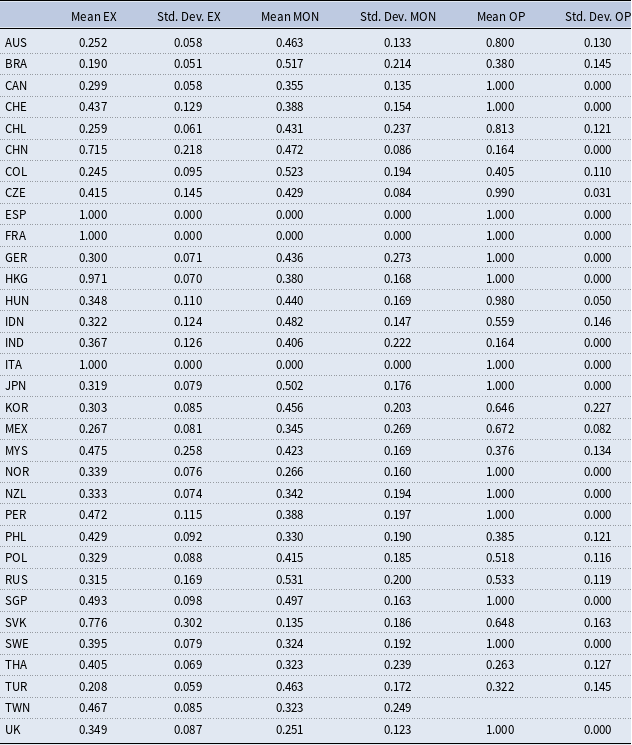
Notes: The table above provides the mean and standard deviations for the impossible trinity measures.
Descriptives
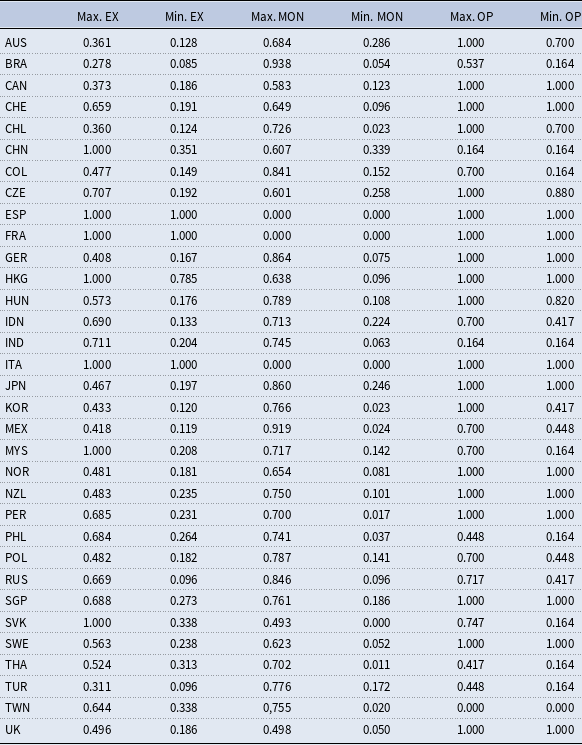
Notes: The table above provides the mean and standard deviations for the impossible trinity measures.
Table 2 provides the corresponding descriptive statistics for the measures for all countries over the sample period. Table 3 shows that several countries have undergone substantial changes in their policy regime over the sample period, with minimum and maximum measures strongly fluctuating. It becomes obvious that most developed countries have chosen financial openness with the corresponding measure mostly one throughout the sample. There is more variation for emerging markets in South America and Asia where the exchange rate regime and the degree of monetary policy independence frequently change. We also see that some emerging countries like Brazil and Chile have relaxed capital flow restrictions over the sample period.Footnote 8 Latin American countries had more stable exchange rate regimes and more restricted capital flows over the full sample period, reflecting changes in the exchange rate regime in various countries, such as changes in the exchange rate regime of Chile and Brazil. India and China are also among the countries with strong capital flow restrictions. All eurozone countries have chosen fixed exchange rates and open capital flows while giving up monetary independence. Monetary independence does not differ remarkably across other countries on average, reflecting the international connectedness of interest rates.
The overall inspection shows that our dataset covers a wide range of policy choices across countries, which also fluctuates over time. The advantage of our approach is that we can incorporate these sectional variations at each point in time when assessing the effects of uncertainty on expectations and disagreement. This is an advantage compared with a simple sample split and a distinction between different groups of countries, such as emerging vs. industrial.
4. Empirical approach to evaluating uncertainty
To evaluate how global uncertainty affects expectations, we estimate local projections put forward by Jordà (Reference Jordà2005) of the type
 \begin{equation} y_{i,t+h} = \beta _{h} unc_{t} +\sum _{\tau =1}^3 \left (\gamma _{h}unc_{t-\tau } +\delta _{h}x_{i,t-\tau }\right )+ \alpha _{i,h}+\lambda _{1,h} t + \lambda _{2,h} t^2 + \epsilon _{i,t+h}, \end{equation}
for each horizon $h$
. The dependent variable
$h$
. The dependent variable $y$
is survey measures from the 33 countries. Note that we include the contemporaneous value of
$y$
is survey measures from the 33 countries. Note that we include the contemporaneous value of $unc_t$
, while the control variables in
$unc_t$
, while the control variables in $x_t$
enter with a one-period lag. In addition to the lagged dependent, we take into account of realized GDP growth, the inflation rate, the interest rate, and the exchange rate, that is, exactly those measures respondents are asked to forecast. Moreover, we control for the international business cycle by including the Baumeister et al. (Reference Baumeister, Korobilis and Lee2022) global economic conditions indicator and the policy choices. We consider lags up to
$x_t$
enter with a one-period lag. In addition to the lagged dependent, we take into account of realized GDP growth, the inflation rate, the interest rate, and the exchange rate, that is, exactly those measures respondents are asked to forecast. Moreover, we control for the international business cycle by including the Baumeister et al. (Reference Baumeister, Korobilis and Lee2022) global economic conditions indicator and the policy choices. We consider lags up to $\tau =3$
with the exception of the policy choices, which are relatively persistent. The set of control variables is intended to capture the information set of respondents at the time they make their forecasts. We also control for country-fixed effects and a linear and quadratic time trend.Footnote
9
$\tau =3$
with the exception of the policy choices, which are relatively persistent. The set of control variables is intended to capture the information set of respondents at the time they make their forecasts. We also control for country-fixed effects and a linear and quadratic time trend.Footnote
9
According to this specification, identification of shocks in global uncertainty is thus achieved through the assumption that global uncertainty is contemporaneously predetermined with respect to the survey measures at the country level. This assumption is supported by the construction of the Piffer and Podstawski (Reference Piffer and Podstawski2018) uncertainty measure, which relies on high-frequency identification. However, also for the Davis (Reference Davis2016) GEPU measure, the assumption appears warranted. As the regression equation includes lagged values of the uncertainty measure and the realized macroeconomic variables, the shock in global uncertainty is simply given by the coefficients of $unc_{t}$
, which amounts to the arguably exogenous shock from the recursive structure in structural vector-autoregressive models with the uncertainty measure ordered first (Bloom, Reference Bloom2009; Leduc and Liu, Reference Leduc and Liu2016; Basu and Bundick, Reference Basu and Bundick2017). Note that in our setting, the predeterminedness assumption is additionally supported by the construction of the uncertainty measure at the global scale and the fact that most countries in our sample are relatively small. In addition, this assumption is justified given the deadline of the survey is the beginning of the respective month in most cases.
$unc_{t}$
, which amounts to the arguably exogenous shock from the recursive structure in structural vector-autoregressive models with the uncertainty measure ordered first (Bloom, Reference Bloom2009; Leduc and Liu, Reference Leduc and Liu2016; Basu and Bundick, Reference Basu and Bundick2017). Note that in our setting, the predeterminedness assumption is additionally supported by the construction of the uncertainty measure at the global scale and the fact that most countries in our sample are relatively small. In addition, this assumption is justified given the deadline of the survey is the beginning of the respective month in most cases.
One complication associated with the Jordà method is the serial correlation in the error terms induced by the successive leading of the dependent variable. To take into account the respective serial correlation in our panel framework, we use the Driscoll and Kraay (Reference Driscoll and Kraay1998) correction of standard errors.
The impulse response functions presented below are calculated based on the sequences of the estimated $\beta _h$
coefficients.
$\beta _h$
coefficients.
The local projections method allows us to estimate state-dependent impulse response functions in a flexible and parsimonious way that is robust to misspecification. To study how policy choices affect the transmission of uncertainty, we extend the regression model from above:
 \begin{align*} y_{i,t+h} = \; & S_{i,t} + \beta _{h} unc_{t} +\sum _{\tau =1}^3 \left (\gamma _{h} unc_{t-\tau } +\delta _{h}x_{i,t-\tau }\right ) \\ + \; &S_{i,t} \left (\beta _{\text{S},h} unc_{t} + \sum _{\tau =1}^3\left (\gamma _{\text{S},h} unc_{t-\tau } +\delta _{\text{S},h}x_{i,t-\tau }\right )\right ) \end{align*}
 \begin{align} + \; & \alpha _{i,h}+\lambda _{1,h} t + \lambda _{2,h} t^2 + \epsilon _{i,t+h}, \end{align}
where $S_{i,t} \in (0,1)$
denotes the state variable capturing where the respondent’s home country is located in each dimension of the impossible trinity, as measured by Aizenman et al. (Reference Aizenman, Chinn and Ito2013). We include multiplicative terms of
$S_{i,t} \in (0,1)$
denotes the state variable capturing where the respondent’s home country is located in each dimension of the impossible trinity, as measured by Aizenman et al. (Reference Aizenman, Chinn and Ito2013). We include multiplicative terms of $S_{i,t}$
with
$S_{i,t}$
with $unc_{t}$
and the lagged dependent to allow for nonlinearities in the responses associated with exchange rate and monetary policy flexibility as well as financial openness. Note that while the surveys have monthly frequency, the Aizenman et al. (Reference Aizenman, Chinn and Ito2013) measures are generated with yearly frequency. We use the yearly observations for 12 months, respectively.
$unc_{t}$
and the lagged dependent to allow for nonlinearities in the responses associated with exchange rate and monetary policy flexibility as well as financial openness. Note that while the surveys have monthly frequency, the Aizenman et al. (Reference Aizenman, Chinn and Ito2013) measures are generated with yearly frequency. We use the yearly observations for 12 months, respectively.
The impulse response functions presented below are calculated based on the sequences of $\beta _h$
and
$\beta _h$
and $(\beta _h + \beta _{\text{S},h})$
coefficients. To take account of the effects of the open economy policy choices,
$(\beta _h + \beta _{\text{S},h})$
coefficients. To take account of the effects of the open economy policy choices, $\beta _{\text{S},h}$
is thus evaluated at 0 and 1, respectively.Footnote
10
$\beta _{\text{S},h}$
is thus evaluated at 0 and 1, respectively.Footnote
10
5. Results
5.1 Response of expectations, forecast errors, and disagreement to uncertainty
Figure 2 shows responses of the expectation measures, while Figure 3 provides the response of forecast errors to a one-standard deviation surge in EU for a horizon of up to 1 year and the four variables under investigation. A look at forecast errors provides an indication of whether forecaster tend to under- or overestimate the effects of uncertainty. To the extent that expectations feature into the transmission of uncertainty shocks through second-round effects, expectations may amplify or attenuate the transmission of uncertainty shocks to macroeconomic variables according to the sign of the response of forecast errors. It is important to recall that they are calculated as the difference between expected and realized outcomes, implying that positive (negative) forecast errors reflect an overestimation if predicted and realized values are positive (negative).
Expectation responses to surges in global uncertainty.
Notes: The figure shows impulse response functions of the survey measures to a one-standard deviation surge in the uncertainty instrument by Piffer and Podstawski (Reference Piffer and Podstawski2018). The gray-shaded areas represent 68 and 90% confidence intervals. The horizontal axis is in months.

Forecast errors to surges in global uncertainty.
Notes: The figure shows impulse response functions of the survey measures to a one-standard deviation surge in the uncertainty instrument by Piffer and Podstawski (Reference Piffer and Podstawski2018). The gray-shaded areas represent 68 and 90% confidence intervals. The horizontal axis is in months.

The appendix provides the corresponding results for EPU (see Figures A.1–A.2). We also briefly discuss these findings to verify our main results with regard to the perception of uncertainty shocks. The dynamics of the responses might naturally differ, which is not surprising given the different nature of the two measures. This implicit robustness tests also enables us to analyze whether different uncertainty shocks have different effects.
We first observe a marked decrease in expected GDP growth. The effect is highly significant for the first months after the shock sets in.Footnote 11 Thus, the response of survey expectations is consistent with the adverse effects of uncertainty that are usually reported in the literature (Bloom, Reference Bloom2014; Castelnuovo, Reference Castelnuovo2019).
Even though, the responses tend to be negative, inflation expectations do not react significantly to uncertainty shocks. Similarly, we also do not find significant evidence that interest rates are systematically expected to decrease as suggested by the a Taylor rule type relationship among expectation measures, and as suggested in, for example, Dräger et al. (Reference Dräger, Lamla and Pfajfar2016), who provide evidence for such a relationship looking at raw correlations in US survey data.
Overall, it appears that people tend to assess uncertainty shocks like a shift of the demand curve, which is how Leduc and Liu (Reference Leduc and Liu2016) characterize uncertainty shocks. The weaker response of inflation compared with growth expectations possibly reflects a flattening of the Phillips curve relationship.
The results in the appendix show that policy uncertainty has similar effects on growth and inflation expectations and additionally leads to an expected decrease in interest rates, a pattern also in line with negative demand shocks.
Looking at expected exchange rates gives us an indication of how survey respondents view the impact of uncertainty shocks on their home country relative to the rest of the world. Interestingly, respondents, on average across countries, tend to expect a depreciation of the domestic currency vis-à-vis the US dollar if global uncertainty increases. This reflects the established safe haven status of the US dollar in times of uncertainty and is in line with previous results in the literature which have identified an effect of uncertainty on exchange rate expectations Beckmann and Czudaj (Reference Beckmann and Czudaj2017). This is also in line with the perception as a negative demand shock that reduces the demand for domestic exports and consequently for domestic currency. These expectations are pretty much in line with the realized effects on exchange although the realized appreciation of the dollar is slightly stronger.
As will be pointed out in the next section, however, open economy policy choices play an important role for how respondents interpret the effects of uncertainty shocks. While the expected GDP growth is always affected adversely, irrespective of the prevailing regime, albeit to different degrees, the sign of the responses of the remaining expectation measures vary.
A look at forecast errors in Figure 3 reveals that the corresponding GDP effect is slightly overestimated. The same pattern holds for inflation and interest rates over the medium run. The depreciation of the domestic exchange rate also tends to be overestimated. A possible explanation is that global uncertainty shocks can be easily observed without substantial costs to acquire information while other shocks may be neglected due to rational inattention, potentially leading to an overweighting of global uncertainty shocks. These finding are essentially confirmed for EPU in the appendix. This implies that expectations tend to amplify effects of uncertainty shocks.
As a next step, we focus on Figure 4, which provides the responses of cross-sectional standard deviations. We consider the standard deviation as an indication for forecast disagreement. Interest rate and inflation disagreement increase slightly over the medium run. This suggests that forecasters disagree about the exact response by monetary policy to uncertainty and regarding the question whether inflation will be affected by uncertainty. Hence, the weak response of mean forecasts for interest rates and inflation do not imply that forecaster remain inattentive with regard to uncertainty shocks. The surge in forecaster disagreement for GDP growth is consistent with the notion that in an environment of high EU, it is more difficult to foresee future business cycle dynamics. We do not observe a direct response of exchange rate disagreement, which suggests a common belief about the role of the US dollar in times of uncertainty. The results for EPU in the appendix confirm that disagreement significantly reacts to uncertainty shocks with slightly different dynamics over the medium-run dynamics.
Disagreement responses to surges in global uncertainty.
Notes: The figure shows impulse response functions of the survey measures to a one-standard deviation surge in the uncertainty instrument by Piffer and Podstawski (Reference Piffer and Podstawski2018). The gray-shaded areas represent 68 and 90% confidence intervals. The horizontal axis is in months.

These results also align with theoretical considerations that explain expectation errors and disagreement based on sticky or noisy-information models. The basic idea is that forecasters are not fully informed and might choose to stay inattentive due to the costs of acquiring information after shocks (Coibion and Gorodnichenko, Reference Coibion and Gorodnichenko2012). Sticky information models result in disagreement effects, while noisy-information models additionally require that policy shocks result in idiosyncratic signals, which lead to some professionals updating their forecasts, while others remain inattentive. These signals might reflect private information-related macroeconomic conditions.
To explore cross-country heterogeneities in response to expectations to uncertainty, we have also performed country-by-country estimations. The full set of these country-specific results is available upon request. The results confirm the main findings. We find that uncertainty has negative effects on expected GDP across the board. Further estimates also show that neither a distinction between emerging and industrial economies nor an analysis based on GDP openness, defined as the sum of exports and imports relative to GDP, provides deep additional insights into the effects of global uncertainty. As a next step, we consider the policy stance among economies as a potential determinant and provide results from state-dependent local projections represented in Equation (3).
Responses of expectations to global uncertainty conditional on exchange rate stability.
Notes: The figure shows impulse response functions of the survey measures. In each panel, the upper panels show responses of expected growth rates where the policy choice is evaluated at 0 and at 1 in the middle panel. The lower panels show t-statistics on the difference between responses. See also notes in Figure 2.

5.2 The importance of open economy policy choices
We now turn to the impact of policy choices based on the impossible trinity classification of Aizenman et al. (Reference Aizenman, Chinn and Ito2013). Our empirical approach enables us to distinguish the linear cases from the cases of very high/low realizations of the impossible trinity measures. We often refer to low monetary policy independence and high exchange rate stability jointly given that both choices are closely related under free capital flows and also frequently display similar results.
Figures 5–10 provide the corresponding graphs from pooled estimations for mean expectations and disagreement represented in Equation (3).Footnote
12
In each panel, the upper graph shows impulse response functions of the survey measures for which the policy choice is evaluated at 0. The middle graph shows responses for which the policy choice is evaluated at 1. A nonlinear relationship between policy choices and the response to uncertainty shocks emerges if the two graphs display different patterns. To assess whether such differences are significant, the lower graph includes t-statistics to evaluate whether the two impulse response functions are statistically significantly different from each other. More precisely, we look at the t-statistics on the coefficient of the interaction term $\beta _{\text{S},h}$
.
$\beta _{\text{S},h}$
.
Responses of expectations to global uncertainty conditional on monetary independence.
Notes: The figure shows impulse response functions of the survey measures. In each panel, the upper panels show responses of expected growth rates where the policy choice is evaluated at 0 and at 1 in the middle panel. The lower panels show t-statistics on the difference between responses. See also notes in Figure 2.

Responses of expectations to global uncertainty conditional on financial openness.
Notes: The figure shows impulse response functions of the survey measures. In each panel, the upper panels show responses of expected growth rates where the policy choice is evaluated at 0 and at 1 in the middle panel. The lower panels show t-statistics on the difference between responses. See also notes in Figure 2.

Responses of disagreement to global uncertainty conditional on exchange rate stability.
Notes: The figure shows impulse response functions of the survey measures. In each panel, the upper panels show responses of expected growth rates where the policy choice is evaluated at 0 and at 1 in the middle panel. The lower panels show t-statistics on the difference between responses. See also notes in Figure 2.

Responses of disagreement to global uncertainty conditional on monetary independence.
Notes: The figure shows impulse response functions of the survey measures. In each panel, the upper panels show responses of expected growth rates where the policy choice is evaluated at 0 and at 1 in the middle panel. The lower panels show t-statistics on the difference between responses. See also notes in Figure 2.

Responses of disagreement to global uncertainty conditional on financial openness.
Notes: The figure shows impulse response functions of the survey measures. In each panel, the upper panels show responses of expected growth rates where the policy choice is evaluated at 0 and at 1 in the middle panel. The lower panels show t-statistics on the difference between responses. See also notes in Figure 2.

In the evaluation of the impulse responses, we mainly focus on three questions. First, how do policy choices affect the perceived resilience vis-à-vis uncertainty shocks? Second, does the overall interpretation of the macroeconomic effects of uncertainty shocks depend on the prevailing regime? And third, how do policy regimes affect disagreement and, thus, uncertainty over domestic developments?
To evaluate expected resilience, we study the impulse response functions of expected GDP growth (first column) and disagreement about it, to uncertainty shocks conditional on exchange rate stability in Figures 5 and 8, conditional on monetary policy independence in Figures 6 and 9, and conditional on financial openness in Figures 7 and 10. The corresponding graphs for EPU are provided in the appendix and, given the rich set of estimates and the comparable results in the previous section, are only discussed here.
We first observe that higher exchange rate stability is associated with stronger initial negative effects on expected GDP growth. This is in line with the perception that flexible exchange rates can act as a shock absorber and dampen the adverse effects of uncertainty shocks. Monetary policy independence does not affect the initially expected on GDP growth. Hence, professionals do not believe in the capacity of monetary policy independence to dampen uncertainty shocks. The results also illustrate that both monetary policy independence and exchange rate stability affect the expected interest rate response. Both higher monetary policy independence and lower exchange rate stability coincide with the belief that short-run interest will increase. This could, for example, reflect a policy regime where higher interest rates aim at preventing capital outflows. This line of reasoning aligns with the results for financial openness in Figure 7. Countries with low openness are also expected to increase interest rates. Free capital mobility is a favorable signal for international investors, while countries with restrictions on international capital frequently experience sudden stops in capital flows in uncertain times. In line with this reasoning, our results show that currencies of economies with low openness are expected to experience stronger depreciations.
These patterns are somehow reversed for low monetary policy independence and higher exchange rate stability where short-run interest rates are expected to decrease. This reflects the perception that domestic central banks will have to follow the global financial cycle and lower interest rates in response to uncertainty shocks. The response of expected exchange rates is not responsive to differences in monetary policy independence, while (lower) higher exchange rate stability leads to an expected appreciation (depreciation) of the dollar. The result for high exchange rate stability is robust to excluding countries of the euro area. One explanation is that some countries, for example, Switzerland and countries in Eastern Europe, have implemented intermediate regimes and/or fixed their currencies to other currencies as the dollar. For some of these currencies, expectations against the US dollar had to be calculated via cross-rates. As a result, an expected appreciation of the domestic currency against the euro can imply that the domestic currency also appreciates against the dollar.
The results for GEPU are provided in the appendix and tend to display similar effects with the significance slightly differing in some cases. We therefore do not discuss them in detail here.
Overall, our results suggest that the overall interpretation of the macroeconomic effects of uncertainty shocks does not depend on the prevailing regime. The negative effect on expected GDP is not affected by the underlying policy regime. However, policy regimes do affect the perceived influence of growth expectations in response to uncertainty shocks. This finding aligns with the results of Kim and Pyun (Reference Kim and Pyun2018), which show that international transmission of business cycles is affected by policy regimes. Both the expected response of monetary policy and the path of the exchange rate strongly depend on the policy regime.
Finally, we turn to the effects of uncertainty on disagreement conditional on the policy regime in Figures 8–10. Overall, the effects of uncertainty effects differ across policy regimes. There are clear state dependencies for the degree of exchange rate stability and monetary policy independence. Forecasters disagree more about the future path of interest rates and inflation under high monetary policy independence and lower exchange rate stability. This result is perfectly plausible given that monetary policy has less options under such a scenario. Low monetary policy independence implies that the domestic central bank follows monetary policy decisions against the anchor country, for example, a significant cut in interest rates in case of uncertainty.
At the same time, forecasters disagree more about future GDP if exchange rate stability is high or monetary policy independence is low. Our previous result is that the degree of monetary policy autonomy does not affect the expected average decrease in GDP growth, but these findings suggest that a loss of monetary autonomy increases the perceived uncertainty with regard to future GDP. Hence, the availability of monetary policy as an independent policy instrument does not reduce the expected adverse macroeconomic effects of both uncertainty shocks but lowers the uncertainty surrounding these shocks. Previous research has found that credible monetary policy anchors expectations Dovern et al. (Reference Dovern, Fritsche and Slacalek2012) since giving up monetary independence often increases the credibility of monetary policy. According to our results, this credibility is also reflected in lower disagreement regarding the path of GDP after an uncertainty shock.
Higher financial openness reduces disagreement about the future path of the exchange rate but increases disagreement regarding GDP growth. This is plausible given that restrictions of financial openness often go hand in hand with volatile exchange rates and are often aimed at reducing the sensitivity to global shocks.
The results for the response of disagreement to a GEPU are again broadly similar. We do, for example, also find a strong state dependence of interest rate disagreement to uncertainty shocks.
An overall conclusion arising from the following results is that the policy regimes do matter and results in several nonlinearities in the expectation mechanism. Forecasters do interpret global uncertainty shocks as negative demand shocks but often disagree substantially regarding the persistence of shocks depending on the policy regime. Such differences can also give rise to second-round effects and offer an explanation for the propagation of global uncertainty shocks via an increase in domestic uncertainty.
6. Conclusion
This paper evaluates the transmission of global uncertainty shocks to the expectations of professionals and disagreement among them. Relying on a large set of survey data covering a wide range of expected macroeconomic outcomes for 33 countries, we establish evidence for an expectation channel of global uncertainty shocks. We consider two uncertainty measures and find that our main results, such as an expected downswing of GDP in case of higher uncertainty, hold for both uncertainty measures
Global uncertainty exerts significant and adverse effects on expectations across the board, and they frequently spill over to disagreement regarding macroeconomic variables, increasing domestic uncertainty. Expectations also tend to amplify the effects of uncertainty shocks as forecasters overestimate the corresponding effects. We also find substantial effects on disagreement, suggesting that global uncertainty shocks propagate since forecasters have different perceptions with regard to such shocks.
Our results also show that policy choices in an open economy do matter for the response to uncertainty shocks, identifying several nonlinear linkages between the policy stance and the response to uncertainty shocks. We also find that the policy regime does affect the perceived persistence of growth expectations in response to uncertainty shocks while leaving the general perception as a negative demand shock unchanged. Policy choices also affect the expected response of monetary policy and the exchange rate. Finally, we show that the policy regime has strong effects on the response of disagreement to uncertainty shocks. These results clearly show that policy choices affect the propagation of global uncertainty shocks to the domestic economy. Giving up monetary policy independence reduces the uncertainty surrounding such shocks and also affects the expected response of interest rates.
Our findings lead to several interesting avenues for future research. Taking additional global uncertainty measures into account or assessing individual forecasts are straightforward extensions. Quantifying the exact importance of the expectation channel for the transmission of global uncertainty shocks to domestic real or financial variables is a more complicated but important task.
Appendix A
Expectation responses to surges in global economic policy uncertainty.
Notes: The figure shows impulse response functions of the survey measures to a one-standard deviation surge in the uncertainty measure by Baker et al. (Reference Baker, Bloom and Davis2016). The gray-shaded areas represent 68 and 90% confidence intervals. The horizontal axis is in months.

Forecast error responses to surges in global economic policy uncertainty.
Notes: The figure shows impulse response functions of the survey measures to a one-standard deviation surge in the uncertainty measure by Baker et al. (Reference Baker, Bloom and Davis2016). The gray-shaded areas represent 68 and 90% confidence intervals. The horizontal axis is in months.

Disagreement responses to surges in global economic policy uncertainty.
Notes: The figure shows impulse response functions of the survey measures to a one-standard deviation surge in the uncertainty measure by Baker et al. (Reference Baker, Bloom and Davis2016). The gray-shaded areas represent 68 and 90% confidence intervals. The horizontal axis is in months.

Responses of expectations to global uncertainty conditional on exchange rate stability (GEPU).
Notes: The figure shows impulse response functions of the survey measures to a one-standard deviation surge in the uncertainty measure by Baker et al. (Reference Baker, Bloom and Davis2016). In each panel, the upper panels show responses of expected growth rates where the policy choice is evaluated at 0 and at 1 in the middle panel. The lower panels show t-statistics on the difference between responses. See also notes in Figure 2.

Responses of expectations to global uncertainty conditional on monetary independence (GEPU).
Notes: The figure shows impulse response functions of the survey measures to a one-standard deviation surge in the uncertainty measure by Baker et al. (Reference Baker, Bloom and Davis2016). In each panel, the upper panels show responses of expected growth rates where the policy choice is evaluated at 0 and at 1 in the middle panel. The lower panels show t-statistics on the difference between responses. See also notes in Figure 2.

Responses of expectations to global uncertainty conditional on financial openness (GEPU).
Notes: The figure shows impulse response functions of the survey measures to a one-standard deviation surge in the uncertainty measure by Baker et al. (Reference Baker, Bloom and Davis2016). In each panel, the upper panels show responses of expected growth rates where the policy choice is evaluated at 0 and at 1 in the middle panel. The lower panels show t-statistics on the difference between responses. See also notes in Figure 2.

Responses of disagreement to global uncertainty conditional on exchange rate stability (GEPU).
Notes: The figure shows impulse response functions of the survey measures to a one-standard deviation surge in the uncertainty measure by Baker et al. (Reference Baker, Bloom and Davis2016). In each panel, the upper panels show responses of expected growth rates where the policy choice is evaluated at 0 and at 1 in the middle panel. The lower panels show t-statistics on the difference between responses. See also notes in Figure 2.

Responses of disagreement to global uncertainty conditional on monetary independence (GEPU).
Notes: The figure shows impulse response functions of the survey measures to a one-standard deviation surge in the uncertainty measure by Baker et al. (Reference Baker, Bloom and Davis2016). In each panel, the upper panels show responses of expected growth rates where the policy choice is evaluated at 0 and at 1 in the middle panel. The lower panels show t-statistics on the difference between responses. See also notes in Figure 2.

Responses of disagreement to global uncertainty conditional on financial openness (GEPU).
Notes: The figure shows impulse response functions of the survey measures to a one-standard deviation surge in the uncertainty measure by Baker et al. (Reference Baker, Bloom and Davis2016). In each panel, the upper panels show responses of expected growth rates where the policy choice is evaluated at 0 and at 1 in the middle panel. The lower panels show t-statistics on the difference between responses. See also notes in Figure 2.

Responses of forecast errors to global uncertainty conditional on exchange rate stability.
Notes: The figure shows impulse response functions of the macroeconomic measures. In each panel, the upper panels show responses of expected growth rates where the policy choice is evaluated at 0 and at 1 in the middle panel. The lower panels show t-statistics on the difference between responses. See also notes in Figure 2.

Responses of forecast errors to global uncertainty conditional on monetary independence.
Notes: The figure shows impulse response functions of the macroeconomic measures. In each panel, the upper panels show responses of expected growth rates where the policy choice is evaluated at 0 and at 1 in the middle panel. The lower panels show t-statistics on the difference between responses. See also notes in Figure 2.

Responses of forecast errors to global uncertainty conditional on financial openness.
Notes: The figure shows impulse response functions of the macroeconomic measures. In each panel, the upper panels show responses of expected growth rates where the policy choice is evaluated at 0 and at 1 in the middle panel. The lower panels show t-statistics on the difference between responses. See also notes in Figure 2.


 Open access

