

Introduction
Pattern formation within rocks and minerals involves the inhomogeneous arrangement of chemical species into spatial structures. These structures have long been a subject of research in the geosciences, where they can be observed at every scale, from the cyclic, stratigraphic variations in kilometre-scale outcrops of interbedded sandstone and shale (Paulissen and Luthi, Reference Paulissen and Luthi2011), down to the micron-sized zoning within single crystals (Shore and Fowler, Reference Shore and Fowler1996; Perugini et al., Reference Perugini, Little and Poli2006).
Several prominent examples of geological pattern formation can be found in the north and northwestern districts of Western Australia, including banded iron formations (e.g. Klein, Reference Klein2005) and ‘zebra rock’ (e.g. Coward et al., Reference Coward, Slim, Brugger, Wilson, Williams, Pillans and Maksimenko2023). Zebra rock is famous for its distinctive periodic iron-oxide pattern, which transforms an Ediacaran-aged siltstone into an attractive semi-precious gemstone. Zebra rock has been the subject of a number of recent studies, with pattern formation ascribed to either pedogenic redoximorphic features or Liesegang banding (Abrajevitch et al., Reference Abrajevitch, Pillans, Roberts and Kodama2018; Retallack, Reference Retallack2020; Kawahara et al., Reference Kawahara, Yoshida, Yamamoto, Katsuta, Nishimoto, Umemura and Kuma2022; Coward et al., Reference Coward, Slim, Brugger, Wilson, Williams, Pillans and Maksimenko2023; Yatsuda et al., Reference Yatsuda, Tsushima, Fang and Nabika2023). Although zebra rock has only ever been identified around the vicinity of Lake Argyle in Western Australia, comparable rhythmic Fe-oxide patterns are also observed in siltstones located across the neighbouring Pilbara region. These patterns are referred to as either ‘print stone’ or ‘newsprint jasper’ and are located within the upper section of the Neoarchean to Early Palaeoproterozoic (2494–2505 Ma) Mount McRae Shale. The Mount McRae Shale has been of significant interest to the academic community over the past few decades, due in part to the extensive history of hydrothermal iron mineralisation throughout the region (e.g. Rasmussen et al., Reference Rasmussen, Fletcher, Muhling, Thorne and Broadbent2007; Reinhard et al., Reference Reinhard, Raiswell, Scott, Anbar and Lyons2009; Raiswell et al., Reference Raiswell, Reinhard, Derkowski, Owens, Bottrell, Anbar and Lyons2011); the economic significance of the overlying Brockman Iron Formation (e.g. Haruna et al., Reference Haruna, Hanamuro, Uyeda, Fujimaki and Ohmoto2003); and the possible preservation of evidence of trace oxygen hundreds of millions of years prior to the Great Oxygenation Event (Anbar et al., Reference Anbar, Duan, Lyons, Arnold, Kendall, Creaser, Kaufman, Gordon, Scott, Garvin and Buick2007; Slotznick et al., Reference Slotznick, Johnson, Rasmussen, Raub, Webb, Zi, Kirschvink and Fischer2022). However, despite extensive mineralogical and isotopic analysis of the host formation, print stone has not yet been examined outside of its palaeomagnetic properties, which served to date the formation of the iron-oxide pigment to either ∼1.5 Ga or ∼310–320 Ma (Abrajevitch et al., Reference Abrajevitch, Pillans and Roberts2014).
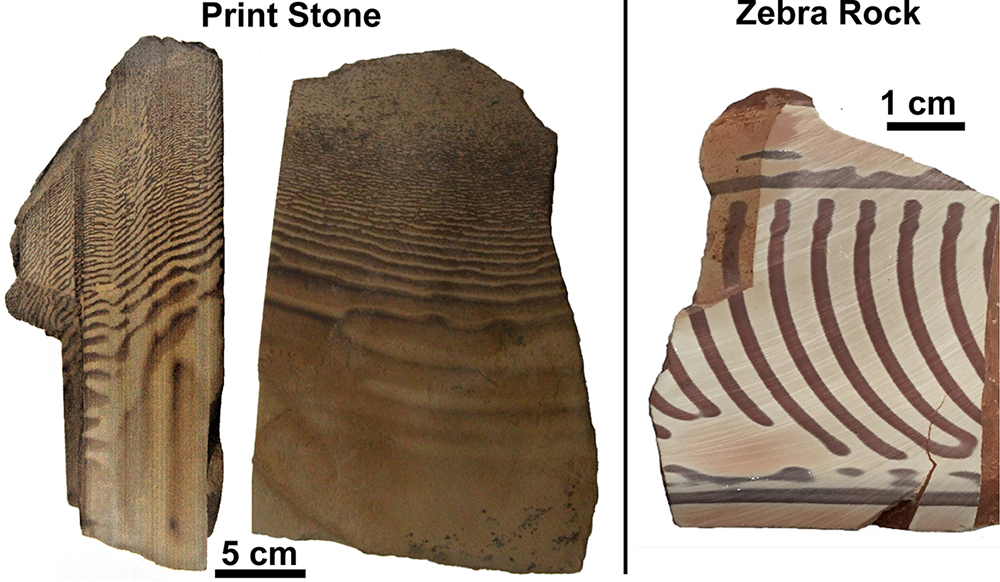
Although less renowned than the unusual hematite patterns that define zebra rock, the distinctive iron-oxide banding of print stone (Fig. 1) nonetheless shares many of the same physical characteristics, including a well defined, spatially repeating pattern and the occurrence of spot- and rod-like pattern morphologies. However, unlike zebra rock, print-stone patterns also exhibit clear and linear variabilities in the width and spacing of its bands (Fig. 1), in a fashion reminiscent of the scaling laws that define Liesegang banding. Liesegang banding is a phenomenon observed in certain reaction-diffusion systems, whereby a migrating chemical front results in the precipitation of alternating bands or rings (e.g. Hartman and Dickey, Reference Hartman and Dickey1932; Yatsuda et al., Reference Yatsuda, Tsushima, Fang and Nabika2023). Laboratory and field observations of Liesegang banding have shown that the spacing and width of the bands are bound by specific rules, known collectively as ‘scaling laws’. The ‘spacing’ law describes the successive linear increases in interband spacing with increasing distance from the pattern origin point (Jablczynski, Reference Jablczynski1923), whereas the ‘width law’ states that the width of the  $n$th band is proportional to a positive power of its distance from the origin point (Müller et al., Reference Müller, Kai and Ross1982). The spacing and width laws can be described through the following equations respectively:
 \begin{equation}\mathop {{\text{lim}}}\limits_{n \to \infty } \left( {{x_{n + 1}}/{x_n}} \right) = 1 + p{\text{ }}\end{equation}
 \begin{equation}w_n\,\propto x_n^a\end{equation}
Side and front view of a sample of print stone from near Wittenoom, compared to a sample of Zebra Rock from East Kimberley (Coward et al., Reference Coward, Slim, Brugger, Wilson, Williams, Pillans and Maksimenko2023).

where  ${x_n}$ is the distance of the $n$th band from the origin point, ${w_n}$ is its width, $p$ is the spacing coefficient, and $a$ is a unitless parameter with a value close to unity (Droz et al., Reference Droz, Magnin and Zrinyi1999).
The geological collocation of print stones and zebra rocks provides an opportunity to gain further insights into the formation and geological significance of periodic iron-oxide banding. Extensive mineralogical and geochemical data were obtained for multiple print-stone samples sourced from three different localities in order to characterise the mineralogical and geochemical features of print stone and constrain the mechanism of self-organisation by which its patterns were formed. The pattern morphology of print stone was examined by spatial analysis, for the purpose of confirming the occurrence of the Liesegang phenomenon. This information was used to construct a possible pathway for the formation of hematite patterns in print stone that is consistent with all established physical and geochemical constraints, as well as providing crucial insights into the origin of the hematite banding in East Kimberley zebra rock.
Geological context
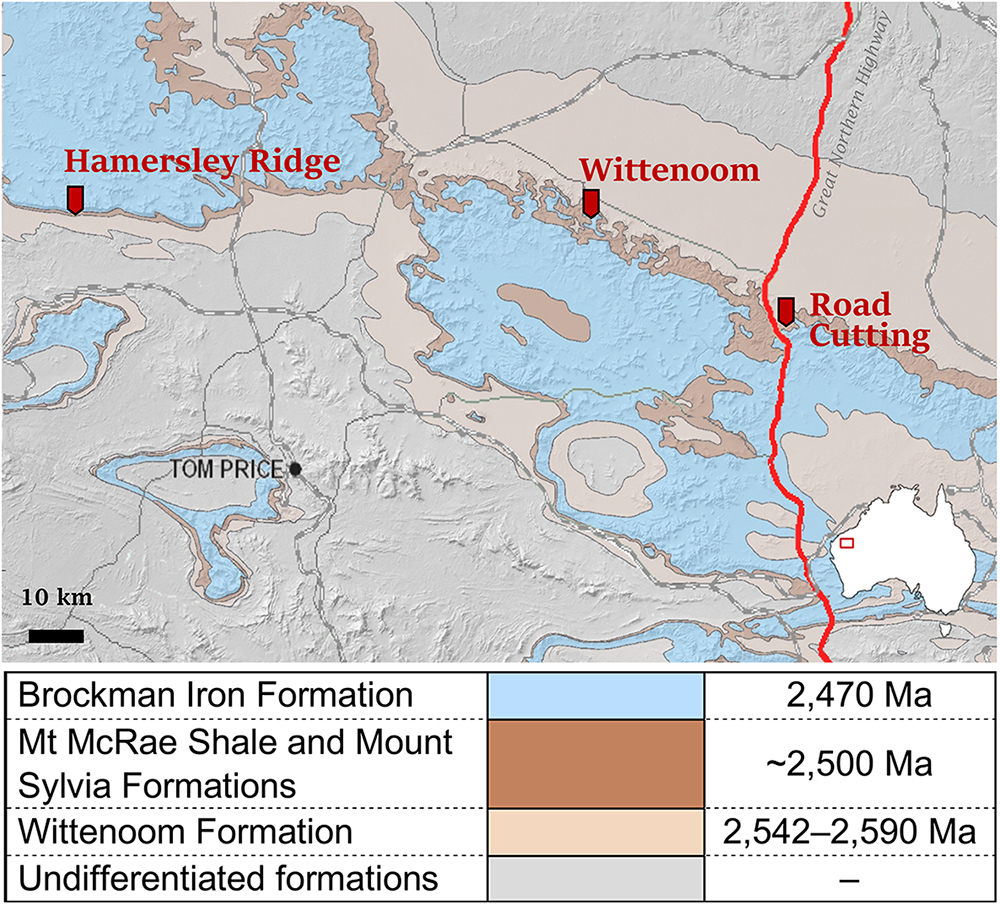
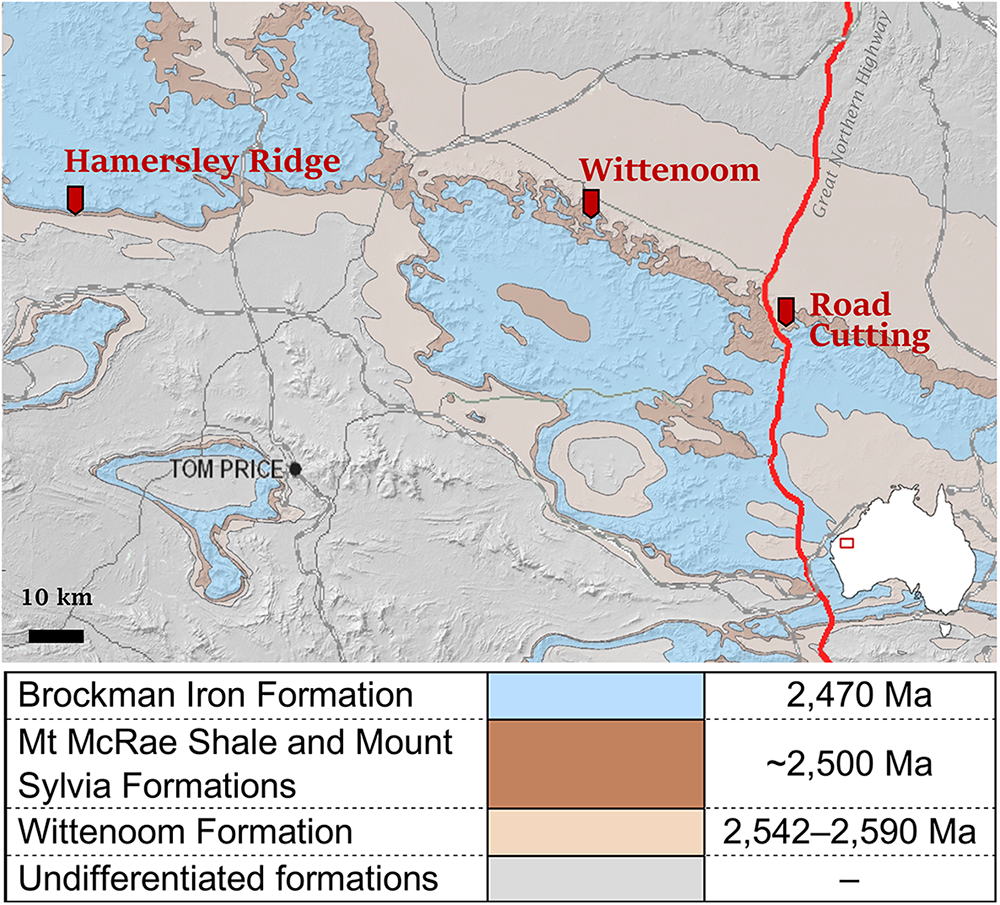
All known print-stone outcrops are located within the Neoarchean-to-Early Palaeoproterozoic, 2500 m thick Hamersley Group, which was deposited between 2.45 to 2.63 Ga ago as part of the Mt Bruce Supergroup (Trendall et al., Reference Trendall, Compston, Nelson, De Laeter and Bennett2004). The Hamersley group is subdivided into eight formations, composed of shales, dolomites, dolerites, rhyolites and banded iron formations (BIFs), the largest and most economically significant of which are the Marra Mamba Iron Formation and the Brockman Iron Formation (Trendall and Blockley, Reference Trendall and Blockley1970). Separating these two BIF units are, in younging order: the dolomites and cherts of the Wittenoom formation; Mount Sylvia cherts and interbedded shales; and the shales and siltstones of the Mount McRae Shale, the latter two units being merged into the ‘Mount McRae Shale and Mount Sylvia Formation’ (Fig. 2; Trendall and Blockley, Reference Trendall and Blockley1970; Thorne and Tyler, Reference Thorne and Tyler1997).
Location of the three print-stone outcrops examined in this investigation relative to the lithostratigraphy of the Mount McRae Shale and other associated formations. Map and geological data adapted from GeoVIEW.WA.
The print stone-hosting Mount McRae Shale is a carbonaceous, marine shale with a conformable boundary with the underlying Mount Sylvia unit defined by a distinctive BIF marker bed termed ‘Bruno’s band’. The Mount McRae Shale has been well studied, in part due to the possibility that it may preserve evidence of an early rise in atmospheric oxygen in the form of localised Mo and Re enrichments and sulfur isotope anomalies (Anbar et al., Reference Anbar, Duan, Lyons, Arnold, Kendall, Creaser, Kaufman, Gordon, Scott, Garvin and Buick2007; Kaufman et al., Reference Kaufman, Johnston, Farquhar, Masterson, Lyons, Anbar, Arnold, Garvin and Buick2007). The Mount McRae Shale was deposited ∼2.50 Ga ago, as determined by 207Pb – 206Pb zircon geochronology (Rasmussen et al., Reference Rasmussen, Blake and Fletcher2005). It consists of interbedded chert, shale, carbonates, and sideritic BIFs, with quartz, K-feldspar, sericite, and chlorite present throughout as the major mineral phases, together with varying amounts of carbonates (siderite, dolomite, ankerite) and pyrite (Trendall and Blockley, Reference Trendall and Blockley1970; Raiswell et al., Reference Raiswell, Reinhard, Derkowski, Owens, Bottrell, Anbar and Lyons2011), with the latter present both as larger nodules formed during burial diagenesis, and smaller, euhedral crystals formed through hydrothermal mineralization (Haruna et al., Reference Haruna, Hanamuro, Uyeda, Fujimaki and Ohmoto2003; Slotznick et al., Reference Slotznick, Johnson, Rasmussen, Raub, Webb, Zi, Kirschvink and Fischer2022).
The top of the Mount McRae Shale unit is defined by a black shale bed half a metre in thickness, directly underlying the lowest BIF band of the Brockman Iron Formation Trendall and Blockley, Reference Trendall and Blockley1970). The Brockman Iron Formation contains some of the highest-grade hematite ore deposits in the world, probably formed via upgrading of BIF through repeated circulation of hydrothermal fluids along major fault lines, beginning ∼2.15 Ga ago with subsequent hydrothermal alteration recurring on at least seven more occasions over the next 1.3 billion years (Rasmussen et al., Reference Rasmussen, Fletcher, Muhling, Thorne and Broadbent2007).
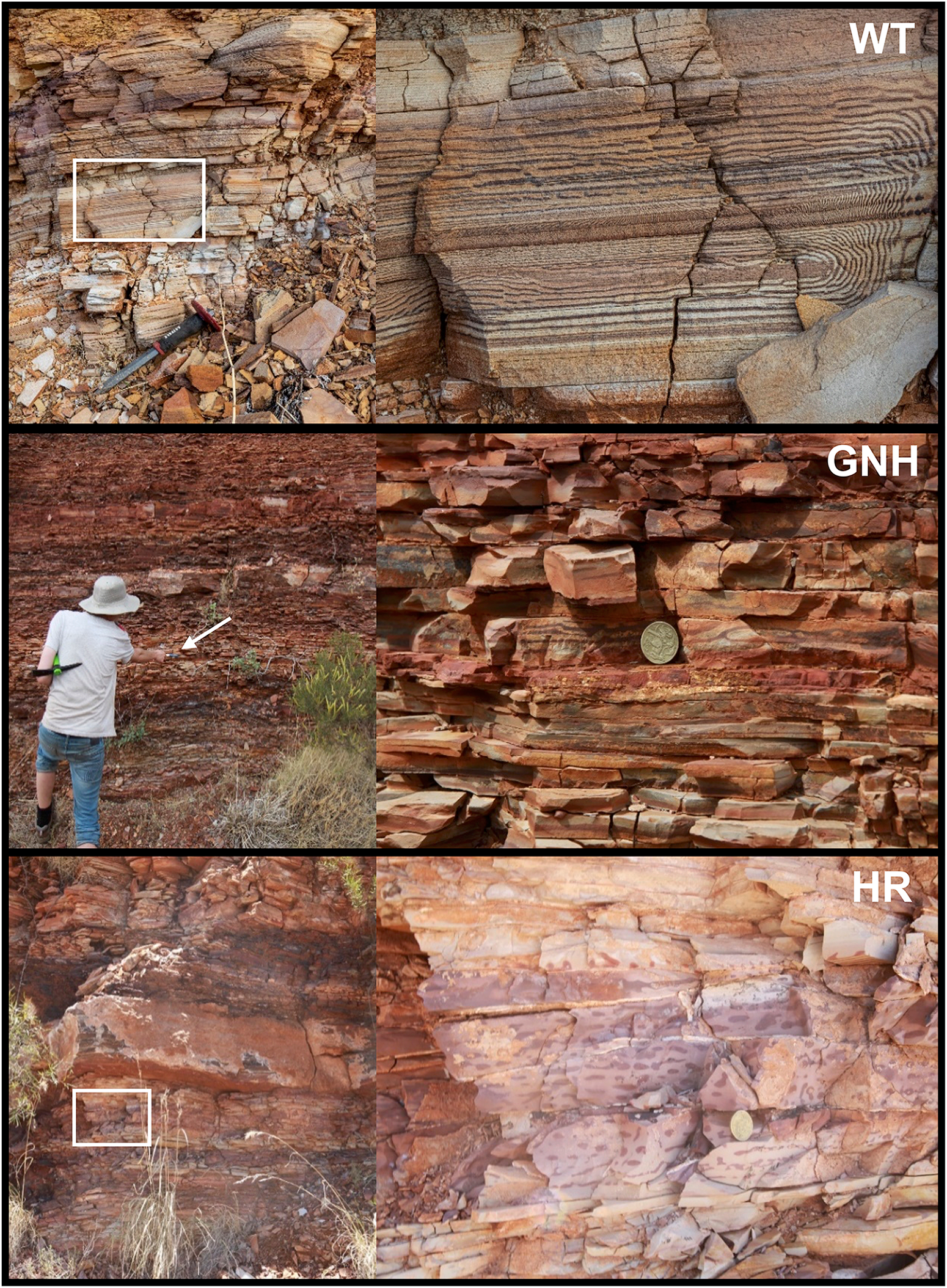
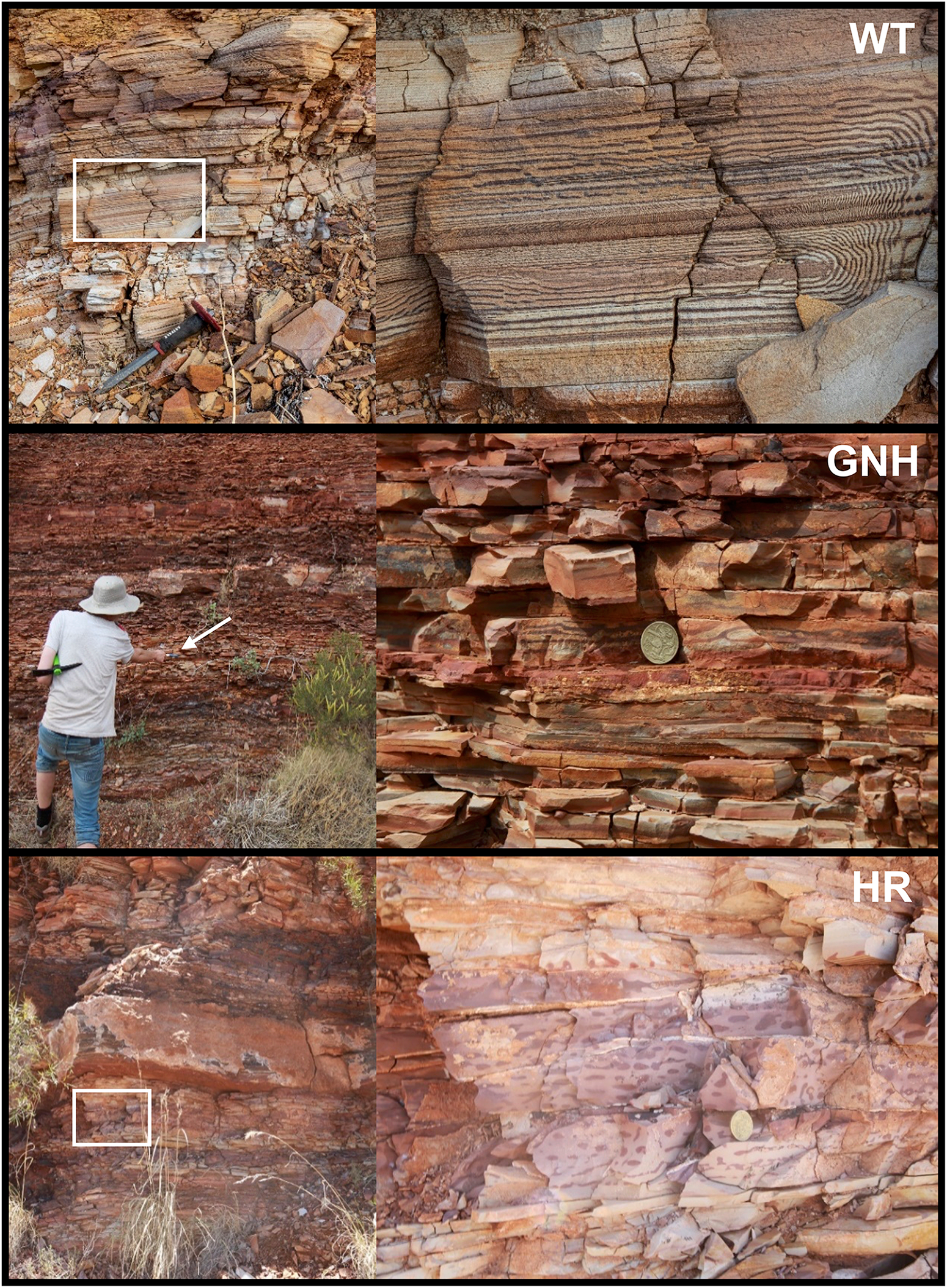
Samples were obtained from three print-stone outcrops across the Pilbara (Fig. 2). Localities include an existing mining lease at Hamersley Ridge, as well as two previously undocumented outcrops, labelled according to nearby geographical features as Wittenoom and Great Northern Highway (Fig. 3).
Print-stone outcrops at Wittenoom (WT), Great Northern Highway (GNH) and Hamersley Ridge (HR).
Analytical methods
A range of analytical techniques were used to characterise the mineralogy, textures and geochemistry of the rocks, including laser ablation inductively coupled plasma mass spectrometry (LA-ICP-MS), powder X-ray diffraction (XRD), scanning electron microscopy (SEM) imaging in secondary electron (SE) and back-scattered electron (BSE) modes and compositional analyses using energy dispersive spectroscopy (EDS), synchrotron-based X-ray fluorescence microscopy (XFM), and synchrotron-based X-ray tomography. For further information about these methods the reader is referred to the analytical methods of Coward et al. (Reference Coward, Slim, Brugger, Wilson, Williams, Pillans and Maksimenko2023).
To determine whether print-stone banding is consistent with the spacing and width laws inherent in Liesegang banding, spatial analysis of print stone was conducted on a sample from Wittenoom with vertical to near-vertical banding orientated perpendicular to bedding. This criterion was necessary due to variations in grain size and mineralogy observed along the vertical axis of most print-stone beds, which are both parameters predicted to provide additional controls on the spacing and width of print-stone bands and prevent accurate calculation of a spacing coefficient. No samples meeting this criterion could be retrieved from the Hamersley Ridge or Great Northern Highway deposits.
The sample was cut open orthogonal to the direction of band propagation. A line of known length was drawn across the image parallel to bedding, intersecting the pattern at a height where the banding was deemed closest to vertical, with no significant forking or discontinuities. Images of the cut, patterned sample were first processed using ImageJ (Abramoff et al., Reference Abramoff, Magalhaes and Ram2004), subtracting the background, and setting a threshold colour value in order to highlight the dark and light banding. The band width ( ${w_n}$) was defined by the points in which the line crossed the predetermined threshold colour value. Likewise, ${x_n}$ was defined by the length along the line from the edge of the sample to the centre of the band, as defined by the colour threshold. In all samples, the origin was chosen so that ${x_n}$ would increase in the direction of increasing interband spacing. To determine if banded print-stone patterns adhered to the spacing law, a least-squares linear-regression was applied to a plot of ${x_{n + 1}}$ against ${x_n}$, with the reported gradient of the regression approximating the apparent spacing coefficient of the patterned sample. Similarly, the degree of consistency of print stone to the width law was determined by a least-squares linear-regression of a plot of ${x_n}$ against ${w_n}$. A t-test was performed on both regressions to obtain a measure of significance (P > 0.01). All linear-regressions and associated t-tests were undertaken using RStudio.
Results
Pattern morphologys
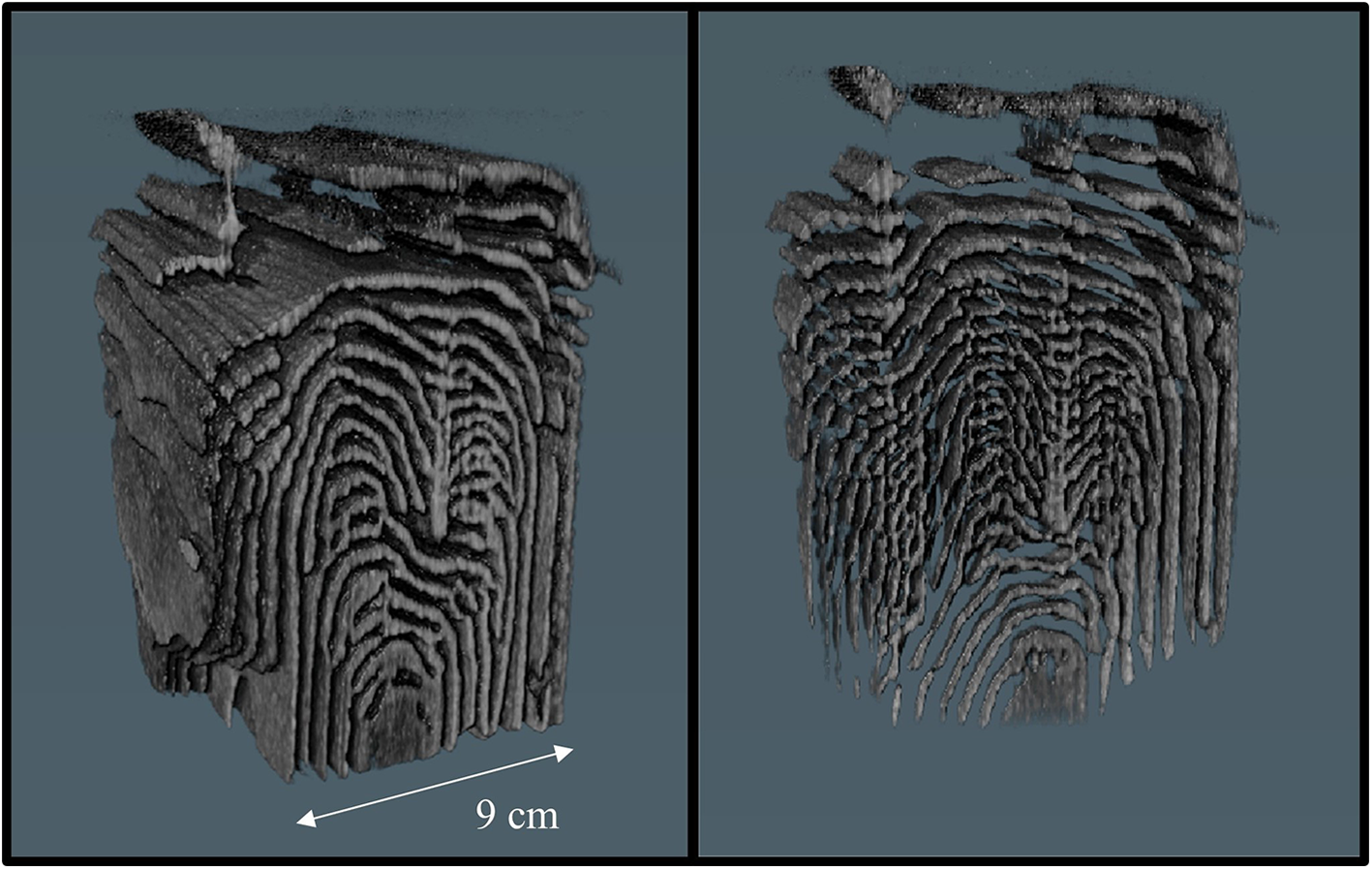
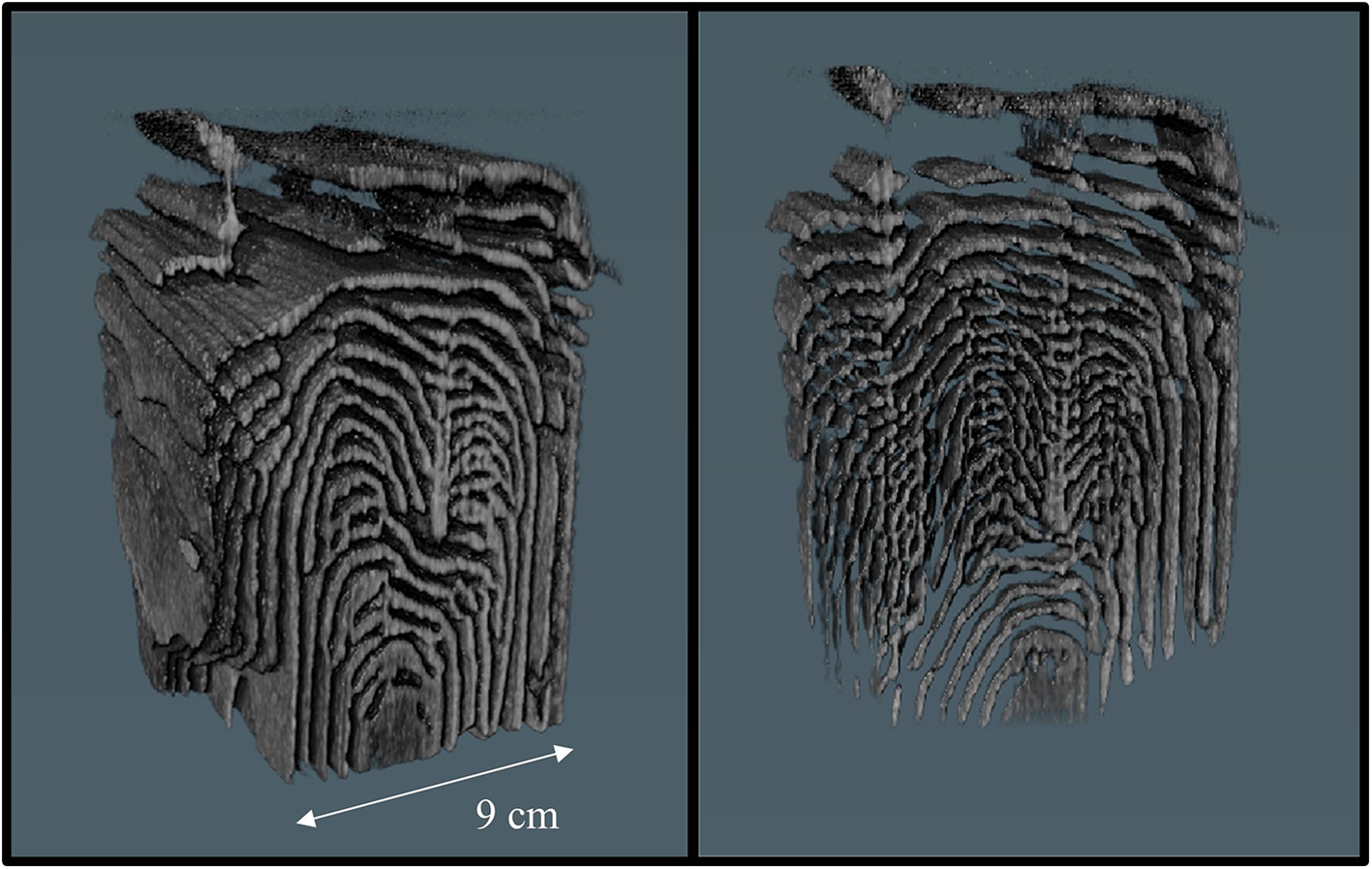
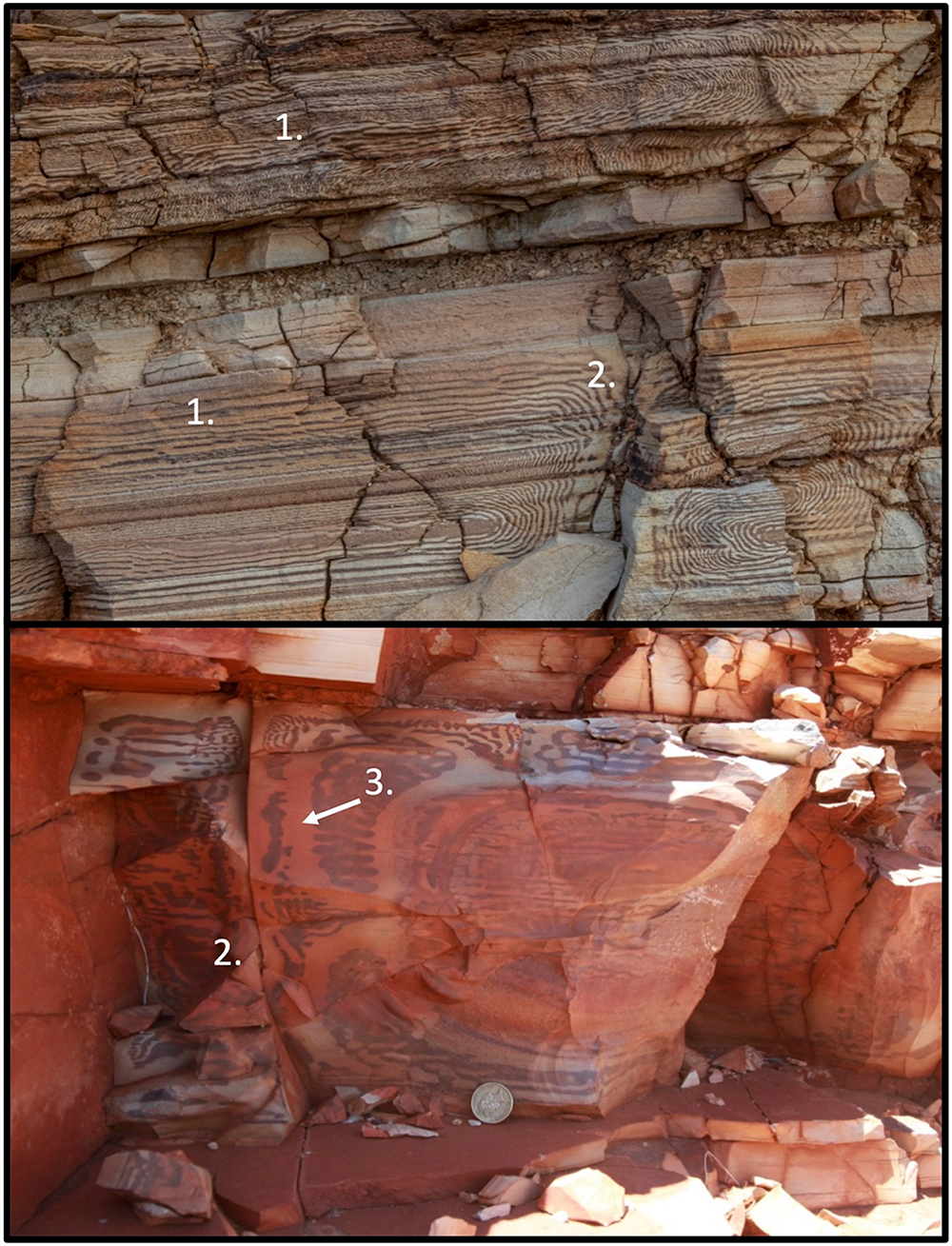
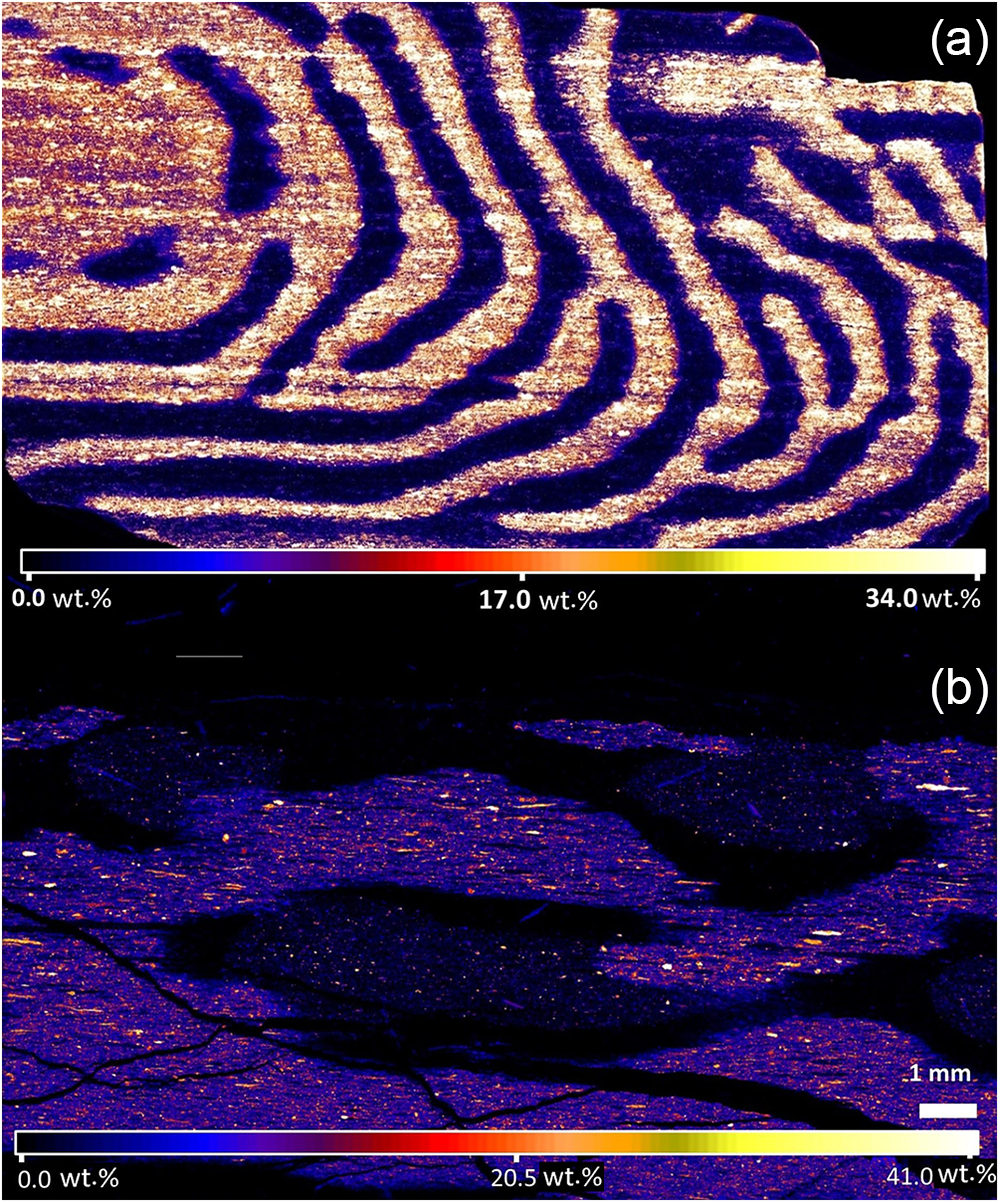
Print-stone patterns were observed in situ at all three outcrops as discrete layers of discontinuous banded structures (expressed as sheets in three dimensions; Fig. 4), with spot-like morphologies also observed (Fig. 3, bottom). Print-stone banding showed a high variability in bandwidth (ranging from <1 mm to 10 mm) and band-spacing at both outcrop and hand-sample scales and possessed a high frequency of band-splitting and band discontinuities, particularly in comparison to zebra rock. Also, unlike zebra rock, print-stone patterns regularly extended vertically into adjacent bedding, with the pattern wavelength changing across vertical strata (Fig. 5). Pattern morphology was, in some sections, strongly influenced by intercutting vertical joints and faults, leading to the development of distinctive, concentric ring-like structures (Fig. 5). At Wittenoom, the distribution of the iron-oxide pigment was also preferentially located along horizontal laminations, which could be observed in the XFM images of Fe in samples from this deposit (Fig. 6a). This phenomenon was not present at Hamersley Ridge or Great Northern Highway, as the patterned siltstone beddings at these locations were predominantly massive in character.
Two internal slices of the three-dimensional pattern morphology of print-stone sample WT-02 from Wittenoom, as determined by X-ray tomography.
Images of in situ print-stone patterns at Wittenoom (upper) and Hamersley Ridge (lower). Of note are the changes in pattern wavelength across the vertical axis (1), intercutting joints influencing pattern morphology (2), and the diffuse secondary banding underlying the primary pattern (3).

XFM images of the distribution of Fe in print stone. (a) Sample WT-4 from Wittenoom; (b) sample PS-L2-1 from Great Northern Highway.

At the Hamersley Ridge outcrop, a secondary pattern was observed overprinting the primary pigment (Fig. 5, bottom). These secondary bands were strongly red tinted and possessed a much longer wavelength and greater uniformity than the primary banding (Fig. 5). Following the convention of Abrajevitch et al. (Reference Abrajevitch, Pillans and Roberts2014), these bands will henceforth be referred to as the ‘uniform’ pattern, with the regular, primary banding to be referred to as either the ‘primary’ or ‘newsprint’ pattern.
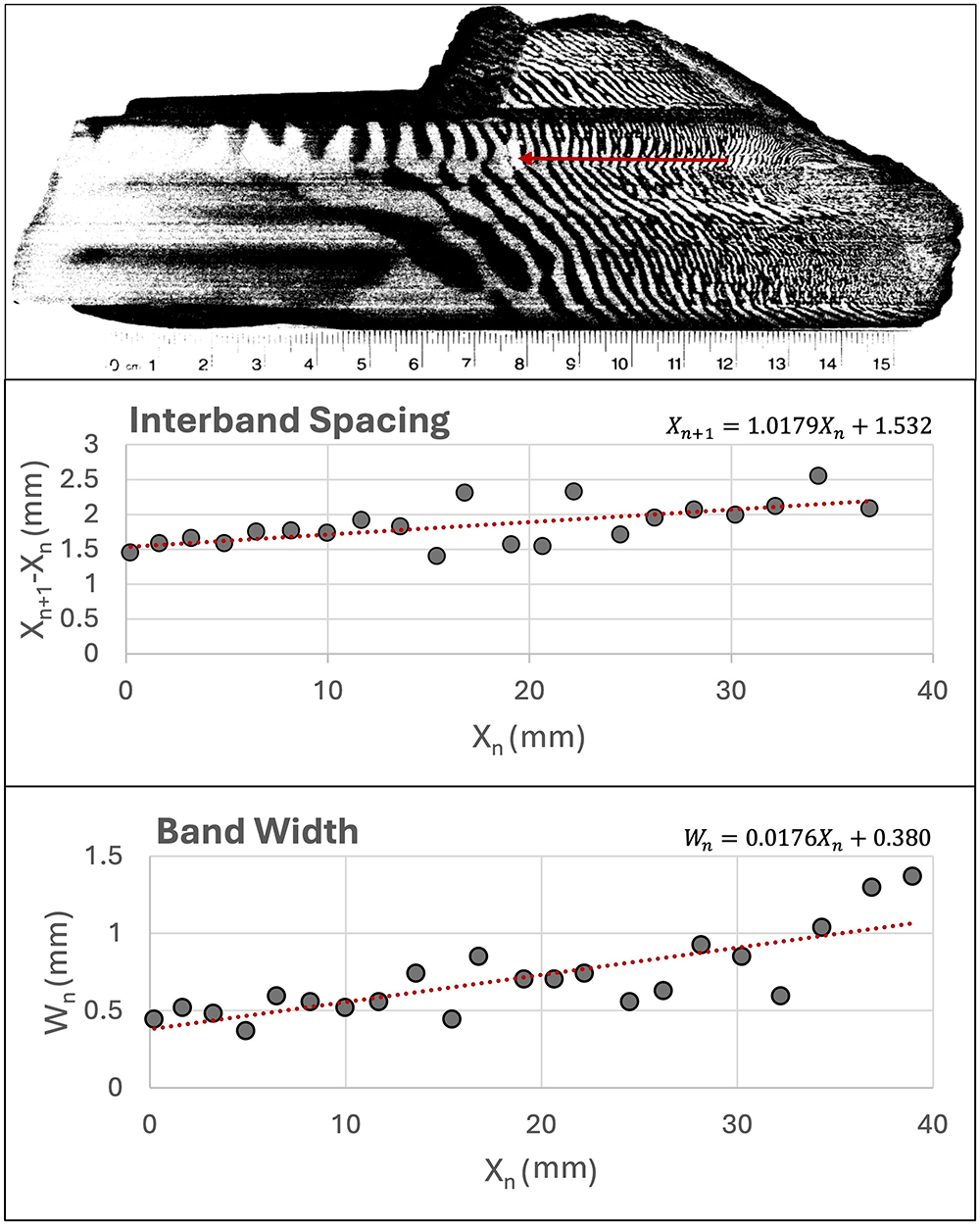
The primary ‘newsprint’ patterns at the Wittenoom outcrop exhibited regular increases in bandwidth and interband spacing parallel to the bedding direction (e.g. Fig. 7, upper), consistent with the spacing and width laws characteristic of Liesegang banding. Spatial analysis of the pattern within a print-stone sample from Wittenoom revealed a spacing coefficient of p = 0.018 ± 0.005, as per equation 1. The width and spacing of each individual band are presented in Fig. 7.
Spatial analysis data for print-stone sample WT07. Upper: sample WT07 after the application of colour thresholds to highlight the band position. The line across which the spacing and width of the bands was determined is marked with a red arrow. (Middle) Plot of the distance (Xn +1–Xn) between each band (Xn). (Lower) Plot of the width (Wn) of each band (Xn).

Mineralogy
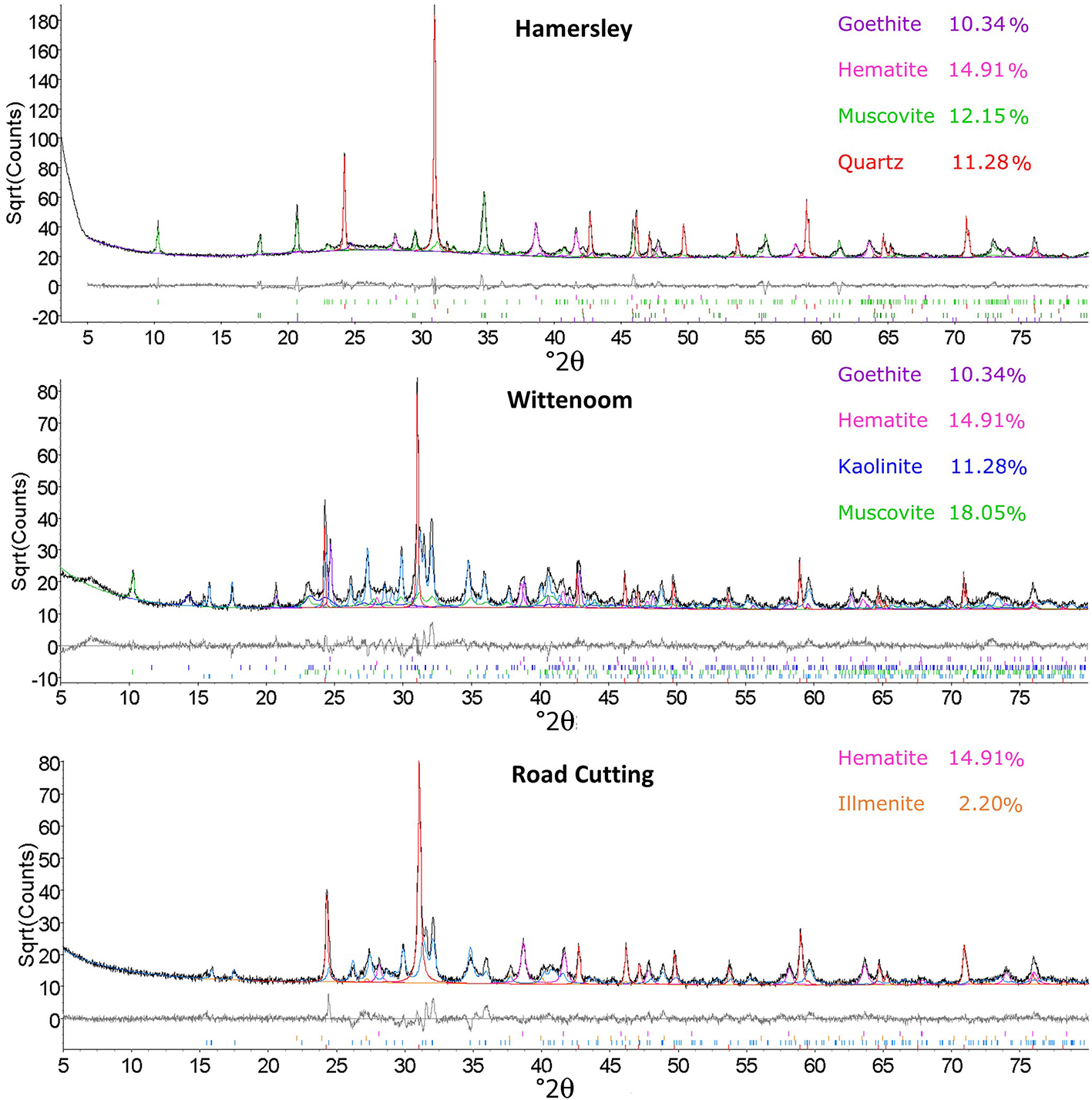
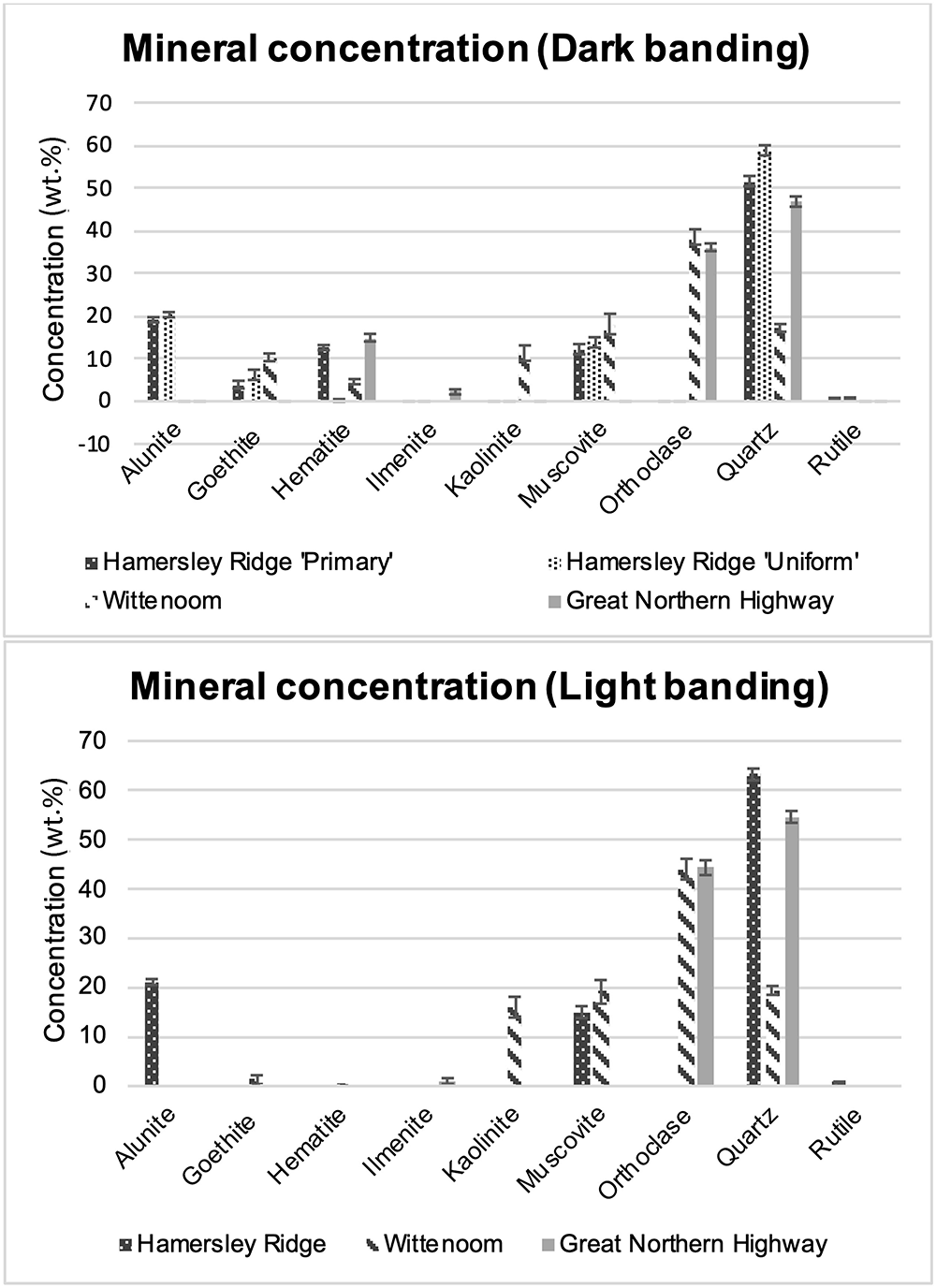
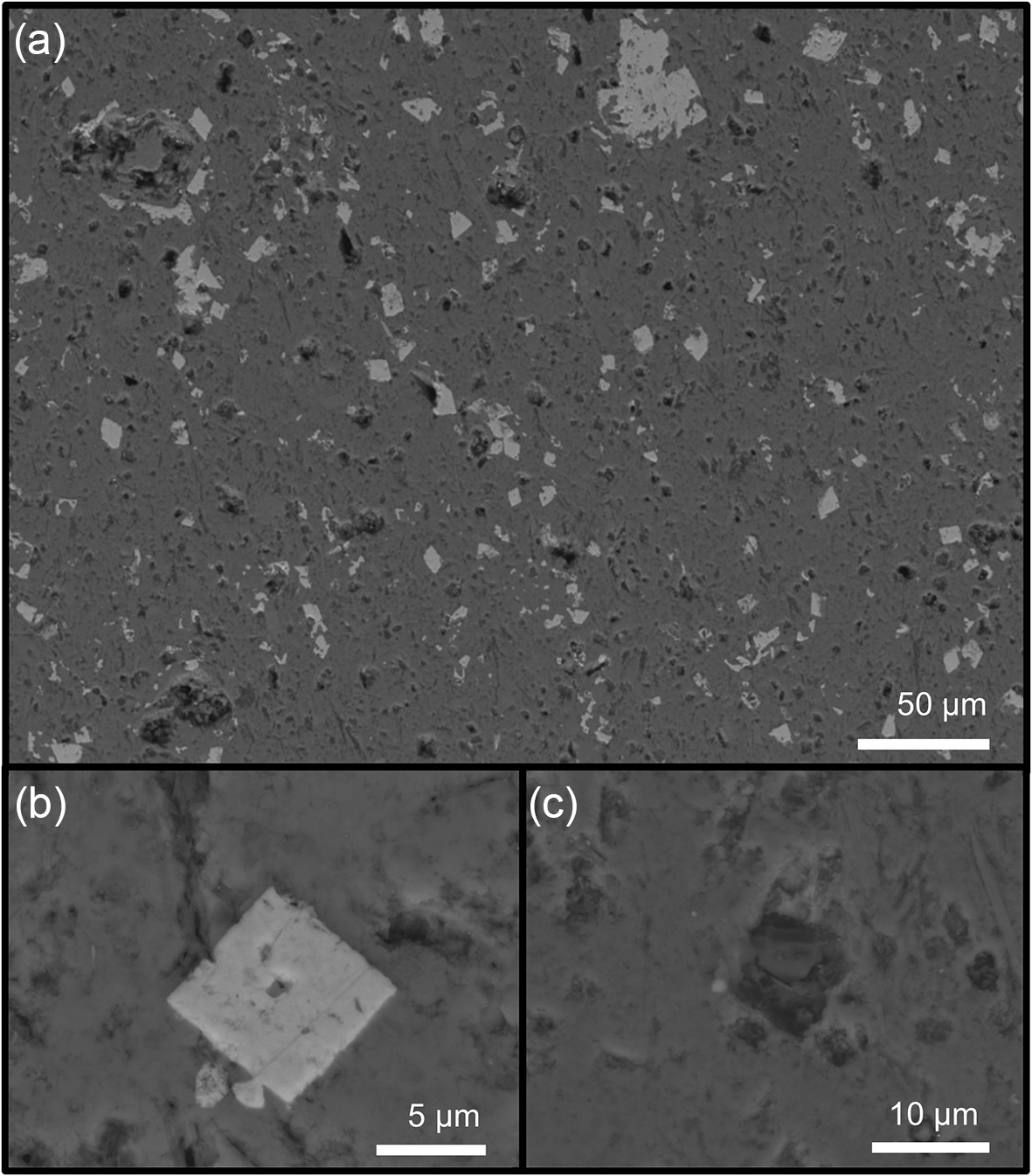
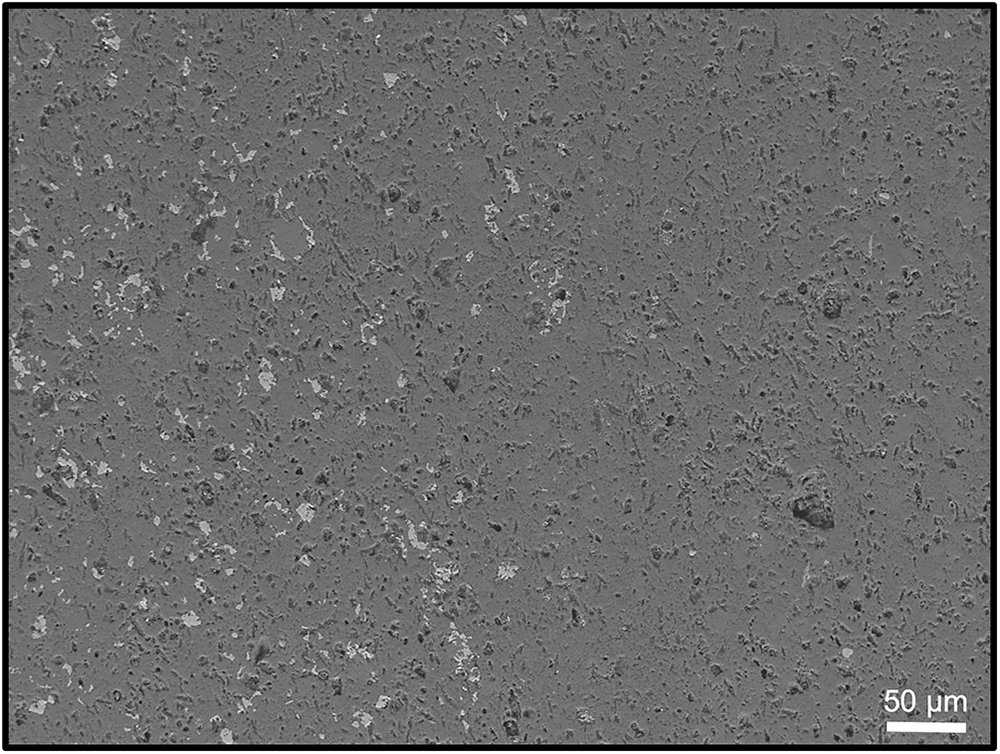
The composition of the print-stone iron-oxide pigment was examined using XRD, with representative Rietveld refinements for the primary bands of each outcrop provided in Fig. 8, and relative mineral abundances presented in Fig. 9. In all samples, iron oxide was mainly present as 5–10 μm grains of hematite and goethite, with each grain possessing a distinct cuboid morphology (Fig. 10a, b). As hematite and goethite grains could not be distinguished using the SEM, any morphological differences between the two phases could not be determined. Smaller quantities of dissolution voids were likewise present throughout the dark and light banding (Fig. 10a), with some voids also appearing cuboid (Fig. 10c). These voids did not appear to be distributed preferentially within either the dark or light banding (Fig. 11).
Representative Rietveld refinements from each of the three outcrops examined in this investigation. Concentrations expressed as wt.%, and intensities as square root of the total counts.

Abundances of mineral phases in the dark (upper) and light (lower) banding of print stone from each of the three examined outcrops, as determined by XRD Rietveld refinement. The mineralogy of the uniform bands in Hamersley Ridge are also included. Note that the calcite veins cutting Great Northern Highway were not sampled for this analysis. Uncertainties in the values given were derived using TOPAS (Coelho et al., Reference Coelho, Evans, Evans, Kern and Parsons2011).

Back-scattered electron (BSE) images showing the distribution and morphology of iron oxides and voids in print stone. (a) Cuboid hematite grains and dissolution voids in the dark banding. (b) Enlargement of a cuboid iron-oxide grain. (c) Cuboid dissolution void in the light banding. All BSE images obtained by SEM from sample CW-2 from the Hamersley Ridge deposit.

BSE image showing the interface between the dark (left) and light (right) banding of print stone, contrast-adjusted to highlight the heterogeneous distribution of iron oxides (white) and the uniform distribution of dissolution voids (black). The BSE image was obtained by SEM from sample CW-2 from the Hamersley Ridge deposit.

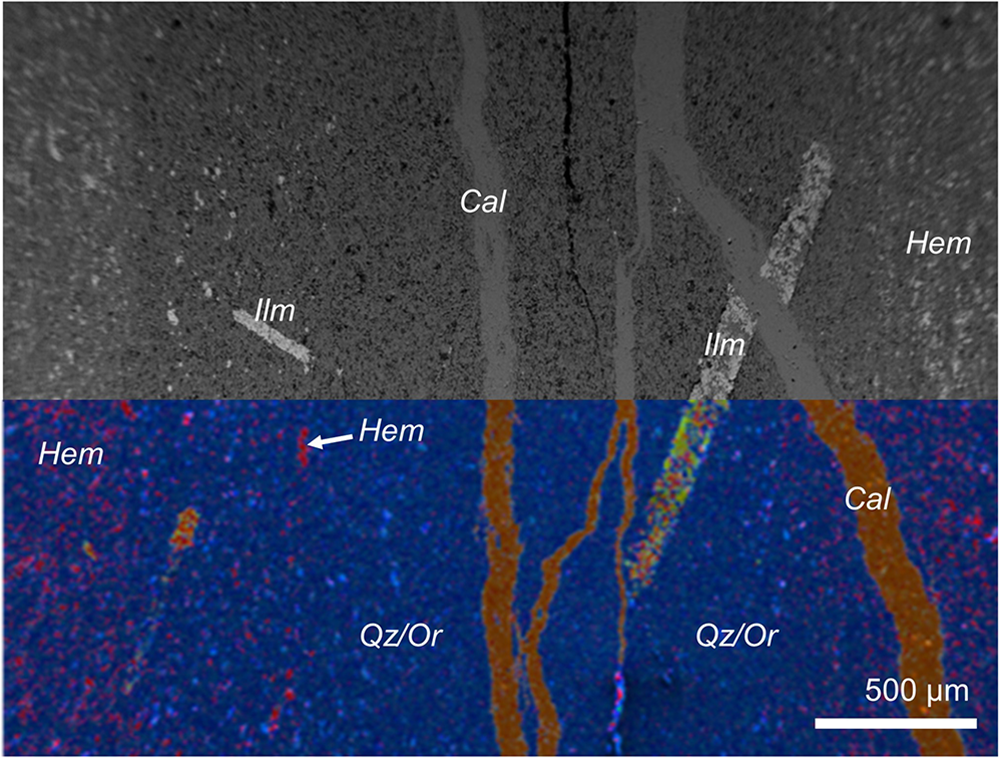
Excluding the iron-bearing pigment, the mineralogical composition of print stone showed no significant variation between the dark and light banding for a given outcrop. However, substantial differences were evident in the major (>5 wt.%) mineral phases between outcrops, varying from highly feldspathic assemblages (orthoclase + quartz ± muscovite ± kaolinite) at Wittenoom and Great Northern Highway to an alunite-dominated assemblage (alunite + quartz + muscovite) at Hamersley Ridge (Fig. 9). In both instances, the iron-oxide phases appeared to be texturally early with respect to the aluminosilicate mineral phases, including kaolinite and alunite. Further mineralogical differences were observed in print-stone samples from Great Northern Highway, where 0.2–1 mm long needle-shaped crystals of ilmenite were disseminated throughout the light and dark banding, bisected in places by crosscutting calcite veins (Fig. 12).
BSE (upper) and energy dispersive spectroscopy (EDS) (lower) composite image of a Great Northern Highway print stone showing the distribution of Fe (red), Ti (yellow), Ca (orange), Si (dark blue) and Al (light blue). Highlighted in this image are intercutting calcite veins (Cal), large ilmenite crystals (Ilm) and hematite pigment (Hem), interspersed within a matrix of quartz (Qz) and orthoclase (Or).

The composition of the uniform banding of Hamersley Ridge print stone was also analysed by XRD, showing a moderate abundance of goethite (∼5 wt.%) and a near absence of hematite (∼0.1 wt.%). All other mineral phases within the uniform banding were unchanged relative to the mineralogical composition of the light banding.
Geochemistry
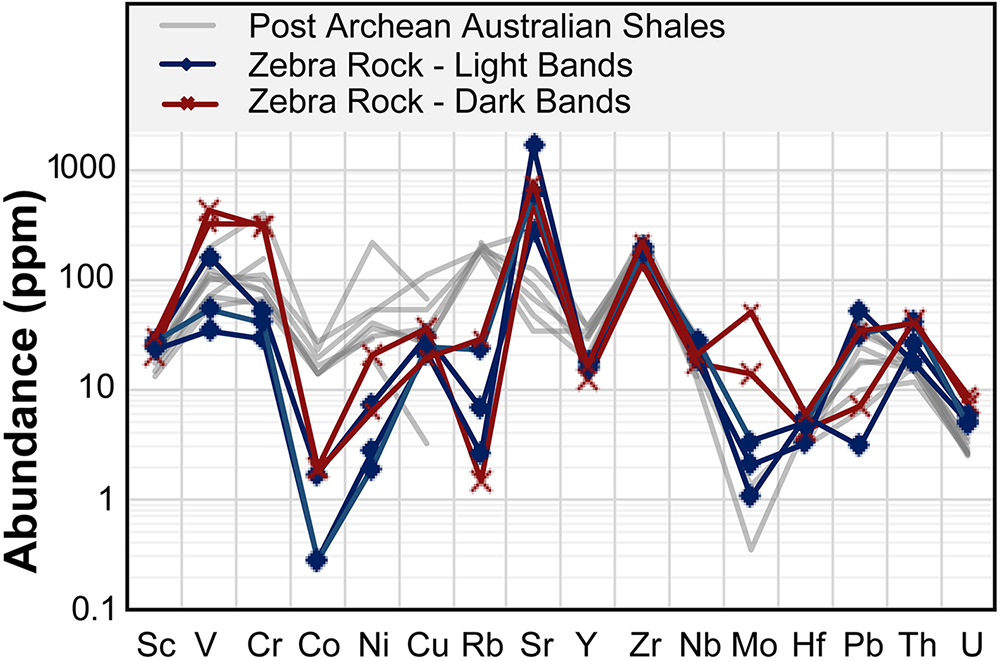
The XFM and laser-ablation-inductively coupled plasma-mass spectrometry analyses were used to identify heterogeneous trace element distributions between the light and dark banding of print stone. In comparison to eight typical post-Archean Australian shales (Taylor and McLennan, Reference Taylor and McLennan1985), print-stone exhibited consistent depletion of many trace metals, including Co, V, Cr, Ni, Sr, Y, Zr, Nb, Hf and Th (Fig. 13), with only Cu showing slight enrichment. No consistent differences between the dark and light banding were observed outside of Mo.
Abundance of specific non-REE trace elements in the dark (red) and light (blue) banding of all print-stone samples analysed by laser ablation inductively coupled plasma mass spectrometry (LA-ICP-MS) vs the chemical compositions of eight Post-Archean Australian shales (grey) from Taylor and McLennan (Reference Taylor and McLennan1985).

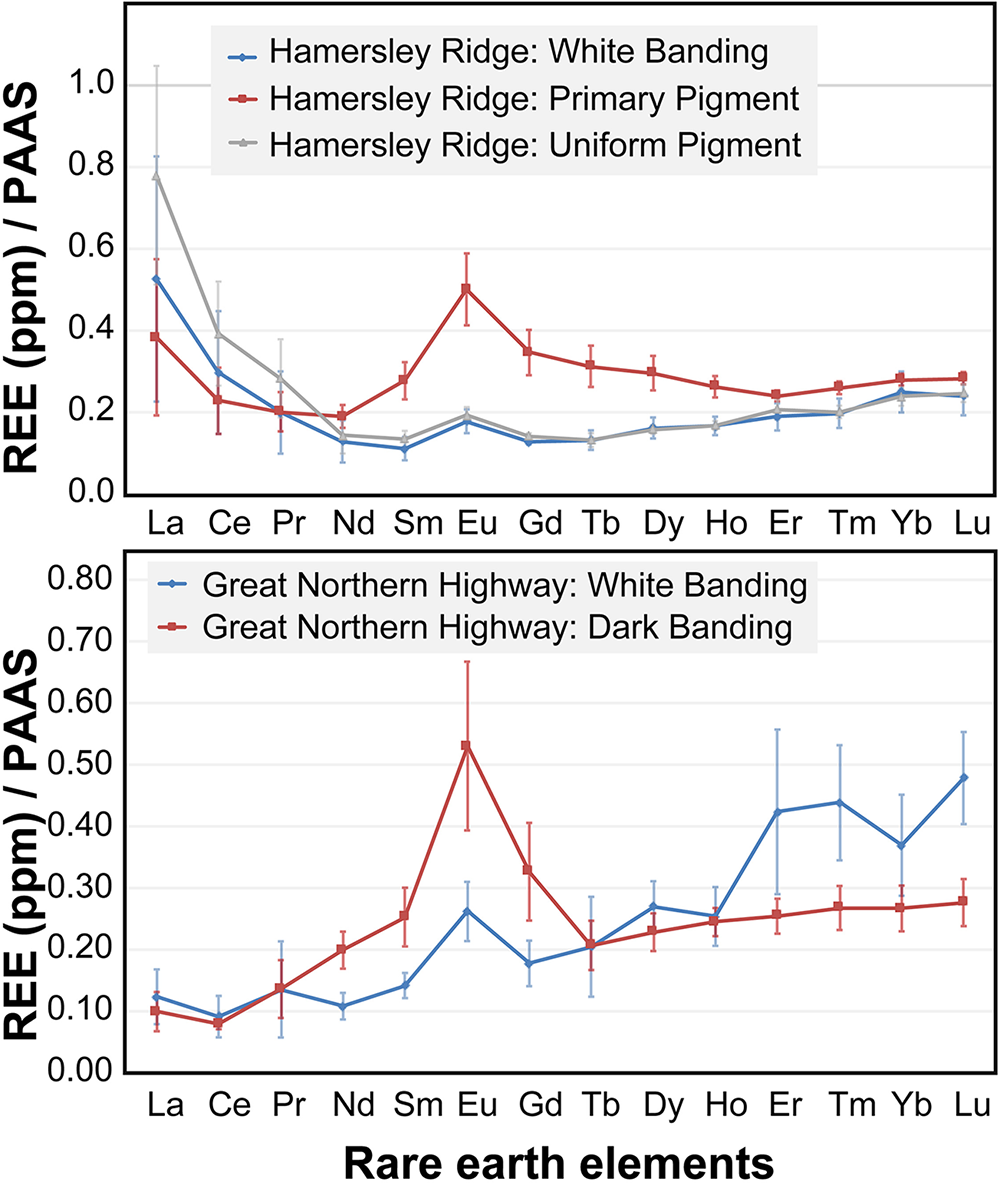
The distributions of REEs between Hamersley Ridge and Great Northern Highway are compared in Fig. 14. The REE abundances in print stone are consistently well below the Post Archean Australian Shale (PAAS) values reported by Taylor and McLennan (Reference Taylor and McLennan1985). Positive Eu anomalies are evident in both outcrops, whereas a strong enrichment of light REE relative to mid- and heavy-REE is observed at Hamersley Ridge. At Hamersley Ridge, the uniform and light banding shared a consistent REE distribution within uncertainties, while the dark, ‘newsprint’ pigment exhibited a significantly larger Eu anomaly, with further enrichment of middle REEs from Sm to Ho when compared to the white and uniform bandings. Relative to the white banding, a similar enhancement of the Eu anomaly is also observed in the dark banding of Rock Cutting print stone, alongside a general depletion of Er, Tm, Yb and Lu.
Average abundance of rare earth elements (REEs) normalised to Post Archean Australian Shale (PAAS; Taylor and McLennan, Reference Taylor and McLennan1985) in the white, primary and uniform pattern of print stone from Hamersley Ridge and Great Northern Highway. Abundance obtained as the average across three sampling locations. The uncertainty of one standard deviation is represented by the error bars. Samples analysed: CW2 (upper) and PS-L2-1 (lower).

Discussion
Pattern morphology consistent with Liesegang banding
Although both print stone and zebra rock are defined by series of regular, repeating bands that can rarely also manifest as spot- or rod-like morphologies (Figs 3 and 5), the pattern of print stone is immediately distinguishable from that of zebra rock by its typically lesser abundance of iron oxides, decreased band order and regularity, a much greater occurrence of band discontinuities and forking, and the extension of banding vertically into adjacent strata. Unlike zebra rock, print stone also exhibits the influence of intercutting joints upon pattern morphology (Fig. 5), indicating that print-stone pattern development was not a near-surface, pedogenic process but rather developed well after lithification.
Strong evidence of the Liesegang phenomenon was observed in Wittenoom print-stone samples where the banding was orientated perpendicular to the bedding plane. In these samples, the band width and spacing coefficient increase with increasing distance from the pattern core, in a manner consistent with the Liesegang spacing and width laws (Fig. 7). The spacing coefficient in Wittenoom print stone is 0.018 ± 0.005 (Fig. 7), less than the three non-zero spacing coefficients measured in zebra rock samples (0.054–0.071; Liu et al., Reference Liu, Calo, Regenauer‐Lieb and Hu2023), but within the general range established by laboratory experiments and computational modelling (0–0.5; e.g. Antal et al., Reference Antal, Droz, Magnin, Racz and Zrinyi1998; Thomas et al., Reference Thomas, Varghese and Lagzi2011; Yatsuda et al., Reference Yatsuda, Tsushima, Fang and Nabika2023). The initial conditions which define the spacing coefficient in Liesegang banding are not yet fully understood, but low diffusion coefficient ratios of the inner to outer reactants, high reactant concentrations and a low degree of super-saturation have all been determined to reduce the spacing coefficient (Büki et al., Reference Büki, É and Zrínyi1995). The spacing coefficient of Wittenoom print-stone banding oriented parallel to bedding (i.e. extending vertically up and down the formation) could not be quantified due to complex changes to band morphology probably induced by variations in host-rock permeability (e.g. Fig. 5).
Mineralogical evolution in print stone
The pigment of the primary print-stone banding is composed entirely of variable quantities of hematite and goethite, with all other mineral phases appearing approximately homogeneous between the dark and light banding. By contrast, the uniform banding found in Hamersley Ridge print stone is almost exclusively composed of low to moderate quantities of goethite, as also reported by Abrajevitch et al. (Reference Abrajevitch, Pillans and Roberts2014). The distinct 5–10 μm cuboid morphology of hematite and goethite in the primary pattern (Fig. 10) suggests strongly that print-stone banding was originally emplaced as pyrite.
Although absent from the print stone samples studied, pyrite is abundant within the Mount McRae Shale in two contrasting modes: large, polycrystalline pyrite nodules up to 10 cm in size, and disseminated, euhedral pyrite ranging from 10 to 20 μm in size (Haruna et al., Reference Haruna, Hanamuro, Uyeda, Fujimaki and Ohmoto2003; Slotznick et al., Reference Slotznick, Johnson, Rasmussen, Raub, Webb, Zi, Kirschvink and Fischer2022). No evidence of past or present nodular pyrite, thought to be syn-depositional in origin (Slotznick et al., Reference Slotznick, Johnson, Rasmussen, Raub, Webb, Zi, Kirschvink and Fischer2022), is observed in print stone. By contrast, micrometre-scale, euhedral pyrite within the Mount McRae Shale is considered to be hydrothermal on the basis of textural relationships and extensive Mo- and As enrichments (Slotznick et al., Reference Slotznick, Johnson, Rasmussen, Raub, Webb, Zi, Kirschvink and Fischer2022). This disseminated pyrite is directly comparable in morphology, grain size and Mo-enrichment, to the pseudomorphic hematite in print stone (Fig. 13), suggesting similar hydrothermal origins. Constraining the precise age and conditions of pyrite emplacement is difficult to ascertain due both to the absence of preserved pyrite in print stone and the pervasive hydrothermal activity within the Hamersley Group during the early Palaeoproterozoic (e.g. Haruna et al., Reference Haruna, Hanamuro, Uyeda, Fujimaki and Ohmoto2003; Slotznick et al., Reference Slotznick, Johnson, Rasmussen, Raub, Webb, Zi, Kirschvink and Fischer2022; Rasmussen et al., Reference Rasmussen, Fletcher, Muhling, Thorne and Broadbent2007). The ages of hydrothermal pyrite in veins elsewhere in the Mount McRae Shale have been determined as 1.66, 2.05 and 2.20 Ga (U–Pb isotope methods; Slotznick et al., Reference Slotznick, Johnson, Rasmussen, Raub, Webb, Zi, Kirschvink and Fischer2022). The temperature and pH during original hydrothermal alteration are likewise difficult to quantify. However, the presence of hydrothermal crocidolite (∼150,000 tons of this fibrous variety of riebeckite, Na2Fe2+3Fe3+2Si8O22(OH)2, were mined between 1937 and 1966; Western Australian Government, 2006) underlying the print stone deposit at Wittenoom suggests exposure of that section of the McRae Shale to large quantities of moderately hot hydrothermal fluids (T ∼130°C), with possible pH values ranging from near-neutral (pH 6.5) to moderately alkaline (Miyano and Klein, Reference Miyano and Klein1983). Given the common association of euhedral pyrite with crocidolite (Miyano and Klein, Reference Miyano and Klein1983) and the close geographical proximity of print stone and crocidolite deposits at Wittenoom, it is considered likely that crocidolite and patterned pyrite were emplaced concurrently during the same hydrothermal event.
Replacement of the pyrite by hematite probably occurred much later, during the exposure of the patterned bedding to oxidising conditions. This oxidation probably took place either in the Late Carboniferous (∼325–310 Ma) or in the Mesoproterozoic (∼1.5 Ga), based on the iron-oxide palaeopole data from Abrajevitch et al. (Reference Abrajevitch, Pillans and Roberts2014). The kaolinite and alunite phases may also have formed during this period, arising from the acidic alteration of host-rock orthoclase by sulfuric acid, an expected by-product of pyrite oxidation. The identification of carbonates (siderite, dolomite, calcite and ankerite) and extant pyrite elsewhere in the McRae Shale (Trendall and Blockley, Reference Trendall and Blockley1970; Raiswell et al., Reference Raiswell, Reinhard, Derkowski, Owens, Bottrell, Anbar and Lyons2011), as well as the apparent absence of alunite and kaolinite in those same lithologies, suggests that the oxidation of pyrite and the associated acidic alteration of orthoclase was not pervasive throughout the entire formation.
The formation of the secondary, goethite-rich, ‘uniform’ banding overprinting the pattern at Hamersley Ridge has been ascribed a much later age of 15–25 Ma and is considered a result of goethite precipitation due to surface weathering (Abrajevitch et al., Reference Abrajevitch, Pillans and Roberts2014). As such, the development of the secondary banding can be considered unrelated to the emplacement of the primary ‘newsprint’ pattern.
Geochemical evidence of hydrothermal origin of the pattern
The enhancement of the positive Eu anomaly in the dark bands of primary print-stone patterns suggests that the emplacement of the iron-bearing pigment arose during a period of high Eu mobility, attributed to the predominance of Eu2+ over the less-soluble Eu3+. At room temperature, Eu2+ is unstable in aqueous solution; however, the stability of Eu2+ relative to Eu3+ increases with increasing temperature, and Eu2+ becomes dominant under mildly reducing conditions (sulfate/bisulfide coexistence) above ∼200°C (Liu et al., Reference Liu, Etschmann, Migdisov, Boukhalfa, Testemale, Muller, Hazemann and Brugger2017). The reduction of Eu3+ to Eu2+ under reducing conditions at elevated temperatures can explain the increase in the strength of the Eu anomaly. For this reason, a positive Eu anomaly is generally interpreted as an indicator of a hydrothermal component, and is demonstrated, for example, by the strong positive Eu anomaly found in many modern hydrothermal vent fluids (e.g. Michard and Albarede, Reference Michard and Albarede1986; Campbell et al., Reference Campbell, Bowers, Measures, Falkner, Khadem and Edmond1988; Hinkley and Tatsumoto, Reference Hinkley and Tatsumoto2012). However, it is also possible that positive Eu anomalies were derived from sedimentation in Archean oceans, which may have been Eu-enriched due to low oxygen levels preventing the scavenging of vent-emitted Eu by co-precipitation with Fe oxyhydroxides (Olivarez and Owen, Reference Olivarez and Owen1991; Sugahara et al., Reference Sugahara, Sugitani, Mimura, Yamashita and Yamamoto2010). As such, though the Eu geochemistry of print stone is consistent with a hydrothermal origin, this cannot be considered diagnostic on its own.
Unlike in the primary banding, no changes in the magnitude of the Eu anomaly are detected between the goethite-rich uniform banding and the adjacent light banding of Hamersley Ridge print stone (Fig. 14, top). Indeed, the REE contents of the uniform banding remained largely unchanged in comparison to the light banding, with the exception of minor enrichment of La, Ce and Pr. The absence of relative Eu enrichment suggests that the uniform bands in Hamersley Ridge print stone were probably not emplaced during the same period as the primary bands and are probably not hydrothermal in origin.
Trace elements are significantly depleted relative to PAAS, with smaller average abundances of most heavy metals and all REEs (Figs 13 and 14). A notable exception to this is Rb, which exhibits abundances on par with other Australian shales (Taylor and McLennan, Reference Taylor and McLennan1985) and over an order of magnitude greater than in zebra rock (Coward et al., Reference Coward, Slim, Brugger, Wilson, Williams, Pillans and Maksimenko2023). Also of note is the substantial depletion of Sr when compared to both zebra rock and other Australian shales, implying the absence of svanbergite and other Sr-bearing aluminium-phosphate-sulfate (APS) minerals. A low Rb/Sr ratio, like that observed in zebra rock (0.003–0.04; (Coward et al., Reference Coward, Slim, Brugger, Wilson, Williams, Pillans and Maksimenko2023), is typically indicative of advanced argillic alteration due to acidic leaching of Rb, as well as the fixing of Sr within APS minerals (Hikov, Reference Hikov2004; Hikov et al., Reference Hikov, Velinova, Catherine and Kunov2017). By contrast, the Rb/Sr ratio of print stone ranges from 2 to 28, suggesting that these outcrops lacked the high acidity necessary to leach Rb, as well as the oxidising conditions normally required for the precipitation of APS phases.
Comparison with zebra rock
Print stone shares many morphological and mineralogical similarities with Ediacaran-age zebra rock from the East Kimberley region of Western Australia, raising the possibility that both patterned siltstones may have developed through related mechanisms. Indeed, the formation of zebra rock through hydrothermally induced Liesegang banding has been proposed by several recent studies (Loughnan and Roberts, Reference Loughnan and Roberts1990; Kawahara et al., Reference Kawahara, Yoshida, Yamamoto, Katsuta, Nishimoto, Umemura and Kuma2022; Coward et al., Reference Coward, Slim, Brugger, Wilson, Williams, Pillans and Maksimenko2023; Yatsuda et al., Reference Yatsuda, Tsushima, Fang and Nabika2023).
Unlike other examples of iron-oxide banding, zebra rock and print-stone patterns are both well defined and highly ordered, with sharp band edges, a similar spacing coefficient, and a wide variation of pattern morphologies, including spots and rods. Together with their morphological similarities, print stone and zebra rock also possess many of the same mineral phases, most notably hematite, alunite, kaolinite and muscovite (Loughnan and Roberts, Reference Loughnan and Roberts1990; Kawahara et al., Reference Kawahara, Yoshida, Yamamoto, Katsuta, Nishimoto, Umemura and Kuma2022; Coward et al., Reference Coward, Slim, Brugger, Wilson, Williams, Pillans and Maksimenko2023). The presence of alunite and kaolinite in print stone and zebra rock suggest that both patterned siltstones were probably exposed to acid-sulfate solutions. However, the absence of feldspar in zebra rock, alongside the increased abundance of hematite, alunite, kaolinite and APS minerals, and a much lower Rb/Sr ratio (Coward et al., Reference Coward, Slim, Brugger, Wilson, Williams, Pillans and Maksimenko2023), suggests that zebra rock experienced more oxidising and acidic conditions during this period relative to print stone.
Perhaps the greatest difference between the two banded siltstones is the morphology of the iron-oxide pigment within the dark banding. In zebra rock, the pigment is composed of texturally late aggregates of 0.2–1 μm hexagonal hematite platelets, distributed within the interstitial spacing between larger quartz, kaolinite and alunite grains. In print stone, the pigment is instead composed of 5–10 μm cubic grains of texturally early, pseudomorphic hematite and goethite. The significant differences between the grain size, morphology, and textural relationships of the iron-oxide phase of both rocks suggests that though the underlying mechanism of self-organisation may be similar, the banding of print stone and zebra rock probably developed under dissimilar geochemical conditions.
Pattern formation
The changes in pattern morphology around intercutting joints (Fig. 5) and the deposition of iron oxides along bedding planes (Fig. 6) strongly suggest that print-stone banding occurred during iron-rich fluid infiltration through joint and pore networks. The formation of banding during this process was probably the result of the Liesegang phenomenon, as evidenced by the adherence of the pattern to Liesegang spacing laws when constrained within relatively homogenous bedding (Fig. 7).
The probable pyritic origin of the hematite pigment, in conjunction with its strong, positive Eu anomaly and the close association with hydrothermal crocidolite at Wittenoom, suggest that the precursor pyrite phase was deposited by strongly reducing, slightly acidic to alkaline, sulfide-bearing hydrothermal fluids (T ≈ 130°C) during the Early Palaeoproterozoic. Later, during the Mesoproterozoic or the Late Carboniferous, erosion of overlying formations facilitated the oxidation and replacement of pyrite by pseudomorphic hematite and goethite, which in turn probably initiated the partial acidic alteration of orthoclase to produce kaolinite and alunite. The development of Liesegang bands in print stone probably occurred during one of these two time periods, i.e. during pyrite formation in the Early Palaeoproterozoic, or during pyrite oxidation in the Mesoproterozoic/Late Carboniferous.
Of the alternatives, a Mesoproterozoic/Late Carboniferous formation is considered less compelling. In this instance, self-organisation of the iron-bearing phase would have been initiated by the oxidation of uniformly distributed pyrite, producing an acidic and possibly ferric solution. As this fluid diffuses through the formation, it may react with, and be neutralised by, carbonate-rich sediments, as found elsewhere in Mount McRae Shale (e.g. Raiswell et al., Reference Raiswell, Reinhard, Derkowski, Owens, Bottrell, Anbar and Lyons2011). In this case, neutralisation of the acidic fluids by carbonate dissolution induces the precipitation of dissolved ferric iron (which is relatively insoluble at pH >3) into available pore spaces (including pyritic dissolution voids) as iron oxides or oxyhydroxides. Similar mechanisms have been proposed for the formation of hematite Liesegang banding in other sediments, including zebra rock (Kawahara et al., Reference Kawahara, Yoshida, Yamamoto, Katsuta, Nishimoto, Umemura and Kuma2022; Coward et al., Reference Coward, Slim, Brugger, Wilson, Williams, Pillans and Maksimenko2023). However, despite similarities to current theories regarding pattern formation in zebra rock, this hypothesis is considered less likely due to two observations. Firstly, the iron-oxides in print-stone appear texturally early with respect to alunite and kaolinite (which probably formed from silicate–acid sulfate interactions arising as a direct by-product of pyrite oxidation) and are not observed within the interstitial spacing between alunite, kaolinite and quartz grains (Fig. 10a), unlike in zebra rock (Coward et al., Reference Coward, Slim, Brugger, Wilson, Williams, Pillans and Maksimenko2023). This relationship is not consistent with the extensive mobilisation, diffusion and reprecipitation of iron required to form Liesegang banding through the oxidation and dissolution of pyrite. Secondly, though semi-cubic dissolution voids were observed in print stone (Fig. 10c), these did not appear to be preferentially distributed within the light banding, which would be expected to occur if the majority of dissolution voids within the dark banding had been infilled by iron-oxide precipitates. Rather, however, pyritic dissolution voids were observed to be distributed uniformly throughout both the dark and light banding (Fig. 11). Furthermore, the dissolution voids in both the light and dark banding appear to be, on average, smaller and less prevalent than the pseudomorphic iron oxides (Figs 10 and 11), suggesting an origin unrelated to the pattern-forming pyrite phase.
The alternative process is that self-organisation in print stone arose during the original deposition of hydrothermal pyrite in the Early Proterozoic. The periodic deposition of pyrite into banding has been recognised previously in sapropelic sediments in the Eastern Mediterranean by Passier et al. (Reference Passier, Middelburg, van Os and de Lange1996). Subsequent modelling by Bektursunova and L’Heureux (Reference Bektursunova and L’Heureux2011) identified this banding as probably resulting from the Liesegang mechanism, finding that the counter-diffusion of ferrous iron and hydrogen sulfides resulted in pyritic banding resembling Liesegang patterns. Note that this mechanism can happen up to high temperatures, e.g. in skarn deposits at contact metamorphic conditions (e.g. Ciobanu and Cook, Reference Ciobanu and Cook2004). We hypothesise that a similar reaction may have arisen in the Mount McRae Shale through the infiltration of a reducing, sulfidic hydrothermal fluid into sediments bearing uniformly distributed Fe(II) mineral phases such as siderite, which is prevalent throughout the formation in the form of sideritic BIFs (Raiswell et al., Reference Raiswell, Reinhard, Derkowski, Owens, Bottrell, Anbar and Lyons2011). Counter-diffusion of the ferrous iron and sulfide-rich solutions could have resulted in pyritic Liesegang bands, with later oxidation occurring without significant iron mobilisation and resulting in the direct replacement of banded pyrite by pseudomorphic hematite and goethite.
Conclusions
This study reached several conclusions regarding pattern development in Pilbara print stone, as summarised below:
(1) As evidenced by general band morphology and adherence of the pattern to the spacing law, periodic self-organisation in print stone probably arose due to the occurrence of the Liesegang phenomenon.
(2) A strong, positive Eu anomaly and distinct cuboid morphology of the iron-oxide pigment, alongside evidence of iron deposition along fluid transport pathways, suggest that print-stone Liesegang banding was initiated by the infiltration of a sulfidic, near-neutral hydrothermal fluid into ferrous, feldspathic sediment, resulting in periodic pyrite precipitation. This pyrite was later oxidised, forming pseudomorphic hematite and goethite. This hypothesis is further supported by the presence of hydrothermal pyrite elsewhere in the McRae Shale, and extensive hydrothermal crocidolite underlying print stone beds at Wittenoom. An alternative hypothesis, that Liesegang banding was instead initiated during pyrite oxidation, was also considered. However, this mechanism is considered unlikely due to both the early precipitation of the iron-oxide phase relative to kaolinite and alunite, and inconsistencies in the size, abundance, and expected distribution of observed cuboid-dissolution voids relative to the pseudomorphic iron-oxide phase.
(3) Pattern formation in print stone occurred in the early Palaeoproterozoic, at a time of extensive hydrothermal activity in the Mount McRae Shale. The oxidation of pyrite and replacement by hematite occurred later, either in the Mesoproterozoic or Late Carboniferous. Pyrite oxidation produced acidic, sulfate-rich fluids, that are responsible for the partial alteration of detrital orthoclase, leading to the formation of alunite and kaolinite.
(4) The close morphological and mineralogical similarities between print stone and East Kimberley zebra rock provides further support for the hypothesis that zebra rock may have also formed via the process of hydrothermally mediated Liesegang banding. However, the positive Eu anomaly, high Rb/Sr ratio, and distinctive cuboid morphology of the iron-oxide phase suggest that these hydrothermal fluids were probably less acidic and more reducing than those responsible for pattern formation in zebra rock.
Acknowledgements
We acknowledge the use of instruments and scientific and technical assistance at the Monash Centre for Electron Microscopy (MCEM) at Monash University, the Environmental Economic Geology Laboratory at the University of Alberta, the Victorian Node of Microscopy Australia, and the use of facilities within the Monash X-ray Platform. Parts of this research were also undertaken on the XFM and Imaging and Medical beamlines at the Australian Synchrotron, part of the Australian Nuclear Science and Technology Organisation (ANSTO). We thank Dr Helen Brand and Dr David Paterson for technical help and expertise provided at the Australian Synchrotron, Baolin Wang for his assistance in obtaining XRD patterns at the University of Alberta. The paper benefited from insightful comments from Huan Li (Central South University, China) and an anonymous reviewer.
Funding statement
We acknowledge financial support from an Australian Government Research Training Program (RTP) Scholarship (A.C.).
Competing interests
The authors declare none.

 Open access

