

While parties in single-party governments can make policy decisions autonomously, governing in coalitions requires coordination and compromise as coalition parties typically have diverging policy preferences. If coalition parties simply pursued their own policy goals without considering the preferences of their partners, severe intra-cabinet conflict would result, possibly ultimately leading to early cabinet breakdown (Lupia and Strøm Reference Lupia and Strøm1995; Saalfeld Reference Saalfeld, Strøm, Müller and Bergman2008). An important instrument that is frequently used by coalition governments in order to prevent coalition infighting and to maintain the stability of the cabinet is coalition agreements (Falcò-Gimeno Reference Falcò-Gimeno2014; Müller and Meyer Reference Müller and Meyer2010). However, Wolfgang C. Müller and Kaare Strøm (Reference Müller and Strøm2008) demonstrated that the length of coalition agreements differs tremendously across cabinets. How can this considerable variation be explained? In this article, we argue that portfolio allocation plays an important role in the design of coalition agreements, which explains why some coalition agreements are much more comprehensive than others.
Coalition agreements typically entail a description of the policy reforms the cabinet seeks to enact during its time of office and procedural rules designed to regulate the relationship between coalition parties (Müller and Strøm Reference Müller and Strøm2000, Reference Müller and Strøm2008; Strøm and Müller Reference Strøm and Müller1999b). Even though coalition agreements are not legally binding, they are important constraints on the behaviour of cabinet parties as coalition parties can be publicly blamed for not complying with the coalition agreement. Catherine Moury (Reference Moury2013) has, for example, demonstrated that coalition agreements significantly constrain ministers as most of the policy reforms suggested in coalition agreements are enacted once the cabinet is in office. Accordingly, Müller and Strøm (Reference Müller, Strøm, Strøm, Müller and Bergman2008: 170) argue that coalition agreements are ‘the most binding, written statements to which the parties of a coalition commit themselves, that is, the most authoritative document that constrains party behavior’ (emphasis in original).
In recent years, several authors have started to analyse why cabinets make use of coalition agreements and why their length varies between governments. Müller and Strøm (Reference Müller, Strøm, Strøm, Müller and Bergman2008), for instance, show that the likelihood that cabinets negotiate a coalition agreement increases with preference divergence among coalition parties, the uncertainty that cabinet parties face and the level of opportunistic behaviour. Indridi Indridason and Gunnar Kristinsson (Reference Indridason and Kristinsson2013) have further demonstrated that not only preference divergence, but also the level of hierarchy – understood as the power of the prime minister in comparison to the other members of the coalition within a cabinet – influence the length of coalition agreements: the more superior the institutional powers of the prime minister vis-à-vis the other coalition partners, the shorter the coalition agreements. Jason Eichorst (Reference Eichorst2014) has shown that not only policy, but also electoral motivations are relevant when writing a coalition agreement. Coalition parties tend to include low saliency issues in agreements when parties are less divided, while they include high saliency issues on more divisive policy dimensions. Additionally, Albert Falcò-Gimeno (Reference Falcò-Gimeno2014) has demonstrated that preference tangentiality matters for the length of coalition agreements. He shows that coalition parties that care about the same policy issues tend to write longer agreements. Finally, Shaun Bowler et al. (Reference Bowler, Bräuninger, Debus and Indridason2016) show that cabinets write shorter coalition agreements when intra-cabinet conflict is high, but at the same time they are more likely to adopt procedures for conflict resolution. While these studies have made an important contribution by shedding light on why cabinets negotiate coalition agreements, an important piece of the puzzle is still missing: the effect of portfolio allocation.
During coalition negotiations, coalition parties not only bargain over the joint policy agenda, they also fight fiercely over the distribution of ministerial portfolios, a process that can last several weeks or even months (Ecker and Meyer Reference Ecker and Meyer2017). Accordingly, there is a vast literature explaining portfolio allocation among coalition parties (see e.g. Bäck et al. Reference Bäck, Debus and Dumont2011a; Browne and Franklin Reference Browne and Franklin1973; Debus Reference Debus2008; Falcò-Gimeno Reference Falcò-Gimeno2012; Laver and Schofield Reference Laver and Schofield1990; Warwick and Druckman Reference Warwick and Druckman2006, Reference Warwick and Druckman2001). Quantitative portfolio allocation research suggests that coalition parties receive their ministerial posts in close proportion to their parliamentary seats, which is famously denoted as ‘Gamson's Law’ (Gamson Reference Gamson1961). Several studies have shown that the relationship between parliamentary seat share and the share of ministerial portfolios parties obtain in coalition cabinets is indeed quite strong (see e.g. Browne and Franklin Reference Browne and Franklin1973; Warwick and Druckman Reference Warwick and Druckman2006).
Qualitative portfolio allocation, on the other hand, argues that parties do not only care about the number of portfolios, it is also important which portfolios they receive because they prioritize some policy issues over others (see e.g. Bäck et al. Reference Bäck, Debus and Dumont2011a; Laver and Schofield Reference Laver and Schofield1990). For instance, social democratic parties traditionally care most about social welfare and labour policy and should typically obtain control over the ministries in charge of these policy areas. More generally, Hanna Bäck et al. (Reference Bäck, Debus and Dumont2011a) have convincingly shown that the probability of obtaining a ministerial portfolio increases with the salience of the issue for a coalition party. Furthermore, Bäck et al. (Reference Bäck, Dumont and Saalfeld2011b) have demonstrated that cabinets are less likely to be terminated early if coalition parties have received their most salient ministerial portfolios. Finally, a third strand of research is concerned with the processes of office allocation (see e.g. Brams and Kaplan Reference Brams and Kaplan2004; Ecker et al. Reference Ecker, Meyer and Müller2015; Mitsutsune and Adachi Reference Mitsutsune and Adachi2014; O'Leary et al. Reference O'Leary, Grofman and Elklit2005; Raabe and Linhart Reference Raabe and Linhart2015).
Building on this literature, we argue that the correspondence between parties' priorities and portfolio allocation has an important effect on coalition agreements. More specifically, we expect that the length of coalition agreements increases with the level of discontent among coalition parties about the allocation of executive offices. We test our theoretical expectations based on a novel data set that combines newly collected data on coalition agreements with a newly assembled data set on portfolio allocation in 24 European countries from 1945 to 2014. We show that the level of correspondence between parties' priorities and portfolio allocation indeed has a negative effect on the length of coalition agreements.
Our results have major implications for our understanding of coalition formation and cabinet governance. This article demonstrates that payoff allocation has a systematic effect on coalition governance as coalition parties that are not satisfied with portfolio allocation rely on comprehensive coalition agreements that allow for tight control of their partners throughout the legislative term. Our article thus contributes to the important coalition governance debate about the design and use of control mechanisms in coalition governments (e.g. Lipsmeyer and Pierce Reference Lipsmeyer and Pierce2011; Martin and Vanberg Reference Martin and Vanberg2011; Müller and Meyer Reference Müller and Strøm2010; Strøm et al. Reference Strøm, Müller and Bergman2008; Thies Reference Thies2001). Among other things, this literature has spent considerable effort on explaining the length of coalition agreement as there is broad consensus that the effectiveness of control exercised through coalition agreements importantly increases with their length (Bowler et al. Reference Bowler, Bräuninger, Debus and Indridason2016; Eichorst Reference Eichorst2014; Indridason and Kristinson Reference Indridason and Kristinsson2013; Klüver and Bäck Reference Klüver and Bäck2019; Moury and Timmermans Reference Moury and Timmermans2014; Strøm and Müller Reference Strøm, Müller, Müller and Strøm1999a, Reference Strøm and Müller1999b).
Coalition governments and coalition agreements
We assume that parties are first and foremost policy-seeking actors that want to maximize their influence on policymaking (Budge and Laver Reference Budge and Laver1993; de Swaan Reference de Swaan1973). They can either be intrinsically policy-seeking because they really care about a certain policy or they can be instrumentally policy-seeking in order to improve their chances at the next election (Strøm and Müller Reference Strøm, Müller, Müller and Strøm1999a). Whatever their underlying motivation may be, what is important for deriving our theoretical argument is that parties strive to shape public policy. In line with the saliency approach of party competition (Budge and Farlie Reference Budge and Farlie1983), we furthermore assume that parties value some issues more than others and that they especially want to maximize their influence on policymaking in those areas they most care about. While parties that govern alone in single-party cabinets can autonomously make policy choices, governing in coalitions is much more complex. A major problem of multiparty cabinets is preference divergence. Coalition parties have important incentives to deviate from the coalition compromise in order to attain their own policy goals, which is facilitated by information asymmetries as shirking may go unnoticed. However, pushing through favoured policies without consulting coalition partners typically leads to intra-cabinet conflict and may ultimately result in early cabinet breakdown (Lupia and Strøm Reference Lupia and Strøm1995; Saalfeld Reference Saalfeld, Strøm, Müller and Bergman2008). Since coalition parties want to avoid losing executive offices early due to disagreements with their partners, they frequently make use of control instruments to keep their partners in line (Falcò-Gimeno Reference Falcò-Gimeno2014; Martin and Vanberg Reference Martin and Vanberg2011; Müller and Meyer Reference Müller and Strøm2010; Thies Reference Thies2001).
An important instrument through which coalition parties can control their partners is coalition agreements that are negotiated during the government formation stage before taking over executive offices. Even though these coalition agreements are not legally binding, they define the policy priorities of the coalition government and constrain the behaviour of coalition parties in the upcoming term. While coalition negotiations are secret, coalition agreements are publicly released, which enhances compliance with the negotiated agreement, as shirking could lead to public blaming and shaming.Footnote 1 Accordingly, Indridason and Kristinsson (Reference Indridason and Kristinsson2013) find that intra-coalition conflict leads to longer agreements, and Robert Thomson (Reference Thomson2001), Catherine Moury (Reference Moury2011) and Katrin Schermann and Laurenz Ennser-Jedenastik (Reference Schermann and Ennser-Jedenastik2014) show that election pledges to which coalition governments commit themselves in their coalition agreements are significantly more likely to be fulfilled throughout the legislative term than pledges not mentioned in the agreement. Moury (Reference Moury2013) has, moreover, found empirical support for the constraining effect of coalition agreements as most interviewees in her study of coalition cabinets in Germany, the Netherlands and Belgium said that they felt highly constrained by the coalition agreement.
Why should coalition agreements constrain coalition parties? We argue that there are essentially two reasons why coalition parties stick to what they have negotiated in the coalition agreement: office and electoral costs. With regard to political offices, we posit that coalition parties take into account current as well as future office costs when deciding whether to break the coalition agreement. Current office costs, on the one hand, refer to costs that occur due to early termination of the existing cabinet. Not complying with the negotiated policy agenda written down in the coalition agreement typically results in intra-cabinet conflict and may ultimately lead to early cabinet breakdown so that coalition parties would lose control over executive offices earlier than necessary (Krauss Reference Krauss2018; Saalfeld Reference Saalfeld, Strøm, Müller and Bergman2008). Future office costs, on the other hand, refer to the probability of being included in future coalition cabinets. Parties that diverge from the compromise policies settled in the coalition agreement will not only be blamed publicly, but will also be less credible in the future (Saalfeld Reference Saalfeld, Strøm, Müller and Bergman2008). Possible future coalition partners will not risk cabinet stability by forming a coalition with unreliable parties. Hence, defecting from the coalition agreement can also result in significant future office costs as coalition partners lose their credibility. Margit Tavits (Reference Tavits2008) has accordingly shown that if a coalition party brings down a cabinet, this party is likely to be punished and not included by its coalition partners in future coalition governments.
With regard to electoral costs, we argue that coalition parties suffer from important electoral losses at the next election if they do not adhere to the policy promises made in the coalition agreement (see Matthieß Reference Matthieß2020, who has relatedly shown that voters punish parties for not fulfilling their election promises). We assume that voters typically appreciate reliable parties that fulfil their promises and maintain government stability. The publication of the coalition agreement is a highly visible event that receives much media attention. The policy reforms promised in the coalition agreement are important yardsticks against which government performance is evaluated. The media closely monitors the fulfilment of the coalition agreement and regularly reports about violations of the coalition treaty, meaning that deviations from the coalition agreement are quickly noted. What is more, if a coalition party defects from the negotiated coalition agreement, its partners can publicly blame the party for not fulfilling its promises and for risking the stability of the government by not complying with the rules (Saalfeld Reference Saalfeld, Strøm, Müller and Bergman2008). Thus, shirking from the negotiated coalition agreement can result in significant electoral costs as parties can be publicly blamed as an unreliable coalition partner that jeopardizes cabinet stability and as a party that does not keep its promises.
The link between portfolio allocation and coalition governance
In the previous section, we argued that coalition agreements can serve as an effective control mechanism. In what follows, we will elaborate on why portfolio allocation plays an important role with regard to the comprehensiveness of coalition agreements. As mentioned above, there is considerable variation concerning the use of coalition agreements. While some agreements are extremely long and provide a detailed account of the cabinet's policy agenda, other agreements are only one or two pages long. Our main argument is that variation in the use of coalition agreements can be explained by the correspondence between which policy issues coalition parties emphasized in their election manifestos and the ministerial portfolios they received during cabinet formation. Based on qualitative portfolio research, we argue that parties particularly desire to control the ministries that are responsible for the policy areas that are salient to them (Bäck et al. Reference Bäck, Debus and Dumont2011a, Reference Bäck, Dumont and Saalfeld2011b). Following Michael Laver and Kenneth Shepsle (Reference Laver and Shepsle1996), we argue that ministers can be important in shaping policies that fall under their jurisdiction due to agenda-setting powers and information asymmetries vis-à-vis their coalition partners.Footnote 2 Given a certain degree of ministerial autonomy, controlling a specific ministry provides coalition parties with an important advantage in implementing preferred policies in the relevant sector. Accordingly, empirical research on the fulfilment of election pledges has shown that the probability of implementing an election pledge is significantly higher if the party that made the pledge gains control over the relevant ministry portfolio (Thomson Reference Thomson2001). If coalition parties control the ministries that are in charge of the policy areas they care about most, they therefore have little incentive to engage in lengthy bargaining to negotiate a comprehensive agreement as they can shape the policies that are most important for them through controlling the responsible ministry without interference from their partner.
Following the saliency theory of party competition, we further argue that parties prioritize some policy issues over others (Budge and Farlie Reference Budge and Farlie1983). As policy-seekers, they care about influencing policy outcomes in the policy areas that are most important to them. Since ministerial portfolios provide an important means to shape public policy, coalition parties have great incentives to hold the offices that are in charge of their most important policy areas. Rather than simply getting as many ministerial portfolios as possible, it is important for coalition parties to obtain the portfolios that are in charge of the policies that are most salient to them. For instance, Green parties typically prioritize environmental policy over other issues and should therefore be particularly interested in gaining control over the ministry in charge of environmental issues. In fact, the German Green Party has obtained control of the ministry responsible for environmental policy in both coalition cabinets in which it has participated so far. More generally, Bäck et al. (Reference Bäck, Debus and Dumont2011a) have found in a seminal study of portfolio allocation in 12 countries that coalition parties are more likely to receive the ministerial portfolios corresponding to the policy remits that they care about most. Thus, since coalition parties have to distribute offices among at least two different parties, we expect that they are essentially log-rolling portfolios in line with their policy priorities.
Hence, with regard to the desire to shape public policy, we argue that a high correspondence between the parties' issue priorities and portfolio allocation is desirable as ministry control allows them to significantly influence legislation in these policy domains. If all coalition parties receive the ministries that are most salient to them, coalition partners have little incentive to install tight control mechanisms in order to avoid being controlled by their partners. Or, in other words, while control is important to coalition parties, they are willing to abdicate some degree of control in order to have a stronger influence on policymaking in their own ministries. A coalition agreement that includes a very detailed description of policy reforms in different policy areas constrains ministers as they cannot launch new policy initiatives freely, but have to comply with the commitments made in the coalition treaty. Accordingly, Heike Klüver and Hanna Bäck (Reference Klüver and Bäck2019) have recently shown that coalition parties devote particular attention to conflictual issues in the coalition agreement in order to leave little room for shirking in divisive issue areas. Coalition parties that obtained control over their preferred ministerial portfolios, therefore, might fear that the other parties in the coalition could restrain their competencies in those portfolios if a comprehensive coalition agreement is negotiated that entails a detailed policy agenda.Footnote 3 Hence, if there is a high average correspondence between parties' priorities in the coalition and portfolio allocation, the coalition rather abstains from adopting a detailed coalition agreement that constrains its policymaking activity.
One potential caveat is that the portfolios might not necessarily be allocated before the coalition agreement is written. Previous research has provided some evidence that portfolio allocation is finalized after the writing of the coalition agreement (see e.g. de Winter Reference De Winter, Luther and Müller-Rommel2002 and Budge and Laver Reference Budge and Laver1992). However, there is also some evidence from Germany that points to a reverse sequence (see Table A.10 in the Online Appendix). This is not necessarily detrimental to our argument, though. Even if portfolio allocation has not yet been finalized by the time the parties write the coalition agreement, coalition negotiations do not happen in a vacuum without any influence from the past or present. Parties can learn from previous government participation, from the current election manifestos of their potential coalition partners as well as from signals given in the electoral campaign as to which cabinet offices the other parties would prefer to obtain.
Additionally, longer agreements typically imply that coalition parties need to find a compromise on more policy issues and that a detailed policy agenda in multiple policy areas needs to be negotiated. While a short agreement may leave considerable room for manoeuvre, long agreements lay out in much more detail what policies will be launched throughout the legislative term. In other words, longer coalition agreements should be more capable of constraining the coalition partners by prescribing in detail which policy proposals will be adopted. As a result, we expect that the average correspondence between parties' priorities and portfolio allocation is negatively related to the length of a coalition agreement. We hereby assume that policies and offices are negotiated simultaneously in coalition negotiations as the outcomes of the policy and office negotiations are only published as a joint package after bargaining over both ministerial offices and the coalition agreement has been finalized. To sum up, we expect that the length of a coalition agreement decreases with the correspondence between parties' priorities and the allocation of portfolios. We thus hypothesize the following:
Hypothesis 1: The higher the correspondence between parties' priorities and portfolio allocation, the shorter the coalition agreement.
Research design
Measuring the dependent variable
Our aim is to analyse whether the correspondence between parties' priorities and the allocation of ministerial portfolios can explain the use of control mechanisms in coalition cabinets. More specifically, we are interested in explaining the length of coalition agreements in multiparty cabinets. Since the coalition as a whole decides on the comprehensiveness of a coalition agreement, our unit of analysis is the coalition and not the member parties of the coalition. Accordingly, our dependent variable is the length of coalition agreements. The length of the coalition agreement is measured by the number of quasi-sentences that a coalition agreement entails. Quasi-sentences are defined as ‘an argument or phrase which is the verbal expression of one idea or meaning’ (Klingemann et al. Reference Klingemann, Volkens, Bara, Budge and McDonald2006: xxiii) and are the coding unit of the famous Manifesto Project that has coded election manifestos over time and across countries (Klingemann et al. Reference Klingemann, Volkens, Bara, Budge and McDonald2006; Volkens et al. Reference Volkens, Lehmann, Matthieß, Merz, Regel and Weßels2017). Following the Manifesto Project, human coders with country-specific expertise and native language skills have divided the coalition agreements into quasi-sentences. To identify quasi-sentences, we followed the coding instructions of the Manifesto Project (Werner et al. Reference Werner, Lacewell and Volkens2014).Footnote 4
We decided to rely on quasi-sentences instead of the number of words in the coalition agreement for two reasons.Footnote 5 First, quasi-sentences contain, per definitionem, a message that is supposed to be communicated to the public. Using the number of quasi-sentences is therefore a better proxy for the strength of the control mechanism than simply using the number of words. Second, there are major differences with regard to the number of words used for different languages. By relying on quasi-sentences, we are able to, at least partially, solve the problem of comparability across languages.
We assume that the length of a coalition agreement signals the strength of the control mechanism. Long coalition agreements are typically much more detailed when it comes to prescribing which policies will be enacted during their time of office. If a coalition agreement only entails one or two pages, it is obvious that coalition parties cannot say much about specific policy proposals that will be enacted throughout the legislative term. By contrast, if coalition parties adopt a coalition agreement that includes, for instance, 100 pages, they can be much more precise in laying out a detailed list of policy reforms. Accordingly, Indridason and Kristinsson (Reference Indridason and Kristinsson2013: 830) argue that longer coalition agreements should at least have a ‘greater potential to impose constraints than shorter ones’. The last Christian democrat-social democrat (CDU/CSU-SPD) government in Germany, for example, adopted a coalition agreement that is over 130 pages long. It includes detailed policy reforms on a large number of topics such as employment policy, healthcare, finance, culture and many more. It is therefore no surprise that many of the specific policy proposals mentioned in the coalition agreement, such as the minimum wage or higher pensions for mothers, were enacted shortly after the election. The coalition agreement written by the German Christian democratic CDU/CSU and the liberal FDP in 1983, on the other hand, is only 10 pages in length. While it covers a range of different topics, there are no specific policy reforms discussed, meaning that the agreement left considerable room for manoeuvre for the coalition parties and their individual ministers. Figure 1 illustrates how the length of coalition agreements negotiated by the 218 cabinets in our sample varies.
Length of Coalition Agreements

Measuring the correspondence
Our theoretical argument about the influence of the average correspondence between parties' priorities and the allocation of portfolios on the length of coalition agreements fundamentally draws on the saliency theory of party competition (Budge and Farlie Reference Budge and Farlie1983). Following the theoretical argument, we make use of saliency scores in order to measure our explanatory variable average correspondence between parties' priorities and portfolio allocation. More specifically, we rely on a gains and losses calculation. Following previous research on party competition and portfolio allocation (Bäck et al. Reference Bäck, Debus and Dumont2011a; Klüver and Spoon Reference Klüver and Spoon2017; Wagner and Meyer Reference Wagner and Meyer2014), we rely on data obtained from the Manifestos Project (MARPOR) to measure the salience of policy areas to coalition parties (Klingemann et al. Reference Klingemann, Volkens, Bara, Budge and McDonald2006; Volkens et al. Reference Volkens, Lehmann, Matthieß, Merz, Regel and Weßels2017).
As discussed above, the MARPOR relies on quasi-sentences as the unit of analysis that are grouped into policy categories by trained human coders based on a codebook that consists of seven major policy domains and 56 categories. To measure the salience of ministerial portfolios, we match the MARPOR data with a newly compiled data set on portfolio allocation that we generated.Footnote 6 More specifically, we use the relative number of quasi-sentences devoted to a policy area in an election manifesto as a measure of the salience of the policy domain to a political party. We follow the so-called ‘maximalist approach’ suggested by Bäck et al. (Reference Bäck, Debus and Dumont2011a) to match the MARPOR categories with ministerial portfolios. According to this approach, one MARPOR category can be allocated to more than one ministerial portfolio. For example, we decided to match the MARPOR category 605 ‘Law and Order: Positive’ with both the Interior and the Justice portfolio as this policy category covers issues that are regulated by both the Interior and Justice ministries. See Table A.9 in the Online Appendix for the matching of MARPOR policy areas with the policy jurisdictions of governmental ministries.
Since portfolio allocation is a zero-sum game,Footnote 7 the distribution of portfolios includes gains and losses for the coalition parties. We draw on this for the operationalization of our correspondence measure. In a first step, we operationalize the gains and losses for the parties as the salience that every party attached to a portfolio. More specifically, the party that was able to obtain the portfolio draws gains from having obtained the portfolio while the other parties in the coalition suffer losses. Hence, the gains are the relative number of quasi-sentences devoted to a specific policy category by the party that was able to obtain the portfolio. The losses amount to the relative number of quasi-sentences devoted to a policy area by those parties that were not able to obtain the portfolio. In cases where the coalition has more than two parties, the sum of the relative number of quasi-sentences is calculated.Footnote 8 We decided to include both gains and losses in our measure because losses in one policy domain could be compensated by gains in another domain. For instance, one might think of a situation in which a coalition party suffers losses with regard to one salient portfolio, but is also very successful in obtaining other salient ministries. In such a case, it is important to include both the losses and the gains since this party might be inclined to refrain from demanding a coalition agreement because it values the gains it derives from having obtained the other portfolios.
In a second step, we then divide the salience score for the party that was successful in obtaining the portfolio by the losses of all other parties in the coalition.Footnote 9 The result is a ratio of gains and losses for every portfolio in the coalition cabinets in our sample.Footnote 10 Theoretically, however, it is possible to end up with the same ratio for two portfolios, even though the salience scores are actually very different due to the general level of salience of the portfolio. For instance, imagine a situation in which Party A devotes 10% of its manifesto to a policy area and Party B devotes 20% to it. Parties C and D, however, emphasize an issue area with 20% and 40%, respectively. In both cases, we would end up with the same ratio but would disregard the general level of salience for both parties. This is why we multiply the ratio of each portfolio by the mean salience attached to it by the parties in the coalition in a third step.Footnote 11
In the last step, we then add up the weighted ratios of each portfolio for every cabinet in our sample and divide them by the number of portfolios. Accordingly, we end up with a cabinet-specific measure of correspondence of parties' priorities with the allocation of portfolios by relying on the salience that parties attach to these portfolios:
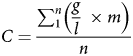
Equation 1 depicts the calculation of the correspondence measure. C is the correspondence, g represents the gains a party draws from being able to obtain the portfolio while l stands for the losses the other coalition parties suffer from portfolio allocation. m is the mean salience and n the number of portfolios in a coalition government.
In order to illustrate the construction of our main explanatory variable, we have included a short example here. Our coalition cabinet consists of two parties, A and B, and three portfolios are to be distributed. The salience scores are provided in Table 1.
Example Illustrating the Correspondence Measure

Party A was able to obtain portfolio 1 and 2 while Party B got portfolio 3. If we now insert the numbers from Table 1 into the earlier equation, we end up with the following correspondence measure:
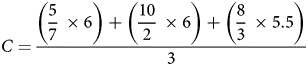

The distribution of the correspondence of parties' priorities with the allocation of portfolios can be found in Figure 2.Footnote 12 The measure ranges from 1.89 to 64.17 with a mean of 8.94 and a standard deviation of 7.72.Footnote 13
Correspondence of Parties' Priorities with Portfolio Allocation
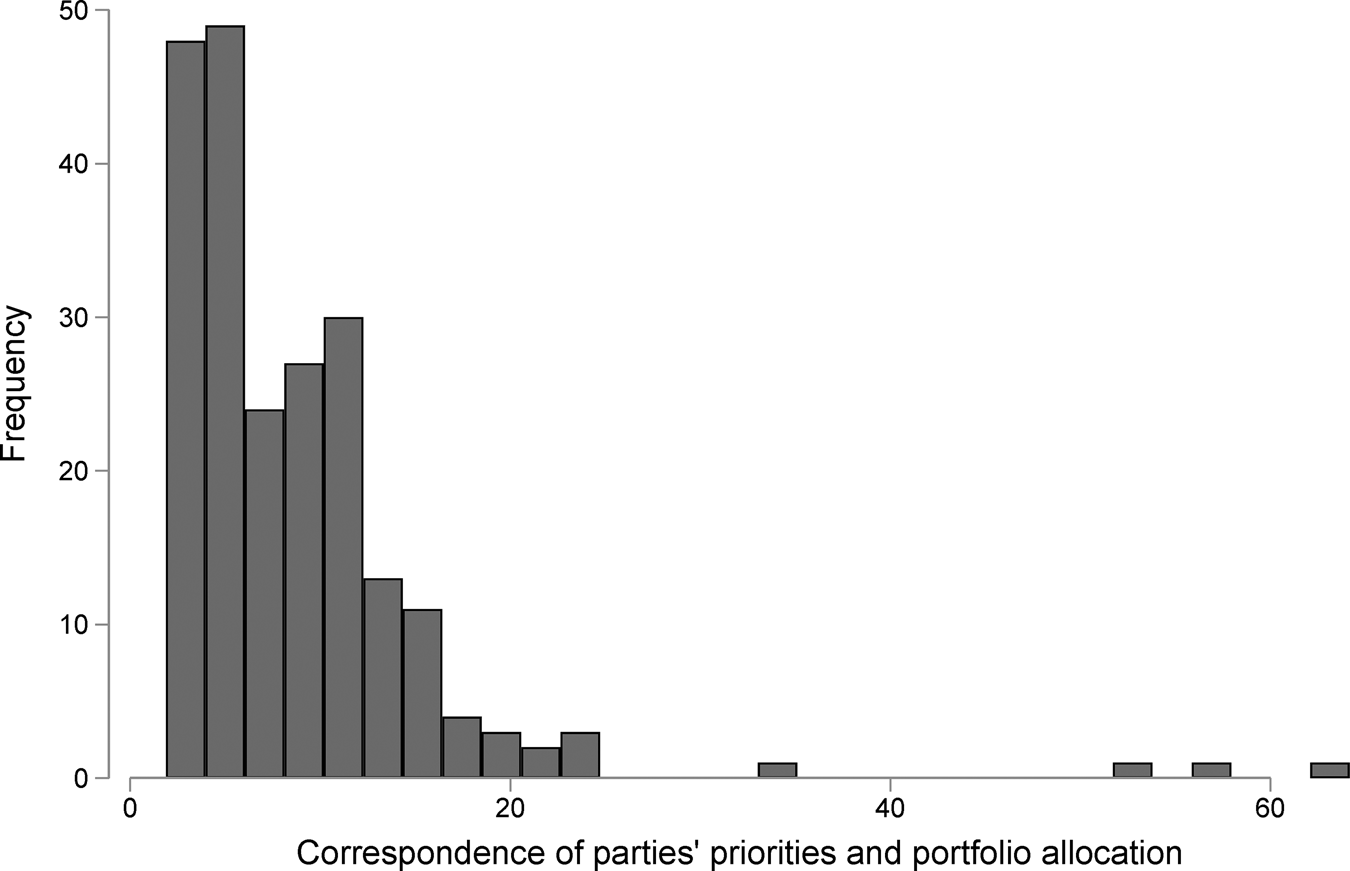
Strictly speaking, we are looking at the correspondence between parties' preferences and portfolio allocation. However, the way in which the main explanatory variable is constructed also includes the concept of tangentiality (Falcó-Gimeno Reference Falcò-Gimeno2014), albeit operationalized in a slightly different way. If preferences are tangential, meaning that parties care about different topics, then the correspondence measure will be higher. Conversely, if parties care about the same topics in a similar way, the correspondence measure will be lower.
Since we rely on an aggregated measure of the correspondence, we cannot say anything about the distribution of the correspondence. Or, in other words, the variable does not tell us if it is mainly one or all parties involved where the correspondence is high or low, respectively. However, because the coalition as a whole decides on the length of the coalition agreement, this should not pose a problem for our analysis.
Operationalization of control variables
In order to test the effect of our main explanatory variable on the length of coalition agreements, we include the following control variables that might potentially affect the hypothesized relationship. First of all, we control for the preference divergence in the cabinet. The larger the ideological differences between cabinet parties, the higher the likelihood that coalition partners need a formalized control mechanism (Bowler et al. Reference Bowler, Bräuninger, Debus and Indridason2016; Müller and Strøm Reference Müller, Strøm, Strøm, Müller and Bergman2008). Hence, we expect that the higher the preference divergence, the longer the agreements. We measure preference divergence by the range of the left–right policy positions held by all cabinet parties, which corresponds to the absolute distance between the policy positions of the most left-wing and the most right-wing members of the cabinet (see Tsebelis Reference Tsebelis2002). The left–right positions of coalition parties were measured based on data obtained from the Manifestos Project discussed above by first calculating the percentages of left and right categories of the total number of coded quasi-sentences and then subtracting the percentage of left sentences from the percentage of right sentences (see also Adams and Ezrow Reference Adams and Ezrow2009; Meyer Reference Meyer2013; Schumacher et al. Reference Schumacher, de Vries and Vis2013). We rely on policy position on the left–right dimension as it is the primary dimension of political conflict in Western democracies (see e.g. Marks and Steenbergen, Reference Marks and Steenbergen2002).
Second, we control for the maximum possible cabinet duration, which measures the number of days that are still left in the constitutional inter-election period (CIEP) after the formation of the cabinet. Müller and Strøm (Reference Müller, Strøm, Strøm, Müller and Bergman2008) argue that the uncertainty for coalition parties should be higher, the longer the remaining time in office as the possible damage caused by cabinet parties shirking from the negotiated coalition compromise increases with the time left until the next election. Hence, we expect that coalition agreements should be longer, the more time is left in the CIEP. For coalition cabinets until 2012, we used the maximum possible cabinet duration from the European Representative Democracy Data Archive (ERRDA) data set (Andersson et al. Reference Andersson, Bergman and Ersson2014), while we calculated the time left in the CIEP for the cabinets from 2012 onwards by adding the number of days included in the country-specific CIEP to the past election date and subtracting the cabinet formation date.
Third, we also include minority status of a coalition in the empirical analysis. Indridason and Kristinsson (Reference Indridason and Kristinsson2013) find that minority cabinets are less likely to write a coalition agreement, but that the coalition agreements tend to be longer if they decide to write one. Additionally, we will also control for the minimal winning status of a coalition cabinet. Müller and Strøm (Reference Müller, Strøm, Strøm, Müller and Bergman2008) argue that minimal winning coalitions should have more incentives to write a coalition agreement because every party's contribution is absolutely necessary for the coalition's effectiveness and functioning. Finally, we include a measure for the differences in party size. We expect that coalition agreements are longer in cabinets in which similarly strong partners govern together than in cabinets where one party clearly dominates the government. In order to control for this, we included the standard deviation of the seat share of parties. The minority and minimal winning status as well as government seat share were measured by relying on the ParlGov database (Döring Reference Döring2013; Döring and Manow Reference Döring and Manow2016). Descriptive statistics for all variables included in the analysis are presented in Table A.1 in the Online Appendix.
Data set
In order to test our theoretical expectations, we study portfolio allocation in 24 European countries.Footnote 14 The selection of countries follows the established standard in coalition research and only includes European democracies that were governed by coalition cabinets at least once in the time period under investigation (see e.g. Andersson et al. Reference Andersson, Bergman and Ersson2014). This country sample allows for a varying number of additional institutional characteristics such as electoral rules and the executive–legislative relationship, which strengthens the external validity of our findings.Footnote 15
Data analysis
In order to shed light on the effect of portfolio allocation on the length of coalition agreements, the specific structure of the data set has to be taken into account. The observations in our data set are not completely independent, as assumed by ordinary regression analysis, but instead are clustered into 24 countries. In order to address this problem, we estimate regression models with clustered robust standard errors that account for the clustering of coalition cabinets into countries.Footnote 16 Our dependent variable, the length of coalition agreements, is a non-negative, integer-valued variable that is highly skewed to the right. Due to the special character of the dependent variable, a count model needs to be estimated to test the hypothesized effects. Since the variable is moreover highly over-dispersed, a negative binomial model is estimated to explain variation in the length of coalition agreements.
Table 2 includes the results of the negative binomial model explaining the length of coalition agreements. The reported coefficients are incidence rate ratios and can be interpreted as follows: an incidence rate ratio smaller than 1 means that a change in the explanatory variable decreases the length of the coalition agreement, while an incidence rate ratio greater than 1 leads to an increase of the length of the coalition agreement. The results support our hypothesis. The correspondence of parties' priorities and portfolio allocation has a statistically significant negative effect on the length of coalition agreements. The higher the correspondence, the shorter the coalition treaty.
Explaining the Length of Coalition Agreements (Negative Binomial Regression)
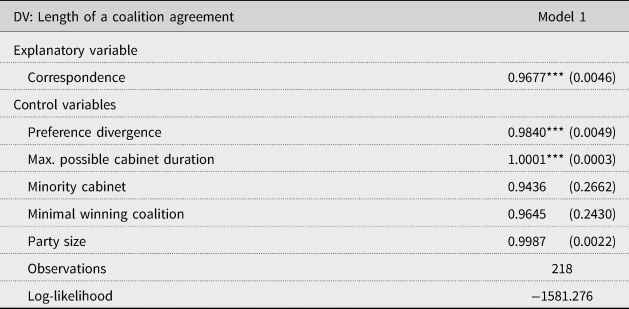
Notes: ***p ≤ 0.01; **p ≤ 0.05; *p ≤ 0.10. Clustered robust standard errors in parentheses. Coefficients displayed are incidence rate ratios.
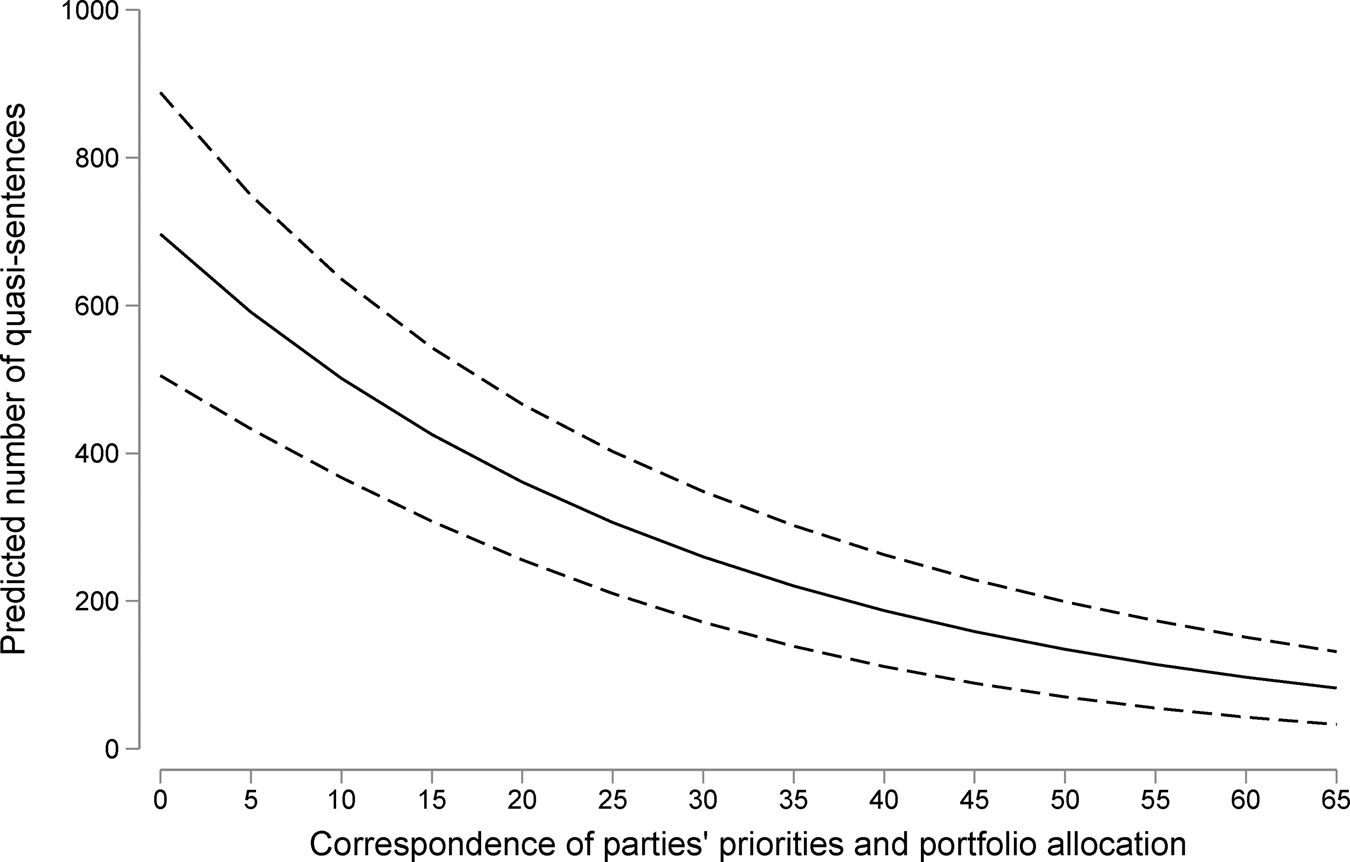
For a more substantive interpretation of our results, we simulated the predicted length of coalition agreements as the correspondence of parties' priorities and portfolio allocation varies (King et al. Reference King, Tomz and Wittenberg2000). Figure 3 shows the simulated predicted length of coalition agreements on the y-axis and the correspondence on the x-axis. The solid line indicates the point estimates while the dashed lines represent the 95% confidence interval. Figure 3 clearly shows that the satisfaction of coalition parties with the executive offices they obtained has a negative effect on the length of negotiated agreements. The predicted length of coalition agreements varies between approximately 697 quasi-sentences (for a correspondence score of 0) and approximately 82 quasi-sentences (for a correspondence score of 65). Thus, the correspondence of parties' priorities and portfolio allocation has a substantial influence on the length of a coalition agreement. Coalition parties tend to write shorter coalition agreements if the members of the cabinet receive the portfolios they care about most.
The Effect of Correspondence on the Length of Coalition Agreements
In order to test the robustness of our findings, we estimated three additional model specifications. First, we control for temporal trends because Müller and Strøm (Reference Müller, Strøm, Strøm, Müller and Bergman2008) have shown that coalition agreements are time dependent: in recent decades more cabinets have published a coalition treaty, and these agreements have become longer over time. Second, there are differences between countries with regard to the content of coalition agreements (Müller and Strøm Reference Müller, Strøm, Strøm, Müller and Bergman2008). While coalition agreements in the Netherlands are rather long, coalition agreements in Eastern European countries tend to be considerably shorter. Third, we also control for quantitative portfolio allocation in order to make sure that our results are not driven by this. The results of the additional regression can be found in Tables A.5, A.6 and A.7 in the Online Appendix. The effect for our main explanatory variable remains essentially the same.
With regard to our control variables, we find that left–right preference divergence is negatively associated with writing comprehensive coalition agreements. The higher the preference divergence, the shorter the coalition agreement. This contradicts our intuition, but might be explained by the fact that ideologically diverse coalition parties might simply not be able to find much common ground to include in the coalition agreement. In addition, our results show that the existence of a comprehensive coalition agreement is more likely, the longer the maximum possible cabinet duration.
Conclusion
How does portfolio allocation influence the length of a coalition agreement? Since ministers can significantly shape policies within their ministerial jurisdiction, we suggested that coalition parties should have less incentive to draft a comprehensive coalition agreement if they receive the ministerial portfolios in policy areas that are particularly important to them. We accordingly hypothesized that the higher the correspondence between parties' preferences and the allocation of ministerial portfolios, the less comprehensive a coalition agreement between coalition partners. We have tested our theoretical expectations based on a large new data set. By combining newly collected data on coalition agreements drafted by 218 cabinets in 24 Western and Eastern European countries from 1945 to 2014 with a newly assembled data set on the distribution of ministerial portfolios, we were able to shed light on how portfolio allocation affects the likelihood of comprehensive coalition agreements. We show that the shorter the coalition agreements, the higher the correspondence between parties' preferences and portfolio allocation.
Our findings have important implications for understanding the link between cabinet formation and coalition governance. This article has demonstrated that the distribution of ministerial portfolios has a systematic effect on the length of coalition agreements. This finding hints at a possible trade-off in coalition negotiations. Parties might be prepared to sacrifice executive offices in exchange for policy commitments (see also Debus Reference Debus2008; Shikano and Linhart Reference Shikano and Linhart2010). If a party is not able to obtain a certain ministerial portfolio, but cares about the policies that fall into the jurisdiction of that ministry, our findings suggest that the party might insist on writing down a detailed policy compromise in the coalition agreement to make sure that its preferred policies are enacted. Since coalition agreements are important control devices that constrain the behaviour of coalition parties, a commitment to a detailed list of policy reforms in a coalition agreement can ensure that the costs of not obtaining ministerial portfolios are comparatively low since coalition parties can make sure that their favoured policies are enacted. Hence, we show that cabinet formation has a direct impact on cabinet governance as coalition parties that are not satisfied with portfolio allocation rely on comprehensive coalition agreements that allow for tight control of their partners throughout the legislative term.
This study offers a crucial next step to understanding the linkage between coalition formation and coalition governance. However, there are still important questions that remain unanswered. First, to shed further light on whether parties are prepared to trade office payoffs for policy benefits, future research should analyse the relationship between portfolio allocation and coalition agreements on the level of specific policy areas (i.e. comparing the policy reforms promised in the coalition agreement with the distribution of the corresponding ministerial portfolio). Second, future research should also address if and how the correspondence between parties' priorities and portfolios influences other aspects of coalition governance and coalition termination. One might, for example, argue that satisfied coalitions should have a lower risk of early government termination (Bäck et al. Reference Bäck, Dumont and Saalfeld2011b). Third, another related avenue for future research is to examine whether parties are punished for not enacting policy initiatives they promised in their coalition agreements. Fourth, future research could shed light on the role of cross-partisan junior ministers as it is possible that the length of the coalition agreement is related to the number and the powers of hostile junior ministers. Finally, in order to learn more about the relationship between portfolio allocation and coalition agreements, a qualitative process-tracing analysis would be ideal to identify factors that have so far been ignored. This might help us better understand what is going on behind closed doors.
Supplementary material
The supplementary material for this article can be found at https://doi.org/10.1017/gov.2021.68
Acknowledgements
The authors follow the principle of rotation. Both authors have contributed equally to all work. The authors thank Marius Sältzer, Denis Cohen and the three anonymous reviewers. The authors are furthermore grateful to the German Research Foundation for funding this study.
Financial support
The authors disclosed receipt of the following financial support for the research, authorship and/or publication of this article: this study was funded by the German Research Foundation (DFG; Grant KL 2692/1-1).


 Open access

