

In different contexts, we keep coming back to the species body’s muteness. In a period when the concept of species lost its basis in theology, identifying species nonetheless became a literary and cultural preoccupation, as though the concept could be shored up by proliferating examples. In Darwin’s work and before it, abandoning the search for “the undiscovered and undiscoverable essence of the term species” (Origin, 357), meant an ever more minute attention to arbitrary markers of species identity, affinity, and difference. This kind of attention was intrinsic to the scientific breeding of sheep and cattle in the eighteenth century and to the breeding of bird and other animal species by fanciers. From the 1790s, teaching such attention also became the task of field guides addressed to amateur naturalists and of children’s books on animals.
In Darwin, as we have seen, the most useful traits in identifying a species are automatic behaviours and rudimentary or de-functioned anatomical parts. While blushing had prior to Darwin been studied by Thomas Burgess as a divinely ordained means of making character and feeling legible on the face, for Darwin, considering the blush as a trait – the only one – distinguishing the human species from all others entailed viewing it as a reflex action without any communicative effect. When field guides began to use bird calls as species markers, they adapted the poetic technique of onomatopoeia to represent them, throwing the mantle of science over animals’ exclusion from language by the poets and philosophers.
In this final part of the book, my argument will again have Darwin’s chapter on blushing as one of its points of reference, but the focus will broaden to encompass a general consideration of blood as a token of identity. Shared blood is an ancient figure of kinship; in the nineteenth century, it becomes closely associated with race and species identity. Moreover, in medicine, literature, and anthropology, the idea that members of animal species were of one blood is disturbingly literalized. We will begin in this chapter with a discussion of medical blood transfusion, a therapy that was first attempted in the seventeenth century using animal blood. Only in the nineteenth century did the transfusion of blood between members of the same species become the norm, though, since blood types were not discovered until 1900, this marked only a very qualified improvement in practice. Blood transfusion remained an experimental therapy until the 1880s and was then largely abandoned until the First World War. As transfusion’s appearances in in Victorian Gothic fiction show, however, it exercised a powerful imaginative appeal.
Also during the first half of the nineteenth century, large-scale bloodletting underwent a spectacular and still largely unexplained boom and bust in acceptance. By 1820, “heroic” bloodletting was a recommended therapy for almost every kind of ailment, especially in men. Particularly in rural areas, periodic bloodletting was practiced prophylactically. Thirty years later, however, as we will see, medical practice had undergone a radical change. Writers on medicine noted the change, and, strangely, could not agree on the reason for it. The decline of therapeutic bloodletting is difficult to present in the form of a narrative, and in consequence remains an understudied topic in the history of medicine. In this chapter, I view it as an episode in the emergence of an hystericized species body that cannot tell its own story.
In what follows, I will document in literature and medicine an organizing fantasy of a species body that economizes blood. This fantasy emerges during the nineteenth century, and it does so as the species body becomes the principal target of biopower, even while the species concept itself grows less determinate. This fantasy is a knot that ties biopolitics to political economy: as Catherine Gallagher argued in The Body Economic, nineteenth-century political economy became a biopolitics once Ricardo, working on the basis of Malthus’s analysis of labour as the activity of a biological population, defined it as the basis of economic value.1 Blood is a pervasive figure for value in the nineteenth century. We will discuss literary examples later in this chapter; it also appears in writing on political economy by Marx, who figures capital’s appropriation of labour as vampirism, and John Ruskin, whose major work on political economy, Unto This Last (1860), has a chapter organized by an analogy between the social circulation of value and the circulation of blood in the body. In what follows, however, I will not be concerned with the economy of blood as such, but with blood’s significance as a figure for kinship, and with the way Victorian literature and medicine literalize this figure in representations of blood as shared between members of a collective social body. This chapter documents the emergent conception of blood as social property in the Victorian era; the next discusses the idea that persons who share blood by consumption or by transfusion become biological kin. We will turn to the theory of totemism as it emerged in anthropology after Darwin, and discuss it as a discourse on species.
In considering Victorian writing on kinship, it should be recalled that the biological basis of inheritance was not known in the Victorian era; Gregor Mendel carried out his path-breaking work on variation and inheritance in peas in Moravia between 1856 and 1863, but his results were little known before 1900. Recognizing the lack at the heart of his theory of natural selection, depending as it does on inheritance and variability, Darwin proposed his own theory of biological inheritance in Variation of Plants and Animals under Domestication (1868). He termed this theory “pangenesis”; it accounted for shared traits among biological kin, and for such facts as reversion, as well as for the observed rules governing variation. It also allowed for the inheritance of acquired traits and for telegony.2 The theory of pangenesis proposed that all of the body’s cells throw off during the whole period of their existence tiny particles Darwin termed “gemmules.” These aggregated in the reproductive organs and were transmitted to future generations. The theory found some acceptance, especially among neo-Lamarckians.3 The most decisive evidence against it came from an experiment that, like the theory itself, illustrates the preoccupations of late Victorian science. Darwin’s cousin and follower Francis Galton, hoping to prove the existence of gemmules, transfused blood between different strains of rabbits, expecting that inherited traits from the donor strains would appear in the offspring of the recipients, owing to the passing from one to the other of gemmules along with the transfused blood. In his results, published in 1871, he was obliged to report, according to Janet Browne, that “not a single incidence of induced variation occurred in a total of eighty-eight offspring of transfused rabbits.”4
***
The idea that sharing blood might be a kind of sex nonetheless pervades Victorian literature and medicine. It’s an idea that is at once raised and closed off by an aphorism with which Foucault in The History of Sexuality distinguishes the nineteenth-century bourgeoisie from Europe’s hereditary aristocracies: “the bourgeoisie’s ‘blood’ was its sex.”5 This observation introduces the central motif of his book’s last part, the claim that in the Western world of the late eighteenth and early nineteenth centuries, a society of “blood” was superseded by a society of “sex.”6 In this transformation, the bourgeoisie was the leading class: it was for the bourgeoisie in the first instance that power came to address itself to the body above all by speaking of sexuality and to sexuality. The class body of the bourgeoisie is thus the first to be defined by sex and sexuality; in this respect, Foucault contrasts it to an earlier aristocratic body, embedded in an older technology of power, that was constituted as bearing blood – that is to say by the thematics of kinship, consanguinity, and filiation.
Foucault affirms that the aphorism I have just quoted, identifying sex as the blood of the bourgeoisie, is not merely a play on words. Indeed, he goes on:
[M]any of the themes characteristic of the caste manners of the nobility reappeared in the nineteenth-century bourgeoisie … in the genre of biological, medical, or eugenic precepts. The concern with genealogy became a preoccupation with heredity; but included in bourgeois marriages were not only economic imperatives and rules of social homogeneity, not only the promises of inheritance, but the menaces of heredity; families wore and concealed a sort of reversed and somber escutcheon whose defamatory quarters were the diseases or defects of the group of relations – the grandfather’s general paralysis, the mother’s neurasthenia, the youngest child’s phthisis, the hysterical or erotomaniac aunts, the cousins with bad morals.7
Foucault’s proposition is thus not a play on words, but rather a metaphor founded on a classically formed proportional analogy, which asserts in full that sex is to the bourgeoisie as blood was to the nobility.
I stress the operation of metaphor at this point in The History of Sexuality in order to underscore that “blood” is not here a term that has a literal referent. It becomes so, however, when Foucault considers a different aspect of the society of blood. The History of Sexuality is nearly as interested in violence as it is in sex; the last part in particular begins with a consideration of the sovereign’s power in the classical age to inflict death. Foucault writes that in “a society of blood – I was tempted to say, of ‘sanguinity’ – … power spoke through blood: the horror of war, the fear of famine, the triumph of death, the sovereign with his sword, executioners, and torturers; blood was a reality with a symbolic function.”8 The executioner sheds real blood; it stands here by metonymy for the life that the absolute sovereign was uniquely entitled to take. Foucault thus describes the society of blood in language that has a realistic dimension as well as a metaphoric one.
In this chapter, I will ask what becomes of this real blood, the blood through which sovereignty speaks, as the sovereign’s power to shed blood and take life diminishes in importance and new forms of power organized around life take its place as part of the long historical emergence of what Foucault termed biopower. My initial focus will be on medicine and biology, rather than on jurisprudence, as I argue that the second quarter of the nineteenth century saw the transformation of a society that spent blood into one that saved it, while blood itself, initially an object whose spectacular display was an everyday part of medical practice, became one that circulated invisibly. I will argue that in this period, Foucault’s symbolics of blood are replaced by an economics. The context for this chapter is the emergence in the nineteenth century of a social circulation of blood. For the first time – and well in advance of the technologies of transfer, storage, and blood typing that today organize the concept of a “blood supply” – blood became a social property, capable of circulating throughout the human species body, that required protection from contamination and safeguarding against waste.
As blood became identified with species, I will argue, its social circulation in humans became one of the forms in which power embodied itself, implanting in the bodies through which it passed new taxonomies of sex and race. To study this process, I will turn to an archive that includes fiction, notably Bram Stoker’s Dracula, and also make a return to Darwin’s chapter on blushing. In both texts, shared blood marks the difference between the human animal and its non-human others. Otherwise, however, the literary focus of this chapter will be on poems in which human beings play the leading roles. Unlike the poems considered earlier in this book, these do not endow species with voice. I will view them rather as making blood and bleeding symptoms of species and racial identity, in an argument developing my claim in Chapter 5 that Darwin understands species identity symptomatically. I will conclude by discussing links between his thought and late Victorian thinking on hysteria, including that of Freud. Here, as throughout this book, I treat poetry as the nineteenth-century literary genre in which the embodiment of power and systems of knowledge is most legible.
***
Without being too arbitrary, we can assign a date to the beginning of blood’s social circulation: September 26, 1818. On this day, Dr. James Blundell performed the first therapeutic blood transfusion between human beings.9 The previous history of medical transfusion goes back to the seventeenth century: the first transfusion experiments involving human subjects were carried out almost simultaneously in France and England in 1667. The salient fact about these experiments is that they in every case involved transfusions between species. In England on November 23, a twenty-two-year-old bachelor of arts student was transfused with the blood of a sheep in order to moderate what was considered the excessive heat of his brain. The recipient survived the operation, and Samuel Pepys records in his diary that after six days, he gave a report to the Royal Society, in Latin, in which he pronounced himself better. In the same year in France, a series of similar experiments were made by Jean-Baptiste Denis, physician to Louis XIV. In the fourth and most celebrated of his cases, he on two occasions transfused calf’s blood into the veins of a certain Antoine Mauroy in order to endow him with docility. When Mauroy died shortly after, Denis was tried for manslaughter; though he was acquitted, transfusion was made illegal in France and abandoned throughout Europe for more than a century.10
When transfusion experiments resumed in the early nineteenth century, it was on a new principle. No longer a treatment directed to curing the quality of the patient’s blood, transfusion was now used to supply blood lost to haemorrhage, particularly in women during and after childbirth. As we will see in a moment, the new transfusion science was part of a developing tendency in mid-nineteenth-century medicine to pathologize bleeding in general. Its earliest proponent was Blundell, who taught midwifery at Guy’s Hospital; his uses of the therapy in the early 1820s showed enough success to attract others to the field. Though it remained controversial, transfusion continued in therapeutic use until the late 1880s, after which it largely gave way to infusion with saline solution.11
From its beginnings with Blundell, nineteenth-century transfusion remained typically a therapy given to women, normally to combat uterine haemorrhaging. The majority of its practitioners were obstetricians, and from its founding in 1858, their leading professional association, the Obstetrical Society of London, provided a major venue for transfusion research. The therapy was thus developed largely for use on women by trained physicians and surgeons, who at the time were exclusively male. Transfusion was therefore, as Ann Kibbie writes, an “instantiation of the now familiar, highly gendered scene of Victorian medicine,” as one of the technologies that enabled male professionals in the first half of the nineteenth century to claim childbirth as a scene of medical practice and to displace the traditional women’s practice of midwifery.12
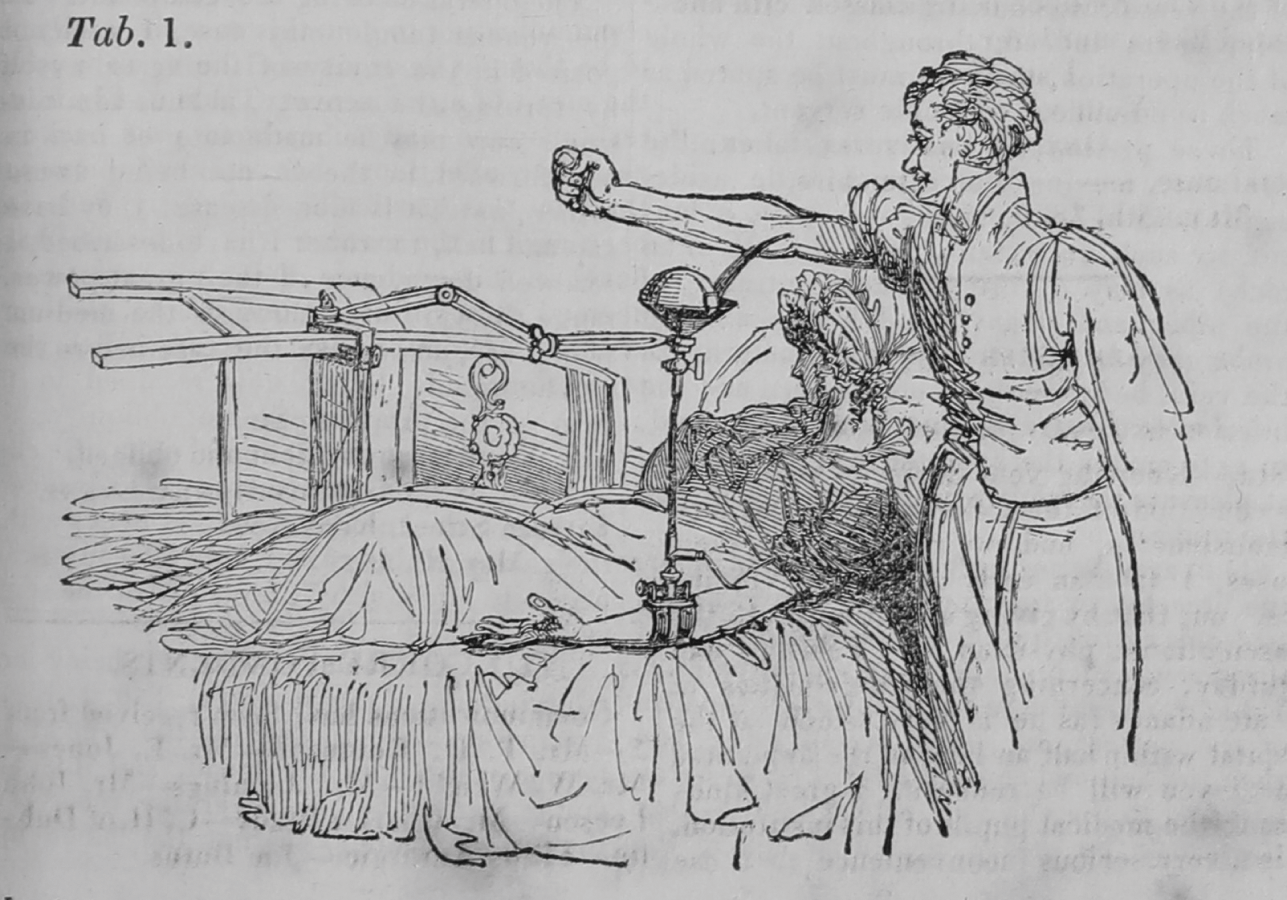
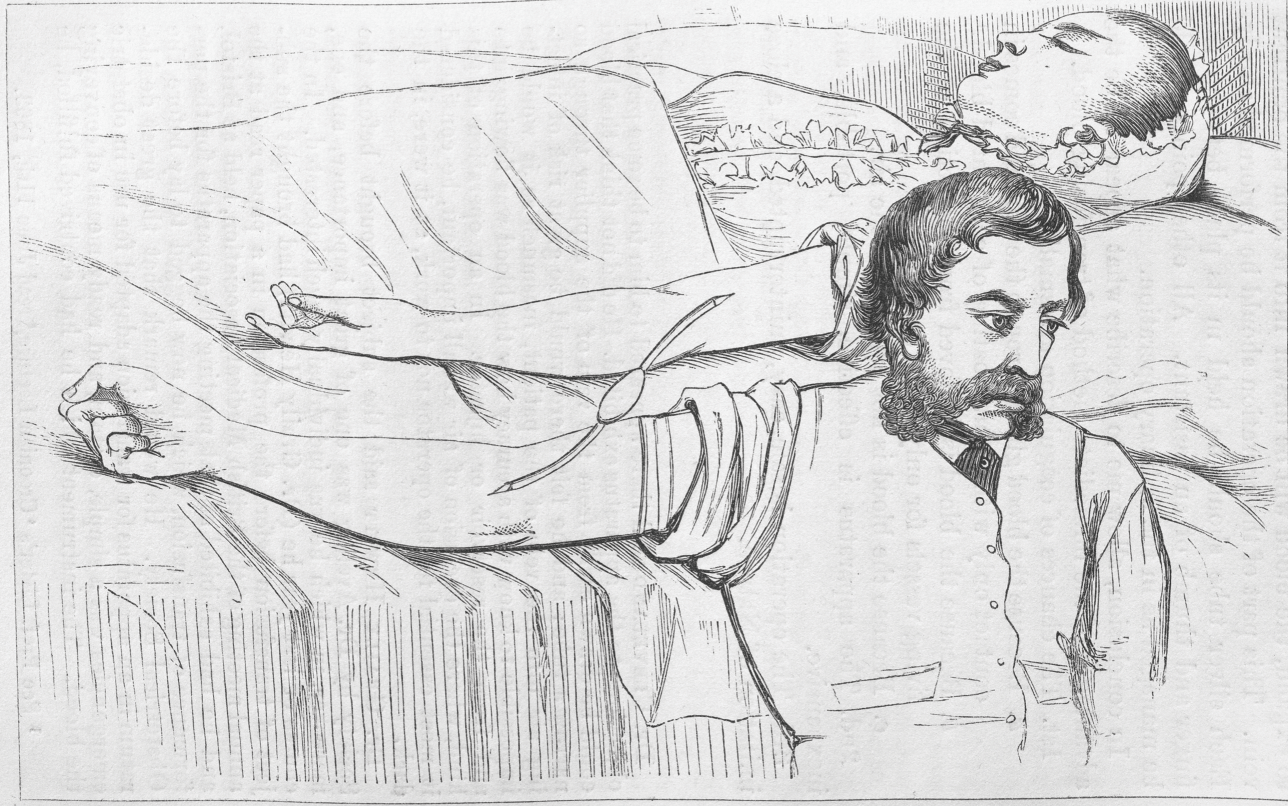
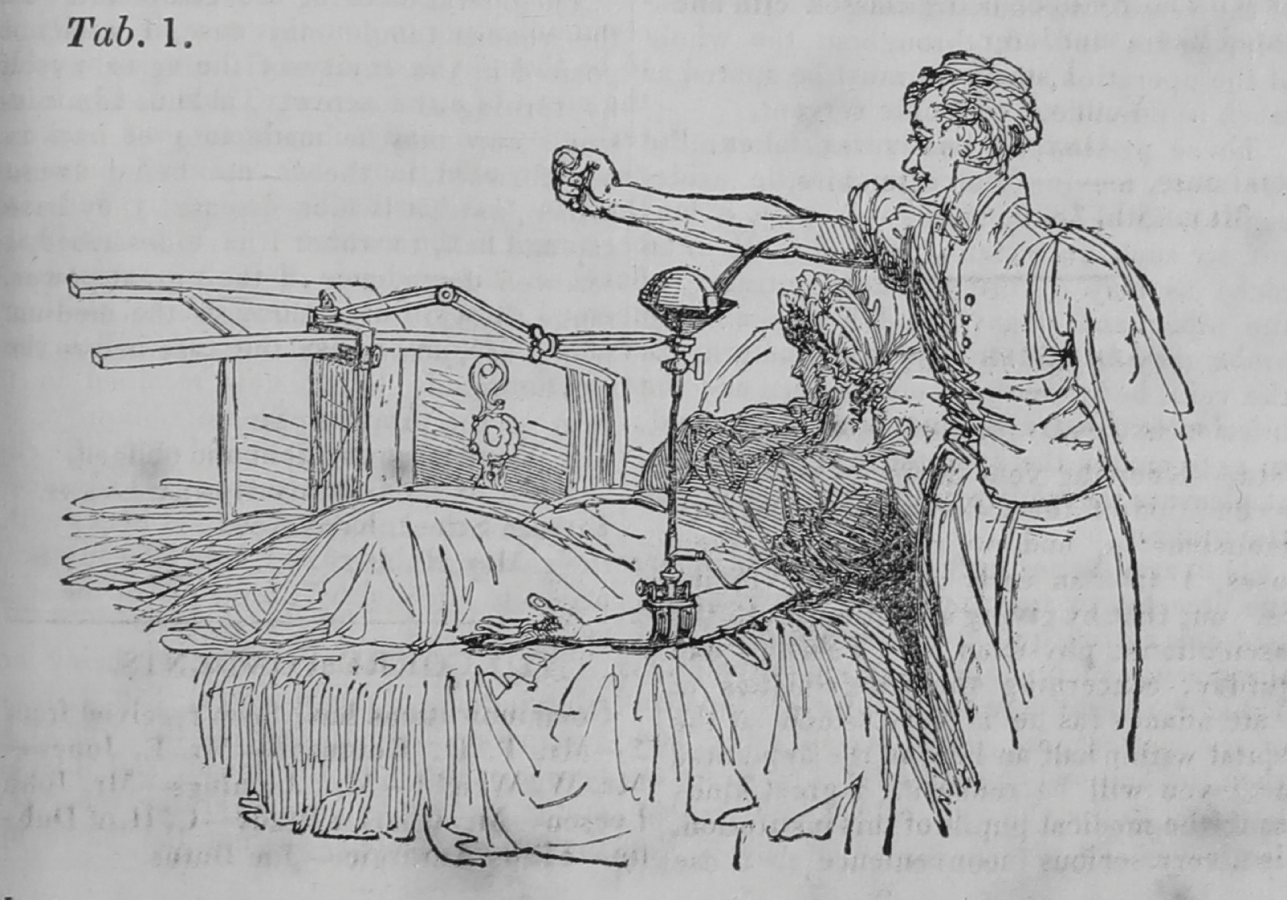
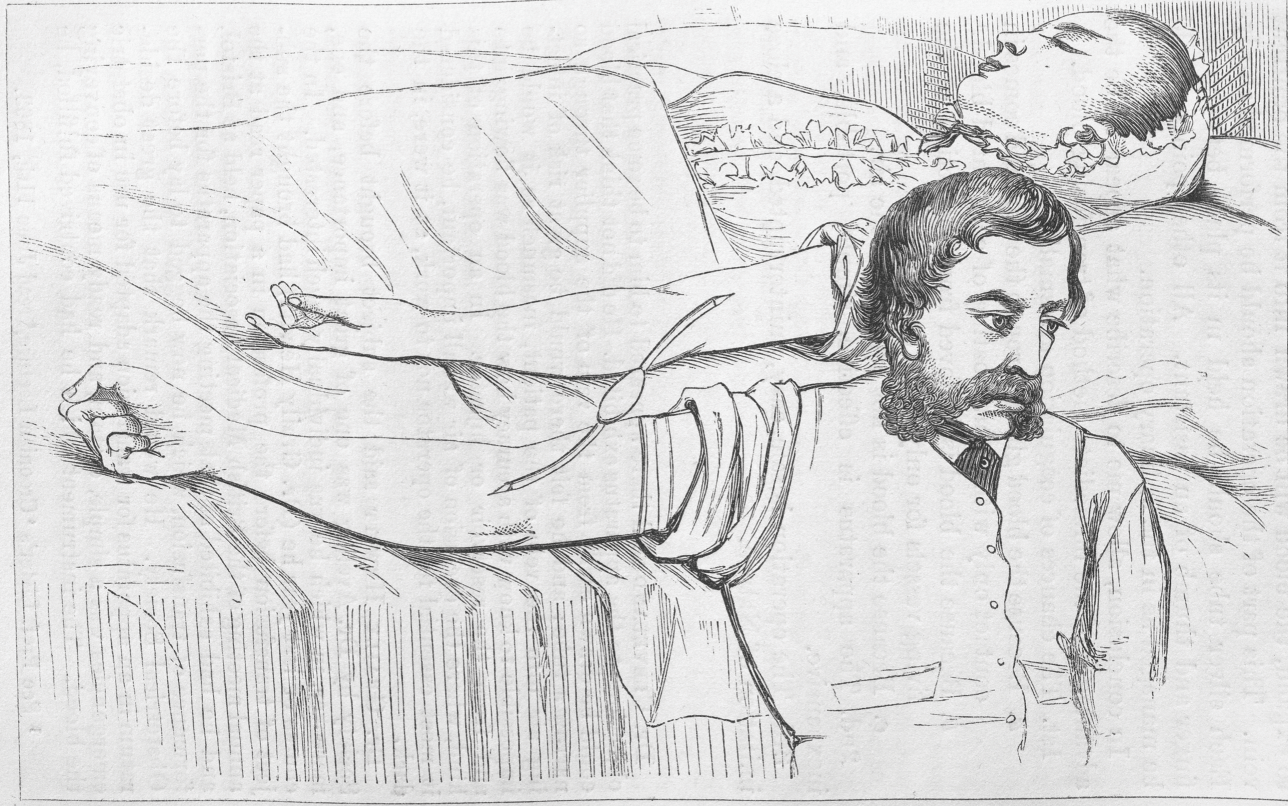
Nineteenth-century transfusion science thus emerges in an institutional setting where the production and redefinition of gender difference was an ongoing endeavour. Illustrations of transfusion from articles in the Lancet and the Transactions of the Obstetrical Society of 1828 and 1864 (Figures 9 and 10) respectively show that practitioners of transfusion imagined in gendered terms not only the relation of doctor and patient, but also that of blood donor and recipient.13 The recipients of transfused blood were typically women, and the blood they received often came from their husbands or from medical men in attendance. The gender differences produced by transfusion are, however, mediated by the flow of what was now understood as undifferentiated blood. Whereas the transfusions of the seventeenth century had the mixing of different kinds of blood as their motive, in those of the nineteenth century, it was precluded from the outset. Blundell very early on ruled out using animal blood for transfusion into humans, and the majority of his British and French successors followed his lead.14 And not until 1900 was Karl Landsteiner to discover that human blood itself is differentiated into types and so make possible all subsequent developments in transfusion technology.
From James Blundell, “Observations on the Transfusion of Blood, with a Description of his Gravitator,” Lancet (1828–9), part 2, 321.
From J. H. Aveling, “On Immediate Transfusion,” Transactions of the Obstetrical Society of London, 6 (1864): 134.
Transfusion was never a central or uncontroversial part of nineteenth-century medical practice. Taken together with other contemporaneous developments, however, the transfusion experiments of the period suggest that in the first half of the nineteenth century, therapeutics involving blood became a social practice charged with political and cultural meaning. The first transfusion experiments coincided with the rise and fall of a “heroic” mode of medical treatment centered on bloodletting. Though phlebotomy dated back to classical medicine, its use greatly increased in the late eighteenth and early nineteenth centuries. Pioneered by Benjamin Rush of Philadelphia, the new practice of bloodletting called for the evacuation of blood in far greater quantities than previously. Massive bloodletting became the norm in Europe as battlefield medicine during the wars and was introduced into civilian practice by medical men returning from the field. In his 1819 Practical Treatise on the Efficacy of Blood-Letting in Epidemic Fever, Benjamin Welsh wrote:
The reduction of our vast military and naval establishments, at the conclusion of the war, has not been without its use in promoting the doctrine which we attempt to advocate. For medical men, retiring from these services, have settled in almost every corner of the empire generally … carrying along with them the practice which they have found so beneficial.15
In his 1835 textbook, James Wardrop wrote of an army and a navy surgeon who treated excessive vascular activity in wounds by letting fifty ounces of blood at a time to a total of two hundred. Like Welsh, Wardrop describes the practice of treating fevers by letting blood as introduced by military surgeons who had seen the supposed benefits during wartime.16 In the post-war years, all fields of medical practice underwent a rapid process of professionalization. The training and licensing of apothecaries and surgeons became more rigorous, and both trades rose in social status. Male physicians replaced midwives as attendants on childbirth, at least in households wealthy enough to be attended by a physician. And the practice of bloodletting was central to the identity of the newly professionalized cadres of medical men. For this reason, when one among their number, Thomas Wakley, in 1823 founded a new journal dedicated to putting medical practice on a scientific basis, the name he chose was that of the instrument most identified with the practice: The Lancet.
Large-scale bloodletting during this period became virtually a universal remedy; K. Codell Carter writes that one “four-volume medical encyclopedia, which included articles by fifty of England’s most celebrated physicians and which went through several editions beginning in 1830, recommended the antiphlogistic regime, and bloodletting in particular, for about two-thirds of the diseases identified in the index.”17 William Stokes, who later became the president of the British Medical Association, recalled in a widely quoted lecture from 1854 that during his training in the 1820s, “there was hardly a morning that some twenty or thirty unfortunate creatures were not phlebotomized largely. The floor was running with blood; it was difficult to cross the prescribing hall for fear of slipping. Patients were seen wallowing in their own blood, like leeches after a salt emetic.”18
The theory underlying the new practice of bloodletting was governed by the concept of heat. Fever, local infection, and inflammation were all understood as different aspects of the same phenomenon, and the treatment in every case was either local or general bloodletting to carry away the excess heat. This theory coexisted with other rationales for bloodletting that long predated it. In ancient medicine, bleeding was viewed as a natural curative, and bloodletting as a form of assistance to nature. Galen thus describes nature as “healing diseases by evacuation of blood,” and asserts on the authority of Hippocrates that “a woman vomiting blood was cured by the menses breaking out,” that “haemorrhoids protect against black bile,” and that “copious haemorrhages from the nostrils are for the most part curative.”19 A millennium and a half later, Thomas Watson in his medical lectures of 1836–7 at King’s College asserted an analogy between “habitual haemorrhage” and the “monthly discharge which is peculiar to the female.”20 A standard household manual of 1834 held that “if [an excessive supply] is not worked off by active exertion, or diminished by a moderate and temperate diet, the blood becomes too rich and copious, and nature attempts often to relieve herself by discharging a portion of it. These discharges … commonly take place from the nose, or from the extremity of the intestinal canal, under the form of bleeding piles.”21 Belief in the value of periodic bleeding was widely held; in his 1845 lectures on surgery, Robert Liston, the senior surgeon at University College Hospital, recalled that “[f]ormerly, it was the practice to bleed every spring, and people did not think themselves safe unless recourse was had to it.”22 Medical writers worried that bloodletting might become habit-forming for patients who underwent it too often.23
The medical establishment abandoned large-scale bloodletting in the second quarter of the nineteenth century as it were without noticing what it was doing.24 William O. Markham dated the change in practice in retrospect to “about 1830.”25 By 1865, Stokes could state in an address to other physicians that “[w]e can hardly conceive of a revolution in practice more complete. Venesection is now, from being the most frequent, the rarest of operations.”26 But, as it was happening, the “revolution” took place largely without comment in the establishment medical press. Debate on the matter occurred in retrospect, and initially took the peculiar form of furious disagreement, not on the therapeutic value of bloodletting, but on the reasons for its abandonment. What came to be known as the Edinburgh Bloodletting Controversy was set off in 1850 by William P. Alison, professor of the practice of physic at the University of Edinburgh, who speculated in a lecture that “there has been a gradual change in the usual form and character of those inflammations [pleurisy and pneumonia], as occurring in the inhabitants of this country – and that … they do not in general present the same intensity of local symptoms, nor the same amount of febrile reaction, as used to attend similar diseased actions … and therefore that they do not furnish the same indications for bloodletting.”27 The theory that heroic bloodletting had been correct in its time but was now counter-indicated by a change in the type of disease had an obvious appeal; as Stokes, who supported the theory, said in 1865, medical men found it “hard to believe that the fathers of British medicine were always in error, and that they were bad observers and mistaken practitioners.”28
Alison’s view was widely accepted in the profession in Edinburgh and throughout Britain. It was left to his main opponent, John H. Bennett, to note the anomaly that discussion of the merits of bloodletting “instead of preceding, has followed the change, inasmuch as those who are now contending for the advantage of bloodletting and antiphlogistics in inflammation, are the very parties who acknowledge that they no longer employ them.”29 Bennett held simply that bloodletting had always been an error, especially in cases of pneumonia, and asserted that mortality from pneumonia had diminished since the abandonment of large bleedings.30 The controversy moved outside Edinburgh in 1857 with the entry of Markham, a prominent London physician, who began his “Remarks on the Inflammation and Bloodletting Controversy” with the summary claim that “both parties are tolerably agreed upon this, – viz. that bleeding, as once practiced, is now an affair of the past, and that the trade of the lancet-maker should at the present time be only an indifferently good one. The question at issue is not so much: Ought we, or ought we not, to bleed – but: How is it that we do not bleed, as our heroic progenitors bled – in inflammatory diseases?”31 Markham rejected the change of type hypothesis, but also argued against Bennett that bleeding had in fact come to be underused in medical practice. The dispute continued on into the 1860s and then, as K. Codell Carter writes, it faded away without either side conceding defeat.32
But inside the profession and outside it, discourse around bloodletting had changed. The 1840s saw the rise of alternative therapies such as homeopathy and hydropathy. The latter was widely popular among writers and intellectuals: Dickens, Tennyson, and Darwin all took the water cure. In an 1868 retrospect, Thomas Laycock generalized: “Persons of highly cultivated minds, and much engaged in occupations involving the imagination or intellect, are most intolerant of blood-letting,” he writes, and continues to assert that as the middle and higher classes have lately “become more imaginative, mystical, and aesthetic in arts, science, religion, and ecclesiasticism, they have for the same reason become more intolerant of blood-letting [and] heroic doses.”33 Outside establishment medical circles, distrust of bloodletting became widespread. Samuel Dickson’s scathing Fallacies of the Faculty, based on a series of lectures, went to a second edition in 1841; Dickson describes the death of Byron as caused by bloodletting and characterizes the therapy as “murderous.”34 The term became current – by 1846 an anonymous reviewer in British and Foreign Medical Review could refer to “that mode of treating diseases which has been absurdly enough termed heroic, but which more properly should be termed murderous.”35 In 1849, a surgeon named John Langley wrote in The Lancet advocating bleeding to “full depletion” in “fever and inflammatory diseases”; he asserts his awareness that he is arguing against “the present fashion in medical practice.”36 When in the following year Robert Peel was thrown from his horse in 1850, suffering injuries that killed him from internal bleeding, he underwent bloodletting, but only by the application of twenty leeches. Langley returned to the fray in a furious denunciation of his physicians, demanding, “Why, even if precautionarily only, the most vigorous and copious depletion was not immediately resorted to?” Of the twenty leeches, he goes on to ask, “What essential benefit can possibly have been anticipated from so effete a measure, I am at a loss to imagine.”37
Under earlier medical paradigms, bleeding was natural to bodies of all sorts. But in the course of the nineteenth century, this long consensus was overturned and bleeding became a pathology. One consequence of this change was a new articulation of sexual difference around blood. As we have seen, until the beginning of the century, bleeding was common to men and women; surgical intervention was required to prompt it in any case where nature’s purging or expenditure of blood was interrupted.38 By the century’s close, however, as Elaine Showalter and Caroll Smith-Rosenberg showed, the periodic loss of blood in menstruation had become a pathological trait specific to women.39 On this supposed trait doctors like Edward Clarke and Henry Maudsley were able to found an entire misogynist sexual science.
In the 1820s, transfusion science also identified bleeding as a pathology endemic to women. As germane, though, to its role in the new sexual science was its postulate of blood as an undifferentiated fluid that could in principle circulate between bodies as well as within them. Blood thus acquired a social circulation, in which male and female bodies were characterized by their different propensities to expend a single scarce resource. Well after the actual practice of blood transfusion had gone out of fashion – and before the discovery of blood types – the idea that blood has a social circulation received a florid literary embodiment in Bram Stoker’s Dracula, published in 1897. As in the seventeenth century political economists had developed a new understanding of flows of goods and money in the social body by analogy with the newly discovered circulation of blood in the individual, so by the time of Dracula blood itself has been refigured on an analogy with money.40 No longer understood either as a humour that must be kept in balance with other humours, requiring purging in the event of a surfeit, or as a nutrient that must be vacated in the event of an oversupply, human blood becomes in this period a sublime and undifferentiated fluid that cannot be shed without loss. In Dracula, blood circulates from men’s bodies into women’s, from women’s bodies into the vampire’s body, and then back again. The society the vampire threatens is thus imagined as a closed social circulation of blood with women as the weak point at which blood can cross into and out of the system.
From the moment the principle of transfusion is to replace lost blood with new blood of the same kind, there attaches to blood an entire thematics of sameness and difference. Dracula himself, as a creature sustained only by blood, virtually embodies its undifferentiated character: his aim is to replicate himself indefinitely by infusing blood into the bodies of his victims.41 On the other hand, as much recent criticism has noted, the novel is obsessed by taxonomy and differences in type. Its characters are classified by gender, ethnicity, nationality, class, generation, and predisposition to criminality, among other traits. And more basic than any of these classifications is the distinction between the human species of the main characters, who share blood by transfusion, and the monstrosity of Dracula. Dracula has no blood of his own in a novel where blood is the determining trait of humanity; he is nonetheless sustained by human blood: hence his relation to the full humanity of the main characters as parasite, simulacrum, and mimic.
Unlike sovereign power, biopower after the mid-nineteenth century no longer speaks through blood. It rather accumulates it in silence. Any individual body that bleeds, or even makes its blood visible, threatens the ideally closed circulation that power works to sustain. As the example of Dracula suggests, in crises when the social circulation of blood is threatened or exposed, blood continues to play a role as a reality that supports the new symbolic function of sex.
***
I will return to Dracula and the idea of kinship as consanguinity in Chapter 7; to show how power is embodied in the social circulation of blood in the second half of the nineteenth century, I will first turn back to a group of texts from the quarter century beginning in 1850. As we have seen, these were the decades when the British medical establishment abandoned large-scale therapeutic bloodletting – or, more accurately, the decades when the establishment became aware that it was for the most part no longer letting blood. The very paradigm shift that transformed the healthy body from one that sheds blood into one where blood circulates unseen itself took place without being seen, to be observed only in a puzzled retrospect.
In the decades I am considering, bleeding becomes a pathology or a scandal; in either case, blood’s appearance becomes a point where power attaches itself to the body or bodies affected. Precisely because bleeding becomes an anomaly in the period, I have not confined myself to texts that directly represent it, but will also discuss literary and scientific treatments of blushing. The close connection of blushing and bleeding in these texts will become clear as the discussion unfolds.42
To begin with, a passage from Dickens on a power that requires “everything in the universe to be filed down and fitted to it.” This power, personified in Mr Podsnap from Our Mutual Friend (1864–5), is embodied in his daughter’s blushes:
A certain institution in Mr. Podsnap’s mind which he called “the young person” may be considered to have been embodied in Miss Podsnap, his daughter. It was an inconvenient and exacting institution, as requiring everything in the universe to be filed down and fitted to it. The question about everything was, would it bring a blush into the cheeks of the young person? And the inconvenience of the young person was that, according to Mr. Podsnap, she seemed always liable to burst into blushes when there was no need at all. There appeared to be no line of demarcation between the young person’s excessive innocence, and another person’s guiltiest knowledge.43
Podsnappery as Dickens describes it purports to seek a universe where no one would ever need to blush. But the blush is also the form in which Podsnappery is embodied: its power requires the very thing it aims to suppress. Moreover, like Foucault, Dickens recognizes that power does not merely require the thing it regulates, but is in fact identical to it: In Foucault’s formulation, power is actually, positively perverse; in Dickens’s, there is “no line of demarcation between the young person’s excessive innocence, and another person’s guiltiest knowledge.” 44
The inter-implication of sex, power, and a blush whose meaning has become radically indeterminate is as we will see a recurrent topic in writing about blushes in the years immediately before and after Our Mutual Friend.45 The earliest work in the sequence to which I now turn is Tennyson’s long poem “Maud” (1855), and we will see both how its representations of blushing and bleeding define a general problematic and how they specifically influence poems written after.
The social circulation of blood and the indeterminate meaning of a woman’s blush are indeed two of the central preoccupations in “Maud.” As Pamela Gilbert writes, “‘Maud’ is an … entire poem about the movement of blood.”46 Like Dracula later in the century, “Maud” has the identification of blood with money as one of its organizing figures. Though in its modern form this identification originates in the seventeenth century, following upon the discovery of the circulation of blood in the human body, not until the mid-nineteenth does the transfer of money between persons come to be figured as blood-eating, a figure that develops into the representation of capitalists and swindlers as vampires or leeches, engorged with blood drawn from others. Tennyson’s “Maud,” published more than a decade before the first volume of Marx’s Capital, is a key text in this development. It consists of a series of dramatic lyrics, all uttered by a single speaker; they are framed by a narrative of dispossession and suicide, in which the speaker’s father lost his fortune to a business partner and then died by falling or jumping into the “dreadful hollow” that the poem opens by describing: “I hate the dreadful hollow behind the little wood, / Its lips in the field above are spattered with blood-red heath, / The red-ribbed ledges drip with a silent horror of blood, / And Echo there, whatever is asked her, answers ‘Death’” (1. 1–4). The cause of this wound in the land appears later in the poem’s first section as the speaker rails against his father’s old business partner, “now lord of the broad estate and the Hall,” who “Dropt off gorged from a scheme that had left us flaccid and drained” (1. 19–20).
There is a gendered economy of bleeding at work in these lines: to bleed is to be emasculated. In accordance with this reading, the wound in the poem’s opening lines may be seen as castrative. But gender is not the main principle governing the representation of blood in “Maud.” Like the blush in Our Mutual Friend and the other texts to be discussed here, the trace of blood migrates from body to body irrespective of gender, bearing with it a generalized guilt.
This migration occurs in a Gothic narrative characterized by events that are repeated across generations and by doubled characters. The story turns around the setting of the hollow, and is thus haunted by Echo as a figure for repetition. Its first section concerns the speaker and Maud’s courtship; she is the daughter of the old man of the Hall, whom the speaker blames for his father’s ruin. The central interpretative problem this story poses is whether the speaker’s love of Maud cancels or continues the bloody feud between the families. The poem makes the question undecideable; its uncanny figure for desire is an undead heart beating beneath the earth, longing to fulfill itself in an eroticized outpouring of blood:
Here at the close of the poem’s first section, the flowers-as-gush-of-blood trope with which the speaker figures his arousal by Maud repeats the image of flowers as blood in the opening lines – where it appeared as the trace of his father’s death. No single set of symbolic associations can account for the meanings of blood in “Maud”; the poem itself beats on, out of control, a machine for generating images of bloodshed.
In the second section, it reverts to a narrative of male violence. The speaker and Maud meet in her garden; her brother finds them and the two men quarrel; in the hollow behind the wood a duel ensues, in which the brother is killed. Tennyson’s representation of these events emphasizes at every turn the doubling of the two male antagonists and the way the death of Maud’s brother echoes that of the speaker’s father in a potentially open-ended cycle of violence: “front to front in an hour we stood, / And a million horrible bellowing echoes broke / From the red-ribbed hollow behind the wood / And thundered up into Heaven the Christless code / That must have life for a blow” (2. 23–7). The narration of the duel opens with a quotation, repeated: “The fault was mine, the fault was mine” (2. 1); thirty lines later, we learn that the quoted words were uttered by Maud’s brother as he died, taking responsibility for the duel and for his own death. But the unassigned quotation at the opening, echoing itself, suggests that no unequivocal assignment of guilt is possible in this story. Indeed, by the very act of trying to take fault on himself with his dying breath, Maud’s brother lays it more heavily on the speaker, at whose hand he dies.47
Since it tells a story in which bloodshed repeatedly gives rise to further bloodshed, “Maud” is as might be anticipated a text with problems of closure. In the poem’s body, the deadly quarrel between its two families stands by synecdoche for a general state of civil war; both the general war and the killing of Maud’s brother by her lover are compared to Cain’s murder of Abel – whose blood in Genesis 4:10 is said to cry aloud from the from the ground, in a figure for violence between kin that haunts the whole of Tennyson’s poem. “Maud” closes with a panegyric on Britain’s declaration of war and mobilization against Russia in the Crimea and the Baltic in 1854, the year before the poem was published. The coming of war, the speaker says, will end the “hysterical mock-disease” from which he and his society have suffered (3. 34). Recovering, he wakes with his countrymen
This close – these were the last lines of the poem as originally published – was widely derided by contemporary critics and remains an embarrassment today. Ending with the same hallucination of a death-uttering mouth and of blood-red flowers that appeared at its opening, the poem undermines its apparent claim that war is a cure for the individual and social pathologies diagnosed earlier on, and suggests that it only projects them outwards.
This hallucinatory figure is massively overdetermined; at the outset, it represents the violence of nascent finance capitalism, and at the close, it represents war. It is therefore the poem’s major point of attachment to mid-Victorian history. My interest in it here is a reductive one: the poem is horrified by male bloodshed, but powerless to stop imagining it. These facts too are historical, and correspond to medical writers’ failure in the same period to imagine the end of therapeutic bloodletting.
Scandalous bleeding in this poem is masculine. I have already noted, however, that blushing in this period also becomes caught up in a similarly structured set of conflicting imperatives. Typically, though by no means invariably, blushing is feminine; but its structural affinity with male bleeding emerges as a topic in “Maud” as well as elsewhere. In “Maud,” the switch word between blushing and bleeding is “fault.” As we have seen, in the poem’s narrative, the fault for its acts of violence is not fully assigned, but shifts from person to person. The poem allegorizes this indeterminacy of fault by setting its scenes of violence in a rocky hollow, or fault, haunted by Echo.48
Fault, then, like property, in this poem circulates among men. In another sense, though, it pertains to Maud herself. She belongs too to the cluster of geological images in the poem, since she is repeatedly figured as a diamond or other jewel. She is the sublime form of coal, whose extraction from the “hollow,” “gutted” earth makes it one of the many seeming commodities the poem represents as toxic. The speaker spends much of the first part of the poem asking himself whether Maud escapes the taint of her father’s money. Here is his first description of her:
Faulty in having no fault, Maud’s jewel-like face thus becomes another example of the irremediable fault haunting the poem.
Besides the question of whether her very faultlessness may be a fault, the other trait of Maud’s appearance that preoccupies the speaker is her blush. On their second encounter he makes her a bow, which she acknowledges only with a blush:
Maud’s blush appears again at a subsequent meeting, and determining its meaning becomes a major focus in the speaker’s obsessive scrutiny of her:
As the speaker falls in love with Maud, he enters a hermeneutic abyss. Even when she herself doesn’t blush to meet him, the landscape around them does instead. The speaker meets Maud in the aftermath of his unacknowledged bow:
A drive to fix the meaning of Maud’s blush is a leitmotif of the poem’s first section; it attains its fullest expression in a deeply strange lyric of anticipation that comes after the speaker resolves to tell her of his love:
As Herbert Tucker points out, this section identifies the red of sunset and of the blush with the red that on Victorian maps marked the British Empire.49 We re-encounter from Darwin’s Expression of the Emotions the conjunction of a universalist view of blushing (Tennyson’s poem imagines everyone as “red”) with a racializing typology (there is nonetheless a distinct type of “red man”). The blush becomes a kind of telegraph, bearing the anticipated news of Maud’s “yes” across a globe united under British rule. East and West become one; Wordsworth’s Cumbrian pastoral (the source of the leaping babe in line 590) is superimposed on North America; and the “red man” is affectively hard-wired into the speaker’s imagination of his erotic fulfillment. As at its close, the poem imagines a cure for the wound or fault that haunts it by projecting it outwards, so here the hermeneutic panic induced by blushing is alleviated by making the blush universal.
***
Three years after “Maud,” the youthful William Morris published The Defence of Guinevere and Other Poems (1858). It was his first volume and consists of highly compressed dramatic lyrics and short narratives, largely on topics drawn from medieval literature and history. The entire volume is to the point here: its recurring theme is the relation between juridical or military violence and sex. In spite of the poems’ medieval source material, they were strongly influenced by Tennyson, especially “Maud,” and by the dramatic monologues of Robert Browning. Morris’s title poem in particular shares with “Maud” its preoccupation with the twin motifs of bleeding and blushing. In this poem, as in “Maud,” power no longer speaks through blood. Blood stammers and repeats itself, and its failure to tell a story motivates the poem.
The most striking thing about “The Defence of Guinevere” is that it could just as well have been called “Guinevere’s Confession.” Its source is an episode from Book 20 of Morte d’Arthur. In Malory’s story, Guinevere and Lancelot are trapped alone in her room in a trap set by Mordred, who wants to prove the queen’s adultery. Though they are surrounded by armed knights, Lancelot escapes, killing thirteen. Guinevere remains, to be found guilty of treason against her husband the king and sentenced to death by burning; at the very moment when she is brought to the stake, however, Lancelot reappears and rescues her, with the slaughter of another catalogue of knights. Morris’s poem begins with Guinevere at the stake; most of the poem is taken up by a speech in which she relates the circumstances that have brought her there. She makes it clear that she loves Lancelot, while in marrying Arthur, she was “bought” by his “great name and his little love” (82–3).50 In her wedding, she says, her vow was “a little word, / Scarce ever meant at all” (86–7). Guinevere speaks after her sentence has been passed and at the behest of her judges; she tells them nothing that they do not already know: “O knights and lords,” she begins, “it seems but little skill / To talk of well-known things past now and dead” (11–12). This apparently posthumous utterance termed her defense might as well be a rehearsal of her indictment: as she closes by telling the story of her capture, she observes that the one thing that would differentiate her story from that of her accusers continues to elude her:
The difference between the defense and the indictment of Guinevere is nonetheless marked, though in a purely formal way, by lines she repeats with slight variation three times during her speech: “Nevertheless you, O Sir Gauwaine, lie, / Whatever may have happn’d these long years, / God knows I speak truth, saying that you lie!” (46–8, 142–4, 283–5). With this near-refrain, the poem distinguishes Guinevere’s discourse from that of her accuser; but it does so only by folding the two discourses into one another, so that the truth of one becomes the falsehood of the other. Guinevere’s discourse contains within itself, in a fold larger than the discourse itself, the accusation which is or should be its context. The point is peculiarly clear because either her modesty or Morris’s prevents her from specifying Gawain’s accusation. Without such a specification, we have no way of knowing what the truth is that Guinevere repeatedly swears to. The crucial term missing from her defense would be a citation of her indictment.
This citation is nowhere to be found. Reference to the broader context of Malory’s poem does nothing to stabilize the relation between the law and Guinevere’s defense. Though Morris follows Malory closely in most of the details of his poem, his poem bizarrely departs from his source by making Gawain into Guinevere’s principal accuser. In Malory, Gawain is at this point her only supporter, and he remains so until after her rescue by Lancelot, the event with which Morris’s poem closes. In the course of the rescue, Malory has Lancelot kill Gawain’s brother Gareth and thus bring upon himself and Guinevere Gawain’s implacable hate. The events of Morris’s poem are therefore caused by an accusation of which in Malory they are themselves the cause. The “lie” with which Guinevere repeatedly charges her accuser is no more to be found in Morris’s source than it is in “The Defence of Guinevere” itself.
Generically Morris’s poem is the dilation of an episode from an epic.51 A few sentences from Morte d’Arthur give rise to 295 lines, most of which are spoken by Guinevere. This formal datum identifies the poem’s critical point with respect to its epic source. There the question of Guinevere’s guilt is discussed only by men, she herself giving no testimony at all. The poem thus belongs to a tradition that begins with Ovid’s Heroides, which takes the erotic matter and women’s voices at the margin of epic and makes them the central concern of dramatic lyrics. Poems in this genre perform a critique of their epic sources; they do so, however, using material epic itself supplies. They dramatize a woman’s reply that must seem already implicit in the epic source, which is why Guinevere’s discourse only reiterates a narrative already to be found in Malory.
As Morris’s poem is to Malory, so Guinevere’s utterance is to the law. She speaks after she has been condemned, and only because her judges have demanded that she do so. In this respect her speech is no more than the rehearsal of her subjection and, as such, it seems a pure and inconsequential formality. But it is the central theme of the poem that the speech does have a consequence, not by virtue of anything that it communicates, but because it takes up the time that’s needed before Guinevere can be rescued. Dilation, or dilatoriness, itself opens a place in Malory’s epic for Guinevere’s agency. In relation to the law, the poem argues that its need to spectacularize the subjection it has already compelled sets in motion a machinery of citation and deferral that finishes by subverting it. This formal machinery renders illegible every utterance that is drawn into it.
My interest in these formal and generic traits of Morris’s poem is that they allegorize an historical argument that can be engaged with Foucault’s narrative of the replacement of a society of blood by a society of sex. In The Defence of Guinevere, a new illegibility of blood emerges at the limit of sovereign power. The poem dramatizes the subversion of juridical utterance by a formal mechanism of citation and expansion. Its organizing figure for this process is a reiterated display of blood. In his mid-Victorian representation of the legendary Middle Ages, Morris’s main object of critique is what he represents as the ancient notion that the law can read blood or speak through it.
Consider Guinevere’s blush at the poem’s opening:
These lines dramatize the law’s need to double its own utterance that provides the poem’s motive. Once they have spoken, Guinevere’s judges require her to speak; as we’ve seen, she begins by protesting the futility of this demand. In this opening description, the law’s purchase on Guinevere is visibly embodied in a blush. Guinevere touches her cheek as though she had felt “a shameful blow,” which suggests that this blush has the nature of a stigma shamefully given her by her accusers. But it is shameful to be treated shamefully – the shame of the stigma given her prompts Guinevere to cover it with her hand. Shame thus redoubles itself from the context to as it were the text of Guinevere’s body. But if Guinevere’s blush shows that she feels a redoubled shame, her own and her accusers’, it also shows the reverse: Morris’s paradoxical formulation is that she feels ashamed of feeling something else besides shame. That something else remains unspecified. Her blush is at once the mark of her shamefaced subjection to a shameful law and of an illegible resistance to it.
This opening treatment of Guinevere’s blush establishes that the poem will throughout treat blood as a mark that reiterates itself and in so doing cancels its meaning. The pure citationality of the blush in Morris’s poem anticipates the recursivity that empties it of meaning in Darwin’s Expression of the Emotions. In Morris, this unreadability characterizes blood as such. Later in her defense, Guinevere recalls the first time she had been accused of adultery, on the evidence – oddly, given that she is a married woman – of blood on her bedclothes:
The bloodstain on the bedclothes redoubles itself in the hypothetical blush that prevents Guinevere from explaining it. Unlike Malory, who does provide a convoluted explanation of the blood and why it gave grounds to suspect the queen (it came from Lancelot’s wounds), Morris gives none at all. Guinevere’s question “whose blood then pray you?” remains unanswered; as the trace of blood reiterates itself, it becomes clear that it is actually never unequivocally proper to any body. To defend Guinevere against Mellyagraunce’s charge, Lancelot challenges him to a trial by combat, which ends, in Guinevere’s words, when “My knight / Sudden threw up his sword to his left hand, / Caught it, and swung it; that was all the fight, / Except a spout of blood on the hot land” (212–14). Is Mellyagraunce’s blood properly forfeit to Lancelot? It seems not, for his death does not close the book on Guinevere’s guilt, which is why she stands at the stake under sentence of death in the scene that frames Morris’s poem. Is her blood now properly forfeit to her judges? The impossibility of an answer only projects into the future the cycle of bloodletting whose beginning the poem has already described.
Another round begins in the last stanza, with another blush from Guinevere, when Lancelot arrives to rescue her. This event shows the success of her defense, which now turns out to have consisted in stalling for time. But it is also the confirmation and reiteration of the transgression for which Guinevere was condemned in the first place.
To close this discussion of Morris’s poem, let’s return to the spots of blood on Guinevere’s bed that make the initial term in this open-ended series of reiterations. As I have said, the poem gives no explanation of these spots, which in Malory were left by Lancelot. Absent this explanation, there is no reason to read them as signs of the queen’s guilt: what if they were simply menstrual blood? In that case, all of the poem’s subsequent effusions of blood would be instances of hysterical bleeding, each of which would cite or mimic an original whose source was the womb (hystera). In this poem, as in Dracula, the female body would be imagined as the original site of a loss of blood that rapidly becomes so general as to imperil an entire society. And in the interim before Dracula’s 1897 publication, as we will see, the link between blushing and hysterical bleeding is also made by Darwin.
All of the literary texts under discussion here have the passing of Foucault’s symbolics of blood as a precondition. The sovereign and the family no longer speak through blood. In its silence, though, blood circulates between bodies bearing an hysterical sexuality that both transgresses and affirms violent taxonomies of race and sex. This cultural history links a form of biopower’s embodiment in the nineteenth century to the history of hysteria, since as we will see, Freud’s understanding of the hysterical symptom itself began with Darwin’s work on blushing.52
Besides the influence of Tennyson and Robert Browning, “The Defence of Guinevere” was also written in dialogue with Morris’s slightly older contemporaries in the Pre-Raphaelite movement. The years immediately after Morris’s volume was published saw Dante Gabriel Rossetti’s second period of intensive work on “Jenny,” his poem on the Victorian sex trade. In its final form, the poem became a dramatic monologue, whose male speaker meets Jenny at a dance hall and goes home with her. Instead of having sex with him, she falls asleep – or pretends to – and the poem consists of his thoughts about her. Shame circulates from character to character in this poem as it does in Morris’s: “Do not let me think of you,” thinks the speaker, “lest shame of yours suffice for two” (91–2).53 At the poem’s close, the speaker blames himself for mocking Jenny, attributing what he has said to being “ashamed of my own shame” (384) – a formulation that, like Morris’s seemingly opposite representation of Guinevere as ashamed of feeling anything but shame, has the effect of making shame a symptom characterized by its transmissibility and reflexivity, rather than by any specific affective content.
Predictably in this period, one of the figures Rossetti adopts to represent the contagion of shame is that of the blush. Rossetti’s use of the figure, like Morris’s, captures the way shame is at once an affect and a stigma, as well as the form of its social circulation. The poem’s speaker wonders how to deliver Jenny from what he imagines as her “lifelong hell” (245), and wishes “a woman’s heart might see” her “erring heart unerringly / For once” (250–2). He goes on, though, to explain why that would be impossible – because a woman who understood Jenny would become like her. To make this claim, he uses the Gothic figure of the fatal book that has the power to trap readers within its pages; Jenny is “Like a rose shut in a book / In which pure women may not look, / For its base pages claim control / To crush the flower within the soul” (253–6). The flowers in this figure are flow-ers – they bleed: “The life-blood of this rose, / Puddled with shameful knowledge, flows / Through leaves no chaste hand may unclose” (264–6). And the book is closed to chaste readers lest the blood puddled in it communicate itself to them in the form of a blush: in its text “are traced such things / As might make lady’s cheek indeed / More than a living rose to read” (259–61).
When blood and blushes circulate between characters in Rossetti’s poem, they don’t speak; indeed, like the young person’s blush in Our Mutual Friend, they function as embodied tools of censorship. The title poem of the first published volume by Rossetti’s sister Christina, “Goblin Market,” answers and critiques “Jenny” (though it was published first) by embracing the possibility of redemptive communication between women. Though it has nothing directly to say about blood, “Goblin Market” belongs to the sequence of texts under examination here because of the way it represents a communion formed by the circulation of body fluids: “Hug me, kiss me, suck my juices” (468). In this respect, and in its narrative of a threat to women posed by supernatural creatures, half human and half animal, “Goblin Market” provided a model for Dracula. But Christina Rossetti’s fullest treatment of blood and bleeding comes in the same volume’s “The Convent Threshold.” The poem indeed seems to inhabit a symbolics of blood: “My lily feet are soiled with mud, / With scarlet mud which tells a tale / Of hope that was, of guilt that was, / Of love that shall not yet avail” (7–10). But the “tale” blood tells does not appear in Rossetti’s poem, which represents an utterance enigmatically set on a series of thresholds marked by blood. The lines I have quoted seem to imply a narrative of sexual guilt; the poem’s opening, however, suggests a narrative of male rivalry: “There’s blood between us, love, my love, / There’s father’s blood, there’s brother’s blood; / And blood’s a bar I cannot pass” (1–3). In these lines, as in “Maud,” sexual guilt and the guilt of murder are obscurely confused: the context these opening lines require is a narrative like that of “Maud,” where conflict between the lovers’ families leads to bloodshed. Indeed, it is possible that Rossetti’s speaker is Maud herself (who never speaks in Tennyson’s poem), referring to the deaths of her lover’s father and of her brother.
Like the other texts we have discussed, “The Convent Threshold” represents an economics rather than a symbolics of blood. Blood circulates in the patrilineal family; however it is shed, it belongs to fathers and brothers. It appears at the sill or threshold of the family dwelling (oikos):
In this poem preoccupied with thresholds, the speaker repeatedly positions herself ambiguously on both sides of them. She addresses her lover while – the title implies – on the verge of entering a convent. But she also imagines herself as already in paradise, where she “tarries” for him, “veiled” not as a nun but as a bride (140). In the dream, the frozen blood to which the speaker awakens seems to be her own – but, as Rossetti’s editor Rebecca Crump points out, the scene echoes chapter 3 of Wuthering Heights, where Lockwood cuts the ghost Cathy’s wrist on a broken window pane to keep her out of her home. Does blood on the sill come from someone trapped outside or inside the house? Even the poem’s opening, which I have read as motivated by conflict between the speaker’s family and her lover’s – a narrative of difference in blood – could also be read as rejecting him because they belong to the same family – a narrative of consanguinity: “There’s blood between us, love, my love, / … / And blood’s a bar I cannot pass” (1–3). Blood circulates in this text, as in the others we have seen, as a social property. It’s in the nature of such circulations to constitute taxonomic classes we can – to adapt Foucault’s phrase – term societies of blood. As we see in this poem, these taxonomies are unstable; here as in all the other texts we have read, Guinevere’s rhetorical question “whose blood then pray you?” locates an interpretative crux. At the borders between circulations, blood appears; whether in blushes or violent effusions, these appearances attach sex to the bodies they affect.
***
As we have seen, Darwin’s 1872 On the Expression of the Emotions in Man and Animals argues that the capacity for emotion is widely shared among human and non-human animals, and that the principal physical expressions of emotion are transmitted by inheritance. Grief, envy, fear, rage, and other emotions are, the work shows, to be found in many different animal species, and their characteristic expressions, such as smiling, weeping, and the erection of hair or fur, are also shared between human beings and their non-human relatives.
There is only one emotional expression that Darwin will allow to be uniquely human, and that is the blush: “Blushing is the most peculiar and most human of expressions. Monkeys redden from passion, but it would require an overwhelming amount of evidence to make us believe that any animal could blush” (310). So opens the last substantive chapter of On the Expression of the Emotions, devoted to blushing and its affective significance. Here as elsewhere in the book, Darwin identifies inherited expressions as involuntary and views them in contrast to behaviours that can be learned or voluntarily modified, as for the most part not useful to the animals in which they occur, either for the purposes of survival or for those of reproduction. While this late work of Darwin’s has lately undergone something of a rediscovery, presaging as it does today’s emerging consensus regarding the cognitive and affective similarities between human and non-human animals, on this point Darwin’s claims have not only failed to find followers, but have actually provoked something close to bafflement. As we saw in Chapter 5, in his modern critical edition of On the Expression of the Emotions, the psychologist Paul Ekman repeatedly expresses surprise at Darwin’s refusal to consider the expressive behaviours that Darwin discusses as forms of communication, which would presumably confer an evolutionary advantage on the species possessing them (Expressions, xxxiii, 53, 63).
The reason for Darwin’s refusal to view emotional expression as communication emerges most clearly in the chapter on blushing. Here Darwin offers an explicit critique of earlier writers in the tradition of natural theology, for whom the blush was a key piece of evidence of providential design in the human body. Darwin quotes Sir Charles Bell, in his unofficial eleventh Bridgewater Treatise, writing that the blush “is a provision for expression” (335) and Thomas Burgess, whose book on blushing argues that it was designed by God in “order that the soul might have sovereign power of displaying in the cheeks the various internal emotions of moral feelings” (335). Darwin’s chapter systematically rejects these claims. He denies that the blush has any necessary relation to a moral sense:
It is not the conscience which raises a blush, for a man may sincerely regret some fault committed in solitude, or he may suffer the deepest remorse for an undetected crime, but he will not blush. … It is not the sense of guilt, but the thought that others think or know us to be guilty which crimsons the face. …
Many a person has blushed intensely when accused of some crime, though completely innocent of it. Even the thought, as [a] lady … has observed to me, that others think that we have made an unkind or stupid remark, is amply sufficient to cause a blush, though we know all the time that we have been completely misunderstood.
The blush then in Darwin’s view is far from communicating the moral sense of the blusher; on the contrary, it can fail to express guilt at an undiscovered fault, but can also appear and lead to misunderstanding of blushers who know themselves to be innocent. As in Our Mutual Friend and the other works discussed in this chapter, the blush in Darwin’s theory does not distinguish between guilt and innocence.
Darwin not only rejects the idea that the blush has any determinate relation to guilt or innocence; his account actually denies that blushing has any determinate affective meaning whatsoever. Rather, he identifies it as the expression of a thought with a specific recursive and citational form: “the thought that others are thinking of us” (335; see also 333, 324). The blush is thus a token of identification. A blusher is someone who thinks about the thought that someone else is having about them, regardless of that thought’s particular content.
Darwin’s interest in the blush as a token of identification rather than a form of communication is of a piece with the central concerns of his book, where, as we have seen, he at no point considers physical expressions of emotion as a form of communication. Rather, his argument focuses above all on their status as evidence for species identity and for kinship among different species of human and non-human animal. His argument concerning blushing is no different: although it is presented as a form of expressive behaviour that humans do not share with any other species, the main thrust of his chapter is to assert that it is shared by all human beings, regardless of race.
Notwithstanding its universalizing argument, as we saw in Chapter 5, Darwin’s chapter on blushing is traversed by minutely recorded differentials of power. These receive no explicit commentary, in spite of the fact that they form the matrix within which the blush is constituted as an object of knowledge. The sources for Darwin’s knowledge of blushing in non-whites are found in the cultural, scientific and governmental apparatus of empire. Travel literature is a rich source of Orientalist anecdotes: Lady Mary Wortley Montagu’s Turkish Embassy Letters are the ultimate source for the claim that Circassian women “who are capable of blushing, invariably fetch a higher price in the seraglio of the Sultan than less susceptible women” (335). Lady Duff Gordon’s Letters from Egypt provide the information that “a young Arab” blushed on coming into the author’s presence (315). The examples discussed in Chapter 5 from Darwin’s correspondents around the world and from the scientific literature show more direct emotional violence, even sadism, in the scrutiny to which they subject non-white bodies.
The scopophilic aggression that tinges observations of the blush in Expressions of the Emotions is not limited to the book’s representation of racialized bodies; we saw that Darwin also calls on testimony from colleagues and from other scientists regarding the extent and the heritability of blushing caused by differences of power extending along axes of gender and class rather than of race. Throughout the chapter, abjected subjects blush to find themselves under observation by persons embodying scientific, governmental, or cultural power. As I argued earlier, the blush is repeatedly produced by the very apparatus set up to observe it, a fact that endows this chapter with a symptomatic character in relation to The Expression of the Emotions as a whole, where the relation between observing behaviour and producing it is a recurrent problem. Power differentials in Darwin’s text, though, do not always unambiguously favour the blush’s observer, as an anecdote shows that he relates from an unnamed physician. He describes how “a young man, a wealthy duke, with whom he had travelled as a medical attendant, blushed like a girl, when he paid him his fee; yet the young man probably would not have blushed and been shy, had he been paying a bill to a tradesman” (328). The example suggests how blushing in Darwin’s theory circulates as an embodiment of identification. The theory claims that blushing is the physical expression of “the thought that others are thinking of us” (335), and the citational and iterative character of Darwin’s formulation suggests how blushing can cross between subject positions, as we have seen it do in the literary texts discussed in this chapter. Darwin’s writing here as elsewhere characteristically excludes the observing subject from representation; in the case of the blush, though, Darwin’s examples largely represent people who blush because they are under observation – thus unavoidably if indirectly folding the process of observation into the material under analysis. Moreover, Darwin’s theory would predict that observers of blushing will themselves be subject to it, since the nesting of thought within thought that the theory describes could in principle be repeated to any extent: if I blush when I think of an observer thinking of me, the observer is surely likely to blush too, as she thinks of me thinking of her thinking of me.54
Like other texts we have read, such as Dante Rossetti’s “Jenny,” Darwin’s work aims to shut down the communication of the blush, while nonetheless theorizing this communication as in principle unlimited. I return to the chapter on blushing here because it points forward: in the 1895 Studies on Hysteria, Freud cites it as a major source for his understanding of the hysterical symptom.55 As I have argued in this chapter, Freud’s use of Darwin develops an implication in his work already present in the cultural context from which the work emerged. Indeed, the topic of hysteria makes a fleeting appearance in the chapter on blushing itself. In the course of his argument, Darwin takes up the question of how attention to a part of the body and the flow of “nerve-force” that accompanies it affect the circulation (336). In giving evidence to show that “mental attention [has] power to affect the capillary circulation” (336), Darwin has recourse to research on mesmerism, as well as on epilepsy and hysteria, and refers to work by the major psychologists of the period, including Henry Maudsley and James Crichton-Browne. From the latter he gleans an anecdote which – though relegated to a footnote – indicates how tightly knotted in this period hysteria was to the topics of blushing and scandalous bleeding:
Dr. J. Crichton-Browne, from his observations on the insane, is convinced that attention directed for a prolonged period on any part or organ may ultimately influence its capillary circulation and nutrition. He has given me some extraordinary cases; one of these, which cannot here be related in full, refers to married woman fifty years of age, who laboured under the firm and long-continued delusion that she was pregnant. When the expected period arrived, she acted precisely as if she had really been delivered of a child, and seemed to suffer extreme pain, so that the perspiration ran on her forehead. The result was, that a state of things returned, continuing for three days, which had ceased during the six previous years.
***
Among the central concerns of Foucault’s late work was a transformation in the modality of power that he termed the birth of biopolitics. This transformation took place between the seventeenth century and the nineteenth, and saw power’s characteristic form change from sovereign rule to governmental management. Sovereignty, Foucault argued, bears on the collective body of a people; as sovereignty is transformed into government, power’s object is transformed from a collective body into a statistical aggregate: the population. The biopolitical turn was the main explanation Foucault gave for the emergence of sexuality as the dominant mode by which power implants itself in individual bodies during the eighteenth and especially the nineteenth centuries. Sexuality, he wrote “exists at the point where body and population meet. And so it is a matter for discipline [and] regularization.”56
Though reasonable, this argument surely requires supplementation. It depends in the first instance on the basic fact that sex is the means by which a population reproduces itself. But in Foucault’s own History of Sexuality, much of what is covered has nothing to do with the birth rate. Even the broader field of sexuality that since the 1830’s power has brought under its aegis in the name of public health does not include the entire terrain. It seems likely that Foucault himself was well aware of this; in his insistence in The History of Sexuality that power does not only produce perversions in order to regulate them, but is itself directly, actually, perverse, he seems to suggest some surplus of pleasure that accrues to power beyond biopolitics.
Such a surplus, however, is not my concern here. I am rather interested in attaching Foucault’s theory of sexuality to another central pillar of his account of the biopolitical turn: the claim that biopower is necessarily racist:
At the end of the nineteenth century, we have then a new racism modeled on war. It was, I think, required because a biopower that wished to wage war had to articulate the will to destroy the adversary with the risk that it might kill those whose lives it had, by definition, to protect, manage, and multiply. … I think that, broadly speaking, racism justifies the death-function of the economy of biopower by appealing to the principle that the death of others makes one biologically stronger, insofar as one is a member of a race or a population, insofar as one is an element in a unitary living plurality.57
These lines could have been written as commentary on some of the texts we have been discussing, notably Dracula and “Maud.” What our texts add to Foucault’s account of the biopolitical basis of race is an erotics. Desire in all of these texts is organized by shared blood, whose trace repeatedly constitutes the point where sex and power are attached to the body. In a Freudian paradigm, these traces would be symbols of a family relation and of desire’s basis in incest. Such a symbolic reading however has remarkably little purchase on the texts we have discussed here, where the crucial concerns are not with relations across or within different bloodlines, but with an undifferentiated blood that can pass between bodies, and with the uncontrollable reduplication and transmission of the blush and other blood traces.
In both contexts, the genealogical question of the relation between different bloods is displaced by the antinomies of surfeit and lack, and of visibility and invisibility, organized around an undifferentiated social circulation. At the limits of that circulation, with a certain eroticized violence, these texts mark the borders between the human species and its various others: non-human animals, parasites, spectres, and vampires. It remains a question why these borders are sexualized. Why are the prototypical participants in the scene of transfusion a married couple – charged not only with the imperative of sexual reproduction, but also with that of sharing their blood with the minimum possible of spillage or waste? Why is the vampire’s attack a kind of seduction? Why does Darwin make the blush, with all its erotic connotations, the singular affective mark distinguishing human beings from all the other animals?
In the next chapter, we will consider the human–animal distinction in Freud’s theories of sexuality and kinship and in their precursors in Victorian anthropology and discuss more broadly the relations between desire and taxonomy in the nineteenth century. In general, sexual reproduction requires a desire that chooses an object not only of the right sex but also, more primordially, of the correct species. The evidence of Victorian anthropology and legal history; of children’s literature; and, later, the evidence of Freud’s case histories – in so many of which his analysands show cross-species desire and identification – suggest that this cannot be taken for granted. And while Foucault insists that the nineteenth-century specification of individuals by sexual taxa was a stratagem of power, it seems completely in the spirit of his work to view it also as a sexual menu. Nineteenth-century sexuality would itself have involved a drive to classify, and would have been the first to imagine the erotic quest as a search for a partner of the right type.58

 Open access