


Introduction
In many democracies across the world populist radical right (PRR) parties have enjoyed increasing support.Footnote 1 Yet, support for PRR parties varies substantially across regions within countries, as well as between smaller geographic entities, such as municipalities and neighbourhoods. While the difference in support for Donald Trump showed clear signs of an urban‐rural divide (Scala & Johnson Reference Scala and Johnson2017), patterns appear to be more complex in European countries. PRR parties tend to be quite popular in some urban areas but not in others and in some rural areas but not in others. This ‘distinct geography’ of support for the PRR (Rodríguez‐Pose Reference Rodríguez‐Pose2018) is not yet well‐explained.
Existing research provides several explanations for geographical patterns of support for PRR parties, such as economic hardship, immigration and rural resentment (e.g., Rink et al. Reference Rink, Phalet and Swyngedouw2009; Biggs & Knauss Reference Biggs and Knauss2011; Rydgren & Ruth Reference Rydgren and Ruth2013; Bock Reference Bock2016; Cramer Reference Cramer2016; Savelkoul et al. Reference Savelkoul, Laméris and Tolsma2017; Rodríguez‐Pose Reference Rodríguez‐Pose2018). However, individually these factors cannot account for the complex geographical patterns of support for these parties in Europe. Moreover, they cannot be expected to be equally relevant in urban and rural areas, because they do not affect cities and the countryside to the same extent. Finally, most studies establish relationships at the contextual level, but do not examine the causal path that links contextual factors to individual level support for a PRR party.
We interpret the rise of the PRR as a counter‐reaction to the increased mobility of people and capital that has generated cultural, demographic, social and economic challenges (Kriesi et al. Reference Kriesi, Grande, Lachat, Dolezal, Bornschier and Frey2008; Swank & Betz Reference Swank and Betz2003; Kitschelt & Rehm Reference Kitschelt, Rehm, P., Beramendi, Häusermann, Kitschelt and Kriesi2016). The citizens particularly affected by these processes are the least mobile, the most attached to and the most embedded in their local area (Goodhart Reference Goodhart2017). However, these processes manifest themselves in different ways between and within urban and rural areas. Since immigration is a predominantly urban phenomenon in European countries (Alba & Fonet Reference Alba and Fonet2017), it is most visible to city dwellers. In the European countryside, however, citizens are more likely to be affected by rural marginalization (Bock Reference Bock2016), which describes the long‐term structural decline that some rural areas are experiencing. Indicators of such decline include the disappearance of private and public services and the exodus of young, highly educated and entrepreneurial citizens.
We expect PRR parties to thrive in dissimilar contexts, even though these dissimilar contexts are the product of related social processes. As a heuristic tool to explain PRR support, we distinguish between ‘multiple roots’ and ‘multiple paths’. The concept multiple roots refers to a situation in which individual level support for the PRR has different contextual level predictors in urban and rural areas. When contextual level predictors have different effects on the attitudes that explain PRR support, these attitudes have different roots. The concept multiple paths refers to a situation in which individual level support for the PRR has different individual level predictors in urban and rural areas. People in different areas then arrive at their vote choice by different causal paths. We hypothesize that support for the PRR in urban areas is predicted by the presence of immigrants, while their support in rural areas is predicted by local marginalization (the concept of multiple roots). Economic hardship is expected to affect support for PRR parties in both areas. We also hypothesize that anti‐immigrant attitudes are more important for explaining PRR support in urban areas, and that populist attitudes are more important in rural areas (the concept of multiple paths). In sum, we expect that there are multiple roots of and paths to supporting PRR parties in urban and rural areas. Thus, this paper abandons the conventional ‘one size fits all’ approach to explain the success of the PRR.
Our investigation relies on data of 8,000 individual Dutch respondents, whose addresses are geo‐referenced. These data are linked to socioeconomic and demographic characteristics of respondents' neighbourhoods. As a small, densely populated and highly centralized country without a historically strong urban‐rural cleavage, we argue that the Netherlands is a least likely case for finding different patterns in support for the PRR Party for Freedom (PVV) in urban and rural areas.
We find evidence for the idea of ‘multiple roots’ of PRR support. Support for the PVV in the Netherlands is rooted in different conditions in urban and rural areas. In urban areas, immigration is an important factor accounting for variation in PVV support. In rural areas, by contrast, immigration does not play a significant role. There, local marginalization accounts for variation in PVV support. Economic hardship predicts PVV support in both cities and the countryside. Yet, we find no support for the idea of ‘multiple paths’ to the PRR. Regardless where people live, their support for the PVV is explained by the same individual level predictors, namely anti‐immigrant and populist attitudes. These predictors have a very similar effect across urban and rural areas.
Since support for the PRR has different roots in rural and urban areas in the Netherlands, it is likely that these factors also shape PRR success in larger and geographically more diverse countries. Hence, to understand the support for the PRR the heterogeneity of its electorate should be recognized.
Theory
Individual level models and the local context
To understand how context influences citizens’ attitudes and their support for the PRR, we need to establish which attitudes and background characteristics are relevant when explaining such support. The literature proposes three theoretical models to explain individual level support for PRR parties: the socio‐structural model, the policy‐voting model and the political discontent model. Although different variants of each of these models exist, this general typology is a useful starting point for our discussion.
Socio‐structural models explain the rise of PRR parties as a counter‐reaction to a set of developments associated with the increased mobility of people and capital, encompassing cultural, demographic, economic and political changes (e.g., Kriesi et al. Reference Kriesi, Grande, Lachat, Dolezal, Bornschier and Frey2008; Swank & Betz Reference Swank and Betz2003; Kitschelt & Rehm Reference Kitschelt, Rehm, P., Beramendi, Häusermann, Kitschelt and Kriesi2016). They point to specific groups of citizens that are most likely to be negatively affected by these changes, in particular low‐skilled workers. Policy‐voting models explain support for PRR parties by pointing at the agreement of voters with the policies these parties propose. Research shows that PRR supporters are as much motivated by substantive policy positions as voters for other parties (e.g., Van der Brug & Fennema Reference Van der Brug and Fennema2009; Rooduijn Reference Rooduijn2017). Political discontent models explain PRR support by political dissatisfaction (Lubbers & Scheepers Reference Lubbers and Scheepers2000; Söderlund & Kestilä‐Kekkonen Reference Söderlund and Kestilä‐Kekkonen2009; Akkerman et al. Reference Akkerman, Mudde and Zaslove2014).
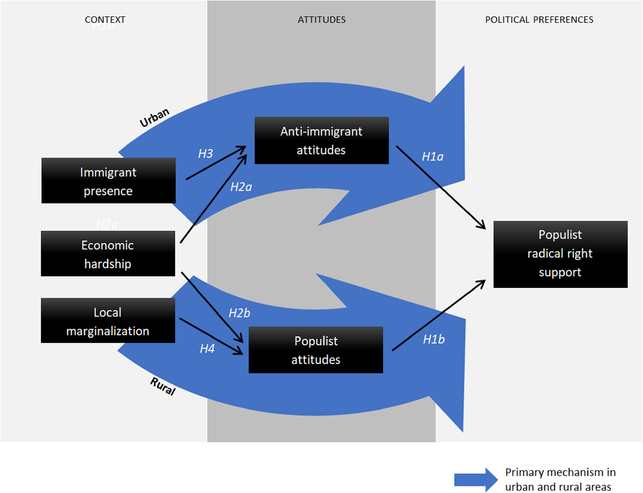
On the basis of these models, we argue that two types of political attitudes exert a direct effect on support for the PRR: anti‐immigrant attitudes and populist attitudes (see Figure 1). The direct effect of these attitudes on support for the PRR has been well established in the literature.Footnote 2 However, we recognize that these attitudes are more present among some social groups than among others. Hence, we take from socio‐structural models that these attitudes originate in specific socio‐structural conditions that are context‐dependent. We therefore postulate that the specific socio‐structural conditions in the area in which citizens live are expected to influence the prevalence and strength of these attitudes, as well as the impact these attitudes have on voting behaviour. Hence, at the individual level, we hypothesize that different causal paths lead to support for the PRR:
-
H1a:Anti‐immigration attitudes have the strongest positive effect on support for the PRR in the most urban areas.
-
H1b:Populist attitudes have the strongest positive effect on support for the PRR in the most rural areas.
The general model for urban and rural areas. [Colour figure can be viewed at wileyonlinelibrary.com]

Which context?
We argue that support for the PRR is rooted in resistance to the social challenges that come with the increased mobility of persons and capital. Voters for PRR parties tend to be pessimistic about the direction in which society is heading (Steenvoorden & Harteveld Reference Steenvoorden and Harteveld2018). Moreover, they care deeply about their local community; they live ‘somewhere’ rather than ‘anywhere’ (Goodhart Reference Goodhart2017). When their community changes, they are likely to resent these changes. However, not all communities are affected in the same way by the increased mobility of people and capital. Some areas improved, while other areas deteriorated. Particularly in these latter areas, we would expect more voters to be prone to support the PRR. Rodríguez‐Pose (Reference Rodríguez‐Pose2018: 200) argues: ‘[t]he areas (…) that have seen better times and remember them with nostalgia, those that have been repeatedly told that the future lays elsewhere, have used the ballot box as their weapon.’ Yet, the ways in which local communities have changed over the past decades differs substantially between urban and rural areas. In urban areas, the most visible changes are associated with the arrival of immigrants who have settled in some neighbourhoods and municipalities more than others (e.g., Alba & Fonet Reference Alba and Fonet2017). In rural areas, the most remarkable changes take the form of long‐term structural decline, which affects some rural areas more than others. This has been referred to as (rural) marginalization (Bock Reference Bock2016) and is observable through the disappearance of services such as libraries and schools, and an exodus of the young, higher educated, and mobile. These developments lead to the erosion of social and cultural capital in some rural areas and generate a sense of loss among those who stay behind (Hochschild Reference Hochschild2016; Wuthnow Reference Wuthnow2018).
In Europe, immigration is primarily an urban phenomenon, while marginalization predominantly takes place in rural areas. Theoretically they could also occur in, respectively, rural and urban areas (e.g., Fonseca Reference Fonseca2008 on immigration in rural areas and Martinez Fernandez et al. Reference Martinez‐Fernandez, Audirac, Fol and Cunningham‐Sabot2012 on marginalization of urban areas). Therefore, we prefer to use the term ‘local marginalization’ instead of ‘rural marginalization.’
In sum, we expect three contextual factors to fuel the support for PRR parties in the context of increased mobility of people and capital: economic hardship, immigration and local marginalization. Yet, we expect some of these conditions to be more important in urban areas and others in rural areas. Hence, at the contextual level, we hypothesize that different roots lead to support for the PRR We now discuss each factor in turn.
Economic hardship
Theories of economic hardship predict that PRR parties obtain more support in areas of the country that are poor and where unemployment is high (Arzheimer Reference Arzheimer2009; Stockemer Reference Stockemer2017). Living in such a context is expected to induce uncertainty and intensify competition over remaining resources, all of which is supposedly blamed, by some, on elites and – through either ‘real competition’ or merely ‘scapegoating’ – on immigrants. PRR parties claim to offer a comprehensive solution to the various uncertainties, by imposing more control over national borders to curtail mass migration and by protecting the interests of the national economy against (allegedly unfair) international competition.
Research on the effects of national and regional economic conditions (such as economic growth and unemployment rates) on PRR support has produced some evidence for this mechanism, although inconsistently (Golder Reference Golder2003; Van der Brug et al. Reference Van der Brug, Fennema and Tillie2005; Arzheimer & Carter Reference Arzheimer and Carter2006; Norris & Inglehart Reference Norris and Inglehart2019; De Blok & Van der Meer Reference De Blok and Van der Meer2018). Yet, recent contributions using more specific operationalizations of the economic impact of the increased mobility of people and capital, such as openness to trade (Dippel et al. Reference Dippel, Heblich and Gold2015; Malgouyres Reference Malgouyres2017), impact of automation (Anelli et al. Reference Anelli, Colatone and Stanig2019) or the level of lay‐offs (Dehdari Reference Dehdari2019), do find consistent effects of these factors on PRR support. Therefore, we expect difficult economic conditions at the local level to boost anti‐immigrant feelings and populist attitudes. So, rather than ‘multiple roots’, we expect economic hardship to exert the same effect in urban and rural areas.
-
H2a:Levels of (and change in) economic hardship in an area increases anti‐immigrant attitudes, and by extension PRR support.
H2b:Levels of (and change in) economic hardship in an area increases populist attitudes, and by extension PRR support.
Exposure to immigration
The presence of immigrants has traditionally been identified as an important contextual factor that explains local and regional variation in support for the PRR (Golder Reference Golder2003; Arzheimer Reference Arzheimer2009; Rydgren & Ruth Reference Rydgren and Ruth2013; Savelkoul et al. Reference Savelkoul, Laméris and Tolsma2017; Janssen et al. Reference Janssen, Ham, Kleinepier and Nieuwenhuis2019). In this literature, ‘immigrant’ is often used as somewhat imprecise shorthand to include out‐groups in a broader sense. According to ethnic threat theories, majority‐group citizens that face (increases in) immigration experience threat and subsequently support parties that propose to block further ethno‐cultural change. At the same time, the presence of immigrants might theoretically also alleviate prejudice. Contact theories propose that, under certain conditions, contact with immigrants increases understanding and tolerance.
Some studies show a positive correlation between immigrant presence in subnational areas and PRR support (e.g., Stockemer Reference Stockemer2016). However, the relationship between anti‐immigrant sentiments and PRR support is not linear, nor uniform, across different contextual levels (Rink et al. Reference Rink, Phalet and Swyngedouw2009; Biggs & Knauss Reference Biggs and Knauss2011; Savelkoul et al. Reference Savelkoul, Laméris and Tolsma2017; Janssen et al. Reference Janssen, Ham, Kleinepier and Nieuwenhuis2019). Moreover, sudden increases in, rather than stable levels of, local immigrant presence induce a negative reaction among majority‐group citizens (Olzak Reference Olzak1994; Tolsma et al. Reference Tolsma, Lubbers and Coenders2007; Savelkoul et al. Reference Savelkoul, Laméris and Tolsma2017; Kaufmann Reference Kaufmann2017). Recent quasi‐experimental studies show that the sudden arrival and/or allocation of Syrian refugees increases support for the PRR (Dinas et al. Reference Dinas, Matakos, Xefteris and Hangartner2019; Dustmann et al. Reference Dustmann, Vasiljeva and Piil Damm2019; Tolsma et al. Reference Tolsma, Laméris and Savelkoul2021). In sum, the relationship between immigration and PRR support reflects a complex interplay between threat and contact.
Given the general direction in most aforementioned studies, we hypothesize that exposure to (increases in) immigration fosters anti‐immigrant sentiments. While we acknowledge that a limited number of rural areas also experience the presence of immigrants, or increases in their numbers, in European contexts this mainly occurs in urban areas (Alba & Fonet Reference Alba and Fonet2017).
-
H3:In urban areas (growth in) the number of immigrants leads to an increase in anti‐immigrant attitudes, and by extension PRR support.
Local marginalization
While immigration changes urban neighbourhoods, a growing literature suggests rural areas are confronted with a set of specific challenges to their livelihood. Marginalization as a consequence of growing mobility of capital and people (Bock Reference Bock2016) is a predominantly rural phenomenon in Western Europe. It encompasses reinforcing developments, such as the demographic exodus of the young, highly educated and economically active, and a decline in services (schools, libraries, banks and post offices). These developments put under stress ‘not only economic prosperity but also potentially the reservoir of social and cultural capital’ (Bock Reference Bock2016: 557), which worsens ‘the dependency rate and undermines the carrying capacity of current models of business, public and private services’ (ibid: 556). The result may be a spiral of outmigration and decline.
While marginalization is more likely to occur in areas facing high unemployment or economic stagnation, it is different from economic hardship per se. First, it can also occur due to factors unrelated to structural economic conditions, such as a rise in tertiary education that results in an exodus of young people to university towns, or changes in government policy that affect service levels in sparsely populated areas.Footnote 3 Second, in terms of mechanisms, while economic hardship sensitizes people to the vulnerability of their own economic prospects, marginalization threatens the livelihood, as well as the social and cultural capital, of communities as such.
There is growing evidence that marginalization fuels feelings of political discontent. Cramer (Reference Cramer2016) shows that the lived experiences in rural areas lead to resentment towards urban elites. She encountered three elements of resentment: (1) ‘a belief that rural areas are ignored by decision makers, including policy makers’, (2) ‘a perception that rural areas do not get their fair share of resources’ and (3) ‘a sense that rural folks have fundamentally distinct values and lifestyles, which are misunderstood and disrespected by city folks’ (Cramer Reference Cramer2016: 23). It is this particularly rural perspective that leads Cramer's interviewees in rural Wisconsin to endorse an anti‐establishment candidate. Hochschild (Reference Hochschild2016) notes a similar conflation of the city and the elite in rural Louisiana. Woods et al. (Reference Woods, Anderson, Guilbert and Watkin2012) discuss rural citizens who feel threatened in their ‘place‐rooted way of life’. These feelings are likely to be especially powerful in contexts of local marginalization.
In European countries, rural resentment may not be equally widespread or deep‐felt as in the United States. However, it is plausible that related feelings of resentment towards ‘the political elite’ are present in rural areas that experience local marginalization.
-
H4:In rural areas, (local) marginalization leads to an increase in populist attitudes, and by extension PRR support.
In sum, H1a and H1b refer to different effects of individual level predictors in urban and rural areas, which we have coined ‘multiple paths’. When focusing on the contextual level variables, we distinguish between factors that have a uniform effect across urban and rural areas and factors that have different effects on individual level predictors in urban and rural areas. H2a and H2b predict that in terms of economic hardship, support for the PRR has the same roots across the country. H3 and H4 predict that such support has different contextual roots in urban and rural areas when we focus on the presences of immigrants or local marginalization, which we have coined ‘multiple roots’ (see Figure 1).
Context or composition?
The concept of multiple roots implies that the local residential context causally affects the party preferences of the people who live there. If the same citizens would live elsewhere, their experiences would differ, and hence their likelihood to support a PRR party would be different as well.
We must distinguish such causal effects from ‘composition effects’, that is how geographical patterns are created by the spatial clustering of individuals with certain characteristics. While the dominant expectation in the literature is that contextual characteristics of the residential environment are causally prior to political preferences, composition effects render the relationship partially endogenous. Political preferences may affect residential preferences directly, if the partisanship of neighbours feeds into movers’ selection of their residential neighbourhood (e.g., Hui Reference Hui2013), or indirectly, if co‐partisans have similar preferences for neighbourhoods. The direct effect is quite unlikely in the Netherlands, in which a weakly polarized multiparty system coincides with low levels of geographical segregation. Moreover, geographical sorting does not affect substantive conclusions on the relationship between neighbourhood context characteristics and voting for PRR parties (De Blok & Van der Meer Reference De Blok and Van der Meer2018) or attitudes (Laurence & Bentley Reference Laurence and Bentley2015). While some residential sorting by party preference does exist in the Netherlands, it is unlikely that reverse causality undermines the conclusions we draw. However, we return to this via several robustness checks.
Design, data and methodFootnote 4
The Dutch case
The Netherlands is a least‐likely case to find clear rural‐urban differences in patterns of support for PRR parties. Unlike many other countries, the Netherlands has no tradition of a long‐standing urban‐rural cleavage (Lipset & Rokkan Reference Lipset and Rokkan1967). It is densely populated and very urbanized. Furthermore, election campaigns, the media system, and the party system in the Netherlands are highly centralized, because the country consists of a single electoral constituency. No regional parties are represented in the Lower House. We therefore expect that differences between urban and rural areas will be smaller in the Netherlands than in most other countries. If we nevertheless find that different factors shape support for the PRR Party for Freedom (Partij voor de Vrijheid, PVV) in urban and rural areas in the Netherlands, it is likely that such differences exist in other countries as well.
Data
Our analyses combine unique geocoded individual‐level survey data with rich data on the characteristics of geographical units in the Netherlands. Many studies on the effect of context on attitudes or vote choice rely either on fully aggregated data, or on individuals nested in relatively large geographical areas. Both raise potential methodological problems. Aggregated data cannot disentangle individual from contextual effects, which likely leads to overestimating neighbourhood effects (see De Blok & Van der Meer Reference De Blok and Van der Meer2018). By combining individual level data with data at the level of neighbourhoods, we are able to distinguish between context and composition effects. Large geographical areas are not evidently the optimal scale to assess contextual effects, as the theoretical mechanisms emphasize everyday contact, social capital and concerns about the local community. Yet, following data availability, many studies measure the presence of out‐groups at the level of countries (e.g., Knigge Reference Knigge1998; Golder Reference Golder2003; Arzheimer & Carter Reference Arzheimer and Carter2006), or large subnational entities (e.g., Lubbers & Scheepers Reference Lubbers and Scheepers2000; Kestilä & Söderlund Reference Kestilä and Söderlund2007) instead of municipalities (Van der Waal et al. Reference Van der Waal, De Koster and Achterberg2013), or electoral wards and neighbourhoods (e.g., Rydgren & Ruth Reference Rydgren and Ruth2013; De Blok & Van der Meer Reference De Blok and Van der Meer2018; Savelkoul et al. Reference Savelkoul, Laméris and Tolsma2017; Janssen et al. Reference Janssen, Ham, Kleinepier and Nieuwenhuis2019). Our contextual data are measured at the level of small geographical areas, which captures citizens’ everyday context (see below).Footnote 5
At the individual level, our data consist of a survey designed to study subnational variation in PRR support. These data were collected online during two weeks in May 2017, shortly after the national elections on March 15th. The respondents were sampled from the standing panel of the survey company GfK – predominantly from their probability‐based sample – to be representative of the population in socio‐demographic and geographic terms. The sample was stratified by age, education, ethnicity, urbanity and province (see Appendix A in the Supporting Information).
Contextual data were obtained from Statistics Netherlands (CBS). Most data were available at three levels: neighbourhoods (‘buurten’; average population: 1,379), districts (‘wijken’: 5,998) and municipalities (‘gemeenten’: 43,004). Not all indicators of our contextual variables were available at the lowest level of aggregation. We therefore decided to link the individual level data to measures at the level of districts. These are not electoral districts, which de facto do not exist in the Netherlands. Districts are socially relevant contexts with boundaries that tend to follow natural demarcation lines around old hamlets and physical divisions (canals, main streets) that are socio‐culturally distinct when it comes to their socioeconomic composition (Tolsma & Van der Meer Reference Tolsma and Van der Meer2017).
The indicators are from the closest available year before the survey, usually 2016 or 2015 (for some variables 2014). Changes in indicators, such as the proportion of non‐Western immigrants, are measured over a 10‐year period (see below). The exceptions are the socioeconomic changes, for which the change variables are calculated from 2009 to 2016 for data availability reasons. Because districts sometimes undergo border changes, change variables cannot be calculated for all districts. As a result, models including change variables omit about 10 per cent of the observations.
Operationalization
Dependent variable . Support for PRR parties is measured using the following indicator:
• Propensity to vote PVV: ‘How likely is it that you would ever vote for the following parties?’ on a scale from 0 (‘Not at all likely’) to 10 (‘Very likely’).
Compared to the actual vote, the propensity to vote variable has the benefit of capturing more variation in support, given that the actual number of PVV voters is limited even in a large sample.
Attitudes . The two key attitudinal predictors of PVV support in our model are as follows:
• Anti‐immigrant attitudes, measured using a scale of questions about immigrants’ effect on the economy, culture and the country in general (alpha = 0.74).Footnote 6
• Populist attitudes, measured using a scale that captures distrust of political elites combined with people‐centrism (alpha = 0.88) (Akkerman et al. Reference Akkerman, Mudde and Zaslove2014).
For more information on the measurement and distribution of our variables, see Appendix B and C.Footnote 7
Context variables . Theoretically, we expect support for PRR parties to be driven by resistance to social changes. We include contextual variables that reflect the current conditions as well as the changes in these conditions in the ten years before the survey data were collected. In part, the inclusion of both kinds of contextual variables is a methodological choice. Since the proportion of immigrants is quite strongly correlated with the change in this variable (r = 0.33), we should at least control for the level if we want to isolate the effect of change (e.g., Kaufmann Reference Kaufmann2017). Yet, as we discuss below, in some cases the level variables reflect how the local context has changed over several decades. The choice for a 10‐year time period is partially driven by data availability, rather than theoretically motivated.
We measure exposure to immigration based on the level of and change in:
• Share of citizens who immigrated from, or whose parents immigrated from, a non‐Western country.
‘Non‐Western’ is defined by Statistics Netherlands as any country outside Europe (excluding Turkey), North America, Oceania, Indonesia or Japan. This covers the groups against which the PVV mobilizes the most: citizens with a Turkish or Moroccan immigration background (and their descendants). We realize that PRR parties may also mobilize against immigrants from Central and Eastern European countries, which Statistics Netherlands would categorize as citizens with a Western immigration background. As a robustness check, we therefore replicate our analysis using the Western immigration background category (reported in Appendix J). While many non‐Western immigrants came to the Netherlands in the 1960s and 1970s, most of the current non‐Western immigrants have arrived since the 1980s.Footnote 8 Hence, the proportion of immigrants in an area reflects a long‐term social change that took place over the past decades. By including both the current share of citizens with a migration background and its ten‐year change, our models capture both longer‐ and shorter‐term changes to the local context.
We measure local marginalization based on the level of and change in:
• The share of people aged 15 to 25;
• The mean distance (in kilometres) to the following public and private services: general practitioner (GP), elementary schools, secondary schools, supermarket, shops, library and bar.
The share of young citizens is a proxy measure for the exodus of young people from certain areas. We do not have direct measures of young people leaving, but if there are relatively few young people (around 20 years old) in a certain area, this is either the result of low fertility rates 20 years ago or of young people leaving. A low fertility rate 20 years ago is largely caused by the fact that there were relatively few people in that area at the age when people normally start a family. So, the proportion of young citizens reflects long‐term changes. We also measure the changes in the proportion of young people. However, if the level already taps into the fact that young people leave, the change indicates whether more young people leave now than in the past. In the case of the distances to services, we are able to measure changes over the past 10 years. Again, we also look at the effect of the level of this variable.
We measure economic hardship based on the level of and change in:
• Average income;
• Share of citizens with unemployment benefits.
In those places where we compare the effects for different independent variables, we have z‐standardized the variables. Furthermore, for some of our models and graphs, it is more convenient to summarize explanatory models using a single variable that is comparable across models. For each set of explanations, we therefore also create a z‐score of one or more variables, using either levels or changes based on the theoretically most relevant indicator: change in number of immigrants (z‐score); level of unemployment and income (average z‐score); change in young residents and services (average z‐score).
Urbanity and rurality . In the theory section, we used the terms ‘urban’ and ‘rural’ as shorthand for ideal types. In reality, urbanity and rurality form the ends of a continuum. The urbanity of districts is therefore measured based on density, using a continuous measure of population density per km2 in the district. In our regression models, we employ the continuous measure. However, in the Structural Equation Models (SEM) we employ a three‐fold ordinal classification based on Statistics Netherlands’ five‐fold classification, consisting of ‘Rural’ (cat. 1–2), ‘Semi‐urban’ (cat. 3–4) and ‘Urban’ (cat. 5). This is because the SEM‐analyses are not suited for simultaneously testing several interactions with continuous variables.
Spatial distribution of variables . Appendix D shows the maps of all variables under consideration in this study, aggregated to the level of municipalities. The first map shows the areas that saw the strongest support for the PVV at the 2017 legislative elections.Footnote 9 This distribution closely mirrors that of the distribution of the anti‐immigrant attitudes and populist attitudes. This is unsurprising, given that these attitudes have been identified as the core predictors of PRR support. However, PVV support does not at all mirror the distribution of exposure to immigration, which is heavily concentrated in the urbanized West of the country (Randstad) and scattered in urban areas outside it. Local marginalization is concentrated in quite different areas, most of which are rural. This already makes it plausible that these two variables play a different role in different parts of the country. The main divide seems to be one of urban versus rural rather than one of Randstad versus the rest.
Method
First, we take a look at the distribution of the dependent and independent variables over urban and rural areas. We then investigate the hypothesized causal paths using multilevel structural equation models (ML SEM). Our theoretical expectation is that attitudes mediate the effect of context on vote choice. While this is a common assertion, we first need to test whether indeed the effects of the local contexts are indirect. Moreover, we wish to establish whether the PVV vote is mainly driven by anti‐immigrant attitudes in urban areas (H1a) and by populist attitudes in rural areas (H1b). These questions can be answered simultaneously by estimating SEM models for the three areas.
For the ML SEM analysis (estimated in Stata using GSEM) a random intercept for districts is used, thus modelling the contextual variables as exogenous. These models are estimated for the three levels of urbanity: urban, semi‐urban and rural. The variables in the SEM models are standardized to allow for comparisons within and between models. The three context variables and the two attitudes are allowed to correlate. Standard goodness‐of‐fit indices such as RMSEA are not available for SEM models with a random intercept. However, we note that all models without random intercepts have good RMSEA scores (all models < 0.01), and models with standard errors clustered on the district level perform well in terms of SRMR (all models < 0.08).
Since SEM provides a measure of fit of the whole model, we prefer it to alternative ways to test mediation. However, the method is mostly designed to test parsimonious causal models that are theoretically grounded (e.g., Bollen Reference Bollen1989). We therefore consider it less useful to explore multiple interactions. In the subsequent section, we test our hypotheses by zooming in on the different relationships in the model, using multilevel regression. In one set of regression models we explain support for the PVV by attitudes, and in another set of models we explain attitudes by context. All these effects are interacted with population density to test whether the effects are different depending on urbanity.
In this latter part of the analysis we control for composition effects by including respondents’ characteristics such as education and immigration background. Moreover, to rule out spuriousness due to selective residential mobility, we support the robustness of our findings by analysing a subsample of respondents who have not moved over the last decade (see Figure 5 of the Supporting Information).
Only respondents without a (first or second generation) immigration background are included in the analysis. This ensures that their share does not, for reasons of composition rather than context, negatively predict support for the PVV. After all, the party has a much lower support among citizens with an immigration background.
Results
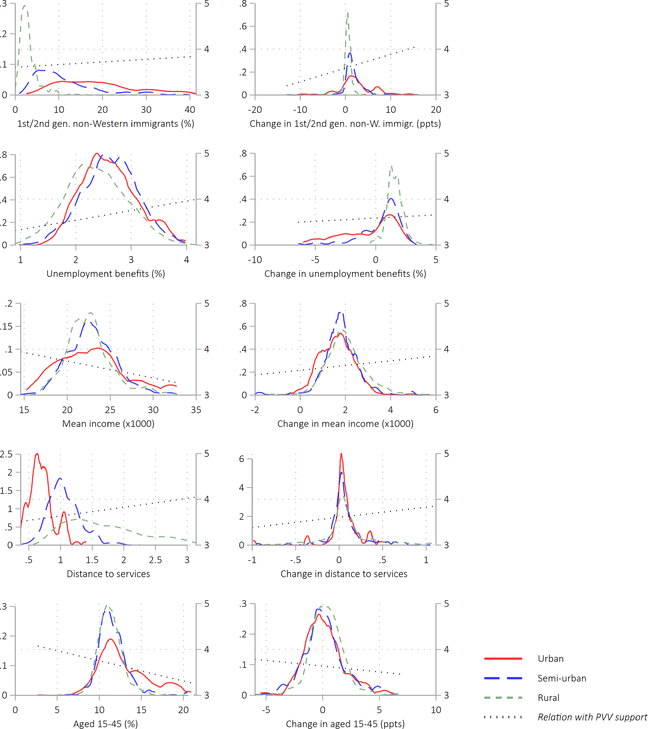
Figure 2 shows the distribution of the main independent variables over the three categories of ‘rural’, ‘semi‐urban’ and ‘urban’. Table C2 in Appendix C provides an F‐test of the differences of the averages between these categories. Based on this table, it is relevant to note that PVV support is not substantially higher in either urban, semi‐urban or rural areas (as is visible in Table C2 in the Appendix). Despite some popular depictions, PRR support (at least in the Dutch case) is neither purely a backlash of rural areas against the urban centre, nor only driven by an urbanized (former) working class. PRR parties draw support from both the countryside and the cities.
Distribution of independent variables across levels of urbanity. [Colour figure can be viewed at wileyonlinelibrary.com]

Figure 2 shows that there is a bivariate relationship between several of the contextual variables and PRR support (the plotted regression lines). Also, Figure 2 confirms that the distribution of these contextual variables is not uniform over rural, semi‐urban and urban areas. Concentrations of immigrants and their descendants are a predominantly urban phenomenon. This is true for the change in immigration too, which is more than three times as high in urban areas. As can be expected, distance to services is a rural phenomenon. Similarly, areas with few young people are more often rural (or semi‐urban). By contrast, economic hardship in the shape of either unemployment or low incomes, both of which are associated with PVV support, occurs in all types of areas.
In short, it is especially the most urban citizens that tend to see their neighbourhoods change as a consequence of immigration, while citizens in rural areas are more likely to live in areas where public services disappear and where young people leave. Whether this leads to differences in the effects of these contextual and individual level variables on PRR support requires a more formal test, to which we turn now.
Structural equation models
We first model the hypothesized causal pattern – from context condition, through attitudes, to PVV support – using SEM, which is a good starting point to investigate causal patterns. As discussed above, exposure to immigration is measured as the z‐score of change in number of immigrants; economic hardship as the average z‐score of the levels of unemployment and (reversed) income; and local marginalization as the average z‐scores of the change in the share of young residents (reversed) and the change in the distance to services.Footnote 10
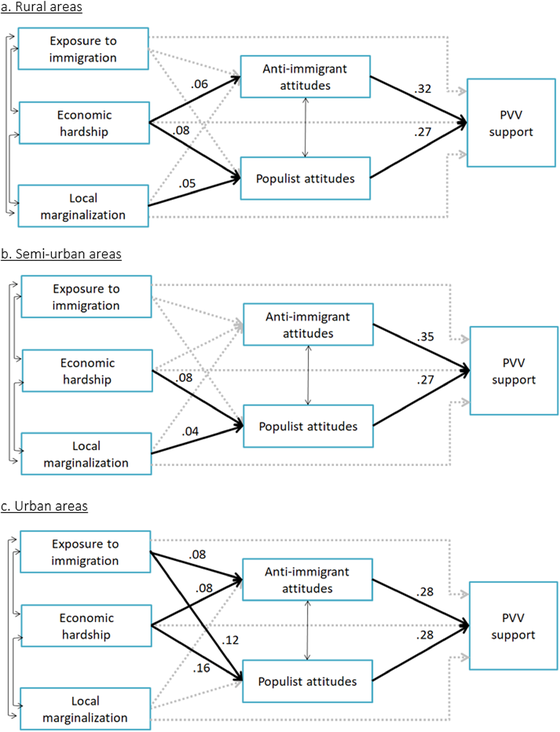
Figure 3 shows that both anti‐immigrant attitudes and populist attitudes predict PVV support equally well in rural, semi‐urban and urban areas. This finding contradicts our ‘multiple paths’ hypotheses H1a and H1b. Citizens throughout the country translate both anti‐immigrant attitudes and populist attitudes into PVV support. Although there are few immigrants in rural areas, anti‐immigrant attitudes are a strong predictor of PVV support in these areas.
Structural equation models. [Colour figure can be viewed at wileyonlinelibrary.com]
Note: standardized coefficients only shown for significant effects (p < 0.05).

We predicted that anti‐immigrant attitudes would be influenced by exposure to immigration (H3), and populist attitudes by local marginalization (H4). We expected the former to be relevant especially in cities, and the latter in rural areas. Moreover, we expected economic hardship to exert an effect on anti‐immigrant attitudes (H2a) and on populist attitudes (H2b) in all areas. Hypotheses 2a and 2b are supported by our findings. Economic hardship affects both attitude scales in all areas except semi‐urban ones. Hypotheses H3 and H4 are partly supported by the analyses in Figure 3. In line with the expectations, populist attitudes in rural districts are explained by the economic hardship and local marginalization variables; in urban districts, anti‐immigrant attitudes are explained by exposure to immigration. At the same time, we see that exposure to immigration also predicts populist attitudes in urban areas. As we will discuss in the concluding section, this likely reflects the fact that immigrant and elite critique have consistently been politicized together, and are thus consistently blamed together.
All in all, we conclude that in urban areas, citizens’ anti‐immigrant attitudes and populist attitudes (and by extension PRR support) are predicted by their exposure to immigration and economic hardship. In rural areas, populist attitudes are predicted by local marginalization and anti‐immigrant attitudes by both marginalization and economic hardship.
Multilevel regression
The SEM models demonstrate that PRR support is causally related to the same two attitudes in all three types of regions that we distinguished. The effects of anti‐immigrant attitudes and populist attitudes are very similar, and when we look at interactions between anti‐immigrant attitudes and populist attitudes (not presented here) we also find a positive interaction in all three regions. This suggests that the general theoretical idea of two different causal paths to the PRR needs to be rejected. Yet, to provide a more formal test of the idea of multiple paths, we present multilevel regression models containing interaction effects. This tests whether attitudes predict PVV support better in some contexts than others. We also perform a more formal test of our ‘multiple roots’ hypotheses, by assessing whether context variables predict attitudes better in some contexts than others. This technique also allows us to control for employment status, level of education, age and gender.
The SEM models showed that populist attitudes and anti‐immigrant attitudes are equally relevant determinants of PVV support in urban and rural areas. This is confirmed by a regression model (reported in Appendix F): both attitudes are a significant predictor of the propensity to vote PVV, but both interaction‐effects with urbanity are not significant and their signs are opposite from what was theoretically expected. Hence, these findings confirm that the multiple paths hypotheses (H1a and H1b) have to be rejected.
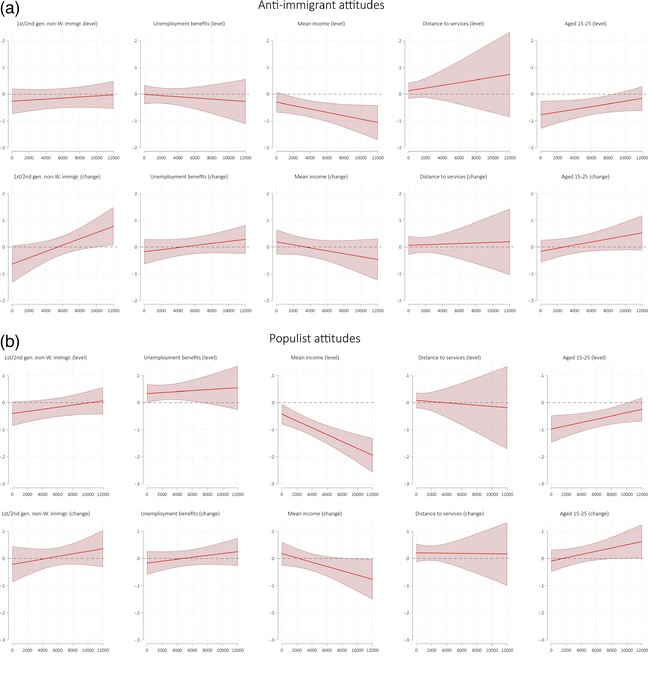
To investigate which context factors predict levels of anti‐immigrant attitudes and populist attitudes, Figure 4 presents the marginal effects of various context variables on the two attitudes, over different values of urbanity, measured by the continuous density indicator.Footnote 11 To avoid multicollinearity arising from the inclusion of 10 interaction terms with population density, we modelled each interaction separately, each time controlling for all micro‐ and macro‐level variables.Footnote 12 The goal is to capture whether the predictive power of context variables is limited to urban or rural regions due to the differences in the underlying distribution. We do so by investigating whether there are ‘cut off points’ above which an effect is (or is no longer) significant. This provides more information than just the interaction effects. Yet, the significance of each interaction is presented in 20 separate tables in Appendices G and H. All models control for individual socio‐demographics as well as the other context variables. To allow for a comparison of effects across models, both the context variables and attitudes have been standardized.
Marginal effects of context on attitudes, by level of urbanity (in resident/km2). [Colour figure can be viewed at wileyonlinelibrary.com]
(a) Anti‐immigrant attitudes
(b) Populist attitudes
Note: standardized dependent and independent variables (except urbanity).
Nrespondents = 5,172; Ndistricts = 1,314

Exposure to immigration: As predicted by H3, anti‐immigrant attitudes tend to be higher if the inflow of (i.e., change in) immigrants is larger, but this relation is only significant in the most urban areas.Footnote 13 The level of immigrants has no significant effect; if anything, the descriptive direction of the effect suggests it decreases anti‐immigrant sentiments.Footnote 14 The number of immigrants and increases in the number of immigrants are not significantly related to populist attitudes, across the whole range of the urbanity scale. This finding differs from the results of the SEM‐analysis, possibly as a result of the large number of contextual control variables. In short, increases in the number of immigrants predicts anti‐immigrant attitudes in the most urban areas, but not significantly so in the rest of the country.
Economic hardship: Higher rates of unemployment benefits are only significantly associated with more populist attitudes in rural areas. By contrast, lower levels of income are associated with higher levels of populist attitudes and anti‐immigrant attitudes across the board, although to a higher degree in urban than in rural areas. In line with H2a and H2b, economic hardship thus predicts both anti‐immigrant attitudes and populist attitudes. It appears to have a stronger effect on populist attitudes than on anti‐immigrant attitudes, but we lack a formal test of this difference. While we find evidence of immigrants being scapegoated for economic hardship, it appears as if political elites are blamed more.
Local marginalization: A low level of young people present in a neighbourhood is associated – even when controlling for the respondents’ own age – with both more populist attitudes and anti‐immigrant attitudes, but only in semi‐rural and rural areas. This is in line with our expectation H4. However, a change in their presence does not have the same effect. It is possible that such a development unfolds over a much longer time than ten years. At any rate, it is notable that a lack of young people is associated with populist attitudes (though less strongly) in more urban areas, too. A decline in services, by contrast, is by itself not a significant predictor in any of these models.Footnote 15
Robustness
We conducted several robustness checks, which we explain in more detail in Appendix J. We replicated our analyses (1) using a categorical rather than continuous measure of urbanization; (2) using the Western (rather than non‐Western) immigration background category; (3) using a jack‐knife analysis of the SEM model in which one province at a time was excluded from the analysis; (4) on a subsample of respondents who had not moved in the past 10 years; and (5) without outliers. None of these resulted in more than marginal modifications of our conclusions.
Conclusion and discussion
The rise of PRR parties has been considered, by some, as a rural revolution against the cosmopolitan elite; by others, as a backlash in the urban theatre of ethno‐cultural tensions. We argued that PRR support is rooted in both, as a result of context‐specific manifestations of social change that induces anxiety. Hence, we predicted that different sets of contextual conditions would lead to the same outcome, that is, that PRR support has multiple roots. We also expected that this would lead to differences in the effects of individual level variables on PRR support, that is, that different causal paths would lead to PRR support. Contrary to our expectations, we find no support for multiple paths. Anti‐immigrant attitudes and populist attitudes are equally strong predictors of PRR support in urban and rural areas.
However, both attitudes do have different roots in urban and rural areas. On the one hand, increases in the number of immigrants and their descendants explain anti‐immigrant (and, less robustly so, populist) attitudes in urban areas. On the other hand, local marginalization is a better explanation of both anti‐immigrant attitudes and populist attitudes in rural areas. Economic hardship results in both grievances regardless of urbanity. Notably, citizens who experience one of these developments are often likely to reject both immigrants and political elites – even if very few immigrants are present.
While our analyses focus on different effects of contextual and individual level predictors, we think that these effects are ultimately the result of different distributions of our explanatory variables over rural and urban areas. Increases in immigrant presence are most common in some urban areas and they account for stronger anti‐immigrant attitudes there. We do not think this reflects a fundamental difference between cities and rural areas. It is plausible that steep increases in immigrants in rural areas would have the same effect on PRR support. Yet, the numbers of respondents in rural areas experiencing this is generally too low to be noticeable. Importantly, in urban areas in which such strong increases are absent, levels of anti‐immigrant attitudes are relatively low, in spite of high levels of immigrant presence. This might reflect, among others, self‐selection effects (Maxwell Reference Maxwell2019). Cities are thus the arena of both successful native‐immigrant interaction and strong anti‐immigrant sentiment (Alba & Fonet Reference Alba and Fonet2017). This seems a plausible reason why many studies find that the number of immigrants is not associated with PRR support (Stockemer Reference Stockemer2016).
Across rural areas, populist attitudes are strongest in areas experiencing local marginalization, especially in areas where few young people remain. By contrast, low public and private service availability (Bock Reference Bock2016) does not predict populist attitudes or anti‐immigration views. The number of immigrants, or the increase thereof, is simply too low to explain much of the variation in PRR support across rural and semi‐urban areas.
We expected that local marginalization would lead to stronger populist attitudes, while exposure to immigration would increase anti‐immigrant attitudes. However, our models suggest that these area‐specific context conditions usually foster both attitudes (with the exception of increasing immigrant numbers, which are above all impacting views on immigrants). There are two reasons why these attitudes may coincide. First, as Hochschild (Reference Hochschild2016) and Gest (Reference Gest2016) argue, perceptions of relative status decline are often experienced most starkly by contrasting it to alleged ‘cue skipping’ by ethno‐racial 'others', even if few are present. Second, anti‐immigrant sentiment and elite critique have become intertwined because they have been consistently politicized together. This fact can explain why opposition to immigration exists in rural areas where few immigrants are present. This pattern has been noted before, and at first sight seems to discard the existence of context effects. However, we show that these attitudes can be rooted in different conditions than the presence of immigrants.
While immigration and local marginalization thus play markedly different roles as factors behind PRR success, economic hardship is relevant in all sorts of areas. Our findings dovetail conclusions of earlier studies (Rydgren & Ruth Reference Rydgren and Ruth2013; Van Gent et al. Reference Van Gent, Jansen and Smits2014; as well as Dippel et al. Reference Dippel, Heblich and Gold2015; Malgouyres Reference Malgouyres2017; Anelli et al. Reference Anelli, Colatone and Stanig2019; Dehdari Reference Dehdari2019). We find unemployment is particularly relevant in rural areas (through its association with populist attitudes), while low incomes matter especially in urban areas (where it is more strongly associated with both anti‐immigration attitudes and populist attitudes). These findings show that the role of economic hardship, too, can be better understood by being sensitive to different mechanisms depending on the urbanity of an area.
Our findings do not downplay the relevance of immigration for PRR support, let alone that of anti‐immigrant attitudes. By contrast, increases in the number of immigrants matter more robustly than in most previous studies, but they primarily do so in urban areas that actually experience large‐scale increases in ethnic diversity. In rural areas, too, PRR support is rooted in concerns about immigration. The fact that anti‐immigrant attitudes are an important predictor in all areas should not come as a surprise, given that immigration is a core theme of public and societal debate, widely covered by the media. However, we show that immigrant numbers are not of much help in explaining why some rural areas are PRR strongholds, while others are not. That variation is rooted in other economic and demographic conditions.
Our findings have two major implications. First, the success of PRR actors is rightly described as a reaction to social change. However, this change has different manifestations depending on context. As a result, PRR support cannot be reduced to an economic or cultural backlash (Norris & Inglehart Reference Norris and Inglehart2019). Second, studies of subnational variation in PRR support (or other electoral outcomes) need to theorize and model how different factors are at work in different contexts, rather than adopt a ‘one size fits all’ approach. The model proposed in this study furthers our theoretical and empirical understanding of support for the PRR, by releasing the assumption of a uniform, context independent, explanation.
Our study confirms that citizens’ PRR support is partially rooted in local conditions. Yet, some limitations need to be acknowledged. First, we test our models on cross‐sectional data, albeit with longitudinal elements, without exogenous variation that could function as leverage to isolate the causal direction of both pathways simultaneously. Nevertheless, direct or indirect selective residential mobility tends to have at best modest effects on estimates. Indeed, our conclusions are robust to permutations that aim to test sensitivity to selective residential mobility. Second, our model does not account for the role of other actors, such as the media and political parties in shaping these attitudes. The fact that anti‐immigrant attitudes have a strong effect on support for the PVV even in rural areas where few migrants live, may well reflect how the PVV influences the attitudes of their own supporters (e.g., Rooduijn et al. Reference Rooduijn, Van der Brug and De Lange2016). Our unique geo‐coded data provided the opportunity to take a first step in establishing this link. However, it will require panel survey data over a long period to tease out further how specific conditions shape attitudes.
Acknowledgements
We want to thank the reviewers and editors of the European Journal of Political Research for their valuable and constructive feedback throughout the process. We also want to express our gratitude to those who provided valuable input at seminars at the universities of Mannheim, Nottingham, Harvard and Amsterdam. The project was funded by an NWO ORA grant 464‐15‐225.
Online Appendix
Additional supporting information may be found in the Online Appendix section at the end of the article:
Appendix A. Sample information
Appendix B. Indicators used for scales
Appendix C. Descriptives
Appendix D. Geographical distribution of independent and dependent variables (aggregated to the level of municipalities)
Appendix E. Correlation matrix macro level variables
Appendix F. predicting support for PVV
Appendix G. predicting anti‐immigrant attitudes
Appendix H. predicting populist attitudes
Appendix I. Figures based on a regression including all interactions terms
Appendix J. Robustness checks


 Open access

