

Introduction
Land-based plastic waste, unless carefully disposed of, makes its way into rivers and other water bodies and becomes an insidious and important source of marine pollution (Jambeck et al., Reference Jambeck, Geyer, Wilcox, Siegler, Perryman, Andrady and Law2015). According to the best global estimates, 80% of plastic waste in the ocean comes from land, with 20% directly from the use of plastics in the ocean (Li, Tse, & Fok, Reference Li, Tse and Fok2016). Although the first report on marine plastic pollution appeared in the early 1970s, little attention was given to this problem within the scientific community until the mid-2000s. However, there is now increased awareness of the scope of marine plastic pollution, with the discovery of plastics in the remotest islands of the planet (including in the Southern Ocean) having highlighted the issue (Waller et al., Reference Waller, Griffiths, Waluda, Thorpe, Loaiza, Moreno and Hughes2017). This paper explores how the problem of marine plastics, and plastic waste more generally, is being managed within the Antarctic Treaty System (ATS), the key governance arrangement for Antarctica and the Southern Ocean.
The ATS comprises several instruments, institutions and arrangements governing the Antarctic continent and the Southern Ocean north of the Antarctic continent to latitude 50º South in the South Atlantic, latitudes 45º–55º South in the South Indian Ocean and south of Australia and 60º South in the South Pacific. This marine domain comprises approximately 10% of the earth’s surface area (Haward, Reference Haward and Harris2019). The ATS has the 1959 Antarctic Treaty as its centrepiece and also includes the 1972 Conservation of Antarctic Seals, the 1980 Convention on the Conservation of Antarctic Marine Living Resources (CAMLR Convention) and the 1991 Protocol on Environmental Protection to the Antarctic Treaty (Madrid Protocol). The ATS also includes decision-making institutions, including the Antarctic Treaty Consultative Meetings (ATCM), the Committee for Environment Protection (CEP), the Commission for the Conservation of Antarctic Marine Living Resources (CCAMLR) Secretariat and the Antarctic Treaty Secretariat.
Outside these instruments and institutions, the ATS engages with a number of expert bodies, including the Scientific Committee on Antarctic Research (SCAR); the Standing Committee on Antarctic Logistics and Operations of the Council of Managers of National Antarctic Programs (COMNAP), and non-governmental organisations; the Antarctic and Southern Ocean Coalition (ASOC), the International Association of Antarctica Tour Operators (IAATO) and the Coalition of Legal Toothfish Operators (COLTO).
The Antarctic Treaty set aside disputes over territorial sovereignty but has very little specific content relating to environmental management of the continent and the surrounding Southern Ocean. The Madrid Protocol supplements the Antarctic Treaty in providing a specific focus on environmental protection and management. The Madrid Protocol was concluded in 1991 and entered into force in 1998 for the main text and Annexes I–IV, with Annex V, adopted separately in 1991, entering into force in 2002. Annex VI of the Protocol (i.e. Liability Arising from Environmental Emergencies) was adopted in 2005 but is yet to enter into force.
The Madrid Protocol’s Annexes III and IV refer to waste disposal and prevention of marine pollution, respectively. It is forbidden to release sewage from ships within 12 nautical miles of the Antarctic land or ice shelves (Annex IV, Article 6), but the Protocol does not compel the Parties to treat the sewage discharged from their respective research stations. In accordance with Annex I of the Madrid Protocol, Parties are obliged to conduct an Environmental Impact Assessment of most activities in the Antarctic Treaty Area and must take measures to reduce their environmental burden. The CEP, established by the Madrid Protocol, provides advice on environmental matters to Parties to the Antarctic Treaty through the annual ATCM. One indicator of an increased focus on plastic pollution can be noted through contributions made at the most recent ATCM, ATCM XLII in Prague in 2019, as discussed in Section “Antarctic Treaty Consultative Meetings and Committee for Environment Protection” below.
With the increasing attention to the global plastic pollution issue, a number of research studies have emerged. When we investigated the previous literature, we found there was relatively little research on plastics in Antarctica, especially on plastics originating from outside the Southern Ocean. In this paper, we investigate publicly available documents related to plastics presented or discussed at meetings of the ATS bodies. Although this investigation shows that the issue of plastic pollution has attracted discussion at relevant meetings in ATS in recent years, there has been limited quantitative research and little analysis of the ATS’s responses. Moreover, the ATS response is effectively limited to the areas set by the Antarctic Treaty and the CAMLR Convention. We conclude that in addition to raising the awareness of the impacts of plastic pollution within the ATS, the parties to the ATS also have a role in promoting wider, globally oriented, governance initiatives.
Literature review
Sources of plastics/microplastics within the greater Southern Ocean
Plastics in Antarctica can come from a variety of sources. These include direct sources, such as disposal of waste from research stations and from ships (Waller et al., Reference Waller, Griffiths, Waluda, Thorpe, Loaiza, Moreno and Hughes2017) and indirect sources, such as through transport by ocean currents that can carry microplastics from remote, low latitudes to the high latitudes of Antarctica (Fraser et al., Reference Fraser, Morrison, Hogg, Macaya, van Sebille, Ryan and Waters2018).
Wastewater from research stations
Wastewater from Antarctic research stations can contain plastic pollution in the form of microfibres and microbeads. Wastewater management is a challenge for all countries currently operating research stations in Antarctica. With the entry into force of the Madrid Protocol, parties have increased attention to the treatment of wastewater from their stations, to address Article 5 of Annex III to the Madrid Protocol that provides guidance on the disposal of sewage and domestic liquid waste into the sea.
Wastewater treatment can be generally divided into three stages, a primary stage (the removal of solid waste), a secondary stage where biological methods treat dissolved biological substances and a tertiary stage where chemical or physical methods are used in sewage treatment (Gröndahl, Sidenmark, & Thomsen, Reference Gröndahl, Sidenmark and Thomsen2009). If this is not possible in practice, the station can discharge sewage and domestic liquid waste directly into the sea under certain conditions, such as where the discharge site has the capacity for initial dilution and rapid diffusion taking into account the absorptive capacity of the marine environment (Annex III, Article 5). However, due to the different sewage treatment capacities of each station, and the fact that the Madrid Protocol does not have strict definitions and standards for dilution, dispersal and assimilation capacity of the marine environment, governance is more difficult (Stark et al., Reference Stark, Bridgen, Dunshea, Galton-Fenzi, Hunter, Johnstone and Smith2016).
Researchers have recorded microplastics in the sewage outfall near the British Rothera Research Station. The vast majority of these microplastic particles were fibrous materials, the most common of which was nylon (42%), which was a semi-synthetic fibre. At Rothera, the source of the plastic fibres was thought to be from the washing of clothing, although such fibres can also be derived from cleaning wipes and hygiene products (Reed, Clark, Thompson, & Hughes, Reference Reed, Clark, Thompson and Hughes2018). Waller et al. (Reference Waller, Griffiths, Waluda, Thorpe, Loaiza, Moreno and Hughes2017) indicated that microfibers discharged from laundry wastewater could be a relatively substantial source of microplastic pollution and are likely to be more concentrated in populated and/or highly visited areas such as the Northern Antarctic Peninsula.
Tourism
Antarctic tourism expanded in the 1960s with the modern cruise industry beginning in 1969 (IAATO, 2020). Large-scale Antarctic tourism grew in popularity in the early 1990s and continues to grow today. The number of tourists rose from 1000 per year on 12 vessels over 1990–1991 summer season to more than 50,000 for the first time in 2017–2018 season, with a total of 50 vessels (McCarthy, Peck, Hughes, & Aldridge, Reference McCarthy, Peck, Hughes and Aldridge2019). According to the latest statistics, the total number of tourists in the 2018–2019 season is 56,168, and the total number of tourists in the 2019–2020 season is expected to reach 78,520 (IAATO, 2020). Antarctic tourism has long been a focus of concern for scientists and policymakers, and as the number of tourists continues to increase, so does the importance of studying its impact on the environment. One area of concern is that plastics on Antarctic tourist ships and passengers with their personal care products containing microplastics may pose a threat to the Antarctic environment (Bessa et al., Reference Bessa, Ratcliffe, Otero, Sobral, Marques, Waluda and Xavier2019; Lacerda et al., Reference Lacerda, Rodrigues, Van Sebille, Rodrigues, Ribeiro, Secchi and Proietti2019; Waller et al., Reference Waller, Griffiths, Waluda, Thorpe, Loaiza, Moreno and Hughes2017).
Fisheries
Eriksson, Burton, Fitch, Schulz, and van den Hoff (Reference Eriksson, Burton, Fitch, Schulz and van den Hoff2013) collected nearly 6500 samples from two sub-Antarctic islands (Macquarie Island and Heard Island), with plastic debris accounting for 95% and 94%, respectively, of all debris. Lost or discarded fishing gear accounted for 22% of the plastic collected on both islands, mainly ropes, bait box straps, monofilament lines and buoys (Eriksson et al., Reference Eriksson, Burton, Fitch, Schulz and van den Hoff2013). Convey, Barnes, and Morton (Reference Convey, Barnes and Morton2002) also showed that in South Georgia, ocean debris is closely related to local fishing activities, whereas in the South Sandwich Islands the source of plastic debris appears to be mainly fishing floats and polystyrene derived from sources far from these islands.
Sources of plastic outside the Southern Ocean
Plastics can also originate from outside the Southern Ocean. For instance, the upwelling Circumpolar Deep Water from lower latitudes may cross the Antarctic Circumpolar Current (ACC) and bring plastics to a shallower depth (Waller et al., Reference Waller, Griffiths, Waluda, Thorpe, Loaiza, Moreno and Hughes2017). Microplastic concentrations in the Southern Ocean have been recorded as five orders of magnitude greater than those expected from possible local pollution sources (Waller et al., Reference Waller, Griffiths, Waluda, Thorpe, Loaiza, Moreno and Hughes2017). The major circulation systems of the Southern Ocean include the easterly ACC, the westerly coastal current, the clockwise Weddell Sea circulation and the Ross Sea circulation. All these currents are possible vectors of plastic pollution.
The Antarctic Polar Front, in particular, was thought to be a barrier between biotic and abiotic organisms moving from low latitudes to high latitudes (Fraser, Kay, Plessis, & Ryan, Reference Fraser, Kay, du Plessis and Ryan2016). Some oceanographic processes have been shown to transmit materials southward across the Polar Front due to high-frequency variations associated with the generation of eddies and the polar front passing through the meander (Waller et al., Reference Waller, Griffiths, Waluda, Thorpe, Loaiza, Moreno and Hughes2017). Another mechanism which may be able to transport material southward from north of the Southern Ocean is deep water transported from low latitudes through the movement of the circumpolar deep water current (Waller et al., Reference Waller, Griffiths, Waluda, Thorpe, Loaiza, Moreno and Hughes2017; Young, Thorpe, Banglawala, & Murphy, Reference Young, Thorpe, Banglawala and Murphy2014). Substances south of the polar front can be transported to land areas and ice coastlines through the branches of the southward flow of local circulation, such as the interaction of the Weddell and Ross seas with Antarctic coastal currents, which might cause further diffusion (Waller et al., Reference Waller, Griffiths, Waluda, Thorpe, Loaiza, Moreno and Hughes2017).
Effects of plastics/microplastics pollution on Antarctic marine ecosystems
There is evidence that plastics can have negative effects on marine ecosystems, including direct health effects on marine species, for instance through ingestion or entanglement with trash and fishing gear. There may also be indirect effects such as invasive species and pathogens binding to microplastics and entering the food chain (Lin, Reference Lin2016). Despite remoteness and low levels of human activity, the Antarctic continent and the Southern Ocean are not immune to plastic pollution. Most plastics found in these areas are packaging bands, synthetic threads and fishing nets.
Historical estimates suggested that 90% of seabirds worldwide ingest plastic, and that figure is expected to rise to 99% by 2025 (Wilcox, Van Sebille, & Hardesty, Reference Wilcox, Van Sebille and Hardesty2015). In the Tasman Sea, to the east of the Australian mainland, seabirds have been found to ingest abnormally high amounts of plastic (Lavers, Bond, & Hutton, Reference Lavers, Bond and Hutton2014). Plastic has also been found in fish shoals in southeast Australian waters, with 342 fish of 21 species ingesting plastic at a 0.3% incidence, as surveyed by Cannon, Lavers, and Figueiredo (Reference Cannon, Lavers and Figueiredo2016).
Microplastic particles have been found in deep-sea sediments in the Weddell Sea (Van Cauwenberghe, Vanreusel, Mees, & Janssen, Reference Van Cauwenberghe, Vanreusel, Mees and Janssen2013), in intertidal sediments on the sub-Antarctic island of South Georgia (Barnes, Galgani, Thompson, & Barlaz, Reference Barnes, Galgani, Thompson and Barlaz2009) and surface waters in the Pacific area of the Southern Ocean (Isobe, Uchiyama-Matsumoto, Uchida, & Tokai, Reference Isobe, Uchiyama-Matsumoto, Uchida and Tokai2017). Microplastics have also been found in the scats of top predators, such as the gentoo penguin from Bird Island (South Georgia) and Signy Island (South Orkney Islands) in the Antarctic Treaty area (Bessa et al., Reference Bessa, Ratcliffe, Otero, Sobral, Marques, Waluda and Xavier2019). Plastic debris found in the deep ocean can also have an impact on benthic organisms. Some plastics have higher densities than seawater, so they can sink directly to the seafloor, while some lighter plastic debris can sink through vertical mixing and other hydrographic processes (Tekman, Krumpen, & Bergmann, Reference Tekman, Krumpen and Bergmann2017).
It has been reported that some microorganisms isolated from the cold marine environment may have the capacity to degrade microplastics, but the information is lacking (Urbanek, Rymowicz, & Mirończuk, Reference Urbanek, Rymowicz and Mirończuk2018). Dawson et al. (Reference Dawson, Kawaguchi, King, Townsend, King, Huston and Nash2018) examined microplastics digested by crustaceans and found that krill had the ability to physically change the size of the microplastics they ingested and turn them into nano-plastics (small particles from 1 to 1000 nanometres (nm)).
Research design
To determine ATS engagement with the marine plastics issue, we carried out a social science-based content analysis (i.e. quantitative and qualitative) of annual reports and meeting documents of various bodies of the ATS, including the ATCM, CCAMLR, SCAR, CEP, IAATO and COMNAP. 1998 was used as the starting point of this analysis as it is the year that the Protocol on Environmental Protection to the Antarctic Treaty entered into force. Firstly, the keyword “plastic(s)” was searched in annual reports (i.e. from 1998 to 2019) of the ATCM-CEP, SCAR, CCAMLR, IAATO and COMNAP, and the frequency of occurrences relating to the plastic pollution identified. The content of these documents was then qualitatively analysed to see what type of marine plastic problems was identified, what solutions were proposed and whether these solutions had been implemented. This methodology follows accepted social science approaches to governance research. While it would be possible to carry out further analysis of the legal, regulatory and scientific functions of the documents, we identified that further work is beyond the scope of the methodology adopted here.
Data analysis and findings
Antarctic Treaty Consultative Meeting and Committee for Environment Protection
At the annual ATCM held at Prague in 2019, Resolution 5 (2019), “Reducing Plastic Pollution in Antarctica and the Southern Ocean” was adopted, which noted that macro-plastic and microplastic levels were rising in the Antarctic Treaty Area (ATCM, 2019). Resolution 5 (2019) was initiated by a Working Paper (WP) submitted to the ATCM by the UK. Although this resolution acknowledges that most plastics are likely to come from outside the Treaty Area, members committed to reducing plastic pollution in this area. Resolution 5 (2019) encourages governments to regulate the use of personal care products (which contain microplastics), actively exchange information with other Parties and use standard and comparable methods to detect plastic contamination. Noting the current lack of monitoring data on plastic pollution to provide the base for decision-making, Resolution 5 (2019) also recommends that SCAR members should be regularly invited to report on emerging research and studies that can help quantify plastic pollution and its risks to Antarctic species and communities. The resolution concludes by encouraging the consideration of microplastic release in a possible future revision of Annexes III (i.e. water disposal and waste management) and IV (prevention of marine pollution) of the Madrid Protocol.
ATCM annual reports
Figure 1 shows the number of times the words “plastic(s)” appears in the annual reports and the number of times it related to pollution (except those in the reference list). By examining the frequency of the words “plastic(s)” in ATCM annual reports for the 22 years from 1998 to 2019, it is observed there is a significant increase from 0 mentions in 1998 to 61 in 2019 (Fig. 1). The highest number of mentions was found to be in 2019 (61), which had nearly four times the number of mentions of the next highest year in 2011 (16). Most of these mentions are about pollution, the rest are mainly related to plastic equipment and tools used in Antarctic field camps. In ATCM annual reports before 2019, the section dealing with plastics was a summary of research on plastic. As global interest, and concomitant research activity, in plastics, have increased in recent years, the ATCPs have increased their attention on plastics. In 2019, the ATCM meeting saw plastics discussed in reports, WPs, Information Papers and Resolutions, with a high of 61 mentions.
The number of mentions of plastic(s) (grey line) and pollution (blue line) in the ATCM annual reports from 1998 to 2019.

ATCM meeting documents
Meeting documents with “plastic(s)” in the title of all categories were also searched. The result was that only four files were retrieved, all from the 2019 ATCM meeting, one WP and three Information Papers. WPs are documents submitted by CEP Parties or SCAR, CCAMLR or COMNAP on matters requiring discussion and proposals for action to be considered at the meeting. Information Papers provide supporting documents or information related to the discussions to be held at the meeting and can be submitted by all CEP Members, including ASOC and IAATO.
The impact of plastics on Antarctica was comprehensively discussed at the 2019 ATCM. The WP entitled “Reducing Plastic Pollution in Antarctica and the Southern Ocean” (WP 14) was submitted by the United Kingdom (UK, 2019). The UK indicated that every effort should be made to reduce the number of microplastics and disposable macro-plastics transported to the Antarctic Treaty Area and to strengthen research on the degree and impact of plastic pollution in the area. In this paper, the UK reviewed several quantitative studies on macro-plastics and microplastics in the Southern Ocean, their sources and possible or identified impacts. The WP describes existing legislative and policy developments, noting that some countries have banned the use of personal care products containing microplastics and the current limits with respect to these sources of plastics in both MARPOL and the Madrid Protocol. Finally, the UK encouraged the CEP to make recommendations to ATCM Parties, including reducing the transport of plastics to the Antarctic Treaty Area, promoting the development, use and sharing of new technologies, strengthening the monitoring of plastic pollution, considering the issue of microplastics in any revision of the Madrid Protocol in the future and considering the submission of a draft resolution to ATCM.
The UK and Peru also submitted an Information Paper (IP 033) entitled “Quantifying and understanding the differences of plastic pollution in the Southern Ocean”, which was based upon a paper by Waller et al. (Reference Waller, Griffiths, Waluda, Thorpe, Loaiza, Moreno and Hughes2017). This paper highlighted the dangers of plastics to marine life, to the biological chain and potentially even to human health. The Waller et al. (Reference Waller, Griffiths, Waluda, Thorpe, Loaiza, Moreno and Hughes2017) paper, therefore, calls for more research into the quantification of microplastics in the Southern Ocean and the impact of plastics on the whole food chain and different marine habitat species, to support the CEP making evidence-based decisions on this issue.
An Information Paper entitled “Reducing single-use plastic and waste generated by polar tourism” (IP 099) was submitted by IAATO. This paper indicates IAATO will work with the Association of Arctic Expedition Cruise Operators (AECO) to commit to reducing disposable plastics and microplastics in their business areas. Additionally, they have jointly developed a Plastic (including microplastics) Reduction Programme and introduced new guidelines for visitors to polar regions aimed at reducing the use of disposable plastics (IAATO, 2019a).
The final Information Paper (IP 133) examined was submitted by ASOC and titled “Mitigating microplastic pollution in Antarctica” (ASOC, 2019). This paper comments that some of the discovered microplastics in Antarctica are due to local human activities. The paper explores potential ways of reducing microplastic pollution (i.e. prohibiting products containing microbeads and adopting various methods for filtering laundry water) and discusses steps that might be taken by the National Antarctic Programs (NAP). The ASOC’s Information Paper also provides examples of commitments that have been made by some companies, such as the COLTO, which has committed to the installation of washing machine discharge filters on toothfish boats operating in the Antarctic Treaty Area to analyse the amount of plastic in water samples and share the results. ASOC recommended that ATCM adopted the resolution on reducing plastic pollution proposed by the UK and also recommended that all vessels and research stations operating in Antarctica should consider the use of filtration technology to reduce the amount of microplastic particles entering the Antarctic marine environment. Such fishing vessels in the waters around Antarctica are also regulated by CCAMLR.
Commission for the Conservation of Antarctic Marine Living Resources
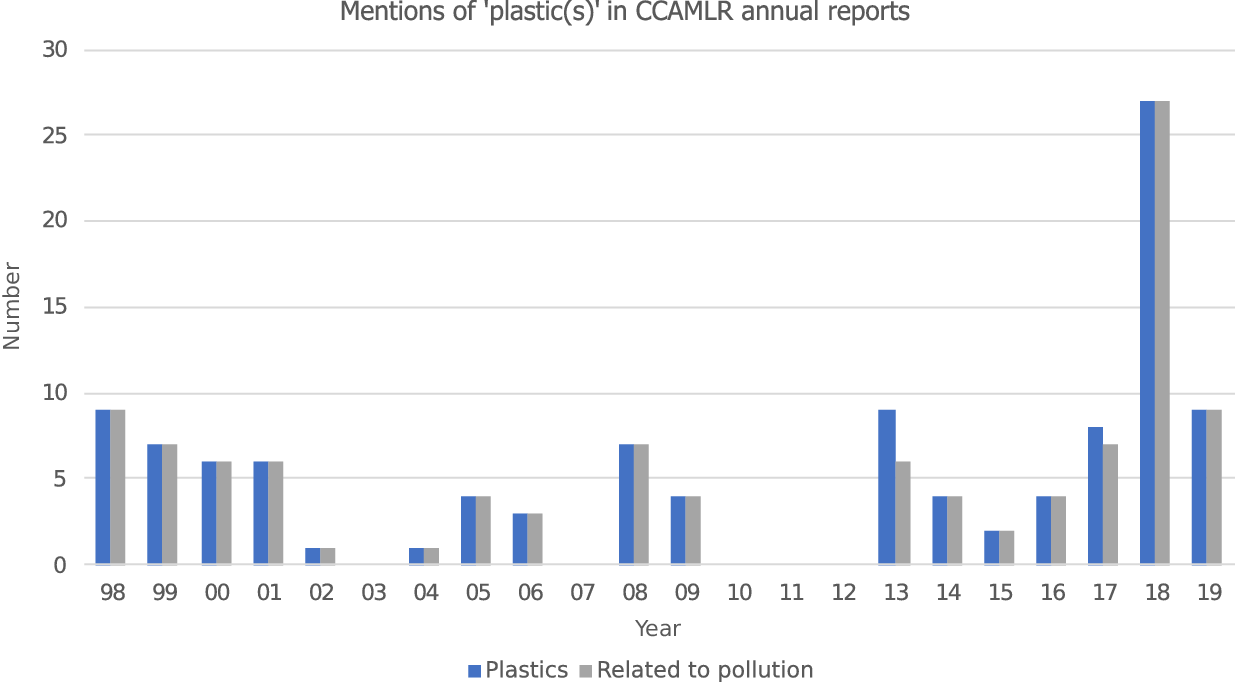
The CAMLR Convention manages marine living resources within the area south of the Polar Front including the Antarctic Treaty Area. CCAMLR established its Marine Debris Program in 1989 to monitor debris levels in the Convention Area, particularly for fisheries debris. Over the past 22 years, CCAMLR’s engagement with the issue of plastic pollution has not changed significantly (Fig. 2). In terms of the number of times that plastic pollution was mentioned, CCAMLR realised the potential impact of plastic on Antarctica earlier than ATCM, having approved a measure for reducing the use of plastic packaging bands (Measure 63/XII) in 1993 (CCAMLR, 1993), which was superseded by Measure 63/XV “Regulation of the Use and Disposal of Plastic Packaging Bands on Fishing Vessels” in 1996 (CCAMLR, 1996) for 10 years. In 2006, Conservation Measure 26-01 (CM 26-01), “General Environmental Protection Measure During Fishing” was adopted (CCAMLR, 2006). This measure, among other elements, prohibited disposal of plastics from fishing vessels in the Antarctic Treaty Area. According to Figure 2, “plastic(s)” was mentioned the most (27) in 2018 because the Standing Committee on Implementation and Compliance (SCIC) meeting reviewed policies and measures related to plastic pollution in the Southern Ocean and Members were actively involved in the discussion of the topic.
Mentions of the words “plastic(s)”, in the context of pollution, in CCAMLR annual reports 1998–2019.
Considering some plastic usage associated with fishing activities may affect the Antarctic marine environment, CM 26-01(2006) provided the Parties should (i) prohibit the use of plastic package bands to fix bait boxes on vessels and the use of other plastics on fishing boats without onboard incinerators, (ii) cut off packaging bands into small sections of about 30 cm to prevent them from forming a loop and (iii) store any plastic residues until they arrive at the port. CM 26-01 has been revised five times, the most recent time being 2019. The measure now specifies the geographic scope of plastic disposal and discharge prohibition in more detail (i.e. different measures are given in the Convention Area and the Antarctic Treaty Area south of 60oS). It also prohibits fishing vessels from discharging plastics throughout the Convention Area; however, it provides an exception for special circumstances, such as when it is necessary to protect the marine environment, secure the safety of a vessel or personnel or when due to accidental damage of equipment onboard or accidental loss of fishing gear (CCAMLR, 2019).
In 2016, the International Union for Conservation of Nature reminded the Commission of the impact of microplastics and nano-plastics on the health of fish (CCAMLR, 2016). In 2018, the UK reported to the Commission on the efforts of its fishing boats to lessen the problem of marine plastic pollution and encouraged other Members to take similar action to reduce the release of plastic particles and microfibres in the Convention Area (CCAMLR, 2018). It is encouraging that many CCAMLR Members expressed interests in reducing plastic pollution from vessels in the Convention Area, including by replacing external laundry water filters. At its meeting in 2019, the SCIC considered changes to CM 26-01 proposed by the EU, which were eventually approved by the Commission (as discussed earlier). Most Members supported the proposed changes, indicating it was within the government mandate of CCAMLR. However, some Members such as Japan, although supporting the broad principle of preventing plastic pollution in the Convention Area, believed that the problem of marine pollution was already being governed by MARPOL, and so was beyond the intended scope of CCAMLR (CCAMLR, 2019).
CCAMLR is currently monitoring the presence of anthropogenic debris in a few locations around the Antarctic continent, but so far this has not included micro-plastics. However, the first abstract on Antarctic plastics project was presented at the 2016 Working Group on Ecosystem Monitoring and Management Meeting of the Scientific Committee for the Conservation of Antarctic Marine Living Resources (SC-CAMLR), which was titled “PLastics in ANtarctic EnvironmenT (PLANET)”, aimed at assessing the presence and impact of microplastics and nano-plastics on Antarctic marine biota (SC-CAMLR, 2016). In 2018, the problem of plastic pollution in the Southern Ocean appeared for the first time as a formal issue in the report of the SCIC as established by CCAMLR (CCAMLR, 2018). This increased attention reflects broader scientific work in other bodies such as SCAR.
Scientific Committee on Antarctic Research
SCAR has also been active on the issue of marine plastics. At the SCAR Delegates Meeting in Davos, Switzerland, in June 2018, the Polar Plastics Action Group (PLASTIC-AG) was formally established as part of its life sciences branch. The PLASTIC-AG will last 3 years and be open to all interested parties in polar plastics research. The group was set up to analyse and quantify the distribution, sources, destination and biological effects of plastics (nano, micro and macro), and ultimately propose solutions to reduce the impact on the polar ecosystems. By reviewing PLASTIC-AG’s side meeting report in 2018, we found that the whole meeting focused on the issue of plastics in the Arctic and Antarctic and its threat to the environment (PLASTIC-AG, 2018). One of the main objectives of the meeting was to initiate a series of actions and strategies aimed at establishing a standardised approach to monitoring plastics in the oceans, intertidal zones and on land. In addition to discussing the ongoing projects in the meeting, they discussed possible mitigation and remediation options, such as innovation and research on alternatives to plastics, a global appeal to more scientists to pay attention to the problem and make recommendations to policymakers and guidelines on the use of plastics at research stations and on fishing vessels. PLASTIC-AG held its first workshop in October 2019 on “Plastic in the Polar Environment: sources, differences and solutions”. The workshop discussed gaps in plastic research at high latitudes and how best to address the potential impact of plastics on polar regions and explored feasible mitigation strategies. Finally, the workshop suggested increasing the coverage of data on both temporal and spatial scales to improve understanding of the fate of plastic in polar regions and its impact on local species (PLASTIC-AG, 2019).
We also examined the current membership of PLASTIC-AG. To date, a total of 71 scientists from 22 countries (from 51 institutions) have joined the research group. Table 1 shows the number of researchers and institutions participating in each PLASTIC-AG country. In terms of the number of researchers and institutions in PLASTIC-AG, the UK ranked first, with 15 and 8, respectively. The UK has played a leading role in PLASTIC-AG and it submitted a WP on reducing plastic pollution in the Southern Ocean and Antarctica to the CEP in 2019, which reflects its leadership on the issue. Other countries such as Italy, Australia, France, New Zealand and Germany have also shown interest in the issue. From Table 1 below, it can be seen that the general participation of European countries is relatively high, yet major consultative parties such as China, the USA and Chile appear less engaged. This suggests that while more actors should be involved in the study of polar plastics, especially those countries with great influence in the world, it is also important that field research activities in Antarctica, such as the NAP, should also aim to limit the use of plastics to reduce their impact.
The number of researchers and institutions participating in PLASTIC-AG in each country.

Council of Managers of National Antarctic Programs
COMNAP is an international council of the managers of the NAP, which is committed to developing and promoting best practices for managing the support of national Antarctic science activities. The word “plastic” first appeared in the 2017–2018 COMNAP annual report where it noted the need for increased discussion among members on the sources of plastics in the Antarctic environment. In 2018, COMNAP members established a project titled “Understanding the sources of plastic in the Antarctic environment” for development, and its Environmental Expert Group committed to reducing the use of plastics in the Antarctic terrestrial and marine environments (COMNAP, 2018). The expert group is an important feature of COMNAP, allowing the NAP staff of their member states to exchange information on a range of related topics. In addition to research on plastics and microplastics, the responsibilities of the Environmental Expert Group include reducing the impact on the environment as a result of NAPs operations and activities, reviewing the work of ATCM and CEP and identifying cooperative programmes for the protection of the Antarctic environment.
COMNAP indicates that the use of macro-plastics in NAPs is to support Antarctic science, business operations and logistics, as the lightweight of plastics can reduce the demand for fuel in navigation (COMNAP, 2019). Regarding the discovery of microplastics in the Antarctic Treaty Area, COMNAP recommends that their member NAPs should prohibit the carrying of personal care products containing microplastics, use laundry bags or install filters capable of capturing microplastics, support the research of microplastics and cooperate with their suppliers to reduce the use of plastics, rapidly clean up and record metadata after the discovery of plastic pollution and should combine cleaning activities (COMNAP, 2019). At present, science and fishing activities of the Member States both on the land and surrounding waters of Antarctica have taken actions on plastics. Tourism, another human footprint in Antarctica, is also trying to regulate the behaviour of tourists in the region.
International Association of Antarctica Tour Operators
The IAATO has also been active on the issue of marine plastics. IAATO is also engaged with SCAR’s PLASTIC-AG, pledged at its 2019 annual meeting to develop new guidelines to reverse plastic use, aiming to reduce the use of single-use plastic by Antarctic visitors. This is part of the IAATO’s commitment to the UN’s Clean Seas campaign (IAATO, 2019b). The new visitor guidelines on reducing waste, announced by IAATO on World Environment Day in 2019, encourages visitors to carry reusable kettles, tableware and bags, and to avoid using disposable cups, straws and other items whenever possible when travelling to Antarctica (IAATO, 2019b). The guideline provides that skincare products and cosmetics containing plastic microbeads and clothing made of synthetic fibres are also be avoided. The action by IAATO in forming these guidelines indicates its commitment to reducing plastic use by eliminating the use of plastic straws, adding special filters to ship washing equipment and preventing microplastics from personal use products from ending up in wastewater. The IAATO guidelines also encourage Antarctic visitors to sort their trash and minimise the use of plastic when they return home.
At the ATCM in 2019, IAATO presented an Information Paper to the meeting that describes its latest efforts in working with AECO to develop a programme to reduce the use of plastics (micro-plastics) products. The programme includes actively sharing ideas and experiences on marine plastic pollution with the polar community, customising multilingual guidelines, supporting research on polar plastics and working with AECO to develop a joint communications strategy to raise awareness. IAATO also indicated in its 2018–2019 report that it would formally join the CCAMLR Marine Debris Program in the 2019–2020 season.
Discussion
Analysis of ATCM documents shows that the concern about plastic and microplastic pollution has become increasingly visible in Antarctic governance since 2017. This has led to increased scientific research on the issue that has confirmed the presence of plastics both in areas subject to regular human activity and in remote areas of Antarctica. The concentration of plastics in Antarctic surface waters suggests that despite efforts to limit human consumption of single-use and personal care products, the region is still significantly affected by plastic and microplastic pollution. These findings have increased interest in further governance actions necessary to address Antarctic plastic pollution, not only among the ATCPs and CCAMLR members but also SCAR, COMNAP and IAATO. The adoption of Resolution 5 of the ATCM, the revision of CM 26-01 of CCAMLR, the establishment of PLASTIC-AG of SCAR and the new tourists’ guidelines formulated by IAATO are all important steps towards managing the problem of locally sourced plastic pollution in Antarctica and the Southern Ocean. These actions need to be supported; however, marine plastic pollution is not an issue only in Antarctica, it is a global problem.
In recent years, marine plastic pollution has become an important global environmental issue of concern to governments, scientists, non-governmental organisations and the public. Statistics show that the vast majority of plastic wastes end up in landfills or pollute the environment, and only 9% are recycled (Geyer, Jambeck, & Law, Reference Geyer, Jambeck and Law2017). In 2010, a total of 275 million tons of plastic garbage was produced in 192 coastal countries (Jambeck et al., Reference Jambeck, Geyer, Wilcox, Siegler, Perryman, Andrady and Law2015). Today, 6.3 billion tons of plastic waste is produced worldwide, and about 4–12 million tons are released into the ocean every year (Brooks, Wang, & Jambeck, Reference Brooks, Wang and Jambeck2018; Haward, Reference Haward2018), with 80% estimated to be from land-based sources (Jambeck et al., Reference Jambeck, Geyer, Wilcox, Siegler, Perryman, Andrady and Law2015). Jambeck et al. (Reference Jambeck, Geyer, Wilcox, Siegler, Perryman, Andrady and Law2015) also pointed out that without improvement in waste management infrastructure, the total amount of plastic waste entering the sea from land is expected to increase by an order of magnitude by 2025. These studies have raised questions about the impact on the environment from the build-up of plastic and microplastic and the global need to address this problem.
Plastics can be transported far from their starting point by ocean circulation through gyres and currents, across international borders and jurisdictions, even to the polar regions (Zarfl & Matthies, Reference Zarfl and Matthies2010). A recent study on the Antarctic Peninsula found 78 types of plastic, as well as some pieces of paint from ships (Lacerda et al., Reference Lacerda, Rodrigues, Van Sebille, Rodrigues, Ribeiro, Secchi and Proietti2019). Lacerda et al. (Reference Lacerda, Rodrigues, Van Sebille, Rodrigues, Ribeiro, Secchi and Proietti2019) reported that most of the particles found were secondary microplastics less than 5 mm long, but also included fragments of nylon thread. The latter suggests that fishing activities may be a local source of plastic pollution (Lacerda et al., Reference Lacerda, Rodrigues, Van Sebille, Rodrigues, Ribeiro, Secchi and Proietti2019). Therefore, it is very important to use international agreements and local laws of various countries and regions to manage plastic at the source.
At present, international agreements such as the Law of the Sea and MARPOL have included discussion on plastics within global marine pollution. International strategies such as the Honolulu Strategy, an outcome of the Fifth International Marine Debris Conference held in Honolulu March 2011 that provides a framework for a global response to marine litter (Shevealy, Courtney, & Parks, Reference Shevealy, Courtney and Parks2012), and the Clean Seas campaign of the UNEP aim to prevent and reduce the level of marine plastic pollution (Wang & Lin, Reference Wang and Lin2018). National and regional governments have also begun to take action to protect the marine environment. The third meeting of the 2017 UN Environment Assembly stressed the need to eliminate the discharge of garbage and microplastics into the sea and encouraged all Member States to develop policies and measures based on the best understanding of the sources and quantities of local plastics, to avoid the entry of plastic waste into the marine environment (UNEP, 2017).
At the national level, however, only a few countries have specific legislation to deal with marine debris, but it is clear that states are acting in this area. Japan has enacted the Law for the Promotion of Marine Litter Disposal. China and South Korea do not have specific laws on marine pollution but have added provisions on plastic waste to their relevant marine environmental management legislation (Wang & Lin, Reference Wang and Lin2018). Including plastics in marine pollution reduction policies at the national level helps strengthen public awareness of marine plastic pollution. Stronger national responses can slow down marine plastic pollution and prevent the flow of plastics into the marine environment.
Since the ATS is limited in its spatial coverage, it cannot effectively control the plastics from outside the Southern Ocean. Leading environmental governance scholar Oran Young has raised the importance of having a high degree of “fit” between the biophysical system in which an environmental issue arises and the governance system created to deal with it. Young believes that the problem of fit became more important with the increasing influence of human beings on the biophysical system (Young, Reference Young2002). Young argues that in managing environmental problems, we should resist the idea of “one size fits all” governance approaches and adjust the various dimensions of institutions according to the dynamic characteristics of biophysical systems (Young, Reference Young2002).
Young’s concept of “fit” helps understand the problems that the ATS has in effectively managing the issue of plastic pollution in Antarctica and the Southern Ocean. Our findings show that the ATCM, CCAMLR, SCAR, COMNAP and IAATO have taken up the issue of locally sourced plastic pollution and, within their respective capacities, sought to govern the issue from within Antarctica by steering behaviour at Antarctic bases and tourist’s vessels. This is an indicator of the ATS’s traditional institutional adaptability and flexibility (Young, Reference Young2010). However, the ATS is only able to respond to locally sourced marine plastic pollution, it has very limited ability, except through production and dispersal of scientific knowledge on the issue, to influence levels of marine plastic pollution emanating from the industrial centres of the Northern Hemisphere and being carried by ocean currents. There is a lack of “fit” between the ATS and its ability to govern the issue of marine plastic pollution. Hence, for plastics that come from outside the jurisdiction of the ATS, the best thing ATS can do is to get its own house in order and act as an intellectual and scientific generator to inspire greater ambition in the broader global governance of marine plastic pollution.
The Antarctic interacts closely with the global climate system, especially it plays an indispensable role in today’s global climate change agenda. Therefore, this mismatch or lack of fit between the biological problem and limits of the governance response of the ATS means that ultimately the problem will be at least partly in the hands of wider global governance initiatives on marine plastics. As the understanding of the source and scale of plastic pollution improves, action and strategies will need to be developed within the ATS. The ATS can, however, as shown in this paper provide leadership and best practice in relation to managing marine plastic pollution and contribute at the global level to prevent and mitigate the movement of plastics to Antarctica.
Conclusion
The ATS has been regarded as a successful example of international governance because of its ability to successfully cope with internal and external pressures while maintaining its core functions and values (McGee & Haward, Reference Haward and Harris2019). The presence of plastics in the Southern Ocean indicates the extent of human impacts on the marine environment in the remotest of oceans. These discoveries and the increasing concern over the impact of micro-plastics emphasise the need to address practices relating to the use, disposal and management of plastics.
The research reported in this paper describes increasing attention of the ATS to this issue. It is likely, however, that further governance work will be needed to address plastic pollution in the Southern Ocean, as it can be expected that microplastics will continue to accumulate in this region. Key further governance actions will include ensuring appropriate waste management and disposal practices at research stations and on fishing and tourist vessels. The management of plastics and microplastic pollution generated from outside the area governed by the ATS is, however, likely to pose more difficult, and ongoing, challenges.



