

“Die Kunst ist zwar nicht das Brot, aber der Wein des Lebens.”
Jean Paul (1763–1825)
In Mesopotamian adaptation:
“Art may not be the bread of life, but it is the beer of life.”
To Andrew who has given us back so many masterpieces of the Mesopotamian “beer of life,” in gratitude and with best wishes for long years of enjoying and discovering this and other sorts of beer …
1. Literature. Theory, methodology, state of research
Categories and the semantic fields associated with them shape what and how we perceive.Footnote 1 Apprehending the modes of perception of other cultures is both a challenge and a special incentive to look beyond our own horizons and open up new ones. What we subsume under the category of ‘literature’ is shaped by our own frame of reference, which can be outlined conceptually. In contemporary Ancient Near Eastern research, the concept of literature is inextricably linked to the concept of the author. Such authors are considered to be ‘writers’ (in German, Schriftsteller), i.e., people who create something in the form of writing and whose name is attached to their work.Footnote 2
Creation of a text by a modern writer, generated with AI by A. Zgoll using a free version of canva.com

‘Literature’ is a label associated inter alia with texts that are distinguished by their style and craftsmanship and exhibit a special degree of quality.Footnote 3 Literature is thus understood in the narrower sense as a form of art. This art, in turn, may claim an autonomous space; it does not have to serve any purpose other than to exist (l’art pour l’art). Nevertheless, literature serves various metafunctions:Footnote 4 it is assumed that authors write for their personal needs, that they seek their identity through writing, and that they want to increase their prestige, win fame, and secure a place for themselves in the ‘literary world.’Footnote 5
The question raised in this article is whether one can speak of a perception of ‘literature’ in Mesopotamian culture, which predates many major intellectual-historical turning points—enlightenment, individualization and pluralism, democratization, and the primacy of the natural sciences, technology, and economy, as a result of which literature and ‘art’ are perceived as occupying a special niche—and in what kind of reference system such literature was framed. The question is twofold: (1) Were certain ancient texts regarded as literature, and (2) was there a notion of authorship? A further objective is (3) to determine how we can categorize texts in a scientifically meaningful way today.
For our test case, we will turn to the source that is the supreme touchstone when it comes to questions of literature and authorship in ancient Mesopotamia, the so-called song Innana B or nin me šara (henceforth NMS). NMS has become the center of discussions of literary authorship because it contains a statement by a first-person speaker who claims to have “given birth”Footnote 6 to the song. This speaker is identified in the text as a high priestess named En-ḫedu-ana. A person of this name is known from other sources to have been installed as high priestess of Nanna, the god of the city state of Ur.Footnote 7 The text of NMS, however, is only attested on around one hundred clay tablets written some five centuries later, in the OB period. In modern research it has therefore been much discussed whether the statement about En-ḫedu-ana “giving birth to” the text is to be regarded as historically correct.Footnote 8 Was this text created by En-ḫedu-ana, or was it a product of OB scribes? Lately, however, the question of who composed NMS has been dismissed as unimportant, and people have instead asked why authorship itself might have been viewed as important by OB scribes.Footnote 9 This question itself must be questioned, since it rests on the assumption that authorship was indeed important for OB scribes. If the assumption on which the question is based is wrong, then the question will inevitably lead to a wrong answer.
Methodologically, it is striking that such assumptions about authorship were not developed inductively from NMS itself; in fact, the text is not quoted much in the context of these questions, and it is certainly not discussed as a complete work. Instead, the question of authorship is deductively applied to the text from the outside. The question is derived from a scenario that has been invented for the OB scribes, namely, that they wanted to increase their prestige and create a particularly exclusive identity for themselves by writing Sumerian texts; other hypotheses operate with scribes and scholars of earlier times.Footnote 10 This scenario of scribal authorship is based on the coordinate system in which literature and authorship stand today, in the twenty-first century AD, but, as will be shown, that system cannot accomodate the creation of texts such as NMS. In summary, the discussion of authorship in Mesopotamia has given rise to many questionable hypotheses.Footnote 11
A methodologically sound analysis must begin with the texts themselves and proceed inductively. Surprisingly, this has only been done in rudimentary ways thus far.Footnote 12 This gap in the research will be closed here. To address the topic we have to rely on our sources as our compass. Not only our answers, but also our questions have to be rooted in our sources. We will therefore first approach the text by giving an overview of its content and structure and its main formal features (→ 2). To reconstruct ancient perspectives on literature, we will take as our point of departure the text-referential, addressee-referential, and self-referential statements of the text: What do they disclose, and to which questions and answers do they lead? It will become clear that the text is to be regarded as a song addressed to a goddess by a priestess (→ 3). Second, we will analyze the first-person statement about the birth of the text in comparison to self-identifications expressed with “I am ….” This will show that the text is not making a claim about authorship but about priesthood (→ 4). A third section will reconstruct the wider cultural background: the creators of ritual songs are gods, and En-ḫedu-ana is only allowed to create such a song when she herself acts as a goddess (→ 5 and 6). The last section will offer proof that NMS belongs to the category of literature, from both ancient and modern perspectives, and explain why it is also to be regarded as both a mythic and ritual text, and how such classifications can be simultaneously valid (→ 7).
The analyses are relevant not only to questions of literature and authorship but also to historical research, ritual studies, and women’s studies.
Outline of the paper

2. Approaching the source: NMS
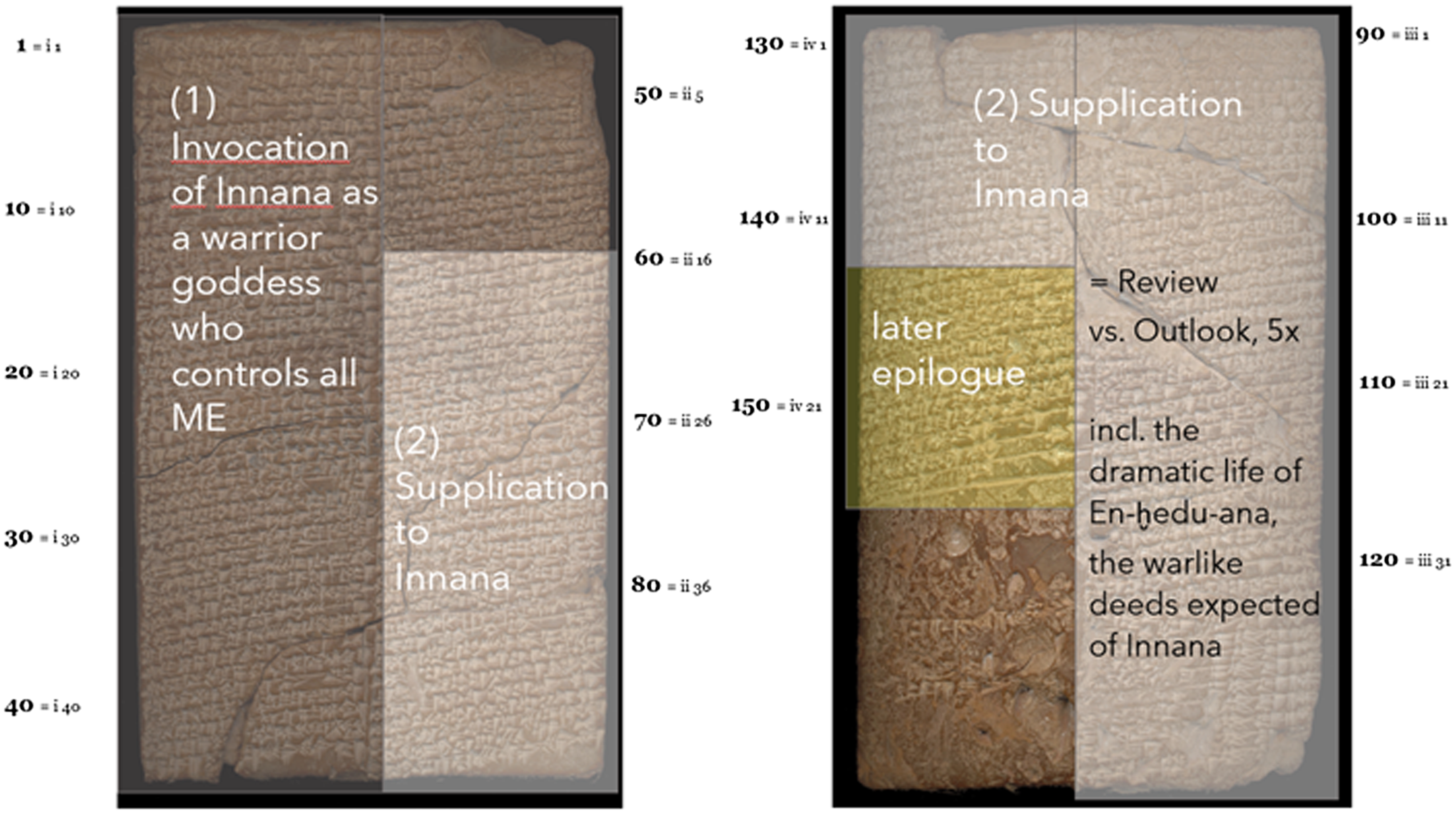
The text of NMS is available on around one hundred tablets dating from the OB period (18th/17th century). It is a song addressed to the goddess Innana. Following ancient tradition, we can refer to the song by its opening words, nin me šara “mistress of all numinous means of power.” The text is linguistically complex and demanding (Wilcke Reference Wilcke1976). Hallo and van Dijk (Reference Hallo and van Dijk1968) presented a short first edition. A second edition that draws on a larger number of manuscripts and provides philological, text-critical, and historical evaluations was published by A. Zgoll (Reference Zgoll1997); Black et al. Reference Black, Cunningham, Ebeling, Flückiger-Hawker, Robson, Taylor and Zólyomi2003 rendered Zgoll’s German translation into English, with minimal changes to the content. The text-critical studies were continued by Delnero (Reference Delnero2006: 1062–216). New philological analyses have led to improved translations.Footnote 13 A. Zgoll (Reference Zgoll, Droß-Krüpe and Fink2021) has reconstructed myths that are incorporated into this song.
The text of NMS consists of two parts plus an epilogue and subscript:
1–59 Invocation of Innana as a warrior goddess who controls all numinous means of power.
60–142 Supplication to Innana. This supplication has a sophisticated structure. It alternates five times between reviews of the dramatic life of the high priestess En-ḫedu-ana and the warlike deeds of the goddess Innana, on the one hand, and glimpses of warlike deeds expected of Innana in the future on the other.
143–152 A later epilogue, distinguished from the rest of the text by its form and content.Footnote 14
(153 Subscript)
Manuscript NiA, CBS 7847 + UM 29-15-422, courtesy of the University of Pennsylvania Museum of Archaeology and Anthropology, Philadelphia, with an overview of the major sections of NMS
The text contains clear historical references to a civil war in the Old Akkadian period (23rd century BC), when a coalition of Sumerian city-states rose up against the Akkadian central empire headed by Narām-Sîn and put this ruler in great danger; he attributed his rescue solely to Innana.Footnote 15
Context of the song NMS in Mesopotamian perspective, design A. Zgoll, realization A. Göhlich

In addition to the allusions to conflict, which we today classify as historical, there are also narrative materials that we refer to as mythical. The following myths have been identified and reconstructed in NMS through the hylistic analysis of narrative materials:Footnote 16, Footnote 17
(Myth 1) An Lets Innana Execute His Judgement on Enemies and Sumer
(Myth 2) Innana Lets Nanna Execute Her Judgement on Ur and Every Rebellious City
(Myth 3) Innana Executes Judgement on the Anuna Gods
These myths belong together and form one composite myth:
Innana Becomes Ruler of the Gods in Heaven and on Earth
All these myths are aggressively directed against the autonomy of the traditional Sumerian city-states. They are extremely anti-Sumerian. So-called “rebellious” cities like Ur and its people, the Sumerians, are humiliated and killed. The text therefore could not have been composed or used or conceived as a symbol of Sumerian culture.Footnote 18
Formally, the text can be described as a prayer that is anchored in a ritual context (→ 3). The language is dramatic (“because of my fate-determining song—must I die?”, 99), aggressive (“you will devour corpses like a predator”, 127) and urgent (“right now you will tell An”, 76). Many statements are formulated in the first person and put into the mouth of a high priestess named En-ḫedu-ana. Unlike the case of Sîn-lēqi-unninni, for example, who is listed in the so-called catalogue of texts and authors from the Neo-Assyrian period as the author of the Gilgameš Epic,Footnote 19 the historicity of this En-ḫedu-ana is clearly proven by various contemporary sources. En-ḫedu-ana was the high priestess of Nanna in the city of Ur, from the reign of Sargon of Akkad to that of his grandson Narām-Sîn (23rd century BC). An inscription and a pictorial representation of En-ḫedu-ana have been preserved on an alabaster disk from her own time (→ 5.2.1), as well as several seals and seal impressions whose owners can be identified as associates of the high priestess En-ḫedu-ana.Footnote 20 The historical information from NMS comports with other historical information about the period, in particular the uprising against Narām-Sîn, the so-called “Great Rebellion.”Footnote 21
3. Inductive text analysis 1: song of a priestess for a goddess
3.1 Self-references in the text
In order to determine—from an ancient perspective—what kind of text we are dealing with, we must examine the text’s three references to itself: the “radiant song,” the “lamentation of tears,” and the “prayer.” “Radiant song,” Sumerian ser3 ku3 (63, 99), has recently been precisely defined as a composition that resonates with today’s ideas of sacred texts but is even more powerful. Such a song is a divine instrument of power, so that ser3 ku3 can be paraphrased as “numinous-powerful song.”Footnote 22 In addition, the word ir2, which primarily means “tears” and also “lament,” namely in the sense of a lament accompanied by tears or “lament of tears” (82), is used to describe the text. Finally, the text is also identified as an a-ra-zu “prayer” (81).
The text’s references to itself indicate that it was understood in ancient times as a prayer, more precisely as a ritual song, to be performed in a plaintive mode, accompanied by tears.Footnote 23 Such a song is believed to have divine-numinous power, i.e., it can change the present and the future. The effects attributed to the song in the present case are particularly concentrated in a passage that is characterized as the climax of the text in terms of contentFootnote 24 and form.Footnote 25 It closely links retrospection on the past and an outlook for the future, which is visually illustrated in the following table.Footnote 26 In terms of content, this passage is the clearest indication that the powerful ritual text is to be understood as part of a war ritual which is made clear by a new translationFootnote 27 (→ 4.2):
NMS 122–132

3.2 References to the addressee
The entire prayer is addressed to Innana. It begins with Innana’s invocation as “Mistress of all numinous instruments of power,”Footnote 28 it is characterized through and through by addresses to Innana and it endsFootnote 29 with a double address to Innana:

The fact that the text ends on such a negative note, with the goddess’s rage undiminished, has caused confusion.Footnote 31 And indeed, such an ending would be incomprehensible if this text were a fiction generated to serve the individual needs of a later writer. Who in Mesopotamia would dare to use a song for a war ritual to urge the most powerful goddess to act out her anger, just to increase his own prestige (→ 1)?Footnote 32 Such an idea is absurd for those familiar with attitudes toward ritual in religious cultures. But this is not a “story” or even an autobiographical account written after a crisis, from a safe distance. Rather, the distressing events have not yet come to a standstill. The song and its conclusion are therefore drastic: the first-person speaker urges the goddess to prolong her anger:
“No one must calm your heart … No one will calm your heart!”
A narrative analysisFootnote 33 of the lines, including the context, shows even more clearly the explosive nature of this conclusion to the song (implicitly reconstructed hylemesFootnote 34 are in grey):
Innana and her anger: how it arises and how she can be calmed down again
Enemies make Innana’s anger great.
Innana is angry with the enemies.
Because of En-ḫedu-ana, no one is allowed to calm Innana now:
En-ḫedu-ana arouses Innana’s anger against the enemies.122–133
So far the explicit content of the song, which implies the following:
Innana gives free rein to her anger against the enemies:
Innana destroys the enemies.
Then someone (= En-ḫedu-ana) calms Innana’s anger. Footnote 35
Innana is calm.
The aggressive conclusion of the song is thus perfectly understandable. It corresponds exactly to the climax of the song in 122–132, quoted above, which promises that Innana’s power will be known; namely, the “judgment,” i.e., the decision about the future, lies with her. This future is evoked in the complete destruction of Innana’s enemies, whose very corpses will not remain. From the perspective of the text, the conclusion of the song is not at all negative, but rather an expression of the goal toward which everything is heading: the positive resolution of the crisis through the defeat of the enemies of Innana (and of En-ḫedu-ana). The song for the war ritual must achieve the goal before its power is allowed to fade.
3.3 References to the first-person speaker
Self-referential statements about the first-person speaker appear three times in the text:


None of these declarations has anything to do with literature or authorship. If En-ḫedu-ana were asserting authorship, then one would expect a statement such as *“I am the person X who created the text” or, in keeping with the thesis of an origin in writing, *“I am the person X who wrote the text”; i.e., the text would include an authorial attribution, a sphragis.Footnote 36 Nothing of the sort can be found. In all three passages, the first-person speaker, En-ḫedu-ana, asserts her identity as the high priestess. The increasing intensity of her repeated claim leads inductively to the question of why this particular statement is emphasized. The answer can be found in the text: the first-person narrator tells us that the insignia of the high priestly office were snatched from her, and that she was given a dagger and driven away. Taken together, this does not sound like a fictional story composed by learned scribes for learned scribes. On the other hand, it sounds exactly like a prayer addressed to a powerful goddess in an emergency. In this prayer, a high priestess struggles to decide whether she is still a priestess. If she is no longer a high priestess—as those who threatened her and chased her away obviously claim—then, as will become clear (→ 5.2.2), she has no right to perform a ritual to the goddess Innana and to create a song for this ritual.
3.4 Conclusion on the analysis of the self-referential and text-referential statements in the text
The evaluation of NMS’s references to text, addressee, and first-person speaker reveals a text that is understood as a prayer or ritual text, is addressed to a goddess, and whose first-person speaker is repeatedly identified as a person who emphasizes that she is really and truly a high priestess. From a stratification-analytical point of view, applying the TTEPP criteria (T = time and themes, E = events, P = places and personsFootnote 37 ) developed for the analysis of narrative material (hylistics),Footnote 38 there is nothing in the narrative material of NMS 1–142 that might point to different layers. Nothing points to a context involving writing or learned writers.Footnote 39 NMS 1–142 consists of a single homogeneous layer whose elements form a consistent whole, namely a prayer by a priestess. In other words, the first inductive textual analysis clearly indicates that the text originates as a prayer voiced by the high priestess named En-ḫedu-ana.Footnote 40
Creation of NMS as a prayer by the high priestess En-ḫedu-ana, design A. Zgoll, realization S. Dak

4. Inductive text analysis 2: the birth of the song
The next methodological step is to analyze the statement that En-ḫedu-ana “gave birth to” the song, which is invariably cited as a reference to authorship. Here, too, a methodical inductive approach is required to determine from the text itself what type of statement is present and how the statement is structured in terms of content and form. It is also necessary to examine how the statement about the birth of the text relates to the immediate context and to other statements about the text.
4.1 “I gave birth to it”: content and formal design of the statement
The statement that En-ḫedu-ana gave birth to the song is—as is so often the case in Sumerian texts—succinctly formulated: “Since it has become full to me, since it has become overflowing to me, powerful lady, I have given birth to it for you.” The grammatical object of this statement has been identified three lines earlier; it is the song of Innana’s raging.Footnote 41 The predicate of the statement is attested in several variants: once it is expressed as “giving birth” (du2), twice as “building, creating” (du3), and five times as “speaking, intoning” (du11).Footnote 42 All of these verbs are pronounced as /du/ in Sumerian. They can be differentiated on the basis of their spelling—but they can also be simplified by using the common word du11 (“to speak”).Footnote 43 In addition to the purely quantitative distribution, a text-critical analysis must also consider the qualitative weight of the spellings in the evaluation of the passage,Footnote 44 and so “giving birth” emerges as the first choice here, as the lectio difficilior; it is also attested in other sources in reference to the creation of sacred texts (→ 5.1). Overall, it is clear from all of the spellings that En-ḫedu-ana produced this song, regardless of whether it is described in terms of birthing, building, or speaking or singing:

Again, it is striking that there is no sphragis here to “seal” the text by naming its author (see → 3.3). This statement therefore does not revolve around authorship.
4.2 “Giving birth” to the song: the immediate context
The immediate context shows that the statement about the song’s birth is included as one action alongside others. It is located shortly after the passage quoted above, which forms the heart of the ritual song—the evocatively repetitive lines 122–132, which make it known that Innana has power over the future and that she will now overpower the enemies, as she has overpowered enemies before—in the following, final section of the song (138):

An application of narrative analysis (→ 2) shows the context in which the song’s birth takes place. It is a war ritual that En-ḫedu-ana performs for Innana:
En-ḫedu-ana creates a war ritual with a song for Innana
Nanna transfers the power of command (over Ur) to Innana. l. 133
// Innana becomes more powerful than Nanna. l. 134
Innana becomes the most powerful (among the gods).l. 134
Ur does not follow Innana’s command (to submit to the king she has appointed, her husband).→ll. 133–135
Ur acts hostile (against Innana and her king). →ll. 133–135
Ur (and other enemies) seize Innana’s (consort and protégé =) king.Footnote 47 →ll. 133–135, 141+111
Innana’s anger (at the actions of Ur and other enemies) becomes great. ll. 135, 142
Innana does not (yet) intervene.→whole text
En-ḫedu-ana sees Innana’s side (the king, the troops, the central kingdom, herself) in great distress. →l. 138
En-ḫedu-ana is oppressed by hardship.l. 138
En-ḫedu-Ana wants Innana to intervene now, i.e. for Innana to strike down the enemies in her anger.→ ll. 135–138, 122–133
En-ḫedu-ana plans a ritual that is supposed to ignite Innana’s anger to such an extent that Innana intervenes. →direct context
En-ḫedu-ana performs this war ritual:
-
En-ḫedu-ana performs purification rituals in Innana’s temple Ešdam-ku for her singing. ll. 136–137
-
En-ḫedu-ana prepares Innana’s temple Ešdam-ku for Innana. l. 137
-
The Ešdam-ku temple is ready for Innana. l. 137
-
En-ḫedu-ana awaits the coming of Innana in the temple Ešdam-ku. → l. 137
-
Night falls: l. 139
-
Innana appears. Footnote 48 → l. 137
-
En-ḫedu-ana trusts that Innana hears the ritual song. →l. 137
-
En-ḫedu-ana (now) creates the song of Innana’s rage.→ll. 135, 138–139
-
i.e. En-ḫedu-ana (now) sings the song of Innana’s anger.
-
This song is decisive (i.e. it will bring about the decisive turning point):Footnote 49
-
“Out of oppression, I, En-ḫedu-ana, create the song for you, Innana!
-
Don’t let your heart cool down for my sake!
-
When the night (and with it the time of distress) is over, a cult singer will repeat the song for you! ll. 139–140
-
Because of your great anger (at the deeds of the enemies), no one will calm your heart (until you have destroyed the enemies)!”
-
Two observations are particularly important for the question of authorship:
-
1. There is no mention of writing anywhere in the text. Rather, the text is a song that is created by being sung. The creation of sacred texts through singing is a typical concept in ancient Mesopotamia (→ 5.1).
-
2. The creation of the song through singing is part of a sequence of actions:
-
2.1 Purification rituals
-
En-ḫedu-ana performs purification rituals in Innana’s temple Ešdam-ku before singing the song. This is a necessary procedure for rituals.Footnote 50
-
-
2.2 Preparation of the Ešdam-ku temple
-
En-ḫedu-ana prepares the temple Ešdam-ku for the coming of Innana through the purification rituals.
-
-
2.3 Creating the song
-
En-ḫedu-ana sings and creates the song of Innana’s rage (→ 5.1).
-
-
The sequence of purification rituals, temple preparation, and singing the song shows that singing is seen as a priestly task alongside other priestly duties.
4.3 “Giving birth” to the song: the overall context
The statement about giving birth does not stand alone in the text, but is accompanied by many parallel statements that describe the actions of the high priestess in relation to the text:
Actions of the high priestess with reference to NMS

1 Since “prayer” is used here as a generic term for the numinous song, this prayer is not spoken but sung.
The actions of En-ḫedu-ana with reference to the text are homogeneous: it is the high priestess herself who, in a cultic context, is engaged in singing the song for Innana here and now.Footnote 51 All other statements in the song reinforce this: The intention behind the song is specific to a high priestess called En-ḫedu-ana living in a civil war during the reign of Narām-Sîn.Footnote 52 The birth of the song is logically placed in this context: En-ḫedu-ana sings this song, which she created for a war ritual. A look into the future reveals an exception: after En-ḫedu-ana has sung the song during the night, a cult singer is said to repeat it at bright noon. This statement indicates that the song is to be included in the repertoire of the temple cult. Here, too, we are not talking about the writing of the song, nor about learned authors, but about temple singers. Looking to the future, the focus is also on the performance of the song in the ritual, not on a written text. The “birthing of texts” is not only mentioned in this text, but also in other texts. This will be discussed in section → 5.1.
4.4 Conclusion on the birthing, transmission, and transcription of the song
The statement that En-ḫedu-ana gave birth to the song is not linked to a copula statement (“I am …”). It is also not given any special weight in comparison to the many other statements in the first person found in the text. In the immediate context, the statement is parallel in form and content to statements about En-ḫedu-ana’s cultic activities. In the text as a whole, the birthing of the song is parallel to statements about the singing of the song. En-ḫedu-ana sings the song, and later the cult singer is to repeat it for Innana. Everything that is said in this text about the origin and use of the text has to do with singing.Footnote 53 The “birthing” of the song takes place through the singing of the song.Footnote 54 This singing, in turn, is part of a ritual that is initiated by purification rites.
The explanation of how the song is to be transmitted to the regular cult reveals important aspects of the tradition: En-ḫedu-ana herself sings it “at night,” and the cult singer is to repeat it “at midday.” Within the context of the composition of NMS, however, these are not just simple indications of time: the “night” also refers metaphorically to the period of distress during which the entire song is composed, while “midday” anticipates the situation after the hoped-for positive turnaround, i.e., after the enemies have been overcome. Is this scenario typical of the tradition of new ritual songs? Did one first test the efficacy of a song by ascertaining whether the gods had acted in the spirit of the ritual song, i.e., accepted the song, before incorporating it into the regular cult? This is a perfectly reasonable assumption. Only if the song had achieved its purpose would there have been a reason to record it in writing.Footnote 55 It would not have been preserved and transmitted for its literary value alone (→ 5.2.2).
Inductive analysis of information gleaned from the text itself thus clarifies the original Mesopotamian perspective on the creation of the song. The song was created as part of a ritual performed by the high priestess En-ḫedu-ana. The ritual was devised for a unique purpose: it was a war ritual intended to end the civil war by recruiting the goddess Innana to completely destroy the enemies of the Central Kingdom under Narām-Sîn. During this crisis, the powerful high priestess sang a new song while performing the ritual, thereby creating it.
The second inductive text analysis shows that, in the context of literature and authorship, the text is not about the production of literature but about the creation of ritual. The text was not created in a private chamber by a scribe hoping to elevate his own reputation,Footnote 56 nor in the chancellery of a royal palace,Footnote 57 but in a temple, at night, by a high priestess seeking the ritual-transformative elevationFootnote 58 of a deity who could preserve an endangered empire.Footnote 59 Subsequently it entered the repertoire of the cult singers at the temple.
5. Cultural context: the creation of ritual songs
The preceding analysis demonstrates that NMS was created by the high priestess as part of a war ritual for the warlike goddess Innana. However, in order to reconstruct the original Mesopotamian perspective on the creation of the song as precisely as possible, it is methodologically important to evaluate also the wider cultural context.
5.1 Gods create ritual texts
Research in recent years has made it clear that the texts used in rituals for individuals in Mesopotamia were regarded as revelations from gods. The sources repeatedly note that these rituals are the words of gods, in particular the ritual god Enki/Ea and his son Asalluḫi/Marduk.Footnote 60 A study of sacred texts in ancient Mesopotamia has shown that in the context of rituals performed at the temple, it is high-ranking deities such as Enlil, Nintu, Enki, Utu, or Erra who are credited with the creation of sacred texts.Footnote 61 Although scholars today treat these texts as anonymous compositions, from the Mesopotamian standpoint, each one had a divine author. This had important consequences in ancient times: because these texts were assumed to have been revealed by gods, they could not be altered. These revealed texts can (but need not) bear a separate note certifying them as the “wording of the (divine) words” (sum. ka enim-ma).Footnote 62 The study of sacred texts has also shown that divine songs and other ritual texts do not originate as written texts. When a written version of a sacred text is described, it is clearly secondary! Thus, the state god Enlil sings a numinous and powerful ritual song that turns a building in Keš into a consecrated place, i.e., a temple. Afterward, the goddess Nissaba creates a written version specifically to safeguard this song of Enlil. This is a guarantee that in rituals it is actually Enlil’s words that are being sung. Enlil’s singing is primary, Nissaba’s writing is secondary.Footnote 63 Sources from the third to the first millennium show that deities create powerful ritual songs and spells through their singing and speaking. These songs and spells are used in rituals to achieve the highest ends of Mesopotamian culture, such as the proper functioning of temples and thus the prosperity of the city-state. The “birthing” of songs also belongs in this context. Innana, for example, “gives birth to” and thus “creates” a dirge for her beloved husband Dumuzi:

Innana and Bilulu 74 (with parallel line 75, where names are explicit)
The terms “birthing” and “creating” emphasize that the goddess is bringing forth a new, unprecedented song.
5.2 En-ḫedu-ana as goddess creates a ritual song
Since the prevailing idea in Mesopotamia was that it was the gods alone who created ritual songs and ritual sayings, the question arises as to how En-ḫedu-ana could even dare to create such a ritual song. The Mesopotamian sources provide a clear answer to this: En-ḫedu-ana, as the high priestess, does not act as a ‘human being’ when she creates a ritual. Rather, she is the embodiment of a deity in the ritual! This is attested by an alabaster disk that dates back to En-ḫedu-ana’s own time (23rd century) and contains both an inscription and an image of her.
5.2.1 En-ḫedu-ana as a goddess
The alabaster disk of En-ḫedu-ana is remarkable for its depiction of the high priestess as a goddess (more on this in a moment), and as a model for the transmission of the song NMS. In the research literature, it is repeatedly doubted that NMS could be an authentic composition by En-ḫedu-ana because the surviving textual witnesses date to the OB period, some five hundred years after the historical En-ḫedu-ana lived, during the Old Akkadian period. But the alabaster inscription of En-ḫedu-ana proves that such a transmission over many centuries is possible. The inscription on the alabaster disk itself, carved during the Old Akkadian period, is in fragmentary condition, but the full text is preserved on an OB tablet. The transmission of the original inscription into the OB period provides a remarkable analogy for the transmission of NMS and shows in general that documents originating from this high priestess were considered valuable.
Survival of the En-ḫedu-ana alabaster disk inscription and of NMS

In general, the transmission of texts over many centuries in Mesopotamia is well attested. Many other such examples are known, such as the song of praise of the gods Nin-tur and Ašgi (the so-called Keš hymn), which was handed down for over seven hundred years,Footnote 64 or the song of praise of Ninurta (the so-called Ninurta and the stones or Lugale), which was handed down for over one thousand years.
The inscription itself and the pictorial representation preserved on the other side of the alabaster disk provide important insights into how the high priestess saw herself.
Alabaster disk of En-ḫedu-Ana, CBS 16665, obverse, 23rd century. Courtesy of the University of Pennsylvania Museum of Archaeology and Anthropology, Philadelphia
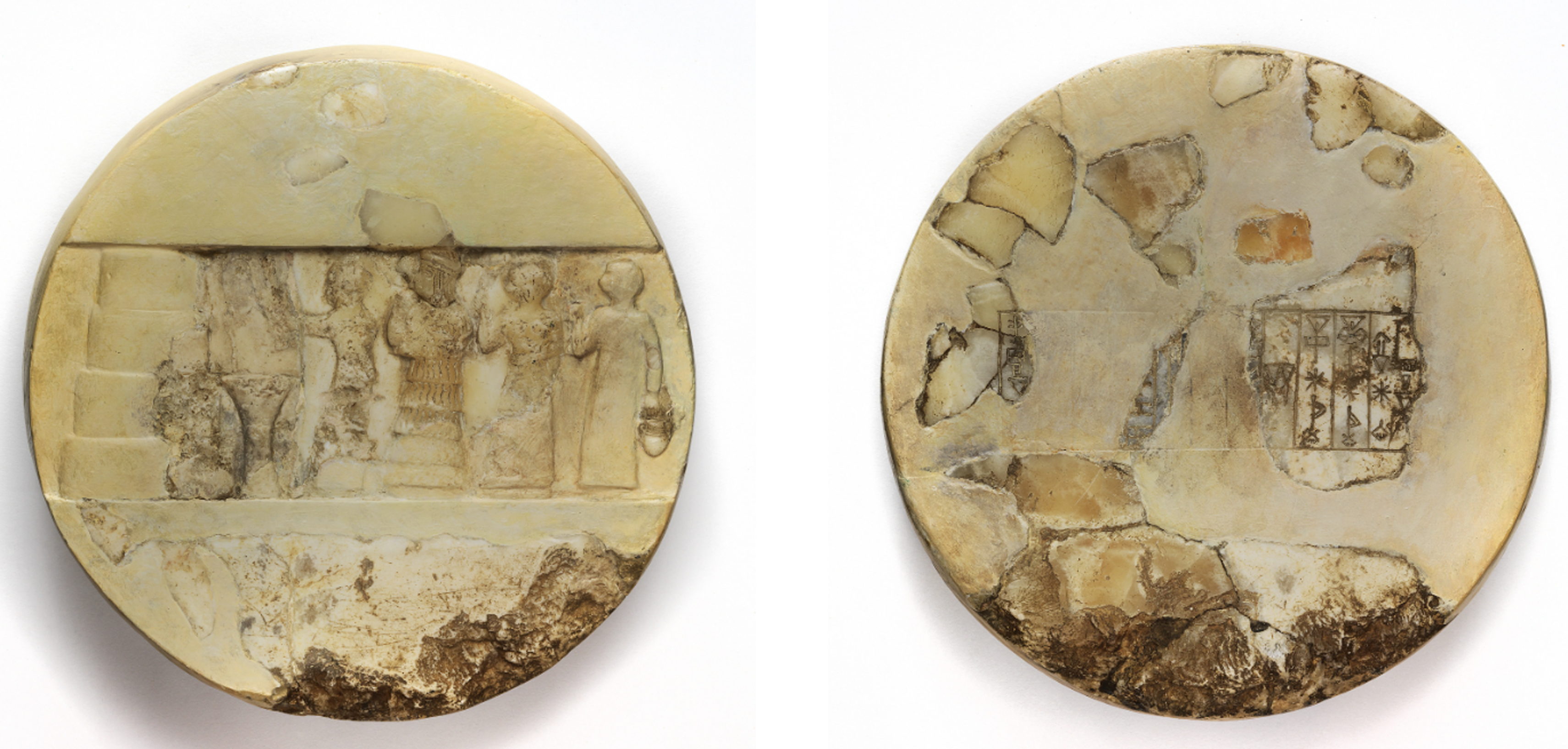
Modern accounts of En-ḫedu-ana usually introduce her as the daughter of Sargon of Akkad. The ancient depiction of En-ḫedu-ana on the alabaster disk presents her as a powerful figure in her own right. En-ḫedu-ana is surrounded by three priests who are depicted somewhat smaller, indicating that they are of lower rank. The four people are offering a libation on an altar. A representation of the deity to whom the libation is being offered has not survived; the modern reconstruction of the alabaster disk has added a temple tower where the deity would have appeared. The inscription on the other side of the alabaster disk confirms that the missing deity is the goddess Innana, for whom En-ḫedu-ana created an “altar of heaven.” Because the disk depicts her in the act of dedicating this altar to the goddess, En-ḫedu-ana thus presents herself here as a high priestess during the performance of a ritual before the goddess Innana, just as she does in NMS.
The inscription on the reverse is even more revealing than the pictorial representation. It mentions four titles of En-ḫedu-ana. They include the title “Child of Sargon,” but it appears in the last place:

Inscription on the reverse of the alabaster disk, 23rd century (photo), courtesy of the University of Pennsylvania Museum of Archaeology and Anthropology, Philadelphia

Inscription on the reverse of the alabaster disk, 23rd century (copy), from Gadd/Legrain Reference Gadd and Legrain1928: UET 1 no. 23 and pl. C

Transcript of the alabaster disk inscription, 18th/17th century, from Gadd/Legrain Reference Gadd and Legrain1928: UET 1 no. 289 lines 73–83

The first three titles of En-ḫedu-ana are far more prestigious than the reference to Sargon. Even the “name” En-ḫedu-Ana is a title-name that expresses that En-ḫedu-ana is a high priest(ess) (Sum. en). It means “high priest(ess), ornament of heaven.”Footnote 65 The following two titles show that this position of power is accompanied by a transformation of essence: as high priestess, En-ḫedu-ana has become the “spouse” of the city god of Ur, Nanna, his “zirru bird,” i.e. his “sweetheart.” In other words: En-ḫedu-ana embodies the goddess Nin-gal, the “Great Mistress!” Nin-gal/En-ḫedu-ana is therefore the consort of the god Nanna and mother of the goddess Innana.Footnote 66
From today’s perspective, the notion that a human can embody a deity seems strange. This is why we tend to ignore or downplay such ideas. But it is precisely in these cases that scientific inquiry is needed to reconstruct the concepts of the other, foreign culture as precisely and objectively as possible. How could anyone in Mesopotamian antiquity have imagined that a priestess could become the manifestation of a deity?
People who are transformed into powerful divine beings in their capacity as priestesses or priestsFootnote 67 are like people who are transformed into gods in their capacity as rulers,Footnote 68 or like temples which, as the sources say, are transformed into the “great heaven” or the “third (cosmic space) next to heaven and earth.”Footnote 69 In ancient Mesopotamia, this transformative power is attributed to rituals. It is a stroke of luck that copies of songs used in the initiation ritual of the high priestess En-ḫedu-ana have survived.Footnote 70 During the consecration ritual, the woman, whose name prior to her consecration we do not know, becomes the high priestess En-ḫedu-ana and thus the powerful consort of the moon god, Nin-gal, the zirru sweetheart of Nanna.Footnote 71
The fact that a goddess is embodied in En-ḫedu-ana is not an isolated case. The concept is well known—ritual experts describe themselves as a “statue (= embodiment) of the god Asalluḫi.” However, the phenomenon can be observed more widely. Priests, ritual experts, and kings in Mesopotamia are transformed into the embodiment of deities through rituals.Footnote 72
5.2.2 En-ḫedu-ana as a goddess may give birth to songs
That the goddess is embodied in En-ḫedu-ana does not mean that En-ḫedu-ana is identical with the goddess as a whole, in every respect, with all her aspects and powers.Footnote 73 But she is identified as a manifestation of the goddess Nin-gal, i.e., she is seen as one manifestation alongside others (such as a statue, symbol, or star). En-ḫedu-ana is seen as an embodiment of Nin-gal. In particular, she is the mouthpiece of the goddess, as we learn from another line of NMS:

When the goddess is embodied in En-ḫedu-ana, the goddess can speak through her. With this essential piece of background knowledge, we can understand what is meant when the text of NMS affirms that En-ḫedu-ana created this very song. It turns out to be a powerful message. This message does not refer to En-ḫedu-ana as a human being, but to En-ḫedu-ana as the goddess Nin-gal, who is the actual creator of this new ritual song.
Concept (1), that the gods embody themselves in consecrated priestesses and priests, and concept (2), that it is the gods who create rituals and ritual texts,Footnote 74 explain how ritual songs can arise in a culture that believes these songs are revealed by gods; and it makes clear why the song NMS declares so forcefully that En-ḫedu-ana is really High Priestess (→ 3.3). The point emphasized here is that she is still High Priestess and therefore a manifestation of the goddess Nin-gal. En-ḫedu-ana’s unique divine status is what allows and enables her to create the ritual song that empowers Innana to let her rage destroy the enemies.Footnote 75 Only high-ranking representatives of the priesthood acting as the embodiment of a deity can produce rituals and ritual songs.
Creation of NMS as a ritual song of the goddess Nin-gal embodied in the high priestess En-ḫedu-ana, design A. Zgoll, realization S. Dak

6. Conclusion on the authorship of NMS from a Mesopotamian perspective
The discovery of a Mesopotamian text claiming that someone was an admirable poet because he had written great literature would be historically unprecedented and highly suspect. Questions would arise about the translation or interpretation of the text and the authenticity of the tablet itself, for its content reflects modern ideas of literature as a text and of the poet as a genius—ideas that are absent from genuine Mesopotamian texts.
Our inductive text analysis of NMS has not identified any “claim of authorship,” but rather a “claim of priestship.” According to the Mesopotamian understanding of ritual, only a person in whom a deity has manifested itself is allowed to create songs that effectively transform the gods and the world. These insights are valuable for historical evaluation, as they confirm the historical correctness of the statements in NMS: by creating the song and singing it during the ritual, the high priestess fulfils the task that a high-ranking priestly personality is allowed to perform as the embodiment of a deity.
Creation of a text by a modern writer vs. creation of a ritual text by an ancient Mesopotamian goddess/priestess, design A. Zgoll, realization A. Zgoll and S. Dak

The fact that the words of the song were regarded as words of the gods also explains why the deviations from the original text that accrued over five hundred years of textual transmission are minimal: In terms of content, the traditions preserved in at least seven different city-states are identical,Footnote 76 even if there are some minor differences in the form of the song.Footnote 77 The words of the gods must be handed down as precisely as possible.
Through several analyses from different angles—text-internal and text-external—NMS has proven to be a homogeneous structure, as summarized in the following table:
The Mesopotamian perspective: What NMS is and what it is not

1 The same is true today for any religious culture, group, or individual. An example: someone who belongs to a culture based on and practising Sharia law, would not even think of performing a song for a war ritual intended to incite the wrath of the mighty God in an imitation of the ritual.
2 In this “song of Innana’s rage” (135), the speaker implores the goddess to roar against her enemies, to strike them down, and even to devour their corpses (125a–127).
From the ancient Mesopotamian perspective, En-ḫedu-ana is analogous to a statue in which the goddess Nin-gal embodies herself and through which she sings and thus creates the song NMS.Footnote 78 The concept that En-ḫedu-ana, as a manifestation of Nin-gal, created the ritual and its song provides the answer to the question we posed at the outset: Can we recover the original Mesopotamian concept of authorship? The answer is that NMS does not speak of the ability to create the ritual song, but of the right to act as a high priestess who creates an entire ritual, including its song. The moot question concerning En-ḫedu-ana in her historical moment is not whether she is able to communicate with the gods, but whether she is still able to embody the goddess Nin-gal! So it is not a question of authorship, but of divinity—and authorship results from divinity. From a modern perspective, the combination of the contemporary historical sources for En-ḫedu-ana (→ 2) and the results of the historical-original reconstruction provided here prove the authorship of En-ḫedu-ana as unequivocally as is possible in the reconstruction of historical facts.Footnote 79
En-ḫedu-ana’s texts were long copied in Mesopotamia, as shown by the example of the alabaster disk, whose inscription was handed down for at least five hundred years, until the same period when the surviving copies of NMS were written.Footnote 80 For researchers who are familiar with Mesopotamian culture, it is not difficult to understand why scribes devoted much energy to the accurate transmission of NMS. From a Mesopotamian perspective, Innana had acted exactly in accordance with En-ḫedu-ana’s ritual in a seemingly hopeless situation: She had executed her wrath on her enemies and had indeed rescued her favorite, Narām-Sîn, “from the constriction,” as it says in one of his inscriptions,Footnote 81 just as En-ḫedu-ana had entreated her. In the ancient worldview, this success proved that the ritual song of En-ḫedu-ana possessed divine power.Footnote 82 Once the power of the song had been validated, it was natural to continue singing the song of this Nin-gal/En-ḫedu-ana in cult (as promised to the goddess in NMS 139f. → 4.2), to preserve and pass it on in written form, and to use it as model of ritual effectiveness for a new time and its challenges. In this way, NMS also inspired other songs that other priestesses or priests sang as embodiments of deities.Footnote 83
7. Literature, ritual, myth
7.1 NMS as literature
“It is certainly true that the epic is a long poem on a grand theme which is clearly a very great literary masterpiece, and thus stands in a definite relation to Babylonian language and culture in the same way as the plays of Shakespeare do to English literature and culture.”
(George Reference George2003: 34)With the result that the song NMS was originally understood as a song for a war ritual, the question of the relationship of the text to literature arises anew.
-
(1) Were literary qualities attributed to this text in Mesopotamian antiquity?
-
(2) From today’s perspective, does NMS belong in the category of literature?
If literature is primarily defined in terms of the deliberate, outstanding formal design of a text, then the formal design of NMS must be examined (1) from the perspective of antiquity and (2) from today’s perspective.
7.1.1 Like the best beer. Ancient perspective
How was the quality of the formal design of NMS assessed in antiquity? This question can be answered because the text itself contains a statement that sheds some light on the nature of literary quality. En-ḫedu-ana sings:

The lament, i.e., the text of NMS, is like a libation of the best beer, i.e., it is comparable to beer of the highest quality. This applies to both the content and form of the text. The statement itself demonstrates the outstanding formal, i.e., literary quality in nuce through its skillful mastery of imagery: the high priestess offers the goddess Innana a libation of the best quality. Just as the fine beer is poured out for the goddess, so too are the priestess’s tears (ir2) poured out before the goddess—according to the first reading of the statement. But the priestess’s lamentation of tears (ir2) that flows out before the goddess is also the song itself. Each of the three statements, which are condensed into one here, has an important meaning. As a priestess, En-ḫedu-ana regularly offers a libation of beer to Innana, as illustrated in the image on the alabaster disk (→ 5.2.1). Also, the description of tears as an offering is not an isolated case.Footnote 85 Corresponding to the pouring out of beer or tears, En-ḫedu-ana now “pours out” the song itself, the lamentation of tears, as an offering for Innana while she sings.
Nobody would dare to sacrifice inferior beer to the goddess. How would the warlike, furious goddess react to that! Accordingly, the song that is supposed to persuade the goddess to finally intervene and destroy En-ḫedu-ana’s enemies must be of the highest quality in terms of content and form.Footnote 86 Thus, the song is of outstanding—as we would say, literary—quality, as befits a song by gods for gods.
7.1.2 Water and fire. Scientific perspective
From a formal and qualitative point of view, the song NMS proves to be a veritable firework display. More than fifty stylistic devices ranging from the micro level, such as devices of assonance (anaphora, epiphany, etc.), to the macro level, such as the overall structure of the song (climax, leitmotif, refrain, etc.), have been analyzed in terms of their function.Footnote 87 The artful intertwinement of retrospective comments and anticipations of a hoped-for future was already discussed in → 2, while connotative and polysemous statements were examined in → 7.1.1. A glance at the imagery alluded to in the song shows Innana as a flood of water and as fire; she is compared to a dragon, to the thunder god, to the storm, and finally to a predator that eats corpses. The highest gods, on the other hand, are compared to bats that have hidden from Innana in ruins and rubble. A literary analysis of NMS clearly validates the text as literature by today’s standards. Or, to put it in the slightly adapted words of Andrew George: It is certainly true that the song is a poem on a gripping theme and is clearly a very great literary masterpiece, and thus it stands in a definite relation to Sumerian language and culture in a similar way as the plays of Shakespeare do to English literature and culture.Footnote 88 A singer can only create such a poem while singing if he or she has mastered the technical requirements. It is easy to imagine that the person to whom the highest priestly office had been entrusted possessed this technical mastery.Footnote 89
7.1.3 The three-dimensional text profile of NMS
The analyses show that the song NMS fully satisfies the formal criteria for literature, both in its original Mesopotamian context and in contemporary scholarly terms. In this respect, the text should therefore be classified as literature. However, the previous sections have shown that the text was conceived as a ritual song. Ritual or literature: is this an inescapable dilemma? At this point in our investigation it becomes clear just how problematic one-dimensional classifications of texts are. They are certainly not sufficient to determine the category of a text.Footnote 90 This is because the categories of ritual and literature respond to different dimensions of a text. While classification of a text as literature is based on its formal design, classification of a text as ritual concerns its function. The third essential category is content. The type of a given text cannot be determined on the basis of a single parameter. Instead, a three-dimensional profile of texts is needed to account for the parameters (1) content, (2) form, and (3) function.Footnote 91 This approach to textual classification also has the advantage that these parameters can be determined on a culture-specific basis. From today’s academic perspective, the content of NMS can be described as a combination of mythical and historical passages. From an ancient perspective, however, there are no “mythical” sections; the content is wholly historical, because the actions of the gods, whether past, present, or future, are perceived as actions that determine the course of history.Footnote 92
The text type of NMS can be determined according to the three-dimensional text profile as follows:
Three-dimensional text profile of NMS

1 For the myths in NMS see A. Zgoll Reference Zgoll, Droß-Krüpe and Fink2021; on the historical evaluation see A. Zgoll Reference Zgoll1997.
2 See A. Zgoll Reference Zgoll1997: 171–178.
These definitions can be made more precise if, for example, the type of ritual in question is specified in modern terms, namely as a song for a war ritual. It is possible to achieve greater specifity in all dimensions when defining a text’s profile in this way.
7.2 Conclusion: NMS as literature, En-ḫedu-ana as the earliest known author
Inductive text-based analysis and new information about the broader Mesopotamian cultural context have shown that the ritual song NMS can be identified as a song of the historically well-attested priestess En-ḫedu-ana. Singing ritual songs was one of the most important tasks of the high priestess, along with purification rituals and libations to the highest gods. The song was not created by writing, but by singing during the ritual. Such creation of a ritual song was reserved for a high-ranking priestess or priest acting as the embodiment of a deity. The words of NMS were perceived as divine words, ensuring that nobody would dare to modify them without divine permission,Footnote 93 even more so in this dramatic case where success was attributed solely to InnanaFootnote 94 —as well as to Nin-gal/En-ḫedu-ana, who had empowered her.Footnote 95 This made her ritual song not only a sacred text but also a divine model not to be changed. From today’s perspective, En-ḫedu-ana must therefore be regarded as the earliest author whose name is known.
From a Mesopotamian perspective, however, the goddess Nin-gal, embodied in En-ḫedu-ana, was the author of NMS.Footnote 96 The birth of literature took place in ritual, through the goddess Nin-gal/En-ḫedu-ana. Such songs of mythical-historical content, which are literary in form and were used functionally for rituals, are the earliest literature known worldwide. In Mesopotamia, gods were regarded as their authors. This literature was not l’art pour l’art, but l’art pour les dieux. In other words, this art was understood as art by gods for gods, and thus a Mesopotamian priestess, responding to the sentence of Jean Paul quoted in the epigraph, might have said, “Art may not be necessary for your daily bread, but for the offerings to the gods.”


 Open access

